




Abstract
Sacrificial moral dilemmas, in which opting to kill one person will save multiple others, are definitionally suboptimal: Someone dies either way. Decision-makers, then, may experience regret about these decisions. Past research distinguishes affective regret, negative feelings about a decision, from cognitive regret, thoughts about how a decision might have gone differently. Classic dual-process models of moral judgment suggest that affective processing drives characteristically deontological decisions to reject outcome-maximizing harm, whereas cognitive deliberation drives characteristically utilitarian decisions to endorse outcome-maximizing harm. Consistent with this model, we found that people who made or imagined making sacrificial utilitarian judgments reliably expressed relatively more affective regret and sometimes expressed relatively less cognitive regret than those who made or imagined making deontological dilemma judgments. In other words, people who endorsed causing harm to save lives generally felt more distressed about their decision, yet less inclined to change it, than people who rejected outcome-maximizing harm.
Imagine: Murderous soldiers have descended on your village, and you have hidden in a basement with several of your neighbors. Silence means survival—but from a swaddle, a baby begins to cry. If no one acts, its wails will draw the soldiers’ attention. You are faced with a horrible decision: Smother the baby to silence it, saving everyone else, or let the baby cry, alerting the soldiers and ensuring everyone’s death. Suppose you did or did not smother the baby: Would you feel upset about your decision? Would you wish you had opted for the alternative?
This scenario exemplifies a class of sacrificial dilemmas where committing direct harm prevents a greater amount of overall suffering. Such dilemmas involve competition between inclinations to (a) minimize overall suffering and (b) avoid causing direct harm. As both responses result in harm, all decision-makers will likely experience some regret, a negative emotion focused on how different behavior could have produced different outcomes (Gilovich & Medvec, 1995). In the current research, we examined regret after sacrificial dilemma judgments.
Deontological and Utilitarian Decisions
Some philosophers argue that killing the baby is permissible (or even obligatory) because doing so maximizes net outcomes, in line with utilitarian ethics (Mill, 1861/1998). Others argue that killing the baby violates a categorical duty to not use others as means to an end, and the act is, therefore, intrinsically wrong according to deontological ethics (Kant, 1785/1959). Accordingly, researchers often describe outcome-maximization judgments on dilemmas as utilitarian and harm-rejection judgments on dilemmas as deontological (e.g., Greene, 2014)—although making a judgment does not imply that decision-makers agree with the broader tenets of any philosophical theory (see Conway, Goldstein-Greenwood, et al., 2018; Kahane et al., 2015). Thus, calling a judgment “utilitarian” describes the decision itself, not the judge’s motivation or psychology.
Instead, dilemma decisions reflect a host of psychological factors (Cushman & Greene, 2012; Greene, 2014). The popular dual-process model posits that decisions to avoid causing harm, such as not smothering the baby, reflect relatively more emotional responses to the harm in question, whereas decisions to accept harm to minimize net suffering, such as smothering the baby to save the villagers, reflect relatively more cognitive processing (Greene, 2014; Greene et al., 2004). A person’s ultimate decision hinges on the relative strengths of these affective and cognitive processes.
Substantial work supports this basic affective-cognitive distinction. Decisions to endorse outcome-maximizing harm are associated with traditional cognitive measures (e.g., Cognitive Reflection Test [CRT] performance, Byrd & Conway, 2019), activity in brain regions involved in cognitive processing (e.g., dorsolateral prefrontal cortex, Greene et al., 2004), and decreased/constrained emotional processing (e.g., damage to brain regions implicated in affective processing, Koenigs et al., 2007; increased emotional distance from harm recipients, Petrinovich et al., 1993). Conversely, decisions to reject outcome-maximizing harm track traditional affective measures (e.g., aversion to causing harm, Reynolds & Conway, 2018) and activation in brain regions implicated in emotion processing (e.g., ventromedial prefrontal cortex, Greene, 2014). That said, the dual-process model may oversimplify the processes involved in dilemma decisions. For example, cognitive motivations to prevent harm contribute to deontological decisions (Gamez-Djokic & Molden, 2016; McPhetres et al., 2018), and affective aversions to witnessing harm contribute to utilitarian decisions (Reynolds & Conway, 2018). Moreover, some deontological decisions reflect general behavioral preferences (Gawronski et al., 2017; Piazza & Landy, 2013), as opposed to solely affective processes. Given the relevance of cognitive processes and affect to both types of decisions, the dual-process model may be an excessively reductive model for dilemma decisions. Nevertheless, on the whole, deontological judgments tend to reflect a nexus of processes that is relatively more affective than cognitive, whereas utilitarian judgments tend to reflect a nexus of processes that is relatively more cognitive than affective (e.g., Conway, Goldstein-Greenwood, et al., 2018).
Sacrificial dilemma decisions have downstream psychological consequences for decision-makers. For example, prior work suggests that dilemmas produce negative emotions like sadness, anger, fear, guilt, and disgust (Christensen et al., 2014; Szekely & Miu, 2015; Tasso et al., 2017), as people find it aversive both to cause harm (Cushman et al., 2012) and to witness others’ suffering (Reynolds & Conway, 2018). These negative emotions can reduce willingness to cause harm (Szekely & Miu, 2015), and emotion reappraisal or suppression can attenuate the impact of emotion on deontological (harm-avoidance) judgments (Lee & Gino, 2015; Szekely & Miu, 2015). Moreover, people who accept or contemplate performing outcome-maximizing harms appear to experience particularly high levels of guilt, and people who experience major regret over such actions tend to avoid making utilitarian trade-offs (Tasso et al., 2017). People also aim to justify and explain their moral dilemma decisions, both through strategic self-presentation (Rom & Conway, 2018) and the use of motivated reasoning. For example, Liu and Ditto (2013) found that people who viewed outcome-maximizing harms as immoral also estimated that those actions would be less likely to succeed at producing the promised outcomes.
Finally, people believe that deontological decision-makers are warmer, more moral, and more trustworthy than utilitarian decision-makers, especially when utilitarian decision-makers express little remorse (Everett et al., 2016; Kreps & Monin, 2014; Rom et al., 2017). Conversely, perceivers view utilitarian decision-makers as more competent, logical, and leader-like than deontological decision-makers (Rom et al., 2017; Uhlmann et al., 2013). Hence, dilemmas where causing harm maximizes outcomes present decision-makers with a trade-off between appearing cruel yet capable or appearing weak yet warm, depending on their decision. Thus, decision-makers may feel morally compromised regardless of their decision and consequently experience regret. However, the type and degree of regret they experience may depend on their decision.
Regret and Moral Dilemmas
Regret is a negative emotion contingent on upward counterfactual thoughts about how things could have gone better had one decided or acted differently (Gilovich & Medvec, 1995; Zeelenberg, 1999). This definition implies both affective and cognitive components of regret: People feel badly about poor outcome x because they think that a different action would have produced preferable outcome y. Consistent with constructionist accounts of emotion, per which emotions are emergent, combinatorial products of generalized “good” or “bad” feelings and cognitive appraisals of the meaning of those feelings (Barrett, 2006; Russell, 2003), regret involves two qualitatively distinct components: Affective regret describes distressed feelings following a decision (the negative valence associated with a suboptimal outcome), whereas cognitive regret describes upward counterfactual thoughts about the (preferential) world that “might have been” (Buchanan et al., 2016). 1
Each possible sacrificial dilemma decision may, therefore, promote different experiences of regret, as one option demands the active commission of harm, and the other allows greater harm, to occur. Both decisions likely provoke negative affect, as no outcome is ideal. However, we predict that the relative strength of affective and cognitive regret will diverge for each decision. A utilitarian dilemma judgment requires the active commission of an unsavory harm (e.g., smothering a child), which is likely to provoke strong negative affect, given that committing harm is affectively aversive (Cushman et al., 2012; Reynolds & Conway, 2018). However, a deontological dilemma decision results in increased net suffering, so people making such a decision may report inclinations toward the foregone outcome-maximizing alternative. Thus, we hypothesized that dilemma decision (utilitarian vs. deontological) and regret type (affective vs. cognitive) would interact:
In addition to shaping initial regret, considerations of counterfactuals may alter regret further downstream. Vividly imagining harm makes people less willing to endorse harm (e.g., Bartels, 2008; Caruso & Gino, 2011). Typically, people find the suffering of a single identifiable target more upsetting than group suffering (e.g., Small & Loewenstein, 2003), which in turn motivates harm rejection (Miller et al., 2014). However, people also find it aversive to witness the suffering of many, which can promote utilitarian decisions (Reynolds & Conway, 2018). Therefore, focusing utilitarian decision-makers on the counterfactual world where they avoid causing harm but allow many to suffer should highlight the emotional costs of the alternative, thereby attenuating affective regret about their utilitarian decision:
The Current Work
Across four studies, we examined affective and cognitive regret following utilitarian and deontological sacrificial dilemma judgments. In Studies 1 (N = 50), 3 (N = 413), and 4 (N = 411), participants made a utilitarian or deontological judgment and completed a measure of affective and cognitive regret to investigate H1. However, this design cannot determine with certainty whether results reflect actual reactions to dilemma decisions or individual differences among those inclined to select each decision. Hence, in Study 2 (N = 137), we randomly assigned participants to imagine making one or another judgment and complete regret measures. In addition, Study 3 tested the generalizability of our results to a broad set of moral dilemmas, and Study 4 tested H2—whether generating counterfactuals regarding the foregone option would attenuate affective regret after a utilitarian decision. All studies received ethics approval from the institution(s) where they were carried out, and we followed American Psychological Association (APA) guidelines. We report all manipulations, measures, and exclusions for all studies, and we have publicly shared all of our data, code, and materials, available here: https://osf.io/hybm3/.
Study 1
In Study 1, we examined affective and cognitive regret after utilitarian or deontological decisions on a sacrificial dilemma, resulting in a 2 (choice: deontological vs. utilitarian; between) × 2 (subscale: affective vs. cognitive; within) mixed design.
Method
Participants
A power analysis using G*Power 3.1 (Faul et al., 2007) suggested that 24 participants would provide ~80% power to detect a two-way within-between interaction with
Procedure
Dilemma
Participants first read and responded to the crying baby dilemma from Conway and Gawronski (2013), where smothering a baby saves several people from execution. Participants selected either Yes, I find this appropriate (utilitarian response, n = 28) or No, I find this inappropriate (deontological response: n = 22; see Greene et al., 2001).
Regret Elements Scale
Participants then completed the Regret Elements Scale (RES; Buchanan et al., 2016), a 10-item measure of state postdecisional regret, including two five-item subscales, with the items presented in randomized order. The affective subscale assesses negative feelings (e.g., “I feel like kicking myself”), whereas the cognitive subscale assesses counterfactual thoughts (e.g., “I should have decided differently”). Responses ranged from 1 (Strongly disagree) to 7 (Strongly agree) for all studies in the current work. Reliability was acceptable (overall α = .81, affective α = .84, cognitive α = .82). Finally, participants reported their age, gender, and ethnicity. 2
Results
To examine whether affective and cognitive regret differed following dilemma decisions, we performed a 2 (decision: deontological vs. utilitarian; between) × 2 (subscale: affective vs. cognitive; within) mixed-model ANOVA. Participants reported similar levels of overall regret whether they selected the utilitarian (M = 3.24, SD = 1.02) or deontological decision (M = 3.02, SD = 1.04), F(1, 48) = 0.54, p = .465,
However, as predicted, these main effects were qualified by a significant interaction, F(1, 48) = 24.34, p < .001,
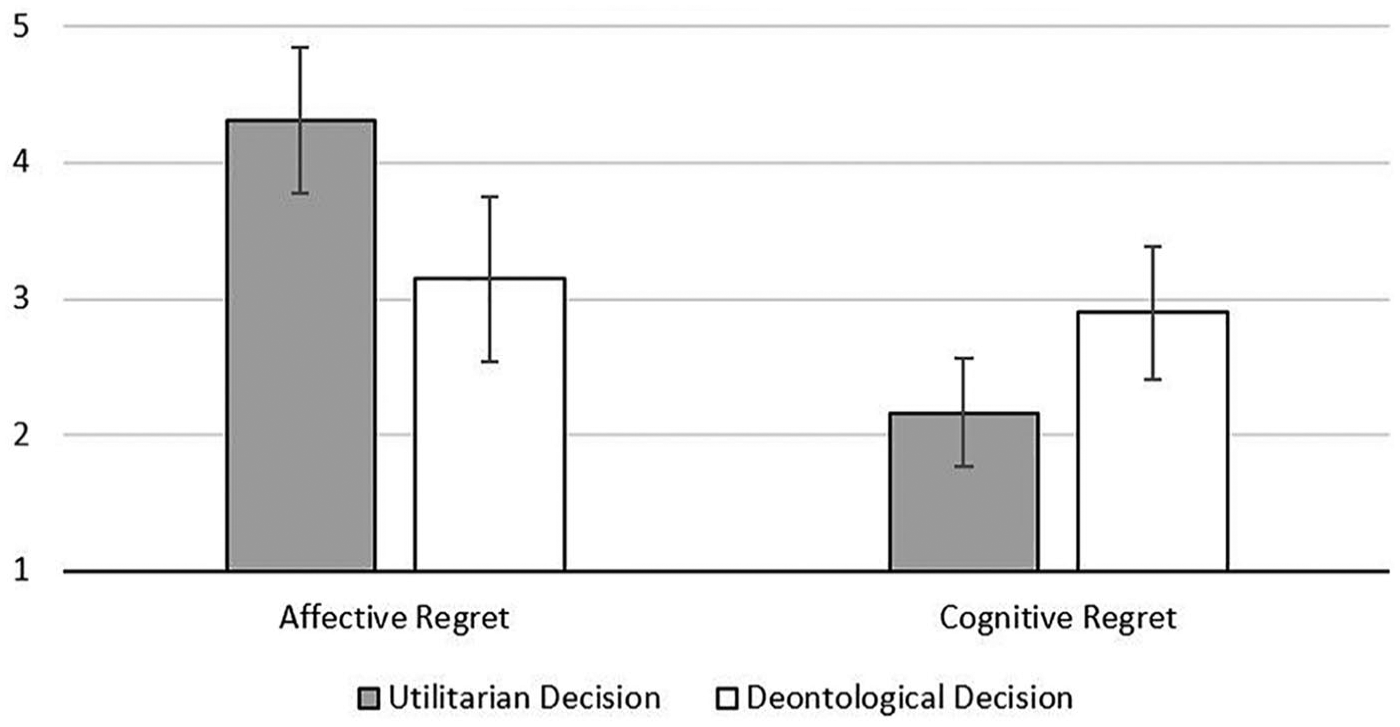
Affective and cognitive regret reported by participants endorsing utilitarian versus deontological decisions, Study 1.
Discussion
Study 1 provided initial support for the interaction predicted by H1: Utilitarian decision-makers expressed more affective regret and less cognitive regret than deontological decision-makers. This pattern suggests that people who agree to commit an unsavory action for a noble cause (e.g., kill one baby to save many more lives) felt upset about their decision but not strongly inclined to change it. Conversely, people who rejected the outcome-maximizing harm, passively allowing several innocent people to die, felt less upset about their decision but reported stronger inclinations to change their decision compared with their outcome-maximizing counterparts.
This pattern fits the dual-process model of affective-cognitive processes underlying dilemma judgments (Greene, 2014; Patil et al., in press). Relatively more cognitive processes underlying utilitarian decisions result in decisions that are mathematically preferable (resulting in less cognitive regret) but require committing harm (resulting in more affective regret). Conversely, relatively more affective processes underlying deontological decisions promote harm-avoidance (resulting in less affective regret) but fail to minimize overall harm (resulting in more cognitive regret). These findings provided initial support for H1. However, it is also possible that divergence in affective and cognitive regret does not reflect dilemma decisions per se, but, instead, reflects chronic differences in the types of regret that people inclined to make utilitarian or deontological dilemma decisions tend to feel. To examine this possibility, Study 2 randomly assigned participants to imagine making utilitarian or deontological decisions and report their anticipated affective and cognitive regret.
Study 2
In Study 1, participants who endorsed utilitarian decisions expressed relatively more affective and relatively less cognitive regret than those who endorsed deontological decisions, consistent with H1. However, these differences may reflect chronic differences in regret associated with participants’ baseline moral decision-making tendencies rather than a downstream effect of those decisions. Therefore, in Study 2, we randomly assigned participants to imagine making either utilitarian or deontological decisions and assessed their anticipated regret. We predicted a pattern parallel to Study 1: Participants who imagined making utilitarian decisions would express more affective and less cognitive regret than those contemplating deontological decisions. We employed a mixed design using the same dilemma as in Study 1.
Method
Participants
A power analysis indicated that 126 participants would provide ~90% power to detect a two-way within-between interaction with
Procedure
Participants read the crying baby dilemma from Study 1, and we randomly assigned them to imagine either making the utilitarian (n = 69) or deontological (n = 68) choice. Participants then completed the RES, indicating how they imagined that their assigned choice would make them feel. Finally, participants reported their actual decision in the scenario. 5 The overall RES and the affective and cognitive subscales again demonstrated strong reliability (α = .90, .85, and .93, respectively). Participants completed the study privately in individual rooms.
Results
As in Study 1, we compared whether anticipated regret differed when imagining a deontological versus utilitarian choice by performing a 2 (imagined choice: deontological vs. utilitarian; between-subjects) × 2 (regret subscale: affective vs. cognitive; within-subjects) mixed-model ANOVA. Again, participants reported more affective (M = 5.68, SD = 1.15) than cognitive regret overall (M = 4.12, SD = 1.62), Mdiff = 1.56 [1.32, 1.80], F(1, 135) = 167.83, p < .001,
As predicted by H1, the results were qualified by a significant interaction, F(1, 135) = 12.35, p = .001,
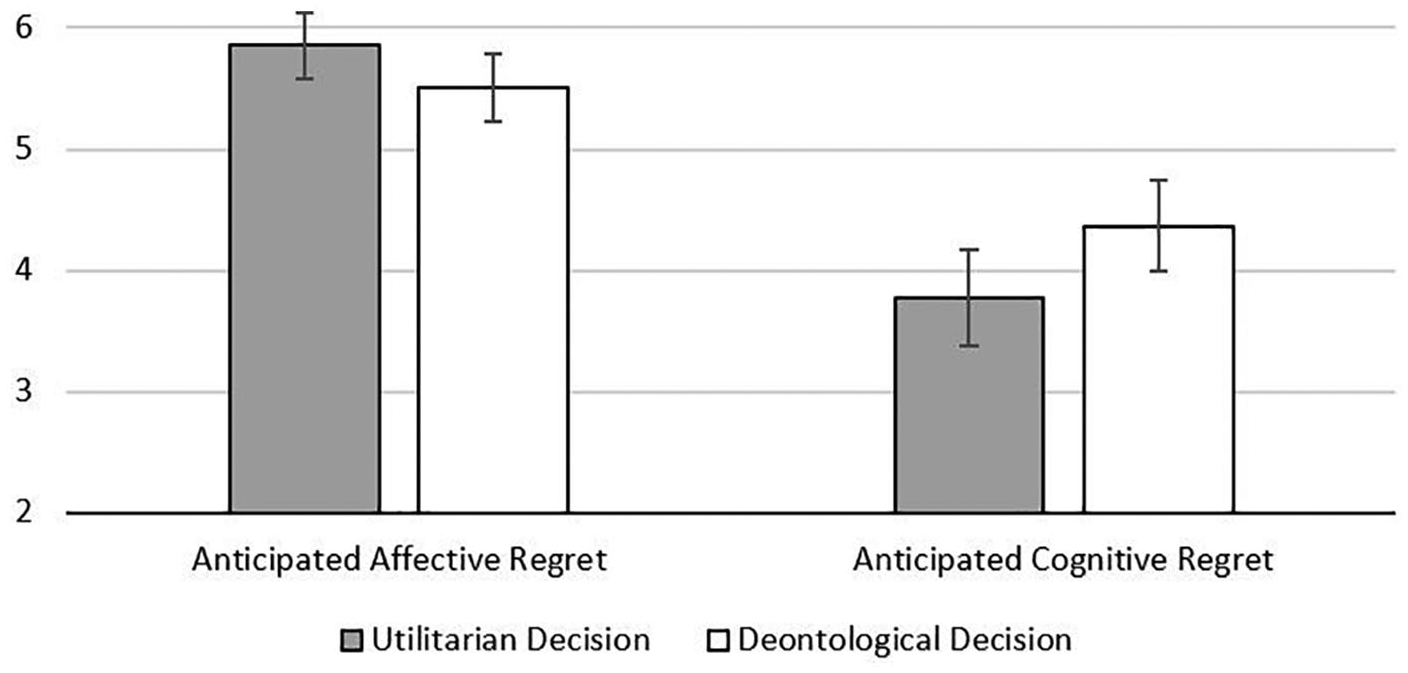
Anticipated affective and cognitive regret reported by participants assigned to imagine making utilitarian versus deontological decisions, Study 2.
Discussion
Study 2 provided further support for H1: A significant interaction revealed that affective regret was marginally higher and cognitive regret was marginally lower for participants randomly assigned to imagine making utilitarian versus deontological decisions. This pattern provides additional evidence that utilitarian and deontological dilemma decisions have divergent downstream psychological consequences for decision-makers. Utilitarian decisions demand the commission of a direct harm, which is affectively distressing. However, utilitarian decisions result in the best possible outcome given a prespecified set of suboptimal options, and thus result in less counterfactual pining. As we randomly assigned participants to imagine making a decision, our findings rule out the possibility that divergence in affective and cognitive regret merely reflects chronic individual differences in dilemma decision-making. The results, instead, suggest that the differences reflect reactions to dilemma decisions. We extended our findings in Study 3 by examining whether similar results would emerge for a diverse set of dilemmas and whether regret reports might differ in public versus private as a result of impression management concerns.
Study 3
In Study 3, we examined whether the pattern in Studies 1 to 2 would generalize to a broad set of moral dilemmas and be influenced by impression management concerns. Instead of responding to the crying baby dilemma, participants encountered one of 10 possible dilemmas at random. In addition, we manipulated whether participants responded to the regret measures while imagining themselves in public or in private to examine whether impression management concerns may moderate affective and cognitive regret. Past work suggests that lay people evaluate dilemma decision-makers who reject outcome-maximizing harm as warmer, more moral, and more trustworthy—but less competent and leader-like—than decision-makers who accept outcome-maximizing harm (e.g., Everett et al., 2016; Rom et al., 2017; Sacco et al., 2017); thus, the (real or implied) presence of others can influence dilemma responding (Bostyn & Roets, 2017; Kundu & Cummins, 2013; Lucas & Livingston, 2014; Reynolds et al., 2019), as people strategically self-present in dilemma contexts by shifting responses to align with perceived expectations (Rom & Conway, 2018). Moreover, people report thoughts and feelings that can enhance positive perceptions and mitigate negative perceptions of their judgments, such as acknowledging negative emotions when causing harm or reporting moral reasoning to buttress their decisions (Liu & Ditto, 2013; Rom et al., 2017). People may likewise express enhanced affective or cognitive regret strategically to manage their reputations in the face of suboptimal sacrificial dilemmas, rather than because of real differences in those regret components. If so, we predict that the interaction between decision and regret should be larger when participants imagine making a decision in public versus in private (see Rom & Conway, 2018).
Method
Participants
G*Power indicated that 162 participants would provide ~95% power to detect a two-way within-between interaction with
Procedure
We randomly assigned participants to respond to one of 10 sacrificial dilemmas. Each was similar in structure to the crying baby dilemma (i.e., the protagonist could directly cause harm to prevent a greater degree of future harm) but varied widely in content. For example, one dilemma involved sacrificing a single member of a nature documentary film crew to save the rest of the crew from being mauled to death by a grizzly bear (dilemmas from Conway, Reynolds, & Rosas, 2019). Participants first made utilitarian (n = 189) or deontological (n = 224) decisions using the same response options as in Studies 1 and 2 and then completed the RES. As in the previous studies, the overall regret scale and affective and cognitive subscales demonstrated strong internal reliability: α = .92, .91, and .94, respectively. We randomly assigned participants to the private (n = 207) or public (n = 206) response conditions via the RES instructions, which read: As you respond to the questions below, imagine that [five of your closest friends are watching over your shoulder]{you are responding in perfect privacy}. [They will be told which decision you made on the scenario and will see exactly how you respond to these questions]{No one will ever know about the decision you made on the scenario or your responses to these questions}.
Finally, participants reported their age and gender. 6
Results
We conducted a 2 (decision: deontological vs. utilitarian; between-subjects) × 2 (regret subscale: affective vs. cognitive; within-subjects) × 2 (response condition: public vs. private) mixed-model ANOVA. Overall, participants again reported more affective (M = 3.76, SD = 1.66) than cognitive regret (M = 2.78, SD = 1.37), Mdiff = 1.02 [0.88, 1.15], F(1, 409) = 225.43, p < .001,
Consistent with Studies 1 to 2 and H1, we found a significant two-way interaction between regret and decision, F(1, 409) = 41.23, p < .001,

Affective and cognitive regret reported by participants endorsing utilitarian versus deontological decisions across the public versus private conditions, Study 3.
There was no main effect of the public/private manipulation, F(1, 409) = 0.09, p = .761,
Discussion
Study 3 provided further evidence of an asymmetry in regret after utilitarian or deontological dilemma decisions, and generalized findings beyond the crying baby dilemma. Consistent with Studies 1 and 2, affective regret was highest following utilitarian compared with deontological dilemma decisions. However, Study 3 did not find clear evidence that utilitarian decision-makers experience less cognitive regret than deontological decision-makers, tempering the strength of our conclusions on this point.
In addition, the public/private response manipulation had no significant effect. This suggests that the pattern of regret ratings is not attributable merely to impression management concerns. However, it is possible that participants did not believe the manipulation—perhaps assuming that even the private decision condition was effectively public insofar as they were reporting decisions to the experimenter, or that their dilemma decision was public but their regret was not (and, hence, would remain unhelpful in managing reputation). It is also possible that this manipulation did not produce effects because people were uncertain which judgments or regret expressions would prove strategically beneficial in this context: Participants in the public condition were told to imagine evaluation by five close friends, and it may be that different participants envisioned groups of friends that differed in whether they would typically approve or disapprove of sacrificial harm. If so, then these different visions of which response was socially desirable may have canceled out systematic variance, leading to a null effect. Past research found robust differences in dilemma decisions using similar public/private manipulations, but such work contained clear cues that suggested to all participants that the expected audience systematically leaned one direction (e.g., a scholarship committee seeking primarily warm and emotional versus logical and competent applicants; Rom & Conway, 2018). Perhaps future studies that communicate systematic audience expectations may demonstrate a difference in regret expressions (e.g., more affective regret for audiences expecting warmth, especially among utilitarian decision-makers).
Study 4
Study 4 aimed to test our secondary hypothesis (H2) regarding utilitarian decision-makers’ heightened affective regret. Utilitarian sacrificial decisions require causing harm, which people find aversive (Cushman et al., 2012). Utilitarian decision-makers’ affective regret may partly stem from the salience of such harm. If so, redirecting attention away from harmful action toward the counterfactual world (i.e., the deontological decision) where many people would suffer should highlight how the alternative choice would have been even worse overall. Thus, counterfactual reflection should reduce the affective salience of the utilitarian harm and highlight the beneficial net outcomes of such decisions, thereby attenuating utilitarian decision-makers’ affective regret compared with utilitarian decision-makers who did not engage in counterfactual reflection (White & Lehman, 2005). Previous research on nonmoral regrets has similarly used counterfactual alternatives to reduce affective regret (Buchanan et al., 2019). Counterfactual thinking should not reduce affective regret for deontological decision-makers, because in that counterfactual world, fewer people die. Because both the factual and counterfactual worlds involve harm that decision-makers may wish to avoid, we did not have specific hypotheses for cognitive regret.
Method
Participants
A power analysis indicated that 156 participants would provide ~95% power to detect a two-way, within-between interaction of
Procedure
Participants began by completing the crying baby dilemma from Studies 1 and 2 (reporting that smothering the baby was either appropriate, n = 219, or inappropriate, n = 192). Then, we randomly assigned participants to a counterfactual (n = 205) or factual (n = 206) reflection condition.
8
In the counterfactual condition, participants were asked: Imagine you made the opposite choice instead. Think about how things would have turned out in that case. Who would have lived, and who would have died? In what ways would that have been worse than the choice you made?
Participants were then asked to write down some of their thoughts.
9
In the factual (control) condition, participants were asked: Consider the decision you just made. Think about how things would turn out in that case. Who would live, and who would die? What would be the consequences of the choice you made?
As in the counterfactual condition, participants were then asked to write a brief response. 10 Participants could not advance for at least 30 seconds.
Immediately after reflecting on either the counterfactual or their actual decision, participants completed the RES, prompted by the instruction, “Keeping in mind what you were just thinking about . . .” The RES demonstrated excellent reliability: α = .91 for the full scale; α = .92 for the affective regret subscale; α = .93 for the cognitive regret subscale.
Results
We performed a 2 (decision: deontological vs. utilitarian; between) × 2 (subscale: affective vs. cognitive; within) × 2 (reflection condition: counterfactual vs. factual, between) mixed-model ANOVA. The main effects of decision, F(1, 407) = 11.22, p = .001,
H2 concerned the selective effects of counterfactual reflection on affective regret for utilitarian decision-makers. The two-way interaction between decision and counterfactual reflection was not significant, F(1, 407) = 2.55, p = .111,
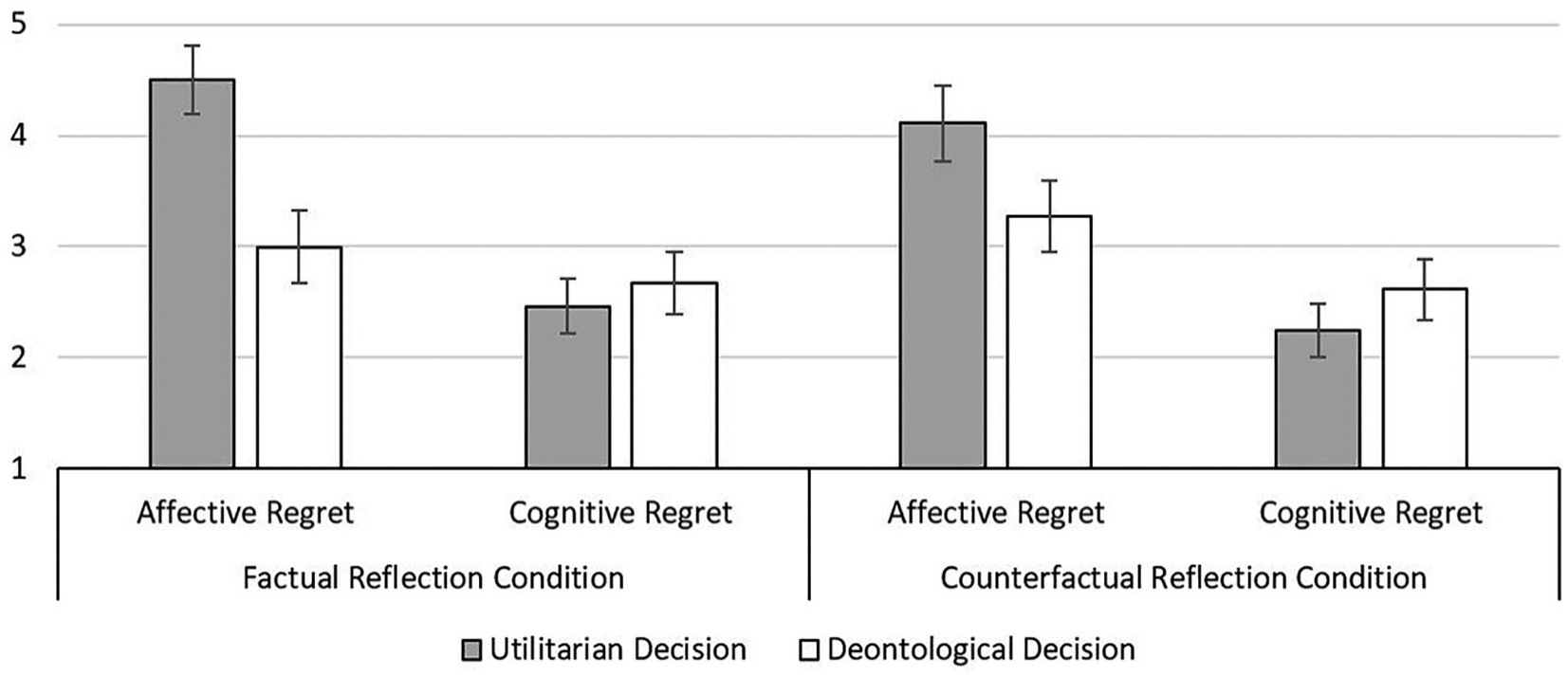
Affective and cognitive regret reported by participants endorsing utilitarian versus deontological decisions across the factual versus counterfactual reflection conditions, Study 4.
We decomposed this three-way interaction into the two-way interactions for each regret type. As predicted by H2, the two-way between-subjects ANOVA on affective regret by dilemma decision and reflection condition revealed a significant interaction, F(1, 407) = 4.22, p = .041,
The three-way interaction can also be understood in terms of the two-way interaction of regret type and decision type within each reflection condition. The two-way interaction was significant in both the factual, F(1, 204) = 77.64, p < .001,
Discussion
Overall, Study 4 provided further support for H1 in a large sample. In both the counterfactual and factual conditions, affective regret was higher for utilitarian than deontological decision-makers. In the counterfactual condition, cognitive regret was higher for deontological decision-makers than utilitarian decision-makers; in the factual condition, the same pattern emerged descriptively but did not reach significance.
The results of Study 4 also offered moderate support for our secondary hypothesis (H2) that refocusing utilitarian decision-makers’ attention to the counterfactual world in which, on net, things would have been worse would attenuate affective regret. Counterfactual reflection had no effect on affective regret for deontological decision-makers, and no effect on cognitive regret for decision-makers of either type. However, counterfactual reflection did lead utilitarian decision-makers to report marginally less affective regret compared with utilitarian decision-makers in the factual reflection condition. Moreover, the mean difference in affective regret between utilitarian and deontological decision-makers was reduced by half after counterfactual reflection.
These findings suggest that utilitarian and deontological choices result in divergent psychological experiences for decision-makers. Participants endorsing utilitarian decisions appear to experience greater affective aversions to their decision because they endorsed a direct, distasteful harm. Yet, such decisions also engender less wishful thinking about the counterfactual world; the utilitarian decision is preferable in terms of overall survival rates. Conversely, deontological decision-makers do not appear to experience as much affective turmoil, given that they did not endorse direct, personal harm. However, deontological decision-makers are not completely insensitive to mathematical realities (Białek & De Neys, 2016). Had deontological decision-makers opted for the utilitarian decision, their decision would have yielded better net outcomes. Therefore, contemplating counterfactuals may not reassure deontological decision-makers.
General Discussion
Across four studies, we found that different sacrificial moral dilemma decisions elicit different degrees of affective and cognitive regret. We found robust evidence that utilitarian decision-makers who accept outcome-maximizing harm experience far more affective regret than their deontological decision-making counterparts who reject outcome-maximizing harm, and we found somewhat weaker evidence that utilitarian decision-makers experience less cognitive regret than deontological decision-makers.
The significant interaction between dilemma decision and regret type predicted in H1 emerged both when participants freely endorsed dilemma decisions (Studies 1, 3, and 4) and were randomly assigned to imagine making a decision (Study 2). Hence, the present findings cannot simply be attributed to chronic differences in the types of regret that people who prioritize each decision experience. Moreover, we found tentative evidence for H2: Focusing on the counterfactual world in which they made the alternative decision attenuated utilitarian decision-makers’ heightened affective regret compared with factual reflection, and reduced differences in affective regret between utilitarian and deontological decision-makers (Study 4). Furthermore, our findings do not appear attributable to impression management concerns, as there were no differences between public and private reports of regret.
Theoretical and Methodological Implications
These findings suggest qualitatively different downstream psychological experiences for utilitarian and deontological decision-makers. A utilitarian sacrificial dilemma decision demands the endorsement of an off-putting harm in the service of preferable ends. Our results fit with past work suggesting that people have strong affective reactions to committing harm, independent of the harm’s consequences (Cushman et al., 2012). Yet, sacrificial utilitarian decisions are also defensible from a cost-benefit perspective: Five lives are greater than one, so utilitarian decision-makers may experience less pull toward the counterfactual decision than deontological decision-makers who failed to minimize net suffering. Both utilitarian and deontological decisions leave decision-makers with regret. For utilitarian decision-makers, regret may stem from aversions to performing the required harm; for deontological decision-makers, regret may stem from the knowledge that they failed to save the most people possible.
The pattern of divergent regret we found both highlights the necessity to measure regret as a multifaceted emotion (Buchanan et al., 2016) and fits with an extensive literature on the rough affective-cognitive distinction in the processes underlying dilemma judgments described by the dual-process model (Greene, 2014; Patil et al., in press). Sacrificial utilitarian decisions are mathematically defensible and, compared with deontological dilemma decisions, may result in weaker postdecisional preferences for the counterfactual world (cognitive regret). Yet, such decisions demand the commission of aversive harms and, therefore, provoke more affective regret than deontological dilemma decisions, which allow decision-makers to avoid dirtying their own hands or violating moral norms. This tension is summed up by one participant’s written response to the crying baby dilemma in Study 4 (emphasis added): “Surviving with how it felt to smother the child would be worse than just dying.”
Moreover, it is possible that a process of weighing each possible action’s emotional toll plays a role in regret. If smothering the baby in the crying baby dilemma is emotionally aversive, then deontological decisions may reduce the intensity of negative emotions experienced during the decision-making process. Accordingly, we would expect to find exactly what we did in the present studies—that utilitarian decision-makers reported relatively more affective regret than their deontological decision-making counterparts. This finding aligns with previous research on emotional reactions to counterfactual dilemma decisions, which found that people contemplating utilitarian trade-offs experienced particularly high levels of negative emotions, especially guilt, and that people who reported particularly high levels of “action regret” (translated from the Italian rimorso) were least likely to accept utilitarian trade-offs (Tasso et al., 2017).
Taking the current findings and past work together, it appears that people find the commission of utilitarian harms emotionally aversive, but, as such actions maximize outcomes, those who endorse utilitarian decisions sometimes experience less pull toward counterfactuals than those who reject outcome-maximizing options. Given the clear links of both anticipated and experienced regret to sacrificial dilemma decisions in the current research, a deeper understanding of the role of regret regulation in decision-making may provide new insights into moral decisions. For instance, decision-makers’ preference for the “sure thing” over an uncertain gamble appears to be shaped by regret aversion (Zeelenberg et al., 1996), a pattern that could extend to dilemmas where decision-makers must choose between a smaller certain harm and a larger but uncertain one.
Our hypotheses specifically concerned differences in regret between utilitarian and deontological decision-makers. However, our studies also allow for comparisons of affective versus cognitive regret among people who selected a given judgment. In two studies, people who selected utilitarian decisions expressed more regret overall than people who made deontological decisions (two other studies showed no significant effect). Moreover, in each study, the absolute difference between affective versus cognitive regret was larger for utilitarian than deontological decision-makers. Such findings align with recent work by Mata (2019) showing that decision-makers who ultimately selected utilitarian responses tended to consider the alternative response more, and experienced more internal conflict, than decision-makers who ultimately selected deontological responses. This work suggests that because utilitarian decision-makers attend more to alternative decisions, they may carefully consider how that alternative decision would play out, exacerbating regret. The sizable difference in utilitarian decision-makers’ affective versus cognitive regret may reflect the residue of this conflict.
Conversely, deontological decision-makers appear to experience less decisional conflict and give less legitimate consideration to utilitarian alternatives (Mata, 2019). If decisional conflict between sacrificial dilemma response options exacerbates differences in regret types, we would expect to see what we did in the current work: Differences between affective and cognitive regret would be smaller for deontological decision-makers than utilitarian decision-makers. 11 Notably, in Mata (2019), social inferences depended more on perceptions of cognitive than affective conflict. Hence, although utilitarian decision-makers expressed more affective than cognitive conflict, it remains possible that such displays have weak impacts on social perceptions. How expressions of affective and cognitive regret influence social perceptions of decision-makers remains an intriguing topic for future research to explore.
Utilitarian Decisions Beyond Dilemmas
Throughout this article, we employed the term “utilitarian” to describe decisions to commit an immediate harm of magnitude x to prevent future harm of a magnitude greater than x. These decisions are classifiable as utilitarian because they coincide with what utilitarian moral philosophy would require in dilemma situations (Conway, Goldstein-Greenwood, et al., 2018). That said, sacrificial dilemma decisions capture only a slice of utilitarianism writ large: Utilitarianism is not just about redirecting runaway trolleys; it emphasizes obligations to minimize suffering beyond dilemma contexts (Singer, 2009). Philosophically, a utilitarian 12 should endorse smothering the infant in the crying baby dilemma. She should also, however, consider her possible obligations to give money to aid organizations or donate one of her kidneys to save a stranger’s life. Dilemma decisions do not necessarily track philosophical commitments in lay people (see Conway, Goldstein-Greenwood, et al., 2018). However, recent research does suggest that different aspects of utilitarian decision tendencies—dubbed “instrumental harm” and “impartial beneficence”—can be distinguished psychologically in lay people (Kahane et al., 2018). We suggest that the differences in regret reported in the current work stem from the suboptimal nature of sacrificial dilemmas: One person must be actively killed or several people must be allowed to die. In short, we examined how people regretted (not) committing instrumental harms, not how they regretted (not) committing acts of impartial beneficence. Many, perhaps most, real-world situations in which one could make a utilitarian decision are not dilemmas. Our findings do not suggest that someone who donates to the Against Malaria Foundation would experience significant affective regret about their choice. 13 Instead, our claims are limited to sacrificial conflicts where causing harm minimizes net suffering, in which both options are suboptimal and guaranteed to result in some degree of harm.
Practical Implications for Decision-Makers
Recently, moral psychology has broadened its attention to include not just the antecedents of dilemma judgments but also their social and psychological consequences (e.g., Everett et al., 2016; Everett et al., 2018; Rom & Conway, 2018). Our findings in Study 3 suggest lay accuracy in predicting the regret one will experience following a utilitarian or deontological decision: Anticipated regret about assigned imaginary decisions effectively matched reported regret about endorsed decisions.
Future research might investigate both the accuracy of perceptions of others’ regret, and how targets’ regrets about moral dilemmas shape social evaluations. Past work suggests that utilitarian decision-makers are perceived as less warm (Rom et al., 2017), less trustworthy (Everett et al., 2016), and less desirable as social partners (Everett et al., 2018) than their deontological decision-making counterparts. Policymakers and other officials may find themselves in situations in which a utilitarian decision may be arguably justifiable—say, shooting down a hijacked plane with 20 people onboard before it crashes in a major city and kills 400—but about which the public feels understandably uncomfortable. Given that disclosing regret is linked to improved social relationships (Summerville & Buchanan, 2014), an authentic expression of affective regret coupled with a clear argument about the necessity of acting (i.e., why the utilitarian option is preferable to the counterfactual) could help mitigate reduced perceptions of utilitarian decision-makers’ warmth. This is consistent with evidence that lay people prefer dilemma decision-makers who express negative emotions at the thought of causing harm (Rom & Conway, 2018). Similarly, decision-makers facing difficult choices may benefit from understanding how regret influences the decisions of those they represent. For example, public support for downing the abovementioned plane may reflect the citizenry’s concerns about their own experience: “How would I feel if I support this decision?” In Study 4, we found preliminary evidence that emphasizing the counterfactual (i.e., the fact that 400 people will die if nothing is done) may attenuate affective regret over utilitarian harms. This suggests that focusing public discussion on not just the positive consequences of utilitarian decisions but also on the potential suffering in a counterfactual world may encourage support for affectively distressing but mathematically preferable utilitarian decisions.
Our findings do not just have implications for policymakers and public figures but also for the public at large. People socially strategize on small, interpersonal scales, and past work suggests that they selectively opt for utilitarian or deontological decisions to asymmetrically convey competence or warmth (Rom & Conway, 2018). Impression management strategies may influence not just the decision made but the regret expressed. We explored this possibility in Study 3 and found no differences in public/private responses, but future work might reveal differences across public/private responses using within-person manipulations or manipulations that shift the audience (e.g., friends vs. potential employers).
Limitations
An enduring limitation of research that uses sacrificial moral dilemmas to tap the psychological processes of moral judgment is that these scenarios are hypothetical. Dilemmas are, effectively, imaginative exercises constrained on several sides by (a) participants’ perceptions of dilemmas’ believability and realism; (b) the possibility that participants view dilemmas as funny, not frightening (Bauman et al., 2014); (c) difficulties in effectively asserting a “closed-world” assumption (i.e., convincing participants to respond exclusively to a dilemma’s given features, as opposed to coming up with ways to avoid responding to the dilemma on researchers’ terms); 14 and (d) the simple fact that what people say they would do and what people actually do can always diverge. Nevertheless, the general shape of sacrificial dilemmas parallels real-world scenarios in which a person, community, or government must balance short- and long-term suffering. For instance, consider ongoing debates about the ethics of designing and programming autonomous vehicles (e.g., Bonnefon et al., 2016; Greene, 2016). Under which circumstances should a self-driving car sacrifice its driver to prevent killing a greater number of others in a traffic accident? Sacrificial moral dilemmas will never be perfect analogs for complex, real-world moral decision-making, but the structure of dilemmas frequently maps onto real-world cases.
Regret following dilemma decisions may also depend partly on whether people make decisions with or without foreknowledge of the outcomes. Like most dilemma research, the stimuli in the present studies specified the outcomes of harm, allowing for a direct comparison between one’s choice and a counterfactual decision. But, in many real decision scenarios, it is not clear what the exact outcomes will be, leading people to endorse harmful action less often (Bennis et al., 2010). When people expect to be able to compare bad outcomes of a decision they made with preferable outcomes that would have resulted from foregone options, they anticipate greater regret than when they cannot make such comparisons, particularly when their decisions involve harmful action as opposed to inaction (Ritov & Baron, 1995). Cases in which direct outcome comparisons cannot be made may reduce cognitive regret, though it remains unclear whether affective regret would also be reduced.
Future Directions
As regret is predicated on counterfactuals, increasing or reducing participants’ focus on counterfactual decisions ought to accordingly influence regret. This possibility is consistent with the findings of Ritov and Baron (1995), who found that people felt less regret when primarily contemplating a single dilemma option, and more regret when evenly comparing multiple options. Restricting knowledge of counterfactuals may reduce cognitive regret or wishful thinking. Similarly, Conway, Weiss, et al. (2018) found that inducing generalized distrust led participants to focus less on a single preferred dilemma decision, instead increasing their desire to both reject harm and maximize outcomes. Hence, inducing distrust may affect regret by increasing a focus on counterfactual options, potentially increasing cognitive regret. Conversely, Trémolière and Bonnefon (2014) developed lopsided dilemma variants where causing harm prevented tremendous tragedy (e.g., kill one to save 1,000,000); such dilemmas are unlikely to produce much cognitive regret. However, they still involve directly killing someone, potentially leading to moderate affective regret. Moreover, these findings suggest that individual differences associated with increases in both harm-rejection and outcome-maximization response tendencies, such as moral identity internalization, moral conviction about harm, and low psychopathy, ought to predict increased regret in the wake of dilemma decisions (e.g., Conway & Gawronski, 2013; Conway, Goldstein-Greenwood, et al., 2018).
Conclusion
In four studies, we found evidence for an asymmetry in the degree of affective and cognitive regret that people report following utilitarian and deontological sacrificial dilemma decisions. Utilitarian dilemma decisions require the commission of a direct, unsavory harm, but they do minimize the net suffering in a given scenario. As such, these decisions provoke relatively more affective regret and, sometimes, relatively less cognitive regret than deontological dilemma decisions, which do not necessitate that a decision-maker commit harm but which do fail to minimize overall suffering.
In William Styron’s iconic 1979 novel (adapted into a now-classic film) Sophie’s Choice, Sophie is forced to choose between either picking one of her children to be gassed to death at Auschwitz, while the other is condemned to forced labor, or refusing to pick one child to be gassed, in which case both will be killed. Sophie eventually opts for the former decision, sacrificing one child to save the other. Our current findings suggest a tension in how Sophie might have felt as she reflected on her choice. There is little doubt that Sophie would have experienced profound sadness about choosing one child over the other. It is difficult to imagine that the knot ever left her stomach. Yet, she may also have understood, intellectually, that the prospect of saving one child is preferable to the prospect of saving neither.
Supplemental Material
Goldstein_Online_Appendix – Supplemental material for (How) Do You Regret Killing One to Save Five? Affective and Cognitive Regret Differ After Utilitarian and Deontological Decisions
Supplemental material, Goldstein_Online_Appendix for (How) Do You Regret Killing One to Save Five? Affective and Cognitive Regret Differ After Utilitarian and Deontological Decisions by Jacob Goldstein-Greenwood, Paul Conway, Amy Summerville and Brielle N. Johnson in Personality and Social Psychology Bulletin
Supplemental Material
Supplement,_Regret_and_Dilemma_Decisions,_PSPB_RandR – Supplemental material for (How) Do You Regret Killing One to Save Five? Affective and Cognitive Regret Differ After Utilitarian and Deontological Decisions
Supplemental material, Supplement,_Regret_and_Dilemma_Decisions,_PSPB_RandR for (How) Do You Regret Killing One to Save Five? Affective and Cognitive Regret Differ After Utilitarian and Deontological Decisions by Jacob Goldstein-Greenwood, Paul Conway, Amy Summerville and Brielle N. Johnson in Personality and Social Psychology Bulletin
Footnotes
Declaration of Conflicting Interests
The author(s) declared no potential conflicts of interest with respect to the research, authorship, and/or publication of this article.
Funding
The author(s) received no financial support for the research, authorship, and/or publication of this article.

Supplemental Material
Supplemental material is available online with this article.
Notes
References
Supplementary Material
Please find the following supplemental material available below.
For Open Access articles published under a Creative Commons License, all supplemental material carries the same license as the article it is associated with.
For non-Open Access articles published, all supplemental material carries a non-exclusive license, and permission requests for re-use of supplemental material or any part of supplemental material shall be sent directly to the copyright owner as specified in the copyright notice associated with the article.
