



Abstract
Typical moral dilemmas pitting the consequences of a given action against the action’s consistency with moral norms confound several determinants of moral judgments. Dissociating these determinants, the CNI model allows researchers to quantify sensitivity to consequences, sensitivity to norms, and general preference for inaction over action regardless of consequences and norms. However, with the currently available set of dilemmas for research using the CNI model, the model is not suitable for studies with individual-difference designs. To overcome this limitation, the current research investigated the suitability of an extended dilemma battery to make the CNI model amenable for individual-difference research, examining relations of its parameters with psychopathy, empathic concern, need for cognition, self-reported utilitarianism, behavioral activation/inhibition, moral identity, and religiosity. The results support the suitability of the CNI model for individual-difference research with the extended dilemma battery, providing more nuanced insights into the underpinnings of individual differences in moral dilemma judgments.
In the aftermath of the terrorist attacks on the Twin Towers in New York on September 11, 2001, people around the globe debated whether it would be acceptable to shoot down a hijacked passenger plane to prevent terrorists from crashing it into a densely populated area (Whitlock, 2006). Whereas some argued that it would be morally acceptable to kill innocent passengers on a hijacked plane to prevent greater harm, others argued that it would be immoral to kill innocent passengers regardless of how many lives would be saved. The former view can be described as utilitarian in the sense that the consequences of a given action for the greater good are deemed essential for the moral status of that action (i.e., shooting a hijacked passenger plane is acceptable from a utilitarian view if it prevents the death of a larger number of people). Conversely, the latter view can be described as deontological in the sense that the moral status of a given action is determined by its consistency with moral norms (i.e., shooting a hijacked passenger plane is unacceptable from a deontological view, because it violates the moral norm that one should not kill innocent people).
To understand the processes underlying utilitarian and deontological judgments, a substantial number of studies have investigated responses to moral dilemmas that pit one moral principle against the other (for a review see Bartels et al., 2015). Research using this approach has also identified a broad range of person-related characteristics that are associated with individual differences in the preference for utilitarian versus deontological judgments (e.g., Gleichgerrcht & Young, 2013; McPhetres et al., 2018; Patil, 2015; van den Bos et al., 2011). The current research aims to provide a basis for more nuanced insights into the latter question using a mathematical modeling approach to quantify individual differences in (a) sensitivity to consequences, (b) sensitivity to moral norms, and (c) general preference for inaction over action regardless of consequences and norms in moral dilemma decisions (see Gawronski et al., 2017). The employed modeling approach allows going beyond mere demonstrations that a given individual-difference variable is associated with differences in the preference for utilitarian versus deontological judgments. Specifically, it clarifies whether observed associations are driven by differences in the sensitivity to consequences, differences in the sensitivity to norms, or differences in the general preference for inaction over action (or a combination of the three).
The Traditional Moral Dilemma Approach
In the traditional moral dilemma approach, participants are presented with a brief scenario in which they are asked to choose between two options, one of which is morally right from a utilitarian view and morally wrong from a deontological view, while the other is morally right from a deontological view and morally wrong from a utilitarian view. For example, in the well-known trolley dilemma (Foot, 1967), participants are told that a runaway trolley would kill a group of five workers unless a particular action is performed that would kill one person instead of five (e.g., pull a lever to redirect the trolley to another track). If participants judge the described action as acceptable, they are said to have made a “characteristically utilitarian” judgment (i.e., a judgment that maximizes the greater good). Conversely, if participants judge the described action as unacceptable, they are said to have made a “characteristically deontological” judgment (i.e., a judgment that is consistent with the moral norm that one should not kill innocent people).
Despite their widespread use in hundreds of studies, the trolley dilemma and its variants have been criticized for various suboptimal features, including their unrealistic and implausible scenarios (e.g., Bauman et al., 2014; Körner et al., 2019). Another concern is that the traditional dilemma approach treats utilitarian and deontological judgments as bipolar opposites, although their underlying processes are assumed to be independent (Conway & Gawronski, 2013). Moreover, whereas utilitarian judgments (e.g., pulling the lever) are typically conflated with action, deontological judgments (e.g., not pulling the lever) are typically conflated with inaction (Crone & Laham, 2017). Thus, the structural confounds in the traditional approach make it impossible to determine whether a given finding is driven by (a) differences in the sensitivity to consequences in a utilitarian sense, (b) differences in the sensitivity to norms in a deontological sense, or (c) differences in general action tendencies regardless of consequences and norms (Gawronski et al., 2016).
The significance of these concerns for individual-difference research can be illustrated with the finding that high levels of psychopathy are associated with a greater preference for utilitarian over deontological judgments in the traditional dilemma approach (e.g., Bartels & Pizarro, 2011; Kahane et al., 2015; Patil, 2015). Based on this finding, some researchers inferred a fundamental problem with sacrificial dilemmas, because it seems rather implausible that psychopaths aim to maximize overall well-being in a utilitarian sense (e.g., Kahane et al., 2015). Yet, others argued that the obtained association between psychopathy and moral dilemma judgments reflects weaker deontological concerns about harmful actions among psychopaths (e.g., Conway et al., 2018). Finally, it is possible that psychopaths simply have a greater tendency to act regardless of consequences and moral norms (e.g., Gawronski et al., 2017). Any of these interpretations is consistent with the obtained association between psychopathy and moral dilemma judgments in the traditional approach, but it is not possible to distinguish between them because (a) utilitarian and deontological judgments are treated as bipolar opposites and (b) utilitarian judgments are conflated with action and deontological judgments are conflated with inaction (see Gawronski et al., 2016).
The CNI Model
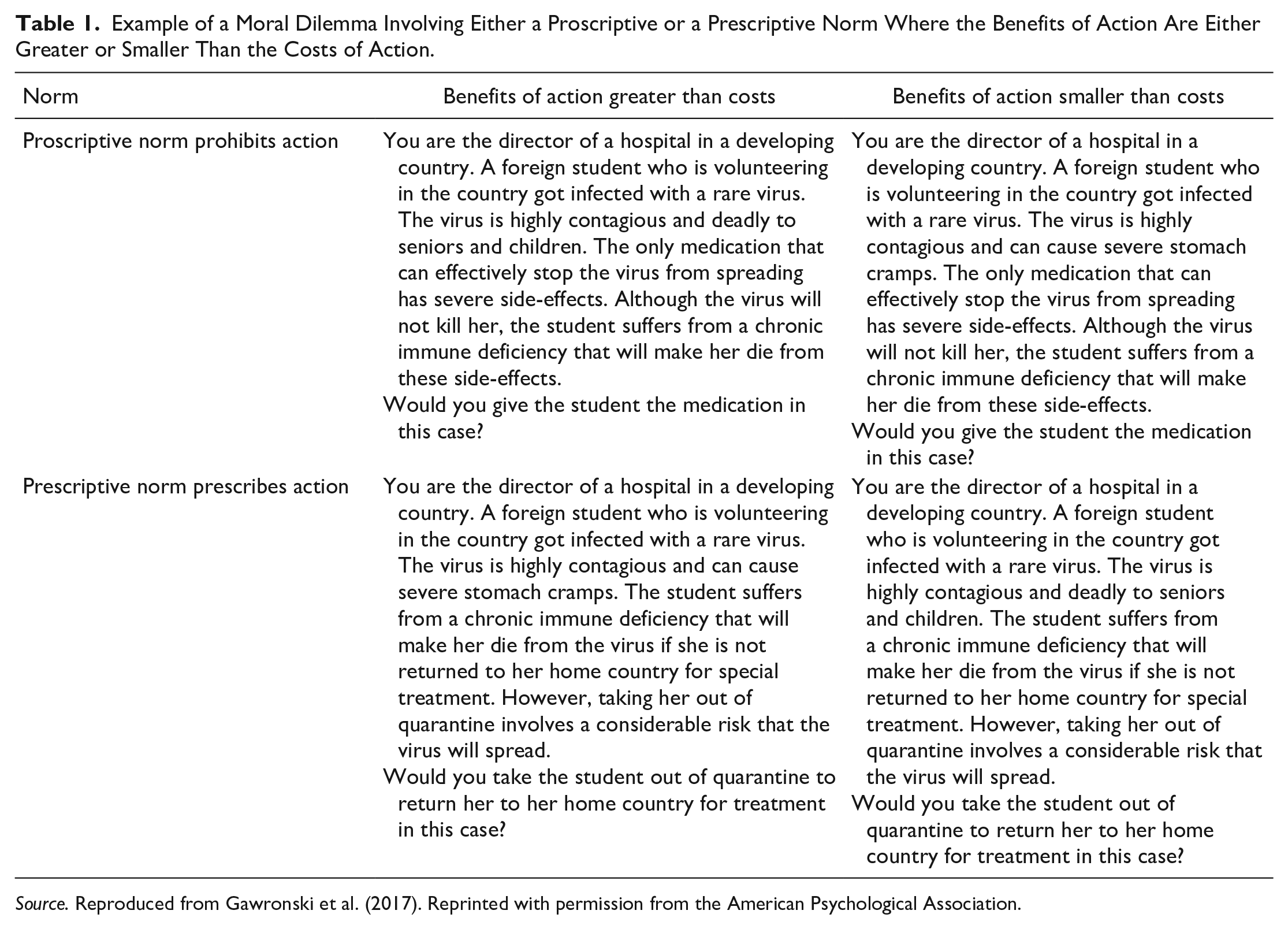
To overcome these limitations, Gawronski et al. (2017) developed a mathematical model that allows researchers to quantify sensitivity to consequences (C), sensitivity to norms (N), and general preference for inaction over action regardless of consequences and norms (I) in responses to moral dilemmas. Their CNI model quantifies these three determinants based on responses to four kinds of moral dilemmas, capturing two orthogonal factors: whether a norm prohibits or prescribes action, and whether the benefits of the action are greater or lesser than the costs (for an example, see Table 1).
Example of a Moral Dilemma Involving Either a Proscriptive or a Prescriptive Norm Where the Benefits of Action Are Either Greater or Smaller Than the Costs of Action.
Source. Reproduced from Gawronski et al. (2017). Reprinted with permission from the American Psychological Association.
Because the statistical details of the CNI model are thoroughly explained by Gawronski et al. (2017), we will only summarize the general procedure. At its core, the CNI model consists of four mathematical equations that include the three model parameters (C, N, I) as unknowns and the empirically observed probabilities of action versus inaction responses on the four types of moral dilemmas as known numerical values (see Gawronski et al., 2017, Appendix B). Using a multinomial modeling approach (see Hütter & Klauer, 2016), these equations are used to quantify the extent to which participants’ judgments reflect a response pattern that is sensitive to consequences (first row in Figure 1), a response pattern that is sensitive to moral norms (second row in Figure 1), and a response pattern of general inaction versus general action irrespective of consequences and norms (third and fourth row in Figure 1). Higher C parameter scores reflect a greater sensitivity to consequences; higher N parameter scores reflect a greater sensitivity to moral norms; and higher I parameter scores reflect a greater general preference for inaction and lower scores reflect a greater general preference for action irrespective of consequences and moral norms. 1 The adequacy of the model in describing the data can be evaluated by means of goodness-of-fit statistics. Poor model fit would be reflected in a significant deviation between the empirically observed probabilities and the probabilities predicted by the model for this data set.
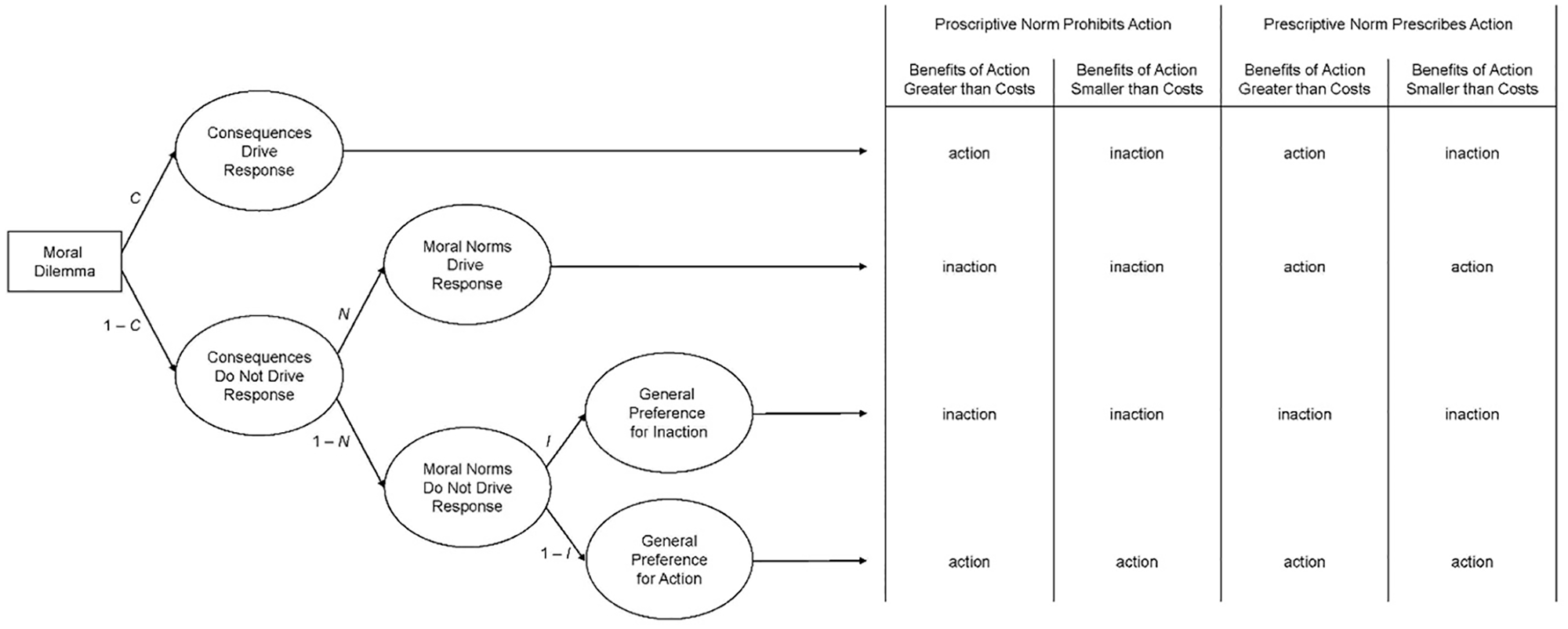
CNI model of moral decision-making predicting action versus inaction responses in moral dilemmas with proscriptive and prescriptive norms and consequences involving benefits of action that are either greater or smaller than costs of action.
Research using the CNI model has provided valuable insights into the effects of cognitive resources (Gawronski et al., 2017), question framing (Gawronski et al., 2017), incidental emotions (Gawronski et al., 2018), testosterone (Brannon et al., 2019), language use (Białek et al., 2019), stress (Li et al., 2019; Zhang et al., 2018), and power (Gawronski & Brannon, 2020) on moral dilemma judgments. Of importance for the current question, findings obtained with the CNI model have also provided deeper insights into the association between psychopathy and moral dilemma judgments. Using an extreme-groups approach, Gawronski et al. (2017) found that participants high in psychopathy (i.e., participants with psychopathy scores in the highest quartile) differed from participants low in psychopathy (i.e., participants with psychopathy scores in the lowest quartile) on all three parameters of the CNI model. Specifically, participants high compared with low in psychopathy showed (a) a weaker sensitivity to consequences, (b) a weaker sensitivity to norms, and (c) a weaker general for preference for inaction versus action. Thus, counter to descriptions of previous findings with the traditional approach, psychopaths are not “more utilitarian” (cf. Bartels & Pizarro, 2011; Kahane et al., 2015). If anything, the findings obtained with the CNI model suggest the opposite, in that psychopaths are less (not more) sensitive to consequences in a utilitarian sense—in addition to being less sensitive to norms in a deontological sense and more willing to act regardless of consequences and norms.
Despite its value in providing deeper insights into the determinants of moral dilemma judgments, the CNI model suffers from one major limitation. With the currently available set of dilemmas for research using the CNI model (i.e., six basic dilemmas in four variants), the model is well suited for studies involving comparisons between groups (e.g., experimental groups or groups with known features), but it is not suitable for research using individual-difference designs. In studies of the latter kind, the model would have to be run on the data of each individual participant (rather than aggregate data from groups of participants). However, with six observations per dilemma type, the number of observations is too small to obtain reliable parameter estimates at the individual level, which is reflected in poor model fit for a substantial proportion of participants and unreliable relations of the model parameters to other measures (for a detailed discussion, see Gawronski et al., 2017).
The Present Research
The aim of the current research was to overcome this limitation by developing and using a larger set of moral dilemmas for research using the CNI model. In a first step, we developed a new set of six basic dilemmas, with four variants of each basic dilemma varying in terms of consequences and norms (see Table 1). All dilemmas were designed to capture real-world cases that ignited moral debates about the most appropriate courses of action (see Gawronski et al., 2017) and to be equally plausible in all four versions (see Körner et al., 2019). In general, we aimed to create dilemmas where the four versions are as similar as possible, the only difference being the nature of the focal norm and the outcome of the described action. To avoid conceptual ambiguities and confounds with other factors, we deliberately avoided scenarios involving self-relevant outcomes and interference with intentional actions of a third person (see Gawronski et al., 2017; Hennig & Hütter, 2020). A list of the new dilemma set is available at https://osf.io/ndf4w/.
In a second step, we conducted two pilot studies to investigate whether (a) the CNI model shows acceptable fit in describing participants’ responses to our new dilemmas and (b) whether our new dilemmas reproduce experimental effects that have been found with Gawronski et al.’s (2017) dilemma set. Toward this end, participants were presented with our new set of moral dilemmas and asked to indicate either (a) whether it is morally acceptable to perform the described action (acceptability framing) or (b) whether they would perform the described action (action framing). Using the same framing manipulation, Gawronski et al. (2017) found that participants in the action-framing condition showed a weaker sensitivity to norms and a stronger general preference for inaction than participants in the acceptability-framing condition (see also Tassy et al., 2013). The two pilot studies largely replicated these findings, with acceptable model fit in each study (see supplemental materials). Although the effects of framing in the two individual studies were somewhat mixed, Gawronski et al.’s (2017) findings fully replicated in an integrative data analysis (Curran & Hussong, 2009) of the two pilot studies. Based on these findings, we conclude that (a) our newly developed dilemmas are psychologically similar to the dilemmas proposed by Gawronski et al. (2017) and, therefore, (b) the two dilemma sets can be combined to increase the number of responses per participant and dilemma type.
In a third step, we conducted four studies in which participants completed a battery of 48 moral dilemmas (12 basic dilemmas in four variants) comprising Gawronski et al.’s (2017) original dilemmas and our newly developed dilemmas. Before responding to the moral dilemmas, participants completed a battery of individual-difference measures that have been found to be associated with moral judgments in the traditional dilemma approach. Moral dilemma responses were analyzed with the CNI model at the individual level to investigate whether correlations between a given individual-difference measure and moral dilemma judgments are driven by (a) differences in sensitivity to consequences, (b) differences in sensitivity to norms, or (c) differences in general preference for inaction over action regardless of consequences and norms (or a combination of the three). To explore the generality of the obtained associations across question framings, participants in Studies 1a and 1b were asked to indicate whether they find the described action acceptable or unacceptable; participants in Studies 2a and 2b were asked to indicate whether or not they would perform the described action.
We consider the CNI model amenable for individual-difference research with the extended dilemma set to the extent that two criteria are met. First, the proportion of participants for whom the CNI analysis yields significant deviations between predicted and observed responses should be close to chance level (i.e., 5% with an Alpha criterion of p < .05). Second, previous results with the CNI model should replicate 2 , specifically the extreme-groups result concerning the negative relations between psychopathy and the three model parameters (see Gawronski et al., 2017). To the extent that both criteria are met, the CNI model can be further evaluated for its capacity to provide more nuanced insights into the underpinnings of individual differences in moral dilemma judgments. 3
Based on concerns about the reproducibility of psychological findings (Open Science Collaboration, 2015), we conducted one initial study and one replication for each question framing. For each study, we aimed to recruit 200 participants, which provides a statistical power of .80 to detect a small to medium-sized correlation of r = .20 (two-tailed) in line with previously observed correlations between dilemma judgments and dispositional measures. By default, we excluded participants who aborted the study or started it more than once, participants with missing data in the essential components of the study (i.e., individual-difference measures, moral dilemmas), participants who showed the same response to all dilemmas, and participants who failed to pass an instructional attention check (see Oppenheimer et al., 2009; for details on numbers of participant exclusions per criterion for each study, see Table 2). The data for each study were collected in one shot without intermittent statistical analyses. We report all measures, all conditions, and all data exclusions. The data, analysis codes, and materials for all studies are available at https://osf.io/ndf4w/.
Overview of Number of Exclusions for Each Criterion.
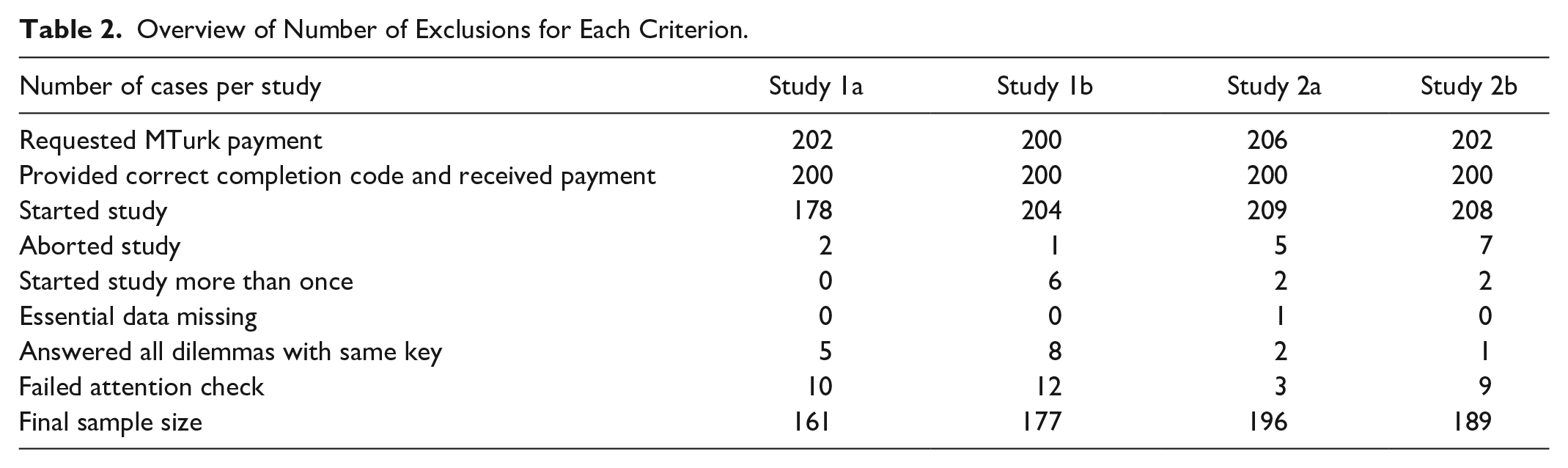
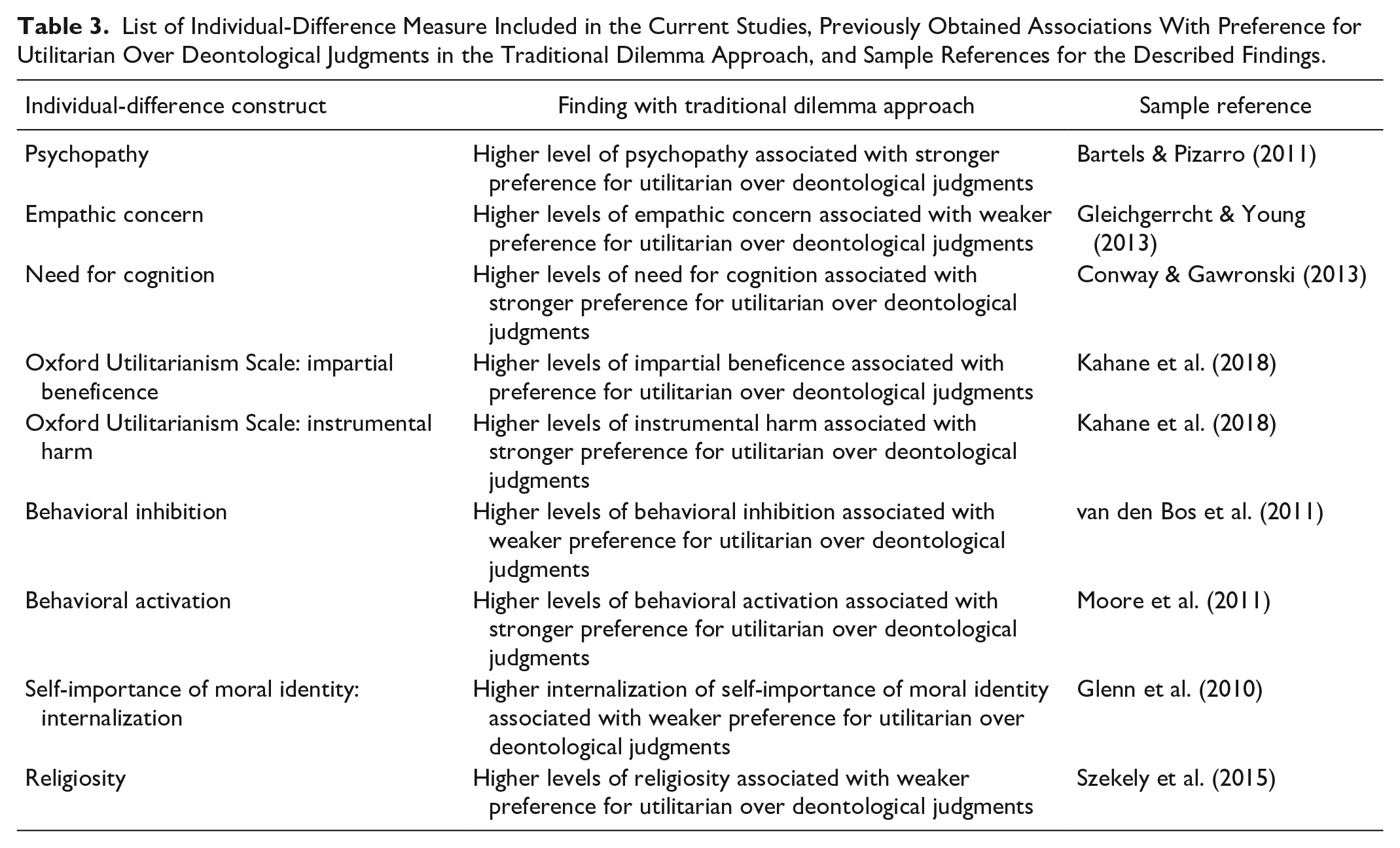
Table 3 provides a list of the individual-difference measures in the current studies, including a brief description of previous findings with the traditional dilemma approach. The present research examines to which extent associations between individual-difference measures and dilemma judgments are driven by (a) differences in the sensitivity to consequences, which should be reflected in correlations with the C parameter, (b) differences in the sensitivity to moral norms, which should be reflected in correlations with the N parameter, and (c) differences in the general preference for inaction over action regardless of consequences and norms, which should be reflected in correlations with the I parameter.
List of Individual-Difference Measure Included in the Current Studies, Previously Obtained Associations With Preference for Utilitarian Over Deontological Judgments in the Traditional Dilemma Approach, and Sample References for the Described Findings.
Studies 1a and 1b
Studies 1a and 1b investigated relations between the individual-difference dimensions listed in Table 3 and the three parameters of the CNI model. Participants in both studies were asked to indicate whether they find the described action acceptable or unacceptable.
Method
Participants
Participants were recruited for a study entitled How Do We Make Moral Decisions? via Amazon’s Mechanical Turk (MTurk). Participants received compensation of US$4.00 for completing the study. Eligibility for participation was limited to English native speakers who (a) had a human intelligence tasks (HIT) approval rate of at least 95% at the time of the study and (b) had not participated in prior studies from our lab using the same moral dilemmas.
Of the 178 participants who started Study 1a, 17 were excluded from all analyses (for details on data exclusions, see Table 2), leaving us with a final sample of 161 participants for Study 1a (72 females, 84 males; Mage = 37 years, SDage = 11; demographic information missing for five participants). 4
Of the 204 participants who started Study 1b, 27 were excluded from all analyses (for details on data exclusions, see Table 2), leaving us with a final sample of 177 participants for Study 1b (65 females, 105 males, two others, four prefer not to respond; Mage = 33 years, SDage = 9; demographic information missing for one participant).
Measures
Before responding to the moral dilemmas, participants completed a battery of individual-difference measures in the following order. Behavioral activation and behavioral inhibition were measured with Carver and White’s (1994) behavioral inhibition system (BIS)/behavioral approach system (BAS) inventory. 5 Need for cognition (NFC) was assessed with the NFC subscale of the Rational–Experiential Inventory (Epstein et al., 1996). Impartial beneficence and instrumental harm were measured with the Oxford Utilitarianism Scale (OUS; Kahane et al., 2018). 6 Empathic concern was measured with the corresponding subscale of the Interpersonal Reactivity Index (Davis, 1983). Psychopathy was assessed with Levenson et al.’s (1995) Primary Psychopathy Scale. Self-importance of moral identity internalization (for the sake of brevity hereafter called moral identity internalization) was measured with the internalization subscale of the Self-Importance of Moral Identity Scale (Aquino & Reed, 2002). Religiosity was assessed with a modified variant of Koenig et al. (2005) Religiousness Scale, adapted from Conway and Gawronski (2013).
After completing the battery of individual-difference measures, participants responded to 48 moral dilemmas (12 basic dilemmas each presented in four variants) in a fixed randomized order. Participants were asked to indicate for each dilemma whether it is acceptable to perform the described action (yes vs. no). Finally, participants provided demographic information, responded to a one-item instructional attention check (see Oppenheimer et al., 2009), and were given an opportunity to comment on the study before receiving a completion code to request their compensation.
Results and Discussion
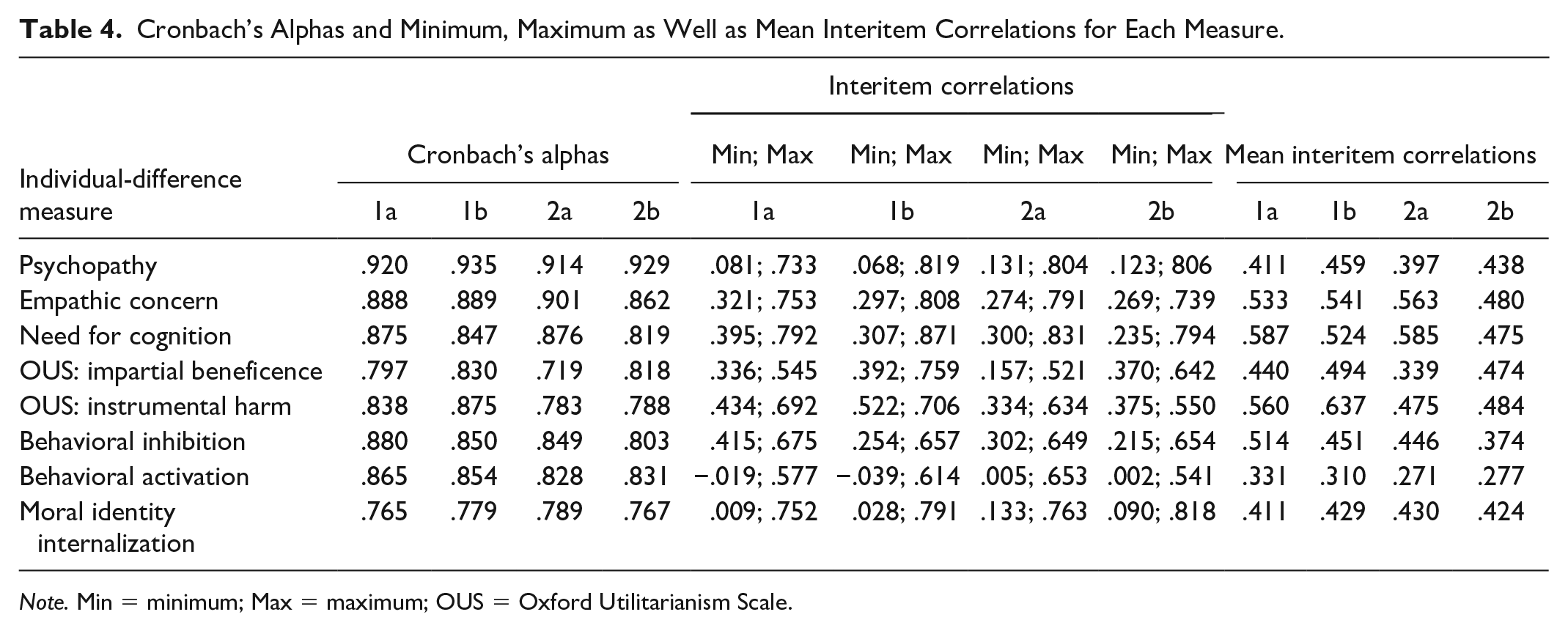
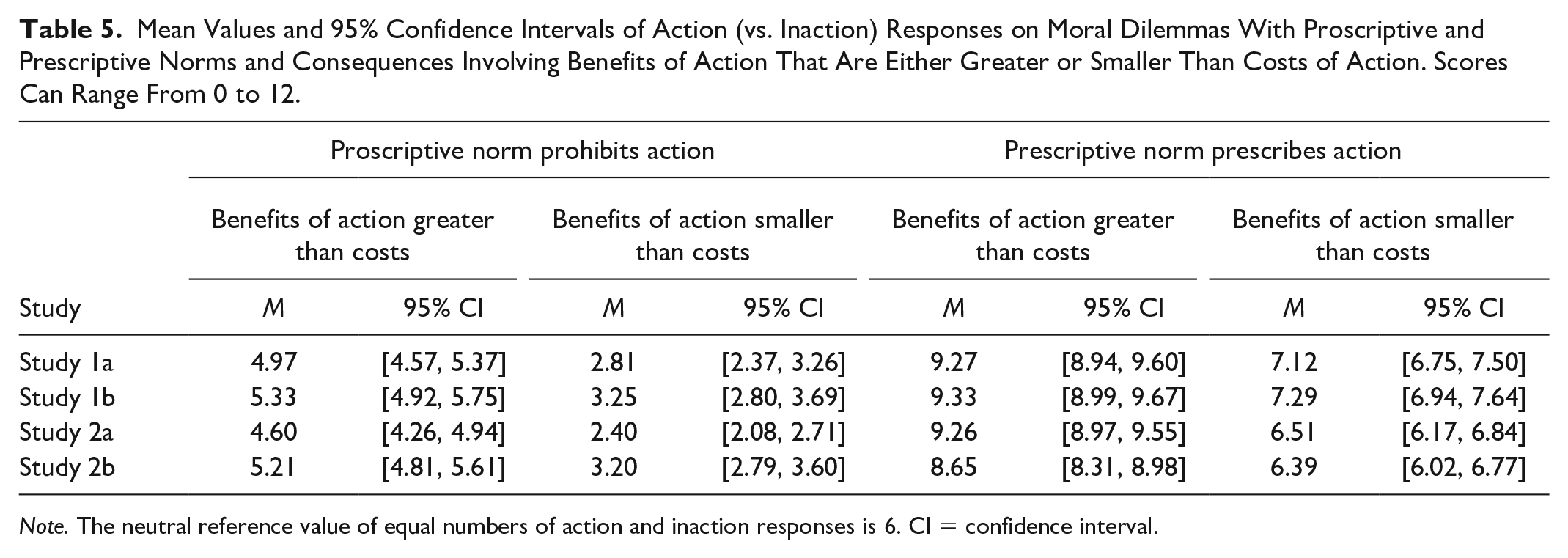
Responses on the individual-difference measures were aggregated by reverse coding negatively framed items and calculating scores according to the instructions provided in the original publications (see Table 4 for estimates of internal consistency and interitem correlations). The moral judgment data were aggregated by calculating the sum of action responses to the four types of moral dilemmas for each participant. With a total of 12 scenarios for each dilemma type, aggregate scores could range from 0 to 12. Mean values and 95% confidence intervals of the aggregated moral judgment data are presented in Table 5. Based on the resulting scores for the four kinds of dilemmas, individual parameter scores of sensitivity to consequences (C), sensitivity to norms (N), and general preference for inaction over action regardless of consequences and norms (I) were estimated with the freeware multiTree (Moshagen, 2010) by fitting the CNI model to the aggregated moral judgment data of each participant. 7
Cronbach’s Alphas and Minimum, Maximum as Well as Mean Interitem Correlations for Each Measure.
Note. Min = minimum; Max = maximum; OUS = Oxford Utilitarianism Scale.
Mean Values and 95% Confidence Intervals of Action (vs. Inaction) Responses on Moral Dilemmas With Proscriptive and Prescriptive Norms and Consequences Involving Benefits of Action That Are Either Greater or Smaller Than Costs of Action. Scores Can Range From 0 to 12.
Note. The neutral reference value of equal numbers of action and inaction responses is 6. CI = confidence interval.
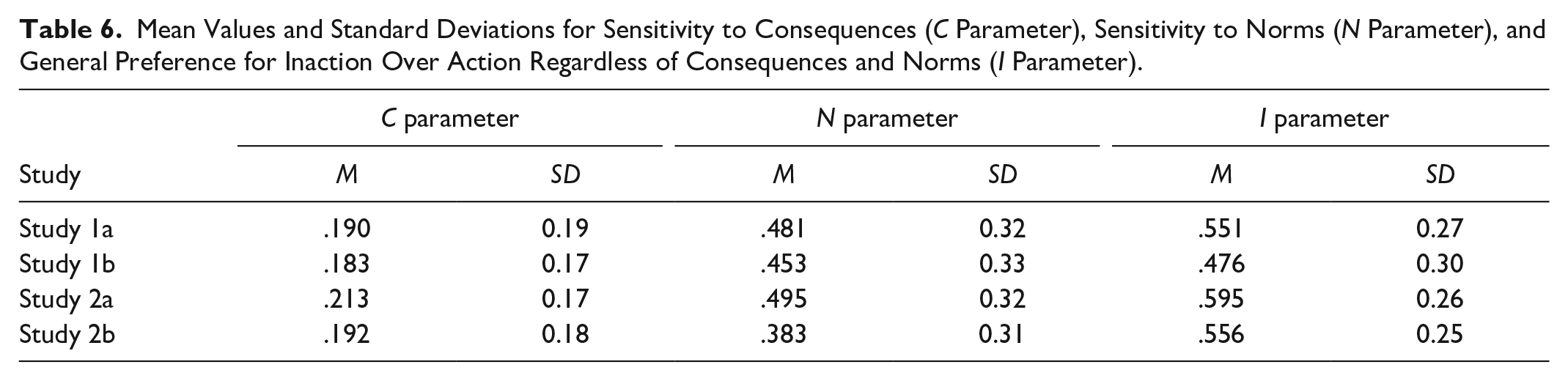
The model fit the data for 95.0% of the participants in Study 1a and 94.4% of the participants in Study 1b. With an alpha-criterion of p = .05 for significant deviations between predicted and observed probabilities of action versus inaction responses, the observed proportions of participants for whom the model did not fit (i.e., 5.0% and 5.6%, respectively) are perfectly in line with the statistically to-be-expected false-positive rate of 5%. These results provide preliminary evidence that the extended set of moral dilemmas is adequate for CNI model analyses at the individual level (see supplemental materials, Tables S7 and S12, for the results of analyses after excluding participants for whom the CNI model did not fit; and see supplemental materials, Tables S6 and S11, for the results after excluding participants for whom the CNI modeling yielded an error message). Mean values and standard deviations of the estimated parameter scores are presented in Table 6. Correlations between the three parameter scores and the individual-difference measures are presented in Table 7 (Study 1a) and Table 8 (Study 1b). Tables 7 and 8 also include correlations between the individual-difference measures and traditional dilemma scores reflecting the relative preference for utilitarian over deontological judgments on dilemmas involving a norm that prohibits action where the benefits of action outweigh its costs to well-being (see supplemental materials, Tables S3 and S8, for a complete table of correlations among all measures).
Mean Values and Standard Deviations for Sensitivity to Consequences (C Parameter), Sensitivity to Norms (N Parameter), and General Preference for Inaction Over Action Regardless of Consequences and Norms (I Parameter).
Correlations Between Individual-Difference Measures and Moral Dilemma Judgments, as Reflected in Relative Preference for Utilitarian Over Deontological Judgments (Traditional Score), Sensitivity to Consequences (C Parameter), Sensitivity to Norms (N Parameter), and General Preference for Inaction Over Action Regardless of Consequences and Norms (I Parameter), Study 1a.
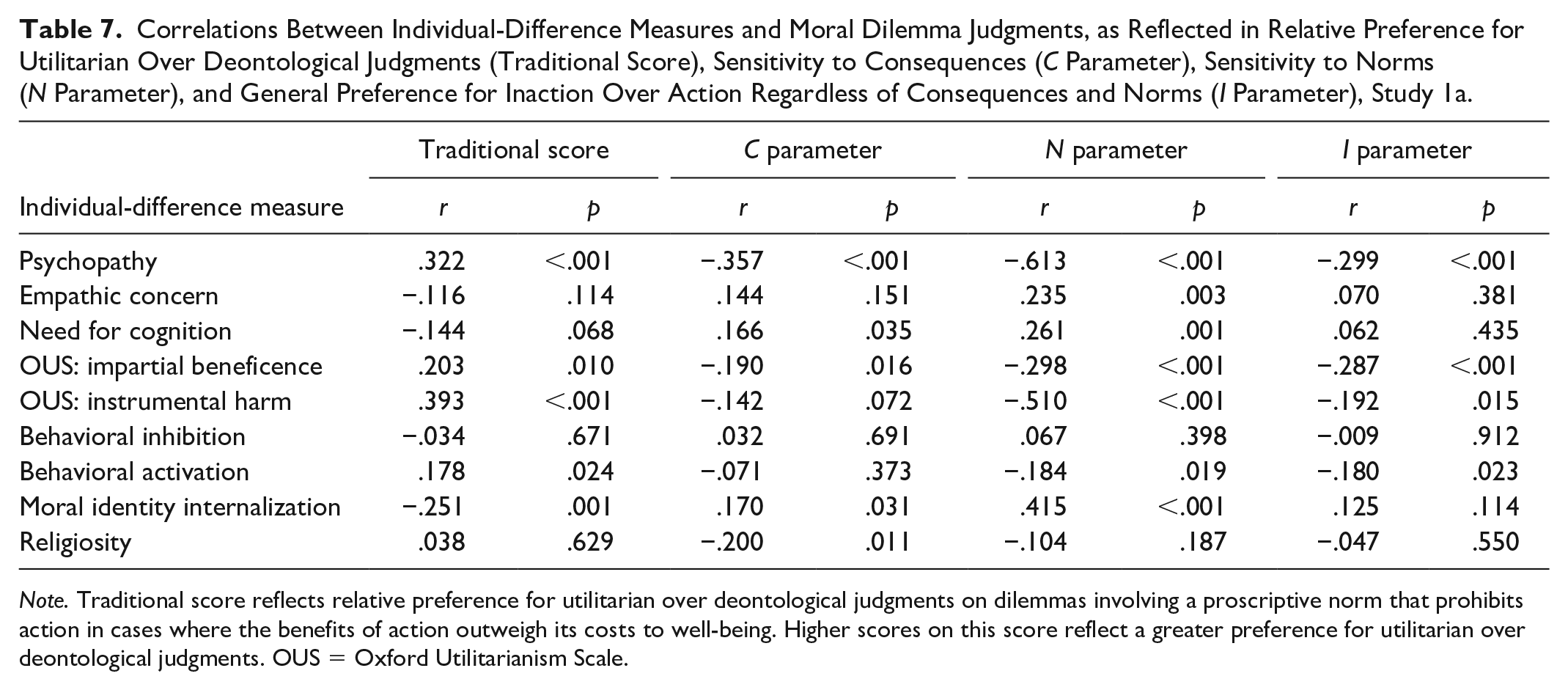
Note. Traditional score reflects relative preference for utilitarian over deontological judgments on dilemmas involving a proscriptive norm that prohibits action in cases where the benefits of action outweigh its costs to well-being. Higher scores on this score reflect a greater preference for utilitarian over deontological judgments. OUS = Oxford Utilitarianism Scale.
Correlations Between Individual-Difference Measures and Moral Dilemma Judgments, as Reflected in Relative Preference for Utilitarian Over Deontological Judgments (Traditional Score), Sensitivity to Consequences (C Parameter), Sensitivity to Norms (N Parameter), and General Preference for Inaction Over Action Regardless of Consequences and Norms (I Parameter), Study 1b.
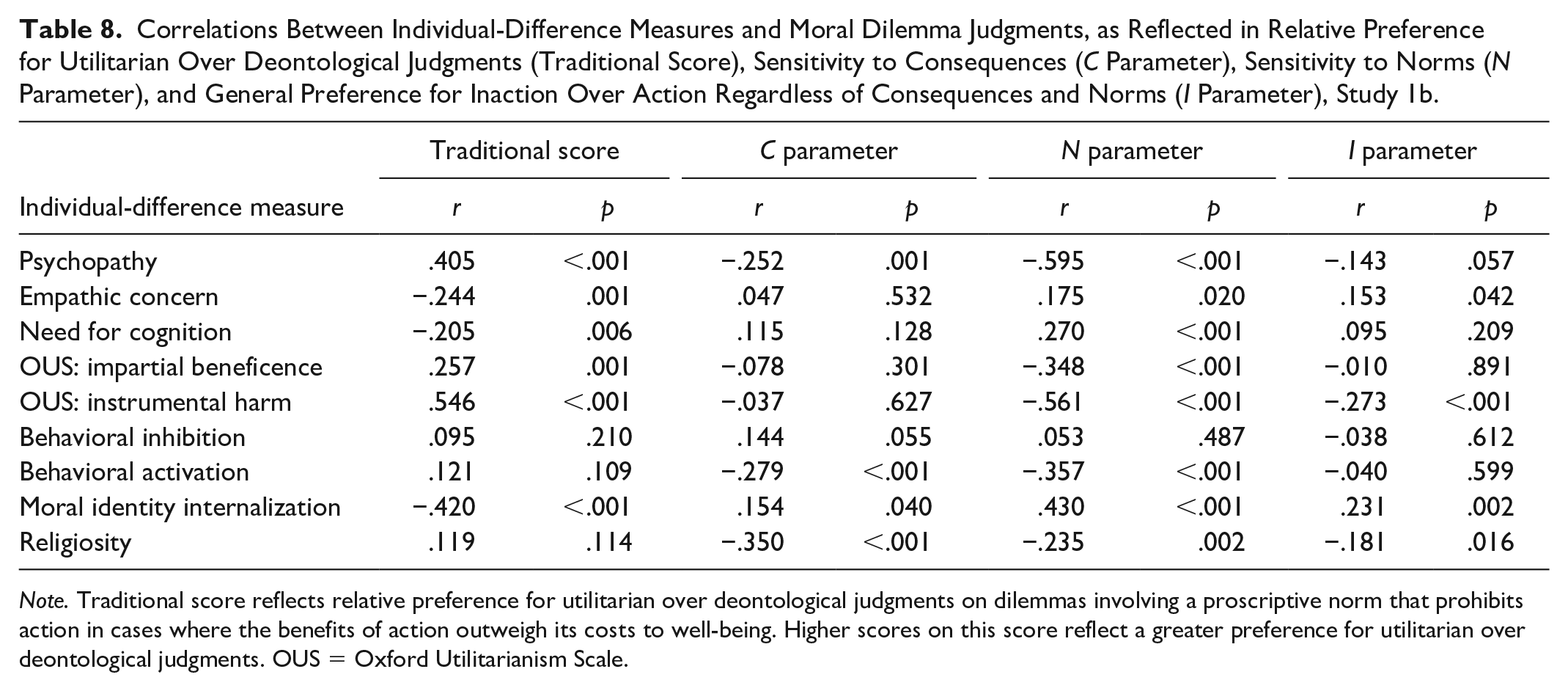
Note. Traditional score reflects relative preference for utilitarian over deontological judgments on dilemmas involving a proscriptive norm that prohibits action in cases where the benefits of action outweigh its costs to well-being. Higher scores on this score reflect a greater preference for utilitarian over deontological judgments. OUS = Oxford Utilitarianism Scale.
Psychopathy
Replicating previous findings, traditional dilemma scores showed a significant positive correlation with psychopathy in both Study 1a and Study 1b, indicating an increasing preference for utilitarian over deontological judgments as a function of increasing psychopathy scores. Moreover, replicating findings of previous research with the CNI model using an extreme-groups approach, psychopathy was negatively correlated with all three model parameters. Specifically, higher psychopathy was associated with a weaker sensitivity to consequences on the C parameter, a weaker sensitivity to norms on the N parameter, and a weaker general preference for inaction over action on the I parameter. These results were consistent across Study 1a and Study 1b, the only exception being a marginal correlation between psychopathy and the I parameter in Study 1b. Together, these results provide further support the suitability of the CNI model for individual-difference research with our extended moral dilemma battery. 8
Empathic concern
Consistent with earlier findings, empathic concern was negatively correlated with traditional dilemma scores in Study 1b, but this finding did not emerge in Study 1a. More fine-grained analyses with the CNI model revealed a positive relation between empathic concern and the N parameter in both Study 1a and Study 1b, suggesting that greater empathic concern is associated with a stronger sensitivity to norms. Empathic concern also showed a significant positive correlation with the I parameter in Study 2b but this relation did not emerge in Study 2a.
NFC
Different from previous findings suggesting a positive relation between NFC and traditional dilemma scores, NFC showed a marginal negative correlation with traditional dilemma scores in Study 1a and a significant negative correlation in Study 1b. Further analyses suggest that these relations were driven by a stronger sensitivity to norms among participants high in NFC, as reflected in significant positive correlations between NFC and the N parameter. Consistent with the idea that higher NFC is associated with enhanced analyses of costs and benefits, NFC showed a significant positive correlation with the C parameter in Study 1a, but this finding did not replicate in Study 1b.
OUS
Replicating previous findings, the traditional dilemma score showed significant positive correlations with the impartial beneficence and instrumental harm dimensions of the OUS in both Study 1a and Study 1b. Surprisingly, further analyses with the CNI model suggest that these correlations were largely driven by a weaker sensitivity to norms among participants high in impartial beneficence and participants high in instrumental harm, as reflected in significant negative correlations with the N parameter. If anything, impartial beneficence was negatively related to sensitivity to consequences, but the relevant correlation with the C parameter was significant only in Study 1a, but not in Study 1b. In addition, instrumental harm showed a significant negative relation with general preference for inaction on the I parameter in both Study 1a and Study 1b. A similar pattern was obtained for impartial beneficence, but its correlation with the I parameter was significant only in Study 1a, but not in Study 1b.
BIS/BAS
Different from previous research, neither Study 1a nor Study 1b revealed a significant negative correlation between BIS scores and traditional dilemma scores. BAS scores showed a significant positive correlation with traditional dilemma scores in Study 1a, but this finding did not replicate in Study 1b. On a more fine-grained level, BAS scores showed a significant negative correlation with the N parameter in both Study 1a and Study 1b, suggesting that greater behavioral activation is associated with reduced sensitivity to norms. There was also a significant negative correlation between BAS and the I parameter in Study 1a and a significant negative correlation between BAS and the C parameter in Study 1b, but neither of these findings replicated in the respective other study.
Moral identity internalization
Consistent with previous findings, both Study 1a and Study 1b revealed significant negative correlations between moral identity internalization and traditional dilemma scores. Further analyses revealed that this association is driven by a positive association between moral identity internalization and sensitivity to norms captured by the N parameter. Interestingly, moral identity internalization also showed significant positive correlations with the C parameter in both studies, suggesting that more pronounced a moral identity internalization is associated with a stronger sensitivity to consequences. In Study 1b, moral identity internalization additionally showed a significant positive correlation with the I parameter, but this finding did not emerge in Study 1a.
Religiosity
Different from previous findings, religiosity was not significantly related to traditional dilemma scores in either Study 1a or Study 1b. However, more fine-grained analyses with the CNI model revealed a significant negative correlation between religiosity and the C parameter in both Study 1a and Study 1b, suggesting that greater religiosity is associated with weaker sensitivity to consequences. In Study 1b, religiosity additionally showed significant negative correlations with the N and the I parameters, but these relations did not emerge in Study 1a.
Studies 2a and 2b
Studies 2a and 2b investigated relations between the individual-difference dimensions listed in Table 3 and the three parameters of the CNI model using action framing instead of the acceptability framing used in Studies 1a and 1b (see Gawronski et al., 2017; Tassy et al., 2013). Given that action framing influenced overall scores on the N and the I parameters in Gawronski et al.’s (2017) dilemma set as well as our newly developed dilemma set (see supplemental materials), we investigated whether the obtained shifts in mean scores at the group level affect correlations with individual-difference measures (see Funder, 2006, for a discussion of the relation between mean-level and individual-difference effects).
Method
Participants
Participants were recruited for a study entitled How Do We Make Moral Decisions? via Amazon’s Mechanical Turk (MTurk). Participants received compensation of US$4.00 for completing the study. Eligibility for participation was limited to English native speakers who (a) had a HIT approval rate of at least 95% at the time of the study and (b) had not participated in prior studies from our lab using the same moral dilemmas.
Of the 209 participants who started Study 2a, 13 were excluded from all analyses (for details on data exclusions, see Table 2), leaving us with a final sample of 196 participants for Study 2a (102 females, 93 males; Mage = 35 years, SDage = 10; demographic information missing for one participant).
Of the 208 participants who started Study 1a, 19 were excluded from all analyses (for details on data exclusions, see Table 2), leaving us with a final sample of 189 participants for Study 2b (90 females, 96 males, two other, one prefer not to respond; Mage = 34 years, SDage = 9).
Measures
The individual-difference measures and moral dilemmas were identical to Studies 1a and 1b, the only difference being that participants were asked to indicate whether they would perform the described actions in the moral dilemmas (yes vs. no).
Results and Discussion
The data were aggregated in line with the procedures in Studies 1a and 1b. Estimates of internal consistency for the individual-difference measures are presented in Table 4. Mean values and 95% confidence intervals of the aggregated moral judgment data are presented in Table 5. The CNI model fit the data for 96.9% of the participants in Study 2a and 94.7% of the participants in Study 2b. With an alpha-criterion of p = .05 for significant deviations between predicted and observed probabilities of action versus inaction responses, the observed proportions of participants for whom the model did not fit (i.e., 3.1% and 5.3%, respectively) are again in line with the statistically to-be-expected false-positive rate of 5% (see supplemental materials, Tables S17 and S22, for the results of analyses after excluding participants for whom the CNI model did not fit; and see supplemental materials, Tables S16 and S21, for the results after excluding participants for whom the CNI modeling yielded an error message). Mean values and standard deviations of the estimated parameter scores are presented in Table 6. Correlations between the three parameter scores, traditional dilemma scores, and the individual-difference measures are presented in Table 9 for Study 2a and in Table 10 for Study 2b (see supplemental materials, Tables S13 and S18, for a complete table of correlations among all measures). 9
Correlations Between Individual-Difference Measures and Moral Dilemma Judgments, as Reflected in Relative Preference for Utilitarian Over Deontological Judgments (Traditional Score), Sensitivity to Consequences (C Parameter), Sensitivity to Norms (N Parameter), and General Preference for Inaction Over Action Regardless of Consequences and Norms (I Parameter), Study 2a.
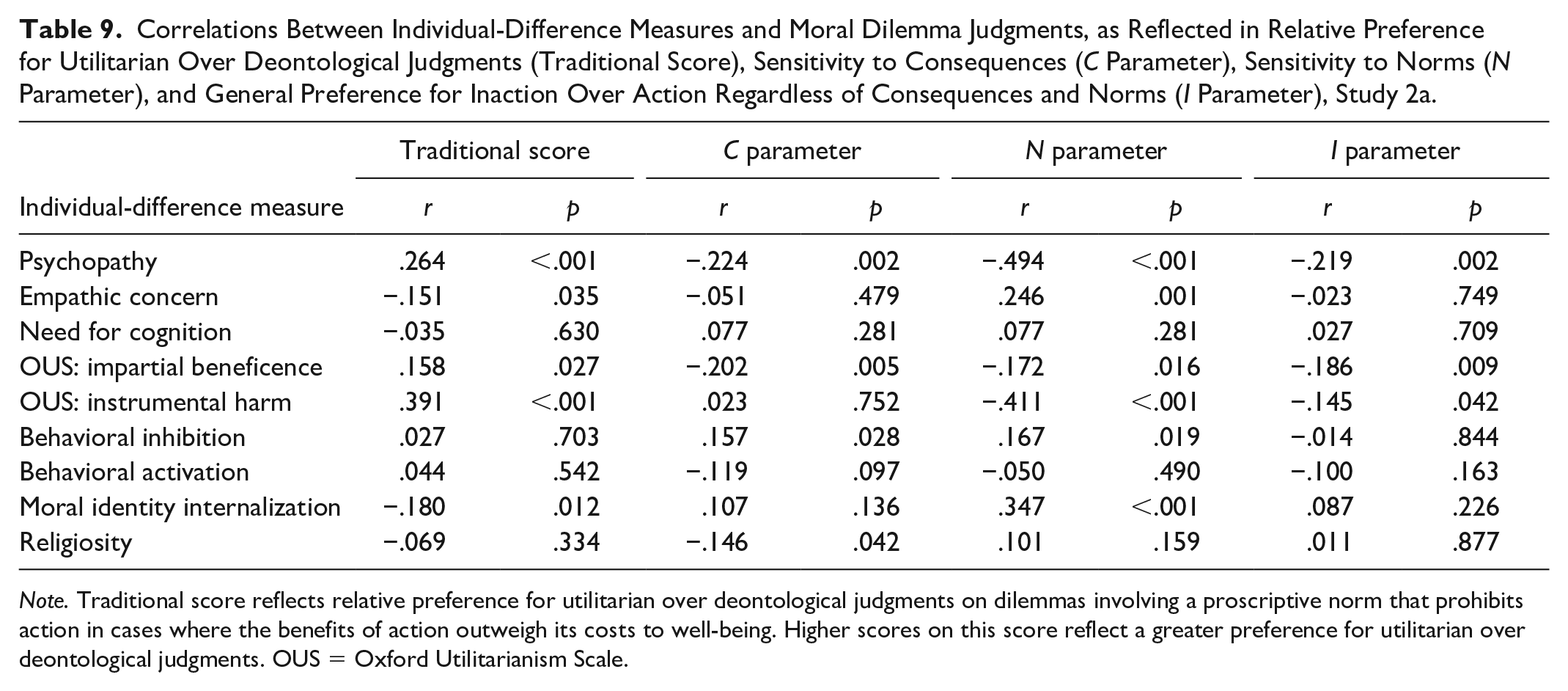
Note. Traditional score reflects relative preference for utilitarian over deontological judgments on dilemmas involving a proscriptive norm that prohibits action in cases where the benefits of action outweigh its costs to well-being. Higher scores on this score reflect a greater preference for utilitarian over deontological judgments. OUS = Oxford Utilitarianism Scale.
Correlations Between Individual-Difference Measures and Moral Dilemma Judgments, as Reflected in Relative Preference for Utilitarian Over Deontological Judgments (Traditional Score), Sensitivity to Consequences (C Parameter), Sensitivity to Norms (N Parameter), and General Preference for Inaction Over Action Regardless of Consequences and Norms (I Parameter), Study 2b.
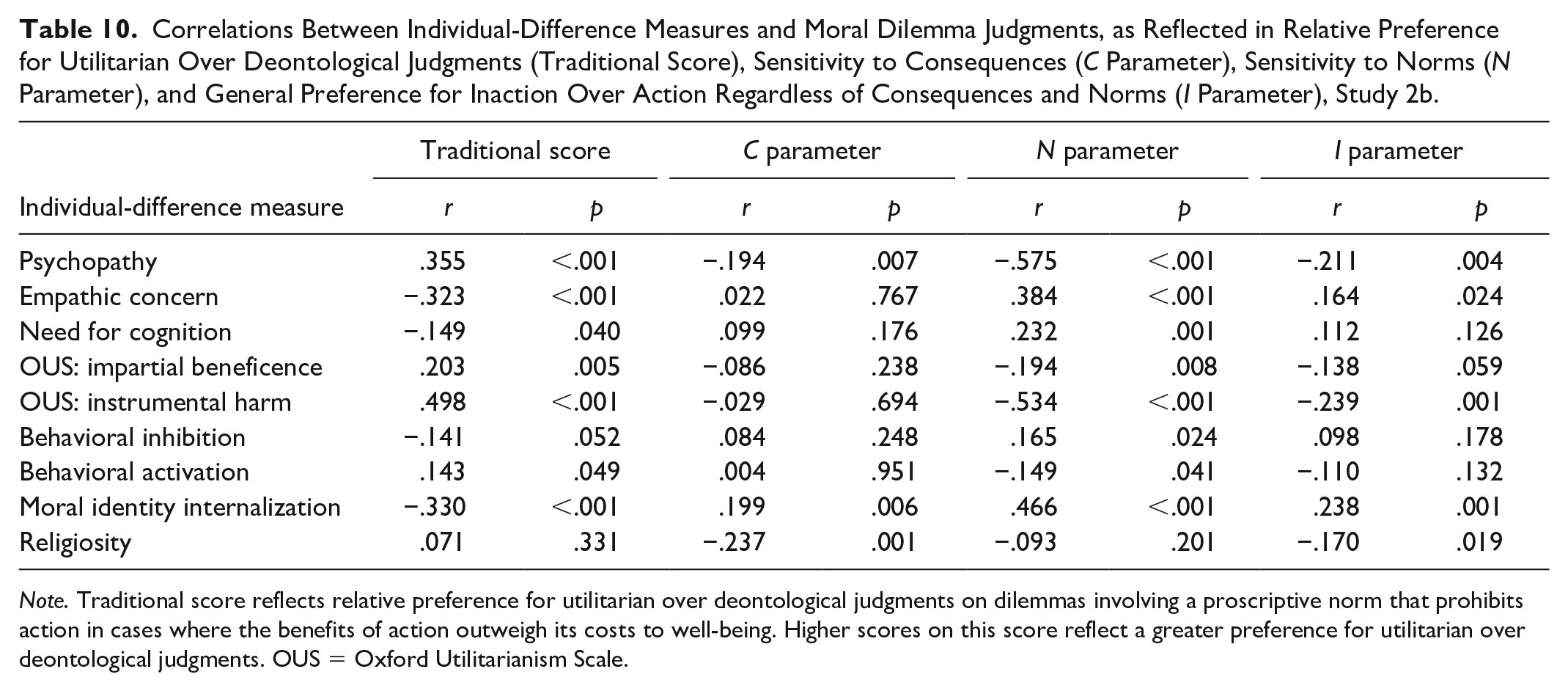
Note. Traditional score reflects relative preference for utilitarian over deontological judgments on dilemmas involving a proscriptive norm that prohibits action in cases where the benefits of action outweigh its costs to well-being. Higher scores on this score reflect a greater preference for utilitarian over deontological judgments. OUS = Oxford Utilitarianism Scale.
Psychopathy
Replicating the findings of Studies 1a and 1b, psychopathy showed a significant positive correlation with traditional dilemma scores, and significant negative correlations with all three parameters of the CNI model in both Study 2a and Study 2b. 10
Empathic concern
Consistent with earlier findings and the results of Study 1b, empathic concern showed a significant negative correlation with traditional dilemma scores in both Study 2a and Study 2b. Replicating the findings of Studies 1a and 1b, analyses with the CNI model suggest that this relation is driven by a stronger sensitivity to norms among participants high in empathic concern, as empathic concern and the N parameter were positively correlated in both Study 2a and Study 2b. Similar to the unreliable positive relation between empathic concern and general action tendencies in Study 1b (which did not emerge in Study 1a), empathic concern showed a significant positive correlation with the I parameter in Study 2b, but not in Study 2a.
NFC
Study 2b replicated the negative relation between NFC and traditional dilemma scores in Studies 1a and 1b, but this relation was not statistically significant in Study 2a. Similarly, Study 2b replicated the positive relation between NFC and the N parameter in Studies 1a and 1b, but this relation was also not significant in Study 2a.
OUS
Replicating earlier findings and the pattern obtained in Studies 1a and 1b, traditional dilemma scores showed significant positive correlations with impartial beneficence and instrumental harm in Studies 2a and 2b. Further analyses with the CNI model suggest that these correlations are largely driven by a weaker sensitivity to norms among participants high in impartial beneficence and participants high in instrumental harm, replicating the pattern obtained in Studies 1a and 1b. The two dimensions also showed negative relations with general preference for inaction over action in both studies, replicating the overall pattern in Study 1a and the pattern for instrumental harm in Study 1b. In Study 2a, impartial beneficence showed a significant negative correlation with the C parameter (similar to Study 1a), but this relation did not replicate in Study 2b.
BIS/BAS
Similar to the unreliable positive relation between BAS and traditional dilemma scores in Study 1a (which did not replicate in Study 1b), BAS was positively correlated with traditional dilemma scores in Study 2b, but not in Study 2a. More fine-grained analyses with the CNI model revealed a significant positive relation between BIS and sensitivity to norms on the N parameter in both Study 2a and Study 2b. There was also a significant positive correlation between BIS and the C parameter in Study 2a and a significant negative correlation between BAS and the N parameter in Study 2b, but neither of these relations replicated in the respective other study.
Moral identity internalization
Replicating the findings of Studies 1a and 1b, moral identity internalization showed a significant negative correlation with traditional dilemma scores in both Study 2a and Study 2b. Again, analyses with the CNI model suggest that this association is driven by a greater sensitivity to norms among participants high in moral identity internalization, as moral identity internalization and the N parameter were positively correlated in both Study 2a and Study 2b. In Study 2b, moral identity internalization also showed significant positive correlations with the C and the I parameters, but these relations did not emerge in Study 2a.
Religiosity
Consistent with the findings of Studies 1a and 1b, religiosity was not significantly related to traditional dilemma scores. Yet, replicating the pattern in Studies 1a and 1b, religiosity showed a significant negative correlation with sensitivity to consequences on the C parameter in both Study 2a and Study 2b. Similar to the unreliable negative relation between religiosity and general action tendencies in Study 1b (which did not emerge in Study 1a), religiosity showed a significant negative relation with the I parameter in Study 2b, but not in Study 2a.
Integrative Data Analysis
The obtained pattern of correlations was very similar for the two question framings. Indeed, when we combined the data from the four studies for an integrative data analysis (Curran & Hussong, 2009) and compared the correlations of the three parameters with each of the employed individual-difference measures, only two of the 27 correlations were significantly different across question framings. First, BAS showed a stronger negative relation with sensitivity to norms for acceptability framing, r(336) = −.276, than for action framing, r(383) = −.114, z = 2.256, p = .024. Second, religiosity showed a stronger negative association with sensitivity to norms for acceptability framing, r(336) = −.168, than for action framing, r(383) = .009, z = 2.386, p = .018. None of the other correlations were significantly different across question framings. Although assignment to the two framings was not random and inferences from null effects should be treated with caution, these results suggest that the obtained effects of question framing on the overall size of parameters scores have little impact on their correlation with measures of individual differences (see Funder, 2006).
General Discussion
The aim of the current research was to overcome a major limitation of the CNI model. With the previously available set of dilemmas, the CNI model is well suited for studies involving comparisons between groups (e.g., experimental groups or groups with known features), but it is not suitable for research using individual-difference designs (see Gawronski et al., 2017). For the latter type of research, the number of observations per dilemma type is too small to provide reliable parameter estimates at the individual level, which is reflected in poor model fit for a substantial proportion of participants and unreliable relations of the model parameters to other measures. To address this limitation, we developed a new set of moral dilemmas and combined it with the existing set of dilemmas for research using the CNI model (see Gawronski et al., 2017).
Using this extended dilemma battery, we found the CNI model amenable for individual-difference studies in terms of our two criteria. First, in all four studies, the CNI model fit the data well for approximately 95% of our participants. With an alpha-criterion of p = .05 for deciding whether a modeling deviation is significant, these results are in line with the to-be-expected proportion of false positives if the hypothesis of no significant model deviation is true. Second, in all four studies, we replicated previous results using the CNI model, specifically the negative relations between psychopathy and the three model parameters (see Gawronski et al., 2017). Although not a new finding, this replication suggests that our extended dilemma battery retains the properties of Gawronski et al.’s (2017) dilemmas for research using the CNI model, which is crucial for evaluating our individual-difference approach. From these results, we conclude that the CNI model is amenable for individual-difference analyses with our extended dilemma battery. Expanding on this conclusion, we further investigated correlations between the three parameters of the CNI model and a broad range of theoretically relevant individual-difference measures, illustrating the deeper insights that can be gained from using the CNI model in research on individual differences in moral dilemma judgments.
Psychopathy
Replicating earlier findings (e.g., Bartels & Pizarro, 2011; Kahane et al., 2015; Patil, 2015), we found that psychopathy was positively related to preference for utilitarian over deontological judgments in traditional dilemma scores. However, more fine-grained analyses with the CNI model indicate that it would be ill-founded to interpret this relation as evidence for greater “utilitarianism” among psychopaths, given that higher levels of psychopathy were associated with weaker (not stronger) sensitivity to consequences in all four studies. In addition, psychopathy showed negative correlations with sensitivity to norms and general preference for inaction over action in all four studies. These results support the reliability of previously obtained associations between psychopathy and the three CNI parameters using comparisons between extreme groups (Gawronski et al., 2017), which can lead to artifacts and misleading results (see MacCallum et al., 2002). In doing so, the current findings corroborate the proposition that the CNI model offers nuanced insights into the association between psychopathy and moral judgment that cannot be gained with the traditional approach.
Empathic Concern
Several studies have found a negative relation between empathic concern and preference for utilitarian over deontological judgments in traditional dilemma scores (e.g., Gleichgerrcht & Young, 2013; Patil & Silani, 2014). We replicated this finding in three of four studies. More fine-grained analyses with the CNI model suggest that this relation is driven by a stronger sensitivity to norms among people high in empathic concern, as reflected in a significant positive correlation between empathic concern and the N parameter in all four studies. In two of the four studies, we also found a significant positive correlation between empathic concern and general preference for inaction over action (Studies 1b and 2b), but given the low reliability of this relation we refrain from drawing any conclusions from this finding. Overall, our results suggest that greater empathy reduces preference for utilitarian over deontological judgments via increased norm sensitivity.
NFC
In contrast to some earlier studies suggesting a positive relation between NFC and preference for utilitarian over deontological judgments in traditional dilemma scores (e.g., Conway & Gawronski, 2013; Wiech et al., 2013; but see Patil et al., 2020), we found a significant negative correlation in Studies 1b and 2b and a marginal negative correlation in Study 1a. More fine-grained analyses with the CNI model suggest that this relation is driven by a greater sensitivity to norms among people high in NFC, in that NFC showed a significant positive correlation with the N parameter in three of the four studies. Although the inconsistency between the current and previous findings require future research on the relation between NFC and moral dilemma judgments, the current findings pose a challenge to the idea that high NFC is associated with more deliberate analyses of costs and benefits in a utilitarian sense (cf. Greene et al., 2001). Instead, our findings suggest that NFC influences moral dilemma judgments via enhanced reflection about moral norms. This conclusion is in line with other recent findings indicating that the impact of deliberation on moral dilemma judgments is much more complex than suggested by the dominant assumption that high deliberation invariably increases concerns about outcomes (e.g., Byrd & Conway, 2019; Patil et al., 2020; see also Körner & Volk, 2014).
OUS
Replicating previous findings (e.g., Kahane et al., 2018), we found that both impartial beneficence and instrumental harm were positively related to preference for utilitarian over deontological judgments in traditional dilemma scores. These relations replicated in all four studies. However, different from an interpretation of these relations as reflecting individual differences in utilitarian reasoning about consequences, more fine-grained analyses with the CNI model suggest that they are mainly driven by individual differences in the sensitivity to norms. Across all four studies, impartial beneficence and instrumental harm were negatively correlated with the N parameter, suggesting a weaker sensitivity to norms among people scoring high in impartial beneficence and people scoring high in instrumental harm. Another factor behind the observed relations is individual differences in general action tendencies. Instrumental harm (in all four studies) as well as impartial beneficence (in three of four studies) showed a negative relation with general preference for inaction over action. Surprisingly, there was no indication that either of the two dimensions of self-reported utilitarianism was positively associated with sensitivity to consequences, although sensitivity to consequences is the hallmark of utilitarianism. If anything, our findings suggest the opposite for impartial beneficence, which showed a significant negative relation to sensitivity to consequences in two of the four studies.
The puzzling aspect of these findings is that the results of the CNI analyses conflict with previous interpretations of findings obtained with the traditional approach. On the one hand, our results replicate previous research showing that both OUS subscales correlate positively with preference for utilitarian over deontological judgments (Kahane et al., 2018). On the other hand, the CNI analyses suggest that higher scores on both OUS subscales are associated with a weaker sensitivity to norms in a deontological sense rather than stronger sensitivity to consequences in a utilitarian sense. 11 At this point, we have no basis to decide whether this unexpected result indicates that (a) the OUS lacks construct validity as a measure of utilitarianism or (b) the CNI model does not adequately capture utilitarian responding with its C parameter. Future research is needed to address this question.
BIS/BAS
Previous research found that preference for utilitarian over deontological judgments in traditional dilemma scores was negatively correlated with BIS and positively correlated with BAS (Moore et al., 2011; cf., van den Bos et al., 2011). The current findings suggest that relations between BIS/BAS and moral dilemma judgments may be not particularly reliable. Although Study 2b replicated the negative relation between BIS and preference for utilitarian over deontological judgments, this relation did not replicate in the other three studies. Moreover, BAS was positively related to preference for utilitarian over deontological judgments in two of four studies. The results obtained with CNI model were similarly inconsistent across studies. The only relation that seemed somewhat reliable was a significant negative correlation between BAS and sensitivity to norms, which replicated in three of the four studies. In addition, there was a positive correlation between BIS and sensitivity for norms in two of four studies. Future research may help to clarify whether this association reflects a reliable relation, and if so, how exactly BAS affects sensitivity to norms.
Moral Identity Internalization
Consistent with previous research (Glenn et al., 2010; Reynolds et al., 2019; cf. Conway & Gawronski, 2013), we found a significant negative correlation between moral identity internalization and preference for utilitarian over deontological judgments in all four studies. Analyses with the CNI model suggest that this relation is driven by a greater sensitivity to norms among people with a strong internalized moral identity, as suggested by a significant positive correlation between the two in all four studies. In three of the four studies, we also found a significant positive correlation between moral identity internalization and sensitivity to consequences; two of the four studies additionally found a significant positive correlation with general preference for inaction over action. Although we refrain from drawing conclusions from the latter finding, the obtained relation with sensitivity to consequences suggests that both deontological and utilitarian responses can reflect genuine effects of moral motivations, providing valuable insights for extant debates about which judgments reflect genuinely moral concerns (see Conway et al., 2018; Kahane et al., 2015, 2018)
Religiosity
Different from the findings of earlier studies suggesting that religiosity is associated with a weaker preference for utilitarian over deontological judgments in traditional dilemma scores (e.g., Barak-Corren & Bazerman, 2017; McPhetres et al., 2018; Szekely et al., 2015), we found no evidence for such an association in any of the four studies. In evaluating this discrepancy, it is worth noting that our studies differ from these previous studies in terms of the employed dilemmas and religiosity questionnaire (but see Conway & Gawronski, 2013). Either of these differences as well as statistical fluctuations could account for these findings. However, more fine-grained analyses with the CNI model suggest that religiosity is associated with moral dilemma judgments in a manner that is consistent with the results of previous studies. Across all four studies, religious participants showed a weaker sensitivity to consequences than nonreligious participants. In addition, religiosity showed negative correlations with sensitivity to norms and general preference for inaction over action, but these correlations were significant only in two of the four studies. Thus, although we did not replicate previous findings using the traditional score, the CNI analysis partly accords with previous findings by associating religiosity with reduced sensitivity to consequences (see McPhetres et al., 2018). However, we found no support for the hypothesis that religiosity would be associated with greater norm-sensitivity.
Conclusion
The present work indicates that, with our extended dilemma set, the CNI model is amenable for research on individual differences in moral dilemma judgments. First, the proportions of participants who showed significant deviations between predicted and observed probabilities of action versus inaction responses was at chance-level. Second, previous findings concerning psychopathy obtained with an extreme-groups approach replicated at the individual level without preselecting extreme groups. Third, demonstrating the more nuanced insights that can be gained from using the CNI model compared with the traditional approach, we obtained systematic relations between three parameters of the CNI model and theoretically relevant individual-difference measures, including psychopathy, empathic concern, need for cognition, self-reported utilitarianism, behavioral activation/inhibition, moral identity internalization, and religiosity. Together, these findings provide a basis for future research with the CNI model using correlational designs, including research on individual differences in moral dilemmas judgments and the prediction of behavior.
To facilitate research along these lines, we have prepared a zip-file that includes our extended dilemma battery, a multiTree template file for individual-difference analyses with the CNI model, and hands-on instructions on how to conduct such analyses. The zip-file with these materials can be downloaded at http://www.bertramgawronski.com/documents/CNI-Model_IndDiffMaterials.zip. It is also available at https://osf.io/ndf4w/. We hope that researchers interested in moral dilemma judgment will find these materials useful for their own research, and we look forward to seeing the products of future work using the CNI model in studies with individual-difference designs.
Supplemental Material
Korner_Online_Appendix – Supplemental material for Using the CNI Model to Investigate Individual Differences in Moral Dilemma Judgments
Supplemental material, Korner_Online_Appendix for Using the CNI Model to Investigate Individual Differences in Moral Dilemma Judgments by Anita Körner, Roland Deutsch and Bertram Gawronski in Personality and Social Psychology Bulletin
Supplemental Material
Supplemental_Materials-R-2019_12_10 – Supplemental material for Using the CNI Model to Investigate Individual Differences in Moral Dilemma Judgments
Supplemental material, Supplemental_Materials-R-2019_12_10 for Using the CNI Model to Investigate Individual Differences in Moral Dilemma Judgments by Anita Körner, Roland Deutsch and Bertram Gawronski in Personality and Social Psychology Bulletin
Footnotes
Declaration of Conflicting Interests
The author(s) declared no potential conflicts of interest with respect to the research, authorship, and/or publication of this article.
Funding
The author(s) disclosed receipt of the following financial support for the research, authorship, and/or publication of this article: This research was supported by National Science Foundation (NSF) Grant # 1449620 and Scholarship # 91690494 from the German Academic Exchange Service (DAAD) to Bertram Gawronski as well as by a SCIENTIA postdoctoral scholarship by the Bavarian Gender Equality Grant of the Bavarian State Ministry of Science for Anita Körner. The funders had no role in study design, data collection and analysis, decision to publish or preparation of the manuscript. Any opinions, findings, and conclusions or recommendations expressed in this material are those of the authors and do not necessarily reflect the views of the funding agencies.

Notes
Supplemental Material
Supplemental material is available online with this article.
References
Supplementary Material
Please find the following supplemental material available below.
For Open Access articles published under a Creative Commons License, all supplemental material carries the same license as the article it is associated with.
For non-Open Access articles published, all supplemental material carries a non-exclusive license, and permission requests for re-use of supplemental material or any part of supplemental material shall be sent directly to the copyright owner as specified in the copyright notice associated with the article.
