



Abstract
When people perceive a moral basis for an attitude, that attitude tends to remain durable when directly challenged. But are moral concerns only influential in the moment or does moralization also signal an attitude that endures over time? Five longitudinal studies considering attitudes toward 19 different topics tested whether attitudes are more stable over time when people report that they are more morally based. Across studies, we find support for the hypothesis that degree of attitude moralization moderates the consistency of attitude reports over time with more moralized attitudes being more stable. These effects of moralization also hold when controlling for other metacognitive predictors of attitude strength, including certainty, ambivalence, importance, knowledge, ease of retrieval, and self-definition. An analysis of all studies together supports the reliability of the hypothesized effect but also suggests that it varies by topic. Implications for models of attitude moralization and attitude strength are discussed.
The burgeoning field of moral psychology often characterizes morality as playing a central role in people’s sense of themselves (Strohminger & Nichols, 2014) and their impressions of others (Goodwin, 2015). Indeed, when a person forms an opinion on the basis of moral values, that opinion takes on unique properties that make it especially rigid and influential (Skitka, 2010, 2014). But is moral cognition’s dominance confined to the present moment or does it have lasting influence? In a series of studies, we test whether perceiving a moral basis for one’s attitude is a sign of an enduring opinion.
Attitude Stability
Attitudes are stored overall evaluations of people, issues, objects, and so on (Eagly & Chaiken, 1993; Petty et al., 2007), and although two people may appear to hold the same attitude on 1 day, they may give different responses on another, one person reporting exactly the same opinion as before whereas the other person shifts toward a more positive or negative stance. So which attitudes endure? This question is especially important in light of evidence that attitudes can only predict future behavior to the extent that the attitude does not change in the interim (Schwartz, 1978).
Much of the research on attitude stability has been conducted within the context of the attitude strength literature. Strong attitudes are those that influence thoughts and action and remain durable over time and in the face of persuasive information (Krosnick & Petty, 1995; Luttrell & Sawicki, in press). Past research has identified myriad variables that predict an attitude’s strength, including how important an attitude is (Eaton & Visser, 2008), how much someone recognizes both positive and negative qualities of the object (i.e., “ambivalence”; Armitage & Conner, 2000), and how confident someone is about their attitude (Tormala & Rucker, 2018). Most relevant to the present research, these characteristics typically predict how stable an attitude is over time (e.g., Bassili, 1996; Luttrell, Petty, & Briñol, 2016; Prislin, 1996).
Because these variables tend to indicate strong attitudes, they may seem to converge on a single latent variable, but empirically, they exert independent effects on these outcomes and fail to consistently load on one factor. Thus, these various attitude attributes, each in their own way, provide valuable insight into which attitudes are strong (for a review, see Visser et al., 2006).
Moralized Attitudes
Recent research has suggested that another variable should be added to the pantheon of attitude strength predictors: attitude moralization. Moralization is when a person perceives that his or her attitude is rooted in moral concerns (Skitka, 2010, 2014). Although it may be tempting to think that some issues are inherently “moral issues” and others are not, people can vary in how much they perceive their attitude on a particular issue as morally based. For instance, Wright et al. (2008) asked people to categorize 40 issues as moral or nonmoral in nature. Although these included what might seem like prototypically moral issues like abortion, same-sex marriage, and animal use in medical research, the authors found that of all these topics, “none was unanimously classified as moral” (p. 1466). Thus, just as attitudes can vary in their certainty, ambivalence, and importance, so too can they vary in how much people perceive a moral basis for them. For example, two people may hold negative attitudes toward eating meat, and while one person believes their attitude is driven by beliefs about the immorality of meat production, the other person simply does not like how meat tastes.
This variance in attitude moralization is consequential in a variety of ways. For example, the more somebody perceives a moral basis to their attitude, the more they psychologically and physically distance themselves from people who disagree (Skitka et al., 2005; Wright et al., 2008), the less willing they are to compromise (Ryan, 2017), and the more animosity they display toward disagreeing others (Garrett & Bankert, 2018). Moralized attitudes also tend to correspond with engaging more in social and political action (e.g., Ryan, 2014; Skitka & Bauman, 2008).
More relevant to the present research, however, moralized attitudes also tend to be relatively resistant to influence. For example, in social situations in which other people express their opinions on an issue, traditional conformity theories suggest that when an individual initially disagrees with the group on that topic, he or she would nevertheless come to adopt an opinion somewhat closer to the group’s (Festinger, 1954). However, the more people perceive a moral basis for their initial attitudes, the more likely they are to resist group conformity pressures (Aramovich et al., 2012; Hornsey et al., 2003, 2007). In addition, the more people moralize an attitude, the less they tend to change that attitude in response to persuasive arguments (Luttrell, Petty, Briñol, & Wagner, 2016; Ringel & Ditto, 2019).
Notably, these attitude moralization effects seem to be independent of established predictors of attitude strength. That is, moralization remains a reliable predictor of attitude strength even after controlling for other attitude attributes such as certainty, importance, and ambivalence (e.g., Aramovich et al., 2012; Luttrell, Petty, Briñol, & Wagner, 2016; Skitka et al., 2005; Wright et al., 2008). Although these studies find that more moralized attitudes tend to be associated with more certainty and importance, moralization also seems to capture a uniquely powerful perception that it is morality at the base of one’s opinion. Despite the correlations, it is possible to be confident in nonmoral attitudes and construe them as important, but people seem to treat attitudes that they think are rooted in morality as ones they particularly ought not abandon. For example, Luttrell, Petty, Briñol, and Wagner (2016) found that experimentally inducing perceptions that a participant’s attitude was based on moral concerns led to more resistance to persuasion without necessarily affecting attitude certainty, importance, and so on.
The Present Research
Given that relatively moralized attitudes tend to remain resolute in the face of social pressure and persuasive rhetoric, it would seem reasonable to expect moralized attitudes to persist more over time even if they are not directly challenged. Established models of attitude moralization provide several reasons why such attitudes would be generally durable. For example, some contend that people experience moralized attitudes “as objective truths about the world” (Skitka, 2014, p. 152), so it makes sense that these attitudes would be quite resistant to persuasion. This process should also extend to the attitude’s endurance over time—one would not expect someone’s belief in an objective fact to fluctuate. In addition, models of moralized attitudes posit that these attitudes are strongly tied to emotion (Skitka et al., 2018), and recent evidence from other areas has begun to highlight how emotionally based attitudes are particularly strong (Rocklage & Fazio, 2018), including data showing that attitude emotionality predicts longitudinal stability (Rocklage & Luttrell, 2019).
Despite existing evidence that moralized attitudes tend to be stronger than nonmoralized attitudes, it is still possible that moralization does not necessarily indicate a longer-lasting opinion. That is, while perceiving a moral basis for one’s attitude in the moment can have powerful effects, those effects may not extend into the future. First, because moralization is a meta-cognition about one’s attitude, its effects might be transient. Indeed, perceptions of moral attitude bases are malleable (Luttrell, Petty, Briñol, & Wagner, 2016), and people can flexibly construe their attitudes in moral or non-moral terms (Van Bavel et al., 2012). More generally, some have suggested that metacognitive attitude strength indicators tend to be less predictive of attitude stability than objectively measured attributes (Bassili, 1996). Second, however, recent research has challenged the view that morally based attitudes are inevitably durable. For example, although people resisted persuasion by pragmatic arguments more when they held relatively moralized attitudes, moralization was not associated with more resistance when the message discussed moral concerns (Luttrell et al., 2019). Other recent work finds no relationship between moralization and resistance to persuasion across several topics (Brannon & Gawronski, 2019). Thus, although moralized attitudes might be relatively durable overall, it is not a foregone conclusion that such attitudes will necessarily remain stable over time.
Although some longitudinal studies have examined effects on moralization itself (Brandt et al., 2015; Feinberg et al., 2019; Hanson et al., 2017; Turner-Zwinkels et al., 2017) or the effects of moral judgments on future responses (e.g., Salomon et al., 2017; Skitka & Mullen, 2002), we could not identify any prior studies that assessed the long-term stability of moralized attitudes. Therefore, we still do not yet have a clear sense of whether and how much moralization moderates an attitude’s consistency over time and whether this effect is unique from the effects of other metacognitive attitude attributes.
Overview of Studies
We conducted five longitudinal studies designed to examine whether moralization is associated with attitude stability. Specifically, we tested the hypothesis that greater moralization of initial attitudes would be associated with greater correspondence between initial and subsequent attitude reports. In each study, participants completed a survey in which they reported their attitudes toward one or more topics along with measures of how much they perceived a moral basis for those attitudes (“Time 1”). Then participants took a follow-up survey in which they reported their attitudes once again (“Time 2”). Delays between Time 1 and Time 2 varied by study and ranged from 2 days to 2 months. The studies used different topics of evaluation and different participant populations to help generalize the conclusions across these two dimensions. Each study also included a set of other metacognitive attitude attributes at Time 1 such as certainty, ambivalence, and importance, to assess whether the effects of moralization were unique from established predictors of attitude strength. 1
Sample sizes were largely determined by resources available at the times of data collection, and retention rates for follow-up surveys were difficult to predict across participant populations. Thus, we aimed to maximize statistical power by assessing multiple attitude objects in most studies and by recruiting as many participants as possible, given resource constraints, for each study’s Time 1 survey. To mitigate any lingering concerns about statistical power, we also report a final analysis that combines the data from all the studies in this line of research to test the central hypothesis across all available data. This final analysis also provides enough power to test heterogeneity of the effect across topics, so we refrain from detailing effect heterogeneity across topic in each individual study (but see the Online Supplement for plots of the moralization effect by topic for each study). For all studies, all data were collected before running any analyses. Data, analysis scripts, and materials for all studies are available on this project’s page on the Open Science Framework (https://osf.io/xgawt/).
Study 1
As a first test of the stability of moralized attitudes, we considered the stability of people’s attitudes toward alcohol. 2 We assessed attitudes at two time points separated by 2 months. If moralization is associated with greater evaluation stability, we would expect to see stronger correlations between Time 1 and Time 2 attitude responses as moralization increases. For covariates, we also measured several attitude characteristics that have been correlated with stability, including certainty (Bassili, 1996), subjective ambivalence (Luttrell, Petty, & Briñol, 2016), importance (Krosnick, 1988), and perceived ease of rendering an opinion (Bassili, 1996). In addition, we measured perceived knowledge about the topic, which has been related to attitude strength but has not formally been tested as a predictor of stability (Davidson et al., 1985).
Method
Participants
For the first survey, 607 undergraduate students at Ohio State University who were enrolled in Introductory Psychology participated in an online survey in exchange for course credit (40.86% male, 54.20% female, 4.94% no response; Mage = 18.82, SD = 2.25). 3 We sent a follow-up survey via email 2 months later, which participants completed for additional course credit. In total, 454 students completed the second survey (75% retention; average delay between measurements = 58.32 days, SD = 6.63). All measured Time 1 variables were entered as predictors in a multiple logistic regression model, and none predicted retention, ps > .20.
Procedure
Students accessed the first survey through a university website, and all participants had 3 weeks at the beginning of the academic term to complete the initial survey. Participants first provided their overall attitude toward alcohol, then responded to questions assessing established attitude strength predictors, and reported how much they thought their opinion had a moral basis. 4 The follow-up online survey re-assessed attitudes using the same measurement as used in the initial survey.
Measures
We provide the complete question wording for this and all studies in the Online Supplement. Also see the Online Supplement for descriptive statistics for each measured variable across studies and raw correlations between attitude attributes for each topic.
Attitudes
Attitudes at both times were measured using three 7-point semantic differential scales (“bad”–“good,” “negative”–“positive,” “against”–“in favor”). Because internal reliability was good for both Time 1 (α = .90) and Time 2 (α = .92) attitudes, responses to these three items were averaged at each time point to form separate composite indices of Time 1 and Time 2 attitudes.
Perceived moral bases
We adapted the measurement approach advocated by Skitka (2010) and measured perceived moral attitude bases by asking “To what extent is your attitude about alcohol a reflection of your core moral beliefs and convictions?” (1 = “not at all”; 7 = “very much”).
Attitude strength predictors
To assess certainty, we used Petrocelli et al.’s (2007) seven-item measure, and responses were provided on 7-point scales (α = .87). To assess subjective ambivalence, we adapted the three-item measure from Priester and Petty (1996), asking participants how “conflicted,” “undecided,” and “mixed” they were about alcohol, using 7-point scales (α = .84). To assess importance, we adapted three items (α = .89) from the measurement approach reviewed by Wegener et al. (1995). For these multi-item scales, responses were averaged to form composite indices of certainty, ambivalence, and importance. Perceived knowledge and perceived ease were each measured with single 7-point scales, again adapted from the measurement recommendations by Wegener et al. (1995).
Results and Discussion
To test the primary hypothesis, we entered initial attitudes, perceived moral basis, and the initial attitudes × moral basis interaction term as simultaneous predictors of Time 2 attitudes in a multiple linear regression model. Predictors were mean-centered. As predicted, there was a significant interaction between initial attitudes and degree of moralizing on follow-up attitudes, B = .04, SE = 0.01, t(433) = 3.16, p = .002, 95% confidence interval (CI) = [0.02, 0.07], f2 = .02. 5 Time 1 and Time 2 evaluations were more strongly correlated for attitudes viewed initially as more moral (1 SD above the mean), B = .83, SE = 0.04, t(433) = 23.38, p < .001, 95% CI = [0.76, 0.90], than for attitudes viewed as less moral (1 SD below the mean), B = .67, SE = 0.04, t(433) = 16.09, p < .001, 95% CI = [0.59, 0.76].
To assess whether the morality effect is independent of established attitude strength predictors, we added to the model all other attitude strength predictors and all corresponding two-way interactions with initial attitudes (Table 1). The attitude × moral basis interaction is weaker in this model, B = .03, SE = 0.02, t(385) = 1.68, p = .09, 95% CI = [−0.005, 0.06], but no other interaction emerged as significant.
Controlling for All Measured Attitude Strength Predictors.
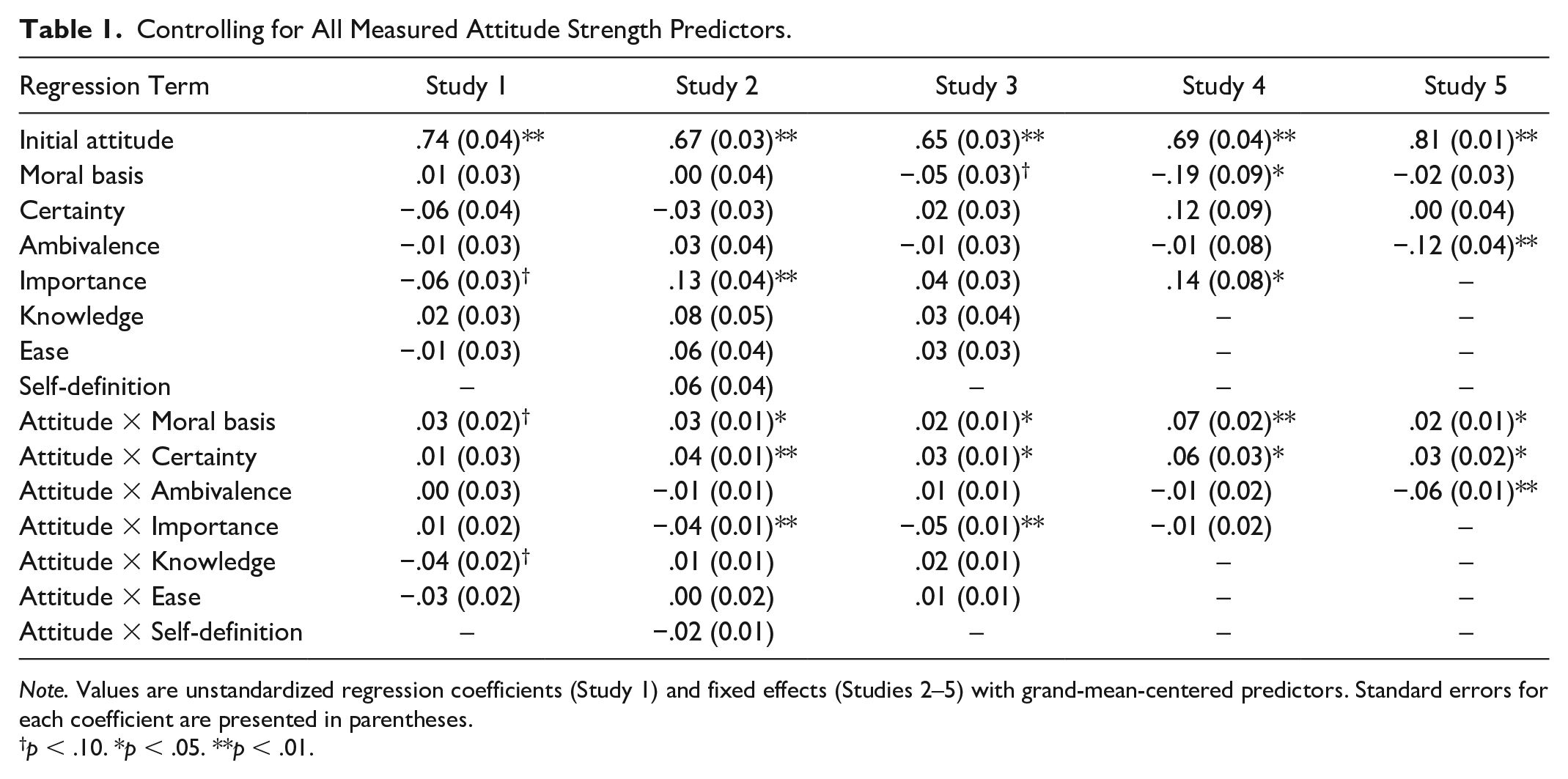
Note. Values are unstandardized regression coefficients (Study 1) and fixed effects (Studies 2–5) with grand-mean-centered predictors. Standard errors for each coefficient are presented in parentheses.
p < .10. *p < .05. **p < .01.
Study 2
We wanted to replicate the effect of moralization with a new set of attitude objects. Thus, in Study 2, we assessed people’s attitudes toward five topics that we thought might vary in valence, stability, and degree of moralization among college students: Barack Obama, football, fast food, coffee, and Muslims. We also measured an additional attitude attribute to test the uniqueness of the moral stability effect. Recent research has highlighted the impact of “self-defining” attitudes, which are attitudes that people say reflect the kind of person they are (Zunick et al., 2017). As one might expect, Zunick et al. showed the more people reported moral bases for an attitude, the more they also said that attitude was self-defining. Self-definition was also correlated with other attitude attributes (e.g., certainty and importance). Thus, perhaps the degree to which an attitude is self-defining is most proximally related to attitude stability, so we included it as an additional covariate to test the robustness of attitude moralization against this other impactful attribute.
Method
Participants
For the first survey, 273 undergraduate students at Ohio State University participated for credit toward an Introductory Psychology course requirement (34.43% male, 65.57% female; Mage = 19.27, SD = 2.61). Students participated in groups of no more than 10 at a time in a small computer lab with dividers separating computer stations. Invitations to complete the online follow-up survey were sent via email 3 weeks after participants completed the initial survey. In total, N = 148 completed the follow-up survey (54% of those invited; average delay between measurements = 22.61 days, SD = 3.03). We ran a logistic regression model entering all Time 1 variables, averaged across topics, as predictors of attrition. Although people who tended to see these topics as personally important were somewhat less likely to complete the second survey, B = −.32, t(263) = −1.99, p = .05, 95% CI = [−0.65, −0.01], no other variable predicted attrition, ps > .20.
Procedure
In the first survey, participants responded to the five topics. For each topic, participants provided their overall attitude, certainty, ambivalence, importance, perceived ease, perceived knowledge, and self-definition before finally reporting how much they thought their opinion had a moral basis. Participants responded to all questions for one topic before moving onto the next one, and the order of topics was randomized for each participant. The follow-up survey was administered online and consisted only of single-item attitude measures for each topic, presented in random order.
Measures
Attitudes
In both surveys, attitudes were measured with a single 11-point semantic differential scale anchored at −5 (“very bad”) and +5 (“very good”).
Perceived moral bases
Moral bases were measured with the same item as Study 1.
Attitude strength predictors
Attitude certainty was assessed on an 11-point scale from −5 (“extremely uncertain”) to +5 (“extremely certain”). All other attitude strength predictors (subjective ambivalence, self-definition, perceived ease, importance, and knowledge) were reported on 7-point scales.
Results and Discussion
Data were restructured such that each observation in the data set pertained to one person’s responses for one topic, resulting in a final data set with 739 complete observations. To account for the fact that each participant provided ratings for the five different topics, we analyzed these data using linear mixed-effects models, modeling random intercepts for participant and topic. For this and all subsequent studies, these models were conducted with the lme4 package for R (Bates et al., 2015), and p-values were computed with lmerTest (Kuznetsova et al., 2017). Effect sizes for fixed effect interactions were computed as a semi-partial R2 designed for mixed models (
As predicted, there was a significant Time 1 attitude × moralization interaction on Time 2 attitudes, γ = .02, SE = 0.01, t(714.2) = 2.26, p = .02, 95% CI = [0.003, 0.04],
Next, we added to the model all other attitude strength predictors and all corresponding two-way interactions with initial attitudes (Table 1). The attitude × moral basis interaction remained significant, γ = .03, SE = 0.01, t(703.7) = 2.43, p = .02, 95% CI = [0.01, 0.05],
Study 3
The aim of Study 3 was to once again test the relationship between moralization and the consistency of attitude reports over time. Five new topics of evaluation were used to test the generalizability of the previous effects to new domains. Also, whereas Study 2 relied on single-item attitude measures (bad–good) at each time point, which may vary across time due to sheer measurement unreliability, Study 3 returns to the multi-item measurement approach of Study 1. The present study’s procedure is otherwise similar to Study 2 except that the time delay is much shorter—participants received an invitation to complete the follow-up survey 2 days after they completed the initial survey.
Method
Participants
For the first survey, 175 undergraduate students at Ball State University participated online for credit toward an Introductory Psychology course requirement (45.71% male, 52.00% female; 2.29% other gender identity; Mage = 19.25, SD = 1.91). We sent a follow-up survey via email 2 days later, which participants completed for additional course credit. One person responded to the Time 2 survey twice, so we retain only the first time this person completed the survey. In total, N = 136 completed the follow-up survey (78% of those invited; average delay between measures = 4.51 days, SD = 3.43). Once again, we ran a logistic regression model entering all Time 1 variables, averaged across topic, as predictors of attrition. Curiously, as in Study 2, people who tended to see these topics as personally important were somewhat less likely to complete the second survey, B = −.32, t(167) = −1.87, p = .06, 95% CI = [−0.67, 0.01], but no other variable predicted attrition, ps > .25.
Procedure
In the first survey, participants responded to five topics: gambling, organic food, immigration reform, gun control, and police officers. For each topic, participants provided their overall attitude, responded to five items tapping established attitude strength predictors, and reported how much they thought their opinion had a moral basis. As in Study 1, participants responded to all questions for one topic before moving onto the next one, and the order of topics was randomized for each participant. The follow-up survey measured attitudes toward each topic again using the same scales with topic order randomized.
Measures
Attitudes
In both surveys, attitudes were measured with four 11-point semantic differential scales (−5 = “negative,” “bad,” “dislike,” “against”; +5 = “positive,” “good,” “like,” “in favor”). Reliabilities were good across topics and surveys (αs > .94), so composite attitude variables were computed by taking the average of the four items for each topic at each time point.
Perceived moral bases
Moral bases were measured using the same items from prior studies, albeit on an 11-point scale.
Attitude strength predictors
Certainty, subjective ambivalence, importance, perceived knowledge, and perceived ease were measured with single items, also on 11-point scales, using similar questions as the previous studies.
Results and Discussion
Data were restructured and analyzed as in Study 2; the final data set contained 680 complete observations. As predicted, there was a significant interaction between initial attitudes and degree of moralizing on follow-up attitudes, γ = .02, SE = 0.01, t(657.1) = 2.02, p = .04, 95% CI = [0.0001, 0.03],
Next, we added all other attitude strength predictors and corresponding two-way interactions with initial attitudes (Table 1). The attitude × moral basis interaction remained significant, γ = .02, SE = 0.01, t(630.6) = 2.27, p = .02, 95% CI = [0.003, 0.04],
Study 4
Until this point, all studies measured perceived moral attitude bases with a single item. In Study 4, we expanded this to a four-item measure used in prior research. Thus, we hoped to replicate the prior studies and generalize the moral stability effect beyond any idiosyncratic effect of the single item we used in prior studies. We also used this opportunity to generalize the effect to still other attitude objects. This study was preregistered (https://aspredicted.org/cq348.pdf); see the Online Supplement for comments on minor deviations from the preregistered plan (e.g., a smaller-than-intended sample size).
Method
Participants
For the first survey, 130 undergraduate students at Ball State University participated online for credit toward an Introductory Psychology course requirement (25.38% male, 73.85% female; 0.77% identifying as nonbinary; Mage = 18.79, SD = 1.24). Twelve students failed our preregistered attention check at Time 1 and were thus excluded from analyses (although including these observations does not substantively change the results).
We emailed invitations to complete the online follow-up survey 2 weeks after each participant completed the initial survey, and they completed the Time 2 survey for additional course credit (average delay between measurements = 17.76 days, SD = 5.27). Of those who passed the attention check at Time 1, 85 students completed the follow-up survey (73% of the eligible Time 1 sample). A logistic regression model showed that none of the Time 1 variables (averaged across topics) predicted retention, ps > .20.
Procedure
Participants completed the first survey online, reporting their attitudes, moralization, and related attitude attributes for five topics: genetically modified food, recycling, vegetarianism, Donald Trump, and Walmart. They responded to all questions for one topic before moving onto the next one, and the order of topics was randomized for each participant. The follow-up survey measured attitudes toward each topic again using the same scales with topic order randomized.
Measures
Attitudes
Attitudes were measured with the same items as in Study 3. Reliabilities were good across topics and surveys (αs > .91), so composite attitude variables were computed by taking the average of the four items for each topic at each time point.
Perceived moral bases
Four items used in prior research (Skitka & Morgan, 2014) were used to measure perceived moral attitude bases. Each was measured on a 5-point scale anchored at “not at all” and “extremely.” For example, participants were asked: “To what extent is your position on [topic] based on a moral principle?” Across topics, the internal reliability of these items was good (αs > .91), so composite variables for perceived moral bases were computed by averaging the four items for each topic.
Attitude strength predictors
Certainty, subjective ambivalence, and importance were measured with single items on 5-point scales, using similar questions as previous studies.
Results and Discussion
Data were restructured and analyzed as in prior studies. The final data set contained 425 complete observations. As predicted, there was a significant interaction between initial attitudes and degree of moralizing on follow-up attitudes, γ = .08, SE = 0.02, t(242.0) = 4.38, p < .001, 95% CI = [0.04, 0.12],
After adding all other attitude strength predictors and their corresponding two-way interactions with initial attitudes, the attitude × moral basis interaction remained significant, γ = .07, SE = 0.02, t(331.5) = 2.95, p = .003, 95% CI = [0.02, 0.11],
Study 5
Because the participants in the previous studies were college students, we wanted to test the generalizability of these patterns with a sample that varied more in their age and backgrounds. Indeed, some data show that younger adults are more prone to changing their attitudes whereas older adults’ opinions remain more stable (Alwin et al., 1991), and moral reasoning can shift across one’s lifespan (Armon & Dawson, 1997). Given these life-span trajectories, it was important to generalize the previous results beyond college students. 6
Like Study 4, this study was preregistered (http://aspredicted.org/blind.php?x=y5hh4e), and the Online Supplement discusses minor deviations from the preregistered plan.
Method
Participants
For the first survey, 1,190 workers on Amazon’s Mechanical Turk (MTurk; 50.59% male, 48.66% female, 0.34% prefer not to respond, 0.42% other; Mage = 36.57, SD = 11.13) participated for US$0.20. Due to recent concerns about the quality of MTurk data, we included a brief free response question at the end of the survey, and two independent raters coded for whether or not participants responded in a way that demonstrated attention to and understanding of the question (see Online Supplement for full details). Coders agreed on 98% of responses, and the 2% of cases on which the first two raters disagreed were re-evaluated by a third rater. In the end, using relatively conservative criteria, 217 respondents were judged not to adequately complete this open-ended attention check. After implementing these exclusions, the final Time 1 sample size was N = 973. Due to a programming error at the time of recruitment, however, only 964 of these participants were invited to complete the follow-up survey.
Invitations to complete the follow-up survey were sent 1 month after participants completed the initial survey. All participants who completed the second survey received an additional US$0.20. In total, 576 people completed the follow-up survey, but four MTurk user IDs appeared twice in the data set, so we kept only the first set of responses from each ID, leaving a final Time 2 sample size of N = 572 (59% of those invited; average delay between measures = 30.12 days, SD = 0.38). Results of a logistic regression model, entering all Time 1 measures averaged across topics as predictors of attrition, showed that the more people tended to feel conflicted, the less likely they were to complete the follow-up survey, B = −.21, t(968) = −2.02, p = .04, 95% CI = [−0.42, −0.01]. No other variables predicted attrition, ps > .50.
Procedure
In the first survey, participants responded to three topics: affirmative action, marijuana legalization, and same-sex marriage (in that order). 7 For each topic, participants first read a description of the issue, provided their opinion, reported how much the opinion had a moral basis, and indicated how certain and conflicted they were. Participants responded to all questions for one topic before moving onto the next one. In the follow-up survey, participants reported their attitudes for each topic, and topics were presented in a random order.
Measures
In both surveys, attitudes were measured with three 9-point semantic differentials anchored at −4 (“bad,” “negative,” “dislike”) and +4 (“good,” “positive,” “like”). Internal reliabilities for the three items were good for each topic at each time point (αs > .98), so composite attitude scores were computed by averaging across the three items. For efficiency in a brief online survey, moral bases, certainty, and subjective ambivalence were each measured with a single item with a 5-point response scale.
Results and Discussion
Data were restructured and analyzed as in the previous three studies. The final data set contained 1,716 complete observations.
Once again, there was a significant interaction between initial attitudes and degree of moralizing on follow-up attitudes, γ = .03, SE = 0.03, t(1,705.0) = 3.98, p < .001, 95% CI = [0.02, 0.05],
After adding certainty, ambivalence, attitude × certainty, and attitude × ambivalence to the model, the attitude × moral basis interaction remained significant, γ = .02, SE = 0.01, t(1,688.9) = 2.21, p = .03, 95% CI = [0.002, 0.04],
All Studies
Because each of the studies in this line of research was run separately and addressed slightly different questions about the stability of moralized attitudes, each study only considered a limited number of topics. However, to ensure sufficient statistical power for the fixed effects and to more appropriately model the random effects by topic, we combined all studies for a final set of analyses. The combined data set includes 19 topics and 1,395 participants who completed both initial and follow-up surveys, resulting in a total of 4,013 observations.
First, to illustrate the initial attitude × perceived moral basis interaction across topics, we conducted regression analyses for each topic separately. These analyses entered initial attitude, perceived moral basis, and the two-way interaction term as predictors of follow-up attitudes. Figure 1 plots the standardized regression coefficients for the interaction term across topics. Although the interactions tend to reflect a moral stability effect such that greater moralization is associated with stronger consistency between initial and follow-up attitudes, the strength of this effect appears to vary quite a bit across topics, and for just a few topics (e.g., recycling and coffee), the interaction is actually in the opposite direction. Notably, the effect for recycling is quite atypical—the interaction is the most negative, and it has a wide confidence interval. Inspection of this specific effect reveals that attitudes were quite positive, on average, at both time points; this low variability potentially made the test–retest correlations for this topic unreliable. See the Online Supplement for plots of this and all other interactions for individual topics.

The standardized betas for the initial attitudes × perceived moral basis interactions on follow-up attitudes across topics considered in five studies.
To use all of the available data and account for the fact that the same samples of participants contributed to several effects depicted in Figure 1, we constructed a multilevel model to analyze all studies simultaneously in a way that also allows us to model the shared variance by individual participants. Because studies varied slightly in the number of scale points used for each measure, we first rescaled all variables on 0–1 scales, making it possible to consolidate effects across studies. 8
We first ran a model on this combined data set that entered initial attitudes, perceived moral basis, and the two-way interaction term as fixed effect predictors of follow-up attitudes. Intercepts were allowed to randomly vary by participant and topic. Results of this analysis mirror those of the earlier studies, supporting the initial attitude × perceived moral basis interaction, γ = .18, t(3,916.8) = 7.83, p < .001, 95% CI = [0.13, 0.23],
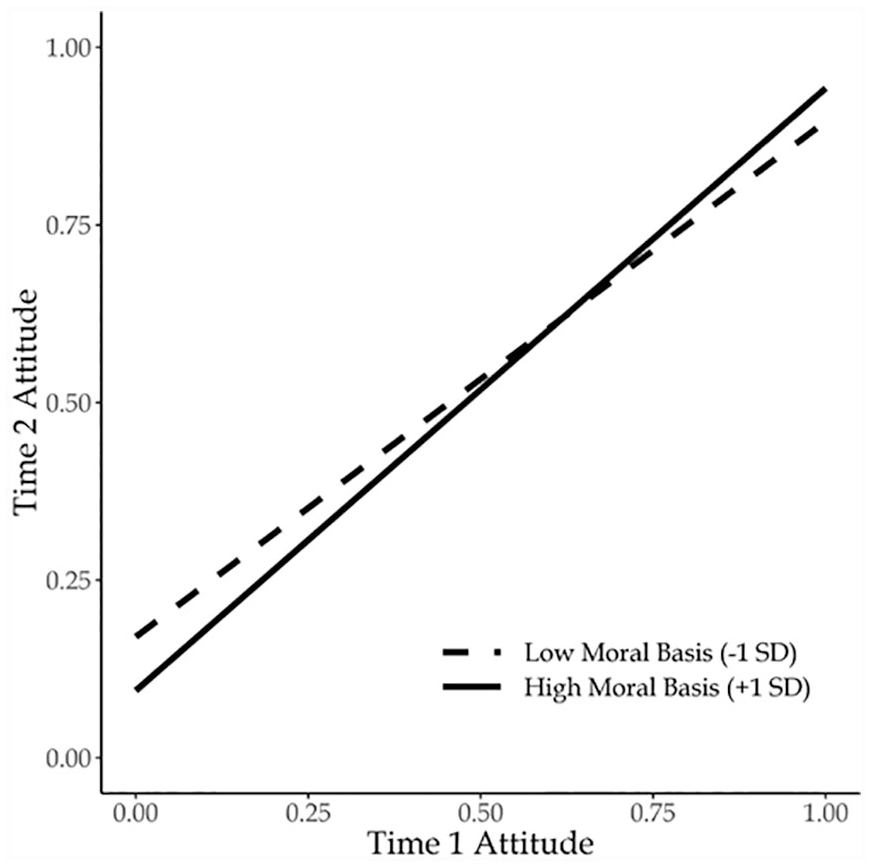
Across all five studies, correspondence between initial and follow-up measures of participants’ attitudes toward 19 different topics is stronger among people who perceive a moral basis for their initial attitudes.
Next, we ran a similar model, except the effects of initial attitudes, perceived moral basis, and the interaction were also entered as random slopes by topic. Even in this model, the fixed effect of the initial attitude × perceived moral basis interaction remains statistically significant, γ = .16, t(7.03) = 3.48, p = .01,
One may wonder whether the moralization effects are strongest for topics that are normatively considered to be “moral.” We computed the average degree of moralization across participants for each topic and tested topic-level moralization as a moderator of the initial attitude × moralization interaction. We dropped the random intercept for topic because it was redundant with the new moderator. Results fail to support the three-way interaction, γ = −.06, t(3,772.2) = −0.41, p = .68, showing that attitude moralization similarly moderates the correspondence between Time 1 and Time 2 attitudes for topics both high and low in normative degree of moralization. This lends further credence to the notion that morality is more impactful when considered as an individual’s idiosyncratic perspective on an issue rather than as a property of a topic itself (see also Skitka, 2010).
Finally, we took this opportunity to examine possible between-participant confounds in our results. That is, perhaps some unaccounted-for individual difference makes people moralize their attitudes and also maintain their attitudes over time, producing a spurious link between moralization and stability. Because participants in Studies 2–5 reported several attitudes, we could create an index of between-participant differences in tendency to moralize by averaging each person’s moralization responses across topics. Following Hamaker and Muthén (2019), we entered mean moralization and the initial attitude × mean moralization interaction term as covariates in the above random intercepts model. Results supported a unique interaction between initial attitudes and attitude-specific moralization on Time 2 attitudes, γ = .15, p < .001, but did not support a unique interaction between initial attitudes and individual differences in moralization, γ = .05, p = .31. 10 This provides compelling evidence that attitude-specific moralization is most proximally associated with attitude stability.
General Discussion
Across five longitudinal studies considering the stability of attitudes toward 19 different topics, we consistently found evidence for a moral stability effect: the more people perceived a moral basis for an attitude, the more consistent attitude reports were at two different times, separated by up to 2 months. Furthermore, this moral stability effect was independent of other established indicators of attitude strength (e.g., certainty), which also tended to independently predict more stable attitudes. Together, this evidence further suggests that moralization is a unique predictor of attitude strength, and it is the first to support such longitudinal effects.
It bears noting, however, that the overall effect of moralization is quite a bit smaller than one might expect given the presumed importance of morality to psychology. That is, the fixed effect of the interaction across studies accounted for a relatively small portion of the variance in Time 2 attitudes (
Second, the relatively small overall effect of moralization is an average across what appears to be a somewhat variable effect at the topic-level (see Figure 1). That is, although the moral stability effect emerged in the aggregate, we may have missed it if we had only considered a few topics because it was significant for some attitudes (e.g., Donald Trump, same-sex marriage) and nonsignificant—but following the same pattern—for others (e.g., affirmative action, police officers). In fact, a few topics actually showed signs of the opposite interaction such that attitudes were more consistent over time at lower levels of moralization (e.g., coffee). We found that this variability was not related to differences in the studies themselves nor was it related to how normatively “moral” the topic was. Thus, this variability is a clear avenue for future research, raising questions about moderators of moralization’s effect on attitude stability (cf. Luttrell, Petty, & Briñol, 2016). Nevertheless, recent analyses show that effect sizes vary even across exact replication studies, suggesting that random variability in effect sizes is under-appreciated in social psychology (Kenny & Judd, 2019).
So, why does moralization tend to predict longer lasting attitudes, and why might this effect vary with the attitude object? As we outlined previously, both the sense of objectivity and emotionality accompanying moralized attitudes may contribute to their stability, but they may also account for the observed variability in this effect. That is, perceived objectivity and emotion may not characterize all moralized attitudes. Evidence from research on meta-ethics supports this possibility, showing that people do not uniformly treat moral questions as though they have objectively correct answers but instead demonstrate considerable variability across moral topics in the extent to which they treat them as matters of fact (e.g., Goodwin & Darley, 2008; Heiphetz & Young, 2017). The same may be true for emotion; despite a general correspondence between emotion and moral judgment, people could nevertheless view their attitudes on a particular issue as morally relevant without necessarily having an especially emotional reaction (cf. McAuliffe, 2019). Future research should probe the roles of these underlying mechanisms in the longevity of moralized attitudes.
One might also surmise that our results on stability over time are due completely to moralized attitudes’ propensity to resist social influence. That is, perhaps more moralized attitudes tend to remain more stable over time because they can withstand the persuasive challenges that arise naturally in one’s daily experiences. This is undoubtedly a compelling mechanism but is unlikely the only one. Moralization might also correspond with more enduring attitudes even if (or because) they are not directly challenged. For example, the more people moralize an attitude, the more intolerant they are of people with opposing views (e.g., Garrett & Bankert, 2018). As a result, moralization may lead people to develop “echo chambers” or attitudinally homogeneous social networks (e.g., Dehghani et al., 2016). In such networks, people’s views are supported by others and rarely challenged, allowing these attitudes to persist over time. Similarly, just as people show stronger selective exposure effects for more confidently held attitudes (Knobloch-Westerwick & Meng, 2009), people with more moralized attitudes may also be more prone to selectively attend to attitude–congenial and avoid attitude–uncongenial information. Future research can unpack these complementary processes that may make these attitudes endure over time.
Finally, it may surprise some readers that other strength-related attitude attributes such as ambivalence and importance did not emerge as robust predictors of attitude stability. Although these variables are often described as reliable predictors of attitude strength, prior evidence has been mixed, and these variables’ effects on attitude strength are often moderated by other features of the attitude or situation (see Luttrell & Sawicki, in press). Nevertheless, even though attitude certainty has sometimes failed to predict attitude stability (e.g., Craig et al., 2005), we find pretty consistent evidence for its role in predicting stable attitudes. We encourage future research that continues to examine a multitude of variables and their role in longitudinal attitude stability over a range of attitude objects.
In sum, this work represents the first in-depth examination of the longevity of moralized attitudes. Consistent with prior research in this area, the more people perceive a moral basis for an attitude, the more stable that attitude tends to be over time. These results contribute to growing interests in moralized opinions and raise intriguing new questions for future research, which will refine our understanding of how individuals’ sense of moral right and wrong modulate the durability and influence of their everyday opinions.
Supplemental Material
Luttrell_Online_Appendix – Supplemental material for The Stability of Moralized Attitudes Over Time
Supplemental material, Luttrell_Online_Appendix for The Stability of Moralized Attitudes Over Time by Andrew Luttrell and LaCount J. Togans in Personality and Social Psychology Bulletin
Footnotes
Acknowledgements
The authors thank Laura Wallace for comments on an earlier version of the manuscript, Richard Petty for feedback on the broader line of research, Matthew Rocklage and Holmes Finch for help on the statistical analytic approach, and Paulie Robinson-Stevens and Amr Elshazly for assistance with data collection.
Declaration of Conflicting Interests
The author(s) declared no potential conflicts of interest with respect to the research, authorship, and/or publication of this article.
Funding
The author(s) received no financial support for the research, authorship, and/or publication of this article.

Supplemental Material
Supplemental material is available online with this article.
Notes
References
Supplementary Material
Please find the following supplemental material available below.
For Open Access articles published under a Creative Commons License, all supplemental material carries the same license as the article it is associated with.
For non-Open Access articles published, all supplemental material carries a non-exclusive license, and permission requests for re-use of supplemental material or any part of supplemental material shall be sent directly to the copyright owner as specified in the copyright notice associated with the article.
