



Abstract
Whereas mindfulness has been shown to enhance personal well-being, studies suggest it may also benefit intergroup dynamics. Using an integrative conceptual model, this meta-analysis examined associations between mindfulness and (a) different manifestations of bias (implicit/explicit attitudes, affect, behavior) directed toward (b) different bias targets (outgroup or ingroup, e.g., internalized bias), by (c) intergroup orientation (toward bias or anti-bias). Of 70 samples, 42 (N = 3,229) assessed mindfulness-based interventions (MBIs) and 30 (N = 6,002) were correlational studies. Results showed a medium-sized negative effect of MBIs on bias outcomes, g = −0.56, 95% confidence interval [−0.72, −0.40]; I(2;3)2: 0.39; 0.48, and a small-to-medium negative effect between mindfulness and bias for correlational studies, r = −0.17 [−0.27, −0.03]; I(2;3)2: 0.11; 0.83. Effects were comparable for intergroup bias and internalized bias. We conclude by identifying gaps in the evidence base to guide future research.
Intergroup bias refers to the systematic tendency to evaluate members of one’s own group more favorably than members outside of one’s group (Brewer & Brown, 1998; Fiske, 1998; Turner et al., 2001). For those with societal power, intergroup bias provides the moral justification for perpetuating injustice and inequality, systemic oppression and violence, ethnic cleansing and genocide (Hewstone & Cairns, 2001). For example, it has been found to contribute to racial and ethnic disparities across a range of life outcomes including health care quality (Hall et al., 2015; Williams & Wyatt, 2015), police use of deadly force (Hehman et al., 2018; Ross, 2015), employment decisions (Bertrand & Mullainathan, 2004; Koch et al., 2015), and disciplinary responses in school settings (Chin et al., 2020; Okonofua & Eberhardt, 2015). Beyond race and ethnicity, intergroup biases related to gender, social class, disability, body size, sexual orientation, and so on have also been associated with significant adverse consequences for marginalized groups (Chrisler & Barney, 2017; Hackett et al., 2020; Lott, 2012; Meyer, 2003; Watts & Zimmerman, 2002).
Despite this common tendency to draw boundaries between “us” and “them,” many individuals are also driven by more humanistic values such as prosociality, allyship, and social justice (Duncan, 2012). Across history, systematic efforts to ostracize, oppress, or aggress against another group have been met with organized opposition among those who see through divisive and dehumanizing rhetoric to recognize our shared humanity. Examples include White activists who opposed apartheid in South Africa; heterosexual allies who campaign for lesbian, gay, bisexual, transgender, and queer/questioning (LGBTQ) rights, and the growing, multicultural activist coalitions that have advanced the Black Lives Matter movement across the world. Recent scholarship describes individual and group-level predictors and processes by which individuals with relative privilege are motivated to work toward ending oppression for marginalized groups (Grzanka et al., 2015; Suyemoto & Hochman, 2021; van Zomeren et al., 2008). Yet such prosocial intentions may be undermined by self-serving motives, emotions of fear and shame, and the pull to retreat to comfort rather than battle the systems that maintain oppression (Radke et al., 2020; Spanierman & Cabrera, 2015). How can we strengthen this impulse toward communality over division, justice over oppression, across diverse groups?
In recent years, there has been a growing interest in mindfulness and other contemplative practices as a pathway to disrupting intergroup bias and promoting more equitable relationships between groups. Contemporary psychological definitions of mindfulness refer to moment-by-moment awareness of our bodily sensations, thoughts, feelings, and surrounding environment, paired with an attitude of openness, curiosity, and nonjudgment (Kabat-Zinn, 2011). Although a robust body of research (see Brown & Ryan, 2003; Davidson, 2010) has established the benefits of mindfulness for the individual—including improvements in mood, stress, emotional self-regulation, psychological flexibility, and working memory—mindfulness as originally developed within Buddhist traditions was aimed at the cultivation of so-called virtuous mental states, including compassion for others (Condon, 2017).
Indeed, there is accumulating evidence of the interpersonal benefits of mindfulness (Berry & Brown, 2017; Berry et al., 2020; Condon, 2017). A recent meta-analysis involving 31 studies (N = 17,241) reported that individual differences in mindfulness were associated with prosocial behavior, and that mindfulness interventions predicted significant increases in helping behaviors (Donald et al., 2019). Berry et al.’s (2020) more recent meta-analysis found that even without the inclusion of ethics-based instruction (e.g., lovingkindness, compassion), mindfulness training alone can promote overt prosocial behavior.
The application of mindfulness and related contemplative practices to the problem of intergroup bias is still in the early stage; however, there is emerging evidence that it may be effective. Oyler et al. (2022) conducted a systematic review of the growing research on mindfulness and intergroup bias. They found that across a diverse pool of 29 studies—which included mindfulness-based interventions, brief mindfulness inductions, expert meditators, and correlational studies of dispositional traits—the overall average effect size was g = 0.29 (k = 36; 95% confidence interval [CI] [0.20, 0.39], suggesting a small but significant effect of mindfulness in improving intergroup bias. Effect sizes were slightly larger for intervention studies than for correlational studies. While results indicate that mindfulness is a promising approach to reducing intergroup bias, the largely descriptive focus of the review highlights the need for a more comprehensive and inclusive conceptual framework to guide research in this burgeoning field. For example, this study used a limited number of search terms for mindfulness and intergroup bias constructs, which may inadvertently exclude some studies on related constructs such as stereotyping, racism, sexism, and other specific forms of bias, due to variability in indexing practices across databases. They also restrict their theoretical focus to studies that examine bias directed toward outgroup members, not the experiences and outcomes of outgroup members themselves. Finally, while the authors provided a useful narrative summary of results by different outcome categories (implicit, behavioral, explicit), they did not separately examine the effect of mindfulness for these different expressions of bias. Given the urgent need for effective approaches to address the increasing polarization and intergroup bias that plagues societies across the globe, the present study seeks to clarify the association between mindfulness and bias by conducting a broad and inclusive meta-analysis of the quantitative research.
We present an integrative conceptual model that synthesizes established bias frameworks along three dimensions: (a) manifestations of bias, specifically implicit attitudes, explicit attitudes, affect, and behavior; (b) bias target, whether members of an outgroup (bias) or ingroup (internalized bias); and (c) intergroup orientation toward bias or anti-bias (see Figure 1). This model guides our approach to examining mindfulness as both an individual difference factor and an intervention directed toward different expressions of bias, while extending the scope of analysis in two key ways to reflect new directions in the science of intergroup bias. First, in addition to examining bias directed toward outgroup members, we include studies that examine the internalization of bias among marginalized populations. These studies are important because they center the experiences of targeted groups (e.g., racial minorities, the mentally ill, LGBTQ populations) who experience derogation and animus in the broader culture, and examine whether mindfulness reduces the internalization of negatively biased attitudes directed toward their group, for example, internalized bias.
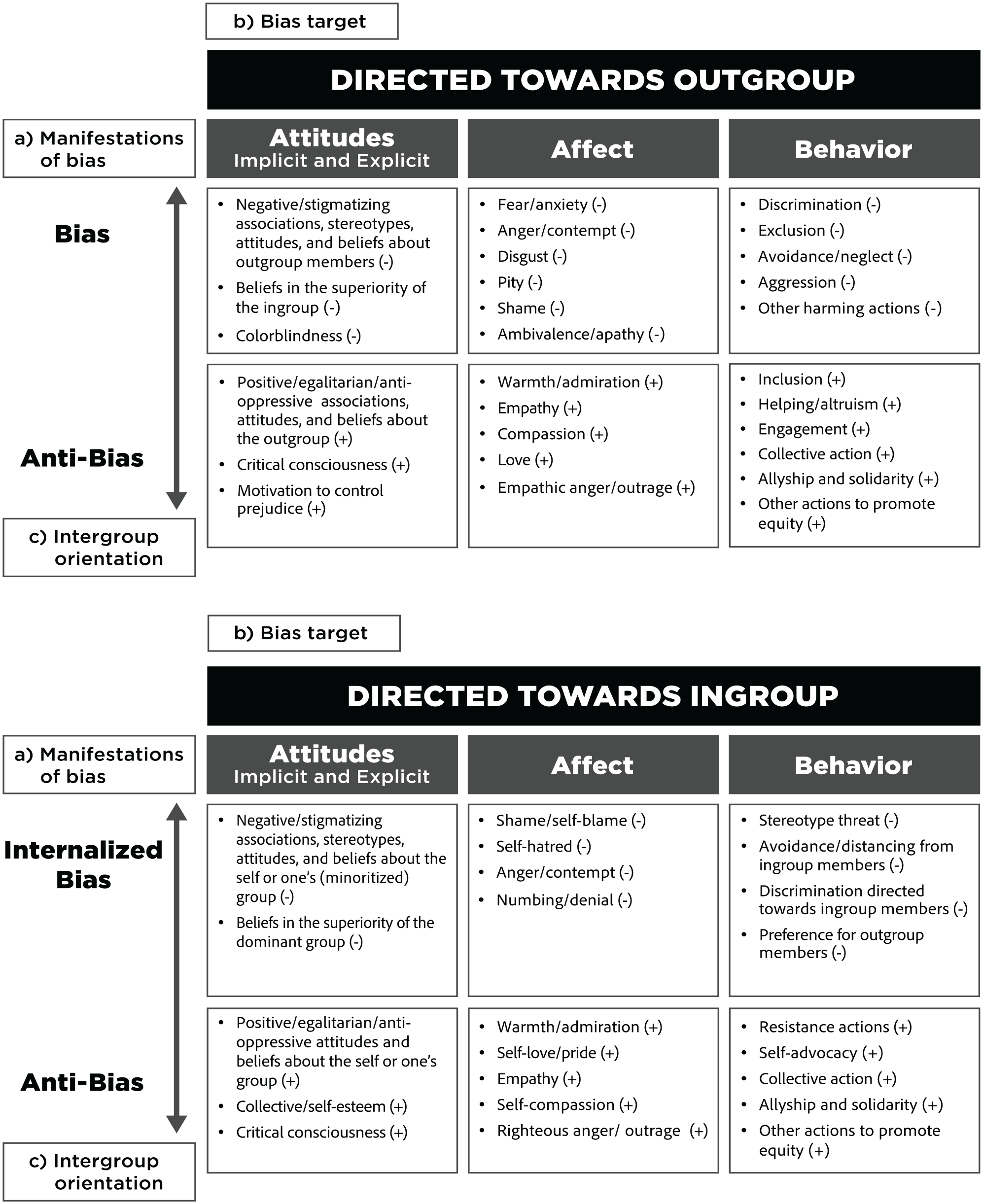
Conceptual Framework.
Second, we conceptualize bias as one end of a continuum, the other end being attitudes, beliefs, and behaviors that reflect and promote greater inclusion, equity, and belonging for marginalized populations. For example, mindfulness and related contemplative practices have been applied recently to the cultivation of cultural awareness and anti-oppressive practice, especially among helping professionals (Hilert & Tirado, 2019; Y.-L. R. Wong, 2013). Accordingly, we also include in our review and meta-analysis studies that examine associations between mindfulness and anti-bias outcomes such as positive emotions toward marginalized groups, cultural awareness, motivation to respond without prejudice, and altruistic and inclusive behaviors toward outgroup members (e.g., Ashar et al., 2016; Ivers et al., 2016; Tourek, 2014).
Guided by our integrative conceptual model, we examine associations between mindfulness and the cognitive, affective and behavioral dimensions of bias, internalized bias, and anti-bias. We also examine substantive moderators, including characteristics of the sample, bias target, study design, and year of publication. Our goal is to summarize and evaluate the relevant empirical studies in this burgeoning field to provide guidance in the effort to remedy the problem of intergroup bias and the division, oppression, and violence that often results.
Intergroup Bias
Dovidio and Gaertner (2010) define intergroup bias as “an unfair evaluative, emotional, cognitive, or behavioral response toward another group in ways that devalue or disadvantage the other group and its members either directly or indirectly by valuing or privileging members of one’s own group” (p. 1084). Thus, embedded in the concept of intergroup bias is an ethical position, specifically that our evaluations and responses toward ingroup and outgroup members should be balanced, equitable, and nonharming.
Bias has typically been examined in terms of stereotypes (overgeneralized beliefs), prejudice (biased attitudes/affect), and discrimination (unfair treatment) (Dovidio & Gaertner, 2010). Stereotypes refer to those qualities, such as social roles and traits, that are perceived to distinguish particular categories of individuals. When stereotypes are activated, individual group members are judged by the cognitive representations of that group, which include trait associations (e.g., Asians are good at math) as well as affective reactions to the group (i.e., low warmth) (Cuddy et al., 2008). Prejudice refers to biased attitudes, which contain cognitive and affective elements, as well as behavioral inclinations to respond in particular ways toward an outgroup (Dovidio & Gaertner, 2010). As prejudice has shifted in modern times to be more subtle and less overtly hostile, it may manifest as aversive or avoidant reactions, policy views that would adversely affect the outgroup (e.g., “colorblind” policies), and implicit associations.
Whereas stereotypes and prejudice are conceptualized as intrapsychic phenomena, spanning cognitive and affective dimensions, discrimination refers to unfair treatment of individuals because of their group membership. Discrimination may include direct and indirect actions that cause harm, including violence, hostility, negligence, and exclusion, as well as less positive behavior or consideration than would be directed toward an ingroup member. Examples include failing to help someone in need, devaluing the qualifications of a job candidate, or ostracizing someone from one’s social network because of their race or some other characteristic.
In their seminal work, Cuddy et al. (2007) proposed the Behaviors from Intergroup Affect and Stereotypes (BIAS) map, which models a set of predictable relationships between cognitive (stereotypes), affective (emotional prejudice), and behavioral (discrimination) dimensions of bias. Empirical tests of the BIAS map confirm that while both stereotype content and emotions predict particular behavioral action tendencies, emotions (Esses & Dovidio, 2002; Esses et al., 1993) mediate the relationship between stereotypes and action tendencies (Bye & Herrebrøden, 2018; Cuddy et al., 2007). In other words, stereotype content activates certain emotions, and those emotions lead to certain behavioral tendencies (to actively or passively facilitate or harm the target group’s goals). These findings are consistent with other studies suggesting that affect often predicts discriminatory behavior better than stereotypes (e.g., Esses & Dovidio, 2002; Stangor et al., 1991). Taken together, research confirms the distinctive but related influence of cognitive and affective dimensions of bias in predicting discriminatory behaviors, suggesting distinct targets for intervention. For example, given the more direct influence of emotions on discriminatory behavior, improving emotional self-regulation in response to stereotype activation may serve to weaken the emotion–behavior link. While less closely associated with behavior, cognitive dimensions of bias (e.g., stereotypes, beliefs, attitudes) also predict discriminatory intentions, creating what Talaska et al. (2008) propose as a “conscious ideological system.” Therefore, strengthening self-awareness and cognitive flexibility also may contribute to decreases in explicit and implicit attitudes and greater behavioral intentions to challenge bias and discrimination in self and others (Lillis & Hayes, 2007). To quantify the relative strength of associations with these different bias components, we draw on the Cuddy et al (2007) BIAS framework to separately explore the effects of mindfulness on the cognitive, affective, and behavioral dimensions of bias (see Figure 1).
Effects of Bias on Targeted Groups
Whereas much of the research on intergroup bias focuses on ways to reduce bias among higher-status groups, less is known about the experiences and impact of bias from the perspective of the target group members themselves (Fox et al., 2018; Pyke, 2010). The sociological concept of stigma describes the status loss that occurs when particular individuals or groups become designated as marked, tainted, or morally polluted as a result of some socially salient attribute (Goffman, 1963; Link & Phelan, 2001). Examples of stigmatized statuses in North America include being a member of a racial, ethnic, sexual, gender, or religious minority; being elderly, overweight, homeless, or having an illness or disability (e.g., mental illness, HIV/AIDS). Those with the power to define and reinforce ideas of differentness and abnormality systematize the process of devaluation into norms, practices, and policies (Crocker et al., 1998; Link & Phelan, 2001). In this way, bias at the interpersonal level is reinforced by and contributes to systematic bias in the institutions and structures of society, with harmful consequences for targeted groups.
For example, chronic exposure to racist stereotypes, prejudice, and discrimination is a feature of everyday life for Black Americans and is associated with low educational achievement, poverty, poor health, police shootings, incarceration, and decreased life expectancy (Mesic et al., 2018; Morris & Perry, 2016; Williams et al., 2019). Over time, they may come to internalize ideas about themselves as inferior and accept racial inequities as deserved (David et al., 2018; Pyke, 2010), resulting in feelings of self-hatred and shame, devaluation of one’s culture of origin and idealization of whiteness (Fanon, 1963; Freire, 1970b).
Like bias itself, internalized bias has been operationalized in terms of its cognitive, affective, and behavioral components. Examples include endorsement of negative attitudes, beliefs, and judgments about one’s own (stigmatized) group; negative affect related to being a member of the group; stereotype-consistent behaviors, discriminating against members of their own group, and supporting institutional policies that maintain inequality (Corrigan et al., 2006; David et al., 2018; Lillis et al., 2010; Steele & Aronson, 1995). However, most studies focus on its cognitive and affective dimensions. For example, the widely used Weight Bias Internalization Scale (Durso & Latner, 2008) assesses respondents’ endorsement of negative views about persons with overweight and obesity (e.g., “I am less attractive than most other people because of my weight”). Studies also typically find that while marginalized groups view their own group more favorably than do dominant groups, they still evidence more positive implicit associations to the (dominant) outgroup, with some exceptions (e.g., Black Americans) (Nosek et al., 2007).
Although internalized bias is detrimental to the mental and physical well-being of marginalized groups (Graham et al., 2016; Hatzenbuehler, 2009; Hwang, 2021; Livingston & Boyd, 2010; Turan et al., 2017), few interventions have been designed specifically to address it. As research has predominantly focused on reducing intergroup bias and stigma among dominant group members (e.g., White college students), centering the experiences of marginalized groups emphasizes both the deleterious psychological effects of bias and oppression as well as intragroup efforts to resist, confront, and heal from it (David, 2013; French et al., 2020; Ma et al., 2019). For these reasons, in the present review and meta-analysis, we broaden our definition of bias outcomes to include both intergroup bias (directed toward outgroup members) and internalized bias (directed toward ingroup members), with a shared focus on their cognitive, affective, and behavioral components (see these dimensions in Figure 1).
From Bias to Anti-Bias
A second distinctive aspect of our approach is to conceptualize bias on a continuum from bias to anti-bias. This view is consistent with critical race scholars who argue that the antidote to racism is not simply race-neutrality or colorblindness, but rather anti-racism (Delgado & Stefancic, 2001; Kendi, 2019). Racial colorblindness, which provides justification for practices that maintain racial inequities, such as race-blind admissions, police brutality, and housing discrimination, has been found to be associated with internalized oppression (Neville et al., 2005) and less engagement in anti-racist actions (Yi et al., 2022). In contrast, an anti-racist position may include awareness that White supremacy and other systems of oppression shape individuals’ life outcomes, and behaviors aimed at disrupting racist ideas and policies to promote racial equity. We extend this basic premise to other forms of bias and anti-bias—including that related to gender identity, sexual orientation, social class, nativity, ability, body size, religion, and illness.
For minoritized groups, becoming aware of and resisting biased and inferiorizing messages from society has been proposed as a crucial component of well-being (David, 2013; French et al., 2020). The influential Brazilian educator Paulo Friere advanced the concept of critical consciousness (CC) or conscientization, which describes the process whereby marginalized or oppressed groups learn to identify and analyze the structural forces (such as racism, classism, and sexism) that produce inequitable social conditions (critical reflection) and take action to change them (critical action) (Freire, 1970a). Resistance to the dominant messages that normalize one’s subordination provides a pathway to reclaiming one’s humanity and changing society. Thus, like bias itself, the concept of critical consciousness encompasses cognitive (awareness), affective (self-compassion), and behavioral (action) components. Among diverse minoritized groups, critical consciousness has been associated with positive psychological, educational, and health outcomes and the reduction of negative consequences associated with oppression (see Jemal, 2017, for a review). Other intervention frameworks for internalized bias focus on the development of self-love, self-compassion, positive ethnic identity, and collective resistance (David et al., 2018; French et al., 2020). Therefore, in addition to examining outcomes related to implicit and explicit cognitions, affect, and behavior regarding stigmatized groups, we also include studies that target outcomes related to anti-bias/ anti-oppressive and inclusive cognitions, emotions, and behaviors (Figure 1). Examples include intercultural attentiveness, sensitivity, engagement, and respect for cultural differences (Chen, 2000), multicultural counseling competence (Holcomb-McCoy & Day-Vines, 2004), and prosocial actions to benefit marginalized groups specifically (e.g., Ashar et al., 2016).
Mindfulness
Given the widespread harm that bias causes to marginalized groups, determining how best to decrease bias and increase anti-bias efforts is a public health priority. In recent years, researchers have begun to explore the possible benefit of mindfulness for reducing bias and promoting anti-bias outcomes. Mindfulness is a term with different meanings in Buddhist and contemporary contexts, but in a basic sense refers to “a self-regulated attentional stance oriented towards present-moment experience that is characterized by curiosity, openness, and acceptance” (Dahl et al., 2015, p. 515). Mindfulness has been operationalized in numerous ways, including as (a) a naturally occurring dispositional trait (e.g., Baer et al., 2006; Brown & Ryan, 2003; Lau et al., 2006), (b) an attentional skill, developed through meditation, of awareness of what is arising moment-to-moment in sensory experience, and (c) a group of meditative practices used to develop a set of skills or qualities to reduce self-processing biases, reduce suffering, and cultivate a healthy mind (Vago & Silbersweig, 2012).
Most studies applying mindfulness to the problem of bias are informed by Buddhist philosophical understandings of mindfulness and its cultivation through different forms of meditation (see Dahl et al., 2015; Lutz et al., 2007). Focused attention (FA) practices involve training one’s attention on a sensory target (e.g., breath) or other object (Dahl et al., 2015). As the task requires noticing when one’s mind has wandered, FA practices cultivate attentional control and self-monitoring skills (Lutz, Slagter, et al., 2008; Vago & Silbersweig, 2012). For example, in Lueke and Gibson’s (2015) study examining the effects of mindfulness on implicit age and race bias, participants listened to a 10-min mindfulness recording that guided them to become aware of any physical sensations they were experiencing in the present moment and to accept those sensations without trying to alter, resist, or judge them. A foundational practice, FA is frequently employed in empirical studies of mindfulness and bias, alone or in combination with other techniques. Building on the attentional control cultivated by FA practices, open-monitoring (OM) practices enhance the person’s ability to monitor dimensions of experience (thoughts, feelings, etc.) with less judgment, discernment, or reactivity (Dahl et al., 2015). OM practices often begin with FA but then broaden the focus of attention while emphasizing the monitoring aspect of awareness. For example, the mindfulness condition in Berry et al.’s (2018) study of prosociality toward ostracized strangers consisted of listening to an 8½-min recording of a guided practice to induce a state of attention to moment-to-moment somatic, cognitive, and emotional experiences (adapted from Segal et al., 2002).
Finally, others have studied the effects of constructive practices, or what Vago and Silbersweig (2012) refer to as “ethical enhancements” to mindfulness interventions. These practices typically begin with foundational training in mindful attention and acceptance of present-moment experience, before advancing to the active cultivation of prosocial emotions, such as lovingkindness, empathy, and compassion (Dahl et al., 2015; see Galante et al., 2014, for a review) that may be specifically directed toward marginalized groups (e.g., Kang et al., 2014). Finally, clinical researchers also have tested the effects of multi-component mindfulness-based interventions (MBIs), such as adaptations of Mindfulness-based Stress Reduction (MBSR) and Acceptance and Commitment Therapy (ACT), that integrate various aspects of mindfulness training with other contemplative, psychological, or relational methods to specifically address intergroup bias and internalized bias (e.g., Lillis & Hayes, 2007; Skinta et al., 2015; Taylor et al., 2016). As applications of MBIs to the problem of bias are in its early stage, this review includes both types of studies (e.g., “mindfulness-only” and multi-component, “mindfulness-plus” studies) and compares results in moderator analyses to identify promising areas for future study.
How Mindfulness May Reduce Bias
In Vago and Silbersweig’s (2012) widely cited integrative conceptual framework, mindfulness is proposed to reduce biases and distortions in three main ways: by developing meta-awareness of one’s moment-to-moment experience without judgment or reactivity (self-awareness), increasing one’s ability to manage emotions and responses in adaptive ways (self-regulation), and cultivating a prosocial orientation toward others that transcends personal needs and desires (self-transcendence). The self-processing focus of their model is supported through converging evidence of the benefits of mindfulness and its underlying neurobiological mechanisms (Hölzel et al., 2011). Experimental, phenomenological, and clinical studies on mindfulness describe a range of cognitive and psychological benefits including improvements in self-awareness, cognitive flexibility, attentional functioning, emotional and behavioral regulation (Hodgins & Adair, 2010; Moore & Malinowski, 2009). These outcomes are mirrored by mindfulness-induced changes in brain regions involved in attention, learning and memory, self-referential processing, perspective-taking, and emotion regulation (for a review, see Tang et al., 2015). Beyond the individual mind, brain, and body, mindfulness also has been shown to have significant interpersonal benefits (Berry et al., 2020; Donald et al., 2019). We predict that these cognitive, affective, and behavioral benefits of mindfulness will extend to the bias domain to reduce biases directed toward marginalized outgroup members as well as biases directed toward the self (internalized bias). This leads to our first prediction:
Links Between Mindfulness and Four Dimensions of Bias
As the effects of mindfulness span cognitive, affective, and interpersonal outcomes, we predict that mindfulness will decrease bias/increase anti-bias tendencies in the four key dimensions of bias introduced above (and presented in Figure 1), namely implicit attitudes, explicit attitudes, emotions, and behaviors (Cuddy et al., 2007).
Implicit Attitudes
A growing number of studies suggest that mindfulness training may be associated with less implicit bias, frequently assessed using the Implicit Association Test (IAT). Relational mindfulness practices in particular, such as lovingkindness and compassion meditation, activate prosocial values and perspective-taking, and may reduce the accessibility of negative stereotypes activated by implicit measures (Flook et al., 2015; Schonert-Reichl et al., 2015; Shih et al., 2009). For example, Stell and Farsides (2016) found that white college students randomly assigned to a 7-min lovingkindness meditation (LKM) condition, part of which involved directing lovingkindness toward an image of a Black stranger, showed lower levels of implicit bias against Blacks relative to a control group. Furthermore, work by Kang and colleagues suggests that longer periods of LKM practice may produce global reductions in implicit bias, even when the practice does not specifically focus on the bias target (Kang et al., 2014; Kang & Falk, 2020).
Other research suggests that the attentional and self-regulatory benefits of mindfulness may also weaken implicit negative associations to target groups, even without directly targeting the content of individuals’ biases. Lueke and Gibson (2015) found that a 10-min mindfulness intervention that guided participants to be more aware of their bodily sensations and thoughts was associated with greater decreases in implicit race and age bias compared with an active control. Separate analyses examining measures of automatic and controlled processing found that this reduction was the result, in part, of a reduction in the automatic activation of negative associations with the target group (e.g., Black/bad, old/bad), and not an increase in cognitive control. However, other correlational and intervention studies find no association between mindfulness and implicit bias (i.e., Hunsinger et al., 2019; Mann, 2012; Verhaeghen & Aikman, 2020), underscoring the value of the present review.
Explicit Attitudes
Mindfulness may affect explicit attitudes in a number of ways, for example by (a) increasing awareness of automatically activated biases and prompting the initiation of self-regulatory processes (Teper et al., 2013), (b) facilitating perspective-taking, which may reduce the endorsement of stereotypes and increase anti-bias commitments (Dovidio et al., 2004; Shapiro et al., 2006), and (c) among marginalized groups in particular, developing self-compassion and acceptance, which have been recommended as strategies for reducing internalized bias (Hwang, 2021).
Correlational studies have found a link between mindfulness and explicit attitudes relating to intergroup bias, internalized bias, and anti-bias attitudes (Gervais & Hoffman, 2013; Graham, 2013; Salvati et al., 2019). In one study, Salvati et al. (2019) found that mindfulness was associated with less internalized sexual stigma in gay/bisexual men and less explicit sexual prejudice in heterosexual men, even after controlling for demographic, psychological, and cultural characteristics. However, other correlational studies find little support for the association between trait mindfulness and explicit attitudes (e.g., Hasler, 2017; Platt & Szoka, 2021).
As another explanation, research suggests that mindfulness may counteract basic processes of social categorization, the main perceptual mechanism through which bias arises and is maintained (Dovidio & Gaertner, 2010). Specifically, mindfulness training is thought to increase awareness of and openness to challenging stereotypic assumptions of marginalized groups as homogeneous, inferior, and “other” (Shapiro et al., 2006), which may produce shifts in explicit attitudes. Several multi-component mindfulness-based interventions incorporating elements such as compassion training (Ashar et al., 2016; Palmeira et al., 2017), socio-emotional skills development (Berger, Brenick, & Tarrasch, 2018; Berger, Brenick, Lawrence, et al., 2018), and cognitive defusion techniques (Hayes et al., 2004; Kenny & Bizumic, 2016) have been found to decrease explicit prejudicial attitudes. Yet, mindfulness interventions have not consistently produced changes in explicit attitudes (e.g., Masuda et al., 2007). So although there are compelling explanations for why mindfulness should inhibit explicit attitudes of intergroup bias, there is a need to assess the extant evidentiary base.
Affect
Intergroup contexts elicit a range of emotions, including fear and anger (prejudice), shame and self-hatred (internalized bias), and hope and compassion (anti-bias) (David et al., 2018; Fiske et al., 2002; Spanierman & Cabrera, 2015). As mindfulness is associated with improvements in emotional self-regulation, mindfulness training may help individuals to manage the stresses of intergroup contact and elicit more positive, inclusive emotions (Richeson & Nicole Shelton, 2003; Stephan & Stephan, 1985).
Mindfully attending to emotional states allows the individual to learn that emotions are dynamic and fleeting, and thus that emotions do not need to be feared or avoided (Shapiro et al., 2006). This cognitive process of decentering reduces reactivity and likely contributes to the effectiveness of MBIs such as MBSR in reducing depression and anxiety in clinical and nonclinical samples (Gotink et al., 2015; Hofmann et al., 2010). Thus, a mindful attitude of nonjudgment, openness, and curiosity may reduce the ambivalence and anxiety that is characteristic of modern forms of bias (Bishop, 2004; Dovidio & Gaertner, 2004; Lau et al., 2006), including internalized bias among marginalized group members (Luoma et al., 2012; Luoma & Platt, 2015).
In addition to reducing negative affect, mindfulness is also associated with increases in positive affect (Jha et al., 2010; Luoma et al., 2012; Lutz et al., 2013). LKM in particular has been found to promote positive emotions and prosociality (Zeng et al., 2015), via activation of brain regions involved in emotion processing and empathy (Lutz, Brefczynski-Lewis, et al., 2008). Fredrickson et al. (2008) found that 7 weeks of training in LKM significantly increased positive emotions (i.e., joy, amusement, pride, love, awe, hope) and greater self-acceptance, social support received, and positive relations with others.
Behavior
Mindfulness is expected to shape behavioral measures of intergroup and internalized bias and anti-bias through cognitive (self-awareness, attention, executive functioning, perspective-taking) and affective processes (emotional regulation), which create the conditions for self-transcendence (Vago & Silbersweig, 2012; Verhaeghen, 2019; Verhaeghen & Aikman, 2020). Self-transcendence involves a shift from a normative focus on the self to a more expansive perspective that includes concern for others or something greater than oneself (P. T. P. Wong et al., 2021). Thus, as mindfulness broadens awareness of bias, perspective-taking, and one’s prosocial values (Ryan et al., 2021), it may decrease discriminatory actions and increase more equity-oriented, anti-bias behaviors. For example, LKM or compassion training has been shown to promote perspective-taking (Kang & Falk, 2020), which has been shown to improve explicit attitudes and helping behavior toward outgroup members (Shih et al., 2009).
In addition, mindfulness may help individuals to become aware of and change their relationship to problematic thoughts and experiences that can interfere with goal-directed behavior, a process called cognitive fusion (Hayes et al., 2009). In support of this, acceptance and mindfulness-based interventions such as ACT have been shown to reduce cognitive fusion and promote goal-directed behaviors (Assaz et al., 2018; Hayes et al., 2009), including those relevant to intergroup bias. In a study of racial prejudice, Lillis and Hayes (2007) showed that undergraduate students who received an ACT intervention demonstrated more positive behavioral intentions, including seeking contact with students of other races or ethnicities, joining diversity-related organizations, and attending events where they would be the only person of their race present.
Furthermore, because emotions are strongly predictive of behavioral tendencies (Bye & Herrebrøden, 2018; Cuddy et al., 2007), mindfulness practices may promote less discriminatory behavior and more anti-bias behaviors by reducing interfering emotions, such as anxiety. Parks et al. (2014) found that a brief LKM intervention was associated with greater intentions for future contact with the homeless. The effect of LKM on intentions for future contact was mediated by both explicit attitudes and intergroup anxiety. These effects also may extend to behavioral outcomes related to internalized bias. In one study, Thai undergraduate women showed decreased evidence of stereotype threat on a reasoning ability test following a 5-min raisin mindfulness practice (Jarunratanakul & Jinchang, 2018).
Taken together, these findings suggest that mindfulness will be negatively linked with each of the four dimensions of bias discussed above. This leads to our second hypothesis:
Comparing the Magnitude of Associations Between Mindfulness, Automatic and Controlled Components of Bias, and Bias Target (Self vs. Other)
Of particular interest is the relative magnitude of the relationship between mindfulness and each of these bias dimensions. While exposure to societal biases is unavoidable, there is a difference between implicitly knowing that certain groups are viewed negatively and explicitly endorsing those views oneself (Devine, 1989). Because implicit biases are automatic and involuntarily activated in the presence of the target group, they are more resistant to change and typically require intentional efforts to unlearn biased associations, for example, through active exposure to counterstereotypical exemplars or evaluative conditioning (Devine et al., 2012; Lai et al., 2014). In contrast, controlled components of bias refer to those that operate in our conscious awareness and control, for example, our explicit beliefs, feelings, and behaviors toward other groups (Devine, 1989). Because these controlled processes are intentional, they may be more flexible and amenable to change through education, increasing opportunities for intergroup contact, and cognitive strategies such as stereotype replacement, recategorization, and perspective-taking (Dovidio & Gaertner, 2010; Paluck et al., 2021). As mindfulness has been shown to improve self-awareness, cognitive control, and emotional regulation, it may be particularly helpful for shifting bias outcomes that are within one’s conscious control. Accordingly, we predict that the effects of mindfulness will be greater for controlled (explicit) dimensions of attitudes, affect, and behavior.
Finally, as studies have typically examined the effects of mindfulness on intergroup bias or internalized bias outcomes but not both, it is unclear whether mindfulness is differentially associated with bias when directed toward others versus the self. Theory and research point to some commonalities in the cognitive, affective, and behavioral processes underlying intergroup and internalized bias. Examples include cultural socialization about the inferiority of marginalized groups, a fixed and narrow view of the self, emotional dysregulation in intergroup contexts, and behavioral alignment with dominant group norms (David et al., 2018; Dovidio & Gaertner, 2010; Pyke, 2010; Trawalter et al., 2009). Furthermore, given robust support for the theorized mechanisms of mindfulness across a range of outcomes (Brown & Ryan, 2003; Dahl et al., 2015; Shapiro et al., 2006; Vago & Silbersweig, 2012), we expect comparable effects of mindfulness for bias both directed toward outgroups (intergroup bias) as well as the self/ingroup (internalized bias).
The Present Study
In this review, we draw on prior theorizing (e.g., Cuddy et al., 2007; David, 2013; Dovidio & Gaertner, 2004; French et al., 2020; Shapiro et al., 2006; Vago & Silbersweig, 2012) to present an integrative three-dimensional conceptual framework for exploring the effects of mindfulness on (a) manifestations of bias at the level of implicit attitudes, explicit attitudes, affect, and behavior; (b) bias target, whether members of an outgroup (bias) or ingroup (internalized bias); and (c) intergroup orientation toward both bias or anti-bias. We make the case for broadening the scope of attention beyond bias enacted by dominant groups to include internalized bias and anti-bias outcomes and their cognitive, affective, and behavioral expressions. Second, we meta-analyze the associations between mindfulness and cognitive, affective, and behavioral dimensions of bias and anti-bias to identify which outcomes are most influenced by mindfulness as a trait and as an intervention. We also examine potential moderators, including features of the sample, bias target, and study design.
Finally, as this field is still in its early stages of development, we contribute an evidence and gap map to catalog how mindfulness has been studied in relation to our three-dimensional framework and identify gaps in need of further investigation. Thus, in addition to testing our separate hypotheses regarding the pooled and separate associations between mindfulness (as a trait and as an intervention) on implicit attitudes, explicit attitudes, affect, and behavior, we also seek to examine two exploratory research questions:
Methods
Procedures, including definitions of key constructs, search terms and strategy, inclusion and exclusion criteria, data extraction procedures, risk of bias assessment, and analytic plan, were preregistered with PROSPERO International Prospective Register of Systematic Reviews after piloting the search criteria (Chang et al., 2018). The datafile, codebook, and script used for analyses are available on the Open Science Framework Online Repository at https://osf.io/w9yxu/?view_only=8122f5fb70de4f87927a80edec60b631.
Eligibility Criteria
We drew upon the steps outlined in the Preferred Reporting Items for Systematic Reviews and Meta-Analyses (PRISMA) statement, including the determination of eligibility criteria (Moher et al., 2009). Quantitative studies were eligible for inclusion if they included (i) a psychometrically valid measure of mindfulness, or a mindfulness intervention or manipulation; and either (iia) a measure of intergroup bias, including explicit and implicit measures of stereotypes, prejudice, or discrimination, with a focus on outgroup derogation, ingroup favoritism, or ingroup derogation (i.e., self-stigma) or (iib) an explicit measure of intergroup anti-bias orientation, for example, egalitarian, inclusive, or multicultural beliefs, attitudes, and behaviors. We placed no constraints on participants’ demographic factors. To minimize publication bias and enhance transparency, we were otherwise maximally inclusive, including published papers and book chapters, as well as dissertations and other datasets that met our inclusion criteria. Supplemental Material contains detailed information on the specific mindfulness interventions, mindfulness measures, and measures of bias and anti-bias we included in this review.
Search Terms and Information Sources
We conducted a literature search on articles published through January 2020 using four databases: PsycINFO, PubMed, EBSCO (Academic Search complete), and Web of Science. We used multiple search terms to identify relevant articles related to mindfulness or mindfulness-based interventions, specifically mindful*, meditation, lovingkindness, compassion focused therapy, compassion training, Acceptance and Commitment Therapy. We crossed these terms with bias-related terms and keywords including prejudice, intergroup bias, stereotype, discrimination, rac* bias, racism, implicit attitude. We also separately crossed the mindfulness terms with anti-bias terms such as cultural competenc*, multicultural competenc*, cultural sensitivity, divers*, social justice, altruism, cultural humility, empathy, and compassion. We also searched for relevant studies in the reference lists of the studies identified via our initial database search, contacted all primary authors of articles meeting our inclusion criteria for other relevant articles in preparation or in press, and posted requests for studies on listservs including the Association for Contextual Behavioral Science and the American Psychological Association Society for the Psychological Study of Culture, Ethnicity, and Race.
Study Selection
Our search yielded 13,212 eligible records. In line with PRISMA guidelines (Moher et al., 2009), two researchers independently screened titles and abstracts of each identified record. Next, the same two researchers independently screened the full texts of the 828 included studies against our eligibility criteria. Any conflicts were resolved with input from a third and in some cases fourth member of the study team.
Data Collection Process
Two reviewers independently extracted data from the 66 eligible records. Any disagreements were resolved via discussion among the first, second, and final authors. Study screening was conducted using the Covidence software (www.covidence.org). In cases where there was insufficient data provided to calculate effect sizes, the authors were contacted with a request to provide the missing data. Failure to respond or inability to provide additional data resulted in the additional exclusion of two studies. Figure 2 is the PRISMA diagram, showing the data screening process, which resulted in the retention of 72 eligible studies from 64 records. This includes 42 intervention studies (n= 41 records), and 30 correlational studies (n = 26 records), with three reports including both intervention and correlational studies.

PRISMA Flow Diagram.
Data Items
Information was extracted on the following variables, where available: (a) publication author(s); (b) publication year; (c) study language; (d) description of study population (e.g., students, health care workers, general community samples); (e) country(ies) in which the study was conducted; (f) sample ethnicity; (g) sample mean age; (h) proportion of the sample that is female; (i) study design (correlational, longitudinal, or experimental); (j) number of participants; (k) cell-sizes (if experimental); (l) instrument used to measure or intervention to manipulate mindfulness; (m) instrument used to measure intergroup bias or anti-bias orientation; (n) type of intergroup bias measure (explicit attitudes, implicit attitudes, affect, or behavior); (o) whether the target of prejudice was an ingroup or outgroup member; and (p) the statistical result measuring the effect of a mindfulness intervention on bias/anti-bias (intervention studies) or the association between mindfulness and bias/anti-bias (longitudinal and correlational studies). Furthermore, among studies of mindfulness interventions, we classified: (q) the type of mindfulness intervention; (r) the length of the intervention (in minutes); and (s) the lag (in weeks) between the end of the intervention and the time prejudice was measured.
Summary Measures
Due to the different inferences that can be drawn from correlational, longitudinal, and intervention studies, we meta-analyzed effects from these studies separately, and as such extracted different summary measures from correlational and longitudinal studies as compared with intervention studies. For intervention studies, an odds ratio, an eta-squared statistic, or a standardized mean difference between treatment and control groups was extracted and converted into Hedge’s g using conversion formulas (Hedges & Olkin, 1985). For correlational and longitudinal studies, all extracted effects were converted to Pearson’s r.
Moderators
We examined a number of potential moderators of the relationship between mindfulness and different dimensions of bias and anti-bias. Individual difference moderators were examined among both intervention and correlational/longitudinal studies, while separate sets of moderators were relevant for intervention studies and correlational/longitudinal studies, respectively.
Substantive Moderators
Bias Target Group
Whereas much intergroup bias research has focused on gender and racial bias in White samples, researchers are increasingly examining bias and inclusion in a broader range of marginalized groups including the elderly, homeless individuals, sexual minorities, obese individuals, and clinically stigmatized groups both from the perspective of the higher-status ingroup member (bias) and lower-status outgroup member (internalized bias). Based on the number of effect sizes available per group, we compared whether mindfulness was differentially associated with improvements in bias outcomes separately for (a) racial/ethnic minorities, (b) clinically stigmatized groups, and (c) other target groups.
Sample Population
While reducing intergroup bias is important for all individuals, recent studies have specifically targeted bias and stigma among helping professionals (e.g., nurses, counselors, therapists, teachers) as a means of promoting equity in health care and education. While there is some evidence that mindfulness can improve other prosocial outcomes such as empathy and compassion in both general populations and helping professionals, results are mixed (Cooper et al., 2020; Fernando et al., 2017). As helping professionals may express greater commitments to values of care and fairness, mindfulness may further enhance their capacity to enact those values and result in greater reductions in bias (Epstein, 1999). On the other hand, the demands of their jobs and regular contact with outgroup members, including challenging members, may increase the difficulty of reducing bias among helping professionals, relative to members of the general population. Therefore, we compared whether mindfulness is differentially associated with changes in bias outcomes among (a) general populations (students, community members) and (b) helping professionals (health care providers, teachers).
Gender
With regard to gender effects, men tend to show greater intergroup bias tendencies than women (Hewstone et al., 2002), and there is some evidence that MBIs may yield better results for women (Kang et al., 2018; Katz & Toner, 2013). However, there are mixed results regarding gender differences in trait mindfulness (e.g., Gervais & Hoffman, 2013; Nicol & De France, 2018). To clarify the role of gender in the relationship between mindfulness and intergroup bias, we examined whether mindfulness may have a greater effect on intergroup bias and anti-bias outcomes among self-identified women compared with men. (We excluded transgender and gender nonconforming individuals in these analyses due to their low representation in study samples.)
Publication Year
Given the substantial increase in studies on the effects of mindfulness since 2006 (Baminiwatta & Solangaarachchi, 2021) and the more recent applications of mindfulness to the problem of bias, we examined whether these effects varied over time.
Moderators Specific to Intervention Studies
Intervention Type
We examined the possibility that mindfulness interventions aimed at reducing bias and fostering inclusion may be enhanced by, or may require specific engagement with ethical, prosocial, or anti-bias training elements (Vago & Silbersweig, 2012). Reviews of bias reduction strategies suggest that the most effective interventions leverage multiple mechanisms (Bezrukova et al., 2016; Lai et al., 2014), yet Berry et al.’s (2020) meta-analysis demonstrates that mindfulness training, even without explicit ethical instruction, is positively associated with prosocial behavior. We therefore compared (a) mindfulness-only interventions to (b) multi-component interventions that combine mindfulness with other contemplative practices such as LKM or compassion, or other therapeutic components such as psychoeducation, social-emotional skills training, acceptance, and cognitive defusion.
Intervention Intensity/Length
There is substantial variation in the intensity of MBIs studied, ranging from brief (<10 min) one-time experimental inductions involving listening to pre-recorded meditations (e.g., Berry et al., 2018), to 1- or 2-day workshops (e.g., Lillis et al., 2009), to those involving regular sessions over many weeks or months (e.g., Berger, Brenick, Lawrence, et al., 2018). Given that intergroup biases are learned habits of mind reinforced by the dominant culture, they may be particularly resistant to change, requiring consistent effort, time, and motivation (Devine, 1989). On the other hand, some recent investigations have found significant reductions in implicit bias even after a brief mindfulness intervention in the lab (e.g., Lueke & Gibson, 2016; Stell & Farsides, 2016). We therefore tested whether more time-intensive interventions had stronger effects on bias outcomes relative to brief interventions, by coding all interventions in terms of their total duration in minutes, for example, ½ hr (30), 1 hr (60), 1 day (1,440), 1 week (10,080).
Timing of Assessment
An important consideration is whether positive changes in bias following mindfulness training are maintained over time. Studies of prejudice reduction interventions suggest that they do not have an enduring effect on attitudes, although follow-up data are scarce (Bezrukova et al., 2016; Somerville et al., 2020). Thus, we compare results (a) obtained immediately after the intervention to (b) that obtained during a follow-up period.
Moderators Specific to Correlational Effects
Mindfulness Measure
As discussed, operational definitions of mindfulness vary across measures. Therefore, we examined whether the relationship between mindfulness and different bias outcomes varied for (a) a unidimensional measure of mindful attention/awareness, for example, the Mindful Attention and Awareness Scale (MAAS; Brown & Ryan, 2003) compared with (b) multidimensional measures that include attitudinal dimensions such as acceptance, nonreactivity, and non-judgment, or skills, such as the Cognitive and Affective Mindfulness Scale–Revised (Feldman et al., 2007), Five Facet Mindfulness Questionnaire (FFMQ; Baer et al., 2006), and the Kentucky Inventory of Mindfulness Skills (KIMS; Baer et al., 2004).
Analyses
Historically, researchers used fixed and random effects models to conduct meta-analyses (Borenstein et al., 2005). A key limitation of this method, however, is that it assumes independence in effect sizes, meaning only one effect size can be used per study. Traditional methods for overcoming the non-independence of multiple effect sizes from a single study (e.g., average effect sizes, or randomly selecting one effect from a study) are problematic in that they lose valuable information and make it difficult to meaningfully test moderators (Cheung, 2014b). One way to overcome these limitations is the use of multilevel structural equation modeling approaches to meta-analysis, which are robust to the non-independence of effect sizes from a single study (Cheung, 2014a, 2014b; Raudenbush & Bryk, 1985; Van Den Noortgate & Onghena, 2003). We used this method in the present meta-analysis.
We conducted all analyses in R using the packages “metaSEM” (Cheung, 2014a) and “metafor” (Viechtbauer, 2010). We used unconditional mixed-effects models to calculate overall pooled effect sizes (Hedge’s g for intervention effects and Pearson’s r for correlational effects) and their respective 95% CIs. Pearson’s r correlations were transformed to Fisher’s z for analysis. Fisher’s z was transformed back to correlations in the presentation of results to enhance interpretability. Record identification number was used as the clustering variable in all multilevel meta-analytic models, following recommendations by Cheung (2014b). Effect sizes that are estimated by the same research team tend to be more similar than those estimated by other researchers (e.g., due to a tendency to use common methods, instruments, and participant pools), and meta-analytic clustering by “record” (i.e., article or dissertation) accounts for this (Cheung, 2014b). To test our theoretical model (see Figure 1), and following similar approaches elsewhere (e.g., Berry et al., 2020), we reverse-coded the anti-bias effects, so that all bias and anti-bias outcomes were assessed with the same valence.
Effect Size Interpretation
To interpret the magnitude of Hedge’s g effect sizes for intervention studies, we referred to Cohen (1994): 0.20 is considered small; 0.50 is considered a medium-sized effect; 0.80 is considered a large effect. For correlational and longitudinal studies, we interpreted the magnitude of our effects according to recent reviews by Gignac and Szodorai (2016) and Funder and Ozer (2019). Both reviews found that correlations in the range of 0.10 are relatively small, 0.20 are typical, and those approaching 0.30 are relatively large. Similarly, Funder and Ozer (2019) found that effects approximating 0.05 are very small, 0.10 are small, 0.20 is a medium-sized effect, and 0.30 is a large effect (in terms of the consequences of each effect size on a single event). We used these heuristics to interpret the findings of the present meta-analysis.
Moderation Analysis
Heterogeneity indices were used to describe the proportion of variance within (I22), and between studies (I23) not attributable to sampling error (Cheung, 2014a, 2014b; Higgins et al., 2003). An I2 statistic that is greater than 25% is typically considered to be evidence of heterogeneity within a given pooled effect (Higgins et al., 2003). In such cases, we conducted moderation analyses to assess whether a priori moderators accounted for variance within and between studies. Meta-analytic moderation involves comparing a model without the moderator as a predictor with one that includes it. The p value from likelihood-ratio tests was used to assess whether the baseline model fit was significantly improved by inclusion of moderator variables (Cheung, 2014b). Furthermore, we reported the proportion of within-study (R22) and between-study (R23) variance explained by each moderator. Where evidence of moderation was found, we conducted subset analyses to estimate the pooled effect for each sub-category of the moderator. In general, a minimum of four effect sizes is required for each moderator subcategory to draw inferences regarding pooled estimates (Fu et al., 2011). We therefore only conducted moderation analyses where all sub-categories contained at least four effect sizes.
Risk of Bias
We drew upon the methods outlined in the PRISMA statement (Moher et al., 2009) to assess the risk of bias for the experimental and correlational studies included in this review. Supplemental Material contains further information regarding the criteria we used to assess risks of bias as well as tables showing risk of bias ratings for each study in the meta-analysis.
Publication Bias
To assess publication bias, we conducted moderation analyses to test whether pooled effects varied as a function of publication status. Evidence of this indicates that effects from published studies may be systematically different (typically larger) than effects from unpublished studies (Borenstein et al., 2009). As a second test for publication bias, we ran the three-parameter selection method (3PSM; Vevea & Woods, 2005). The 3PSM approach has been found to be a robust sensitivity measure relative to more traditional assessments of publication bias (e.g., Egger’s regression test, rank correlation test, Trim-and-Fill; McShane et al., 2016; Rodgers & Pustejovsky, 2020) and is especially advantageous for tests of publication bias among moderately sized meta-analytic datasets (Vevea & Woods, 2005). The 3PSM test generates a meta-analytic model that includes the relative chance of observing a nonsignificant effect size estimate as well as between-study heterogeneity (Rodgers & Pustejovsky, 2020). Evidence of a significant likelihood-ratio test statistic from this model indicates selective reporting of results.
Where we found evidence of publication bias, we ran sensitivity analyses using the precision-effect test and precision-effect estimate with standard errors (PET-PEESE) method (Stanley & Doucouliagos, 2014). Further information on these tests and PET-PEESE analyses can be found in Supplemental Material.
Results
Study Characteristics
Of the 70 eligible studies from 62 reports included in the meta-analysis, we identified 42 studies (178 effect sizes; N = 3,229 participants) that measured the effect of an MBI on indices of bias and anti-bias; six were unpublished studies. We identified another 30 correlational studies (150 effect sizes; N = 6,002 participants) that examined the relationship between self-reported mindfulness, bias, and anti-bias outcomes. Twelve studies were unpublished as of January 2020 when we completed the search; however, two have since been published, specifically Berry et al. (2021) (from Berry, 2017) and Kang and Falk (2020). Our search did not identify any longitudinal studies that met our inclusion criteria. The characteristics of the 70 included studies are summarized in Supplemental Material and shown in Tables S1 and S2.
Table 1 presents our model-based evidence and gap map, specifically the studies and number of effect sizes for each of the categories in our theoretical model in Figure 1 (this addresses RQ2). For bias directed toward outgroups, the number of effect sizes were respectable for outcomes focusing on attitudes, affect, and behavior, except there were only two effect sizes for implicit attitudes. For bias directed toward ingroups, there were no effects for either internalized bias or anti-bias for either implicit attitudes or behavioral measures. The number of effect sizes for internalized bias for explicit attitudes and affect were respectable to proceed with a meta-analysis.
Model-Based Evidence and Gap Map.

Risk of Bias
To answer RQ 1, risk of bias assessment was conducted by study (n = 70). Most were rated as having a moderate risk of bias but 10 were rated as having a high risk of bias (k = 7 INT, k = 3 CORR) and three were rated as having a low risk of bias (k = 2 INT, k = 1 CORR).
See Supplemental Material for results of risk of bias assessments by effect size (S3 and S4). Due to the methodological and inferential differences between intervention and correlational studies, we report results from both sets of studies separately in the following sections. As mentioned, we did not identify any longitudinal studies in this review.
Intervention Studies
Primary Analyses
In Table 2 and Figures 3 and 4, we show the results of the meta-analyses of the 42 intervention studies (within 40 separate records) included in this review. As noted, following recommendations by Cheung, (2014b), we used “record ID” as the clustering variable in all meta-analyses. Consistent with Hypothesis 1, and as Table 2 shows, there was a medium-sized negative effect of mindfulness interventions on intergroup bias outcomes (g = −0.56, CI 95% [−0.72, −0.40]). To test Hypothesis 2, the extent to which mindfulness influences bias along the four dimensions of attitudes (implicit and explicit), affect, and behavior, we conducted subset analyses. We calculated the meta-analytic effect of mindfulness interventions separately for each of these four dimensions of intergroup bias. Consistent with Hypothesis 2, mindfulness interventions produced a small-to-medium sized negative effect on implicit attitudes (H2(a); g = −0.35, CI 95% [−0.51, −0.19]), a medium-sized, negative effect on explicit attitudes (H2(b); g = −0.51, CI 95% [−0.68, −0.34]) and affect (H2(c); g = −0.55, CI 95% [−0.74, −0.36]), and a large negative effect on behaviors that reflect intergroup bias (H2(d); g = −0.90, CI 95% [−1.53, −0.26]). These findings, and the effect sizes from the studies underpinning them, are shown in Figure 3A and 3B.
Meta-Analytic Effects and Moderation Tests for Mindfulness Intervention Studies on Bias Outcomes.

Note. k = number of records (i.e., articles and dissertations); ES = number of effect sizes; g = Hedge’s g; CI = confidence interval; R2(2) = within-record variance in the pooled effect explained by the moderator; R2(3) = between-record variance in the pooled effect explained by the moderator.
p < .05.
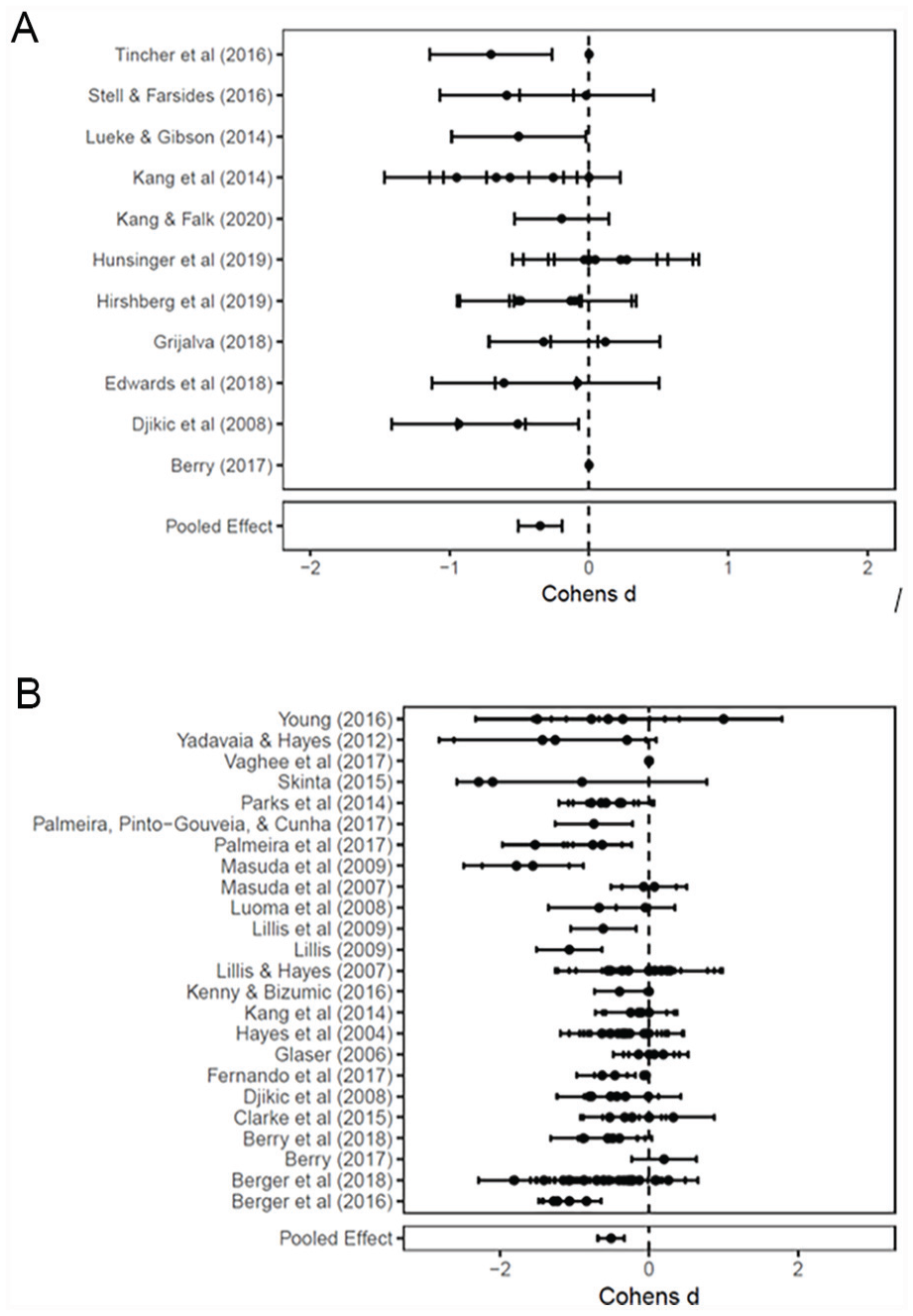
(A) Forrest Plot of Effects of Mindfulness Interventions on Biased Implicit Attitudes; (B) Forrest Plot of Effects of Mindfulness Interventions on Biased Explicit Attitudes.
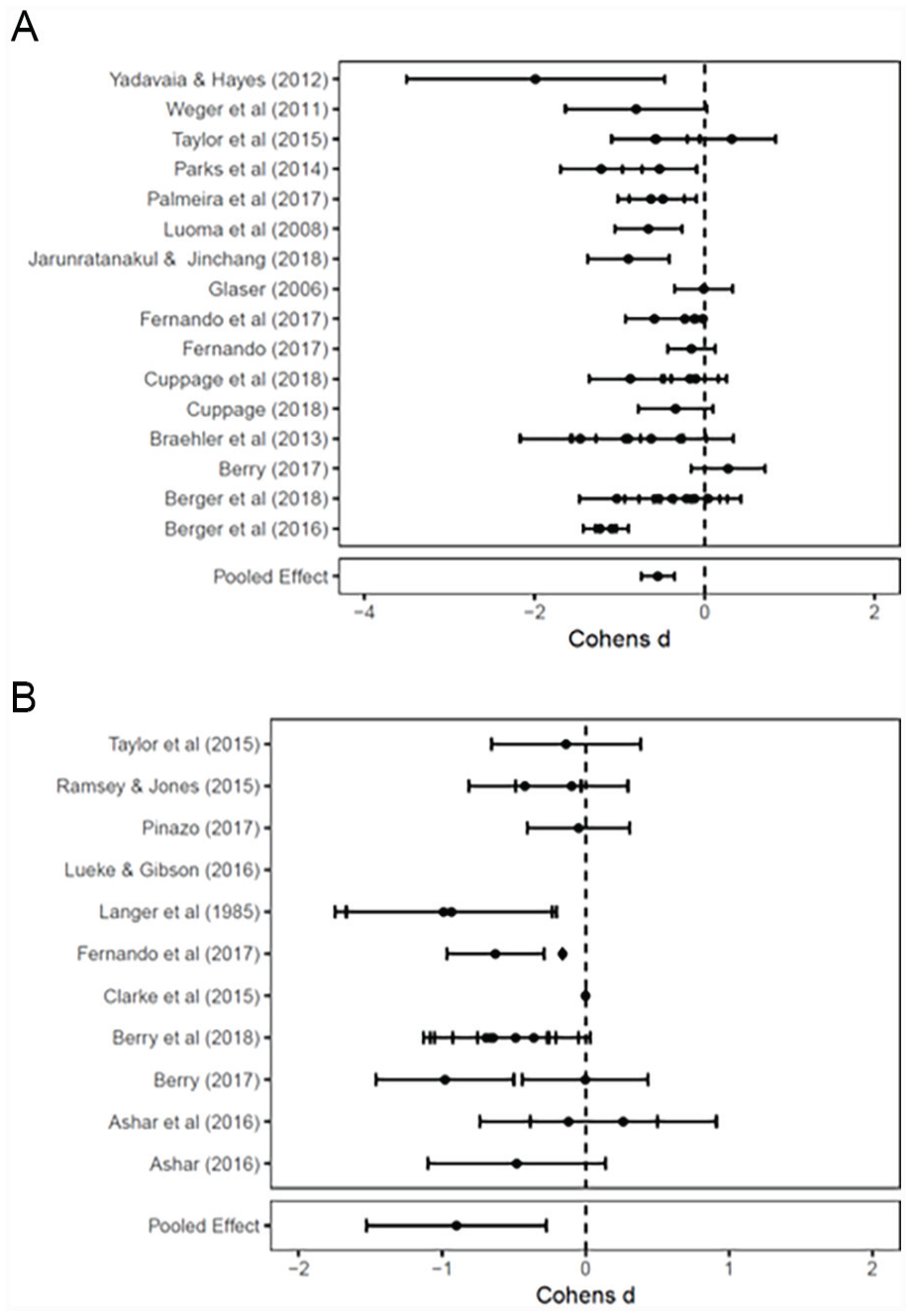
(A) Forrest Plot of Effects of Mindfulness Interventions on Biased Affect; (B) Forrest Plot of Effects of Mindfulness Interventions on Biased Behavior.
We next tested Hypothesis 3, that mindfulness interventions would have larger effects on forms of controlled bias (i.e., explicit attitudes, emotions, and behavior) than implicit attitudes. We did not find evidence for this, however (R22 = 0.00; R23 = 0.047; p = .71). The pooled effect for controlled forms of bias was large in magnitude (g = −0.62, CI 95% [−0.82, −0.43]), while the pooled effect for implicit attitudes was moderate in size (g = −0.35, CI 95% [−0.51, −0.19]); however, the confidence intervals surrounding these effects overlapped.
Finally, we tested Hypothesis 4, that mindfulness interventions would have similar-sized effects on bias toward outgroups relative to their effect on internalized bias. We found support for this prediction, with no evidence that effects of mindfulness interventions differed between these two different forms of bias (R22 = 0.00; R23 = 0.065; p = .215). Effects for both sets of targets were of a similar, large magnitude (for outgroup bias, g = −0.51, CI 95% [−0.71, −0.33]; for internalized bias, g = −0.70, CI 95% [−0.88, −0.51]).Notably, the confidence intervals of the two pooled effects overlap substantially, which increases our confidence in H4. As an additional step, we conducted sensitivity analyses, with one study by Langer et al. (1985) excluded from the analysis. Mindfulness interventions such as the one conducted by Langer et al. (1985) have been argued to be conceptually somewhat different from more Buddhist conceptualizations of mindfulness (e.g., Brown, Ryan, & Creswell, 2007). Excluding this study did not alter the pattern of meta-analytic findings (H1, among all bias outcomes, g = −0.55, CI 95% [−0.71, −0.40]; H2, among biased behaviors, g = −0.85, CI 95% [−1.47, −0.24]; and for H3 and H4, there was no evidence of moderation).
Moderation Analyses
We identified moderate levels of both within- and between-study heterogeneity for the overarching meta-analytic effect of mindfulness interventions on bias outcomes (R22 = 0.39; R23 = 0.48; see Table 2). We therefore proceeded with moderation analyses to probe potential sources of this heterogeneity. Based on a priori theorizing, we examined the following moderators: bias target, sample population, gender, study design, and publication year. We also examined several methodological moderators (i.e., intervention type, duration, and timing of assessment) and risk of bias.
Bias Target Group
First, we tested whether the meta-analytic effect varied between biases directed at three bias target groups: (a) racial/ethnic minorities, (b) clinically stigmatized groups, and (c) other bias target groups. We did not find evidence that effects varied as a function of any of these different categories (for racial/ethnic minorities, R22 = 0.00; R23 = 0.030; p = .373; for clinically stigmatized groups R22 = 0.00; R23 = 0.005; p = .700; for other groups R22 = 0.00; R23 = 0.061; p = .271).
Sample Population
Next, we tested whether the pooled effect differed between studies among helping professionals compared with studies of students and the general population. We found evidence of marginally significant moderation (R22 = 0.00; R23 = 0.16; p = .057). The pooled effect of mindfulness interventions on intergroup bias among helping professionals was medium in magnitude (g = −0.26, CI 95% [−0.40, −0.12]), while the effect among students and the general population was large (g = −0.63, CI 95% [−0.82, −0.45]). Notably, the confidence intervals around these estimates were non-overlapping, indicating mindfulness interventions had a larger impact on intergroup bias among the general population than among helping professionals.
Gender
We next tested whether the percentage of female study participants would explain differences in effect sizes across studies, with expectations that studies with majority female samples may find larger effects than those with majority male samples. However, we did not find evidence for this (R22 = 0.067; R23 = 0.030; p = .554).
Study Design
As Table 2 shows, meta-analytic effects varied as a function of study design (R22 = 0.00; R23 = 0.15; p = .032). The pooled effect for randomized controlled trials (RCTs) was smaller (g = −0.53, CI 95% [−0.71, −0.34]) than the effect for non-RCTs (g = −0.66, CI 95% [−0.96, −0.37]), though the confidence intervals around these effects were overlapping. These findings provide further support for Hypothesis 1, with a medium-to-large pooled effect of randomized controlled mindfulness interventions on all bias types. For parsimony, we tested Hypotheses 2, 3 and 4 among RCT studies only. In support of Hypothesis 2, we found that among RCT studies, mindfulness interventions resulted in medium-sized attenuations in implicit attitude biases (H2(a); g = −0.33, CI 95% [−0.51, −0.16]), medium-to-large reductions in explicit attitude biases (H2(b); g = −0.41, CI 95% [−0.55, −0.23]), and large reductions in biased affect (H2(c); g = −0.58, CI 95% [−0.87, −0.29]) and behaviors (H2(d); g = −0.90, CI 95% [−1.53, −0.26]). In relation to Hypothesis 3, we did not find evidence that mindfulness interventions had larger effects on controlled forms of bias (i.e., explicit attitudes, affect, and behavior) than on implicit attitudes (R22 = 0.00; R23 = 0.192; p = .901). Regarding Hypothesis 4, and consistent with prior findings, we did not find differences in effects of mindfulness interventions on biases toward outgroups and internalized biases, among RCTs (R22 = 0.004; R23 = 0.815; p= .213).
Other Potential Moderators
Effects did not vary as a function of publication year or the methodological moderators intervention type (i.e., interventions with mindful awareness as their singular focus [“mindfulness-only” interventions] vs. multi-component [or “mindfulness-plus”] interventions), intervention duration (including when this variable was log- and quadratic-transformed for possible non-linear effects), or timing of assessment. Regarding intervention type, we used a +1 (mindfulness-only) versus −1 (multi-component) coding scheme and tested whether this dichotomous variable explained heterogeneity in the pooled effect. We also conducted sensitivity analysis with multi-component mindfulness interventions removed from the dataset and obtained a meta-analytic effect (g = −.57, CI 95% [−0.91, −0.23]) that was almost identical to the pooled effect with all interventions included (see also Table 2). We also found no evidence that risk of bias was a moderator of the pooled meta-analytic effect.
Tests for Influential Outliers and Corrections
We examined funnel plots for outliers and tested for influential outliers using the “influence” function in the “metafor” package in R. Funnel plots are displayed in Supplemental Material. Our formal test for influential outliers identified two influential outliers among intervention studies. We conducted subset analyses with these outliers removed. The exclusion of these outliers did not substantially change the pattern of meta-analytic findings. Among intervention studies, the outlier-adjusted meta-analytic effect of mindfulness interventions on all bias outcomes was g = −0.47, CI 95% [−0.57, −0.36]. We also tested for influential outliers among effects for each of the four bias categories (i.e., implicit attitudes, explicit attitudes, explicit affect, and biased behavior), but there were none.
Publication Bias Tests and Corrections
Tests of moderation by publication status identified evidence of publication bias for affect, but not for any of the remaining three outcome types (i.e., implicit attitudes, explicit attitudes, and prejudicial behavior). Meta-analytic effects of mindfulness interventions on measures of affect were larger for published (g = −0.62, CI 95% [−0.81, −0.43]) than unpublished studies (g = −0.10, CI 95% [−0.31, −0.11]), indicating potential publication bias. Second, the 3PSM tests found evidence of potential publication bias for implicit attitudes, χ2(df = 1) = 7.62, p = .006, and explicit attitudes, χ2(df = 1) = 6.19, p = .013. Based on this evidence, we used the PET-PESSE method to generate bias-corrected meta-analytic estimates for implicit and explicit attitudes, and affect. Bias-corrected estimates for implicit attitudes became non-different from zero (g = −0.12, 95% CI [−1.40, 1.16]), while those for explicit attitudes and affect reduced to a medium-sized effect (for explicit attitudes, g = −0.37, 95% CI [−0.56, −0.17]; for affect, g = −0.38, 95% CI [−0.63, −0.12]). There was no evidence of publication bias among intervention studies of prejudicial behavior, or when all outcome types were included in a single meta-analytic model, so no corrections were made to these estimates.
Correlational Studies
Primary Analyses
Meta-analytic findings from the 30 correlational studies (nested within 25 records) included in this review are shown in Table 3 and Figures 5 and 6. As Table 3 indicates, and in support of Hypothesis 1, there was a negative association between dispositional mindfulness and indices of intergroup bias (r = −0.17 [−0.27, −0.03]). Per guidelines provided by Funder and Ozer (2019) and Gignac and Szodorai (2016), this can be interpreted as a small-to-medium sized correlation: one that is consequential over time and of potential explanatory and practical value in the short term (e.g., in relation to specific instances of intergroup bias (Funder & Ozer, 2019).
Meta-Analytic Associations and Moderation Tests for Self-Reported Mindfulness and Bias Outcomes.

Note. k = number of records (i.e., articles and dissertations); ES = number of effect sizes; d = Cohen’s d; CI = confidence interval; R2(2) = within-record variance in the pooled effect explained by the moderator; R2(3) = between-record variance in the pooled effect explained by the moderator; MAAS = Mindful Attention and Awareness Scale (Brown & Ryan, 2003).
p < .05.
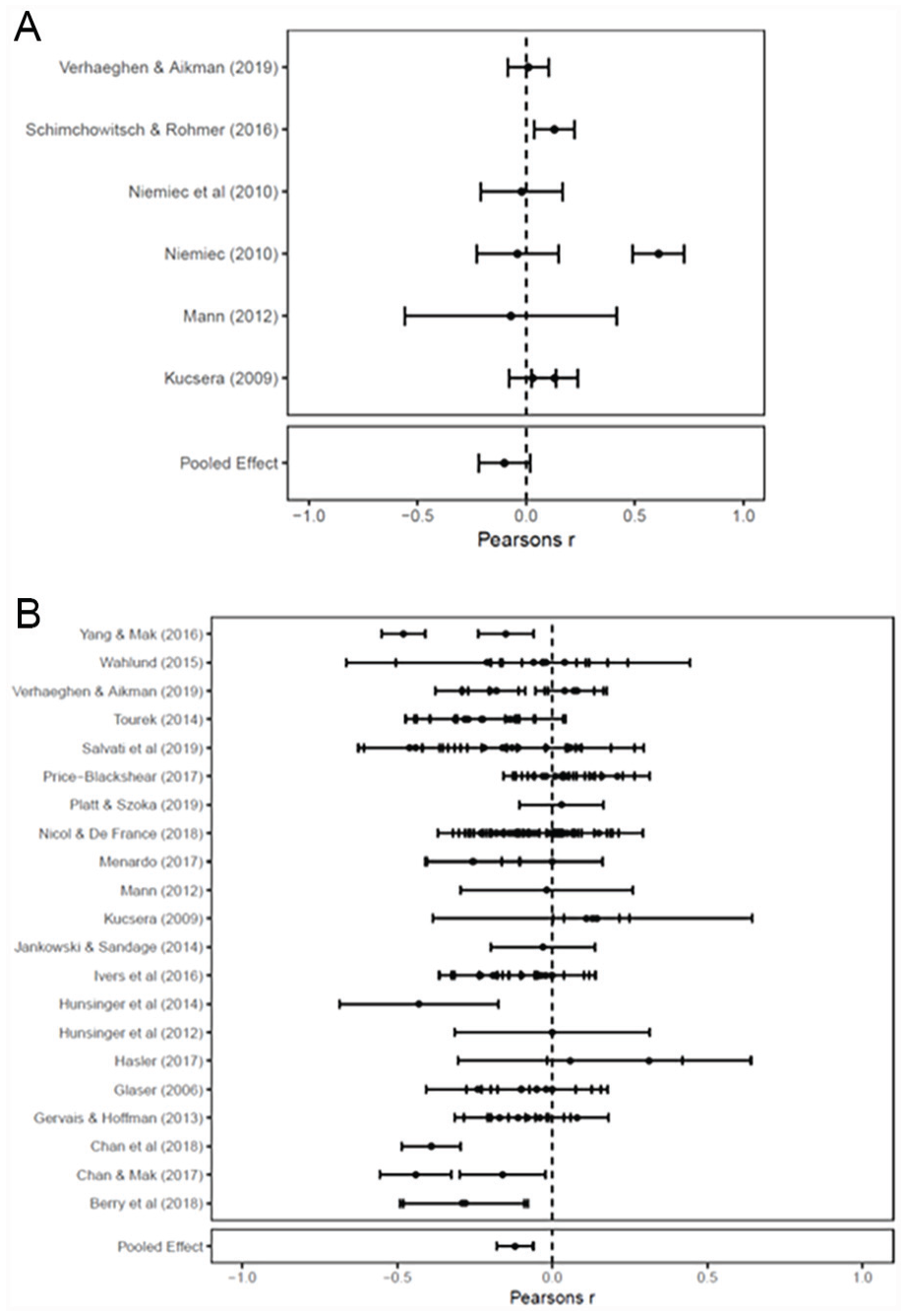
(A) Forrest Plot of Correlation Between Self-Reported Mindfulness and Biased Implicit Attitudes; (B) Forrest Plot of Correlation Between Self-Reported Mindfulness and Biased Explicit Attitudes.
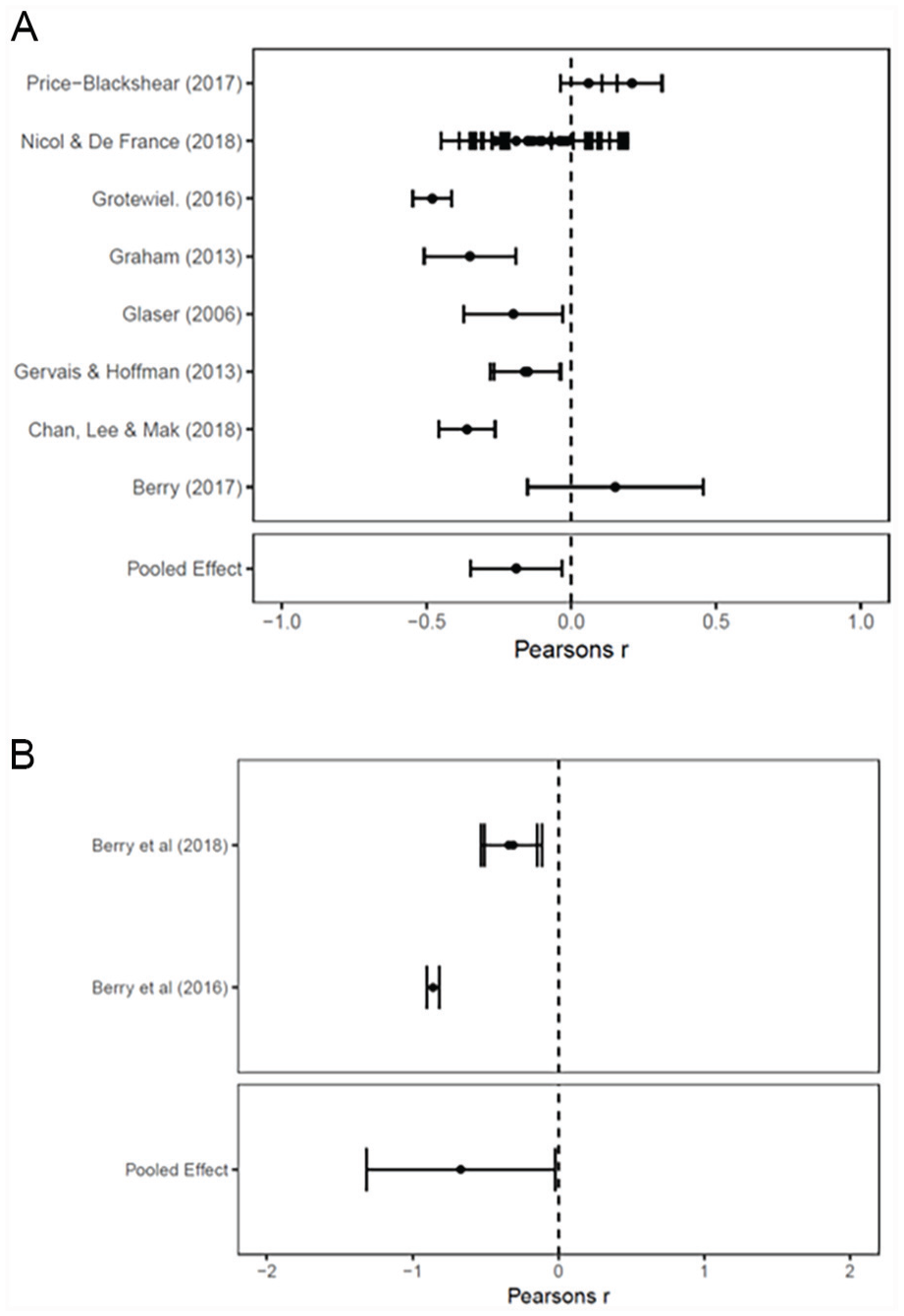
(A) Forrest Plot of Correlation Between Self-Reported Mindfulness and Biased Affect; (B) Forrest Plot of Correlation Between Self-Reported Mindfulness and Biased Behavior.
We next tested Hypothesis 2, conducting subset analyses on the associations between self-report mindfulness and the four indices of intergroup bias. As Table 3 shows, we found mixed support for this prediction among correlational studies: The meta-analytic effect for the association between mindfulness and implicit attitudes was non-different from zero (H2(a); r = −0.12 [−0.27, 0.03]). There were small-to-medium sized, negative associations between mindfulness and both explicit attitudes (H2(b); r = −0.12, CI 95% [−0.18, −0.06]) and affect (H2(c); r = −0.19, CI 95% [−0.33, −0.04]), but insufficient data (per the Fu et al., 2011 guidelines) to conduct subset analyses for discriminatory behavior (H2(d); k = 2; ES = 3).
Regarding Hypothesis 3, that mindfulness would have a more negative association with controlled forms of biases (i.e., explicit attitudes, emotions, and behaviors), than with implicit attitudes, we did not find evidence for this (R22 = 0.018; R23 = 0.082; p = .102). The pooled association between mindfulness and controlled forms of bias was medium-sized and negative (r = −0.18, CI 95% [−0.28, −0.07]), while the pooled effect for implicit attitudes was non-different from zero (r = −0.12 [−0.27, 0.03]).
Finally, we found evidence in support of Hypothesis 4, that dispositional mindfulness would be similarly associated with decreases in bias directed toward others as well as the self (R22 = 0.002; R23 = 0.000; p = .940). The association between mindfulness and bias toward outgroups was of a small magnitude (r = −0.13, CI 95% [−0.25, −0.01]), while the association between mindfulness and internalized bias was medium-sized (r = −0.23, CI 95% [−0.37, −0.08]).
Moderation Analyses
As Table 3 shows, there was substantial heterogeneity between studies (I22 = 0.83), indicating that 83% of the variation in effect sizes was unexplained by the baseline meta-analytic model. Within-study heterogeneity was negligible (I23 = 0.11). To probe this unexplained heterogeneity, we conducted moderation analyses testing whether effects varied as a function of the bias target group, study population, gender, mindfulness measure, publication year, and risk of bias.
Mindfulness Measure
As shown in Table 3, the type of mindfulness measure was a marginally significant moderatorof the pooled effect (R22 = 0.08; R23 = 0.00; p = .054). Subset analyses showed that meta-analytic associations for studies with attentional/awareness measures of mindfulness (i.e., studies using the MAAS; Brown & Ryan, 2003) were non-different from zero (r = −0.21, CI 95% [−0.54, 0.17]), while associations based on multidimensional mindfulness measures were negative, and small-to-medium in size (r = −0.17, CI 95% [−0.24, −0.10]). However, we note the limited number of studies and effects based on the MAAS (k = 6; effects = 14), limiting the inferences that can be drawn from these moderation findings.
Other Potential Moderators
We found no evidence that the meta-analytic effect varied as a function of the bias target group, study population, gender, publication year, or risk of bias status (Table 3).
Tests for Influential Outliers and Corrections
We examined funnel plots for outliers and tested for influential outliers using the “influence” function in the “metafor” package in R. Funnel plots are displayed in Supplemental Material. Our formal test for influential outliers identified five influential outliers among correlational studies. We conducted subset analyses with these outliers removed. Among correlational studies, the outlier-adjusted meta-analytic association between mindfulness and all bias outcomes was z = −0.14, CI 95% [−0.20, −0.07], which is very similar to the un-adjusted effect. We then separately tested for influential outliers among effects for each of the four bias categories (i.e., implicit attitudes, explicit attitudes, explicit affect, and biased behavior). For effects on explicit attitudes and explicit affect, these were almost identical to effects that were not adjusted for outliers (effects, respectively, were z = −0.11, CI 95% [−0.17, −0.05] and z = −0.15, CI 95% [−0.27, −0.03]). Effects for implicit attitudes were smaller in magnitude than the original result (z = −0.06, CI 95% [−0.11, −0.01]), while for biased behavior, there were insufficient effect sizes to generate a meaningful estimate.
Publication Bias Tests and Corrections
As our first test of publication bias, we ran moderation analyses to assess whether meta-analytic effects varied as a function of publication status. We did not find evidence for this. As a second step, we ran the 3PSM analyses, and found evidence of publication bias for the meta-analytic association between mindfulness and all prejudice outcomes, χ2(df = 1) = 4.71, p = .030, as well as the association between mindfulness and implicit attitudes, χ2(df = 1) = 4.00, p = .045. We next calculated bias-corrected effect sizes for these meta-analytic effects, using the PET-PEESE approach. The bias-corrected effect for the association between mindfulness and all prejudice outcomes was negative and medium sized (r = −0.20, 95% CI [−0.33, −0.07]). For the association between mindfulness and implicit attitudes, the PET-PEESE model failed to converge, likely due to the small number of studies (k = 5) included in this subcategory (Stanley, 2017).
Discussion
Whereas prosocial values such as being kind to your neighbor and caring for those in need are promoted in societies all over the world, empirical studies suggest a universal tendency to discriminate against outgroup members, especially those with less social power (Brewer & Brown, 1998; Fiske, 1998; Turner et al., 2001). In this meta-analysis, we explored whether mindfulness, as both a meditative practice and a dispositional factor, may reduce intergroup bias and promote anti-bias tendencies. Guided by our three-dimensional conceptual model, we examined associations between mindfulness and (a) different manifestations of bias, specifically implicit attitudes, explicit attitudes, affect, and behavior, directed toward (b) different bias targets, whether members of an outgroup (bias) or ingroup (internalized bias). We examined these relationships in a bidirectional way, examining individuals’ (c) intergroup orientation toward bias or anti-bias as assessed by measures of intergroup bias as well as measures of anti-oppressive and inclusive attitudes, affect, and behaviors. Study samples were multinational (including the United States, Canada, the United Kingdom, Italy, Portugal, Spain, Israel Palestine, India, Thailand Hong Kong, Australia, New Zealand) and spanned diverse settings and contexts (including university students, clinical populations, community members, research panels, trainees and professionals in health and mental health care, teachers, and law enforcement officers).
We found broad support for our hypothesis that mindfulness would be associated with improvements in intergroup bias/anti-bias outcomes (H1). Effects were medium sized for intervention studies (g = −0.56) and small-to-medium sized for correlational studies (r = −0.17); all effects were in the direction of reduced bias. Compared with Oyler et al. (2022), which included fewer study samples (k = 29 compared with 70 in the present study), this meta-analysis yielded a larger-sized effect of mindfulness interventions but a similar-sized effect for correlational studies on bias outcomes compared with their results (g = +.33 for intervention studies; g = +.24 for dispositional mindfulness, scaled in the direction of reduced bias).
Our hypothesis that effects would be significant across all bias outcomes (H2) was also confirmed, with MBIs having a very large effect on behaviors, a large effect on affect and explicit attitudes, and a medium-sized effect on implicit attitudes. A conservative test, including only the RCT studies, found comparable results and confirmed that effect sizes tended to be larger for biased behavior and affect, followed by explicit attitudes and implicit attitudes. Results from correlational studies also mirrored this pattern although overall effect sizes were smaller. Associations to explicit attitudes and affect were in the small-to-medium sized range, whereas there was no significant association with implicit attitudes. According to Funder and Ozer (2019), a small-to-medium sized correlation can be interpreted as one that is consequential over time and of potential explanatory and practical value in the short term (e.g., in relation to specific instances of intergroup bias). Notably, there were not enough correlational effects to examine associations separately for biased behavior.
Together, these results provide robust support that the benefits of mindfulness extend to the bias domain, with stronger effects on explicit responses and weaker effects on responses operating outside of our conscious awareness and control (e.g., implicit attitudes). These results are consistent with findings that while implicit biases can be changed, such changes are likely to be modest and rely on mechanisms that are distinct from those most effective for changing explicit biases (Forscher et al., 2019). According to dual-process theories, explicit biases stem from cognitive processes that are slower, deliberate, and controllable (Devine, 1989), such that mindfulness-induced improvements in attention, self-awareness, and cognitive control may attenuate the conscious, explicit expression of bias in its cognitive, affective, and behavioral forms. Furthermore, as mindfulness has been found to strengthen the link between intention and behavior (Chatzisarantis & Hagger, 2007), the larger effect size for behavior may be driven in part by mindfulness-induced changes in cognitive resources and motivation to control the effects of bias on behavior (Devine, 1989; Fazio & Olson, 2014).
In contrast, implicit biases reflect automatic mental processes that are fast, efficient, habitual, and uncontrolled (Devine, 1989). In a recent meta-analysis of strategies to change implicit measures, procedures that induced goal-directed motivation (e.g., making anti-racist norms salient) or directly or indirectly targeted biased associations (e.g., Black = bad) reduced implicit bias relative to a neutral control (Forscher et al., 2019). Along these lines, mindfulness-based interventions, such as lovingkindness practice, may affect implicit attitudes by emphasizing prosocial norms (Berry et al., 2020), increasing perspective-taking (Kang & Falk, 2020), and reflective awareness, which Verhaeghen and Aikman (2020) found was associated with both implicit racial bias and motivation to control prejudiced reactions.
Our third hypothesis, that mindfulness would have a substantially greater effect on controlled aspects of bias (explicit attitudes, affect, and behavior) than on automatic (implicit) bias (H3), was not supported, although results trended in the expected direction. For intervention studies, for example, the pooled effect for controlled forms of bias was large in magnitude, while the pooled effect for implicit attitudes was moderate in comparison. Further research is needed to clarify the different mechanisms through which mindfulness may affect automatic versus controlled types of bias and implications for behavior (Cuddy et al., 2007; Fazio & Olson, 2014; van Zomeren et al., 2008).
Given the psychological and health outcomes associated with internalized bias (Gale et al., 2020), our final hypothesis examined whether mindfulness would be associated with comparable effects on bias directed toward the (marginalized) self and outgroup members (H4). Results showed that MBIs were associated with large negative effects for both internalized bias and intergroup bias outcomes. Among correlational studies, associations between mindfulness and bias were also significant, though in the small (intergroup bias) to medium-sized (internalized bias) range. To our knowledge, this is the first meta-analysis to demonstrate that in addition to improving intergroup outcomes for dominant group members, mindfulness may enhance the well-being of marginalized individuals by increasing resilience to negative societal messages about their group. As internalized bias has both direct and indirect associations with outcomes such as distress, quality of life, self-esteem, and health risk behaviors among stigmatized groups (Lee et al., 2019), decreasing internalized bias through mindfulness may be an important part of a multi-tiered strategy for promoting health equity. At the same time, systems-level interventions are needed to dismantle the structural inequities that perpetuate and maintain population health disparities (Bailey et al., 2017).
Moderation analyses found that the effects of MBIs and dispositional mindfulness were comparable for biases directed toward racial/ethnic minorities, clinically stigmatized groups, and other bias targets, whether an outgroup or ingroup member. Effects also did not vary by gender of the respondent, year of publication, or study quality (i.e., risk of bias). For intervention studies specifically, effects also did not vary by length of the intervention or timing of assessment. Importantly, we examined the possibility, raised by Berry et al.’s (2020) critique, that the inclusion of ethical enhancements in many MBIs may introduce demand characteristics and social desirability concerns, which may promote reductions in bias beyond the direct effects of mindfulness itself. To explore this possibility, we compared the effects of mindfulness-only interventions to multi-component interventions that include other enhancements, such as compassion, values-enhancement, or other psychological skills. We also conducted “subset” analysis, to examine meta-analytic effects of mindfulness interventions with the so-called “mindfulness-plus” interventions excluded from the analysis. Together, these tests provide evidence that there was no systematic variation in effects between so-called “pure” mindfulness interventions and those with ethical enhancements. As shown in Table 2, effect sizes for both intervention types were medium sized and comparable (for “mindfulness-only” interventions, k = 16, g = −0.57, 95% CI [−0.91, −0.23], and for “mindfulness-plus” interventions, k = 25, g = −0.54, 95% CI [−0.69, −0.39]. Results for the mindfulness-only interventions are largely consistent with Berry et al.’s (2020) findings, taking into account their more restrictive selection criteria. For the studies focusing on prejudice outcomes (20.6% of the sample), they found a small to medium effect of mindfulness training only when compared with active and inactive controls, k = 6, g = .464, 95% CI [.302, .626].
Altogether, the results of moderation analyses for the intervention studies highlight that even small doses of mindfulness training, alone or packaged with other components, were sufficient to significantly improve bias outcomes for both ingroup and outgroup members. However, moderation analyses by type of mindfulness measure suggest that multiple processes are involved in bias reduction. Results from correlational studies indicated that the effect of nonjudgmental awareness (as assessed by the MAAS; Brown & Ryan, 2003) was not different from zero, whereas associations between multidimensional measures of mindfulness and bias outcomes were negative and small-to-medium sized. It seems that actively altering biased associations requires more than nonjudgmental awareness, for example, the additional skills of description, acceptance, and nonreactivity assessed by multifactor measures such as the FFMQ (Baer et al., 2006) and the KIMS (Baer et al., 2004).
A positive trend within the field of mindfulness studies is a growing focus on applications to real-world contexts. Notably, moderation analyses comparing members of the general population (predominantly university student samples) to helping professionals (e.g., teachers, counselors, and medical staff) found that MBIs had a stronger effect on bias in the general population. This finding is consistent with claims that university students represent a unique population, with less crystallized attitudes, less formulated senses of self, more tendencies toward compliance, and therefore particularly vulnerable to experimental manipulations (Sears, 1986), although empirical studies suggest they are more heterogeneous than previously assumed (Peterson & Merunka, 2014). Another possibility is that helping professionals interact more directly with individuals who are the targets of bias within institutional contexts that have a history of pathologizing and marginalizing groups with low social power. For example, systemic inequities in educational achievement and school discipline rates reflect racial, gendered, and class-based stereotypes that are often normalized and reinforced in school settings (Chin et al., 2020; Okonofua & Eberhardt, 2015). Applying MBIs within such institutional contexts likely increases the difficulty of shifting biases among helping professionals and others in positions of power, although MBIs were still associated with improved outcomes overall. More contextualized MBIs may be needed to address the complex and situated power dynamics that may reinforce bias toward stigmatized members of society (see, for example, Kanter et al., 2020). However, for correlational studies, moderation analyses found no differences in effects among the general population and helping professionals.
We found some evidence of publication bias for affect, explicit, and implicit attitudes for the intervention studies. Our bias-corrected estimates indicated a medium-sized effect of mindfulness interventions in reducing explicit biased attitudes and affect, but not in reducing implicit biases or biased behaviors. While there is arguably value in adjusting estimates for potential bias, we also note that bias-adjusted estimates need to be interpreted with caution, and not in isolation from the original estimates (Carter et al., 2019; Stanley et al., 2017).
The State of the Evidence and an Agenda for Future Research
Our model-based evidence and gap map identified a number of notable gaps in the evidence base. First, most of the identified effect sizes pertained to bias/anti-bias responses to outgroup members, with only 12% focusing on bias experiences of minority groups. This disparity reflects the relatively recent shift in the field of psychology to center the lived experiences of marginalized populations, including studying internalized bias and other psychological effects of structural violence and oppression. As most of the studies examining internalized bias sampled clinically stigmatized groups (i.e., individuals with psychiatric disorders, substance use problems, overweight, or HIV) as well as sexual minority populations, more research is needed to clarify how mindfulness may reduce internalized bias among other groups with less societal power such as racial/ethnic minorities, immigrants, the poor, disabled, and elderly, as well as those with multiple marginalized identities (e.g., women of color).
As a relatively new area of research, the terms being used to describe the phenomenon of internalizing negative attitudes related to one’s oppressed minority identity vary depending on the theoretical frameworks and disciplinary perspective adopted by the researcher. Reflecting our focus on mindfulness and social-psychological perspectives on intergroup dynamics, we adopted a social cognition/bias framework to guide our search. Future studies on internalized bias would benefit from developing a construct map to chart the boundaries of the construct from different disciplinary perspectives. For example, related constructs may include self-stigma, internalized oppression, collective self-esteem, and self-acceptance as well as those referring to specific group experiences, for example, racial trauma, colonial mentality, internalized sexism, and internalized homophobia. Recent efforts to operationalize constructs related to internalized bias have yielded a number of new measures (e.g., Campón & Carter, 2015; Choi et al., 2017; Hübner et al., 2016) that may facilitate future research on mindfulness as a potential mitigating factor.
Second, among studies of outgroup bias, the weight of the evidence was skewed toward attitudes and affective measures of bias, with the majority of effect sizes examining associations between mindfulness and explicit attitudes (see also Paluck et al., 2021). Notably, the largest effects were found for behavior/behavioral intentions and affect, despite there being fewer effect sizes available for these outcomes. While promising, more research is needed to confirm these results, in addition to studies that examine the real-world effects of mindfulness training on behaviors that uphold or challenge structural oppression and inequity (i.e., voting behavior and other forms of collective action or resistance).
Third, the largest gaps in the literature pertained to bias directed toward the ingroup. There were a few effect sizes for explicit attitudes and affect for internalized bias, but fewer still for anti-bias. There were no effect sizes for implicit attitudes or behavioral measures of bias directed toward the ingroup for either internalized bias or anti-bias. Research is needed to fill these gaps in the literature. For marginalized groups, developing an awareness of how one’s internalization of negative self-views has been shaped by structural oppression and cultural socialization processes (critical reflection) is a crucial first step; however, that awareness does not always translate into changes in behavior (critical action) (Freire, 1970a). Research is needed to clarify how mindfulness may facilitate resilience to denigrating societal messages about one’s group at cognitive, affective, and behavioral levels.
Fourth, future research should focus on increasing sample diversity. Although many studies included some cultural diversity in their samples, they were too underpowered to conduct separate analyses by race or ethnicity, gender identity (including transgender and nonbinary individuals), as well as other demographic characteristics such as social class. This is consistent with the general problem of underrepresentation of people of color (aka people of the global majority), sexual and gender minorities, and low-income individuals in mindfulness research (DeLuca et al., 2018; Waldron et al., 2018). Furthermore, as most standardized MBIs have been developed by White Euro-American or European practitioners and researchers and in most cases, decontextualized from their Buddhist spiritual origins, it cannot be assumed that results may generalize across different cultural and social identity groups. A meta-analysis of MBIs among people of color found smaller effect sizes relative to findings in other populations (Sun et al., 2021), highlighting the need for future studies to confirm that such interventions are effective for culturally diverse populations and if and how they may need to be culturally adapted to increase relevance and acceptability with specific populations (DeLuca et al., 2018).
Finally, more research is needed to test theorized mechanisms of mindfulness as they relate to bias outcomes. Whereas most studies in our review did not examine mechanisms (thereby preventing meta-analytic mediation analyses), a handful did. Drawing on the studies in this review, three potential mechanisms are self-compassion, psychological flexibility, and stress reduction, and we now briefly discuss each. Self-compassion, which encompasses attitudinal and affective responses to the self, may result in less defensive responding and greater motivation to respond without bias among privileged groups, and facilitate greater resistance to biased messages among marginalized groups (Burgess et al., 2017; Palmeira et al., 2019; Yang & Mak, 2017). Chan et al. (2018) examined pathways to stigma resistance among 311 individuals with psychiatric disorders in Hong Kong, China. Using structural equation modeling, they found that mindfulness was positively associated with stigma resistance and that the association was mediated by both self-compassion and psychological flexibility.
Psychological flexibility refers to the ability to remain fully in contact with the present moment, even when facing difficult thoughts and feelings, while acting in ways that reflect one’s goals and values (Hayes et al., 2006). Psychological flexibility is a target process of ACT, a mindfulness-based therapy that has been increasingly applied to reducing internalized bias among a range of marginalized groups and increasing anti-bias attitudes and behaviors among dominant groups. Thus, in these contexts, psychological flexibility encompasses the self-awareness, self-regulation, and self-transcendence components of mindfulness (Vago & Silbersweig, 2012). Results from several ACT studies (e.g., Lillis et al., 2009; Luoma et al., 2008; Skinta et al., 2015) confirm that psychological flexibility is a key pathway through which mindfulness may soften stereotypic beliefs about self and other and increase the potential for more intentional responding in more compassionate and inclusive ways.
Finally, given that intergroup interactions are experienced as stressful and anxiety-provoking (Richeson & Nicole Shelton, 2003; Stephan & Stephan, 1985), reducing stress (perceived threat) and anxiety may be another key pathway for reducing bias. Several studies support this premise. In Kang et al. (2014), the reduction in bias toward the homeless following LKM was mediated by reductions in psychological stress (“stress experienced in the past week”). Similarly, Parks et al. (2014) found that the effect of LKM on intentions for future contact with homeless individuals was mediated by intergroup anxiety. Other promising relational mechanisms that future studies should examine include empathy (Cooper et al., 2020) and perspective-taking (Kang & Falk, 2020). Finally, as we did not find relevant longitudinal studies, research is needed to test whether the effects of mindfulness on bias endure over time.
Limitations and Constraints on Generality
Results of this study should be interpreted with consideration of several limitations. First, the present meta-analysis does not address the issue of how mindfulness compares with other potential factors in influencing intergroup bias, nor do we rule out additional independent influences on these outcomes. Second, although we did not find evidence that bias target, gender, intervention type or duration, timing of assessment, mindfulness measure, or risk of bias moderated the pooled effects, we cannot rule out that unmeasured variables account for the variation in effect sizes in this meta-analysis. For both the intervention and correlational effects tested in this review, there was substantial between-study unexplained heterogeneity in effects. Future studies should explore other possible sources of variation in effects, such as race/ethnicity, socio-economic status, education level, and other characteristics of the sample.
We acknowledge that characteristics of the study samples constrain the generalizability of the results of this research. While the intervention studies included more culturally and ethnically diverse samples in the United States and other countries, the correlational studies tended to focus more on dominant group members (e.g., White participants in the United States and the United Kingdom or Indians in India). Except for studies that focused on reducing internalized bias among stigmatized groups, there was limited demographic information provided in most studies regarding sexual orientation, ability/disability status, and age, for example. As a result, the general finding that mindfulness may be helpful in reducing bias directed toward others should not be assumed to generalize to minoritized group members’ views about dominant group members. Furthermore, in the absence of an intersectional analysis on bias in the field, it remains unclear how mindfulness may impact multiply minoritized individuals’ views about different dimensions of internalized bias. For example, among sexual minority men of color, whether mindfulness helps to reduce internalized racism and homophobia equally remains unknown.
Conclusion
This review concludes that mindfulness is a promising pathway to reducing intergroup bias and internalized bias in the direction of greater equity and inclusion of marginalized groups. We found multi-method evidence, across RCTs, other intervention designs, and correlational studies that mindfulness inhibits intergroup bias and promotes anti-bias attitudes, affect, and behavior in diverse country contexts and samples. Analysis of evidence and gaps in the literature highlights the need for future studies to adopt rigorous RCT designs, examine mechanisms of mindfulness, and target the under-researched areas of internalized bias and anti-bias attitudes, affect, and behaviors among marginalized groups specifically. Creative approaches are needed to operationalize minority experiences more thoroughly and recognize the complex intersectional ways that dynamics of power and oppression manifest in intergroup contexts. At the same time, we acknowledge that the problem of intergroup bias is complex and reinforced by systems of oppression such as racism, sexism, and classism. Structural solutions are needed to address the systemic nature of bias across life domains.
Supplemental Material
sj-docx-1-psp-10.1177_01461672231178518 – Supplemental material for Does Mindfulness Improve Intergroup Bias, Internalized Bias, and Anti-Bias Outcomes?: A Meta-Analysis of the Evidence and Agenda for Future Research
Supplemental material, sj-docx-1-psp-10.1177_01461672231178518 for Does Mindfulness Improve Intergroup Bias, Internalized Bias, and Anti-Bias Outcomes?: A Meta-Analysis of the Evidence and Agenda for Future Research by Doris F. Chang, James Donald, Jennifer Whitney, Iris Yi Miao and Baljinder Sahdra in Personality and Social Psychology Bulletin
Footnotes
Declaration of Conflicting Interests
The author(s) declared no potential conflicts of interest with respect to the research, authorship, and/or publication of this article.
Funding
The author(s) received no financial support for the research, authorship, and/or publication of this article.

Data Availability
Supplemental Material
Supplemental material is available online with this article.
References
Supplementary Material
Please find the following supplemental material available below.
For Open Access articles published under a Creative Commons License, all supplemental material carries the same license as the article it is associated with.
For non-Open Access articles published, all supplemental material carries a non-exclusive license, and permission requests for re-use of supplemental material or any part of supplemental material shall be sent directly to the copyright owner as specified in the copyright notice associated with the article.
