



Abstract
Virtual work arrangements, whereby dispersed employees interact with each other using technology-mediated communication, can both positively and negatively impact their psychological well-being. Yet, research on these dual effects in different virtual work research domains (e.g., telecommuting, virtual teams, and computer-mediated work) is not well integrated, which limits insights into how their findings overlap and inform each other. Using a work design theoretical lens to synthesize findings from 115 empirical articles, we develop an integrative framework that advances understanding of how virtual work both helps and harms employee well-being. The framework explicates different pathways linking subdimensions of technology dependence and dispersion—two core dimensions underlying different types of virtual work—to well-being through employees’ perceived work characteristics. We identify four technology dependence and three dispersion subdimensions that differ in their degree of positive versus negative impact on hedonic and eudaimonic well-being outcomes as well as in the work characteristics that explain these effects. These findings suggest that employees’ well-being experiences in virtual work depend on the subdimensions involved and that the same subdimension can influence well-being both positively and negatively. Across the subdimensions, a dominant set of work characteristics in four categories (task, knowledge, social, and work context) explain virtual work’s dual effects on well-being, moderated by contingencies at different levels (individual, team, organization, and external context). These multilevel contingencies point to potential interventions for enhancing the benefits and mitigating the downsides of virtual work for employee well-being. Based on these insights, we develop a future research agenda and discuss practical implications.
Over the last two decades, there has been explosive growth in virtual work (Makarius & Larson, 2017; Raghuram, Hill, Gibbs, & Maruping, 2019) whereby dispersed employees interact with each other using technology-mediated communication (TMC). Virtual work arrangements include telecommuting/mobile work (i.e., working from home/any preferred location), virtual teamwork (i.e., collaborating across distance using TMC) and computer-mediated work (i.e., using communication technologies to facilitate interactions). The COVID-19 pandemic further accelerated this growth trend, and many organizations plan to continue some degree of virtual work after the pandemic because of its significant benefits (Levy, 2020; Zeidner, 2020), which include administrative and real estate cost savings as well as productivity gains (Haag, 2020; Rue, 2020). Employees, too, appreciate the increased flexibility, reduced travel, and time savings virtual work can provide. As a result, the shift to virtual work has been identified as one of the biggest business trends in the coming years (Agovino, 2020; Robinson, 2022).
Despite these benefits, research suggests that virtual work can significantly change the characteristics of employees’ work (Bliese, Edwards, & Sonnentag, 2017; Gajendran & Harrison, 2007; Wang, Liu, Qian, & Parker, 2021), with both negative and positive implications for their psychological well-being, which is defined as “feeling good and/or experiencing fulfillment and purpose” (Sonnentag, 2015: 262). For example, using mobile technologies to connect to work anytime and from anywhere may extend employees’ work hours, increasing emotional exhaustion (e.g., Lanaj, Johnson, & Barnes, 2014), but it may also increase work–family balance by providing flexibility to attend to work and family demands (e.g., Derks, Bakker, Peters, & van Wingerden, 2016). In addition, fewer interactions, with coworkers in distant locations may increase social isolation, which, in turn, results in psychological strain and decreased job satisfaction (Bentley et al., 2016). Conversely, it may reduce strain by providing an escape from negative work relationships (Collins, Hislop, & Cartwright, 2016). Given these dual effects and the growth in virtual work, it is critical to understand how and when such arrangements may help or harm employee well-being.
We currently lack a comprehensive understanding of well-being in virtual work, because this research has occurred in siloes (Raghuram et al., 2019; Wang, Liu, & Parker, 2020) related to different virtual work domains (e.g., telecommuting, virtual teams, mobile work, computer-mediated work), making it difficult to understand how their findings overlap and inform each other. For example, computer-mediated work research has revealed that TMC both positively and negatively impacts well-being (Adisa, Gbadamosi, & Osabutey, 2017; ter Hoeven, van Zoonen, & Fonner, 2016). Yet, although these findings are relevant for understanding well-being in other domains, virtual team scholars mostly focus on TMC's harmful effects (Ayoko, Konrad, & Boyle, 2012; Johnson, Bettenhausen, & Gibbons, 2009), and telecommuting studies seldom include characteristics of the technologies used to work from home (Raghuram et al., 2019).
To make sense of these mixed findings and identify future research needs, we conducted a comprehensive review of 115 quantitative and qualitative studies focused on employees’ psychological well-being in virtual work. Our review shows that virtual work influences well-being by changing employees’ perceptions of their work characteristics (i.e., the design of work). Thus, we apply a work design theoretical lens (Hackman & Oldham, 1976; Morgeson, Garza, & Campion, 2012; Parker, 2014) to develop an integrative framework for understanding how virtual work both helps and harms well-being through its influence on perceived work characteristics.
Our framework integrates the siloes in virtual work research by following Raghuram and colleagues’ (2019) guidance to examine the effects of two core dimensions that underlie different configurations of virtual work: technology dependence (i.e., the use of technology tools for work interactions) and dispersion (i.e., distance in virtual work; e.g., Kirkman & Mathieu, 2005; O’Leary & Cummings, 2007). Focusing on these underlying virtual work dimensions (and their subdimensions) facilitates analysis of how different virtual work arrangements enabled by different communication technologies affect well-being. By unpacking the pathways whereby subdimensions of technology dependence and dispersion positively and negatively influence different types of hedonic (related to feeling good) and eudaimonic (related to experiencing fulfilment and purpose) well-being outcomes through different work characteristics, our framework makes three important research contributions.
First, it integrates the fragmented empirical research on well-being in different virtual work arrangements by explicating the effects of four subdimensions of technology dependence (communication leanness, asynchronicity, technical complexity, and flexible connectivity) and three subdimensions of dispersion (spatial distance, temporal distance, and out-of-office context). These subdimensions draw on and extend those already defined in the literature (e.g., Kirkman & Mathieu, 2005; O’Leary & Cummings, 2007; Schweitzer & Duxbury, 2010; Villamor, Hill, Kossek, Foley, 2022) to capture additional aspects of technology dependence and dispersion that are relevant to well-being. Our regular multidimensional conceptualization of virtual work can be used across different virtual work arrangements as a means for more nuanced theorizing and testing of their effects on well-being. Our finding that these virtual work subdimensions have differential effects on well-being suggests that employees’ well-being experiences in virtual work vary depending on the specific subdimensions involved.
Second, our framework addresses calls to extend work design theorizing to reflect the contemporary workplace (e.g., Morgeson et al., 2012; Parker, Morgeson, & Johns, 2017). We draw on Morgeson and colleagues’ (2012) integrated work design framework (IWDF), which integrates major work design theories. However, these theories assume in-person, face-to-face work that is separated by a clear boundary from employees’ nonwork context (Oldham & Hackman, 2010). Thus, we contextualize the IWDF for virtual work settings by examining how the technology dependence and dispersion subdimensions shape well-being outcomes through their influence on employees’ perceived work characteristics. Across the subdimensions, the framework identifies mediating work characteristics in four categories: task, knowledge, social, and work context. These include work characteristics that are not specified within IWDF but are germane to virtual work—for example, those related to how employees control their work–nonwork boundaries.
Finally, our framework shows that the same subdimension can influence well-being both positively and negatively, highlighting the importance of understanding factors that determine the strength of these opposing effects. Thus, we identify contingencies at different levels (individual, team, organization, and external context) that point to potential interventions for enhancing virtual work's benefits for employees’ well-being and mitigating its downsides. Based on insights from our review, we offer a future research agenda and discuss practical implications.
Literature Review
Past Reviews Related to Well-Being in Virtual Work
A search for past reviews related to psychological well-being in virtual work yielded broad integrative reviews of virtual work research without a specific focus on well-being outcomes (e.g., Makarius & Larson, 2017; Raghuram et al., 2019). Other reviews targeted specific types of virtual work, including the use of information and communication technologies (Wang et al., 2020), virtual teams (e.g., Kirkman, Gibson, & Kim, 2012; Gilson, Maynard, Jones-Young, Vartiainen, & Hakonen, 2015), telecommuting (Gajendran & Harrison, 2007), and mobile work (Hughes & Silver, 2020). However, these were general reviews examining only one or two well-being outcomes along with other outcomes, such as turnover intentions and performance (e.g., Gajendran & Harrison, 2007; Kirkman et al., 2012; Wang et al., 2020); or they narrowly focused on specific well-being outcomes’ such as those related to work–family dynamics (Hughes & Silver, 2020). Given the recent growth in research examining virtual work's effects on well-being, our review includes significantly more studies on this topic than in past reviews and is the first to explicate the differential impacts of virtual work subdimensions on different types of well-being outcomes and the pathways through which these effects occur.
Literature Search
We searched Web of Science for empirical studies of virtual work that examined well-being outcomes in management, psychology, communication, business, and information systems journals. We included articles dating back to 1995 (through 2022) when virtual work research activity began to increase (Raghuram et al., 2019). To be as inclusive as possible, we used an extensive list of search terms combining our conceptualizations of virtual work and well-being.
Our conceptualization of virtual work makes two key assumptions. First, the degree of virtuality in a job lies on a continuum from low to high, with most jobs involving some amount of virtual work (e.g., an office-based worker making phone calls to a service provider). However, research on well-being in virtual work mostly focuses on arrangements such as telecommuting or virtual teams that involve a significant amount of virtual work (Makarius & Larson, 2017). Second, technology dependence and dispersion are two distinct dimensions. For example, as noted by Kirkman and Mathieu (2005), employees may work in the same building (low dispersion) but interact primarily via electronic media (high technology dependence). Thus, it is important to examine the dimensions’ separate effects.
Employee well-being research has often focused on hedonic concepts (Sonnentag, 2015), including positive affective experiences such as job satisfaction and the absence of negative affective experiences such as exhaustion and stress (Huta, 2015; Russell, 1980; Tellegen, Watson, & Clark, 1999). There is also growing interest in eudaimonic well-being, which includes constructs reflecting experiences such as thriving and work engagement, as well as effective functioning in life such as work-life balance and high-quality relationships (Huta, 2015; Sonnentag, 2015). Examples of poor eudaimonic functioning are work–family conflict and loneliness. Some well-being outcomes may include both hedonic and eudaimonic elements, depending on their conceptualization and measurement. For instance, job satisfaction is usually conceptualized and measured to reflect fulfilment of emotional needs, which is hedonic in nature; but life satisfaction relates to meaning and the accomplishment of life goals, making it more eudaimonic (Huta, 2015). We therefore carefully reviewed the operationalization of well-being outcomes in our review to categorize them appropriately.
We manually reviewed the publication abstracts from our initial search and retained studies that (a) were empirical (reviews and theoretical articles were excluded); (b) related to a work setting (e.g., studies related to children, consumer-behavior, online dating, online learning, and personal social media use were excluded); (c) aligned with our conceptualization of virtual work (e.g., studies focused on cultural diversity and expatriates were excluded); and (d) examined an individual-level well-being outcome. To ensure we focused on the most rigorous research studies, we only included papers in journals listed in Thomson Reuters’ Journal Citation Reports. This yielded a final list of 115 publications.
Review Methodology: A Work Design Perspective
In both the quantitative and qualitative studies in our review, scholars either explicitly or implicitly examined how different aspects of virtual work environments influence work characteristics and the implications for employees’ well-being. This aligns with the work design theoretical perspective (e.g., Morgeson et al., 2012; Parker, 2014), which considers how employees’ perceptions of their work characteristics—i.e., “the content and organization of one's work tasks, activities, relationships, and responsibilities” (Parker, 2014: 662)—influence work outcomes, including well-being. As virtual work involves a different organization of individual tasks, activities, and relationships than in-person office work (Wang et al., 2020), it may influence employees’ perceptions of their work characteristics. Thus, we applied a work design perspective to synthesize findings from our review.
Individual studies in our review applied different work design theories to examine a narrow set of work characteristics related to specific well-being outcomes. To synthesize existing research on well-being in virtual work and to capture the breadth of work characteristics and well-being outcomes examined, we selected Morgeson and colleagues’ (2012) integrated work design framework (IWDF). This is a general framework that integrates major work design models—for example, the job characteristics model (Hackman & Oldham, 1976), the job demands-control model (Karasek Jr, 1979), and the job demands-resources model (Demerouti, Bakker, Nachreiner, & Schaufeli, 2001)—that on their own include narrower sets of work characteristics. The IWDF therefore addresses a more comprehensive range of work characteristics that have been linked to a wide array of well-being outcomes (for meta-analyses, see Humphrey, Nahrgang, & Morgeson, 2007; Fried & Ferris, 1987). Unlike other integrative models focused on different elements of work design, such as contextual influences and antecedents of work characteristics (Parker, Wall, & Cordery, 2001; Parker, Van den Broeck, & Holman, 2017), one important focus of the IWDF is to organize work characteristics from major work design models into four categories (task, knowledge, social, and work context). Our preliminary examination of the work characteristics in the articles in our review confirmed the presence of these four categories.
Given our focus on virtual work, it is important to note that the work design models incorporated into the IWDF were developed based on in-person settings. However, the IWDF suggests that “structural influences” related to the broader work setting—including technological and physical elements—may shape employees’ perceived work characteristics. Based on this, Morgeson and colleagues (2012) proposed that virtual work settings may influence work characteristics, but they stopped short of specifying the pertinent aspects of virtual work and called for more research in this area. Thus, in this review, we contextualize the IWDF for a virtual work setting by identifying subdimensions of technology dependence and dispersion that impact well-being through their influence on employees’ work characteristics in the four categories mentioned earlier. We also remained open to uncovering work characteristics that are particularly germane to virtual work but not yet specified in the IWDF or in other existing work design models.
We systematically coded the quantitative and qualitative findings to identify: (a) subdimension(s) of technology dependence and dispersion theorized to influence well-being, (b) related well-being outcome(s), and (c) work characteristics that explain these relationships. Our analysis also revealed contingencies at different levels (individual, team, organization, and external context) that moderated the relationships between the virtual work subdimensions and work characteristics; so we expanded our coding to capture these multilevel contingencies. Two authors independently coded the findings from the review articles and discussed any discrepancies to reach agreement. The remaining two authors reviewed the results, and, when necessary, the entire team discussed differences to reach consensus.
Based on this synthesis of existing research findings, we developed the integrative framework shown in Figure 1, which unpacks the pathways through which virtual work has been shown to influence psychological well-being. Before discussing these findings in more detail, we describe the subdimensions of technology dependence and dispersion related to well-being in existing research and the work characteristics that explain their effects.
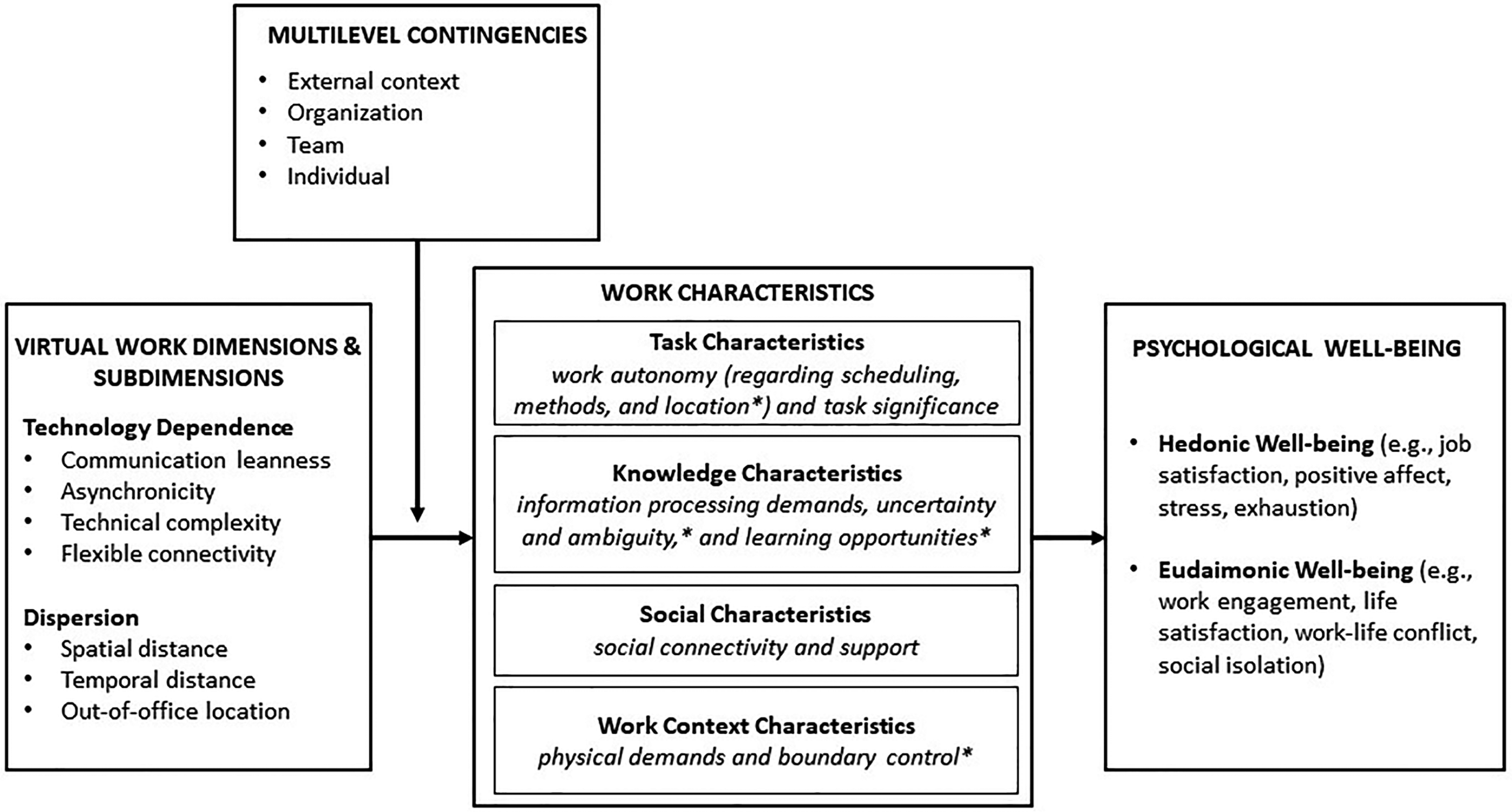
Integrative Framework of Well-Being in Virtual Work
Technology Dependence and Dispersion Subdimensions Related to Well-Being
To integrate the siloed research related to well-being in different virtual work arrangements, we identified the subdimension(s) of technology dependence and dispersion explicitly or implicitly examined, regardless of the type of virtual work arrangement or communication technology studied. For example, in quantitative studies, researchers have theorized that telecommuting reduces the amount of social support from work colleagues (e.g., Sardeshmukh, Sharma, & Golden, 2012) and increases employees’ control over their work–nonwork boundary (Golden, Veiga, & Simsek, 2006), which respectively decreases work engagement and work-family conflict. In these cases, the dispersion subdimension relevant to social isolation is spatial distance (i.e., physical separation from coworkers), and out-of-office location (i.e., working from home) is relevant to work–family balance. In research on virtual teams, scholars have similarly examined the social isolation effects of spatial distance from team members. Thus, identifying the underlying subdimensions of virtual work responsible for the effects on well-being enabled us to integrate research related to different virtual work arrangements and potentially uncover new virtual work subdimensions that have not been explicitly measured. We applied the same approach to identify relevant subdimensions in the findings of qualitative studies as they had no explicit hypotheses or measures of virtual work.
We used existing labels and definitions for subdimensions previously conceptualized in the virtual work literature, adapting them as needed to the individual level. For subdimensions discussed in the literature but not yet formally defined or measured, our team worked to reach consensus on labels and definitions, consulting with experts in the field as needed. As shown in Figure 1, we identified four technology dependence (communication leanness, asynchronicity, technical complexity, and flexible connectivity) and three dispersion (spatial distance, temporal distance, and out-of-office location) subdimensions. Each one is conceptualized as a continuum whereby work interactions are more virtual when they involve higher levels of a subdimension.
Next, we define these subdimensions and their proposed operationalization based on actual measures used in the studies in our review (where relevant) and/or current measures used in virtual work research that is not focused on well-being. As we have discussed, the subdimensions were not always explicitly measured in the studies we reviewed because some studies were qualitative and some of the quantitative studies focused on virtual work arrangements rather than their underlying subdimensions. The operationalizations we describe can be used to measure the subdimensions in future studies.
Asynchronicity derives from media synchronicity theory (Dennis, Valacich, & Fuller, 2008) and refers to the extent to which there is a time lag between sending a message and receiving a response as well as the ability to receive multiple messages in parallel (Dennis et al., 2008). For example, email exchanges are asynchronous, as they lack the immediacy of feedback in face-to-face interactions, new emails can be received while composing another one, they can be reprocessed repeatedly, and receivers can take time to compose a response. By contrast, synchronous media (e.g., phone calls or video conferencing) have no (or little) time lag. In some of the studies in our review (e.g., Chen & Casterella, 2019), and in virtual work research more generally (e.g., Brown, Dennis, & Venkatesh, 2010; Hamilton & Mohammed, 2008), scholars have measured this subdimension using surveys to assess employees’ perceptions of the degree of synchronicity in their work communications.
Technical complexity is the extent to which information and communication technologies are challenging to use (Ragu-Nathan, Tarafdar, Ragu-Nathan, & Tu, 2008; Suh & Lee, 2017) and reflect the opposite of “ease of use” (Davis, 1989). Measures of this subdimension in studies in our review (Cho, Kim, Chin, & Ahmad, 2020; Dias, Sílvia Lopes & Ricardo Peixoto, 2022; Suh & Lee) as well as other relevant research (Davis, 1989) are typically subjective, using surveys to assess these perceptions. Perceived technical complexity may occur for different reasons—for example, lack of skills to use virtual tools (Dias et al., 2022) or technical hassles (connection problems, software glitches, etc.) that make them difficult to use (Cho et al., 2020).
Flexible connectivity refers to the extent to which communication technologies provide employees with access to work-related information, systems, and people, at any time and from anywhere (e.g., Adisa et al., 2017; Conole & Dyke, 2004; Thomas, 2014). Although our review revealed growing interest in this phenomenon (e.g., Adisa et al., 2017; Duxbury, Higgins, Smart, & Stevenson, 2014; Turel, Serenko, & Bontis, 2011), most researchers focused on specific mobile technologies (such as smartphones) rather than advancing formal definitions to capture their underlying capabilities that impact employee well-being. Our definition of flexible connectivity serves to integrate research across these studies. Lower degrees of flexible connectivity are possible with stationary technologies such as computers that provide connectivity from fixed locations away from a main office (e.g., at home or a hotel). As there is no existing measure of flexible connectivity, one approach is to use surveys to assess employees’ perceived access to technologies that provide flexibility to work from any location at any time.
Temporal distance has been conceptualized and measured in virtual team research as time-related differences (e.g., differences in time zones) between team members (O’Leary & Cummings, 2007). However, most of the studies in our review (e.g., Nurmi & Hinds, 2020) theorized the effects of temporal distance without actually measuring this construct in the study (e.g., Ruppel, Gong, & Tworoger, 2013). Drawing on the team-level definition, we define and propose a measure of individual-level temporal distance as the extent of overlap between an employee's normal work hours and those of coworkers.
Out-of-office location reflects the extent to which employees work in locations outside the main office during regular work hours, with a focus on the conditions in these work contexts that have implications for well-being. It differs from the first two dispersion subdimensions because employees who work in the main office (i.e., low out-of-office location) may nevertheless experience high spatial or temporal distance, because, for example, they work with distributed team members or colleagues who telecommute. It also differs from flexible connectivity to work because the different out-of-office contexts where work occurs may have distinct impacts (e.g., due to noise and disturbances or a lack of technical support which is available in the main office). The dominant out-of-office location in our review was employees’ home offices, often measured as the proportion of the regular work week (e.g., hours, days) spent working from home (e.g., Golden, 2006a; Golden & Veiga, 2005). Some researchers used a dichotomous measure comparing full-time work in the main office to working one or more days per week from home (e.g., Konradt, Hertel, & Schmook, 2003; Mann & Holdsworth, 2003). Although nearly all findings in the studies we reviewed related to working from home, mobile work involves other out-of-office locations such as client sites, hotel rooms, and coffee shops (e.g., Ladkin, Willis, Jain, Clayton, & Marouda, 2016). Despite limited research in this area, work conditions (e.g., noise/disturbances) in these other locations may affect well-being. Thus, a useful approach for measuring out-of-office location is to assess the proportion of time spent working from locations other than the main office.
Work Characteristics That Mediate Virtual Work's Effects on Well-Being
Figure 1 presents our integrative framework, which includes work characteristics aligned with the four IWDF categories (Morgeson et al., 2012) that mediate the effects of technology dependence and dispersion subdimensions on well-being. These work characteristics were either explicitly hypothesized as mediators, or we discerned them by examining the theoretical arguments used to explain a subdimension's influence on well-being (quantitative studies) or based on descriptions of findings (qualitative studies). Next, we describe the work characteristics in our framework, noting those (shown with asterisks in Figure 1) that are germane to well-being in virtual work but not specified in the IWDF, which was developed based on traditional work settings.
Effects of Virtual Work Subdimensions on Well-Being and Mediating Work Characteristics
Having described the virtual work subdimensions and the work characteristics in our integrative framework, we discuss our review findings. Table 1 shows all the well-being outcomes associated with each virtual work subdimension in the studies we reviewed and their positive and/or negative effects on hedonic and/or eudaimonic well-being. Table 2 complements Table 1 by showing the task, knowledge, social, and work context characteristics that mediate these helpful and harmful effects and the number of studies supporting each relationship. The online supplement for this article contains fuller versions of these tables that include supporting references for each well-being outcome and mediating work characteristic. In our discussion, we summarize the well-being outcomes linked to each virtual work subdimension (Table 1) as well as the mediating work characteristics (Table 2), including relevant examples from the studies in our review. In this way, we show the different pathways through which each subdimension has been found in existing research to influence different types of well-being outcomes positively and negatively. We also highlight important differences between the subdimensions.
Positive and Negative Effects of Virtual Work Subdimensions on Well-Being Outcomes
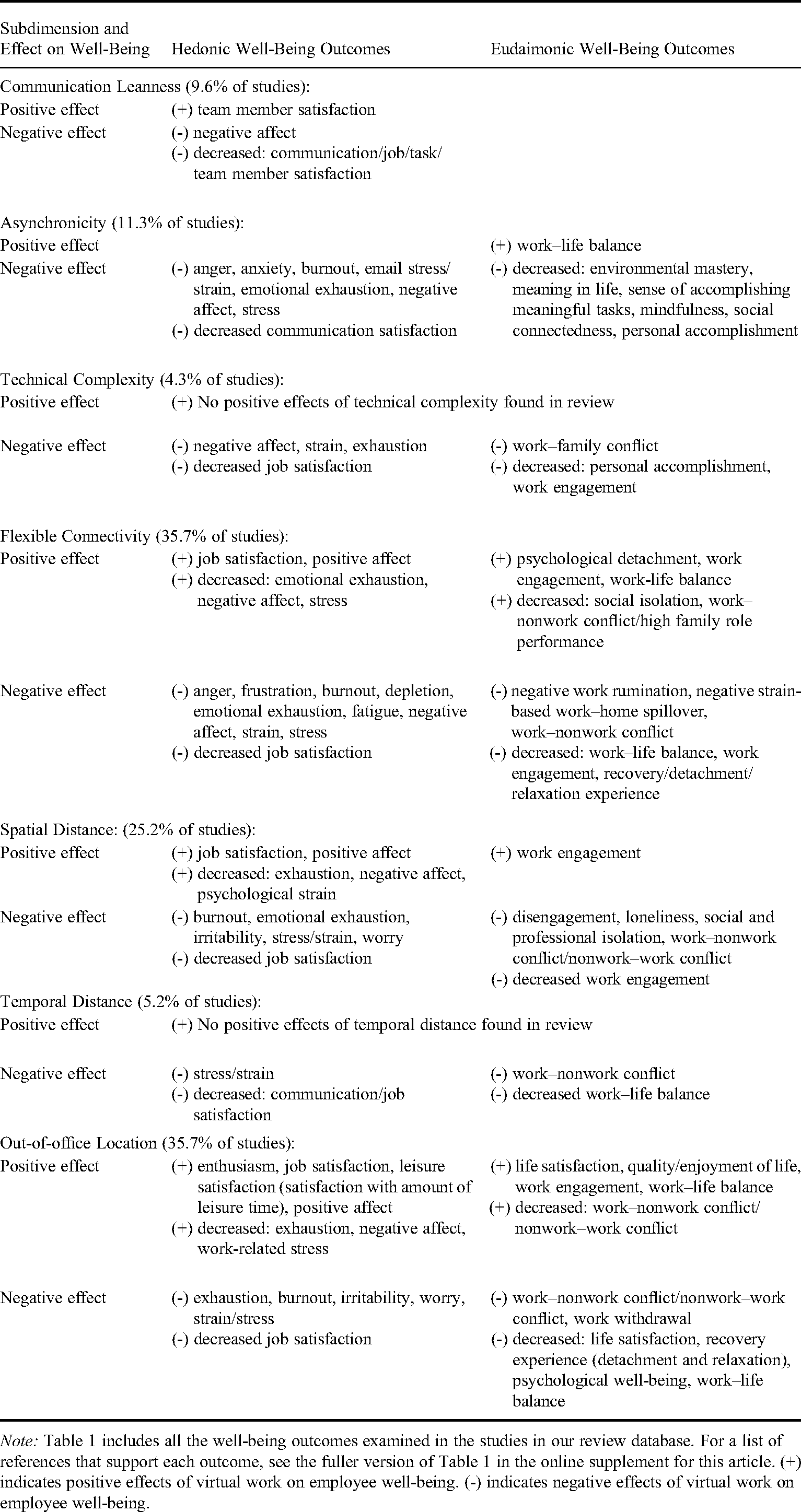
Note: Table 1 includes all the well-being outcomes examined in the studies in our review database. For a list of references that support each outcome, see the fuller version of Table 1 in the online supplement for this article. (+) indicates positive effects of virtual work on employee well-being. (-) indicates negative effects of virtual work on employee well-being.
Work Characteristics That Mediate Positive and Negative Effects of Virtual Work Subdimensions on Well-Being
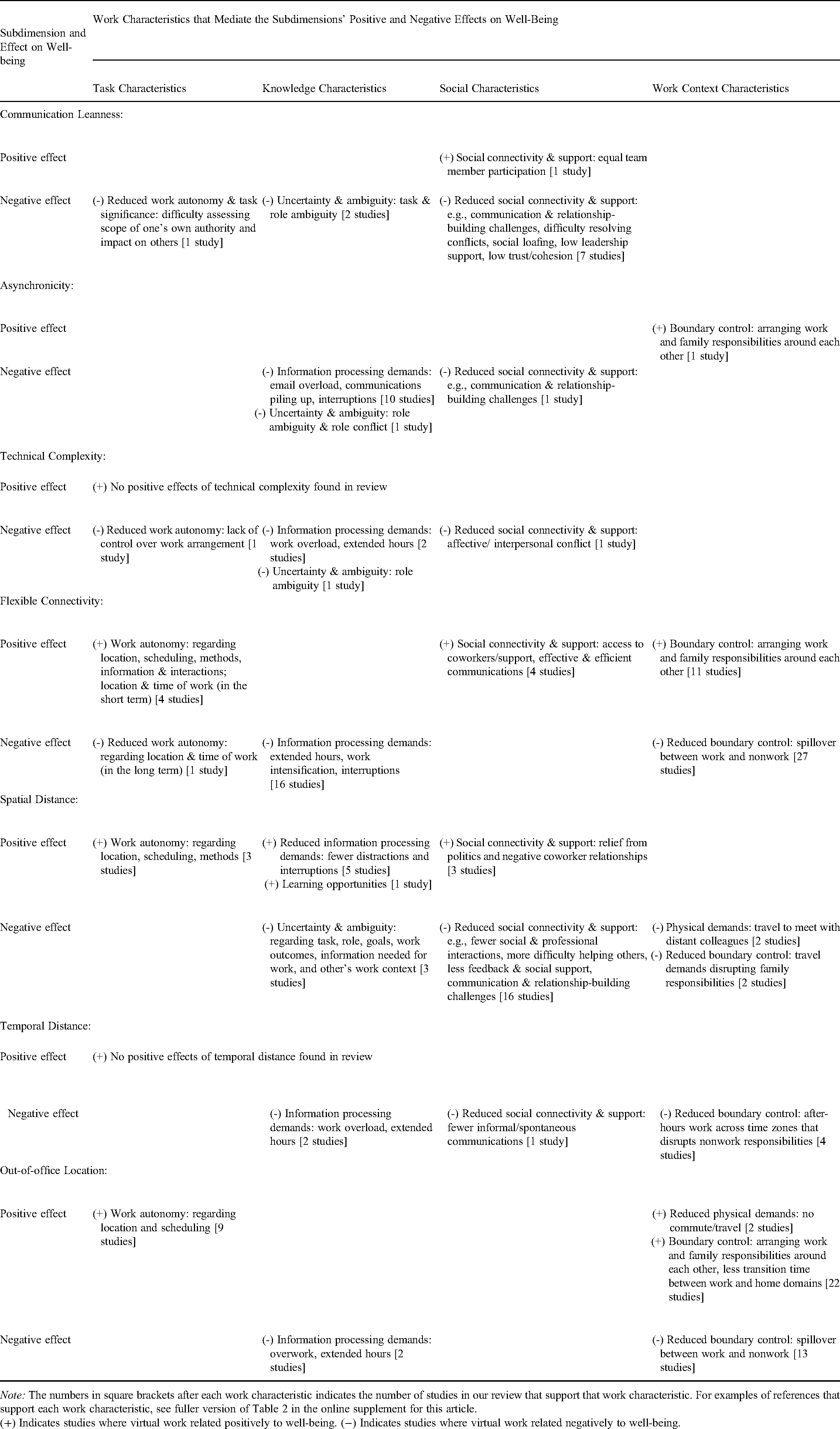
Note: The numbers in square brackets after each work characteristic indicates the number of studies in our review that support that work characteristic. For examples of references that support each work characteristic, see fuller version of Table 2 in the online supplement for this article.
(+) Indicates studies where virtual work related positively to well-being. (−) Indicates studies where virtual work related negatively to well-being.
Effects of Technology Dependence Subdimensions on Well-Being
Communication leanness affects well-being due to a lack of social and informational cues. On the negative side, a lack of cues reduces understanding in communications and lessens visibility into another's context, which is detrimental to different aspects of social connectivity and support. For example, leaner communication makes it difficult to resolve conflicts (Stark & Bierly, 2009) and develop trust in virtual teams (Johnson et al., 2009; Romeike, Nienaber, & Schewe, 2016). In addition, leaner communication with managers reduces employees’ perceptions of support (Braun, Hernandez Bark, Kirchner, Stegmann, & van Dick, 2019) and makes it easier for team members to engage in social loafing (Monzani, Ripoll, Peiro, & Van Dick, 2014; Penarroja, Orengo, & Zornoza, 2017). In a few studies, researchers focused on the negative effects of communication leanness on well-being due to higher uncertainty and ambiguity (knowledge characteristic) and lower autonomy and task significance (task characteristics). For example, Whitman and colleagues (2005) found that reliance on email and chat functions leads to greater uncertainty regarding tasks and roles. In addition, Hill and colleagues (2014) found that greater reliance on electronic media in their job reduces employees’ psychological empowerment (which includes autonomy and task significance) by making it more difficult to understand the extent of one's authority or the impact of one's work.
A positive effect of communication leanness on well-being occurs through social characteristics. Fewer social cues reduce the salience of team members’ status differences, which results in more equal participation and greater team member satisfaction (Stark & Bierly, 2009).
Negative effects of asynchronicity on well-being are attributed primarily to increased information processing demands associated with communications piling up, email overload, and interruptions (e.g., Barley et al., 2011; Lee, 2016; Russell, Woods, & Banks, 2017; ten Brummelhuis, Bakker, Hetland, & Keulemans, 2012)—all of which are knowledge characteristics. For example, incoming emails and phone calls disrupt employees’ workflow and require extra energy to address when they are unanticipated, leading to greater exhaustion at the end of the workday (ten Brummelhuis et al.). Asynchronicity also increases feelings of role ambiguity and role conflict because receiving multiple messages simultaneously creates competing demands from different sources (Cho, Lee, & Kim, 2019). The only positive effect found for asynchronicity is that it facilitates boundary control because it allows employees to respond at their convenience, rather than immediately upon receiving a message (Chen & Casterella, 2019).
Technical complexity negatively impacts well-being by affecting knowledge characteristics in the form of information processing demands and uncertainty and ambiguity. For instance, it creates work overload by making work more difficult (Suh & Lee, 2017), and Cho and colleagues (2020) found that technology-related hassles such as software glitches and internet connection problems delay employees’ communications and work progress, causing them to work extended hours. In Cho and colleagues' (2019) study, technical complexity led to role ambiguity because system feature overload made it more difficult to interpret information. Research has also shown that technical complexity has a negative impact on well-being because it reduces autonomy and social connectivity and support. For example, Dias and colleagues (2022) found that, in the context of the COVID-19 pandemic, employees felt less control and autonomy in teleworking arrangements when they lacked the skills to effectively use virtual communication technologies. Ayoko and colleagues (2012) showed that problems using technology tools can increase interpersonal conflict between members of virtual teams.
Unsurprisingly, flexible connectivity influences well-being mainly through its effects on the work–nonwork boundary. On the positive side, the ability to work from any location at any time helps employees coordinate work and family responsibilities (e.g., Adisa et al., 2017; Choroszewicz & Kay, 2019; Derks et al., 2016). A few studies also highlight benefits for social connectivity and support, such as being able to connect with coworkers more easily for timely and efficient communications (Ragsdale & Hoover, 2016; ter Hoeven et al., 2016). The positive effects are also attributed to autonomy over how, when, and where work interactions take place (e.g., Fujimoto, Ferdous, Sekiguchi, & Sugianto, 2016; ter Hoeven et al., 2016); however, this sense of autonomy might be short term, because working “anytime, anywhere” may lead to people working “all the time, everywhere” (Mazmanian, Orlikowski, & Yates, 2013).
The negative effects of flexible connectivity occur through reduced boundary control, as dealing with work requests during nonwork time may interfere with nonwork activities (Derks & Bakker, 2014; Ferguson et al., 2016; Tams, Grover, Thatcher, & Ahuja, 2021). Negative effects are also due to information processing demands, as working “all the time, everywhere” extends employees’ work hours, making detachment from work more difficult (e.g., Choroszewicz & Kay, 2019; Derks et al., 2016; Turel et al., 2011).
Effects of Dispersion Subdimensions on Well-Being
Spatial distance primarily influences well-being through reduced social connectivity and support. For example, Golden (2006b) showed that teleworkers who work away from the office most of the week have lower levels of leader–member and team–member exchange, and Orhan and colleagues (2016) found that less face-to-face interaction reduces social interactions and social support among distributed team members. Other negative effects of spatial distance are attributed to uncertainty and ambiguity in work—for example, distributed team members’ lack of visibility into teammates’ local conditions (procedures, norms, etc.) makes it difficult to reach a shared understanding of team goals and members’ roles (Nurmi, 2011). Finally, negative effects of spatial distance also occur through work context characteristics—specifically, the physical demands of traveling (Nurmi, 2011)—which also reduces the ability to manage nonwork responsibilities (Nurmi & Hinds, 2020).
Spatial distance has positive effects on well-being through task, knowledge, and social characteristics. From a task perspective, employees experience greater autonomy over when and how they complete their work tasks, because distant supervisors have less opportunity to micromanage (e.g., Hornung & Glaser, 2009; Sardeshmukh et al., 2012). Knowledge characteristics also are enhanced among teleworkers who face fewer distractions and interruptions when separated from coworkers (e.g., Anderson, Kaplan, & Vega, 2015; Fonner & Roloff, 2010; Maruyama & Tietze, 2012), and among team members who experience more learning opportunities because they work with geographically dispersed teammates (Nurmi & Hinds, 2016). Socially, spatial distance decreases negative politics and toxic work relationships (e.g., Collins et al., 2016; Fonner & Roloff, 2010; Windeler, Chudoba, & Sundrup, 2017).
Temporal distance has been studied primarily in the context of globally distributed teams with members located in different time zones. Reduced boundary control is an important work characteristic that explains the effects of temporal distance because team members often work after hours during family time to accommodate teammates’ work schedules (Sarker, Ahuja, & Sarker, 2018; Sarker, Sarker, & Jana, 2010). This increased workload creates more information processing demands (Nurmi, 2011; Nurmi & Hinds, 2020). Finally, temporal distance reduces social connectivity and support, as there are fewer opportunities for informal and spontaneous communications that foster strong interpersonal relationships (Ruppel et al., 2013).
The mixed effects of working from home on well-being occur primarily through work context characteristics—in particular, boundary control. On the positive side, employees have more boundary control because it is easier to structure work around family needs and to transition between the work and home domains (e.g., Delanoeije & Verbruggen, 2020; Hilbrecht, Shaw, Johnson, & Andrey, 2008; Mann & Holdsworth, 2003). For example, teleworkers describe benefits such as the ability to attend their children's activities and manage caregiving responsibilities. Working from home also reduces physical demands by eliminating commutes (Baruch, 2000; Mann & Holdsworth). On the negative side, employees experience less boundary control because a permeable work–nonwork boundary increases spillover of demands from one domain into the other (e.g., Delanoeije, Verbruggen, & Germeys, 2019; Eddleston & Mulki, 2017; Gashi, Kutllovci, & Zhushi, 2021). Mobile workers who work out-of-office but not at home also experience less boundary control when moving between work locations that require a lot of travel, thus increasing time away from home (Ladkin et al., 2016).
Work autonomy also explains the positive effects of out-of-office location on well-being, because working from home allows employees freedom to decide when and where they work (Anderson et al., 2015; Delanoeije & Verbruggen, 2020; Wheatley, 2012). However, this subdimension may have negative effects by causing employees to work extended hours, which increases information processing demands (Peters & van der Lippe, 2007).
Summary: Virtual Work Subdimensions’ Differential Pathways to Well-Being
Our literature review shows that the subdimensions have received varying degrees of research attention. Flexible connectivity, spatial distance, and out-of-office location have been studied more extensively, whereas technical complexity, communication leanness, and temporal distance have received very little attention. Thus, our findings based on existing research may not account for all potential effects of virtual work on well-being. Nevertheless, our analysis reveals important insights that point to future research needs. These insights are based on the trends revealed in Table 3, which we discuss in the next section. Table 3 summarizes the positive and negative effects on hedonic and eudaimonic well-being outcomes for each subdimension and the work characteristics that mediate these effects. The subdimensions and work characteristics that have received most attention in existing research are marked with an asterisk. This summary highlights that the subdimensions vary in their degree of positive versus negative impact on hedonic and eudaimonic well-being. In addition, different subdimensions that influence the same type of well-being outcome in the same way (i.e., in the same cell in Table 3) often do so through different work characteristics. For example, asynchronicity negatively influences hedonic well-being through knowledge characteristics (information processing demands), whereas out-of-the office location negatively influences hedonic well-being through work context characteristics (usually by reducing boundary control). These findings suggest that employees’ well-being experiences in virtual work vary based on the subdimensions involved.
Summary of Virtual Work Subdimensions With Positive and Negative Influences on Hedonic and Eudaimonic Well-Being and Work Characteristics That Mediate Their Effects
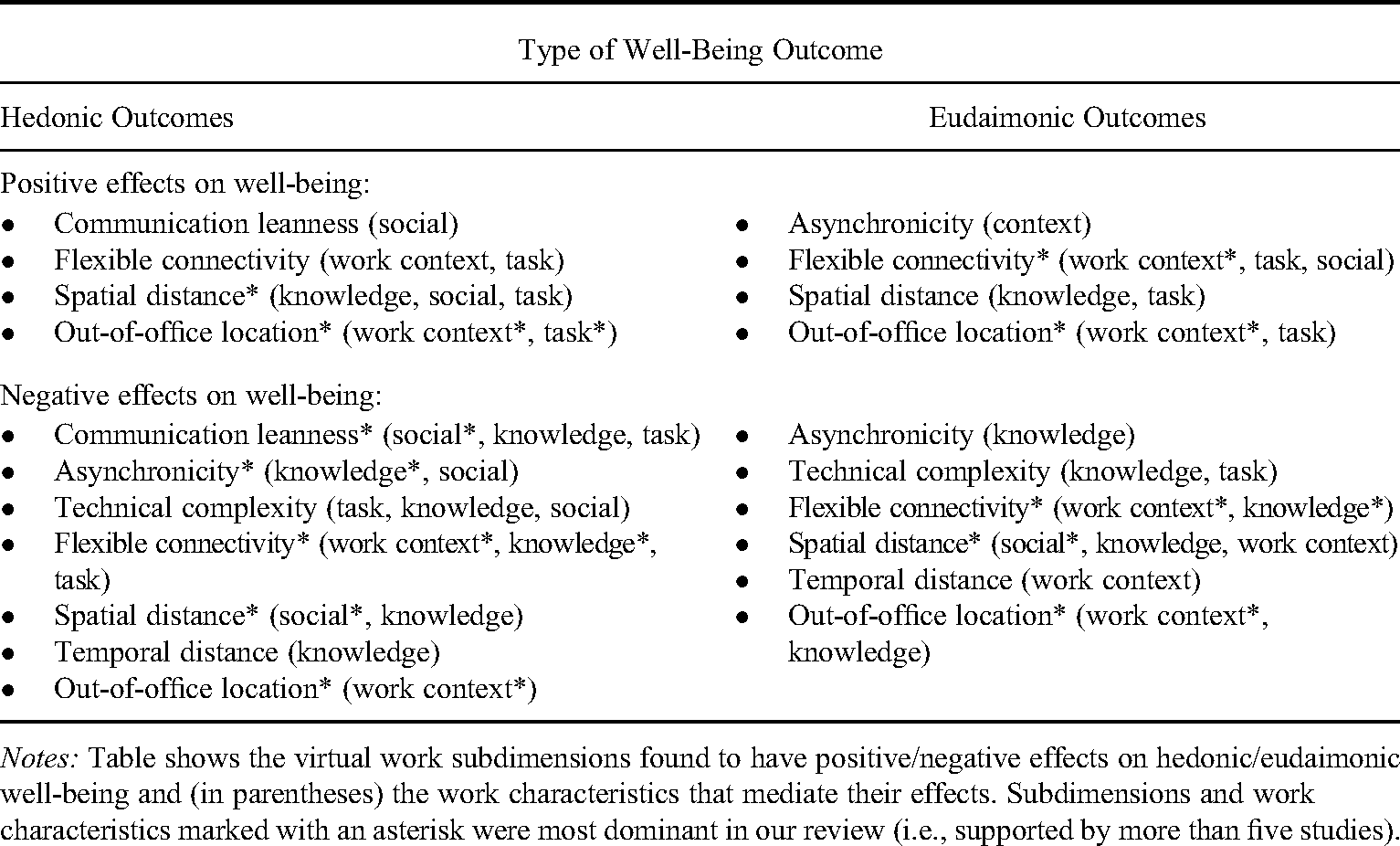
Notes: Table shows the virtual work subdimensions found to have positive/negative effects on hedonic/eudaimonic well-being and (in parentheses) the work characteristics that mediate their effects. Subdimensions and work characteristics marked with an asterisk were most dominant in our review (i.e., supported by more than five studies).
Virtual Work's Dual Effects on Well-Being: Key Trends
Although the subdimensions vary in their impact on well-being, when viewed across subdimensions, the summary in Table 3 reveals important trends for understanding virtual work's dual effects. These trends relate to the subdimensions’ relative influence on hedonic versus eudaimonic well-being, as well as positive versus negative effects.
Trends Related to Effects on Hedonic Versus Eudaimonic Well-Being
All the subdimensions influence hedonic and eudaimonic well-being to varying degrees, except communication leanness, which only impacts hedonic outcomes. Common hedonic outcomes across subdimensions include exhaustion, positive/negative affect, and satisfaction with different targets. Eudaimonic outcomes mostly relate to the work–nonwork boundary (e.g., work–family balance and work–nonwork conflict), but there are also effects on work engagement and social/professional isolation. Although the subdimensions affect well-being through different combinations of work characteristics, our synthesis reveals a dominant set of mediating work characteristics in each category of task, knowledge, social, and work context (see Figure 1 and Table 2). It is worth noting that the work context characteristic of boundary control is the most common mediator of effects on eudaimonic well-being, which highlights the importance of expanding work design theorizing to include outcomes related to the work–nonwork boundary.
Trends Related to Positive Versus Negative Effects on Well-Being
Flexible connectivity, spatial distance, and out-of-office location are associated with the most positive effects on well-being, but also with negative effects. Thus, the oft-touted benefits of virtual work for freeing employees from the restrictions of working collocated with others in a main office during standard work hours may come at a cost—namely, social and professional isolation, poorer quality relationships, reduced boundary control, and work intensification. Indeed, we found more negative than positive effects on well-being for most subdimensions in the current review. Another important trend highlighted in Table 3 is the potential for the same subdimension to have mixed effects on well-being, including opposing effects through the same work characteristic. For example, flexible connectivity and out-of-office location have both positive and negative effects on well-being by enabling but also undermining employees’ control of their work–nonwork boundary. This suggests that managing well-being effectively in virtual work depends on enhancing a subdimension's benefits while mitigating its downsides, which points to the critical role of the contingencies in our integrative framework.
Contingencies of Virtual Work's Effects on Well-Being Through Work Characteristics
As shown in Figure 1 and Table 4, our analysis highlights contingencies at different levels (individual, team, organization, and external context) that strengthen the effects of virtual work subdimensions on work characteristics in each category (task, knowledge, social, work context), thus moderating the subdimensions’ indirect effects on well-being. Here, we discuss examples of common types of contingencies that have been found to moderate their effects on well-being through work characteristics in each category. We refer the reader to Table 4 for a complete list.
Multilevel Contingencies That Strengthen Virtual Work's Positive and Negative Mediated Effects on Well-Being Through Different Categories of Work Characteristics
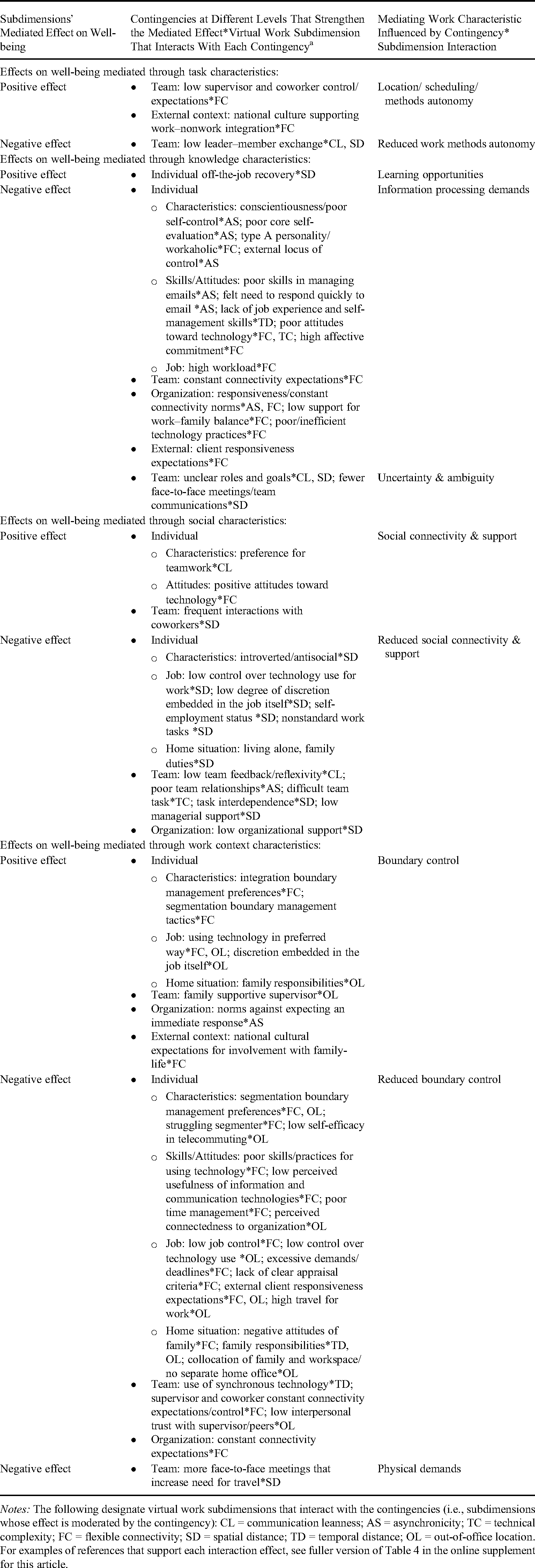
Notes: The following designate virtual work subdimensions that interact with the contingencies (i.e., subdimensions whose effect is moderated by the contingency): CL = communication leanness; AS = asynchronicity; TC = technical complexity; FC = flexible connectivity; SD = spatial distance; TD = temporal distance; OL = out-of-office location. For examples of references that support each interaction effect, see fuller version of Table 4 in the online supplement for this article.
On the other hand, several different types of contingencies exacerbate negative effects through social characteristics. First, conditions that intensify employees’ sense of isolation—for example, being introverted or living alone (Charalampous, Grant, & Tramontano, 2021; Gao & Sai, 2020; Wiesenfeld, Raghuram, & Garud, 2001)—strengthen the negative effects of physical separation from colleagues. Second, factors that increase the need to interact with co-workers heighten the perceived constraints associated with spatial distance or use of technology to communicate. An example at the individual level is having a job with fewer standardized and discrete tasks that are under an employee's sole control (Golden & Veiga, 2005; Neirotti, Raguseo, & Gastaldi, 2019); and an important team-level factor is work involving tasks that require close coordination with others (Golden & Veiga, 2005; Orhan et al., 2016). Finally, inadequate support from team members (Stark & Bierly, 2009), managers (Maruyama & Tietze, 2012; Shockley, Allen, Dodd, & Waiwood, 2021), and the organization (e.g., Bentley et al., 2016), strengthens the negative effects of virtual work on employees’ perceptions of social connectivity and support.
Conversely, the negative mediated effects through reduced boundary control are stronger under conditions that make it more difficult to manage spillovers between work and nonwork domains. This includes those who would prefer to segment work and nonwork but struggle to do so (Duxbury et al., 2014), poor time management skills (Fenner & Renn, 2010), excessive job demands (Charalampous et al., 2021), and family responsibilities (e.g., Golden et al., 2006; Mann & Holdsworth, 2003). Other contingencies of negative effects relate to poor support from supervisors, coworkers (Derks, van Duin, Tims, & Bakker, 2015; Gerdenitsch et al., 2015), and organizations (Charalampous et al., 2021; Duxbury & Higgins).
Future Research Agenda
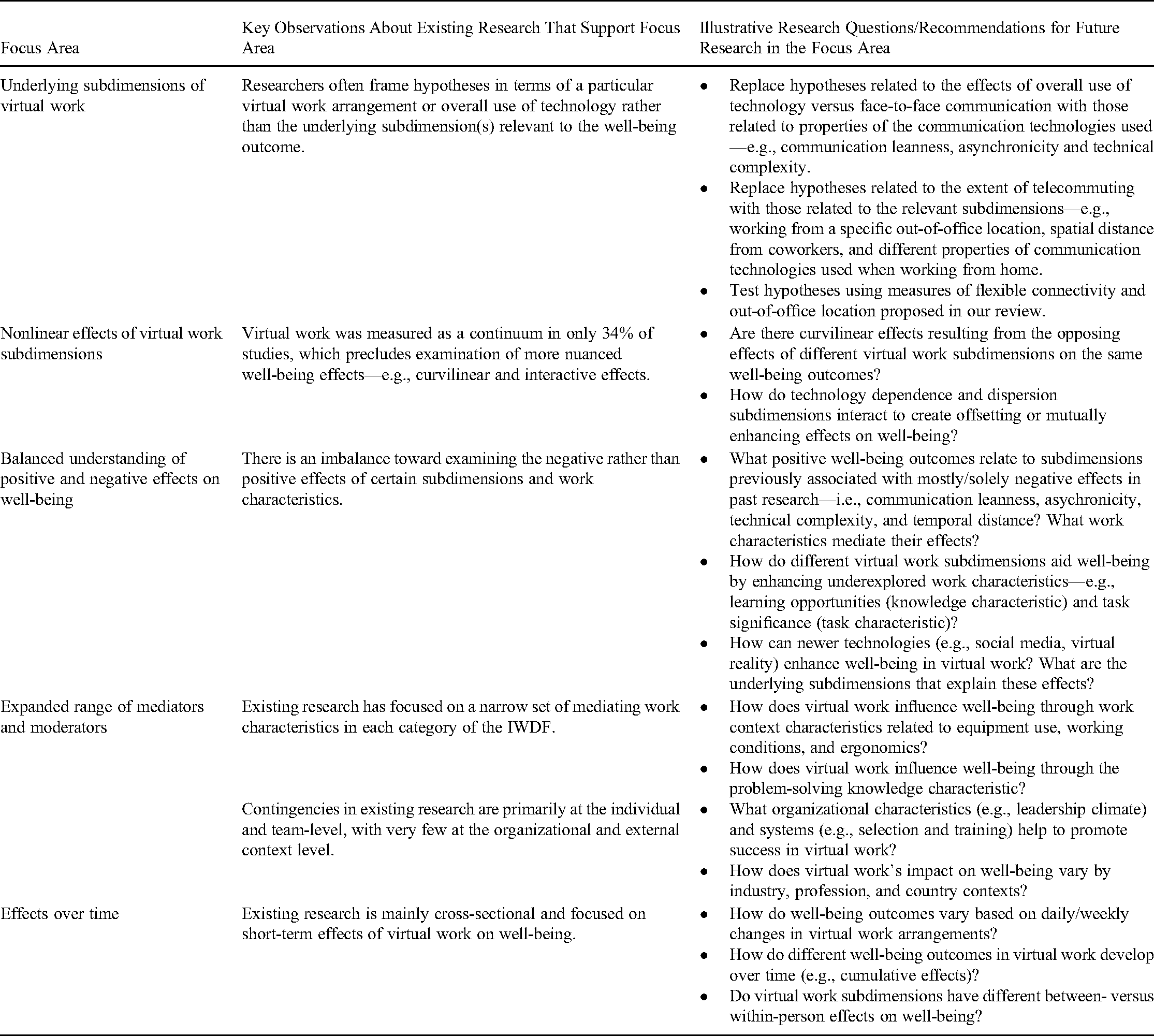
Based on the trends uncovered in our review, we identify five areas for future research, including more focus on: (a) underlying subdimensions of virtual work; (b) nonlinear effects of the virtual work subdimensions; (c) gaining a balanced understanding of virtual work's positive and negative effects on well-being; (d) expanding the range of mediators and moderators; and (e) examining effects over time. Table 5 summarizes these focus areas, including observations about existing research that support each area as well as related examples of research questions and recommendations for future research.
Directions for Future Research on Well-Being in Virtual Work
Underlying Subdimensions of Virtual Work
A pressing future research need based on our framework is to shift attention away from hypothesizing and testing effects of different virtual work arrangements or technologies on well-being to focusing on their underlying subdimension(s). This should facilitate integration of research findings from different virtual work domains and across different types of communication technologies and arrangements. We see two major areas of opportunity. First, in several studies, researchers hypothesized or tested the effects of overall use of technology-mediated versus face-to-face communication rather than isolating the effect of a specific characteristic of the technology (e.g., communication leanness and asynchronicity). Second, telecommuting scholars typically examine effects of the extent of telecommuting rather than effects related to relevant subdimensions (e.g., working in a specific out-of-office location, spatial distance from coworkers, and properties of technologies used when working from home).
An example of where it might be helpful to focus on underlying subdimensions is Hill, Ferris, and Martinson's (2003) unexpected finding that mobile workers who work from different locations experience less work–life balance than those who work in an office or at home. They proposed two potential reasons for these findings: (a) Mobile workers lack cues in their external context to remind them when they are at work or home and (b) they have access to technology that allows them to connect to work from any location. These explanations respectively align with the effects of working from an out-of-office location other than the home and the effects of flexible connectivity. In future work, researchers might use the measures we have proposed to conduct empirical studies that test which subdimensions are driving these effects.
Nonlinear Effects of Virtual Work Subdimensions
Isolating relevant subdimensions also facilitates examining their more nuanced effects on well-being, such as nonlinear effects and interactions between the subdimensions. These types of effects are mostly lacking in our review, potentially because researchers did not measure virtuality as a continuum in 66% of the studies we reviewed, despite it being conceptualized as such in the literature. Instead, most researchers took a dichotomous approach, comparing face-to-face work settings with partially or highly virtual settings. For example, in telecommuting studies, most researchers compared employees who worked full time in the office with those who worked one or more days at home. Other researchers used samples consisting solely of employees in highly virtual settings (e.g., a sample of globally distributed teams). Researchers who have examined virtuality as a continuum explicitly or implicitly studied linear effects, except for a few scholars who hypothesized curvilinear effects of the extent of telecommuting (e.g., Golden, 2006b; Virick, DaSilva, & Arrington, 2010). A continuous measure of virtuality is particularly relevant to hybrid work, which is a growing trend (Kropp & McRae, 2022).
A greater focus on curvilinear effects would be helpful for understanding the well-being tradeoffs in virtual work. For example, Golden (2006b) found a curvilinear (inverted U-shape) relationship between spatial distance and job satisfaction. They argued that this is because it is more difficult for managers to monitor employees’ work, resulting in increased work method autonomy, which promotes job satisfaction; however, at higher levels of spatial distance, this effect may be offset by having less social interaction with coworkers, which decreases satisfaction. In future research, scholars might explore other curvilinear effects resulting from the opposing effects of a virtual work subdimension on the same well-being outcome.
More studies of interactive effects between virtual work subdimensions are also needed, as employees are likely to experience more than one subdimension simultaneously. For example, given the use of technology to bridge spatial and temporal distance and to facilitate work from different out-of-office locations, a promising direction is to explore the interactive effects of technology dependence and dispersion subdimensions. We identified a few interactive effects in our review (see Table 4) that are consistent with this direction (see Table 4). For example, in a study of dispersed teams, Ruppel and colleagues (2013) found that temporally dispersed team members experience less work-family balance when they use more synchronous communication because real-time interactions with coworkers require that they work outside their normal hours. On the other hand, synchronous communication may be more effective for relationship-building and social support across spatial and temporal distance. We encourage researchers to consider interactions involving both offsetting and mutually enhancing effects between different subdimensions.
Balanced Understanding of Positive and Negative Effects on Well-Being
We found more negative than positive effects on well-being, with out-of-office location as the only subdimension that has balanced positive and negative effects. Thus, a fruitful avenue for future research is to explore more positive effects of subdimensions that have previously explained solely or primarily negative effects. For example, a potential positive effect of technical complexity missing in our review is providing learning opportunities that foster growth and work engagement. Positive effects through learning opportunities were examined in only one study (related to spatial distance; Nurmi & Hinds, 2016).
A reason for the predominantly negative effects associated with the technology dependence subdimensions (except flexible connectivity) in existing research might be due to the focus on older, text-based communication technologies (e.g., email). Although generally viewed as a hindrance relative to face-to-face communication, these technologies are still widely used to communicate in a virtual setting. Yet, Treem and Leonardi (2012) proposed that newer technologies such as social media offer unique affordances (or “possibilities for action”) that can transform organizational communication. This is consistent with our finding that flexible connectivity, which mostly involves newer mobile technologies such as smartphones, yields many positive as well as negative effects. Furthermore, research on newer meeting technologies like Zoom and Teams could also shed light on the positive and negative effects of virtual work on well-being, if their use forms a significant part of the work arrangement (e.g., jobs that involve a lot of meetings). Emerging research in this area suggests that using such technologies increases mental fatigue, but this can be reduced—for example, by turning off the camera and/or microphone (e.g., Bennett, Campion, Keeler, & Keener, 2021; Shockley, Gabriel, et al., 2021). Extensive use of these communication media could therefore affect work characteristics such as information processing demands. In future research, scholars might examine well-being associated with using newer technologies such as social media, virtual reality, and virtual meeting tools where these technologies form a significant part of a person's job. To uncover these effects, researchers may need to expand the subdimensions in our framework to include others that have not yet been examined. For example, social media provides greater accessibility to join social networks (McFarland & Ployhart, 2015), which may influence well-being through aspects of social connectivity and support.
Expanded Range of Mediators and Moderators
Our review highlights a dominant set of work characteristics that explain the subdimensions’ effects on well-being as well as multilevel contingencies of these effects. We encourage researchers to explore additional mediators and moderators that illuminate different pathways through which virtual work influences well-being. This may involve other mediating work characteristics in the IWDF that we did not find in our review. For example, several characteristics in the work context category of the IWDF may be relevant to understanding how out-of-office locations other than the home context influence well-being, an area of research mostly lacking in our review. These include physical ergonomics (i.e., how people's bodies interrelate with everyday work implements such as desks, chairs, and keyboards) and environmental conditions (e.g., air quality, noise, privacy), both of which have been associated with job satisfaction, physiological arousal, and work stress (e.g., Colenberg, Jylhä, & Arkesteijn, 2021). In addition, employees working from out-of-office locations may lack access to necessary equipment, resulting in work delays that cause frustration and exhaustion. This relates to the work context characteristic of “equipment use,” which Morgeson et al. (2012: 538) described as a “largely unrecognized contextual characteristic.” We also see interesting opportunities to identify knowledge characteristics that mediate positive effects of virtual work on well-being rather than the mostly negative effects associated with this work characteristic category in our review. For example, the knowledge characteristic of enhanced problem solving in the IWDF may help explain how asynchronicity can support well-being by enabling employees to take time to process and reflect on information they receive.
Future work could also broaden the scope of contingencies examined, including additional organizational and external context moderators, since the contingencies in our review are primarily at the individual and team levels. The dominant types of contingencies that emerged at these lower levels may be a useful starting point to identify additional organizational-level moderators. For example, we found team-level contingencies that help provide employees with the latitude to take advantage of the potential autonomy that virtual work provides. At the organizational level, this points to the importance of organizations promoting an empowering leadership climate, perhaps through the training and rewards provided to managers. Our review also highlights individual traits and skills (e.g., self-management, technical expertise) that help employees cope with the demands of virtual work. Thus, organizational selection and training practices that help prepare employees for working virtually might also play a contingent role.
Regarding the external context, more research is needed to understand how the effects of virtual work on well-being vary across different industries, professions, and countries. For example, in a study of teleworkers in a large organization, Maruyama and Tietze (2012) found that sales and marketing professionals who were spatially distant from work colleagues missed the visibility and professional interactions associated with co-location. These researchers speculated that professional employees (particularly those in customer-facing roles) place more value on in-person interactions with coworkers that facilitate professional development and networking. Although these findings are based on data from a single organization, they point to profession and industry as potentially relevant contingencies. The few external context contingencies uncovered in our review focus on the importance of expectations from external sources—that is, client expectations (Mazmanian et al., 2013; Park et al., 2020) and a country's cultural norms (Choroszewicz & Kay, 2019; Fujimoto et al., 2016). Thus, other relevant external context contingencies may be type of industry (related to the type of clients), different types of national cultures, and other country characteristics. Although researchers have studied the well-being effects of virtual work in 22 different countries (see Appendix), more studies are needed that compare effects across countries.
Effects Over Time
Consistent with well-being research more generally, the studies we reviewed did not examine effects on well-being beyond a few weeks and mainly used cross-sectional study designs. Studying longer-term effects could provide important insights for understanding how well-being in virtual work changes over time. As organizations increasingly implement hybrid arrangements where individuals alternate between in-person and virtual work, it would be useful to understand which patterns of hybrid work are most beneficial by studying how effects on well-being fluctuate based on daily/weekly changes in virtual work arrangements. For example, is it better to work a week in the office followed by a week at home or to be in the office a few days each week? In addition, study designs are needed to understand how well-being effects develop and accumulate over time. For example, virtual work's effects on social and professional isolation may grow gradually over time, only manifesting after a few months, whereas effects on work–family conflict may emerge more quickly.
Examining the influence of virtual work subdimensions on well-being over time would also facilitate comparisons of their between- versus within-person effects—something mostly missing in our review. In one example of such a study, researchers examined both between- and within-person effects (Delanoeije & Verbruggen, 2020) associated with a pilot program that allowed employees to work from home for up to 2 days per week. They collected data at the start and end of the pilot to understand between-person changes in well-being outcomes over time as well as data on 13 consecutive workdays after the start of the pilot to test within-person effects. Both types of effects were positive for pilot participants but involved different types of well-being outcomes. Thus, future research might also explore whether between- and within-person effects on well-being can be in opposite directions for the same virtual work subdimension. For example, spatial distance may have positive effects on feelings of accomplishment on days employees work from home because it allows them to work uninterrupted; however, between-person effects for this same outcome may be negative because physical separation from co-workers makes it more difficult to see how their work impacts others.
Practical Implications
We offer three important strategies for organizations and leaders to apply our integrative framework to improve their employees’ well-being in virtual work. First, they can use it to understand how different virtual work arrangements may affect well-being by considering the underlying technology dependence and/or dispersion subdimensions involved. For example, the well-being of an employee who telecommutes while simultaneously collaborating on virtual teams that cross time zones may be impacted by working from a home location as well as working with colleagues across spatial and temporal distance.
Second, the contingencies in our framework serve as a guide to help maximize employees’ well-being in virtual work. For example, organizations might address individual-level contingencies by selecting and/or training employees to ensure they have the necessary experience, skills, attitudes, and personal resources (e.g., self-efficacy) for working virtually. Another effective strategy is to help employees take advantage of virtual work's autonomy-enhancing potential by empowering them to make decisions about their work and providing access to appropriate technologies. Examples of effective actions at the team level include clearly defining work roles and objectives to reduce uncertainty and ambiguity; structuring the team's work and fostering effective communications to reduce information processing demands; and encouraging frequent communications to help reduce remote employees’ feelings of isolation. Organizational norms, such as not expecting employees to be available for work during nonwork hours, can also play an important role in countering negative effects of virtual work.
Finally, we encourage organizations to pay particular attention to challenges in managing the work–nonwork boundary that might result from flexible connectivity to work, temporal distance, and working from home. Although mitigating negative effects on boundary control may depend on factors outside their control (e.g., employees’ home and family situations), organizations can help employees by implementing practices that support work–family balance.
Conclusion
Virtual work is becoming “an essential and increasingly common element of conducting business” (Makarius & Larson, 2017: 159)—even more so because of the COVID-19 pandemic. Thus, managers need to understand how to maximize their employees’ psychological well-being in different virtual work arrangements. Toward this goal, we have applied a work design theoretical lens to develop an integrative framework based on a synthesis of 115 empirical studies. Our framework illuminates how subdimensions of technology dependence and dispersion differentially relate to hedonic and eudaimonic well-being outcomes through positive and negative effects on perceived task, knowledge, social, and work context characteristics, including multilevel contingencies of these effects. Our proposed agenda for future research promises to help promote higher levels of well-being in an expanding virtual workforce.
Supplemental Material
sj-docx-1-jom-10.1177_01492063221131535 - Supplemental material for Unpacking Virtual Work's Dual Effects on Employee Well-Being: An Integrative Review and Future Research Agenda
Supplemental material, sj-docx-1-jom-10.1177_01492063221131535 for Unpacking Virtual Work's Dual Effects on Employee Well-Being: An Integrative Review and Future Research Agenda by N. Sharon Hill, Carolyn Axtell, Sumita Raghuram, and Niina Nurmi in Journal of Management
Footnotes
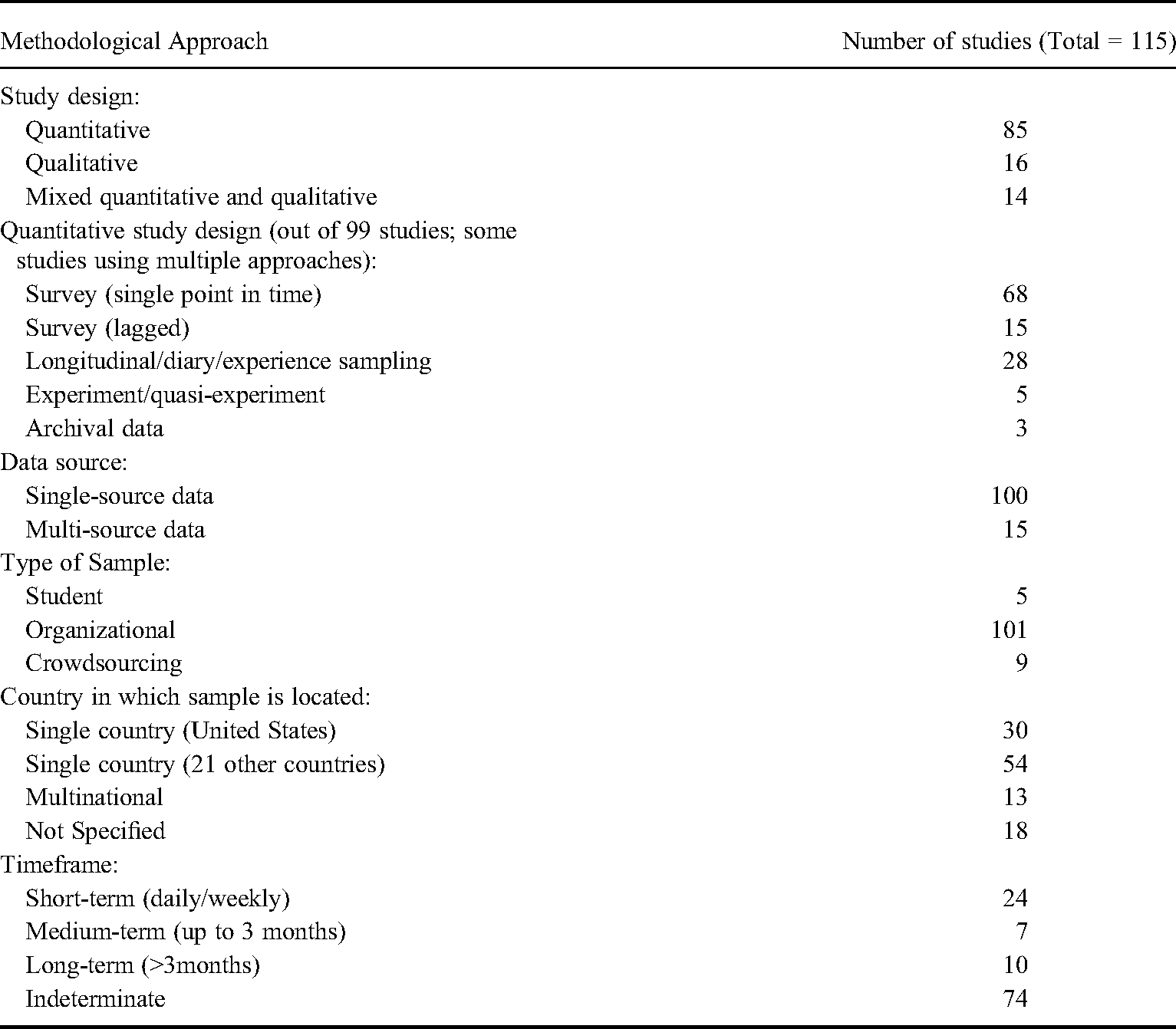
APPENDIX: METHODOLOGICAL APPROACHES USED TO STUDY THE EFFECTS OF VIRTUAL WORK ON WELL-BEING
| Methodological Approach | Number of studies (Total = 115) |
|---|---|
| Study design: | |
| Quantitative | 85 |
| Qualitative | 16 |
| Mixed quantitative and qualitative | 14 |
| Quantitative study design (out of 99 studies; some studies using multiple approaches): | |
| Survey (single point in time) | 68 |
| Survey (lagged) | 15 |
| Longitudinal/diary/experience sampling | 28 |
| Experiment/quasi-experiment | 5 |
| Archival data | 3 |
| Data source: | |
| Single-source data | 100 |
| Multi-source data | 15 |
| Type of Sample: | |
| Student | 5 |
| Organizational | 101 |
| Crowdsourcing | 9 |
| Country in which sample is located: | |
| Single country (United States) | 30 |
| Single country (21 other countries) | 54 |
| Multinational | 13 |
| Not Specified | 18 |
| Timeframe: | |
| Short-term (daily/weekly) | 24 |
| Medium-term (up to 3 months) | 7 |
| Long-term (>3months) | 10 |
| Indeterminate | 74 |
Acknowledgements
We thank Matthew M. Piszczek for his valuable feedback on an early draft of this manuscript. We also thank our associate editor, Devasheesh Bhave, and the anonymous reviewers for their helpful guidance and highly constructive feedback that greatly improved our manuscript.

References
Supplementary Material
Please find the following supplemental material available below.
For Open Access articles published under a Creative Commons License, all supplemental material carries the same license as the article it is associated with.
For non-Open Access articles published, all supplemental material carries a non-exclusive license, and permission requests for re-use of supplemental material or any part of supplemental material shall be sent directly to the copyright owner as specified in the copyright notice associated with the article.
