



Abstract
Team virtuality has been mostly conceptualized as structural features, such as the percentage of time team members communicate via technology. However, the perception of distance and of information deficits (team perceived virtuality, TPV) may be an indispensable construct to understand virtual teams’ functioning. The lockdowns imposed on most countries due to COVID-19 created virtual teams with high degrees of structural virtuality. With structural virtuality held constant among teams, we explore configurations of work characteristics (autonomy, interdependence, and organizational support) that influence TPV. With a sample of 296 multinational workers, a Latent Profile Analysis identified four distinct profiles of those work characteristics. Those profiles related differently to TPV. Contrary to previous findings, interdependence seems to play an important role in these teams high in structural virtuality when their autonomy is also high, highlighting the pivotal role of frequent interaction among team members, under conditions of high structural virtuality.
Keywords
The study of virtual teams (VT) entered organizational behavior and management fields some decades ago, when technology began to allow individuals to work together while being physically distant. The fast-paced development of technology, coupled with other socio-economic trends such as globalization and market expansion, has steadily highlighted the relevance of virtual work and of understanding how teams can best navigate the challenges that come with it. However, the COVID-19 pandemic and the public health-driven lockdowns have forced teams, regardless of how they worked before, into a situation where they were suddenly forced into a maximum level of team virtuality (i.e., high reliance on communication technologies and potentially geographic dispersion, e.g., Foster et al., 2015; Schulze & Krumm, 2017). Hence, understanding which factors are helpful to teams in highly virtual contexts has become of paramount interest for both academics and managers.
Previous field studies have operationalized virtuality using measures of structural virtuality. This discounts the effect that perceived virtuality may have on individual and team outcomes, and therefore fail to understand the full concept of team virtuality. This confound may also account for the fact that there is a large heterogenity in effects of team virtuality, with a decent number of studies finding effects that vary largely over study settings (e.g., De Guinea et al., 2012; Gibbs et al., 2017).
Structural virtuality is the objective physical distance between team members, or even the features of the communication technology used by those members to communicate (e.g., the amount or type of nonverbal cues it can transmit). However, this definition of team virtuality overlooks an account of team members’ actual experience of virtuality, which may explain why some virtual teams function better than others. Team Perceived Virtuality (TPV, Handke, Costa, et al., 2020) was recently proposed as a construct of team members’ perceptions rather than structural features of their degree of virtuality (i.e., technology reliance and geographic dispersion). TPV makes it possible for teams with a high degree of structural virtuality to still perceive closeness and information richness. In other words, teams may have the same degree of dispersion between work locations and use the same communication technologies and still experience different levels of distance and information deficits.
To disentangle the consequences of team perceived virtuality from structural virtuality, it is necessary to hold structural virtuality constant across teams. This can be achieved via laboratory research, but the opportunity to do this in a naturalistic setting has been elusive. The COVID-19 lockdowns led precisely to uniformly high levels of structural virtuality (i.e., as most members were obligated to work from home all the time). What is more, the lockdown had challenges of its own that may have impacted teamwork and their TPV. For example, individuals were experiencing increased fear and anxiety due to uncertainties of the pandemic, there was no time to prepare and train for shift to work from home, and employees had to manage the physical presence of other family members (or roomates) all time. Our study focuses, then, in understanding TPV differences under conditions of high structural virtuality and lockdown-specific constraints. More specifically, given that virtuality perceptions are hypothesized to be further shaped by team work design, we examined how work characteristic configurations, which may account for interindividual differences even under similar lockdown-specific constraints, impact TPV. Work design characteristics are of interest because they have been shown to influence the performance of individuals and teams, and they can be shaped when planning remote work to respond to the needs of workers.
The objectives of this study were two-fold. First, we sought to identify unique configurations of work characteristics in virtual teams. We explore emerging profiles of VT’s work characteristics that can help characterize them into groups defined by distinct configurations, providing a foundation for analyzing their implication for team outcomes. Second, we sought to evaluate how those configurations related to team perceived virtuality within the unique context of the pandemic. By doing this, our work provides a unique examination of the existence and role of the TPV construct and explores some of its antecedents, identified but not tested by Handke, Costa, et al. (2020).
Structural versus Perceived Team Virtuality
The literature on the concept of virtuality within teams resides in two general traditions. On the one hand, we have work that focuses on the objective features of communication technology or the actual distance between team members. Examples of such structural elements are the degree to which a given technology is able to transmit voice, or the transmission velocity it allows for, or the number of miles separating team members (Gilson et al., 2015; Raghuram et al., 2019). On the other hand, other work refers to the socially constructed perception of reality (Walther & Parks, 2002) and argues that more than the objective features of the context or the situation, how individuals collectively shape and interpret their situation is more relevant to understand their behavior and outcomes. Hence, part of the confounding effect in the findings around virtual teamwork may arise because the studies tend to use structural features to measure virtuality, while the socially-constructed ones are not usually accounted for. Indeed, knowing the objective physical distance between team members, or how many time zones separate them, may not necessarily account for how distant team members feel subjectively or how much of their work is affected by that distance. Although their day-to-day interactions are constrained both in content and form by communication technologies (Daft & Lengel, 1986), team members are not passively reacting to those constraints. Through sociotechnical dynamics individuals also shape and influence how technology is used (see adaptive structuration theory, DeSanctis & Poole, 1994; compensatory adaptation theory, e.g., Kock, 1998, 2001; sociomaterial theory, e.g., Orlikowski, 1992, 2010) and, more importantly, co-construct meaning around technology usage, distance, and team functioning. Therefore, parallel to the structural properties of teams’ virtuality (i.e., objective distance measures or technology usage), how individuals perceive their own level of virtuality becomes critical to understand virtual teams and their outcomes in terms of performance, learning, and individual reactions (Mathieu et al., 2019).
Team perceived virtuality is a shared affective-cognitive emergent state (see Marks et al., 2001), characterized by two dimensions (experienced distance and experienced information deficits; Handke, Costa et al., 2020). Collectively experienced distance is an affective dimension of TPV closely related to the concept of perceived proximity (Wilson et al., 2008) or propinquity (Korzenny, 1978). It is therefore related to the degree to which interpersonal relationships are colder, less affectionate, and less intimate. Collectively-experienced information deficits is a cognitive dimension of TPV that represents a barrier to an efficient, timely, and rich conveyance of information, with potential negative consequences for converging meaning and exchanging task relevant information. Consequently, higher perceived distance and higher perceived communication deficits characterize high TPV and would be related to more negative team outcomes, independent of the objective degree of virtuality.
According to its theoretical model, and being an emergent state, TPV will develop and evolve depending on team processes and on fluctuations in antecedent variables, such as structural virtuality or team design (Handke, Costa et al., 2020). Considering that the global lockdown provided a unique situation where the structural virtuality of teams was held relatively constant at a high level across teams, organizations, and even countries, this was an ideal scenario to study how work design configurations could impact perceived distance and information deficits. Moreover, the organization of work and of tasks is something that teams and team leaders can actively shape when planning how to work remotely. Particularly relevant to the study of virtual teams are autonomy, interdependence (Handke, Costa, et al., 2020), and structural as well as social support, developed below (e.g., Handke, Kloneck, et al., 2020; Hoch & Kozlowski, 2014).
Work Characteristics and Virtual Work
Work design relates to the nature and organization of activities and tasks both at the individual (e.g., Parker et al., 2001) and team (Parker, 2014) levels, and has been extensively studied as a predictor of team effectiveness (for a meta-analysis, see Carter et al., 2019).
Nonetheless, less is known about the ability of work design dimensions to predict or influence the emergence of shared affective or cognitive states. According to Morgeson and Humphrey (2006), there are three main sources of work characteristics: task characteristics, social characteristics, and contextual characteristics. Task characteristics reflect aspects of the work itself or of the task environment (e.g., task variety, autonomy, complexity, information processing); social characteristics represent interpersonal features and events, such as feedback from others or interdependence); and contextual characteristics emerge from the physical or organizational environment (e.g., ergonomic design, organizational support). In the present study and building on Handke, Costa, et al.’s (2020) proposal, we look at potentially synergetic configurations of some of the most critical work characteristics for teams in the context of this study (Morgeson et al., 2006) from the three sources identified: autonomy (task), interdependence (social), and organizational support (contextual).
Autonomy is defined as the extent to which one has discretion and freedom in deciding how to carry out tasks (Langfred, 2005). Autonomy is consistently identified not only as the most studied work characteristic, but also as a critical factor for team effectiveness, usually with a positive relationship with different team outcomes (from performance to well-being). The theory of autonomy rests upon both motivational and informational mechanisms (Langfred & Moye, 2004). Motivationally, autonomy relates to personal initiative and proactive behavior (e.g., Griffin et al., 2007; Raabe et al., 2007) and to an increase in critical psychological states such as increased responsibility over work outcomes (Hackman & Oldham, 1976). Informationally, allowing team members to participate in decision making and in problem solving will likely increase their job-relevant information and knowledge, while reducing the delay between the onset of a problem and its resolution, which translates into better performance and learning opportunities. Not surprisingly, positive effects of autonomy on team outcomes have been reported in VT and the broader telecommuting literature. A recent review of the interactive effects of team virtuality and work design on team functioning (Handke, Klonek, et al., 2020) found consistently positive main effects of team autonomy on virtual team functioning. What is more, autonomy was found to partially mediate the positive impact of remote work on outcomes such as job satisfaction and performance (Gajendran & Harrison, 2007). These authors found that when remote work leads to increased autonomy of employees, it has a positive effect on those outcomes, namely as job satisfaction, performance, turnover intent, and role stress. This happens because individuals have increased perceived control over work processes and environment, and allows them to better synchronize demands from work and family life.
Socially, task interdependence reflects the degree to which completing a task requires the interaction of team members; it has been found to be one of the most common work design variables influencing team performance. It is considered a positive influence for team outcomes, because interdependence necessarily leads to an increase in communication and information exchange, as well as encouraging motivation through social facilitation effects. Notably, Courtright et al. (2015) distinguished between task and outcome interdependence. Outcome interdependence describes the extent to which outcomes are measured, rewarded, and communicated on a collective, as opposed to individual, level. Task interdependence is “the degree to which taskwork is designed so that members depend upon one another for access to critical resources and create workflows that require coordinated action” (Courtright et al., 2015, p. 4). Here, we focus on task interdependence, as it can be much more affected by virtual communication and virtual work. In VTs, the relationship between interdependence and team outcomes is inconsistent (Handke, Klonek, et al., 2020), with some studies reporting positive consequences for performance, and others highlighting a detrimental increase in complexity and coordination demands on team members. Furthermore, we concentrate on task, rather than outcome interdependence because while important to virtual team functioning, outcome interdependence shows mixed effects in prior research (e.g., Handke, Klonek, et al., 2020), suggesting that it’s particularly interesting to study in conjunction with other work characteristics. For example, Golden and Gajendran (2019) found telecommuting and interdependence interacted to predict performance. For telecommuters in complex jobs with low interdependence, telecommuting was associated with higher job performance.
Finally, perceived organizational support is concerned with the general beliefs about the degree to which the organization values employee contributions and cares about their well-being (Eisenberger et al., 1986; Rhoades & Eisenberger, 2002), and is generally related to positive perceptions of feedback, reward systems, availability of relevant resources, and formal training provided (Morgeson & Humphrey, 2006). Virtually, a study by Hoch and Kozlowski (2014) showed structural virtuality strengthened the relationship between structural supports (i.e., rewards system, and team performance, communication, and information) and team performance, therefore highlighting the relevance of perceived organizational support in a high structural virtuality context.
A large volume of VT research has been conducted using controlled laboratory designs, which control and manipulate variations in work characteristics in isolation (see Handke, Klonek, et al., 2020). However, we posit that these three characteristics are experienced holistically, and therefore they need to be examined as configurations or bundles as they are experienced by employees in the work environment. Accordingly, we adopt a person-centered approach, which is rooted in the assumption that these work design characteristics do not exist independently of each other. Each of the characteristics under study (autonomy, interdependence, and organizational support) may exist in association with the others in such a way that they need to be considered collectively, rather than separately, as configurations, or profiles, of characteristics. Indeed, there is growing research demonstrating that work design is experienced holistically (De Treville & Antonakis, 2006; Keller et al., 2017; Parker, 2014), and there is growing support for a configural, or profile, approach in teams research (McLarnon & O’Neill, 2018; O’Neill et al., 2016, 2018; Shuffler et al., 2018). Below we explain that the unique configurations of autonomy, interdependence, and organizational support may impact TPV. If so, this would lead to a better understanding of the impact of patterns of work characteristic configurations, which could be an essential tool to the design of virtual teams.
It is likely that individuals will report different combinations of autonomy, interdependence, and perceived organizational support. A major reason for this is the type of work itself. Whereas some jobs allow for a high discretion in scheduling and allocating work hours (e.g., software developers, accountants), others depend on third parties and, therefore, have scheduling requirements incompatible with individual choices (e.g., customer service, teachers, journalists). Similar reasoning applies to interdependence. Regardless of interdependence being one of the key elements to define teamwork (Kozlowski & Bell, 2003), some jobs do require a high amount of interdependence among team members (e.g., between developers and content creators), and others can be easily performed by employees alone most of the time (e.g., research teams conducting complementary experiments). Another reason is related to the availability of resources for providing support. Large and financially stable companies may have been able to invest in, for instance, laptops or training sessions for their workers, whereas smaller and struggling ones may not even have technical support personnel. In addition, managers’ attitudes toward remote work also plays a role. Some managers may see remote work as a threat to their ability to control and monitor the work of their employees, and prefer to limit their followers’ scheduling autonomy. In our research, we explicitly model how each employee experiences configurations of work scheduling autonomy, interdependence, and organizational support, rather than treating these three variables as separate and unrelated to each other. Moreover, we expect that these configurations will differentially contribute toward team experiences, thereby leading to differences in TPV.
Work Characteristics and TPV under Lockdown Conditions
The lockdown imposed on most workers during the COVID-19 pandemic had specific features that likely constrained teamwork. First, the lockdown created virtual teams comprised of members who had previously worked together face-to-face. Rather than being teams who had always worked remotely, these teams brought their own history to the virtual world. Second, the shift to VTs happened without the luxury of advanced preparation, consideration of who should be on the team, task design, training, and other human resource management supports. This was completely unplanned, and the timing may have been suboptimal for an effective transition for many. Third, team members working during the COVID-19 pandemic mostly worked from home. Their work environment likely lacked the arrangements and conditions they had previously had, both material (tools, equipment, resources) and environmental (e.g., lack of a private space to work in). Finally, this rapid shift was due to the existence of a real health threat with serious consequences. Therefore, the anxiety over the invisible menace and the uncertainty about the future top the other hostile conditions these teams were created in and worked in.
In a virtual context, and specifically in the lockdown period where teams had to shift to a remote mode very quickly, autonomy, interdependence, and organizational support gain particular importance. First, during the stressful lockdown periods, allowing individuals the discretion to control and customize their work schedules was important to manage non-work related demands (e.g., childcare, housework, care of infected relatives), and reduce stress levels. Relatedly, the degree of discretion over controling the work schedule (i.e., work scheduling autonomy) was possibly the most salient facet of autonomy during the lockdown. Being able to manage one’s work time and flex one’s work hours greatly influenced how individuals responded to and experienced the increased demands of the lockdown period. This facilitated the balancing of work and personal life. Scheduling autonomy was, therefore, more relevant in this period than autonomy of work methods or decision making (Breaugh, 1985; Morgeson & Humphrey, 2006). Second, having a high degree of interdependence among team members requires recurrent information exchanges that can be incompatible with work scheduling autonomy. Informal exchanges are less common virtually, and interactions such as knocking on each other’s office door for a quick question are unavailable. Third, organizational support was reflected in both material and imaterial ways. Materially, the ability of organizations to provide their employees with adequate office supplies, including technological equipment or internet access if needed could either foster of hinder their ability to adequatly perform their tasks. Furthermore, IT support and IT-related training could be available to a larger or lesser degree, influencing individuals’ levels of technostress (Ragu-Nathan et al., 2008) or technology-related strain and frustration (e.g., technostress, Ayyagari et al., 2011). The existence, acquisition, or development of information sharing platforms or software (e.g., Slack, MS Teams, Trello, etc.) is another way organizational support was (or was not) given to employees and teams.
Individual (scheduling) autonomy
Handke, Costa, et al. (2020) argued that work methods autonomy contributed to reducing TPV. Both types of autonomy favor an optimal adjustment of individuals and teams and their coordination. If teams are required to make decisions about the content and process of their work, individuals will need to coordinate better, more often, and exchange more information. This, in turn, will be help decrease perceived information deficits and perceived distance. However, regardless of the previous levels of autonomy in terms of decision making and work methods, in the specific context of the pandemic lockdowns, the ability to control the timing of work (i.e., work scheduling autonomy) was likely one fundamental facet of autonomy. Individuals were not only working from home, but were doing so while managing other responsibilities or situations simultaneously (i.e., during and after traditional work hours). These include children at home, elderly to attend to, partners needing the same equipment, space sharing at home, among others. In this constrained scenario, we look at how individual scheduling autonomy influences TPV. Being able to schedule work autonomously, as individuals, can lead to discrepant work hours among team members. This may not only impede information exchange and collaboration—thereby contributing to a higher experience of informational deficits—but can also create obstacles to synchronous interaction, thereby increasing experienced distance. Indeed, Parker et al. (2017) argued that despite being perceived as a beneficial design characteristic, autonomy’s positive effects might diminish in different contexts, namely virtual teams. In these, an increase in autonomy can dampen cooperation and coordination (Carter et al., 2019). Nonetheless, the impact of scheduling autonomy on TPV is likely to differ depending on its combination with the social and contextual environment of each team (i.e., interdependence and organizational support).
Interdependence
Considering TPV, previous work (Handke, Costa, et al., 2020) suggests that interdependence can increase TPV as the coordination demands result in some inevitable impairments that can result in perceived communication deficits and increased distance.
Interdependence and autonomy have been studied mostly as having interactive effects on team outcomes, with performance being the most studied. More specifically, task interdependence has consistently been conceptualized as a moderator of the influence of autonomy on team performance (Langfred, 2000), where benefits (and costs) of autonomy are dependent on interdependence (Langfred & Moye, 2004). Moreover, the influence of interdependence on the relationship between autonomy and performance depends on whether we are considering team or individual autonomy. Whereas the relationship between team autonomy and team performance is stronger under high task interdependence (i.e., team autonomy helps teams deal with the coordination demands imposed by high interdependence), the relationship between individual autonomy and team performance is stronger under low task interdependence (Langfred, 2005). Individual autonomy and task interdependence are thus somewhat contradictory forces with one pushing individuals apart, while the other brings individuals together, resulting in increased coordination complexity. This logic mostly applies to situations where we want to predict performance.
However, when predicting feelings of distance and the experience of information deficits (facets of TPV), we expect that teams with higher interdependence and higher individual scheduling autonomy would be the ones experiencing less distance and less information deficits, in the specific context of the lockdowns. These teams’ members can enjoy the flexibility allowed by scheduling autonomy and its respective positive motivational gains, while maintaining enough opportunities to interact and exchange information. As team members necessarily need to interact more often when they are highly interdependent, task interdependence is likely to reduce perceived distance, as well as provide more opportunities for information exchange and clarification. Hence, we expected that higher interdependence would compensate for the increasing effects that individual scheduling autonomy could have on TPV, under high structural virtuality. Adding to the influence of these two work characteristics, pandemic-induced perceived virtuality can also be dependent on a third, contextual characteristic.
Perceived organizational support
In the drastic change to remote work, and to a higher focus on isolated work, a supportive organizational context can provide enough material support (e.g., equipment, technology, and infrastructure) that allows individuals to continue to perform their work. Moreover, according to reciprocity logic (Falk & Fischbacher, 2006)), when individuals perceive that their organization gives something, they are prompted to give back, in the form of effort, commitment, and engagement, which eventually translates into performance gains. Simultaneously, providing these resources should be crucial for reducing TPV. Access to adequate technology, equipment, or company apps/software may facilitate frequent and quality interactions, which are the cornerstone for helping in coordination and information exchange (reducing experienced information deficits) and for reducing perceived distance.
As previously stated, we expect to find multiple combinations of autonomy, interdependence, and organizational support, and following the reasoning presented above, we expect that these different configurations relate differently to TPV. Overall, we expect that:
Method
This study was approved by the research ethics board at one of the participating institutions (title: Teleworking and teamwork during Covid-19, protocol number REB20-0547).
Participants and Procedure
For this study, 477 participants were recruited through mailing lists, online communities, and the authors’ extended social networks. Of these 477 participants, 296 fulfilled the criteria for further analyses (i.e., employed/self-employed at the time of the study, engaged in teamwork) and had completed the necessary items in the online survey.
In this final sample, participants’ age ranged from 21 to 66 years (M = 38.01, SD = 10.10); 57.1% identifying as female. Most participants (48.1%) lived in Germany, 7.3% in other Central, Eastern, or Northern European countries (e.g., Switzerland, Denmark, Poland), 22.8% in Portugal, 6.6% in other Western European countries (e.g., Spain, France), 12.5% in North America (i.e., Canada, the US), and 2.8% in other countries (e.g., Australia, Brazil). Participants worked in education/research (40.2%), construction and manufacturing industries (12.2%), the information technology sector (11.5%), healthcare (9.5%), public administration (3.4%), the commercial, trade, finance, or service sector (2.7%), media (2%), transport and logistics (2%), judiciary or legal sector (2%), hotel/gastronomy (1%), social work (1%), or other (11.8%) areas. Participants’ average tenure in their focal team was 4.04 years (SD = 6.68). About one-third (38.2%) of the participants indicated that they had children at home that could currently not attend school or daycare. The large majority of participants (79.4%) worked exclusively from home during the time of the survey, only 3% indicated to still work exclusively on-site, the remaining 17.6% occasionally worked elsewhere than from home. Moreover, participants indicated that, on average, 94.72% (SD = 16.05%) of their time spent on intrateam communication occurred using technologies (rather than via face-to-face interaction). Accordingly, our sample was characterized by a high degree of structural team virtuality.
Measures
Participants could fill out the items in English, German, or Portuguese (measurement invariance analyses can be found in Appendix A).
Team perceived virtuality
We measured team perceived virtuality (TPV) with two scales reflecting the two dimensions feelings of distance and perceptions of information deficits, respectively, as proposed by Handke, Costa, et al. (2020). We measured feelings of distance with one item (“Please use the following scale to indicate how close you currently feel to your team members”), using a response scale ranging from 1 (very distant) to 100 (very close), which we later recoded to reflect distance (rather than proximity). Perceptions of information deficits was measured using three slightly adapted items from a subscale of a virtual collaboration scale developed by Hill and Bartol (2016): (1) “Our team communicates virtually (i.e., using technologies) with other team members in a way that is clear and easily understood,” (2) “Our team sends virtual communication with a positive and encouraging tone,” (3) “Our team takes steps to avoid misunderstandings when communicating virtually with team members (e.g., by providing important background information, verifying receipt of messages, requesting and providing clarification).” Responses ranged from 1 (strongly disagree) to 5 (strongly agree), which we later recoded to reflect information deficits (rather than communication effectiveness). Cronbach’s alpha was α = .80.
Autonomy
Autonomy was measured using the work-scheduling autonomy scale from Morgeson and Humphrey’s (2006) Work Design Questionnaire (WDQ; German translation by Stegmann et al., 2010), consisting of three items. An example item is “The job allows me to make my own decisions about how to schedule my work” (α = .82). Responses ranged from 1 (strongly disagree) to 5 (strongly agree).
Interdependence
Interdependence was measured using the received interdependence scale from Morgeson and Humphrey’s (2006) Work Design Questionnaire (WDQ; German translation by Stegmann et al., 2010), consisting of three items. One exemplary item is “The job activities are greatly affected by the work of other people” (α = .85). Responses ranged from 1 (strongly disagree) to 5 (strongly agree).
Organizational support
Organizational support was measured using three items taken from Eisenberger et al.’s (1986) perceived organizational support scale, which we adapted to the context of working from home: (1) “The organization cares about my opinions about working from home”; (2) “The organization cares about my general satisfaction when working from home”; (3) “Even if I did the best job possible when working from home, the organization would fail to notice [R].” Responses ranged from 1 (strongly disagree) to 5 (strongly agree) Cronbach’s alpha was α = .74.
Analytical Procedure
We used latent profile analysis (LPA) to identify latent profiles using the individual facets of the three work characteristics as indicators, and using a robust maximum likelihood estimator as implemented in Mplus 8.4 (Muthén & Muthén, 1998–2017). We identified the optimal profile solution by specifying a single-profile model and then adding profiles in subsequent models (see Hofmans et al., 2020; McLarnon & O’Neill, 2018; Morin et al., 2020; for further applications of this procedure, see also O’Neill et al., 2016, 2018).
A profile solution was regarded as optimal based on the lowest Akaike Information Criteria (AIC), consistent AIC (CAIC), Bayesian Information Criteria (BIC), as well as sample size adjusted Bayesian Information Criterion (aBIC) values (Nylund et al., 2007). These information criteria values can be depicted via an elbow plot, which suggests an optimal model after a flattening has been reached (see Ciarrochi et al., 2017). Further, significance tests associated with the bootstrapped likelihood ratio test (BLRT) and Lo-Mendell-Rubin adjusted likelihood ratio test (aLMR; Lo et al., 2001), both of which can be used to evaluate incremental fit of a set of profile solutions. Lastly, optimal solutions clearly classify teams into a single profile, which is reflected in high (>.70) entropy values (see e.g., Lee & Cho, 2020; O’Neill et al., 2018).
Following the identification of the optimal LPA solution (i.e., H1), to explore the work characteristics profiles we examined mean differences in perceived distance and information deficits (H2, H3, and H4) across the profiles. Equality of means was assessed using Mplus’ AUXILIARY command, and the BCH procedure discussed by Bakk and Vermunt (2016). The BCH procedure provides an overall pseudo-Wald χ2 test for the equality of means across all profiles, and pairwise Wald χ2 tests for mean equivalence across each possible comparison of profiles (for a discussion of this procedure, see also McLarnon & O’Neill, 2018).
Results
Means, standard deviations, and intercorrelations of our focal variables can be found in Table 1. The LPA fit indices can be found in Table 2. As described above, a profile solution was regarded as optimal based on the lowest AIC, CAIC, BIC, and aBIC values (Nylund et al., 2007). As evident from the elbow plot (Figure 1), a clear pattern of flattening after four profiles was observed (i.e., that there was a trivial improvement in fit for the five factor model). Moreover, while the BLRT demonstrated an improvement in fit until the four-profile model, the five-profile solution produced a non-significant BLRT value. Moreover, the four-profile solution demonstrated the highest entropy. Taken together, we considered the four-profile solution as the most robust and parsimonious, and therefore optimal. We were further able to replicate the best likelihood value for the four-profile solution after rerunning the calculations with 5,000 random starts (see Marsh et al., 2009).
Means, Standard Deviations, and Intercorrelations of Study Variables.
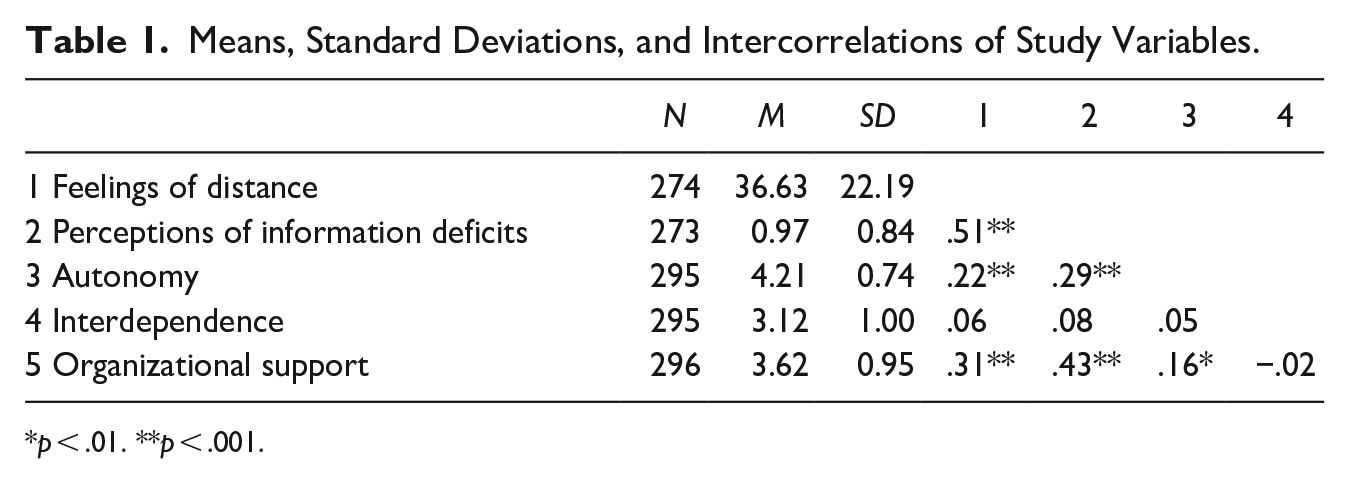
p < .01. **p < .001.
LPA Model Fit Indices.
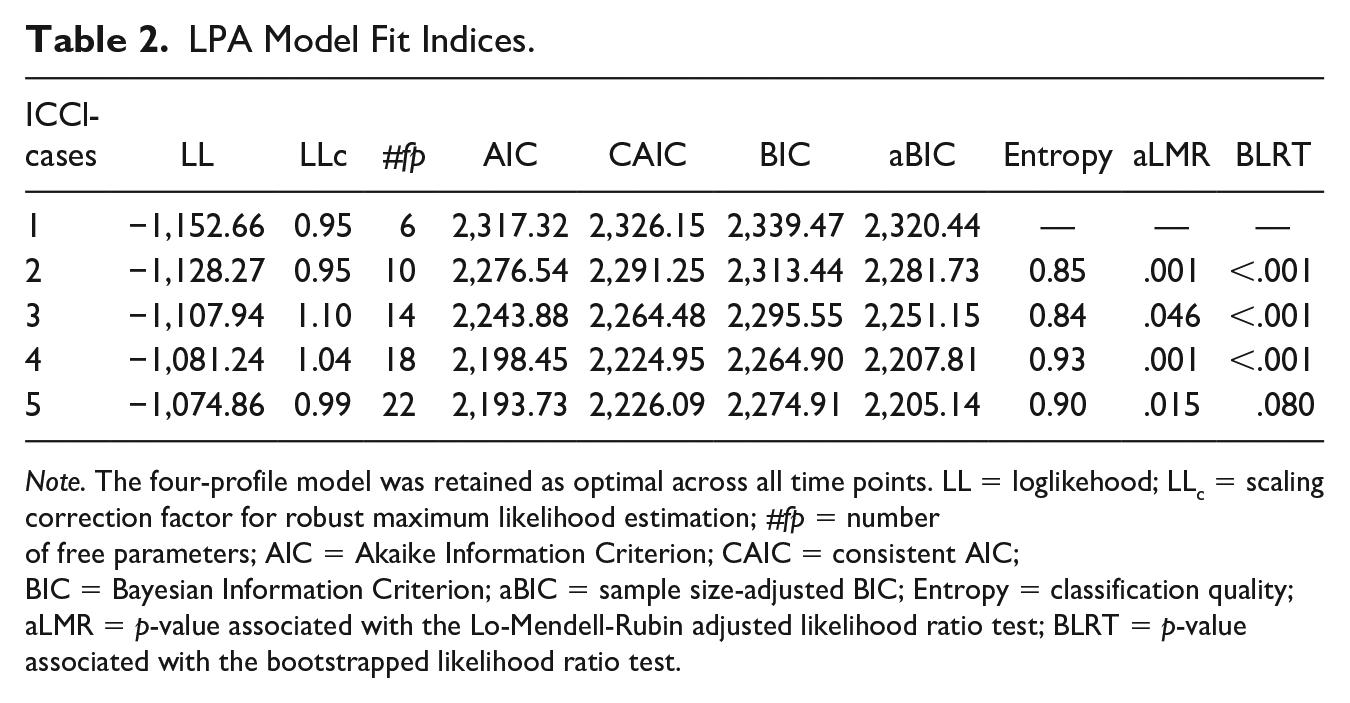
Note. The four-profile model was retained as optimal across all time points. LL = loglikehood; LLc = scaling correction factor for robust maximum likelihood estimation; #fp = number of free parameters; AIC = Akaike Information Criterion; CAIC = consistent AIC; BIC = Bayesian Information Criterion; aBIC = sample size-adjusted BIC; Entropy = classification quality; aLMR = p-value associated with the Lo-Mendell-Rubin adjusted likelihood ratio test; BLRT = p-value associated with the bootstrapped likelihood ratio test.
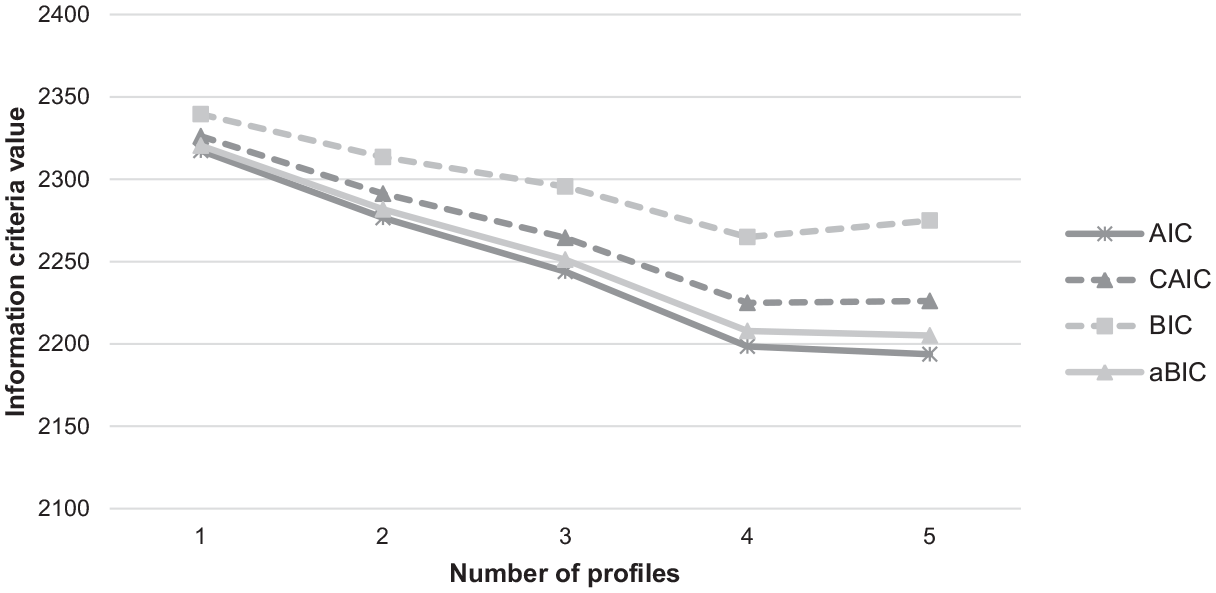
Elbow plot of the information criteria for the LPAs.
Identifying the Structure of Work Characteristics
H1 proposed that we would find multiple profiles involving work characteristics. Figure 2 contains bar graphs (based on raw scores) depicting configurations of work characteristics within the four-profile solution. Profile 1 represents persons high in all three work characteristics (i.e., those showing highly autonomous, interdependent, and supported teamwork, referred to as the HAIS profile, containing 40% of the sample). Of the four, this is the profile highest in autonomy, and also high in interdependence and support. Profile 2 represents teams with moderate to high levels of all three work characteristics (i.e., autonomous, interdependent, and supported teams; referred to as the AIO profile). 44% of our sample was assigned to the AIO profile. Profile 3 is the only profile where organizational support is higher that both of the other characteristics, which are both moderate in extent. This profile is labelled autonomous, interdependent, and high support teamwork (AI-HO; 10% of the sample). Finally, Profile 4 (6% of the sample) has the lowest autonomy level of the four profiles, as well as the lowest organizational support level—coupled with the highest levels of interdependence. We refer to this profile, which describes people collaborating in highly interdependent, unsupported conditions, the low autonomy/organizational support—high interdependence (LAO-HI) profile. H1 was therefore supported given the multiple profiles.
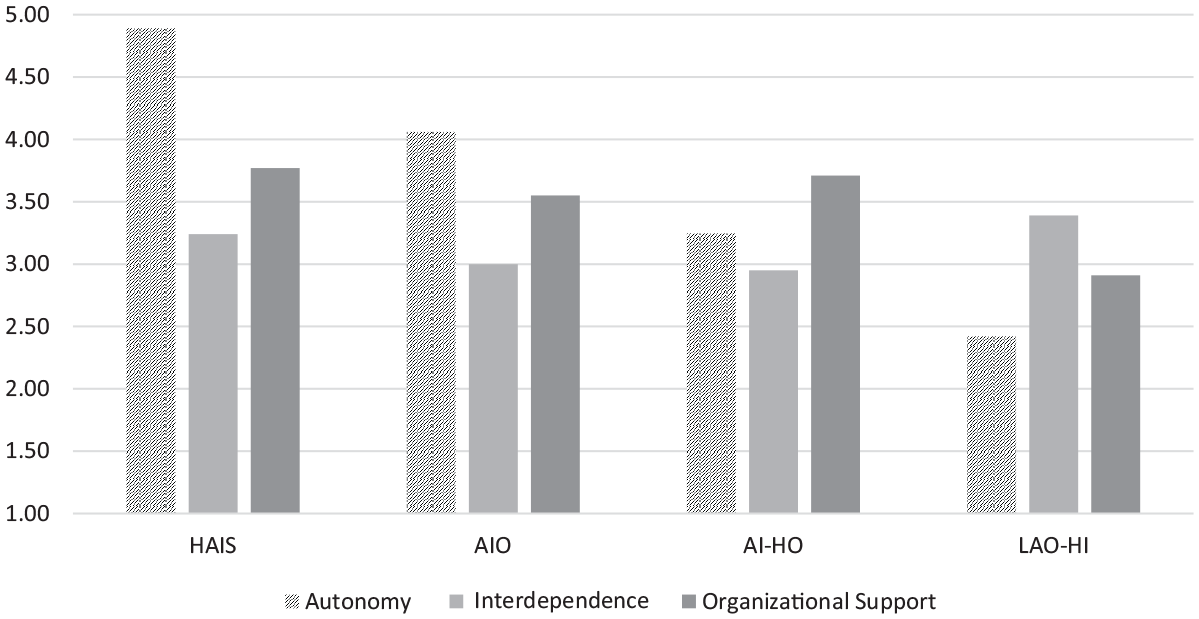
Four-profile solution of work characteristics using raw scores.
Work characteristics profiles and TPV
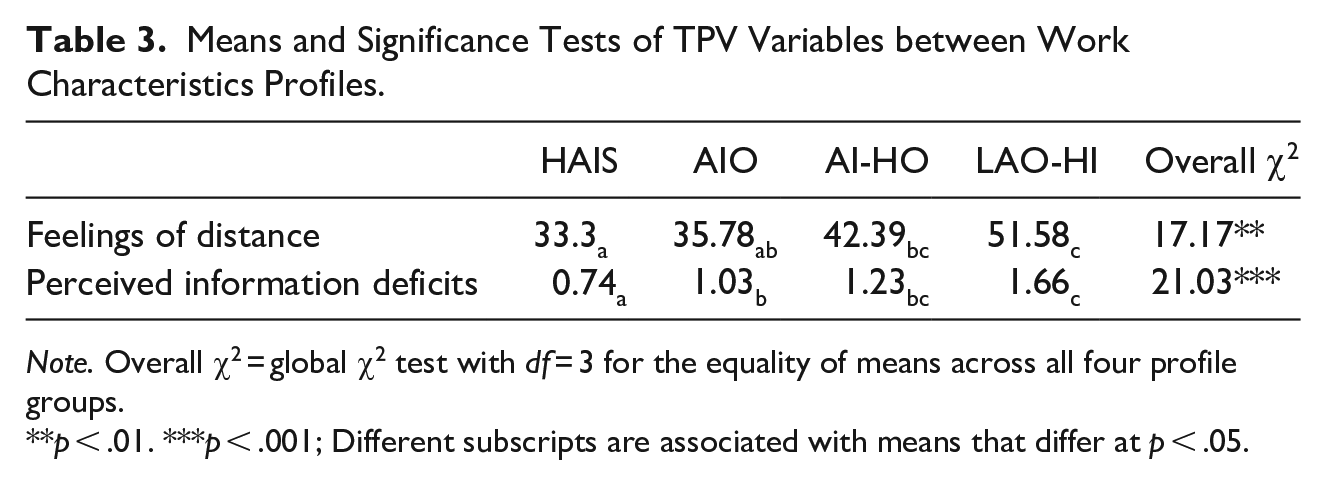
Table 3 contains the results of H2 to H4. Specifically, the table contains the mean levels of perceived distance and information deficits classified in each of the four profiles. As noted, we used the BCH procedure, and its Wald χ2 test (right column of Table 3), which provides an omnibus overall significance test of mean differences for each variable across profiles (Asparouhov and Muthén, 2014).
Means and Significance Tests of TPV Variables between Work Characteristics Profiles.
Note. Overall χ2 = global χ2 test with df = 3 for the equality of means across all four profile groups.
p < .01. ***p < .001; Different subscripts are associated with means that differ at p < .05.
These results in Table 3 suggest that highly interdependent and unsupported, low autonomy work (Profile 4, LAO-HI) is significantly higher on TPV- in both of its dimensions-than the first (HAIS) and second (AIO) profiles, which is reflected in higher levels of perceived distance and information deficits. This means that team members working under low scheduling autonomy and organizational support compared to high levels of interdependence, feel more distant from their team members and more ineffective when communicating virtually than people in profiles that show a high/higher degree of autonomy compared to interdependence. Profile 1 (HAIS), in turn, showed the lowest levels of TPV (i.e., lowest levels of distance and information deficits), differing significantly in information deficits from all other profiles, and in perceived distance from all profiles but Profile 2 (AIO). The AIO and AI-HO profiles showed similar values within the spectrum between HAIS on the one end and LAO-HI on the other.
H2 and H3 were, therefore, supported: LPA identified meaningful profiles of work characteristics that allowed to distinguish between TPV levels (H2), with collectively experienced distance and collectively experienced information deficits being lowest when all work characteristics are high (H3). H4, however, was not supported. Interestingly, and contrary to our predictions, there was no combination with low (below average) values of interdependence and organizational support at high autonomy levels. Indeed, when interdependence was very low, then scheduling autonomy was low too (AI-HO and AIO).
Discussion
The lockdown imposed in many countries due to the COVID-19 pandemic produced many teams with high levels of structural or objective virtuality. Therefore, this scenario allowed for a unique field study where structural virtuality was held relatively constant across team members sampled. Subjective (or perceived) virtuality, what Handke, Costa, et al. (2020) call TPV, has recently become a focal point in research, given the theoretical argument that teams with the same degree of objective virtuality could experience very different levels of subjective virtuality. Accordingly, in one of the global lockdown periods during the 2020 era of the COVDI-19 pandemic, where objective virtuality was maximized and held constant for all teams in the current study, we examined whether perceived virtuality differed among teams.
After establishing that TPV does vary in a highly objectively virtual context, we further considered antecedents of TPV in the form of work design characteristics. We found four unique configurations with respect to autonomy, interdependence, and organizational support emerging during the pandemic. Moreover, as expected, we find that some configurations were better than others in terms of reducing TPV. Our results show that the higher the individual scheduling autonomy of these teams relative to their level of interdependence showed the strongest outcomes with respect to dimensions of team perceived virtuality. It is worth noting that despite autonomy being higher than interdependence, interdependence values in these profiles are above the average point of the scale; therefore, we do not consider them low in interdependence. We emphasize, however, lower in interdependence relative to autonomy.
Theoretical Implications
Our study contributes to both the conceptualization of TPV and to the understanding of the relationship between autonomy and interdependence under conditions of high structural virtuality.
First, our results provide strong evidence that objective virtuality is only one part of the theoretical puzzle defining the virtual team experience. Indeed, team members, regardless of their high degree of objective virtuality, can experience differences in feelings of distance and perceptions of information deficits, which contribute toward a unique perception of team virtuality. This broadens the concept of team virtuality, enriching an already relevant research field.
Second, our results are contrary to the logic found in previous studies (e.g., Langfred & Moye, 2004; Rico & Cohen, 2005), where the relationship between individual autonomy and team performance is stronger under low task interdependence (Langfred, 2005). For variables with a more affective nature, such as TPV, and in the context of high structural virtuality, preserving (or developing) interdependencies can help these teams have enough opportunities to interact (both socially and task-relatedly) thus reducing their feelings of distance and information deficits. The potential extra coordination efforts seem to be mitigated by the benefits of increased interaction, provided that individuals keep their individual scheduling autonomy. This positive effect of interdependence is coupled with the ability to self-determine work schedules, providing an appropriate time management of those interactions, and with high organizational support as a contextual characteristic. On the contrary, lower individual scheduling autonomy is possibly related to specific jobs that are dependent on third parties (e.g., investors, journalists, and sales), and is particularly detrimental for team perceived virtuality. When teams depend on other individuals outside of the team (e.g., clients) to work, and especially when team members depend on one another to continue their work, they need to make the most out of the time they have to interact to focus on the task. This can result in less time, when interacting, to invest in social interactions: because individuals are unable to manage their time, when they interact with their team members that interaction is likely to be task-focused.
Third, the conceptual proposal of Handke, Costa, et al. (2020) suggests that different values on the two TPV dimensions (experienced information deficits, experienced distance) could result in different combinations to represent unique states of teams in regard to TPV. On the one extreme, teams high in experienced distance and high in experienced information deficits are described as in a lost in translation state; on the other extreme, teams low in experienced distance and low in experienced information deficits, are described as in a cruising speed state. The description of these two extremes (for a detailed description, please refer to Handke, Costa, et al., 2020) implies that cruising speed states reflect low levels of TPV and are better for teams, as individuals feel close to their teammates and perceive that they have an effective information exchange. In parallel, lost in translation states imply that team members perceive a high degree of TPV and fail to coordinate or develop interpersonal relationships effectively. In between these two, the remaining two states refer to combinations of low perceived distance and high perceived information deficits (i.e., nightclub state) and of high perceived distance and low perceived information deficits (i.e., machine state), both reflecting average levels of TPV on aggregate.
Although we did not test TPV but work characteristics profiles, the results from our study question whether the four aforementioned quadrants might have a real-life representation in teams. Our profiles clearly distinguished teams where information deficits and perceived distance were either both high (LAO-HI) or both low (HAIS), hence reflecting lost in translation and cruising speed states, respectively. However, a closer look at the differences between the profiles, shows that the two worst ones (i.e., the ones that contribute to higher TPM, AIO, and LAO-HI did not significantly differ in terms of information deficits or perceived distance between them. On the other side of the spectrum, in profiles which contribute to lower TPV, HAIS is significantly lower in terms of information deficits than AI-HO, but not higher in perceived distance. This suggests that although we can have teams who are low in information deficits while feeling distant (i.e., machine state), teams where distance is low but informational deficits are high (i.e., nightclub state) may not be possible in a high objective virtuality context. This suggests that effectively transmitting task-related information may not be hindered by feelings of distance. However, in the opposite pattern, feeling close to teammates does not necessarily guarantee effective task-related communication.
These findings match existing research on VTs. This research (e.g., Geister et al., 2006) emphasizes that VTs can have high levels of performance which do not significantly differ from the ones found in face-to-face ones, yet showing low levels of satisfaction. We can argue that these teams are likely to have low levels of information deficits, therefore being able to coordinate rather well and exchange task related information adequately, but can fail to promote the social interactions relevant for reducing feelings of distance. In this context, interdependence (coupled with scheduling autonomy and organizational support) can be of an extreme importance, as it will necessarily result in more frequent exchanges between individuals, creating more opportunities to reduce feelings of distance.
Practical Implications
Our study focused on work characteristics that have shown to strongly influence employees’ experiences in a myriad of studies. What is more, they are factors that the organization can adjust if an ROI can be expected. In this sense, under conditions of high objective virtuality, team managers should consider promoting interdependence with benefits. This means that giving team members work scheduling autonomy is relevant, especially for work-life balance (e.g., Emre & De Spiegeleare, 2019), but that feeling close to team members is enhanced when individuals keep or develop interdependencies among them that foster interaction. Depending on the type of job at hand, this can be done by promoting specific types of interdependence (i.e., reciprocal, sequential, or pooled interdependence, Saavedra et al., 1993), and coordination strategies that align with those. In reciprocal interdependence, all team members must continuously adjust to their colleagues’ actions. This common in fast and uncertain environments or when individuals must adjust following customer or managers’ requests. If this is the case, facilitating this type of interdependence under high levels of virtuality requires creating the space, time, and interface that allows for mutual adjustment (Mintzberg, 1989). Collaborative software such as Slack or MS Teams™ that allows for multiple messages to be sent to multiple receivers simultaneously and to add relevance tags (e.g., urgent, priority, regular) are an interesting option. What is more, is important to define the communication channels to be used for urgent requests and norms for dealing with those can help smoother coordination. For example, defining that phone calls to be only used for urgent action, or identifying that a certain subject must be added to the email on those situations will help teams filter these situations, while keeping the most of their work scheduling autonomy. In sequential interdependence, individual output is required for the next person to work. In a team of researchers, for example, one needs to run the analysis so that the next team member can write the results of a given study. In this type of interdependence, planning is the key to coordinate and keep work scheduling autonomy. Setting deadlines, and regularly updating others on progress and expected delivery times becomes fundamental. In contexts of high objective virtuality, leveraging technology by sharing calendars or planning tools (e.g., Trello) is an useful strategy. Finally, for pooled interdependence, when the task is achieved by combining parallel inputs from everyone, previously standardizing not only timings and deadlines but also processes and tasks can prevent information deficits. Developing templates of documents, deciding on length, sections, and content of reports, for example, could be helpful, especially if team members decide on those rules collaboratively and synchronously.
Limitations and Future Research
We believe that our study enriches our understanding of virtual teamwork, by demonstrating that teams do have distinct values of perceived virtuality even when their levels of objective virtuality are similar. Nonetheless, some limitations may prevent the generalization of the results to other contexts. First, it is a cross-sectional design. Future research could aim at replicate these results with in a multiple wave study, which would account for changes over time. The more teams interact virtually the more they are able to shape and refine work processes and interactions, and a longitudinal design could account for that. Second, the majority of our participants worked in the research/education domain, which often facilitates higher levels of scheduling autonomy. Therefore, a larger sample with individuals in other types of jobs and industries is called for.
Third, our data was collected cross-sectionally and at the individual level. Considering TPV is an emergent state, future research is needed to address how work characteristics and TPV are related at the team level.
Fourth, we collected data during March/April 2020, which corresponds to the first wave of worldwide lockdowns due to COVID-19. Whether these findings are lockdown-specific is also an open question, as the lockdown itself had some very specific features. Individuals knew or expected that this way of work was temporary and, simultaneously, they were all facing increasing and stressful demands. Virtual teams who expect to be working virtually as the rule (rather than as the exception) may devote more time to ensure better coordination or develop norms of virtual interaction. Also, team members with less strain related to their personal life (e.g., anxiety over the pandemic, family members to take care of, partners or roommates at home) may have a less pronounced need for scheduling autonomy. Hence, examining whether teams under high degrees of objective virtuality outside the pandemic context will shed further light onto these results. Finally, future studies can address other aspects that are conceptually related to TPV, namely team-level autonomy (Langfred, 2005) and team familiarity (Maynard et al., 2019).
Conclusion
Working in virtual teams presents several challenges for team members, namely being able to adequately share information and creating an effective interpersonal environment. Teams that suddenly became virtual due to the COVID-19 pandemic lockdowns, added further challenges to those known challenges. Work and interpersonal relationships had to be developed under adverse emotional and logistical situations. In this specific context, where the degree of structural virtuality was high, being able to preserve autonomy to schedule work time was relevant, and especially so when teams did work with high degree of interdependence among them, which made interaction necessary. Therefore, virtual teams may require careful consideration of their work processes in order to foster an interdependence level that can prevent them from growing apart.
Footnotes
Appendix A
To assess multigroup measurement invariance (Multigroup-MI) across different languages, we examined configural, metric, and scalar invariance for the first-order structure of the three work characteristics employed in later LPAs. Configural invariance considers whether the same pattern of factor loadings holds at each time point. Adequacy of the configural model is given by typical CFA guidelines (e.g., CFI > .95; RMSEA < .08; e.g., Hu & Bentler, 1999). Metric invariance constrains respective factor loadings to equality across groups, whereas scalar invariance places additional equality constraints on item means and intercepts across groups. Table A1 below provides the results of the invariance analyses. Configural invariance demonstrated good fit, CFI = .991 and RMSEA = .030. Adding equality constraints on the factor loadings resulted in Δχ2(12) = 31.21, p = .002, thereby rejecting metric invariance. The scalar invariance model resulted in a Δχ2(28) = 33.92, p = .204, versus metric invariance, suggesting a discrepancy between factor means between languages. After examination of the modification indices metric model, we freed the factor loadings of people on the English-speaking sample, thereby proceeding with partial invariance. This resulted in Δχ2(6) = 6.83, p = 337 (compared to the configural model), thereby supporting partial metric invariance
Declaration of Conflicting Interests
The author(s) declared no potential conflicts of interest with respect to the research, authorship, and/or publication of this article.
Funding
The author(s) received no financial support for the research, authorship, and/or publication of this article.
