



Abstract
Employees’ self-initiated and active behaviors to improve organizational change design and implementation (i.e., proactive support) are a critical determinant of effective organizational change. Despite organizational change being an inherently dynamic phenomenon, research has largely adopted a static view with little attention to the temporal development of employee responses to change. We build on appraisal theory to examine how shifts (increases vs. decreases) and stability (consistently high vs. low) in employees’ appraisals of work-related benefits of change are associated with proactive support over time. Using cross-level polynomial regression with two-wave survey data (Study 1; n = 267) from a technology firm undergoing change, we find the highest levels of proactive support when employees experience an increase in work-related benefit appraisals between Time 1 and Time 2, compared to all other patterns including a stable pattern of high benefits over time. Results further show that even a decrease in benefit appraisals, compared to consistently low benefit appraisals, predicts higher levels of proactive support for change. The relationships between shifts in benefit appraisals and proactive support are largely replicated in Study 2, an experiment (n = 523). This study also illustrates that positive emotions help to explain why the experience of shifting appraisals matters for employee proactive support for change. Our research highlights the role of temporal shifts in appraisals and provides important implications for organizational change-related theory, research, and practice.
An axiom in organizational change research and practice is that employee behavioral support is essential to the success of any change initiative (Herscovitch & Meyer, 2002; Kim, Hornung, & Rousseau, 2011; Rafferty & Minbashian, 2019). Existing research provides evidence for this assertion by showing that various forms of employees’ discretionary behavioral support are particularly valuable (e.g., Fugate & Soenen, 2018; Kanitz, Gonzalez, Berger, Reinwald, Huettermann, & Franczak, 2023). A fundamental reason why employees’ discretionary support is important is that even the savviest leaders of change cannot know all the operational details necessary for effective implementation, and they therefore must rely on employees to help navigate changes as they unfold. This reality motivates a key objective of this paper: to enhance our understanding of employees’ proactive support for change, which refers to their self-initiated, future-focused, and active efforts (Oreg, Bartunek, Lee, & Do, 2018) to contribute ideas that improve the design and implementation of organizational change. We posit that proactive support behaviors are manifestations not only of employees’ underlying cognitive appraisals, but also the shifts in these appraisals over time.
Cognitive appraisals are evaluations of person-situation encounters (i.e., events) in terms of personal goals and meaning, and they serve as the key cognitive mediating mechanism between experienced events and subsequent responses to them (e.g., Dember, 1974; Lazarus, 1991; Scherer, Schorr, & Johnstone, 2001). Appraisal theory assumes as a starting point that an event has personal meaning for the individual, specifically, when it is relevant to and (in)congruent with one’s goals (Lazarus, 1991). 1 If an event has no personal relevance, then there is nothing at stake and no reason to react. When, however, an event is appraised as goal-relevant and -congruent, then it is appraised as beneficial and likely to trigger positive emotions. Our paper focuses on employees’ work-related benefit appraisals of the change, which capture the extent to which an employee evaluates the organizational change event as offering personal advantages relevant to their job and daily work situation, reflecting the degree to which an employee evaluates the change event as relevant to, and congruent with, their work-related goals (cf. Fugate, 2013; Oreg et al., 2018).
Consideration of the implications of changes on employees’ job- and work-related goals are paramount to both understanding and managing their reactions and associated outcomes (for a review see Oreg, Vakola, & Armenakis, 2011). It therefore is valuable not only to understand employees’ appraisal in terms of personal goals but also to understand how these appraisals shift over time as the organizational change unfolds. Researchers most often simply claim or assume that the appraisal process is dynamic and changes over time (Fugate, Kinicki, & Scheck, 2002), but they rarely elaborate on the theoretical implications (see Kanitz, Gonzalez, Fugate, & Venkatesh, 2026, for a recent review) or empirically validate the inherent temporal nature of appraisals (see Jansen, Shipp, & Michael, 2016; Kaltiainen, Lipponen, Fugate, & Vakola, 2020, for notable exceptions). The vast majority of existing research measures appraisals at a single time point (see, Oreg & Sverdlik, 2026), along with the associated predictors and outcomes. Rafferty and Restubog (2017), for instance, showed that stress appraisals, measured at Time 1 in their study, variously predicted psychological contract violation and voluntary turnover at subsequent time periods. Fugate and Soenen (2018) similarly demonstrated that employees’ challenge and threat appraisals predicted their subsequent compliance and championing of change. These studies are helpful in understanding the role of employees’ appraisals of change, but their designs measured appraisals at only one point in time despite both applying appraisal theories that are inherently dynamic. As such, the literature on appraisals has not been refined to specify and examine the actual pattern of appraisal shifts over time (e.g., more positive, less positive, or stable), which also means that we do not understand the implications for outcomes of specific patterns of shifts.
This oversight is problematic, as it may lead to inaccurate conclusions regarding the nature of employees’ appraisals of change, which could in turn lead to false conclusions regarding their accompanying reactions. Consider these contrasting scenarios to illustrate the point. An employee may initially appraise a change as personally beneficial to their job (e.g., more efficient work processes), and this positive appraisal may remain stable throughout the change implementation process. In a different scenario, an employee may initially appraise a change (e.g., reporting relationship) as beneficial, but their perceived benefits may shift over time—either increasing or decreasing—as the change unfolds. These examples illustrate that both the level of initial appraisals and the direction of how appraisals shift matter. Among the potential implications is that conclusions from existing research are potentially deficient, or at least simplistic. We therefore aim to overcome these shortcomings by investigating the patterns of appraisal shifts over time and their resulting relationships with employees’ proactive support for change.
Beyond investigating the temporal shifts within the relationship between appraisals of change and employees’ proactive support, we further examine positive emotions as a mediating mechanism. Appraisal theory postulates that the appraisal of an event as beneficial generates emotional responses (i.e., valence and activation; Oreg et al., 2018). The resulting emotions provide energy and direction to respond to the event (Frijda, 1986; Lazarus, 1991; Scherer, 1984). Extending this logic to temporal shifts, we explore how shifts in benefit appraisals trigger positive emotions, and whether these emotions subsequently predict employees’ proactive support. Figure 1 shows our conceptual model.
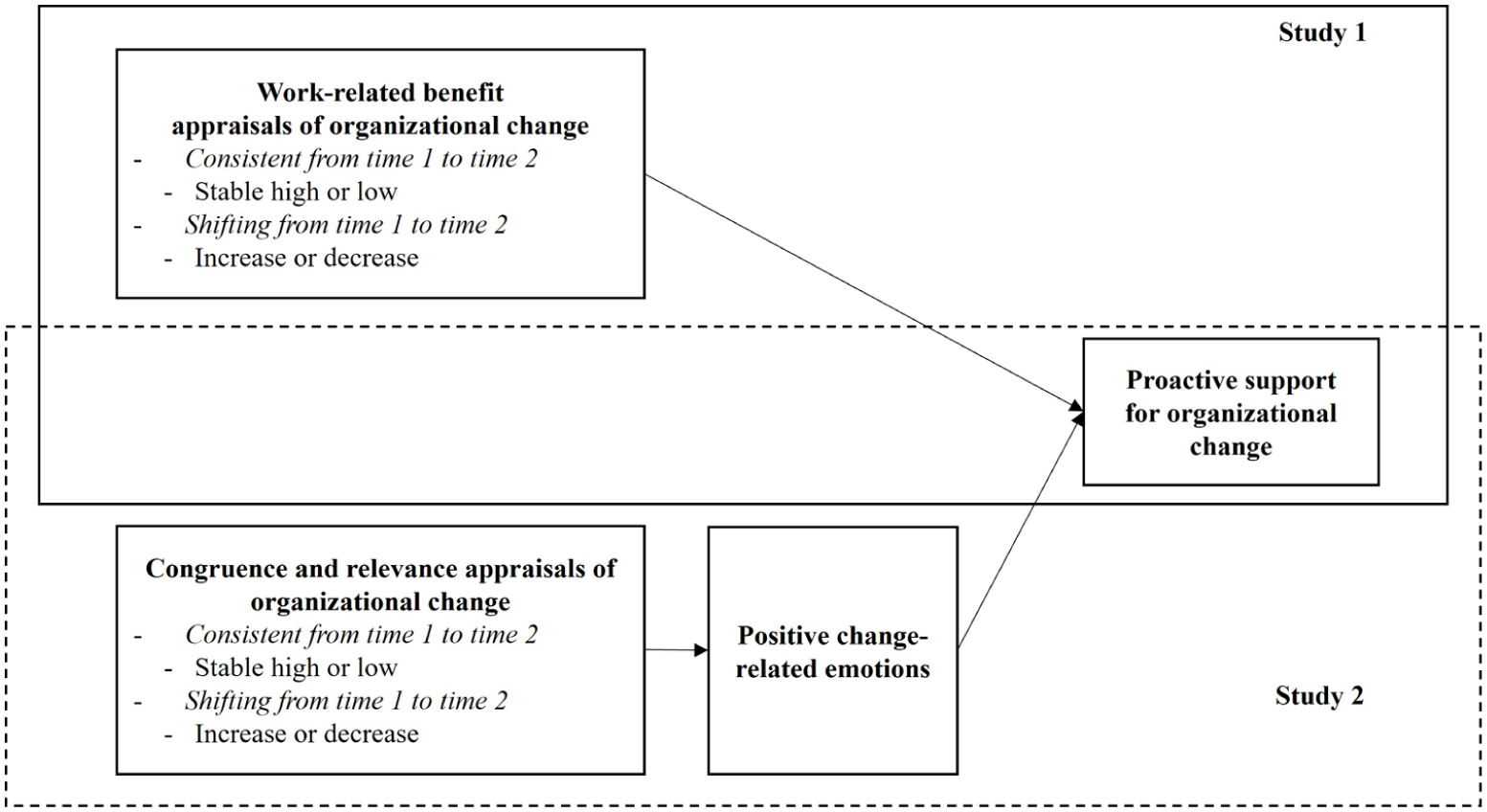
Conceptual Model and Overview of Studies
Considering the above collectively, the contributions of this paper reflect what McNamara and Schleicher (2024) describe as phenomenological and theoretical, which they state, “often co-occur within a paper and ideally work in concert with one another to form the basis for overall contribution” (McNamara & Schleicher, 2024: 1497). Both studies in the paper focus on organizational change, a ubiquitous and often consequential process for both employers and employees. Our first contribution shows that employees’ change-related benefit appraisals do shift as the change unfolds. This dynamism is foundational to both appraisal theory and organizational change, but heretofore such shifts have largely been assumed or inferred in research (Kanitz et al., 2026). We demonstrate that the patterns of these shifts matter in differential ways. To elaborate, existing research suggest that positive appraisals are positively related to desirable employee responses to change and negatively related to undesirable reactions (e.g., Rafferty & Restubog, 2017), and vice versa for negative appraisals (e.g., Fugate, Kinicki, & Prussia, 2008). This research would suggest that employees who report stable high benefit appraisals over time would be most likely to engage in more proactive support for change, and conversely, those with stable, low benefit appraisals over time are least likely to do so. However, we challenge these assumptions and present a nuanced reality where patterns of increasing and decreasing benefit appraisals differentially relate to proactive support compared to consistently high or low benefit appraisals. Hence, the current paper offers novel insights, highlighting how particular patterns of shifting appraisals—not just those at a single point during the change process—are important to advancing theorizing (Kanitz et al., 2026).
A second contribution refines and empirically validates a core assumption of appraisal theory: that person-situation encounters are appraised in terms of impact on an individual’s goals. We show that employees appraise organizational change in terms of relevance to and congruence with their work-related goals, helping to distinguish benefit appraisals from challenge appraisals, which additionally require risk of loss and coping (Lazarus & Folkman, 1987). Theory and research have long contended that goal relevance and congruence are fundamental dimensions for cognitive appraisals of person-situation encounters (Yeo & Ong, 2024), and the current paper helps validate this heretofore underexamined assumption in the context of organizational change (e.g., Oreg et al., 2018).
Our third set of contributions pertains to behavioral support for change (Fugate & Soenen, 2018; Kim et al., 2011) and change-related emotions (Rafferty & Minbashian, 2019). Proactive support has received limited scholarly attention relative to more passive forms of discretionary support (Oreg et al., 2018). We advance insights by theorizing and showing how employees’ proactive support is a distinct form of active, discretionary behavioral support, one that can be motivated through benefit appraisal shifts compared to stable appraisals over time. Additionally, the current paper illustrates that positive emotions serve as a mechanism through which shifts (both positive and negative) in change-related benefit appraisals translate into higher levels of proactive support. By illuminating this important role of emotions we advance research, as existing scholarship explains that “emotions provide greater detail of an individual’s experiences of change than more molar appraisals” (Fugate, 2013: 27; cf. Watson, Wiese, Vaidya, & Tellegen, 1999). Put differently, although appraisals are informative in terms of the general valence perceptions of an employee, the associated emotions are often more numerous and visible, providing what Fugate (2013) described as greater detail and “affective color” to employee experiences of change (Fugate, 2013).
Benefit Appraisals of Organizational Change
Benefit appraisals are a derivative of the appraisal paradigm within the cognitive revolution in psychology, wherein researchers sought alternatives to behaviorism for explanations of behaviors and other phenomena (for historical accounts, see Dember, 1974), such as the appraisal theory of stress and coping (e.g., Lazarus & Folkman, 1984), appraisal theory of emotions (e.g., Roseman, 1996), and appraisal theory of behavior (e.g., Hou, Luo, Ke, & Cheng, 2022). Schorr (2001) explained that rather than referring to each as its own appraisal theory, it is accurate and parsimonious to refer to these as appraisal theory, the plural form, as the same appraisal process underlies each. We adopt the same terminology and use appraisal theory to explain employees’ evaluation of organizational change in terms of their job- and work-related goals, and their subsequent change-related emotions and proactive support (i.e., cognitions, affect, and behaviors). At its core, employees’ appraisals are the key mechanism between change-related events and employees’ subsequent emotional (e.g., anxiety and anger, Barclay & Kiefer, 2019; positive emotions, Rafferty & Minbashian, 2019) and behavioral (e.g., employee withdrawal, Fugate, Prussia, & Kinicki, 2012) responses.
Richard Lazarus made foundational contributions to appraisal theory, beginning with stress appraisals—harm, threat, and challenge (e.g., Lazarus & Folkman, 1984)—and later extending to a full range of emotions. As his research evolved, he introduced a fourth form: benefit appraisal, which accounts for positive emotional experiences not captured by stress appraisals and does not require demands that tax or exceed one’s resources (Lazarus, 2001). Moreover, benefit appraisals were particularly relevant for explaining positive emotions not well accounted for by various stress appraisals (Lazarus, 1991). 2 Lazarus further elaborated and differentiated benefit appraisals when he wrote: “To understand positively toned emotional states . . . each must be connected with a different pattern of appraising. To make this work, the concept of benefit must be added to the system” (Lazarus, 2001: 54).
To position benefit appraisals of change within the nomological net, it is important to distinguish them from related constructs. Change readiness, defined as “beliefs, attitudes, and intentions regarding the extent to which changes are needed and the organization’s capacity to successfully undertake those changes” (Armenakis, Harris, & Mossholder, 1993: 681), is most often considered an attitude (Choi, 2011; Rafferty, Jimmieson, & Armenakis, 2013) that emphasizes organizational capacity and incorporates stable cognitive elements such as beliefs. Beliefs are defined as “enduring, unquestioned ontological representations of the world and comprise primary convictions about events, causes, agency, and objects that subjects use and accept as veridical” (Connors & Halligan, 2015: 2). 3 For his part, Armenakis defined a belief similarly as “an opinion or a conviction about the truth of something that may not be readily obvious or subject to systematic verification” (Armenakis, Bernerth, Pitts, & Walker, 2007: 483). 4 By contrast, appraisals are immediate, dynamic evaluations of particular events (Lazarus, 1991; Scherer et al., 2001), and, as explained previously, focus on the personal meaning of an event and can shift as circumstances evolve, making them especially well-suited to capture the unfolding experience of organizational change (Fugate et al., 2002; Oreg et al., 2018). 5 It also is worth underscoring that change readiness predominately focuses on an organization’s change-related capacity (Choi, 2011), whereas employees’ work-related cognitive appraisals focus exclusively on the evaluation of person-situation encounters in terms of personal goals and well-being for an individual employee.
Employees’ Benefit Appraisals and Proactive Support for Organizational Change
Proactive support for organizational change refers to self-initiated, future-focused, and active efforts (Oreg et al., 2018) to contribute ideas that improve the implementation and design of organizational change (see also Seo, Taylor, Hill, Zhang, Tesluk, & Lorinkova, 2012; Shin, Taylor, & Seo, 2012, on creative support for change). 6 Exemplary proactive behaviors include creating and presenting ideas aligned with the goals of the change to advance the initiative, identifying practical solutions to hurdles encountered, or contributing insights to improve the initiative’s effectiveness (Dutton, Ashford, O’Neill, & Lawrence, 2001). As stated by Hornung and Rousseau (2007), proactive change behaviors go “beyond mere overfulfillment of existing roles or organizational values (Frese & Fay, 2001; Parker, 1998), manifesting in novel behaviors in pursuit of goals” (p. 403). Because such initiative is central to effective implementation, we adopt proactive support as our focal outcome.
Our choice for proactive support was further motivated by Fugate and Soenen (2018) and Oreg, Sverdlik, Paine, and Seo (2024), who articulated the benefits of discretionary and active versus passive forms of behavioral support for change. These authors argue that active support for organizational change is especially valuable, compared to passive forms (e.g., compliance), given the often uncertain and unfolding nature of change, wherein leaders must rely on employees to determine and implement change-related challenges. In short, organizations depend on employees’ initiative when realities shift during change, which underscores the importance of understanding proactive, implementation-focused behaviors.
At the same time, there are other discretionary forms of behavioral support for change. Championing, for example, also represents a discretionary form of support, but focuses on selling, promoting, or otherwise advocating the benefits of proposed changes to others (e.g., vocal advocacy). Proactive support, in contrast, is characterized by discretionary behaviors focused on contributing ideas to improve change-related problem solving and processes (see Parker, Bindl, & Strauss, 2010, for a review), with employees going beyond promoting change to contributing solutions. Notably, championing and proactive support have different theoretical foundations: championing is rooted in the commitment literature (e.g., Herscovitch & Meyer, 2002), while proactive support is grounded in the larger proactive work behaviors literature (for a review, see Parker, Wang, & Liao, 2019). Having specified our focal behavior and distinguished it from championing, we now turn to the mechanism that energizes proactive support.
To explain when employees enact proactive support, we draw on appraisal theory. A key tenet is that benefit appraisals, perceiving an event as goal congruent and relevant, are likely to generate positive emotions, followed by approach behaviors, whereas threat or harm appraisals tend to evoke negative emotions and withdrawal or resistance behaviors (Frijda, 1986; Lazarus, 1991; Lazarus & Folkman, 1987). This perspective aligns with theorizing on proactive motivation (Parker et al., 2010) for understanding how and why benefit appraisals can foster proactive behaviors. Specifically, Parker et al. (2010) distinguish between the cognitive (“reason to”) and affective (“energy to”) components of proactive motivation. These central tenets connect with appraisal theory: the “reason to” aligns with the cognitive appraisal of why the change is worth supporting (i.e., the goal relevance and congruence) and the “energy to” corresponds to the (positive) emotional activation that motivates employees to go beyond acceptance and proactively support the change.
Building on this logic, we propose that work-related benefit appraisals trigger positive emotions because changes are perceived as goal relevant and congruent (Lazarus, 1991; Scherer et al., 2001). These emotions contain what Frijda (1986) describes as “action tendencies”—motivational impulses directing differential responses to specific events based on the discrete emotion. Positive emotions (including excitement, interest, and inspiration) are typically associated with approach behaviors, while negative emotions largely link to withdrawal (avoidance) behaviors (Barclay & Kiefer, 2014; Diener, Thapa, & Tay, 2020; Fugate, 2013). Through eliciting positive emotions, benefit appraisals expand employees’ cognitive and motivational resources (Fredrickson, 2001), thus motivating discretionary proactive behavior aimed at supporting, refining, or advancing organizational changes. Therefore, when employees appraise a change as beneficial (the “reason to”), they are more likely to experience positive emotions (Fredrickson, 2001; Fugate, 2013; Lazarus, 1991) and thus develop the “energy to” proactively support the change (Parker et al., 2010).
Beyond Static Appraisals: Why Shifts in Benefit Appraisals Matter for Proactive Support for Change
Because organizational change unfolds over time, employees continually update or re-appraise the meaning of the changes they confront (e.g., Fugate et al., 2012; Oreg et al., 2018). This temporal nature of appraisals is central to our theorizing, as it allows us to capture not only whether employees support change but also how their support fluctuates as appraisals shift. As changes evolve, employees re-appraise the meaning of change for personal everyday goals, self-concept, and well-being (Fugate et al., 2002). Consequently, examining only a single instance or snapshot appraisal may be overly simplistic and fail to capture the true nature of employees’ experience. Building on this logic, we propose that shifts in benefit appraisals can stimulate renewed “reason to” and “energy to” proactively support the change (Parker et al., 2010). Moreover, changes in appraisals are particularly impactful because they signal something unexpected or novel relative to one’s prior state. Scherer (1984) suggests that novel or shifting conditions heighten attentional focus on an event, prompting employees to contrast the present with the past (“things turned out differently than expected”). By comparison, when appraisals remain stable (whether consistently high or low), they lack such novelty, and employees may see the situation as “business as usual,” thus reducing the impetus for reappraisal and, in turn, modified reactions.
Research supports the idea that shifts in appraisals and novel stimuli can have unique effects on subsequent attitudes and behaviors. Chen, Ployhart, Thomas, Anderson, and Bliese (2011), for instance, demonstrate that systematic increases or decreases in job satisfaction over time impact individuals’ decisions to remain or leave their jobs, beyond absolute levels of job satisfaction at any given point in time. In the organizational change context, Fugate et al. (2002) found that employees’ appraisals shifted throughout a change process and were associated with different coping behaviors. Moreover, Jansen et al. (2016) showed that employees whose change-related perceptions improved from low to high (“converts”) reacted differently than those who were always high (“champions”) or always low (“doubters”), highlighting how shifting perceptions can have distinct motivational consequences. Using a similar rationale, we contend that shifts in work-related benefit appraisals have distinct motivational consequences compared to consistent (high or low) appraisals. When appraisals remain stable, the absence of novelty can reduce employees’ impetus to re-evaluate or invest additional proactive effort. We next elaborate on how employees’ positive versus negative shifts in benefit appraisals differentially predict their proactive support for change.
Positive Versus Negative Shifts in Work-Related Benefits
Not all shifts have the same motivational impact. A positive shift (i.e., increase in work-related benefits) confirms goal relevance and signals an emerging congruence between the appraised change and work goals. Given that the change was previously perceived as less beneficial, this increase is likely experienced as an unexpected gain—a strong “reason to” support the change. Consistent with appraisal theory, enhanced work-related benefits foster “energy to” in the form of positive emotions, motivating employees to more proactively address potential challenges or propose improvements, going beyond mere acceptance of change (Fugate & Soenen, 2018). By contrast, a negative shift (i.e., a decrease in benefits) represents a loss of previous work-related benefits. A decrease in “reason to” (i.e., lowered goal congruence and relevance) typically reduces positive emotions. Although some residual positivity may remain, which could motivate approach behaviors, this results in relatively less affective “energy to” proactively support change. We argue that, although both types of shifts—positive and negative—heighten attentional focus and motivate action through the appraisal contrast with the past, positive shifts are expected to generate stronger positive emotions than negative shifts, and thus higher proactive support. In sum, shifts in appraisals signal novelty and prompt employees to re-evaluate the change, making them motivationally consequential. We therefore first compare whether the direction of the shift matters, postulating that proactive support is higher following positive compared to negative shifts. This leads to:
Hypothesis 1: Employees exhibit higher levels of proactive support for change when they experience a positive shift (i.e., an increase) in appraised work-related benefits over time, compared to a negative shift (i.e., when benefits decrease).
Positive Shift Versus Consistently High Work-Related Benefits
Building on our previous arguments regarding shifts, when employees perceive a positive shift in work-related benefits, they experience an enhanced motivational drive to proactively support the change. The novelty and perceived gain of this positive shift (Parker et al., 2010) sparks renewed attention, prompting employees to contrast the present with the past and realize that the change now offers more personal gains than before. We extend this theoretical argument by proposing that employees who experience a positive shift in work-related benefits demonstrate greater proactive support for changes compared to those who experience consistently high work-related benefit appraisals over time. This is because, according to Lazarus (1991), novel or unexpected improvements (gain) in appraisal capture attention and generate stronger motivational impulses than a consistent, albeit favorable, perception. When employees perceive that benefits are rising (with increased goal congruence and relevance), they are more likely to engage in problem-solving and contribute new ideas in support of change, as they feel a fresh sense of alignment and excitement (Oreg et al., 2018). Because positive emotions are more proximal drivers of behavior than appraisals alone (Fredrickson, 2001; Fugate, 2013), an increase in perceived benefits is more likely to elicit stronger positive emotions than a consistently high appraisal. By contrast, when benefits remain consistently high, appraisals still signal goal congruence and relevance, but the associated positive emotions are less intense, providing less “energy to” support the change.
While a consistently high level of benefit appraisals also indicates goal relevance and congruence, and therefore is likely associated with positive emotions and a motivational drive to proactively support the change, the absence of novelty may lead employees to habituate or plateau with diminished “energy to” proactively support (Seo, Barrett, & Bartunek, 2004). In other words, consistently high benefit appraisals signal that the change is on track but lack the “surprising upswing” and emotional activation that can re-invigorate employees’ discovery and proactivity. This aligns with research on judgment formation (Granberg, 2012) in which the absence of significant changes in stimuli does not actively challenge or shift an individual’s attitudes, leading to motivational stagnation. Thus, we posit:
Hypothesis 2: Employees exhibit higher levels of proactive support for change when they experience a positive shift (i.e., an increase) in appraised work-related benefits, compared to when these benefits are consistently high.
Negative Shift Versus Consistently Low Work-Related Benefit Appraisals
A negative shift in work-related benefit appraisals signals a diminished state for employees who initially appraised the change as beneficial to their daily work. While their current appraisal may reflect reduced goal congruence, employees may recall the earlier value that the change held for them. Similar to positive shifts, negative shifts can intensify motivational processes by prompting individuals to contrast the present with the past (Lazarus, 1991; Scherer, 1984). In this way, initial goal congruence and relevance provide a cognitive reference point that can still motivate attempts to restore alignment.
Drawing on these arguments, we propose that a negative shift can stimulate proactive support by triggering an attempt to restore goal congruence. The motivation to “course-correct” emerges not from current appraisals alone, but from the remembered benefits of the change, adding a unique impetus for action. Emotional responses arise not only from present meaning but also from the loss of earlier experienced value. This emotional contrast can dampen positive emotions and trigger frustration, an emotion elicited when an expected or attainable goal becomes blocked (Lazarus, 1991). It is of course possible—if not likely—that a negative shift scenario will generate negative emotions due to the loss of goal congruence, but research also shows that recalled benefits can still trigger positive emotions that may reenergize support (Fredrickson, 2001; Seo et al., 2004). By contrast, employees with consistently low appraisals have never perceived the change as beneficial. They experience not a loss but a continued absence of congruence and relevance, with the reappraisal confirming the prior negative experience. Without prior positive appraisals to draw on, they may lack both the cognitive rationale (“reason to”) and emotional activation (“energy to”) needed to initiate support for changes. The change holds little personal meaning, without a psychological anchor from which to imagine potential gains. As a result, their inclination to contribute ideas or effort is likely to remain low. Although a negative shift may thwart an individual’s everyday goals, it still elicits greater proactive support than consistently low appraisals as the remembered experience of benefits provides both a motivational reference point and evidence that value could potentially be restored. Based on this rationale, we posit:
Hypothesis 3: Employees exhibit higher levels of proactive support for change when they experience a negative shift (i.e., decrease) in appraised work-related benefits over time, compared with when these benefits are consistently low.
Overview of Studies
We test our hypotheses across two studies. Study 1 is a two-wave field survey conducted in the context of a real organizational change initiative, examining the relationship between employees’ shifting versus consistent benefit appraisals and their proactive support.
In Study 2, a scenario experiment, we replicate these relationships along with investigating the mediating role of emotions between shifting benefit appraisals and proactive support. Statistical code for both studies is available at https://osf.io/wzp5s/.
Study 1: Shifting Appraisals and Proactive Support
Research Context
Because Study 1 draws on a larger organizational data collection effort, we provide transparency regarding its relation to prior publications. 7 We collected data at a German technology company specializing in high-end products for the business-to-business market (annual revenue greater than US$10 billion). While the company has long emphasized engineering excellence and product quality, evolving market demands and advancements in digital technology prompted top management to initiate a strategic change. The goal was to support a digital servitization strategy enabled by transitioning from a product-centric, hierarchical structure to a more agile, collaborative, and customer-focused organization. To facilitate this strategic change, the top 50 leaders developed seven foundational business principles—listening, passion, integrity, lean thinking, quality, risk-taking, future orientation—to guide employee behavior, decision-making, and team collaboration across all global functions. The senior leaders also identified and defined desired behaviors and outcomes across both people- and business-oriented domains. Managers communicated the change to employees through town hall meetings, newsletters, and workshops, they further operationalized the change through the introduction of agile work practices, collaboration platforms, and digital decision-support tools. Employees were not only expected to adopt these new ways of working but were also encouraged to actively contribute to shaping the change, making this context well-suited to examine proactive support for change.
Procedure and Sample
Our collaboration involved the management team and HR department of a functional unit dedicated to research and development (R&D) activities. The head of the unit sent out an email invitation to all employees during both data collection waves, emphasizing that participation was voluntary. We collected responses from 557 organizational members at the first time point (T1), achieving a response rate of 44%, and 611 responses at T2, corresponding to a response rate of 49%. Successful matches were made for 267 employees from T1 to their responses in the T2 survey, creating a final sample consisting of 267 employees clustered within 69 work groups. Most employees had an organizational tenure between 5 to 10 years (24.81%; N = 65), followed by 10 to less than 15 years (22.90%; N = 60), and 30 years or more (19.08%; N = 50). Fewer employees worked less than 5 years (8.78%; N = 23), between 15 and 20 years (7.25%; N = 19), between 20 and 25 years (8.78%; N = 23), or 25 to less than 30 years (8.40%; N = 22). Five respondents did not indicate their tenure. The sample represents both junior and senior employees and consists of 219 male employees, 41 female employees, and seven employees who did not disclose their gender.
Managers introduced the initiative to employees before conducting our first survey, and the second survey was conducted 10 months later. This time lag was chosen to allow sufficient time for employees to experience events that could plausibly lead to shifts in their appraisals and proactive support to occur. Importantly, time lags should align with the phenomenon of interest rather than follow a fixed rule of thumb. Accordingly, we measured benefit appraisals of change in close proximity to key change events within the focal organization. From a theoretical perspective, appraisals evolve as individuals encounter and reinterpret unfolding events, which requires time for reappraisal processes to occur. From a practical perspective, the timing of the second data collection was also partly constrained by the organization’s change timeline and data access conditions. The observed distribution of increasing, decreasing, and stable appraisal patterns suggests that the time lag was adequate for capturing meaningful shifts in appraisals over time (see Appendix B in the online supplemental materials for data coverage).
Measures
All items focused on the particular change ongoing in the company. To ensure accuracy in translation from English to German, we employed the back translation procedure outlined by Brislin (1986). If not stated otherwise, participants rated their agreement with the items on a 5-point scale (1 = strongly disagree, 5 = strongly agree). We report ω (omega) in brackets as a measure of internal consistency. Detailed information on the measures and their respective items is presented in Appendix G.
Proactive support for change (T2 ω = 0.94)
Proactive support for change was measured using an adapted four-item version of the change support scale by Shin et al. (2012), based on Zhou and George (2001). A sample item reads: “I suggest new ways of how to achieve the goals of the [change initiative].”
Work-related benefit appraisals (T1 ω = .91, T2 ω = .93)
We used three items adapted from the perceived personal benefit scale by Holt, Armenakis, Feild, and Harris (2007) to assess the appraisals of work-related benefits. The items were amended in collaboration with the organization to ensure a good fit with the specific context. The amendments were based on interviews with employees and a thorough analysis of the change-related communication materials. Through this process three major categories of benefits were identified and were operationalized in one item each. A sample item states: “The [change initiative] is personally valuable for me because it helps me to make better decisions at work.”
Control variables
A set of theoretically relevant control variables were used. We controlled for organization-related benefit appraisals (T1 ω = 0.93, T2 ω = 0.94), using a four-item measure adapted from Holt et al. (2007), using the same process as for work-related benefit appraisals. The sample item reads: “I think that [company] will benefit from the implementation of the [change initiative].” Second, we controlled for leadership responsibility by using a dummy variable that indicates whether a person holds a formal supervisory role or not. As leaders are often involved in the development of change projects, they may perceive change initiatives to be more beneficial (Hill, Seo, Kang, & Taylor, 2012) and report higher levels of proactive support because such behaviors are implicitly part of their leadership role. Third, we controlled for organizational identification, which we measured using the visual overlap scale developed by Bergami and Bagozzi (2000). It captures the degree to which employees see their identity as overlapping with that of the organization. We included organizational identification as a control variable because it can influence how people interpret and respond to organizational change (Van Knippenberg, Martin, & Tyler, 2006), and therefore it could confound our results. Employees who strongly identify with their organization may be more inclined to perceive the change as beneficial and at the same time show higher proactive support for change.
Analytical Approach
Polynomial regression analysis and response surface methodology (Edwards, 2002) were used to test our hypotheses. Although this technique is mainly used for congruence testing, it is also well-suited to assess the effect of shifts (or changes) in variables over time on a dependent variable (Edwards & Parry, 1993; Edwards & Rothbard, 1999), as recent applications show (Jansen et al., 2016; Yoon et al., 2023). In our case, the two independent variables represent work-related benefits at Time 1 and Time 2 and the dependent variable is employee proactive support for change at Time 2.
Polynomial regression accounts for linear and curvilinear effects. The dependent variable (i.e., proactive support for change) was regressed on a set of five regression terms, including interactions and squared terms of the independent variables (i.e., work-related benefits). See the equation below where Z stands for proactive support for change at Time 2, X for work-related benefits at Time 1, and Y for work-related benefits at Time 2:

We employed the same strategy as Jansen et al. (2016) and assessed the difference between specific points on the surface (see also, Edwards & Rothbard, 1999). Points were chosen that represent high and low values of work-related benefits at T1 and T2; the 10th and 90th percentiles of each scale to determine which numbers represent high and low values. Differences in surface points were compared (e.g., high at T1, low at T2) with each other, using standard procedures for testing the significance of linear combinations of regression coefficients (the nlcom-command in Stata). Independent variables were scale-mean centered before conducting the analyses. Due to the nesting of participants in groups, this clustering was accounted for by modeling a random intercept for each group.
Results: Study 1
Descriptives and measurement model
Table 1 shows descriptives and correlations. Confirmatory factor analysis was used to assess our measurement model. The proposed five-factor model (proactive support for change at T2, work-related benefits at T1 and T2, and organization-related benefits at T1 and T2) demonstrated adequate fit (χ 2 (125) = 199.60, CFI = .98, RMSEA = .053, SRMR = .029), and a better fit than all nested four-factor models (see Appendix A). We tested longitudinal measurement invariance of the benefits measure across Time 1 and Time 2. Results supported strict measurement invariance, as constraining factor loadings, item intercepts, and residual variances to be equal across time did not result in a meaningful deterioration of model fit relative to less constrained models (see Appendix A).
Descriptives and Correlations Study 1
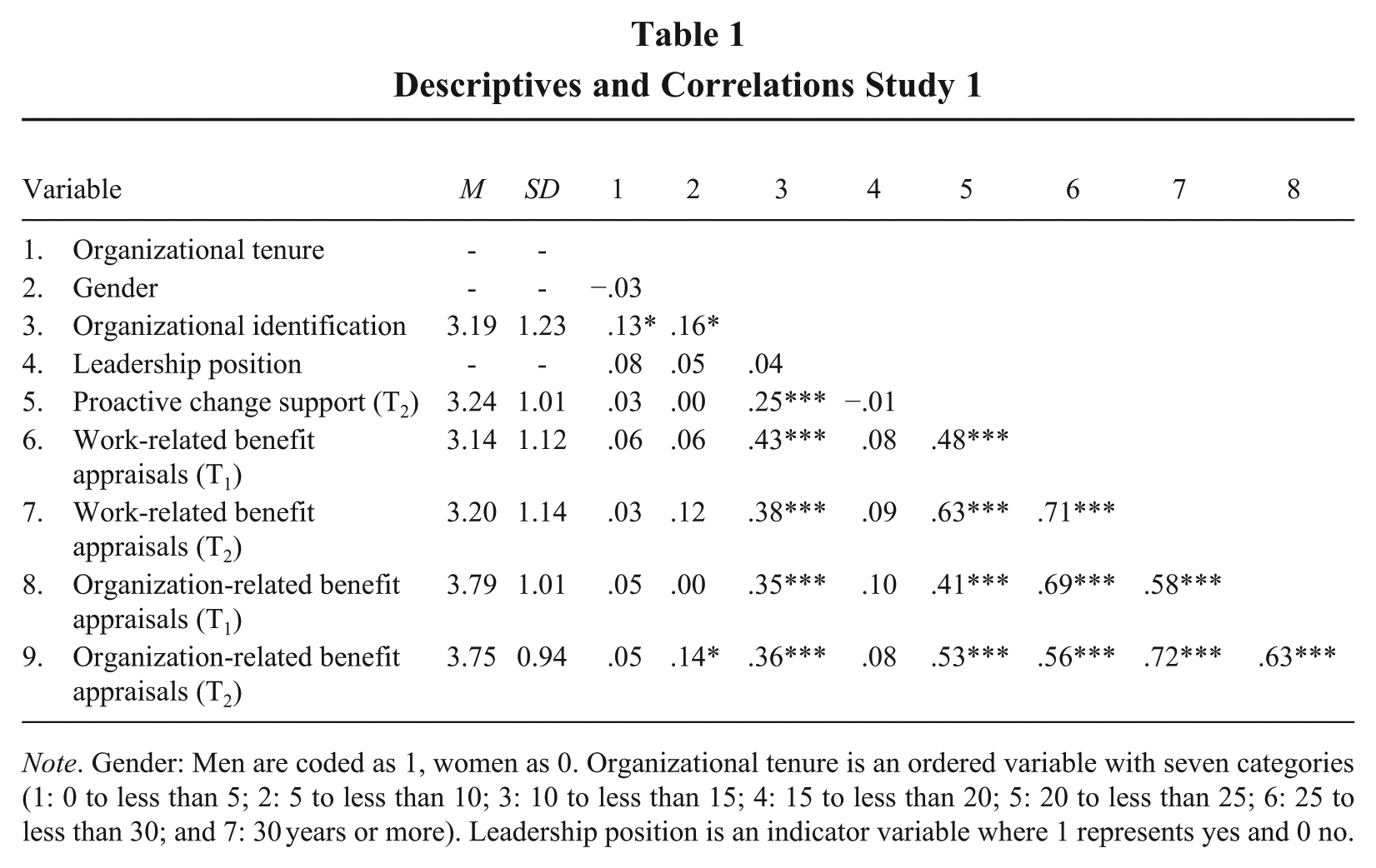
Note. Gender: Men are coded as 1, women as 0. Organizational tenure is an ordered variable with seven categories (1: 0 to less than 5; 2: 5 to less than 10; 3: 10 to less than 15; 4: 15 to less than 20; 5: 20 to less than 25; 6: 25 to less than 30; and 7: 30 years or more). Leadership position is an indicator variable where 1 represents yes and 0 no.
We also tested two unmeasured latent method construct (ULMC) models, one with fixed factor loadings and one with freely estimated loadings. The fixed-loading ULMC model did not improve fit (p = .332), whereas the free-loading model did (p < .001), so we examined it more closely. Adding the free-loading ULMC left the intercorrelations among our latent factors virtually unchanged, indicating that common method variance was not a serious threat (for a similar approach, Shin, Kim, Choi, Kim, & Oh, 2017). These analyses support the convergent and discriminant validity of our measures.
Temporal shift effects
Table 2 shows the regression results and the point comparisons. We also graphed the surface plot (see Figure 2), providing an initial indication that proactive support is highest when work-related benefits increase compared with all other patterns. Note that unless explicitly stated, findings remained the same when controlling for organization-related benefits, leadership position, organizational identification (see Table 2).
Regression Results for Study 1
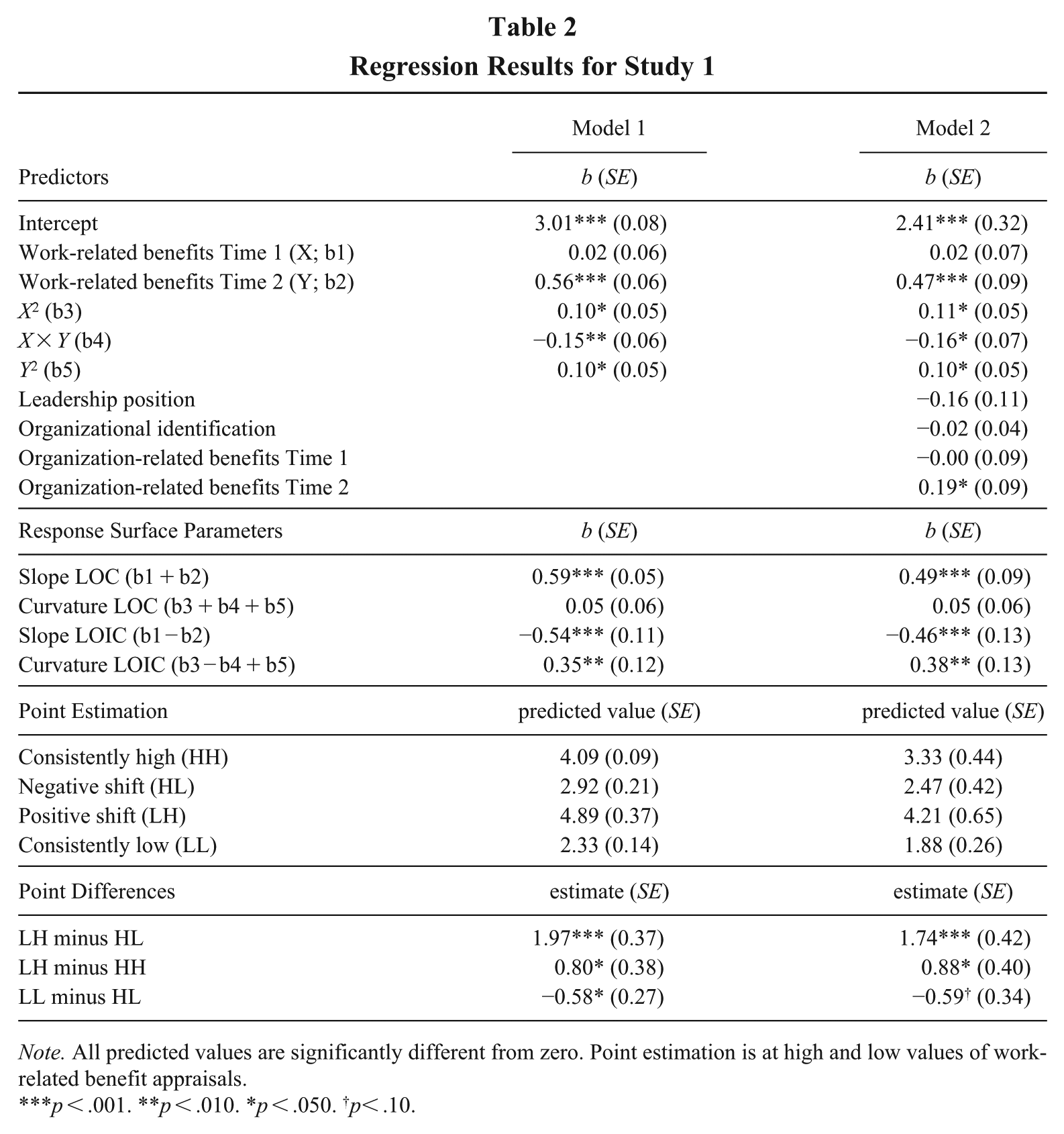
Note. All predicted values are significantly different from zero. Point estimation is at high and low values of work-related benefit appraisals.
p < .001. **p < .010. *p < .050. †p< .10.
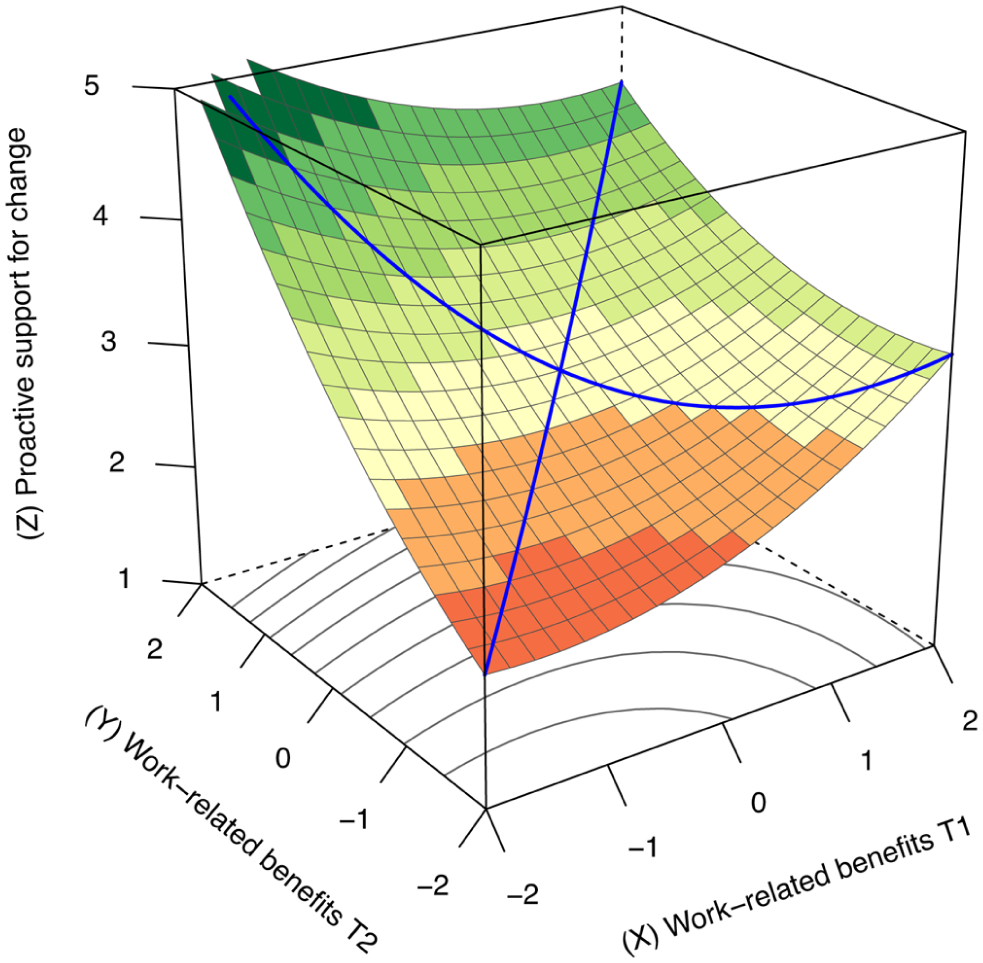
Response Surface Plots for Study 1
Response surface analysis is useful to test our hypotheses because it can capture congruence effects (Edwards & Parry, 1993). It allows us, for instance, to examine whether a shift in appraisals is linked to higher levels of change support compared to consistent appraisals (see e.g., Yoon et al., 2023). The results show that the surface does not curve along the line of congruence (stability), as indicated by a significant a3-parameter (see Table 2). The criteria of a congruence effect are thus not met (Edwards & Parry, 1993; Humberg, Nestler, & Back, 2019). Instead, the response surface parameters show that having similar values of work-related benefits at both time points is not systematically linked to more proactive change support compared to shifts in work-related benefits. Further, the direction of the shift matters, with positive shifts being more strongly related to support than stability and negative shifts. The significant a4 parameter further indicates that this difference becomes larger as the size of the positive shift increases.
Next, we conducted formal tests of our hypotheses using point estimates. Unless stated otherwise, results remained the same when including control variables. Results showed that proactive support for change was significantly higher when work-related benefit appraisals increased over time (Positive shift; estimate = 4.89, SE = 0.37), compared with when they decreased (Negative shift; estimate = 2.92, SE = 0.21; difference = 1.97, SE = 0.37, p < .001). Hypothesis 1 was supported. Aligned with Hypothesis 2, there was a significant difference in proactive support when work-related benefit appraisals increased over time (Positive shift; estimate = 4.89, SE = 0.37), compared with when they were consistently high (Consistently high; estimate = 4.09, SE = 0.09; difference = 0.80, SE = 0.38, p = .037). Finally, results showed a significant difference in proactive support when work-related benefits remained low (Consistently low; estimate = 2.33, SE = 0.14), compared to a decrease (negative shift; estimate = 2.92, SE = 0.21; difference = −0.58, SE = 0.27, p = .032). This difference remained significant at the 10% level with control variables included (difference = −0.59, SE = 0.34, p = .083). This supports Hypothesis 3, suggesting that employees who perceived a decrease in benefits over time exhibited higher levels of proactive support compared with those whose benefits were consistently low. 8
Supplementary analyses on change championing behavior
We examined the extent to which the observed effects are unique to proactive support behaviors, as opposed to other active forms of behavioral support for change, such as change championing, which emphasizes vocal advocacy and promoting change to others. To examine this, we conducted supplementary analyses using three items capturing championing behavior, adapted from Herscovitch and Meyer (2002) and previously used in the literature (e.g., Kanitz et al., 2023; Kukula, Reinwald, Kanitz, & Hoegl, 2025). These items reflected efforts to promote the change to others (e.g., “I speak positively about [change initiative] to others”; T2 ω = .97).
First, we found a considerable correlation between proactive support and championing (r = .67). To formally test for discriminant validity, we conducted a confirmatory factor analysis. The two-factor model—χ2(13) = 21.16, CFI = .99, RMSEA = .059, SRMR = .023—fit the data significantly better than the one-factor model—χ2(14) = 176.17, CFI = .83, RMSEA = .261, SRMR = .088—supporting empirical distinctness. Second, we examined whether the observed effects of appraisal shifts can be generalized to championing (see Appendix C for details and response surface plot). Polynomial regression analyses with championing as the dependent variable showed some significant effects, particularly for comparisons between consistently low and consistently high benefit appraisals (difference = −2.29, SE = 0.12, p < .001), and between increasing and decreasing appraisals (difference = 1.62, SE = 0.30, p < .001). However, the critical contrasts related to shifting appraisals were not significant (Positive shift vs. consistently high: difference = −0.10, SE = 0.46, p = .832; consistently low vs. negative shift: difference = −0.57, SE = 0.39, p = .138), suggesting that appraisal shifts matter less for championing compared to proactive support in our setting. Third, to examine whether our effects for proactive support remained consistent after controlling for championing, we included championing as a covariate in our main polynomial regression model. The key pattern of the hypothesized effects for proactive support persisted. We elaborate on these findings in the discussion section.
Brief Discussion of Study 1 Results
Results highlight an important relationship between employees’ appraisals of work-related benefits and their proactive support for change. Evidence shows that not only the level of work-related benefit appraisals at a given point in time matters for employees’ proactive support, but also the patterns of shifts in these benefit appraisals over time differentially predict subsequent proactive support for change. Specifically, proactive support is highest when employees report an increase in work-related benefits over time, even higher than when benefits remain consistently high. A negative shift (i.e., a decrease in perceived benefits) is also associated with greater proactive support compared to consistently low benefits.
Study 2: Why Do Shifts Affect Proactive Support? The Role of Positive Emotions
Findings from Study 1 highlight that shifts in benefit appraisals, and the patterns of these shifts matter, but leave open a critical question: Why do such shifts affect proactive support? Study 2 aims to answer this question by exploring relevant mediators identified by our theorizing while providing additional supporting evidence for the results in Study 1. Aligned with appraisal theory and our arguments presented in the hypothesis development section, we argue that positive emotions are elicited by reappraisals of goal relevance and goal congruence (i.e., the two key dimensions underlying work-related benefit appraisals), playing a central role in translating appraisal shifts into proactive support for change. We explicitly focus on the role of positive emotions as those carry the specific action tendencies (Frijda, 1986) needed to motivate proactive support for change, such as suggesting improvements.
Method
Study 2 consists of an online simulation experiment in which participants worked for an organization that implemented a change. We designed the study to examine goal relevance and congruence appraisals and positive emotions as mechanisms explaining the effects of shifts in change benefits on proactive support for change. A prime design (Schabram, Myers, & Hardin, 2025) was used as it allowed us to generate variance in the critical psychological state: appraisal and reappraisals of goal relevance and congruence. As the key feature of our approach, we manipulated the objective benefits of a change initiative at two time points to trigger different temporal patterns of appraisal development.
Sample
We recruited participants via Prolific and received 601 complete responses. To ensure data quality and integrity in our online sample, we implemented several a priori and post hoc measures against non-human or low-quality responders. First, our study required active cognitive engagement with complex citation tasks, which inherently mitigates bot participation. Second, we included multiple validation checks, including directed attention checks and a post-survey self-report item asking participants to confirm their data’s trustworthiness. We applied the following exclusion criteria: (1) 24 participants who failed at least one attention check; (2) 1 participant who indicated at the end that their data was not trustworthy; 9 and (3) 53 participants who completed the survey in less than 6 minutes or more than 36 minutes, as they were considered insufficiently engaged and non-human responders likely completed the survey much quicker. Thus, our measures were designed to increase the likelihood that only engaged, human responders remained in our final sample. The final sample consisted of 523 participants. On average, participants were 38.04 years old (SD = 11.68), 36.33% identified as men, 62.14% as women, and 1.53% as another gender. Of the participants, 65.39% held an undergraduate or higher degree, and 80.69% were employed.
Experimental Setting and Procedure
To create a realistic work environment in our experiment, participants were recruited as gig workers for a startup called cite-helper.com, a simulated work context adapted from prior research (see Reinwald, Kanitz, Bamberger, Backmann, & Hoegl, 2026). We created a professional-looking website for cite-helper.com, presenting it as a legitimate business (see Appendix E). We informed participants about the mission of cite-helper.com and informed them that their task would involve correcting citation errors. They received a fixed payment, supplemented by a performance-based bonus. The core task involved correcting citation errors. The introduction of an AI tool, AI-Curate, represented the change initiative aimed at improving worker performance on the platform. We experimentally manipulated the objective benefits of the AI tool for the citation tasks across two time points. Participants completed work tasks before and after the AI tool was introduced and updated. At each stage we assessed how they appraised the initiative and at the end how willing they were to proactively support it. This allowed us to capture responses to the same change initiative over time, isolating the impact of shifts in appraisals (see Appendix D for a detailed description of the experimental procedure).
Conditions
We conducted the experiment with four conditions. Depending on the condition, the objective benefit of the change initiative was either consistently low, consistently high, increasing over time (positive shift), or decreasing over time (negative shift). In the low-benefit conditions, participants received AI-generated suggestions that were wordy, unstructured, and lacked clear guidance on what was incorrect and why (see Appendix F). As a result, the AI suggestions were difficult to interpret and offered minimal support in detecting and correcting citation errors. In contrast, in the high-benefit conditions participants received structured AI suggestions presented in bullet points, which listed each mistake and the corrected APA format. This made the tool objectively highly beneficial for completing the citation correction tasks.
To manipulate shifts in the appraisals of the AI tool’s suggestions, participants were informed midway through the study that the AI tool had been updated, after which the benefits of the AI tool changed after random assignment for two out of the four conditions. In the positive-shift condition, participants first received low-benefit AI suggestions, which were improved to high-usefulness AI suggestions after the update. Conversely, in the negative-shift condition, participants first experienced high-benefit AI suggestions, which then declined in quality to the low-benefit version.
Measures
Willingness to proactively support the change (ω = .86)
Willingness to proactively support the change was measured using an adapted four-item version of the support scale used in Study 1. We asked participants: “If we were to invite you to another study and you were to continue working for cite-helper.com, how would you respond to the AI-Curate change initiative?” A sample item reads: “I would suggest new ways of how to achieve the goals of the AI-Curate initiative.” They responded on a 7-point Likert-type scale, ranging from 1 (strongly disagree) to 7 (strongly agree).
Relevance and congruence appraisals
Relevance and congruence appraisals were measured at two time points, before and after the AI-curate update, adapting items from the Geneva Appraisal Questionnaire (Geneva Emotion Research Group, 2002). The extent to which the change initiative was perceived to be goal relevant was measured with the item “The AI-Curate initiative was important for succeeding with my task.” The extent to which the change initiative was perceived to be goal congruent was measured with the item: “The AI-Curate initiative was beneficial to my task.” All items were responded to on a 7-point Likert-type scale, ranging from 1 (strongly disagree) to 7 (strongly agree).
Positive emotions in response to change (ω = .95)
We measured high activation positive emotions towards the change with four items chosen from established scales (Fisher, 2000; Watson, Clark, & Tellegen, 1988). Specifically, we asked to what extent the AI Curate change initiative made them feel “excited,” “interested,” “inspired,” and “happy.” Participants responded on a 7-point Likert-type scale, ranging from 1 (not at all) to 7 (extremely).
Control variables
We measured frustration (ω = .93) towards the change initiative with four items adapted from established scales (Fisher, 2000; Watson et al., 1988). Specifically, we asked to what extent the change initiative made them feel “frustrated,” “irritated,” “annoyed,” and “angry.”
Results and Hypothesis Testing for Study 2
We show regression results in Table 3. We used the conditions as predictor variables and proactive support as the dependent variable.
Regression Results Study 2
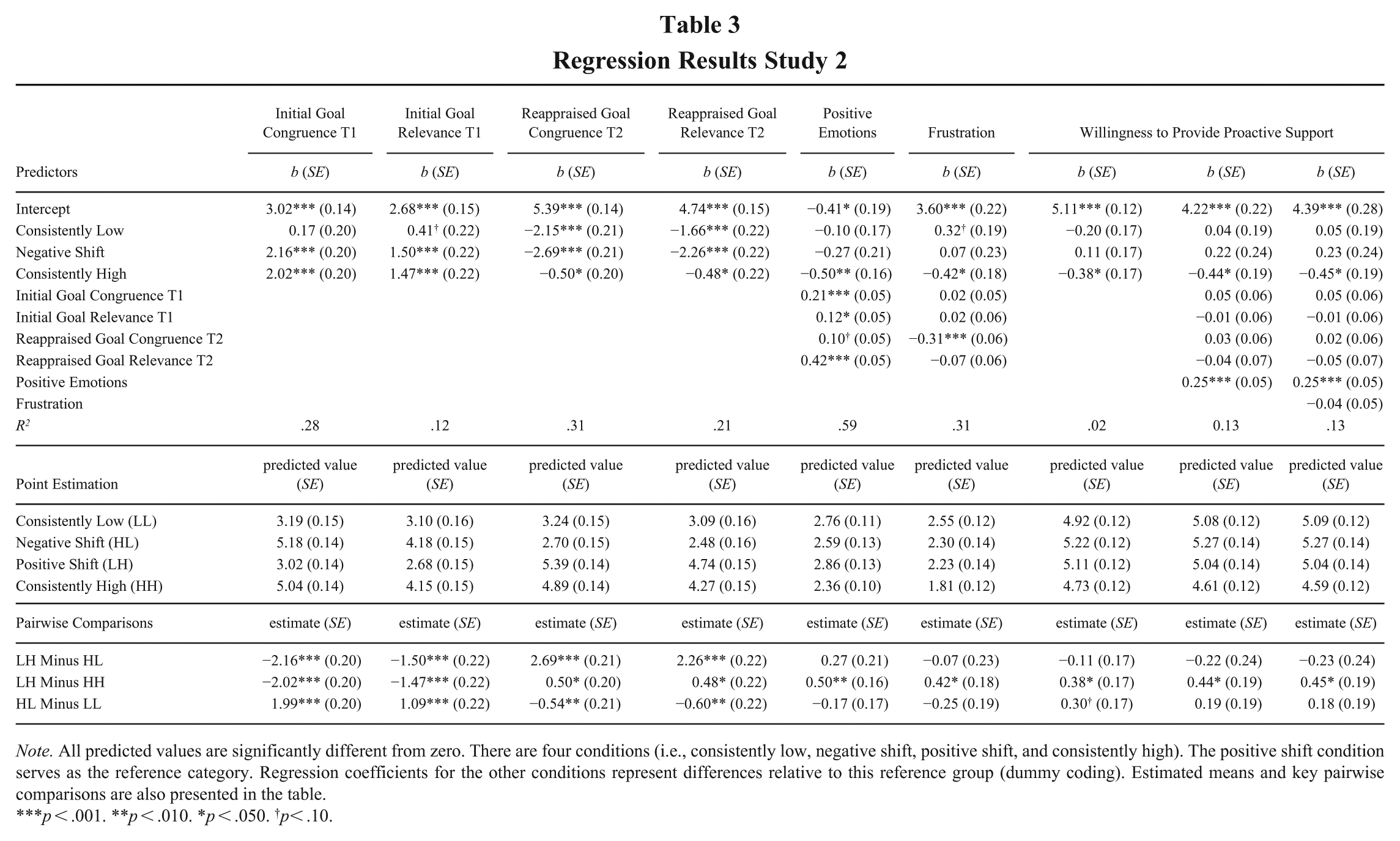
Note. All predicted values are significantly different from zero. There are four conditions (i.e., consistently low, negative shift, positive shift, and consistently high). The positive shift condition serves as the reference category. Regression coefficients for the other conditions represent differences relative to this reference group (dummy coding). Estimated means and key pairwise comparisons are also presented in the table.
p < .001. **p < .010. *p < .050. †p< .10.
Hypotheses 1 to 3 concern specific contrasts between conditions. We tested these using a regression model with three dummy-coded condition variables; the positive-shift condition was the reference group. All pairwise comparisons were made by re-running the model with a different reference group. Please see Appendix F for a bar chart showing the results of proactive support for each experimental condition. Related to Hypothesis 1, participants who experienced a positive shift (estimate = 5.11, SE = 0.12) did not differ significantly in their willingness to proactively support compared to those with a negative shift (estimate = 5.22, SE = 0.12; difference = −0.11, SE = 0.17, p = .528; see Table 3). Hence, Hypothesis 1 was not supported.
Hypothesis 2 involves the difference between the positive shift condition and the consistently high condition (estimate = 4.73, SE = 0.12). Participants who experienced a positive shift (vs. consistently high appraisals) indicated they were more willing to support the change (difference = 0.38, SE = 0.17, p = .023; see Table 3). Thus, Hypothesis 2 was supported.
Hypothesis 3 involves the differences between the negative shift and the consistently low benefit condition (estimate = 4.92, SE = 0.12). Participants experiencing a negative shift (vs. consistently low) indicated that they were more willing to provide change support, which was significant at p < .10 (difference = 0.30, SE = 0.17, p = .08), in line with Hypothesis 3.
Analyses of Mediating Mechanisms
We used mediation analysis to test emotions as mechanisms for the proposed relationships (see Figure 1). Aligned with our theorizing, we examined whether a positive shift in benefits triggers congruence and relevance re-appraisals (first-stage mediators), which in turn relate to positive emotions (second-stage mediator), predicting higher proactive support. As a first step, we confirmed that reappraised (T2) goal relevance (b = 0.42, SE = 0.05, p < .001) and goal congruence (b = 0.10, SE = 0.05, p = .053) were positively related to positive emotions. Similarly, initial goal relevance (b = 0.12, SE = 0.05, p = .015) and (T1) goal congruence (b = 0.21, SE = 0.05, p < .001) were also positively related to positive emotions. Positive emotions, in turn, were positively associated with willingness to provide support (b = 0.25, SE = 0.05, p < .001). These results suggest that the mediators can help explain the effects.
Positive versus negative shift
Results further show that participants who experienced a positive shift reappraised the change as more relevant (estimate = 4.74, SE = 0.15) and congruent (estimate = 5.39, SE = 0.14) compared to those who experienced a negative shift (relevance: estimate = 2.48, SE = 0.16; congruence: estimate = 2.70, SE = 0.15). These differences were statistically significant (relevance: difference = 2.26, SE = 0.22, p < .001; congruence: difference = 2.69, SE = 0.21, p < .001).
To assess the significance of the indirect effects, we calculated a 95% bias-corrected confidence interval based on 5000 resamples. There was a significant indirect effect through T2 reappraised goal relevance and positive emotions (indirect effect = 0.24, 95% CI = [0.134, 0.383]) and through T2 reappraised goal congruence and positive emotions (indirect effect = 0.07, 95% CI [0.000, 0.170]). The indirect effect through goal congruence was significantly smaller than the indirect effect through goal relevance (difference between indirect effects = −0.17, 95% CI = [−0.366, −0.029]), indicating that goal relevance matters for the effects.
Positive shift versus consistently high appraisals
Participants in the positive shift condition (vs. consistently high) also perceived the AI change in their T2 reappraisal as more relevant (difference = 0.48, SE = 0.22, p = .029) and more congruent (difference = 0.50, SE = 0.20, p = .014). Thus, under a positive shift, the AI tool was reappraised as more goal relevant and congruent compared to when participants experienced consistently high benefits. There was a significant indirect effect through T2 reappraised relevance and positive emotions (indirect effect = 0.05, 95% CI = [0.010, 0.114]) and through T2 reappraised goal congruence and positive emotions (indirect effect = 0.01, 95% CI [0.001, 0.040]). The indirect effect through congruence was significantly smaller than the indirect effect through reappraised goal relevance (difference between indirect effects = −0.04, 95% CI = [−0.106, −0.001]).
Negative shift versus consistently low appraisals
In the negative shifts condition, participants perceived the change in their initial T1 appraisal as more goal relevant (difference = 1.09, SE = 0.22, p < .001) and congruent (difference = 1.99, SE = 0.20, p < .001). There was a significant indirect effect through initial T1 relevance and positive emotions (indirect effect = 0.03, 95% CI [0.007, 0.076]) and through initial T1 congruence and positive emotions (indirect effect = 0.11, 95% CI [0.050, 0.186]). The indirect effect through initial T1 goal congruence was significantly larger than the indirect effect through initial T1 goal relevance (difference between indirect effects = 0.07, 95% CI [0.003, 0.165]). This implies that even when appraisals decline later, a strong initial sense of congruence and relevance can have a lasting effect on proactive support.
Finally, we tested whether the effect of positive emotions on proactive support remained robust when controlling for negative emotions. Frustration was included as a control because decreases in perceived benefits may elicit negative emotions (Oreg et al. 2018) such as frustration, which could in turn reduce or even increase employees’ proactive support depending on how individuals regulate and channel these negative emotions. Including frustration allows us to test if the effects of appraisal shifts on proactive support are driven primarily by negative rather than by the positive emotions central to our theorizing. The relationship between positive emotions and proactive support remained significant (b = 0.25, SE = 0.05, p < .001), whereas frustration was unrelated to proactive support (b = −0.04, SE = 0.05, p = .326). None of the indirect effects were significant when we replaced positive emotion with frustration as the second-stage mediator.
Brief Discussion of Study 2 Results
The results of Study 2 largely replicate the findings for the hypotheses for Study 1, this time by manipulating objective work-related benefits of a change initiative. This provides further evidence of the idea that the patterns of shifts in appraisals do matter for proactive support. Furthermore, Study 2 provides evidence that positive emotions serve as a mediating mechanism through which shifts translate into willingness to proactively support. We found that a positive shift (vs. consistently high appraisals) was associated with higher willingness to support, because it enhanced appraisals of goal relevance and congruence, and in turn goal relevance (but not congruence) was associated with stronger positive emotions. The shifts result in a more intense positive emotional response compared to a consistently high condition.
Findings from Study 2 also support our argument that scenarios involving a negative shift, the loss of initial benefits is associated with higher proactive support compared to consistently low benefits, because initial (T1) congruence (though not goal relevance), still carries weight in generating positive emotion. While negative emotions (i.e., frustration) were elicited by some of our experimental conditions (e.g., negative shift), frustration did not have a significant motivational impact on proactive support as measured in our study. Thus, it does not explain the observed effects of appraisal shifts on proactive support in our setting.
General Discussion
The purpose of our paper was to examine how different temporal patterns of work-related benefit appraisals—whether consistent or shifting—predict employees’ proactive support for organizational change. Study 1 shows that shifts in benefit appraisals (i.e., increases or decreases over time) are differentially associated with proactive support, compared to consistently low or high benefit appraisals, a finding that is replicated in Study 2. Study 2 further demonstrates that shifts in employee benefit appraisals, particularly changes in perceived goal relevance and goal congruence, along with resulting positive emotions, serve as mediating mechanisms linking appraisal shifts to employees’ willingness to proactively support the change. Collectively, our studies demonstrate that benefit appraisals do indeed shift as organizational changes unfold, and that the nature of these shifts has important implications for subsequent change-related emotions and proactive support.
Implications for Theory and Research
Temporal shifts in appraisal and their implications
Most generally, this paper provides important evidence that responses to change, here captured as cognitive appraisals, are indeed a dynamic process, an assumption widely acknowledged yet largely untested in organizational change research (Bartunek & Woodman, 2015; Belschak & Jacobs, 2023; Kunisch, Bartunek, Mueller, & Huy, 2017). Our findings challenge an implicit assumption in the existing literature. Many researchers and practitioners assume that stability in positive appraisals is inherently optimal for supportive change behaviors. Our research instead shows that a positive shift in work-related benefit appraisals over time can act as a motivational catalyst, providing both greater cognitive rationale (“reason-to”) and emotional activation (“energy-to”) for engaging in proactive behaviors (Parker et al., 2010).
Moreover, our results reveal that not only an increase, but also a decrease in appraised benefits can activate rather than reduce proactive behaviors over time (compared to consistently low benefit appraisals). This finding challenges the assumption that negative shifts lead to negative outcomes (Oreg et al., 2018), and that decreasing benefits (only) result in negative responses (e.g., employee change cynicism; Brown & Cregan, 2008). They can, under certain conditions, stimulate higher levels of proactive support. This suggests that the memory of prior positive experiences (Do & Lyle, 2022) can serve as a cognitive anchor, motivating efforts to restore lost benefits, even when current appraisals are less favorable. Our findings therefore suggest different and more complex relationships over time between appraisal and proactive behaviors than previously acknowledged (see Kanitz et al., 2026, for a recent review). Rather than focusing exclusively on absolute levels of appraisals at any given point, or average levels, our findings highlight that temporal patterns of these appraisals are equally, if not more, important in predicting proactive support.
The role of appraisals and emotions in response to change
A further contribution to the organizational change research is our articulation and empirical testing of the goal-based foundation of benefit appraisals. Benefit appraisals are positive appraisals that occur when a change is both relevant to and congruent with individual goals (Lazarus, 1991; Lazarus & Folkman, 1987), differing from the more commonly studied challenge appraisals of change, which, while also positive, involve some risk of loss and mobilization for coping (Fugate & Soenen, 2018; Lazarus & Folkman, 1987; Rafferty & Restubog, 2017).
Although appraisal theory has long contended that person-situation encounters are appraised in terms of goal relevance (whether the situation matters for one’s goals) and goal congruence (whether the situation helps or hinders one’s goals; Lazarus, 1991; Scherer et al., 2001; Yeo & Ong, 2024), these core dimensions have (to the best of our knowledge) not been directly measured and tested in organizational change research. Our Study 2 addresses this gap by testing both dimensions, demonstrating that employees indeed appraise change in these terms and that the two dimensions play distinct roles in driving the effects of positive (vs. negative) shifts. For positive shifts, goal relevance mattered more than congruence, whereas for negative shifts, congruence carried greater weight. Conceptualizing work-related benefit appraisals in terms of these underlying dimensions is important because it moves beyond simple valence (positive vs. negative appraisals) to provide precision about what drives benefit appraisals, pointing to dual pathways: Newfound relevance energizes proactive support, while the felt loss of congruence prompts attempts at restoration. By empirically distinguishing these dimensions, we provide a more precise theoretical understanding of change-related appraisals. Our work aligns with research across a range of appraisal theories (see the meta-analysis by Yeo & Ong, 2024), and it also articulates an avenue for expanding appraisal theory in the context of organizational change.
Moreover, our paper has implications for research pertaining to the role of emotions in responses to change (Liu & Perrewe, 2005; Oreg et al., 2018; Santos de Souza & Chimenti, 2024). Our research advances the growing literatures on positive experiences (Kiefer, Barclay, & Conway, 2025), change readiness (Rafferty et al., 2013), and positive emotions in organizational change (Rafferty & Minbashian, 2019), an area long overshadowed by research on negative emotions (Huy, 2011; Huy, Corley, & Kraatz, 2014; Kanitz, Huy, Backmann, & Hoegl, 2022; Kiefer, 2005). It is noteworthy that, in Study 2, frustration was one such negative emotion elicited by our conditions (particularly by negative shifts), yet it did not predict proactive support. This contrast reinforces the role of positive emotions in energizing employees’ proactive support. The finding is also consistent with valence-congruent effects: negative emotions typically predict negative, but not positive, outcomes, whereas positive emotions predict positive, approach-oriented outcomes (Kiefer, Barclay, Conway, & Briner, 2022). Taken together, these results underscore the centrality of positive emotions in our theorizing.
By demonstrating how shifts in appraisals can relate to positive emotions, we provide a more balanced view. Positive shifts activated goal relevance, making change newly salient and producing stronger positive emotions than consistently high appraisals, where perceived benefits, although present, lose impact over time. This renewed relevance was associated with stronger positive emotions than those observed under consistently high conditions, which had become expected and seemingly lost their emotional impact over time. Conversely, negative shifts underscored prior congruence, as initial appraisals continued to shape positive emotions and behaviors despite later decreases, highlighting the interplay between past and present appraisals. These findings point to an interplay between past and present appraisals (Do & Lyle, 2022) and associated positive emotions, suggesting that prior positive experiences may create an emotional residue that continues to influence behaviors even after circumstances have changed. This expands current theory by showing that what matters is not only appraisal levels themselves but also shifts from prior experiences and the emotions these shifts activate.
Research on proactive responses to change and positive emotions
Our work extends research on behavioral support for organizational change (e.g., Fugate & Soenen, 2018; Kanitz et al., 2023; Kim et al., 2011) by turning attention to theorizing on change recipients’ proactive responses (Hornung & Rousseau, 2007). Proactive support is highly relevant in organizational change because employees’ willingness to take initiative, suggest improvements, and engage in problem-solving can shape how change is implemented. Yet, despite its importance, proactive support has received comparatively little explicit research attention. Oreg et al. (2018), for example, introduced a circumplex model of change responses and identified “change proactivity” as a distinct category, characterized by positive valence and high activation. Their model highlights that most prior research has treated support primarily in terms of positive valence, thereby overlooking the activation dimension. We build on this insight by focusing specifically on proactive support and by theorizing how it can be activated through appraisal shifts rather than assumed static positivity. By highlighting appraisal dynamics as the underlying basis for proactive support, we position it as a central yet underexamined response to change that merits greater research attention.
Drawing on appraisal theory, we argued that proactive support is the “natural” (i.e., theoretically aligned) behavioral outlet of positive emotions elicited by shifts in work-related benefit appraisals. Although we did not set out to test differences across discretionary support behaviors, our supplementary analyses from Study 1 offer a tentative insight that supports this view: proactive support was particularly sensitive to shifts in benefit appraisals over time, whereas championing appeared more closely associated with consistently high benefit appraisals. This pattern suggests that different active and discretionary behaviors may be associated with distinct appraisal dynamics and different emotion patterns. While exploratory, these findings indicate that not all positive–active responses may fall neatly into the same category, as implied by circumplex models (Oreg et al., 2018), and highlight the value of an appraisal- and emotion-based perspective for differentiating among them. We encourage future research to examine these distinctions more directly.
Practical Implications
First, managers should avoid the common mistake of assuming employees’ perceptions of organizational changes are consistent. People continually appraise and re-appraise a change as new information arrives and work realities evolve. Our results show that it is not only how appraisals are at a single point that matters, but that they shift and the patterns of shifts matter. For instance, positive shifts can unlock energy, and even a negative shift can mobilize efforts to restore benefits, whereas persistently low or unchanging benefit appraisals rarely do. Practically, the current paper suggests that employers may benefit from monitoring employees’ appraisal trajectories with short, regular pulses, and responding with targeted actions rather than generic communications. To do this effectively, it would help to train line managers to read these patterns, discuss them openly with teams, and implement targeted interventions (e.g., “boost relevance”; Hagl, Kanitz, Gonzalez, & Hoegl, 2024).
Second, the current paper suggests that managers would be well-served to create contexts that induce positive appraisal shifts. To this end, managers could consider identifying and setting everyday work-related goals for employees, then explicitly linking particular changes to specific work-related goals. This would effectively help reduce uncertainty and clarify “what’s in it for my work?” (e.g., change to day-to-day tasks), both why it matters (goal relevance) and how it helps (goal congruence). At each milestone, they could surface a tangible benefit (e.g., time savings, fewer hand-offs, clearer decision rights, or faster tools) and pair it with a quick “try it now” moment (live demo or micro-practice). Fostering positive shifts in appraisals in such ways helps facilitate increases in proactive support for implementation, as illustrated by the findings in our two studies.
Third, the current paper further illuminates the practical value of positive emotions in the context of change. Not only do we show that emotions are associated with work-related benefit appraisals, but they are also more visible. Emotions are affective manifestations of employees’ change-related cognitions and are relatively more visible to outsiders (e.g., managers of change) than the underlying cognitions. This gives managers of change reason to both identify and foster specific positive emotions, such as excitement, interest, inspiration, and happiness as precursors to and/or indications of the likelihood of proactive support.
Limitations and Future Research
Our work also has limitations that might serve as avenues for future research. First, while this study examined the impact of shifts and stability in work-related benefit appraisals at two points in time, it is important to acknowledge that employee responses to change can exhibit more complex trajectories over time. Future research could delve deeper into response trajectories (see Swider, Yang, & Wang, 2024) by examining more than two appraisal measurements over the course of a change. This allows for a more comprehensive understanding of how appraisals change over time (e.g., u-shaped trajectories), and how these patterns affect different forms of change support. However, and importantly, the theorizing and results provided in this paper establish a foundation on which such studies could build.
Second, although our experimental design in Study 2 offered insights into the relationship between appraisal shifts and proactive support, it relied on a simulated change scenario and is subject to several limitations. While we took extensive measures to enhance experimental realism, participants’ relationship with the organization may not fully capture the rich process experienced by employees with deeper organizational attachment. The design of Study 2 may also explain the mixed findings related to Hypothesis 1 across studies. While we found support for Hypothesis 1 in Study 1 (i.e., increases are associated with higher proactive support compared to decreases), we did not find consistent support in Study 2. Specifically, the comparison between positive and negative shifts in Study 2 was not statistically significant, although directionally aligned with our predictions. This discrepancy may stem from the fact that Study 1 was a two-wave field study conducted during an actual organizational change, where appraisals unfolded naturally over time and reflected relevant experiences. In contrast, Study 2 used an experimental simulation with externally manipulated shifts over a short period and limited personal stakes. The artificial setting may have reduced the psychological salience and motivational impact of benefit shifts. Future research could employ experimental field designs or longitudinal interventions that better capture the experience of real-world organizational change.
Third, our self-reported measurement faces limitations. Our measure of proactive support in both studies does not capture the specific behaviors and did not specify their type or quality. Given the nature of our research and the impact on participants in the field study, adding supervisor ratings or objective data were unfortunately not an option that the organization was willing to agree to. This raises questions about the exact nature and impact of the behaviors exhibited. Our approach also does not clarify how and to whom suggestions to improve the change are made, leaving basic yet crucial aspects unaddressed (Dutton et al., 2001). Moreover, our measurement of behavioral intentions rather than actual behaviors in Study 2 reflects both practical constraints of experimental methodology and theoretical considerations. While intentions do not perfectly predict behavior, they capture the motivational mechanisms central to our theory even more directly than behavioral measures, which can be influenced by contextual constraints orthogonal to appraisal processes (Ajzen, 1991). This approach aligns with established research on discretionary behaviors (Parker & Collins, 2010). Future work should aim to refine measurement to capture the specific quality of behaviors, thereby offering a better understanding of how proactive support manifests.
Fourth, our study highlights the need for greater conceptual and operational clarity regarding employee support for organizational change. Although we conceptualized our main dependent variable as proactive support for change, others have termed constructs measured with a similar set of items as “creative support for change” (e.g., Oreg et al., 2024; Seo et al., 2012; Shin et al., 2012). We chose the term “proactive support” because the construct and its operationalization focus on employees’ proactive problem solving and idea suggestions to improve change, rather than on the (level of) creativity of the ideas themselves. We acknowledge that support can take many forms (attitudes, beliefs, behaviors), and inconsistent definitions and measures risk concept stretching and reduced theoretical precision (Yg, 1989). Future research should more carefully distinguish between forms of support (e.g., attitudinal vs. behavioral), levels of activation (passive vs. active), and discretionary versus non-discretionary behaviors and their target to ensure valid conclusions.
Shift happens—and it matters. Across a field study and an experiment, we show that benefit appraisals change over time and that their temporal pattern, not a single snapshot, best predicts proactive support. We also clarify why: shifts in perceived goal relevance and congruence activate positive emotions that convert into “reason” and “energy” to engage in proactive support. We hope these insights inspire research to move beyond static views and examine the temporal shifts of employee appraisals as a driver of change behaviors.
Supplemental Material
sj-docx-1-jom-10.1177_01492063261449752 – Supplemental material for Shift Happens During Change: Appraisal Shifts and Employee Proactive Support for Organizational Change
Supplemental material, sj-docx-1-jom-10.1177_01492063261449752 for Shift Happens During Change: Appraisal Shifts and Employee Proactive Support for Organizational Change by Rouven Kanitz, Leander De Schutter, Julia Backmann, Tina Kiefer, Mel Fugate and Martin Hoegl in Journal of Management
Footnotes

References
Supplementary Material
Please find the following supplemental material available below.
For Open Access articles published under a Creative Commons License, all supplemental material carries the same license as the article it is associated with.
For non-Open Access articles published, all supplemental material carries a non-exclusive license, and permission requests for re-use of supplemental material or any part of supplemental material shall be sent directly to the copyright owner as specified in the copyright notice associated with the article.
