



Abstract
Working longer is an important area of research given extended life expectancy, shortfalls of retirement income, desires to remain socially engaged, and solvency concerns of social insurance programs. The purpose of this longitudinal population-based study of older adults is to examine how different types of social resources (social bonding, bridging, and linking) relate to returning to work after retirement. Data were drawn from the Health and Retirement Study of fully retired older adults aged 62+ in 1998 (N = 8,334) and followed to 2008. After controlling for a comprehensive set of fixed and time-varying covariates, findings suggest that social bridging (informal volunteering) and social linking (formal volunteering, partnered with an employed spouse) were strongly and positively related to returning to work (Hazard Ratio [HR]: 1.49, p < .001; HR: 1.58, p < .0001; and HR: 1.75, p < .0001, respectively). Social bonding resources were not significantly associated with returning to work. Implications for social policy are discussed.
Unretirement, defined as retirees returning to work (Maestas, 2010), is an emerging phenomenon that will likely grow, given older adults’ longer life expectancy, shortfalls in retirement income, and the desire to remain socially engaged (Cahill, Giandrea, & Quinn, 2011; Freedman, 2008; Munnell & Sass, 2008). Researchers have applied a resource perspective to uncover factors associated with returning to work after retirement. For example, older adults may return to work due to economic necessity (Choi, 2000; Haider & Loughran, 2001; Hayward, Hardy, & Liu, 1994; Lahey, Kim, & Newman, 2006; Maestas, 2010; Ozawa & Lum, 2005; Singh & Verma, 2003). Resources such as formal education, health, and occupational experience have been consistently and positively related to unretirement (Choi, 2000; Haider & Loughran, 2001; Maestas, 2010; Munnell & Sass, 2008; Ozawa & Lum, 2005). This longitudinal population-based study of older adults aims to examine how different types of social resources (social bonding, bridging, and linking) relate to returning to work after retirement, above and beyond the economic and human capital factors that are known to affect unretirement.
We are unaware of a population-based study that has examined how social resources influence the transition out of retirement back to paid work. Furthermore, the extant literature is limited by study designs that are cross-sectional, use convenience samples, and/or are based on self-report (Corden & Angela, 2004; Corden & Sainsbury, 2005; Holdsworth & Quinn, 2010; Morrow-Howell et al., 2008; Musick & Wilson, 2007; Nichols & Ralston, 2011; Smith, 2010; Wilson & Musick, 1999), primarily focus on younger generations for which work is normative (Paine, McKay, & Moro, 2013; Spera, Ghertner, Nerino, & DiTommaso, 2013; Zhang, Anderson, & Zhan, 2011) or exclude important covariates such as health, education, or lifetime occupational status (Paine et al., 2013; Spera et al., 2013). Carr and Kail (2012) found that individuals engaged in paid work and formal volunteering prior to full retirement were more likely to continue to volunteer during retirement and subsequently return to work compared to those who did not formally volunteer. They speculated that the increased social resources associated with volunteering facilitate retirees’ return to paid work. This study builds on the literature and examines how three types of social resources (bonding, bridging, and linking) affect the likelihood of unretirement.
Social Capital: Social Bonding, Bridging, and Linking
Although there are varying definitions of social capital (Van Deth, 2003), we define it as social ties, information, obligations, expectations, and the social norms of a group of people that enable an individual to act (Coleman, 1988; Portes, 1998; Son, Lin, & George, 2008). There are at least three subtypes: Social bonding connections are close social ties among family members, social bridging connections are looser social ties among friends and neighbors that “bridge” people horizontally within a social stratum, and social linking connects individuals to others in higher and lower social strata (Putnam, 2000; Woolcock, 2001). We conceptualize different network connections as discrete social resources that may support or hinder an individual who seeks employment.
There is evidence that adults utilize the social bonding or bridging connections of family and friends as resources to learn about employment opportunities (Furstenberg & Hughes, 1995; Reingold, 1999). Yet, family and friends may not always know about employment opportunities or may face unemployment themselves. Thus, the relative homogeneity in socioeconomic status among an individual’s family members or neighbors may undermine opportunities to acquire information from them about job opportunities (Zhang et al., 2011). In contrast, social linking situates an individual within a socioeconomically heterogeneous network where there is a greater chance to learn about a wide range of employment opportunities (Briggs, 1998; Gittell & Vidal, 1998; Woolcock, 2001).
This study examines how various civic activities are related to returning to work. Civic engagement is fundamentally social. Adler and Goggin (2005) define civic engagement as “individuals who participate in the life of a community in order to improve conditions for others or to help shape the community’s future” (p. 1). Doing volunteer work for religious, educational, health-related or other charitable organizations or helping friends, neighbors, or relatives are regarded as civic activities (Musick & Wilson, 2007). These civic activities bring people of similar and different social, economic, and cultural backgrounds together to address a collective concern. Social relationships formed in civic activities provide a mechanism for individuals to exchange information about employment opportunities that may lead to paid work for retirees. Since formal volunteering with an organization may situate an individual in a heterogeneous social group with varied resources beyond those of family members, close friends, and neighbors, the relationships formed there can be conceptualized as social linking connections. Informal help extended to family, friends, or neighbors can be conceptualized as social bridging because it “bridges” individuals within the same social milieu.
While a large body of research has demonstrated the positive relationship of social linking and employment, there are important methodological limitations. For example, most of the research focuses on young and middle-aged individuals in cross-sectional and convenience samples (Corden & Angela, 2004; Corden & Sainsbury, 2005; Wilson & Musick, 1999). Although there are studies using longitudinal population data (Paine et al., 2013; Spera et al., 2013), important antecedent factors (e.g., formal education, lifetime occupational status, health, wealth, income, or other types of social capital, such as marital status, employment status of spouse/partner, and informal volunteering) were omitted, which may confound the relationship between social linking connections and employment. Finally, the amount of time or “intensity” individuals invest in volunteering may also be important. For example, findings from an intergenerational tutoring program suggest that older volunteers who accrued a large number of service hours experienced an increase in the number of social activities they were engaged in and developed an expanded circle of friends (Morrow-Howell et al., 2008); they also felt they used their time more productively, felt better about themselves, and felt that life had improved. Findings from other studies suggest a strong and positive relationship between the intensity of civic activity, either formal or informal volunteering, and health (Butrica, Johnson, & Zedlewski, 2009; Hong & Morrow-Howell, 2010; Lum & Lightfood, 2005; Luoh & Herzog, 2002).
We extend this body of research by utilizing longitudinal analyses of population data, controlling for a comprehensive set of time variant and invariant factors to explore whether the type of social connections has an effect on returning to the workforce after retirement. Specifically, we examine if social connections within the family (bonding), within strata among friends and neighbors (bridging), and across strata in formal volunteer organizations (linking) yield different likelihoods of unretiring. Finally, we assess whether intensity, or hours of engagement, with various social connections has an impact on unretirement.
Research Design
Data Source
Data were derived from the Health and Retirement Study (HRS) and the RAND-HRS, from 1998 to 2008. The HRS is a large-scale, longitudinal, and representative sample of older adults that studies the labor force participation and health transitions individuals undergo in their later lives. Respondents are surveyed every 2 years.
Sampling Design
Survey interviews were primarily done by telephone. The HRS sample was obtained under a multistage area probability sample design with four distinct selection stages; Black and Hispanic respondents and residents of the state of Florida were oversampled. PROC SURVEYPHREG and person-level weights were utilized in all analyses.
Inclusion Criteria
Inclusion criteria at baseline for this study were (a) adults aged 62 or older in 1998, (b) claimed retirement status, and (c) reported not working any hours or any weeks; these criteria yielded a sample of 8,334 at baseline.
Measures
Respondents were coded as unretired (yes, returned to work = 1), if they reported being partly retired, working part-time or full-time, and reported paid work in any of the subsequent waves (2000–2008). This information came from the “labor force status” variable in the RAND-HRS (RxLBRF), which uses 14 questions on employment including whether working for pay, employment status, whether considers self-retired, usual hours worked per week, usual weeks worked per year, second job, hours per week and weeks per year on second job, and whether looking for work. For example, respondents were asked, “We are interested in what people think about retirement, whether they themselves are retired or not. At this time do you consider yourself partly retired, completely retired, or not retired at all?” Respondents were also asked, “Now I’m going to ask you some questions about your current employment situation. Are you working now, temporarily laid off, unemployed and looking for work, disabled and unable to work, retired, a homemaker, or what?” “Are you doing any work for pay at the present time?” and “How many hours a week do you usually work on this job” or “How many hours a week do you usually work in this business?” Respondents who reported partly retired, working part-time or full-time, and reported any hours or weeks of paid work in any of the subsequent waves were coded as unretired.
Independent variables
Social bonding refers to relationships with nonemployed family members. Marital status was coded as 1 for married/partnered and 0 for separated, divorced, widowed, and never married. Parenting a coresiding child or grandchild under the age of 18 was coded as 1. All items were treated as time variant and lagged by one interval prior to paid work in a subsequent wave.
Social bridging was measured with the item “Altogether, about how many hours did you spend in the last 12 months helping friends, neighbors, or relatives who did not live with you and did not pay you for the help?” If any hours were reported, the respondent was coded as an informal volunteer (1 = yes). We trichotomized the variable: none (0 hr), moderate intensity (less than 100 hr), and high intensity (100 hr or more); the group “none” was used as the reference group. Social bridging variables were time variant and lagged by one interval prior to paid work in a subsequent wave.
Social linking was measured with the item “Have you spent any time in the past 12 months doing volunteer work for religious, educational, health-related or other charitable organizations?” (yes = 1). To capture intensity, the question was asked, “Altogether, how many hours did you spend in the past 12 months doing volunteer work for such organizations?” and was trichotomized: none (0 hr), moderate intensity (greater than 0 hr, less than 100 hr), and high intensity (100 hr or more); none was used as the reference group. Respondents who were married and whose spouse/partner was employed were also included in social linking. The rationale for treating those individuals with working spouses as possessing a linking connection is that workplace settings are heterogeneous in terms of social strata and thus will likely provide access to new information. Spouses were coded as working (1), if they reported working part-time or full-time in any of the subsequent waves (2000–2008). This information came from the labor force status variable in the RAND-HRS (SxLBRF), which uses 14 questions of employment data as detailed above. Social linking variables were time variant and lagged by one interval prior to paid work in a subsequent wave.
Covariates
Age, gender, race, economic, health, and social factors were used as covariates because they have proven to be theoretically and empirically significant. Age is a continuous variable. Being female was coded as 1. Race was transformed into a dichotomous variable, where non-White = 1. These variables were treated as time invariant.
Total household net worth was transformed using the inverse hyperbolic sine function, the preferred method used in the literature (Friedlinie, Masa, & Chowa, 2012; Maestas, 2010). Income was log transformed due to skewness. The presence of a pension was measured with the question, “Are you (or your husband/wife/partner) currently receiving an income from retirement pensions?” (1 = yes, presence of pension). Government health insurance was measured with the question, “Are you currently covered by any Federal Government Health Insurance Programs, such as Medicare, Medicaid, or CHAMPUS, VA, or other military programs?” (yes = 1). Respondents covered by an employer–retiree health insurance are coded as 1. All of these variables were treated as time variant and lagged by one interval prior to paid work in a subsequent wave.
Education was measured in years and was taken at baseline and treated as time invariant. Self-rated health was measured with the question “Would you say your health is excellent, very good, good, fair, or poor?” and was reverse coded where (1 = poor to 5 = excellent). Lifetime occupational status captured older adults’ work experience. The 17 occupational codes were dummy coded into occupations that require high, midrange, and low skills (see Autor, 2010 for more details); low-skill occupations was used as the reference group. Education and lifetime occupation are treated as time invariant and taken at baseline. Health is treated as time variant and lagged by one interval prior to paid work in a subsequent wave.
Statistical Analysis
The Cox proportional hazard model (Allison, 1995; Cox & Oaks, 1984) was used to estimate the effects of independent variables on the hazards of unretirement. Survival curves were parallel. All of the time-variant factors were lagged by one interval prior to employment in a subsequent interval to address issues of endogeneity. The fully conditional specification method (Brand, 1999; van Buuren, 2007) was used to complete all missing values in the study variables, creating 10 independent data sets with no missing data. Multicollinearity diagnostic tests were performed, and results suggested there were no multicollinearity issues.
Results
Table 1 summarizes the univariate results. The average age at baseline was 74 (range 62–102, SD = 7.37). More than half (53.75%) were female. Most (88.52%) were White. Approximately 6% (501) of retirees returned to work in subsequent waves. This percentage is lower than what is found in the literature, likely for one of two reasons. First, many studies use self-report labor force status which is an unreliable measure (Cahill et al., 2011). In this study, we performed a verification process to examine if the respondent had worked any hours or weeks in subsequent waves. Secondly, previous studies perform analyses on younger samples (individuals 50 years of age or older). Here, analyses were restricted to people aged 62 years and older, given that most people retire at this age (Munnell, 2015).
Univariate Results of Sample at Baseline.
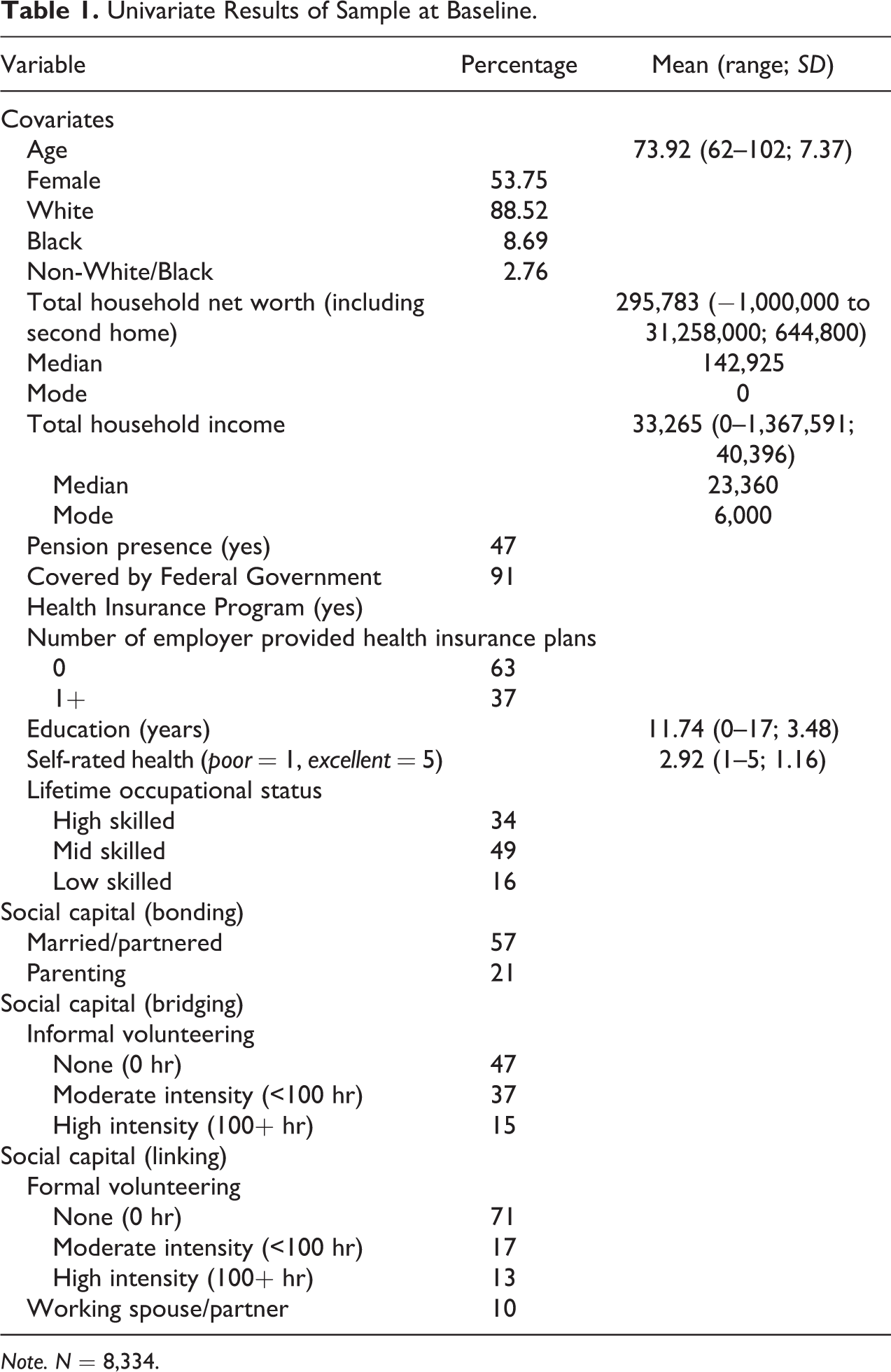
Note. N = 8,334.
Bivariate Results
All of the social capital indicators were positively and significantly related to returning to work in subsequent waves (Table 2). Evidence indicates that social bonding factors are related to work in later life: marital status (HR: 1.75, p < .0001) and parenting a child (HR: 1.97, p < .0001). There is also evidence that social bridging factors are related to the dependent variable: informal volunteering (HR: 2.54, p < .0001) at moderate intensity (HR: 2.16, p < .0001) and at high intensity (HR: 2.75, p < .0001). Social linking is also significantly related to returning to work: formal volunteering (HR: 2.12, p < .0001) at moderate intensity (HR: 1.96, p < .0001) and high intensity (HR: 2.28, p < .0001) and partnered with an employed spouse (HR: 2.93, p < .0001).
Bivariate Results.

Note. N = 8,334.
aReference group = low skill. bReference group = not engaged with informal volunteering. cReference group = not engaged with formal volunteering.
† p < .10. *p < .05. **p < .01. ***p < .001.
Certain covariates were significantly related at the bivariate level and in the expected direction: age (HR: 0.87, p < .0001), sex (HR: 0.74, p < .001), income (HR: 1.34, p < .001), government health insurance (HR: 0.38, p < .0001), and health (HR: 1.37, p < .0001). Education was trending toward significance at the bivariate level (p < .0576). Interestingly, other covariates were not significantly related at the bivariate level: race (p = .9704), total household net worth (p = .4557), pension possession (p = .1618), employer-sponsored retiree health insurance (p = .8079), and lifetime occupational statuses (high skill p = .7884 and mid skill p = .8673).
Multivariate Results
Table 3 summarizes the multivariate models. Models I and II examine social bonding, bridging, and linking related to returning to work. Social bonding factors (marital status and parenting) were trending toward significance at the multivariate level (HR: 0.78, p = .06; and HR: 1.22, p = .07, respectively). Social bridging was significantly related to returning to work (HR: 1.49, p < .001), which suggests that individuals who engaged in helping friends, neighbors, and family members outside of the household were 49% more likely to return to work when compared to individuals without this social resource. Intensity levels retained their significant relationship as well, where moderate-intensity (HR: 1.41, p < .01) and high-intensity (HR: 1.68, p < .001) social bridging predicted returning to work in the subsequent wave by 41% and 68%, respectively, when compared to individuals without this social resource. Finally, social linking was strongly and positively related to returning to work (HR: 1.58, p < .0001), suggesting that volunteering with an organization increased the odds of returning to work in the subsequent wave by 58% when compared to individuals who did not. Moderate- and high-intensity formal volunteers were 50% and 66% more likely to return to work in the subsequent waves when compared to individuals who were not (HR: 1.50, p < .01; HR: 1.66, p < 0001, respectively). Having an employed spouse retained its significant relationship with the dependent variable at the multivariate level (HR: 1.75, p < .0001); these respondents were 75% more likely to return to work in the subsequent wave when compared to respondents whose partners were retired (HR: 1.75, p < .0001).
Social Resources Informing Returning to Work After Retirement.

Note. aReference group = low skill. bReference group = not engaged with informal volunteering. cReference group = not engaged with formal volunteering.
† p < .10. *p < .05. **p < .01.***p < .001.
As would be expected, certain covariates were significantly related with the dependent variable and in the expected direction such as age (HR: 0.88, p < .0001), sex (HR: 0.75, p < .01), pension presence (HR: 0.77, p < .05), employer-sponsored retiree health insurance (HR: 0.76, p < .05), self-rated health (HR: 1.24, p < .0001), high-skilled lifetime occupation (HR: 1.77, p < .01), mid-skilled lifetime occupation (HR: 1.59, p < .05). This suggests that with every unit increase in age, the odds of returning to work in the subsequent wave declined by 12%; the odds of women returning to work was 25% lower when compared to men; individuals with a pension are less likely to return to work by 23%; and with every unit increase in self-reported health, the odds of returning to work increased by 24%. Total household net worth and income were insignificant (p = .6418, p = .3008, respectively), similar to other studies (Maestas, 2010). Education is significantly related but in the reverse direction of what was expected: Every unit increase in education reduces the odds of returning to work by 4% (HR: 0.96, p < .05).
Discussion
Findings from this longitudinal population-based study suggest that certain types of social resources (social bridging and linking) facilitate older adults coming out of retirement and returning to the paid workforce. In short, older adults who helped their friends and neighbors or volunteered with community organizations were more likely to go back to work after retirement, possibly due to the exchange of information with individuals across and between social strata. There is also evidence to support social linking with the employment status of a spouse/partner. Working spouses are likely to acquire new information about job prospects, opportunities, and open channels for employment for their retired partners. Similar to other studies (Zhang et al., 2011), it appears that social bonding factors (marital status and parenting) are insignificantly related to returning to work.
Although most of the covariates operated in the expected direction, education did not. Ajrouch, Antonucci, and Webster (2016) suggest that human capital and social capital may substitute for each other in the context of productive activities. They hypothesize that low human capital is compensated for by access to plentiful social capital, meaning that individuals with low education levels (human capital) often rely more heavily on their social relationships (social bonding, bridging, or linking) to acquire employment; multivariate results of this study support this hypothesis.
Findings from this study as well as others (Carr & Kail, 2012; Morrow-Howell et al., 2008) offer evidence that employment and volunteering expand social ties, improve health, and promote the resources needed to remain engaged in activities that produce goods and services to society later in life. Social policies should support these productive activities as complementary. Indeed, more can be done to make employment transitions smoother among private, public, and nonprofit sectors. For example, employers could offer preretirement planning that includes exposure to volunteer opportunities for older workers and then follow up with retired workers about future volunteer mentorship or paid employment opportunities within the company. In addition, Senior Corps (Retired and Senior Volunteer Program, Foster Grandparent Program, and Senior Companion), Senior Community Service Employment Program (SCSEP), AARP’s Experience Corp, and ReServe can help ensure older adults have opportunities to volunteer in their communities in schools, religious organizations, and nonprofits. The finding that education is negatively associated with going back to work in the context of social resources is particularly important to SCSEP and Experience Corp. These two national volunteer and employment programs focus on recruiting and retaining racial and ethnic minority and low-income older adults, two populations known to have lower levels of education than Whites. Such programs can increase the social resources needed to acquire paid work among populations at risk of social isolation, unemployment, ill-health, and economic insecurity. Unfortunately, these programs cannot currently keep pace with rising inequities and the demographic challenges of a rapidly aging and racially/ethnically diverse population (Harootyan & McLaughlin, 2012; McBride, 2007). More resources are needed to rigorously evaluate these programs’ reach, impact, and effectiveness and to identify ways to scale these programs to meet the challenges and opportunities of an aging society. Expanding programs to be inclusive of hard-to-reach populations may not only improve participants’ health but also improve their social resources and employment prospects.
There are important limitations. First, due to limited data in the HRS, this study was unable to measure the quality, quantity, timing, and flow of information within social networks. Understanding the cultural dimensions of social capital (collective solidarity, reciprocity, trust, and obligations) and the quality of engagement, not just the quantity, are topics for further study Gonzales, Matz-Costa & Morrow-Howell, 2015; Matz-Costa, Carr, McNamara, & James, 2015). Second, the dependent variable is measured in 2-year time intervals and may underestimate the frequency of movement into and out of the labor force, especially among economically depressed workers. Third, we restricted our analyses to individuals aged 62 and older, given that many retire at age 62 (Munnell, 2015). Future research should explore social resources and labor market behavior among younger populations, perhaps starting at the age of 50. Finally, the breadth and depth of civic activities is not fully captured in this study (e.g., voting, community organizing, and neighborhood petitions) and is left for future research.
Population aging presents both challenges and opportunities for promoting the health and economic well-being of older adults. This longitudinal population study contributes to the social capital literature by clearly demonstrating the strong relationship between social bridging and social linking and unretirement. Social resources can be strengthened by expanding social policies to engage older adults in civic engagement activities (Fox & Gershman, 2000; Gittell & Vidal, 1998; Jackson, 2001; McBride, 2007) and to facilitate co-occurrence and transitions between productive roles (work, volunteering). When viewed from a social resource perspective, civic activities provide links and bridges for retirees to work longer. The extra years in the paid labor force can result in contributions to the national economy and bolster economic security and health among older adults themselves; there is a need to shift social policies to extend opportunities for employment for those who want or need to work longer into the life span.
Footnotes
Author Contributions
E. Gonzales led and planned the entire study, from conceptualization to data analysis, and writing of the article. W. B. Nowell contributed to the conceptual, empirical, and discussion sections.
Acknowledgments
We thank Drs. Nancy Morrow-Howell, Amanda Moore McBride, Edward Spitznagel, Michael Sherraden, Timothy McBride, and Brian Carpenter for their guidance at Washington University in St. Louis; Julie Norstrand from Boston College; and graduate students Kate Goettge, Celeste Brown, and Marianne Musk at Boston University, School of Social Work for their literature reviews.
Authors’ Note
Parts of this article were presented at the Annual Meetings of the Gerontological Society of America in San Diego, CA, 2012; International Association for Gerontology and Geriatrics, Seoul, Korea, 2013; Society for Social Work Research, New Orleans, LA, 2015; and U.S.-Shanghai 2015 Conference on Public Policy Challenges and Governance Innovation in an Aging Society, University of Shanghai, China.
Declaration of Conflicting Interests
The author(s) declared no potential conflicts of interest with respect to the research, authorship, and/or publication of this article.
Funding
The author(s) disclosed receipt of the following financial support for the research, authorship, and/or publication of this article: This work was partly supported by the Peter Paul Professorship at Boston University, John A. Hartford Foundation Dissertation Fellowship, The Chancellor’s Fellowship at Washington University in St. Louis, and the Dissertation Award by the Brown School of Social Work at Washington University.