



Abstract
Friends’ moral characteristics such as their moral reasoning represent an important social contextual factor for children’s behavioral socialization. Guided by this assumption, we compared the effects of children’s and friends’ moral reasoning on their aggressive behavior in a low-risk sample of elementary school children. Peer nominations and teacher reports were used to assess children’s aggressive behavior and friendships. During individual interviews, moral reasoning was measured by justifications following moral judgments and moral emotion attributions. Results revealed that, compared to individuals’ moral reasoning, friends’ moral reasoning was more consistently related to children’s aggressive behavior. Moreover, friends’ aggressive behavior mediated the relationship between friends’ moral reasoning and children’s aggressive behavior. The findings provide evidence for the important role that friends’ moral development plays in children’s behavioral socialization, and highlight the need for integrated, systematic approaches to moral development and friendship relations.
Friendships have positive effects on children’s moral development: through interactions with their friends, children learn to take others’ perspectives, to critically reflect on their own moral arguments and those of others, and to co-construct elaborate solutions to moral dilemmas through discussion with their friends (Damon & Killen, 1982; Keller, 1996; Piaget, 1932/1965). However, there are also arguments supporting a negative relation between friendship and moral development (Bukowski & Sippola, 1996). For example, friendships may incline children for unfair decisions by favoring friends over nonfriends in moral conflicts (Slomkowski & Killen, 1992). Moreover, the positive effect of children’s friendships on their moral development may depend on the moral development of their friends; having a friend who is not committed to morality is unlikely to improve one’s own moral development (Taylor & Walker, 1997).
But how is a friend’s moral development related to a child’s aggressive behavior? Even though much is known about the influence of friends on children’s moral development, moral development researchers have largely neglected the role that close others, such as friends, play in children’s behavioral socialization. This is all the more surprising when considering that the role of peer group context for moral action has been emphasized from early on. For example, Kohlberg’s concept of “moral atmosphere” is strongly based on the assumption that moral action in real-life contexts is not only the result of individual moral competences, but is also influenced by norms and decision-making within friendships and peer groups (Kohlberg, 1984; Power, Higgins, & Kohlberg, 1989).
In the present study, we aimed to fill some of these research gaps by investigating children’s moral reasoning, their friends’ moral reasoning, and relations to children’s aggressive behavior. Moreover, we compared the effect of friends’ and nonfriends’ moral reasoning on children’s aggressive behavior because we wanted to distinguish between the unique effects of friends’ moral reasoning from those of peers more generally. Finally, we included friends’ aggressive behavior in the prediction of aggressive behavior and tested mediational models in order to shed light on the processes by which friends’ moral development affects children’s aggressive behavior.
Relations between moral development and aggressive behavior
Children’s moral development plays a critical role for their motivation to act in moral ways (Eisenberg, 1986; Kohlberg & Candee, 1984). Moral development includes both cognitive and affective components (Gibbs, 2003). An important cognitive moral competence is children’s ability to judge moral transgressions as morally wrong and to justify these judgments with reasons referring to moral principles such as fairness and welfare (Keller, 1996). Moral competences within the affective domain include the ability to react emotionally to moral transgressions with guilt or empathy (Eisenberg, 1986). For example, an important affective moral competence is children’s understanding that a moral transgressor feels guilty after transgressing a moral rule (Arsenio, Gold, & Adams, 2006; Krettenauer, Malti, & Sokol, 2008).
A substantial body of research supports the assumption that juvenile delinquents exhibit lower moral judgments than their nondelinquent peers (Stams et al., 2006). Even though studies including younger samples are much more limited, this research also suggests a link between children’s moral development and their antisocial behavior. For example, aggressive behavior has been shown to relate to increased acceptance of moral transgressions (Murray-Close, Crick, & Galotti, 2006), fewer negative moral emotion attributions to moral transgressors (Malti, Gasser, & Buchmann, 2009), and to lower moral reasoning following moral judgments and emotion attributions in elementary school children (Malti & Keller, 2009). Some of these studies also indicate that moral emotion attributions and related moral reasoning were more consistently related to children’s antisocial behavior than moral reasoning following moral judgments and decision-making (Arsenio & Lemerise, 2004; Gini, Pozzoli, & Hauser, 2011). For example, a study by Gasser and Keller (2009) indicated that 8-year-old bullies, compared to prosocial children, achieved lower moral reasoning scores in the context of emotion attributions, even though they did not differ in terms of moral reasoning following moral judgments. This finding provides support for the assumption that moral emotion attributions may represent authentic reactions to what seems personally important to the child (Nunner-Winkler, 2007). In contrast, some children may understand moral rules at a merely informational level and, thus, do not develop an internalized sense of these moral rules.
However, little research has included measures on both moral judgments and moral emotion attributions when investigating relations with aggressive behavior. More research is needed to broaden our knowledge about how multiple dimensions of children’s moral development is related to children’s aggressive behavior. A further limitation of this research consists of the fact that moral action is primarily viewed as the result of individual moral competences, although friends are known to play an important role in the development of children’s aggressive behavior.
Relations between friendship and children’s aggressive behavior
A growing body of literature on aggressive behavior points to the significant role of friends in children’s and adolescents’ behavioral socialization (Rubin, Bukowski, & Laursen, 2009). According to this research, aggressive behavior is genuinely social, because it is embedded in an interactional context where friends operate as assistants and reinforcers of children’s aggressive behavior. Accordingly, an analysis of friendship relations holds promise for achieving a better understanding of the relation between children’s moral development and their aggressive behavior.
It is important to distinguish between two broad categories of peer relationships that pertain to different levels of analysis (Bukowski & Hoza, 1989). Peer acceptance and peer rejection are constructs at the peer group level and indicate the degree to which a child is liked or disliked by his or her peers. On the other hand, friendship represents a dyadic construct and is characterized by reciprocity and voluntariness of a relationship between two persons. Moreover, friends differ from nonfriends in important ways. For example, friends, compared to nonfriends, engage in more frequent and cooperative interaction, are emotionally more involved, and express more closeness and loyalty (Newcomb & Bagwell, 1995).
Friendship is related to many desirable developmental outcomes such as social or moral competences (Youniss, 1980). From a cognitive-developmental perspective (Kohlberg, 1984), the similarity in friends’ developmental status, as well as the cooperative and reciprocal nature of their relationship, constitute an important developmental context for eliciting cognitive disequilibrium, and thereby promote moral growth. In this respect, it is of particular significance that friends, compared to nonfriends, allow more disagreement and criticism in their discourses (Berndt, 1987). These aspects of discourses have been shown to have positive effects on children’s moral development (Berkowitz, Oser, & Althof, 1987).
However, friends are different and, accordingly, the direction of friends’ influence is likely to depend upon the positive or negative features of friends’ identies. The differential influence of friends’ identities on children’s social behavior is well illustrated by research on the so-called homophily hypothesis. Several studies including elementary school children show that friends compared to nonfriends are more similar with regard to their social behavior (Hanish, Martin, Fabes, Leonard, & Herzog, 2005; Haselager, Hartup, Lieshout, & Risken-Walraven, 1998; Poulin et al., 1997; Werner & Crick, 2004). On the one hand, similarity between friends is explained by children’s selection of friends with similar behavioral characteristics. For example, aggressive children are often rejected by the mainstream peer group and, as a consequence, affiliate with children who correspond with regard to behavioral attitudes (Vaillancourt & Hymel, 2004). On the other hand, longitudinal research has shown that having aggressive friends predicted increases in aggressive behavior over time, even after controlling for initial levels of social behavior (Werner & Crick, 2004). Therefore, similarity between friends also reflects mutual socialization within friendships. Even though affiliation with antisocial friends and the social learning processes within deviant friendships have most frequently been studied in adolescence and late middle childhood, recent research has indicated that these processes already occur in preschool children (Snyder et al., 2008).
However, research on friends’ influence has focused almost exclusively on behavioral characteristics and has not considered friends’ characteristics in the social-cognitive or moral domain. Given that social behavior is inherently related to some kind of social-cognitive development (Selman, 1980), one may assume that similarities in friends’ behavior reflect similarity in their social cognitions and related moral development at the dyadic level.
The present study
The main goal of the present study was to investigate the relative contributions of friends’ moral reasoning, compared to children’s and nonfriends’ moral reasoning, to children’s aggressive behavior. In this study, moral reasoning was assessed by children’s level of moral justifications following moral judgments and moral emotion attributions. Moral judgments were measured by children’s evaluation of moral transgressions as right or wrong. Moral emotion attributions were assessed by children’s expectations of emotions after a story protagonist transgressed a moral rule. We hypothesized that friends’ moral reasoning would be a stronger predictor of children’s aggressive behavior than individual moral reasoning. This hypothesis is based on research indicating that friends exert a strong influence on children’s behavioral socialization (Vaillancourt & Hymel, 2004), and that friends’ level of moral development plays an important role in this process (Brugman, 2010). Congruent with Kohlberg’s conception of “moral atmosphere,” we assumed that reference to individual moral competences would be insufficient to explain immoral action and that social contextual factors, such as friends’ moral reasoning, play an important role in children’s decision making in real-life contexts as well. Moreover, we predicted that, compared to friends’ moral reasoning, nonfriends’ moral reasoning would not be related to children’s aggressive behavior, because friendship is an emotionally more salient relationship than peer relations in general and should have stronger effects on children’s behavioral socialization (Newcomb & Bagwell, 1995).
We also tested moderation and mediational hypotheses. First, we were interested in whether individual moral reasoning and friends’ moral reasoning interact with each other. For example, we expected that the risk of aggressive behavior would be greatest in cases in which both the child and his or her friends have poor moral reasoning. Second, we investigated the process through which friends’ moral reasoning is associated with children’s aggressive behavior by exploring the mediational role of the friends’ aggressive behavior.
Finally, we expected that the results for moral reasoning following moral judgments would differ from those for moral reasoning following moral emotion attributions. Because moral reasoning has been shown to be a better indicator of children’s moral motive strength if it occurs in the context of emotion attributions than if it occurs in the context of moral judgments (Gasser & Keller, 2009), stronger relations were expected between moral reasoning and aggressive behavior if the moral reasoning followed emotion attributions than if it followed moral judgments.
These hypotheses were addressed in a sample of 118 third graders. Research in the social-cognitive domain suggests that elementary school children, compared to adolescents, may be more likely to rely on their friends’ reasoning in deciding whether to act in an aggressive way. For example, research on children’s social and moral reasoning about stereotypic exclusion has shown that fourth graders were more likely to view peer pressure as a legitimation for gender- or race-based exclusion than adolescents (Killen, Lee-Kim, McGlothlin, & Stangor, 2002). Moreover, elementary school children, compared to adolescents, are more likely to focus on similarities with their friends and are less aware of how they differ from their friends (Furman & Bierman, 1983). These findings might reflect a more general developmental trend in children’s friendship conceptions towards an increasingly balanced and integrated understanding of the role of autonomy and interdependence in friendship relationships (Selman, 1980).
Method
Participants
The sample consisted of 118 third graders (60 girls; M age = 9.46, SD = 0.42) recruited from eight elementary school classes from different communities in the German-speaking part of Switzerland. The socioeconomic background of the families was estimated based on the type of community in which the parents lived. This information is provided by the Swiss Federal Statistical Office. Accordingly, approximately 23% of the children’s parents had little or no secondary education and approximately 23% had earned a higher vocational diploma or had a university degree. The remaining 54% of the parents had either vocational training or had attended vocational school. These numbers are fairly representative of the German-speaking part of Switzerland (Malti, Gummerum, Keller, & Buchmann, 2009). If parents or children did not want to participate, they could decline consent. The participation rate was 95.6%.
Assessment of aggressive behavior
Because of the limitations of single measures, we used a multi-informant approach to assess children’s aggressive behavior including peer nominations and teacher ratings. There was only one teacher per class and teachers of all classes agreed to participate. Teachers were not provided any incentives, but were informed about the main results of the study and possible educational implications. In Switzerland, the same children remain together in one class over the elementary school years; therefore, the children of this study knew each other very well.
Peer nominations
Children’s nominations of their peers’ aggressive behavior were assessed with a procedure similar to that used in previous research (e.g., Werner & Crick, 2004). The aggressive behavior scale consisted of three items describing overtly aggressive behavior (e.g., “This child hits and pushes others”). Children completed the peer-nomination instrument in writing during a single group-testing session in class. Children were allowed to nominate an unlimited number of peers. The nominations the children received from their peers were summed for each aggressive item and then standardized within class. The total scores were created by summing these three standardized scores (Cronbach’s α = .97).
Teacher ratings
The rating instrument used by the teachers was adapted from Crick, Casas, and Mosher (1997). The aggressive behavior scale consisted of three items (e.g., “This child hits or kicks peers”). Teachers indicated on a four-point scale how well the item described each child. Mean scale scores were then calculated and standardized (Cronbach’s α = .92). As teacher and peer ratings of aggressive behavior were significantly correlated (r = .50, p < .001), an overall mean score was computed.
Identification of reciprocal friends and nonfriends
Children’s friends and nonfriends were assessed by procedures adapted from previous research (Hardy, Bukowski, & Sippola, 2002; Poulin et al., 1997). Children were asked to nominate an unlimited number of children they most liked to be with. A child was considered to be a friend only if the nominations were reciprocal; that is, if each child nominated the other. Previous research has shown that reciprocal, like most, nominations are a valid method to assess children’s friendships (Bukowski & Hoza, 1989). Children who did not receive reciprocal nominations were excluded from the sample. The excluded children (n = 12) did not differ from the involved children (n = 118) in terms of moral judgment reasoning (Ms = 3.48, 3.34; SDs = 0.55, 0.62), moral emotion reasoning (Ms = 2.72, 2.88; SDs = 0.58, 0.66), and aggressive behavior (Ms = 0.11, −.05; SDs = 1.06, 0.83). The mean number of reciprocal peer nominations was 3.08 (SD = 1.63). Finally, all remaining children were considered as nonfriends.
Moral reasoning interview
Procedure
The interviews on moral reasoning were conducted by undergraduate students who had received two days of training. The interviews were conducted in a separate room in the school area and lasted about 30 minutes. The children were told to respond spontaneously and that there were no right or wrong answers. The interviews were recorded and were transcribed verbatim for subsequent coding.
Interview questions
Children’s moral reasoning was assessed by an instrument similar to that used in previous research (e.g., Malti, et al., 2009). It included the presentation of four moral transgressions representing typical overtly aggressive behavior (i.e., physical and verbal attacks). The stories were illustrated with colored pictures and matched for the child’s sex. Children were first asked to judge the moral transgressions (“Is it okay or not okay for the child to do [x]?”) and then to justify these moral judgments (“Why is it right/wrong to do [x]?”). Next, children were asked to attribute emotions to the perpetrators (“How does the child feel now?”) and to justify the emotion attributions (“Why does the perpetrator feel that way?”).
Coding of justifications of moral judgments and emotion attributions
We only used children’s justifications following moral judgments and emotion attributions because it is mostly through justifications that the moral meaning of the judgments and emotion attributions becomes apparent (Gasser & Keller, 2009). Children’s justifications of their moral judgments and emotion attributions were classified using a coding system adapted from previous research (e.g., Malti, Gasser, & Buchmann, 2009). The categories were defined as follows: (a) moral: others’ welfare or the unfairness of the action, or empathy with the victim (“It’s not right to hurt others”); (b) sanction-oriented: negative sanctions after the transgression from authorities or peers (“She will be punished by the teacher”); (c) hedonistic: satisfaction of personal needs (“Now I have all on my side”); (d) undifferentiated: failure to give a specific or sufficiently elaborated reason (“because she did this,” “it’s not nice”). Interrater reliability between the two coders, based on 15% of the interviews, was κ = .88.
Next, two measures representing levels of moral reasoning in the context of moral judgments and emotion attributions were computed for each child. The level score of moral reasoning has been validated in previous studies (Malti, Gasser, & Gutzwiller-Helfenfinger, 2010; Malti, Gummerum, & Buchmann, 2007; see Eisenberg, 1986). Accordingly, the scores were weighted as follows: 4 = moral reasons; 3 = sanction-oriented reasons; 2 = unelaborated reasons; and 1 = hedonistic reasons. Only one child justified a positive emotion attribution with an undifferentiated reason, and only one child that judged the transgressions to be ok referred to undifferentiated reasoning. Furthermore, no child judged the transgression to be wrong or attributed negative emotions with a hedonistic justification. It thus seemed justified to code undifferentiated reasons higher than hedonistic reasons in this context, because the former are accompanied by a naïve understanding of rule validity or moral emotion attribution, whereas the latter are not (Malti et al., 2010). This coding is also in line with findings in developmental studies in the happy victimizer tradition (see Krettenauer et al., 2008). The scores were then averaged across the four moral transgressions. The final scores were labeled “moral judgment reasoning” (MJR) and “moral emotion reasoning” (MER). Cronbach’s α was .68 for MJR and .72 for MER.
Friends’ and nonfriends’ moral reasoning and aggressive behavior scores
The total scores for friends’ moral reasoning and aggressive behavior were computed by averaging children’s scores across reciprocally nominated friends. Therefore, each child received three of these scores, each representing the mean of his or her friends’ moral judgment reasoning, moral emotion reasoning, and aggressive behavior scores. Similarly, nonfriends’ moral reasoning scores were created by averaging across nonfriends. Descriptive statistics of children’s, friends’, and nonfriends’ moral reasoning scores are depicted in Table 1.
Means (SD) of child’s, friends’ and nonfriends’ moral reasoning variables
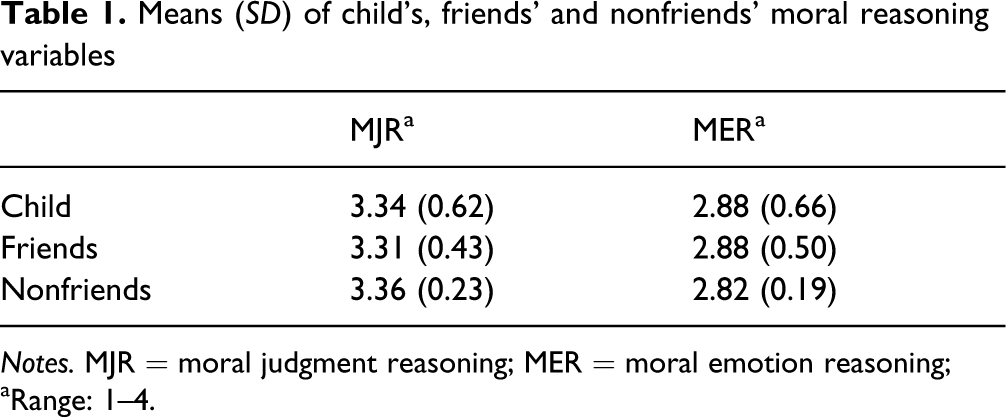
Notes. MJR = moral judgment reasoning; MER = moral emotion reasoning;
aRange: 1–4.
Language ability
As a control variable, children’s language ability was measured by the Sentence Imitation subtest of the Heidelberg Evaluation of Language Development Test (Grimm & Schöler, 1991). This subtest measures children’s ability to orally repeat 12 spoken sentences of differing complexity. The children’s answers were transcribed and later scored. A sentence reproduction was scored 2 if completely correct, 1 if partly correct, and 0 if totally incorrect. The mean verbal reproduction score was 21.78 (SD = 3.11), α = .72.
Results
Results are presented in three sections. First, we present correlations among the study variables. Second, we report the unique contributions of children’s, friends’, and nonfriends’ moral judgment reasoning (MJR) and moral emotion reasoning (MER) to children’s aggressive behavior. Third, we present results on the mediating effect of friends’ aggressive behavior on the relations between friends’ moral reasoning and children’s aggressive behavior.
Correlations among variables
Correlations among the study variables are given in Table 2. Four features of these correlations are noteworthy. First, consistent with previous studies on the homophily hypothesis, positive correlations were found between children’s and friends’ aggressive behavior as well as between children’s and friend’s moral reasoning. Second, nonfriends’ moral reasoning was not related to children’s aggressive behavior. Third, children’s MER, but not their MJR, was negatively related to their own aggressive behavior. Fourth, and most importantly, both friends’ MJR and friends’ MER were positively related to children’s and friends’ aggressive behavior.
Correlations among the study variables (N = 118)
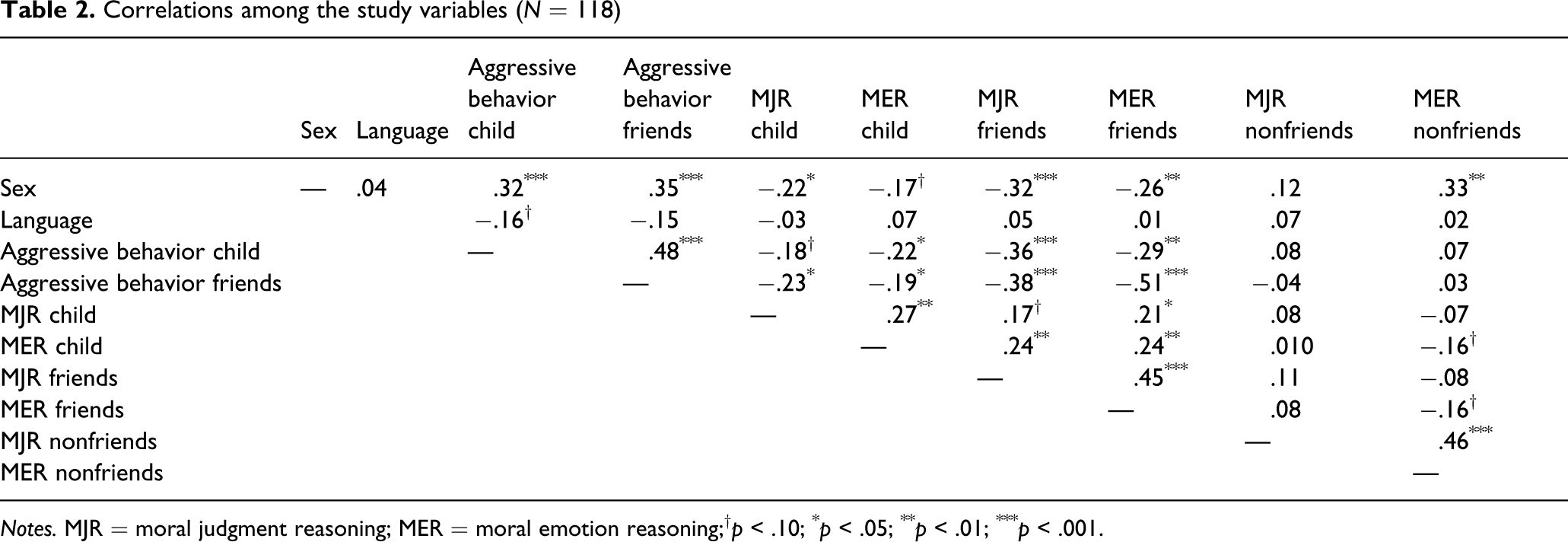
Notes. MJR = moral judgment reasoning; MER = moral emotion reasoning;† p < .10; * p < .05; ** p < .01; *** p < .001.
Relations of children’s and friends’ moral reasoning with aggressive behavior
To test our hypothesis on the relative predictive power of children’s, friends’, and nonfriends’ moral reasoning, and their interaction on aggressive behavior, a set of hierarchical linear regression analyses was performed with children’s aggressive behavior as the dependent variable. Separate analyses were conducted for MJR and MER. As the first step, we entered sex and language skills, because both were related either significantly or marginally significantly to aggressive behavior. As the second step, we entered children’s and friends’ MJR (children’s and friends’ MER, respectively). As the third step, we entered the interaction between children’s and friends’ MJR (interaction between children’s and friend’s MER, respectively), as well as the interaction between children’s and nonfriends’ MJR (interaction between children’s and nonfriends’ MER, respectively). As no interaction term including sex significantly predicted aggressive behavior, these terms were excluded from further analyses.
Consistent with our hypothesis, friends’ MJR and friends’ MER negatively predicted children’s aggressive behavior. Children’s MJR and MER, as well as nonfriends’ MJR and MER, however, did not significantly predict aggressive behavior (Table 3). Additionally, boys were more aggressive than girls.
Results of the hierarchical linear regression analyses predicting aggressive behavior by children’s and friends’ MJR and MER
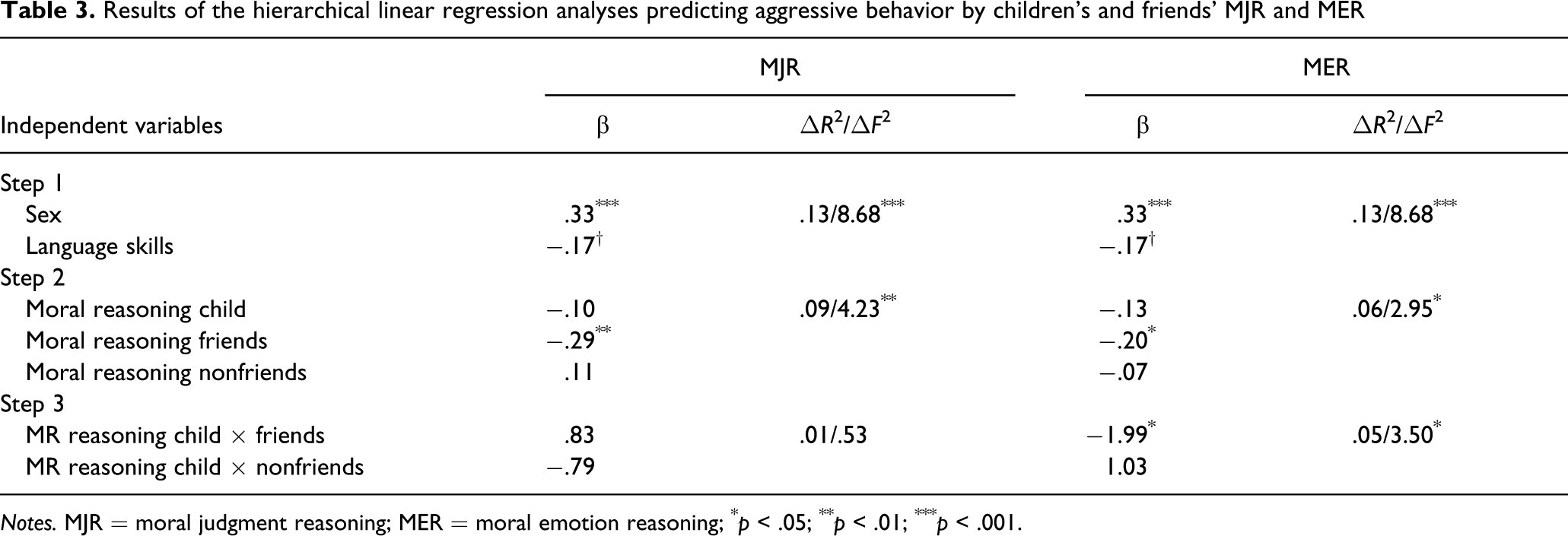
Notes. MJR = moral judgment reasoning; MER = moral emotion reasoning; * p < .05; ** p < .01; *** p < .001.
As expected, an interaction between children’s and friends’ MER significantly predicted children’s aggressive behavior. Simple slope analyses indicated that if friends’ MER was high, children’s MER negatively predicted their aggressive behavior (b = −.29, t = −2.57, p < .02). However, if friends’ MER was low, children’s MER was unrelated to their aggressive behavior (b = 0.12, t = 1.04, p > .05). In other words, aggressive behavior was low only when both children and their friends exhibited advanced MER (Figure 1).
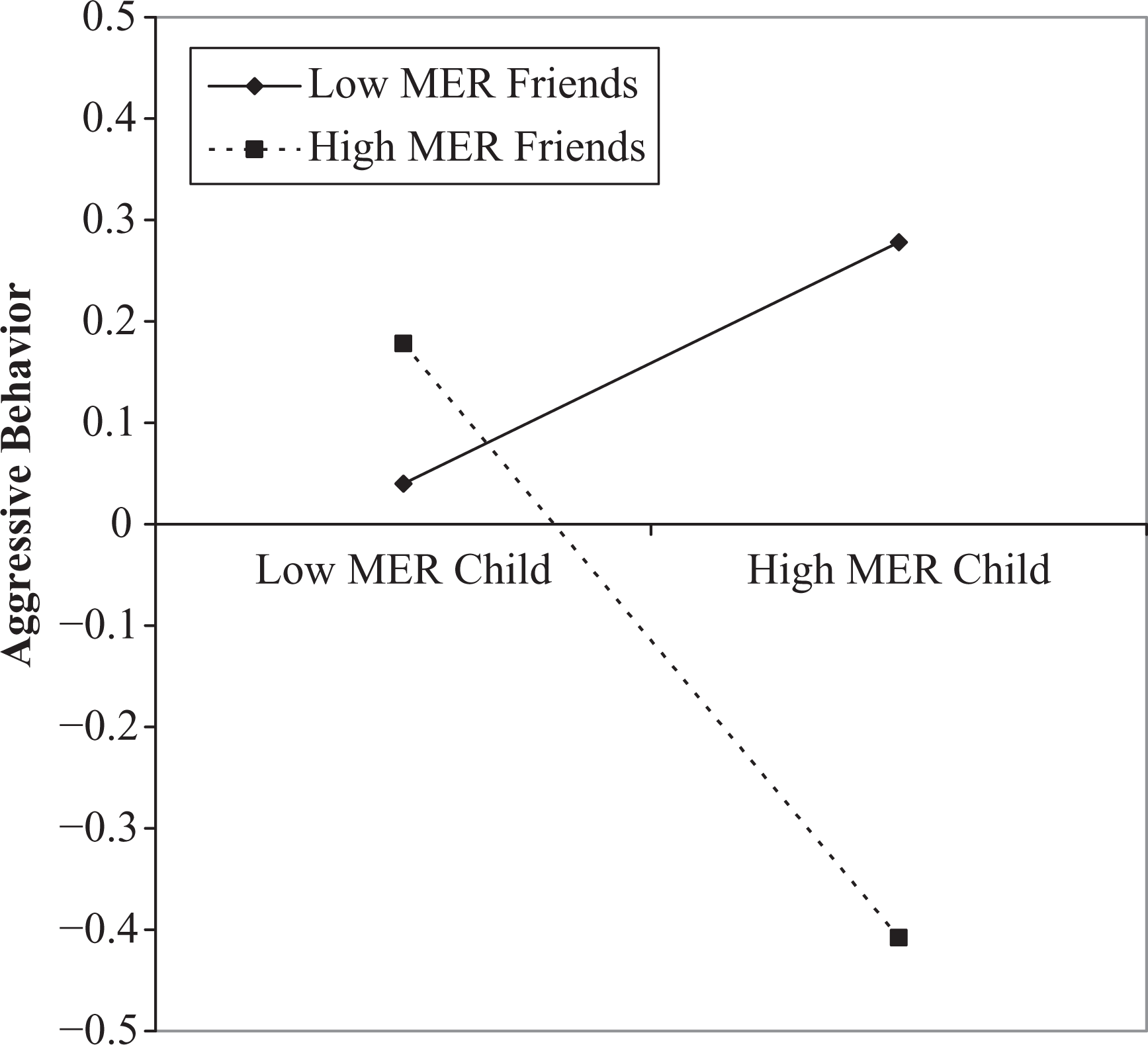
Interaction of children’s and friends’ moral emotion reasoning for the prediction of children’s aggressive behavior
Mediational role of friends’ aggressive behavior
Finally, we examined our hypothesis on the indirect effects of friends’ moral reasoning on children’s aggressive behavior as possibly mediated by friends’ aggressive behavior. To assess this possible mediation, the following conditions had to be met (cf. Baron & Kenny, 1986): (a) friends’ moral reasoning must significantly predict children’s aggressive behavior; (b) friends’ moral reasoning must significantly predict friends’ aggressive behavior; (c) friends’ aggressive behavior must significantly predict children’s aggressive behavior; and (d) the effect of friends’ moral reasoning must significantly decline after controlling for friends’ aggressive behavior. We used the Sobel test to determine if this decline was significant. The mediation hypothesis was tested separately for MJR and MER.
The results of the mediation analyses are given in Figures 2a–b. The analyses revealed that the relation between friends’ MJR and children’s aggressive behavior was partially mediated by friends’ aggressive behavior (Figure 2a). Even though the direct effect of friends’ MJR on children’s aggressive behavior decreased when friends’ aggressive behavior was controlled for (Sobel z = −3.18, p < .01), a significant direct effect remained. For MER, friends’ aggressive behavior fully mediated the effect of friends’ MER on children’s aggressive behavior (Sobel z = 3.77, p < .001; Figure 2b). Hence, having friends with low moral reasoning skills predicted higher levels of aggressive behavior among friends and, in turn, higher levels of individual aggressive behavior among children.
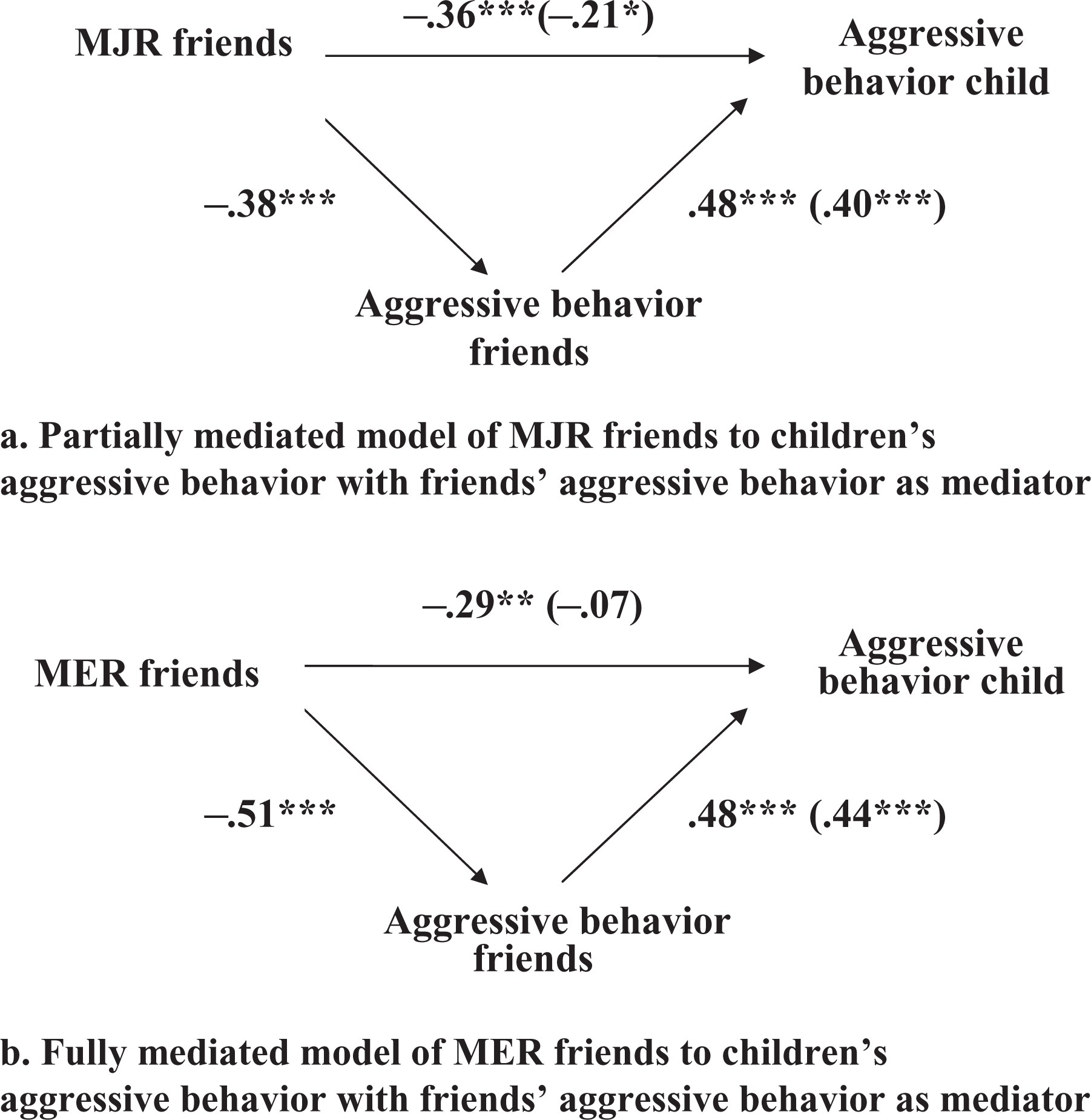
Mediation among friends’ moral reasoning, children’s aggressive behavior and friend’s aggressive behavior
Discussion
The present study sought to extend research on relations between moral reasoning and aggressive behavior by investigating the effect of friends’ moral reasoning on children’s aggressive behavior. Whereas most prior research on the relation between moral reasoning and aggressive behavior has focused on individual moral competences, the present study is the first to include the moral characteristics of reciprocal friends for the purpose of predicting children’s aggressive behavior.
The results provide evidence for a significant role of friends’ moral reasoning in children’s aggressive behavior. Consistent with our hypothesis, we found that friends’ moral reasoning following moral judgments, and emotion attributions was significantly related to children’s aggressive behavior. All these relations remained significant even after controlling for sex, language, individual moral reasoning, and nonfriends’ moral reasoning.
These findings extend previous research on the homophily hypothesis (Haselager et al., 1998) by showing that friends’ characteristics in the moral domain represent important social contextual factors for children’s behavioral socialization. Moreover, our findings parallel those of research on moral atmosphere and antisocial behavior. This research has shown that adolescents’ perceptions of moral atmosphere at school are better predictors of children’s morally relevant behavior than individual moral competences (e.g., Brugman et al., 2003). Even though the present study did not operationalize moral atmosphere via individual perceptions of shared values and norms and did not focus on adolescents, we also found that friends’ moral reasoning was more consistently related to children’s aggressive behavior than individual moral reasoning. Altogether, these findings support the assumption that moral atmosphere is a promising concept for bridging the gap between moral competence and moral action (see Brugman, 2010). Moreover, research on moral atmosphere has revealed that the effect of perceived moral atmosphere on adolescents’ behavior varies across different social contexts such as family, school, and peer group (De Wolff & Brugman, 2010). Our study points to the necessity of a further differentiation of moral atmosphere with regard to different peer relationships; that is, reciprocal friendships and more general peer relationships.
In contrast to friends’ moral reasoning, nonfriends’ moral reasoning was not related to children’s or friends’ aggressive behavior. This finding may be explained by the distinctive features of friendships and more general peer relationships such as increased emotional involvement or reciprocal commitment (Newcomb & Bagwell, 1995). It is therefore not surprising that friends’ and nonfriends’ moral reasoning show differential relations with children’s and friends’ aggressive behavior.
Even though relations between friends’ moral reasoning and aggressive behavior were stronger and more consistent than relations at the individual level, there was evidence suggesting that individual moral reasoning following emotion attributions is relevant to the explanation of individual differences in aggressive behavior. Namely, a significant interaction between children’s and friends’ moral reasoning following emotion attributions indicated that aggressive behavior was low only when both children’s and friends’ moral reasoning following emotion attributions was high. Therefore, one cannot assume that individual moral reasoning is irrelevant to children’s aggressive behavior. Rather, our findings support a social interaction perspective (Vitaro, Brendgen, & Tremblay, 2000), suggesting that it is not only peer contexts, but also individual characteristics, that contribute to the development of aggressive behavior.
Interestingly, individual moral reasoning following emotion attributions, but not individual moral reasoning following moral judgments, was related to aggressive behavior in the present study. These divergent results suggest that moral reasoning in the context of emotion attributions is more indicative of children’s internalized rule understanding and moral motive strength than moral reasoning in the context of moral judgments. This interpretation is in line with previous research that has documented the importance of distinguishing between moral judgment and other, more self-related components of morality (such as moral self-relevance or moral emotions) when predicting aggressive behavior (Arsenio & Lemerise, 2004; Barriga, Morrison, Liau, & Gibbs, 2001; Gasser & Keller, 2009; Gibbs, 2003; Johnston & Krettenauer, 2010). For example, moral emotions, such as compassion or guilt feelings, are recognized as influencing a person’s understanding of the prescriptive nature of the norms of fairness and caring (Malti & Latzko, 2012). As such, they help children and adolescents anticipate the outcomes of sociomoral events and adjust their moral action tendencies accordingly.
One should keep in mind, however, that we possibly failed to find relations between individual moral reasoning following moral judgments and aggressive behavior because of our measure of moral judgment. Within social domain theory, children’s moral judgments about moral rule transgressions are assessed by several questions representing defining critera of the moral domain (i.e., generalizability, obligation, inalterability, and independence from rule and authority sanctions; Turiel, 2002). Moreover, from the perspective of social domain theory, relations between children’s moral judgments and moral action should vary as a function of the specific contexts to be judged (Turiel, 2002). Aggressive and nonaggressive children might differ only with regard to their moral judgments of specific moral transgression (Leenders & Brugman, 2005). Future research is needed to clarify how different criteria of judgments and transgression contexts are related to morally relevant behaviors.
We further aimed to shed light on how friends’ aggressive behavior influences the effect of friends’ moral reasoning on children’s aggressive behavior. Friends’ aggressive behavior partially or fully mediated the relation between friends’ moral reasoning and children’s aggressive behavior. This finding suggests that friends with low moral reasoning are more likely to behave in aggressive ways, which in turn affects children’s engagement in aggressive activities. The significant effect of friends’ aggressive behavior on children’s aggressive behavior, found in the mediation analysis, has been well documented in the literature (Hanish et al., 2005). Researchers have interpreted links between children’s and friends’ social behavior as evidence for the influence of peer socialization. Specifically, it has been argued that children and friends become similar by reciprocally reinforcing or imitating social actions that are considered central to the friendship or the peer group’s identity. For example, Dishion, McCord, and Poulin (1999) use the term “deviancy training” to describe the social learning processes that lead to antisocial behavior in deviant friendships. Research on deviancy training has shown that communication between antisocial friends is dominated by antisocial topics, and that the reinforcement of such deviant talk predicts future antisocial behavior (Snyder et al., 2008). The present study extends this research by elucidating the possible role that friends’ moral reasoning plays in this process. The indirect effect of friends’ moral reasoning on children’s aggressive behavior may indicate that the reinforcement patterns between children and their aggressive friends reflect low moral competence in friends. For example, deficits in friends’ moral skills may egocentrically bias the perpetrator’s perspective in group discussions and lead to less constructive problem solving in actual moral conflict. These biases may enhance the risk of antisocial communication and behavior in friends which, in turn, may enhance the risk that children will imitate their friends’ deviant talk and antisocial behavior.
Even though we did not formulate specific hypotheses on sex effects, this study also contributes to the literature on sex differences in social development and moral reasoning. Boys showed higher levels of aggressive behavior and revealed slightly lower levels of moral reasoning than girls. These findings replicate sex effects found in previous research (e.g., Malti et al., 2009; Murray-Close et al., 2006) and they may be explained by socialization processes such as sex-specific role expectations (e.g., Nunner-Winkler, Meyer-Nikele, & Wohlrab, 2007). However, the results provide no evidence that the effect of children’s or friends’ moral reasoning on children’s aggressive behavior depends on the child’s sex. This finding is consistent with related studies that have revealed no sex-specific relations between group norms and children’s aggressive or bullying behavior (Salmivalli & Voeten, 2004). Nonetheless, one may also argue that girls’ engagement in aggressive behavior is more likely to depend on social contextual factors, because girls may be more sensitive towards social group dynamics than boys (Werner & Crick, 2004). To find out if the present results apply to boys as well as girls, future research with larger samples is warranted.
There are limitations to our study. First, our study did not include multiple age groups and, as such, this precludes us from generalizing the results to younger and older children. Second, the correlational and cross-sectional nature of the study precludes definitive answers to questions about the causes of moral development and aggressive behavior that we proposed in our models. Longitudinal data and more complex analytical models are needed to capture the causal direction and the possible reciprocal nature of these relationships. Third, we assessed only overt aggressive behavior, not other forms of aggressive behavior such as relational aggressive behavior. Friendships among relationally aggressive children are characterized by greater intimacy and exclusivity than those among overtly aggressive children (Grotpeter & Crick, 1996). This finding raises the possibility that relationally aggressive friends are more likely than physically aggressive friends to influence each other and adopt each other’s moral attitudes.
Despite these limitations, the present study clearly highlights the importance of including friends’ moral development when predicting children’s aggressive behavior, as our data show that friends’ moral development was consistently related to children’s aggressive behavior. Moreover, this relationship was mediated by friends’ aggressive behavior. In conclusion, our findings indicate that taking account of the role of friends’ moral reasoning in children’s behavioral socialization is a promising approach for those who seek to bridge the gap between children’s moral development and morally relevant behavior.
Footnotes
Funding
This research received no specific grant from any funding agency in the public, commercial, or not-for-profit sectors.