



Abstract
There is growing interest in understanding how beliefs about emotion regulation are related to individual emotional experiences. Extant studies have mainly focused on explicit beliefs about emotion regulation among individuals in Western societies. The current study examined implicit emotion regulation and explored their contributions to emotional outcomes in 147 Chinese adolescents. Participants were tested on their implicit beliefs about emotion regulation and their negative emotion experiences. Results showed that the down-regulation was implicitly evaluated as more positive than up-regulation. Moreover, positive implicit beliefs about down-regulation increased with age. Among younger adolescents, those who evaluated down-regulation more positively had less negative emotional experiences. These results suggest that down-regulation may have important implications in Chinese culture.
Adolescence is a period of development that is characterized by mood fluctuations (Casey et al., 2010). Prior research suggests that adolescents encounter various challenges that may require them to exert a greater degree of emotion regulation than earlier in their childhood (Deng, Sang, & Luan, 2013). Understanding how emotion regulation capacities develop during this important period can facilitate the understanding of socio-emotional development and has important applications across the fields of psychology and education.
Emotion regulation refers to attempts to change the experience or expression of emotion (Gross, 1998). It has been argued that people engage in emotion regulation in order to maintain or increase pleasant emotional experiences and decrease unpleasant emotional experiences (Davidson, Jackson, & Kalin, 2000). However, recent research demonstrates that the determinants of emotion regulation are more complex than simple hedonic considerations would suggest. In particular, individuals regulate emotions according to their beliefs about emotion regulation, with this regulation occurring explicitly or implicitly (Tamir, John, Srivastava, & Gross, 2007).
Beliefs about emotion regulation
One line of research about implicit beliefs in emotion regulation has come from Dweck’s social-cognitive model of motivation. According to this model, individuals behave differently to their approaches to achievement situation because of their implicit theories about their abilities (Dweck, 1999). Two kinds of implicit beliefs (entity theories and incremental theories) are thought to influence people’s motivations towards emotion regulation. People who hold incremental beliefs view attributes as malleable and controllable and show a flexible interpretation of events (e.g., intelligence is changeable). When facing academic challenge, these incremental beliefs promote self-regulation. These individuals may exhibit a coherent pattern of response tendency (e.g., making efforts to obtain high academic achievement). In contrast, people who hold entity beliefs view their intelligence is fixed and tend to accept their failure along with maladaptive attributions (e.g., I failed in the exam because I am stupid).
Implicit beliefs are not necessarily just about achievement motivation, but apply to a variety of human attributes including emotions and emotion regulatory strategies. For example, people who hold incremental beliefs about emotions take the view that emotions are malleable and therefore may be more likely than others to make efforts to regulate their emotions when involving in an emotionally challenging episode. Conversely, people who believe that emotions are fixed and impossible to change would be less likely to try to regulate their emotional experience (Tamir, John, et al., 2007). People may differ not only on whether they believe emotions are amenable to change, but also on whether they believe such change is desirable. Implicit beliefs of emotion regulation have been studied in terms of how desirable or useful they are perceived as regulatory strategies to deal with emotional experiences (Mauss, Evers, Wilhelm, & Gross, 2006). Implicit beliefs of emotion regulation may be related to people’s regulatory preferences. Prior studies have shown that beliefs about emotion regulation influence individuals’ motivation and tendencies to regulate their emotions (Mauss, Cook, & Gross, 2007; Mauss et al., 2006). For instance, individuals who believe that emotion should be regulated tend to down-regulate their emotions in response to emotion-inducing stimuli (Mauss et al., 2007). These findings suggest that beliefs about emotion regulation may affect the likelihood of using a specific regulatory strategy. The source of the implicit beliefs about emotion regulation has been suggested to derive from individuals’ implicit norms and regulatory goals based on early experiences, which may vary according to cultural background (Rudman, 2004).
Measuring implicit beliefs
The validity of the Implicit Association Test (IAT) is considered to significantly exceed that of self-report measures and is viewed as a robust predictor of personal and cultural beliefs (Greenwald, Poehlman, Uhlmann, & Banaji, 2009). When individuals are asked to report retrospective evaluation of emotion regulation explicitly, their evaluation may be confounded by their semantic memory biases and social desirability (Robinson & Barrett, 2010). As a result, there may be a discrepancy between what they really think and what they report (Robinson & Clore, 2002). Also, in a meta-analysis about the correlation between the results from IAT and explicit self-report measures, the findings of Hofmann, Gawronski, Gschwendner, Le, and Schmitt (2005) suggested that explicit measures might have potential vulnerability in assessing personal and cultural beliefs because of the higher order inferences and lack of conceptual correspondence. In fact, prior developmental research on explicit measures indicated that even children might respond in certain ways to maintain social desirability norms (Fu & Lee, 2007). Thus, using implicit tests of emotion regulation may be a useful strategy to reduce the potential impact of social desirability and other biases and to obtain a better understanding of how people think about emotional processes (Mauss et al., 2006).
Research has shown significant effects of implicit beliefs on individual emotional experiences and activities (Robins & Pals, 2002). For instance, dysfunctional implicit self-beliefs are likely to be associated with negative academic-related emotional experiences. Also, individuals who believe that their intelligence is fixed implicitly show helplessness in their cognitive, affective, and behavioral responses to academic challenges and experiences of negative emotions (Robins & Pals, 2002). Furthermore, implicit beliefs of emotion regulation may affect individuals’ daily emotional experiences. In a study of relations between implicit beliefs about emotion regulation and social and emotional outcomes across a major life transition, Tamir, John, et al. (2007) found that individuals who view emotions as more malleable reported higher levels of psychological well-being, less depressive symptoms, and better social adjustment.
Beliefs about emotion regulation in Chinese culture
It should be noted that research on beliefs about emotion regulation has been conducted primarily in Western societies (Miyamoto & Ma, 2011). However, it has been argued that social and cultural norms play an important role in shaping individual emotional processes and experiences such as display of specific emotions (Novin, Riefe, & Mo, 2010). In Western societies, people are encouraged to express their emotions, particularly positive emotions (Kitayama, Markus, & Kurokawa, 2000), and expressive suppression is considered to be associated with negative psychological functioning (Soto, Perez, Kim, & Minnick, 2011). In contrast, some evidence indicates that suppression of emotions is not associated with psychological problems in Chinese Americans (Soto et al., 2011). These findings suggest that there may be differences in the beliefs about emotion regulation in Western and Chinese societies, which may in turn be reflected in the process of emotion regulation.
Through their different value systems, Western and Chinese societies differ in beliefs about emotions, regulatory goals, and display rules (Luo, Gilmour, & Kao, 2001; Wei, Su, Carrera, Lin, & Yi, 2013). Prior research has indicated that compared with European Americans, Asians are less inclined to pursue favorable internal feelings and consider pleasant emotions to be potentially obstructive (Uchida & Kitayama, 2009). In Asian culture, positive emotions may be more associated with interpersonal harmony with other people than with individual feelings. For example, Luo et al. (2001) found that the relationship between the value of social integration and happiness experience was significant in a Taiwanese sample but not in a British sample. Furthermore, cultural variation not only influences how individuals perceive emotions but also influences how they respond to them. In Chinese culture, maintenance of interpersonal concordance is the normal goal of regulation (Fung & Jin, 2011). According to Wei et al. (2013), Chinese people tend to down-regulate their emotions to preserve interpersonal harmony, whereas their Western counterparts may not necessarily decrease their emotions for this goal. Also, as in some other Eastern societies, Chinese display rules are impacted by the goal of maintaining interpersonal harmony (Fung et al., 2011; Novin et al., 2010). The goal of avoiding the display of pride and maintaining interpersonal harmony may demands Chinese adolescents to down-regulate their emotions, such as suppressing positive facial expressions and reappraising their temporary success with respect to long-term achievement (Deng et al., 2013). In addition, the dominant cultural script in China is grounded in moderation. Because seeking the middle way is highly advocated, it is believed that the control of emotions to reduce extreme experiences is important for people to obtain optimal affective states (Miyamoto & Ma, 2011). For example, calmly facing success and failure is seen in Chinese society as a virtue as well as a requisite for future success (Deng, et al., 2013). Chinese beliefs about emotion regulation may therefore emphasize the importance of down-regulation and may differ from beliefs in Western societies.
Unlike Western societies that value independence and emphasize emotional expression, Chinese culture tends to value down-regulation in maintenance of interpersonal harmony (Mesquita & Albert, 2007). Prior research suggests that emotional down-regulation is a strategy that fits with the pursuit of Chinese regulation goals and that the relations between down-regulation and negative emotion experience may not be the case in Eastern societies (Rothbaum & Rusk, 2011; Soto et al., 2011). For example, in the longitudinal study of Sang, Deng, and Luan (2014), Chinese adolescents who used more down-regulation in response to both pleasant and unpleasant emotional events reported less negative emotion experiences. Given the different findings on the relations between emotion regulation and emotion experience in Western and Chinese societies, we expected that the implicit beliefs about down-regulation would be dominant in Chinese culture and would have an impact on emotion experience.
Emotion regulation in adolescence
In addition to social and cultural norms and values, age may be an important factor in affecting implicit beliefs about emotion regulation. It has been found that with age, children and adolescents tend to use increasingly effective regulatory strategies and abandon ineffective or maladaptive ones (Compas, Connor-Smith, Saltzman, Thomsen, & Wadsworth, 2001). Studies with adults indicate that whether individuals consider a particular regulatory strategy adaptive or maladaptive depends largely on their beliefs about emotion regulation (Tamir, John et al., 2007). Moreover, individuals tend to use those regulatory strategies that they believe to be positive or adaptive even though they may elicit unpleasant emotions (Tamir, Chiu, & Gross, 2007). Thus, it is useful to examine how beliefs about emotion regulation influence individuals’ emotional outcomes during adolescence, a period that has a relatively high demand of emotion regulation. In Western culture, adolescence is often depicted as a period of “storm and stress” in which various life challenges must be met (Casey et al., 2010). Like their Western counterparts, Chinese adolescents also face emotional fluctuations and developmental challenges in this period (Yan & Berliner, 2009). For example, highly competitive school environments makes academic challenges one of the most significant stressors of Chinese adolescents and often gives rise to emotional turmoil (Crystal et al., 1994). Senior high school students (10–12th-grade students), confront this challenge more intensely than junior high school students (6–9th-grade students) because of the importance of the college entrance examination. Although Chinese adolescents have cultural background that is different from that of their Western counterparts, adolescence is a distinct period of life and needs to be paid attention to (Hesketh, Ding, & Jenkins, 2002). Examining how beliefs about emotion regulation influences individuals emotional outcomes in early to late adolescence might have potential implications for intervention and educational practices.
The healthy adaption of adolescents in such a period of high regulatory demand requires flexibly choosing strategies to fit the situational context (Opitz, Gross, & Urry, 2012). Certain emotional regulatory strategies may play an especially important role for Chinese adolescents. As indicated by the selection, optimization, and compensation with emotion regulation (SOC-ER) framework (Urry & Gross, 2010), people regulate emotions by setting realistic goals according to their capacities (selection), making efforts to achieve selected regulation goals (optimization), and increasing efforts or finding help to reduce losses (compensation). With different maturity levels, socio-emotional capacities, and situational demands, individuals may vary in specific regulatory strategy usage across the life span (Sheppes, Scheibe, Suri, Radu, Blechert, & Gross, 2014; Zimmermann & Iwanski, 2014). For example, the use of different emotion regulation strategies may show specific patterns related to the development of emotional reactivity (Eisenberg & Spinrad, 2004). Consistent with this argument, Hare and colleagues (2008) found that the peak of emotional reactivity during adolescence increased the need for emotional control and down-regulation. Moreover, as mentioned above, being influenced by a dominant cultural script to seek the middle-way during development, down-regulation is a primary choice for Chinese adolescents to satisfy the situational demands (Miyamoto & Ma, 2011).
Given the literature suggesting that emotion regulation demands in adolescence may be particularly high in social situations, the experience of negative social experiences may be an important index of emotional outcomes during adolescence. When adolescents modulate social emotions, self-awareness and estimations of self-worth are typically involved (Silvers at al., 2012), leading us to focus on these issues in the current study.
The present study
The main purpose of the present study was to build on previous work by using implicit measures to reduce the potential impact of social desirability and to provide a complement to research based on explicit measures of emotional beliefs. We sought to examine developmental differences between younger and older Chinese adolescents in terms of their implicit beliefs about emotion regulation. In addition, although previous studies indicated that people who believed that emotions were fixed reported more negative emotional outcomes, little research has directly explored implicit beliefs about emotion regulation and their emotional outcomes. Thus, we sought to examine relations between implicit beliefs about emotion regulation and emotional experiences. We first hypothesized that positive evaluation of down-regulation would be higher in older adolescents than in younger adolescents. We also hypothesized that individuals reporting positive beliefs about down-regulation would experience less negative emotional experience in daily life.
Method
Participants
Data were collected from a public school in a city located in eastern China. In total, 67 junior high school students (Grades 6 to 9) (33 boys, 34 girls; Mage = 13.25, SD = 1.16), and 80 senior high school students (Grades 10 to 12) (35 boys, 45 girls; Mage = 16.51, SD = 1.17) were recruited by advertisements posted in the school. All of the participants came from an urban community. In the sample, 46.3% of the junior high school students and 57.5% of the senior high school students were only children; others had one or more siblings. Approximately 32.2% of fathers and 25.4% of mothers in the younger adolescent group, and 31.2% of fathers and 27.5% of the mothers in the older adolescent group, had received a college education. Other parents had received an education of high school or lower. Child gender, sibling status and parental education did not have significant effects on the variables or the relations of interest in this study (see Table 1).
Correlation between participants’ demographic information and variables of interest.
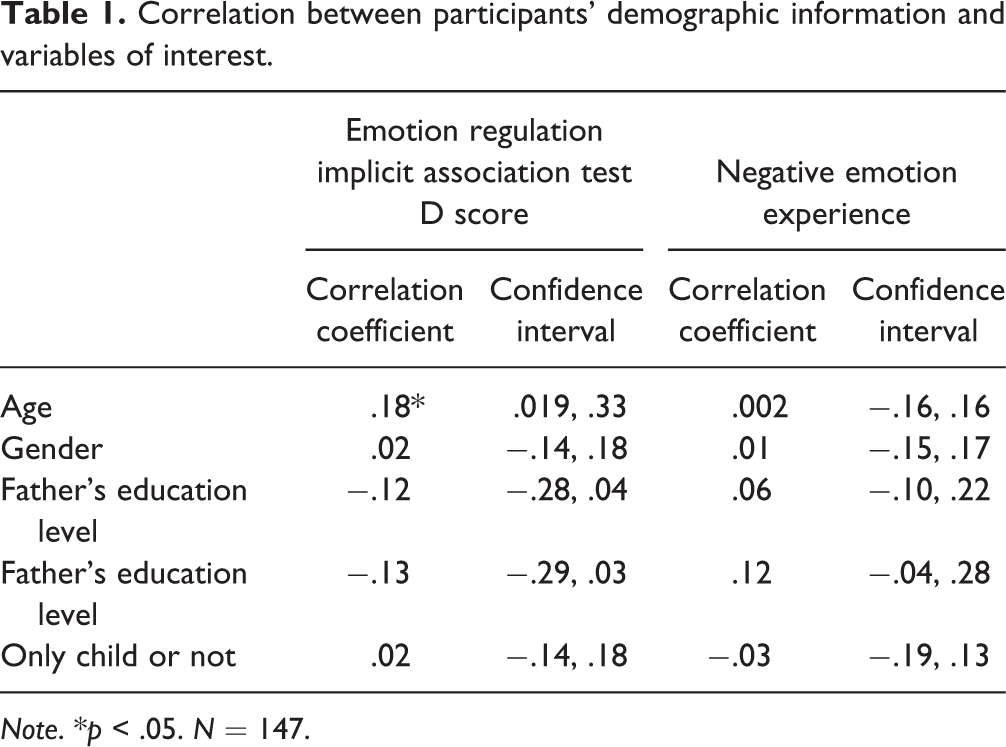
Note. *p < .05. N = 147.
Materials
Implicit beliefs about emotion regulation
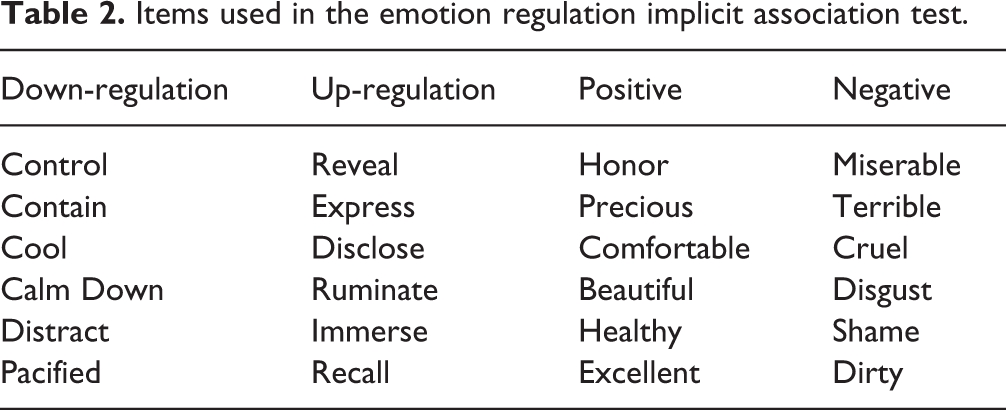
Implicit beliefs about emotion regulation were assessed using a version of the IAT designed to index beliefs about emotion regulation (the ER-IAT, Mauss et al., 2006). We modified the ER-IAT of Mauss et al. (2006) by expanding the concepts of emotional control and emotional expression to broader aspects of up-regulation and down-regulation. Up-regulation is a type of regulatory strategy that increases the degree of emotion experience and amplifies behavioral and facial responses. Conversely, down-regulation is defined as a regulatory strategy that decreases and minimizes the intensity of emotion experience and weaken behavioral and facial responses (Krompinger, Moser, & Simons, 2008). In accordance with these definitions of up- and down-regulations, we examined not only emotional control and facial expressions but also other typical up- and down-regulation strategies in the literature. For example, attentional distraction, cognitive reappraisal, and emotional control were included as part of down-regulation in our IAT. We used six items (e.g., control, contain, cool, calm down, distract, pacified) to examine the implicit evaluation of down-regulation strategies. For up-regulation, attentional immersion, cognitive rumination, and emotional expression were included. We also used six items (e.g., reveal, express, disclose, ruminate, immerse, recall) to examine the implicit evaluation of up-regulation strategies. Given the literature suggesting that down-regulating pleasant and unpleasant emotions is generally encouraged in Chinese culture, the ER-IAT used in the study was not emotion-specific.
The task was administered with a program from Inquisit Software. The ER-IAT task was used to examine the relative implicit association strength between the target (up- and down-regulation) and the attributes (positive and negative concepts). During the test, participants categorized the item according to the different concepts by pressing different response keys. Participants were told to categorize each stimulus word as quickly as possible but also to not make many errors. Items from the categories of up-regulation, down-regulation, positive and negative were presented (see Table 2) across blocks of compatible and incompatible conditions. In the compatible block, participants categorized items into two combined groups, namely, down-regulation and positive items versus up-regulation and negative items (20 practice and 40 test trials). In the incompatible block, participants categorized items into two combined groups, namely, down-regulation and negative items versus up-regulation and positive items (20 practice and 40 test trials). The logic of the IAT is that reaction times should be shorter if participants more strongly associate the two concepts that share the same response key. All of the items were presented in Chinese.
Items used in the emotion regulation implicit association test.
Our modified ER-IAT was scored according to the D-Scoring algorithm proposed by Greenwald, Nosek, and Bnaji (2003). Data from practice trials as well as test blocks were included when calculating the D values of the ER-IAT. Trials with reactions time (RT) greater than 10 seconds were omitted. Standard deviations across practice and test trials were computed for each participant. Average RTs for practice and test blocks were divided by the resulting standard deviations. Final D scores for the ER-IAT were calculated by measuring the difference in mean RTs between the compatible and the incompatible block in units of the participants’ standard deviations. Basic information about the ER-IAT is showed in Table 3. Higher D values indicated more positive implicit evaluation of down-regulation relative to up-regulation. Positive D values indicated that participants implicitly considered down-regulation positive and up-regulation negative. Negative D values indicated that participants implicitly considered up-regulation positive and down-regulation negative.
Basic information about emotion regulation implicit association test.
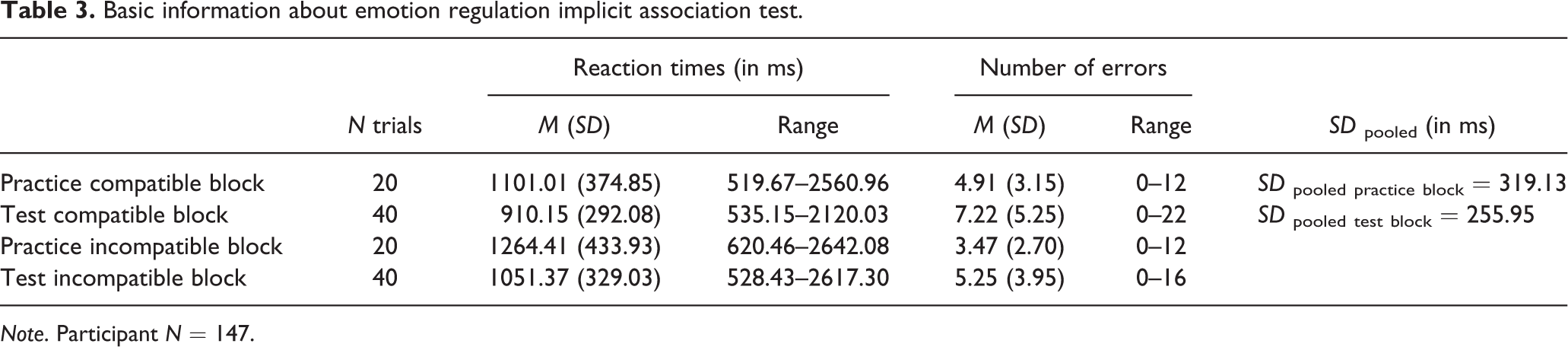
Note. Participant N = 147.
Negative emotional experience
Since negative emotional experiences have been associated with many affective problems, which are particularly important for adolescents and reflect more voluntary aspects of emotion regulation, we mainly focused on negative emotional experiences in participants’ daily lives. As mentioned above, negative social emotional experiences are an important index of emotional outcomes during adolescence. When adolescents modulate social emotions, self-awareness is likely to be involved. Therefore, to measure the negative social emotional experience, we selected four subscales from the Chinese version of the Daily Emotion Scale (DES-IV) (Huang & Guo, 2001; Sang et al., 2014) to assess the frequency of negative social emotional experiences. The four negative emotions from the DES focused on the emotions pertaining to self-worth. The participants were asked to rate the extent to which they generally felt angry (e.g., I am irritated and feel angry with others), disgusted (e.g., I have a feeling of disgust), despised (e.g., I feel despised), and hostile (e.g., I am angry and unsatisfied by myself). Unlike other basic negative experiences (e.g., sadness and fear), negative emotion experiences measured in the study were more concerned with the self and trait-like emotional conditions. Each of the emotions had three items. Participants rated the 12 items on a 4-point scale (1 = never to 4 = always). Total scores were computed based on the participant’s responses to all items, with higher scores indicating more negative emotional experiences in daily life activities. Internal reliability was .78 for negative emotional experience.
Procedure
The measure of negative emotional experiences was administered in a morning class, with the ER-IAT being administered in the evening class session in the school. Each testing session lasted about 40 minutes. The research assistant described the procedure and provided extensive explanations to participants during the collection of data. No evidence was found to suggest that adolescents had difficulties in understanding the items or procedures. Written consent was obtained from all children and their parents through the school.
Results
Age differences in implicit beliefs about emotion regulation
We first compared the D value from the ER-IAT with zero to confirm that participants evaluated differently implicit up- and down-regulation. D values for both younger and older adolescents were significantly greater than 0, t(66) = 2.29, p < .05, d = .56, 95% CI [.02, .29], M younger adolescents = .15, SDyounger adolescents = .55; t(79) = 5.34, p < .05, d = 1.20, 95% CI [.22, .49], Molder adolescents = .36, SDyounger adolescents = .60. The results indicated that both of the younger and older adolescents evaluated down-regulation more positive than up-regulation implicitly. To examine age differences of the implicit beliefs about emotion regulation, a t test was used to compare the D values between younger adolescents and older adolescents. As expected, D values of older adolescents were higher than the D values of younger adolescents, t(145) = −2.13, p < .05, d = −.35, 95% CI [−.39, −.01]. This result indicated that the positive evaluation of down-regulation was higher in older adolescents than that in younger adolescents.
Relations between implicit beliefs about emotion regulation and negative emotional experiences
To examine associations between beliefs about emotion regulation and emotional outcomes, a regression analysis was conducted with age and ER-IAT D values being entered as predictors. As shown in Table 4, results indicated that age was not significant in predicting negative emotional experiences. However, ER-IAT D values were negatively related to negative emotional experience, β = −.46, t = −3.66, p < .001.
Linear regression results for predictors of negative emotional experience.

Note. N = 147. R2 = .09. F(3, 143) = 4.52. p < .01.
Moreover, a significant interaction between age and D values was found in the regression analysis, β = .34, t = 2.54, p < .01. As the ER-IAT D values increased, negative emotional experience decreased in younger adolescents, but not in older adolescents. Simple slope tests for the interaction showed that there was a significant negative relation between IAT D values and negative emotional experiences in younger adolescents, β = −.23, t = −2.63, p < .01, but not in older adolescents. The results are presented in Figure 1. Therefore, among younger adolescents, those who evaluated down-regulation as more positive had fewer negative emotional experiences. However, among older adolescents, this effect was not significant.
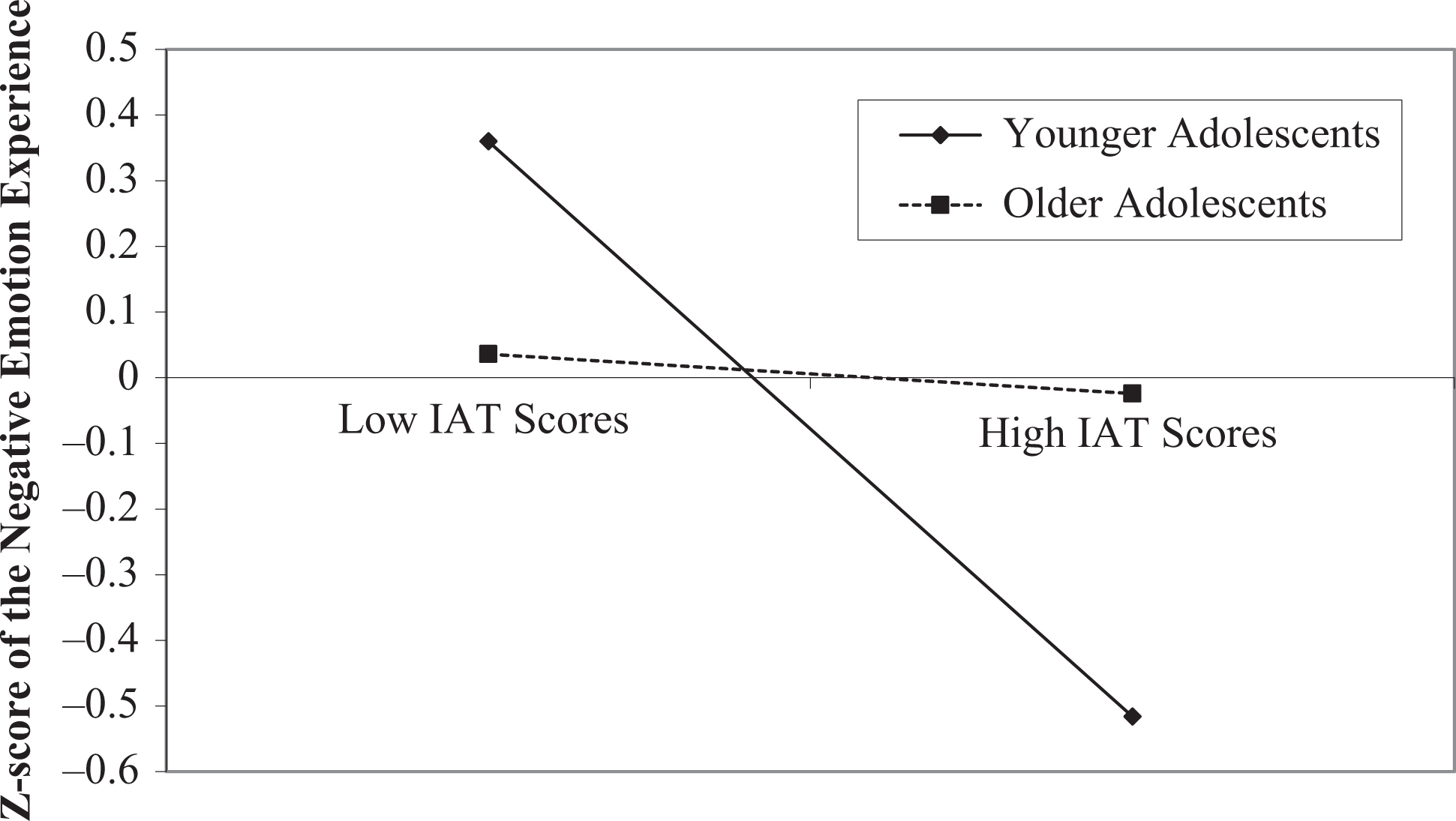
Associations between beliefs about emotion regulation and negative emotional experience in different stages of development (N Younger Adolescents = 67, N Older Adolescents = 80). IAT = Emotion Regulation Implicit Association Test.
Discussion
The present study examined developmental differences in implicit beliefs about emotion regulation and their relations with emotional outcomes in Chinese adolescents. The results indicated that Chinese adolescents evaluated implicit down-regulation more positively than up-regulation. Consistent with our first hypothesis, the positive implicit belief of down-regulation was more evident with increasing age. In addition, our analyses of the relations between implicit beliefs about emotion regulation and emotion experience indicated that adolescents who evaluated down-regulation more positively also reported less negative emotional experiences, particularly for the younger group. This result was consistent with our second hypothesis. The general pattern of these findings are consistent with prior research suggesting that down-regulation of emotion is positively valued by Chinese adolescents and may serve as an adaptive function in the Chinese context.
Adolescence has been called as a period of “storm and stress” and characterized by mood fluctuations (Casey et al., 2010). To cope with various social challenges and psychological disturbances, adolescents need to maintain a balance among the pursuit of personal independence, establishment of social relationships, and exploration of the environment (Casey, Getz, & Galvan, 2008; Eccles & Roeser, 2011; Monahan & Steinberg, 2011; Peck, Brodish, Malanchuk, Banerjee, & Eccles, 2014). Adolescents’ implicit beliefs about emotion regulation represent an important connection between the developing self and their social environment (Raval, Martini, & Raval, 2007). How adolescents in a society perceive different emotional regulatory strategies reflects their understanding of social goals and display rules (Novin, Banerjee, Dadkhah, & Rieffe, 2009). In our study, the data suggested that both younger and older adolescents exhibited biases toward down-regulation and positive concepts, suggesting that they might hold beliefs that down-regulation was more positive than up-regulation. Furthermore, perhaps due to the influence of socialization, positive implicit beliefs about down-regulation became more salient from early adolescence to late adolescence. Positive evaluations of down-regulation is consistent with the findings from previous research suggesting that down-regulation is regarded as more acceptable or desirable for achieving the core regulatory goal of Chinese culture of maintaining interpersonal harmony (Miyamoto, Ma, & Petermann, 2014). It has also been argued that down-regulation fits the cultural script of emotion regulation in China (Miyamoto & Ma, 2011).
Finally, consistent with the implicit beliefs regarding the acceptability of down-regulation, we found that adolescents who evaluated down-regulation more positively reported less negative emotional experience in daily life, particularly in younger adolescents. Our outcome measure of negative emotional experiences assessed trait-like emotions toward the self, reflecting feelings of self-worth. The results suggested that down-regulation might have a higher adaptive value than up-regulation, especially for the younger adolescents, in Chinese society. According to Deng and colleagues (2013), adolescents who utilized down-regulation in both pleasant and unpleasant emotional events in a higher frequency experienced generally more positive emotional states. Our findings that the relations between implicit beliefs about emotion regulation and negative emotional experience were more evident in early adolescence than late adolescence might be related to the fact that younger adolescents are less mature and thus more vulnerable than older adolescents to the influence of emotions (Garnefski & Kraaij, 2006). Specifically, whereas their older counterparts may be able to maintain stable emotions in various settings, younger adolescents are likely to display different emotional reactions depending on how they regulate their emotions and whether the regulation strategies are in accord with social values. More specifically, individual beliefs about up-regulation likely increase the tendency of up-regulating emotions. However, up-regulating emotions is not encouraged and is inconsistent with display rules in the Chinese culture. When adolescents encounter interpersonal conflicts, their beliefs of expressing emotion regulation may therefore cause them to respond in an inappropriate way and result in negative emotional outcomes (Deng et al., 2013).Younger adolescents may be more vulnerable to the negative influence of the beliefs about up-regulation and thus may be less effective in exerting emotion regulation than older adolescents. Although implicit beliefs about emotion regulation are important in adolescents’ emotional lives, relations between implicit beliefs about emotion regulation and negative emotional experiences might be attenuated because of the higher effectiveness in emotion regulation of older adolescents (Silvers et al., 2012).
Previous research on implicit beliefs about emotions (Tamir, John, et al., 2007) has been primarily concerned with beliefs about emotion itself, rather than about emotion regulation. The effects of beliefs about emotion regulatory strategies are likely to be equally, if not more, important than the beliefs about emotions for individual functioning. Although implicit beliefs about emotion likely influence motivations for emotion regulation (e.g., individuals who view certain emotions as useful would tend to up-regulate them (Tamir et al., 2008), and implicit beliefs about regulatory strategies may determine the selection of the actual strategy. For example, although happiness seems to be useful to the fulfillment of hedonic needs and psychological health, if expressing happiness is unacceptable to others, individuals may be reluctant to choose up-regulation of this emotion (Novin et al., 2009). The significance of positive beliefs about down-regulation strategies in Chinese adolescents may be reflected in their roles in guiding them to regulate their emotions in the way that is consistent with the regulatory goals and display rules in the Chinese context. It is also consistent with the SOC-ER framework which suggests that people regulate emotions according to their goals and capacities (Urry & Gross, 2010).
Limitations and future directions
The present study enriches the literature of emotion regulation and socio-emotional development by adding a consideration of the implicit beliefs of emotion regulation and examining their emotional outcomes outside Western culture. Together with other studies that show cultural differences in the usage of different emotional regulatory strategies, our findings highlight the importance of taking into account how people evaluate different strategies in cultural and developmental contexts. Nevertheless, there still were several limitations in this study. First, we discussed the Western literature on emotion regulation and its functional significance mainly as a background. However, the study was conducted in Chinese adolescents without a comparison group from a Western country. It will be interesting for future studies to directly examine whether adolescents across cultures differ on emotional regulation.
Second, based on the literature (e.g., Deng et al., 2013; Sang et al., 2014), we discussed the influence of Chinese social and cultural values on adolescents’ emotion regulation. However, we did not assess these social and cultural values in the study. There is a large body of literature on the assessments of cultural orientations and values such as independence and interdependence (e.g., Singelis, 1994). Future research should draw on this literature and examine how individual value system is associated with emotion regulation and its relations with psychological experiences. At the same time, researchers should investigate various situational and personal factors (e.g., family, school practices, etc.; Silbereisen & Chen, 2010) that may be involved in these processes.
Third, our study focused on the period of early adolescence to late adolescence. The results indicated that adolescents at different ages might view down-regulation and up-regulation differently and that age may moderate relations between emotion regulation and experiences. Thus, one needs to be careful in generalizing the findings to other developmental periods such as childhood. Additionally, given more and more studies indicating that some emotional processes (e.g. emotional reactivity and facial emotion processing) are more strongly influenced by puberty-related effects (Blakemore, Burnett, & Dahl, 2010; Silvers et al., 2012), it may be fruitful for future work to examine whether age and pubertal status exert differential effects on emotion regulation.
Also, in terms of the measure of emotional outcomes, external emotion ratings (e.g., maternal and teacher reports of participants emotional health) or observation would avoid the measurement bias inherent in our self-report measures. It is recommended for future studies to include other objective measures of participants’ emotional health.
Finally, China is currently undergoing dramatic changes due to the massive social and economic reform toward a market-oriented society. Individualistic values such as autonomy and self-expression are more encouraged in the new environment. It will be interesting to investigate how the macro-level societal changes affect children’s and adolescents’ evaluations of down-regulation and up-regulation and their developmental significance for emotion experiences.
Footnotes
Funding
The author(s) disclosed receipt of the following financial support for the research, authorship, and/or publication of this article: This article was funded by the Young Teachers Support Project in Humanities and Social Science of Shenzhen University (Grant / Award Number: ‘15QNFC20’), and the National Natural Science Foundation of China (Grant / Award Number: ‘31371043’).