



Abstract
Background
Environmental sustainability has become a pressing concern in the hospitality sector, especially in developing economies where organizational capabilities are often underutilized. Leadership, organizational climate, and culture are critical intangible resources that can drive improved environmental outcomes.
Objective
This study investigates the role of ethical leadership in enhancing environmental performance in Egypt’s hotel sector. It further examines the mediating effect of green climate and the moderating role of green culture on this relationship.
Methods
Grounded in the Resource-Based View (RBV) theory, the study employed a quantitative research design and collected data from 381 hotel employees. Structural Equation Modeling (SEM) was used to test the hypothesized relationships among ethical leadership, green climate, green culture, and environmental performance.
Results
The findings indicate that ethical leadership significantly enhances environmental performance both directly and indirectly through green climate. Additionally, green culture positively moderates the relationship between ethical leadership and environmental performance, amplifying its effect under strong environmental values.
Conclusions
The study underscores the strategic importance of ethical leadership, green climate, and green culture as internal resources for promoting sustainability in the hospitality industry. It offers practical insights for hotel managers aiming to strengthen environmental outcomes through ethical practices, particularly within the Egyptian context.
Keywords
Introduction
The increasing concern at environmental challenges, including the degradation of natural resources, emission of greenhouse gases, excessive energy consumption, and production of waste through manufacturing processes and products, 1 has motivated organizations and people to prioritize creating policies that promote environmental sustainability policies. 2 Therefore, it has become more imperative for organizational leaders to execute environmental strategies through which they can effectively respond to the pressures imposed by various stakeholders and develop the environmental performance (Latter mentioned EP) of their businesses.3,4 As EP is regarded as a significant competitive advantage source, 5 it enhances the capacity of organizations to face environmental challenges while building the skills and abilities needed for their enhanced EP. 6
Moreover, organizational leaders play a key role in implementing initiatives intended to improve environmental performance, which not only responds to ecological demands but also serves as a strategic route to achieving competitive advantage. Environmental performance, or the capacity of a firm to meet social expectations for addressing environmental concerns, 7 is particularly imperative in sectors with significant ecological footprints, such as the hospitality sector. 8 Hotels essentially attract significant amounts of resources and create significant amounts of waste, thus making their EP the central element of sustainability initiatives. 9 Achieving high environmental performance not only benefits the ecosystem but also customer satisfaction, organizational image, and operational efficiency. 10
Leadership becomes crucial in guiding organizations towards sustainability, especially through the lens of ethical leadership (Latter mentioned EL). 11 Ethical leadership is characterized by qualities such as transparency, integrity, fairness, and a strong dedication to the welfare of all stakeholders, including nature. 12 In the current business world that considers environmental awareness most critical, ethical leaders are increasingly being seen as primary agents of change who not only practice ethicality but also lead sustainability initiatives in organizations. 13 As organizations experience growing pressures to drive their environmental performance, EL presents itself as a strategic resource, aligning the interests of business with environmental considerations. 4 Thus, ethical leadership is indispensable in realizing greater environmental performance through influencing values, behaviors, and systems that together bring about long-term environmental sustainability. 1
Organizational employees connect the green climate (Latter mentioned GC) to collective perceptions of organizational policies, practices, and procedures that promote environmental sustainability. 14 An effective GC is capable of inspiring organizational employees to adopt environmentally sustainable behaviors. 15 Ethical leadership can motivate such a climate by integrating environmental values within the organizational culture, thereby indirectly shaping environmental performance. 16 Furthermore, organizational culture encompasses shared principles, norms, and values among the people in an organization. 17 A green culture (Latter mentioned GCU) focuses on environmental sustainability as a core value that guides decision-making and behavior across all organizational levels. 18 The cultural system may control the interaction between ethical leadership and environmental performance, and enhance or decrease the influence of leadership initiatives based on cultural values alignment with environmental aims.
In the Egyptian context, the hospitality industry is one of the main pillars of the national economy, playing a key role in employment and Gross Domestic Product (GDP). 19 This industry, however, also has special environmental issues, particularly in urban regions such as Greater Cairo, where environmental issues like water shortages, air pollution, and waste management are very severe. 20 Despite governmental attempts at enhancing waste management processes and developing renewable energy solutions evidenced by initiatives such as the Benban Solar Park and the launch of recycling facilities, the implementation of sustainable programs in the hotel sector remains decidedly uneven. 21 Whereas leadership and organizational culture were studied in the past concerning their influence on environmental performance, a considerable research gap to the Egyptian hospitality sector can be recognized. This research intends to close this gap by investigating the relationship between ethical leadership, green climate, green culture, and environmental performance of hotels in Egypt.
The decision to conceptualize GCU as a moderating variable rather than a mediator was grounded theoretically and empirically. Specifically, GCU was posited to function as a contextual enhancer that shapes the strength and direction of the relationship between Ethical Leadership (EL) and Environmental Performance (ENVP), rather than serving as an intermediary mechanism through which EL exerts its effect. This conceptualization aligns with the contingency perspective and prior literature that frames organizational culture—particularly green culture—as a boundary condition that can amplify or constrain leadership effectiveness on environmental outcomes (Daily et al., 2009; Jabbour & de Sousa Jabbour, 2016). In this study, we tested GCU as a moderator to assess whether the positive influence of EL on ENVP becomes more pronounced in organizational settings where a strong green culture is present. By incorporating those variables into the Resource-Based View (RBV) model, the research gives a comprehensive insight into how intra-organizational dynamics contribute to environmental sustainability in the hospitality industry. The study is conducted to explore the following questions: (1) To analyze the direct impact of ethical leadership on environmental performance in Egyptian hotels. (2) To examine the mediating effect of green climate on the relation between ethical leadership and environmental performance. (3) To investigate the moderating effect of green culture on the relation between ethical leadership and environmental performance.
The research contributes to the current literature by integrating ethical leadership, green climate, and green culture within the RBV model to account for environmental performance in the hospitality sector. It addresses a contextual gap by concentrating on the hotel industry in Egypt, thereby offering insights applicable to other comparable developing economies. Practically, the results can be used in training hotel managers and policymakers about the essence of promoting ethical leadership and cultivating a green organizational culture in realizing sustainability objectives.
Empirical review and hypothesis development
Resource-Based View (RBV) theory
This study is grounded in the Resource-Based View (RBV), a widely recognized theoretical framework developed by Barney 22 and Grant, 23 which emphasizes that organizations can attain sustainable competitive advantage by effectively developing and leveraging internal resources that are valuable, rare, inimitable, and non-substitutable. 24 In this research, we adopt the VRIN framework—an earlier conceptualization of strategic resources—while recognizing that the VRIO framework later refined this by replacing “non-substitutable” with “organizational support.” 22 The decision to use VRIN stems from its relevance to intangible resources such as ethical leadership and green culture, which are difficult to substitute in organizations lacking environmental consciousness and leadership commitment.
Ethical leadership is conceptualized as a strategic intangible resource that shapes organizational norms and behaviors. It supports the development of a green climate and green culture, which represent internalized values, beliefs, and environmental practices shared across the organization. 18 These cultural elements not only define how sustainability is embedded into daily operations and decision-making but also act as unique organizational capabilities—aligned with the RBV logic of generating inimitable and path-dependent attributes. 25
Through this lens, the study provides a theoretical contribution by illustrating how ethical leadership can serve as a dynamic capability that fosters environmental performance in the hotel sector, particularly within the context of Egyptian resorts where sustainable practices are gaining importance. The interplay between ethical leadership, green culture, and green climate constitutes a synergistic configuration of internal resources that advances environmental sustainability as a source of competitive advantage.
Hypothesis development
Ethical leadership and environmental performance
The existing research evidence
26
rightly corroborated the significant contribution of morality-based leadership in improving employees’ green behavior. Spiritual leadership, for example, essentially affects the environmental behavior of employees by creating a spiritual working environment and supplementing moral values,
27
while responsible leadership also positively affects the environmental behavior of employees by being an antecedent to environmentally sustainable behavior.
28
Briefly, leaders’ behavioral style can initiate environmental behaviors of workers in working environments. Idealizing as a real idol of normative acts, ethical leaders possess the potential to shape the values, attitudes, beliefs, and moral conduct of employees. Iqbal et al.
29
found that as a tangible personality of morality, ethical leaders conform to environmental ethics and laws and facilitate organizational environmental goals. Based on the ethics as the first canon of ethical leadership, ethical leaders automatically have an ethical responsibility to maintain the ecological environment and show and promote environmental behavior.
30
Finally, it is concluded that through moral leaders’ observational learning, a strong ecological morality sense emerges among the followers, which, in turn, logically engages his/her followers in demonstrating vivid voluntary environmental behavior and thus contributes to natural environment and humanity protection.31,32 Accordingly, the study established the following hypothesis: H1: Ethical leadership positively influences environmental performance
Ethical leadership and green climate
Ethical leaders, based on justice, integrity, and concern for the greater good, are role models who lead by promoting ethical values and norms in their organizations.
30
When leaders care for people and the planet at all times, they create a green climate, a common understanding among organizational members that environmentally friendly behaviors are rewarded.
33
In a green climate, ethical leadership not only guides employee behavior but also sets the tone of environmental awareness and responsiveness, thereby nesting sustainability within the culture of the organization.
26
Moreover, previous empirical studies confirm the relationship between ethical leadership and green climate.33,34 Ethical leaders convey the need to care for the environment, invest in green activities, and incentivize employees who engage in pro-environmental actions.
31
This conduct reinforces the perception that the firm genuinely cares for the environment, thus promoting a green climate. In sectors like banking or hospitality where environmental concerns are increasingly coming into the limelight, ethical leadership can be the determining factor in mobilizing collective efforts towards ecological goals. Thus, the hypothesis is: H2: Ethical leadership positively influences green climate
Green climate and environmental performance
Based on the RBV theory, it is evident that when the organization identifies green climate as an important resource for creating environmental issues, employees are more actively involved in green activities and development.
35
This active involvement, motivated by the green climate resource, greatly enhances the EP of the organization. Researcher Qasim, Ahmed
25
emphasized the critical role of employee green climate in constructing organizational performance. As noted by Miah et al.
36
workers who are not typically responsible for energy consumption or workplace equipment usage tend to reveal decreasing involvement in green action. However, green-minded organizations enforce strong green culture by providing workers with a green work environment.
37
Green climate, on the other hand, induces greater appreciation for environmental values and environmental management within the organization, ultimately stimulating EP. These findings were also supported by another study by Naz et al.
38
which revealed there was a significant positive influence of green climate on EP. Therefore, the study hypothesizes: H3: Green climate positively influences environmental performance
Green climate as a mediator
Green climate comprises employees’ general perception that organizational environmental procedures and policies exist to work towards green values and environmental sustainability.
33
Ethical leaders establish norms of behavior and inspire their subordinates to embrace these norms.
13
With the use of two-way communication systems, ethical leaders highpoint the significance of the established ethical standards to their subordinates as well demystify employees’ misunderstandings regarding the standards.
26
Ethical leaders not only practice the ethical norms through the reward and punishment system but also motivate their juniors to report their problems regarding the ethical norms that provide a green environment in the organization.
1
As sustainability is an ethical issue and ethical leaders are of the view that protecting the natural world is a moral obligation, it is probable that ethical leaders develop and establish the environmental standards to protect the natural world.
32
Not just green behaviors but a green climate also boosts them to demonstrate discretionary and pro-social behaviors.
37
Past research shows that the green climate leads employees to demonstrate environmental behaviors.38–40 Hence, the study set out the following hypothesis. H4: Green climate positively mediates the relationship between Ethical leadership and environmental performance
Green culture as a moderator
Organizational green culture is important in constructing employees’ mental models and shaping their behaviors.
18
Green culture contributes substantially to organizational environmental activities. Among all the many drivers of green practice, green culture is of particular significance, as integrating environmental awareness into the organizational culture is essential to having backing for sustainable conduct.
37
A robust green culture supports shared values, symbols, and assumptions focusing on environmental responsibility, which in turn reinforces the internalization of ecological objectives at all organizational levels.
41
With ethical leadership as the umbrella, green culture can become even stronger in that it can better align the leadership behaviors with the ecological values of the organization to make the green programs more consistent and efficient. Viewed through the lens of the RBV, green culture is a strategic in-house asset that is valuable, scarce, and highly embedded within the corporation.
42
Rather than being independent, green culture may be a contextual variable that moderates the effect of ethical leadership on environmental performance. In such cultural systems, employees are likely to identify sustainability as a real organizational priority, therefore amplifying their responsiveness to moral leaders demanding environmental stewardship.
43
Green culture thus not only arrives as an unspoken environment but as a dynamic facilitator, that amplifies the leadership–environment interface. This, the study recommends: H5: Green culture positively moderates the relationship between Ethical leadership and environmental performance
Methodology
Scale development and validation
The survey used in this investigation was divided into three main parts. The introductory section presented a summary of the study’s aims and comprehensive guidelines for filling out the survey. The second aspect gathered demographic information of the respondents. Finally, the measurement of several important factors pertinent to the study was the focus of the third portion. The study used a 7-point Likert scale (1 being “strongly disagree” to 7 being “strongly agree”). To evaluate the ethical leadership (EL) scale, five items that were adopted from Kalshoven et al. 44 were used. Similarly, five items from Dumont et al. (2017) served as the foundation for the green climate (GC) scale. While the environmental performance (ENVP) scale was created using five items taken from Melnyk et al. 45 the green culture (GCU) scale used seven items from Umrani, Channa. 46 Pilot study was assessed through 20 hospitality industry professionals, including senior hotel managers and industry experts, to guarantee its accuracy and dependability. To improve the questionnaire’s content validity, several sentences were rewritten and rearranged in response to their input.
Procedures
The current study mainly focuses on the direct relationship between EL and the ENVP of Egyptian hotel businesses. Additionally, it examines GCU’s moderating role and GC’s indirect mediating role between EL and ENVP. Egyptian hotel staff in the greater Cairo were chosen using a convenience sample technique. The research survey was available in both Arabic and English. The survey was translated into English, reviewed, and approved by two multilingual specialists. To ensure that the questionnaire was properly phrased and to pinpoint areas that required improvement, 30 hotel professionals were also asked to participate in a pilot study. A few minor language changes were made to better accommodate staff members after piloting.
The online survey was conducted using the methodology of Hair et al. 47 After creating the instrument, an online survey was created and reviewed carefully for correction and appearance and then participants were emailed the link to the e survey. In the introduction, the aims of the current study were detailed and hotel staff members asked to take part. Participants were told the reason of the research and confidentiality. Through different social media platforms, employees who are currently in resorts of Eastern Region were introduced and the e survey link in English and Arabic was distributed. We continually checked each response several times a day. The researchers’ contact information was provided to the participants in case they had any further questions after the introduction.
In order to meet ethical requirements, the participants were informed of the goals of the study so that they would be in agreement with participating in it. In the quantitative phase, the participants had verbally approved the questions and that their responses would remain anonymous. The researchers found participants through networks, meaning, family and coworkers. The taking of the data, every responder acknowledged that this was study, and they were volunteering their involvement. It took the gathering of data for the study 3 months, from January 2025 to March 2025. Amazingly, 76.2% of 381 out of 500 questionnaires were completed. Additionally, no data was missing. The size of the sample (381 valid responses) was appropriate considering Nunnally et al.’s 48 criterion for maintaining sample ratio (1:10 items). Of the 381 valid responses, the full population yielded 291 (76.4%) male employees and 90 (23.6%) female employees. The 78.4% of respondents were employees aged 26 to 35 and 86.4% understood the hotel environmentally friendly practices quite a lot.
Analysis and evaluation of data
Smart PLS-SEM was applied to investigate the research data. As per Hair et al. (2017), PLS-SEM is a substitute of the conventional covariance-based SEM (CB-SEM). According to Henseler et al. 49 PLS-SEM has gained popularity because it is used even in exploratory and prediction-oriented study. This method works quite well when applied to small and larger samples, as well as not making any normal assumptions about the sampling distribution pattern.50,51 Ringle et al. (2020) state that the PLS analysis was done using the SmartPLS-4.01. A study was also conducted to reduce common method variance (CMV) using Harman’s test in the line with Podsakoff et al. 52
Results
Statistical attributes of variables and measurements.

Fornell & Larcker discriminant validity.

*The ratios in bold represent the square root of the Average Variance Extracted (AVE).
The results in table 2 show that each of the variable in the proposed model better defines the fluctuation of its constituent parts as compared to other constituent parts since the proposed model follows the recommendations of Fornell and Larcker 53 and Hair et al. (2017) for each variable. Therefore, the model is verified with respect to its discriminant validity. Furthermore, the loading of every item on its related construct is higher than on any variable construct in the suggested model of the study. Also, these results strongly validate the discriminant validity of this model, as validated by Chin 54.
Assessing discriminant validity using heterotrait-monotrait (HTMT).

Results of the hypothesis assessment.

The purpose of this study was to examine direct and indirect relationships between ethical leadership (EL), green climate (GC), green culture (GCU), and environmental performance (ENVP) at the level of Egyptian hotel enterprises. To establish the robustness of path relationships in PLS-SEM, 95% confidence intervals (CIs) were generated using bias-corrected bootstrapping with 5000 resamples, a widely recommended non-parametric technique for significance testing in structural equation modeling.51,56 Confidence intervals serve as an inferential tool to determine whether the estimated effects are statistically different from zero. An effect is considered statistically significant at the 5% level if the 95% CI does not include zero. 57 For an effect to be considered statistically significant, the 95% confidence interval must not include zero. This implies that both the lower bound (LB) and upper bound (UB) must be either positive or negative, indicating that the effect is consistently in one direction. 51 Additionally, the LB must be numerically smaller than the UB, reflecting the correct ordering of interval estimates derived through resampling. This approach enhances the precision of estimation and is particularly valuable for validating the significance of direct, indirect (mediation), and interaction (moderation) effects. Thus, the use of confidence intervals alongside bootstrapping strengthens the credibility and generalizability of the model outcomes.
Results of the hypothesis testing in Table
3
and Figure 1 show strong and significant effects as proposed in the model. Results supported (β = 0.457, T = 3.913, P = 0.000) the first hypothesis concerning the direct effect of EL on ENVP. These findings imply that ethical leadership is necessary to enhance environmental performance in the hotel sector — those principles of ethical conduct, commitment to sustainability, and responsibility for the natural environment inspire an organization to practice environmental responsibility. Similarly, the second hypothesis was confirmed, that EL played a strong positive role on GC (β = 0.912, T = 8.786, P = 0.000), which demonstrates that the ethical leadership has a large impact on green climate within employees of hotels. This finding implies that whenever leaders feature ethics and sustainability, employees will consider their organizational setting to be environmentally friendly. The third hypothesis is based on the relationship between GC and ENVP, and this third hypothesis was significantly supported (β = 0.450, T = 3.716, P < 0.001), which confirms that having a green climate within an organization is positively related to environmental performance. Additionally, these findings provide support for the notion that ethical leadership can affect environmental performance directly as well as provide the green climate that in turn promotes sustainability outcomes. Research final model.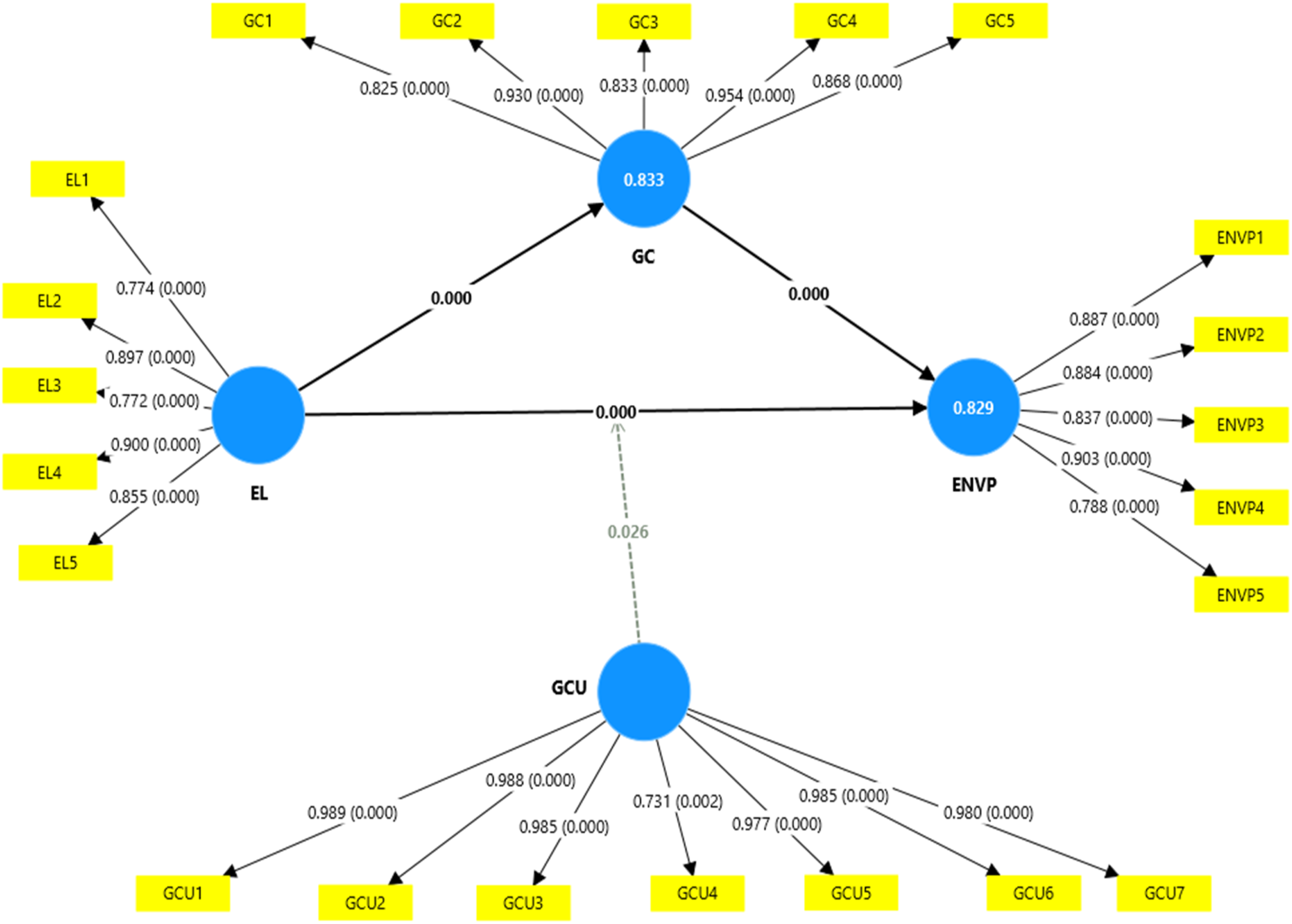
Regarding indirect effects, the mediation analysis demonstrated that GC plays a significant role in linking EL to ENVP. The indirect effect of EL on ENVP through GC was statistically significant (β = 0.411, T = 3.642, P < 0.001), indicating that a green climate serves as a crucial pathway through which ethical leadership influences environmental performance. This suggests that ethical leadership does not merely influence sustainability outcomes directly but does so largely by cultivating a workplace atmosphere that prioritizes environmental responsibility. Additionally, the interaction effect of GCU and EL on ENVP was significant (β = 0.091, T = 2.230, P = 0.026), indicating that green culture moderates the relationship between ethical leadership and environmental performance. This result suggests that the impact of ethical leadership on environmental performance is strengthened in organizations with a well-established green culture, emphasizing the importance of aligning leadership values with organizational environmental norms. These findings highlight the complex interplay between leadership, workplace environment, and sustainability efforts, suggesting that both green climate and green culture are instrumental in enhancing the effectiveness of ethical leadership in driving environmental performance.
Regarding indirect effects, mediation analysis reveals a major role of GC in mediating the effect of EL on ENVP. EL significant influenced ENVP indirectly through the partial mediation of GC (β = 0.411, T = 3.642, P < 0.001), implying that a green climate slightly role in mediating mechanism that leads the ethical leadership to environmental performance. This implies that ethical leadership does not primarily (or at all) affect sustainability outcomes through direct inputs but rather through promoting the creation of a work environment focused on environmental responsibility. Moreover, the interaction effect of EL and GCU on ENVP (β = 0.091, T = 2.230, P = 0.026) shows that ethical leadership is moderated by green culture and that green culture reinforces the relationship between it and environmental performance as indicated in Figure 2. This finding implies that ethical leadership is more likely to affect organizations’ environmental performance when there is a well-rooted green culture in the organization, and that leadership values should be coherent with the environmental norms of the organization. Thus, these findings indicate that both green climate and green culture are important factors to boost the role of ethical leadership in spurring environmental performance. The moderation effect.
Discussion
The research investigates the impact of ethical leadership on environmental performance within Egypt’s hospitality sector, emphasizing the green climate’s mediating effect and green culture’s moderating effect. Rooted in the Resource-Based View (RBV) theory, the results emphasize the strategic value of intangible assets, such as ethical leadership and organizational culture, in realizing sustainability agendas.
The results confirm that ethical leadership significantly develops environmental performance in hotels in Egypt. This study aligns with Hameed et al. 1 and Nwanzu et al. 31 Ethical leaders establish clear expectations for being environmentally responsible and demonstrate pro-environmental behavior themselves. This is consistent with RBV theory, which argues that distinctive, valuable, and non-imitable assets such as EL are likely to generate competitive advantage. In Egypt’s hospitality sector, where environmental concerns are particularly leading, ethical leadership arises as a critical internal asset fostering green behaviors. 58
The results provide strong evidence for hypothesis H2, that is, ethical leadership significantly affects a green climate within Egyptian hotels. These findings are consistent with previous studies of Iqbal et al. 34 and Khan et al. 33 Ethical leaders, through their unwavering moral conduct and open communication, set organizational norms that place environmental sustainability in perspective. Leaders’ demonstration of personal dedication to sustainability leads employees to internalize these values, building a collective green ethos in the organization. 12 This shared belief system not only directs employees’ actions toward environmental objectives but also generates an organizational culture that encourages green thinking and environmentally friendly decision-making throughout all organizational levels.
To verify Hypothesis 3, the research asserts that a green climate is a key catalyst for better environmental performance. As employees become cognizant that their hotel is endorsing environmental initiatives, they are more likely to exhibit pro-environmental acts like resource conservation, recycling, or endorsing sustainable hotel practices. This finding aligns with previous studies of Iqbal et al., 34 Akhtar et al., 40 and Dumont et al., 35 indicating that climate perceptions are pointers of behavior that direct personal conduct according to organizational objectives. Under the RBV, a green climate manifests in the shape of an embedded capability that enhances operational effectiveness as well as environmental performance. 14 Therefore, developing a green climate can act as a key mechanism through which ethical leadership translates organizational values into quantifiable sustainability performance.
The results provide evidence for H4 and indicate that green climate is positively mediating between ethical leadership and environmental performance. This implies that ethical leadership not only directly affects environmental performance but also indirectly through the reinforcement of a green climate—that is, the common understanding of employees regarding the environmental values and priorities of the organization. Ethical leaders encourage environmental awareness, exemplify green habits, and establish norms leading employees to adopt environmentally sound practices. 59 These leadership actions develop an internal culture whereby sustainability is embedded in the culture of an organization and, therefore, motivates employees to engage in environmentally friendly behavior. 60 When considering using the RBV, a green climate is viewed as a critical internal resource that transforms the values of leaders into shared environmental behaviors, ultimately influencing organizational performance. In the context of Egyptian hotels, where institutional demands for sustainability are mounting, building a green climate through ethical leadership is a strategic route to environmental success.
Green culture, as an organizational collective commitment towards environmental values and practices, acts as the moderator between ethical leadership and environmental performance. The study finds that the positive effect of ethical leadership on environmental performance is more pronounced in organizations that possess a strong green culture. This means that if environmental values are well-rooted in organizational culture, then ethical leadership is likely to be more effectively conveyed into successful and sustainable environmental outcomes. Yet, in organizations with an absence of an effective green culture, the influence of ethical leadership on environmental performance might be diminished. This interaction suggests that the connection between leadership behaviors and the overall cultural context of the organization needs to be established to successfully address environmental goals.
These results inform theory and practice by emphasizing that leadership-driven sustainability initiatives are most effective when they are rooted in a supportive organizational context. Therefore, hotel managers who aim to improve environmental performance need to cultivate not only ethical leadership but also a green-oriented culture and climate.
Theoretical implications
The findings of this study offer a substantial theoretical contribution to the Resource-Based View (RBV) by revealing how intangible and socially embedded resources—specifically ethical leadership, green climate, and green culture—work in concert to improve environmental performance within the hospitality sector. The RBV, as developed by Barney 22 and Grant (1991), posits that sustained competitive advantage arises from internal firm resources that are valuable, rare, inimitable, and either non-substitutable or well-organized to capture value. While the more contemporary VRIO framework emphasizes organizational support as a critical element in resource activation, this study deliberately draws on the earlier VRIN framework, which highlights non-substitutability. This choice reflects the nature of the constructs examined—particularly ethical leadership and green culture—as context-specific, deeply internalized, and not easily replaced by formal systems or alternative mechanisms.
Ethical leadership, in this context, functions as a strategic intangible resource that meets all the criteria of the RBV. It is valuable for its direct contribution to sustainability outcomes, rare in its genuine alignment with moral and environmental priorities, inimitable due to its complex foundation in personal values and organizational trust, and non-substitutable in settings where environmental commitment cannot be enforced through procedural or technological substitutes. By positioning ethical leadership as a core resource rather than a peripheral behavioral trait, this study deepens the theoretical reach of RBV into the human and ethical dimensions of strategy. It suggests that leadership ethics, when institutionalized through behavior and reinforced by organizational norms, forms a distinctive capability with long-term performance implications.
In addition to ethical leadership, the study illustrates that green climate serves as an internal mechanism that transmits the influence of leadership across the organizational system. Green climate—defined as shared perceptions of environmental policies, values, and practices—emerges as a routinized and socially accepted expression of sustainability. Its significance lies in its mediating role, through which ethical leadership is translated into environmental performance. This process-oriented insight contributes to RBV by shifting the lens from static resource possession to dynamic resource activation. It reinforces the idea that strategic advantage depends not only on what the firm has, but also on how resources interact and are embedded into daily operations.
The study further finds that green culture plays a moderating role in shaping how leadership translates into outcomes. As a deeply held and path-dependent system of environmental values, green culture amplifies the strength of the relationship between leadership and performance. This highlights the importance of cultural alignment as a contextual enabler of intangible resource effectiveness. Green culture, unlike formal policies or visible routines, is resistant to imitation due to its historical layering, internal cohesion, and emotional resonance among employees. As such, it embodies the RBV logic by acting as a high-order capability that configures and supports the functionality of other strategic resources.
Collectively, these findings extend the RBV by empirically validating the role of ethical and cultural constructs as central drivers of performance, especially in sustainability-focused contexts. The study not only supports the traditional RBV claim that intangible assets can yield competitive advantage, but also expands the theory by demonstrating how ethical orientation, value systems, and environmental norms can operate as strategic resources in service-based, non-Western environments. This contributes to a more nuanced and inclusive understanding of the RBV, especially as firms navigate complex ecological and social expectations in the contemporary business landscape. The deliberate application of the VRIN lens further underscores the enduring theoretical relevance of non-substitutability—particularly for organizations where environmental leadership and culture are not yet supported by formal institutional structures, but nonetheless constitute irreplaceable foundations for long-term strategic advantage.
Practical implications
The findings of this study offer several innovative and practical implications for managers, policymakers, and stakeholders in the hospitality industry. These implications can help hotels not only enhance their environmental performance but also build a competitive edge through sustainability-oriented leadership and culture.
Primarily, the positive influence of ethical leadership on environmental performance underscores the need for hotel organizations to deliberately recruit, train, and promote leaders who demonstrate high ethical standards and a commitment to sustainability. Hotels can develop leadership development programs that integrate environmental ethics, transparency, and accountability into core competencies. By aligning leadership practices with green values, hotels can foster a culture of environmental responsibility that cascades throughout the organization. Additionally, the finding that ethical leadership fosters a green climate suggests that leaders play a pivotal role in shaping the environmental mindset of their teams. Hotel managers should implement internal communication strategies that consistently promote eco-friendly behaviors and reinforce the organization’s sustainability goals. Regular town hall meetings, visual dashboards displaying environmental KPIs, and leader-led sustainability campaigns can help institutionalize green thinking and behavior among employees at all levels.
Given that green climate directly contributes to environmental performance, hotel management should invest in systems and structures that support pro-environmental behavior. This includes adopting green technologies, setting departmental-level environmental targets, and rewarding environmentally responsible practices through incentives or recognition programs. Practical tools like digital platforms for monitoring energy and water usage can empower employees to take ownership of their ecological footprint, translating green climate into measurable outcomes. Moreover, the study’s demonstration that green climate mediates the relationship between ethical leadership and environmental performance offers a strategic insight: leadership alone is insufficient without an enabling internal environment. Therefore, hotels should ensure that their organizational infrastructure—such as HR policies, workflow processes, and decision-making protocols—aligns with green principles. Embedding environmental criteria into performance appraisals, job descriptions, and training modules can solidify the link between leadership and performance through a cohesive green climate.
The moderating effect of green culture further emphasizes the importance of deeply ingrained environmental values in amplifying the positive effects of ethical leadership. Hotels should focus on cultivating an authentic green culture by involving employees in sustainability planning, celebrating environmental achievements, and telling stories that highlight the organization’s green legacy. Partnerships with local communities, NGOs, and green tourism initiatives can also reinforce green values and enhance the hotel’s reputation as an environmentally responsible brand.
Limitations and future research
Despite offering valuable insights into the relationship between ethical leadership and environmental performance within the Egyptian hotel sector, this study is subject to several limitations that warrant consideration. First, the research adopts a cross-sectional design, which limits the ability to draw causal inferences about the relationships among ethical leadership, green climate, green culture, and environmental performance. Future research should therefore consider employing longitudinal designs to better assess how these variables interact over time and to establish the directionality and stability of the observed relationships.
Second, this study was conducted within a specific context—hotel resorts in Eastern Egypt—which may limit the generalizability of its findings. The socio-cultural, economic, and environmental characteristics of this region may differ from other geographical areas or hospitality settings (e.g., urban hotels, budget accommodations, or international chains). While the results provide practical insights for resort management, further research is needed to assess their applicability in different contexts. Therefore, generalization should be made with caution. Future studies should consider replicating this research in varied hospitality sectors and locations to validate and expand the current findings.
Third, the moderating role of green culture was explored at the organizational level, but the study did not account for the potential impact of national culture or broader societal values that may shape organizational practices. To gain a more holistic understanding, future studies should investigate how national cultural dimensions (e.g., collectivism, uncertainty avoidance) interact with organizational green culture in influencing environmental performance outcomes.
Fourth, the study focuses primarily on ethical leadership as the antecedent of green climate and performance but does not consider other leadership styles or organizational factors that may also play a critical role. For instance, transformational, servant, or participative leadership could also influence environmental outcomes. Future research should adopt a comparative approach to examine how different leadership paradigms affect green climate and sustainability outcomes in the hospitality industry.
Fifth, while the study highlights the mediating role of green climate, it does not account for potential alternative or parallel mediators, such as green human resource management practices, employee environmental commitment, or organizational learning. Future research could incorporate multiple mediators in a more complex model to better understand the mechanisms through which ethical leadership influences environmental performance.
Footnotes
Acknowledgments
The authors would like to extend their appreciation to the management and staff of the participating Egyptian hotels for their cooperation and support during data collection. We are also grateful to the Egyptian Ministry of Tourism and Antiquities for facilitating access to relevant organizational information. Special thanks to the research assistants and academic mentors whose guidance contributed to the completion of this work.

Ethical considerations
This research complies with all relevant guidelines and regulations for studies involving human subjects.
Author contributions
Sikandar Ali Qalati: Conceptualization, study design, and data collection. Ahmed Mohamed Hasanein: Data analysis, interpretation of results, and visualization. Hanan Eid Badwy: Literature review, theoretical framework development, and drafting the manuscript. Bassam Samir Al-Romeedy: Supervision, critical revisions, and final editing of the manuscript. All authors contributed to the research and approved the final version of the paper.
Funding
The authors received no financial support for the research, authorship, and/or publication of this article.
Declaration of conflicting interests
The authors declared no potential conflicts of interest with respect to the research, authorship, and/or publication of this article.