



Abstract
Research on the link between turnout and corruption has produced inconclusive evidence: while some studies find corruption to be positively related to turnout, others report a negative relationship. This article argues that the relevant question is not whether corruption has a positive or negative effect on turnout, but for whom. We hypothesize that the effect of corruption on the likelihood to vote depends on individuals’ employment sector. Public employees have different incentives to vote in corrupt settings since their jobs often depend on the political success of the government of the day. Hence, while corruption dampens turnout among ordinary citizens, public employees are more likely to vote in highly corrupt countries. Analysis of World Values Survey data from 44 countries, shows that the differential in voting propensity between public employees and other citizens gets larger as corruption increases, partially confirming our expectations.
Introduction
There is a vast amount of literature analysing the determinants of voter turnout. Differences in both individual-level resources and motivations are the main factors explaining why people do or don’t vote (Verba et al., 1978), together with socio-economic, political and institutional features at the aggregate-level (Geys, 2006). Yet, citizens do also make the decision on whether to vote or abstain based on their perceptions on how trustworthy and transparent the whole political system is (Birch, 2010). Political corruption influences political legitimacy, political efficacy and confidence in the electoral process, and as such can play a determinant role in shaping individuals’ voting behaviour.
Surprisingly, research examining the impact of corruption on voter turnout is rather scarce; moreover, previous studies yielded contradictory results. According to most of the existing research, corruption has a negative effect on turnout, since it causes alienation and apathy among voters (McCann and Domínguez, 1998; Stockemer et al., 2013; Sundström and Stockemer, 2015). Yet, this finding is not conclusive. First, some studies have found that, instead of having a demobilizing effect, corruption does increase turnout (Escaleras et al., 2012; Kostadinova, 2009). Second, the negative effect of corruption on turnout vanishes in highly corrupt countries (Dahlberg and Solevid, 2016).
This article argues that if the effect of corruption on turnout is not uniform everywhere, it is because not everyone is affected in the same way. We hypothesize that the effect of corruption on voter turnout depends on individuals’ sector of employment. Corruption is more likely to have a positive effect on turnout among public employees than among ordinary citizens. In highly corrupt societies, the practice of delivering or maintaining public-sector jobs in exchange for political support tends to be widespread (Kurer, 1993). Thus, the incentives to vote among public employees would be higher in corrupt societies since their fortunes are tied to the political fate of the incumbent government or the politician who has appointed them. By contrast, corruption is more likely to have a negative effect on turnout among citizens who do not work in the public sector and are, therefore, less dependent on the state and the political success of the government of the day for their livelihoods. By proposing patronage as a possible contributing mechanism to account for the mixed results obtained by previous research, this article seeks to bridge between two strands of literature: the one that investigates the link between corruption and turnout, and the one that focuses on the different voting behaviour of public-sector workers.
We test our expectations using data from the World Values Survey (WVS) to analyse the impact of the level of corruption found in a country on individual voting propensity, comparing citizens working in the public sector with the rest of the population. We run logistic multilevel models on a sample of 56,376 individuals from 44 countries, finding empirical evidence that is partially consistent with our expectations. Our results show that the turnout differential between the two categories indeed grows as the perceived level of public-sector corruption increases. However, while corruption has a demobilizing effect among those who are not public employees, public employees do not vote more in highly corrupt countries. They remain equally likely to vote regardless of corruption levels.
The rest of this article is structured as follows. In the second section, we define both corruption and patronage, discussing their relationship. Subsequently, in the third and fourth sections we summarize previous research analysing the effect of corruption on voter turnout, and the electoral behaviour of public employees, respectively. In the fifth section we present the argument of this article. Data and methods are introduced in the sixth section; and in the seventh we present the results. The last section concludes with a discussion and suggestions for future research.
Corruption and its by-product: Patronage
We shall start by defining corruption and its relationship with one of the many practices that are common within corrupt societies: patronage in the allocation of public-sector jobs.
The most common definition of corruption in the literature relates to ‘acts in which the power of public office is used for personal gain in a manner that contravenes the rules of the game’ (Jain, 2001: 73). Similarly, Gerring and Thacker describe corruption as ‘an act by a public official (or with the acquiescence of a public official) that violates legal or social norms for private or particularistic gain’ (2004: 300). For Heidenheimer and Johnston, corruption is the ‘transaction of bureaucratic resources for political purposes and political support’ (Heidenheimer and Johnston, 2011: 246). These definitions of corruption – and many others found in the scholarly literature – bring into focus ‘the public sphere in which political actors operate’ (Heywood, 1997). In this article, we also focus on corruption within the public sphere.
By (political) patronage we refer to practices in which a party or candidate distributes public-sector jobs in exchange for electoral support (Weingrod, 1968). Among the main functions of patronage, Sorauf (1960: 29) mentions ‘attracting voters and supporters’. He explains how patronage appointments are often used ‘to convert the recipient (and a large portion of his family and friends) into life-long and devoted supporters of the appointing party’. Moreover, he states that ‘gratitude for the job will win his support for the party […] and a desire to retain the job by keeping the party in power will enforce it’ (Sorauf, 1960: 29).
Corruption and patronage are two different phenomena. Yet, patronage finds fertile ground in corrupt systems (Kitschelt, 2000; Kurer, 1993). Corruption violates public trust and jeopardizes the quality of democratic institutions. It is often described as having a destructive impact on the principles of democratic legitimacy and accountability (Johnston, 2005). Government regulations are more ambiguous and vague in corrupt settings, which gives public officials more discretionary power in their decisions (Lambsdorff, 2006). Countries that have safeguards against corruption (free media, independent judiciary, etc.) have higher levels of meritocracy in the recruitment of public employees. No safeguards against corrupt practice means more patronage and nepotism (Sundell, 2012).
Corruption indices are occasionally used as proxy measures of patronage (Kenny, 2015; Schuster, 2016). Not only higher levels of corruption encourage patronage appointments, but when patronage appointments are in place, the risk of corruption increases. Several studies have found that recruitment for public-sector jobs based on meritocracy decreases corruption (see, for instance, Oliveros and Schuster, 2017): public-sector employees recruited through examinations are less inclined to engage in corrupt practices.
Corruption and voter turnout: A puzzling relationship
Previous research has suggested that corruption has a limited effect on individuals’ voting behaviour. Voters do not always punish corrupt incumbent parties or candidates, which in most cases manage to be re-elected despite their misbehaviour (Manzetti and Wilson, 2007). Nevertheless, prior studies may underestimate the impact of corruption on voting behaviour by looking at vote choices of individuals casting a ballot (for whom they vote) and neglecting electoral participation (whether citizens vote or not).
Indeed, research investigating the effect of corruption on voter turnout is rather scarce. In addition, it has produced contradictory results. Most studies report a negative effect of corruption on electoral participation, showing that high levels of corruption decrease turnout rates (Davis et al., 2004; McCann and Domínguez, 1998; Stockemer et al., 2013). In corrupt settings, citizens become disenchanted, sceptical and exhibit stronger voter apathy and distrust towards the political system.
Yet, this finding is not conclusive. Some scholars have found that corruption can lead to higher turnout (Escaleras et al., 2012; Kostadinova, 2009). Two mechanisms are put forward by scholars to explain this positive effect of corruption on turnout. The first explanation is that citizens react to growing corruption and hold corrupt politicians accountable for their misconduct, which mobilizes them to cast ballots at higher rates. They want clean governments and vote in large numbers against corrupt leaders (Kostadinova, 2009). The second explanation that is brought up in the literature in order to explain the positive effect of corruption on turnout refers to clientelism, patronage appointments and ‘pork barrel politics’ (Stokes et al., 2013). This would imply practices where votes are traded for public goods, favours, cash or other benefits, and voters, as well as politicians, would benefit from their reciprocal clientelist transactions.
On the other hand, further recent research has suggested that the previous mixed results can be attributed to the fact that the effect of corruption on voter turnout is contingent on the level of corruption that prevails in a country (Dahlberg and Solevid, 2016). Thus, Dahlberg and Solevid found that the negative effect of corruption on turnout is manifested only in countries with low to medium levels of corruption. Voters’ perception of corruption does not seem to affect turnout in highly corrupt countries, where the likelihood to vote is generally lower and potentially driven by different self-interested incentives, not least clientelist exchange (Kitschelt, 2000).
The inconsistent findings of previous research reveal the complexity of the issue, providing additional reasons to inspect the relationship between corruption and turnout more closely. This article aims to shed some light on this puzzle. We argue that the relevant question is not only whether corruption has a positive or a negative effect on turnout, but for whom. In particular, we hypothesize that individuals would react differently to corruption depending on whether they work in the public sector or not.
On the political behaviour of public employees
Voting behaviour of public employees has received considerable attention in the literature, particularly among public-choice scholars, who have used the concept of ‘public/private-sector cleavage’ to describe the different political attitudes of public employees (Blais et al., 1990). Public-sector employees have more left-leaning ideological orientations (Jensen et al., 2009) and are more likely to support political parties in favour of increasing government spending (Garand et al., 1991). They also tend to be ‘more active in civic affairs’ than the rest of the population (Brewer, 2003) and, what is more relevant for the purposes of this study, they show higher levels of electoral participation (Bennett and Orzechowski, 1983; Corey and Garand, 2002; Garand et al., 1991).
Previous literature suggests two alternative explanations to account for the differences in turnout among public and non-public employees (Garand et al., 1991). On the one hand, individuals with certain idiosyncratic features and political orientations would gravitate to public-sector jobs. Public employees are found to have higher levels of education, income, interest in politics, political knowledge and social capital (Corey and Garand, 2002). In other words, they meet the characteristics that are classically associated with electoral participation (Wolfinger and Rosenstone, 1980). On the other hand, public employees would develop greater propensity to cast votes once in public employment, for at least two reasons. First, their working environment contributes to lower the costs of voting (i.e., making it easier to gather political information or facilitating the task of voting by granting public employees paid time off to vote on the election day). Second, the expected benefits of voting are higher for public employees: self-interest would drive the voting behaviour of public employees since they ‘can reasonably expect that their votes may contribute to an increased level of personal and bureau benefits’ (Corey and Garand, 2002: 262).
Better educational attainment, greater interest in politics or higher levels of civic engagement do not totally account for the turnout differential among public- and non-public-sector employees. Public-sector employees turn out to vote more, even after controlling for their socio-demographic and attitudinal characteristics (Corey and Garand, 2002). Moreover, the policy preferences of public employees change after retirement, converging with the preferences of non-public-sector workers (Rattsø and Sørensen, 2016). This finding clearly challenges the assumption that the higher turnout rate among public employees is only due to a ‘selection bias’ in their recruitment, whereby individuals having distinct political preferences and being more likely to vote are attracted to public-sector jobs. Thus, we contend that public employees are not necessarily different from other citizens a priori or per se, but that their different political behaviour should be also understood as the response to distinct incentives once they enter public employment.
Our argument
Besides being mainly centred on the USA, previous literature on the voting behaviour of public-sector employees does not consider one key factor for this sector of the population that can eventually modify the costs and benefits of voting: the level of corruption. The low quality of democratic institutions in corrupt settings allows for patronage recruitment, which is likely to influence the voting decision of public-sector employees. Yet, to our knowledge, no research has been done on the impact of corruption on turnout of public employees.
In corrupt countries, the allocation of public-sector jobs is often based on patronage instead of meritocracy: public positions are distributed by the incumbent party or candidate (the patron) in exchange for political support. Public employees (the clients) have incentives to maintain in office the patron that has appointed them. Since their jobs are tied to the political success of the patron, they are expected to vote for the incumbent party or government. Implicitly, this also entails that they will be more likely to turn out to vote.
Of course, public employees could punish the corrupt patron by voting for the opposition. Indeed, since in most cases the ballot is secret, party officials cannot monitor for whom people vote, but only whether they show up at the polls (Chandra, 2004; Stokes, 2005). This has led scholars analysing clientelism and patronage to coin concepts such as ‘turnout buying’ to refer to a strategy by which parties, interested in mobilizing their potential constituencies, reward supporters for going to the polls (Nichter, 2008). Thus, Nichter (2008: 31) affirms that ‘much of what is interpreted as vote buying (exchanging rewards for vote choices) may actually be turnout buying (exchanging rewards for turnout)’. Yet, if patronage recruitment is in place, to vote for an option other than the patron would be against the self interest of public employees. As noted by Oliveros, ‘public-sector jobs (and, importantly, working conditions) enjoyed by supporters will be maintained by the incumbent but not by the opposition’ (Oliveros, 2017: 3). In any case, this article is concerned with the effect of corruption on turnout. It does not test whether public-sector employees in corrupt countries turn out to vote for the incumbent (as we assume) or for the opposition.
Summing up our expectations, public-sector employees, regardless of the level of corruption in a country, tend to vote more than the rest of the population, as we already know from previous research. What we argue is that this differential in voting propensity would be higher in more corrupt countries, where there is a bigger difference in the degree of dependence upon election results between the two groups. Drawing on the Indian case, Chandra already predicted that in ‘patronage democracies’ a high degree of dependence upon the state is associated with higher electoral participation: There should be a positive relationship between the degree of dependence of voters upon the state and turnout rates. Within patronage democracies, therefore, we should expect individuals dependent upon the state for their livelihood to turn out in higher rates than individuals who, […], are less dependent (Chandra, 2004: 54).
We expect corruption to have a positive effect on turnout among public employees, since they largely depend on the political fate of the government for their livelihood. Public-sector employees are expected to vote for the incumbent party or candidate, the patron that has appointed them. Implicitly, this also entails that they will be more likely to turn out to vote. By contrast, corruption is expected to have a negative effect on turnout among citizens who do not work in the public sector and are, therefore, less dependent on the state and the political success of the party in office. Thus, as corruption increases, we expect the difference in turnout between public-sector employees and the rest of the population to grow.
Data and methods
This article uses individual-level data from the last wave of the WVS, which was conducted between 2010 and 2014 in 59 countries (WVS, wave 6). The WVS is the largest cross-national dataset including questions on both individual voting behaviour and employment status, the latter allowing us to identify public-sector employees. Various country-level variables, such as the ones accounting for corruption and relevant control variables, have been merged in the dataset. Missing data on any of these variables have led to the exclusion of 15 countries from the analysis. Our sample consists of 56,376 individuals from 44 countries. 1
The WVS does not ask if the respondent voted in the last election. However, it includes the following question: ‘When elections take place (national level), do you vote always, usually or never?’ and we use this question to estimate individual-level turnout. 2 The dependent variable equals 1 when the individual indicates that he/she ‘always’ votes, and 0 when the individual indicates that he/she votes ‘never’ or ‘usually’. We opt for this operationalization because it fits best our theoretical expectations. If the mechanism driving public employees to vote is their stronger attachment to parties and politicians, it follows that they would always go to the polls, without missing a single chance to cast a ballot for their potential patrons in corrupt systems. People who declared they ‘usually’ vote do not show the same attachment and would probably turn out to vote depending on contingent factors rather than stable clientelist exchanges. The alternative specification of the dependent variable (‘usually’ coded as 1, together with ‘always’) is however used as a robustness check.
We account for the degree of corruption with a country-level variable. Corruption cannot be directly measured or quantified in an objective way. All the extant indicators used to compare the level of corruption across countries are in fact accounting for perceptions of corruption (Olken, 2009). The existing perception-based indicators of corruption proceed from either expert assessment or public-opinion surveys. Both types of measure have their respective values and limitations. Indicators that rely on the assessment of country experts such as Transparency International’s Corruption Perceptions Index (CPI) or the World Bank’s Worldwide Governance Indicators (WGI) are useful to provide a single number synthesizing the complex and multifaceted phenomena of corruption, but they may pose a problem by introducing an ‘elite bias’. While they reflect the views of analysts or business people (usually high-status informants), these indicators overlook the experience of a more broadly representative group of citizens. We opt to use the Global Corruption Barometer, conducted by Transparency International and defined by this institution as ‘the only world-wide public opinion survey on corruption’. Besides reflecting the views of a larger number of people, this survey offers an additional advantage for our analysis. Instead of providing a general composite index, it allows us to select a narrower, more specific question to measure the perception of corruption in the public sector. Among all the questions included in the Global Corruption Barometer, there are two that explicitly refer to perceptions of corruption in the public sector: ‘To what extent do you think that corruption is a problem in the public sector in this country?’ and ‘To what extent do you see the following categories in this country affected by corruption? Public officials/Civil servants’. Responses are given on a scale from 1 to 5 (from less to more corruption). We use the average country score on the first question as our main indicator of corruption, and the average country score on the second question as a robustness check.
The main explanatory variable at the individual level is a dummy which differentiates between public employees (i.e. people working in government or public institutions) and the rest of the population included in the sample (i.e. those working in private business, industry, non-profit organizations, or in the autonomous or informal sector, and those out of work). This variable is dichotomous, having a value 1 for individuals working for the government or a public institution, and 0 for the rest of the respondents.
The literature identifies certain variables that may influence turnout (Blais, 2006), and we include them in our statistical models as control variables. At the individual level, we control for seven socio-demographic characteristics: gender, education, income, age, employment, marital status and size of the municipality. Education compares people who have attained primary, secondary or tertiary education to those with no education (reference category). Income is based on income deciles originally included in the WVS: it has been recoded so that individuals with middle-low-, middle-high- and high-income positions are compared with those with low income. As age is expected to show a non-linear relationship with turnout, age squared is added to the model. Since the higher turnout levels among public employees could be due to the fact that the rest of the population includes people that are out of work such as the unemployed and inactive, we include in our models a dummy variable that takes the value 1 for employed people. Since married people are more likely to vote than those unmarried, we also control for marital status with a dummy variable that is equal to 1 if the respondent is married. Size of the municipality indicates whether the respondent lives in a town with more than 500,000 inhabitants. We also account for a number of attitudinal variables such as ideology (left- and right-leaning persons relative to centrist), party membership (dummy), interest in politics (on a 5-point scale from less to more interest) and political mobilization (an additive index ranging 0–4, based on the number of political actions that the respondent has done: signing a petition, joining in boycotts, attending peaceful demonstrations and/or joining strikes).
Since there is wide heterogeneity between the countries considered in this study, we include the following country-level variables in our models: economic development, degree of political rights, type of electoral system and compulsory vote. We control for economic development with GDP per capita converted to international dollars using purchasing power parity rates (World Bank). The degree of political rights in the country is measured on a scale from 1 to 7, with 1 representing the greatest degree of freedom and 7 the smallest one (Freedom House). The type of electoral system is a dichotomous variable having a value 1 for proportional systems. Finally, compulsory voting is also included in the model as a dichotomous variable. We excluded missing values and ‘don’t know’ answers on any of the utilized variables, that is, 32,474 cases over a total of 88,850 cases included in WVS wave 6.
We use multilevel logistic regressions with random intercepts. 3 This allows us to take into account the hierarchical structure of the data, whereas individual observations (N=56,376) are nested in 44 countries. Standard logistic models would in fact violate the assumption of independent errors, since individual observations from the same country may be dependent on each other. In order to capture country-specific variation, intercepts are left free to vary randomly across groups. The main focus is put on the cross-level interaction between the sector of employment (individual level) and the level of corruption in the public sector (country level), that is the analytical way through which we test our expectations.
Results
Our main interest lies in checking whether and how the effect of corruption depends on individuals’ employment sector. Corruption should act as a disincentive to vote for most citizens, while potentially being an incentive to turn out to vote for public employees, who remain attached to their patron regardless of how corrupt they are, or even benefiting from this.
As recalled above, turnout of public employees is in general higher. A breakdown of the dependent variable allows us to check whether this is observed also in the WVS data. Figure 1 shows the proportion of respondents that declared they vote ‘never’, ‘usually’ or ‘always’ (recall that the former two categories are coded together in our binary dependent variable), differentiating between public employees and the rest of the population. Our sample shows a higher average voting propensity for public employees: 66% of them declared they always go to the polls, against 59% of non-public employees (the difference between the proportions is highly statistically significant). By contrast, the proportion of those who never vote is lower for public employees (11%) than for the rest of the population (17%).
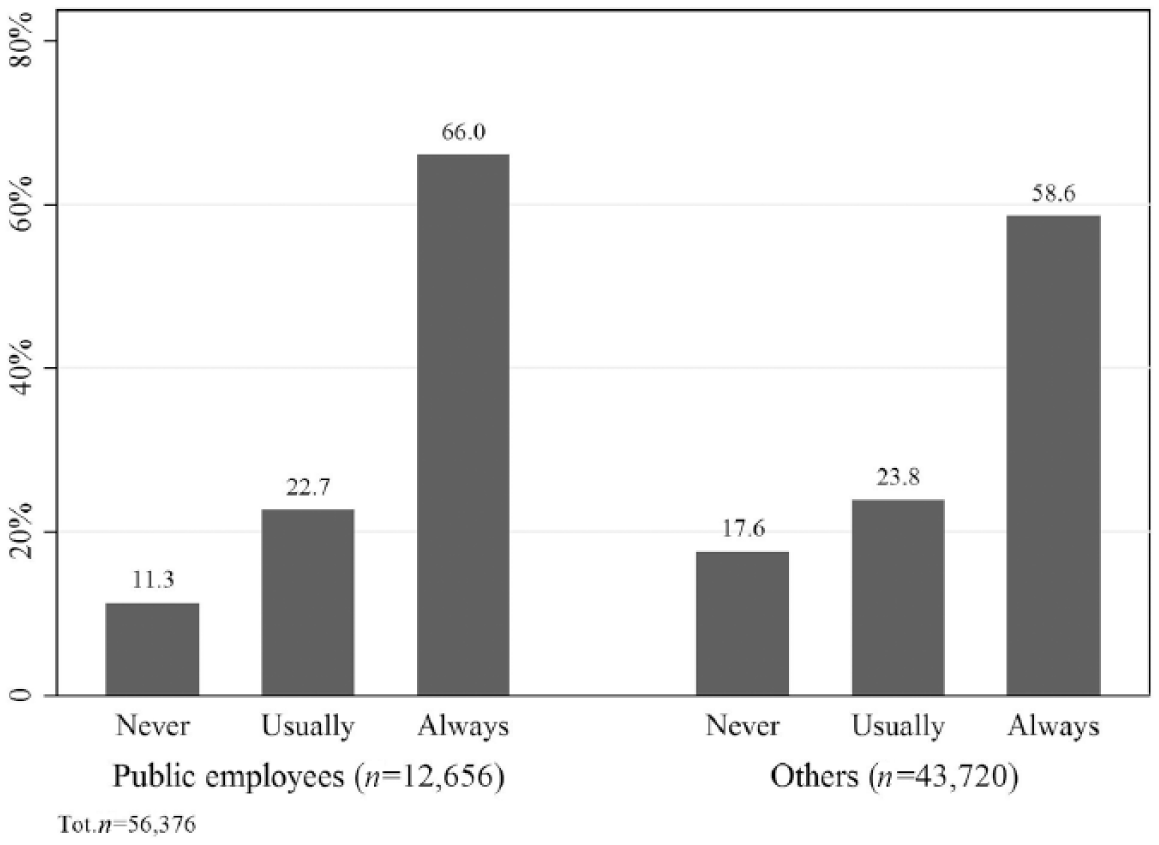
Percentages of respondents reporting to vote ‘never’, ‘usually’ or ‘always’, among public employees and the rest of the population.
If this simply confirms what was highlighted by previous research on voting behaviour of public employees, we now take a closer look at how the differential turnout of public employees and other citizens varies across countries with different levels of corruption. Appendix 1 (see Online Supplementary Material) shows the country sample composition (total observations and share of public employees in each country) and the descriptive statistics of the variables of interest: turnout (total, for public employees, and for other people) and the general perceived level of corruption in the public sector. Figure 2 plots the difference between turnout for public employees and for the rest of the population against the corruption index, for the 44 countries in our sample. Some modest bivariate evidence for a differential turnout response to corruption between the two population sub-groups does emerge. Although the dispersion is very large, the differential increases for higher corruption scores (to the right side of the graph). On average, public employees seem increasingly more likely to vote than other people as corruption increases. The correlation, represented by the dotted line in Figure 2, is in any case not significant. 4 However, it is spurious given many other potential interfering factors. The simple bivariate correlations may become significant when taking them into account. First, the compositional effect of country samples can be hiding our main correlation of interest: many other individual-level characteristics are also associated with voting behaviour. Second, the countries included in our sample differ consistently from each other. Country-specific political, institutional and economic characteristics must be also taken into account to get a less biased picture.
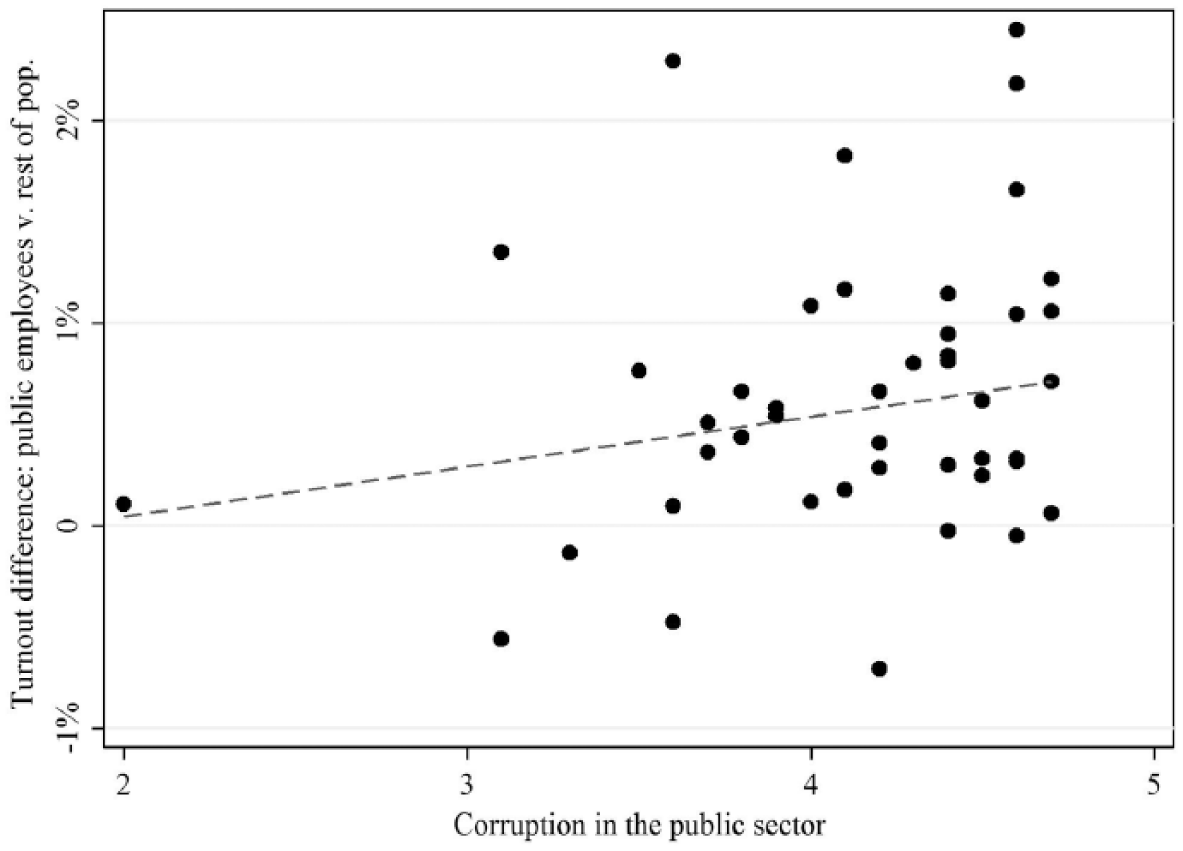
Corruption in the public sector and the differential between turnout for public employees and for the rest of the population in each country (percentage point difference).
Therefore, we proceed to multivariate analysis. Table 1 presents the estimates from 3 logistic multilevel random-intercept models. In Model 1, turnout is regressed on the individual-level independent variables. Odds ratios show the expected relationships. In line with previous research, net of controls, public employees are (15%) more likely to turn out than other people. The likelihood to usually go to the polls increases with age (although the correlation slightly reverses in later life), with the interest in politics and with the degree of mobilization. It is higher for those who see themselves as left- or right-wing relative to the centrists, for the employed than for non-employed, for married people than for the unmarried, for those with tertiary education relative to people with no education. It is instead lower for those who live in big towns compared to those who live in towns with less than 500,000 inhabitants, and, surprisingly, for party members. Party membership ceases however to be significant if one takes out the other factors that are obviously correlated with it – interest in politics and mobilization – and when taking into account that being affiliated to a party has a different meaning in different countries (i.e. adding a random slope to party membership: see Appendix 2 in the Online Supplementary Material). Gender and income do not seem to affect individual voting propensity when controlling for all other characteristics.
Logistic random-intercept multilevel models for turnout: Odds ratio.

p<0.01, **p<0.001. Standard errors in parentheses.
Model 2 adds the country-level independent variables. The main effect of the perceived corruption in the public sector on turnout is not significant. 5 Indeed, previous research found mixed evidence with regards to this effect: as do we, insofar as corruption does not seem to matter at all when just looking at its general effect among the whole population. The rest of country-level variables serve as controls: economic development (GDP per capita) and the proportionality of electoral system do not seem to matter, while compulsory voting and the lack of political freedom are respectively positively and negatively associated with the likelihood of voting.
In order to investigate the hypothesized interrelation between corruption and sector of employment, Model 3 adds a cross-level interaction between the country-level average perceived corruption of the public sector and the dummy for whether an individual works in the public sector. The interaction term is highly significant, thus pointing to effectively different turnout implications of being a public employee in more or less corrupt countries. 6
To better interpret the interaction in Model 3, Figure 3(a) shows the marginal effect of being a public employee for the different scores of country-level corruption observed in our sample. 7 The effect of being a public employee appears to be conditional on the level of corruption in a way that matches our expectations. The marginal effect is even negative (i.e. public employees less likely to vote than other people) in countries with a very low corruption score, of around 2 on the scale 1–5. In our sample, however, the only case was Rwanda, which we identified as a potential outlier. For comparatively low-to-medium levels of corruption, there is no significant gap in turnout likelihood between public-sector employees and other people (the confidence interval of the marginal effect crosses zero). Coherently with the hypothesized patronage mechanism, if the public sector is not generally perceived as corrupt, public employees and the rest of the population should have the same incentive to go to the polls (net of other individual characteristics). The marginal effect becomes significant and increasingly positive in countries whose corruption score is higher than 3.7, which is the case for 36 out of the 45 countries included in our sample (see Appendix 1, Online Supplementary Material). That is, the turnout gap significantly increases in favour of public employees in countries with medium-to-high corruption scores. On average and net of other factors, public employees become up to 5% more likely to go to the polls relative to the rest of the population (right end of Figure 3(a)).

(a) Marginal effect of ‘being a public employee’ and (b) predicted turnout probabilities for different levels of corruption observed in the sample. Expressed in probabilities and with 95% confidence intervals.
The increasing turnout differential revealed by the marginal effect could be due to two different patterns. The probabilities for public employees and other people to vote could respectively increase and decrease as corruption increases. This is, indeed, what we hypothesized (a positive effect of corruption on turnout among public employees and a negative effect among the rest of the population). Alternatively, corruption could affect negatively the turnout likelihood of both categories, although demobilizing common people more than public employees. In order to inspect this, Figure 3(b) plots the predicted probabilities of turnout for public employees and for the rest of the population, controlling for compositional and country-level factors (Model 3 in Table 1). Predicted probabilities reveal a cross-over interaction, which falls closer to the second of the patterns explained above. As we expected, corruption appears to significantly demobilize those who are not public employees (steeper dashed line in Figure 3(b)). Non-public employees start from a higher turnout probability (but, again, empirically this would be only the case for Rwanda), that then decreases and goes below the predicted line for public employees as perceived corruption increases. Yet, against our expectations, corruption does not have a positive effect on turnout among public employees. Public employees seem unaffected by corruption: their likelihood to vote stays by and large the same at different corruption scores (almost flat line for public employees). However, the result is weaker than it seems. The confidence intervals overlap all along the range of corruption scores observed in our sample. In fact, the probabilities of voting for the two population sub-groups do not significantly differ, in spite of the significant marginal effect observed for medium-high level of corruption in Figure 3(a). Thus, the pattern which emerges from the cross-over interaction has to be taken with extreme caution, since non-public employees do not actually show a significantly ‘higher’ or ‘lower’ probability to vote than public employees (at a 95% confidence level), at least not in our data.
Due to the heterogeneous composition of our country sample, we tested the consistency of our findings with a number of robustness checks (see Appendix 2, Online Supplementary Material). We reran the interaction model with the following specifications: by using the alternative measure of corruption presented in the section above (perceived corruption of public officials/civil servants); by taking Rwanda out of the analysis; by using a different operationalization of the dependent variable turnout, that considers those who declared they vote ‘usually’ as 1 instead of 0; by using country-specific relative measure of education; by splitting the sample into high- and low-corruption countries (above and below the median corruption score). Moreover, we replicated the results by letting the effects of ‘Public employee’, gender and party membership free to vary across countries, in different random slope models. The interaction coefficient remains significant in all model specifications, and the pattern shown above holds.
In summary, our expectations are only partially supported. We expected corruption to have a positive effect on the turnout of public employees, and a negative effect for the rest of the population. If at all, corruption seems to dampen the likelihood to vote for non-public employees only; public employees are not affected by increasing corruption levels. We found evidence for the existence of an interaction between the perception of public-sector corruption and individuals’ sector of employment: the interaction term is significant and passed all robustness checks, and the marginal effect of being a public employee becomes significant and increases with the corruption score. This potentially reflects a closer attachment to the public sphere that makes public employees immune from the discouraging effect of corruption on voting, plausibly due to patronage exchanges on which they can better rely in more corrupt societies. However, in our country sample, this does not match statistically significant differences in the predicted turnout probabilities between public employees and other people, for any of the observed corruption scores.
Discussion and conclusion
The empirical evidence on the relationship between corruption and turnout is mixed, and scholars are divided as to whether corruption has a mobilizing or demobilizing effect. This article points to the need for acknowledging that corruption leads to different responses among different population sub-groups. Following the literature on the development of patronage ties in corrupt societies, we differentiated between two groups of citizens that have a different set of (dis-)incentives to vote vis-à-vis corruption: we compared people working in the public sector with the rest of the population.
Politicization of the public sector is a more common phenomenon in corrupt societies, where effective governance is more difficult to achieve, and bureaucratic quality is lacking. Thus, the central argument in this study is that, especially in corrupt settings, public employees have greater incentives to maintain a stable political environment and stable political actors. By the act of voting they could pursue this aim, which can pay off in terms of future patronage benefits, such as, for example, securing their job stability. Hence, we expected them to be more likely to vote in countries with a corrupt public sector. By contrast, we expected corruption to have a demobilizing effect among the rest of the population, which does not have the same incentives as public employees, since patronage appointments are primarily linked to the public sector.
Our results only partially meet these expectations. We found that, controlling for a number of compositional and country-level factors, the marginal effect of being a public employee (as compared to the rest of the population) becomes significant and positive in countries where the perception of public-sector corruption is comparatively medium/high. That is, as we expected, there is evidence of an increasing turnout gap between public employees and other people as corruption increases. However, this is not due to a mobilizing and demobilizing effect of corruption among public employees and the rest of the population respectively. Our analyses hint at a different pattern. While the turnout likelihood of those who are not public employees is indeed negatively affected by corruption, public employees appear equally likely to vote in more or less corrupt countries. This pattern is to be taken with extreme caution. Although the significant interaction revealed an increasing turnout differential between public employees and other people depending on perceived levels of public-sector corruption, we did not find statistically significant differences in the probability of voting for the two population sub-groups, for any of the corruption scores observed in our sample. Moreover, we cannot exclude the possibility of a higher impact of social desirability among public employees, who might be more likely to overreport turnout. Further research is hence required to inspect such interaction in more depth, better uncovering whether and how public and non-public employees react differently to corruption.
Overall, although it does not empirically solve the puzzle of the mixed effect of corruption on voter turnout which emerged from previous literature, our article sets out a new route for future research. It shows that corruption has different meanings and provides different incentives for different sections of the electorate. Some parts of the population are likely to benefit from corrupt practices like patronage. As a consequence, they would not be affected by any demobilizing effect of corruption, which would, by contrast, affect other people. Therefore, we suggest that the question is not whether corruption has an impact on turnout in general, but rather for whom it does. When the electors are people who depend on the state and politicians in their daily life – the case for public employees – corruption may not matter at all (as our results show), or it may even act as an incentive to vote.
The proposed patronage mechanism is however just one out of more possible explanations. Public employees who turn out to vote in corrupt societies could in fact do so not only to consolidate the political power of their patron, but – by contrast – to express their discontent, voting against the corrupt government in office. Although in systems where patronage is widespread this could imply biting the hand that feeds them, we cannot exclude this circumstance based on the analysis and on the country-sample included in this study. Being closer to the public sphere, and hence potentially more aware of corruption dynamics in the public sector, public employees could actually express their disappointment by voting to punish (instead of favouring) the incumbent government they see as corrupt. This could be the case especially in consolidated democracies and most economically developed countries. In our sample, these countries tend to score relatively highly in terms of average perceived corruption: citizens would in fact tend to be stricter in their judgement of the level of corruption in contexts in which corruption is the exception rather than the rule. Although we use a relatively large set of 44 countries, the generalisability of our results could gain from further empirical research testing the same expectations among an even broader, and possibly, more heterogeneous set of countries with respect to corruption scores.
In order to confirm whether patronage (rather than voters’ disappointment) is indeed the mechanism behind higher voting propensity of public employees in corrupt societies, future research is encouraged to inspect the relationship between corruption and specific partisan preferences of the sub-population at stake. That is, to check whether public employees not only turn out to vote, but if they do so to vote for the incumbent, which is arguably a necessary condition for the patronage mechanism to hold. Previous findings, that did not distinguish between target populations, have shown a rather small effect of corruption on incumbent’s vote share. Therefore, it remains interesting to analyse how corruption shapes partisan preferences of different groups of citizens. If public employees are more likely to vote for the incumbent government, the argument presented in this study would be further strengthened.
More research is also required to inspect the differential impact of corruption on turnout over time, instead of cross-sectionally as done in this article. This could add confidence in speaking of a different set of incentives behind the voting behaviour of public employees in corrupt societies, beyond any suspicion of self-selection in their recruitment and reverse causality.
Supplemental Material
IPS795174_French_and_Spanish_abstracts – Supplemental material for Closer to the state, closer to the polls? The different impact of corruption on turnout among public employees and other citizens
Supplemental material, IPS795174_French_and_Spanish_abstracts for Closer to the state, closer to the polls? The different impact of corruption on turnout among public employees and other citizens by Sabina Haveric, Stefano Ronchi and Laura Cabeza in International Political Science Review
Supplemental Material
Supplementary_material_RR – Supplemental material for Closer to the state, closer to the polls? The different impact of corruption on turnout among public employees and other citizens
Supplemental material, Supplementary_material_RR for Closer to the state, closer to the polls? The different impact of corruption on turnout among public employees and other citizens by Sabina Haveric, Stefano Ronchi and Laura Cabeza in International Political Science Review
Footnotes
Acknowledgements
The authors greatly appreciate the valuable input received from Prof. Dr André Kaiser, the participants of the Cologne Center for Comparative Politics (CCCP) Seminar, three anonymous reviewers, and the editors of International Political Science Review.
Funding
The authors are grateful for the financial support provided by the Research Training Group SOCLIFE, funded by Deutsche Forschungsgemeinschaft (DFG), and especially thank its Academic Director, Hans-Jürgen Andress.

Notes
Author biographies
References
Supplementary Material
Please find the following supplemental material available below.
For Open Access articles published under a Creative Commons License, all supplemental material carries the same license as the article it is associated with.
For non-Open Access articles published, all supplemental material carries a non-exclusive license, and permission requests for re-use of supplemental material or any part of supplemental material shall be sent directly to the copyright owner as specified in the copyright notice associated with the article.
