



Abstract
Using family systems theory and an actor–partner interdependence model, we examine the influence of the division of family work (including fathers’ participation in child rearing) on father–child relationship quality, satisfaction with the family work division, and marital quality. The strongest effect on both spouses’ marital quality is wives’ perception of father–child relationship quality. Following this, wives’ perceptions of father participation in child rearing are positively associated with both spouses’ reports of marital quality. Furthermore, both husbands and wives report higher marital quality when they are more satisfied with the division of labor. When wives report their husbands have greater responsibility for family tasks, both spouses report higher satisfaction with the division of labor. Post hoc analyses revealed that wives are more satisfied with the division of labor when they work with their spouse rather than alone. All findings support a systemic relational orientation to family work, the division of roles, and relationship quality.
Keywords
The division of labor is a common area of disagreement for couples, with research indicating that husbands and wives experience more conflict related to the division of labor than paid work (Kluwer, Heesink, & Van de Vliert, 1996). As such, the division of labor becomes an important correlate of individual happiness and marital quality (Claffey & Mickelson, 2009; Stevens, Minnotte, Mannon, & Kiger, 2007). Indeed, when women feel satisfied with the division of labor, they are more inclined to report higher marital quality (Grote, Naylor, & Clark, 2002; Stevens et al., 2007; Wilcox & Nock, 2006). Although one might assume that women’s perceptions of marital quality would be linked to how much fathers help with children, few studies include father’s child-rearing activities in assessments of family work. One might also assume that the amount of time fathers spend with children would be linked to father–child relationship quality, yet little research exists on this account either. A more complete model of the impact of family work on marital quality ought to include satisfaction with the division of labor, a father’s participation in child rearing, and father–child relationship quality. Thus, we examine husbands’ and wives’ perceptions of the division of family work including father involvement in child-rearing tasks, explore how these influence father–child relationship quality and satisfaction with family work, and test the influence each has on husbands’ and wives’ perceptions of marital quality.
Review of Literature
Synthesizing the Literature Through Family Systems Theory
Our approach to studying family work and marital quality is grounded in family systems theory (Holmes & Huston, 2010). Family systems theory makes four important propositions about family functioning. First, a family is a unit of organized, interdependent individuals. The individuals are best understood in the context of this whole unit, where the functioning of the individuals is related not only to the individuals themselves, but also to the complex system of behaviors between members of the system. Thus, individual contributions to marital quality may be best understood by considering both husband and wife perceptions of their marital union, and by considering other individual and shared activities, such as household labor and child rearing within the same family system. The interdependent nature of the family system suggests that a husband’s experiences within the family system would influence not only his perceptions but also his wife’s perceptions, and vice versa. Our exploration of father involvement on both husbands’ and wives’ satisfaction with the division of labor and marital quality all reflect this assumption.
Second, the family system is not only composed of organized interdependent individuals. It is also composed of interdependent subsystems such as the parental marriage and parent–child relationships. We therefore employ a dyadic analysis to account for nonindependence in the family system and assume that father–child relationship quality will be related to the quality of the parental marriage.
Third, family systems theory proposes that family processes reflect both direct and indirect processes. From a systemic perspective, these direct and indirect pathways create unique family contexts which may contribute to varying levels of marital quality. We focus our path analyses on one key gap in the existing literature: a need to better understand the indirect ways in which fathers’ contributions to household labor and child rearing affect both husbands’ and wives’ perceptions of marital quality.
Fourth, roles guide social interaction and influence behavioral expectations. Family roles and expectations also create meaning in family relationships. The way spouses work within interconnected subsystems may influence their perceptions of the marital relationship, particularly when children are small and parenting roles are forming (Fox, 2009).
Linking Family Work and Father Involvement
Family work refers to the day-to-day work families do to care for each other’s physical and emotional needs (DeVault, 1991). Differences exist between the types of household tasks men stereotypically perform and the types of tasks women stereotypically perform (Coleman, 1988). For example, women are more likely to perform routine tasks—those tasks that are highly repetitive, time intensive, and potentially less enjoyable—whereas men are more likely to perform periodic tasks—those tasks that are infrequent, more enjoyable, and less time intensive (Barnett & Shen, 1997; Cunningham, 2005; Greenstein, 1996). Because these qualitative differences exist in the production of household tasks, researchers emphasize that one must consider distinctions between doing routine and periodic household tasks when assessing the division of labor (Coltrane, 2000). Based on this distinction, we assess both routine and periodic household tasks.
But doing household chores is only part of the family work construct. Family work also includes tasks directly and indirectly associated with child rearing and relationship development (Bahr & Bahr, 2009). Despite this knowledge, fathers’ direct and indirect child-rearing tasks are often missing from assessments of family work on individual or marital well-being. Interestingly, despite efforts to create a multidimensional measure of father involvement that includes both direct (e.g., engagement, responsibility for child) and indirect (e.g., providing, supporting mother, and being accessible) forms of fathering, inventories of father involvement do not include men’s completion of household tasks (Hawkins et al., 2002; Lamb, Pleck, Charnov, & Levine, 1985). This is unfortunate because current research indicates that domains of family work and father involvement are interrelated (Bianchi, Robinson, & Milkie, 2006; Holmes, Baumgartner, Marks, Palkovitz, & Nesteruk, 2010).
A further weakness in current empirical research on fathering is that both quantitative components (such as the amount of a father’s responsibility for child rearing and his participation in household tasks) and qualitative components of father involvement (such as the quality of father–child interaction) are less commonly explored in the same models (Holmes & Huston, 2010). More research is needed to understand associations between quantitative and qualitative components of father involvement. Thus, one of the strengths of this article is our ability to not only emphasize participation in household tasks as a meaningful component of father involvement but also test the association between both quantitative and qualitative components of father involvement.
Linking Family Work and Marital Quality: Satisfaction With Family Work
Although couples generally divide family work unequally, with most of the work given to women (Bartley, Blanton, & Gilliard, 2005; Bond, Galinsky, & Swanberg, 1998; Stevens, Kiger, & Mannon, 2005), the actual division of labor is less responsible for women’s reports of marital quality than their satisfaction with the division of labor is. When women feel satisfied with the division of labor, they are more inclined to report higher marital quality (Dew & Wilcox, 2011; Grote et al., 2002; Wilcox & Nock, 2006). Thus, satisfaction with the division of labor links the actual division of labor and women’s marital quality. We are unaware of research to date on whether or not men’s satisfaction with the division of labor is also linked with men’s reports of marital quality, but based on the family systems assumption of interdependence, we argue that perceptions of satisfaction would likely produce both direct and indirect effects on each partner’s marital quality, such that wives’ satisfaction with the division of labor would likely influence their own marital quality as well as their husbands’ and vice versa.
Father Involvement and Marital Quality
How does father involvement influence marital quality? A large body of research has already established that marital quality predicts father involvement, with low marital quality and high conflict often associated with more problematic fathering (for more extensive reviews, please see Cummings, Goeke-Morey, & Raymond, 2004; Fincham & Hall, 2005). According to a family systems perspective, however, it is likely that a bidirectional association exists between parenting and marriage, such that a father’s involvement in family work may also be predictive of his own or his wife’s marital quality (Goeke-Morey & Cummings, 2007). Qualitative research suggests that women feel cared for when their partners take an active role in child rearing (Holmes, Duncan, Bair, & White, 2007). Holmes et al. (2007) argue that because care work is a central part of women’s socially constructed roles and responsibilities, women find men’s care work to reflect sensitivity and responsiveness to women’s needs. Such responsiveness to needs is a critical component of marital quality (Lemay, Clark, & Feeney, 2007; Reis, Clark, & Holmes, 2004), thus it is likely that men’s participation in family work, particularly care work associated with the home and child rearing, will lead to increased marital quality for wives. Despite a theoretical framework for bidirectional effects of father involvement and marital quality, quantitative explorations of the effects of father involvement on marital quality are sparse.
The Present Study
The present study extends current understanding of associations between father involvement, family work, and marital quality in three key ways. First, we operationalize father involvement as a multidimensional construct, including assessments of father involvement in household tasks, child rearing, and father–child relationship quality. Second, based on a family systems perspective, we explore direct and indirect effects of multidimensional components of father involvement on marital quality, accounting for the interdependent nature of marriage. Third, the study contributes to a better understanding of men’s satisfaction with the division of labor and the way men’s participation in family work may contribute to their marital quality, both understudied areas of research on men in families.
Hypothesized Model
Based on family systems theory and our review of research, we expect a number of associations between variables of interest in our hypothesized structural equation model. For both wives and husbands, we anticipate that daily family work, periodic family work, and perceptions of father involvement with children will be positively associated with both the satisfaction with the division of family work tasks and the perceived quality of the father–child relationship. Furthermore, we expect that both satisfaction with the division of family work and father–child relationship quality will be positively associated with marital quality for wives and husbands. We further anticipate that wives’ marital quality will be more strongly associated with levels of father involvement and subsequent father–child relationship quality than husbands’.
To account for interdependence between husbands and wives in our sample, we used the actor–partner interdependence model in our analyses (Kenny, Kashy, & Cook, 2006). This reduces bias in estimates and test statistics (Kenny, Kashy, & Bolger, 1998).
Method
Procedure
This study draws on the study conducted by Schramm, Marshall, Harris, and Lee (2005) in which marriage licenses of newlyweds (married less than 1 year) were randomly selected from the state’s Department of Health. A total of 1,010 surveys were returned in the first wave of data collection. Those who reported their 2002 marriage as a “first marriage” were contacted and solicited to participate in this follow-up study by completing self-report questionnaires. As the purpose of this study is to examine the associations between spousal participation and family work and child rearing, only parents were included in the present study.
A total of 713 couples who responded to the first wave of the newlywed survey in 2002 were in a first marriage, and therefore deemed eligible for this study. A letter was sent to the participants inviting them to confirm their address and to indicate their preference for online or mail survey (Dillman, 2007). Of the 713 contact letters mailed, 112 were undeliverable, 4 couples declined to participate, 8 couples had divorced, 2 couples had had one spouse die, and 315 couples did not respond. Given the number of participants contacted and the number who completed surveys, the total response rate for this study was 30%, a typical response rate for mail-in surveys including men (Hawkins et al., 2002). The final sample included 126 married fathers and 152 married mothers (in 118 cases data was collected from both spouses). When we did not have data for both spouses, we accounted for missing values by using full information maximum likelihood estimation. Full information maximum likelihood estimation is preferred to listwise deletion or similar methods (Enders, 2010), as statistical power is preserved and results tend to be less biased. After estimating missing data, the final sample consisted of 160 couples.
Participants
Participants included 160 couples between the ages of 21 and 55 years, with a child 5 years of age or younger. Ages of the wives ranged from 21 to 39 years (M = 27.46 years, SD = 2.90), whereas ages of the husbands ranged from 23 to 55 years (M = 29.55 years, SD = 4.07). The majority of participants (73%), however, were between the ages of 25 and 30 years, with the median age for wives being 27 years and the median age for husbands being 28 years. The length of time participants had been married ranged from 4 years 2 months to 5 years 9 months (M = 5.11 years, SD = 0.23). Nearly 97% of the sample reported their ethnicity as White, non-Hispanic. Annual income for participants ranged from less than $10,000 to more than $100,000, with the average income range of $50,000 to $59,999. Nearly all husbands (98%) and only 16% of wives reported that they were employed full-time, whereas 24% of wives worked part-time, and the remaining 60% of wives were not currently employed.
Measures
Father Involvement in Family Work
To evaluate participation in family work, participants were asked to indicate which spouse is generally responsible for completing 20 common household tasks. The tasks were taken from a list compiled by Bird, Bird, and Scruggs (1984). Although the list of household tasks was taken from a study done nearly 30 years ago, it is likely that the nature of actual household tasks has not changed sufficiently to make the list obsolete. In response to the task list, each spouse indicated on a 5-point Likert-type scale who was responsible for each task. Responses ranged from husband alone on one end to wife alone on the other with both husband and wife in the middle. Participants could also indicate that neither was responsible for a specific task (coded as missing). Mean scores were taken in computing each of the family work scales (see below). Responses were coded such that high scores indicate a high degree of father involvement in family work whereas low scores indicate a low degree of father involvement in family work. To avoid confounding the work measure with the measure of father involvement in child care, three items related to childcare were removed. An additional three items related to social activities and family recreation were also removed.
In a factor analysis of the remaining items (not shown) we found two 7-item factors, which we labeled routine family work and periodic family work. Example items from the routine family work scale are vacuuming, food preparation, and other cleaning. Alpha levels for the routine family work scale were .68 for husbands and .71 for wives. Example items from the periodic family work scale include minor car repairs, lawn mowing and care, repair and maintenance of the house, and paying bills and balancing the checkbook. Alpha levels for the periodic family work scale were .74 for husbands and .69 for wives.
Father Involvement in Child Rearing
To measure father involvement, the Father Involvement Scale (Finley & Schwartz, 2004) was included in the survey. The scale was originally designed for adolescents to rate their father’s involvement in their lives. The items were modified such that fathers rated their own involvement in their children’s lives and mothers rated how involved their husbands were in their children’s lives. The scale lists 20 domains of father involvement (e.g., intellectual development, leisure activities, mentoring/teaching, and care giving) and asks respondents to rate their degree of involvement from 1 (not at all involved) to 5 (very involved). Feedback from respondents indicated that four of the items did not apply to their circumstances because their children were still relatively young (e.g., helping the child with school/homework, career development). These items were removed before calculating father involvement scores. Higher scores indicate higher levels of father involvement. The alpha coefficient for the modified Father Involvement Scale was .94 for wives and .93 for husbands.
Satisfaction With the Division of Family Work Tasks
In addition to asking about division of common household tasks, participants were asked about their satisfaction with how they divided household tasks as a couple. On a 5-point Likert-type scale, participants responded to the statement, “I am pleased with how my spouse and I divide household tasks,” as true, not true, or somewhere in-between. Responses to this question were reverse coded so that a higher score indicated higher satisfaction with the family work arrangement.
Positive Father–Child Relationship
To evaluate the father’s relationship with his child, study participants completed an adapted version of the Nurturant Fathering Scale (Williams & Finley, 1997). The scale consists of nine items that are designed to assess the relationship between a child and his or her father. The scale also was originally designed for adolescents to rate their relationship with their father. The questions were modified such that a mother rated her husband’s relationship with their children and a father rated his relationship with their children. Questions include items such as “Do you have enough energy to meet your child’s needs?,” “Are you available to spend time with your child in activities?,” “How emotionally close are you to your child?,” and “How much do you enjoy being a father?” Responses range from 1 (never/not at all close/not at all) to 5 (always/extremely close/a great deal). Higher scores indicate a better overall relationship between a father and his child. The scale has proved reliable with alpha coefficients ranging from .88 to .94 (Finley, 1998; Finley & Schwartz, 2004). The alpha coefficient for this study was .87 for wives and .81 for husbands.
Marital Quality
In reviewing marital research in the 1990s, Bradbury, Fincham, and Beach (2000) called on marriage scholars to look beyond global measures of “satisfaction.” They argued that a broader measure that incorporates other aspects of the relationship can be more helpful in understanding marital quality. Accordingly, we used two measures of marital quality: the Kansas Marital Satisfaction Scale (KMSS) and the Revised Dyadic Adjustment Scale (RDAS). In the structural equation model, each scale was used as an indicator of the latent variable marital quality.
The KMSS was used as a global measure in assessing the level of marital satisfaction. It is a three-item instrument that was developed to evaluate an individual’s satisfaction with his or her spouse, marriage, and overall relationship, and it includes items such as “How satisfied are you with your marriage?” (Schumm et al., 1986). Each spouse indicated on a 7-point Likert-type scale his or her degree of satisfaction with each of the items. Answers range from 1 (extremely dissatisfied) to 7 (extremely satisfied). The KMSS is brief and simple to use in measuring overall marital satisfaction. It has been used in many studies and has been shown to be reliable and consistent, with alpha coefficients ranging from .89 to .97 (Callahan, 1997). The mean score of the three items was computed with higher scores indicating higher levels of satisfaction. In this study, the alpha coefficient was .95 for wives and .87 for husbands.
The RDAS (Busby, Christensen, Crane, & Larson, 1995) is a 14-item instrument designed to assess marital adjustment and satisfaction and asks questions about areas such as how often couples “have a stimulating exchange of ideas,” how often they agree on various items (e.g., sexual relations, religious matters), and how often negative events or feelings occur in their marriage (e.g., they have conflicts or regrets about their marriage). The mean score of the 14 items was computed with higher scores indicating higher levels of marital adjustment. The RDAS is composed of three subscales: consensus, satisfaction, and cohesion. For this sample, the RDAS yielded a standardized alpha reliability coefficient of .87 for wives and .88 for husbands.
Results
Mean Comparison Analysis
On average, both husbands and wives indicated that wives engaged in routine family work tasks more often than did husbands (Mhusband = 2.37, SD = 0.42; Mwife = 2.01, SD = 0.46). Conversely, both husbands and wives indicated that wives engaged in periodic family work tasks less often than did husbands (Mwife = 3.26, SD = 0.62; Mhusband = 3.64, SD = 0.59). Both spouses showed fairly high satisfaction with the family work arrangement (Mwife = 3.77, SD = 0.99; Mhusband = 4.19, SD = 0.81), relatively high levels of father involvement (Mwife = 4.01, SD = 0.65; Mhusband = 3.93, SD = 0.49), and positive perceptions of the father–child relationship (Mwife = 4.34, SD = 0.51; Mhusband = 4.28, SD = 0.40). On average, scores on the RDAS (Mwife = 53.20, SD = 7.20; Mhusband = 53.16, SD = 6.91) and KMSS (Mwife = 18.27, SD = 3.61; Mhusband = 19.05, SD = 2.28) indicated that both spouses reported positive marital relationships.
To determine if husbands’ mean scores were significantly different than wives scores for each of the study variables, a multivariate analysis of covariance (MANCOVA) was conducted, with work status and education level as control variables. The MANCOVA was significant, Wilk’s Λ = .917, F(6, 268) = 4.030, p < .001, partial η2 = .08, indicating that there were differences between spouses. The covariates, work status and level of education, were not significant. As follow-up tests to the MANCOVA, we conducted a univariate analysis of covariance. The Bonferroni method was employed to control for Type I error. Compared with wives, husbands reported significantly higher levels of satisfaction with the family work division, F(1, 273) = 11.035, p < .001, partial η2 = .04, and perception of father involvement in periodic family work tasks, F (1, 273) = 8.114, p < .01, partial η2 = .03. No significant differences existed between wives’ and husbands’ perception of father involvement in routine family work tasks, report of father involvement with children, report of the quality of the father–child relationship, and level of marital quality.
Structural Equation Model Analysis
We constructed an actor–partner structural equation model to examine the differences and similarities in the effects of family work, father involvement, and the father–child relationship on marital quality. To account for shared method variance, we correlated the disturbance terms for each spouse for each measure. (Please see Table 1 for intercorrelations among study variables.) Based on fit indexes, the model fit the data well: χ2 = 47.826, df = 48, ns; Tucker–Lewis index = 1.000; comparative fit index = 1.000; root mean square error of approximation < .001 (Byrne, 2010).
Correlations Among Study Variables.
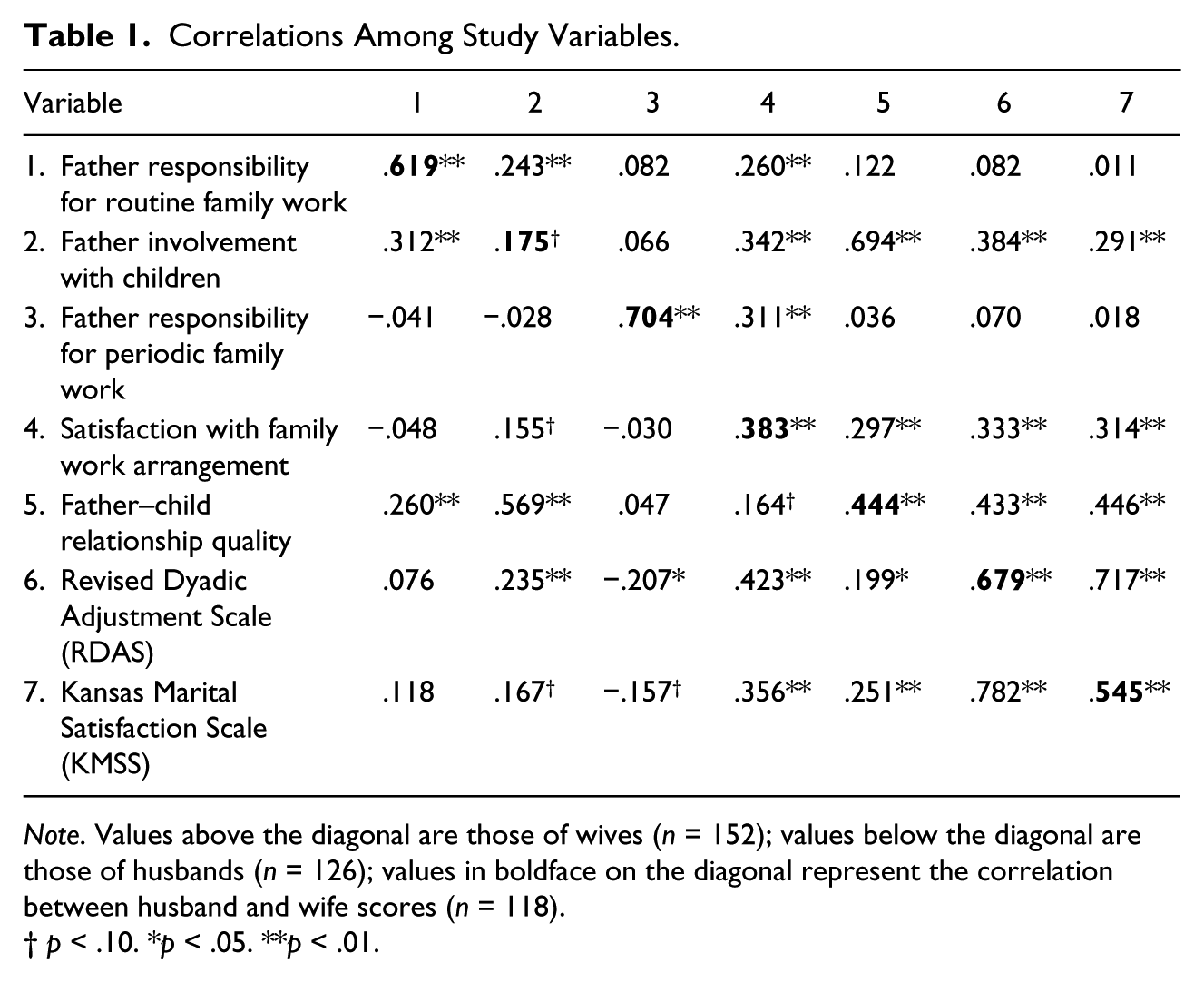
Note. Values above the diagonal are those of wives (n = 152); values below the diagonal are those of husbands (n = 126); values in boldface on the diagonal represent the correlation between husband and wife scores (n = 118).
p < .10. *p < .05. **p < .01.
Similar to multigroup analysis, we conducted an analysis to ascertain equivalence between spouses using nested model comparisons. Equivalence is determined by successively constraining measurement path coefficients and latent variable disturbance term variances, structural path coefficients, predictor variable disturbance term variances, and correlations to be equal for both spouses. Each constrained model is compared with a less constrained model that frees more coefficients for estimation. In Model 2, to ensure constructs are similar across spouses, measurement paths and the variances of the disturbances of the dependant variables are constrained to be equal. In Model 3, structural paths are tested for invariance between spouses by examining the critical ratios for the differences. In Model 4, correlations between predictor variables are constrained across spouses. A significant chi-square difference between a less constrained and a more constrained model indicates nonequivalence of the respective components of the model related to each step in the procedure. When results indicate nonequivalence, further comparisons should be interpreted with caution (Byrne, 2010).
The chi-square difference between the unconstrained and constrained measurement models was significant, Δχ2(7) = 26.996, p < .01, indicating a significant difference between spouses. Examining the pairwise parameter comparisons revealed that the primary difference between spouses was in the KMSS factor loading on marital quality and the error variance for marital quality. Thus, the marital quality construct may be slightly different between spouses. However, this difference is small given the small difference in the factor loading (Δβ = .06). Given this small difference, we compared the structural paths between spouses. The unconstrained model and the model constraining structural paths were significantly different, Δχ2(13) = 41.577, p < .01. Observing the difference between spouses, we examined the pairwise parameter comparisons for significant critical ratios for differences in the structural paths. There were several paths that were significantly different (see Figure 1). Following a procedure noted by Macho and Ledermann (2011), we employed maximum likelihood Monte Carlo bootstrapping to extract 2,000 bootstrap samples to obtain the bias corrected significance levels for the indirect, direct, and total effects (see Table 2).

Standardized pathways to wives’ and husbands’ marital quality.
Decomposition of Effects From Structural Equation Model on Husbands’ and Wives’ Marital Quality.
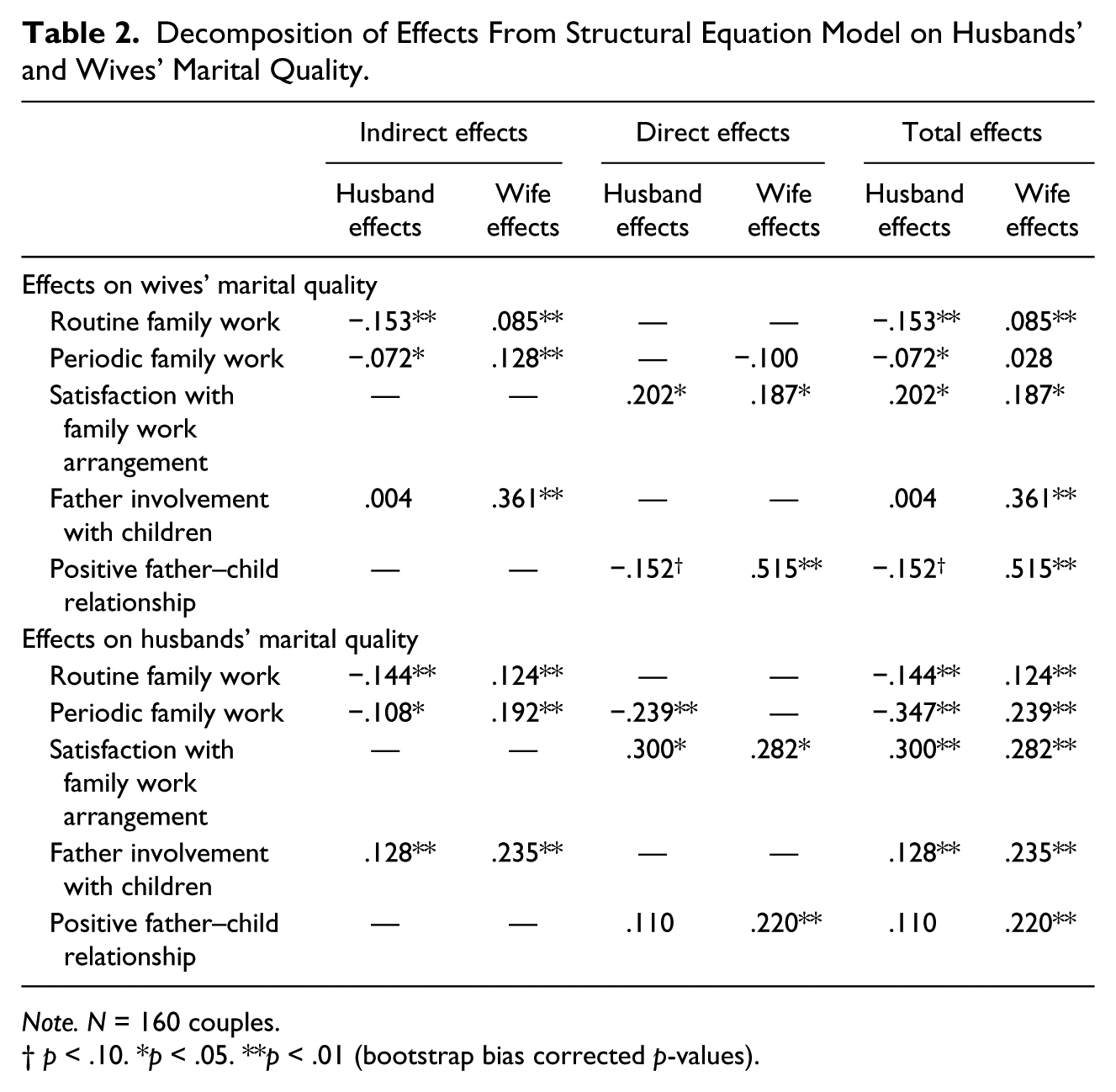
Note. N = 160 couples.
p < .10. *p < .05. **p < .01 (bootstrap bias corrected p-values).
As noted in Figure 1, the actor and partner reports of daily and periodic family work influence each spouse’s satisfaction with family work differently. Wives’ reports of both routine and periodic family work increased their satisfaction with the family work arrangement (βs = .29 and .40, respectively), whereas husbands’ reports of both types of work had no effect on their satisfaction with family work. Furthermore, the more periodic family work wives reported, the higher their husband’s satisfaction with the family work arrangement (β = .27), whereas husbands’ report of the same was unrelated to wives’ satisfaction. Husbands’ reports of routine family work were negatively associated with wives’ satisfaction with family work (β = −.21), whereas the same effect for wives was not a significant predictor of husbands’ family work satisfaction. Given these differences in what predicts satisfaction with family work, it is interesting to note that the actor and partner reports of satisfaction with family work all significantly affected marital quality for husband and wives (wives and husbands actor effects were β = .19 and .30, respectively, whereas wives and husbands’ partner effects were β = .28 and .20, respectively).
We also explored the effects of family work on father–child relationship quality. Partner effects of daily family work on father–child relationship quality differed significantly between spouses. When husbands indicated that they did more daily family work, wives viewed the father–child relationship less positively (β = −.15), whereas wives’ reports of daily family work did not significantly affect husband’s reports of the father–child relationship.
Finally, the actor and partner effects of the father–child relationship on marital quality were significantly different. Whereas the husband’s perception of the father–child relationship had no effect on either his own or his wife’s marital quality, the wife’s perception of the father–child relationship had a strong positive effect on both her own and her husband’s marital quality (βs = .52 and .22, respectively).
Post Hoc Analysis
Our analysis indicated that predictors of satisfaction with the family work arrangement may be different for husbands and wives. DeVault (1991) and Thompson (1991) argue that women may view family responsibilities in relational (i.e., necessary work for people they care about) rather than instrumental ways (i.e., tasks that just need to be completed). To test this more relational way of doing things, we recoded our family work variables so the highest scores would indicate doing family work together and lower scores would indicate doing work alone. As the measures of family work “togetherness” were derived from the same items that measured father involvement in family work, we ran a separate analysis with the togetherness variables replacing the father involvement in family work variables. We found one significant change between our final model and our post hoc exploration. When we assess family work in terms of how frequently tasks are performed with one’s spouse, we discover that wives who report performing daily family work together are more satisfied with the division of labor (β = .23, p < .01). Yet the assessment of “togetherness” was not significantly associated with men’s satisfaction with the family work arrangement.
Discussion
Guided by family systems theory, we developed a dyadic model which explores the effect of husbands’ participation in family work and child rearing on both husbands’ and wives’ marital quality. In our model, we also considered the role of spousal satisfaction with family work and each spouses’ assessment of the father–child relationship. We found significant differences between husbands and wives across each of these domains of family life. Taken together, our findings provide both an individual and relational perspective in understanding the multiple ways fathers’ engagement in household roles and responsibilities influence the parental marriage.
The strengths of the present study are threefold. First, we explore the direct and indirect effects of multiple components of family work and relationships on marital quality accounting for interdependence in marriage. Second, we emphasize participation in household tasks as a meaningful component of father involvement and test the association between quantitative involvement in child rearing and father–child relationship quality. Third, not only does the study contribute to the current body of research on associations between family work and women’s marital quality, it also contributes to a better understanding of men’s satisfaction with the division of labor, and the way men’s participation in family work may contribute to their marital quality—both understudied areas of research on men in families.
We found that for both spouses, husbands’ involvement in family work tasks was related to marital quality. Similar to previous research (Bartley et al., 2005; Cunningham, 2005), we found a gendered distinction in the type of family work spouses reported. Both spouses reported that wives engaged in routine family work more often than husbands, whereas husbands engaged in periodic family work more often than wives. Wives’ report of husbands’ participation in routine family work was positively associated with both wives’ as well as husbands’ marital quality. In other words, the more wives perceived that husbands were engaged in routine family work tasks, the better the relationship was for both partners. This is similar to recent findings by Dew and Wilcox (2011).
Interestingly, when husbands reported increased engagement in routine family work, both wives and husbands reported lower marital quality. For husbands in this more traditional sample where wives were not employed outside the home, it makes some sense that more engagement in routine work could lead to decreased marital quality. However, the decrease in marital quality for wives may seem counterintuitive. One possible explanation may be that wives sense their husbands may be crossing an “equity point.” Lennon and Rosenfeld (1994) conceptualized this as the point where one begins to feel that he or she is doing more than his or her fair share of the work, regardless of the actual division. As a husband increases his share of the routine work, he and/or his wife may come to feel he is doing more than his fair share. If the wife perceives this, it could influence her feelings of satisfaction with the way work is divided and, ultimately, the marital relationship. Furthermore, she may feel that he is worried too much about the household arrangements so he cannot engage as effectively with their child(ren). This might explain why when wives perceive their husbands are participating in high amounts of family work, they also perceive the father–child relationship to be of poorer quality. Similarly, this may also explain the negative relationship between husbands’ report of routine family work and marital quality.
We also explored associations with each spouses’ perceptions of father–child relationship and marital quality. We found that wives’ perceptions were significantly associated with both spouses’ marital quality scores. Indeed, in our model, the strongest predictors of wives’ marital quality were her perception of the father–child relationship followed by the father’s involvement with the children; although significant, these associations were weaker for husbands. In line with previous research, this adds support to the notion that wives may place a greater emphasis on care work within the family than husbands, and that they view work on their homes and work with their children as important relational work (DeVault, 1991; Fox, 2009; Thompson, 1991).
Similarly, both spouses’ reports of satisfaction with the family work arrangement were associated with increased marital quality for husbands and wives. As with previous research, satisfaction with family work was as strong as, if not stronger than, actual perceptions of engagement in routine or periodic family work (Dew & Wilcox, 2011; Grote et al., 2002; Wilcox & Nock, 2006). For both spouses, we found a similar relationship between satisfaction with the family work arrangement and marital quality. However, we found that the predictors of satisfaction with family work for husbands and wives were different. Husbands’ satisfaction with the family work arrangement depended only on their wives’ report of husbands’ engagement in periodic family work tasks. Wives’ satisfaction with family work, on the other hand, was dependent on all variables in the model except husband’s report of periodic family work. Thus, the processes by which satisfaction influences marital quality still appear different for husbands and wives.
As we noted, for wives, the effect of satisfaction with family work division on marital quality may be an effect of wives viewing such participation as care work for the family (DeVault, 1991; Thompson, 1991). In our study, this idea seems particularly salient given the strong relationship between wives’ perceptions of father–child relationship quality and her marital quality. Contrastingly, husbands’ own perceptions of their relationship with their child(ren) had no effect on their own marital quality. These findings provide an important systemic and relational context to understanding the relationship between satisfaction with family work and marital quality. In the future, both qualitative and quantitative research should explore potential variables that may mediate the relationship between satisfaction with family work division and marital quality and also explore if such mediation is moderated by spouse.
Women view family work in more interpersonal ways than men do (Thompson, 1991). Pleck (1985) argues that women want men to be involved in child-rearing responsibilities to foster better relationships between fathers and children. Furthermore, DeVault (1991) argues that women view family responsibilities in relational ways (e.g., necessary work for people they care about) rather than instrumental ways (tasks that just need to be completed). To test this more relational way of doing things, we recoded our family work variable and found one significant change between our final model and our post hoc exploration. When we assess family work in terms of how frequently tasks are performed with one’s spouse, we discover that wives who report performing daily family work together are more satisfied with the division of labor. Yet an assessment of “togetherness” is not significantly associated with men’s satisfaction with the family work arrangement.
Limitations and Implications for Practitioners
Before concluding, it is important to mention some limitations to this study. First, although the present sample is part of a third wave of data collected from newlyweds, this is the first time the current parenting measures were given. Thus, the data in this study were gathered from only one time point, which precludes the ability to imply causation. Because of this, the direction of effects between variables may be different than those presented herein. The absence of any observational measures also raises the question of accuracy in only using self-report data. Additionally, participants were predominantly white, middle-class individuals, who generally reported high levels of marital quality. Because of this, the generalizability of the results to other populations is likely limited. Despite these limitations, this study adds much to our understanding of the interrelationships between the research in both the areas of father involvement and division of family work while raising important questions for future research.
Given our finding that wives’ perceptions of both quantity and quality fathering were among the most significant predictors of marital quality, family life educators or therapists working with couples may find it beneficial to help fathers see the importance of the father–child relationship to their marital relationship. This may be particularly important in stepfamily situations (Crosbie-Burnett, 1984). Helping professionals could work with fathers to help them find ways to better their relationships with their child(ren), perhaps through affinity seeking strategies (Ganong, Coleman, Fine, & Martin, 1999) or other means.
Conclusion
We took a family systems perspective and a dyadic analytical approach to examine actor and partner effects of family work, father involvement, father–child relationship quality, and marital quality. By broadening the concept of family work to include father involvement with his children, and father–child relationship quality, we discovered that wives’ perceptions of both quantity and quality fathering were among the most significant predictors in the model. Our results suggest that increased marital quality may result from nurturing parent–child relationships and satisfaction with how the needs of the family are met. Despite this, couples in our study still view the division of other family tasks through gendered lenses. Shared perceptions of the value of men’s fathering contributions to the family appear to add increased meaning in marriage and permeate other aspects of family life (including the division of family work), as spouses work together to build and understand the life they have created together.
Footnotes
Authors’ Note
The first two authors are equal contributors.
Declaration of Conflicting Interests
The author(s) declared no potential conflicts of interest with respect to the research, authorship, and/or publication of this article.
Funding
The author(s) received no financial support for the research, authorship, and/or publication of this article.