



Abstract
In this article, we seek to extend understanding of the role of gender in early fatherhood by examining narratives of paternal masculinities, that is, the social and cultural constructions of gendered practices and conventions produced by men on their roles as male parents. The data comprised interviews with 44 Finnish first-time fathers (aged 20-42 years) living in a heterosexual relationship. The narrative of the “decent father,” was identified as the dominant narrative of paternal masculinity in early fatherhood. Although the narrative was characterized by some important gendered differences, it was also in line with the well-known concept of the “new father.” Two counter narratives, labeled the “equal father” and “masculine father,” in which gendered parenthood was rejected in the former and essentialized in the latter, were also identified. The results indicate the normative quality of narratives on paternal masculinity.
Keywords
Introduction
Well, I do change diapers, I do feed and clothe her. The practical duties, you know. But the overall care of our family business, I think it’s hers (wife).
Above, Pekka, a first-time father, is describing contemporary Finnish male parenthood and emphasizing his participation in parental practices. Simultaneously, his words imply that parental gender differences exist in the contemporary family and that different responsibilities are attached to male and female parenting. This contradiction prompts the question of the role of socially constructed masculinities in male parenting and gendered parental responsibilities in general.
As parenthood is a highly gendered area, male parental roles and men’s role in their families are bound up with the practices and cultural conceptions of masculinity. Over the past two decades, and especially during the last couple of years, both gender and family research has seen a considerable growth in studies integrating the current changes in the idea of fatherhood with social constructions of masculinity (see, e.g., Doucet, 2006; Marsiglio, Amato, Day, & Lamb, 2000; Marsiglio & Pleck, 2005; Miller, 2011a). Recently, questions of gender in male parenting have been raised by, among others, Miller (2011a), Yarwood (2011), Finn and Henwood (2009), and Dermott (2008) in the context of contemporary U.K. fathers. At the same time, along with the broad international interest in Nordic parental policies, scholars have highlighted gendered practices on the taking of family leave in the Nordic countries (Almqvist, 2008; Lammi-Taskula, 2008; O’Brien & Moss, 2010). Increasing interest has also been shown recently in how fathers balance “earning and caring” (McDonald & Jeanes, 2012) and the connections between fatherhood and work in general (e.g., Brandth, 2012; Miller, 2010, 2011a).
In this study, we examined gendered male parenting in the Nordic context through the narratives of Finnish first-time fathers. Although the Nordic countries are occasionally showcased as models of gender-equal parenting and shared parenthood on account of their progressive and father-friendly parental leave policies, in Finland and Sweden, for example, men’s share of all the parental leave taken amounts to only 6% and 20%, respectively (Haataja, 2009). These figures imply that a huge gap and clear gendered differences in parental responsibilities during the initial stages of parenthood continue to prevail in the Nordic societies. However, a father’s take-up of parental leave seems to correlate with his educational and professional status (Takala, 2005). According to a Finnish study, higher education and working in a health care occupation or doing professional work correlate with the taking of more and longer paternal leaves, whereas lower education and self-employment in an industrial context were linked with a lower rate of leave taking (Takala, 2005). How such differences appear on the narrative level remains unclear. Nevertheless, the fact that issues of parental leave and men’s role in early childcare have been foregrounded in public and media discourses and in professional and scientific debate in Finland throughout the 2000s, means that these issues have likely had some impact on men’s narration regarding what constitutes culturally suitable male parenting.
In this article, 1 we seek to extend understanding of culturally dominant paternal gender roles by examining the narratives of Finnish first-time fathers. Our data were interviews with 44 first-time fathers. The fathers were from a relatively middle-class background, which probably affects their narrative content and style. The concept we operationalize in this article is paternal masculinities, that is, the social and cultural constructions and practices of male parenting that inform men’s descriptions of their role as male parents and that the men themselves adopt and follow. Our aim is to identify the culturally dominant content of the paternal masculinities that men narrate, and to understand the role this plays in male parenthood. The specific research question is as follows: What are the dominant and possible counter narratives of paternal masculinity that Finnish first-time fathers narrate regarding their early fatherhood?
Conceptualizing Paternal Masculinities
Scholarship focusing on masculinity, and men as explicitly gendered individuals, has its origins in American psychology and social sciences of the mid-1970s (Coltrane, 1994). Since then, from the 1980s onward in Western societies, social constructions of masculinity have frequently been examined within the social sciences and, in particular, gender studies. Masculinities have been defined as, for instance, the ideas and characteristics attached to men in social interaction (Connell, 2005), the cultural conventions appropriate for men (Pease, 1999) and men’s practices 2 (Hearn, 1996). Although the concept has been used in a variety of ways (Hearn, 1996), and has been criticized for its lack of specificity (Connell & Messerschmidt, 2005), for example, “How do individual men relate to socially constructed masculinities?” (Hearn & Collinson, 1994, pp. 103-105), it has gained established status in contemporary discourses in the social sciences as a tool for perceiving the socially constructed dimension of maleness.
However, the social and cultural constructions of masculinity exist predominantly as ideals, and hence their relations to “real life” are unclear. This invites rhetorical questions such as “Why do individual men act diversely, if what decides how they act is a cultural construction?” or “Why does the same man act differently in different situations?” This particular issue can be explored through Coles’s (2009) theory of the fields of masculinity. Coles, who combines Connell’s (2005) theory of hegemonic masculinity with Bourdieu’s (1993) theory of fields, draws a distinction between hegemonic and dominant masculinities. According to Connell (2005), at any given time there is one form of masculinity, that is, hegemonic masculinity, that is culturally exalted and which has hegemonic position in relation to the other masculinities. Thus, hegemonic masculinity illustrates cultural ideals, regards, and configurations of gendered practices rather than answering the question “How do men really act,” and its contents are to be sifted according to the social and historical situation. Whereas hegemonic masculinity describes culturally constructed ideals of a male in general that are regarded as the most powerful compared with other possible ideals, dominant masculinity emphasizes the ideal construction of a male in a particular field. In his study, Coles sketches the field of masculinity in which the appropriate conventions and ideals of masculinity are negotiated. The field of masculinity divides into numerous subfields, such as gay masculinity, labor masculinity, academic masculinity and Black masculinity, to mention just a few. Each subfield has its own dominant masculinity, which might not overlap with the hegemonic construction of masculinity, along with other masculinities that diverge from the dominant one. In this study, in the terms used by Coles, we focus on the field of paternal masculinity—a subfield of masculinity that appears in particular in men’s family relations.
Since the late 1980s, cultural images of fatherhood, including analyses of masculinity, have been considered by, among others: Furstenberg (1988), Marsiglio (1993), LaRossa (1997), and Marks and Palkovitz (2004). As pointed out by these authors (see Marsiglio, 1993), whereas breadwinning has been firmly attached to cultural conceptions of male parenting throughout the 20th century and since (in the United States, but also more broadly in Western societies), it has been increasingly complemented with a diversity of social roles from gender role model to care-giver. To cite Roy and Dyson (2010), the increasing trend toward combining both provider and care-giving roles in the ideals of contemporary fatherhood is opening up possibilities for new ways of expressing masculinity.
This is reflected in recent research, for example, in reports on the narrated masculinities of stay-at-home fathers (Doucet, 2004, 2006), gendered parenting of first-time fathers (Miller, 2011a), and masculine care of stay-at-home fathers (Brandth & Kvande, 1998). It has been shown that becoming a father reasserts a man’s masculine identity, giving novel content to being a man (Brandth, 2012; Daly, Ashbourne, & Brown, 2013), while some studies have even proposed that fatherhood should be understood as a cultural norm in adult masculinity (e.g., Dermott, 2008). A central finding of all these studies is that fathers distinguish between paternal and maternal care. In their study of Norwegian stay-at-home fathers, Brandth and Kvande (1998) discuss masculine care, in particular father–child “being and doing together,” whereas in Doucet (2006) the emphasis is on the father’s need to differentiate masculine care from maternal care and femininity, in order to attest to their masculine identity. According to Yarwood (2011), breadwinning continues to be perceived as the contemporary dominant male parenting role. The perception of breadwinning as a paternal duty is also highlighted by Palkovitz (2002), and is thus to be seen as a culturally important aspect of paternal care. In her studies of U.K. first-time fathers, Miller (e.g., 2011b) found that men took a relatively active role in caring practices in the first weeks of their parenting, but subsequently fell back into normative gendered behavior. However, research findings suggest that although care giving can be interpreted culturally as a feminine duty (Doucet, 2004; Miller, 2011b), masculine care seems to play an important part in paternal masculinities.
Early Fatherhood: The Gender Perspective
In the scholarship on paternity, much interest has been shown in the transition to fatherhood and early fatherhood (e.g., Miller, 2011a; Palkovitz, 2002; Palkovitz & Palm, 2009). As men become fathers in cultural and social contexts that intersect with gender relation systems (Marsiglio & Pleck, 2005), a gender-receptive approach is necessary. For example, according to Fox (2009), “parenthood creates gender more thoroughly than any other experience in most people’s lives” (p. 6). For the past couple of decades, attention has been paid in particular to the concept of the “new father.” This concept, which has gained focal cultural status in the Nordic countries, indicates that traditional gendered parental roles have fundamentally changed (Eerola & Huttunen, 2011). That is, the “new father” is assumed, for instance, to be capable culturally of “mother-like” nurture, participating in early care and taking comprehensive responsibility for the child, unrestricted by gender. According to the results of a Finnish questionnaire (see Haataja, 2005), virtually all the men respondents believed that fathers are just as capable of and suited to child care as mothers. Male parenthood fundamentally in accordance with this notion, however, still seems to be scarce, even in the Nordic countries. Although the discourse of shared caring in Nordic countries is strong (e.g., Lundqvist, 2012), fathers continue to be at greater liberty to decide the terms of their engagement and participation (Miller, 2011b), take parental leave less often (Brandth, 2012; Haataja, 2009; Lammi-Taskula, 2006) and work significantly more hours outside the home than mothers (Miettinen & Rotkirch, 2012), all of which tend to stress the mother as infant nurturer and care giver and the father as economic provider. However, despite such contradictions between paternal ideologies and practices, we can consider Finnish men as relatively involved and engaged fathers from early childhood on, since, for example, more than 80% 3 of them take paternal leave after the child is born (Haataja, 2009) and participate significantly 4 in hands-on parenthood thereafter (Miettinen & Rotkirch, 2012).
Nevertheless, previous studies show that in Western societies, gendered parental differences and responsibilities appear from the very onset of parenthood. Although men’s childbearing behavior is a relatively unexplored area (Lappegård, Rønsen, & Skrede, 2011), it seems that mothers are more determined in their intentions to have children (Miettinen & Rotkirch, 2008), and more often to have the final word in decisions to start trying for a baby (Sevón & Huttunen, 2004). In addition, the early care of a child and comprehensive commitment to nurture work has been interpreted mainly as maternal responsibility, as the changes in men’s lives are less dramatic. However, several studies on the transition to fatherhood have underlined first-time fatherhood as a focal transition in a man’s life (e.g., Mykkänen, 2010; Palkovitz, 2002). According to Palkovitz (2002), for instance, first-time fatherhood might have a central role in promoting a man’s growth and adult development.
Although the previous research on early fatherhood and paternal involvement has highlighted the importance of early care and involvement for future involvement (Allen & Daly, 2007), societal support remains noticeably broader for new mothers than for fathers in the Nordic countries, if not elsewhere. For instance, institutional services (such as prenatal clinics, etc.) continue to be directed mainly at mothers, and mothers’ nonsharable quota of parental leave is commonly larger than that of fathers. In Finland, for example, paid paternal leave is 9 weeks, whereas maternal leave is nearly 18 weeks and negotiable parental leave 26 weeks (see Salmi, 2012). As elsewhere in the Nordic region, leave legislation in Finland is based on the principle of gender equality and shared parental care and responsibilities, and thus the majority of paid parental leaves are available to both parents. However, in cases where leave is not father-or-mother-specific, it is primarily taken by mothers (Lammi-Taskula, 2012). Although Nordic parental policies have been reviewed regularly to enhance men’s early participation, and now specifically include paid paternal leave (O’Brien & Moss, 2010), these measures have not succeeded as expected. Although it is true that Nordic fathers are increasingly taking child care leave, its duration is relatively short compared with that taken by mothers, and its long-term effects on, for example, the later father–child relationship, fathers’ continuing engagement in child care, and the distribution of domestic labor, remain unclear.
Narrative Method and Data
The method applied in the study is narrative inquiry, 5 in which narratives are understood as constructors of knowledge. Since the “narrative turn” 6 of the late 1980s, the method has gained increasing attention in social and human research (e.g., Loseke, 2007; Riessman, 2003; Squire, Andrews, & Tamboukou, 2008, p. 1). The basic premise of narrativity is that telling stories is an innate and familiar way for people to produce meanings and to perceive the world. Moreover, since personal experiences and stories interact with cultural narratives, narrative inquiry is interested in how people narrate their lives and how their narratives are connected to the wider social context (Plummer, 2001; Somers, 1994).
Hatch and Wisniewski (1995, pp. 116-118) describe the characteristics of narrative inquiry as follows: (a) focus on the individual, (b) personal nature of the research project, (c) practical orientation, and (d) emphasis on subjectivity. In comparison with qualitative methods in general, narrative inquiry has the advantage that it draws attention to personal experiences and at the same time enables narratives to be understood as “social acts” (Ewick & Silbey, 1995, p. 197) that are timely and situationally produced and interpreted in a particular social context. The method sees narratives as constructions that enable individuals to gain a sense of “reality,” and to understand, expound, and construe phenomena from the perspective of socially constructed reality (Bruner, 1996, p. 122; Chase, 2005, p. 656; Josselson, 1995, p. 33) Through narratives, individuals construct their lifespan as a continuum (Frank, 2002), normalizing and “naturalizing” experiences and events in their life (Abbott, 2002, p. 40) and creating coherence by linking sporadic events into meaningful wholes (Loseke, 2007; Polkinghorne, 1991). Thus, among the topics studied using a narrative approach, intimate topics such as life stories and life changes have been especially popular (e.g., Hänninen, 2004; Riessman, 2003). For instance, studying life changes as narratives enables us to capture the meanings people give to the most sensitive experiences in their lives (Hänninen, 2004). Although there is no unambiguous answer to the question “What is a sensitive topic?” (Hyden, 2008, p. 134), first-time fatherhood can be considered such a topic for the vast majority of men.
As stories are socially organized phenomena (Ewick & Silbey, 1995, p. 206), and as social and cultural norms and habits affect the narratives that people produce, narration does not occur in a vacuum. Diverse narrative alternatives that are culturally available for telling (Ewick & Silbey, 1995, p. 212) contribute to the “cultural stock of stories” (e.g., Hänninen, 2004). Within these narratives, however, some narratives are more culturally established than the others, and have hegemonic or dominant status (e.g., Ewick & Silbey, 1995; Somers, 1994). These dominant narratives might be “common knowledge” or they might be local and occupy a hegemonic position for a few people only. Narratives that diverge from the culturally hegemonic narratives are termed counter narratives. Like dominant narratives, counter narratives are not static, but rather evolve over space and time, and make sense only in relation to dominant narratives (Andrews, 2004; Bamberg & Andrews, 2004).
To obtain empirical data, we interviewed 44 first-time fathers 7 aged 20 to 42 years, as the average age of first fatherhood in Finland is approximately 30 years (Statistics Finland, 2004). The interviewed men represented various professional fields and disciplines, such as engineers, health-care specialists, students, policemen, and private entrepreneurs. Overall, the men can broadly be described as middle class. Nine men had experience of being a stay-at-home father (3 months-2 years).
We conducted 8 the interviews 9 by applying the methods of the narrative and thematic interview. The topics discussed in the interviews encompassed, for instance, the time before the birth of the child, becoming a father, everyday fatherhood, work and family, the significance of being a father and the couple relationship. We implemented the narrative analysis by reading the interviews with the aim of finding congruencies and similarities between the different stories and answers. First, we asked what the most essential content in each story was. During this phase, three divergent narratives of paternal masculinities began to emerge. After that, to illuminate the relations between the narratives, we looked at the interrelationships between the stories. In this phase, we identified one dominant narrative and two counter narratives of paternal masculinity. Furthermore, as our analysis advanced, areas such as gender differences, responsibility, nurture, and family orientation had a focal role in supplementing the classification of the men’s narratives. To further illuminate the narratives, we constructed a composite narrative of the dominant and condensed narratives of the counter narratives from authentic interview extracts. Although such first-person composites and condensed narratives have rarely been used in narrative studies (see, e.g., Wertz, Nosek, McNiesh, & Marlow, 2011), they provide an opportunity to understand the men’s narration as a meaningful whole on both personal and societal level. Additionally, direct and authentic extracts from the interviews are given (names and occupations changed to protect participant anonymity).
Narratives of Paternal Masculinities in Early Fatherhood
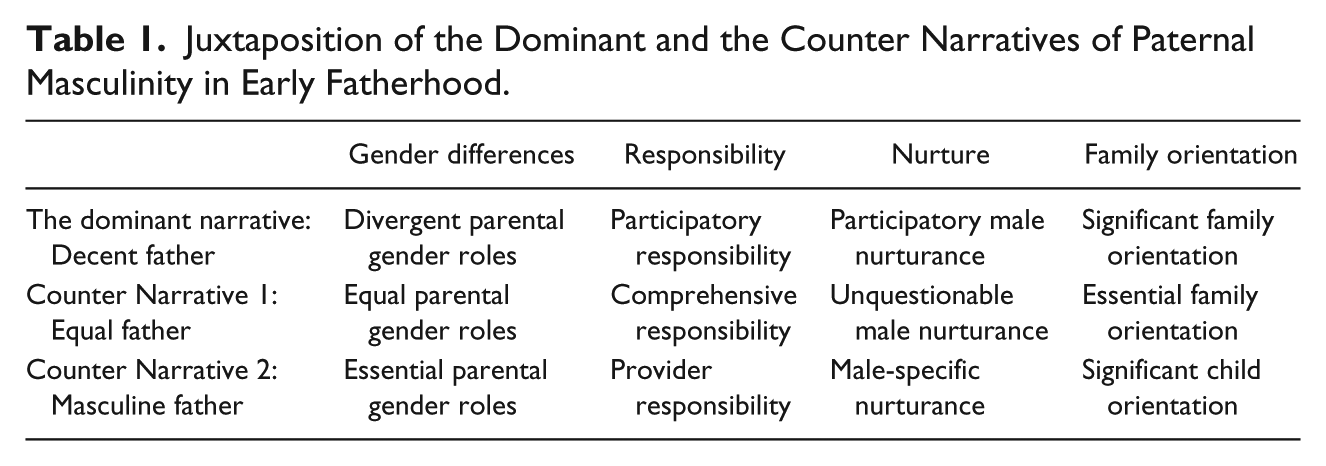
The dominant narrative of paternal masculinity in early fatherhood we identified in our analysis was labeled the narrative of the decent father. In addition, two counter narratives—the narrative of the equal father and the narrative of the masculine father—were identified. We present the main features of these narratives in Table 1 under the headings gender differences, responsibility, nurture, and family orientation.
Juxtaposition of the Dominant and the Counter Narratives of Paternal Masculinity in Early Fatherhood.
The Dominant Narrative: The Decent Father
We have named the dominant narrative the decent father, as it emphasizes culturally decent male parenting in early fatherhood. It is characterized by divergent parental gender roles, participatory paternal responsibilities, participatory male nurturance, and a significant family orientation. The dominance of the narrative is twofold: First, quantitatively, as the narrative was produced substantially more often than the other narratives
10
; and second, qualitatively in the cultural dominance of the narrative, describing customary and culturally suitable practices of contemporary male parenting. The narrative, however, should not be understood as an unambiguous and clearly defined story, but rather as a flexible framework, directing and assessing the boundaries for a culturally appropriate narrative of paternal masculinity in early fatherhood. The narrative is presented as a composite constructed from the discourse of several fathers: Well, you know . . . We were married, we had an apartment, I had a permanent job, all that . . . Then, she just started to talk about it (getting a baby), and . . . Quite soon I was like, yeah, why not . . . And, then she just came to me one day and showed me the test which was positive (laughing). And the time when she was pregnant, it was quite a nice time. . . . I sometimes went to the maternity clinic with her, and we bought a baby seat, carriers, all that stuff we would need, you know. . . . I also read some discussion forums and magazines for newbie parents, but I think these were mainly directed at the mothers. But when he was born, it was. . . . It was just amazing. I was in a kind of like positive shock (laughing). And when we come home with the little one, I took my three-week paternal leave, no question about that . . . And there we were, practicing family life together. . . . She fed the baby naturally, but certainly I tried to participate in everything else. The first months also went quickly, things went well, and . . . Well, yeah, I have to admit that it was sometimes a bit hard for me to give up of your own time and hobbies, and suchlike. . . . I sometimes have time to meet my friends, but only a few of my friends actually have children, and I think that we don’t talk that much about the kid and family stuff. . . . At least not like I guess that the mothers do, though I think it would be nice sometimes, actually. However, everything has gone just fine, and actually I have really thought that, if it was just possible, it would be nice to spend few weeks or months at home with him. . . . But, the questions of living, work, and suchlike should be solved first, so . . . I don’t know, we’ll see, at least maybe with the next one (laughing). (Constructed from the discourse of several interviewees)
In our analysis of the narratives on paternal masculinity, we paid attention to talk about parental gender differences in order to highlight the discrepancies and similarities in the narrated paternal and maternal roles. In the dominant narrative, parental gender differences were mentioned, although the differences appeared somewhat blurred. Our data show that parental roles began to be gendered from the time before the pregnancy, as in most cases family planning and pregnancy were narrated mainly in relation to the mother, the father being “with her.” For example, only few of the men narrated an equivalent role in family planning, as in the majority of the cases the mother was the more determined party. For example, Erkki’s narration implies maternal primacy in family planning, also indicating the mother’s primacy in contemporary Nordic family life in general: Yeah, sure, there was some pressure from her (wife), but . . . I had always thought that I would like to have kids, so, it was quite ok for me, too. (Erkki, 32 years, daughter 14 months, researcher)
The discourses on the “new father” and shared parenting emphasize the changed character of gendered parental roles (e.g., Hawkins & Dollahite, 1997; Marks & Palkovitz, 2004). Similarly, the dominant narrative highlights the father’s participation in child and household care as an important part of the paternal role, in accordance with the previously presented results on Finnish family practices. For example, the narrative underlines the father’s participation in household tasks such as vacuuming, making dinner, doing the laundry, and so on. According to our data, however, the main responsibility remains with the mother, an issue also noted by Johansson and Klinth (2008). The mother’s primacy in child care and housekeeping and the father’s in wage work were narrated as conventions that both parents agree with, in parallel with Finnish parental leave statistics. This can be seen, for example, in Mikko’s narration of the possibility of staying at home with the child: Well, I don’t know . . . I just somehow think that it’s not for me, I might lose my cool a bit too often (laughing) . . . And, because it’s ok to her (wife) to be here (at home), so . . . I prefer working. (Mikko, 27 years, son 9 months, student)
Several studies have emphasized that many men perceive providing as a paternal care role (e.g., Palkovitz, 2002). The decent father narrative is different from the exclusively paternal provider role as it conforms with the Nordic dual-earner household model (e.g., Ellingsaeter & Leira, 2006; Kuronen, 2001). However, the main responsibility for economic issues was narrated as belonging to the father, which is in line with the fact that in most Nordic families the father’s role as a breadwinner is pronounced. Although some fathers narrated experiences of or the wish to be a stay-at-home father, the main storyline in the narrative highlighted the men’s role as providers. An extract from Kalle’s interview illustrates how the role of provider, paternal responsibility, and male identity are interwoven in the men’s narration: Financial situation, it’s a. . . . I think it’s like the responsibility that I have as a man, you know, to take care of living, and . . . (Kalle, 37 years, son 3 years, electrician)
The decent father narrative emphasizes gendered differences in parental responsibility. According to our data, the responsibilities that emerged as appropriate to paternal masculinity, and thus set the boundaries for good and responsible male parenting, were economic responsibility and assisting in caregiving. In most cases the mother took the final responsibility for the everyday decisions and actions of the family and the children. Although the men narrated maternal primacy in family planning, the narration of responsibility began from the very beginning. From the men’s point of view, having a family was related to the questions of having a permanent job, an adequate income, and a good couple relationship, as was also stressed by Timo: Well, the situation was quite stable, our couple relationship was good, I had a job, and . . . Things just click into place, like, now’s the time, I’m ready (for a child). (Timo, 26 years, son 2 years, nurse)
According to Pringle (1995), one of the masculine characteristics that promote well-being in the family is men’s nurturing ability. In this narrative, male participation in nurturance is highlighted. For instance, fathers reported assisting mothers in parental duties such as feeding, clothing, carrying the baby, and getting the baby to sleep, all of which emphasized the father’s involvement in early care. The previous discourses on paternal masculinity have located nurture and caregiving in the feminine sphere (Doucet, 2006). Here, however, participation in nurturing was narrated as focal in all the interviews, in accordance with the decent father narrative, reflecting to both Nordic family ideals and practices. Recently, Brandth (2012, p. 116) has suggested that men’s increased orientation toward child nurturing can be understood in terms of “a new child-oriented masculinity.” For instance, Aki, employed as psychologist, emphasized the importance of “being there” as an essential paternal practice: As I see it, the most important is just to be there with him . . . Really, what else would a one-year-old baby need? To be emotionally present, that’s the only thing that matters (Aki, 27 years, son 21 months, psychologist)
The decent father narrative implies a family-oriented approach to being a man. Most of the interviewed men had always thought that they would like to have a family, and the family was mentioned as the central content in their life. In addition to their emotional narration about the family, the men narrated their family orientation by reference to paid work. Paid work was justified, for example, by its contribution to the welfare of the family and through showing economic responsibility. The men also pondered the possible contradictions between work and family, for example, how their possible taking of family leave would be regarded in the workplace or what consequences a family orientation would have on their career development. Notable differences in narrating their family orientation between men in different professions were not highly evident, although the men working in, for example, health care, social services, and education seemed to produce a more multifaceted and sensitive narration on nurturing. The finding reflects the statistics (Takala, 2005) according to which men from these professions more frequently take parental leave. According, for example, to Olli, a social worker, Although I take care of the living . . . I don’t want it to be only that, I certainly do want to participate in the care work, too. . . . I want to spend time with him as much as possible, and so on . . . (Olli, 29 years, daughter 15 months, social worker)
In some interviews, fatherhood as a part of the continuum of being a man was brought up. For example, “we had this traditional way, that first we got engaged, and then got married, and well, here we are” (Sampo, 26 years, son 15 months, student). In addition, progressions of “from boy to a man” occurred, as being a father was narrated as a more adult male person, or as bestowing extra status, for example, “for me, getting a child was just like an extra feather in my cap” (Valtteri, 30 years, daughter 2 years, student). 11 Discourse that occurred in several interviews, but not in all, was the importance of, and lack of, homosocial (e.g., Connell, 2005) support. Intimate discussions on family issues were absent in men’s homosocial relationships, even though men narrated their needs and wishes to discuss particular family-related topics.
To summarize, the dominant narrative emphasizes a broader conception of male parenting and values men’s participation in childcare, in accordance with the concept of the “new father” (e.g., Marks & Palkovitz, 2004). With some variation in details, the framework of the narrative was constructed around parental gender differences, participatory paternal responsibilities, participatory male nurturance, and a strong family orientation, all of which appeared in all the narratives.
Counter Narrative 1: The Equal Father
We named the first of the two counter narratives identified from the data as the narrative of the equal father, as it emphasizes a gender-equal approach to male parenting. The narrative challenges the decent father as insufficient to produce gender-equal paternal behavior. It is characterized by equal parental gender roles, comprehensive responsibility, unquestioned male nurturance, and the centrality of a family orientation. The explicit evidence for this narrative was found in six interviews, where it also partially overlapped with the dominant narrative. As this particular narrative was rarely produced in its entirety, the following condensed narrative and extracts illustrating the narrative are drawn from the interview with Niilo, a 27-year-old stay-at-home father from metropolitan area of Helsinki, the capital of Finland (with an MA degree in mathematics). This particular interview exhibits the salient features of the equal narrative: Well, I think we started to think about it seriously right after we found this (apartment) . . . And, quite soon we found out here we go (laughing) . . . You could say, I didn’t have any idea what was coming. . . . I think that my kind of father-identity started to shape up during the pregnancy, when we, you know, went to the prenatal clinic, read books, and . . . The first days after he was born, those were really nice . . . As she (spouse) was sleeping and recovering from childbirth, I was taking care of him, and . . . I think it was crucial to take an active approach right from the beginning, as the breastfeeding ties them (mother and child) together so closely, I think . . . After the first two months, I was working for couple of months, but . . . As I had already graduated and she (wife) was still studying, we decided that it would be the best for the whole family if she could continue her studies and do some part-time job and I could stay at home, even if it has brought our income level down. To date, I’ve been here (at home) for a year now, and I think that it has been really . . . I have grown a lot as father, and, you know . . . Of course there were some challenges in the beginning, but . . . When I truly realized how much I enjoyed taking care of him, and stuff like that, it was . . . I just felt that, yeah, this is it . . . (Narrative condensed from a single interview with Niilo, 27 years, son 23 months, stay-at-home father)
In the equal father narrative, the mother and father are narrated as similar and equal parents, with an emphasis on differentiating this kind of parenting from the gendered division of labor associated with “traditional” parenthood. The narrative is linked with the issue of the gender-equal man and father that arose in the 1970s in the Nordic societies (Johansson & Klinth, 2008; Lundqvist, 2012).
In contrast to the decent narrative, the equal narrative rejects men’s role as primarily that of a breadwinner and highlights stay-at-home fathering as a suitable and economically viable choice. For instance, the father’s choice to stay at home with his few-months-old infant was foregrounded, even though it meant temporary exit from the labor market and downward adjustment of his family’s financial situation. It is noteworthy, however, that this father does not underestimate the importance of financial security and paid employment—stay-at-home parenting is something that suits him and is the equal right and duty of both parents. To cite Doucet (2006, p. 224), “the heavy burden of social expectations and moral assumptions” of breadwinning is absent.
While some studies have shown that men’s parental role is minor at the outset of parenthood and increases along with the child’s development, as in the dominant narrative, the equal father narrative found here lays emphasis on parenthood as essentially shared and gender-equal from the very beginning. Niilo discusses the issue in the following extract, refuting the mother’s commonly understood role as the father’s guide in child care: Well, it was just like that, we practiced together, wondered together, for example, how to change a diaper (laughing). . . . We had quite equal roles as parents, like, the mother was not telling me how everything should be done.
Whereas the decent narrative spoke of the importance of the father having a family orientation, the equal narrative went beyond this, to the extent that the narrative can be described as living for the family. This appears as a focal intention to make family-centered decisions. It is noteworthy that the father’s decisions, for example, to stay at home with the child instead of remaining in paid employment, were not questioned or compared with those of other men or with the dominant male culture. In contrast to the parental gender differences in the dominant narrative, the equal narrative is mainly gender-neutral, yet partially characterized by “mother-like” speech, that is, the father’s narration represented conventions that might culturally be interpreted as maternal or feminine. This suggests that the father identifies with feminized parental language to narrate himself as a caregiver parent, while simultaneously he questions the culturally dominant narrative on how men should talk about parenthood and expands the narrative repertoire of male caregiving. This is illustrated in the following fragment: I . . . I don’t now . . . I just don’t find it interesting, how men talk about it (pregnancy and having a baby). Mostly it’s just about that how they have bought a new and bigger car and other stuff like that.
A nongendered division of labor can also be perceived in the narration. Whereas the men narrating in accordance with the decent father narrative usually participated in household chores at least on some level, in the equal narrative, men’s participation in household tasks is seen as self-evident, free of gendered restrictions. For instance, the following narrative fragment describes how the narrative combines taking care of household chores with stay-at-home fatherhood: As I’m at home, I have more time to wash, to do laundry and hoover and all that stuff. I think it’s not that big a deal, since I’ve been at home more, it’s been quite natural that I’ve done most of it.
Whereas the decent narrative emphasized participatory paternal responsibilities, the equal father highlights comprehensive parental responsibility. For instance, the father narrates his view on the question of family planning, and his preparation for his fatherhood. For example, the equal father took an active role in early nurture and care of the child to stabilize his role as a parent in the early childhood context. This narrative conforms with Doucet’s (2006) portrayal of emotional responsibility, and highlights the intentional character of fatherhood. This can also be perceived in the following extract, in which Niilo narrates his own growth along with his fatherhood: Yeah, I’ve actually grown up a lot, and . . . I think my values have changed, become more family oriented, and, I’ve found a gentler and more sensitive side of myself.
The narrative constructs masculinity from outside the core of the dominant cultural images of contemporary male parenthood, and it can be seen as a novel expression of paternal masculinity. For example, whereas the decent father narrative accords with the concept of the “new father,” that of the equal father transcends it, by challenging its adequacy to produce gender-equal parenting. Although the decent father narrative included shared parenting as part of the paternal role, it can be clearly distinguished from the all-embracing nurture and intuitive sense of gender-equal parenting, in which there are no gendered parental roles, as is foregrounded in the equal father narrative.
Counter Narrative 2: The Masculine Father
We named the second counter narrative the narrative of the masculine father, as it draws on the culturally hegemonic ideas of “true” masculinity 12 (see Connell, 2005, p. 45). It recognizes the decent father narrative as a cultural ideal that might fit some men, but which is not for everyone. It is characterized by strict parental gender roles, in which the paternal responsibilities are breadwinning, male-specific nurturance, and a strong child orientation. Although strong evidence of the narrative was found in five interviews, in most of these the narrative was only partially present and overlapped with the dominant narrative. As the narrative was rarely produced in its entirety, the presented condensed narrative and the interview samples illustrating the narrative are drawn from the interview with Esko, a 31-year-old, high school graduate employed as security specialist, living in a medium-sized city in Central Finland. In Esko’s interview, the salient features of the narrative clearly emerge.
I’ve always liked to go out on a date, and meet a lot of women, you know, a bachelor’s life . . . But, one day, without any plans, I just realized that, damn it, I’m in love (laughing)! But, quite soon after we started to date, contraception failed, and, you know the rest . . . I had a job and living was secure, so I was like “yeah, of course we’ll keep it,” but . . . Truly speaking, the first months were like a rollercoaster, ups and downs all the way . . . Then again, I quite soon kind of adapted to the idea of fatherhood, like that it’s going to be my kid as well, and, after that it has been obvious to me that I take care of the child, whatever happens . . . Right after she was born, I spent two weeks at home, and then got back to work. In the evenings, sure, of course I assisted her (wife) with all that stuff, you know, changing diapers, playing . . . But now that I’ve been working, I haven’t had that much time to help her. On weekdays, I work for 10 hours, and on weekends I’ve had to take on some extra shifts, too, so . . . On the other hand, two weeks would be the max that I could stay at home, definitely, otherwise I’m sure my head would explode (laughing). But this is only what I think, I know that someone else would think differently, sure. . . . As a father, I sometimes might be quite strict, ‘coz I think there are certain rules that are not made to be broken, you know. . . . However, I’ve never had to yell at her (daughter) or pull her hair, hit her. Never . . . To sum it all up, I think I have a pretty good situation, as I have great job, marvellous kid, pretty good wife, and . . . although it certainly would be nice to have more sex, I think that life’s sitting quite pretty at the moment, really, what else would a man need . . . ? (Narrative condensed from an interview with Esko, 31 years, son 3 years, security specialist)
The masculine father narrative diverged notably from the other narratives found in this study. Instead of family and parenting issues, the themes of work and being a man were strongly present in the interview. In addition, clear parental gender differences were mentioned. The narrative emphasized the discourses of homosociality, heterosexuality, and violence that have assumed a central role in scholarship on masculinities (e.g., Connell, 2005) but were largely absent in the other narratives. Moreover, for example, the father’s drinking habits were discussed, a topic that was absent from the other interviews.
Although parental gender differences were identified in the dominant father narrative, the masculine father narrative portrays the father as a clearly different parent from the mother. The narrative refers to the idea of the “essential father” (see, Pleck, 2010), which emphasizes the uniqueness of male parenting. Although the primary responsibility for the early care of the child was the mother’s, the father as a role-model and socializer was assumed to gain in importance along with the child’s growth. In accordance with the “traditional” images of male parenting (see the “Early Fatherhood: The Gender Perspective” section), breadwinning was narrated as an integral part of the paternal role—the father’s role as the breadwinner and the spouse’s role as a stay-at-home mother were not questioned at all—adhering to a view of masculinity in which men act as public agents outside the family. Whereas the mother took on the primary everyday parental nurture and care work, paternal nurture mainly comprised occasional “assisting her (wife)” and “doing things with the kid,” in contrast to the content of nurture and care in the other narratives. In addition, whereas in the decent father narrative issues of work were mainly dismissed, they played an essential role in the masculine father narrative, through emphasis on the domain of paid employment as a focal part in the father’s life. However, although work seemed to occupy a significant role in the father’s life per se, the narration also emphasized the welfare of the family as an important objective of work.
Perhaps the most interesting finding in this counter narrative was the emergence of three topics that were rarely discussed in the decent narrative: the focal role of homosociality, an emphasis on heterosexuality, and the discourse of violence. For example, the father was working in a male-dominated area, where “you have to be a tough guy,” that is, one who has done military service
13
(“you’ve been in the army”), have several children (“maybe with several different women”), and “perhaps gone through a divorce.” However, the father narrated himself as slightly outside this description, highlighting the expansion in his experience of his masculine status after becoming a father, an issue also noted by Daly et al. (2013): I actually felt like a junior, “cos they’ve had kids and women much earlier, whereas I was 28, wet behind the ears (laughing)” . . . “After getting the child, I really felt that I was a part of the club, for the first time.”
Whereas the decent narrative was characterized by the absence of homosociality, the masculine narrative emphasizes male peers as an essential support in parenthood and family life. For example, the family and children were frequently discussed in the men’s everyday conversations, emphasizing the father’s need and willingness to share parenthood with other men. In addition, the narrative drew on a strong narration of heterosexuality, which was absent from the other narratives found in the study. For instance, the narrative emphasized a male heterosexuality, as also emerged from Esko’s talk: Yeah, this is where we quite often collide. Every time that I’d be ready, she’s not, and I’m ready 90 percent of the time.
The masculine father narrative subsumes masculinity and violence, and was the only narrative in our data in which violence was mentioned. Although the relations between violence and different masculinities remain unclear, culturally, violence generally attaches to male individuals. In Esko’s narration, violence was partly present because he had to confront it as a part of his job (security specialist), but the narration of potential violence also extended to his family sphere. He underlined how “I’m not really a violent person,” and how he would never, for example, hit the child, but nevertheless: I’m sometimes really scared, that, if it happened . . . If the impulse came, and I just lashed out. I’m really scared of that . . . ‘Cause it’s wrong, and . . . But if it was just to happen, it’s something that I’m really scared to death of.
Although this narrative differs in many respects from the decent father narrative, it emphasizes the father’s involvement with the children as a natural part of male parenting—at least on some level. For example, the father spoke of his “call” to take care of his children in the future as well as in the present, and of his aspiration to establish an emotional bond with his daughter as self-evident. In addition, keeping the family together until the children are older is important in this narrative. If the decent father narrative was characterized by a strong family orientation, as Esko’s narrative implies, the masculine father narrative was characterized rather by a strong child-orientation: I’ll be satisfied, if we’re together (with the wife) for the first eight years . . . Then they (the children) will have a strong relationship with their father, and, they’ll know who their father is, if she has a new man. . . . They know that sometimes their father gets angry, sometimes their father hands out a punishment, but he’s still good guy who cares for them.
Conclusion
This study describes the dominant narrative and two counter narratives on paternal masculinity in early fatherhood produced by a sample of Finnish first-time fathers. Without waiving the provider role earlier interpreted as significant in cultural concepts of male parenting (see “The Dominant Narrative: The Decent Father” section), the decent father narrative shows a shift in focus toward more “hands-on” and nurture-enabling practices in male parenting. In doing so, it confirms and extends recent scholarship on first-time fatherhood (e.g., Brandth, 2012; Doucet, 2006; Miller, 2011b), indicating notable changes in not only Nordic but also global discourses on male parenting.
An intriguing question is what makes this particular narrative, which accords with the concept of the “new father,” culturally dominant rather than any of the other possible narratives? It is very likely that the efforts made in Finland and the other Nordic countries through their family policies to promote the participation of fathers in the family, as well as a sense of gender equality in society in general, has probably informed men’s understanding of what constitutes a suitable male parental role. In other words, it seems that the dominant narrative is in many important respects in line with contemporary Nordic family and fatherhood ideals. It is also likely that as cultural conceptions of parenthood and men’s role in the family have changed, this too has affected men’s narratives. This can be seen, for example, in the relative narrowness and vagueness of expression of the masculine narrative. It is also possible that the institutional stigma attached to the research interview might bias respondents to produce narratives deemed by society at large to be culturally decent and appropriate. However, that would only serve to confirm our interpretation of the decent father as the dominant narrative.
To revert to the theory of fields of masculinity presented by Coles (2009), it seems clear that the field of paternal masculinity exists, at least on the narrative level. However, as narratives are necessarily related to the surrounding society, we can assume that the narratives identified here also have their counterparts in “real life.” In the Finnish and Nordic context, for instance, male parenting is perceived as involving extensive caring practices and wide-ranging parental responsibilities (see “The Dominant Narrative: The Decent Father” section).
Although Coles’s theory stresses the idea of dominance, the identification of a saliently dominant narrative was nevertheless surprising, as it indicated how relatively confined the paternal masculinities as narratives were in this study. First, this emphasizes the strength and normative character of socially constructed masculinities, and how cultural conceptions and metanarratives appear in men’s narratives. That is, particular constructions guide men toward the production of a culturally appropriate narrative. Similar results were obtained in the recent study by Miller (2011b), who found that even though a transition from a single model of unified masculinities had taken place along with evidence of a more emotional narration of fatherhood, the narratives of first-time fathers were relatively consistent and closely related to the dominant constructions of masculinity. Second, this raises a problem that is widely encountered in inquiries into fatherhood: Fathers with culturally appropriate narratives are more likely than others to participate. However, it is clear that the decent father narrative has established a central position in Finnish narratives on paternal masculinity in early fatherhood. In addition to being culturally dominant, the decent father narrative was also quantitatively dominant, as three out of every four interviewees 14 produced narratives that drew on it. Despite differences in detail, the primary content of the decent father narrative was identified in these interviews. However, since the boundaries of the dominant narrative were not self-evident, some of the men combined and swapped elements from different narratives, for example, the narrative element of male providing was occasionally included in the decent as well as masculine narratives, and the element of an essential family orientation in the decent as well as equal narratives.
Because in this study the participants were largely middle-class Finnish men, who can be described as responsible and involved fathers, the question of the generalizability of the findings arises, that is, among what social groups is the decent father narrative dominant? As our analysis indicates, significant differences between men from different professional backgrounds were not found, indicating the broad distribution of the narrative across middle-class Finnish men. However, if Swedish or Canadian first-time fathers from a middle-class background or Finnish substance-abusing fathers were to be studied, would the result be the same? Given the cultural similarities between the Nordic societies, we assume that the themes addressed in the decent father narrative by the present sample of Finnish men are also likely to be found among their Nordic middle-class counterparts. As masculinities have gone global (Connell, 1998) and cultural transformations of fatherhood have been widely attested (e.g., Doucet, 2006; Miller, 2011a), we can assume that similar findings would also appear more broadly in the middle-class Western context. However, if fathers from significantly divergent social and cultural backgrounds were to be studied, the results might look different.
The present counter narratives were identified according to how they were positioned in relation to the dominant narrative. Whereas the equal narrative transcends the dominant narrative in terms of gender equality and paternal nurture, the masculine narrative rejects the dominant narrative as unmanly, and emphasizes that it is not suited to all men. In addition, whereas the masculine narrative refers to essential gender differences in parenthood, the equal narrative distances itself from gendered practices. Occasionally, however, the counter narratives also overlapped with the dominant narrative, for instance, all the narratives included a clear narration of paternal responsibilities, even if very divergent in content. It should also be noted that the counter narratives identified here are probably not all the counter narratives that exist; if the voices of a representative sample of all Finnish first-time fathers were to be heard, several other counter narratives would probably also be found.
Despite the fact that the study sample consisted of broadly middle-class men and that the results cannot be generalized statistically, some light was shed on the relation between socioeconomic status (SES) and the narratives. Although the decent father narrative was produced irrespective of the men’s SES, the interviewees with slightly lower SES flirted more often with the masculine father narrative than those with slightly higher SES who, in turn, more often combined the equal and the decent father narratives. As these results remain tentative only, and do not allow strong conclusions to be drawn, we can ask whether, more generally, there is a middle-class tendency toward adoption of the dominant narratives in society.
The age of the men in our sample was in the range of 20 to 42 years; however, the decent father remained the dominant narrative irrespective of the age of first fatherhood. This result can be interpreted as indicating that, more than age or generation, societal and cultural standing affect first-time fathers’ narratives of male parenthood, thus demonstrating the cultural boundedness of paternal masculinity narratives. However, as the counter narratives demonstrate, the culturally dominant narrative does not go unquestioned, meaning that the dominant narrative is subject to prospective shifts and transformations. If paternal masculinities supporting comprehensively involved male parenting and gender equality in parenthood are to be encouraged, then attention in future research should be paid to the interfaces, borders, and transitions between the decent and the equal father narratives.
Footnotes
Declaration of Conflicting Interests
The author(s) declared no potential conflicts of interest with respect to the research, authorship, and/or publication of this article.
Funding
The author(s) received no financial support for the research, authorship, and/or publication of this article.