



Abstract
This study extended the job demands–resources model to consider how resources and demands stemming from the work domain were related to the perceived parental success of dual-earner mothers and fathers. The analysis was performed using data from the 2002 National Study of the Changing Workforce (N = 308 dual-earner mothers and 296 dual-earner fathers). Results for mothers indicated that job resources and demands only mattered when the interactions between them were considered, with supervisor support and organizational support moderating how the demand of nonstandard work hours related to perceived parental success. The findings for fathers highlight the importance of direct relationships, with the results showing that nonstandard work hours were related to lower perceived parental success, whereas the work resources of coworker support and supervisor support were both positively related to the dependent variable. These findings suggest that the job demands–resources model can be extended to examine the perceptions held by mothers and fathers regarding their parenting.
Keywords
The rise of the dual-earner family, now the modal type of family in the United States, has resulted in pervasive societal and scholarly concern over the impacts of working mothers on children (e.g., Levitan & Belous, 1981; Scarr, Phillips, & McCartney, 1989; Siegel & Haas, 1963). Despite such concern, research has continued to show few, if any, negative impacts of women working on their children (for reviews, see Galinsky, 1999; Gottfried & Gottfried, 2008; Tan, 2008). Even though the scholarship has been consistent, families have continued to worry about how their work lives affect their children, which points to the importance of exploring subjective perceptions of parenting success. Despite more than three decades of research on the implications of working parents on children, we continue to know little about such perceptions. The literature that does exist focuses on perceptions of time spent with children (Milkie, Bianchi, Mattingly, & Robinson, 2002; Milkie, Mattingly, Nomaguchi, Bianchi, & Robinson, 2004; Nomaguchi, Milkie, & Bianchi, 2005; Roxburgh, 2006), with such research finding connections between feelings pertaining to time spent with children and depression among working parents (Roxburgh, 2012). Subjective parenting perceptions, however, extend beyond perceptions regarding time.
In this study, I contribute to the growing literature on perceptions of parenting by examining perceived parental success, which is defined as the general, overall perceptions that parents hold regarding how successful they view themselves in the parental role. Examining such perceptions builds on previous social psychological work emphasizing the importance of perceptions to shaping well-being outcomes (Snyder, Tanke, & Berscheid, 1977; Taylor & Brown, 1988). I also contribute to the literature by extending the job demands–resources model to consider one outcome related to parenting—perceived parental success—which has been unexamined in previous research using this theoretical perspective. In doing so, this study is among only a handful of studies that demonstrate the utility of this model beyond the work domain (Bakker, Brummelhuis, Prins, & van der Heijden, 2011). A gender role socialization theoretical perspective is also incorporated that allows for consideration of how job demands and resources may differentially impact dual-earner mothers and fathers (e.g., Ferree, 1990; Nomaguchi et al., 2005). Data from a subset of the 2002 National Study of the Changing Workforce (N = 308 dual-earner mothers and 296 dual-earner fathers) are used to explore these issues.
The Job Demands–Resources Model
According to the job demands–resources model, workers encounter both demands and resources in their jobs that either contribute to or reduce the stresses inherent in paid work (Bakker & Demerouti, 2007; Bakker, Demerouti, & Schaufeli, 2003; Demerouti & Bakker, 2011). This model is based on the theoretical work of Hobfoll (1989), who proposed that as individuals respond to stress they seek to conserve and build resources. Job demands are defined as aspects of the job that may increase the psychological costs or strains associated with a given position (Bakker & Demerouti, 2007; Bakker et al., 2003; Demerouti & Bakker, 2011). Such demands take a variety of forms, including pressure, emotional demands, changes in tasks, and so forth (Bakker et al., 2003). Workers also encounter job resources at their places of work, which can be beneficial for achieving goals, enhancing learning and personal growth, and reducing the costs associated with job demands (Bakker & Demerouti, 2007; Bakker et al., 2003; Demerouti & Bakker, 2011). Job resources also take a variety of forms ranging from social support to performance feedback (Bakker et al., 2003). This perspective also theorizes that resources and demands will interact in predicting worker outcomes, with job resources potentially buffering the impacts of job demands on well-being (Bakker & Demerouti, 2007).
Previous research using the job demands–resources model has explored a variety of outcomes, including burnout, turnover intensions, and organizational commitment (e.g., Demerouti, Bakker, Nachreiner, & Schaufeli, 2001; Hu, Schaufeli, & Taris, 2011). Although scholarship on the job demands–resources model has tended to highlight work-related outcomes, given the permeable boundaries between work and family, this model may also be helpful in predicting nonwork outcomes. As such, one path-breaking study used the model to explore how job demands and resources shape work–home interference (Bakker et al., 2011). Along similar lines, the present study proposes that job demands and job resources may help shape the perceived parental success of dual-earner parents. This is because job resources and job demands may spill over beyond the workplace walls to influence workers in other domains. Such a perspective is especially insightful when examining the lives of dual-earner parents who face a complex negotiation of two jobs in addition to family and child care responsibilities (Moen & Yu, 2000). As such, their job demands and job resources may be salient to how they subjectively evaluate themselves as parents.
In this study, I focus on job demands that apply across a broad range of occupations and that are timely given recent trends in the United States. First, job pressure is included because demanding jobs in which workers constantly feel like they do not have enough time to accomplish all tasks can leave parents feeling drained and exhausted. Furthermore, workers across a broad range of occupations—from factory workers to corporate executives—have the potential to suffer from high-pressure jobs. Second, work hours are also studied, as scholars have noted a trend toward long work hours among many U.S. workers (Schor, 1993), and larger societal conversations continue to question whether those who work long hours can adequately parent their children (Haddock, Zimmerman, Current, & Harvey, 2002; Hays, 1996). Last, nonstandard work hours are analyzed because the general trend of moving to a 24/7 economy has been found to have important implications for well-being and stress, and such hours may detract from the time that parents are able to spend with their children, which may hamper parent–child relationships (Presser, 2003).
Jobs also offer workers numerous resources, including various forms of social support, which are seen as among the most important of resources to workers in terms of reducing the negative impacts of job demands (Bakker & Demerouti, 2007). A key theme that emerges from research on the work–family interface is the critical role played by three forms of social support in the workplace—coworker support, supervisor support, and organizational support (Kossek, Pichler, Bodner, & Hammer, 2011)—and studies have connected the interpersonal atmosphere at work to parenting behaviors at home (Costigan, Cox, & Cauce, 2003). Given the salience of these factors for examinations of the lives of dual-earner parents, they seem especially pertinent to understanding how job demands and job resources may spillover into the family domain to shape perceived parental success. Moreover, numerous studies, as evidenced in meta-analyses, have connected workplace social support to a variety of work–family outcomes (Kossek et al., 2011; Michel, Mitchelson, Pichler, & Cullen, 2010); however, these key resources have yet to be linked to the outcome of perceived parental success.
Job Demands and Perceived Parental Success
Using the job demands–resources model, paid work hours are conceptualized as a job demand. Researchers have yet to examine how work hours relate to perceived parental success; however, objective indicators of parenting outcomes, including time spent with children and quality of parent–child interactions, have been studied. For instance, previous work has connected longer work hours with less time spent providing child care for mothers and fathers, less leisure time with children for mothers and fathers, less participation in parent–child activities among mothers and fathers, and less satisfaction with children’s behavior among firefighter fathers (Bass, Butler, Grzywacz, & Linney, 2009; Bianchi, Robinson, & Milkie, 2006; Greenberger, O’Neil, & Nagel, 1994; Roeters, van der Lippe, Kluwer, & Raub, 2012; Shreffler, Meadows, & Davis, 2011; Zick & Bryant, 1996). The connections between work hours and perceived parental success remain underexamined, but it stands to reason that parents working long hours may be concerned that these hours detract from their parenting successes. This is because hours worked are hours that cannot be spent with children, and longer work hours may leave parents exhausted and hence unable to parent to the highest levels of their abilities. Moreover, larger societal norms in the United States continue to question the adequacy of parenting in the face of long work hours (Haddock et al., 2002; Hays, 1996). Given these conditions, I expect work hours to be negatively related to perceived parental success.
Job pressure is another job demand encountered by working parents. Research using the job demands–resources model has connected job pressure to a variety of outcomes, including health problems and absenteeism (Bakker et al., 2003). Although studies have not examined how job pressure relates to perceived parental success, previous research has connected job pressure to objective parenting outcomes. For example, job pressure has been linked to less knowledge about children among fathers, less intimate relationships with children among fathers and mothers, and to an increased risk of fathers being categorized by researchers as having lower levels of parenting quality (Bumpus, Crouter, & McHale, 1999; Goodman, Crouter, Lanza, Cox, & Vernon-Feagans, 2011; Ransford, Crouter, & McHale, 2008). One study that did explore subjective parenting outcomes found that exposure to job demands was related to increased perceptions of parental time pressures (Roxburgh, 2012). Job pressure may be related to reduced perceived parental success because it may leave parents exhausted—both physically and emotionally (e.g., Bakker & Demerouti, 2004)—and hence it is likely job pressure may result in parents being unable to be as fully involved in parenting as they would like. They might lack the energy to engage in playful or enriching activities with their children, thereby potentially reducing perceived parental success.
Nonstandard work hours are working hours that take place outside of the “normal” work hours of roughly 9:00 a.m. to 5:00 p.m. on weekdays, and considerable research has explored the ramifications of nonstandard hours for family dynamics (e.g., Kalil, Ziol-Guest, & Epstein, 2010; Presser, 2000, 2003). Some studies point to negative child well-being outcomes when both parents work nonstandard hours (e.g., Strazdins, Clements, Korda, Broom, & D’Souza, 2006), and others suggest various parenting outcomes, including maternal sensitivity, may be reduced when mothers work nonstandard hours (Grzywacz, Daniel, Tucker, Walls, & Leerkes, 2011). Another study connected nonstandard work schedules among fathers to a higher likelihood of being categorized by researchers as having lower levels of parenting quality (Goodman et al., 2011). Other research using data from the American Time Use Surveys found that working nonstandard hours was associated with parents spending less time in some child-related activities (Wight, Raley, & Bianchi, 2008). Such hours, then, might be connected to perceived parental success because parents may worry that nonstandard hours detract from family life and the level of parenting they can provide.
Altogether, based on the previous literature, I propose the following hypothesis pertaining to job demands:
Job Resources and Perceived Parental Success
This study also considers how different forms of workplace social support (coworker support, supervisor support, and organizational support) are related to perceived parental success. Previous work has found connections between the level of support in a workplace and objective parenting outcomes, such as social–affective behaviors and intimacy with children (Goodman et al., 2011; Ransford et al., 2008), but we know little about how these resources shape subjective perceptions of parenting success.
Coworker support, composed of both instrumental and emotional support provided by coworkers, has been empirically connected to many positive outcomes ranging from enhanced job satisfaction to reduced work-to-family conflict (Glavin & Schieman, 2010; Hill, 2005; Minnotte, 2012; Minnotte, Gravelle, & Minnotte, 2013). When parents have supportive coworkers, they may be able to discuss their children openly at work, including any issues with their children that they may be facing. Coworkers might then propose useful ideas to help parents address such issues. Coworkers might also provide emotional support by listening to concerns or by empathizing with the issues faced by working parents. In such ways, coworkers, then, may serve as supportive resources for dual-earner parents, thereby potentially enhancing how parents evaluate themselves as mothers and fathers.
Supervisor support, defined as having a supervisor, who is perceived as supportive by the worker, is conceptualized in this study as including both job-related support and family-supportive supervisor behaviors (e.g., Hammer, Kossek, Anger, Bodner, & Zimmerman, 2011). Supervisors are especially important to parents, because they are influential in not only setting the tone in an office, but they also serve as gatekeepers to important family-friendly benefits (Minnotte, Cook, & Minnotte, 2010; Thompson, Beauvais, & Lyness, 1999). In terms of how supervisors shape actual parenting behaviors, previous research has shown that supervisor support was positively associated with mothers engaging in warm and responsive interactions with their children (Estes, 2004), shared meals, and higher levels of firm and flexible discipline (Estes, 2005). Furthermore, one study of dual-earner parents found that high-pressure situations at work coupled with low levels of supervisor support were related to less intimacy with adolescent children (Ransford et al., 2008). Given the positive benefits that have been connected to supervisor support, it may also be related to perceived parental success.
Recent scholarship has also highlighted the role played by the larger workplace culture in shaping outcomes. As such, organizational support, defined as perceptions regarding the extent to which the larger organizational culture is supportive of workers meeting work and family needs, is conceptualized as a job resource. Working for a family-friendly organization may lead workers to talk more about their families at work and behave in other ways that underscore the importance of workers’ families instead of hiding family responsibilities. Such workers may feel more comfortable attending to family needs, such as responding to a telephone call from an upset child during work hours. Along these lines, organizational support is expected to be positively related to the perceived parental success of mothers and fathers. Altogether, the following hypothesis is proposed regarding job resources and perceived parental success:
The job demands–resources model also proposes that job resources may mitigate some of the negative consequences associated with job demands (e.g., Bakker & Demerouti, 2007; Hu et al., 2011). Indeed, one of the main benefits of job resources is that they may buffer the impacts of job demands. As such, it becomes theoretically important to explore interactions between job resources and job demands. Hence, the present study investigates interactions between each job demands and job resource in predicting the perceived parental success of dual-earner mothers and fathers.
Gender Role Socialization Theory: Gender and Parenting Outcomes
A gender role socialization perspective is also drawn on to highlight the ways in which job demands and job resources may differentially affect parents contingent on gender (e.g., Nomaguchi et al., 2005; Roxburgh, 2012). In the United States, cultural norms continue to suggest that women remain primarily responsible for caretaking activities (Hays, 1996; Johnston & Swanson, 2007). Mothers also remain accountable to the norms surrounding intensive mothering, which define motherhood as an all-consuming endeavor, with mothers expected to spend enormous amounts of time with children and to forsake outside concerns to focus exclusively on mothering (Hays, 1996). In accordance with such norms, studies have found that working mothers were rated as less effective parents than nonworking women and full-time employed mothers were rated as less nurturing than full-time employed fathers (Etaugh & Folger, 1998; Okimoto & Heilman, 2012). Research has also found that working mothers were often judged as selfish and uncaring mothers who place greater importance on career success than on their children (Haddock et al., 2002). In contrast, U.S. society has certainly witnessed calls for active fathering, but fathers are not yet held accountable for how their work impacts children in the same manner in which mothers are. Indeed, the wider cultural beliefs concerning fathers have long emphasized that the main parental contribution of fathers comes through breadwinning (Christiansen & Palkovitz, 2001; Höfner, Schadler, & Richter, 2011; Simon, 1995). These studies point to the additional normative pressures placed on working mothers compared with working fathers. Given these differing normative expectations, it is important to explore whether any gendered processes emerge in terms of how job resources and job demands relate to perceived parental success (Roxburgh, 2012), which I do by analyzing data separately for dual-earner fathers and mothers to detect relevant gender patterns that may be evident.
Method
Data from the 2002 National Study of the Changing Workforce (NSCW) were used to address the research questions. A questionnaire addressing work and family life was developed by the Families and Work Institute (Bond, Thompson, Galinsky, & Prottas, 2003), which was then used by Harris Interactive to collect the data. A nationally representative sample of employed adults 18 years of age or older was interviewed over the telephone across an 8-month time frame. Random-digit dialing was used to generate the sample, with interviewers determining eligibility for the study at the time of the telephone call. Adults 18 years of age or older who were employed in the paid labor force were eligible to take part in the study. This data set is ideal to address the present study’s research questions, as it is both a nationally representative sample of working adults and contains numerous variables pertinent to the work and family lives of the respondents. As such, this data set has been used by numerous researchers to gain a comprehensive understanding of how U.S. workers navigate the key domains of work and family. Given the analytical focus of this study on dual-earner parents, analysis was restricted to individuals with at least one child under the age of 18 living in the home whose partner was also employed at the time of the questionnaire (N = 308 dual-earner mothers and 296 dual-earner fathers). As a point of clarification, the data were collected from individuals not couples and mothers and fathers who were interviewed were not from the same household.
Measures
Dependent Variable
Perceived Parental Success was measured using one item that asked respondents to rate their success as a parent on a scale from 1 to 10. Although it would be ideal for the measure to contain multiple items, the question that was posed does provide a good, general idea of how dual-earner mothers and fathers rate themselves as parents. This measure is also similar to measures used in past studies to examine subjective perceptions of phenomena, such as discrimination and time spent with children (e.g., Minnotte, 2012; Nomaguchi et al., 2005).
Independent Variables
Job Pressure was measured using a five-item index adapted from Karasek’s (1979) psychological work demands scale. Sample items included “I never have enough time to get everything done on the job” and “My job requires that I work very hard.” Response categories ranged from strongly disagree (1) to strongly agree (4). For all indexes used in this study, the responses are summed and then divided by the total number of index items for ease of interpretation. The job pressure index has an alpha reliability coefficient of .675 for dual-earner mothers and .594 for dual-earner fathers, and it has been used extensively in other studies (e.g., Schieman & Glavin, 2011). Work hours included the average hours per week the respondent reported working. To measure nonstandard work hours, respondents were asked to characterize the schedule they worked at their main job. Respondents could select from working a regular daytime shift, a regular evening shift, a regular night shift, a rotating shift, a split shift, a variable schedule with no set hours, or some other schedule. Respondents who indicated working a regular daytime shift were coded 0 and all other respondents were coded 1.
To measure coworker support, an index of three items was used (α = .74). A sample item is, “I have the coworker support I need to do a good job.” Supervisor support was measured using an index of nine items (α = .91). Representative items include “My supervisor keeps me informed of things I need to know to do my job well” and “My supervisor is understanding when I talk about personal/family issues.” For both coworker support and supervisor support, response categories ranged from strongly disagree (1) to strongly agree (4). A four-item index of organizational support (α = .73) was used. Representative items include “There is an unwritten rule at my place of employment that you can’t take care of family needs on company time” and “At my place of employment, employees who put their family or personal needs ahead of their jobs are not looked on favorably.” Response categories ranged from strongly agree (1) to strongly disagree (4). All three measures of workplace social support were created by the designers of the NSCW using existing measures as a guide and have been used in numerous studies.
Control Variables
Income was measured as a series of dummy variables, with the following household income categories: less than $23,000; $23,000 to $40,000; $40,001 to $60,000 (reference group); $60,001 to $89,999; and more than $89,999. Education was measured with a series of dummy variables: less than high school education, high school education, some college (reference category), bachelor’s degree, and postgraduate degree. Race was a series of dummy variables, with the following categories: self-identified as White (comparison group), self-identified as African American, self-identified as Hispanic, and self-identified as some other race. Age was measured in years. Job autonomy was measured with an index of three items (α = .71 for dual-earner mothers and .72 for dual-earner fathers) that was adapted from Karasek (1979). A sample item is, “I have the freedom to decide what I do on my job.” Responses ranged from 1 = strongly disagree to 4 = strongly agree. Preschool children was a dummy variable with 1 indicating the presence of at least one such child in the household and a 0 indicating that no preschool children were present. Number of children represents the number of children in the household who were below the age of 18 years. Workday hours on child care was measured by asking respondents to report the average time they spent on childcare on workdays (all responses have been converted to hours).
Analytic Strategy
First, descriptive statistics and bivariate correlations will be presented. Separate ordinary least squares (OLS) regression equations were estimated for dual-earner fathers and mothers to uncover gendered processes that may come into play. In each case, three models were used: Model 1 is comprised of the control variables, Model 2 adds the job resources and job demands (to address Hypotheses 1 and 2), and Model 3 adds the interactions between each job resource and job demand. The interactions were designed to test if job resources are helpful in buffering the effects of job demands. In all models listwise deletion of missing cases was used. All non-dummy independent variables were centered to help address potential issues with multicollinearity that often arises when interactions are introduced. All variance inflation factors were well below 10, indicating multicollinearity does not appear to be an issue in the analyses.
Results
Descriptive statistics for the variables used in the analyses are displayed in Table 1. For the dependent variable, I found that dual-earner mothers reported significantly higher levels of perceived parental success (M = 8.33, SD = 1.34) than dual-earner fathers did (M = 8.08, SD = 1.58). In terms of job demands, dual-earner fathers worked significantly longer hours (M = 51.06, SD = 13.19) compared with dual-earner mothers (M = 39.97, SD = 14.66). Dual-earner mothers and dual-earner fathers reported fairly similar levels of job pressure (M = 2.79, SD = 0.70, M = 2.87, SD = 0.63, respectively) and were roughly equally likely to work nonstandard hours (27% vs. 29%, respectively). In terms of job resources, dual-earner mothers reported significantly higher levels of coworker support (M = 3.50, SD = 0.60) and organizational support (M = 3.07, SD = 0.78) than dual-earner fathers reported (M = 3.37, SD = 0.62, M = 2.90, SD = 0.77, respectively). Dual-earner mothers and dual-earner fathers had roughly equivalent levels of supervisor support (M = 3.40, SD = 0.65, M = 3.34, SD = 0.61, respectively). Correlations among selected independent variables are reported in Table 2.
Descriptive Statistics (N =308 dual-earner mothers and 296 dual-earner fathers).
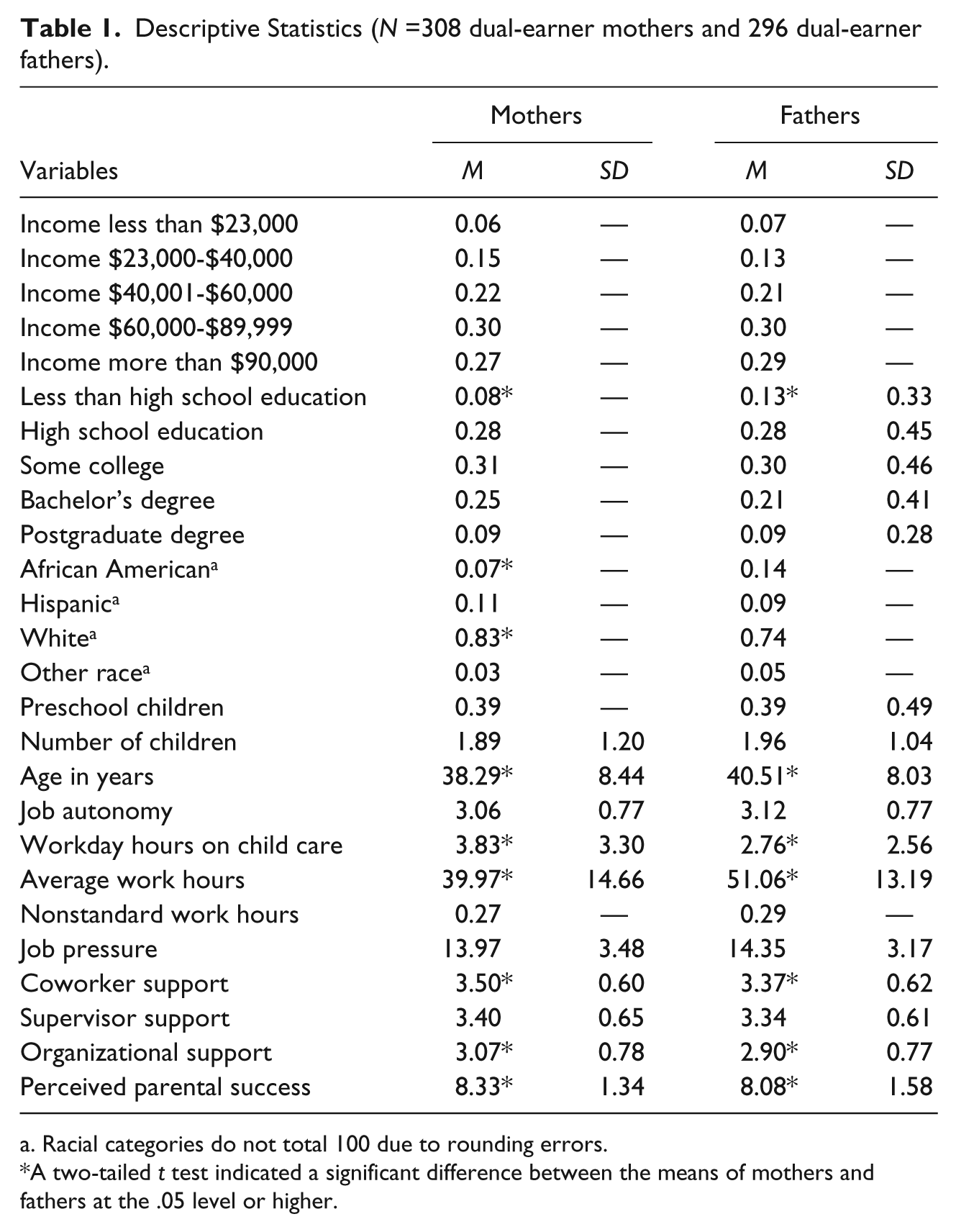
Racial categories do not total 100 due to rounding errors.
A two-tailed t test indicated a significant difference between the means of mothers and fathers at the .05 level or higher.
Bivariate Correlations for Selected Independent Variables (N = 308 Dual-Earner Mothers and 296 Dual-Earner Fathers).
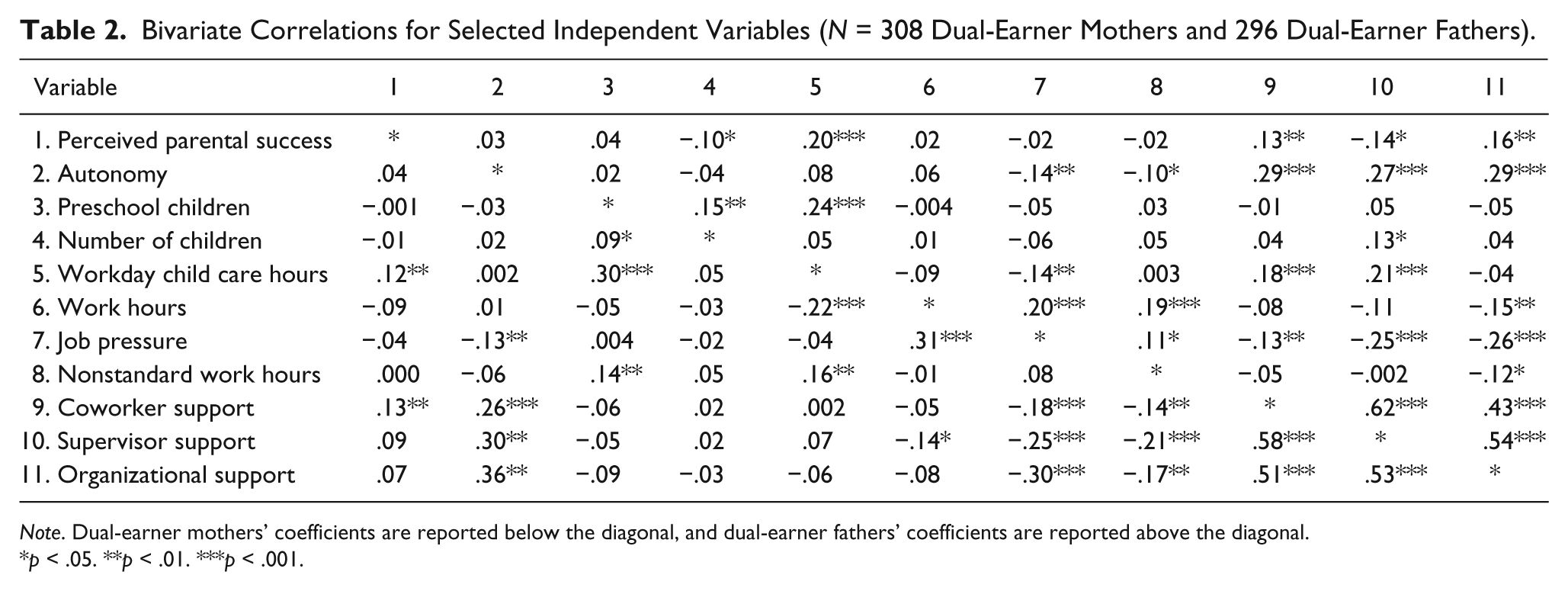
Note. Dual-earner mothers’ coefficients are reported below the diagonal, and dual-earner fathers’ coefficients are reported above the diagonal.
p < .05. **p < .01. ***p < .001.
The findings from the OLS regression can be found in Table 3. The first hypothesis stated that the job demands of work hours, job pressure, and nonstandard work hours would be negatively related to perceived parental success (see Model 2, Table 3). No support for this hypothesis was found for dual-earner mothers, as none of the job demands were significant in predicting their perceived parental success. Hypothesis 1 was partially supported among dual-earner fathers, as nonstandard work hours were negatively related to the dependent variable. The second hypothesis stated that the job resources of coworker support, supervisor support, and organizational support would be positively related to perceived parental success (see Model 2, Table 3). This hypothesis was partially supported for dual-earner fathers, as both coworker support and supervisor support were significantly and positively related to the dependent variable. The hypothesis was not supported for dual-earner mothers, although there was a positive relationship between coworker support and perceived parental success that was approaching statistical significance (p = .059).
Standardized Coefficients for Models Examining the Role of Job Demands and Resources in Predicting Perceptions of Success as a Parent for Dual-Earner Mothers and Fathers (N = 308 Dual-Earner Mothers and 296 Dual-Earner Fathers).

Note. Standard errors presented in parentheses.
$40,001 to $60,000 is the reference category.
White is the reference category.
Some college is the reference category.
p < .10. *p < .05. **p < .01. ***p < .001.
This study also investigated the interactions between job resources and job demands (see Model 3, Table 3). The results for dual-earner mothers indicated two significant interactions between job demands and job resources (nonstandard work hours × supervisor support and nonstandard work hours × organizational support). To interpret the first significant interaction, the interaction plot seen in Figure 1 was generated. I computed the regression lines implied by the model for dual-earner mothers’ perceived parental success on supervisor support for the categories of dual-earner mothers working standard hours and nonstandard hours. Because nonstandard work hours is a dummy variable, these were found by entering 0 and 1, respectively, for nonstandard hours in the model. The plotted endpoints of supervisor support are one standard deviation above and below the mean of that variable. All non-dummy variables are assumed to be at the centered means of 0, and therefore do not contribute to the lines shown. The dummy variables contribute according to their proportions in the sample. As shown in Figure 1, as dual-earner mothers’ supervisor support increases, this is associated with reduced perceived parental success among those working nonstandard work hours and enhanced perceived parental success among those working standard hours. Figure 2 was generated following the same procedures outlined above to interpret the interaction between nonstandard work hours and organizational support. As depicted in Figure 2, higher levels of organizational support are associated with higher levels of perceived parental success, but only among dual-earner mothers working nonstandard hours. The perceived parental success of dual-earner mothers working standard hours appears largely unrelated to organizational support.
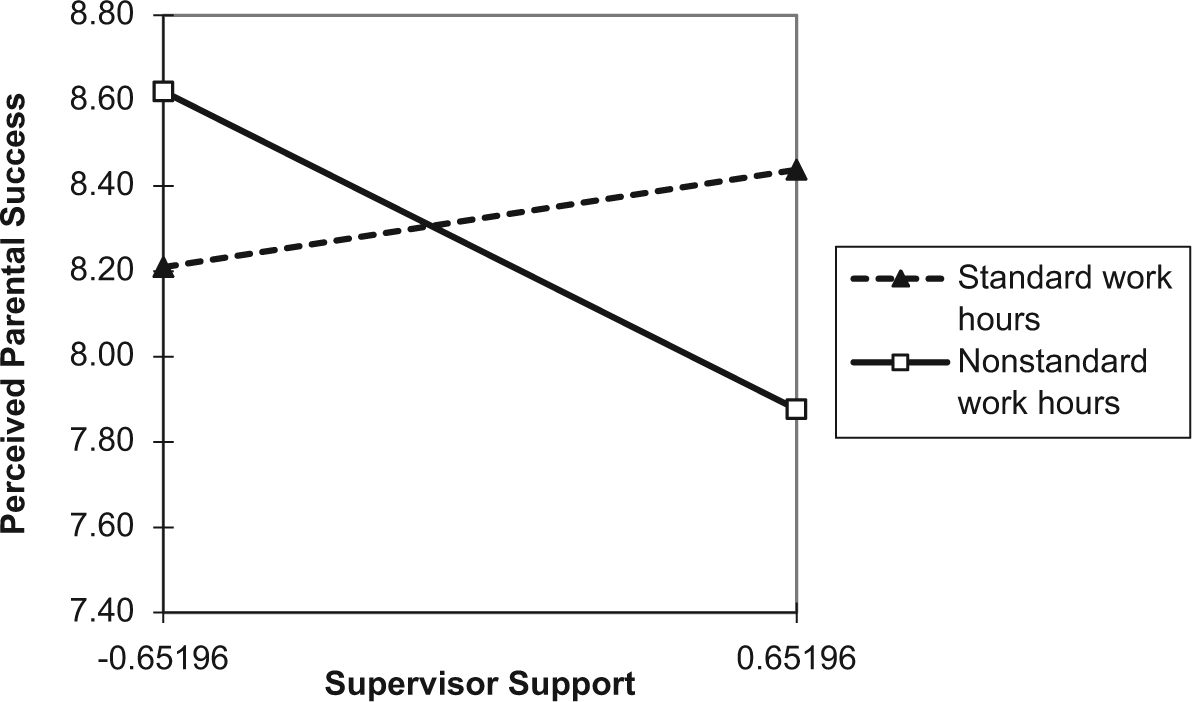
Interaction effects between dual-earner mothers’ nonstandard hours and supervisor support on perceived parental success.
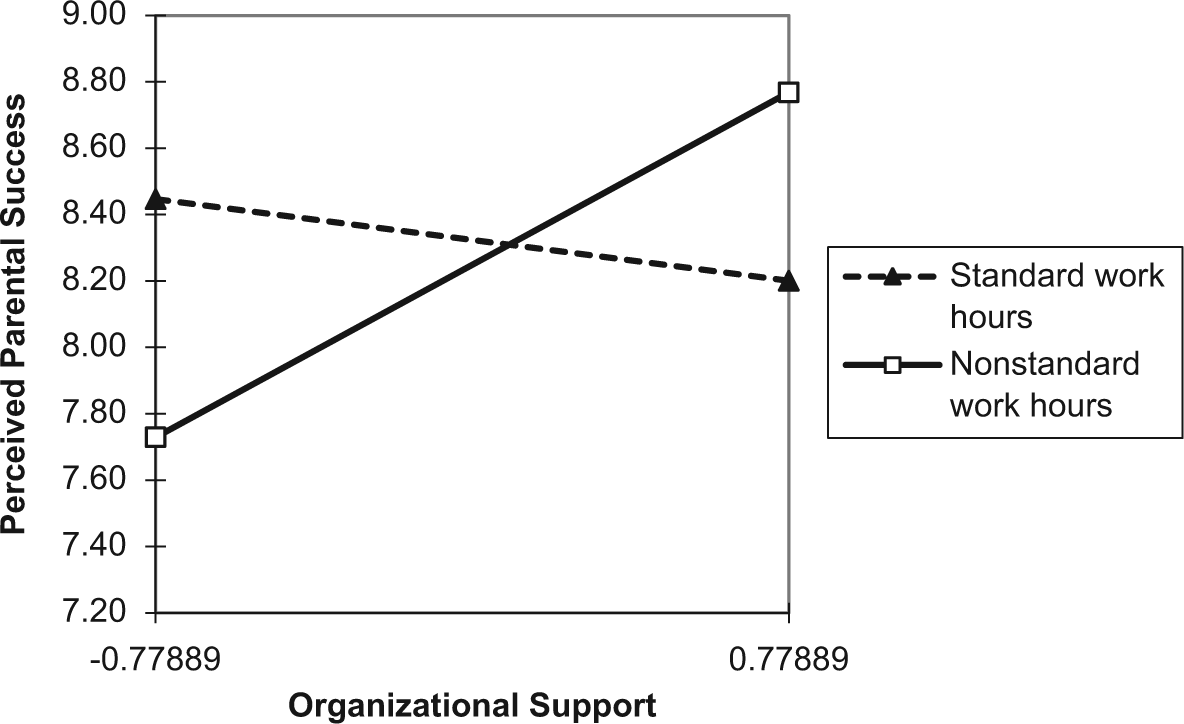
Interaction effects between dual-earner mothers’ nonstandard hours and organizational support on perceived parental success.
This study also explored gendered patterns in terms of how job demands and resources relate to perceived parental success. The results from Model 2 showing the direct effects indicated that job resources pertaining to workplace social support were more important in predicting perceived parental success among dual-earner fathers compared with mothers. Furthermore, there was a direct relationship between nonstandard work hours among dual-earner fathers that was not evident among the mothers in the sample. Last, significant interactions between job demands and resources were only found among dual-earner mothers. These findings suggest that there may be gendered patterns in terms of how job demands and resources relate to the dependent variable.
Discussion
Guided by the need to understand how parents feel about parenting, this study extended the job demands–resources model to examine how job demands and resources were related to the perceived parenting success of dual-earner mothers and fathers. A gender role socialization perspective was also used to explore whether any gendered patterns were evident. Not all job demands were influential in predicting perceived parental success. For instance, the findings indicate that work hours do not interfere with perceptions of parenting success among dual-earners, which is in contrast to past research showing that work hours may impact some objective parenting behaviors (e.g., Bass et al., 2009; Shreffler et al., 2011). As such, this finding points to possible differences in the antecedents of subjective versus objective parenting indicators. These findings also suggest that dual-earner fathers do not appear to be equating their parenting responsibilities solely with breadwinning activities. Indeed, the variable that bears the strongest relationship to fathers’ perceived parenting success is workday time spent with children, suggesting that dual-earner fathers are not embracing the “good provider role” as the sole indicator of their perceived parental success and may be holding themselves accountable to the recent call for active fathering (Christiansen & Palkovitz, 2001; Coltrane, 1996). Moreover, the findings from this study emphasize that it is the timing of work hours not the sheer number of work hours that predicts perceived parental success. In terms of policies and practices that aim to enhance such parental perceptions, efforts appear to be better spent on helping dual-earner fathers to avoid nonstandard hours and ensuring dual-earner mothers have high organizational support when they do have to work such hours. Theoretically, the results from this study imply that the timing and scheduling of hours are more important to perceived parental success than are the objective number of hours worked.
This study extends findings from past research that connect nonstandard work hours to objective parenting outcomes (e.g., Strazdins et al., 2006) by showing that such hours also appear to shape subjective parenting outcomes among fathers. Such fathers may feel like they are missing out on meaningful aspects of parenting, such as putting children to bed and having dinner together as a family, when they work such hours. Among fathers the finding adds to the growing literature demonstrating the difficulties entailed in nonstandard work hours for family life (Presser, 2000, 2003). It is worth noting that there was no direct relationship between nonstandard work hours and perceived parental success among mothers, suggesting that how such hours come into play for mothers may depend on the presence of absence of specific job resources or other contextual variables.
The importance of the job resources of coworker support and supervisor support for dual-earner fathers’ perceived parental success are highlighted by this study. It is likely that both instrumental and emotional support play important roles in terms of how these resources relate to perceived parental success. In addition to reducing work-to-family conflict and increasing work-to-family enhancement (e.g., Glavin & Schieman, 2010; Hill, 2005), these job resources appear to bolster how successful fathers view themselves as parents. It may be that when dual-earner fathers have higher levels of these forms of support that they feel more comfortable talking about their children at work and using any family-friendly policies that may be available in their workplaces, thereby embracing a more active fathering role (Coltrane, 1996). Fathers may be unlikely to bring up their children when they work in unsupportive workplace environments, and this may make them feel more distanced from their children. In terms of perceived parental success, it appears that the more immediate forms of workplace social support matter more than the larger organizational support for dual-earner fathers.
The findings from this study suggest that in order to truly understand how the job demand of nonstandard hours relates to perceived parental success among mothers, job resources must also be considered. This is in contrast to past research demonstrating a direct, negative relationship between nonstandard work hours and objective parenting outcomes (e.g., Grzywacz et al., 2011). In particular, this study found that organizational support appears to buttress the perceived parental success of dual-earner mothers working nonstandard hours. It may be the case that the overall tone of the organization matters more to such mothers because they are likely to work in contexts isolated from supervisors and coworkers. In such an environment, the overall atmosphere of the workplace, as reflected in organizational support, is likely to matter a great deal, as supervisors and coworkers may not be present to provide support. Furthermore, in this study supervisor support is related to enhanced perceived parental success, but only among the mothers working standard hours. It may be that supervisor support is more helpful in buttressing the perceived parental success of dual-earner mothers working standard hours because such mothers have greater contact with their supervisors who may be more influential in setting the tone of the workplace. In contrast, dual-earner mothers working nonstandard hours may have little to no contact with their supervisor given their work schedules. This may leave such mothers relatively unaffected by their supervisors, even when supervisor support is high.
This study also explored how gender comes into play in predicting perceived parental success. In terms of the job demands–resources model, direct relationships were more central to dual-earner fathers and indirect relationships more important for mothers, suggesting that the application of the job demands–resources model to family outcomes might operate in gender differentiated ways. It may also be the case that given the recent call for increased involvement of fathers in their children’s lives (Coltrane, 1996) that only fathers who feel supported in the workplace are able to lead lives that adhere to such norms, regardless of the presence or absence of other variables. Furthermore, it also appears that the models, in general, are more predictive of fathers’ perceived parental success compared with mothers’ (as reflected in the higher percentage of variance explained in the perceived parental success of dual-earner fathers), perhaps pointing to a greater importance of job demands and resources for fathers. Also indicative of gendered patterns, the predictions for fathers significantly improve with the introduction of the job demands and resources, whereas they do not significantly improve the predictions for mothers.
The present study is characterized by limitations that should be taken into consideration. First, a one-item measure of perceived parental success may not be as reliable as one that incorporated a number of items, as it may miss certain nuances in how parents view themselves—thus, potentially introducing measurement error into the analysis. Nonetheless, I am hopeful that this item does provide a good, general picture (somewhat like a grade on a report card) of perceived parental success. Second, the inability to take into consideration the work schedule of the respondents’ partners may have interfered with the ability to detect how the 24/7 economy shapes perceived parental success (Presser, 2003). It may the combination of both partners’ schedules that shapes perceived parental success among dual-earner parents. A third limitation concerns the use of self-report measures of key variables introducing the possibility of common method variance, thereby potentially overstating the relationships uncovered among variables. However, it is noted that previous research on the job demands–resources model using both self-report and observer ratings has found strong support for the model (Demerouti, et al., 2001). A last limitation concerns the cross-sectional nature of the study, making it impossible to determine the direction of causality among the variables.
I have argued that it is important to consider not just objective indicators of parenting but also subjective perceptions of how parents feel about their parenting. As such, the present study adds to a small but growing literature on perceptions of parenting. I also extended the job demands and resources approach to consider the outcome of perceived parental success. In doing so, this study highlights that dual-earners raise children in a stressful context of juggling two jobs with family responsibilities (Moen & Yu, 2000) and that as they do so the job context comes into play in shaping how they see themselves as parents, especially in terms of the job demands and job resources found therein (e.g., Bakker & Demerouti, 2007).
Future research should continue to consider perceptions of parental success. Such studies can help identify further job demands and job resources that come into play. Studies that place dual-earners in the context of the couple would be especially insightful, as they would allow us to see, for instance, how each partner’s job demands and job resources shape perceptions of parental success. The continued uncovering of mechanisms that shape perceived parental success can potentially help ease the burdens of working parents, especially as further job resources that parents can draw on are identified. Future research should continue to expand the outcomes of the job demands and resources model beyond the workplace walls. Indeed, this study along with work by Bakker et al. (2011) highlight that job demands and resources do spillover to affect workers in other spheres.
Footnotes
Declaration of Conflicting Interests
The author(s) declared no potential conflicts of interest with respect to the research, authorship, and/or publication of this article.
Funding
The author(s) received no financial support for the research, authorship, and/or publication of this article.