



Abstract
This study examined the gender difference regarding the simultaneous impacts of Job Demands–Control–Support model variables (job demands, job control, supervisor support, and coworker support) on job satisfaction via work–family conflict using multiple group structural equation modeling. The participants were 1,092 male and 1,367 female employees from the 2008 National Study of the Changing Workforce. Results showed that job control was only significantly associated with work–family conflict in female employees. In addition, high levels of job control, supervisor support, and coworker support were significantly associated with an increase in job satisfaction in both male and female employees. Regarding the mediating effect, work–family conflict mediated relationships between job demands, supervisor support, coworker support, and job satisfaction in both male and female employees, whereas work–family conflict only mediated the association between job control and job satisfaction in female employees. In this study, the implications considering the gender difference and work–family contexts are discussed.
Keywords
Female employment rates are steadily increasing, and dual-earner families are becoming a common model in the majority of countries included in the Organization for Economic Co-operation and Development (2010). For this reason, the work domain is one of the most significant areas affecting the well-being of both male and female employees and their family members. According to Gallup’s 2014 Work and Education Poll, half of all full-time employees worked more than 40 hours; moreover, 4 out of 10 worked more than 50 hours in the United States (Saad, 2014). This means that many workers spend most of the day at their workplace. From the employees’ perspective, a family-friendly workplace can alleviate an employee’s struggle to manage multiple life roles (Allen, 2001). From the employer’s point of view, an employee’s well-being in the work environment is an important issue because it contributes to high-quality job performance, an elevated level of job satisfaction, and lower voluntary turnover rates (Friedman & Greenhaus, 2000). Bronfenbrenner’s (1986) ecological framework suggested that the workplace has a strong and significant influence, affecting working parents and their children’s development through various direct and indirect ways. For example, long working hours, job burnout, and work stress can directly undermine employees’ parenting behaviors, which in turn influences young children’s developmental outcomes. In sum, the work environment is considered an overarching topic in the research field of work and family.
Many studies have investigated the impact of the work environment on individual workers’ wellness, and results show that organizational factors such as job demands, job control, supervisor support, and coworker support are significantly associated with employees’ psychological well-being (Häusser, Mojzisch, Niesel, & Schulz-Hardt, 2010; van der Doef & Maes, 1999). However, Netterstrom et al. (2008) have argued that previous research has overlooked the possibility of gender difference in the association between work environment and employees’ well-being; they point out that many studies conventionally adjusted for gender as one of the control variables. Although recent empirical studies on this issue have investigated the association among organizational factors, employees’ perception of work–family conflict, and their job-related well-being (Hammer, Saksvik, Nytrø, Trovatn, & Bayazit, 2004; Karimi, Karimi, & Nouri, 2011; Pal & Saksvik, 2008; Treiber & Davis, 2012), they have not focused on the gender difference in detail.
To address this gap in the literature, we set out to compare the gender difference regarding the impact of the work environment on employees’ job satisfaction via work–family conflict using the 2008 National Study of the Changing Workforce, a large representative database in the United States. We provide a theoretical background for each of the variables and pose related hypotheses based on the Job Demands–Control–Support model (Karasek, Triantis, & Chaudhry, 1982). Figure 1 represents the hypothesized model, which will be described in step-by-step detail.
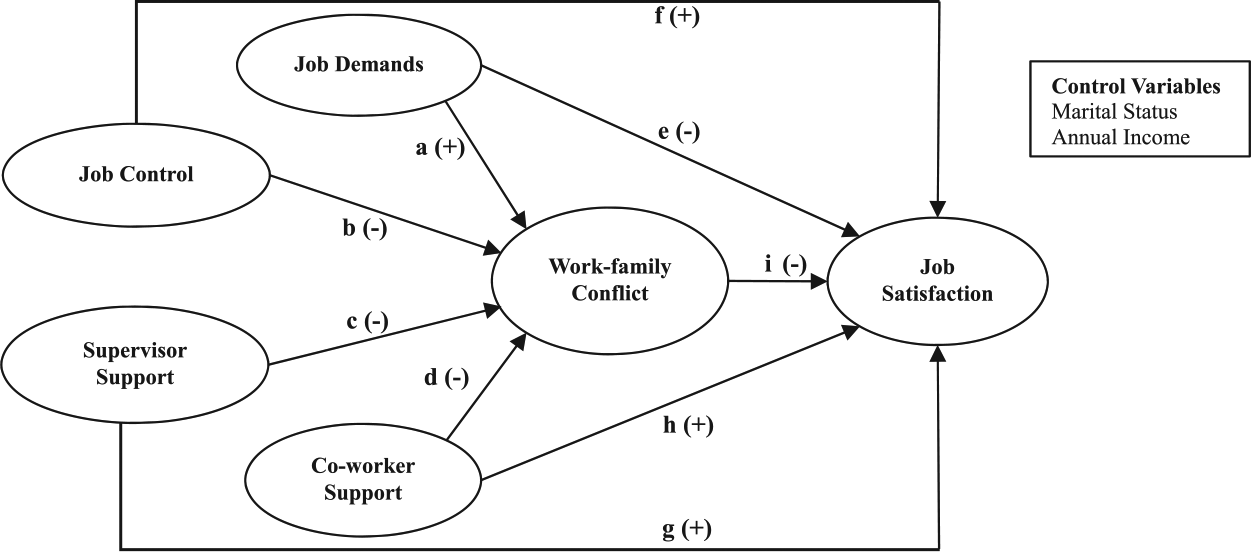
The hypothesized model.
Theoretical Background
The Job Demands–Control–Support Model
The Job Demands–Control–Support model (Karasek et al., 1982) is a well-known theoretical perspective that has helped explain the relationship between job characteristics and workers’ psychological well-being over the past three decades. Job demands cause a psychological tension with regard to the events occurring in work environments, commonly associated with heavy workload, unexpected tasks, and job-related strain (Karasek, 1979). Compared with the job demands, job control refers to employees’ opportunity to use specific job skills while they are working and his or her autonomy in job-related decisions in the workplace (Karasek & Theorell, 1990). Past literature has found that high levels of job demands deteriorate employees’ well-being, whereas greater job control is beneficial for alleviating employees’ work-related strain (Häusser et al., 2010; Joudrey & Wallace, 2009; van der Doef & Maes, 1999).
According to Karasek and Theorell (1990), work-based social support is defined as the “overall levels of helpful social interaction available on the job from both co-workers and supervisors” (p. 69). Supervisor and coworker support have something in common, as they are both considered coping resources in the workplace to buffer the impact of job-related stress on employees (Karasek et al., 1982). However, supervisor and coworker support have different characteristics of impact on employees depending on the work environment. According to Treiber and Davis (2012), coworker support has more critical and immediate influence as compared with supervisor support because the relationship with a coworker is equal and more companionate than it is with a supervisor. In addition, coworker support is a large factor in potential work environment resources, especially when organizations emphasize teamwork with their staff (Kossek, Pichler, Bodner, & Hammers, 2011). Supervisor support is more strongly related to employees’ job attitude, such as job satisfaction, commitment, and turnover intention, rather than coworker support (Ng & Sorensen, 2008). If organizational culture is relatively hierarchical, a supervisor’s influence is likely to be more valued in the work environment (Hwang, Lee, & Lee, 2012).
Job Satisfaction
Recent research on the Job Demands–Control–Support model has focused on employees’ general psychological and job-related well-being as outcomes (Häusser et al., 2010). Among outcome variables, job satisfaction is the employee’s overall affective orientation toward his or her work role (Kalleberg, 1977), and it has received wide attention from both employees and employers. According to the spillover perspective, good moods and high energy in one domain can affect the other domain (Edwards & Rothbard, 2000; Grosswald, 2003). In other words, employees’ high levels of job satisfaction in the work domain can positively influence their family life and well-being. From the employer’s perspective, managing employees’ job satisfaction is significant because it can directly affect an organization’s profit. Empirical studies have found that job satisfaction is a predictive factor for job performance, counterproductive work behavior, and turnover intentions (Eby, Deena, Michael, & Charles, 1999; Shore & Martin, 1989; Spector, 1997). In particular, employees’ increased job satisfaction is strongly associated with a decline in their turnover intentions (Podsakoff, LePine, & LePine, 2007; Tschopp, Grote, & Gerber, 2013). Considering that high levels of turnover intentions lead to extra spending for recruiting and training new employees, organizational leaders began to have interest in the significance of managing employees’ job satisfaction to enhance employee productivity and organizational profit (Kim, 2002).
Work–Family Conflict
There is growing empirical evidence that the boundaries between work and family domains are blurred because work environment factors encroach on an employee’s family life (Hammer et al., 2004). Consequently, work–family conflict occurs when employees are unable to cope with the conflicting demands of time and energy in both organizational and familial contexts (Ramadoss, 2013). Greenhaus and Beutell (1985) defined work–family conflict as “a form of interrole conflict in which the role pressures from the work and family domains are mutually incompatible in some respect” (p. 77). The initial concept of work–family conflict was based on unidirectional flow: The work domain interferes with the family domain (Greenhaus & Beutell, 1985). Afterwards, researchers recognized the bidirectional characteristic of work–family conflict: The family domain interferes with the work domain (Carlson, Kacmar, & Williams, 2000; Frone, Russell, & Cooper, 1992). Considering that the goal of the present study is to investigate the impact of organizational contexts on individual and familial contexts, this study narrowed down the bidirectional concept of work–family conflict to focus on the unidirectional concept of work-to-family conflict.
Many studies have examined the mediating role of work–family conflict in the complex relationship between work environment and employees’ psychological well-being (Magee, Stefanic, Caputi, & Iverson, 2012; Major, Klein, & Ehrhart, 2002; Parasuraman, Purohit, Godshalk, & Beutell, 1996; Treiber & Davis, 2012). However, empirical studies on the association between the Job Demands–Control–Support model variables and job satisfaction via work–family conflict are scarce. Regarding the Job Demands–Control–Support model, job demands, job control, supervisor support, and coworker support are considered to be an antecedent of work–family conflict (Bianchi & Milkie, 2010). For example, high levels of job demands are significantly related to an increase in work–family conflict, whereas high levels of job control are significantly related to a decrease in work–family conflict (Carlson et al., 2011). In addition, supervisor and coworker support are significantly associated with lower levels of work–family conflict (Byron, 2005). Regarding the consequences of work–family conflict, many studies have found that work–family conflict is significantly associated with lower levels of job satisfaction (Allen, Herst, Bruck, & Sutton, 2000; Kossek & Ozeki, 1998). In terms of the mediating role of work–family conflict, past literature examined the mediating effect of work–family conflict in the relationship between job demands and job satisfaction (Gao & Jin, 2015) and the association between supervisor support and job satisfaction (Thomas & Ganster, 1995). In conclusion, it is possible that work–family conflict is a key variable to mediate the relationship between the Job Demands–Control–Support model variables and employees’ job satisfaction.
Gender Difference
Previous studies delivered mixed messages about the gender difference in the association between the Job Demands–Control–Support model variables and employees’ well-being (Vermeulen & Mustard, 2000). On the one hand, many studies have showed that the impact of the Job Demands–Control–Support model variables on employees’ psychological well-being is similar in men and women (Häusser et al., 2010; van der Doef & Maes, 1999). Some studies have failed to find the gender difference in the relationship between work characteristics and psychological distress (Pugliesi, 1995), and in the association between work-based support and job satisfaction (Ng & Sorensen, 2008). Similarly, Roxburgh (1996) argued that there is a gender difference in the association between job demands and employees’ well-being, but that the effect is small.
On the other hand, other research has put forth opposite views and noted that there is a gender difference between the Job Demands–Control–Support model variables and employees’ well-being. For example, Armon, Melamed, Shirom, and Shapira (2010) found that workload, job control, and work-based social support are significant predictors of increased depression for male employees but not for female employees. Grönlund’s (2007) study showed that job control is more significantly associated with a decrease in work–family conflict among employed women than among employed men. Grandey, Cordeiro, and Crouter (2005) argued that the association between work–family conflict and job satisfaction is stronger for female employees than for male employees because female employees are still likely to be the caretaker in the family domain.
In conclusion, the results of gender difference regarding the Job Demands–Control–Support model is still controversial. However, many studies investigating the impact of job characteristics on employees’ job satisfaction adjusted gender as a control variable (Baruch-Feldman, Brondolo, Ben-Dayan, & Schwartz, 2002; Cambré, Kippers, van Veldhoven, & De Witte, 2012; Ducharme & Martin, 2000). Therefore, it is difficult to examine how work environments differently affect employees across gender, and thus additional studies are needed.
The Current Study
Theoretical perspectives on the Job Demands–Control–Support model have influenced much research regarding work environments and employee’s well-being. However, previous studies have overlooked the simultaneous effect of the Job Demands–Control–Support model variables on employees’ job satisfaction via work–family conflict. Furthermore, even though past literature has showed conflicting results of gender difference regarding the impact of the Job Demands–Control–Support model variables on employees’ job satisfaction, empirical studies have utilized gender as a control variable in their research models conventionally. Therefore, the present study employed multiple group analysis and tested for difference between male and female employees to compensate for the limitations of the Demands–Control–Support model research. Overall, the present study tested the following hypotheses (see Figure 1):
In addition, the present study added a research question regarding gender: Do the hypothesized relationships among job demands, job control, supervisor support, coworker support, job satisfaction, and work–family conflict differ by gender? In this study, marital status and annual income were controlled as covariates in the model.
Method
Participants
The data used to evaluate hypotheses come from the 2008 National Study of the Changing Workforce (NSCW) conducted by the Family and Work Institute. The NSCW included a nationally representative sample of 3,502 employed adults in the labor force. The data were collected by telephone using a Computer Assisted Telephone Interviewing system, and the response rate for the sample was 54.6% (Families and Work Institute, 2011). Among 3,502 working adults, this study selected 2,459 wage and salaried employees who had worked for someone else and who had worked with a supervisor and coworkers (male = 1,092; female = 1,367).
The sample’s mean age was 44.81 years for males and 46.54 years for females. In the case of educational backgrounds, 291 men (26.6%) graduated from 4-year colleges, and 250 men (22.9%) graduated from high schools. Similarly, 362 women (26.5%) graduated from 4-year colleges, and 283 women (20.7%) graduated from high schools. Regarding marital status, 733 male employees (67.1%) and 744 female employees (54.4%) were legally married, and 529 male employees (48.4%) and 662 female employees (48.4%) were in dual-earner families. The average of annual household income was $62,210 for male employees and $41,840 for female employees.
Measures
Job demands were measured using three items (e.g., “My job requires that I work very hard,” “My work environment is competitive and fast paced”). Each item was measured by a 4-point Likert-type scale ranging from 1 (strongly disagree) to 4 (strongly agree), with the high scores reflecting high levels of job demands. For this study, Cronbach’s α was .59 in the male group and .65 in the female group.
Job control was assessed using three items about the extent of freedom for work and decision latitude (e.g., “I have the freedom to decide what I do on my job,” “It is basically my own responsibility to decide how my job gets done”). Each item was measured by a 4-point Likert-type scale ranging from 1 (strongly disagree) to 4 (strongly agree), with the high scores reflecting high levels of job demands (α = .74 in both male and female groups).
Supervisor support was calculated by averaging the individual’s responses to five questions (e.g., “My supervisor or manager is understanding when I talk about personal or family issues that affect my work,” “My supervisor or manager really cares about the effects that work demands have on my personal and family life”). Response alternatives ranged from 1 (strongly disagree) to 4 (strongly agree). A high score represented a supportive supervisor (α = .82 in the male group; α = .84 in the female group).
Coworker support was assessed using three items (e.g., “I have the support from coworkers that I need to do a good job,” “I feel I am really a part of the group of people I work with”). The response categories range from 1 (strongly disagree) to 4 (strongly agree). The responses were combined into an index with higher scores indicating high coworker support (α = .75 in the male group; α = .77 in the female group).
Work–family conflict was measured using three items (e.g., “How often have you not had enough time for your family or other important people in your life because of your job?” “How often have you not had the energy to do things with your family or other important people in your life because of your job?”). Response alternatives ranged from 1 (never) to 5 (very often), with the higher scores reflecting high levels of work–family conflict (α = .79 in the male group; α = .82 in the female group).
Job satisfaction was determined by asking the respondent three items (e.g., “All in all, how satisfied are you with your job?” “If a good friend of yours told you that he or she was interested in working in a job like yours, would you strongly recommend your job?”). Three items were rated on a scale ranging from 1 (not satisfied at all) to 4 (very satisfied), with higher scores reflecting high levels of job satisfaction. Cronbach’s α was .75 in the male group and .79 in the female group.
In terms of control variables, this study utilized marital status (0 = no; 1 = legally married) and annual income as covariates in the hypothesized model.
Results
Descriptive Analysis
Table 1 presents means, standard deviations, and correlations for the main variables across genders. Regarding mean difference, female employees reported significantly higher levels of coworker support (F = 4.11, p = .043) and job satisfaction (F = 4.49, p = .034) than male employees. Other study variables showed no mean difference across gender. In terms of correlations, job demands were only negatively associated with job satisfaction in female employees (β = −.05, p = .049). This means that as job demands increase, job satisfaction decrease only for female employees.
Means, Standard Deviations, and Correlations of Study Variables Across Gender.
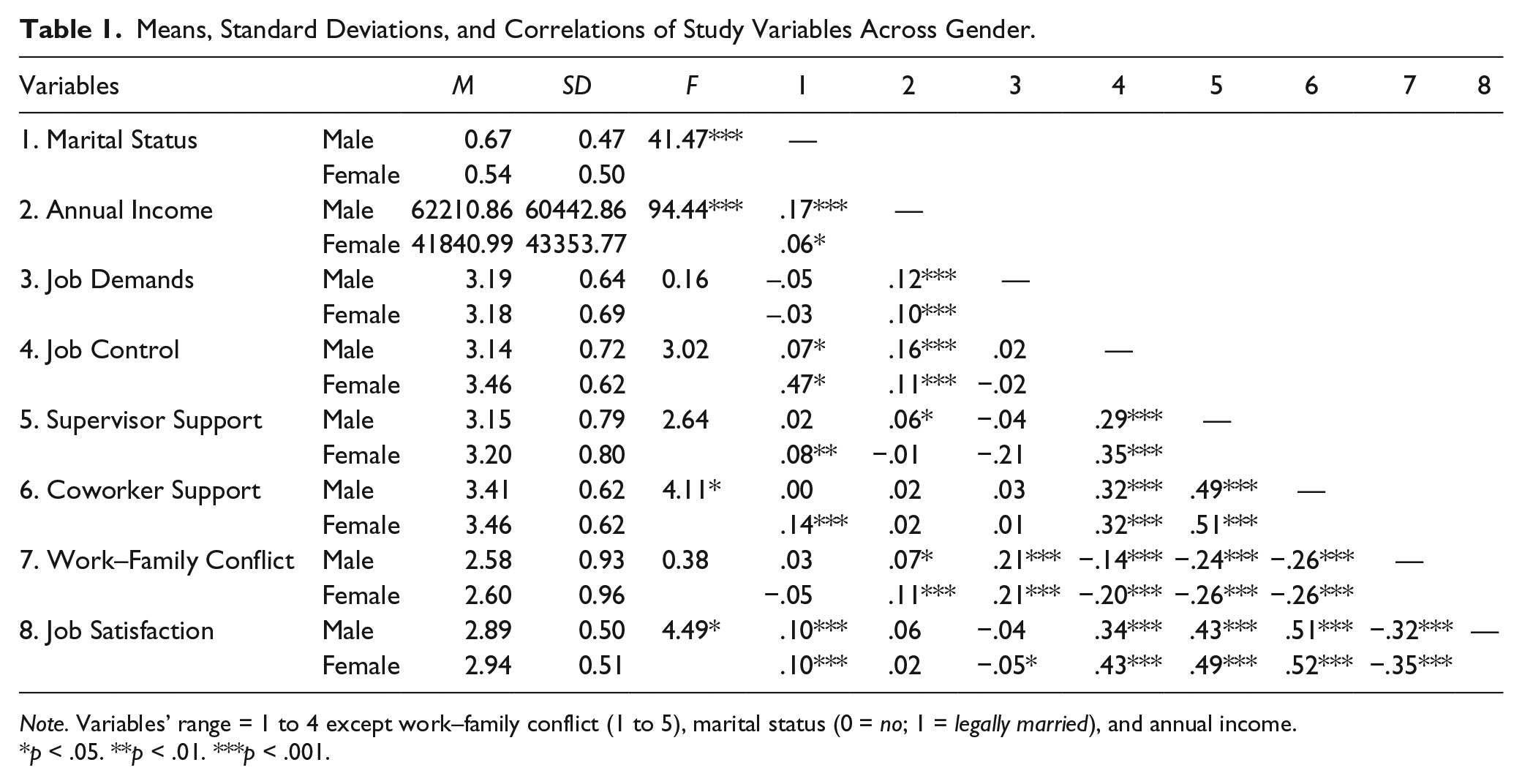
Note. Variables’ range = 1 to 4 except work–family conflict (1 to 5), marital status (0 = no; 1 = legally married), and annual income.
p < .05. **p < .01. ***p < .001.
Testing the Hypothesized Model
The goal of this study is to examine differential effects of the Job Demands–Control–Support model variables on job satisfaction via work–family conflict across gender. Therefore, the present study utilized multiple group analysis using the maximum likelihood method in Amos 19.0 based on the hypothesized model. In this study, multiple group analysis was conducted using three steps (Brown, 2012). First, this study tested male and female groups’ hypothesized model respectively. If one of the groups showed a poor model fit, it was not necessary to analyze any further steps of the measurement invariance evaluation. Second, the present study conducted simultaneous analysis of equal form between male and female groups. This equal form analysis is to ensure that the items of a questionnaire measure the same constructs in male and female groups. In the last step, this study evaluated whether the factor loadings of the latent variable indicators are equivalent in male and female groups. This step is a core test in a multiple group analysis because this equal-factor loading analysis determines whether the measures have the same structure and meaning for different groups of respondents (Brown, 2012). This study conducted three indices to assess the fit of our hypothesized model in male and female groups based on Hu and Bentler’s (1999) suggestion to evaluate structural equation modeling analysis: comparative fit index (CFI; value greater than .95 indicates a reasonably good model), root mean square error of approximation (RMSEA; value less than .06 indicate an adequate model fit), and standardized root mean square residual (SRMR; value less than .08 indicate a good model fit). Regarding control variables, the present study utilized a standardized annual income value in the analysis.
Table 2 presents the results of the multiple group analysis of the hypothesized model in male and female groups. In the first step, male and female employee groups showed a reasonably good model fit respectively (male: χ2(156) = 544.213, p < .001, CFI = .938, RMSEA = .048, SRMR = .047; female: χ2(156) = 481.129, p < .001, CFI = .963, RMSEA = .039, SRMR = .042). Therefore, this study conducted equal form and equal factor loadings analysis. Results showed that both the equal form and equal factor loadings models had an overall good fit to the data (equal form model: χ2(246) = 1415.429, p < .001, CFI = .963, RMSEA = .030, SRMR = .048; and equal factor loadings: χ2(257) = 1431.079, p < .001, CFI = .963, RMSEA = .030, SRMR = .048). Furthermore, chi-square between equal form and equal factor loadings models were not significantly different: Δdf(11) = 15.650, p > .05. This result indicates that the measures have the same structure and meaning for male and female employee groups.
Results of Multiple Group Analysis.
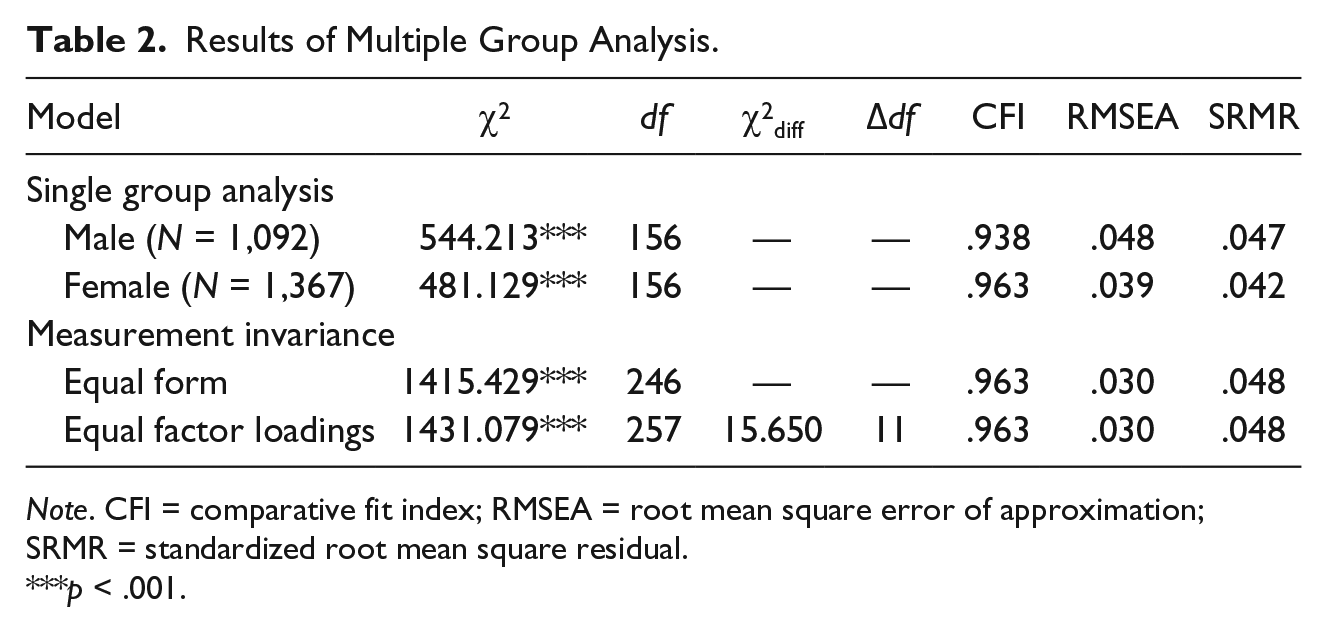
Note. CFI = comparative fit index; RMSEA = root mean square error of approximation; SRMR = standardized root mean square residual.
p < .001.
Male and female employees’ results are shown in Figures 2 and 3. Regarding the first hypothesis, job demands were significantly associated with greater work–family conflict (Path a) in both male and female employee groups (β = .30, p < .001 in male; β = .28, p < .001 in female). In addition, supervisor and coworker support were strongly linked to lesser work–family conflict (Paths c and d) in both male and female employee groups (β = −.12, p = .023, and β = −.24, p < .001, in male; β = −.15, p < .001; β = −.19, p < .001 in female, respectively). However, unlike the male employee group, job control was significantly and negatively associated with work–family conflict (Path b) in the female employee group (β = −.11, p = .006). In terms of the second hypothesis, on the one hand, there was no significant relationship between job demands and job satisfaction in both male and female employee groups (Path e). On the other hand, job control, supervisor support, and coworker support were significantly related to greater job satisfaction (Paths f, g, and h) in both male (β = .17, p < .001; β = .16, p < .001; and β = .44, p < .001) and female (β = .30, p < .001; β = .09, p = .016; and β = .43, p < .001) employee groups. In the case of the third hypothesis, work–family conflict was negatively associated with job satisfaction (Path i) in both male and female employee groups (β = −.18, p < .001 in male; β = −.19, p < .001 in female). Marital status and annual income had no significant relationship with job satisfaction in both male and female employee groups. Overall, the male model in Figure 2 explained 22% of the variance in work–family conflict and 55% of the variance in job satisfaction, whereas the female model in Figure 3 explained 22% of the variance in work–family conflict and 59% of the variance in job satisfaction.
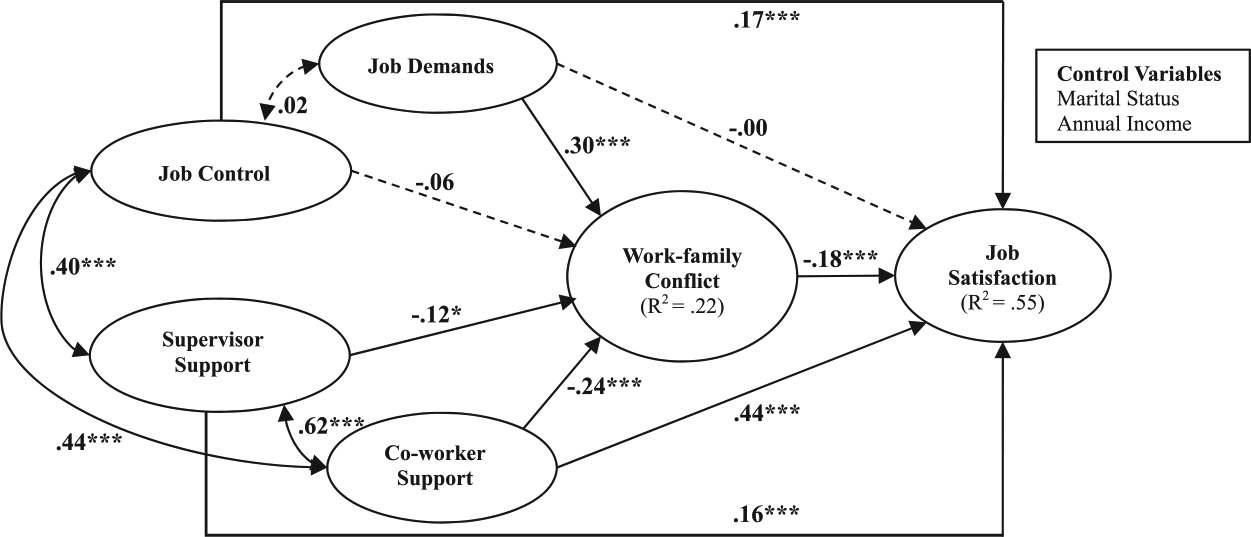
Results of the hypothesized model for male employees (N = 1,092).
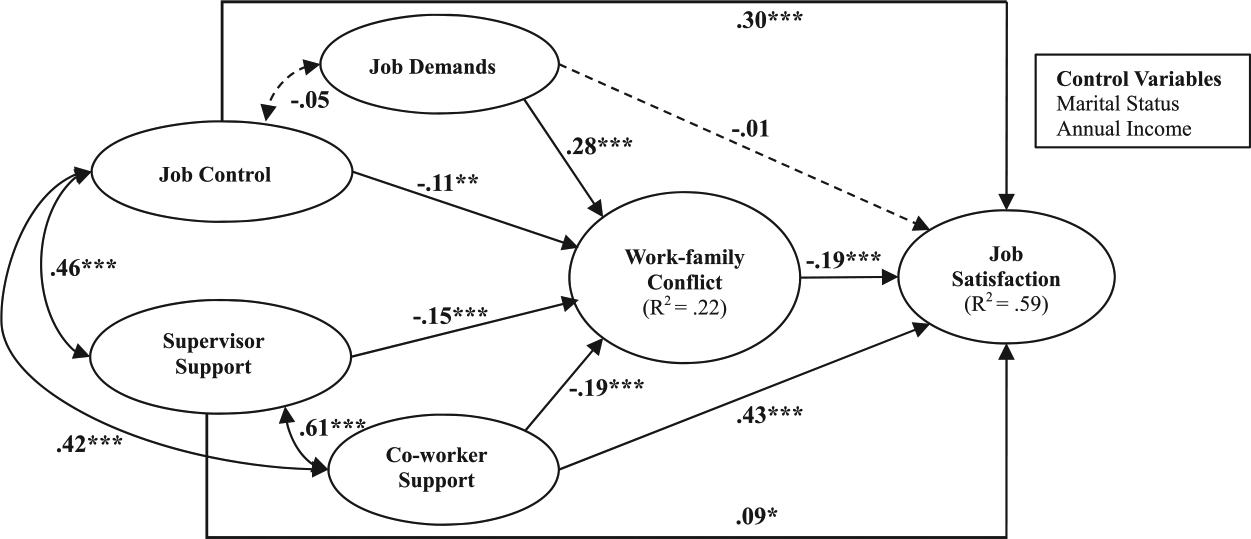
Results of the hypothesized model for female employees (N = 1,367).
Testing Mediation, Direct, Indirect, and Total Effects
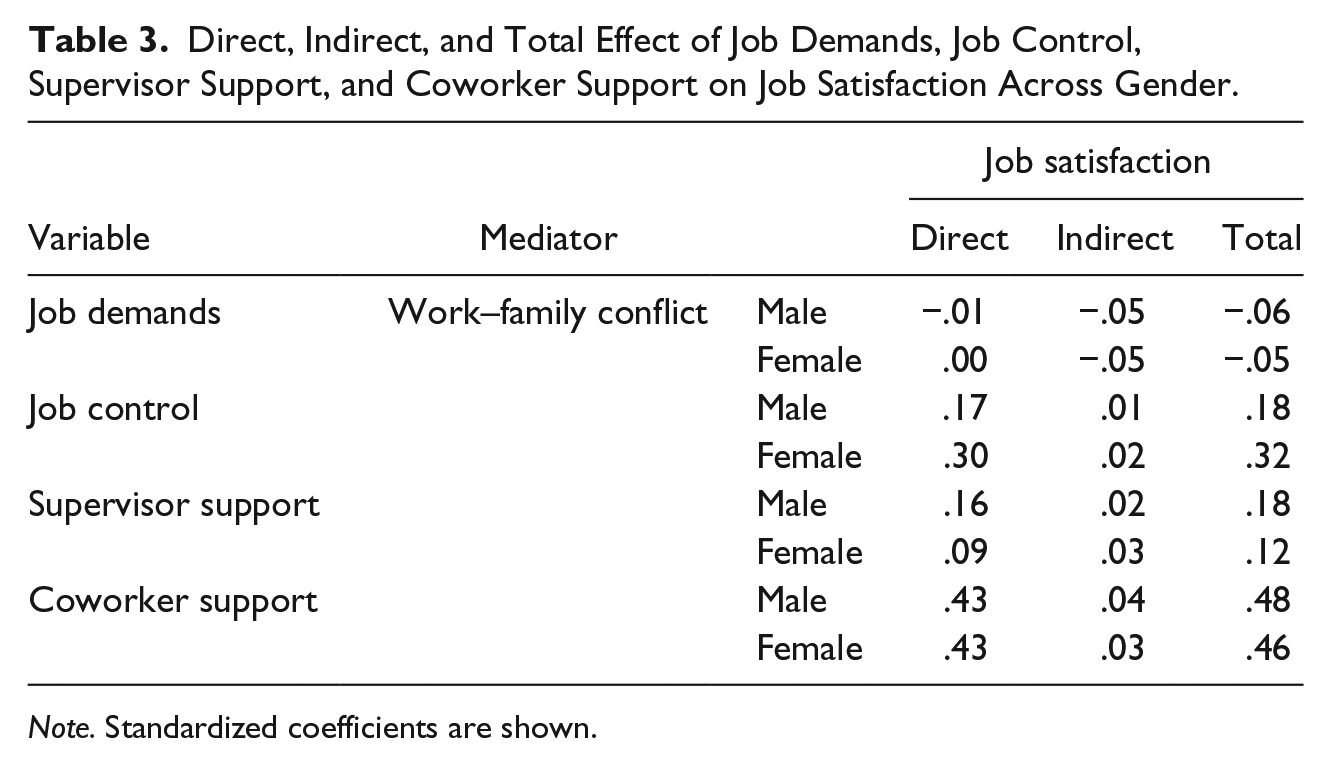
A Sobel test was employed to examine whether work–family conflict mediates the effect of job demands, job control, supervisor support, and coworker support with regard to job satisfaction. In order to calculate the z value for significance, unstandardized regression coefficients and their unstandardized errors were utilized from the theoretical model. Regarding the male employee group, the effect of job demands, supervisor support, and coworker support on job satisfaction was significantly mediated by work–family conflict (z = −3.71, p < .001; z = 2.01, p = .04; and z = 3.08, p < .001 respectively). Work–family conflict had no mediating effect between job control and job satisfaction. In the case of the female employee group, however, the effect of job demands, job control, supervisor support, and coworker support on job satisfaction was significantly mediated by work–family conflict (z = −4.82, p < .001; z = 2.51, p = .01; z = 2.91, p < .001; and z = 3.44, p < .001, respectively). Table 3 presents the direct, indirect, and total effect of study variables across gender. On the one hand, the total effect of job control, coworker support, and supervisor support on job satisfaction was .18, .48, and .18 in the male employee group, and .32, .46, and .12 in the female employee group, respectively. On the other hand, the total effect of job demands on job satisfaction was −.06 in the male employee group and −.05 in the female employee group. In conclusion, coworker support had the highest levels of total effect on job satisfaction in both male and female employee groups.
Direct, Indirect, and Total Effect of Job Demands, Job Control, Supervisor Support, and Coworker Support on Job Satisfaction Across Gender.
Note. Standardized coefficients are shown.
Discussion
The present study sought to understand how job demands, job control, supervisor support, and coworker support have a differential effect on job satisfaction via work–family conflict across gender. The hypotheses of this study are as follows. First, job demands contribute to greater work–family conflict, whereas job controls, supervisor support, and coworker support contribute to lesser work–family conflict and greater job satisfaction. Second, job demands contribute to lesser job satisfaction, whereas job controls, supervisor support, and coworker support contribute to greater job satisfaction. Third, work–family conflict contributes to lesser job satisfaction. Furthermore, the present study added a research question regarding a gender issue: Do the hypothesized relationships among job demands, job control, supervisor support, coworker support, job satisfaction, and work–family conflict differ by gender?
Results revealed that most hypotheses supported the Job Demands–Control–Support model (Karasek & Theorell, 1990). For example, job demands were significantly associated with an increase in work–family conflict, whereas supervisor and coworker support were significantly associated with decreases in work–family conflict. However, job control only showed a significant and negative relationship with work–family conflict in female employees. This inconsistency with the Job Demands–Control–Support model perspective has two potential explanations. First, job control may differently affect across male and female employees’ work–family conflicts. According to Grönlund (2007), women, who carry out their main responsibility at home, tend to utilize job control resources to reduce the role strain in the family domain. Previous studies showed that women are more vulnerable to work–family conflict than men because women spend more time doing housework and taking care of their children (Craig, 2006; Perry-Jenkins & MacDermid, 2012); thus, female employees feel more role overload between work and family domains than male employees (Duxbury, Higgins, & Lee, 1994; Higgins, Duxbury, & Lyons, 2010). Contrary to female employees, male employees tend to utilize job control resources to alleviate their demanding tasks in the work domain (Grönlund, 2007). According to Noonan, Estes, and Glass (2007), men step in to assist with domestic work only when their wives are not available. It is possible that male employees reinvest job control resources into their tasks in the work domain because they have an attitude that domestic work is not their main responsibility in the family domain, based on a traditional gender ideology. For this reason, job control can become a significant coping resource to reduce work–family conflict for female employees, unlike male employees. However, the present study did not examine participants’ time spent in the family domain, nor their attitude regarding gender ideology. Therefore, additional studies are required to explain the gender difference in the relationship between job control and work–family conflict using the aforementioned factors.
Second, from the male employees’ perspective, they may not necessarily utilize job control as a coping resource to reduce work–family conflict because they think that supervisor and coworker support are enough for managing their work–family conflict. Correlation analysis has shown that that job control had a significant and negative relationship with work–family conflict for both male and female employees. In the present study’s model, however, the effect of job control on work–family conflict disappeared in male employees. Considering the present study’s hypothesized model designed to examine the simultaneous effect of employees’ perception of the Job Demands–Control–Support model variables on their job satisfaction and work–family conflict, we assume that male employees may feel that supervisor and coworker supports are stronger and more significant resources than job control for managing their work–familyconflict. Future studies need to examine the time spent in a family domain for both male and female employees in order to verify the relationship between job control and work–family conflict across gender.
As the present study expected, job control, supervisor support, and coworker support predicted an increase in job satisfaction in both male and female employees. Although job demands had no significant direct effect on job satisfaction for both male and female employees, work–family conflict was significantly mediated between job demands and job satisfaction. In a similar vein, work–family conflict is the significant mediating variable between the Job Demands–Control–Support model variables and job satisfaction. Such results are in line with previous studies that have found that the Job Demands–Control–Support model can explain employees’ job-related well-being beyond personal psychological and physical well-being (Häusser et al., 2010; van der Doef & Maes, 1999). In addition, work–family conflict is a key psychological variable that forms a connection between the Job Demands–Control–Support model variables and job satisfaction (Grandey et al., 2005; Podsakoff et al., 2007). In the past two decades, work and family research has consistently shown that work-based support is important for employees and their families’ well-being (Bianchi & Milkie, 2010; Perry-Jenkins, Repetti, & Crouter, 2000). However, it seems that encouraging a family-friendly workplace for employees is not a top priority for organizations; employers still hesitate to hire women because female employees are more likely to quit their job because of family issues than male employees, and this leads to spending additional costs for hiring and training new employees (Estévez-Abe, 2005). For this reason, investigating employees’ job-related well-being is important to reduce the gap between employer and employee’s attitude of work and family issues. Future studies need to examine the relationship between employees’ job-related well-being and a company’s profit-related employee productivity and commitment, and turnover intentions as well as employees’ familial well-being.
Regarding the total effects of the Job Demands–Control–Support model variables on job satisfaction, coworker support was considerably higher than job demands, job control, and supervisor support. Considering that the organizational environment in the United States is less hierarchical based on the individualistic cultural contexts (Triandis, 1995), good coworker relationships are important for building effective teamwork and enhancing employees’ job satisfaction (Ducharme & Martin, 2000). However, other studies have asserted that supervisor support is more strongly associated with job satisfaction compared with coworker support because supervisor support plays a significant role for employees’ organizational life (Ng & Sorensen, 2008). According to Kossek et al. (2011), there were far less empirical studies on coworker support, especially as compared with supervisor support. Additionally, the impact of supervisor and coworker support on job satisfaction may differ across individualistic and collectivistic societies. Therefore, future studies need to examine the influence of supervisor and coworker support on employees’ job-related well-being in diverse cultural contexts.
As with all research, certain limitations should be acknowledged. First, the coefficient of reliability regarding job demands was not good compared with other measurements. Contrary to our expectations, the total effect of job demands on job satisfaction was considerably low compared with other study variables. Therefore, future studies need to examine the relationship between job demands and job satisfaction using a reliable measurement. Second, the present study tried to explain the gender differences of the impact of the Job Demands–Control–Support model variables on job satisfaction in a work domain. However, without family domain variables such as time spent on household work and parenting, family–work spillover, and marital satisfaction, this study cannot fully explain the relationship between the Job Demands–Control–Support model variables and job satisfaction across gender. Future studies need to examine the impact of both work and family domain variables on job satisfaction across gender. Third, this study is based on cross-sectional data in the United States. Therefore, the present study could not examine the causal effect of the Job Demands–Control–Support model variables on job satisfaction. In addition, other cultural contexts, such as a rigid and hierarchical organizational environment in collectivistic cultural contexts, may show a different implication compared with the individualistic cultural contexts in the United States. Therefore, longitudinal and comparative research methods are required to examine the relationship between the Job Demands–Control–Support model variables and job satisfaction.
Limitations notwithstanding, the results of this study highlighted several potential points for enriching the Job Demands–Control–Support model and work–family research. First, this study highlighted that there is a gender difference in the association between job control and work–family conflict. Therefore, the result of this study will be useful for examining gender differences of employees’ well-being in the workplace and for informing more effective work–family policies for both male and female employees. Second, the present study found the simultaneous effect of the Job Demands–Control–Support model variables and job satisfaction. As mentioned earlier, job satisfaction is a significant variable for both employers and employees. For this reason, the finding of this study expands the spectrum of the Job Demands–Control–Support model to job-related well-being beyond general psychological well-being. Third, this study found the mediating effect of work–family conflict between the Job Demands–Control–Support model variables and job satisfaction. It can be concluded that work–family conflict is the essential psychological bridge between work environments and employees’ job-related well-being.
Footnotes
Declaration of Conflicting Interests
The author(s) declared no potential conflicts of interest with respect to the research, authorship, and/or publication of this article.
Funding
The author(s) received no financial support for the research, authorship, and/or publication of this article.