



Abstract
Research suggests that child perception of parenting styles may strongly influence child outcomes and parents must balance support and structure based on their emerging adult children’s changing needs. The current study examined emerging adult perceptions of parenting style in comparison with their preferences and how these characteristics interact to predict psychological problems. Significant interactions between preferred and perceived parenting style were found, several of which were further moderated by gender. Results suggest that emerging adults prefer parenting styles that grant autonomy, and males reported lower psychological problems when they also perceived such a parenting style, whereas females reported higher psychological problems. This may suggest that females experience more risky behaviors while at college when granted autonomy relative to males, thus accounting for their higher psychological problems. The current study emphasizes the ongoing impact of parental influences on emerging adult outcomes and that children’s preferences and perceptions influence parent–child gender dyads.
When it comes to parenting and what children want, the adage “children seek structure” may apply. However, children also may struggle to have their way when their parents enforce limits. Furthermore, what children want and need may differ based on their development, and this tension may reach a zenith during emerging adulthood, when children are freer to speak their minds and strive for autonomy (Finley, Mira, & Schwartz, 2008). Cullaty (2011) and Schiffrin et al. (2014) addressed this developmental specificity by indicating that parents who exert excessive control may promote resentment and hinder autonomy in their emerging adult children, noting that emerging adult children do not prefer intrusive parents but also want parental support. Thus, it may be especially important to consider emerging adult preferences as the parent–child relationship may be disrupted if parents fail to consider these preferences and adjust to developmental changes. Despite this, a paucity of research exists on how children themselves prefer to be parented, and even less research compares children’s preferences with their perceptions or connects them with psychological outcomes. Thus, the current study investigated perceived and preferred parenting style in the context of parent–child gender dyads during emerging adulthood, a time still under the influence of parenting and at highest risk of psychiatric illness (Arnett, 2000; Kessler, Chiu, Demler, Merikangas, & Walters, 2005; Walker & McKinney, 2015).
In an older study, Sowers (1937) commented that children preferred parents to be kind, sincere, friendly, and self-controlled; provide firm but fair discipline without nagging; and avoid corporal punishment and consider their point of view (i.e., authoritative style). More recent studies are consistent with Sowers (1937), noting that emerging adults preferred supportive parental relationships characterized by authoritative style (Manza, 2008), with several studies finding gender differences (e.g., authoritarian style being viewed more negatively by females than males and in mothers than fathers; Barnhart, Raval, Jansari, & Raval, 2013; McGillicuddy-De Lisi, & De Lisi, 2007).
Although these studies begin to explore preferences regarding parenting, it appears that no other research addresses how emerging adults’ preferences and perceptions interact to predict psychological problems. Differences between perceived and preferred parenting may result in poor adjustment when emerging adult preferences and perceptions are mismatched. For example, emerging adults may experience increased difficulties when they prefer more autonomy in the face of parental overcontrol or more closeness with their parents than they are provided. Thus, the current study examined perceived and preferred parenting styles and how they interact to predict psychological problems. It advances the research described above by connecting parenting style perceptions with preferences and examining how these characteristics relate to psychological problems in emerging adults.
Life-course theory suggests that children are best served when they experience increasingly more independence as they transition through emerging adulthood with the support of their parents (Aquilino, 1997). Thus, it was hypothesized that emerging adults who preferred and perceived styles that promote autonomy would report lower psychological problems, whereas emerging adults who preferred styles that promote autonomy but perceived styles that hinder it would report higher psychological problems. Given prior findings, gender effects also were examined in an exploratory manner.
Method
Procedure
Following institutional review board approval, the survey was conducted online. Participants completed an informed consent form prior to participation and received a printable debriefing form on exiting the study. Completing or withdrawing from the study resulted in credit. Participants completed the preferred and perceived as well as the maternal and paternal versions of the Parental Authority Questionnaire separately to promote independence of ratings and with regard to current perceptions and preferences. Measures were completed in random order to balance order effects across participants.
Participants
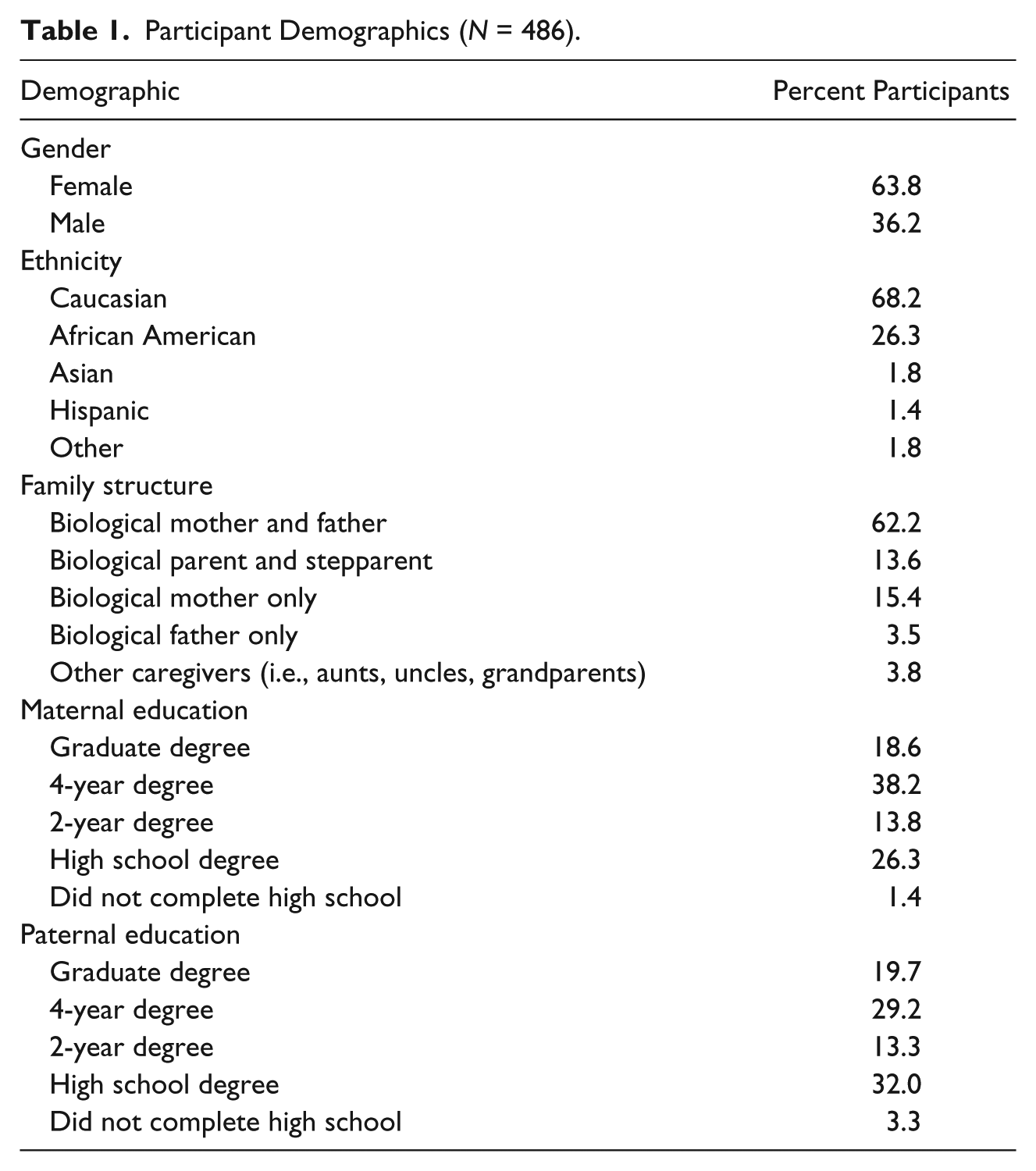
Participants included 486 emerging adults attending a Southern university (89.4% of participants originated from a Southern state) who were aged 18 to 25 years (M = 19.58 years, SD = 1.38). See Table 1 for participant demographics.
Participant Demographics (N = 486).
Descriptive statistics for preferred and perceived parenting style variables are reported in Table 2, and the mean of the Adult Self-Report total problem subscale was 38.65 (SD = 27.31). Correlations among variables are shown in Table 3. As shown in Table 2, males and females preferred and perceived authoritative style the most, followed by authoritarian and permissive style across mothers and fathers. As shown in Table 3, perceived maternal and paternal styles were associated positively with respective preferred styles across males and females, with rs ranging from .39 to .60.
Means and Standard Deviations of Preferred and Perceived Maternal and Paternal Parenting.

Note. PAQ = Parental Authority Questionnaire.
Correlations Among Variables by Gender.
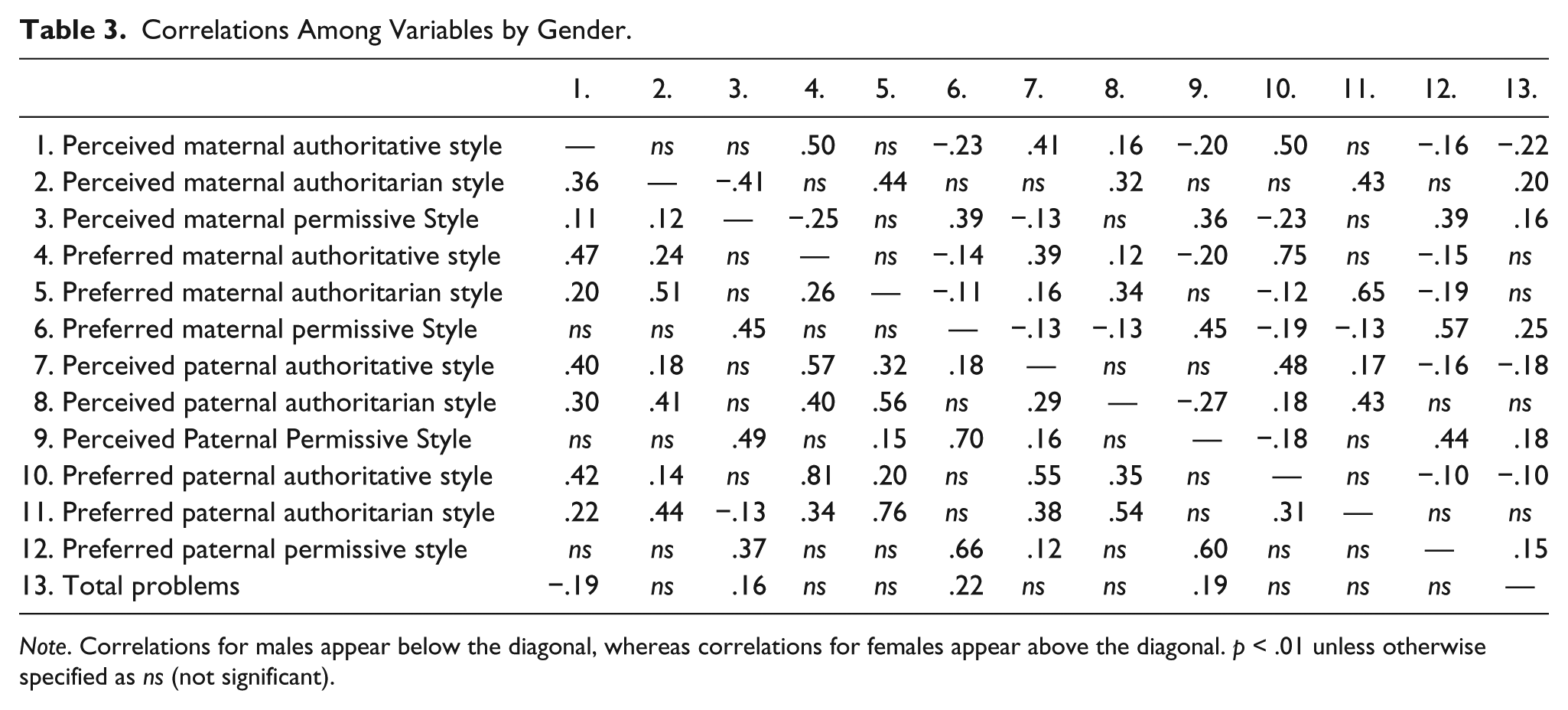
Note. Correlations for males appear below the diagonal, whereas correlations for females appear above the diagonal. p < .01 unless otherwise specified as ns (not significant).
Instruments
Parental Authority Questionnaire
The Parental Authority Questionnaire (Buri, 1991) contains 30 questions, rated from strongly agree to strongly disagree, assessing parents’ authoritative (e.g., my mother encourages verbal give-and-take), authoritarian (e.g., my mother expects me to listen immediately), and permissive (e.g., my mother believes that children should have their way in the family) parenting styles. Participants were instructed to complete the measure regarding current perceptions (e.g., rate your mother as she actually treats you currently) as well as their preferences (e.g., rate your father as you would ideally like for him to treat you). Participants rated maternal and paternal as well as perceived and preferred items separately. Internal consistencies of the subscales ranged from .78 to .85 in the current study.
Adult Self-Report
The Adult Self-Report (Achenbach & Rescorla, 2003) contains 123 items measuring psychological symptoms. Respondents answer statements as 0 (not true), 1 (somewhat or sometimes true), and 2 (very true or often true). Subscales include withdrawn (e.g., I’d rather be alone), somatic complaints (e.g., I feel dizzy), anxious/depressed (e.g., I worry about my future), rule-breaking behavior (e.g., I am irresponsible), aggressive behavior (e.g., I attack others), intrusive (e.g., I brag), thought problems (e.g., I cannot get my mind off certain things), and attention problems (e.g., I am forgetful) and can be summed into a total problem score, which was used to indicate psychological problems. Internal consistency alpha of the total problem scale in the current study was .91.
Results
The interaction effects between preferred and perceived parenting styles on psychological problems while considering gender were examined using PROCESS (Hayes, 2013) version 2.13, Model 3, which examines the effects of two moderators (i.e., preferred parenting style and gender), including the three-way interaction, on the relationship between two variables (i.e., perceived parenting style and emerging adult psychological problems). Analyses included a model for each of the three parenting styles for mothers and fathers, resulting in six models. Significant interaction effects were plotted using upper (+1 SD) and lower (−1 SD) bounds of the standardized variables (Cohen, Cohen, West, & Aiken, 2003). Predictors in the six models (i.e., maternal and paternal authoritative, authoritarian, and permissive style) included perceived style, preferred style, gender, and their interactions (i.e., perceived style × preferred style, perceived style × gender, preferred style × gender, and perceived style × preferred style × gender).
The maternal authoritative style model predicted a significant portion of the variance in emerging adult psychological problems, R2 = .06, F(7, 478) = 4.53, p < .01. Significant predictors included perceived style, b = −.19, t(478) = −3.56, p < .01, and the perceived style × preferred style × gender three-way interaction, b = −.25, t(478) = −3.11, p < .01. The perceived style × preferred style two-way interaction was significant for males, b = −.11, t(478) = −2.25, p = .03, and females, b = .14, t(478) = 2.20, p = .03. See Figure 1 for this interaction. The paternal authoritative style model also was significant, R2 = .03, F(7, 478) = 2.29, p = .03. The only significant predictor was the perceived style × preferred style × gender three-way interaction, b = −.13, t(478) = −1.96, p = .05. The perceived style × preferred style two-way interaction was significant for males only, b = −.09, t(478) = −2.29, p = .02. See Figure 2 for this interaction.
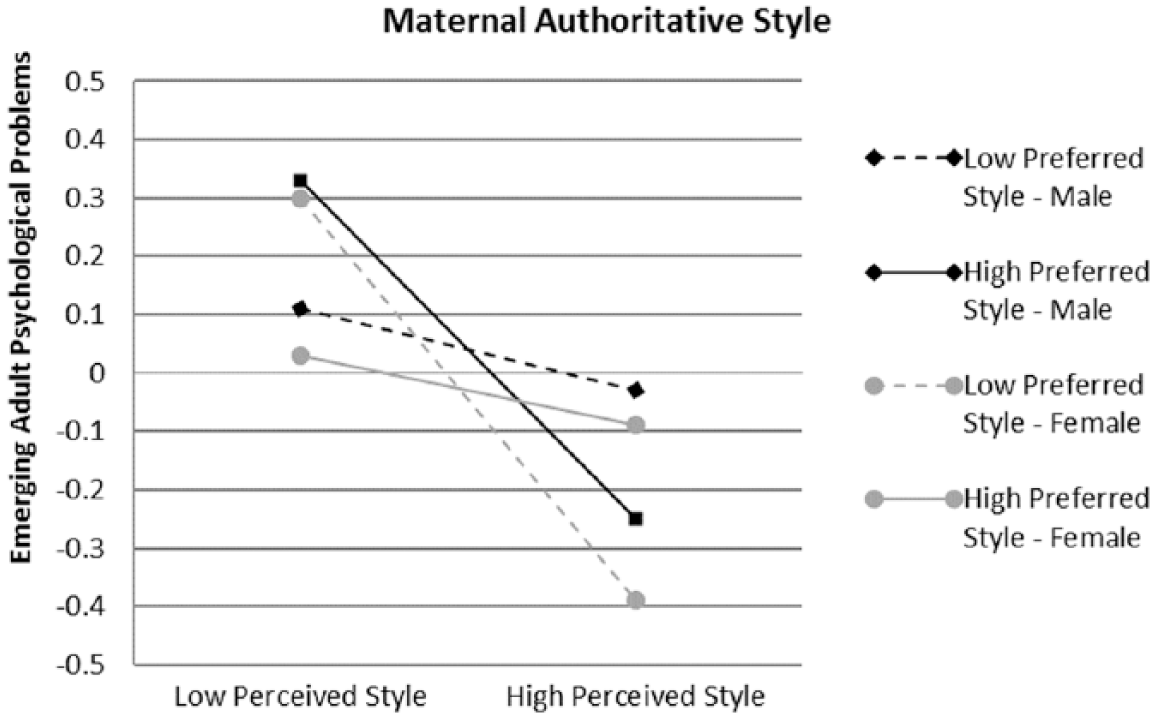
Gender × perceived × preferred maternal authoritative style interaction. Two-way interaction is significant for both males and females.
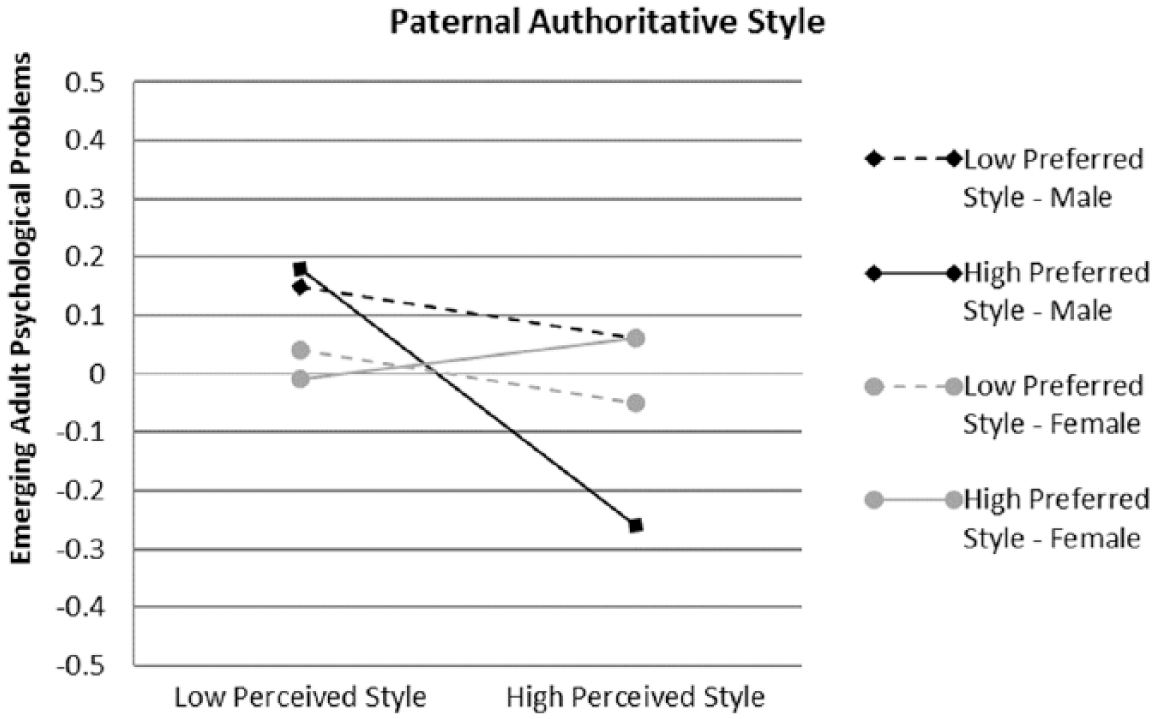
Gender × perceived × preferred paternal authoritative style interaction. Two-way interaction is significant for males only.
The maternal authoritarian style model was significant, R2 = .04, F(7, 478) = 3.06, p < .01. The only significant predictor was the perceived style × preferred style × gender three-way interaction, b = −.21, t(478) = −2.67, p = .01. The perceived style × preferred style two-way interaction was significant for females only, b = .18, t(478) = 2.74, p = .01. Please see Figure 3 for this interaction. The paternal authoritarian style model was not significant overall and none of the individual predictors were significant.

Gender × perceived × preferred maternal authoritarian style interaction. Two-way interaction is significant for females only.
The maternal permissive style model was significant, R2 = .08, F(7, 478) = 5.95, p < .01. Significant predictors included preferred style, b = .20, t(478) = 3.96, p < .01, and the perceived style × preferred style × gender three-way interaction when using a one-tailed test, b = −.10, t(478) = −1.63, one-tailed p = .05. The perceived style × preferred style two-way interaction was significant for females only, b = .13, t(478) = 2.93, p < .01. Please see Figure 4 for this interaction. The paternal permissive style model also was significant, R2 = .05, F(7, 478) = 3.38, p < .01. The only significant predictor was perceived style, b = .17, t(478) = 3.20, p < .01.
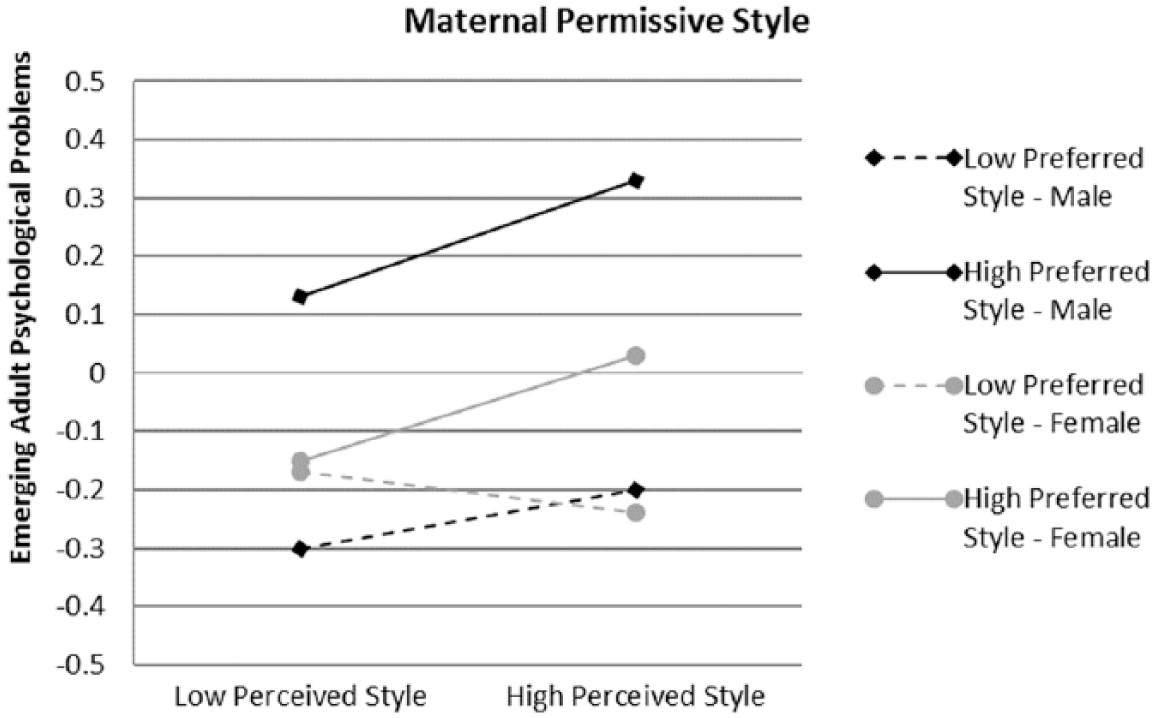
Gender × perceived × preferred maternal permissive style interaction. Two-way interaction is significant for females only.
Discussion
When examining maternal authoritative style, the preferred × perceived interaction was significant for both males and females but in opposite directions. Specifically, males who had the lowest psychological problems were associated with preferred and perceived high maternal authoritative style and males with the highest psychological problems were associated with preferred high but perceived low maternal authoritative style. Males who preferred low maternal authoritative style experienced more moderate psychological problems, regardless of perceived style, than those who preferred high maternal authoritative style. This finding supports the hypothesis that those preferring and perceiving a style that is supportive and grants autonomy (i.e., authoritative) would experience the fewest problems. Contrary to the hypothesis, this effect was markedly different when examining females. Specifically, females who had the lowest psychological problems were associated with preferred low but perceived high maternal authoritative style and females who had the highest psychological problems were associated with preferred and perceived low maternal authoritative style. Females who preferred high maternal authoritative style experienced more moderate psychological problems, regardless of perceived maternal authoritative style, than those who preferred low maternal authoritative style.
Taken together, this three-way interaction suggests that males who prefer high authoritative mothers and have them experience markedly lower psychological problems compared with males who do not. These males want high authoritative mothers, are benefitted when they get them, and are harmed when they do not. Conversely, females who prefer low authoritative mothers and have them experience markedly higher psychological problems compared with females who do not. These females do not want authoritative mothers but are still benefitted when they get them and harmed when they do not.
This brings up the question of why male and female psychological problems are similarly high when perceived maternal authoritative style is low and similarly low when maternal authoritative style is high, despite their opposing preferences. Although the findings regarding perceived style are consistent with prior research (i.e., perceived high authoritative style is beneficial), the reversal between male and female preferences is of interest. Perhaps females who perceive low maternal authoritative style have grown to prefer it as a method of identifying with their same-sex parent (e.g., Bem, 1974), despite the negative consequences. These mothers may provide less warmth and structure to their daughters, resulting in daughters disengaging from traditional gender role expectations and not preferring supportive mothers; perhaps these daughters are coping with their nonsupportive mothers by accepting it as reality and stating it as a preference as a method of control over their own lives. Alternatively, these daughters may prefer less maternal authoritative support and structure while at college because it allows them to engage in risky behaviors they perceive as desirable but result in negative outcomes. Conversely, females who do not prefer their mothers to be authoritative but have this as the case anyway may represent a section of emerging adult college students seeking autonomy and thus wanting less maternal support and structure but still benefitting when they perceive it.
When examining the three-way interaction for paternal authoritative style, the two-way interaction effect of perceived and preferred style was significant for males only. Males preferring and perceiving high paternal authoritative parenting experienced the lowest psychological problems. However, males who preferred low paternal authoritative style did not benefit similarly from high perceived authoritative style as those who also preferred it. These males may have fathers who provide them with support and structure but are striving for autonomy while at college, resulting in their lowered preference for an authoritative father.
The maternal authoritarian and permissive style preferred × perceived interactions were significant for females only, and the paternal authoritarian and permissive style preferred × perceived interactions were not significant for either gender. For maternal authoritarian style, females reported the lowest psychological problems when they perceived high maternal authoritarian style but preferred low authoritarian style, and they reported the highest psychological problems when they perceived low maternal authoritarian style and preferred it. Females who preferred high maternal authoritarian style experienced more moderate psychological problems, regardless of perceived maternal authoritarian style, than those who preferred low maternal authoritarian style. This interaction suggests that females who do not want their mothers to be authoritarian are benefitted when she is and harmed when she is not. As noted above, these females may represent a group who perceive their mothers as meddling in their college affairs and experience more psychological problems related to having too much freedom, enabling them to engage in risky behaviors. Consistent with prior research, males who preferred low but perceived high maternal authoritarian style experienced the highest psychological problems. This group could represent males who are striving for autonomy and desire their mothers to be flexible and warm but instead perceive the opposite, resulting in increased psychological problems. Alternatively, mothers of these males may become increasingly authoritarian in response to misbehavior by sons, whose problems evoke harsher responses from their mothers.
Finally, females who perceived low maternal permissive style reported similarly moderate psychological problems regardless of preference; however, females perceiving high maternal permissive style experienced poorer outcomes when they also preferred it compared with those who did not. Again, as noted above, females wanting and receiving high permissive maternal parenting are likely freer to engage in risky behaviors, resulting in poorer outcomes. However, females who do not want but still perceive high permissive parenting may know better than their mothers. That is, they believe their mothers should be less permissive than they are and thus limit their risky behavior themselves.
Limitations and Implications
It is important to note several limitations in the current study. As a correlational study with cross-sectional data, the results are limited in explaining the directionality of the relationship between the variables and inferring causation. For example, psychological problems may cause perceptions and preferences of parenting styles to be viewed more negatively rather than vice versa. Future research may benefit from examining whether preferred and perceived parenting practices yield similar outcomes throughout different periods of development as well as using longitudinal data to determine directionality. However, given the lack of research on child preferences in parenting, it was beneficial to examine these processes. Additionally, the use of self-report from a single informant renders the study vulnerable to response biases. It should be noted that researchers (e.g., Achenbach & Rescorla, 2003; Finley et al., 2008; Yahav, 2006) have established self-report to be a valid measure of parenting, especially during emerging adulthood when individuals are freer to express their minds. Nonetheless, future research should recruit multiple informants and observe parent–child interactions. The current sample also consisted predominantly of participants originating from a Southern state, limiting generalizability. For example, research suggests that the region in which children are raised may influence their opinion on how their parents should act. Specifically, Southern parenting may be characterized by high levels of demandingness and support alongside strictness, which may be viewed as more normative as well as more loving relative to other regions (Flynn, 1994; Lansford, 2010, McKinney & Brown, 2017).
Despite these limitations, the current study provides several contributions. Notably, a range of perceptions and preferences were observed in the current study, suggesting that emerging adults represent a heterogeneous group of individuals. Some groups of emerging adults were not surprising as they preferred and perceived high authoritative style and were benefitted by it; however, many groups’ preferences were not consistent with their perceptions, this effect was conditional on gender, and many viable explanations exist for these findings. Thus, researchers and clinicians alike are encouraged to consider individual differences in these characteristics and to assess a broader range of variables to better understand the processes underlying the effects observed in the current study.
Emerging adults typically report wanting their parents to provide them with a certain parenting style, one characterized by increased autonomy granting as well as continued support (e.g., Cullaty, 2011, Schiffrin et al., 2014); however, results of the current study suggest that too much autonomy may be associated with psychological problems, especially in females, possibly related to increased engagement in risky behavior and/or lack of support. Parents and emerging adults finding the “just right” amounts of autonomy, structure, and support appears to be a critical task during this period, where too much or not enough can be harmful (i.e., goldilocks effect).
Footnotes
Declaration of Conflicting Interests
The author(s) declared no potential conflicts of interest with respect to the research, authorship, and/or publication of this article.
Funding
The author(s) received no financial support for the research, authorship, and/or publication of this article.