



Abstract
Parental depression has been associated with psychological problems in offspring. It was hypothesized that harsh parenting would mediate this relationship and that gender differences would suggest moderated mediation. Emerging adults (N = 490) reported on their current perceptions of parental depression, harsh parenting, and their own psychological problems. The indirect effects of parental depression on emerging adult psychological problems in the context of parent–child gender dyads were examined. All variables shared positive free correlations across gender, whereas direct and indirect effects were influenced heavily by gender. Parental depression was directly related to male and female depression, and harsh parenting was only directly and indirectly related to female depression. Further research should focus on the complexity of harsh parenting and environmental predictors on child psychological problems. Addressing parental depression may indirectly and directly improve children’s internalizing and externalizing problems.
The influence of parental psychopathology on children has been researched extensively. Many studies have shown that parental psychopathology, especially parental depression, is associated with both internalizing and externalizing behaviors in offspring (Kane & Garber, 2004). For example, children of parents with recurrent depressive symptoms exhibited higher rates of depressive symptoms themselves (Gryczkowski, Jordan, & Mercer, 2010; Kouros & Garber, 2010) and were more likely to develop depression in adulthood (Weissman et al., 2006). Researchers also have found that higher reported levels of depression in mothers predicted higher levels of depression and externalizing behaviors in children (Kouros & Garber, 2010; Weissman et al., 2006). Moreover, parental depression has been linked to inconsistent and harsh parenting (defined by the current study as physically assaultive and psychologically aggressive behaviors), both of which have been associated with negative child outcomes including internalizing and externalizing behaviors (Dette-Hagenmeyer & Reichle, 2014; Leinonen, Solantaus, & Punamäki, 2003).
However, less research has examined how parental depression and harsh parenting are associated with outcomes in emerging adult children. Sawyer, Azzopardi, Wickremarathne, and Patton (2018) suggest that adolescence encompasses ages 10 to 24 years, rather than 10 to 19 years. Moreover, children progressing through emerging adulthood often rely more on their parents relative to older cohorts (McKinney, Morse, & Pastuszak, 2016). Given this changing context of children relying on their parents into emerging adulthood, investigating how parenting characteristics such as depression and harshness extend into emerging adulthood is particularly relevant. Additionally, much of this research does not account for both parents’ influence on males and females separately (i.e., parent–child dyads). Thus, the current study examined how maternal and paternal depression influence harsh parenting, and how harsh parenting, in turn, influences emerging adult psychological problems in the context of gender.
Parental Depression, Harsh Parenting, and Child Outcomes
Parental depression, more common in women than men (Dette-Hagenmeyer & Reichle, 2014), has a lasting impact on later parenting behaviors (Letourneau, Salmani, & Duffett-Leger, 2010) and has been associated with the adoption of negative parenting behaviors (Karazsia & Wildman, 2009). Baumrind (1989) defined these negative behaviors as being low in warmth and affection and high in control and harsh discipline. Parents with depressive symptoms often exhibit higher levels of overactivity, laxness, hostility, and lower levels of consistency and positive discipline than nonsymptomatic parents, which may be a result of parental stress levels (Arellano, Harvey, & Thakar, 2012; Jansen et al., 2012; Karazsia & Wildman, 2009; Letourneau et al., 2010; Venta, Velez, & Lau, 2016). Some researchers have suggested that the relationship between parental psychopathology and harsh parenting was explained by poor interpersonal functioning (Kane & Garber, 2004), whereas others have suggested that young maternal age and gender were moderating factors in the use of harsh discipline (i.e., mothers were harsher than fathers, and younger mothers were harsher than older mothers; Jansen et al., 2012). Additional determinants of harsh parenting have been researched including ethnic background, low-socioeconomic status, psychopathology, and parental history of physical abuse (Jansen et al., 2012; Karazsia & Wildman, 2009; Leinonen et al., 2003).
A large body of evidence suggests that harsh parenting has a strong impact on child outcomes (Baumrind, 1989; Gryczkowski et al., 2010; Jansen et al., 2012; Karazsia & Wildman, 2009; McKee, Colletti, Rakow, Jones, & Forehand, 2008; McKinney, Walker, & Kwan, 2016). For example, negative parenting (i.e., harsh discipline, overreactivity, laxness, and displays of anger) during childhood, regardless of consistency, predicted an increased risk of externalizing and internalizing problems in children between the ages of 2 and 25 years (Baumrind, 1989; Jansen et al., 2012; Karazsia & Wildman, 2009; McKinney & Brown, 2017; McKinney, Stearns, & Szkody, 2018; McKinney, Morse, et al., 2016), although harsh discipline in particular has not been shown to differentiate between internalizing and externalizing behavior problems (McKee et al., 2008; McKinney, Walker, et al., 2016). Harsh parenting continues to influence behavior problems into emerging adulthood (McKinney et al., 2018). Parents continue to be a guiding influence during the transition from adolescence to adulthood (i.e., emerging adulthood) as individuals move out of the home but continue to receive social support from parents (Arnett, 2000). Recent studies have shown that paternal harsh parenting increased emerging adult alcohol abuse (Diggs, Neppl, Jeon, & Lohman, 2017; Pollard & McKinney, 2016), and harsh parenting from either parent increased eating behavior problems among emerging adult females (Lohman, Gillette, & Neppl, 2016). As suggested by a growing body of research (McKinney & Brown, 2017; McKinney, Brown, & Malkin, 2018; McKinney, Walker, et al., 2016; Pollard & McKinney, 2016), the current study examined the current use of harsh parenting practices on emerging adult internalizing and externalizing problems.
Mediation and Gender Differences
Recently, researchers have begun exploring mediational models explaining the relationship between parental depression and child outcomes via parenting characteristics (Arellano et al., 2012; Dette-Hagenmeyer & Reichle, 2014; Gryczkowski et al., 2010; Karazsia & Wildman, 2009; Leinonen et al., 2003; McKee et al., 2008). Most studies categorize parenting characteristics into positive and negative constructs where positive parenting includes variables such as warmth, involvement, and consistent discipline, and negative parenting includes variables such as inconsistent or harsh discipline, laxness or permissiveness, poor monitoring, and overreactivity (Arellano et al., 2012; Gryczkowski et al., 2010; Karazsia & Wildman, 2009; Leinonen et al., 2003; McKee et al., 2008; Venta et al., 2016).
Karazsia and Wildman (2009) examined the mediating factor of parenting in the relationship between parental affect and child behavior problems in children 2 to 16 years old. They found that the relationship between parental affect and child behavior problems were mediated by maladaptive parenting (i.e., the use of overreactive or lax/permissive parenting). In a study by Dette-Hagenmeyer and Reichle (2014) with German elementary school students, paternal depression was correlated positively with inconsistent parenting and was found to only mediate the relationship between oppositional defiant disorder in children and paternal depression. The effect of paternal depression on children’s hyperactivity was only mediated by positive, consistent parenting, and no mediation was found with internalizing behaviors. Maternal depression was positively correlated with inconsistent discipline, which mediated the relationship between maternal depression and all child behavior outcomes. Dette-Hagenmeyer and Reichle (2014) suggested that the lack of perceived parental responsibility by fathers as a result of traditional gender roles may explain these mother–father discrepancies. Leinonen et al. (2003) explored another meditational model examining the impact of parental depression on parenting and children’s mental health in children in second grade and then again at 12 years old. They found that paternal and maternal depression had differing impacts on children’s mental health when associated with different parenting. Specifically, paternal depression and punitive fathering linked only to internalizing behaviors in daughters and linked to both externalizing and internalizing behaviors as well as substance use in sons, whereas maternal depression and noninvolved mothering was related to substance use in sons and externalizing behaviors in daughters.
Other research has identified additional parent and child gender differences. For example, involvement by fathers and positive parenting by mothers both led to less externalizing behavior in boys, whereas less supervision by mothers led to more externalizing behaviors in girls (Gryczkowski et al., 2010). Additionally, inconsistent discipline by mothers, but not fathers, led to higher levels of externalizing behaviors in both boys and girls (Arellano et al., 2012; Dette-Hagenmeyer & Reichle, 2014; Gryczkowski et al., 2010).
Gender role socialization has been suggested to influence individual reactions to stress and distress as explained by functional models. Specifically, maladaptive impressions of gender roles may explain gender differences among depressive problems as a result of harsh parenting. Therefore, individuals may react to harsh parenting (i.e., the stressor) with maladaptive behavior. Among males, maladaptive gender roles emphasize aggression (i.e., externalizing behavior), whereas females emphasize submission and inadequacy (i.e., internalizing behavior; Kulis, Marsiglia, & Nagoshi, 2010).
Family systems theory suggests that parental depression increases familial conflict (i.e., parent–child conflict and martial conflict) which increases stress within the family; increased stress among the family increases the likelihood of internalizing and externalizing behavior problems among adolescents (Franck & Buehler, 2007). Increased interpersonal parent–child conflict (i.e., as measured in the current study within the construct of harsh parenting) also increases self-blaming behaviors and poor coping strategies among children (Fear et al., 2009).
Parental Depression on Internalizing and Externalizing Behavior
Children of depressed parents are more likely to be exposed to poor living conditions, substance use, partner cruelty among parents, and lower levels of practical and emotional support which puts them at a higher risk of internalizing and externalizing behavior problems (Barker, Copeland, Maughan, Jaffee, & Uher, 2012). Additionally, a meta-analysis found that paternal depression was associated with higher levels of parent–child conflict and child internalizing and externalizing problems (Kane & Garber, 2004). When compared with children of nondepressed mothers, children of depressed mothers were three times more likely to develop major depression, anxiety disorders, and substance dependence in adulthood (Weissman et al., 2006). Adolescents with depressed mothers reported higher levels of depressive symptoms themselves, and higher levels of internalizing and externalizing behavior problems (Campbell, Morgan-Lopez, Cox, & McLoyd, 2009). Additionally, parent depression increases the risk for internalizing and externalizing behavior problems in sons (Kouros & Garber, 2010; Leinonen et al., 2003).
Current Study
Prior research has examined the mediational role of harsh parenting between parent and child psychopathology in general and depression specifically. However, this research has not examined this process in emerging adults and often does not fully account for parent–child gender dyads. Thus, the current study advances the research discussed above by examining emerging adults in the context of parent and child gender. Specifically, the effects of maternal and paternal depression on harsh parenting and emerging adult psychological problems were examined based on emerging adults’ current perceptions.
It was hypothesized that (1) parental depression would be related directly to harsh parenting and (2) emerging adult psychological problems, and that (3) harsh parenting would be directly related to emerging adult psychological problems. Parents with depressive problems are more likely to respond with rejection or harsh parenting behaviors (Karazsia & Wildman, 2009). Additionally, parental depression is associated with child psychological problems through both genetic and environmental pathways. Specifically, children of parents with depression are more likely to experience depression themselves as a result of being conferred their parents’ genetic risk for depression as well as being exposed to parenting behaviors associated with depression, such as harsh parenting, which has been strongly associated with child psychological problems (Franck & Buehler, 2007). Hypothesis 4 indicated that harsh parenting would mediate the relationship between parental depression and emerging adult psychological problems as suggested by family systems theory (Dette-Hagenmeyer & Reichle, 2014; Franck & Buehler, 2007; Gryczkowski et al., 2010).
Hypothesis 5 indicated that the mediational relationship in Hypothesis 4 would be moderated by parent and child gender (i.e., moderated mediation; Leinonen et al., 2003; Letourneau et al., 2010). Specifically, it was hypothesized that maternal depression would have a stronger relationship to harsh parenting than paternal depression to harsh parenting. Furthermore, it was expected that same-sex parent–child dyads will demonstrate stronger relationships when examining emerging adult internalizing problems (i.e., depressive and anxiety problems), whereas opposite-sex parent–child dyads will demonstrate stronger relationships when examining emerging adult externalizing problems (i.e., inattentive, hyperactive–impulsive, and antisocial problems). Previous research has suggested the link between same-sex/opposite-sex differences in behavior outcomes.
Method
Participants
The sample consisted of 177 males and 313 females who were attending a Southern university and ranged in age from 18 to 24 years (M = 18.60, SD = 1.00). Individuals reported their race to be Caucasian (69.1%), African American (23.7%), Hispanic (2.7%), Asian (2.2%), and other (2.2%). Participants reported that their household consisted of both a biological mother and father (66.3%), a biological parent and a step-parent (13.6%), one biological parent only (17.1%), other care givers (e.g., aunts, uncles, grandparents; 3.0%). Participants reported that 52.8% of their fathers and 56.9% of their mothers had a bachelor’s degree or higher. When asked how much contact participants had with their parents, 88.9% stated they had contact with their father daily, whereas 96.7% stated they had contact with their mother daily.
Measures
Conflict Tactics Scale: Parent–Child Version (CTSPC)
The CTSPC (Straus, Hamby, Finkelhor, Moore, & Runyan, 1998) is a 22-item scale assessing conflict tactics used by mothers and fathers on their children. Subscales include psychological aggression (e.g., shouted, yelled, or screamed at you) and physical assault (e.g., shook you). Frequency of behaviors are rated on a 7-point scale ranging from never happened to more than 20 times in the past year. Participants completed this measure based on their current perceptions of their parents’ psychological aggression and physical assault. Good construct validity has been demonstrated (Straus et al., 1998), and internal consistency alphas ranged from .76 to .88 in the current study. Items from the psychological aggression and physical assault subscales were summed and used to indicate the construct of harsh parenting for mothers and fathers separately. Rates of item endorsement for maternal and paternal items are shown in Table 1.
Item Frequency as Reported by Participants.

Parental Environment Questionnaire (PEQ)
The PEQ (Elkins, McGue, & Iacono, 1997) consists of 42 self-report questions measuring the parent–child relationship. Subscales include parent–child conflict (e.g., my parent and I often get into arguments). Responses are rated on a 4-point scale with answers ranging from definitely true to definitely false. Participants completed this measure based on their current perceptions of parent–child conflict. The scale has demonstrated good internal consistency and construct validity (Elkins et al., 1997), and internal consistency alphas ranged from .74 to .89 in the current study. Items from the conflict subscale were summed and used to indicate the construct of harsh parenting for mothers and fathers separately.
Adult Self-Report (ASR) and Adult Behavior Checklist (ABCL)
The ASR and ABCL (Achenbach & Rescorla, 2003) are both 123-item instruments measuring externalizing and internalizing psychopathology. The ASR and ABCL provide information about informants and other individuals based on informants’ current perceptions, respectively. Respondents answer items as 0 (not true), 1 (somewhat or sometimes true), and 2 (very true or often true). Both measures contain specific problem subscales including depressive (e.g., feels worthless), anxious (e.g., worries a lot), inattentive (e.g., has trouble concentrating or paying attention), impulsive–hyperactive (e.g., impulsive or acts without thinking), and antisocial (e.g., blames others for problems) problems. Internal consistency alphas have ranged from .87 to .93 in previous studies, and good validity has been established (Achenbach & Rescorla, 2003). In the current study, these subscales had alphas ranging from .88 to .92. The depressive problems scale of the ABCL was summed and used to indicate the observed variables for maternal and paternal depressive problems separately as perceived by the emerging adult participant, and the five problem subscales of the ASR noted above were used to indicate the observed variables for current emerging adult psychological problems.
Procedure
Following the institution review board approval, the measures were posted to an online survey system to be chosen by undergraduate psychology students. Potential participants (i.e., students within the online system between the ages of 18 and 25 years) were recruited to the study from a list of available studies. Participant recruitment was closed after 500 participants completed the study; of those who chose to participate, 100% completed the study. Participants indicated their informed consent electronically before beginning and completed measures in random order, completed mother and father measures separately, and completed all measures based on current perceptions. Completion of or voluntary withdrawal from the study resulted in the award of credit, and participants received a printable debriefing sheet at the end of the study. Participants were treated in accordance with the APA code of ethics.
Planned Analyses
Structural equation modeling was conducted using AMOS 24.0. Latent constructs included maternal and paternal harsh parenting, indicated by the psychological aggression and physical assault subscales of the CTSPC and conflict subscale of the PEQ. Maternal and paternal depressive problems were indicated by the depressive problems subscale of the ABCL. The subscales of the ASR indicated emerging adult depressive, anxious, inattentive, impulsive–hyperactive, and antisocial problems. Maternal and paternal variables were examined together to account for their shared variance and make direct comparisons between them.
For the purposes of structural equation modeling, a sample size of 490 is considered good (Kline, 2015). The maximum likelihood method of covariance structure analysis was used. Given the recommended two-index presentation strategy by Hu and Bentler (1999), model fit was examined with the standardized root mean square residual (SRMR) and the comparative fit index (CFI); in combination, SRMR values less than or equal to .09 and CFI values greater than or equal to .95 indicate good model fit. A two-stage modeling approach as suggested by Barry and Stewart (1997) was taken to decrease poor construct measurement. A measurement model that allowed all constructs to correlate freely was evaluated first followed by a structural model testing direct and indirect paths among variables.
Correlations among variables in the measurement model were used to test Hypotheses 1 through 3. Hypothesis 4 was tested using indirect effects, which have been suggested to more adequately test for mediation (MacKinnon, 2008; Rucker, Preacher, Tormala, & Petty, 2011). Indirect effects were estimated with bootstrapping using 2,000 iterations, which is considered to be more robust than typical tests of indirect effects (Hayes, 2009). Hypothesis 5 was tested using multiple group analysis using pairwise parameter comparisons, a statistical test comparing the difference between path coefficients (i.e., paths different based on gender). This comparison produces a Z score indicating the statistical difference between groups on a particular path coefficient.
Results
The original measurement model as described above and shown in Figure 1 provided good model fit, χ2(62) = 189.19, SRMR = .06, CFI = .96, RMSEA = .07, Tucker–Lewis index (TLI) = .95. All factor loadings exceeded .60 (all ps < .001), indicating convergent validity. Please see Table 2 for correlations among variables in the measurement model. On specifying an appropriate measurement model, the structural model as shown in Figure 2 was tested and found to provide good model fit, χ2(4) = 36.40, SRMR = .05, CFI = .99, RMSEA = .13, TLI = .99. Note that RMSEA should not be used as a fit index when degrees of freedom are low (i.e., 4 in this case; Kenny, Kaniskan, & McCoach, 2015).

Factor loadings for constructs in the measurement model.
Correlations Among Variables in Measurement Model.
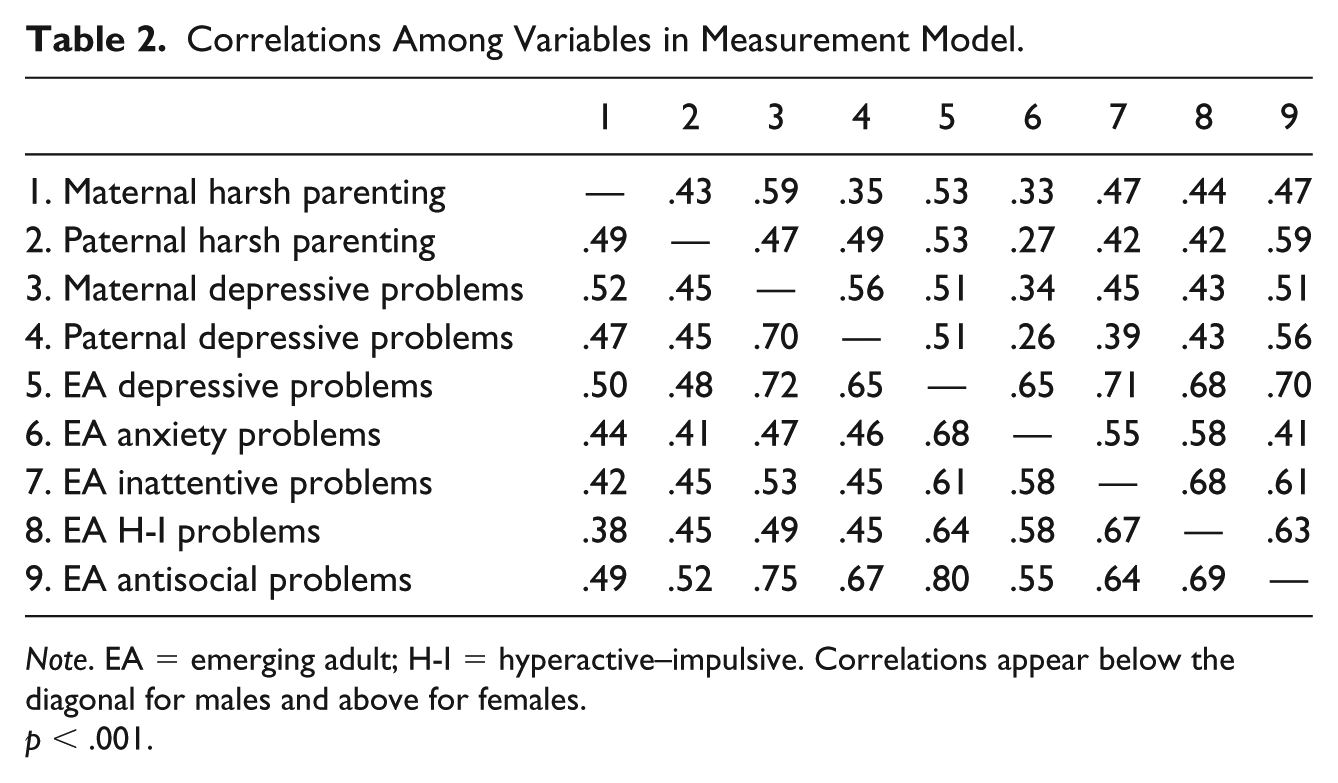
Note. EA = emerging adult; H-I = hyperactive–impulsive. Correlations appear below the diagonal for males and above for females.
p < .001.

Structural model.
As shown in Table 2, Hypotheses 1 through 3 were supported as all variables were related positively to each other. Specifically, parental depression, harsh parenting, and all emerging adult psychological problems were related directly.
As shown in Table 3 and supporting Hypothesis 4, maternal and paternal depressive problems had a significant indirect effect through harsh parenting on all emerging adult female problems except antisocial problems. However, when examining males, the only significant indirect effects were maternal depressive problems on anxiety problems and paternal depressive problems on antisocial problems.
Direct and Indirect Effects and Gender Differences for Structural Model Shown in Figure 2.

Note. EA = emerging adult; H-I = hyperactive–impulsive; CI = 95% confidence interval. All p < .05 unless noted as ns. *Indicates paths significantly different between males and females at p < .05.
Contrary to Hypothesis 5 and as shown in Table 3, maternal depressive problems did not predict harsh parenting more strongly than paternal depressive problems. Also shown in Table 3, males and females differed significantly on several paths. Specifically, the path between maternal depressive problems and maternal harsh parenting was stronger for females than males, and the paths between maternal depressive problems and emerging adult depressive and antisocial problems were stronger for males than females. Also, the paths between both maternal and paternal harsh parenting and emerging adult depressive problems were stronger in females than males. These path differences suggest moderated mediation. Specifically, the indirect effects of parental depressive problems on emerging adult depressive problems through harsh parenting are significant for females but not males. Maternal depression was a stronger predictor of maternal harsh parenting for females, suggesting that traditional gender roles may be at work (Hypothesis 5). Moreover, all direct paths from harsh parenting to emerging adult psychological problems were significant for females except for maternal harsh parenting predicting female antisocial problems and paternal harsh parenting predicting female anxiety problems, whereas they all were nonsignificant for males except for paternal harsh parenting predicting male antisocial problems. This resulted in the indirect effects being conditional on gender (i.e., moderated mediation) primarily as a result of the direct effects of harsh parenting (i.e., significant when examining females but not males).
Discussion
The present study extended current research by examining the relationships among parental depression, harsh parenting, and psychological problems (i.e., depressive, anxiety, inattentive, hyperactive–impulsive, and antisocial) in emerging adults. Direct relationships between parental depression and harsh parenting were hypothesized and supported when examining both free correlations and path coefficients. The direct relationship between parental depression and harsh parenting in both mothers and fathers supports current literature that suggests psychological aggression, physical assault, and conflict (i.e., indicators of harsh parenting in the current study) are influenced by parental psychological health (Jansen et al., 2012). Additionally, maternal and paternal depression were hypothesized and supported as being directly related to emerging adult psychological problems in all cases when using free correlations and in almost all cases when using path coefficients, with exceptions including paternal depression not significantly predicting male inattentive problems and female anxiety problems. Harsh parenting also was directly associated with emerging adult psychological problems in all cases when examining free correlations; however, these effects were attenuated when examining path coefficients in males, described in greater detail below. The free correlations among these variables are consistent with current research that suggests parental depression is associated with the usage of harsh parenting, and that harsh parenting is associated with higher levels of psychological problems in children (Baumrind, 1989; Jansen et al., 2012; Karazsia & Wildman, 2009).
All indirect paths (i.e., the effect of parental depressive problems on emerging adult psychological problems through harsh parenting) were significant in females except the maternal depression indirect effect on antisocial problems. Conversely, the only significant indirect effects for males were maternal depression on anxiety problems and paternal depression on antisocial problems. Given that harsh parenting did not significantly predict emerging adult psychological problems in males except when examining antisocial problems, the indirect effects for males also were not significant (i.e., the mediator, harsh parenting, did not predict the dependent variable, psychological problems, thus preventing the possibility of indirect effects in males). It appears that males are directly affected by parental depressive problems (i.e., all direct paths from parental depressive problems to male psychological problems were significant except for paternal depressive problems on male inattentive problems), and although parental depressive problems directly predict harsh parenting, harsh parenting does not directly predict male psychological problems.
Conversely, females are influenced directly as well as indirectly. Specifically, parental depressive problems directly predict female psychological problems and harsh parenting, and harsh parenting directly predicts female psychological problems, resulting in significant indirect effects. These findings are not supported by the current literature that suggest harsh parenting to be a mediating variable between parental depression and behavior problems in both females and males (Arellano et al., 2012; Dette-Hagenmeyer & Reichle, 2014; Gryczkowski et al., 2010; Leinonen et al., 2003). The significant paths for females compared with the nonsignificant paths for males suggest that both males and females are sensitive to parental depressive problems but that only females are sensitive to harsh parenting, which may affect their sense of self-worth and belongingness (Jansen et al., 2012). Simultaneously, parental depressive problems shared higher path coefficients with psychological problems in males than females, suggesting that the higher variance shared between parental depressive problems and male psychological problems may account for the total effects observed. That is, these stronger direct paths found when examining males may be more important and account for the variance observed between harsh parenting and male psychological problems when using free correlations. Additionally, different genders may interpret harsh parenting differently. That is, males may view psychological and physical aggression as well as conflict as less threatening relative to females given their presumed gender roles.
Several limitations should be mentioned. Parental depression and emerging adult psychological problems were reported from emerging adult perspectives and may be inflated by a shared method bias. Although the frequency of contact participants had with their parents was assessed, the current study did not assess the nature of that contact or if participants lived with their parents. Additionally, most all participants reported daily contact with their parents; thus, the current sample may not be representative of children who have limited contact with their parents. Future research is encouraged to investigate such processes given their potential effects; for example, adults living with their parents likely would experience higher levels of the variables assessed by the current study relative to those living on campus or otherwise away from home.
Data also were cross-sectional and do not accurately measure any change over time or imply causation, although the hypothesized mediational model is consistent with theory and evidence. Directionality between variables were examined as proposed by family systems theory. Specifically, family systems theory suggested that parental depression would increase harsh parenting techniques and, in turn, their child’s psychopathology (Franck & Buehler, 2007). A true representation of parental depression and parenting strategies should be addressed in a dyadic nature from both the emerging adults’ and the parents’ perspective to receive a more accurate estimate of symptomology and practice. Moreover, these effects should be examined over time. Additional pathways between the variables should be examined longitudinally to see other associations, such as how children’s depression may increase harsh parenting from parents. Likewise, children exposed to harsh parenting from parents may be at an increased risk of depressive problems, or parents of depressed or unruly children may experience more stress and have more depressive problems as a result. In the current study, harsh parenting was defined by psychological aggression, physical assault, and conflict. Literature suggests a more robust collection of parenting variables to include warmth, laxness, and marital conflict (Arellano et al., 2012; Gryczkowski et al., 2010; Karazsia & Wildman, 2009; Leinonen et al., 2003; McKee et al., 2008). Differences in socioeconomic backgrounds, environmental stressors, and caregiving situations (e.g., grandparent, single parent, and foster parent) also were not evaluated.
Harsh parenting and parental depression are implicated as risk factors for specific emerging adult externalizing and internalizing problems in both genders. Females largely demonstrated direct risks (i.e., parental depression directly predicts female psychological problems) as well as indirect risks (i.e., parental depression predicts harsh parenting which, in turn, predicts female psychological problems), whereas males largely demonstrated only direct risks. Males are more likely to demonstrate externalizing problems (e.g., aggression) as a result of negative gender role socialization, whereas females are more likely to demonstrate internalizing problems (e.g., depression; Kulis et al., 2010). Gender differences among maladaptive behaviors demonstrate the impact of negative gender role socializations. Socialization of traditional gender roles may be a potential place for interventions to prevent depressive problems among women. Working with parents to address their depression would appear to ameliorate their children’s problems as well, the results of which may occur directly or indirectly based on gender. Future research should address the complexity of harsh parenting and environmental predictors as well as parental psychopathology on children’s psychological problems across development as well as parent–child gender dyads. Investigating determinants of parental depression also is paramount in developing efforts to reduce its effects.
Footnotes
Declaration of Conflicting Interests
The author(s) declared no potential conflicts of interest with respect to the research, authorship, and/or publication of this article.
Funding
The author(s) received no financial support for the research, authorship, and/or publication of this article.
