




Abstract
This study examined the correlates of fathers’ satisfaction with physical affection (SPA) in their marital relationship before and after the birth of a new baby. Both parents (N = 97) completed surveys assessing SPA, and fathers completed surveys assessing division of household labor and coparenting quality during the third trimester of pregnancy and again at 3 months post-birth. An actor-partner interdependence model revealed partner effects, such that mothers’ SPA post-birth was predicted by fathers’ SPA pre-birth but not viceversa. Cross-lagged path analyses indicated that fathers who have high SPA pre-birth reported more supportive coparenting post-birth. Furthermore, fathers who believed pre-birth that they would be more involved in child-related household labor had increased SPA after the birth of a new baby. Results are discussed in terms of implications for couple and family therapy, education for new fathers, as well as programs designed to support parents during the transition to parenthood.
After childbirth, workloads for both fathers and mothers increase significantly, sometimes causing high levels of stress, especially for first-time parents (Maas, McDaniel, Feinberg, & Jones, 2018). The stress associated with having a new baby can also create a gap between couples’ closeness and emotional intimacy, which are essential factors related to their sexual and physical satisfaction (Nakić Radoš, Soljačić Vraneš, & Šunjić, 2015). Many modern parents report experiencing a high degree of pressure to spend large amounts of time with their children; in turn, they sacrifice time with their spouses, which can decrease the intimacy between couples (Edward, 2009). Hence, both parents confront a changed dynamic in their relationship that accompanies the need to accommodate a third family member.
While often experiencing a loss of intimacy, new parents are also tasked with reorganizing other aspects of their relationship. This process begins before the birth of the child as families make pre-birth preparations for parenthood and continues after the child’s arrival (Deave, Johnson, & Ingram, 2008; Kuersten-Hogan, 2017). This sometimes includes drastic shifts in the division of household labor (including child-related tasks)—and subsequent conflict that may accompany those shifts (Elliston, McHale, Talbot, Parmley, & Kuersten-Hogan, 2008). Furthermore, new parents are tasked with developing a new relationship—the coparenting partnership—in which supportive couples work together to meet the needs of their child (Kuersten-Hogan, 2017). Understanding how both men and women navigate these roles while also maintaining affectionate relationships with their partner is an important goal not only for family research but also for family practice aimed at supporting the needs of new parents.
Although a limited body of research has begun to link physical affection and sexual satisfaction with broader relationship dynamics for mothers (Carlson, Hanson, & Fitzroy, 2016; Maas et al., 2018; Yoo, Bartle-Haring, Day, & Gangamma, 2014), fathers’ perceptions remain vastly underrepresented, and the direction of effects between satisfaction with physical affection and couple relationship functioning is unknown. Furthermore, prior studies have not prospectively tracked satisfaction with physical affection and couple dynamics both before and after the birth of a child. From a family systems theoretical perspective, the transition to a new baby simultaneously requires a reorganization of relationship dynamics between parents around issues involving childrearing (coparenting, division of household labor) as well as those that exist outside of the child (physical affection). The developmental course of fathers’ physical affection is a largely neglected aspect of the transition to parenthood, but one that may have far-reaching implications for broader relationship and interparental functioning across the first several years. As such, family therapists, prenatal and early childhood parenting programs, and interventions designed to support new parents may benefit from more information on the longitudinal associations among these variables. In summary, guided by family systems theory, the present study was designed to elucidate associations between (1) mothers’ and fathers’ satisfaction with physical affection and (2) fathers’ satisfaction with physical affection and coparenting quality and division of household labor before and after the birth of a new baby.
Physical Affection Among New Parents
Aspects of relationship quality among married couples such as satisfaction and stability are linked to higher levels of sexual satisfaction (Yeh, Lorenz, Wickrama, Conger, & Elder, 2006). Some research suggests that couples who have a better sexual life are more satisfied with their overall relationship (Nezhad, & Goodarzi, 2011; Yıldız, 2015; Yoo et al., 2014). For instance, research by Nezhad and Goodarzi (2011) indicated that if couples had a high level of satisfaction with physical affection, the vast majority of them (71%) had high overall marital satisfaction; however, if both partners were dissatisfied with their physical affection, very few couples (6%) were satisfied with their overall marriage.
In general, satisfaction with physical affection encompasses both sexual satisfaction as well as satisfaction with other, nonsexual forms of physical intimacy (e.g., kissing, hugging, cuddling), which also tend to decrease for most couples following childbirth. For new and expectant parents, there are often physical or medical reasons for abstaining from sexual intercourse (McBride, Olson, Kwee, Klein, & Smith, 2017). Thus, other forms of nonsexual physical contact may be important indicators of relationship satisfaction. Thus, the present study uses the term satisfaction with physical affection to describe satisfaction with this more inclusive set of behaviors that encompasses both sexual and nonsexual forms of physical intimacy.
Fathers’ Satisfaction With Physical Affection
Although there is a growing body of research about mothers’ sexual satisfaction during the transition to parenthood, few studies have addressed how fathers’ characteristics such as sexual desire and sexual satisfaction are affected during these same transitions (von Sydow, 1999). These studies have mostly focused on the postpartum period rather than tracking men’s satisfaction with physical affection from pre-to post-birth (MacAdam, Huuva, & Berterö, 2011). These limited data suggest key differences between new mothers and fathers. For instance, women’s sexual desire tends to gradually dissipate across time (Pauleta, Pereira, & Graça, 2010), whereas men’s sexual desire shows a less dramatic decline (Sagiv-Reiss, Birnbaum, & Safir, 2012) during pregnancy. Although these previous studies mostly query fathers about satisfaction with vaginal intercourse, sexuality as a whole (sexual satisfaction as well as satisfaction with other, nonsexual forms of physical intimacy) among new fathers has not been well elucidated (von Sydow, Ullmeyer, & Happ, 2001).
Although first-time fathers’ desire for sex does not change during the postpartum period, they report a lower level of sexual satisfaction and less frequent sexual activity (Maas et al., 2018). Some data suggest that this lack of sexual satisfaction may affect male partners more than females (Maas et al., 2018). Indeed, first-time fathers’ satisfaction with physical affection appears to have a crucial impact on the quality of the marital relationship because satisfaction with sexuality—and physical affection more broadly—seems to be a particularly strong predictor of global marital satisfaction among men (Jackson, Miller, Okay, & Henry, 2014).
Fathers’ satisfaction with physical affection may be important not just for relationship satisfaction but also for other specific aspects of relationship functioning that are particularly salient following the birth of a child. A social exchange theoretical perspective (Blau, 1964) indicates that family dynamics might be in part governed by the exchange of activities among family members. As such, partners may use both physical affection and household labor to negotiate family roles. In essence, both family dynamics and satisfaction with physical affection may be a product of negotiated expectations and rules between partners. Given the tendency for interparental relationship functioning to spill over into family dynamics involving children (e.g., Doherty, Kouneski, & Erickson, 1998), an understanding of the correlates of fathers’ satisfaction with physical affection may be critical for understanding changes in family functioning from pre-to post-birth. Pre- and post-natal interventions and educational programming often focus almost exclusively on the experiences and well-being of new mothers (Pruett, Pruett, Cowan, & Cowan, 2017). Thus, elucidating the dynamics underlying fathers’ physical affection may represent a novel point of intervention to support couples across the transition to parenthood. Two such dynamics—the quality of the coparenting relationship and the division of household labor—will be considered in the present study.
Coparenting and Satisfaction With Physical Affection
Coparenting, according to McHale (1995), refers to the level of support and solidarity between members of a couple around parenting-related issues, the degree of conflict in these parenting efforts, and the extent of both partners’ active participation in directing and engaging with the child. Some dimensions of coparenting such as partner support, child caring agreement, and equity in the division of labor (Feinberg, 2003) are related to marital functioning (Chong & Mickelson, 2016). Fathers’ relatively equal involvement as coparents has been linked to higher marital satisfaction for both couples (Galovan, Holmes, Schramm, & Lee, 2014), and a high-quality pre-birth marital relationship increases couples’ supportive coparenting behaviors across time (Schoppe-Sullivan & Mangelsdorf, 2013). Furthermore, although coparenting has a positive impact on couple dynamics (e.g., McHale, Salman-Engin, & Coovert, 2015), the coparenting partnership can affect mothers’ and fathers’ relationship satisfaction differently (Mangelsdorf, Laxman, & Jessee, 2011), especially when it comes to satisfaction with physical affection. For example, when men take more responsibility for child care, they have the lowest satisfaction with physical affection, but women have the highest satisfaction with physical affection among first-time parents (Carlson et al., 2016).
Each spouse’s availability for physical affection, as well as their desire to participate in physical intimacy when available, may affect each couple’s feelings about a fair division of household labor and child care (DeMaris & Mahoney, 2017). Thus, couples’ satisfaction with coparenting could play an important role in explaining the link between marital quality and sexual intimacy among first-time parents (Carlson et al., 2016). Indeed, some studies suggest that the coparental relationship might be affected by physical intimacy because couples’ physical affection increases both positive relationship feelings (Nezhad & Goodarzi, 2011; Yoo et al., 2014) and communication between partners (Yoo et al., 2014). Thus, fathers’ satisfaction with physical affection may positively affect later coparenting after the birth of a new baby. Given the prominence and effectiveness of recent coparenting interventions (Feinberg et al., 2016; Solmeyer, Feinberg, Coffman, & Jones, 2014) understanding more about the fathering characteristics that lead to supportive coparenting may be fruitful for improving subsequent interventions.
Division of Household Labor and Satisfaction With Physical Affection
Cowan and Cowan (1988) used three different categories to define division of household labor: (1) household tasks such as laundry, cooking, or car maintenance; (2) family decision making including vacation plans, partners’ involvement in work outside the family, and some amount of involvement in the community; and (3) child-related tasks such as feeding, dressing, bathing, or calling the doctor to describe the division of labor in family life. For new parents, division of labor in child-related tasks are particularly salient. Communication regarding division of child care responsibilities begins before the birth of the child (Fillo, Simpson, Rholes, & Kohn, 2015). Therefore, the present study will include both pre-birth expectations for, and post-birth perceptions of, division of child-related tasks. Reciprocal relations between parents’ perceptions of household labor and relationship functioning may exist (Chong & Mickelson, 2016). According to Gjerdingen and Center (2005), mothers’ satisfaction with sharing household responsibilities was associated with their spouses’ overall relationship satisfaction. For instance, mothers’ thoughts about a fair division of household labor affect fathers’ emotional spousal support, and fathers’ support for parenting and a fairness of sharing the household tasks impact relationship satisfaction of mothers (Chong & Mickelson, 2016).
Likewise, Maas et al. (2018) demonstrated that considerable satisfaction with the division of labor predicts fathers’ (but not mothers’) satisfaction with the romantic relationship. With regard to sexuality in particular, sexual intimacy is positively related to satisfaction with the division of routine household labor such as cooking, cleaning, and laundry (Carlson, Miller, Sassler, & Hanson, 2016). Child care responsibilities increase both mothers’ and fathers’ total workload, a situation that can cause a decline in both parents’ perceived sharing of household labor and satisfaction with division of household labor (Gjerdingen & Center, 2005). In contrast, an equal division of household labor is related to greater relationship satisfaction (Barstad, 2014) during postpartum. In general, a more equitable distribution of shared housework is related to more frequent sexual activity and higher sexual satisfaction (Carlson, Miller, et al., 2016; Maas et al., 2018) and to sexual relationship quality between couples (Carlson, Miller, et al., 2016). However, male partners who have the majority of responsibility to complete household tasks (including child-related tasks), are sexually less active and satisfied than other male partners who share the household tasks equally or cede primary responsibility to their female partners (Carlson, Miller, et al., 2016).
These findings suggest a potential link between division of household labor and fathers’ satisfaction with physical affection. Despite the importance for couples of pre-birth communications regarding child care responsibilities (Fillo et al., 2015), to our knowledge no investigations have examined the extent to which pre-birth expectations for division of child-related household labor might affect satisfaction with physical affection. As such, the extent to which these variables are related from pre- to post-birth remains to be seen. Given that disagreement regarding division of household labor is a frequent cause of marital conflict (Kluwer, Heesink, & Vliert, 1997; Knight & Alberts, 2018; Mikula, Riederer, & Bodi, 2012) and a common target of marital therapy (Maier & Priest, 2016) these results may have implications for clinical practice with couples pre- and post-birth.
Existing Limitations and the Present Study
Although a modest body of research has examined new parents’ satisfaction with physical affection, these investigations have largely assumed that mothers’ and fathers’ satisfaction are independent of one another. However, a family systems theoretical perspective suggests that the satisfaction of married partners is inexorably intertwined and cannot be understood in isolation. For example, Yoo et al. (2014) found that mothers’ sexual satisfaction affects fathers’ overall relationship satisfaction because each spouse’s experiences influence not only their own perception but also their partner’s perception within family systems (Galovan et al., 2014). The present study will extend this past work by considering the interdependent nature of mothers’ and fathers’ satisfaction, using the actor-partner interdependence model (APIM; Kenny, Kashy, & Cook, 2006) to determine both actor (i.e., one’s own perceptions) and partner (i.e., the perceptions of one’s spouse) effects on satisfaction with physical affection.
Although past research provides evidence for a possible association between satisfaction with physical affection and family dynamics, the direction of effects between these variables has not been well-elucidated. Specifically, satisfaction with physical affection can be conceptualized as both a cause and a consequence of the couple and family dynamics following the birth of a child. Thus far, an exclusive reliance on cross-sectional data has obfuscated this direction of effects. Furthermore, prior studies relevant to satisfaction with physical affection have relied almost exclusively on postpartum assessments rather than following couples prospectively before and after the birth of their child. Little is known about how satisfaction with physical affection before the birth of a child impacts both division of labor and coparenting as well as how pre-birth expectations for division of labor and coparenting could affect satisfaction with physical affection before and after the birth of a new baby. Further clarifying the direction of effects by following couples across time before and after the birth of their child is essential for understanding the causes and consequences of fathers’ physical affection satisfaction for family functioning before and after the birth of a new baby. Moreover, for couples navigating changes in multiple roles simultaneously, each of these changes can be a source of conflict in family relationships. Thus, elucidating the associations among these family roles pre- and post-birth can inform both interventions and preventive interventions designed to protect couples from the many demands of becoming a new parent.
The present study addressed these gaps in the research literature and informs clinical work with expecting and new parents by examining the following research questions:
Method
Participants
Participants were 97 predominantly middle-class couples (80% European American) who participated in two phases of a longitudinal study pre-birth (third trimester of pregnancy) and again when the child was 3 months of age. There were 41 couples in which one or both partners had previous children. All couples were married and had been married on average for 3.41 years (range = 0-8.92 years, SD = 2.07 years). Expectant mothers’ ages ranged from 22 to 42 years with a mean age of 28.10 years (SD = 4.14 years). Expectant fathers’ ages ranged from 22 to 45 years with a mean age of 30.18 years (SD = 5.28 years). The median family income ranged from $51,000 to 61,000 (range: <$10,000 to >$100,000). Eighty-nine percent of expectant mothers and 79% of expectant fathers had obtained at least a college degree (range for expectant mothers: some college to the doctoral degree; the range for expectant fathers: some high school to doctoral degree). Eighty-six percent of the participants were European American, 5% African American, 4% Hispanic, 3% Asian, and 2% mixed race/ethnicity. In the third trimester of pregnancy, 4 fathers and 10 mothers were not in the workforce. Between the first and second phases of this study, all expectant mothers gave birth to single, healthy, and full-term infants. The infants were 3.67 months old at the time of the second assessment (SD = 10.08 days).
Procedure
Study procedures, including the informed consent documents signed by participants, were approved by the sponsoring university’s institutional review board. Couples were recruited from childbirth education classes, flyers posted at local businesses, and through print and electronic newsletters and word of mouth. Data were collected at two phases for the study: during the third trimester of pregnancy and 3.5 months postpartum. Both parents completed a series of questionnaires independently assessing various domains of relationship satisfaction and family functioning.
Measures
Satisfaction With Physical Affection
At each time point mothers and fathers separately completed the Dyadic Adjustment Scale (DAS; Spanier, 1976), a 32-item widely used survey measure of global marital satisfaction. Six individual items from the DAS were selected to form a physical affection satisfaction subscale that assessed satisfaction with displays of physical affection, sexual relations, amount of time spend together, frequency of kissing, disagreements regarding being too tired for sex, and not showing enough love. Items were selected based on face validity, past research that has utilized a prior version of an “affection scale” (without whatever item was not included), and a strong pattern of intercorrelations among items. During postpartum, both parents again completed the physical affection satisfaction scale. Pre-birth Cronbach’s alpha for satisfaction with physical affection subscale scores were .69 for mothers and .69 for fathers. Post-birth Cronbach’s alpha for the satisfaction with physical affection subscale scores were .70 for mothers and .65 for fathers.
Division of Household Labor
Fathers’ perceptions of the division of household labor were also assessed using the Who Does What Questionnaire (WDW; Cowan & Cowan, 1988). The WDW scale measures partners’ perceptions of their relative responsibilities. Given the study’s focus on new parenthood before and after the birth of a new baby, this investigation used only the 12 items related to caring for children. Each item is rated on a 1-to-9 scale for “How it is now” and “How I’d like it to be,” with 1 indicating primary involvement by the female partner and 9 indicating primary involvement by the male partner. A rating of 5 indicates that both partners are involved about equally. We measured WDW items related to fathers’ participation in child care but eliminated items that would not apply to parents of newborns (e.g., disciplining the child or arranging the child’s play visits with friends). For the pre-birth WDW assessment, since there was no baby as of yet, parents were asked to describe how they expected the child care work might be allocated after the baby’s arrival. Thus, at Time 1 fathers reported expectations for division of labor, whereas post-birth they reported current perceptions of division of labor. Pre-birth Cronbach’s alpha for division of household labor was .69. Post-birth Cronbach’s alpha for division of household labor was .71.
Reported Supportive Coparenting
Fathers completed the Parenting Alliance Inventory (PAI; Abidin & Brunner, 1995) as an assessment of self-reported coparenting support at both timepoints. The PAI assesses parents’ beliefs that they have a sound working relationship with their child’s other parent (i.e., a high-quality “parenting alliance”). The pre-birth assessment asked fathers to report about their expectations for the coparenting relationship after their child is born. The PAI has been well-validated and shows convergent validity with assessments of both child and marital adjustment, as well as parental behavior (Abidin & Brunner, 1995). The measure consists of 30 items assessing parents’ beliefs about their relationship as parents (i.e., “My child’s other parent and I communicate well about our child”). Each father rated every item on a 5-point Likert-type scale (1 = strongly disagree; 5 = strongly agree), and total scores were computed by averaging across all PAI items. Pre-birth and post-birth Cronbach’s alpha for reported supportive coparenting scores were .93 and .94, respectively.
Results
Descriptive Characteristics and Bivariate Correlations
Means, standard deviations, and bivariate correlations among all study variables are presented in Table 1. In general, mothers showed more satisfaction with physical affection than fathers at Time 1 pre-birth, t = 2.87, p = .01; the difference between mothers and fathers was marginally significant at Time 2 post-birth, t = 1.97, p = .05. Overall, mothers and fathers showed substantial agreement in their reports of satisfaction with physical affection at both time points. Fathers’ satisfaction with physical affection at either time point was not significantly related to fathers’ perceptions of division of household labor at either time point. However, fathers’ satisfaction with physical affection at both time points was related to fathers’ reports of greater coparenting support at both time points. Preliminary analyses examined correlations among all variables for first-time versus experienced parents separately. Both groups showed similar patterns of association, and Fisher’s r to z transformations indicated that the magnitude of all correlations did not differ significantly between groups. Thus, subsequent analyses include both first-time and experienced parents.
Bivariate Correlation Matrix (N = 97), Means, and Standard Deviations of Model Variables.
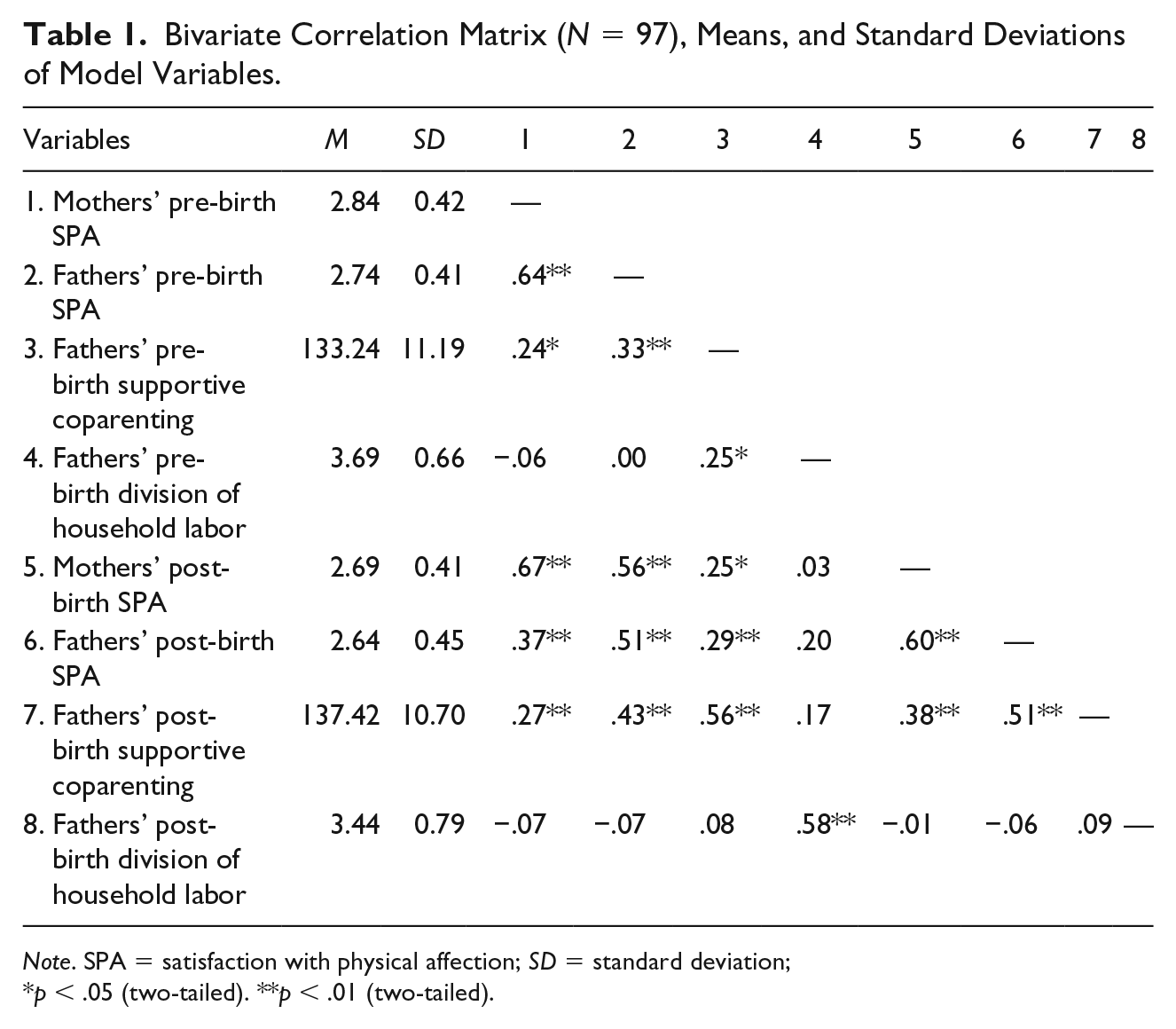
Note. SPA = satisfaction with physical affection; SD = standard deviation;
p < .05 (two-tailed). **p < .01 (two-tailed).
Path Analyses
Rather than treating individuals in relationships as independent, The APIM (Kenny et al., 2006) allows researchers to model dependencies in dyadic data, such that the effect of each partner’s own perceptions (i.e., actor effects) and their partners’ perceptions (i.e., partner effects) on satisfaction with physical affection can be considered simultaneously. Thus, APIM was used to examine the influence of mothers’ and fathers’ pre-birth physical affection satisfaction on both their own (actor effects) and their partners’ (partner effects) post-birth physical affection satisfaction. A path analysis was specified in which pre-birth satisfaction with physical affection for each parent was included as a predictor of post-birth satisfaction for each parent. At each time point, the error variance in mothers’ and fathers’ reports were allowed to covary to account for nonindependence of data.
Results from this APIM model are reported in Figure 1 and indicated that mothers’ pre-birth satisfaction with physical affection predicted their own post-birth satisfaction with physical affection. Similarly, fathers’ pre-birth satisfaction with physical affection was significantly related to their satisfaction with physical affection post-birth. Although mothers’ pre-birth satisfaction with physical affection did not predict fathers’ post-birth satisfaction, fathers’ pre-birth satisfaction with physical affection was significantly related to higher levels of mothers’ post-birth satisfaction with physical affection. These results are consistent with actor effects for both mothers and fathers, before and after the birth of a new baby, as well as partner effects for mothers. Specifically, each parents’ pre-birth physical affection satisfaction predicted their own post-birth physical affection satisfaction, and mothers’ post-birth satisfaction was also predicted by fathers’ pre-birth satisfaction.

Actor-partner interdependence model (APIM) examining associations between fathers’ and mothers’ satisfaction with physical affection.
To examine the direction of effects between fathers’ physical affection satisfaction and relationship dynamics before and after the birth of a child, two cross-lagged path analyses were conducted. The first examined associations between fathers’ satisfaction with physical affection and father-reported pre-birth (expectations) and post-birth (perceptions) of division of child-related household labor. To isolate satisfaction with physical affection these analyses also controlled for observed marital quality. This eliminates the interpretation that findings would be explained by variation in overall marital quality rather than satisfaction with physical affection specifically. Results are presented in Figure 2 and revealed that greater expectations for fathers’ participation in household labor pre-birth predicted their greater participation in household labor post-birth. Fathers’ higher pre-birth satisfaction with physical affection predicted higher post-birth satisfaction with physical affection. Moreover, there were longitudinal associations between division of household labor and fathers’ satisfaction with physical affection. Fathers’ post-birth satisfaction with physical affection was affected by their pre-birth division of household labor, but pre-birth satisfaction did not predict post-birth division of labor. In essence, when fathers demonstrated a greater involvement in household labor pre-birth, they reported higher post-birth satisfaction with physical affection.
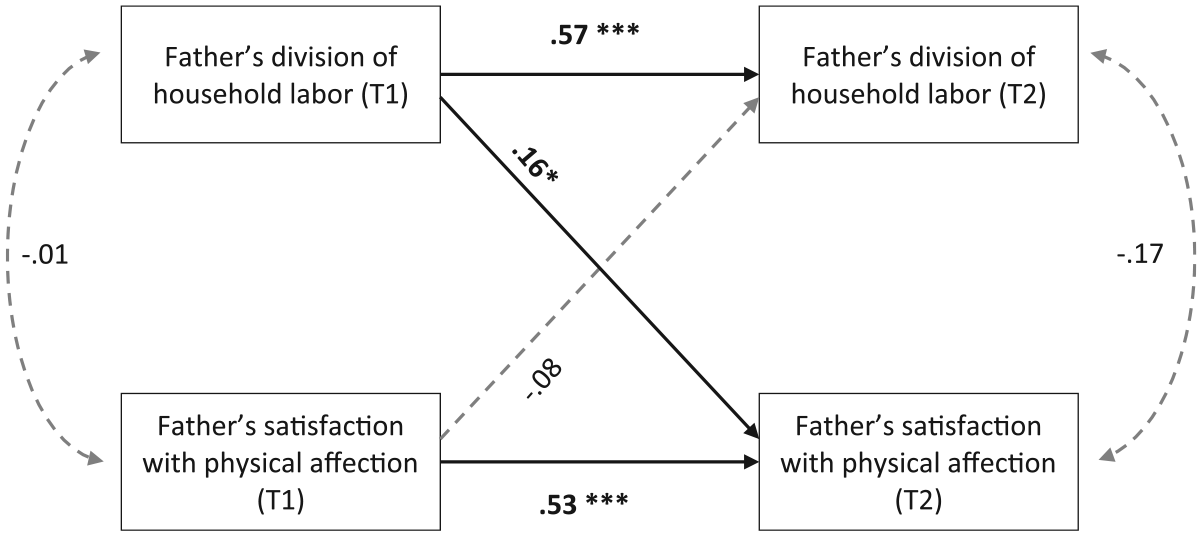
Cross-lagged model to examine the direction of effects between fathers’ satisfaction with physical affection and division of household labor before and after the birth of their child.
The second cross-lagged model examined concurrent and longitudinal associations between fathers’ satisfaction with physical affection and supportive coparenting. This model also controlled for pre-birth global marital quality. Results from this model are presented in Figure 3. Again, results indicated significant stability before and after the birth of a new baby, such that fathers’ pre-birth preparations for coparenting were significantly related to their post-birth coparenting perceptions. Similarly, fathers’ pre-birth satisfaction with physical affection predicted their own post-birth satisfaction with physical affection. In contrast to household labor participation, fathers’ higher levels of pre-birth satisfaction with physical affection predicted subsequent gains in coparenting support for fathers. However, fathers’ post-birth satisfaction with physical affection was unaffected by their pre-birth preparations for coparenting.

Cross-lagged model to examine the direction of effects between fathers’ satisfaction with physical affection and coparenting before and after the birth of their child.
Discussion
The purpose of this study was to examine the associations between dyadic satisfaction with physical affection in a sample of married couples before and after the birth of a new baby, and the relationship between (1) coparenting and (2) division of labor with fathers’ satisfaction with physical affection satisfaction. Overall, fathers’ and mothers’ pre-birth satisfaction predicted their own post-birth satisfaction, and fathers’ pre-birth satisfaction predicted their partners’ post-birth satisfaction. Fathers’ pre-birth satisfaction also predicted post-birth coparenting support, whereas pre-birth division of household labor predicted fathers’ post-birth satisfaction. Results suggest a complex interplay between triadic family dynamics and satisfaction with physical affection pre- and post-partum and have important implications for therapeutic and educational practices aimed at supporting couples prenatally and following the birth of a new baby.
Cross-Parent Effects for Satisfaction With Physical Affection
When both mothers and fathers reported greater pre-birth satisfaction with physical affection, they also reported higher post-birth satisfaction with physical affection. Furthermore, fathers’ pre-birth satisfaction predicted mothers’ post-birth satisfaction. This finding speaks to the independent and interdependent nature of each partner’s physical affection satisfaction before and after the birth of a new baby. It may be that after becoming a parent, mothers and fathers become more interconnected in some domains of relationship functioning. Many women are likely to experience changes in desire for, and satisfaction with, physical affection during pregnancy and early postpartum. For these women, fathers’ pre-birth satisfaction with physical affection may be a buffer that allows women to remain satisfied with physical affection even after the physical and biological changes that accompany childbirth. Men who are satisfied with physical aspects of the couple relationship before the arrival of a new child may continue to engage physically with new mothers in a way that is mutually satisfying and/or may be accepting and understanding of physical and psychological challenges to physical affection that often accompany this transition. Both cases may result in elevated satisfaction with one’s physical relationship for mothers of young children. These results speak to the importance of incorporating discussions and open communication around physical affection into programming for pregnant couples. Nurturing satisfaction with this aspect of the couple relationship and setting appropriate expectations for changes that may occur post-birth, could be an important, and thus far largely overlooked, element of educational programs, counseling, and clinical work targeting the transition to parenthood.
Division of Household Labor Predicts Fathers’ Satisfaction With Physical Affection
When fathers reported greater contributions toward household labor pre-birth, they reported higher post-birth contributions to household labor. In the model including division of household work, fathers who were satisfied with their physical affection again showed later satisfaction with physical affection following childbirth. Moreover, fathers who expected to be active contributors to child-related tasks before the baby’s birth reported higher post-birth satisfaction with physical affection.
Consistent with other study results, fathers’ post-birth satisfaction was predicted by their pre-birth satisfaction, and household labor pre- and post-birth were related to one another. Interestingly, pre-birth division of household labor also significantly predicted higher levels of fathers’ post-birth satisfaction with physical affection. This direction of effects differs from the coparenting model and suggests that pre-birth expectations for household labor may have implications for fathers’ subsequent satisfaction with physical intimacy. Fathers who have an expectation that they are going to be highly involved before the child is born may be expressing a strong investment in the parenting role and/or a realistic expectation of the demands of having a new baby. In turn, these fathers may be more likely to cultivate moments of mutually satisfying physical affection with their partners or may simply be better prepared for the downturn in physical affection that sometimes accompanies the addition of a new child. In both cases new fathers may be more likely to view physical aspects of the couple relationship in a more positive light. These results are consistent with evidence from family interventions demonstrating that fathers’ prenatal investment in the parenting role has downstream consequences for many aspects of personal well-being and family functioning (Doherty, Erickson, & LaRossa, 2006; Florsheim et al., 2012).
Fathers’ Satisfaction With Physical Affection Predicts Coparenting
In prior work, coparenting has most often been conceptualized as a predictor of satisfaction with physical affection (Carlson, Hanson, et al., 2016; Maas et al., 2018). However, the present study’s findings suggest that when it comes to supporting one another’s parenting efforts, coparenting appears to be an outcome of satisfaction with physical affection.
This finding extends research linking gains in coparenting to general marital quality by demonstrating the predictive power of satisfaction with physical affection—a more specific aspect of marital quality—to later coparenting support. Satisfaction with physical affection is thought to be beneficial in its own right for men’s and women’s mental health, as well as global marital and relationship satisfaction (Abidin & Brunner, 1995). This study is the first evidence that the benefits of this satisfaction may extend to the coparenting relationship and interactions involving both parents and the child. According to Heiman et al. (2011), sexual satisfaction is one of the most important factors for relationship happiness for both men and women. Hence, when fathers are satisfied with physical affection even before the child is born, they may also be more likely to form a successful coparenting partnership. Preparations for parenthood and the task of caring for a new infant in the first several months often necessitate the committed cooperation of both parents (Kuersten-Hogan, 2017). These preparations for couples—including dealing with common changes and/or discrepancies related to physical satisfaction—begin before the child is born and may well have important consequences for family dynamics post-birth. Issues around physical affection can be difficult and challenging topics for parents facing physical changes and the impending demands of a new baby (Johnson, 2011; Woolhouse, McDonald, & Brown, 2012). These findings suggest that those discussions in the home, as well as in therapeutic practice or parent education settings, may pay dividends for post-birth family functioning.
Limitations and Future Directions
Although the present study documents relevant associations among satisfaction with physical affection, division of household labor, and supportive coparenting before and after the birth of a child, it also has some notable limitations. The first limitation of these data involves the nature of the sample itself. Middle-class, well-educated, and largely White (80% European American) couples were overrepresented in the study. The extent to which these findings generalize across ethnicity and socioeconomic status remain to be seen. Moreover, the sample consisted exclusively of different-gender, married couples with biological children. Other diverse forms of families (e.g., same-sex couples, nonresidential parents, adoptive parents) may exhibit different patterns of association. Future work would be well-served by examining these relations in samples with more diverse characteristics. Furthermore, the present study had only a modest sample size, and future studies should assess satisfaction with physical affection on larger and more diverse samples.
Moreover, there are limitations with the measurement of study variables that can be improved upon. Specifically, the primary variables of interest (satisfaction with physical affection, coparenting, and division of labor) were measured just once pre-birth and once post-birth at 3 months of age. However, the sharp decline in satisfaction with physical affection happens during the transition to a new baby and may well begin before 3 months of age. Moreover, family dynamics may develop throughout pregnancy, as couples make pre-birth plans for the addition of a new child (Deave et al., 2008). Hence, future studies should include multiple pre-birth and post-birth assessments to better track the trajectories of these dynamics before and after childbirth.
Furthermore, although the DAS has been widely used and well-validated, the particular subscale employed in this study may warrant further validation. For example, some alpha values were just slightly less than .70. Numerous methodologists argue for values greater than .60 as a more reasonable criterion, particularly when employing a new scale that consists of a small set of items (e.g., Cronbach & Shavelson, 2004; Lewis & Loewenthal, 2015; Yang & Green, 2011), as was done in the present study. Nonetheless, additional data supporting the reliability and validity of this measure of satisfaction with physical affection may be warranted.
Finally, this study relies exclusively on self-report data, which can lead to spurious associations due to shared method variance. Future research should attempt to replicate these findings using other methodologies, especially observational assessments of coparenting and marital dynamics, but also perhaps with time diaries that track moment-to-moment fluctuations in satisfaction and family functioning. Furthermore, given this is a relatively new area of inquiry, qualitative and mix methods approaches might be useful tools for better understanding how individuals and couples make sense of physical affection before and after the birth of a child.
Implications
This study speaks to the importance of integrating satisfaction with physical affection into both research and practice with new and expectant parents. Specifically, interventions and preventive interventions with individuals, couples, and families can incorporate information on satisfaction with physical affection into their programming. Overall, couples would be well-served by engaging in open communication regarding their parenting challenges/changes and how satisfied they each are with physical affection during this joyful, but stressful period. Hence, programs and clinical work aimed at new parents should recognize that individuals’ satisfaction with physical affection is inexorably intertwined.
Parent education is another important avenue that could play a role in promoting quality family life for new parents. Education for expectant parents should recognize the need to focus on physical affection before the birth of a child rather than attempting to intervene after maladaptive patterns have already been established. In particular, educational materials for first-time fathers that promote empathy and understanding of the medical, hormonal, and emotional challenges associated with new motherhood, as well as potential gender differences in physical affection for new parents, may be especially useful. Relatedly, establishing patterns of—and expectations for—relatively equitable divisions of household labor may in turn have consequences for satisfaction with physical affection and potential downstream benefits for couple relationship functioning.
Furthermore, counseling that encourages new parents to openly discuss the realities and expectations regarding physical affection before and after the birth of a new baby across the transition to a new child could be particularly effective. In general, efforts to increase satisfaction with physical affection should also incorporate other aspects of family dynamics (e.g., coparenting, division of household labor) as both determinants and consequences, with a particular focus on the importance of pre-birth planning and setting appropriate expectations for family dynamics even before the child is born. Similarly, interventions focused on increasing the quality of the coparenting partnership should also recognize the interconnectedness of coparenting and triadic family dynamics with satisfaction with physical affection.
Overall, the present study provides evidence for the interconnectedness of fathers’ and mothers’ physical affection satisfaction. Our findings also indicate that satisfaction with physical affection is a significant part of other relationship dynamics such as coparenting and division of household labor before and after the birth of a new baby. Given the reciprocal nature of these relationships, research and practice with young families would be well-served by incorporating an enhanced understanding of physical affection as both a contributor to—and an outcome of—adjustment to the addition of a new child.
Footnotes
Author’s Note
Sarah C. Mangelsdorf is now affiliated with the University of Rochester.
Declaration of Conflicting Interests
The author(s) declared no potential conflicts of interest with respect to the research, authorship, and/or publication of this article.
Funding
The author(s) received no financial support for the research, authorship, and/or publication of this article.
