



Abstract
Emerging adult (EA), college students from immigrant families continue engaging in language brokering (LB), translating documents and other media for their parents, in ways that can affect their well-being. For these language brokers, the relationship between parental attachment and psychological well-being may be through frequency and perceptions of their LB work. In this study, 459 language brokers (Mage = 21.36, Female = 80%) completed an online questionnaire about frequency and perceptions of LB, attachment, and psychological well-being. Attachment anxiety and avoidance had negative indirect effects on anxiety and somatic symptoms through feelings of LB burden. Attachment anxiety had a negative indirect effect on somatic symptoms through LB intrusiveness. There were negative indirect effects of LB burden on attachment avoidance to anxiety and somatic symptoms. There was a negative indirect effect of LB intrusiveness on attachment avoidance to somatic symptoms. Findings indicate that perceptions of LB may relate to psychological well-being when attachment is insecure.
The responsibilities of attending to parents’ acculturation needs may continue for emerging adult (EA) children from immigrant families. Immigrant children often learn the host language faster than their parents and are frequently asked to language broker for parents and other adults, translating text, conversations, and media from the heritage language to the host language and vice versa (Tse, 1995). Language brokering (LB) is a common practice for children (Dorner et al., 2008; Weisskirch & Alva, 2002), adolescents (Chao, 2006), and EAs (Weisskirch et al., 2011) from immigrant families. Given that most LB occurs for parents, the quality of the parent-child relationship—in the form of attachment—may shape the experience of LB for the child (Guntzviller & Wang, 2019; Shen et al., 2019). Children who have poorer attachment with their parent(s) may experience LB more negatively. Over time, then, these experiences of LB may take a toll on the individual’s psychological well-being (Shen et al., 2019; Tseng & Fuligni, 2000; van Leeuwen et al., 2014). EA college students may be particularly affected by ongoing LB because they are at a place, developmentally and socially, where there are pressures to individuate and separate from their families, and continued LB responsibilities at this time may become deleterious on their psychological well-being (Schwartz, et al., 2013).
Emerging Adults’ Attachment to Parents
The ongoing relationship between EA college students and their parents may be understood through attachment theory. Attachment may be framed as the reciprocal, enduring emotional bond formed between infants and caretakers (i.e., usually, the parents; Ainsworth et al., 1978). Based on the work of John Bowlby (1969), attachment theory asserts that, as infants form an attachment bond, the pattern of relating between the caregiver and the child becomes “an internal working model” for the child about relationships. Caregivers who are attentive to infants’ needs and rhythms, and are predictable in this attention, will foster a sentiment in the infants that relationships are to be trusted and the world is a secure place. Caregivers who are not well attuned to the infants’ needs, lack responsivity, or neglect to provide care may have infants who develop an insecure attachment.
There is evidence that the attachment pattern established in infancy carries forward to adulthood (Simonelli et al., 2004). This attachment pattern has been described as comprising of two dimensions: attachment anxiety and attachment avoidance (Sanford, 1997). Attachment anxiety is manifested in adults as poor development of control over outcomes from interactions and feeling that others who are close will reject and abandon them (Mikulincer & Shaver, 2003). Attachment avoidance is when individuals generally have negative views of others and demonstrate a tendency to avoid closeness and dependency on others. Individuals who are low on attachment anxiety and low on attachment avoidance are viewed as having a secure attachment. A secure attachment sets a foundation for psychological adjustment through childhood into adulthood (Whittaker & Cornthwaite, 2000). There has been support for associations between attachment and psychological outcomes. Dawson et al. (2014) reported that insecure attachment in EAs (i.e., preoccupied) was associated with externalizing behaviors. Further, individuals with insecure attachment were more likely to report anxiety and depression in the face of adversity (Rholes & Simpson, 2004).
Parental Relationships and Language Brokering
In the research with adolescent language brokers, findings about the frequency of LB and relationships with parents are mixed. Some research has found greater conflict with parents (Hua & Costigan, 2012) and other research has found greater understanding of parents (Kim et al., 2017). For EA college students, the parent-child relationship may also relate to perceptions of LB (Weisskirch, 2018). EA college students have obligations to school and their personal lives, which may conflict with requests to engage in LB. At the same time, as EAs, they may also have gained experience with LB over time and may feel at ease during LB. In addition, for EAs, specifically, it is also important to investigate perceptions of LB as well as frequency of LB. What is not known is if quality of the overall parent-child relationship, in the form of attachment, relates to perceptions of LB and to psychological outcomes. Given that past research with adolescents has found that when LB tasks are not viewed as stressful they are less likely to have deleterious outcomes (Dorner et al., 2008), it is likely that EA college students will have deleterious psychological outcomes when LB is perceived negatively.
The quality of parent-child relationships relates to the perceptions of LB for language brokers (Hua & Costigan, 2012; Kam, 2011; Love & Buriel, 2007; Martinez et al., 2009; Wu & Kim, 2009). When parent-child relationships are positive, then language brokers report fewer negative perceptions (e.g., burdened) and more positive outcomes (e.g., feeling efficacious). Negative parent-child relationships have been associated with LB being perceived as burdensome (Wu & Kim, 2009), contributing to family disagreements (Trickett & Jones, 2007), and higher levels of family conflict and depressive mood (Lazarevic, 2017). Among Mexican American EA college students, Weisskirch (2013) found that a lack of parental support predicted a sense of burden when LB. This sense of LB burden also related to lower self-esteem and self-efficacy and contributed to greater school-related stress (Sy, 2006; Weisskirch, 2013). Guan and Shen (2015) found that, among Asian American, Latino, and White EAs, frequency of LB indirectly and negatively affected relationship quality through lower perceived parental praise. Lazarevic (2017) found, that among the LB Eastern European American EAs in her study, there was a strong feeling of family obligation but that they harbored negative feelings about their role in the family when engaging in LB. Weisskirch (2018) found that frequent language brokers reported less paternal and maternal nurturance, paternal and maternal connection, and greater maternal disrespect in comparison to non-language brokers in a sample of EA college students. Thus, the quality of the parent-child relationship may relate to perceptions of LB.
Some researchers have asserted that there may be role reversal within the family or parentification of the child when there is LB. Role reversal can be understood as an exchange of roles in the family where the child acts adult-like and the parent’s role is subordinate to the child’s position. Portes and Rumbaut (1996) added that role reversal occurs when children’s competence with English and the host culture exceeds their parents’, and family decisions become dependent on the children’s knowledge. For example, Schofield et al. (2012) found that parent-child fluency in Spanish, but not in English, was related to lower levels of role reversal and less hostility among Mexican-American adolescents because of cultural consistency between parents and adolescents. A similar concept within the notion of role reversal is parentification where the child moves into the parental subsystem and acts in a parent-like role within the family, and in which the parents’ reliance on the child obstructs the child’s typical developmental process (Castro et al., 2004). Kam et al. (2017) found that those Latino adolescents who were more parentified were more likely to report greater frequency of LB, more perceived discrimination, and greater depressive symptoms in comparison to occasional and less frequent language brokers. Titzmann (2012) reported that, in a sample of both German native-born adolescents and immigrant ethnic German adolescents from the Soviet Union to Germany, frequency of LB was associated with instrumental (i.e., support of domestic-related parental responsibilities) and emotional parentification (i.e., support in regulating parental emotions). However, among immigrants, instrumental parentification was associated with better self-efficacy and lower levels of exhaustion in comparison to native adolescents. Among former Soviet Union EA immigrants to Israel, there was an association between role reversal and psychological distress (Ponizovsky et al., 2012). Kam (2011) reported, among Latino adolescents, that positive feelings toward LB were associated with parentification, which was not significantly related to risky behaviors. Trickett and Jones (2007) found that frequency of brokering was positively associated with family adaptability and not with role reversal among Vietnamese-American adolescents. For EA college students, continued LB may be perceived as extending the role reversal that may have occurred earlier in development and may influence the perceptions of LB for parents.
EA college students from immigrant families may also continue to feel obligated to fulfill their role as language brokers in addition to other familial responsibilities, despite potentially residing away from home and having school-related responsibilities. Past research has indicated that, among adolescents, family obligations, including LB, can impede academic success (Fuligni, 2001). Among Latino adolescents, Anguiano (2018) found that every day, low-stakes LB was associated with academic achievement, but high-stakes brokering where family health and well-being were involved negatively related to academic achievement and increased stress. Recently, Vasquez-Salgado et al. (2018) reported that Latino university students who resided within 50 miles of their families were affected more by family obligations, including LB, than those who resided farther away. In particular, attentional control was diminished when family obligations were high, particularly for women. According to Sy (2006), LB frequency was associated with greater school-related stress for Latina college students, and the relationship of work hours to school-related stress was made worse when there was LB. Further, LB was associated with greater school-related stress whereas spending time hanging out with family was not, indicating that LB itself may present a different kind of stressor than just time away from activities (Sy, 2006). Collectively, these studies support the idea that LB obligations pull language brokers out of their non-familial activities and into the family obligations. It may be useful to focus on how intrusive LB is on college-specific responsibilities and how that intrusiveness may relate to psychological well-being.
Language Brokering as a Mediator
What is unknown is how attachment might predict psychological well-being through frequency and perceptions of LB. It is likely that the relationship between attachment and psychological well-being is indirectly affected by frequency and perceptions of LB. Given that episodes of LB afford children opportunities to have close, intimate, and extended contact with a parent in a potentially stressful activity, LB may serve as reinforcement of positive family relations (i.e., secure attachment) and may serve as exacerbation of negative family relations (i.e., insecure attachment). That is, those with secure attachments may view LB as less stressful or less burdensome because of the positive relationship established. Furthermore, youth who have a secure attachment to parents may be more willing to engage in LB because of the close, personal bond. Those with more insecure attachments may engage in less LB overall or may find the frequency of LB more deleterious to their well-being as it stems from the poor relationship quality.
Since the parent-child relationship often shapes how LB is experienced by the language broker (Kam & Lazarevic, 2014; Weisskirch, 2017), it is likely that the established pattern of relating, the attachment pattern, may be associated with perceptions of LB. It is possible that language brokers who report secure attachments are less likely to report LB as negative. In contrast, it is likely that language brokers who are high on anxious attachment or are high on avoidant attachment are more likely to report negative perceptions of LB. This negative perception of LB can, in turn, affect psychological well-being among those who broker. Mikulincer and Florian (1998) reported that under stressful circumstances, those individuals who are high on attachment anxiety or high on attachment avoidance show ineffective ways of coping and experience high levels of distress. Moreover, high attachment anxiety has been associated with ongoing conflict, distress, and anger with parents among EAs (Seiffge-Krenke, 2006). Therefore, it is likely that LB may be perceived negatively by those individuals with insecure attachment patterns. Language brokers with insecure attachment patterns may have difficulty coping with the stressful experience of LB. These difficulties can compound and affect psychological well-being.
The Present Study
Insecure attachment has been implicated in affecting how individuals manage stressful circumstances (Mikulincer & Shaver, 2003). Given the challenging nature of LB, it is likely that attachment relates to how individuals perceive their LB experience. Those with insecure attachments are likely to perceive LB as more problematic than those with secure attachments. Since the literature has supported the link between frequency and perceptions of LB and psychological outcomes (e.g., Shen, et al., 2019; Rainey et al., 2014), it is likely that the relationship of attachment to measures of psychological well-being is indirectly affected by frequency and perceptions of LB. We hypothesize that the relationship between attachment and psychological well-being will be mediated by frequency and perceptions of LB. Specifically, the relationship of attachment to psychological well-being will be indirectly affected through frequency of LB and perceptions of LB (i.e., burden, role reversal, efficacy, and intrusiveness). See Figure 1.

Conceptual Model of frequency and perceptions of LB mediating attachment to psychological well-being.
Method
Participants
Given that language brokers are a unique subset of individuals who speak a language other than English and engage in LB for parents or other adults, we targeted a LB subsample from a larger sample of individuals. For the larger study, 1,360 EA college students (Female = 1,074, Male = 286) from three public universities in California completed an online questionnaire for extra credit, for research credit, or to be entered into a raffle for gift cards. Once the participants gave consent, the completion of the questionnaire took about 30 minutes. The ethnic-racial composition of the entire sample was 3.4% African American, 21.4% Asian American, 30.3% Caucasian, 33.8 % Latino, and 11.1% multiracial/others. Only participants between the ages of 18 years and 25 years (M = 21.00, SD = 1.93) were included in the study sample to focus on EAs (Arnett, 2004).
From this larger sample, those individuals who answered affirmatively to “Do you speak a language other than English” and to “Do you ever translate conversations, papers, documents, or other items from English to another language for one or both of your parents?” were retained in the final study sample to focus on those who engage in LB. The final study sample included 459 EA college students (Female = 367, Male = 92) with an average age of 21.36 years (SD = 1.93). Within the sample, 91% reported that their mothers and their father, respectively, were born outside the United States and 90% had two foreign-born parents. The ethnic-racial composition of the study sample is 1.5% African American, 24.0% Asian American, 4.6 % Caucasian, 66.2% Latino, and 3.7% multiracial/others. All research activities were approved by the IRBs of each institution. See Table 1 for demographic background of participants.
Demographic Variables of Participants.
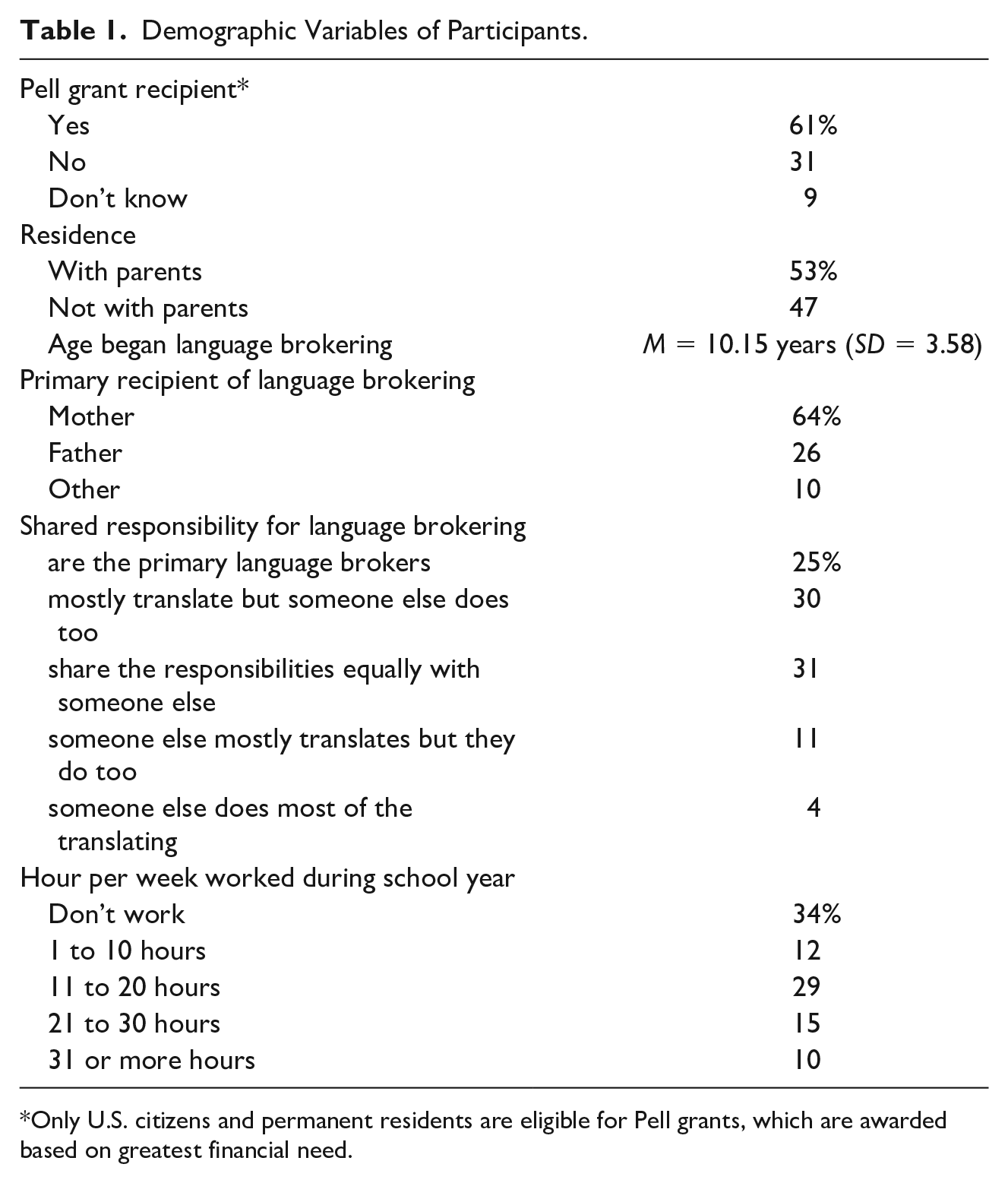
Only U.S. citizens and permanent residents are eligible for Pell grants, which are awarded based on greatest financial need.
Measures
Demographics
Participants indicated gender, ethnicity, GPA, residence, hours worked during the school year, and receipt of a Pell grant.
Frequency of language brokering
Participants completed two items to indicate the frequency with which they language broker. One item was “In the last week, how often have you translated for your parents?,” rated with scale of 1 = every day, 2 = mostly every day, 3 = a few days of the week, 4 = 1 to 2 days a week, 5 = not at all. The second item was “In general, how often do you currently translate for your parents?,” rated with a scale of 1 = everyday, 2 = a few times a week, 3 = once a week, 4 = a few times a month, 5 = once a month, 6 = one time every few months, 7 = once every six months, 8 = once a year.
Burden when language brokering
Participants completed the four-item burden scale of the Language Brokering Scale from Kim et al. (2014). An example item included “It is stressful to translate,” rated using a scale of 1 = strongly disagree to 4 = strongly agree. In this study, Cronbach’s alpha for this scale was .85.
Role reversal in language brokering
Participants completed the seven-item role reversal scale from the Language Brokering Scale (Kim et al., 2014). An example item included “I do not have respect for my parent because I translate for him/her,” rated using a scale of 1 = strongly disagree to 4 = strongly agree. In this study, Cronbach’s alpha for this scale was .86.
Efficacy when language brokering
We used Kim et al. (2017) four-item LB efficacy scale to assess participants’ feelings of self-efficacy when LB. A sample item included “I am good at translating for my parent,” rated using a scale of 1 = strongly disagree to 4 = strongly agree. In this study, Cronbach’s alpha for this scale was .90.
Intrusiveness of language brokering
We created a six-item measure to assess how intrusive LB is on the typical responsibilities of college students. Participants were asked to rate the items, using a scale of 1 = never to 4 = almost always : “How often do you: miss class to translate for your parents; miss work to translate for your parents; give up social events to translate for your parents; not do your homework or turn it in late because you’re translating for your parents; stay up late working or studying because you spent so much time translating for parents; go out of your way to translate for your parents?” These items were developed based on the research literature on LB and college students from immigrant families (e.g., Fuligni et al., 2002; Orellana, 2009; Sy, 2006; Vasquez-Salgado et al., 2018). For this measure, Cronbach’s alpha was .82.
Attachment orientation
Participants completed the Experiences in Close Relationships-Relationships Structures Questionnaire (ECR-RS; Fraley et al., 2011). The nine items were rated, using a scale of 1 = strongly disagree to 7 = strongly agree. We modified the items to use “parent” rather than “this person.” The measure is comprised of two subscales of attachment: attachment anxiety (three items) and attachment avoidance (six items). Sample items include “I’m afraid that this parent may abandon me” (anxiety) and “It helps to turn to this parent in times of need” (reverse-scored; avoidance). Cronbach’s alphas for the entire measure and the subscales, respectively, were .86, .87, and .86 for this study.
Sadness/Depressive Symptoms
Participants rated the eight-item PROMIS sadness and depressive symptom scale, using a scale of 1 = never to 5 = almost always (Hays et al., 2009). A sample item included “In the past seven days, how often you felt the following: I could not stop feeling sad.” Cronbach’s alpha was .95 for this sample.
Anxiety symptoms
Participants rated the eight-item Neuro-QOL Anxiety, Short Form, using a scale of 1 = never to 5 = almost always (Cella et al., 2012). A sample item included “In the past seven days, how often you felt the following: I felt uneasy.” Cronbach’s alpha was .93 for this sample.
Somatic Symptoms
Participants completed an eight-item scale about somatic symptoms (Gierk et al., 2014). They indicated “In the past seven days, how much how you been bothered by any of the following problems?” including stomach or bowel problems, back pain, pain in arms, legs, and joints, headaches, chest pain or shortness of breath, dizziness, feeling tired or having low energy, and trouble sleeping, using a scale of 1 = not at all to 4 = very much (α = .82).
Results
Preliminary Results
Given the findings in the language research literature on differences by gender and age, for this sample, we investigated differences by gender and age on LB frequency, LB burden, LB role reversal, LB efficacy, LB intrusiveness, attachment anxiety and avoidance, sadness/depressive symptoms, anxiety symptoms, and somatic symptoms. There were two significant differences by gender. Males were higher (M = 1.42, SD = .46) than females (M = 1.31, SD = .44) for LB role reversal, F(1, 458) = 4.71, p < .05. In addition, males were higher (M = 3.65, SD = 1.32) than females (M = 3.25, SD = 1.50) for attachment avoidance, F(1, 458) = 5.41, p < .05. There were no other significant differences by gender. There were associations with age and general frequency of LB (i.e., as participants were older, they brokered more often), r = -.09 p < .05; with intrusiveness of LB, r =.10, p < .05; with attachment anxiety (r = -.13, p < .01); and with sadness/depressive symptoms r =-.10, p < .05, respectively.
In addition, we wanted to assess the associations between the variables of interest. LB burden was positively associated with LB role reversal (r = .46, p <.001), LB intrusiveness (r = .41, p <.001), attachment anxiety (r = .21, p <.001), attachment avoidance (r = .26, p <.001), anxiety symptoms (r = .21, p <.001), depressive symptoms (r = .14, p <.01), and somatic symptoms (r = .23, p <.001), and was negatively associated with LB efficacy (r = -.14, p <.01). Role reversal when LB and intrusive showed a similar pattern of associations, respectively. LB efficacy was associated positively with LB frequency in the last week (r = .14, p <.01), and negatively associated with LB burden (r = -.14, p <.01), LB role reversal (r = -.12, p <.01), attachment anxiety (r = -.18, p <.001), attachment avoidance (r = -.15, p <.001), and anxiety symptoms (r = -.11, p <.001). See Table 2 for detail.
Correlations among the Variables of Interest.

Note: Weekly LB = frequency of language brokering for parents in the last week; General LB = in general, frequency of language brokering for parents; Burden = burden when language brokering; Role reversal = role reversal when language brokering; Efficacy = efficacy when language brokering; Intrusiveness = intrusiveness of language brokering activities; *p < .05, **p < .01, ***p < .001.
In order to assess the indirect effects of frequency and perceptions of LB on the relationships between attachment and psychological well-being, we utilized Model 4 (Mediation), with bootstrapping, of the PROCESS macro for SPSS (Hayes, 2013). The PROCESS macro allows for testing the direct effects of the independent variable and the indirect effects of the hypothesized mediating variable on dependent variable using regression. Attachment anxiety and attachment avoidance were entered separately as independent variables with anxiety symptoms, sadness/depressive symptoms, and somatic symptoms as outcomes and LB frequency (i.e., in the last week and in general, respectively), perceptions of LB (i.e., burden, role reversal, and efficacy), and intrusiveness of LB as intermediary variables. Gender and age were controlled for in analyses. There were significant direct effects from attachment anxiety to LB burden (B = .11, p <. 001), LB role reversal (B = .14, p <. 001), LB efficacy (B = -.07, p <. 001) and intrusiveness of LB (B = .07, p <. 01), respectively. There was a significant direct effect of attachment anxiety to anxiety symptoms (B = .10, p <. 01). Attachment anxiety was indirectly associated with anxiety symptoms via LB burden (B = .03, 95% CI = .01, .05). There was a significant direct effect of attachment anxiety to sadness/depressive symptoms (B = .19, p <. 001). There was a significant direct effect of attachment anxiety to somatic symptoms (B = .11, p <. 01). Attachment anxiety was indirectly associated with somatic symptoms via burden when LB (B = .02, 95% CI = .01, .04) and intrusiveness of LB (B = .01, 95% CI = .00, .03), respectively. See Table 3.
Direct, Indirect, and Total Effects of Attachment Anxiety on Well-being.
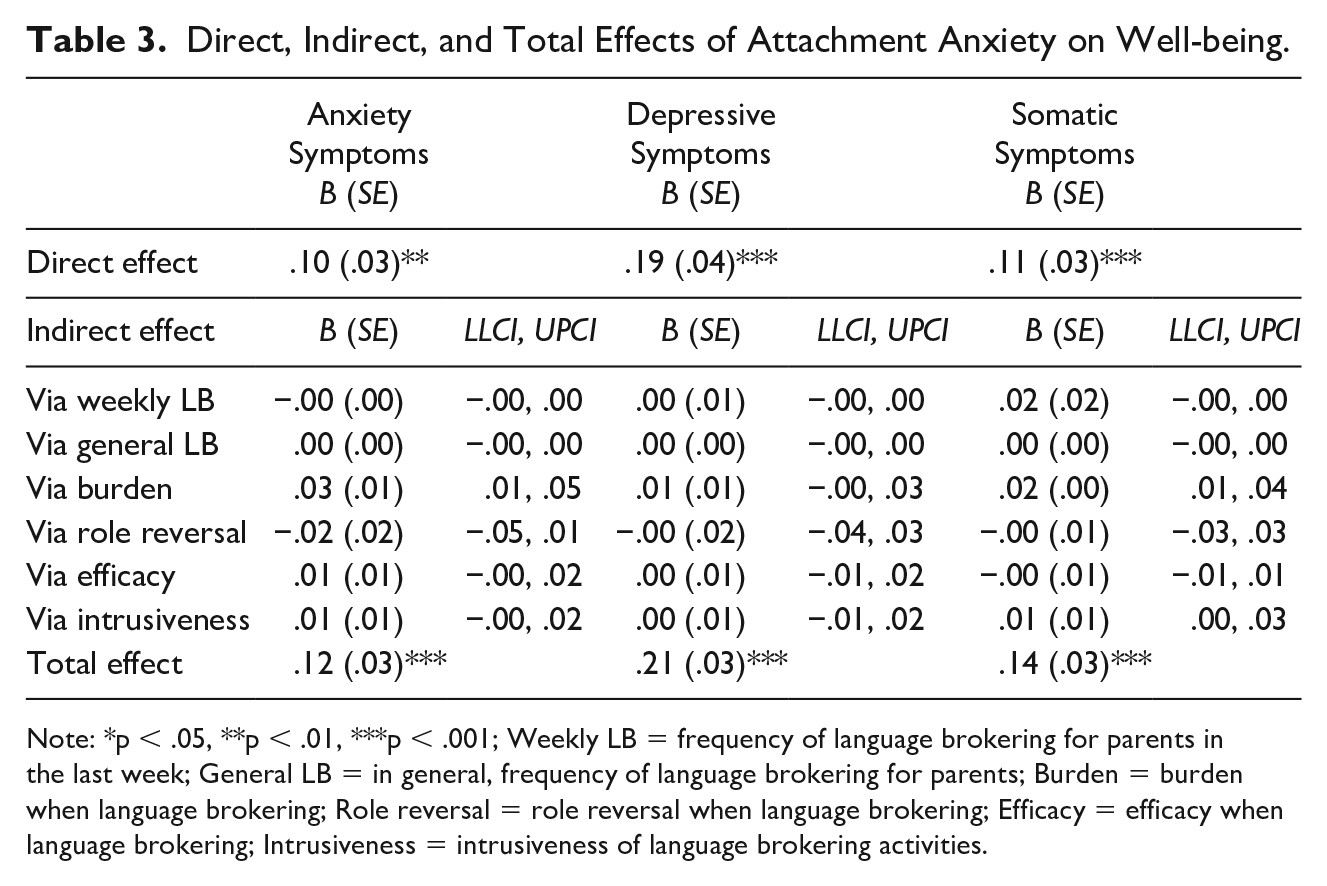
Note: *p < .05, **p < .01, ***p < .001; Weekly LB = frequency of language brokering for parents in the last week; General LB = in general, frequency of language brokering for parents; Burden = burden when language brokering; Role reversal = role reversal when language brokering; Efficacy = efficacy when language brokering; Intrusiveness = intrusiveness of language brokering activities.
Further, there were significant direct effects from attachment avoidance to burden when LB (B = .12, p <. 001), role reversal (B = .06, p <. 001), efficacy (B = -.05, p <. 01), intrusiveness (B = .05, p <. 01), and general frequency of LB, respectively (B = -.94, p <. 05). Attachment avoidance was indirectly associated with anxiety symptoms via burden when LB (B = .03, 95% 95% CI = .01, .05). There was a significant direct effect of attachment avoidance to sadness/depressive symptoms (B = .11, p <. 001). Attachment avoidance was indirectly associated with somatic symptoms via burden (B = .02, 95% CI = .01, .04) and via intrusiveness (B = .01, 95% CI = .00, .02), respectively. See Table 4 for details.
Direct, Indirect, and Total Effects of Attachment Avoidance on Well-being.
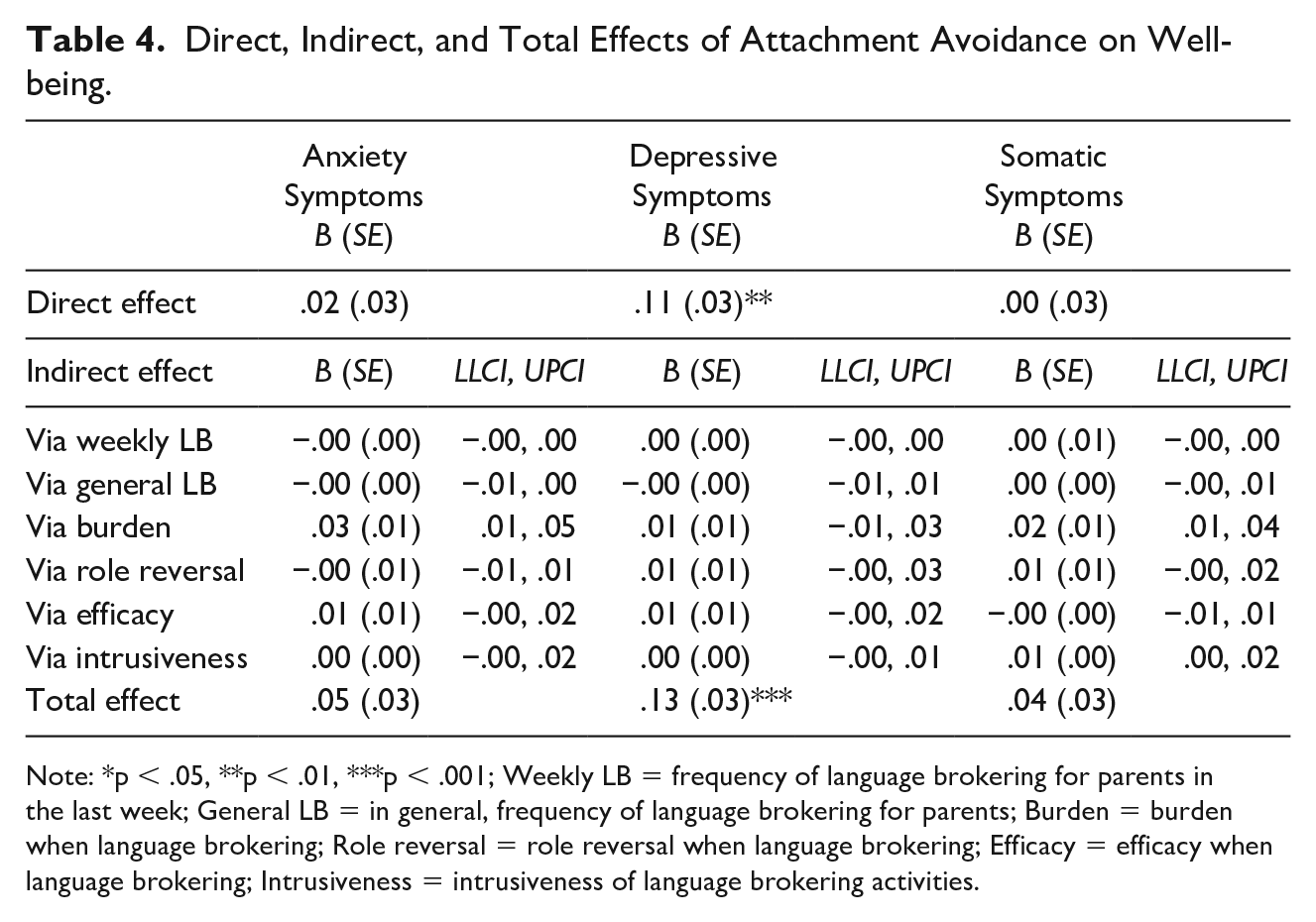
Note: *p < .05, **p < .01, ***p < .001; Weekly LB = frequency of language brokering for parents in the last week; General LB = in general, frequency of language brokering for parents; Burden = burden when language brokering; Role reversal = role reversal when language brokering; Efficacy = efficacy when language brokering; Intrusiveness = intrusiveness of language brokering activities.
Discussion
In this study, we investigated how attachment avoidance and attachment anxiety, as indicators of the quality of the parent-child relationship, and psychological well-being are indirectly affected by frequency and perceptions of LB. First, findings support the association between attachment anxiety and attachment avoidance and LB burden, role reversal, efficacy, and intrusiveness, respectively. In addition, attachment avoidance was associated with frequency of LB (i.e., lower attachment avoidance related to more frequent LB). These findings indicate that the enduring quality of the parent-child relationship may relate to how language brokers perceive their LB. Attachment anxiety and attachment avoidance, and anxious symptoms and somatic symptoms, respectively, were indirectly affected via burden when LB. These findings point to the importance of how the negative subjective experience of the language broker in situ may relate to poor psychological outcomes. Our findings are similar to the work of Shen et al. (2019) who found that brokers who felt burdened and continued to feel burdened reported greater parental relationship problems and psychosocial problems in emerging adulthood. Likewise, Weisskirch (2013) also found that burden when LB predicted self-esteem and self-efficacy.
Also, in this study, intrusiveness of LB had an indirect effect on attachment anxiety and attachment avoidance to somatic symptoms, respectively. These findings may reveal a developmental component to the psychological outcomes of LB for EA college students (Titzmann & Lee, 2018). That is, the perception of LB as intrusive in their lives as EA college students, when they have insecure attachment, may manifest in negative psychological outcomes in the form of somatic symptoms Therefore, based on our findings, our hypotheses were partially supported.
What is interesting about these findings is the absence of indirect effects of frequency of LB in light of LB burden relating to anxiety and to somatic symptoms. Our hypotheses were that frequency of LB would indirectly affect the relationship of attachment to psychological well-being. Past research has indicated that frequency of LB had deleterious effects for language brokers (e.g., Kam, 2011). It may be that, in the present study, feeling as though LB is burdensome, separate from actually engaging in LB is what contributes to anxiety symptoms for these EA college students. Moreover, feelings that these responsibilities are intrusive related to the attachment and somatic symptoms. It could be that, for these children of immigrant families, having this potential additional task, which they do not like to do, adds to overall impending feelings, which manifest as anxiety and somatic symptoms. In other words, these individuals may know that they can be called to language broker at any time, and this anticipation may contribute to the negative outcomes more so than actually engaging in LB.
For EA college students from immigrant families, there may be ongoing responsibilities to be a language broker. Past research has indicated that language brokers may experience LB positively, such as feeling efficacious, or negatively, as feeling burdened. At the same time, because of the non-normative nature of immigration, role re-negotiation between parents and children may be required for successful acculturation (Pedersen & Ravenson, 2005; Shen et al., 2017). However, for EA,college students, there may be a clash between the family’s acculturation needs and the individual child’s developmental needs that manifest in deleterious outcomes (Titzmann & Lee, 2018).
Limitations
The findings of this study should be considered in light of several limitations. First, the study is cross-sectional in nature, which does not allow for determining the direction of the associations. Second, the sample is skewed towards women. The findings may then reflect a bias towards how women interpret LB and relationships, and they may not apply towards men in the same fashion. Third, the sample size is somewhat small and may be limited in generalizability. Fourth, there is no objective measurement of how often participants are LB for their parents. It might be better to use a daily-diary method to assess objectively how often they actually translate for parents. Fifth, there is no measure of the participants’ fluency in the heritage or host language. It could be that the burden or efficacy experienced comes from a high degree of proficiency in both languages. When comprehension is incomplete in one language, LB may be experienced as more burdensome, for example.
Conclusion
Despite these limitations, this study presents some insights. Frequency of LB may be less influential on outcomes for EA college students than is the feeling of being burdened by LB. Given that the language brokers in this sample started brokering in childhood, it could be the ongoing feeling of being burdened when LB that may have an impact on psychological well-being, when attachment is less secure. Insecure attachment among individuals who find LB particularly burdensome and intrusive may manifest in poorer psychological outcomes of anxiety and somatic symptoms.
Footnotes
Declaration of Conflicting Interests
The author(s) declared no potential conflicts of interest with respect to the research, authorship, and/or publication of this article.
Funding
The author(s) received no financial support for the research, authorship, and/or publication of this article.
