




Abstract
Immigration brings particular challenges to older Chinese immigrants’ wellbeing because they make a new home in a foreign country. Based on 30 semi-structured in-depth interviews, this study aims to understand the immigration history of this specific group and unravel the complex links between family relationships and wellbeing. Four themes emerged from the interviews. First, the decision to immigrate is the result of the combined influence of family values, affinities and the need for aged care. Second, after immigration, housework normally negatively influences their wellbeing. The third theme pertains to the interactions amongst family members. The final theme shows that Chinese immigrants’ perceived wellbeing is influenced by family relationships, an independent lifestyle and social networks. This research highlights older Chinese immigrants’ complex feelings of family commitment, personal values and the need for aged care. Practical implications for policymakers to better facilitate this group’s wellbeing are provided.
Introduction
Accelerating transnational movements and the growing ageing population have prompted serious questions about the wellbeing of older immigrants. In the context of globalisation, an increasing number of older people leave their homes to move to other countries (United Nations, 2019) and a significant number of scholars and policymakers around the world are increasingly concerned about older immigrants’ health and wellbeing, their relationships with their families and their creation of the ‘home’ (Blunt, 2005; Buffel, 2017; Ciobanu et al., 2017). This phenomenon of transnational family reunion has brought about significant changes to the intergenerational relations of Chinese immigrant families. Despite an increasing focus on older immigrants in literature (Wood and Martin, 2019; Wylie, 2007), it is important to understand the nexus between family relationships while the wellbeing of older immigrants remains underexplored.
Existing research that examines the health issues of older Chinese immigrants, showing the difficulties of accessing health services, higher risk of suffering mental health issues such as depressing and loneliness (Lai, 2009; Tang et al., 2018). Due to language barriers and transportation limitation, older Chinese immigrants have limited social networks and support (Liu et al., 2019). They struggle to adapt to the new environment and cultivate a sense of home and their ethnic identities through everyday lives (Da and Garcia, 2015; Lin et al., 2016; Zhan et al., 2017). Family relationships were a crucial topic in previous studies on older Chinese immigrants (Lai et al., 2019). Families are sources of shared responsibilities such as intergenerational transfers of caregiving and affective bonds (Lin et al., 2020). In Chinese culture, intergenerational co-residing is an important traditional value, expecting that adult children live with and care for their older parents. This has shaped family structures and relationships between parents and children.
Because of the decline in health throughout ageing, the understanding and key components of wellbeing later in life change dramatically (Gilroy, 2007). This is especially important for older immigrants because they live in a new context that differs in physical living environment, interpersonal relationships and the welfare system from their home society (Wang and Zhan, 2021). Wellbeing was investigated by various disciplines (e.g. sociology, geography, psychology and economics) (Fleuret and Atkinson, 2007; Gatrell, 2013; Ziegler and Schwanen, 2011). Wellbeing is, however, an elusive concept, understood by variables that measure this concept indirectly (Andrews et al., 2014). Some scholars consider wellbeing as an objective phenomenon related to an individual’s living environment (Fleuret and Atkinson, 2007; Phillips, 2006) while other approaches consider wellbeing as subjective experiences such as autonomy and positive relationships with others (Gatrell, 2013; Wang and Wang, 2015). Factors that determine older people’s wellbeing include living environments (Chaudhury et al., 2016), family support (Lin et al., 2015), social networks and the involvement in society (Ziegler and Schwanen, 2011). Staying healthy is significant to wellbeing. However, this concept mainly focuses on physical and mental health (Riva & Curtis, 2012). Other aspects of wellbeing, such as independence and social networks, cannot be depicted only by health (Ziegler & Schwanen, 2011). As Andrews et al. (2014) argued, the feeling of wellbeing is something that is ‘lived’ and can come into being through the processes of interactions between people. In this research, wellbeing is related to an individual’s social networks, coping skills, choices, as well as the context within which individuals maintain their everyday lives (Nordbakke, 2013).
Hence, the aim of this research is to fill in this gap by investigating the following questions of ‘what kinds of family relationships do older Chinese immigrants have and how do they affect their wellbeing’? The next section reviews family relationships of older Chinese immigrants. This is followed by the methodology part that introduces the case study, data collection and data analysis processes. Then, the result section, based on the interviews, examines the reasons for immigration and the different elements of family relationships that may affect the wellbeing of older Chinese immigrants. This is followed by a discussion about the difficulties that older Chinese immigrants face when they interact with their families. Finally, the paper concludes with insights for further research on older Chinese immigrants and provides practical suggestions for how the wellbeing of older Chinese immigrants can be improved.
Family Relationships Among Older Chinese Immigrants
The growing practices of immigrant families worldwide have become an increasing challenge to the traditional concept of family that is typically associated with a steady place of residence. Family-oriented international retirement immigrants were an essential strand of older immigrants. Substantial scholarly interest has paid attention to immigrant families in recent years (Baldassar et al., 2007). Among them, much of the scholarship has focused on the older immigrants’ adaptation experiences, particularly their family relationships and care experiences in which they are involved (Ho and Chiu, 2020). Older immigrants move abroad to join their adult children’s families, which allows them to lower their children’s costs of childcare and housework, consolidate family relationships and receive eldercare (Ho and Chiu, 2020; Nedelcu and Wyss, 2020). The experiences of older immigrants have been scrutinised by scholars. For instance, older Romanian travelled to Canada to take care of grandchildren, and the older immigrants were called ‘zero generation’ (Nedelcu & Wyss, 2009). Scholarship highlights a wide variety of older immigration patterns, which also reveals the complexity of issues that characterise ageing within transnational families.
Family relationships can be understood by embodied practices such as the exchange of care and social interactions between family members and also daily household practices (Sheng and Settles, 2006). Katz (2009), for example, has specifically investigated the interaction, conflict and support of adult children for older people. The unique family relationships in Chinese immigrant families need to be focused on. First, longstanding and dense immigration exists between China and Australia. Second, it is commonly believed that filial piety rooted in Confucianism defines parent–child relationships in Chinese families. In Chinese culture, ethics of filial piety require adult children to have the responsibility of taking care of ageing parents (Phillips et al., 2008). Recent studies suggest that both younger and older generations are re-interpreting the practice of filial obligations (Li and Chong, 2012; Guo et al., 2020) due to modernisation, shrinking family sizes and economic independence. The immigrant family provides a distinctive context to examine the changing practices of care and the meaning of filial piety.
For older Chinese immigrants, previous studies have investigated the family relationships in Chinese immigrant families. For example, the research of Dong and co-workers investigated older Chinese immigrants in Chicago, showing that a high proportion of family members in their social networks reported better health compared to those with fewer family ties (Dong and Chang, 2017). Older Chinese immigrants’ network composition was heavily kin-oriented, and their adult children were the main source of informal, yet instrumental, emotional support (Dong et al., 2012; Guo et al., 2016; Lin et al., 2015). However, high dependency on family members may lead to higher levels of vulnerability if needs of older Chinese immigrants are unmet. Different values and lifestyle choices as well as intergenerational contact are the sources of intergenerational conflict (Ip et al., 2007). As such, family tension may exist, resulting in adverse mental health outcomes (Guo et al., 2019). As Dong et al. (2012) demonstrated, older Chinese immigrants showed unsatisfaction with their family relationships. In the transnational context, family-oriented values can be challenged (Li and Chong, 2012) and identities contested (Guo et al., 2020). Wellbeing provides another vantage point from which we can expand situated understandings of older immigrants. This research takes wellbeing as the major perspective to examine the effects of the family relationships on older Chinese immigrants.
Methodology
The participants in this study are immigrants from mainland China who are now living in Gold Coast, Australia. Chinese immigration has a long history in Australia, from the gold rush era in the 19th century to the more contemporary waves (Ip et al., 2007). Consequently, among the ethnically diverse society of Australia, Chinese immigrants have become a substantial component, representing 2.7% of Australia’s total population (ABS, 2019). Although the Gold Coast (the sixth largest city in Australia) has never been a historical settlement area for Chinese immigrants, its rapid urban development and increasing multicultural demographic has resulted in the number of Chinese immigrants more than doubling from 2011 to 2016 (from 4500 to 9900) (ABS, 2016). Chinese immigrants have actually become the largest non-English speaking immigrant group (1.7% of the population) with some mature Chinese communities existing on the Gold Coast (ABS, 2016).
A qualitative methodological approach was adopted as it provides a better understanding of subjective experiences and complex social contexts (Warren and Karner, 2005). Overall, there were 25 questions (Figure 1) that inquire about personal information and immigration history. The concept of wellbeing provides the frame for the questions. The focus of the study was to explore older Chinese immigrants’ experiences of migrating to Australia and their understandings of wellbeing. This study aims to understand the components of wellbeing; hence questions asked about the change in wellbeing. Family relationships were practiced in everyday activities. As such, the interview strategies are placed at the intersection among family responsibilities and resources, social networks and immigration regimes. By comparing the family practices, daily activities beyond families and social networks prior to and after immigration, this study could provide more nuanced insights on the immigrant family experiences. Interview questions for older Chinese immigrants based on the Gold Coast, Australia.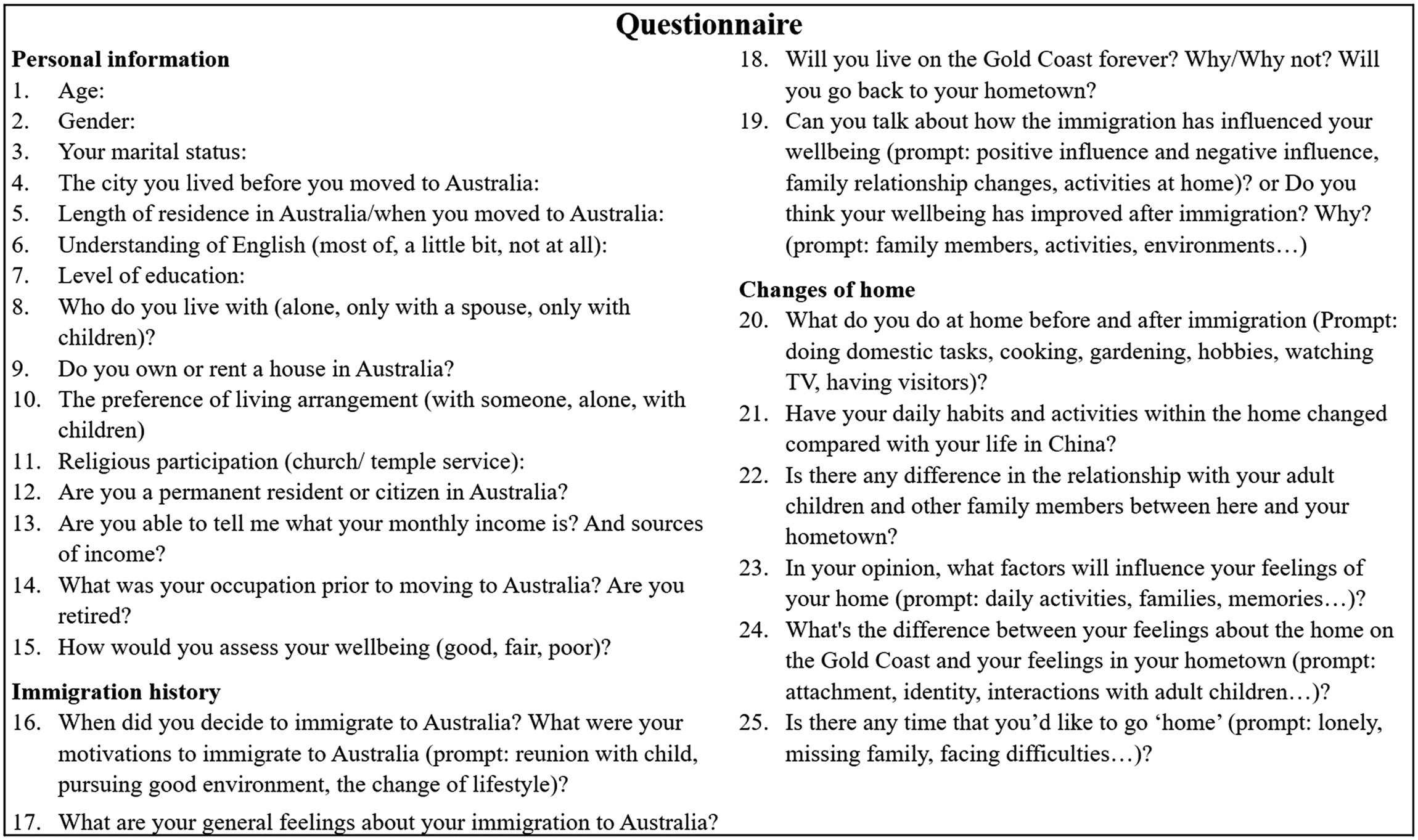
Some questions also looked at how the participants perceived their interactions with family members, daily activities at home and wellbeing after immigration in comparison to before in their home country. In-depth, semi-structured interviews were undertaken from February to May in 2019.
In this research, purposive sampling was used to recruit older Chinese immigrants who were 55 years old and over. This age limit was informed by China’s statutory retirement policy stipulating that men, regardless of occupation, retire at 60 years of age and women retire at 55 if they are public servants, or 50 if they are blue-collar workers (Zhang, et al., 2018). The most effective way to recruit participants for this study was through the help from Chinese organisations on the Gold Coast. By attending a Chinese church and regularly participating in tai chi courses and other social activities organised by Chinese associations, the interviewer gained the trust of potential participants and managed to interview 30 older Chinese immigrants.
Characteristics of participants.
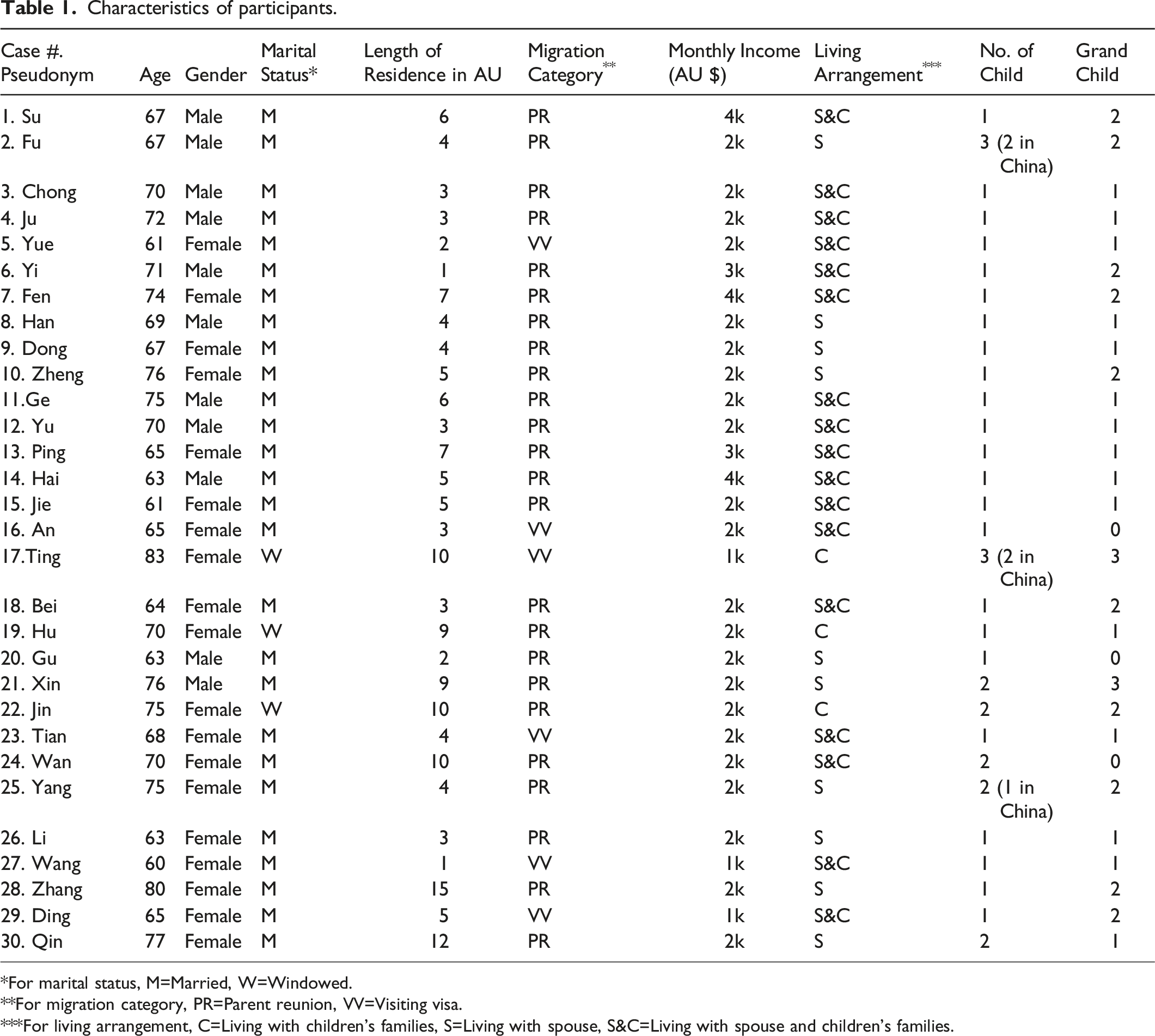
*For marital status, M=Married, W=Windowed.
**For migration category, PR=Parent reunion, VV=Visiting visa.
***For living arrangement, C=Living with children’s families, S=Living with spouse, S&C=Living with spouse and children’s families.
The interviews were carried out at convenient locations such as the Chinese organisation’s offices, parks or the Chinese church on the Gold Coast. Both a participant information statement and a consent form were signed before the interviews. The interviews were audio recorded with the permission of the participants. The length of the interviews varied from 30 to 100 minutes. All the interviews were conducted in Mandarin and then the transcript was translated into English verbatim for further interpretation. The translation was conducted by the interviewer and checked by a proof-reader in order to capture implicit meanings and avoid losing any contextual or cultural expressions (Suh et al., 2009). Findings were presented using pseudonyms rather than real family names to protect participants’ confidentiality and help researchers portray participants’ stories effectively.
Data analysis was based on the constant comparative method as explained by (Corbin and Strauss, 2014). The first step was coding process. By reading the transcript verbatim, codes were assigned to the descriptive or inferential information. Codes were constantly compared to find the consistencies and differences; thus, common themes and categories were developed, including ‘the reason for immigration’, ‘closeness to families’, ‘conflicts with families’ and ‘wellbeing experiences’. Coding and management processes were accomplished by using Nvivo software. Once finishing coding, the relationships between coding were delineated to reach the findings of this study. For example, the research found that the reason for immigration is closely related to family relationships. Family relationships affect wellbeing experiences of older Chinese immigrants.
Findings
The focus of this study was to explore the experience of parents immigrating to Australia, their interaction with family members and their understandings of wellbeing. Four main findings emerged from the interview data. The first relates to factors influencing older Chinese immigrants’ decision to immigrate. The second concerns the ways in which domestic family practices promote or undermine wellbeing. The third reveals the interaction with family members. The final finding presents participants’ perceptions of wellbeing during the process of immigration and their interaction with family members.
Immigration: A Story of Family Reunion
There is one very clear result that emerged from the interviews: all the participants expressed that the reason why they moved to the Gold Coast was to reunite with their children. However, there are more nuances regarding the decision itself, including often a mix of duty feeling, personal values and convenience. In fact, 77% of the participants did not immediately immigrate after retirement, but instead enjoyed retirement in their hometown. They engaged in activities with friends, attended colleges for seniors and were satisfied with their lives. Applications for immigration were processed at the children’s request for help and even more readily accepted when the participants realised they needed support. Mrs Dong moved to Australia when she was 63 years old, at a time when she was active in retired relaxation and began to make tentative plans towards meeting her own eldercare needs. This can be implied by Mrs Dong, ‘My spouse is also old. If I lived in China and there was any emergency, my daughter cannot help me because we live far away from my children. I want to live with them’.
It was also found that these parenting immigrants rejoiced at reuniting with their children while remaining a realist. Mrs Tian, a parent of one child, amplified the importance of living with her son. In order to meet her understanding of families, Mrs Tian chose to move to Australia. Mrs Tian said: ‘An old Chinese saying goes that although there are a lot of disadvantages, as long as the family can be together, life will be good. Family harmony is important. I can’t live without my children’. Living with adult children and other family members in one house provided opportunities for them to enjoy the companionship of their offspring, which created and reinforced their family relationship. This was illustrated in comments such as, ‘I lived alone in China. I felt bored and lonely. But here [in Australia], my son and daughter-in-law and my three grandsons can keep me company. They usually play instruments for me and talk to me. It’s always lively and I feel very happy’! (Mrs. Ting) Mrs Ting was 83 years old at the time of the interview. As her health deteriorates, the companionship of family members becomes increasingly important to her.
However, nearly two-thirds of the participants expressed that the physical house they live in cannot be a ‘home’ for them. Those feelings are well described in Mrs Tian’s interview: ‘If they [her son, daughter-in-law and grandchildren] are not at home, I don’t know what to do. I sit on the sofa with my husband and we play with our phones. The house is so big and quiet. I have nothing to do in the house’. It demonstrates the importance of family members in creating both wellbeing and attachments to home, sometimes at the cost of forfeiting previous lifestyles and home environments.
This finding was also confirmed by the answer to the question ‘do you think that you could live in another Australian city’? Over 90% of the survey participants expressed that, despite praising the climate on the Gold Coast and feeling as though they had adapted to local lifestyles, they would follow their children to another city if required to. For example, Mrs Jie replied concisely and firmly ‘I’ll go wherever they go’. Mrs Jie moved to Australia when she was 56 years old, a year after she retired. She immediately applied for a visa to travel and live in Australia with her children. Now she has become a permanent resident, showing her determination that living close to her children is a top priority.
Last, 70% of the participants indicated they moved to the Gold Coast to take care initially of the grandchildren but often find themselves doing household duties as well, as Mrs Jie told: ‘I came here to take care of my daughter when she was pregnant. After the baby was born, I took care of the baby and did some cleaning and cooking for the whole family’. Cleaning (73%), cooking (77%), gardening (67%) and shopping (53%) were the four main tasks described by the participants, besides tending to the grandchildren. However, it also quickly became clear that the number of tasks, and the way they were experienced, influenced the participants’ wellbeing. This finding is further explained in the next section.
Domestic Practices: A Burden
Complaints about the burden of housework were clearly expressed and nearly all the participants (93%) mentioned that they felt overwhelmed by the responsibility of caring for the whole family. ‘Tired’ was the most frequent word used by the participants when asked to describe how they felt about their daily lives at home. These participants were normally young old (60–70 years old) and able to conduct tiring housework. Sacrificing a valuable retired lifestyle to maintain intimate relationships made participants’ wellbeing complex. The interviews revealed that participants undertook excessive housework in specific places, namely, the kitchen, dining room and living room. Mrs Ping spoke about her busy work schedule and fatigue:
I don’t have any rest time here [in Australia]. I make breakfast for the whole family in the morning, and go with my daughter to take her children to school. Then, I go to the supermarket or go home to do cleaning and washing. I eat some simple food at noon, wait for the children to finish school, then I need to prepare dinner. Life here is more tiring than in China. There is no free time all day.
The ignorance toward the sacrifices made by parenting immigrants was also found to be an important factor that negatively influences their wellbeing. A majority of the participants (83%) indicated that their own children did not acknowledge their domestic work. As Mrs Tian described, ‘We older Chinese immigrants are babysitters who don’t get paid’. She further reported that, ‘We (Mrs. Tian and her daughter-in-law’s mother) feel tired… Nobody says thanks to me’. Mrs Tian holds Visiting Visa, and she usually stays in Australia for about 6 month per year. She and her in-laws alternate living in Australia to look after the whole family. Overcoming challenges in unfamiliar places further amplifies dissatisfaction with her adult children. Participants who did not live with adult children also reported similar experiences. As Mr Fu stated, ‘I walk to my daughter’s house every day to take care of my granddaughter and do some housework and cooking’.
Consequently, the new home on the Gold Coast could become a place of strained family relationships and even oppression, a phenomenon heightened by the fact that parenting immigrants, as seen previously, prioritise family affairs at the expense of leisure activities and their own wellbeing. Yet, some participants also conveyed a sense of self-fulfilment when they helped their full-time working children, proud to provide them with enough time to relax at home. Mr Chong explained, ‘It’s not easy for them to work in a foreign country, so I can help them. I am retired, I have enough time’. In conclusion, the interviews revealed the complexity of family relationships and also how these relationships contribute to both ends of the wellbeing spectrum. Unacceptable behaviours of the children were sometimes described which brings forth the following findings on family relationships.
Interaction with Families: Not Really Heaven
Most of the participants (90%) revealed that the relationships with their children were sometimes far from harmonious, clearly describing intergenerational conflicts. Co-residing with adult children increases the possibility of conflicts within families. For example, Mrs Ping, lived in Australia for 9 years, recalled the experience of her son yelling at her. She remembered the tone of her son, ‘We quarrel a lot. My son’s temper is not good. If I deny him, he often yells at me! I just said to him, ‘you cannot talk to me like this.’ …I really, really want to go home. I have no home here’. The quotation indicated that Mrs Ping did not build a sense of home on the Gold Coast. Her willingness to go back home to China demonstrated her pinning for the homeland. Such a situation generates feelings of loneliness, which amplifies and worsens Mrs Ping’s reactions to negative family relationships.
A majority of the participants (60%) also complained about poor communication within their family, discussing how this made the participants feel detached from the place they live. Mrs Wang also disclosed that ‘When I encounter something that I don’t understand, I ask my son or my grandson, they ignore me. Sometimes they speak English to each other and I can’t understand. It is not respectful’. In foreign countries, Mrs Wang has to rely on their adult children due to the distinct societal context and language barriers. Mrs Jin mentioned her experience, ‘There is a generational gap between us and we can’t talk together. They are not interested in what I say’. Mrs Jin only lived with her children’s family, and thus, she would expect higher communication needs with her children. Older Chinese immigrants received fewer supportive resources after immigration. They are unable to express themselves to their spouse or friends. These quotes illustrate how these two participants were excluded by their own family, and as such felt like spectators in their own home. Older Chinese immigrants had higher expectations of adult children’s care responsibilities due to living in a foreign country, which generated a negative environment and affected their wellbeing.
Another finding that might also explain these perceptions is the fact that parenting immigrants often reported a lack of control over their life. Mrs Hu explicated that her life after immigration was ‘not free’ because it was dependent on her children’s daily schedule. Mrs Tian also expressed this feeling, ‘In my own home [in China], if I have time, I will clean the house and wash the dishes. But if I don’t have time, I just leave it there. But in Australia, I need to arrange my life based on my son’s life. It feels like there is always something restraining me’.
The lack of knowledge pertaining their new home country and the lack of English proficiency makes parenting immigrants rely on their children and therefore accept a lower status within the family unit. Both aspects were reported by 93% of the participants. As Mrs Li stated, ‘I don’t understand many things here. I feel that my daughter is like my parent, I need to follow her orders’. This decline of authority also restrained participants’ sense of belonging, as Mr Xin stated, ‘I made some decorations during spring festival such as the red lantern and paper cut-outs. But my children said these decorations that I created looked bad. I feel depressed’. Xin further commented, ‘I understand that it is not my home’. Both Mrs Li and Mr Xin lived only with their spouses demonstrating their abilities to live separately with adult children. However, the lack of knowledge of societies negatively influences their wellbeing.
Components of the Wellbeing of Older Chinese Immigrants
Question 19 addressed the perceptions of the participants regarding their wellbeing and immigration (Can you talk about how immigration has influenced your wellbeing? Do you think your wellbeing has improved since immigrating?). Overall, the data depict that the participants’ perceptions of wellbeing are closely related to family relationships, social networks and their living environment. Although reuniting with adult children has been deemed the main reason for older Chinese immigrants moving to and remaining in Australia, their wellbeing does not necessarily improve after they begin living close to, or with, their adult children. Actually 23% of participants felt that their wellbeing decreased and only 27% felt it had improved after immigration while the remaining 50% were neutral.
Harmonious family relationships seem to be the cornerstone of perceptions of wellbeing. As most participants’ immigration reasons were reunion with their adult children, the weight of the impact of family relationships on wellbeing increased after immigration. The interviews demonstrated that all the participants who complained about unsatisfactory family relationships had perceived a decrease in wellbeing. Mrs Bei lived with her spouse and her son’s family. She noted that, ‘I have more conflicts with my son after I started living with him and his family. I am happy to take care of my grandchildren, but I don’t like living here. I am really struggling’.
On the other hand, most of the participants who were able to integrate into local society perceived an improvement in their wellbeing and thus illustrated the relationship between social networks and wellbeing. As Mrs Zheng described, ‘My wellbeing definitely improved after immigration. I have a good relationship with my children. I made some friends. I participate in social activities once a week. The life here is simple but I enjoy it’. Mrs Zheng lived only with her spouse, which demonstrated her ability to live in Australia independently. Besides, living without adult children guarantees a minimum possibility of conflicts. However, participants who could not develop social networks perceived their wellbeing negatively. Mr Yu took care of his grandson and have less spare time to social with others. In China, he likes riding bicycles with friends. In Australia, he can only ride bicycle himself. He expressed that, ‘I don’t like the life here. I cannot go out myself and I always ask my children to take me out. I don’t have friends here. I feel lonely. I live here because my children live here. I want to go back to my hometown’.
For those participants whose perceptions of wellbeing did not change, all of them reported that living with their adult children contributed to their wellbeing while difficulties in conducting an independent life and social networks negatively influenced their overall wellbeing. This was aptly pointed out by Mr Wan, ‘My wellbeing hasn’t changed a lot. I feel good because I can live with my children and enjoy the mild climate. However, I sometimes feel lonely because I don’t have close friends. But I need to live here because I am old. The connection with my adult children is the most important thing in my life’. Mr Wan was 70 years old and had lived in Australia for 10 years. He was ageing out of his place and had to find a balance between obtaining care resources from his family and losing lifetime social networks with friends.
In conclusion, older Chinese immigrants’ wellbeing is a complex concept, as they deal with the dilemma of living with their adult children at the expense of enjoying other aspects of their lives.
Discussion
Overall, the findings reveal that family relationships significantly impact upon the decision to immigrate, household chores undertaken by parenting immigrants and the wellbeing of older Chinese immigrants. Consequently, the participants fail to build an integrated sense of wellbeing as they have to make trade-offs among family-oriented values, getting access to adult children’s support and undesired life experiences caused by immigration.
‘Home’ For Older Chinese Immigrants
First, this research shows reuniting with family is both linked to wellbeing and the key reason for older Chinese immigrants leaving their hometown. However, in the transnational context, family-oriented values and ideas of ‘home’ are challenged by new situations that require the reconstruction of the ‘home’ and oneself. It is generally agreed among scholars in cultural geography that the ‘home’ is a ‘material and affective space’ (Blunt, 2005, p. 506), created through everyday practices, social interactions, lived experiences and emotions (Blunt, 2005).
The results show that older Chinese immigrants re-establish their ‘home’ after immigration and their homes are closely attached to adult children. In the Chinese context, older Chinese people’s idea of ‘home’ is informed by ‘family first’ values (Liu, 2014). Although living with older parents is not obligatory for adult children, traditional Chinese cultural norms such as filial piety, guided by Confucianism, still influence living arrangements and aged care (Li et al., 2010) with older people often willing to live with or near their children (Su et al., 2006). Therefore, the meaning of ‘home’ for older Chinese immigrants should be further studied as it could provide an in-depth understanding of one’s wellbeing once settled in Australia.
Burden of Housework That Needs to be Reduced
Parenting immigrants demonstrate a complex blend of practical caregiving activities and family affection. Adult children become an important resource for older Chinese immigrants as both a caregiver and a source of information. However, within the home environment, older Chinese immigrants conduct high level of housework and are more likely to have high expectations for filial piety. As the study of Lo and Russell (2007) showed, older immigrants heavily rely on aged care from family members and seldom use public services. However, as this research indicates, adult children are more likely to, perhaps inadvertently, overlook their parents’ difficult life situation because they are busy with their own ‘full-time work’. Insufficient understanding of, and support for, ageing parents largely shapes how negative wellbeing is perceived among older Chinese immigrant parents. In fact, the Australian government has arranged various health and social services to support older residents (Ageing and Aged Care, 2019). The use of social services could relieve adult children from the burden of providing support for their older Chinese immigrant parents while also shift their immigrant parents’ high expectations of support from them which will ultimately benefit the wellbeing of these older Chinese immigrant parents (Wang, 2004). For policymakers, an educational initiative that informs and encourages older immigrants to use public services is important.
As the research by Xu et al. (2019) revealed, older immigrants in immigrant families had the highest levels of worry compared to their counterparts in transnational families (those whose children migrated abroad, whereas they remained) and nonimmigrant families. Apart from excessive housework, older Chinese immigrants need to adapt to the new cultural context. Besides, given the altered family relationships and social isolation, older Chinese immigrants do not have adequate resources to cope with existing and expected stressors. They are unable to cope with challenges related to immigration and other stressors in the ageing process, such as declining health, resulting in older Chinese immigrants’ lowest wellbeing levels than older Chinese people in other groups.
Conflicts Hidden in Immigrant Families
The complaints of older Chinese immigrants imply that they are a vulnerable group to family conflicts. Due to mobility restrictions, difficulties in language and unfamiliarity with Western societies, the results of this research imply that the high dependence on adult children generally leads to older Chinese immigrants losing the role of an authority figure, as already observed by Lin et al. (2015). Being socially isolated from the wider host-society can lead to the home becoming a place where conflicts are hidden (King et al., 2017). The conflicts are even more concerning when considering the high proportion of culturally diverse communities because ethnic minority groups are more socially isolated and lack social resources (Acierno et al., 2010). However, some participants and their adult children may not have other ways to provide solutions, especially when affinities and family values are involved in these processes (Taylor et al., 2014). Values, traditional culture and beliefs stipulate the roles, power and responsibilities of family members as well as their behavioural patterns in family practices (Blundell and Clare, 2012).
As demonstrated in the participants’ quotations, the main factors that impact their wellbeing are the extent of household work and the change in family values that are placed at the forefront of experience as a result of this move. However, dissatisfied participants continue to want to help their children. The mixed contiments many have about the unacceptable behaviour of their adult children means that most participants remain defined by the status quo. A significant implication is that policymakers should provide opportunities to conduct the social interactions with others beyond the family. Which could help older Chinese immigrants change their living arrangement and promote their wellbeing.
Implications on the Wellbeing of Older Chinese Immigrants
Older Chinese immigrants demonstrated heterogeneity in wellbeing within this study. Family commitments, domestic affection and their desired retirement entangled with unfamiliar places give rise to unique experiences of wellbeing among older Chinese immigrants. In the context of global immigration, the number of immigrant families is rapidly increasing, and the family structure is being transformed (Bai et al., 2016; King et al., 2014). Conflicts within the transnational families has also increased (Lin et al., 2015). The experiences of living in foreign countries with different social and cultural contexts played a part in shaping their understanding of their wellbeing. They have experiences being uprooted from a familiar place and have had to rebuild their lives in a new cultural context.
The association between family relationships and wellbeing is not new. Previous studies mostly explore wellbeing by splitting the concept into constitutive dimensions such as psychological and social aspects (Atkinson et al., 2012). This study provides a relational understanding that helps to move current research on different dimensions of wellbeing to instead consider how individuals interpret and react in different contexts. A fixation on wellbeing as a status exists in previous studies, whereas this study considers how wellbeing emerges. In this research, older Chinese immigrants’ sense of wellbeing takes place when they immigrate to Australia, live with their adult children, receive and provide care, and rebuild social networks.
Older immigrants’ understanding was a holistic sense of wellbeing, expressed in terms of how they chose to live their lives, within and beyond the family, in a way that honoured both their previous lifestyles in China, and the adaptive daily activities they built in Australia. Through immigration, older Chinese immigrants regain their parent and grandparent roles and their care resources from adult children, which is crucial to their overall wellbeing. This study echoes the research of Lai et al. (2019) showing that a feeling of closeness with children benefits wellbeing. After they moved to Australia, their coping skills to deal with life challenges in a foreign country negatively influenced their ability to acquire care resources. As Nordbakke (2013) argued, coping skills contribute to wellbeing. Coping skills refer to older Chinese immigrants’ ability to use supportive resources. Older Chinese immigrants acquire resources from their children but lose their resources from friends and society. It should be acknowledged that wellbeing is closely related older immigrants’ ability to use available care. As such, the development of programs, including leisure and recreational, that help to improve family relationships and develop family support could facilitate intergenerational understanding. Service providers could design and develop appropriate services to help older Chinese immigrants receive support beyond families and integrate into society.
Conclusion
This paper uses interviews to collect data and depicts the lived experiences of Chinese immigrant parents residing on the Gold Coast. Firstly, older Chinese immigrants’ decisions to immigrate can be seen as partly an involuntary decision that is guided by their family commitment, personal values and convenience. The interaction between Chinese immigrant parents and their adult children is fraught with not only affinities, but also tension, conflicts and compromises. Older Chinese immigrants often perceive that they are undertaking excessive household work. Their customary understanding and traditional practices of retirement life are negatively influenced. Older Chinese immigrants’ wellbeing relates to a more complex situation as they fulfil their values of living with adult children while sacrificing an independent life and social networks.
The limitations of this study should be highlighted. The recruitment strategy in this study was to approach older Chinese immigrants with the assistance of Chinese organisations, which means that the participants interviewed may be healthier and more mobile physically and socially. Thus, the most vulnerable group of people who are socially isolated and disabled may be underestimated. This group of people might provide a different perspective on relationships within immigrant families and need a higher level of health and social services. Future studies could recruit more frail older immigrants to explore their experiences in families. Comparing the differences between active and frail older Chinese immigrants could deepen our understanding of the family relationships in immigrant families. Besides, this research only interviews perceptions of older Chinese immigrants regarding their interaction with adult children and wellbeing, future studies could collect adult children’ perceptions on the life of their ageing parents, which may provide a holistic understanding of the relationships between the family relationships and wellbeing.
The increase of immigrant families has important implications for service providers in the field of elder care, especially in locales with massive immigrant populations. The findings of this study have two implications. First, this research makes a contribution to previous immigration literature by embracing wellbeing as an insightful perspective for understanding the family relationships. Practically, by revealing the complicated mechanisms underlying family relationships, immigration and wellbeing, this research contributes to the current policymaking process by which understanding family relationships is a path to maintaining the wellbeing of older immigrants. The trigger of moving to Australia is grandparenting duties such as taking care of babies or transporting grandchildren, suggesting that suitable and affordable childcare and after-school services are still lacking in Australia. Options that can be considered include providing flexible working arrangements for parents and more extensive after-school activities for children. Under such circumstances, older Chinese immigrants have more freedom to choose where they live. For those who have conflicts but still choose to live with their adult children, social organisations such as Chinese organisations should be offered. More supportive sources are crucial to enable them to receive the emotional and social support they need beyond family. Such supportive organisations could relieve adult children’s burden of taking care of their older parents, reduce family conflicts and improve the social engagement and overall wellbeing of older Chinese immigrants.
Footnotes
Declaration of Conflicting Interests
The author(s) declared no potential conflicts of interest with respect to the research, authorship, and/or publication of this article.
Funding
The author(s) received no financial support for the research, authorship, and/or publication of this article.
