



Abstract
Research on fathering has substantially increased but we still know relatively little about whether and how fathers’ own perspectives on their parenting differ across a variety of family situations. We estimate associations between nonresident fathers’ family types and nonresident fathers’ perceptions of the quality of their parenting and their relationships with their children, using data from the Child Support Noncustodial Parent Employment Demonstration program on lower-income nonresident fathers (n = 5,835) and logistic regressions. High-quality parenting is more likely to be reported by nonresident fathers with multiple-partner fertility and both resident and nonresident children than either those with multiple-partner fertility and only nonresident children or those with single-partner fertility. High-quality relationships with children are more likely to be reported by those with single-partner fertility than those with multiple-partner fertility. These findings suggest the importance of resident children in fathers’ perceptions of their parenting and highlight the difficulties of parenting across multiple households.
Keywords
Research on fathering has substantially increased in the last 50 years (Marsiglio et al., 2000; Schoppe-Sullivan & Fagan, 2020), but we still know relatively little about whether and how fathers’ own perspectives on their parenting differ across a variety of family situations. High rates of nonmarital childbearing and union instability, which are more common among socioeconomically disadvantaged populations (Carlson et al., 2013), have led to a variety of family contexts in which men experience fatherhood. Parenting for some fathers now includes parenting both children who live with them (resident children) and children who live elsewhere (nonresident children). Moreover, these children may be from more than one partnership (multiple-partner fertility, or MPF), such that fathering may require negotiating multiple roles and relationships with (ex-)partners and children in multiple families, leading to further complications. Even when both parents have only joint children (single-partner fertility, or SPF), the nonresident father (NRF) role is often characterized by ambiguity vis-à-vis family relationships and responsibilities (Berger & Bzostek, 2014).
Co-parenting with more than one ex-partner and across resident and nonresident children can create particular challenges. Furthermore, socioeconomically disadvantaged NRFs may face considerable obstacles to executing multiple fathering responsibilities across households due to limited resources (time and money; Tach et al., 2010). Yet, we know very little about whether and how various family types are associated with NRFs’ self-assessments of their parenting quality and relationships with their children, especially when they have limited resources.
In this paper we examine lower-income NRFs’ self-assessments of their parenting quality and relationships with children, contrasting three family types in which fathering occurs (SPF with nonresident children, MPF with only nonresident children, and MPF with both resident and nonresident children). Focusing on fathers’ self-assessments is important as it highlights fathers’ own voices, thereby honoring their perspectives, and these self-assessments are closely linked to their wellbeing (Yuan, 2016). Much of the previous research has examined parenting behaviors; we extend this research to consider fathers’ assessments of their overall parenting quality and the quality of their relationships with their children. Our analyses provide a window into whether and how contemporary family patterns may be associated with how NRFs experience their parental roles.
Background and Theoretical Framework
We use identity theory as a framework to consider how different family types may be associated with perceived parenting quality and relationships with children. We then review the empirical literature on associations of family types with fathering and highlight the few studies focused explicitly on fathers’ own perceptions of their parenting quality and relationships with children. Although our literature review covers fathering in various family types, our analysis eventually focuses on lower-income NRFs.
Theoretical Framework
Identity theory is centered on one’s social identities, which constitute the sets of meanings that individuals attribute to social roles vis-à-vis both themselves and others in specific social contexts and relationships; these identities are defined, modified, and re-defined in a series of interactions with others, within the context of social structure, and are malleable over time and in different contexts (Stets & Serpe, 2013; Stryker, 1968). Identity theory posits that individuals organize identities hierarchically based on the salience of each of their social roles in a given social context (Stets & Serpe, 2013; Stryker, 1968). Individuals also affirm (or disaffirm) identities in relation to both their perceived self-meanings in the role and also others’ expectations for the role (Stets & Serpe, 2013). Correspondence between one’s (positive) self-perception of the role and others’ feedback on identity-specific roles, a process referred to as identity verification, gives rise to positive emotions such as self-efficacy and self-esteem (Burke, 1991; Stets & Serpe, 2013).
Identity theory has been used in research on parenting, especially in family contexts in which one is likely to experience multiple overlapping parental identities that may conflict with one another (Berger & Bzostek, 2014; Goldberg, 2015; Guzzo, 2009; Högnäs & Williams, 2017; Minton & Pasley, 1996). Fathers who live with their children may place the father identity higher than those who live apart from their children both because resident parenting carries more role salience and less ambiguity than nonresident parenting and because it facilitates greater opportunities to actively engage with children. As such, fathering in a family in which both biological parents live together and have children only with one another may induce a positive self-assessment of parenting and engender support and positive reinforcement from others. In contrast, fathering in a family in which the parents do not live together or in which multiple mothers and children are involved may engender multiple, potentially conflicting, father roles that require managing and negotiating multiple relationships with and expectations from (ex-)partners and (resident and nonresident) children (Berger & Bzostek, 2014). Fathering in families in which there are multiple mothers and resident and nonresident children may thus contribute to a lower rank of one’s overall father identity in the identity hierarchy.
Factors Influencing Nonresident Fathers’ Parental Identity
Factors that influence NRFs’ identity processes involve multiple aspects and vary (and often become complicated) depending on their parenting circumstances and subsequent involvement with their children. NRFs’ paternal identity may be strengthened or weakened by father–child interactions and relationships (Yuan, 2016), which can be limited by a child’s resident mother (gatekeeping) (Fagan & Cherson, 2017; Marsiglio et al., 2000). Empirical evidence also suggests that NRF contact with children decreases, on average, when a child’s mother forms a new romantic relationship (Guzzo, 2009), has a child with a new partner (Meyer & Cancian, 2012), or has other family members who play a caregiving role (Högnäs & Williams, 2017), as these circumstances may hinder maintaining a cooperative parenting relationship between the NRF and resident mother. In contrast, NRFs who maintain strong co-parenting relationships with resident mothers and other co-parenting partners (e.g., relatives) are more likely to remain involved in children’s lives (Carlson et al., 2008; Fagan et al., 2016).
Circumstances in which NRFs’ parental identities are less frequently invoked or are negatively reinforced may lead to lesser father involvement which, in turn, may decrease the quality of relationships with some or all children and the salience of the father role. NRFs face greater constraints and challenges in interacting with their children than resident fathers due to the extra time and effort needed to arrange parenting time when living apart (Marsiglio et al., 2000; Yuan, 2016). These challenges may be particularly salient when mothers have sole physical custody, as well as in a context of MPF, which requires negotiating parenting time, roles, and responsibilities with multiple mothers. Also, NRFs’ own new partnership and children can lead to decreased involvement with children from previous relationships (although findings are mixed; Berger et al., 2019; Koster et al., 2021; Manning et al., 2003). All of these circumstances may contribute to lower-quality relationships and lesser father identity through lower father involvement. Indeed, NRFs, on average, spend less time with their children, are less engaged in activities (telling stories, playing) with them, and provide fewer childrearing materials (clothes, medications, toys) to them than resident fathers (Goldberg, 2015; Koster et al., 2021). In addition, NRFs’ involvement may take different forms and vary by child age and sex, though empirical evidence here is mixed (Berger et al., 2019; Manning et al., 2003).
Lastly, because NRFs’ parenting usually involves contributing financial resources to children (Meyer & Cancian, 2012; Nepomnyaschy & Garfinkel, 2010), as well as spending time with children (e.g., engaging in activities) (Ellerbe et al., 2018), performance in both domains—as assessed by both fathers themselves and others with whom they interact—may affect nonresident (and resident) fathers’ identities as parents. If the amount of financial resources that NRFs think their children need, and that they can provide, is congruent with what mothers want, father identity can be smoothly achieved. However, when their expectations and ability to pay differ, identity conflict likely occurs; this is more often true for lower-income NRFs than their more affluent counterparts.
Overall, the “father” identity is determined both by internalized factors (fathers’ own perceptions) and external and relational factors (others’ appraisals; specific contexts, and situations). When one’s self-appraisal as a father and feedback as to whether they are meeting others’ expectations in their father role are congruent, the father identity is reinforced which, in turn, engenders increased positive self-assessment of oneself as “father.” Moreover, when one receives positive feedback and support from others, they become more committed to the father identity (Stets & Serpe, 2013; Stryker, 1968). However, incongruence between parents vis-a-vis parenting roles and responsibilities may lead to lesser perceived parenting quality with respect to some or all children, and associated negative emotions and self-perceptions of oneself as a parent. Fathers who have children with multiple mothers and those with both resident and nonresident children may experience discordance with some or all of their children’s mothers and, potentially, some or all of their children, which may lead to lesser salience of the father identity (and lower-quality relationships) with respect to some or all of their children. On the contrary, those with more children from different partners may have greater father identity because they may have had more chances to succeed (Edin & Nelson, 2013).
Nonresident Fathers’ Self-Assessments of Parenting Quality and Relationships with Children
A growing body of research has examined the role of various forms of NRF involvement with and investments in children, or lack thereof, vis-à-vis child wellbeing (Adamsons & Johnson, 2013; Carlson & Magnuson, 2011; Greene & Moore, 2000; Miller et al., 2020; Nepomnyaschy et al., 2020). However, how NRFs—and men, in general—perceive themselves as fathers has been relatively understudied. Moreover, fathers’ perspectives are widely underrepresented in most household surveys, which often employ mothers’ proxy reports to assess fathers’ parenting behaviors and quality of relationships with children (Ellerbe et al., 2018; Goldberg, 2015). Yet, mothers’ reports may deviate from fathers’ own assessments; mothers may also provide incomplete information on (especially nonresident) fathers’ parenting behaviors and relationships (Marsiglio et al., 2000). Although the inclusion of fathers in surveys has increased in recent years, fathers’ response rates are still lower than mothers’ (e.g., Ellerbe et al., 2018), and sample sizes are often small when fathers’ reports are used (e.g., Manning et al., 2003; Manning & Smock, 2000).
To date, just a handful of studies have used fathers’ self-reports to examine how they perceive themselves as parents. Evidence from the Future of Families and Child Wellbeing Study (formerly the Fragile Families and Child Wellbeing Study), for example, indicates that the majority of fathers, both resident and nonresident, view themselves as “good,” “very good,” or “excellent” fathers, with only about 1 percent reporting that they are “not a very good father” (Högnäs & Williams, 2017). Similarly, evidence from the National Survey of Family Growth suggests that about two thirds of fathers appraise their parenting quality as “very good” or “good,” about a quarter as “okay,” and about a fifth as “not very good” or “bad” (Martinez et al., 2006). Notably, however, there is considerable variation in self-appraised parenting quality by co-residence status: about 80% of resident fathers, compared to only 60% of NRFs, report that they are doing a “very good” or “good” job as a father (Martinez et al., 2006).
Fathers’ self-perceptions of their parenting quality and relationships with their children may be closely related to circumstances by which their father identities are influenced (Burke, 1991; Stets & Serpe, 2013). As noted above, coresident situations can engender more occasions for father involvement, which may give men a clearer father identity and more opportunities to build a good relationship with their children. Other family members’ behaviors and feedback may also influence fathers’ self-assessments of their parenting and, for NRFs, maternal kin may be particularly salient (Högnäs & Williams, 2017). In addition, fathers with MPF report lower self-appraisals as fathers than those with SPF (Högnäs & Williams, 2017).
Summary and Empirical Expectations
Despite increasing diversity in fathers’ parenting contexts and growing interest in understanding fathers’ roles in children’s lives, little is known from large-scale studies about how fathers with MPF and with resident and nonresident children, especially those who are socioeconomically disadvantaged, view their own parenting quality or their relationships with their children. Whereas previous studies have examined father involvement in a variety of family contexts (Goldberg, 2015; Manning & Smock, 2000; Manning et al., 2003; Minton & Pasley, 1996), our study extends this literature by investigating NRFs’ own perceptions of themselves as fathers and of their relationship with children in the context of various family configurations.
Our empirical analyses, described below, examine only lower-income fathers with nonresident children. Our research questions consider whether NRFs’ self-assessments of their parenting quality and relationships with children differ among NRFs with SPF, NRFs with MPF and only nonresident children, and NRFs with MPF and both resident and nonresident children.
The framework of identity theory and previous research provide an anticipated ordering among the three types. NRFs with MPF may have lower assessments of their parenting and lower-quality relationships with their children than NRFs with SPF, perhaps because they have more difficulty parenting across families. Our expectation within fathers who have MPF (comparing fathers with both resident and nonresident children to those with only nonresident children) is ambiguous. Fathers with both resident and nonresident children may view themselves as lower-quality parents relative to those with only nonresident children given the complexity of parenting both resident and nonresident children. Conversely, having a resident child may increase the salience of the father role and thus be associated with better perceived parenting quality and relationships with children.
Finally, in an extension of our research questions, we consider not only whether NRFs in the three family types differ in their assessments of the quality of their relationships with their children, on average, but whether their assessments differ across individual children. That is, we explore whether NRFs in some family types may have a high-quality relationship with at least one child (and a low-quality relationship with at least one child). We anticipate that those with MPF, especially those with MPF and both resident and nonresident children, will report more heterogeneity in the quality of their relationships across children.
Method
Sample
Data for this paper are drawn from the Child Support Noncustodial Parent Employment Demonstration (CSPED) program, an intervention piloted from 2013 to 2016 (Cancian et al., 2022). The intervention targeted low-income noncustodial parents who were behind in their child support payments and were experiencing unstable employment. All CSPED participants, whether randomly assigned to receive the intervention or not, completed the same pre-randomization baseline survey in seven states (California, Colorado, Iowa, Ohio, South Carolina, Tennessee, and Wisconsin), and fathers’ responses to survey questions are the source of information for this study. Relative to the few other existing data sources that include fathers’ self-reports of their parenting quality, CSPED data provide information on a larger sample of NRFs and include information on multiple children rather than a single focal child. Moreover, given that the majority of these fathers have children with more than one partner, CSPED data are well-suited to study NRFs’ parenting in the context of different family types.
Our focus is to investigate self-perceptions of parenting quality and relationships with children among lower-income NRFs with diverse family configurations. Thus, our analysis sample consists of lower-income fathers who have at least two biological (or adopted) children, at least one of whom is under the age of 21 and does not live with the father. We focus only on NRFs with at least two children because MPF, by definition, requires one to have at least two children. Considering only fathers with two or more children allows for more relevant comparisons between fathers with SPF and MPF. Given our focus on NRFs, we exclude the small number of fathers in our data who owe child support even though they live with all of their children. From these 5,953 NRFs, we excluded 62 fathers who reported their age as greater than 65 or that they had a first child before the age of 15 and 56 fathers who had missing data on key measures including family type and self-assessed parenting and relationship quality with nonresident children, resulting in a final sample of 5,835 fathers. Given low rates of missing data for the control variables, we replaced missing values with the sample mean (for continuous variables) or zero (for dichotomous variables) and include in our analyses indicators that the value had been imputed. Approximately 5% of sample observations included a missing value on at least one covariate; however, no covariate had a missing value rate of 3% or greater.
Measures
Father Family Types
Fathers provided information on each of their biological children such that we are able to observe which children have the same mother and with whom each child lives (defined as the parent with whom the child spent 16 or more overnights in the last 30 days). We use this information to create three mutually exclusive (and exhaustive) categories: having SPF (the reference group that represents having responsibilities to the children of only one ex-partner), having MPF and only nonresident children, and having MPF and both nonresident and resident children. 1
Nonresident Fathers’ Self-Assessments of Parenting Quality and Relationships With Children
Our analyses focus on two primary outcomes from the baseline survey: NRFs’ self-assessments of their parenting quality and NRFs’ self-assessments of their relationships with their children. NRFs’ self-assessment of their parenting quality is measured by a single global question asking how they feel about themselves as a parent, considering all of their children. Participants were asked to choose whether they are an “excellent parent,” “very good parent,” “good parent,” or “not a very good parent.” In our main analyses, we focus on a dichotomous indicator that the father reported being a very good or excellent (versus good or not very good) parent. This operationalization is useful in that roughly half of the sample falls into each of these categories. Other researchers have also dichotomized this type of parenting assessment, using other data, in a way that results in approximately splitting the sample (Högnäs & Williams, 2017). To test the robustness of our results to this categorization, however, we also estimated supplemental analyses using a dichotomous indicator that the father reported being a good, very good, or excellent parent (versus not a very good parent; 92% vs. 8%). 2
NRFs’ self-assessment of their relationships with children is measured in three ways. First, the simplest measure consists of a composite measure of father–child relationship quality averaged across all biological children. For each biological child the father was asked whether the father–child relationship was “excellent,” “very good,” “good,” “fair,” or “poor.” To parallel the parenting quality measure, in our main analysis we averaged these scores across all of the father’s biological children then, after rounding to the nearest integer, created a dichotomous indicator that the father reported, on average, having very good or excellent relationships with his children (versus good, fair, or poor relationships with them; 62% vs. 38%); this is conceptually similar to the dichotomization of parenting quality. To test the robustness of our results to our primary categorization, we also estimated supplemental analyses using a dichotomous indicator that the father reported having good, very good, or excellent relationships with his children, on average (versus having fair or poor average relationships with them, on average (84% vs. 16%)).
Because the average score oversimplifies variation in relationships that NRFs may have with different children, we also examine two additional measures: the highest relationship quality and the lowest relationship quality across all children. The highest relationship quality measure indicates whether the father reported having a very good or excellent relationships with the child for whom he reports the highest relationship quality ranking (versus having a good, fair or poor relationship (85% vs. 15%)). The lowest relationship quality measure operates the same as the highest relationship. Only 35% of fathers reported having a very good or excellent relationship with the child with whom they report the lowest relationship quality ranking (versus having a good, fair, or poor relationship (65%)).
In addition, because the relationship quality item was asked with respect to each child (whereas the parenting quality item was asked only globally), we are also able to examine a father’s relationship quality (average, highest, and lowest) with only his nonresident children, which provides insight into whether any differences by family type in average relationship quality across all children are driven by perceived relationships with resident or nonresident children. 3
Covariates
We include three sets of covariates, drawn from the literature: sociodemographic characteristics, fertility characteristics, and family relationships. Sociodemographic characteristics include the father’s race and ethnicity (non-Hispanic white, non-Hispanic Black, Hispanic, non-Hispanic other race/ethnicity), age, education (less than a high school degree/GED, high school degree/GED, some college/associates degree/vocational degree, 4-year college degree or more), earnings in the last 30 days ($0, $1–$300, $301–$800, $801 or more), whether he has ever been convicted of a crime, 4 whether he scored in the ‘depressed’ category of the PHQ-8 (Kroenke et al., 2009), 5 whether he lived with both biological parents at age 15, and his biological father’s involvement and relationship quality with him while he was growing up (very involved with excellent/very good/good relationship, very involved with fair/poor relationship, somewhat involved with excellent/very good/good relationship, not at all involved). 6 In addition, we include indicator variables for the seven CSPED states. Fertility characteristics include: the number of biological children the father has had, a composite measure of his marital status at each child’s birth (all births nonmarital, all births marital, some births marital and some nonmarital), 7 the age of his oldest child under age 21 (0–5, 6–10, 11–15, 16–20), the age of his youngest child under age 21 (0–5, 6–10, 11–15, 16–20), and a composite measure of his children’s sexes (boys only, girls only, or both). The third group of control variables, reflecting family relationships, include whether the father provided informal cash or in-kind support to any child over the last 30 days, his current union status (married, cohabiting, neither), his ex-partners’ (resident mothers’) new union statuses (proportion across all resident mothers: re-partnered, not re-partnered, and not sure), and his report of whether he saw any of his children less than he wanted because one or more resident mothers made it difficult (gatekeeping). 8
Analytic Approach
Our analyses use logistic regressions from which we present marginal effects at means. We regress self-assessed parenting quality or quality of relationships with children on indicators for the father’s family type and the control variables. We conduct sensitivity tests using a smaller sample of fathers who have at least two nonresident children. 9 We do this because, in our primary sample, some fathers with SPF have only one nonresident child but are compared to fathers with two or more nonresident children. The sensitivity test allows us to directly compare fathers with SPF and MPF who have multiple nonresident children. Another set of sensitivity tests uses alternate versions of the dichotomous dependent variables, as described above.
Results
Descriptive Statistics
Descriptive Statistics for Self-Assessment of Parenting Quality and Relationship with Children by Family Type.

Note. Percent or mean (and standard deviation) presented. SPF = single-partner fertility; MPF = multiple-partner fertility.
aSignificantly differs from SPF at p < .05.
bSignificantly differs from MPF with only nonresident children at p < .05.
Most sample fathers also reported relatively high average relationship quality across all of their children. The majority reported their relationships, on average, to be excellent (31%), very good (30%), or good (23%), while only a small minority reported them to be fair (11%) or poor (5%) (Table S1). Our primary dichotomous operationalization of this measure compares fathers who rated their relationships with their children, on average, as excellent or very good (62%) to those who rated their relationships as good, fair, or poor (38%); our alternative dichotomous measure compares those who rated their relationships with their children, on average, as excellent, very good, or good (84%) to those who rated their relationships as fair or poor (16%). Notably, fathers were somewhat less likely to rate their relationships with nonresident children as high quality. For example, only 53% of NRFs rated their relationships with their nonresident children, on average, as high quality (excellent or very good), whereas 62% rated their relationships, averaged across all children, as high quality.
Considering our primary dichotomous measures, the raw data indicate that fathers with MPF and both resident and nonresident children were most likely to rate their parenting as high quality, with 61% reporting they were a very good or excellent parent. They were also highly likely to rate their relationships with their children positively, with 72% reporting they had very good or excellent relationships with their children. Moreover, almost all reported the highest quality relationship with any of their children as being very good or excellent, whereas relatively few rated the lowest quality relationship with any of their children as being very good or excellent across all children (only 33%), indicating a large discrepancy between the highest and lowest quality relationship with a child. Finally, it is notable that fathers with MPF and both resident and nonresident children were less likely to report high-quality relationships when only their nonresident children, as opposed to all of their children, were considered (48% vs. 72%). This implies that perceived high-quality relationships with children among these fathers likely reflect perceived high-quality relationships with resident rather than with nonresident children.
NRFs with MPF but only nonresident children were least likely to rate their parenting and relationships as high quality, with only 41% reporting they were a very good or excellent parent and just 50% reporting they had very good or excellent relationships with their children. However, with respect to the highest quality relationship with any of their children, 79% reported having a very good or excellent relationship with at least one child. In contrast, only 25% reported a very good or excellent relationship with the child with whom they had the lowest quality relationship, further indicating inconsistency in relationships among children.
By comparison, 50% of fathers with SPF rated themselves a very good or excellent parent and 73% rated themselves as having very good or excellent relationships, on average, with their children. These fathers reported relatively consistent relationship quality with all children, with 78% of the highest quality relationship and 60% of the lowest quality relationship being rated very good or excellent.
Descriptive Statistics for Covariates by Family Type.
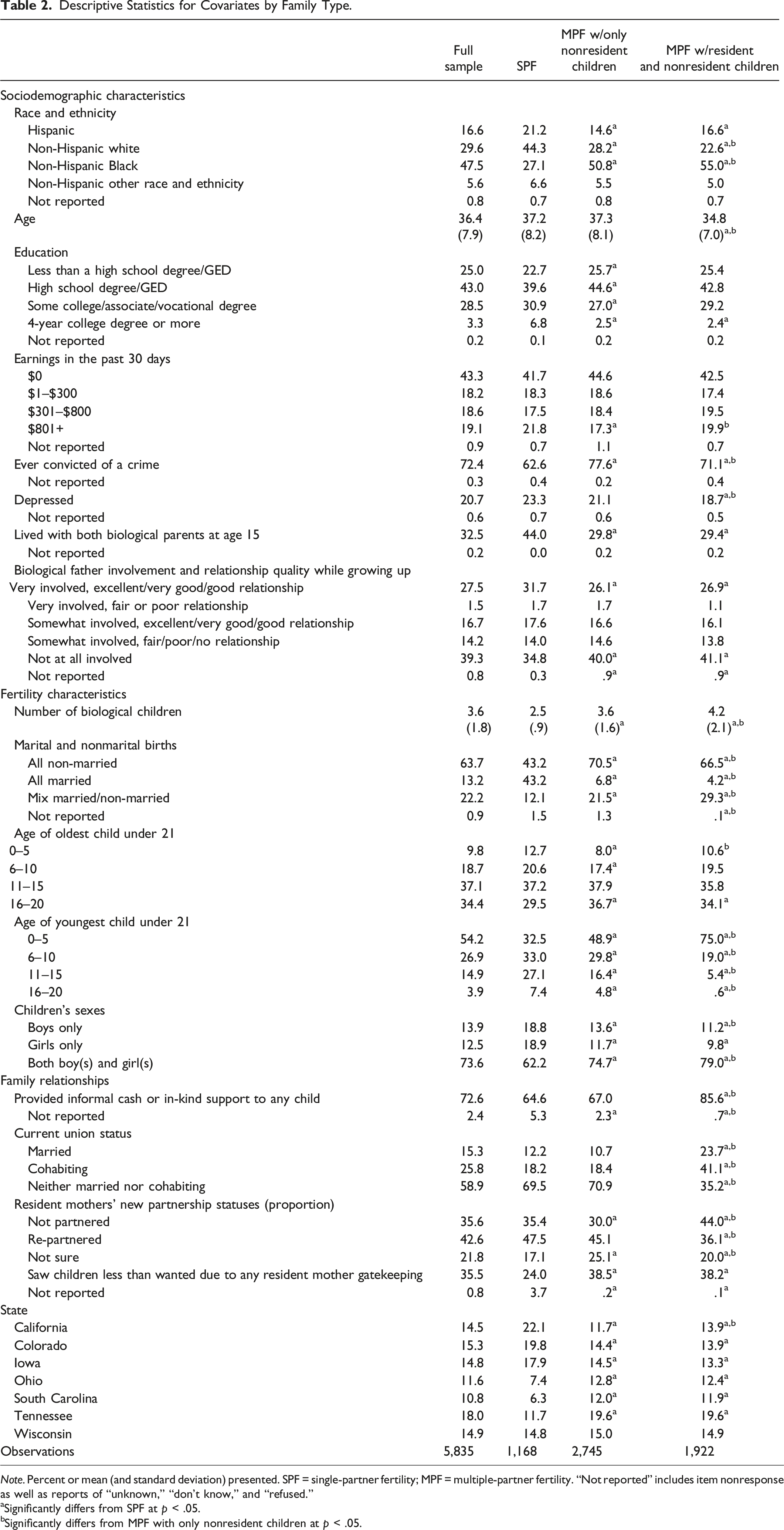
Note. Percent or mean (and standard deviation) presented. SPF = single-partner fertility; MPF = multiple-partner fertility. “Not reported” includes item nonresponse as well as reports of “unknown,” “don’t know,” and “refused.”
aSignificantly differs from SPF at p < .05.
bSignificantly differs from MPF with only nonresident children at p < .05.
The raw data also indicate that NRFs who have children with only one partner (SPF) tend to be relatively more advantaged than both groups of fathers with MPF. On average, the former had higher levels of education, lower levels of criminal justice convictions, and higher earnings. They were also disproportionately non-Hispanic white, whereas NRFs with MPF, regardless of whether they had only nonresident children or also resident children, were disproportionately non-Hispanic Black. NRFs with SPF were most likely to live with their biological parents at age 15 and to report that their biological parents were highly involved during their childhood and that they had good relationships with them. In addition, fathers who had children with only one partner reported having the fewest biological children, were most likely to have had all their children while married, and were least likely to report maternal gatekeeping. Patterns of family relationships suggest that NRFs with MPF and both resident and nonresident children were more likely than other NRFs to provide informal support and to be married to or cohabiting with a new partner. They also had fewer ex-partners (resident mothers) who had re-partnered.
Regression Results: Associations of Father Family Types With NRFs’ Assessments of Their Parenting Quality
(a) Associations of Family Type with Nonresident Fathers’ Assessment of Their Parenting Quality (b) Associations of Family Type with Nonresident Fathers’ Relationship Quality.

Note. 5,835 observations. Marginal effects (and standard errors) from logit regressions presented. Models also control for covariates. SPF = single-partner fertility; MPF = multiple-partner fertility.
*p< .05, **p< 0.01, ***p< .001.
aSignificantly differs from MPF with only nonresident children at p < .05.
Table 3 also shows estimates of the associations of father family types and fathers’ relationship quality across all children and across all nonresident children. Considering average relationship quality across all children, the comparison of those with SPF to those with MPF and only nonresident children is as expected: NRFs with MPF and only nonresident children are 22% points (30%) less likely than NRFs with SPF to rate themselves as having high-quality relationships with their children. In contrast to the parenting quality results, NRFs with MPF and both resident and nonresident children are 5% points (7%) less likely than those with SPF to rate themselves as having high-quality relationships with their children. However, considering the highest relationship quality child, across all children, NRFs with MPF and both resident and nonresident children are 13 (17%) percentage points more likely than NRFs with SPF to rate themselves as having a high-quality relationship with that child. In contrast, they are 25 (41%) percentage points less likely to do so vis-à-vis their lowest relationship quality child, and this pattern is also true for NRFs with MPF and only nonresident children.
The final columns of Table 3 compare NRF reports of their relationship quality with only their nonresident children and indicate that NRFs with MPF and both resident and nonresident children are 32% points (52%) less likely than NRFs with SPF to rate themselves as having high-quality relationships with nonresident children. This pattern is consistent when considering highest and lowest relationship qualities across nonresident children. Together, these findings suggest that NRFs with MPF and both resident and nonresident children perceive much higher quality relationships with their resident children than with their nonresident children. Thus, that there is only a small difference between NRFs with SPF and those with MPF and both resident and nonresident children in average perceived relationship quality across all children largely reflects perceived high-quality relationships with resident children rather than nonresident children. In sum, NRFs with MPF generally report worse relationship quality with children than those with SPF, NRFs with MPF and only nonresident children are least likely to report high-quality (very good or excellent) relationships with the child with whom they have the lowest-quality relationship, and those with MPF and both resident and nonresident children exhibit the biggest discrepancy in relationship quality between children.
Though not the focus of this study, the covariates (results shown in S2 and S3) typically operate in expected directions, suggesting, for example, that fathers with greater educational attainment are more likely to report being high-quality parents, though not necessarily to have high-quality relationships with children, and that fathers who have been convicted of a crime are less likely to report being high-quality parents and having high-quality relationships with their children. Several other covariate estimates are also of note. First, we find that non-Hispanic Black and Hispanic fathers are more likely than non-Hispanic white fathers to report high-quality relationships with children. Second, NRFs whose own fathers were less involved and/or with whom they had a lower-quality relationship during childhood report being lower-quality parents and/or having lower-quality relationships with their children. Third, fathers of younger children were more likely than those of older children to report high-quality parenting and/or relationships with children. Fourth, fathers who had only marital births, provided informal support, or were currently married were most likely to report being high-quality parents (and, in some cases, to have better relationship with their children), whereas those for whom (a greater proportion of) resident mothers had re-partnered were less likely to report high-quality relationships with children. Finally, fathers who reported seeing their children less frequently than they wanted due to maternal gatekeeping were less likely to report high-quality relationships with their children.
We conducted two sensitivity tests to assess the robustness of the findings from our primary specifications. First, we limited the sample to fathers with at least two nonresident children, which yielded results that are consistent in pattern to those from our primary specifications (Table S4). Thus, despite some differences in the magnitude of the estimates across specifications, limiting our sample to NRFs with two nonresident children would not substantively alter our conclusions.
Second, we replicated the models using an alternative dichotomous coding scheme for the parenting quality and quality of relationships with children measures. The alternative specifications change the categorization of “good,” such that we are comparing reports of being a good, very good, or excellent parent to not a very good parent and reports of having good, very good, or excellent to having fair or poor relationships with children. Results using our alternative specification are presented in Table S5. The pattern of results for parenting quality is consistent across our primary and alternative specifications, although the estimates are smaller in magnitude and less likely to attain statistical significance when the alternative specification is used. For relationship quality across all children, we also find a consistent pattern of results for NRFs with MPF and only nonresident children across the two specifications, again with point estimates that are smaller in magnitude.
With respect to NRFs with MPF and both resident and nonresident children, however, the point estimates change direction suggesting that these fathers are 6 percentage points (7%) more likely than NRFs with SPF to report having high-quality relationships, averaged across all of their children, whereas we found these fathers to be 5 percentage points (8%) less likely to report having high-quality relationships, averaged across all of their children, when we employed our primary coding scheme. This indicates that these results are dependent on whether the middle (‘good’) category is considered to represent a high- or low-quality relationship. Finally, using the alternate measure for highest relationship quality, we find a larger magnitude of association for NRFs with MPF and both resident and nonresident children whereas we find a similar pattern with smaller magnitude of association in terms of lowest relationship quality.
Differences between the estimates produced by our primary and alternative coding schemes likely reflect differences in the skewness of the distributions of the parenting quality and quality of relationships with children measures, both in general and within family types. For example, using our primary measure, 49% of all NRFs report being high-quality parents, 62% report having high-quality relationships across all children, and 53% report having high-quality relationships across nonresident children (see Table 1). By comparison, these figures are 92%, 84%, and 77% when the alternative coding scheme is used (see Table S1). For relationship quality across all children among NRFs with both resident and nonresident children—for which the estimates are least consistent across the two specifications—the difference in the skewness of the distribution is particularly pronounced. Using our primary coding scheme, 72% of NRFs with both resident and nonresident children report having high-quality relationships across all of their children, whereas this is the case for 94% of these NRFs when the alternative coding scheme is applied. Given the high degree of skewness when the alternative coding scheme is used, as well as that these scores may be affected by social desirability bias, we argue that our primary scheme is better suited for assessing higher- and lower-quality parenting and relationship quality with children, in general, whereas the alternative coding scheme likely identifies only extremely low-quality parenting and relationships.
Discussion
This study provides new evidence about associations between father family types and lower-income NRFs’ perceptions of both the quality of their parenting and the quality of their relationships with their children. Our results lead to several overarching conclusions. First, the majority of NRFs perceive themselves as relatively high-quality parents and report having relatively high-quality relationships with their children, though this is less true vis-à-vis relationships with nonresident children than relationships with resident children.
Second, the ordering of the three groups differs when assessing high-quality parenting and assessing high-quality relationships with children. For high-quality parenting, fathers with MPF and both resident and nonresident children rate themselves highest, followed by those with SPF, then by those with MPF and only nonresident children. For high-quality relationships with children (averaged over all children), NRFs with SPF rate themselves highest, followed by those with MPF and both resident and nonresident children, then by those with MPF and only nonresident children. Moreover, these relationship assessments appear to be driven more by perceived relationships with resident than nonresident children. Indeed, NRFs with MPF and only nonresident children are more likely than NRFs with MPF and both resident and nonresident children to report high-quality relationships with their nonresident children; yet, this is outweighed by the very positive relationships they report with their resident children.
We were unable to separately assess parenting quality for resident and nonresident children given that CSPED used only a single item to assess global parenting quality across all children, regardless of co-residence status. However, given our finding that relationship quality differs considerably with respect to resident and nonresident children (such that high average levels of relationship quality across all children are driven by perceptions of high-quality relationships with resident children), it is possible that our findings for parenting quality may be driven by perceptions of high-quality parenting vis-à-vis resident children, rather than nonresident children, when NRFs have both. It will be important for future research to separately assess parenting and relationships with children by co-residence status.
Our findings provide mixed empirical support for several tenets of identity theory (see Berger & Bzostek, 2014) vis-à-vis father family types and NRFs’ perceptions of the quality of their parenting and relationships with children. First, we expected NRFs with SPF to perceive themselves as higher quality parents and as having higher quality relationships with their children than NRFs with MPF, perhaps because they experience lesser identity conflict. This hypothesis was supported for relationship quality, but not for the global measure of parenting quality. Interestingly, NRFs with MPF and both resident and nonresident children were more likely than those with SPF to perceive themselves as high-quality parents. This may suggest that fathers with MPF engage in sequential parenting (Edin & Nelson, 2013) such that their sense of themselves as a parent is primarily based on children from their current relationship; that is, their resident children (see also Tach et al., 2014). As noted above, our measure of perceived parenting quality is a global measure and does not differentiate between resident and nonresident children, and it is possible that NRFs with both resident and nonresident children are primarily thinking of their resident children in their response. Examining the extent to which NRFs may rate the quality of their parenting consistently or differently with respect to resident versus nonresident children is ripe for future research.
The identity theory framework does not provide a clear hypothesis regarding fathers with MPF and only nonresident children versus those with MPF and both resident and nonresident children. On one hand, the complexity of parenting both resident and nonresident children for NRFs with both may suggest poorer perceived parenting and relationship quality. At the same time, however, the presence of resident children may increase the salience of the fathering role relative to that for NRFs with only nonresident children and, thus, be associated with better perceived parenting quality and relationships with some or all children. Our results generally support the latter in that fathers with MPF and both resident and nonresident children report higher parenting quality and higher-quality relationships (averaged over all children) than those with MPF and only nonresident children. Nonetheless, one aspect of our results is consistent with the former explanation as well: when we focus only on relationships with nonresident children, those with only nonresident children report better relationships than those with both nonresident and resident children. Thus, diversity of family types does appear to matter.
Our results should be considered in the context of several study limitations. First, our measures of parenting quality and quality of relationships with children are relatively broad and may thus be limited with respect to both sensitivity and specificity. Moreover, we are unable to separately measure parenting quality vis-à-vis resident and nonresident children. Second, while having NRFs’ self-assessments of their own parenting and quality of relationships with children is a core strength of this study, it is unfortunate that we do not also have children’s perceptions of the NRFs’ parenting and quality of relationships with them. Future research examining children’s perceptions of such in the context of diverse family types is warranted. Similarly, our data lack some factors that may be associated with self-assessments of parenting quality including, for example, the extent to which an NRF’s kin or his partner’s kin support him as a parent, or the extent to which NRFs act as parents to those who are not their biological children. Third, our sample consists of disadvantaged NRFs who were behind on their child support and having employment difficulties; while this is a strength of the study considering that this is a highly policy-relevant population from which there is little available data, we caution that our results may not generalize to NRFs more broadly. Finally, we caution that our results are descriptive in nature and do not lend themselves to causal interpretation.
With these caveats in mind, our analyses provide unique descriptive information on how contemporary family patterns are associated with NRFs’ perceptions of themselves as parents and reflect voices from fathers with significant economic challenges, many of whom are members of minoritized groups. We find that these fathers rate their parenting and relationships with their children as generally being of high quality. These positive assessments in the face of substantial challenges underline these fathers’ resilience and commitment to their children. That said, our findings also highlight that NRFs with children in multiple family configurations due to MPF perceive their parenting and overall relationships with children to be of lesser quality than those NRFs with single-partner fertility. This finding suggests that fatherhood and related programs would be well-served by explicitly offering strategies for strengthening parenting behaviors and the quality of relationships with children in diverse family types—those characterized by MPF and, for NRFs, whose children reside in multiple households.
Supplemental Material
Supplemental Material - Lower-Income Nonresident Fathers’ Self-Perceptions About Their Parenting Quality and Relationships With Children
Supplemental Material for Lower-Income Nonresident Fathers’ Self-Perceptions About Their Parenting Quality and Relationships With Children by Yoona Kim, Lawrence M. Berger, and Daniel R. Meyer in Journal of Family Issues
Footnotes
Declaration of Conflicting Interests
The author(s) declared no potential conflicts of interest with respect to the research, authorship, and/or publication of this article.
Funding
The author(s) disclosed receipt of the following financial support for the research, authorship, and/or publication of this article: The data used in this paper were collected as part of the evaluation of CSPED (grant number 90FD0184), which was funded by the Office of Child Support Enforcement within the Administration for Children and Families, US Department of Health and Human Services, and awarded to the Wisconsin Department of Children and Families.

Supplemental Material
Supplemental material for this article is available online.
Notes
References
Supplementary Material
Please find the following supplemental material available below.
For Open Access articles published under a Creative Commons License, all supplemental material carries the same license as the article it is associated with.
For non-Open Access articles published, all supplemental material carries a non-exclusive license, and permission requests for re-use of supplemental material or any part of supplemental material shall be sent directly to the copyright owner as specified in the copyright notice associated with the article.
