



Abstract
Over the last decade, issues related to immigration have become increasingly salient across Western democracies. This increasing salience has made it more important to understand people’s attitudes toward immigration, including the effects of media use on those attitudes. Differentiating between attitudes toward different types of immigration, attitudes toward immigration from different parts of the world, and perceptions of immigration’s impact, this article investigates the effects of media use on attitudes toward and perceptions of immigration in Sweden. Based on a three-year, three-wave panel study, it investigates the effects of media use on the individual level. Among other things, results show that there are limited effects of using traditional news media but more substantial effects on people’s immigration attitudes of using anti-immigration, right-wing alternative media and pro-immigration, left-wing alternative media. These findings imply that it is highly relevant to account for media use, especially alternative media use, when studying public attitudes toward immigration. Further, we find that variations in people’s immigration attitudes, to a high degree, depend on the type of immigration and on where migrants are coming from. This finding underlines the importance of measuring both of these aspects when the aim is understanding general attitudes toward immigration and/or key predictors behind immigration attitudes.
Within the context of the so-called refugee crisis in 2015, Brexit, and the electoral success of populist and radical-right parties, immigration-related topics have become increasingly salient across Europe and other Western democracies (Schmuck and Matthes 2017; McLaren, Boomgaarden, and Vliegenthart 2018). At present, the electorate in many European countries considers immigration to be a principal challenge facing their countries (Heath and Richards 2016), and research suggests that many people hold increasingly negative attitudes toward immigration (Heath et al. 2019).
While public attitudes toward and perceptions of immigration are shaped by many factors (Hainmueller and Hopkins 2014), of key importance in understanding such attitudes and perceptions is the media. For many people in developed countries, media is the primary source of news and political information (Shehata and Strömbäck 2014), and numerous studies have shown that media can have effects on, among other things, what people consider the most important issues and how they perceive politics and society (Arendt and Matthes 2014; Maurer 2014). Several studies also suggest that news media, by focusing on negative aspects of immigration (Igartua and Cheng 2009; Schemer and Müller 2017), might trigger and reinforce negative attitudes toward immigration and immigrants (Jacobs and van der Linden 2018; McLaren, Boomgaarden, and Vliegenthart 2018).
Despite previous research, our knowledge of how media use influences attitudes toward immigration is limited for several reasons. 1 First, the few studies that examine how media use influences attitudes toward immigration cover a limited number of countries (e.g., Eberl et al. 2018). Second, most studies on this topic rely on cross-sectional data (Gil de Zúñiga, Correa, and Valenzuela 2012; Héricourt and Spielvogel 2014; Beyer and Matthes 2015), which preclude causal inferences (cf., Jacobs, Meeusen, and d´Haenens 2016). Third, most studies in this area have applied narrow measures of immigration attitudes, such as attitudes toward immigration from a specific country (Gil de Zúñiga, Correa, and Valenzuela 2012) or toward a specific type of immigration (Beyer and Matthes 2015), or perceptions of immigration’s impact on a specific issue (Héricourt and Spielvogel 2014). Yet media use might have different effects on attitudes toward economic and refugee migration or immigration from different parts of the world (Brader, Valentino, and Suhay 2008; Igartua, Moral-Toranzo, and Fernández 2011; Blinder and Jeannet 2017). Fourth, few studies compare the effects of media use on attitudes toward immigration versus perceptions of its impact on society. Since attitudes are closely related to assessments of how things should be, while perceptions are related to how things are (Eagly and Chaiken 1993; Ajzen 2005), media effects on attitudes and perceptions might differ. Finally, there are virtually no studies comparing the effect of using traditional news media and so-called alternative media with explicit political agendas, even though media that clearly favor one side might have different effects than more balanced news media (Levendusky 2013).
Hence, this article investigates the effects of media use on attitudes toward different types of immigration and toward immigration from different parts of the world, as well as perceptions of immigration’s impact on society in Sweden. Among other things, it contributes to research by using a broader range of indicators of attitudes toward immigration than other studies on media effects in this area (Gil de Zúñiga, Correa, and Valenzuela 2012; Héricourt and Spielvogel 2014; Beyer and Matthes 2015). Further, investigating media effects on different types of immigration and on immigration from different parts of the world offers a more comprehensive understanding of how media use influences immigration attitudes. In addition, this article distinguishes between effects on attitudes and on perceptions and accounts for the use of both traditional and alternative media. Equally important, in contrast to other studies (Gil de Zúñiga, Correa, and Valenzuela 2012; Héricourt and Spielvogel 2014; Beyer and Matthes 2015), it relies on panel data, a precondition for investigating media effects on changes in attitudes or perceptions.
Empirically, this article builds on data from a three-wave panel study conducted in Sweden between 2014 and 2016. Sweden during this time period serves as an interesting case for mainly two reasons. First, compared to other countries in Europe, Sweden is characterized by rather positive attitudes toward immigration (Heath and Richards 2016; Strömbäck and Theorin 2018). As preexisting attitudes might impact the relationship between media use and attitudes toward and perceptions of immigration, investigating the case of Sweden offers a way to expand research conducted in countries where attitudes toward immigration are more negative to begin with. Second, actual immigration, as well as immigration policy and the public debate about immigration, was in turmoil across Europe during this period, with a record number of refugees coming to Sweden (SCB 2019), more restrictive migration policies (Regeringen 2016), intensified media coverage of migration-related issues (Bolin, Hinnfors, and Strömbäck 2016; Strömbäck, Andersson, and Nedlund 2017), and immigration and immigrant integration becoming the most important issues on Sweden’s public agenda (Andersson et al. 2017). Examining Sweden during this time period, thus, allows us to investigate media effects on attitudes toward and perceptions of migration in a period of profound changes.
To summarize our findings, this article shows that respondents in the survey we analyze had quite positive perceptions of and attitudes toward immigration, but their attitudes in this respect differed, depending on the reasons people have for immigrating and what parts of the world they come from. In terms of media effects, our results suggest that using traditional news media had limited effects on attitudes toward and perceptions of migration but that using right-wing and left-wing alternative media had more substantial effects on these attitudes and perceptions. The implications of these findings for the wider study of international migration are (1) that there is a need to account for media use, especially alternative media use, when studying public opinion on immigration, (2) that it is necessary to both distinguish between and simultaneously take into account attitudes toward different types of immigration and toward immigration from different parts of the world when investigating immigration attitudes, and (3) that scholars should distinguish between attitudes toward immigration and perceptions of its impact when seeking to understand public opinion regarding immigration.
Attitudes toward Immigration and Perceptions of Immigration’s Impact
As noted above, most studies on the effects of media use in the area of immigration use narrow measures focused either on a specific type of immigration (Gil de Zúñiga, Correa, and Valenzuela 2012; Beyer and Matthes 2015) or on public perceptions of immigration’s impact on a particular issue (Arendt 2010; Héricourt and Spielvogel 2014). One example is Beyer and Matthes (2015), who investigate the relationship between using public-service and commercial television news and attitudes toward unauthorized immigration. Another example is Héricourt and Spielvogel (2014), who examine the influence of media use on beliefs about immigration’s impact and on policy preferences but focus on perceived economic impact only.
Another problem with existing research on the effects of media use vis-à-vis attitudes toward immigration is that measures of attitudes, policy preferences, and perceptions are often conflated (Arendt 2010; Gil de Zúñiga, Correa, and Valenzuela 2012; Beyer and Matthes 2015). For instance, both Gil de Zúñiga and colleagues (2012) and Beyer and Matthes (2015) base their measures of attitudes toward immigration on a mixture of items tapping perceptions of immigration’s impact on the host country and items about specific policy preferences with respect to immigration. Mixing such items is problematic since the distinction between attitudes and perceptions or beliefs is crucial, both conceptually and in terms of the impact of media use. Following Eagly and Chaiken (1993, 1), an attitude is “a psychological tendency that is expressed by evaluating a particular entity with some degree of favor or disfavor.” Thus, attitudes are about predispositions “to respond favorably or unfavorably to an object, person, institution, or event” (Ajzen 2005, 3). Perceptions and beliefs, in contrast, are about “the linkages that people establish between the attitude object and various attributes” (Eagly and Chaiken 1993, 11) and how people understand aspects of the world around them. Thus, in contrast to attitudes, perceptions and beliefs pertain to knowledge and can be more or less correct (Wyer and Albarracín 2003). Although attitudes and perceptions/beliefs can mutually shape one another (Eagly and Chaiken 1993; Kruglanski and Stroebe 2003; Marsh and Wallace 2003), in general, perceptions are considered the cognitive component of an attitude that, together with the affective component, guide or predict the overall attitude (Crites, Fabrigar, and Petty 1994; Eagly, Mladinic, and Otto 1994; Giner-Sorolla 2004; Kühne and Schemer 2015).
Thus, conceptually, it is important to differentiate between public attitudes toward immigration and public perceptions of immigration’s impact. With respect to attitudes toward immigration, it is also key to distinguish between attitudes toward different types of immigration and toward immigration from different parts of the world, as research indicates that people are less negative toward high-skilled than toward low-skilled immigrants (Aalberg, Iyengar, and Messing 2011; Valentino et al. 2017), toward immigrant workers than toward refugees (Blinder 2015), and toward immigration from countries that ethnically or culturally are closer, rather than distant, from the host country (Sides and Citrin 2007; Ford 2011; Hainmueller and Hopkins 2014). As these findings indicate, it is misleading to treat “immigration” as a general attitude object (Ford 2011; Blinder 2015).
As these findings from previous research highlight, scholars must distinguish between attitudes toward different types of immigration and between attitudes toward immigration and perceptions of immigration’s impact on society (Ford 2011; Blinder 2015). To do so and to provide a baseline for our analyses of the effects of media use on attitudes toward and perceptions of immigration in Sweden, we begin by exploring how respondents’ attitudes toward immigration varied depending on (a) why people immigrated, (b) where they were migrating from, and (c) how respondents perceived immigration’s impact on Swedish society. To take advantage of the panel design, we also map whether there were any changes in respondents’ attitudes and perceptions across time. To examine these dynamics, we ask the following research questions: RQ1: How did respondents’ attitudes toward immigration vary depending on what reasons people have for migrating? RQ2: How did respondents’ attitudes toward immigration vary depending on what region in the world immigrants are coming from? RQ3: What impact did respondents perceive immigration to have on society? RQ4: How did respondents’ attitudes toward immigration and perceptions of its impact on society change across time?
Effects of Media Use on Attitudes toward Immigration
Turning to the effects of media use, a growing body of literature focuses on how media use influences attitudes toward immigration (Gil de Zúñiga, Correa, and Valenzuela 2012; Héricourt and Spielvogel 2014; Beyer and Matthes 2015). With respect to general media use, some findings indicate that it might generate more unfavorable attitudes toward immigration (Arendt 2010; Gil de Zúñiga, Correa, and Valenzuela 2012; Héricourt and Spielvogel 2014). Arendt (2010), for example, shows that the more time individuals spend reading newspapers, the more they overestimate the frequency of foreign offenders. One explanation for this finding is that news media tend to focus on problems and negative aspects, rather than on positive aspects, of immigration (Meeusen and Jacobs 2017; Schemer and Müller 2017). For instance, research indicates that foreign-born residents tend to be overrepresented in the media as offenders and suspects (Gilliam, Iyengar, Simon, and Wright 1996; Arendt 2010), that criminals who belong to ethnic minorities are portrayed in more threatening ways than perpetrators belonging to the majority population (Jacobs 2016), and that negative frames of and a negative tone concerning immigration in media coverage are more common than positive frames and tones (Strömbäck, Andersson, and Nedlund 2017; Eberl et al. 2018). Media coverage that links immigration to problems and threats might thereby trigger or reinforce negative stereotypes and threat perceptions, which may then trigger or reinforce unfavorable attitudes toward immigration 2 (Vergeer, Lubbers, and Scheepers 2000; Esses, Medianu, and Lawson 2013).
Closely related to what this article investigates, there is also some research on the effects of using specific media types, although the scope of this work is limited and findings are not consistent. Watson and Riffe (2013), for example, found that using online news influenced the extent to which users perceived immigration as a threat but found no effect from watching television news or reading newspapers. In a three-country comparative study, Beyer and Matthes (2015), on the other hand, showed that the use of commercial television news was associated with negative attitudes toward unauthorized immigration whereas the use of public-service television news was not. A comparative, six-country study using opposition to immigration as the dependent variable (Strabac, Thorbjørnsrud, and Todal Jenssen 2012, 182) noted that “watching commercial TV news increases opposition to immigration.” Further, Jacobs, Meeusen, and d’Haenens (2016), using panel data from Belgium, found cross-lagged effects of preferences for commercial television news on anti-immigrant attitudes, suggesting that commercial television news had an effect on users’ immigration attitudes. In all cases, authors argue that the different effects of watching commercial and public-service television news might be explained by differences in content (i.e., that commercial television news has a stronger tendency than public-service television news to focus on crime, conflict, and negative aspects of immigration).
3
In support of this interpretation, studies from Sweden have found that the commercial news show TV4 Nyheterna, compared to the public-service news shows Aktuellt and Rapport, reports more about crime, conflict, and sensational news (Pollack, 2001; Jönsson and Strömbäck 2007). As most previous studies in this area have relied on cross-sectional analyses, however, it is unclear how robust the findings are that media effects on immigration attitudes differ depending on whether people use public-service or commercial television news. Against this background, our first hypothesis is: H1: Watching commercial television news will have more negative effects on (a) respondents’ attitudes toward immigration and (b) respondents’ perceptions of immigration’s impact on society than watching public-service television news.
Another distinction related to media types is between quality newspapers, or broadsheets, and tabloids, which are argued to portray immigration and related topics more negatively (Gabrielatos and Baker 2008; Cheregi 2015; Eberl et al. 2018). Tabloids, it is suggested, similar to commercial television news, tend to focus more on sensational and negative news, as well as on soft news such as crime and scandals (i.e., news focused on events perceived to be emotional in style and to play to people’s interest and on individuals and individual consequences), while broadsheets are more restrained and more likely to focus on hard news (i.e., news focused on important events with societal consequences and unemotional in style) and to place issues in a broader context (Reinemann et al. 2012; Greussing and Boomgaarden 2017). In line with that argument, some studies have shown that tabloids cover immigration-related issues more negatively than broadsheets (Gabrielatos and Baker 2008; Cheregi 2015), although other studies indicate that there are not always clear differences between tabloids and broadsheets (Carvalho, Eatwell, and Wunderlich 2015; Greussing and Boomgaarden 2017; Strömbäck, Andersson, and Nedlund 2017).
In Sweden, research has shown that media coverage about violence, crime, and other topics that are likely to trigger threat perceptions are more common on tabloid than on broadsheet front pages (Strömbäck 2008). At the same time, more recent findings suggest only small differences in how immigration-related issues are covered in tabloids and broadsheets in Sweden (Strömbäck, Andersson, and Nedlund 2017). Moreover, while some research suggests that reading tabloids triggers more negative attitudes toward immigration than reading broadsheets (Blinder 2015), research in this area is too limited to allow firm conclusions. Based on the notion that tabloids tend to focus more on sensational, negative, and soft news, including crime, we nevertheless hypothesize: H2: Reading tabloids will have more negative effects on (a) respondents’ attitudes toward immigration and (b) respondents’ perceptions of immigration’s impact on society than reading broadsheets.
Beyond these distinctions, other studies have investigated the impact of media use on migration attitudes, based on the media outlet’s ideological leaning (Gil de Zúñiga, Correa, and Valenzuela 2012; McLaren, Boomgaarden, and Vliegenthart 2018). Gil de Zúñiga and colleagues (2012), for example, found that in the United States, watching conservative Fox News was associated with anti-immigration attitudes while watching CNN, which is considered mainstream (Benkler, Faris, and Roberts 2018), was not. Broadening the perspective, this finding suggests that using media with a clear ideological leaning or stance on immigration might have other, stronger effects than using traditional news media. The fact that there appear to be specific effects associated with ideological outlets points toward the distinction between traditional news media, guided by journalistic norms of objectivity and impartiality, and alternative media, guided by political agendas (Benkler, Faris, and Roberts 2018). Research suggests that the content in many right-wing alternative media tends to be characterized by anti-immigration sentiments, emotional agitation, polarization, and “us against them” frames (Atkinson and Leon Berg 2012; Holt 2016a, 2016b). It is reasonable to assume, then, that using such alternative media will have negative effects on people’s attitudes toward immigration, while the use of alternative media with a more pro-immigration stance will have positive effects on people’s attitudes toward immigration. Hence, our next hypotheses are: H3: The use of anti-immigration, right-wing alternative media will have negative effects on (a) respondents’ attitudes toward immigration and (b) respondents’ perceptions of immigration’s impact on society. H4: The use of pro-immigration, left-wing alternative media will have positive effects on (a) respondents’ attitudes toward immigration and (b) respondents’ perceptions of immigration’s impact on society.
In this context, it is also relevant to consider that media that clearly favor one side of a debate over the other might have stronger effects than media characterized by more balanced news presentation guided by journalistic norms of objectivity and impartiality (Levendusky 2013). In the Swedish case, there are no partisan-based major news media (Asp and Bjerling 2014), but similar to other countries, there are plenty of so-called alternative online media with different political agendas. To investigate whether the use of media with clear political agendas has stronger effects than the use of traditional news media, we test the following hypothesis: H5: The use of so-called alternative media will have stronger effects on (a) respondents’ attitudes toward immigration and (b) respondents’ perceptions of immigration’s impact on society than the use of traditional news media.
Our final hypothesis targets the distinction between attitudes and perceptions. As discussed above, attitudes are about evaluations and a tendency to respond favorably or unfavorably toward an attitude object (Eagly and Chaiken 1993; Ajzen 2005), while perceptions pertain to how people perceive the world around them (Eagly and Chaiken 1993; Wyer and Albarracín 2003). Thus, attitudes are more closely related to assessments of how things should be, while perceptions are related to assessments of how things are. The stronger linkage between attitudes and assessments of how things should be suggests that attitudes toward immigration can be expected to be more stable than perceptions of immigration’s impact (Kruglanski and Stroebe 2003; Marsh and Wallace 2003). There is also evidence that perceptions are more easily influenced than attitudes (Brader, Valentino, and Suhay 2008); thus, it is reasonable to expect that the scope for media effects is greater with respect to perceptions of immigration’s impact than with respect to attitudes toward immigration. Hence, our final hypothesis is: H6: Media use will have stronger effects on respondents’ perceptions of immigration’s impact than on their attitudes toward immigration.
Methodology and Data
To answer the research questions and test the above hypotheses, we use a three-year, three-wave panel survey conducted in Sweden from 2014 to 2016. The sample was drawn, using stratified probability sampling, from a database of approximately 35,000 residents from the polling firm Novus’s pool of web survey participants. Participants are recruited continuously, using random digit dialing, and no self-recruitment is allowed. About 7.8 percent of those invited to join Novus’s pool agree to do so. In terms of sociodemographics such as age, gender, and education, the pool is largely representative of the Swedish population. It also includes respondents with an immigrant background, either because they have one or two parents born abroad or because they have themselves immigrated.
Initially, 7,652 participants were invited to join the panel study’s first wave in November 2014 (November 13–25). 51 percent of those invited participated in the first wave and were subsequently invited to participate in the second wave (November 12–24, 2015), and those who participated in the second wave were then invited to the third wave (November 10–22, 2016). In all three waves, 2,254 respondents participated, representing a response rate of 29 percent of those initially invited to participate. The analyses in this article are based on those who participated in all panel waves. Overall, the final sample is largely representative of the Swedish population in terms of age, gender, and education, as is shown in Supplemental Table A1 in the Supplemental Appendix. 4 Supplemental Table A1 also shows that respondents who participated in all three waves did not differ to any large extent from participants who participated only in the first wave. It should be noted, though, that the age groups 18–25 years and 36–45 years are slightly underrepresented in the final sample, while the age group 46–55 years and the highly educated are slightly overrepresented. The differences, however, are quite modest and, therefore, unlikely to influence the results.
Dependent Variables
In this article, the dependent variables are (a) attitudes toward different types of immigration, (b) attitudes toward immigration from different parts of the world, and (c) perceptions of immigration’s impact. Attitudes toward different types of immigration were measured by asking, “What is your opinion about immigration to Sweden from the following groups of people?” The response alternatives were (1) those who come to Sweden to escape war and oppression, (2) those who come to Sweden to work, (3) those who come to Sweden to study, and (4) those who come to Sweden to live with their family. Response options ranged from 1 (very negative) to 5 (very positive). Based on these items, an index was constructed and rescaled to range from 0 to 1, where higher values indicate more positive attitudes. 5
Attitudes toward immigration from different parts of the world were measured by asking, “What is your opinion about immigration to Sweden from the following parts of the world?” The response options were (1) Nordic countries, (2) Europe outside Nordic countries, (3) The Middle East, (4) Asia, (5) Africa, (6) North America, and (7) South America. Response options again ranged from 1 (very negative) to 5 (very positive). Based on these items, an index was constructed and rescaled to range from 0 to 1, with higher values indicating more positive attitudes. 6
Perceptions of immigration’s impact were measured by asking, “What is your perception of people who have moved here from other countries?” The items were
1. Our culture is enriched when people from other countries move to Sweden.
2. It happens too often that immigrants have customs and traditions that do not fit into Swedish society.
3. Immigrants often come here just to take advantage of Swedish welfare.
4. That people are moving to Sweden is good for the Swedish economy.
5. Immigrants often take jobs from people born in Sweden. Response options ranged from 1 (agree completely) to 4 (do not agree at all).
Based on these items, an index was constructed and rescaled to range from 0 to 1, with higher values indicating more positive perceptions of immigration’s impact. 7 Before constructing the index, responses to statement 2, 3, and 5 were reversed so that a higher value indicate more positive perceptions.
Independent Variables
The key independent variable — media use — was measured by asking about respondents’ use of broadcast news, newspapers, and alternative online media. With respect to broadcast news and newspapers, respondents were asked about their use in different formats: via traditional form (television, radio, and print), via computer, or via cell phone or tablet. The question measuring the use of broadcast news media was, “During the last week, how often have you used the following TV and radio news?”: Aktuellt and Rapport (public-service television) and TV4 Nyheterna (commercial television). 8 The question measuring newspaper use was, “During the last week, how often did you use the following broadsheets and tabloids”?: Dagens Nyheter and Svenska Dagbladet (broadsheets) and Aftonbladet and Expressen (tabloids). The question measuring use of alternative media was, “In general, how often do you visit the following news sites on the Internet?”: ETC (left-wing, pro-immigration) and Avpixlat (right-wing, anti-immigration). In all cases, after being reversed, response options were: Daily (6), 5–6 days a week (5), 3–4 days a week (4), 1–2 days a week (3), more seldom (2), and never (1). Figure 1 summarizes the extent to which the sample used the media outlets during 2016. The results for 2014 and 2015 can be found in the Supplemental Appendix (Supplemental Figures A1 and A2). Overall, the changes in media use between panel waves were modest. It should be noted that while Avpixlat clearly is anti-immigration and overwhelmingly focused on issues related to immigration (Holt 2016a), ETC is a more generalist news site with a leftist slant (Coogan and Wänelöf 2014; Strömbäck and Theorin 2018). 9 The degree to which Avpixlat is anti-immigration and ETC pro-immigration, thus, differs.
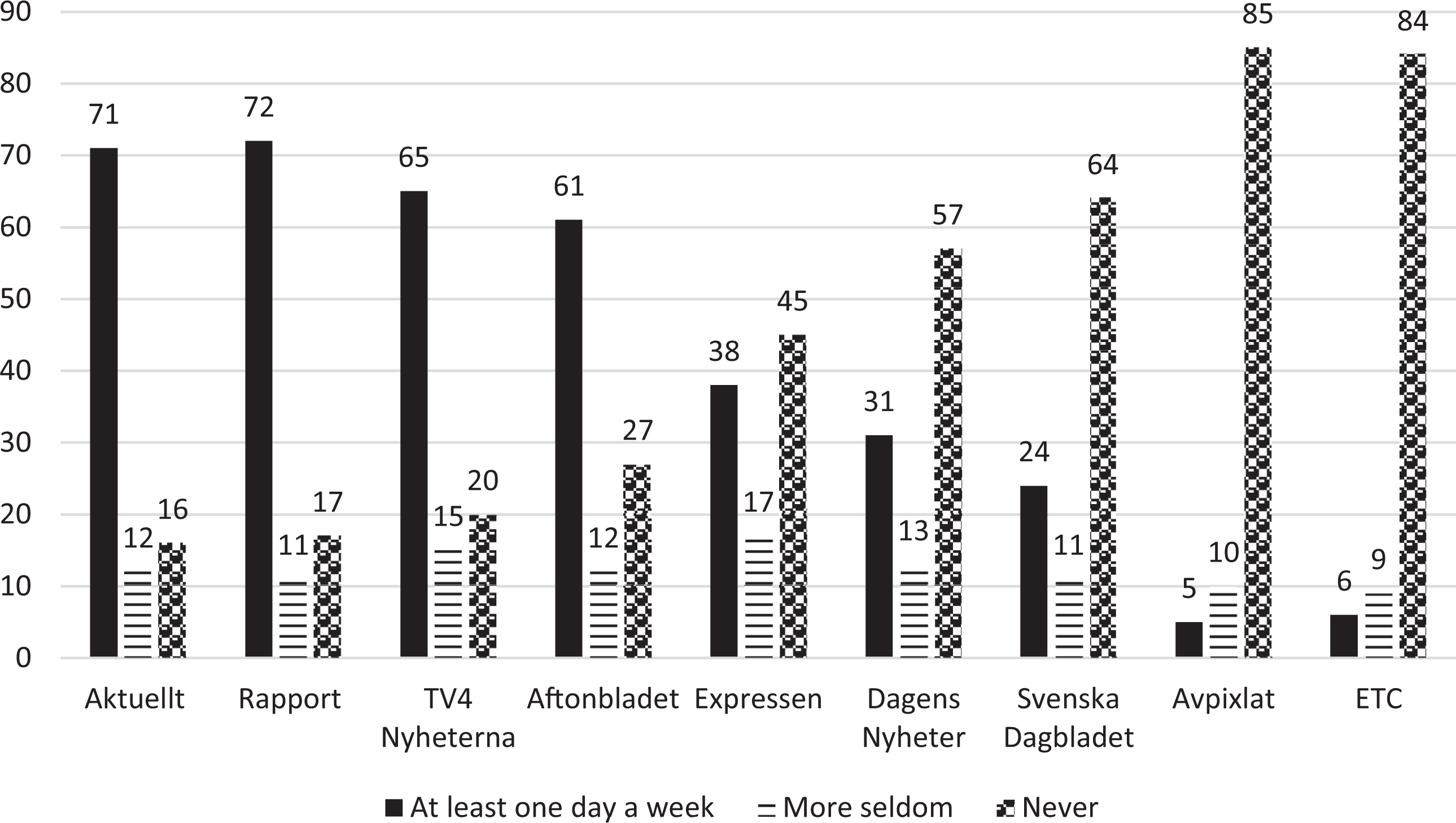
Use of the Investigated Media Outlets Year 2016 (Percentages)
To construct the media variables used to test our hypotheses, we first recoded the individual variables tapping respondents’ use of broadcast news and newspapers so that each respondent for each individual media was assigned the value that corresponded to the most frequent use of that type of news media. For example, someone who read a print newspaper 3–4 days a week, on the computer 1–2 days a week, and on the phone or tablet 5–6 days a week was assigned the value corresponding to the use of that newspaper on the phone or tablet. To construct the variables measuring the use of different media types, we created one index for the use of broadsheets (Dagens Nyheter and Svenska Dagbladet 10 ), one for use of tabloids (Aftonbladet and Expressen 11 ), and one for use of public-service television news (Aktuellt and Rapport 12 ). With respect to commercial television news, we used the original measure since respondents were only asked about one commercial television news show (TV4 Nyheterna). The same holds for the use of alternative media sites. Finally, the indices were rescaled to range from 1 to 6 to make them comparable with the other media use variables.
Data Analysis
To answer our research questions, we used descriptive statistics to analyze people’s attitudes toward immigration and perceptions of immigration’s impact. To test our hypotheses on the effects of media use, we conducted a series of lagged OLS regression analyses, controlling for gender, age, education, and political interest. In these analyses, the dependent variables are indices of respondents’ attitudes toward immigration and perceptions of its impact. It is important to note that the dependent variables are based on data from the third panel wave (2016), while the independent variables are based on data from the second wave (2015). By including the dependent variable’s lagged value, our analyses captured the effect of media use on changes in people’s attitudes toward immigration and perceptions of immigration’s impact, while also serving as catch-all controls up to the previous panel wave. In contrast to studies based on cross-sectional data, this approach provides a much tougher test of the effects of media use, as it allows causal inferences (Finkel 2007). To be clear, when we speak about media effects, we refer to statistical effects based on the described analyses (see Finkel 2007, for an overview of this approach).
Results
We begin by addressing our research questions asking how respondents’ attitudes toward immigration vary depending on what reasons people have for immigrating (RQ1), what part of the world they immigrate from (RQ2), and what impact on society immigration is perceived to have (RQ3). We also map whether these attitudes and perceptions changed across time (RQ4). The results are presented in Table 1. Beginning with respondents’ attitudes toward immigration depending on why people were coming to Sweden (RQ1), overall the results show that respondents had quite positive attitudes towards immigration but that those attitudes varied, depending on why people were immigrating. The kind of immigration toward which respondents were most positive was work- or education-related immigration, while they were less positive toward refugee and family immigration. These results suggest that respondents held more favorable attitudes toward the immigration of individuals perceived to contribute to the host society (Aalberg, Iyengar, and Messing 2011; Ford 2011; Hainmueller and Hopkins 2015; Valentino et al. 2017) and tended to “grade” different types of immigration even in a setting where attitudes in general were quite positive.
Attitudes towards Immigration and Perceptions of the Impact of Immigration, 2014–2016 (mean values).
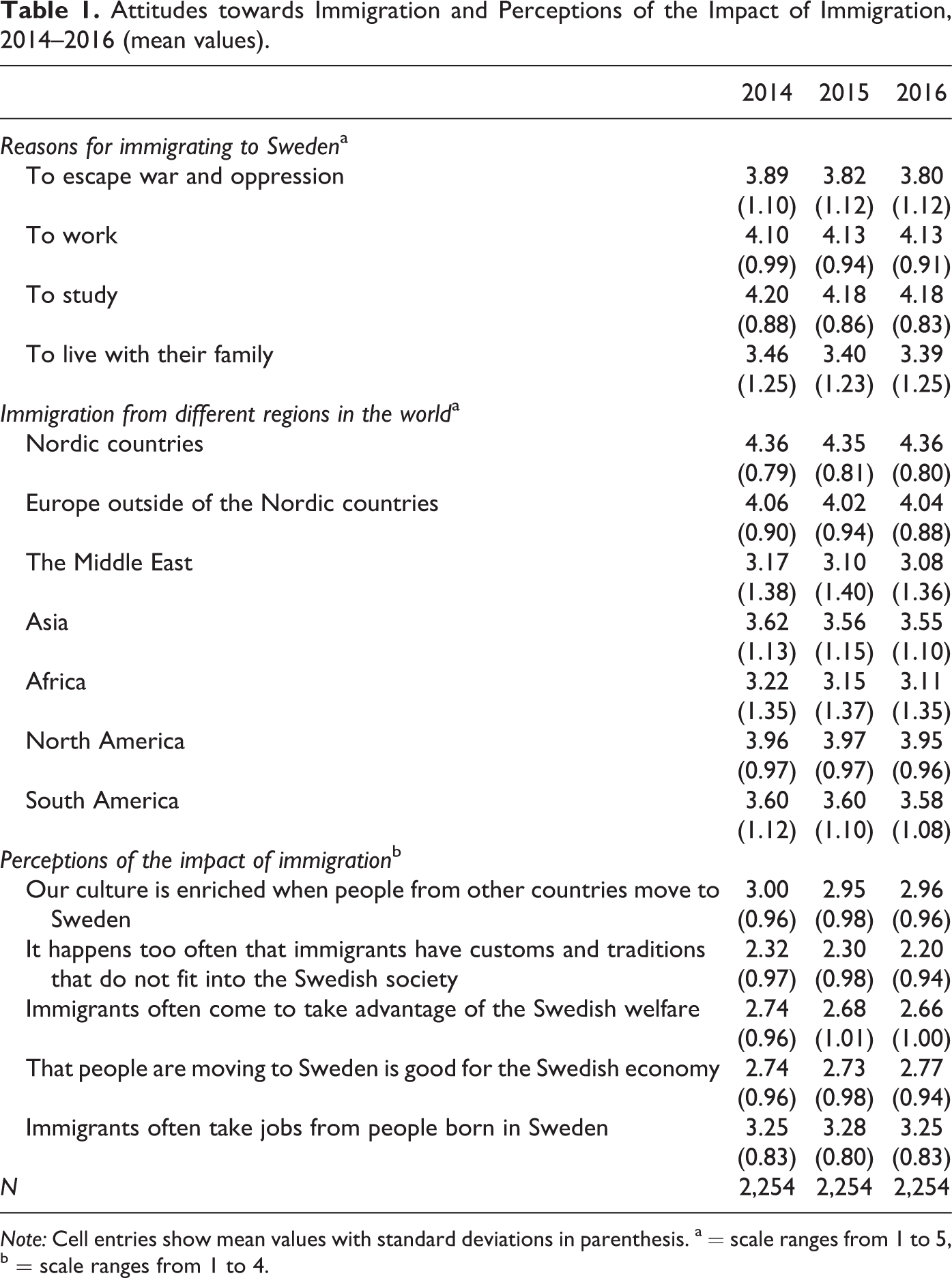
Note: Cell entries show mean values with standard deviations in parenthesis. a = scale ranges from 1 to 5, b = scale ranges from 1 to 4.
Turning to how respondents’ attitudes varied, depending on where people are coming from (RQ2), results again show that they held quite positive attitudes. It is, however, also clear that their attitudes varied, depending on what part of the world immigrants were coming from. Overall, respondents were most positive toward immigration from Nordic countries, followed by immigration from other European countries and North America, and reported the least positive attitudes toward immigration from the Middle East and Africa. These results suggest that respondents tended to be more positive toward “culturally and ethnically close” than toward “culturally and ethnically remote” groups (Brader, Valentino, and Suhay 2008; Igartua and Cheng 2009; Ford 2011) and support research suggesting that perceived cultural threat is a central mechanism behind negative immigration attitudes (Lucassen and Lubbers 2012; Hainmueller and Hopkins 2014). Interestingly, respondents’ attitudes varied slightly more, based on where people were migrating from than on why they were migrating. This finding might be interpreted as indication that the former is a stronger predictor of immigration attitudes than the latter. These differences are modest, though, and the main conclusion is that both where people were migrating from and why they were migrating were important predictors of immigration attitudes.
Turning to perceptions of immigration’s impact (RQ3), results indicate more ambivalence. While the means are above the midpoint with respect to the positively phrased statements (e.g., “That people are moving to Sweden is good for the Swedish economy”), it is also clear that respondents thought that immigrants too often have customs and traditions that do not fit into Swedish society. The fact that more respondents agreed with the statement about customs and traditions than with statements about immigrants taking advantage of Swedish welfare or taking jobs from people born in Sweden might be interpreted as indication that unfavorable immigration attitudes are based on cultural rather than economic threat perceptions (Hainmueller and Hopkins 2014). At the same time, perceptions that immigrants take advantage of welfare may also be explained by lack of identification with and, thus, solidarity toward immigrants. In other words, respondents might perceive immigrants as less deserving of welfare benefits due to negative prejudice and “us versus them” identity differentiation (van Oorschot 2008). Thus, there might also be cultural, and not just economic, explanations for perceptions about immigrants taking advantage of welfare.
Finally, RQ4 asked about changes across time. Here, results suggest that respondents’ attitudes and perceptions were quite stable. Although two years is a short time period, Sweden during the period in question, especially 2015, received a record number of refugees (SCB 2019), which in turn intensified media coverage and public debate concerning immigration (Strömbäck, Andersson, and Nedlund 2017). During this time period, Swedish policy toward refugee immigration also changed significantly, becoming more restrictive (Regeringen 2016). As people often rely on cues from political elites when forming their attitudes (Zaller 1992), this policy shift could have influenced public opinion on immigration-related issues. From that perspective, the stability of respondents’ attitudes and perceptions is noteworthy.
Influences of Media Use
Descriptive findings about attitudes toward immigration and perceptions of immigration’s impact notwithstanding, the key issue in this article is the effects of media use on these attitudes and perceptions. By using panel data where we include the dependent variable’s lagged value, we can investigate the effects of media use on changes in respondents’ attitudes toward immigration. In contrast to studies relying on cross-sectional data, using panel data allows us more leverage to make causal inferences (Finkel 2007).
Our first hypothesis, H1a, predicted that the use of commercial television news would have more negative effects on people’s attitudes toward immigration than the use of public-service news. Results show some support for this hypothesis. Model 1 in Table 2 shows the effect of watching commercial versus public-service news on attitudes toward different types of immigration. A significant, although quite modest, effect can be observed, suggesting that watching commercial news was likely to contribute to more negative attitudes. This effect holds in Model 4, where we control for the use of all types of media. However, no significant effects can be found on attitudes toward immigration from different parts of the world (Models 1 and 4 in Table 3). This finding suggests that commercial television news had a (modest) impact on attitudes toward different types of immigration but not on attitudes toward immigration from different parts of the world. One explanation might be that media coverage during the time period under study focused mainly on refugee migration (Strömbäck, Andersson, and Nedlund 2017). As attitudes toward refugee migration are more negative than attitudes toward work- and education-related immigration (see Table 1), these attitudes might furthermore have been more easily reinforced.
Media Effects on Attitudes toward Different Types of Immigration (OLS).

Note: *p < .05. **p < .01. ***p < .001. Standard errors in parentheses. The dependent variable is measured on a scale from 0 to 1 (0 = negative attitude towards different types of immigration, 1 = positive attitudes towards different types of immigration). The control variables are gender, age, educational level, political interest, and the lagged value of the dependent variable.
Media Effects on Attitudes toward Immigration from Different Regions (OLS).
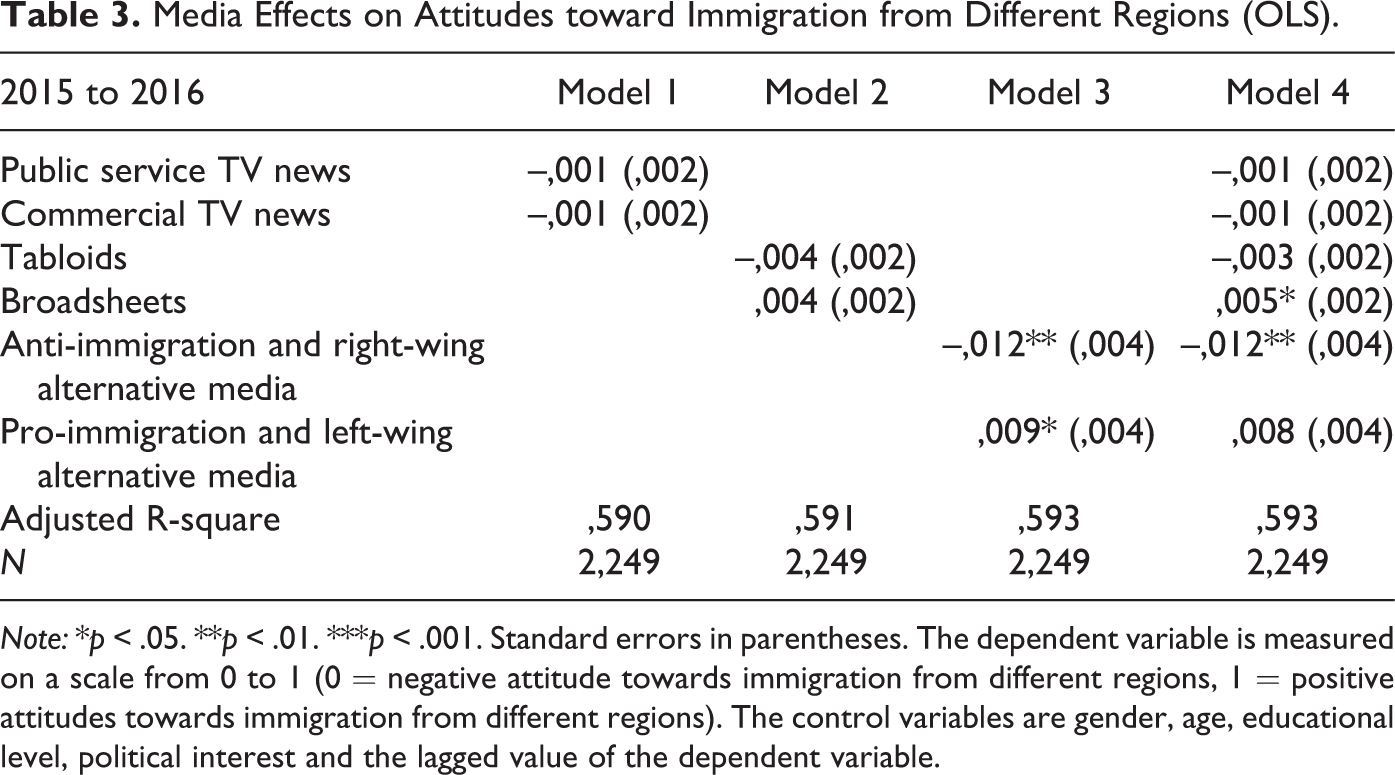
Note: *p < .05. **p < .01. ***p < .001. Standard errors in parentheses. The dependent variable is measured on a scale from 0 to 1 (0 = negative attitude towards immigration from different regions, 1 = positive attitudes towards immigration from different regions). The control variables are gender, age, educational level, political interest and the lagged value of the dependent variable.
Turning to H2a, which predicted that reading tabloids would have more negative effects on attitudes toward immigration than reading broadsheets, results again show some support for this hypothesis. Model 2 in Table 2 displays a significant and negative effect of reading tabloids on different types of immigration. When controlling for the use of other media types, the effect becomes insignificant, however. Moreover, there is no significant effect of using tabloids on attitudes toward immigration from different parts of the world (Models 2 and 4 in Table 3). Yet results display a positive and significant effect of reading broadsheets when controlling for the use of other media types (Models 2 and 4 in Table 3). Thus, while the effect of using tabloids appear weak and disappear under control for the use of other media types, results indicate that broadsheets might stimulate slightly more positive immigration attitudes.
The next question is whether the use of anti-immigration, right-wing alternative media leads to more negative attitudes (H3a). Results are shown in Model 3 in Tables 2 and 3 and suggest that there are significant and negative effects of using anti-immigration, right-wing alternative media, regardless of what index is used as dependent variable. The effects also remain significant when controlling for the use of other media types (Model 4 in Table 2 and Table 3). Altogether, these results lend support for H3a.
Contrasting the use of right-wing alternative media, H4a predicted that using left-wing, pro-immigration alternative media would lead to more positive immigration attitudes. As can be seen from Model 3 in Tables 2 and 3, results display significant positive effects. When the dependent variable is the index for attitudes toward different types of immigration, but not the index for attitudes toward immigration from different parts of the world, there is a positive significant effect also when controlling for the use of other media types (Model 4 in Tables 2 and 3). The implication here is that it is highly important to consider alternative media when investigating how media use influence immigration attitudes.
Finally, H5a predicted that the use of so-called alternative media would generate stronger effects on attitudes than would the use of traditional news media. Results presented in Tables 2 and 3 show that this prediction receives support: generally speaking, the effects of using traditional media types appear weak, whereas more substantial effects of using alternative media are found. This finding indicates that the use of media outlets with clearer ideological leanings was a stronger predictor of immigration attitudes than the use of traditional media types, once again suggesting that media type should be considered when seeking to understand people’s immigration attitudes.
Our focus now shifts from effects on public attitudes toward immigration to effects on public perceptions of immigration’s impact. To reiterate, attitudes and perceptions are two distinct concepts; thus, it cannot be assumed that the effects of media use are the same for attitudes and perceptions. H1b predicted that watching commercial television news would have more negative effects on people’s perceptions of immigration’s impact than watching public-service television news, while H2b predicted the same pattern for reading tabloids compared with reading broadsheets. H3b and H4b predicted that the use of right-wing alternative media would have negative effects while the use of left-wing alternative media would have positive effects on people’s perceptions of immigration’s impact. Results are presented in Table 4.
Media Effects on Perceptions of the Impact of Immigration on Society (OLS).
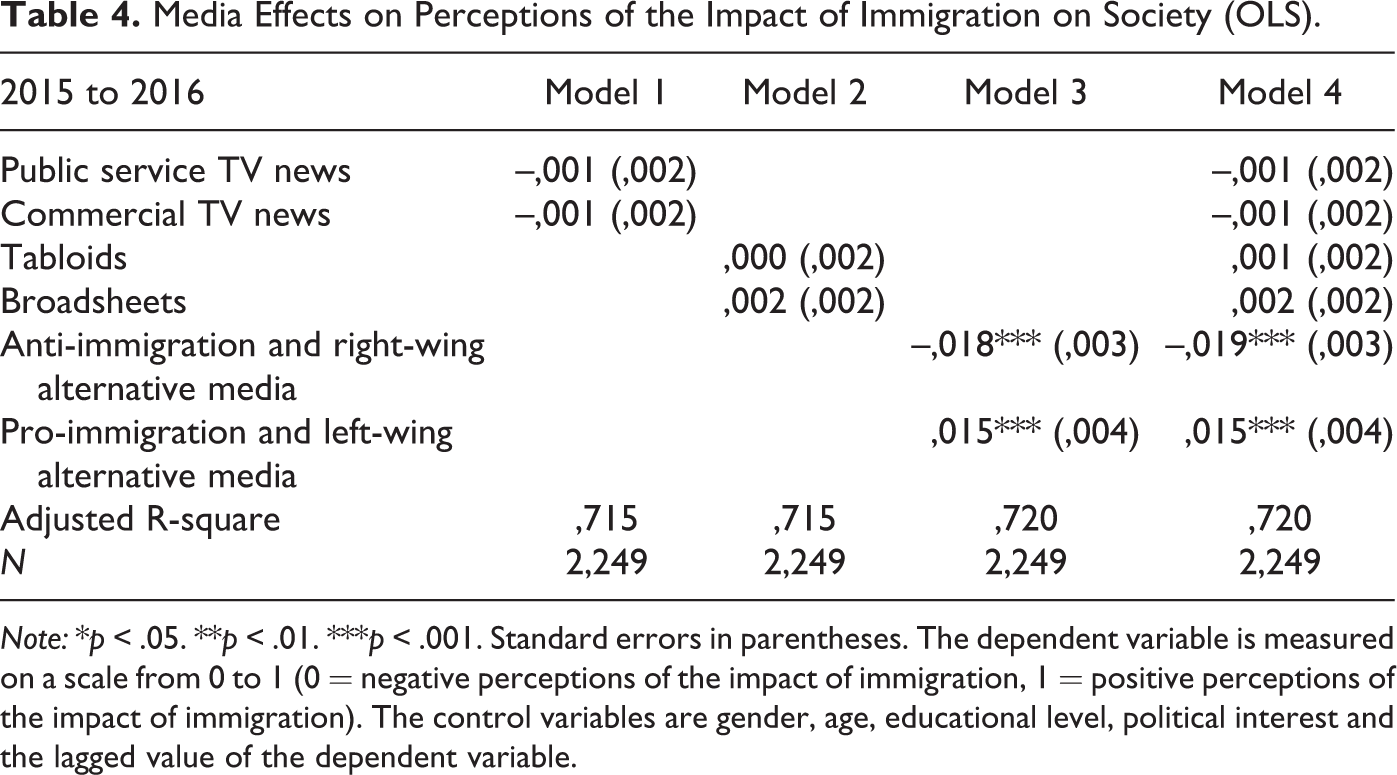
Note: *p < .05. **p < .01. ***p < .001. Standard errors in parentheses. The dependent variable is measured on a scale from 0 to 1 (0 = negative perceptions of the impact of immigration, 1 = positive perceptions of the impact of immigration). The control variables are gender, age, educational level, political interest and the lagged value of the dependent variable.
Beginning with H1b and H2b, results provide no support for these hypotheses. Altogether, there are no significant effects of watching public-service or commercial television news or of reading tabloids or broadsheets on perceptions of immigration’s impact (Models 1 and 2 in Table 4). There is, however, support for H3b and H4b: while there is a significant negative effect from using right-wing alternative media, there is a significant positive effect of using left-wing alternative media, even when controlling for the use of other media types (Models 3 and 4 in Table 4). Taken together, these results support H5b, which predicted stronger effects from using alternative than from using traditional news media.
The final hypothesis (H6) predicted that media use would have stronger effects on perceptions of immigration’s impact than on attitudes toward immigration. The rationale was that there is a closer linkage between attitudes and values than between perceptions and values, indicating that attitudes should be more strongly anchored in people’s value systems and, hence, less subject to change. Results provide no support for this hypothesis, however. In fact, they show more significant effects on attitudes than on perceptions. The only deviation is that the use of left-wing alternative media had a slightly stronger effect on perceptions than on attitudes (Models 3 and 4 in Table 4: ,015*, compared to Models 3 and 4 in Table 2: ,013*** and Table 3:,009*, 008). Overall, though, the effects of media use on attitudes and perceptions do not seem to differ much. This finding might be viewed as indication that the distinction between perceptions and attitudes plays a minor role in explaining public opinion on immigration. Too large conclusions based on a single study should, however, be avoided, and it might still be fruitful to distinguish between attitudes and perceptions in other contexts or if investigating the potential mediating role of perceptions on attitudes.
Additional Analyses
The results discussed thus far pertain to the time period between 2015 and 2016. To test their robustness, we conducted identical analyses using data from the time period between 2014 and 2015 (Supplemental Appendix, Supplemental Tables A2–A4). To summarize the findings, overall, results are in line with those presented above. With respect to the use of traditional media types, we find only one significant effect (Supplemental Table A2, Models 1 and 4). In contrast, the use of right-wing alternative media has significant and negative effects on attitudes and perceptions, while the use of left-wing alternative media has positive effects. Thus, the effects of using alternative media were stronger than those of using traditional media between 2014 and 2015 as well. Finally, there is no evidence that media effects are stronger for perceptions of immigration’s impact than for attitudes toward immigration.
Discussion and Conclusion
Although there is extensive research on people’s attitudes toward immigration and related topics (Hainmueller and Hopkins 2014), this work suffers from several shortcomings. Among these shortcomings are the predominance of studies based on both cross-sectional data (e.g., Héricourt and Spielvogel 2014; Beyer and Matthes 2015) and “attitudes to ‘immigrants’ as an undifferentiated mass” (Ford 2011) and the rarity of studies paying attention to the effects of media use (e.g., Eberl et al. 2018).
In light of these gaps, this article has contributed to research on media effects on immigration attitudes in several ways. First, it is one of the few studies to investigate the effects of specific media use on attitudes toward and perceptions of immigration’s impact, showing the importance of differentiating between different types of media. Second, it used a broader range of indicators of attitudes toward immigration than other studies in this area, thus capturing “immigration attitudes” more comprehensively than previous work (e.g., Gil de Zúñiga, Correa, and Valenzuela 2012; Héricourt and Spielvogel 2014; Beyer and Matthes 2015). Third, this article is the first to investigate media effects on people’s attitudes toward immigration, as well as on perceptions of immigration’s impact, thus highlighting the need to distinguish between attitudes and perceptions. Fourth, it accounts for the use of both traditional and alternative media, which is important in times when more people are turning toward different forms of alternative media and when politically biased alternative media are on the rise (Benkler, Faris, and Roberts 2018). Finally, it is one of the few studies using panel data to investigate the effects of media use on changes in people’s attitudes toward and perceptions of immigration’s impact — a major strength, since studying how the independent variable influences changes in the dependent variable is a precondition for causal inferences (Finkel 2007). Altogether, then, this article provides the most comprehensive analysis thus far of how different types of media use influence immigration attitudes and perceptions of immigration.
Empirically focusing on Sweden, results presented here both confirm and add to previous research (Ford 2011; Hainmueller and Hopkins 2014; Blinder 2015). To begin, our findings suggest that respondents in general had quite positive attitudes toward immigration. While not surprising (Heath and Richards 2016; Strömbäck and Theorin 2018), the fact that these results hold even when using a broader range of indicators suggests that findings from previous studies are robust. Consistent with previous studies (Ford 2011; Hainmueller and Hopkins 2014; Blinder 2015), results also show that respondents’ attitudes differed depending on why people were migrating and from what parts of the world they were coming. Generally speaking, respondents were most positive toward immigration associated with work and study and from regions perceived to be culturally and ethnically close. Thus, even in contexts where attitudes were quite positive toward immigration, people tended to “grade” different types of immigration and immigration from different parts of the world. One implication of this finding is that immigration attitudes need to be assessed vis-à-vis both why and from where people are immigrating when the aim is understanding general immigration attitudes and/or key predictors behind immigration attitudes.
Overall, immigration was perceived by many respondents to have a positive, rather than negative, impact on Swedish society, although many also thought that immigrants too often had customs and traditions that did not fit into Swedish society. In fact, more respondents seemed to worry about immigrants’ customs and traditions than about immigrants’ taking advantage of welfare services or taking jobs from native-born residents. To some extent, these results support claims that opposition toward immigration stems more from a perception that immigration represents a “cultural threat” than an “economic threat” (Sides and Citrin 2007; Hainmueller and Hopkins 2014).
More important in the context of this article, however, are the effects of media use. Taking advantage of the panel data to investigate the effects of media use on changes in attitudes toward immigration and perceptions of immigration’s impact, results suggest that there are some effects of using traditional news media. However, these effects are few, weak, and often insignificant when controlling for additional variables. By contrast, results show that using pro-immigration, left-wing alternative media have positive effects while using anti-immigration, right-wing alternative media have negative effects on both people’s attitudes toward migration and perceptions of immigration’s impact. These findings are quite consistent, regardless of whether we focus on the time period 2014–2015 or 2015–2016. Equally important, the negative effects of using anti-immigration, right-wing alternative media seemed to be stronger than the positive effects of using pro-immigration, left-wing alternative media — a finding which might be explained by the fact that the right-wing alternative media investigated here is blatantly anti-immigration (Holt 2016a), while the left-wing alternative media is more tempered in its pro-immigration stance and less focused on immigration-related issues (Coogan and Wänelöf 2014; Strömbäck and Theorin 2018). Thus, differences in the degree to which alternative media is biased is a key part of the picture.
Altogether, our findings suggest the importance not only of using comprehensive indicators of immigration attitudes but also of including and controlling for a comprehensive set of media. They also show the importance of using panel data and of controlling for the dependent variable’s lagged value when investigating media effects.
While we believe this article represents a significant contribution to the literature, it is not without limitations. First, it is a single-country study. As always, the degree to which results are valid in other countries is hard to assess. Another potential limitation is the time lag between panel waves. There might be effects of media use that the data cannot detect, due to the one-year lag between panel waves. Furthermore, research indicates that self-reported media use measures might underestimate media effects (Scharkow and Bachl 2017). Thus, real-world effects of media use on immigration attitudes and perceptions might be larger than what this article suggests. Finally, immigration changed dramatically between 2014 and 2016. After receiving a record number of asylum seekers in 2015, during Fall 2015, Swedish immigration policy became much more restrictive. The fact that 2014–2016 was an atypical time period with respect to immigration and immigration policy makes it interesting but also raises questions about whether the results would be the same if the time period had been less atypical. While the finding that the pattern is so similar from 2014 to 2015 and from 2015 to 2016 speaks against such a notion, we cannot rule out that results would have been different if the study had been done during another time period.
To sum up, then, a key finding is that media use affects people’s attitudes toward immigration and perceptions of immigration’s impact, but these media effects occur mainly, albeit not exclusively, for politically biased alternative media. That there are stronger media effects of using outlets with a clear political stance is an important finding, not least since politically biased media have become more important players across many Western democracies (Newman et al. 2018). To the extent that politically biased media become more important as sources of information about politics and society, use of such media might contribute to increasing polarization not only of attitudes toward migration but also of perceptions of how immigration influences host societies. If or when that situation occurs, it would risk contributing to even further polarization of the public immigration debate, with far-reaching consequences for the political system’s ability to form immigration policies based on evidence and viewed as legitimate by the public.
Supplemental Material
Online_appendix,_final - Some Media Matter More Than Others: Investigating Media Effects on Attitudes toward and Perceptions of Immigration in Sweden
Online_appendix,_final for Some Media Matter More Than Others: Investigating Media Effects on Attitudes toward and Perceptions of Immigration in Sweden by Nora Theorin and Jesper Strömbäck in International Migration Review
Footnotes
Declaration of Conflicting Interests
The author(s) declared no potential conflicts of interest with respect to the research, authorship, and/or publication of this article.
Funding
The author(s) received no financial support for the research, authorship, and/or publication of this article.

Notes
References
Supplementary Material
Please find the following supplemental material available below.
For Open Access articles published under a Creative Commons License, all supplemental material carries the same license as the article it is associated with.
For non-Open Access articles published, all supplemental material carries a non-exclusive license, and permission requests for re-use of supplemental material or any part of supplemental material shall be sent directly to the copyright owner as specified in the copyright notice associated with the article.
