




Abstract
Tertiary music students show patterns of playing-related musculoskeletal disorders (PRMDs) similar to professionals, indicating the need for effective education in management and prevention during student years. When problems occur, music students are most likely to seek advice from their instrumental teachers; therefore, it is important for teachers to be involved in ensuring education programs are relevant to the occupational and artistic needs of both student and professional musicians. Musicians have previously reported improvements in outcomes associated with PRMDs and performance quality following Alexander Technique (AT) classes. In this study, 12 university music students and eight of their teachers evaluated video-recordings filmed before and after a semester of weekly, purpose-designed AT classes. Positive changes were observed in muscle tension, posture, tonal resonance, breathing, instrumental technique, and movement quality. Noted improvements were consistent with student participants’ subjective experiences, reported previously from questionnaire data. The results suggest that AT training at the instrument may have a direct positive impact on key factors associated with PRMDs as well as playing quality. Use of video assessments as a component of controlled, mixed-method studies with larger populations is recommended to establish the potential value of AT for inclusion in music training.
Introduction
Professional musicians experience a high incidence and prevalence of musculoskeletal disorders compared to workers in other fields (Paarup, Baelum, Holm, Manniche, & Wedderkopp, 2011), and investigations of music student populations show they are on a trajectory to facing similar difficulties (Ioannou & Altenmüller, 2015; Williamon & Thompson, 2006). The experience of playing-related musculoskeletal disorders (PRMDs) in student musicians has been shown to lead to the frequent need to reduce playing time (Davies, 2019; Ioannou & Altenmüller, 2015), dissatisfaction with playing quality (Kreutz, Ginsborg, & Williamon, 2008), and possible adverse psychological effects (Spahn, Richter, & Zschocke, 2002).
Music students believe their playing-related pain to be caused by long sessions of playing or practice, poor posture, excess muscle tension, stress, and faulty or inadequate technique (Ackermann & Adams, 2004; Ioannou & Altenmüller, 2015). The music medicine and occupational health literatures confirm the role of self-reported excess muscle tension and stress in the etiology of work-related musculoskeletal injuries (Davies & Mangion, 2002; Huysmans, Blatter, & van der Beek, 2012; Rennie-Salonen & de Villiers, 2016). Accordingly, there is an urgent need for students to develop skills in self-management of playing loads to avoid the build-up of dangerous levels of muscle tension, stress, and fatigue. However, during university studies, music students may be more concerned with developing musical skills than addressing health consequences of playing (Clark & Lisboa, 2013; Waters, 2019; Williamon & Thompson, 2006). Therefore, strategies that enhance performance factors alongside playing-related health may attract better engagement than strategies aimed at injury prevention alone.
Among health professionals, the discourse around prevention of PRMDs has largely focused on the need to improve musicians’ physical conditioning—“the musical athlete”—(Baadjou, Verbunt, van Eijsden-Besseling, Huysmans, & Smeets, 2015; Clark & Lisboa, 2013) through education in healthy practice habits, preventive strategies (Ackermann & Adams, 2004; Spahn, Hildebrandt, & Seidenglanz, 2001), body awareness, and a knowledge of anatomy (Rennie-Salonen & de Villiers, 2016). An increase in exercise and general physical activity has been encouraged, although there is mixed evidence for the role of these factors (Baadjou et al., 2015; Nawrocka et al., 2014; Waters, 2019). Correction of playing postures has received much attention (Ackermann & Adams, 2004; Blanco-Piñeiro, Díaz-Pereira, & Martínez, 2015; Steinmetz, Seidel, & Muche, 2010), and the development of more biomechanically efficient instrumental techniques has been recommended (Ackermann & Adams, 2004; Rennie-Salonen & de Villiers, 2016).
Regrettably however, many of the great instrumentalists on whom music students model themselves may not necessarily be judged by health professionals as exemplars of either biomechanically efficient techniques or correct playing postures. Nor is there evidence that there is consensus among musicians as to what these “injury-preventive” techniques and postures might consist of in a field where there are so many different schools of playing (Shoebridge, Shields, & Webster, 2017), all serving a function for expert players in technical precision, sound production, and expression. While the ability to play in a “relaxed,” “free,” and “natural” manner is a valued goal of many pedagogical methods (Loo, Evens, Hashim, & Loo, 2015), among musicians and health professionals alike, there is little indication as to agreement on the definition of such qualities, their visual attributes, or their measured efficacy for injury prevention. Furthermore, it is instrumental teachers, rather than health professionals, who are most likely to be consulted when students develop problems, and to provide advice and information about injury management and prevention (Clark & Lisboa, 2013; Ioannou & Altenmüller, 2015; Williamon & Thompson, 2006). As professional players, teachers are likely to have had firsthand experience of PRMDs (Paarup et al., 2011), thus their contribution to the evaluation of prevention programs may increase students’ perceptions that such programs are relevant to career progress and longevity.
Alexander Technique
Alexander Technique (AT) training may be a potentially useful preventive strategy for musicians since it is based on principles more fundamental than specifics of different schools of playing (Cacciatore, Horak, & Henry, 2005; Davies, 2019; Hamel, Ross, Schultz, O’Neill, & Anderson, 2016). The Australian actor F.M. Alexander (1869–1955) suffered a vocal overuse injury at the height of his career, which he came to recognize was the result of an unconscious habit of recruiting excessive muscle tension to achieve “good” posture, breathing, voice projection, and dramatic expression (Alexander, 1932/1985). In solving his own difficulties, he discovered principles which, when consciously applied, were thought to improve general and specific coordination for any activity (Alexander, 1932/1985; Jones, 1976/1997). AT training involves recognition and “unlearning” of interferences to this healthier neuromuscular functioning (Alexander, 1923/1987), emphasizing the importance of present moment awareness to enable non-judgmental self-observation and inhibition of the detrimental increases in muscle tension and psychological disquiet accompanying activities and/or intentions. The student is trained to set aside the compulsion to achieve an immediate end result and instead engage strategies to avert habits that block achievement of that end (Alexander, 1923/1987; Cacciatore et al., 2005).
AT teaches improved use of the self (the workings of the total mind–body complex in any present moment activity) through the cultivation of the primary control (a sensitive, dynamic coordination dependent on the balanced relationship between the head, spinal axis, rest of body, and gravity), using the tools inhibition (awareness and prevention of suboptimal neuromuscular habits), and direction (accessing the primary control in activity to maintain a free, expanded condition, termed the “postural frame” by Cacciatore, Mian, Peters, & Day (2014). Maintaining this efficient strategy for postural control while playing musical instruments is key to accessing benefit from AT training. Optimal use is thought to integrate and simplify other neuro-mechanical responses, improving the reliability of kinesthetic and proprioceptive feedback and the coordination of specific actions through a reduction and redistribution of muscle tension (Cacciatore et al., 2005; Kleinman & Buckoke, 2013). For instrumentalists, this means that tension or coordination problems encountered in breathing, arm use, or hand use are first approached indirectly through the restoration of a functional primary control and improved whole body coordination.
Aims
Although AT is popular with musicians and often available in tertiary institutions, there is limited empirical evidence for effects with musicians (Klein, Bayard, & Wolf, 2014), and musicians who have not experienced it may underestimate the benefits (Davies, 2019). However, a study measuring self-reported effects of a series of purpose-designed AT classes in a group of university music performance majors found that AT classes yielded positive outcomes for playing-related pain (PR-pain) and key predictors of PRMDs: excess muscle tension, poor posture, stress, and performance anxiety (Davies, 2019). These results confirmed other findings from the literature regarding positive effects of AT training, discussed fully in Davies (2019). (See also Chan, 2014; Klein et al., 2014; Woodman & Moore, 2012). Participants also reported benefits to instrumental technique, practice efficacy, performance level, and non-PR-pain from AT classes.
The present study therefore sought to further investigate these survey findings by inviting both student participants and their teachers to assess videos of the students playing their instruments before and after the AT course. Video-recordings have been used in previous studies with musicians to evaluate performance quality after AT training, but with inconclusive results (Gaunt, 2007; Klein et al., 2014; Wolf, Thurmer, Berg, Cook, & Smart, 2017), and no studies to our knowledge have used teacher evaluations. Regarding any changes resulting from AT classes, specific aims were to
elicit opinions of students and their instrument teachers,
establish degree of correlation between evaluations of students and teachers, and
establish degree of correlation between students’ video evaluations and their self-reported survey results.
Methods
Video procedure
Twenty-two tertiary music performance students from an Australian University were video-recorded playing their instruments, using a Zoom Q3 HD recorder, before and after a semester’s course of AT classes. Three 1-min video-recordings of each participant were made at each test point, where they were asked to play (1) a purely technical item such as a scale or warm-up exercise, (2) a musical excerpt they found “easy and comfortable,” and (3) a musical excerpt they found difficult that would “show them at their most tense.” In each of the three videos, participants were filmed from all angles.
Course curriculum and assessment tool
The curriculum used for the AT course was modified for music students from that developed for orchestral musicians in the Sound Practice Posture Trial (Chan, 2014). There were 14 weekly classes of 1-hr duration, with six students per class. Course content focused on AT basics, education in anatomical concepts relevant to optimal coordination and movement of the whole body, breathing and limbs, and direct application of AT to tension issues encountered during playing. Twenty-one students had previously completed a post-course questionnaire reporting effects of the classes, outlined in Davies (2019). For the present study, the same participants were then invited to complete a questionnaire assessing the pre- and post-test video-recordings of themselves playing to determine if they observed any positive or negative changes specifically as a result of AT classes. They were also required to complete a separate consent form permitting their teachers to evaluate the videos.
Control group
Pre-program, an attempt was made to establish a control group for the video assessment by asking student participants’ teachers to recommend another of their students (not enrolled in the AT course) as a matched control, to be video-recorded on the same dates, helping to establish how much change in assessed areas was attributable to AT classes rather than concurrent one-on-one instrumental lessons. Only three teachers suggested a student for the control group, so this portion of data collection did not proceed.
Outcome variables
Three key outcome variables, posture, excess muscle tension, and instrumental technique, were included on the basis that in the self-reported survey, participants had reported a strong benefit to those variables as a result of AT classes, and also that changes in those variables could potentially be detected visually and aurally via video-recording. A further variable pertaining to posture, positioning at the instrument, was added, as well as two outcomes relating to movement quality which might reflect an alteration in muscle tension, excessive movement and fluidity of movement/coordination. Tonal resonance/sound production, requiring aural rather than visual judgment, was also assessed, as in many instrumental pedagogies sound quality is thought to be affected by tension (Shoebridge et al., 2017). Participants were asked to score the amount of change they observed for each outcome on a scale from –5 = worst possible change, to 0 = no change, to +5 = best possible change. There was an opportunity to contribute instrument-specific feedback regarding details of changes to technique. Further comments were also invited.
Participants’ characteristics
Fifteen of a possible 21 participating students gave consent for their teachers to assess the videos. Three of the remaining six students had changed teachers and were not comfortable with their former teachers doing the evaluation. The other three were lost to follow-up. Videos were then evaluated by teachers of eight of the 15 students who had given consent, and by 12 of the 21 student participants who had completed the self-report survey, with an overall response rate of 56%. For six students, both student and teacher evaluations were received: two string players, two keyboard, and two wind. Another string teacher deemed the videos of too poor quality to make any assessments. Six videos were evaluated by male teachers and two by females. Three students and one teacher had had a small amount of previous AT experience. Table 1 shows the characteristics of students whose videos were assessed.
Students’ characteristics.
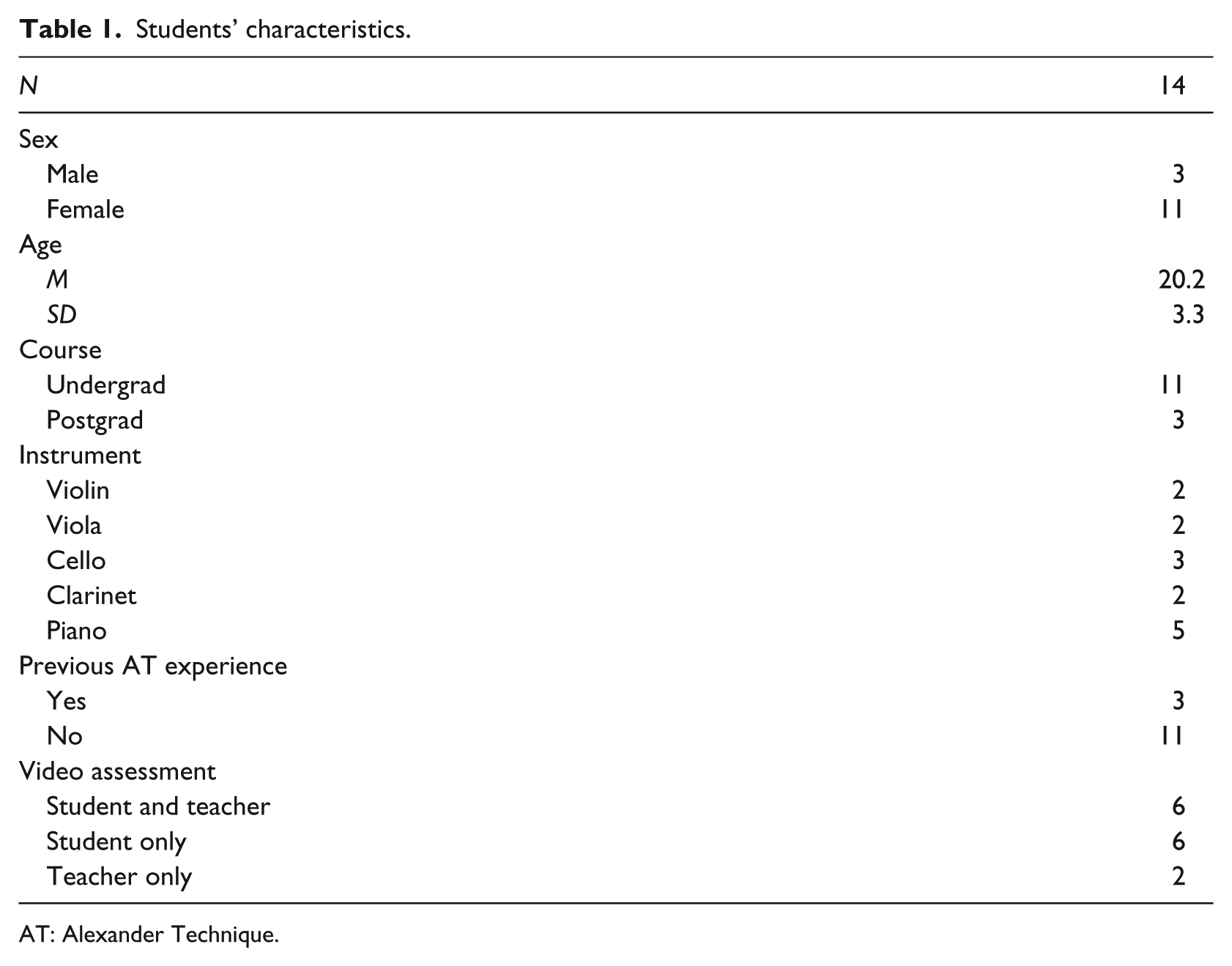
AT: Alexander Technique.
Results
Quantitative data
Table 2 shows that for student participants, the greatest perceived changes for the better were in breathing (for wind players), and for all players, musical tone, muscle tension, and posture. Teacher participants’ appraisals were similar, with muscle tension, musical tone, breathing, and posture receiving highest scores. The majority of participants noted improvements in all variables, with the average mean score between 2 and 3 out of a maximum score of 5. The mean score for all students’ evaluations was 2.89 (SD = 1.0), and for teachers, 2.25 (SD = 1.6). The difference between students’ and teachers’ scores did not reach significance using the Mann-Whitney U test (p = .28) 1 (see also Table 5).
Students’ and teachers’ assessments of videos (where –5 = maximum change for worse, 0 = no change, and +5 = maximum change for best).
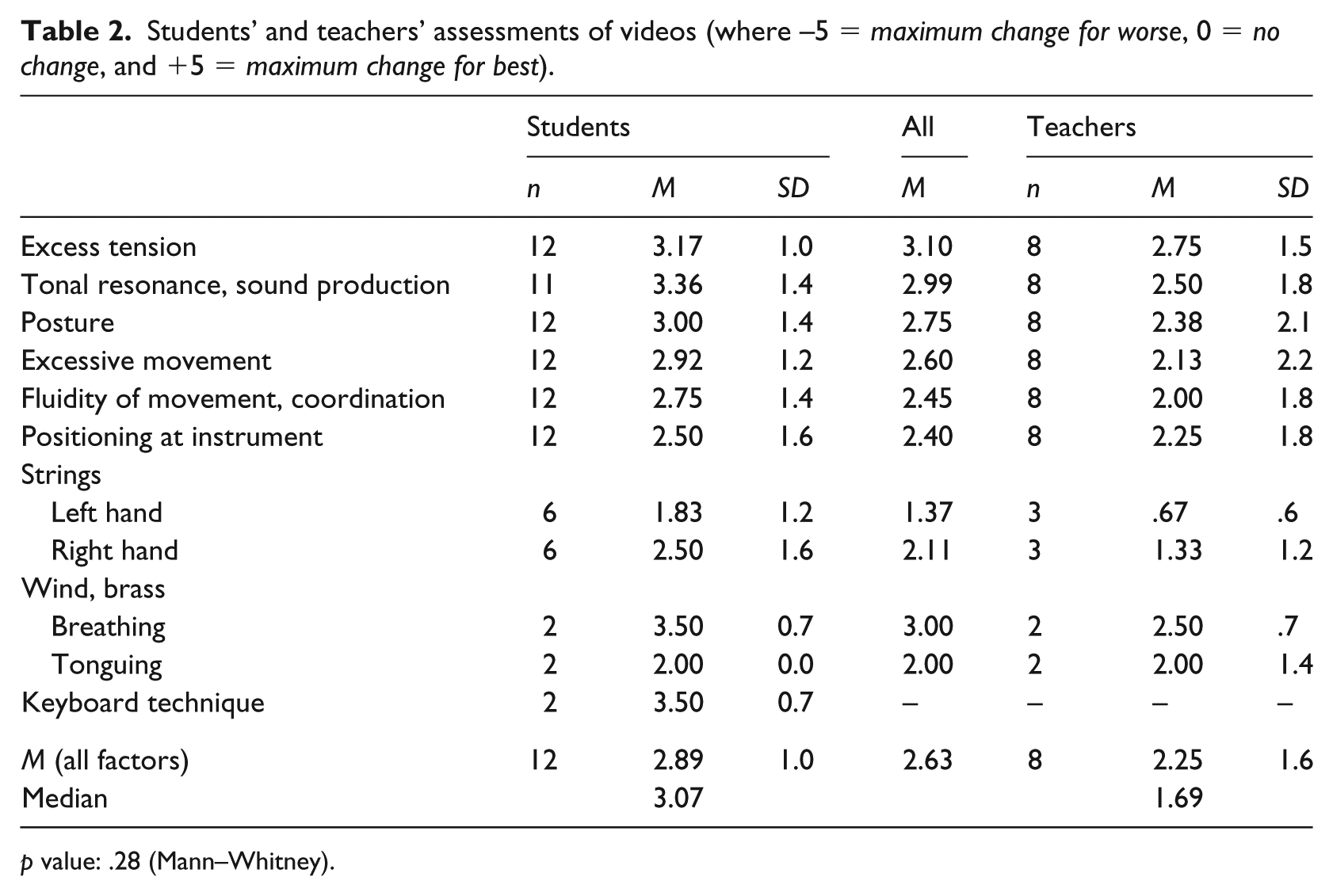
p value: .28 (Mann–Whitney).
For the six students whose teacher also completed an evaluation, the mean score for the difference between student and teacher evaluations was 0.55 (SD = 1.19). Four students had higher evaluations of beneficial change than their teachers, and two students obtained higher teacher evaluations. The range was from –1.13 (teacher’s score higher) to 1.87 (student’s score higher), with string players showing greater disparity (see Table 3).
Comparison of students’ and teachers’ assessment scores.
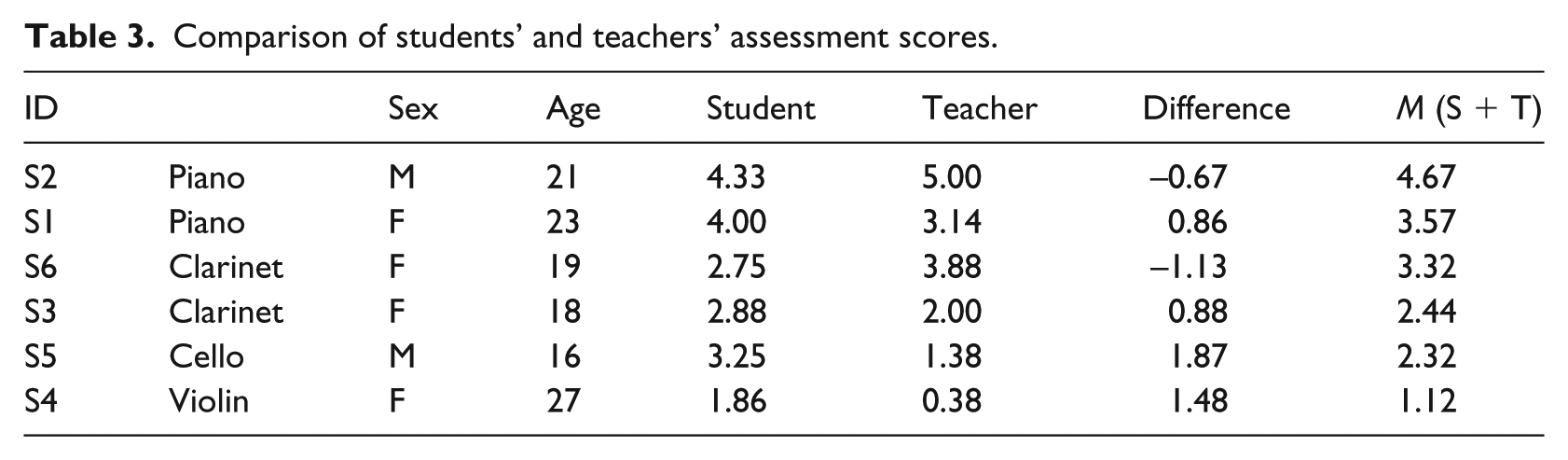
Participants who played or taught wind and keyboard observed more positive changes than participants who played or taught strings (Table 4). A significant difference (p = .03) was found between total scores for strings (1.92, SD = 1.20) and other instrumentalists (3.21, SD = 1.08) (see also Table 5).
Comparison of strings’ and others’ assessments.
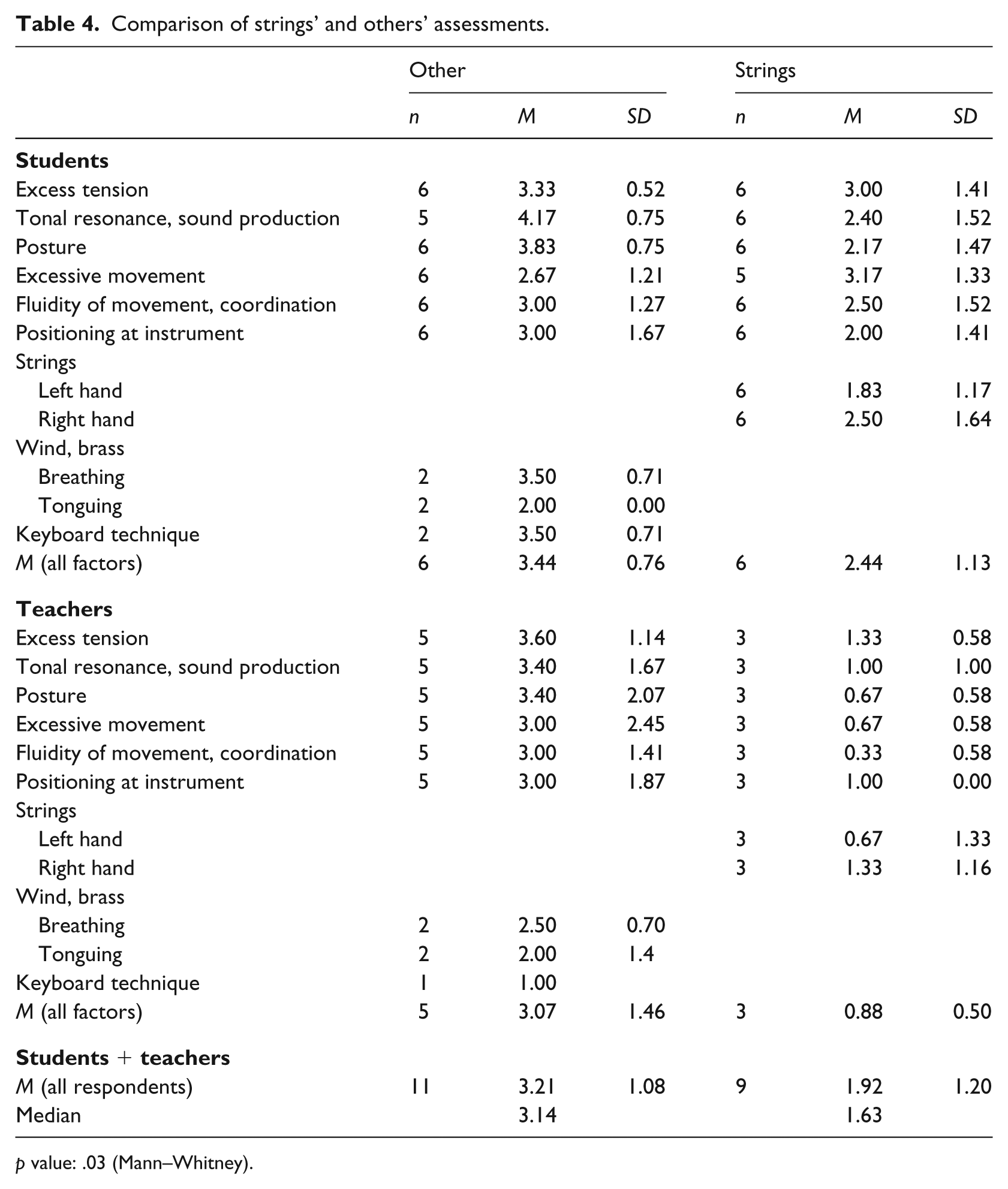
p value: .03 (Mann–Whitney).
Summary of comparisons of groups.
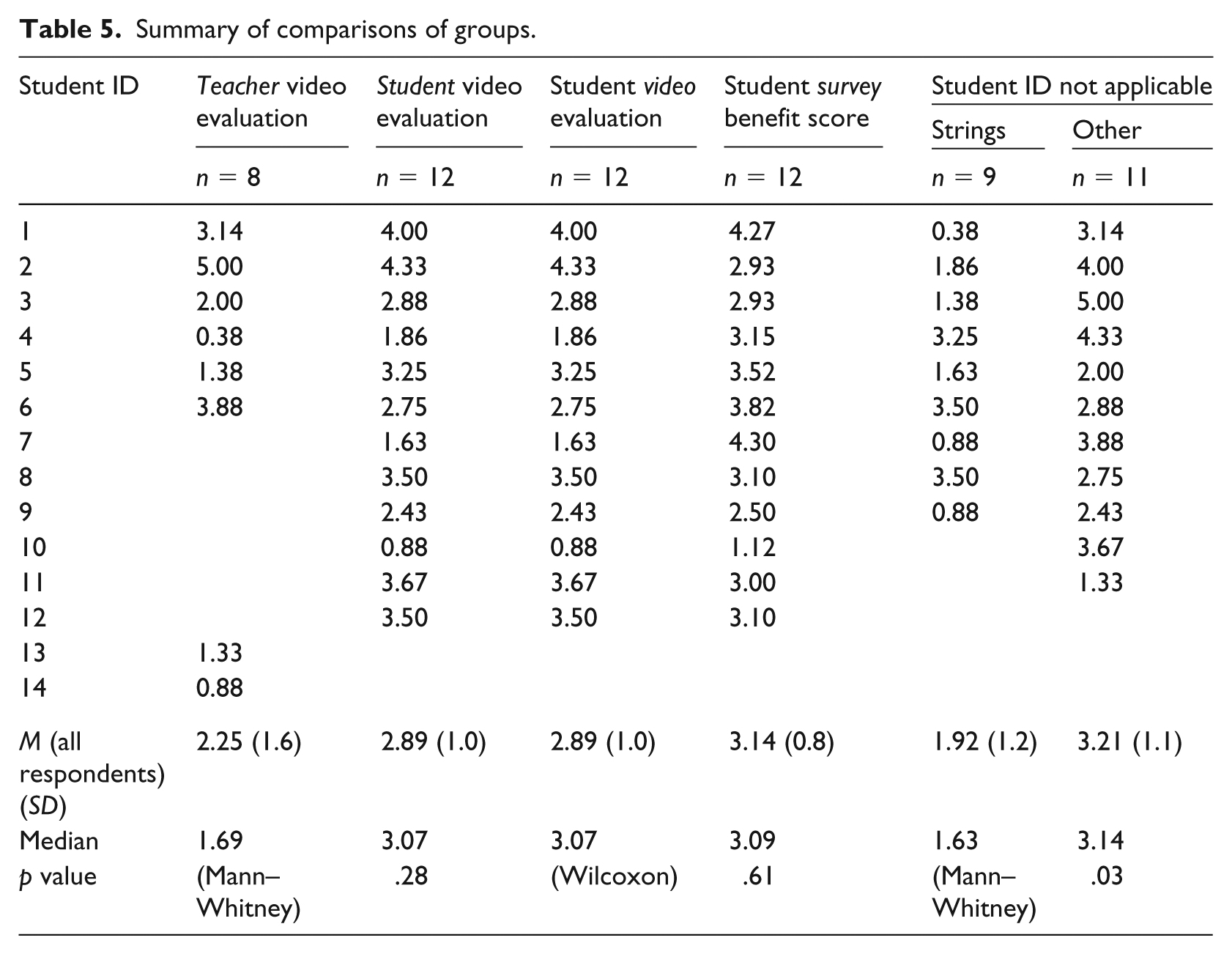
The students’ video assessment scores were then compared with their scores of benefit from the self-report survey data (Davies, 2019), converted from the original score out of three to a score out of five for comparison. No significant difference was found (p = .61) between students’ video evaluations and their survey scores (see Table 5). Table 5 presents a summary of the comparative scores of the three groups.
Of note, the self-reported survey score of benefit from the student sample in the present study (n = 12) was significantly lower than for the nine students who did not assess the videos: 3.14 (SD = 0.85) < 3.96 (SD = 0.76), p = .03.
Qualitative data
Posture, tension, movement quality
Eight of 12 students and seven of eight teachers offered further comments, in which posture was deemed “more easy and upright”, “less stilted,” and with “noticeably less tension in the body.” A “more relaxed way of playing” and better body balance was noted by both student and teacher participants. The two keyboard students commented that a focus on whole body coordination had led to “refinement in coordination of the arm and hand,” particularly during changes of register. The string-playing students noted having developed the “ability to achieve more sound in the bow arm with less tension in the shoulders” and to release tension spots in the left hand and arm, associated with perceived reduction in pain. The teachers of both clarinetists noted that there was “less left arm flapping” and more “easy, natural looking body movement.”
Technique, performance quality
Some participants noted specific changes to the biomechanical and tonal aspects of technique, such as one clarinet teacher: Glisses in slurred intervals in the before sections (became) clear intervals without oral cavity interruptions in the after. Tone was much easier and more precise with intonation. The articulation change was subtle but evident. (Score for Teacher 6 (T6) =3.88, Score for Student 6 (S6) =2.75)
A piano student observed: In the before videos, my elbows seemed to be pulled by gravity, displaying difficulties in the horizontal movement which the excerpt requires. In playing chords (where a) big hand span (was) required, the knuckles where fingers join the hand were collapsed in the before excerpt, but the bridge of the knuckles is evident in the after video, displaying a solid “C-shape” hand gesture.
The student also commented that her shoulders were freer and more mobile in the after videos. Her teacher concurred that there was a considerable reduction in the student’s shoulder tension after the classes, a problem which had previously hampered her legato, and further noted that the student displayed “more rhythmic vitality and ease at the keyboard” (S1 = 4, T1 = 3.14). Other comments also reflected changes to performance quality, for example, a teacher remarking that their student was “now playing with considerable ease and much greater authority” (T2 = 5, S2 = 4.33). Only one participant (clarinet teacher) observed a deterioration in performance quality in their student, in that tonal deterioration, wrong notes, and lack of fluency were noted concurrently with postural improvement, greater relaxation of shoulders, arms and hands, and more natural looking movements. Possible reasons given for this by the teacher were reed selection and “split focus/new postural ideas,” highlighting the potential difficulty for musicians in applying and integrating new techniques to playing. The evaluation of the student differed however, in that she gave a score of 2/5 for tonal improvement and reported ongoing benefits: “It feels better to play this way. I am better able to do the things I want to in my playing” (S3 = 2.88, T3 = 2.00).
Sound, tonal resonance
Regarding tonal resonance, both students and teachers reported tone to be “more fluid and resonant.” Some comments reflected perplexity regarding the manifestation of audible changes in the absence of very visible postural changes: for example, one piano teacher, “(her) posture seems to be unchanged. It was good before and after. Yet the sound is more fluid and more resonant. There must have been a psychological effect to the contents of the music” (T13 = 1.33). And a violinist. Looking at the videos my overall impression is that AT helps a lot with many things, especially resonance . . . the posture improved slightly . . . (but) it appears as though the tone improved significantly. (S7 = 1.63).
Amount of change
Several comments directly related to the “amount of change” believed to have specifically resulted from the AT classes (participants were given the option to select “not the result of AT”). One violin student said it was difficult to see the changes, especially in the neck area, because in the post-intervention video her hair was out and her clothing was loose. Her overall score, and that of her teacher, reflected this lack of ability to see change (S4 = 1.86, T4 = 0.38). However she commented: I am now a lot more aware of my body and what I am doing especially when playing. I had excessive tension in my left hand and used to have shoulder and neck pains but the classes have helped me be more aware of these tension spots and also how to release them.
In addition, a lower score for change sometimes reflected that the AT training had successfully coincided with the teacher’s goals: (The student) had been working on and making great progress on a number of fundamental areas of technique so it is not really possible to say exactly how much of the progress between the two videos is due to AT or his work on technique with his teacher. Hopefully a blend of both! (S5 = 3.25, T5 = 1.38)
All participants’ scores and comments are available in the online supplemental material.
Discussion
In this study using analyses of pre- and post-test video-recordings to assess changes in students’ playing after AT classes, important playing-related predictors for PRMDs: excess muscle tension, poor posture, and instrumental technique were deemed improved after AT classes by both students and their teachers, as well as other factors affecting performance quality: tone, breathing, and movement fluidity. The findings generally confirmed students’ self-reported survey responses (Davies, 2019), as well as previous research, where positive changes were observed for posture, tension, and technique after AT classes (Chan, 2014; Loo et al., 2015). Noted improvements in wind players’ breathing aligned with previous studies reporting improvements in respiratory function brought about by AT (Austin & Ausubel, 1992), and improved breathing movements accompanying postural improvements in oboe students after AT training (Gaunt, 2007).
Since AT training develops the musician’s ability to hold the whole body in the attention field while attending to the instrument and performance context (Kleinman & Buckoke, 2013), beneficial changes in sound production and tonal resonance observed in the present study reflected a recent investigation from Dora, Conforti, and Güsewell (2019), which found positive changes in sound volume and stability, concomitant with subjective feelings of ease, when upper string players directed attention to different parts of the body while playing. In the experience of AT teachers working with musicians, better “use” is often accompanied by a marked increase in tonal resonance. However, observers untrained in AT may be likely to associate AT with notions of “good posture,” and postural or use changes which alter tonal resonance can be visually subtle, possibly explaining participants’ comments that tonal improvement seemed mysterious in the absence of visibly obvious change.
Teachers and students also observed increased efficiency in the biomechanics of body movement and technique, positive changes tending to be described in qualitative terms, such as more “easy” or “natural,” and improved postural alignment as “balanced,” “easy,” “upright,” and less “stilted.” No respondent commented that posture, technique, or movement was more “correct,” rather improvements seemed to reflect a subjective notion of appropriateness to the task. The research of Shoebridge et al. (2017) shows that both health and music professionals concerned with musicians’ performance and well-being associate optimal playing posture with easy uprightness, balance, and fluidity, despite discrepancies among professions regarding methods of posture management. Video-recordings provide a potentially valuable tool to test outcomes of different approaches to improving playing postures. Defining and measuring such outcomes objectively is an important area for future study. However, music students’ subjective perceptions of benefit may provide motivation to apply approaches such as AT to playing, and validation of teachers and other elite performers regarding benefits to health, technical, and artistic factors may increase students’ perceptions that integration of AT into their playing is a worthwhile commitment. In the present study, teacher participants, mostly with no prior experience of AT, were able to recognize positive changes in their students’ playing coordination and posture after the AT course which largely paralleled their goals in studio lessons (with the exception of the clarinet teacher mentioned), and to describe these changes in pedagogically relevant language.
The reasons for the lower scores given by string participants in this study are unclear. The positions and postures for stringed instruments could be considered more complicated, and string techniques can look more varied, possibly distracting from fundamental aspects of use more obvious in other instruments. In addition, all comments regarding logistic difficulties encountered in seeing, hearing, and assessing changes were from string participants. A low measure for change did not necessarily equate with low benefit however, given that comments were generally positive. Furthermore, two of the string players receiving low teacher marks were among the three students who had had some previous AT work before the course, possibly making the visual contrast less obvious than with beginner students.
According to the AT paradigm, beneficial changes to musicians’ posture, breathing, technique, movement quality and/or tone are thought to result from improvements in general coordination, or use, achieved through the release of unnecessary tension, redistribution of muscle tone, and recruitment of more responsive and efficient neuromuscular strategies for posture and movement control (Davies, 2019; Jones, 1976/1997). Thus the results of this study suggest that education and training in identifying faults in use, as manifested in compromised movement and tonal quality, may yield constructive outcomes for musicians that address the complexities of active performance as well as health factors. This broader approach moves beyond focusing on correcting discrete factors such as posture, positioning, and biomechanics, and provides principles, potentially acceptable to both teachers and students, with which to work toward injury-preventive methods of playing. Furthermore, the strong emphasis on process in AT lessons may assist students who are obsessively focused on short-term goals and career outcomes to achieve these outcomes in more healthful ways. The associated ability to direct attention constructively may help break cycles of stress and anxiety for injured students.
Strengths, limitations, and future research
A strength of this study is that it addresses the gap between music medicine and instrumental pedagogy, being the first investigation to highlight informed input from instrumental teachers in an area where most previous research has been published by health care professionals. The AT curriculum content specifically addressed playing-related tension issues at the instrument and had been used in previous studies, allowing for comparison of results. Data from this study provided a form of triangulation with some of the measures from participants’ survey results.
Limitations of the study include the small sample size and lack of a control group. The low participation rate also means that these results can be regarded as indicative only. However, non-responding students scored significantly higher benefits from classes on the written survey than respondents to the video questionnaire; therefore, those who evaluated the videos were unlikely to have done so on the basis of highest perceived benefit. The absence of before and after videos for a control group impeded the more exact quantification of positive changes resulting from the AT intervention, with the possibility that improvements could have resulted from usual teaching and practice over time, or that participants’ responses reflected a desire to please the researcher. Nonetheless, the results merit further investigation, as they are consistent with previous literature, particularly findings from Chan (2014), which used the same curriculum. Positive outcomes in the small study sample signpost several areas for further research, including the possible role of AT in prevention of PRMDs, the potential of AT to enhance music performance indicators, and the possible value of instruction in AT principles at different levels of music education.
For future studies, greater involvement of instrumental staff at all stages of study design may yield higher response rates. Staff participants could be recruited before the commencement of the study, along with their participating students and matched controls. Consistent venues should be used for pre- and post-test videos, and follow-up testing should be carried out to establish whether benefits were maintained once classes were completed.
Conclusion
The high prevalence of PRMDs among music students is a global issue for which urgent solutions are needed. AT is popular with musicians, but the efficacy of AT as a preventive and management strategy for PRMDs has not been established. This study is the first to our knowledge to use evaluations of video-recordings by music students and their teachers to assess perceived effects of purpose-designed AT classes on a range of outcomes related to both management of PRMDs and the development of performance skills. The majority of teacher and student participants judged excess muscle tension, posture, and instrumental technique as improved, confirming findings from survey data for the same study sample. Breathing, instrumental tone, and movement efficiency and fluidity were also deemed improved. Studio teachers recognized these improvements without prior experience of AT, confirming that AT changes met criteria identifiable to professional players. Controlled studies with larger populations are needed to establish the potential role of AT in music education for benefits to both health and performance factors. Use of video evaluations is recommended to assist in assessment of outcomes. Teachers’ validation of artistic and technical changes brought about by AT may increase music students’ uptake of this particular approach to improving playing health.
Supplemental Material
supplement_to_880007 – Supplemental material for Alexander Technique classes for tertiary music students: Student and teacher evaluations of pre- and post-test audiovisual recordings
Supplemental material, supplement_to_880007 for Alexander Technique classes for tertiary music students: Student and teacher evaluations of pre- and post-test audiovisual recordings by Janet Davies in International Journal of Music Education
Footnotes
Acknowledgements
The author is indebted to Dr. Peter Petocz for assistance with the statistical analysis, Ann Shoebridge, Dr. Frank Decker and Chris Howe for input during preparation of the manuscript, and Professor Anna Reid, the Conservatorium Students’ Association, and participating faculty and students for supporting the research.
Ethical approval
This study was approved by the University of Sydney Human Ethics Committee.
Declaration of conflicting interests
The author declared no potential conflicts of interest with respect to the research, authorship, and/or publication of this article.
Funding
The author received no financial support for the research, authorship, and/or publication of this article.

Supplemental material
Supplemental material is available online for this article.
Notes
References
Supplementary Material
Please find the following supplemental material available below.
For Open Access articles published under a Creative Commons License, all supplemental material carries the same license as the article it is associated with.
For non-Open Access articles published, all supplemental material carries a non-exclusive license, and permission requests for re-use of supplemental material or any part of supplemental material shall be sent directly to the copyright owner as specified in the copyright notice associated with the article.
