



Abstract
The study attempts to explore the relationship between job satisfaction of veterinarians and their level of professional commitment and job involvement. The universe of the study has been confined to veterinary doctors working on a permanent basis in government institutions in the state of Punjab. A sample of 322 veterinary doctors was collected to represent the universe. The analysis reveals that professional commitment and job involvement have positive relationship with and have explanatory power for job satisfaction. Taking into consideration the significance of animal husbandry to the growth of Indian economy and specifically to the Punjab economy, the government should take consistent and steadfast measures to improve the level of job involvement, professional commitment and, hence, job satisfaction of veterinarians. Such measures will definitely benefit the veterinarians, the government itself and the nation as a whole.
Introduction
For an organization to be successful and achieve its organizational objectives it is imperative that its employees are satisfied with their work, since work occupies an important place in many people’s lives; such conditions are likely to affect not only their physical but also a high level of social, psychological and spiritual well-being. It is well established in literature that employees with a high level of psychological well-being are more committed and more productive than employees with a low level of psychological well-being (Wright & Bonett, 2007; Wright & Cropanzano, 2004). Well-being is a function of job-related attitudes, such as job satisfaction, job involvement and professional commitment, and consistent research and interest in the area have gained much popularity and importance because of their pivotal role in generating various desirable positive outcomes.
Satisfaction is a psychological factor, which cannot be seen and quantified but its expression in human mind is understandable. It is generally recognized as a multifaceted construct that includes employee feelings about a variety of, both intrinsic and extrinsic, job elements (Howard & Frink, 1996). The literature on the subject indicates that many different aspects of job, such as pay, promotions, supervision, fringe benefits, one’s co-workers support and excessive working hours, etc., are examined as determinants of job satisfaction and have been found associated with levels of satisfaction (Watson, Buchanan, Campbell & Briggs, 2003).
Commitment is becoming an increasingly important topic of discussion for employers as well as for employees. Two important facets of commitment, which need utmost attention, are organizational and professional commitment. These two aspects are being discussed and studied by managerial and organizational behaviour researchers during the recent decades (Abtahi & Molaee, 2007). Vandenberg and Scarpello (1994) defined professional commitment as a person’s belief in and acceptance of the values of his or her chosen occupation or line of work, and a willingness to maintain membership in that occupation. Interest in professional commitment developed as researchers and practitioners began exploring the positive impact of having employees who are highly committed to their profession (Hall, Smith & Smith, 2005). The literature suggests that individuals become committed to professions for a variety of reasons, including an affective attachment to the values of the profession, a realization of the costs involved with leaving the profession and a sense of obligation to the profession (Meyer & Allen, 1997). Professional commitment has been linked to important outcomes, such as, improved work performance, reduced turnover intentions and greater satisfaction at both organizational and professional levels (Elias, 2007). Higher levels of professional commitment are associated with positive behaviours that are beneficial to an organization. Accordingly, individuals with high levels of professional commitment should be less likely to engage in activities that are detrimental to a firm (Greenfield, Norman & Wier, 2008). Baugh and Roberts (1994) studied professional and organizational commitment among engineers in relation to job performance and satisfaction and revealed that individuals high on both forms of commitment were also high on level of satisfaction and performance. Professional commitment and job satisfaction are widely studied factors in management literature (Allen & Meyer, 1990; Bodla & Danish, 2009; Bodla & Naeem, 2009a, 2009b; Parker et al, 2005). However, other researchers (Busch, Fallan & Pettersen, 1998; Chiu-Yueh, 2000; Feinstein & Vondrasek, 2006; Freund, 2005; Mannheim, Baruch & Tal, 1997) found that job satisfaction was a significant predictor of professional commitment. According to Shan (1998), job satisfaction amongst teachers is critical to teacher retention and has been shown to be a significant determinant of teacher commitment, and in turn, a contributor to school effectiveness. Some researchers argued that job satisfaction reflects immediate affective reactions to the job while commitment to the profession develops more slowly after the individual forms more comprehensive valuations of the employing organization, its values and expectations and one’s own future in it. Therefore, job satisfaction is seen as one of the determinants of professional commitment (Mannheim et al., 1997). It is, thus, expected that highly satisfied workers will be more committed to the profession. Hence, the construct of commitment establishes two-way relationships with job satisfaction, but the present study views professional commitment as an antecedent of job satisfaction.
The concept of job involvement was first introduced by Lodahl and Kejner (1965) and they defined job involvement as the psychological identification of an individual with the work or importance of work in that individual’s self-image. Kanungo (1982a) defined job involvement as psychological identification with a job. Job involvement is how people see their jobs as both a relationship with the working environment, the job itself and how their work and life are commingled. This definition implies that employees who are highly involved in their job will see work as an important part of their self-concept (Lawler & Hall, 1970), and that jobs define one’s self-concept in a major way (Kanungo, 1982a). Dubin (1956) conceptualized job involvement as the degree to which the total job situation is a central life interest, that is, the degree to which it is perceived to be a major source for the satisfaction of important needs. Job involvement is also a distinct concept from job satisfaction and organizational commitment. Job involvement is the importance of the person’s job/work in his or her life, and job satisfaction is the degree of satisfaction an employee obtains from his or her job (Kanungo, 1982b). On conceptual ground, Locke (1976, cited in Brief & Weiss, 2001) distinguished job satisfaction as a positive emotional state reflecting an ‘affective response’ to the job situation, from job involvement, which is defined as a ‘cognitive belief’ state reflecting the degree of psychological identification with one’s job (Kanungo, 1979; Lawler & Hall, 1970; Locke, 1976, cited in Brief & Weiss, 2001; Rabinowitz & Hall, 1977).
The preceding discussion advocates the fact that all the three concepts, that is, job satisfaction, professional commitment and job involvement are distinct in nature and scope but are related to each other. An effort has been made in this study to analyze the interrelationship of the three constructs and gauge the impact of professional commitment and job involvement as antecedents of job satisfaction.
Literature Review
Extensive work has been done to trace out the notion of job satisfaction, its measures and factors influencing it throughout the world. Many professions have been the subject matter of research on job satisfaction but there has been limited research as far as the systematic evaluation of job satisfaction with respect to other attitudes in Indian healthcare sector is concerned. This section enumerates the review of relationship of job satisfaction with professional commitment and job involvement in varied fields.
A number of previous researchers have reported mixed findings on the relationship between job satisfaction, professional commitment and job involvement. For instance, Werniment and Fitzpatrick (1968) suggested that employees who are more involved in their job, desire more intrinsic satisfaction from the work itself rather than extrinsic satisfaction. Maurer (1979) informed that individuals who are highly involved in their work tend to meet higher personal needs, such as desire for self-esteem, autonomy and self-actualization. Schwyhart and Smith (1972) obtained a positive relationship between job involvement and satisfaction of a group of middle managers in a company. Singh and Pestonjee (1990) explored the effect of job involvement and sense of participation on job satisfaction of bank employees. The study revealed that job involvement and participation were positively related to job satisfaction. Some researchers argued that job satisfaction reflects immediate affective reactions to the job while commitment to the profession develops more slowly after the individual forms more comprehensive valuations of the employing organization, its values and expectations and one’s own future in it. Therefore, job satisfaction is seen as one of the determinants of professional commitment (Mannheim et al., 1997). Joshi (1999) studied the relationship between the age, job experience, monthly income and education level of industrial employees of public and private sector with their job involvement and work involvement. The study also investigated and reported the relationship between job satisfaction, job involvement and work involvement. The results further revealed that employee’s job satisfaction and job involvement are significantly associated. Usha and Sasikumar (2007) revealed that teacher commitment is the best predictor of job satisfaction among school teachers. Shukla (2009) demonstrated a high positive relation between professional commitment and job satisfaction. Researchers (Busch et al., 1998; Chiu-Yueh, 2000; Feinstein & Vondrasek, 2006; Freund, 2005; Mannheim et al., 1997) found that job satisfaction was a significant predictor of professional commitment. A positive state of intense psychological identification with one’s job also leads to positive personal results of motivation, goal-directed behaviour, personal growth and work satisfaction (Hackman & Lawler, 1971; Kahn, 1990; Lawler & Hall, 1970; Schultz & Schultz, 1994).
The literature reviewed highlights that in addition to intrinsic and extrinsic factors, professional commitment and job involvement are also related to job satisfaction. Measuring the level of job satisfaction among the medical professionals purely on the basis of these behavioural attitudes may provide a new dimension to the findings of the previous studies. These concepts of the medical practitioners is being looked at from the point of view of commitment to the profession due to its nobility and service to the humanity rather than due to the factors traditionally identified with this concept. This article attempts to validate the same notion in the healthcare sector in Punjab.
Rationale
The veterinary profession is progressing by leaps and bounds with each passing day. Its scope of activity has also diversified manifold. The veterinarians have outplayed their role in providing the state of the art technology to the farmers in every nook and corner of the society. The role of veterinarians in providing technical services, for example, vaccination, disease treatment, controlling different types of outbreaks, providing artificial insemination for breed improvement and advising livestock owners in rearing and maintaining the health status of animals, paves the way for increased importance to this profession.
But healthcare institutions have a dearth of satisfied and committed officers, especially in government offices. The level of job satisfaction among doctors, especially young doctors, appears to be declining, as they are often found complaining about their inappropriate working conditions, lack of career development opportunities, inadequate compensation and exhaustive working hours etc. The people, however, generally remain indifferent to these factors and continue to believe that the doctors must show and comply with exemplary standards of professionalism, merely on the basis of their involvement and commitment to the profession. Lack of job satisfaction leads to lesser self-development, stress, burnout, turnover, less organization citizenship behaviour and absenteeism. Dissatisfied, less involved and uncommitted doctors cannot exert their full effort towards discharging their duties. As this profession is perceived to be a service to the ailing humanity and its members are required to rise above personal interests while performing their duties, this study examines the impact of professional commitment and job involvement on the part of veterinarians on their job satisfaction.
Research Methodology
The universe of the study consists of veterinary doctors employed by Punjab government on permanent basis. Initially, the questionnaire designed for data collection was e-mailed to all the veterinary officers but to speed up the response of the officers, they were approached personally and through their senior officers and finally a total of 322 questionnaires were collected.
The constructs used in the study, that is, job satisfaction, professional commitment and job involvement have been measured by using following scales:
Professional Commitment Scale
Professional commitment was measured using a self-administered, 20-item scale based on the scales developed by Meyer, Allen and Smith (1993), Fjortoft and Lee (1994) and Aranya, Kushnir and Valency (1986). The scale used items like ‘veterinary profession is an important, well-thought, rewarding, challenging and an interesting profession’. The reliability of professional commitment measure in the study as measured by Cronbach’s alpha was 0.845.
Job Involvement Scale
The 20-item job involvement inventory (Lodahl & Kejner, 1965) has been used to measure the degree of job involvement among the respondents of the present study. The examples of items included to assess job involvement are willingness to work overtime, major satisfaction from job, involvement and perfectionism in job and items showing less involvement are reverse scored. The Cronbach alpha for the scale has been found to be 0.707.
The responses for these two scales were sought on a 5-point scale ranging from ‘Strongly Agree’, ‘Agree’, ‘Undecided’, ‘Disagree’ to ‘Strongly Disagree’. The response ‘Strongly Agree’ has been assigned a weight of 5, ‘Agree’ a weight of 4, ‘Undecided’ a weight of 3, ‘Disagree’ a weight of 2 and ‘Strongly Disagree’ a weight of 1.
Job Satisfaction Scale
The 15-item job satisfaction measure developed by Warr Cook and Wall (1979) was used to assess the level of job satisfaction among the veterinary doctors. The scale included single items to assess level of satisfaction with the hours of work, co-workers, pay, promotion opportunities, job security etc., in general. Cronbach (1951) alpha, coefficient of internal consistency of the original scale varies from 0.83 to 0.90 for different samples whereas the alpha value calculated for the present study is 0.893.
The responses were sought on a 5-point Likert scale; Very Dissatisfied, Moderately Dissatisfied, Undecided, Moderately Satisfied and Very Satisfied. The response ‘Very Dissatisfied’ has been assigned a weight of 1, ‘Moderately Dissatisfied’ a weight of 2, ‘Undecided’ a weight of 3, ‘Moderately Satisfied’ a weight of 4 and ‘Very Satisfied’ a weight of 5.
Summated scores of all the scales, that is, professional commitment, job involvement and job satisfaction have been used for the purpose of analysis.
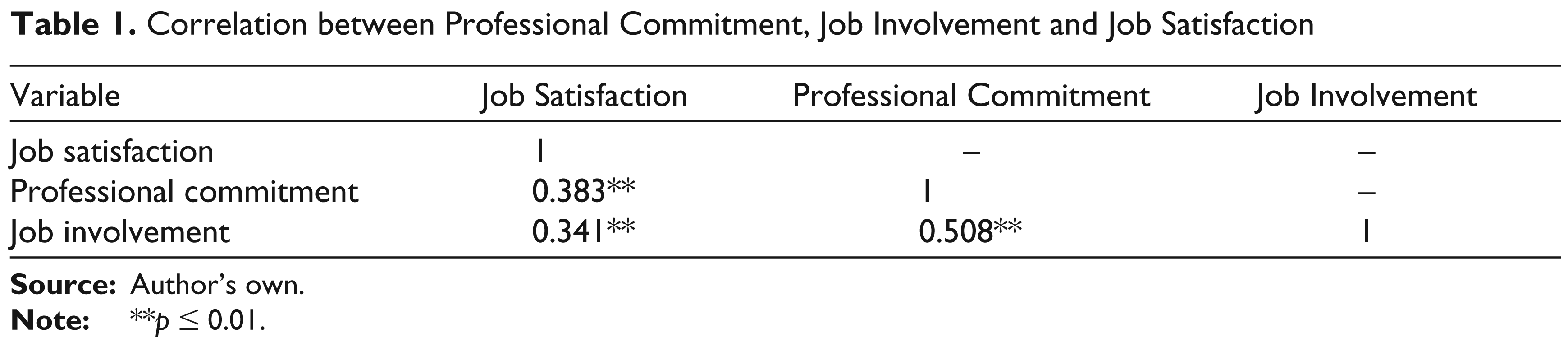
Correlation between Professional Commitment, Job Involvement and Job Satisfaction
Results and Discussion
In order to examine the impact of professional commitment and job involvement on job satisfaction, correlation analysis as a preliminary requirement of multiple regression has been used. Correlation analysis as depicted in Table1 established significant and positive association between these variables. It is inferred that the presence of professional commitment and job involvement improves job satisfaction of the respondents.
Job Satisfaction and Professional Commitment
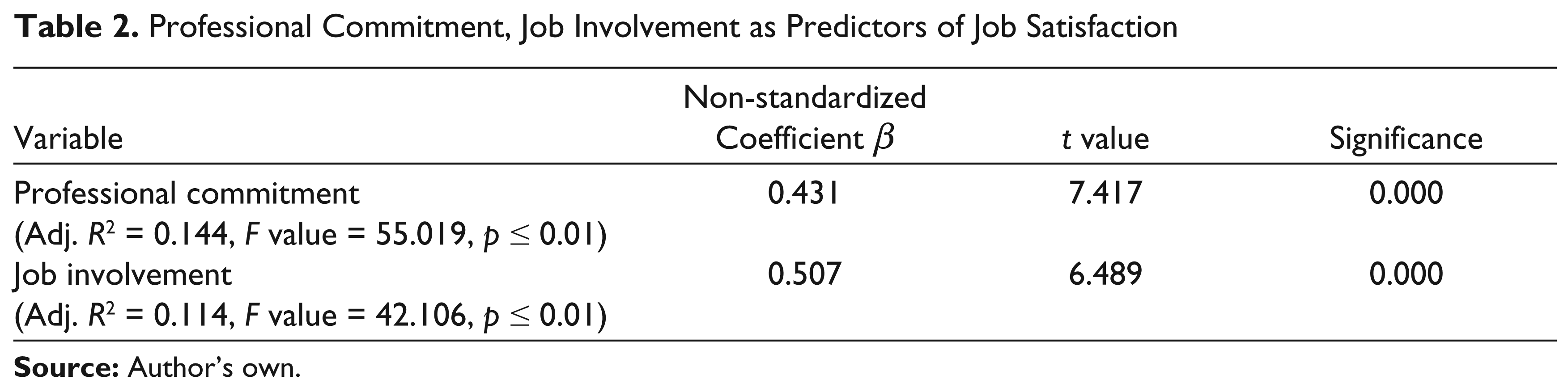
Correlation analysis as depicted in Table 1 established significant and positive relationship between the job satisfaction and professional commitment (r = 0.383, p ≤ 0.01). The positive association between these variables suggests that higher level of professional commitment among employees lead to higher job satisfaction. Table 2 discloses that the value of Adj. R2 = 0.144 indicates that professional commitment accounts for 14.4 percent of total variance in job satisfaction, which is significant as the value of F (55.019) is significant (p ≤ 0.01). The value of β (0.431) indicates that one unit change in professional commitment would bring 0.431 unit change in job satisfaction.
Commitment is the function of inherent sincerity of an individual which leads to development of the capacity to work hard and give good results in all the circumstances. Effective employees consider commitment as both the aspect of an individual and organizational importance. A committed, sincere and honest person efficiently sustains hard work which gives him internal satisfaction of putting optimum effort to his job. Professional commitment also determines an employee’s decision to stay or leave the organization, hence only the professionally committed employees enjoy their tenure and derive satisfaction thereof. The positive relationship between job satisfaction and professional commitment is supported in literature, as both the variables lead to improvement of performance in the organization. The results of this study are in line with that of Lu, Chang and Wu (2007) which demonstrate a significant, direct and positive effect of professional commitment on job satisfaction, as well as a significant inverse influence of job satisfaction on work stress of healthcare workers. The findings of the study can help show that professional commitment plays an antecedent role to job satisfaction and work stress of nurses. Similarly Aranya, Lachman and Amernic (1982) analyzed the effects of organizational and professional commitment on job satisfaction for non-partner chartered accountants. They reported a statistically significant correlation between organizational commitment and job satisfaction. Professional commitment affected job satisfaction indirectly through organizational commitment. Harrell, Chewing and Taylor (1986) examined the effects of organizational and professional commitment on job satisfaction. The results of the study were statistically significant for the multiplicative interaction of the three variables organizational commitment, professional commitment and organizational professional conflict. The findings of the study can help show that professional commitment plays an antecedent role to job satisfaction of veterinarians. This study suggests that professional commitment is an important factor related to job and that healthcare institutions should be concerned with this issue.
Professional Commitment, Job Involvement as Predictors of Job Satisfaction
Job Involvement and Job Satisfaction
Similarly, Table 1 reveals that job involvement is positively and significantly related to job satisfaction (r = 0. 341, p ≤ 0.01), which specifies that higher the level of job involvement, better is the level of job satisfaction among the veterinarians. Table 2 presents the results of regression analysis of job satisfaction as the criterion variable and job involvement as the predictor variable. The value of Adj. R2 = 0.114 indicates that job involvement accounts for 11.4 percent of total variance in job satisfaction, which is significant as the value of F (42.106) is significant (p ≤ 0.01). The value of β is 0.507, which indicates that a unit change in job involvement would bring 0.507 unit change in job satisfaction among the respondents.
Blau and Boal (1987) refer to people with high levels of job involvement and organizational commitment as institutionalized stars who are critical to the long-term success of the organization. They refer to workers with low job involvement and organizational commitment as apathetic employees who may actually impede the long-term success of the organization. Efraty and Sirgy (1990) empirically established the positive relationship between need satisfaction (quality of work life) and job involvement. The correlation indicated the more employees satisfy survival, social, ego and self-actualization needs in the organization, the more they will be involved in their job. Singh and Pestonjee (1990) explored the effect of job involvement and sense of participation on job satisfaction of bank employees. The study revealed that job involvement and participation were positively correlated to job satisfaction. Nelson (1993) observed that workers with high job involvement are able to drive self-esteem, satisfaction and pride in their work through effective supervision. Venakatachalam, Reddy and Samullah (1998) revealed that the employees working in public banks were more job involved and showed greater level of job satisfaction than those working in public schools and government offices. Recent studies of job involvement show that such involvement enhances the individual’s satisfaction, while at the same time increasing productivity for the organization (Hall & Lawler, 2000). Gifford (2002) attempted to broaden understanding of nurses’ job satisfaction by including measures of organizational commitment, empowerment and job involvement and employee turnover. A primary finding of the study was that the human relations model has the strongest statistical relationship with the quality of work life measures and is positively related with commitment, job involvement, empowerment and job satisfaction, but negative relationship with employee turnover.
From the discussion above, it can be concluded that the results of the present study are in line with the results of the previous studies. Hence, government should provide an environment to the veterinarians that fulfils their needs, keeps them involved in the profession and makes them feel satisfied.
Job Satisfaction, Professional Commitment and Job Involvement
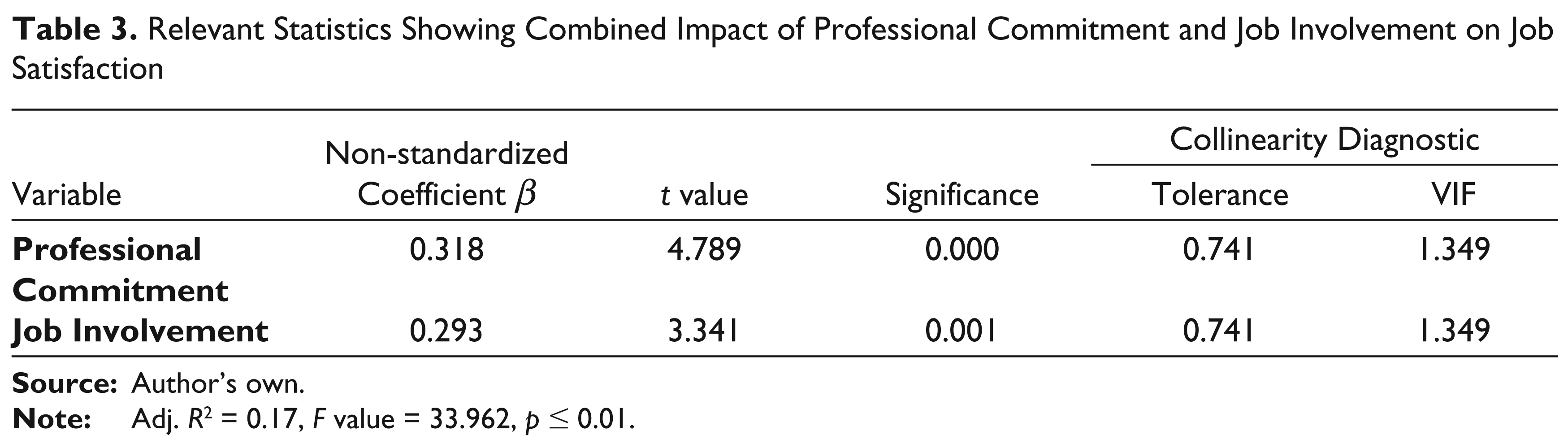
In order to assess the impact of both the independent variables, that is, professional commitment and job involvement on job satisfaction, linear regression was used. The results observed from Table 3 show that value of adj. R2 has increased to 0.17, which indicates that job involvement and professional commitment account for 17 percent of total variance in job satisfaction, which is significant as the value of F (33.962) is significant (p ≤ 0.01).
Relevant Statistics Showing Combined Impact of Professional Commitment and Job Involvement on Job Satisfaction
It can be safely concluded that job satisfaction has a strong relationship with job involvement and professional commitment. The workers who are attracted by the job and organization turn out to be most motivated; this is because their organizational commitment and job involvement are of a very high level. They identify with and care about their jobs. The results of the study are in line with the earlier argument by Kanungo (1982a) to the effect that high job involvement will result in higher levels of job satisfaction and by extension, higher intention to stay with (or less intent to leave) the organization. Therefore, it seems logical that employees who are highly involved in their job are more likely to be committed to the organization. However, in previous studies (Mathieu & Zajac, 1990) the issue of discriminant validity has been raised and variables of job satisfaction, job involvement and organizational commitment found to be always associated and correlated to each other.
Dissatisfaction among the medical professional is not a recent phenomenon. Excessive workload, demand on time and bureaucratic working environment had been the traditional irritants leading to low level of job satisfaction among the doctors (Lee, Park, Park, Hahm & Cho, 2008). More areas of dissatisfaction have been identified by the recent studies which relate to decreased professional autonomy over clinical decisions and reduced time per patient (Murray et al., 2001). But the results of this study are consistent with results obtained in study conducted by Huselid and Becker (1996). The study contributes towards explaining importance of employee involvement in job satisfaction. Some studies indicate that job involvement is an index of well-being along with job satisfaction (Dreher, 1980; Morris & Koch, 1979; Sekaran & Mowday, 1981), others suggest that job involvement may be a predictor of job satisfaction (Ben-Porat, 1980; Gechman & Wiener, 1975; Rabinowitz, 1985).
Conclusion
Employee attitudes towards the employing organization have become of utmost importance to researchers and employers because of their impact on work-related behaviours and outcomes. This is particularly so as employee attitudes are reflected in tendencies to respond to the job and the organization either positively or negatively. Most of the government organizations do not realize the importance of these attitudes, which as per the present study, are the key contributing factors towards job satisfaction. The study contributes towards explaining importance of employee involvement and commitment in job satisfaction. Taken together, the findings of this study imply that within the department of animal husbandry, Punjab, these work-related attitudes are in fact related. Doctors could be interviewed to determine their perceptions of administrator’s ability to address these issues. The results of the study intend to assist policymakers in identifying key workplace issues which contribute towards satisfaction as perceived by the veterinarians. Taking into consideration the significance of animal husbandry to the growth of Indian economy, and specifically to the Punjab economy, the government should take consistent and steadfast measures to improve the level of job involvement, professional commitment and, hence, job satisfaction of the veterinarians. Such measures will definitely benefit the veterinarians, government itself and the nation as a whole.
The findings of this study must be considered in the context of several limitations. First, the generalization of the findings of this study will be restricted to the department of animal husbandry, Punjab. Second, the study is restricted to the state of Punjab, which is dominated by agriculture, along with its diversified activities contributing to overall prosperity of the state. The results of the study can be successfully replicated for other states only if such conditions prevail there also. Third, the study was conducted on veterinary doctors engaged on permanent basis. Therefore, the results cannot be generalized to budding veterinarians appointed on contractual basis with consolidated pay and without job security.
These limitations notwithstanding, it is believed that the relationship between the work-related attitudes considered in this study are important and a legitimate area of inquiry The present study needs to be replicated in the private sector and semi-government institutions like Guru Angad Dev Veterinary and Animal Sciences University (GADVASU). While the present study may have assumed a direct relationship between the work-related attitudes considered in this study, the relationships may, in fact, be indirect or moderated by contextual factors. Hence, further research may be needed to consider potential moderators of the relationships between these work-related attitudes.