



Abstract
This article focuses on semi-narrative guided interviews with students with visual impairment (VI) who attend a state-approved special school for students with VI at the time of the interview, although they had different previous experiences in both segregated and inclusive schools. We are conducting a qualitative analysis from the perspective of teenagers concerning how they negotiate institutional ascriptions of (dis)abilities. We have selected interview sequences of two young people: (a) Kai: self-confidence and internalized self-doubt and (b) Felix: between fighting and claiming ableist divides. Our analyses reveal the different ways of how Kai and Felix each contest the ableist divide they constantly have to cope with. Kai does so by sticking to her self-concept and ambitious life plans; Felix does so by ridiculing how the institution ascribes neediness to students.
The German school system, unlike those of most other countries, is very subdivided. After 4 years of primary school, students are tracked into one of three different school forms, depending on the student’s academic performance. In addition, there are several private and alternative schools, as well as eight different types of schools for students with so called special needs. Germany has a tradition of more than 200 years in special education. In 1806, the first German school for individuals with visual impairment (VI) was founded in Berlin. Currently, more than 10 years after Germany signed the UN Convention on the Rights of Persons with Disability (CRPD), involving the right of school choice for every student, a high rate of students are segregated into special schools. In 2018, 9,385 students, 0.13% of the total number of German schoolchildren, are visually impaired. One half of them attended schools for so-called special needs (48.91%), and the other half (51.09%) attended regular schools (Kultusministerkonferenz, 2020, p. XVI/5/10). In spite of the CRPD, the multi-layered German school system, with its practices of transition and assessment, remains highly segregated (Pfahl, 2012, p. 432). Since Germany is in the midst of school reforms, it is an interesting time to ask how the affected students experience the transition from special to inclusive schooling. While students with so called special needs are those who are most affected by the reforms, their perspectives are included less within research. In Germany, to our knowledge, there are no studies which consider the perspective of students with VI. 1 Instead, research explores, for example, teachers’ perspectives on the well-being and social participation of students with VI (Lang & Sarimski, 2019). Capovilla et al. (2018) make suggestions on how to use assistive technologies to avoid awkward situations for children who use these technologies, without including the perspectives of the students themselves. Two quantitative studies do consider students’ perspectives, one comparing the physical activities (Giese et al., 2017), the other comparing bullying between students with and without VI (Pinquart & Pfeiffer, 2011). There are also international studies on the well-being and social participation of students with VI (de Verdier, 2016; Jessup et al., 2018; Lourens & Swartz, 2016; Manitsa et al., 2019; Tanure Alves et al., 2018), some of which conducted qualitative interviews with the students. Main results concluded that students with additional disabilities are less socially integrated than those who are partially sighted. Questions addressed issues such as how they are included in school, what they are doing and how they felt. However, these studies consider the perspective of students with VI, they do so from an assimilative perspective. The idea of integration seems to be of an unquestioned dominant perspective determining what it means to be integrated within a hegemonic matrix. Our paper shifts the perspective: we let students with VI speak for themselves, and we analyze their narratives from a theoretical perspective that challenges hegemonic concepts of normality.
In our article, we analyze how students negotiate institutional ascriptions of (dis)abilities. Following Powell (2007, p. 321), we hold that disability also results from teachers’ orientations toward a normal matrix determining and ascribing (il-)legitimate abilities (Buchner & Pfahl, 2017, p. 215). The school system establishes a symbolic order that affects students’ self-descriptions and coping strategies. It (re-)produces knowledge about the social value of individuals structuring their capacity to act (Pfahl, 2012). In our article, we not only unpick how students reproduce but also deconstruct ideas of normality in their narratives. Following an understanding of impairment that does not exist intrinsically, instead that is a cultural, social, and historical product (Waldschmidt, 2007), we do not reiterate specific diagnostic information about the students’ degrees of VI. Instead, we apply the perspective of ableism. One of the established orders in school is the “ableist divide” of students and their abilities into not/normal (Buchner & Pfahl, 2017, p. 215). This divide is the product of ableism as a network of beliefs, processes, and practices that generates a special kind of self and body considering itself as perfect, species-typical and therefore essential and completely human. Consequently, disability is seen as an inferior state of being human (Campbell, 2012). We carve out the impact of the ableist divide in the narrative material below and show how students cope with institutional denials of their abilities.
Method
We focused on students from classes 9 and 10, as higher classes ensure that students have accumulated more school biographical experiences they can talk about. German speaking research furthermore assumes a higher narrative maturity for the ages from 14 and above (Riegel, 2018). We did not initially intend to cover the ages between 15 and 19, rather, this wide range indicates that transitions within the multi-layered educational system cause students’ school (and life) years and fractions in their school biographies as they repeat one or more school years. We furthermore decided to interview students currently in school, as there is already research with affected people who talk about their experiences retrospectively (as adults) (Buchner, 2018; Pfahl, 2012). In total, we personally recruited eight students with VI in their school and conducted semi-narrative guided interviews with them. At the time of the interview, each student was attending a state-approved special school for students with VI in Hesse, although they had different previous experiences in both segregated and inclusive schools (see Table 1). All participants and their parents gave informed consent and pseudonyms were used to protect privacy.
The participants and their school experiences.
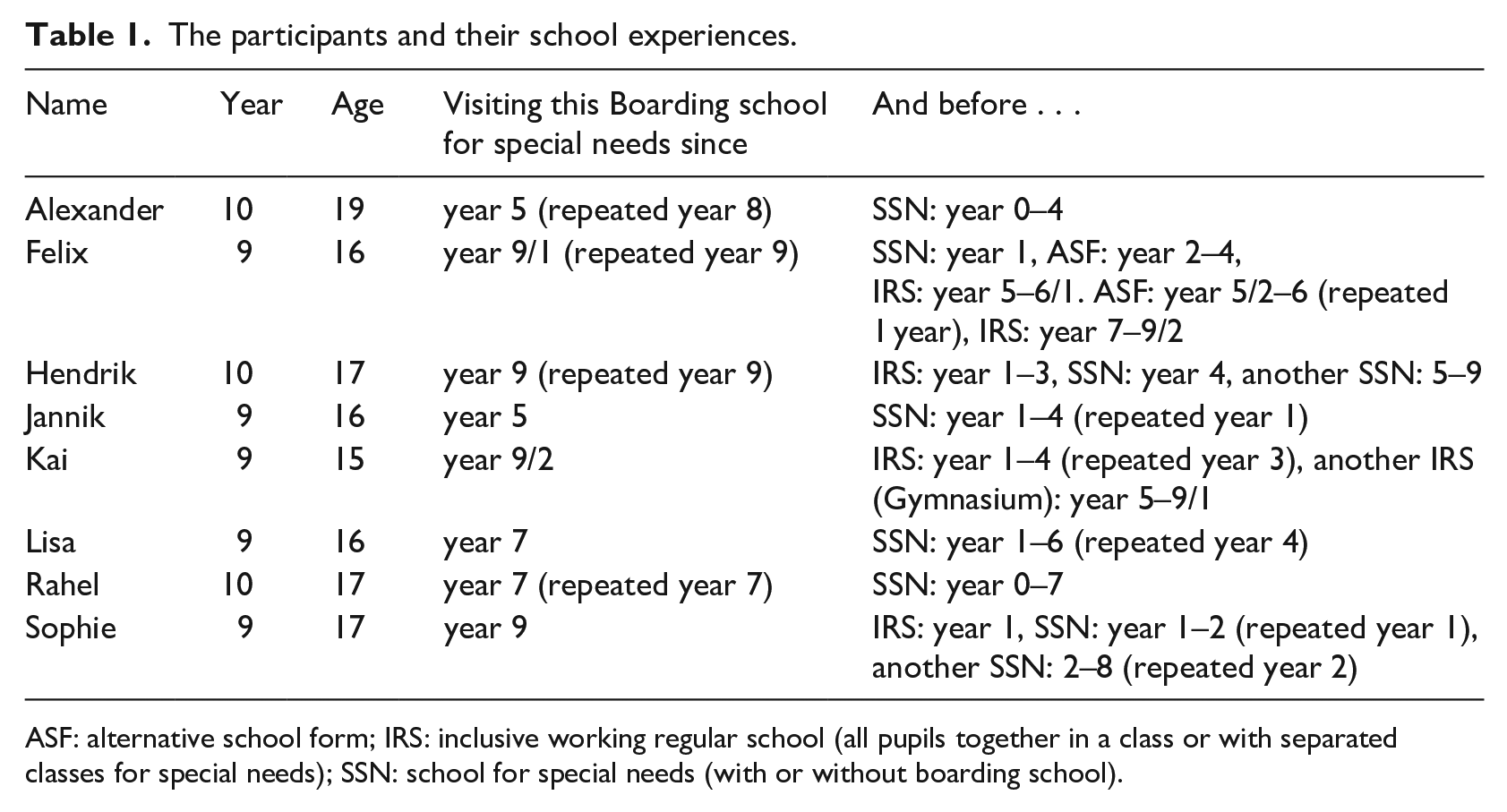
ASF: alternative school form; IRS: inclusive working regular school (all pupils together in a class or with separated classes for special needs); SSN: school for special needs (with or without boarding school).
Analysis
For the following qualitative analysis, we reconstructed narrative identities within the interviews according to Lucius-Hoene and Deppermann (2004). The method is based on the narration analysis by Schütze (1977) and includes basic ideas of discursive psychology (Edwards & Potter, 1992) and grounded theory (Glaser & Strauss, 1967). The analysis took several steps: first, we broke down each interview identifying highly performative text passages. Then, we analyzed the linguistic communication strategies in detail. For the main study, we also focused on the physical positioning of the interviewed persons in relation to the interviewer. We also interpreted selected interview passages in various scientific community groups. The results we present are the essential points of all these steps and were determined from the analysis of example sequences presented below as well as others. We use the following passages as characteristic examples of the interviews. We took sequences from two contrastive interviews.
Results
The analyses of the interviews reveal that all the interviewed youths cope with the symbolic orders of disability in school. The narratives disclose how disability (and which understanding of it) is made relevant in school.
Kai: self-confidence and internalized self-doubt
The student Kai switched from a regular school to her current special needs school 3 months before the date of the interview. Of all those interviewed, she has the longest regular school experience, which was more than 10 years. In her interview, we reconstructed the ambivalence between a strong self-claim and self-doubt that emerges where she tends to have internalized the ascription of lacking abilities. The following excerpt illustrates our analysis: Well, I think/ yes, of course, and I think/ well, I don’t know yet, because of my eyes I don’t worry so much. I think it’s an extreme pity that the Pilot program will be dropped, but yes, well. But also there, if you are talking about (. . .) assistance, you can also take your laptop with you. And I would never use more than a laptop anyway, so that would work, I guess. So if you understand what I mean, (I: yes.) you always say, “yes, hmm, is it possible with your eyes?” and so, I/ I hope and think that it would be possible. Could it, #00:34:49#
Kai’s career aspiration is ambitious: there are relatively high-entry requirements to becoming a pilot, a profession that is associated with great prestige and income. Her great disappointment is that she is denied this option (“I think it’s an extreme pity”), which shows her high self-claim on individually set goals that are not oriented toward the professions for those with physical limitations or low ambition. At another point in the interview, she tells us that she does not want to become a “stupid social worker,” but would rather work in AIDS relief or build hospitals in developing countries. She is not concerned about her sight (“about my eyes I don’t worry so much”), while others are (“is it possible with your eyes?”).
Kai knows what she wants and is not led astray by her social environment that sets her VI as relevant. She rejects assistive technologies that are specific to the VI implicitly here and explicitly at other points in the interview when she reiterates that she is “normal.” For her, the use of assistive technologies becomes a stigma. She refuses to use them even if that means her leaving regular school.
Simultaneously, the excerpt reveals Kai’s doubts when she, albeit rhetorically, asks the interviewer to validate her (“Could it?”). Here and in other sequences, we ascertained how Kai doubts her abilities in a way that reflects the educational system’s ableist divide into not/normal abilities: she “guesses,” “hopes,” and “thinks” that “that would work.” Kai knows what she wants, and yet she expresses doubts asking the interviewer to confirm that she can do things with her eyes. In her narrative, self-confidence and doubts about her abilities intermingle leading to the hypothesis that she has internalized the institutional ableist divide.
Felix: between fighting and claiming ableist divides
In his interview, Felix sums up his experience attending various schools, six in total, and talks especially about the third: The third school was one of those: Here we are prepared for the visually impaired. You get a screen reader, you get a blackboard camera. You get very, very thick pencils. And you get boldly lined paper. So, um, anything that the person who sees badly needs. Uh, but there was regular blackboard lessons. It worked, no question. Only the level was not that high. #00:28:20#
Felix speaks as “we” portraying the voice of the school. He caricatures how the school turns what should be an offer, intended to accommodate the visually impaired, into a demand by each of the students. He caricatures how every person upon entering the school is randomly assigned technical equipment (“You get a screen reader, you get a blackboard camera. You get . . .”), whether they require it or not. In his narrative, the students are not the ones visually impaired, but the school, because it does not take note of the students’ individual needs. Listing assistive technologies from “screen readers” to “boldly lined paper,” Felix gradually increases the degree of assistance parodying the paternalistic way the school addresses the students no matter what they really need. For Felix what all the assistive technologies have in common is that “the person who sees badly” needs them. Felix considers teaching that is based on all these assigned technologies to be on a “not that high” level: there seems to be a discrepancy for him between teaching VI people who use these technologies and demanding, performance-oriented teaching. Later in the interview, the discrepancy becomes increasingly more obvious between what he thinks, he is able to do, and what others insinuate he is not able to: And I was able to read worksheets wonderfully at that time, even normal worksheets. Even though nobody believed me, as always. That’s the point anyway. Nobody believed me when I said “I can read that.” There was at least one person who said, “No, you need this bigger now.” #00:28:48#
While Felix previously spoke sarcastically about the institution’s perspective, he now names what the school’s watering can principle means for those affected: although he could “read worksheets wonderfully,” no one believed him. With “as usual” he demonstrates the institution’s ingrained routines. Communicating his self-assessment to the teaching staff becomes a persuasion task with vain attempts: “nobody” ever believed him, and there was “at least one person” who thought they knew better what he needed.
All in all, Felix competently describes how he experienced paternalization in a mis-structured aid organization, which happens to be his school. He does not take over the ascriptions of abilities that emanate from the institution, deconstructing them instead. On the other hand, however, he participates in ontologizing and strengthening an ableist divide, insofar as he does not see teaching, which is primarily organized via assistive technologies, as compatible with his own high ability. Paradoxically, he fights the ableist divide that he also claims for himself.
Conclusion: ambivalent contestations
Our analyses reveal the different ways of how Kai and Felix each contest the ableist divide they constantly have to cope with. Kai does so by sticking to her self-concept and ambitious life plans; Felix does so by ridiculing how the institution ascribes neediness to students. The resistance against the ableist divide also turns out ambivalent, as Kai and Felix reproduce ableist coding themselves. Kai feels uncertain about her abilities and expresses the need for reassurance. Her self-confidence is at risk from an outside perception as inable. Consequently, she wants to be considered normal. “Longing for normality” (Bödicker, 2020), she becomes entangled in a paradox of wanting to break out of an ascribed deviation, which she reinforces herself precisely through this longing. Hence, rejecting assistive technologies becomes a paradoxical act: she rejects rehabilitation practices because they visualize her disability. At the same time, she is willing to overcompensate for the demanded performance. Rejecting the ableist divide on one hand, she at the same time reinforces it by applying the performance norm for herself. Felix, too, is subject to an ableist understanding of performance, which he defends himself against by ridiculing the institution. He uses the category of binary coding of in/able when he stages himself as a high-performing student in contrast to lower-performing students in his class. With his attempts to fend off the attributions of VI, he too paradoxically participates in the production of in/able subjects.
The ableist divide becomes a threatening shadow even for those young people who are able to competently cope with institutional ascriptions. Both Kai and Felix uncover ability ascriptions, yet reproducing the symbolic order in which they are forced to act. They work their ways along the border strip which persistently and powerfully marks a binary divide into in/able. Contesting the institution’s great divide turns out possible, yet ambivalent and fragile.
Discussion
The analyses of the two interviews confirm research results that young people become disabled through segregated institutions stigmatizing them in the first place (Powell, 2007, p. 321). As for Kai, the institutional ableist divide negatively affects her self-perception. Felix does not seem to be as affected, perhaps because he experiences appreciation in theater projects and in his anime peer group. This “having a place to shine,” which Jessup et al. (2018, p. 96) have identified as an important component for social inclusion and a positive sense of identity for young people with VI, seems to add to his confidence. Schools should consciously create such places, ideally in cooperation with all those involved.
Following an understanding of disability that is culturally construed, we claimed the difference between blind and partially sighted to be irrelevant for the study. In fact, Kai has a diagnosis as blind and Felix as partially sighted. The results, however, showed that no matter which diagnosis, once ascribed as a student with VI all of them have to cope with disability ascriptions.
Most research on VI implicitly explores disability as a deviation from an unquestioned normality, thereby affirming hegemonic ableist orders. With our study, we attempted to add an ableism critical perspective that does not ask what students with VI are in reference to normality concepts, but how students with VI contest these normality concepts denying to bow to them. The students also reproduce the order that they criticize, which shows how the ableist normal matrix ultimately also binds their (critical) perspectives.
Students with VI competently question ableist institutional practices. Listening to them will enhance self-advocacy skills that are indispensable for successful coexistence in an inclusive classroom (Valle & Connor, 2010). Instead of a watering can principle, schools could work according to individual needs, adopting solutions with and for the students.
Limitations
The data are from participants all attending a special school setting. Further studies should compare the experiences of students with VI from special schools with those from integrated schools.
Footnotes

Declaration of conflicting interests
The author(s) declared no potential conflicts of interest with respect to the research, authorship, and/or publication of this article.
Funding
The author(s) received no financial support for the research, authorship, and/or publication of this article.