



Abstract
The current study examined relationship power in the context of the investment model of relationship commitment (Rusbult, 1980). It was hypothesized that satisfaction with, quality of alternatives to, and investment in the relationship would mediate the relationship between power and commitment in 120 dating couples. Data were analyzed using mediation within the actor-partner interdependence model. Participants who possessed a higher level of power reported lower satisfaction and commitment and higher quality of alternatives. Furthermore, the relationship between female’s power and male’s commitment was mediated by male’s satisfaction and the relationship between male’s power and female’s commitment was mediated by male’s quality of alternatives. Findings are discussed within the context of the field’s expanding conceptualization of power within intimate relationships.
Keywords
Power dynamics characterize virtually all intimate relationships (Amaro, 1995; Dunbar, 2004; Peplau, 1979) and impact intimate relationships at multiple levels, including the dyadic, intermediate (e.g., norms), and macro (e.g., patriarchy) levels (Harman, Stewart, & Keneski, under review). However, the explicit inclusion of power in the most widely used and validated model of relationship commitment—the investment model of relationship commitment (Rusbult, 1980, 1983)—is missing (Harman et al., under review). In the present research, we explore the role of power in the investment model by examining actor and partner effects between heterosexual dating partners using the actor–partner interdependence model (APIM; Kenny, 1996) for mediation (APIMeM; Ledermann, Macho, & Kenny, 2011). We begin with a brief summary of the investment model and examine definitions of power. We then highlight research that alludes to the role of power in the investment model and present an overview of the present study. Next, the advantages of using the APIMeM are explained and results from the current study on dating couples are presented. To our knowledge, the present research is the first to empirically examine power in the investment model.
The investment model of relationship commitment
The investment model of relationship commitment (Rusbult, 1980, 1983) has been extensively investigated since its inception more than three decades ago. The investment model posits that satisfaction with, poor quality of alternatives to, and high investment in the current relationship are necessary to foster and maintain commitment to an intimate relationship (Rusbult, 1980). If partners perceive more rewards than costs in the relationship, they will be more satisfied (Bui, Peplau, & Hill, 1996), and satisfaction with one’s relationship is essential to remaining committed to that relationship (Bui et al., 1996; Rusbult, 1980, 1983). In fact, a meta-analysis found satisfaction to be the strongest predictor of commitment within the investment model (Le & Agnew, 2003). Furthermore, if an individual in the relationship perceives a higher quality of alternatives to the current relationship, he or she will be less committed to the relationship (Rusbult, 1980). Quality of alternatives can take many forms, such as a different dating partner, spending time with friends/family, or spending time alone. In regards to investment, when an individual is highly invested in the relationship, he or she is more committed (Rusbult, 1980). Like quality of alternatives, investment can take different forms, as either: (a) tangible investments (e.g., children, shared possessions) or (b) intangible investments (e.g., length of relationship, disclosure). In one study, men with higher amounts of both tangible and intangible investments reported a higher level of commitment (Lehmiller, 2010). Meta-analytic work has confirmed that higher levels of satisfaction and investment and poorer quality of alternatives predict relationship commitment and account for unique variance in explaining commitment (Le & Agnew, 2003). While satisfaction, quality of alternatives, and investment are important predictors of commitment, we hypothesize that power is also important in understanding commitment in intimate relationships.
Definitions of power
Power is a common feature of intimate relationships (Amaro, 1995; Dunbar, 2004; Peplau, 1979). Power has been defined in a number of ways, including: (a) dominance or control over others (Fiske, 1993; Operario & Fiske, 2001), (b) influence over others (French & Raven, 1959), and (c) a means to meet survival needs (Pratto, Lee, Tan, & Pitpitan, 2010). In interdependence theory, which served as a basis for the investment model, power is conceptualized as the inverse of dependence (Kelley & Thibaut, 1978; Rusbult, Agnew, & Arriaga, 2012; Thibaut & Kelley, 1959). For example, if Jane is less dependent upon her partner (Ed) to meet her needs, and Ed is more dependent upon Jane to meet his needs, Jane is thought to have more power in the relationship. Therefore, asymmetries in dependence among partners suggest that one partner has more power than the other partner. Asymmetries in dependence can arise when one partner has lower quality of alternatives, termed the “comparison level for alternatives” by interdependence theory (Thibaut & Kelley, 1959; Rusbult & Van Lange, 1996). The lower Ed’s comparison level for alternatives, the more likely he is to be dependent upon Jane, thereby relinquishing his power within the relationship. When Jane is less dependent upon Ed, Jane has more power, and is less likely to be committed to the relationship. Consequently, when equal levels of power are possessed by both partners, the partners are equally committed (Drigotas, Rusbult, & Verette, 1999).
Within relationships, most individuals do not report having equal power with their partner (Bruhin, 2003; Peplau, 1979). Past research (e.g., Drigotas et al., 1999) assumed that power levels within a couple, whether symmetric or asymmetric, develop over time as one or both partners deepen their dependence upon the other. The current work assumes, however, that male and female partners may enter an intimate relationship with different levels of power pre-defined by societal norms, which can subsequently impact intimate relationship commitment through the investment model variables (i.e., satisfaction, quality of alternatives, and investment). Men have more power and higher status than women in virtually every society (Lee, Pratto, & Johnson, 2011; Sidanius & Pratto, 1999). Women may possess a lower level of power compared to men because men and women are perceived differently in many societies (Connell; 1987; Wingood & DiClemente, 2000) based on the division of labor (e.g., women are paid less than men for comparable work), the division of power (e.g., women are treated as sexual objects in the media), and norms regarding emotional attachment (e.g., women are seen as submissive and motherly). These three factors can result in a power imbalance whereby women are more dependent upon men and possess less power in relationships (Wingood & DiClemente, 2000). For example, a woman who is financially dependent upon her male partner may be less likely to negotiate condom use for fear that her partner will leave her, thus giving her male partner more power in regards to condom use decision-making. Indeed, research on power in intimate relationships has shown that men have more power than women in influencing decisions regarding condom use (Agnew, 1999).
In the current paper, we conceptualize power as the feeling derived from the ability to dominate, or control, the behavior, affect, and cognitions of another person. Power over one’s relationship partner can involve one partner controlling resources and limiting the behavioral options of the other partner.
Power and the investment model
Power in intimate relationships may be related to satisfaction, quality of alternatives, and investment, and, subsequently, relationship commitment. Because power confers greater access to resources, decision making ability, and agency in general (e.g., Fiske, 1993), it can become a source of many benefits for a relationship partner (Pratto & Walker, 2004). Power would therefore be related to higher levels of satisfaction. Possessing more power also provides partners with the resources, efficacy, and opportunities to seek and find a greater number of alternatives to the relationship (e.g., Peplau, 1979). Therefore, power would be related to better quality of alternatives and, subsequently, lower levels of commitment. Finally, partners with more power may be less likely to depend on their partners for money, time, and other investments, resulting in a negative relationship between power and investment and, subsequently, lower levels of commitment. Partners who were less invested in the relationship (e.g., the principle of least interest; Sprecher, Schmeeckle, & Felmlee, 2006) and had higher quality dating alternatives reported more power in the relationship (Peplau, 1979). Overall, the partner with higher power in the relationship tends to be less committed to the relationship (e.g., Grauerholz, 1987; Peplau, 1984; Sprecher, 1985; for an exception in women see Davis, Williams, Emerson, & Hourd-Bryant, 2000). Thus, we hypothesize that the association between relationship power and commitment is mediated by the traditional investment model variables—satisfaction, quality of alternatives, and investment.
The present study
We expected to find the previously established relationships between investment model variables: higher levels of satisfaction and investment, and poorer quality of alternatives, would be related to higher levels of commitment. We hypothesized that men would report higher levels of power than women and that power would be positively related to satisfaction and quality of alternatives, and negatively related to investment and commitment. Furthermore, we hypothesized that satisfaction, quality of alternatives, and investment would mediate the relationship between power and commitment. Gender differences within these meditational models were explored.
We examined our hypotheses using the actor–partner interdependence model for mediation (APIMeM; Ledermann et al., 2011), which incorporates meditational processes within the traditional actor–partner interdependence model (APIM; Kenny, 1996; Kenny, Kashy, & Cook, 2006). This approach allowed us to examine how variables from both partners are related and to test mediational models. We specifically examined whether each partner’s power is associated with each partner’s commitment, and whether this link is mediated by satisfaction, quality of alternatives, and investment (i.e., whether the data support the idea that power may exert an indirect influence on commitment through direct effects on the mediating variables).
The current approach offers several methodological and analytical advantages over past examinations of the investment model and power within relationships. The hallmark of the APIM framework is the simultaneous analysis of actor and partner effects within dyads. The effect of one’s own independent (initial) variable on one’s own outcome is called the actor effect. Research that includes only one member of a relationship couple examines only actor effects, an intrapersonal effect (Kenny et al., 2006). The advantage of using APIM lies in the ability to examine partner effects. The effect of one’s partner’s initial variable on one’s own outcome is called the partner effect. Partner effects examine interpersonal effects and are a measure of interdependence that may exist within a couple (Kenny et al., 2006). Therefore, we can estimate if Jane’s power impacts Ed’s satisfaction in addition to her own satisfaction.
APIM also addresses limitations that can arise when analyzing dyadic data. APIM accounts for the nonindependence of data that exists (e.g., both partners’ outcomes have some shared variance) because data from both members are included in the model and the errors of the outcome variables are correlated (Kenny et al., 2006). APIM also allows us to examine distinguishable dyads (e.g., one partner is male and one partner is female; Kenny et al., 2006). With heterosexual couples, we can test if power levels are related to outcomes differentially for men versus women. Also within the APIM, specific theoretical patterns (e.g., actor-only or couple patterns; see Testing Dyadic Patterns section) can be tested (Kenny & Cook, 1999; Kenny & Ledermann, 2010).
The APIMeM incorporates a mediator into the APIM framework (see Figure 1) in order to assess the intervening mechanism between a set of initial (causal) variables and a set of outcomes within actors and among partners. Mediation allows us to identify variables (e.g., satisfaction, quality of alternatives, investment) that may account for the association between power and commitment. By incorporating mediation within the traditional APIM, we can examine the indirect effect that power has on commitment in addition to examining the role of satisfaction, quality of alternatives, and investment as mediators of this association. We can identify whether power is directly related to commitment (i.e., power acts as a proximal predictor) or if power is indirectly (i.e., distally) related to commitment through a more proximal predictor (e.g., satisfaction). Because we suggest that individuals may enter a relationship with a pre-defined level of power, power is a distal predictor of commitment in our models. Assessing mediation within the APIM also allows us to determine whether one mediator—say, female’s satisfaction—has a stronger effect on female’s and male’s commitment than the effect of male’s satisfaction on commitment.
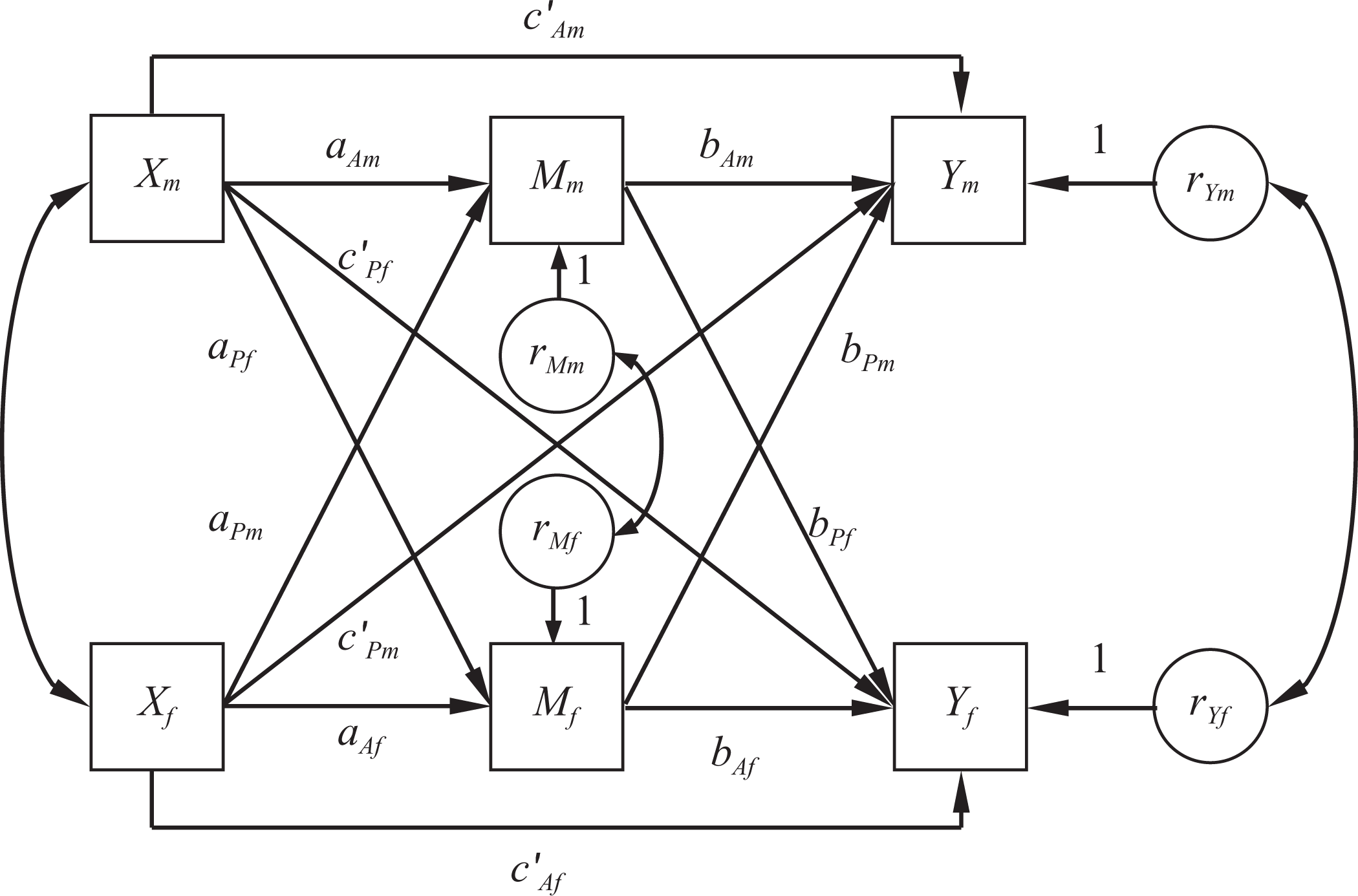
Base actor-partner interdependence model for mediation (APIMeM). X denotes the initial (causal) variable, M the mediator, and Y the dependent (outcome) variable. a, b, and c′ denote the traditional meditational paths. Subscript A refers to the actor effect, subscript P refers to the partner effect, subscript m refers to males and subscript f refers to females. r indicates the residuals.
Method
Participants and procedure
Heterosexual dating couples (k = 120) were recruited from the psychology department’s participant pool. The participants were on average 19.35 years old (SD = 1.54) and had been dating for 13.80 weeks (SD = 14.87). The majority of participants identified as Caucasian/White (68.8%). The remaining participants identified as either Asian/Pacific Islander (14.8%), African American/Black (8.4%), Hispanic/Latin American (5.6%), or Other (2.4%). Participants completed the study, which lasted no longer than 30 minutes, at the same time as their partners, but were in separate rooms and could not communicate. Participants chose to receive either US$5 or course credit for participating.
Measures
Participants first completed a short demographic form that collected their age, race, ethnicity, and relationship length. Participants then completed the investment model scale, which contains four subscales that have been empirically identified and found to be valid and reliable (Rusbult, Martz, & Agnew, 1998). Both the facet and global items of each scale were administered to participants; however, only global items are included in the analyses (Rusbult et al., 1998). The satisfaction subscale (five items; Cronbach’s α = .91) includes items such as “I feel satisfied with our relationship” and “Our relationship makes me very happy.” The quality of alternatives subscale (5 items; α = .84) includes items such as “The people other than my partner with whom I might become involved are very appealing” and “My needs for intimacy, companionship, etc. could easily be fulfilled in an alternative relationship.” The investment subscale (five items; α = .85) includes items such as “I feel very involved in our relationship—like I have put a great deal into it” and “Many aspects of my life have become linked to my partner (recreational activities, etc.), and I would lose all of this if we were to break up.” Finally, the commitment subscale (seven items; α = .89) contains items such as “I'm committed to maintaining my relationship with my partner” and “I would not feel very upset if our relationship were to end in the near future” (reverse-scored). Items were measured on a scale of 0 (don’t at all agree) to 8 (agree completely).
To measure power, we used a 10-item scale that assessed the power the individual has over his or her partner (α = .83; Mazurek, 1999). This measure addresses the feeling of power derived from a variety of broad (“I feel powerful when I can dominate my partner”) and specific (“I feel powerful when my partner does not use a condom because of my request”) situations. Therefore, this measure represents generalized power over one’s partner in the relationship. All items were measured on a scale from 1 (strongly disagree) to 4 (strongly agree). This measure has been found to be valid and reliable (Mazurek, 1999).
Analyses
Data were analyzed using the APIMeM and Amos (Arbuckle, 1999–2010), as described above. We tested three separate APIMeMs, which differed only by the mediator (satisfaction, quality of alternatives, or investment) tested. In all three models, we used power as the initial variable (X) and commitment as the outcome variable (Y). We tested the mediating hypotheses in three steps (cf. Ledermann et al., 2011). First, we assessed all direct effects in the unconstrained (saturated) APIMeM. Second, in order to simplify the APIM for mediation we tested whether specific dyadic patterns occur, as discussed by Kenny and Cook (1999). Finally, in the simplified model, we assessed all simple and total indirect effects and the total effects.
Results
Descriptive statistics of the model variables (power, satisfaction, quality of alternatives, investment, and commitment) and comparisons of male’s and female’s model variables can be found in Table 1. Briefly, males reported significantly higher levels of power compared to females and females reported significantly higher levels of satisfaction and commitment compared to males.
Descriptive statistics, correlations, and t-tests for males’ and females’ investment model and power variables
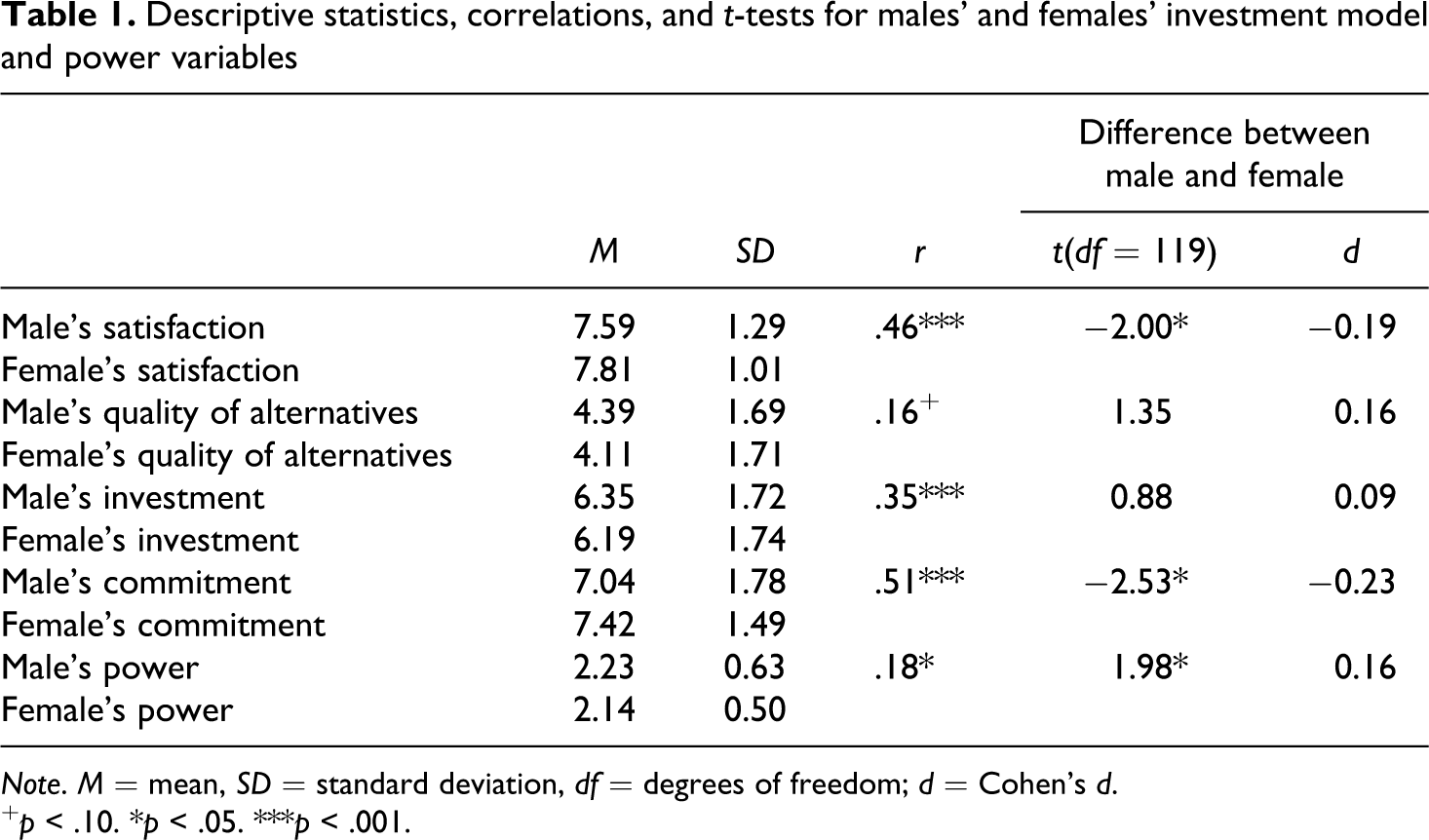
Note. M = mean, SD = standard deviation, df = degrees of freedom; d = Cohen’s d.
+ p < .10. *p < .05. ***p < .001.
Direct effects in the unconstrained models
Figure 2 illustrates the three tested APIMeMs with standardized estimates. Unstandardized estimates are given in Table 2. For the model with satisfaction as mediator (Figure 2a.), both male’s and female’s actor effects from power to satisfaction and the partner effect from female’s power to male’s satisfaction were negative and statistically significant. For the association between satisfaction and commitment, both the male’s and the female’s actor effects and the partner effect from female’s satisfaction to male’s commitment were positive and significant, but the partner effect from male’s satisfaction to female’s commitment was not significant. For the direct effects from power to commitment, both actor effects were negative and significant, and neither of the partner effects were significant.

Models with standardized parameters testing the association between power and commitment in males and females with satisfaction (Figure 2a.), quality of alternatives (Figure 2b.) and investment (Figure 2c.) as mediators. Variable X denotes the initial variable, M denotes the mediator, and Y denotes the outcome variable. Variables labeled r represent residuals, subscript m refers to males, and subscript f refers to females.
Unstandardized effect estimates for the three mediation models with power as initial variable and commitment as outcome
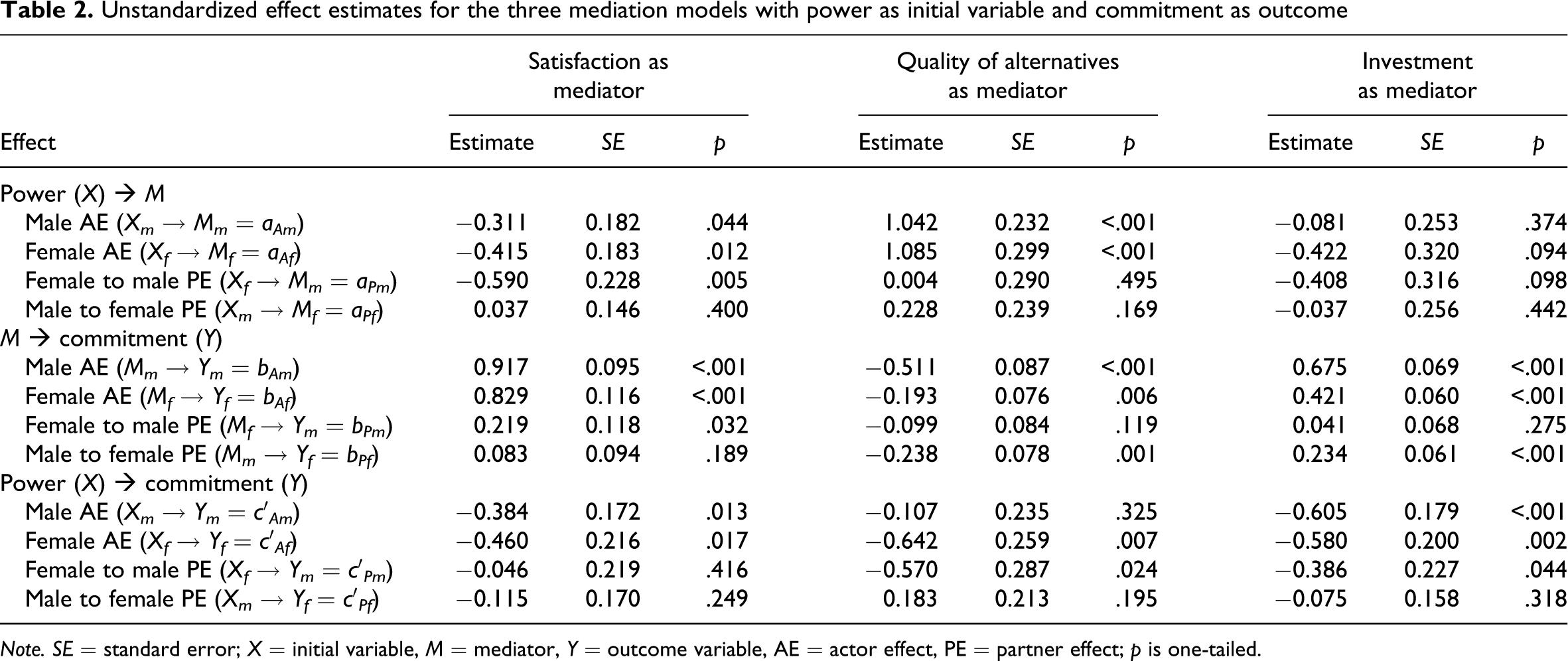
Note. SE = standard error; X = initial variable, M = mediator, Y = outcome variable, AE = actor effect, PE = partner effect; p is one-tailed.
For the model with quality of alternatives as mediator (Figure 2b.), both the male’s and female’s actor effects from power to quality of alternatives were positive and statistically significant, but neither of the partner effects were significant. Both actor effects from quality of alternatives to commitment were negative and significant. The partner effect from male’s quality of alternatives to female’s commitment was also negative and significant, but the partner effect from female’s quality of alternatives to male’s commitment was not significant. For the effects from power to commitment, the female’s actor effect and the partner effect from female’s power to male’s commitment were negative and significant, whereas the male’s actor effect and the partner effect from male’s power to female’s commitment were not significant.
For the model with investment as mediator (Figure 2c.), all actor and partner effects from power to investment were statistically non-significant. For the effects between investment and commitment, both actor effects and the partner effect from male’s investment to female’s commitment were positive and significant. Among the direct effects between power and commitment, both actor effects and the partner effect from female’s power to male’s commitment were negative and significant, whereas the partner effect from male’s power to female’s commitment was non-significant. Because the effects from power to investment were not significant, we could not test for mediation in this model, only for specific dyadic patterns between investment and commitment.
Testing dyadic patterns
Using the APIM framework, specific dyadic patterns can be tested (Kenny & Ledermann, 2010). Given the estimates of the direct effects, we tested for two theoretical patterns: the actor-only pattern and the couple pattern. If the actor effect is nonzero and the partner effect is zero, the actor-only pattern is present. With heterosexual couples, the actor-only pattern may indicate that (a) a person’s outcome (the mediators or commitment) is affected only by his or her own initial variable, or (b) a person’s initial variable has an effect on his or her own outcome, but not on the partner’s outcome. If both the actor and the partner effect are nonzero and equal in magnitude, the couple pattern is present. With heterosexual couples this may indicate that a person’s outcome is affected to the same magnitude by his or her own initial variable and the partner's initial variable.
These dyadic patterns can be assessed by calculating the parameter k, which is defined as the partner effect (e.g., the effect of the male’s power on the female’s satisfaction) divided by the corresponding actor effect (e.g., the effect of male’s power on his own satisfaction). If k is 0 the actor-only pattern is indicated, and the respective partner effect was fixed to 0 in order to assess model fit. If k is 1 the couple pattern is indicated, and corresponding actor and partner effects were set equal to each other to assess model fit. We used the unstandardized estimates given in Table 2 to calculate k and Efron and Tibshirani’s (1993) bootstrap method to estimate 95% bias-corrected bootstrap confidence intervals (CI) based on 5000 bootstrap samples. The CIs provide a direct test of whether a specific pattern exists. When 0 but not 1 and −1 is in the CI, the actor-only pattern is supported. When 1 but not 0 is in the CI, the couple pattern is supported.
With heterosexual couples, dyadic patterns can be tested in terms of either the initial or the outcome variable (Kenny & Ledermann, 2010). For the effects between power and the mediator we were interested in whether one’s own power had a stronger effect on one’s own or one’s partner’s mediator. Although most individuals desire an egalitarian relationship, most couples do not report equal levels of power within a relationship (Peplau, 1979). Therefore, we were interested in whether one’s own or one’s partner’s level of power is more strongly related with the investment model variables of satisfaction and quality of alternatives. For the effects between the mediator and commitment, we were interested in whether commitment was more strongly related to one’s own, or one’s partner’s, mediator variable. Here we wanted to extend the use of the investment model to not only test how one’s own satisfaction, quality of alternatives, and/or investment is related to commitment, but also whether one’s partner’s satisfaction, quality of alternatives, and/or investment had a stronger, weaker, or equal effect on one’s own commitment. For example, we were interested in whether Jane’s initial variable (power) had a stronger effect on her own or Ed’s mediator(s) and whether commitment was more strongly associated with her own or Ed’s mediator(s). The inclusion of a mediator in an APIM permits the analysis of this two-fold focus.
For the model with satisfaction as mediator, we found evidence of the actor-only pattern for the effect of male’s power on female’s and male’s satisfaction (kXM = −0.119, CI: −6.252, 0.996). For female’s power the partner effect was about 40% stronger than the actor effect (kXM = 1.422, CI: 0.586, 3.533), and thus not indicative of either the actor-only or the couple pattern. For the effects between satisfaction and commitment the actor-only pattern was present for female’s commitment (kMY = 0.100, CI: −0.114, 0.346); for male’s commitment, the partner effect was about a fourth of the actor effect (kMY = 0.239, CI: −0.049, 0.577), and thus indicated something between the actor-only and couple pattern. Note that we did not test specific patterns between power and commitment because these direct effects do not have an effect on the possible mediating (indirect) effects in the model (see Ledermann et al., 2011); our focus in this section of the paper is to test for dyadic patterns that may be present in the data. Constraining male’s kXM to 0 and female’s kMY to 0, this simpler model supported the actor-only patterns (χ 2(2) = 0.841, p = .657; RMSEA < .001; CFI = 1.00). Therefore, we selected this simpler model to test the mediating hypothesis. In this final model there were six actor effects: two between X and M (male’s [female’s] power ⇒ male’s [female’s] satisfaction); two between M and Y (male’s [female’s] satisfaction ⇒ male’s [female’s] commitment), and two between X and Y (male’s [female’s] power ⇒ male’s [female’s] commitment). There were also two partner effects: one from female’s power to male’s satisfaction and one from female’s satisfaction to male’s commitment.
For the model with quality of alternatives as mediator, we found support for the actor-only pattern for effects between power and quality of alternatives (for male’s power kXM = 0.219, CI: −0.315, 0.743; for female’s power kXM = 0.004, CI: −0.606, 0.507). For the effects between quality of alternatives and commitment, the actor-only pattern was indicated for male’s commitment (kMY = 0.194, 95% CI: −0.094, 0.550). For female’s commitment, the partner effect was as strong as the actor effect (kMY = 1.233, CI: 0.441, 4.849), and thus supported the couple pattern. Constraining both male’s and female’s kXM to 0, male’s kMY to 0, and female’s kMY to 1, the model was consistent with the data (χ 2(4) = 2.889, p = .577; RMSEA < .001; CFI = 1.000) and so provided additional support for the actor-only patterns. In this final model, as in the model with satisfaction as a mediator, there were six actor effects: two from X to M, two from M to Y, and two from X to Y. There were also two partner effects: one from male’s quality of alternatives to female’s commitment and one from female’s power to male’s commitment.
For the model with investment as mediator, as mentioned above, none of the effects between power and investment were significant, so we did not test for specific patterns for that part of the model. For the effects between investment and commitment, we found evidence for the actor-only pattern for male’s commitment (kMY = 0.061, CI: −0.124, 0.281). For female’s commitment, the actor effect was about twice as large as the partner effect (kMY = 0.556, CI: 0.178, 1.160), which indicated something between the actor-only and the couple pattern; therefore no constraints were imposed upon female’s kMY . Constraining male’s kMY to 0, this simpler model had good fit (χ 2(1) = 0.356, p = .551; RMSEA < .001; CFI = 1.000) and, thus, provided additional support for the actor-only pattern for males. There were four actor effects—two from M to Y and two from X to Y—and two partner effects: one from male’s investment to female’s commitment and one from female’s power to male’s commitment.
Testing the mediating mechanisms
The mediating mechanisms in the simplified models were tested by the bootstrap method, which has been advocated for this purpose by several authors (e.g., Bollen & Stine, 1990; Preacher & Hayes, 2008). Bias-corrected bootstrap confidence intervals were calculated based on 5000 bootstrap samples. In the current study, we tested two mediation models—one for satisfaction and one for alternatives—which involved simultaneously testing two initial variables (i.e., his and her power), two mediational variables (i.e., his and her mediator), and two outcome variables (i.e., his and her commitment).
In models with two simultaneous mediators (e.g., her satisfaction, his satisfaction), there are three types of composed effects (Bollen, 1987): (1) simple indirect effects (IE), which link one initial variable with one outcome through one mediator; (2) total IEs, which are the sum of all IEs between an initial and an outcome variable; and (3) total effects, which are the sum of the simple IEs and the corresponding direct effect between an initial and an outcome variable. For the two simplified models (one with satisfaction as the mediator and one with quality of alternatives as the mediator), point and interval estimates of the simple IEs, the one total IE in the satisfaction model, the direct effects between power and commitment, the total effects, and contrasts are presented in Table 3.
Unstandardized effect estimates and interval limits in the final models
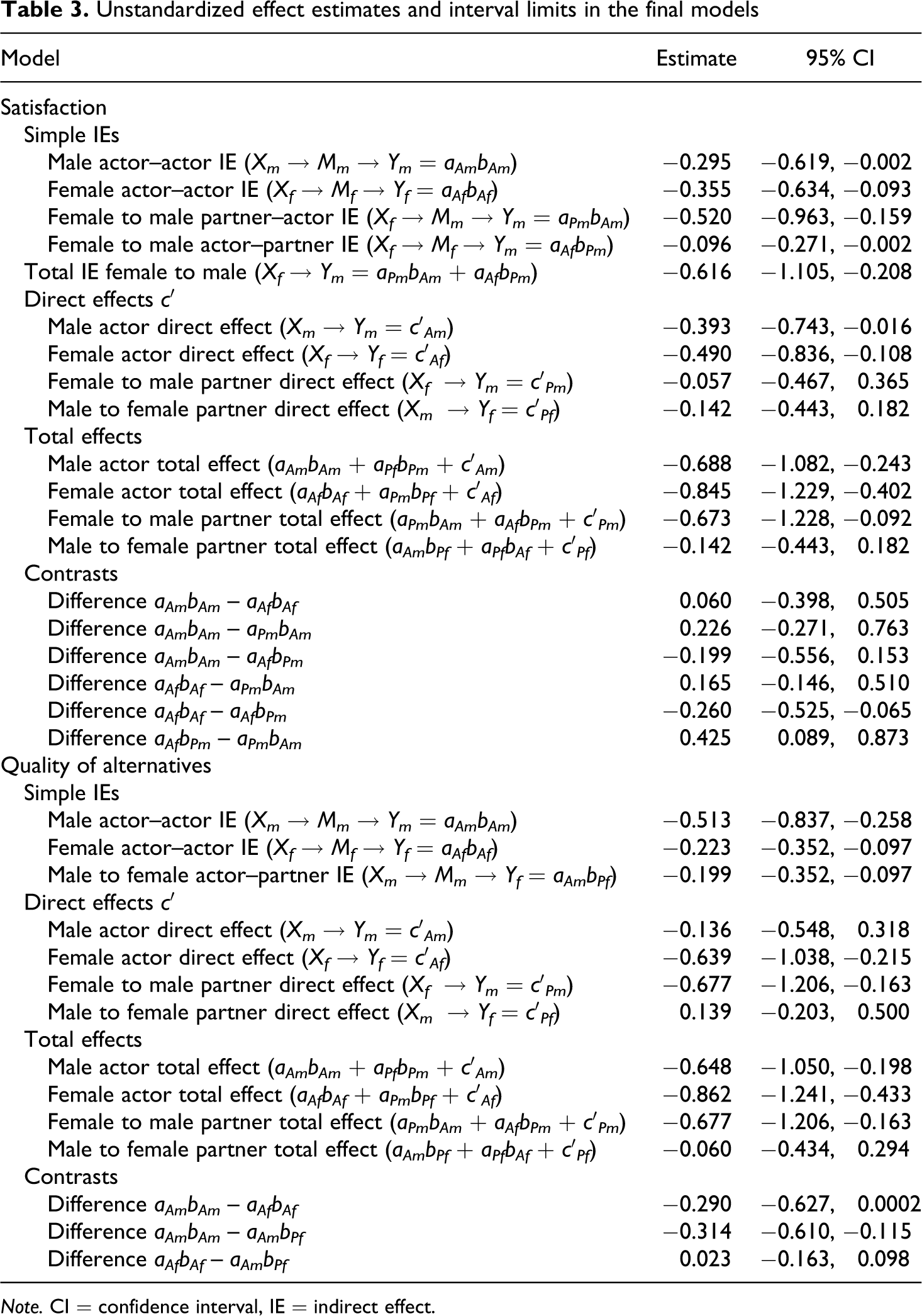
Note. CI = confidence interval, IE = indirect effect.
In the simplified model with satisfaction as mediator, there were four simple indirect effects (see Simple IEs section, Table 3): two actor–actor IEs (one for males and one for females), one partner–actor IE from female’s power to male’s commitment through male’s satisfaction, and one actor–partner IE from female’s power to male’s commitment through female’s satisfaction. All four IEs were negative and statistically significant (Table 3). The actor–actor IEs indicate that within each partner the association between power and commitment was mediated by satisfaction (in Figure 2a: For males, Xm ⇒ Mm ⇒ Ym ; for females, Xf ⇒ Mf ⇒ Yf ). The partner–actor IE indicates that male’s satisfaction mediated the effect of female’s power on male’s commitment (Figure 2a: Xf ⇒ Mm ⇒ Ym ) and the actor–partner IE suggests that female’s satisfaction mediated the effect of female’s power on male’s commitment (Figure 2a: Xf ⇒ Mf ⇒ Ym ). These two simple IE constitute a total IE involving two simultaneous mediators that link female’s power with male’s commitment. This total IE (see Table 3) was negative and statistically significant, indicating that the effect of female’s power on male’s commitment is mediated simultaneously through both male’s and female’s satisfaction. For the direct effects (c′) from male’s and female’s power on one’s own commitment, partial mediation occurred due to the corresponding significant direct effects (see Table 3), whereas for the effects of male’s and female’s power on the partner’s commitment, complete mediation took place. The total effects, or sum, of the simple IE with its corresponding direct effect were all negative (see Total Effects section, Table 3).
Next, we compared the magnitude of the simple IEs using phantom models (Macho & Ledermann, 2011). We found that the actor–partner IE to male’s commitment was statistically weaker than female’s actor–actor IE and partner–actor IE to male’s commitment (see Table 3, Contrast section). This means that female’s power seemed to have a stronger IE through her satisfaction on her own commitment than on male’s commitment, and the indirect association between female’s power and male’s commitment was stronger when it went through his satisfaction than through her satisfaction. The other comparisons were not statistically significant. In sum, these results provided evidence that within both males and females, satisfaction mediated the link between power and commitment. In addition, male’s and female’s satisfaction mediated the relationship between female’s power and male’s commitment with a stronger effect through male’s satisfaction.
In the simplified model with quality of alternatives as mediator, there were three simple IEs (see Simple IEs section, Table 3): two actor–actor and one actor–partner IE. Again, both actor IEs were negative and statistically significant, indicating that within each partner the association between power and commitment was mediated by quality of alternatives (Figure 2b: for males, Xm ⇒ Mm ⇒ Ym ; for females, Xf ⇒ Mf ⇒ Yf ). In addition, the actor–partner IE through male’s quality of alternatives was negative and significant, indicating that male’s quality of alternatives mediated the effect of male’s power on female’s commitment (Figure 2b: Xm ⇒ Mm ⇒ Yf ). For the direct effects (c′) from male’s and female’s power on one’s own commitment, see Table 3. As in the model with satisfaction, female’s quality of alternatives acted as a partial mediator, whereas male’s quality of alternatives operated as a complete mediator. Both actor total effects and the female-to-male partner total effect were significant, whereas the male-to-female partner total effect was not (see Total Effects section, Table 3; we note that the actor–partner IE was negative and the corresponding direct effect is positive, lowering the total effect). Comparing the three IEs, we found that male’s actor–actor IE was significantly stronger than male–to-female actor–partner IE (see Contrast section, Table 3). That is, the male’s power has a stronger indirect effect on his own commitment than on female’s commitment. In sum, these results provided evidence that male’s and female’s quality of alternatives mediated male’s and female’s actor effect from power to commitment. In addition, male’s quality of alternatives mediated the relationship between male’s power and female’s commitment.
In the model with investment as mediator, no effects between power and investment were significant, which violates a prerequisite for the occurrence of mediation (e.g., Baron & Kenny, 1986; Ledermann & Macho, 2009). That is, investment had no mediating role in the association between power and commitment.
Discussion
In the current study, we explicitly integrated power into the investment model of relationship commitment (Rusbult, 1980). Using couple data and the APIMeM (Ledermann et al., 2011), we explored possible mediators of actor and partner effects within the traditional APIM (Kenny, 1996). The associations among the investment model variables observed in the present study were analogous to past research: higher levels of satisfaction and investment and lower levels of quality of alternatives were associated with higher levels of commitment (e.g., Le & Agnew, 2003). Overall, males reported significantly higher levels of power than females, and females reported significantly higher levels of satisfaction and commitment than males. In the current study, possessing a higher level of power was associated with a higher level of quality of alternatives and a lower level of commitment. Contrary to the hypothesis, possessing a higher level of power was also associated with a lower level of satisfaction. Despite desiring egalitarian intimate relationships (especially the case for female partners; Falbo & Peplau, 1980), few intimate relationship partners report equal power (Peplau, 1979). A higher level of power may be related to less satisfaction with the relationship because the power imbalance deviates from the egalitarian ideal held by many in intimate relationships (Peplau, 1979). Partners may be less satisfied because unequal power is perceived as a cost to the relationship, rather than as a benefit to the individual.
We tested three separate APIMeMs where satisfaction, quality of alternatives, and investment served as mediators to the relationship between power and commitment. This approach offers several advantages, including the estimation of both actor and partner effects, mediational processes, and different dyadic patterns (e.g., actor–only, couple). Additionally, the APIM allowed us to test if relationships were stronger for men versus women and to elucidate complex interactive relationships that traditional methods (e.g., measuring only one partner’s investment model variables) cannot examine. Satisfaction and quality of alternatives acted as mediators to the relationship between power and commitment. Power was not significantly related to investment; therefore investment could not be tested as a mediator. Power and investment may not have been related because the average relationship length was fairly short (M = 13.80 weeks); individuals may not have become very invested in the relationship yet. Satisfaction did act as a traditional (actor–actor) mediator to the relationship between power and commitment in both men and women (e.g., female’s power ⇒ female’s satisfaction ⇒ female’s commitment). The negative association between female’s power and male’s commitment was mediated by both male’s and female’s satisfaction. This meditational effect was stronger through male’s satisfaction; male’s commitment is more dependent upon his own satisfaction than his partner’s satisfaction. In regard to quality of alternatives, the actor–actor meditational paths were also present in both females and males (e.g., female’s power ⇒ female’s quality of alternatives ⇒ female’s commitment). The positive association between male’s power and female’s commitment was mediated by male’s quality of alternatives. The poorer the quality of alternatives possessed by the male partner, the more commitment the female partner reported.
While expanding the field’s knowledge of the role of power in intimate relationships, this study is not without its limitations. Our measure of power taps one particular dimension of power; that is, feeling powerful in a situation where you influence your partner in some way (e.g., to not use a condom). This measure may speak more to situations that prime feelings of power as opposed to measuring absolute or relative levels of power that one holds within the relationship. Furthermore, participants were not asked if they felt the power within their relationship was balanced or if they were satisfied with their level of power within the relationship. Past research has shown that being satisfied with the level of power one possesses within the relationship, whether it is high or low, has a strong effect on outcomes (Rogers, Bidwell, & Wilson, 2005). Also, results may not be generalizable outside of short-term college dating relationships. College dating relationships may function differently from other types of intimate relationships (e.g., married couples), given the unique environment within which college students find themselves. Even though relationship length was fairly short for this sample (M = 13.80 weeks), it seems power is still playing a role early on in relationships, suggesting that partners may enter the relationship with a pre-determined level of power. Furthermore, all couples in this study were heterosexual. Past research has found that investment model variables operate differently in same-sex versus opposite-sex couples (Kurdek, 2007); therefore, it is difficult to draw conclusions regarding same-sex couples.
A further limitation of the present study regards the issue of causality. In our model, power is the initial (i.e., causal) variable affecting the investment model variables. We made the argument that power can be a function of intergroup dynamics where men and women enter relationships with already differing levels of power because of gender inequality. On the other hand, it is plausible that power could be a result of the investment model variables. Drigotas et al. (1999) describe power as asymmetric dependence in the relationship, and dependence can be experienced as commitment. Therefore, power would be caused by satisfaction, quality of alternatives, and investment. In our study, we explored dating couples who have been in the relationship for a relatively short period of time (on average three months). Power as asymmetric dependence may not be developed because it takes time to cultivate investment (in fact, power and investment were not related in our study). Furthermore, according to expectation states theory (Correll & Ridgeway, 2003), gender serves as a status-defining characteristic, so the belief that men have more power than women is often an antecedent to actual behavioral interaction. Thus, power would be the initial variable in a mediational model. Because we examined dating couples who have not been in their relationships for very long, our model may be more appropriate for our sample than a model that has power as the outcome variable. However, due to the cross-sectional nature of our data, we cannot make causal claims with the present study, and the issue of causality remains an important task for future research.
To that end, future research should aim to validate this model with married couples. Because married couples are more invested in their relationship than dating couples, this may help elucidate the role of power in the investment model, if indeed power and investment are at all related. Future research should also explore the relationship(s) between power, the investment model variables, and perceptions of the egalitarian norm. For example, would satisfaction be lower if one partner has more power and either partner endorses the egalitarian norm? If one partner has more power but neither partner endorses the egalitarian norm, would each partner have a higher level of satisfaction compared to couples who do endorse the egalitarian norm? Answering these questions would aid in elucidating the negative relationship between power and satisfaction.
Given the nascent stage of research involving power and the investment model, it is important to develop a concrete, multi-faceted conceptualization of what relationship power is in order to understand how power operates. Power has been defined in many ways, such as social influence (e.g., French & Raven, 1959), a means to meet survival needs (e.g., Pratto et al., 2010), and, as conceptualized in the current study, dominance over others (e.g., Fiske, 1993). The current study examines power as generalized dominance over one’s partner; however, other aspects of relationship power should be examined as well. Bryan, Webster, and Mahaffey (2011) have highlighted three different dimensions of dominance—physical, social, and financial—which may operate differently within a relationship. For example, women perceive men who are physically dominant as more attractive and socially dominant (Bryan et al., 2011). Pulerwitz and colleagues (2000) have identified two subtypes of sexual relationship power: relationship control and decision-making dominance; the interaction between these two types of sexual relationship power has been shown to have implications for condom use behaviors (Pulerwitz et al., 2000, 2002). Different dimensions of dominance may play differential roles in how power operates in intimate relationships and how power is related to commitment, satisfaction, quality of alternatives, and investment. Partner influence can also have a positive impact on relationship outcomes, as evidenced by the Michelangelo phenomenon (Drigotas, Rusbult, Wieselquist, & Whitton, 1999). Future research should expand the conceptualization of power to fully understand how different aspects of power are related to relationship functioning and outcomes.
The current study examined the role of power within the investment model of relationship commitment. Using the APIMeM, we found that satisfaction and quality of alternatives served as mediators of the relationship between power and commitment. Furthermore, participants with higher levels of power were less satisfied and less committed to the relationship, suggesting that power may not necessarily lead to better outcomes for the holder.
Footnotes
Acknowledgements
A previous version of this research was presented at the 12th Annual Meeting of the Society for Personality and Social Psychology. We extend our gratitude to two reviewers for comments on earlier drafts of this manuscript.
Funding
This research was supported by a Psi Chi Graduate Research Grant and NIH traineeship under Institutional National Research Service Award T32-MH074387 (PI: Seth C. Kalichman) awarded to the first author. This material is based upon work supported by the National Science Foundation Graduate Research Fellowship under Grant No. (DGE-0753455) awarded to the second author.