



Abstract
It is commonly believed that passionate love diminishes over time even as companionate love may grow. According to the self-expansion model (Aron and Aron (1986) Love and the expansion of the self: Understanding attraction and satisfaction. New York, NY: Hemisphere Publishing Co/Harper & Row Publishers), this change may reflect changes in opportunities for self-expansion in the relationship. Early in relationships, as partners continuously learn new things about each other, self-expansion—which occurs through the integration of the qualities and characteristics of the partner into oneself—generates passion for one’s partner. Later, as one’s partner is completely included in the self, self-expansion opportunities diminish and less passion is generated. From this perspective, if self-expansion could be sustained, so could passionate love. Over 500 adults in a Midwestern community responded to a telephone survey about their romantic relationship. They answered questions about the length of their relationship, experiences of self-expansion within their relationship, passionate love—including both romantic and obsessive components—and companionate love. As expected, people in longer lasting relationships reported lower levels of self-expansion within their relationships. Romantic and obsessive components of passionate love showed different patterns across time in relationship, but both were positively associated with self-expansion experiences as expected by the model. Self-expansion was unrelated to companionate love. Broadly consistent with the self-expansion model, these findings highlight a need for further theoretical development to explain the specific linkages of self-expansion with different components of passion.
“If love doesn’t last forever, then what’s forever for” asks singer, Michael Martin Murphy (Van Hoy, 1978). In an era when one-half of all U.S. marriages end in divorce (Miller & Perlman, 2009), some theorists hypothesize that love is not supposed to last forever (Fisher, 1992). Yet many couples do sustain mutual attraction for a lifetime (Acevedo & Aron, 2009). What’s the key that makes love last?
While there is no simple answer to this question, a half-century of relationship research has begun to identify factors of individuals and relationships that may portend a lasting love. The current article focuses on one of these proposed factors: self-expansion. I begin by distinguishing different categories of love that follow different trajectories over time and describe a theory that links the diminution of passionate love in long-term relationships to reduced opportunity to expand the sense of self. I then report the results of a cross-sectional community survey that allows a test of the linkage between love and self-expansion within relationships of varying lengths.
Love
When asked, “what makes love last?” most social scientists would respond with “What do you mean by love?” It is not that they do not believe in love, but social scientists have conceptualized love in many different ways (Hatfield, Bensman, & Rapson, 2012). Krafft-Ebing (1886/1945, cited in Berscheid & Regan, 2005), for instance, saw at least four varieties of love, while Lee (1977) described love’s six “colors”; Fisher (2000) described love’s three functional systems, while Sternberg’s Triangular Theory (1986) identifies eight distinct love states. However, perhaps the most widely recognized taxonomy distinguishes just two types: passionate love and companionate love (Bersheid & Hatfield, 1969; Hatfield & Rapson, 1993).
Passionate love has been defined as an “intense longing for union with another” (Hatfield & Rapson, 1993, p. 5). It is understood to be an emotionally volatile state characterized by strong attraction, an attraction that brings elation when reciprocated but that is cause for despair when rejected. People experiencing passionate love may be obsessed with their partner, experiencing intrusive thoughts and fantasies that distract them from everything else (Tennov, 1979). Although passionate love often includes a sexual longing, sex is not its sole focus (Fisher, 2000; Myers & Bersheid, 1997).
Companionate love, in contrast, is the “deep affection toward someone with whom your life is intertwined” (Hatfield & Rapson, 1993, p. 9). It is the love of close friends who have a genuine concern for each other (Grote & Frieze, 1994). Built on intimacy and trust, companionate love is more prototypical of love than is passion (Fehr, 1994). Whereas passionate love is “hot” and arousing, the flames of a fire that move and shift in unpredictable ways, companionate love is “warm” and comforting, the embers of a fire that remain through the night (Hatfield & Rapson, 1993).
It is widely accepted that passion is short-lived (Bersheid & Regan, 2005; Fletcher, 2002; Hatfield & Rapson, 1993; Miller & Perlman, 2009). Some authors give it only 24 months (Myers, 2008). Fisher (2000) argues that this is not only natural but even necessary. After all, one could not live in a state of constant obsession, unable to focus on the tasks of everyday life. From an evolutionary perspective, the fading of passionate love allows couples to build a life and raise a family (Kenrick & Trost, 1987). Others, however, see the drop in passionate love as an artifact of other changes in the relationship (Aron & Aron, 1986; Baumeister & Bratslavsky, 1999) and hypothesize that the ability to sustain the passion is important for the long-term health of the relationship (Acevedo & Aron, 2009).
Love and self-expansion
According to the self-expansion model (Aron & Aron, 1986), people have a fundamental motive to expand their sense of self that is primarily achieved through the formation of close relationships. As people develop new relationships, they gain access to the resources, perspectives, and identities of their partners that can expand their knowledge and increase their efficacy for interacting with the world. Cognitive research suggests that self-expansion is more than metaphorical; people actually begin to include a partner’s characteristics into their own self-concept, treating partners as extensions of themselves. For instance, attribution researchers have long observed that people extend self-serving biases that are intended to protect and enhance their own ego to close others, protecting and enhancing their partners’ selves as their own (Sedikides, Campbell, Reeder, & Elliot, 1998). Recent research using reaction time and resource allocation measures further suggests that people treat close others as part of themselves, even showing confusion in distinguishing a partner’s characteristics from their own (Aron, Aron, Tudor, & Nelson, 1991; Mashek, Aron, & Bencimono, 2003).
Fulfilling the drive for self-expansion within a relationship is expected to increase attraction for one’s partner (Aron & Aron, 1986), and rapid self-expansion is believed to generate an intense attraction that is experienced as passionate love. But once a partner is included in the self, opportunities for expansion within the relationship become diminished, and passionate love is expected to drop even though one may continue to feel close to one’s partner (Aron, Aron, & Smollan, 1992). Baumeister and Bratslavsky (1999) have observed that the experience of passionate love seems to correspond with the rapid growth in intimacy in the early phases of a relationship, and Aron, Paris, and Aron (1995) have observed that people describe themselves more expansively just after falling “in love.” Although the self-expansion model offers a parsimonious account for the especially high levels of passion felt early in a relationship, when possibilities for self-expansion are maximal, there is little empirical data that directly link these observations. Does self-expansion really account for the high levels of passion early in a relationship and reduced self-expansion for observed drops in passionate love after the relationship is established?
Surveys of college students reveal strong correlations between self-reported self-expansion in a relationship and feelings of passionate love for a romantic partner (Paniccia, 2011; Sheets, Paniccia, & Sandrick, 2012). Studies of adult couples find that boredom predicts lower relationship satisfaction (Tsapelas, Aron, & Orbuch, 2009), while activities associated with expansion predict positive affect and relational quality (Graham, 2008); similarly, interventions that engage couples in novel and exciting activities (that are believed to promote self-expansion) seem to increase relationship satisfaction (which is related to passionate love; e.g., Aron, Aron, Heyman, Norman, & McKenna, 2000; Carson, Carson, Gil, & Baucom, 2007; Reissman, Aron, & Bergen, 1993). However, these studies provide no data on the natural course of self-expansion that would indicate whether self-expansion and passionate love follow a common trajectory over the life of a relationship. It may be that self-expansion only correlates with passionate love in late adolescence/early adulthood when both the search for a romantic partner and the construction of an adult identity are salient psychological tasks (McAdams, 2001) or when people are particularly motivated to seek novel experiences for self- or relationship improvement (Mattingly, McIntyre, & Lewandowski, 2012).
Self-expansion, love, and the life cycle
Questions about the impact of self-expansion on passionate love are further motivated by recent research on the life course of passionate love. Despite several studies documenting drops in passionate love across the life of a romantic relationship (Bierhoff & Schmohr, 2004; Hatfield, Pillemer, O’Brien, & Li, 2008; Sprecher & Regan, 1998; Wojciszke, 2002), some studies show that this outcome is not inevitable. Acevedo and Aron (2009) report that passionate love may be retained throughout a long marriage, and O’Leary, Acevedo, Aron, Huddy, and Mashek (2012) found that 40% of married adults (and over a quarter of those married more than 10 years) still report “intense” love for their partners, long after traditional wisdom says their passion should have died. Acevedo, Aron, Fisher, and Brown (2008) further found brain scan evidence supporting the possible maintenance of passionate love over time. One explanation for these seemingly contradictory conclusions may rest in Graham’s (2011) observation—shared by others (e.g., Acevedo & Aron, 2009)—that traditional conceptions of passionate love confuse two distinct dimensions, romantic love and obsessive love, which may have different temporal courses. In fact, in a meta-analysis of 81 studies of love, Graham (2011) found that obsessive love was negatively associated with the length of a reporter’s relationship, while romantic love was positively associated with relationship length. If as expected, self-expansion declines over time—tracking the course of obsessive rather than romantic feelings—self-expansion may not be one of the keys to maintaining romantic passion; in fact, it could be detrimental if it is linked to obsessive love, which is negatively associated with relationship satisfaction (Acevedo & Aron, 2009; Graham, 2011).
As noted above, there is currently no specific data showing that self-expansion, in fact, drops over time with a partner, as predicted. Although the logic that as you include another in the self, there is less remaining to be included later seems irrefutable, it is possible that partners’ outside activities continue to support expansion throughout their lives (O’Leary et al., 2012).
The current study
The current study examined the relationship between love and self-expansion within romantic relationships of varying duration. Because different components of love may show different trajectories over time, separate assessments of obsessive and romantic components of passionate love as well as companionate love were made. Following conceptual development and empirical work of Bierhoff and Schmohr (2004), Acevedo and Aron (2009), and Graham (2011), items from the mania and eros subscales of the Love Attitudes scale (Hendrick & Hendrick, 1986) were used to represent obsessive and romantic components of passionate love, and an item from the storge subscale was used to assess companionate love.
Based on the self-expansion model, it was predicted that those in long-standing relationships would report lower levels of self-expansion within their relationships, and as a result, lower levels of passionate love for their partners—although it was not predicted whether this would occur on only one or both obsessive and romantic measures of passionate love. Based on prior claims that romantic love (and opportunities for self-expansion) drop rapidly in the first 24 months, nonlinear effects of relationship duration and self-expansion were also examined. No relationship was anticipated between levels of self-expansion in a relationship and feelings of companionate love.
Methods
Participants
Five hundred thirty-nine (41% men) registered voters in a medium-sized (population = 60,000) Midwestern community participated in a telephone survey about their current romantic relationship. Respondents ranged in age from 18 to 92 years (median (Mdn) = 49.3; 17 not reporting (nr)). Most (84.2%) respondents were living with their romantic partner (1 nr), and 74.7% were married to their partner. Of these, 14 (2.6%) were involved with a same-sex romantic partner (1 nr). Respondents’ relationships ranged in length from 1 day to 65 years (Mdn = 16.6 years; 38 nr).
Where possible, the sample demographics were compared with census data for the county in which the study was conducted (U.S. Census, 2000). These comparisons revealed that women (59% of the sample) were overrepresented compared to the local population (51% female). The median age of the sample (49 years) was slightly greater than for adults in the area (44 years), although the proportion of older adults (e.g., over 65 years) in the sample (16.7%) was slightly lower than that in the local population (18.4%). Data were not collected on the sample’s racial or educational composition, but census data reveal that the study locale is 91% White and 6% African American and one-fifth (21%) have at least a bachelor’s degree. Recent telephone surveys conducted through the lab reveal that the respondents tend to be slightly more educated than expected (with approximately one-third holding a bachelor’s degree).
Procedures
Students in an undergraduate course in social science research methods randomly called 4774 phone numbers of registered voters in a medium-sized Midwestern community in west-central Indiana. Most numbers were “bad” (e.g., disconnected, fax/modem line, etc.; N = 2117) or resulted in “no contact” with a qualified adult resident (e.g., no answer, busy signal, no adult present, etc.; N = 613). When someone answered, the caller would indicate that he/she was telephoning from the survey research lab in the psychology department at a local university. Callers would confirm that the potential respondent was 18 and seek verbal consent to continue with the survey. In total, 2044 calls that were “answered” (including immediate hang ups) yielded 854 completed interviews, a 41.8% compliance rate. Three hundred fifteen individuals (36.9%) were not in a romantic relationship; they were asked questions about a best friendship, if any; these data are not included in the current report.
Measures
The relationship survey consisted of several parts.
Demographics
Participants were asked their age and sex, the age and sex of their romantic partner, the length of their romantic relationship (“How long have you been romantically involved with your partner?”), whether they were married to and/or living with their romantic partner, and whether they had any children together.
Love
Six items from the Love Attitudes scale (Hendrick & Hendrick, 1986) were selected based on their face validity as representations of the three dimensions of love to be assessed: eros, mania, and storge. Items were modified to allow for presentation via telephone (e.g., shortened and changed from first person to third person).
Eros refers to romantic/sensual attraction to one’s partner that is one of the dimensions of passionate love (Graham, 2011); items were “Your partner fits your ideal standards of beauty/handsomeness” and “Your partner and you have the right physical chemistry” (r = .34, p < .001). Mania assesses a possessiveness or obsession for one’s partner that has also been viewed as a dimension of passionate love (Bierhoff & Schmohr, 2004); items were “If your partner ignores you, you do things to get his/her attention” and “Since being with your partner, you find it hard to focus on the routines of life” (r = .26, p < .001). Storge represents the love of a close friendship and is used as a measure of companionate love (Bierhoff & Schmohr, 2004; Graham, 2011); items were “Your love for your partner is really just a deep friendship” and “You always expect to be friends with your partner” (r = .10, not significant (ns)). Responses were recorded on a 1–5 scale where 1 = doesn’t describe your relationship at all and 5 = describes your relationship very well.
A principal components analysis confirmed that these items reflected three distinct components of love as intended. Three components with eigenvalues greater than 1.0 were obtained, accounting for 65% of variance in participants’ responses. One item “You always expect to be friends with your partner” did not load on the expected subscale (coincidentally, it was the only item of the six that has no parallel on the Life Attitudes Schedule: Short Form; Hendrick, Hendrick, & Dicke, 1998) and was dropped from further analysis.
Eros and mania scores were computed as the average of the aforementioned items. Overall, participants reported very high levels of eros (M = 4.42, SD = .76) and somewhat lower levels of storge (M = 2.88, SD = 1.71) and mania (M = 2.25, SD = 1.08).
Self-expansion
Three face-valid items were used to measure core aspects of self-expansion experiences in relationships as represented in a scale developed by Lewandowski and Aron (2002). Items included “You are still learning things about your partner”; “Being with your partner expands your sense of who you are”; and “Your relationship with your partner is the source of new experiences.” Responses were given on a 1–5 scale where 1 = not at all and 5 = very much. Responses to these items were significantly correlated (r = .21–.41, p < .001), and a principal components analysis confirmed their unidimensionality with the single component accounting for 55% of variation in participants’ responses. Items were averaged to form a single measure of self-expansion experiences (M = 3.87, SD = .97, α = .59).
Results
Sixty-four respondents were missing values on one or more measures used in the analyses (mostly age or relationship length) and were excluded from all analyses subsequently. Preliminary analyses that compared these respondents with those included in the analyses revealed no significant differences in any of the dependent measures examined here.
Table 1 presents the means of self-expansion and three measures of love (eros, mania, and storge) at various relationship durations (chosen to assure n > 40 per category). To model their trajectories across time, four sets of regressions were performed in which self-expansion and the three measures of love were regressed on relationship length. A set of covariates—respondent age, sex, cohabitation status (whether they were cohabiting with their partner), and co-parenting status (whether they had children with their partner)—were also entered to examine the possibility that findings were spurious effects of these other variables. The latter three, sex (1 = male), cohabitation (1 = yes), and co-parenting (1= yes), were dummy-coded for these analyses. To test the importance of self-expansion in explaining variation in love, self-expansion was added as a predictor of the three measures of love. Finally, in an additional step, nonlinear relationships were explored: a quadratic term tested for curvilinear effects of relationship length on each dependent measure and an interaction term tested for variability in the association of self-expansion on the measures of love across relationships of varying duration. Table 2 presents the correlations between self-expansion and each measure of love at various relationship durations. Table 3 presents the means, standard deviations, and correlations among all variables used in these analyses.
Mean levels of self-expansion and love at various relationship durations.

Correlations between self-expansion and love at various relationship durations.
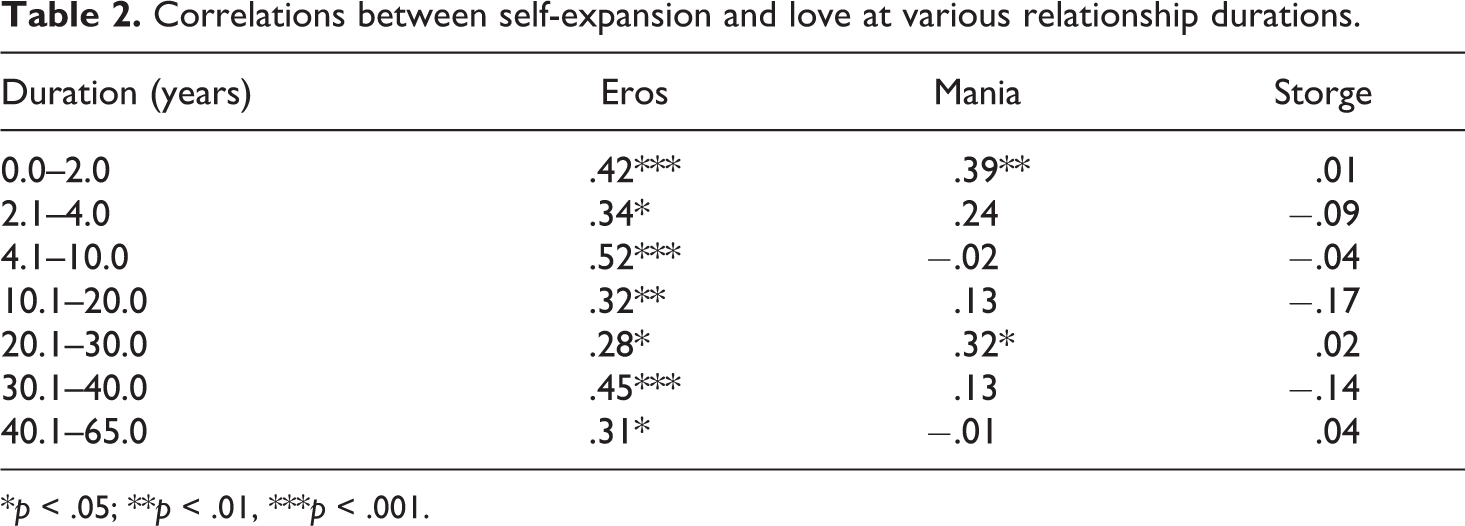
*p < .05; **p < .01, ***p < .001.
Correlations, means, and SD of all measures (N = 475).

Note. Means for quadratic and interaction effects and all correlations are computed after centering relationship length and self-expansion measures.
†p < .10; *p < .05; **p < .01; ***p < .001.
Self-expansion
As seen in Table 1, respondents in longer lasting relationships generally reported less self-expansion within their relationship. This association was verified in the first regression analysis, β = −.18, p < .001; however, this effect was reduced by half, and not significant, when the four covariates, age, sex, cohabitation status, and co-parenting status, were included, β = −.09, ns. But despite a significant model, R 2 = .05, p < .001, none of the covariates showed significant effects either: β = −.10, ns, for age; β = .08, ns, for cohabitating with partner; and β = −.08, ns, for having children with partner—although there was a marginally significant sex difference, β = .08, p < .10, with men reporting higher rates of self-expansion. This outcome likely reflects multicollinearity among the predictors as age and relationship length were strongly correlated (r = .76, p < .001). The quadratic term for relationship length, β = .02, ns, did not significantly improve the model.
Eros
As seen in Table 1, romantic love varied little across the life span of participants’ relationships. Romantic love was unrelated to relationship length both in the initial model, β = .01, ns, and after the addition of the covariates, β = .06, ns. Nor were any of the covariates related to romantic love: β = −.06, ns, for age; β = .02, ns, for sex; β = −.06, ns, for cohabitation status; and β = .05, ns, for co-parenting status. However, self-expansion was strongly predictive of romantic love, β = .37, p < .001, even after controlling for these covariates. As seen in Table 2, self-expansion was significantly associated with romantic love at every stage of relationship, and the addition of an interaction term to the regression analysis offered no evidence that this association was moderated by relationship length, β = −.03, ns. There was, however, a significant quadratic effect for relationship length, β = .12, p < .05. This implied that the trajectory of romantic love was curvilinear across time in relationship. Further probing revealed that—as seen in Table 1—romantic love dropped gradually across relationships for the first 20+ years (vertex = 22) but then rebounded in longer lasting relationships.
Mania
As seen in Table 1 and confirmed via regression, obsessive love dropped in long-lasting relationships, as expected, β = −.27, p < .001, although this association was not significant when covariates were added to the model, β = −.12, ns. Obsessive love was significantly predicted by respondent age, β = −.22, p < .01, and sex, β = .14, p < .01 (with men reporting greater levels of obsessive love) but not cohabitation status, β = −.00, ns, nor co-parenting status, β = .03, ns. Self-expansion in a relationship was also significantly related to obsessive love, β = .15, p < .01. Although there was no evidence of a quadratic component of relationship length in this trajectory, β = −.02, ns, the interaction of self-expansion and relationship length approached significance, β = −.08, p = .06. Further probing revealed—as evident in Table 2—self-expansion was positively associated with obsessive love early in the relationship, but this effect generally diminished over time (except for those married 20–30 years—which may reflect the particular cut points used in creating the table).
Storge
As seen in Table 1, companionate love appeared to increase in longer relationships, β = .15, p < .01, but this effect was not significant when the covariates were included in the model, β = −.05, ns. Respondent age was positively related to levels of companionate love, β = .28, p < .001, but respondent sex, β = .07, ns; cohabitation status, β = −.08, ns; and co-parenting status, β = .04, ns, were not. Nor was self-expansion related to companionate love, β = −.04, ns, at any relationship duration (see Table 2) as confirmed by a nonsignificant interaction term, β = .01, ns. The quadratic term for relationship length, β = −.00, ns, also failed to achieve significance.
Discussion
As every couple knows, love is not static, but relationships, and the love between partners, change over time. This study showed that people in long-standing relationships reported lower levels of self-expansion in their relationships than did people who had been with partners for shorter periods of time. This pattern is consistent with the self-expansion model of love (Aron & Aron, 1986), which further predicts corresponding changes in passionate love. Two measures of passionate love both varied across groups in relationships for different amounts of time. Romantic love showed a complex trajectory, decreasing slightly with time in relationship for groups of participants in the first 20 years of their relationships and then increasing with time in relationship for participants whose relationships lasted longer. Obsessive love showed a more steady decrease across time, though it appears that aging, rather than time in relationship, may account for this pattern. Despite their seemingly different trajectories, self-expansion was positively related to both measures of passionate love. Companionate love, which is not central to the self-expansion model, also appears to change, with older participants reporting greater levels of “friendship” with their partners than younger participants; these feelings were unrelated to experiences of self-expansion in their relationships.
Many researchers have examined changes in love across time. This is the first study, however, to explicitly examine the temporal trajectory of self-expansion and the association of these experiences with romantic and obsessive components of passionate love across the life span. The results have specific implications for the self-expansion model and, more generally, enhance existing knowledge on aging in relationships. Subsequently, I discuss both the specific and general implications of the findings and the limitations of the current study.
Implications for the self-expansion model
According to the self-expansion model (Aron & Aron, 1986), as intimacy grows and a partner is fully included in the self, self-expansion opportunities within the relationship diminish. This is consistent with the pattern obtained in the current study. Respondents in the longest lasting relationships reported lower levels of self-expansion than those in relatively newer relationships, although collinearity makes it unclear whether this is independent of age/aging. Contrary to expectations, however, there was no parallel drop in romantic love as a function of time in relationship or participant age. Although romantic love tended to drop with increasing time in relationship early on, it appears to rebound later, and people who had been with their partner for over 40 years reported just as much romantic love toward their partner as those just a few years into their relationship. Although these diverging trends seem inconsistent with the self-expansion model, self-expansion experiences were positively associated with romantic love no matter how old the relationship, just as expected by the self-expansion model. How is it that romantic love is maintained at high levels despite diminishing levels of self-expansion, given a positive association between them? Several explanations seem possible.
First, romantic love may have causes besides self-expansion with one’s partner. For instance, other relationship factors may counter the decline that would be expected with reduced self-expansion opportunities in long-term relationships (Fingerman & Charles, 2010). Perhaps early retirement or children leaving home permits partners to experience pleasure in each others’ company while carrying out the mundane activities of life that do not engender opportunities for self-expansion (Gorchoff, John, & Helson, 2008). Alternatively, even as self-expansion opportunities through one’s partner diminish in long-lasting relationships, other opportunities for self-expansion emerge that may positively impact attraction for one’s partner and relationship. For instance, one’s grown children or grandchildren may become routes for continued self-expansion that are both independent of one’s relationship with a partner (as measured here) and intimately connected to it. One might speculate that an avocation or other outside source of self-expansion might also generate positive affect—perhaps even passion—that may be transferred to a supportive partner who does not themselves participate.
A second possibility is that the affective benefit of self-expansion may change over age or time in relationship. There is no a priori reason why self-expansion in a mature relationship should generate the same level of positive affect as in a youthful relationship. In fact, it seems possible that small changes to a fully developed self (that includes one’s romantic partner) could evoke stronger responses than larger changes in a still developing self. Consistent with this, some researchers have observed that older adults enhance the significance of new love experiences through constructing a sense of their uniqueness from prior experiences in life (Ben-Ari, Lavee, & Gal, 2006); whether this pattern of “enhancement” occurs with self-expanding events in long-term relationships is mere speculation. However, if it does, lower levels of self-expansion would be needed to maintain higher levels of romantic passion in later life, which is consistent with the obtained results.
Finally, it is also possible that there is no decline in self-expansion in long-lasting relationships. Because of the cross-sectional nature of the current data, it is impossible to be certain that the lower self-expansion reported by participants from longer lasting relationships really reflects a change in their experience relative to when their relationships were newer; instead, it could be that this pattern of reports reflects the experience of participants from different cohorts. Some authors (e.g., Twenge & Campbell, 2008) have argued that American society is increasingly emphasizing the “self,” and this may have resulted in greater emphasis on close relationships as a source of self-expansion. As a result, the absolute levels of self-expansion reported by those from relatively young relationships may reflect their different experience (self-expanding through their relationships) relative to those in older cohorts (who may find self-expansion in outside activities) even as the association between self-expansion and romantic love remains the same.
Like self-expansion, the obsessive component of passionate love seemed to decline in longer lasting relationships, although this seems linked to aging rather than time in relationship, per se. While self-expansion experiences were positively associated with this component of passionate love as implied by the self-expansion model, unexpectedly, this association was most evident in relatively young relationships and seemed to diminish over time. Perhaps obsession is necessary to sustain interactions with a partner long enough for self-expansion to be initiated, but once inclusion of the other is underway, one’s focus can be released to explore other sources of expansion. Alternatively, this association may represent an attempt to jealously protect the potential for self-expansion in a partner that has not yet been realized, which may dissipate once it has (Lewandowski, 2003 similarly notes the affective importance of the potential for self-expansion). Understanding the parameters of this correlation is important because unlike romantic love, obsessive love is negatively associated with relationship satisfaction (Graham, 2011).
Aging in relationships
Although the motivation of this study was to examine the temporal course of self-expansion in relationships and its association with measures of passionate love, other trends in the data also merit consideration.
There was no evidence of a precipitous drop in passionate love in the first years of a relationship, but this may reflect the relatively small number of respondents in relationships of less than 2 years. On the other hand, a large number of respondents were in relationships of 20 years or longer, and many, much longer, which may have enabled detection of the “rebound” in romantic love at older ages. While there was a downward trend in romantic love in relationships from 0 to 20 years, the trend was positive in longer lasting relationships. This finding is relatively unique, and its causes are not immediately obvious. As noted above, family and life cycle transitions (e.g., retirement, children leaving, etc.) or other factors may allow older partners to enjoy each other more (Fingerman & Charles, 2010; Gorchoff et al., 2008) and alter the experience and trajectory of romantic love. It is also interesting to speculate whether this trend might be related to other changes in later life. For instance, researchers have noted a general increase in happiness and well-being at older ages, which could be the underlying cause (Keyes, Shmotkin, & Ryff, 2002; Weiss, King, Inoue-Murayama, Matsuzawa, & Oswald, 2012); alternatively, it is worth exploring whether changes in romantic love contribute uniquely to general well-being in older adults. This finding highlights the importance of adequately representing older adults and of testing for nonlinear patterns in relationship studies.
There was also a tendency for older respondents to report more companionate love toward their partners than younger respondents. Although one must be cautious in interpreting responses to this single-item measure, especially in light of Graham’s (2011) meta-analysis which found that companionate love (“practical friendship”) was unrelated to relationship length or satisfaction, other researchers (e.g., Bierhoff & Schmohr, 2004) have reported increases in “storge” in older relationships. It may surprise some that there was no significant correlation between companionate love and self-expansion experiences in this study as it may seem logical that romantic love (which is correlated with self-expansion experiences) eventually becomes companionate love (Aron et al., 2008; Sprecher & Regan, 1998). However, if such a transition occurs, the observed relationships are likely to be lagged by an unknown temporal parameter and difficult to see without an additional measure of “achieved” expansion or integration (perhaps the Inclusion of Other in Self scale Aron et al., 1992) to bridge these experiences. Clearly, more research is needed to understand this pattern.
Limitations
Although this study included a larger and potentially more representative sample of American adults than is typically obtained in relationship studies, it must be noted that the Midwestern population it represents is itself a culturally homogenous group, showing relatively little of the variability that might be observed in a larger, urban area. Given cultural and subcultural variability in the nature and importance of the self, it would be especially interesting to explore these relationships in a more diverse cultural group or in a locale that is not as self-focused as the United States and where passion is not seen as a basis for marriage.
While the use of a telephone survey methodology enabled collection of data from a broad range of community members, telephone assessment also has limitations, perhaps the most salient of which is the reliance on brief measures. Although the items used were carefully selected to represent established constructs, there is almost certainly a loss of precision and increase in error associated with such brief measures. For instance, the wording of the single item to represent companionate love, “Your love for your partner is really ‘just’ a deep friendship” may have inappropriately limited endorsement by respondents who also felt passion toward their partners. It is reassuring that the factor structure of the measures were consistent with those reported in other samples using larger versions of the measures. Caution is still warranted in drawing comparisons between companionate and passionate love types and in interpretation of nonsignificant findings despite a moderate large sample size.
It is also important to recognize the limitations posed by the cross-sectional nature of the data. Although the observed patterns may represent changes that typically occur in relationships across time, there are a number of potential confounding factors. For instance, the very large correlation between participants’ age and length of relationship obscured the role of time in relationship versus age as an explanation for the trajectory of self-expansion. In addition, as mentioned above, observed trends may not represent “changes” in participants’ life or relationship experiences but differences in the experiences of people who began their relationships at different times over the last 60+ years. A longitudinal design is necessary to begin to disentangle these possibilities.
One further caution is in order. Although the current results support others (e.g., Acevedo & Aron, 2009) in questioning the common wisdom that passion and romance necessarily fade, it is important to observe—as have others (e.g., Hatfield et al., 2008)—that those whose passion faded the most are likely missing from the current study (as their relationships have probably ended). This could easily explain the absence of an expected downward trend in passionate love across longer lasting relationships, but there is no obvious reason to suspect that would have affected the significant nonlinear trends and associations between self-expansion and passionate love reported here. As a result, while one cannot conclude from the current findings that romantic love does not weaken over time, one can conclude that it does not have to.
Conclusion
As noted at the beginning of the article, people often wonder, “What makes love last?” Research is increasingly pointing to the value of self-expansion experiences. Correlational and laboratory studies suggest that novel and exciting experiences generate self-expansion and motivate positive affect toward partners (Aron et al., 2000; Sheets et al., 2012); interventions that engage couples in novel and exciting activities and promote self-expansion (Carson et al., 2007; Reissman et al., 1993) similarly show positive relationship outcomes. The current study that examined the relationship between self-expansion and passionate love in a large community sample, further documents the important relationship of these experiences. Across relationships from 1 day to 65 years, these data show that self-expansion is strongly, positively associated with feelings of romantic passion. While self-expansion is not a panacea that will cure all relationship ills, it is one of the more promising keys to enhancing positive affect between long-term partners who seem to have grown bored.
Footnotes
Author’s note
A preliminary version of this article was presented at the International Association for Relationship Research (IARR) conference, Chicago, Illinois, USA, 2012.
Funding
This research received no specific grant from any funding agency in the public, commercial, or not-for-profit sectors.
References
Supplementary Material
Please find the following supplemental material available below.
For Open Access articles published under a Creative Commons License, all supplemental material carries the same license as the article it is associated with.
For non-Open Access articles published, all supplemental material carries a non-exclusive license, and permission requests for re-use of supplemental material or any part of supplemental material shall be sent directly to the copyright owner as specified in the copyright notice associated with the article.
