




Abstract
Attachment insecurity (i.e., levels of attachment anxiety and avoidance) is associated with interpersonal violence and aggression. However, evidence suggests that the associations are more consistent for attachment anxiety than for attachment avoidance. This raises questions as to whether there are particular moderators that may help to explain the lack of consistency in findings for attachment avoidance. In this article, we focus on a novel moderator regarding the association between attachment avoidance and aggression. Drawing on attachment theory, the aggression literature, and research into systems of threat detection, we suggest that the association between attachment avoidance and aggression may reflect a defensive fight (DF) response in situations of high relationship threat. Across two studies (Study 1, a self-report cross-sectional design; N = 128; Study 2, a cross-sectional experimental design, N = 126), we tested the extent that DF moderated the association between attachment avoidance and aggression under perceived relationship threat. In line with our suggestion, a three-way interaction was found across both studies between attachment avoidance, relationship threat, and DF. The findings have important theoretical and practical implications for the study of interpersonal aggression from an attachment theory perspective.
Research into adult attachment has found that attachment insecurity (i.e., levels of attachment anxiety and avoidance) is associated with interpersonal violence and aggression (e.g., Bookwala, 2002; Doumas, Pearson, Elgin, & McKinley, 2008). However, evidence to date suggests that the associations between individual differences in adult attachment and aggression are more consistent for attachment anxiety (characterized by a need for approval, a preoccupation of relationships, and worries of rejection; Brennan, Clark, & Shaver, 1998; Karantzas, Feeney, & Wilkinson, 2010) than for attachment avoidance (characterized by a discomfort with emotional closeness, a lack of trust in others, and excessive self-reliance; Brennan et al., 1998; Karantzas et al., 2010) (see Mikulincer & Shaver, 2016 for a review).
In this article, we report on two studies that investigate whether a subsystem of threat detection may be a moderator that can help to explain when attachment avoidance may be associated with aggression. Specifically, we suggest that when faced with a threatening situation, individuals high in attachment avoidance will demonstrate aggression as a defensive fight (DF) response to relationship threat. DF is key subsystem of a biologically based Fight, Flight, Freeze System (FFFS) which is proposed to regulate individual variation in responses to environmental threat (Corr & Cooper, 2016). We thus suggest that individual differences in attachment avoidance may be tied to individual differences in DF.
Attachment styles and aggression
Attachment styles reflect individuals most chronically accessible ways of thinking, feeling, and behaving in close relationships (Gillath, Karantzas, & Fraley, 2016; Mikulincer & Shaver, 2016). Attachment styles are conceptualized along two dimensions—attachment anxiety and attachment avoidance (Fraley & Waller, 1998). Individuals high in attachment anxiety are characterized by a preoccupation with romantic relationships and an excessive need for approval and validation (Brennan et al., 1998; Karantzas et al., 2010). The characteristics of attachment anxiety are underpinned by hyperactivating strategies of distress regulation. These strategies are enacted in times of threat and reflect intense and persistent affective-behavioral attempts at seeking closeness or garnering the attention of a significant other to assuage distress (Mikulincer & Shaver, 2003, 2016). These hyperactivating strategies, nonetheless, tend to heighten distress during threatening situations such as relationship conflicts where issues of invalidation, rejection, and abandonment arise (e.g., Dutton & Browning, 1988; Mikulincer & Shaver, 2011). This distress can often result in the experience of negative affect such as anger and frustration (Mikulincer & Orbarch, 1995). The experience of these emotions, coupled with their difficulties regulating distress (Mikulincer & Shaver, 2018) and their use of a conflict pattern termed destructive engagement (i.e., conflict behaviors involving coercion, blame, and manipulation, see Feeney & Karantzas, 2017), can impel anxiously attached individuals to aggressively act out against partners. Literature to date has provided theoretical insights and empirical support for the role of affect (e.g., jealousy and anger), relationship threats, and difficulties with managing and dealing with conflict as mechanisms to explain the association between attachment anxiety and aggression (e.g., Dutton & White, 2012; Roberts & Noller, 1998; Wright, 2017).
Individuals high in attachment avoidance are characterized by a discomfort with closeness, a distrust of others, and excessive self-reliance (Brennan et al., 1998; Karantzas et al., 2010). The characteristics of attachment avoidance are underpinned by deactivating strategies of distress regulation. Deactivating strategies reflect cognitive and behavioral attempts to disengage or suppress distress and negative affect during threatening situations and contexts. According to Mikulincer and Shaver (2016), these deactivation strategies result in individuals high on attachment avoidance masking their vulnerability and suppressing their attachment needs. Consequently, in conflict situations that incite distress, threat, and vulnerability, individuals high on attachment avoidance engage in patterns of conflict avoidance or detachment (i.e., conflict behaviors entailing withdrawal, distancing, lack of openness, and refusal to discuss the topic; Feeney & Karantzas, 2017). Thus, aggression is thought by some attachment theorists to be inhibited in individuals high on attachment avoidance, or unlikely to manifest in highly overt ways as a function of these deactivating strategies and conflict strategies (Bartholomew & Allison, 2006).
Nevertheless, not all studies find attachment avoidance to be negatively associated with aggression. Rather, there are some studies that find attachment avoidance to be positively associated with aggression. For instance, Treboux, Crowell, and Waters (2004) found that individuals high on attachment avoidance engaged in both verbal and physical aggression against a relationship partner. Gormley and Lopez (2010) found that both men and women who were high on attachment avoidance engaged in the emotional abuse of partners, especially when highly stressed. These findings point to factors beyond deactivating strategies and conflict avoidance patterns that may help to explain the conditions (intrapsychic and/or interpersonal) under which attachment avoidance may predict aggressive responses within interpersonal relationships.
Some suggest that the antagonistic personality traits that have been found to correlate with attachment avoidance (e.g., hostility, narcissism) may impel aggressive behavior (e.g., Bookwala & Zdaniuk, 1998; Mayseless, 1991). Nevertheless, if this was the case, then trait-like characteristics should yield far more consistent associations between attachment avoidance and aggression than is currently reported in the literature. On the other hand, some assume that aggression may result when individuals high on attachment avoidance are provoked or experience a threat in which their capacity to cognitively or behaviorally disengage from the threat is perceived as not viable, and thus, a response must be enacted to defend against the threat (e.g., Bartholomew & Allison, 2006). That is, if their default repertoire of deactivation strategies is perceived as ineffective in ameliorating the threat, then aggression may ensue. Although this may be the case, this reason is largely theoretical, with little by way of supporting empirical evidence. Nevertheless, we contend that this notion aligns with extensive research undertaken within the aggression and personality literatures to suggest that there are instances when aggressive responses can reflect defensive reactions to threatening (and even uncertain) situations (e.g., Halevy, 2017; Simunovic, Mifune, & Yamagishi, 2013). That is, some individuals high in attachment avoidance may engage in what is termed as defensive aggression (McNaughton & Gray, 2000; Simunovic et al., 2013). Defensive aggression is defined as a DF response designed to counter threat or harm that is perceived as imminent or unavoidable. Below we outline the specific manner in which defensive aggression may manifest in individuals high on attachment avoidance.
Attachment avoidance and aggression: A response of DF
Defensive aggression is thought to be underpinned by the fight subsystem of the FFFS (Corr & Cooper, 2016; McNaughton & Gray, 2000). The FFFS is considered a system of threat detection that is designed to mobilize the individual to take evasive action to avoid the threat once identified. In situations where threat is perceived as unavoidable or inescapable, the system is likely to mobilize DF responses to counter the instigator, and if successful, escape from the aversive context and experience the attenuation of negative affect (e.g., McNaughton & Gray, 2000; Walker, Jackson, & Frost, 2017). Moreover, individual differences in the functioning of the FFFS are likely to regulate the extent to which DF responses ensue in threatening contexts (Corr & Cooper, 2016).
Outlining the functioning of the FFFS and the role of the DF subsystem in dealing with threat can help further our understanding as to a potential moderating factor by which attachment avoidance is associated with aggression. Specifically, we suggest that individuals high on attachment avoidance who also have a particularly sensitive DF system are more likely to respond with defensive aggression in threatening contexts. In their review of the literature linking the FFFS with individual differences in adult attachment, Karantzas, Kambouropoulos, and Ure (2018) suggested that individuals high in attachment avoidance may harbor a hypersensitive FFFS. That is, the FFFS is calibrated such that individuals high on attachment avoidance are vigilant to detecting threat and respond defensively to distance oneself from threat—either by fleeing when the threat is perceived as not imminent or avoidable, or through DF responses when the threat is perceived as imminent or unavoidable. This hypersensitive calibration of the FFFS aligns with the deactivating behavioral strategies of individuals high in attachment avoidance. It also aligns with recent theoretical and empirical work on Social Defense Theory in which individuals high on attachment avoidance engage in a rapid fight-or-flight response when encountering threat (e.g., Ein-Dor, Mikulincer, Doron, & Shaver, 2010; Ein-Dor, Mikulincer, & Shaver, 2011).
Therefore, when faced with relationship threats such as conflict situations in which a romantic partner verbally attacks through criticism, derogation, or hostility, individuals high on attachment avoidance with a sensitive DF subsystem may engage in aggression as a necessary defensive reaction. However, to provide proof of concept for our theoretical explanation regarding the conditions under which individuals high in attachment avoidance will aggress, we conducted two empirical studies (Study 1: Cross-sectional survey design; Study 2: Experimental).
Study 1
The aim of Study 1 was to investigate whether DF (a component of the FFFS) would moderate the association between attachment avoidance and aggression in the context of relationship threat. In an attempt to provide initial evidence for this prediction, we conducted a cross-sectional self-report study in which we used individual differences in aggression (i.e., trait aggression) as the outcome variable. As a strict test of this moderation prediction, we also assessed attachment anxiety as well as the behavioral approach system (BAS) and included these variables in our analyses. In this way, we could test the extent to which attachment anxiety was associated with aggression (see, e.g., Roberts & Noller, 1998) and examine whether DF was implicated in moderating the attachment anxiety to aggression link. Theoretically, DF should have little, if any, role in this association as individuals high in attachment anxiety demonstrate little by way of DF or flee-like behavior in instances of threat (e.g., Ein-Dor et al., 2011). Rather, their use of hyperactivating strategies (Mikulincer & Shaver, 2016) is likely to counter or nullify a DF propensity. We also controlled for individual differences in the BAS to account for whether variance in aggression may be due to appetitive urges often associated with aggression (e.g., Harmon-Jones & Peterson, 2008).
Method
Participants
A total of 126 participants (87% Caucasian; 73% women, age [M = 26.83 years, Mdn = 24.00; SD = 7.50]) were recruited using online social network sites and forums (e.g., Facebook and Reddit). All participants were currently in a heterosexual romantic relationship (relationship length [M = 7.66 years; Mdn = 6.00 years]) and 98.5% were either steady dating or cohabiting.
Materials and procedure
Participants completed an anonymous online survey that took approximately 20 minutes to complete, which included demographic questions (i.e., age, gender, relationship length, relationship status, sexual orientation) followed by a set of self-report measures. Attachment style was measured using the Experiences in Close Relationships-Short Form (Wei, Russell, Mallinckrodt, & Vogel, 2007). The measures consist of 12 items, measuring two dimensions (attachment anxiety [6 items, α = .75] and avoidance [6 items, α = .83]) that are rated on a 7-point Likert-type scale ranging from 1 = strongly disagree to 7 = strongly agree. Higher scores on each subscale reflect greater attachment insecurity. Relationship threat was assessed using three items specifically designed for the current study rated on a 4-point scale from 1 = very false of me to 4 = very true of me. Items included “I feel threatened when my partner confronts me about an issue,” “I become distressed when my partner raises an issue about our relationship with me,” and “When my partner criticizes me I feel it is an attack on me.” Higher scores across all items reflected higher relationship threat (α = .86). DF and BAS functioning were measured using the DF and BAS subscales of the Reinforcement Sensitivity Theory of Personality Questionnaire (Corr & Cooper, 2016). The DF subscale consists of 8 items (α = .79), while the BAS subscale consists of 32 items (α = .84). All items are rated on a 4-point scale from 1 = not at all to 4 = highly, with higher scores reflecting greater DF and BAS, respectively. Trait aggression was measured using the Brief Aggression Questionnaire (BAQ, Webster et al., 2014) which consists of 11 items rated on a 7-point scale from 1 = extremely uncharacteristic of me to 7 = extremely characteristic of me. Higher scores indicate higher levels of trait aggression (α = .77).
Results and discussion
A three-strep hierarchical regression was conducted in order to determine the associations between our predictor variables as well as their interaction terms and trait aggression. In Step 1, we included attachment anxiety and avoidance, DF, and relationship threat. We included scores on the BAS measure as a control variable in Step 1 to account for the association noted in past research between behavioral approach and trait aggression (e.g., Harmon-Jones & Peterson, 2008). In Steps 2 and 3, we included all possible two-way and three-way interactions between the predictor variables respectively. We estimated power across all our regression models using G*Power 3.1 (Faul, Erdfelder, Buchner, & Lang, 2009) by accounting for the number of predictors in the model and the R2 increase.
The overall model was significant, R = .78, R2 = .61, F(2, 114) = 3.36, p < .05; power = .82. 1 As shown in Table 1, the predictors included as part of Step 1 made a statistically significant contribution to the model with attachment anxiety and avoidance, and DF significantly positively associated with trait aggression. The addition, all two-way interaction terms in Step 2 did not make a statistically significant contribution to the model. However, the addition of the three-way interactions in Step 3 yielded a significant increase in R2 (see Table 1). Specifically, the three-way interaction between attachment avoidance × relationship threat × DF was positively associated with trait aggression. Simple slopes analysis of the three-way interaction revealed that individuals high (1 SD above the mean) on attachment avoidance, relationship threat, and DF demonstrated significantly higher levels of trait aggression than individuals low (1 SD below the mean) on any predictor involved in the three-way interaction (see Figure 1; ts > 1.96, ps < .05).
Hierarchical regression model for Study 1.

Note. AttAv = attachment avoidance; Attanx = attachment anxiety; DF = defensive fight; BAS = behavioral approach system; RelThreat = relationship threat; SE = standard error.
***p < .01; **p < .001.

Three-way interaction between attachment avoidance, DF, and relationship threat condition (Study 1). Note. Av = attachment avoidance; DF = defensive fight.
Study 1 provides initial support for the prediction that when relationship threat is appraised as high, attachment avoidance will be associated with aggression when coupled with heightened DF. Moreover, we found this prediction to hold for attachment avoidance, and not attachment anxiety. This finding speaks to the defensive processes that are thought to underpin the behavioral characteristics and tendencies of people high on attachment avoidance (Gillath et al., 2016; Mikulincer & Shaver, 2016). That is, cognitive or behavioral disengagement is often the default response for avoidant individuals when experiencing threat—behaviors that reflect an attempt to preemptively or immediately minimize threat and deactivate the attachment system. However, when avoidant individuals encounter a relationship threat and have a heightened sensitivity for DF, then aggressive behavior may indeed reflect a protective response.
Study 2
Study 1 was a “proof-of-concept” empirical investigation regarding the moderating role of DF in the proposed association between attachment avoidance, relationship threat, and aggression. However, the study did not focus on any specific context in which relationship threat may manifest. Rather, Study 1 asked participants to report on their general perceptions of threat in their current romantic relationship. Given that research has largely suggested that aggression is often demonstrated within the context of threat such as relationship conflicts and rejection (e.g., Leary, Twenge, & Quinlivan, 2006; Riggs & O’Leary, 1996), in Study 2, we were interested in testing the moderation prediction in a specific relationship context. We, therefore, manipulated relationship threat by exposing participants to one of two relationship vignettes designed to invoke high or low threat. The high threat condition involved a relationship conflict characterized by criticism directed by one’s partner toward the participant. In this way, we could test whether DF would moderate the attachment avoidance to aggression association in conditions of high relationship threat.
Study 1 also focused on trait aggression rather than aggression specific to the context of romantic relationships. To address this limitation of Study 1, we assessed relationship specific aggression in Study 2 by having participants report on their tendency to respond in an aggressive manner after being exposed to either the high or low relationship threat vignette. To this end, Study 2 allowed us to examine whether the degree of DF moderated the association between attachment avoidance and relationship-specific aggression under high and low conditions of threat.
Method
Participants
A total of 128 participants (84% Caucasian; 76% women, age [M = 20.25 years; Mdn = 20.00; SD = 2.10]) were recruited using the same methods as Study 1. All participants were currently in a heterosexual romantic relationship (relationship length [M = 4.66 years; Mdn = 3.00 years]) and 94.5% were either steady dating, cohabiting, or engaged/married.
Materials and procedure
Participants completed an anonymous online survey that included a number of the same measures included in Study 1 to assess participant demographics, attachment style DF, BAS, and trait aggression (see Study 1 for measure details).
In addition to completing these measures, participants were randomly assigned to receive either a high threat or low threat relationship vignette. In the high threat vignette condition (n = 62), participants were asked to imagine a situation with their romantic partner in which they were criticized for being “selfish” by spending too much time at work and not focusing on their romantic relationship. As part of the situation, the partner questions the future viability of the relationship. In the low threat condition (n = 66), participants were asked to imagine a relationship situation in which their romantic partner inadvertently burns the dinner they were cooking for the two of them as a result of going to the bathroom while the dinner was still on the stove. The romantic partner apologizes for burning the dinner but remarks that they wished “you” had noticed the dinner burning and taken it off the cooktop.
After reading the vignette, participants were asked to rate how threatening they found the situation across six threat-based emotions (nervous, afraid, worried, threatened, scared, and anxious) rated on a 5-point scale from 1 = a little to 5 = a lot (α = .88). Participants then rated a set of 11 items that were modified from the BAQ (Webster et al., 2014) in order to reflect aggression in response to the relationship situation they had read. Items were rated on the same 7-point scale used as part of the original BAQ. These range from 1 = extremely uncharacteristic of me to 7 = extremely characteristic of me. Higher scores indicate higher levels of relationship-specific aggression (α = .83).
Results and discussion
We conducted a preliminary analysis to test whether the high and low relationship threat conditions were appraised as different in degree of threat. A t-test revealed that participants rated the high threat condition as invoking more threat (M = 3.50, SD = 1.02) than the low threat condition (M = 1.19, SD = .35); t-adjusted-equal variances not assumed (74.5) = 16.96, p < .001.
A three-strep hierarchical regression was conducted in order to determine the associations between our predictor variables as well as their interaction terms and responses of aggression across the high and low relationship threat conditions. In Step 1, we included attachment anxiety and avoidance, DF, and the relationship threat condition (coded 0 = low threat, 1 = high threat). As with Study 1, we included scores on the BAS measure as a control variable in Step 1 but also controlled for trait aggression. In Steps 2 and 3, we included all possible two-way and three-way interactions between the predictor variables, respectively, and estimated power using the same method as Study 1.
The overall model was significant, R = .83, R2 = .68, F(2, 114)= 18.85, p < .001; power = .82. 2 As shown in Table 2, the predictors included as part of Step 1 made a statistically significant contribution to the model with attachment avoidance, DF, relationship threat condition, and trait aggression significantly positively associated with situational aggression. The addition, all two-way interaction terms in Step 2 yielded a significant increase in R2 (see Table 2) as did the addition of the three-way interactions in Step 3 (see Table 2). Specifically, the three-way interaction between attachment avoidance × relationship threat condition × DF was positively associated with relationship-specific aggression. Simple slopes analysis of the three-way interaction (see Figure 2) revealed that individuals high (1 SD above the mean) on attachment avoidance and DF who were exposed to the high threat condition demonstrated significantly higher levels of relationship-specific aggression than individuals low (1 SD below the mean) on any predictor involved in the three-way interaction (ts > 1.96, ps < .05).
Hierarchical regression model for Study 2.
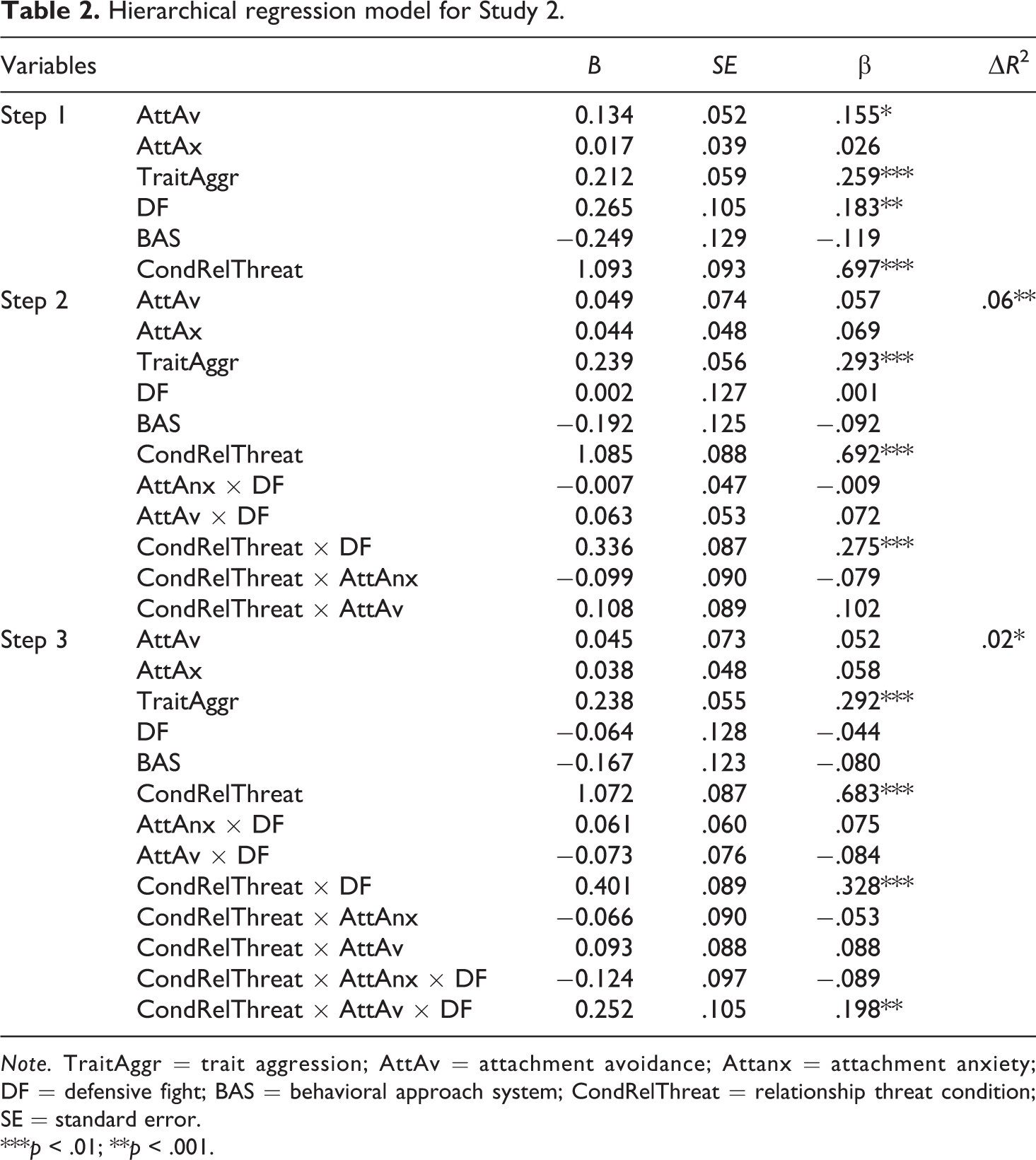
Note. TraitAggr = trait aggression; AttAv = attachment avoidance; Attanx = attachment anxiety; DF = defensive fight; BAS = behavioral approach system; CondRelThreat = relationship threat condition; SE = standard error.
***p < .01; **p < .001.

Three-way interaction between attachment avoidance, DF, and relationship threat condition (Study 2). Note. Av = attachment avoidance; DF = defensive fight.
Study 2 provides further support for the prediction that attachment avoidance, when coupled with relationship threat, will be associated with aggression, but only for those who have a heightened DF. In Study 2, the findings extend beyond individual differences in aggression (i.e., trait aggression) to demonstrate that the association between attachment avoidance, relationship threat, and the propensity to engage in DF is associated with people’s aggressive responses in specific situations—namely relationship contexts involving high threat. The findings again suggest that DF responses may indeed co-occur for people high on attachment avoidance and that aggressive responses may well reflect a form of DF or defensive aggression.
General discussion
To date, research into adult attachment has demonstrated attachment avoidance is inconsistently associated with aggression and intimate partner violence (for review, see Mikulincer & Shaver, 2016). However, these inconsistencies may not reflect paradoxical findings, but rather, a need to uncover the conditions and mechanisms under which attachment avoidance is associated with aggression and the conditions and mechanisms under which it is not. In this respect, some attachment theorists have suggested that aggression is a defensive response for those individuals high in attachment avoidance who perceive a relationship context as one in which physical or psychological threat is unavoidable (Bartholomew & Allison, 2006). Thus, it is only when the typical deactivation strategies used by individuals high on attachment avoidance (i.e., withdrawal, disengagement, conflict avoidance) are perceived to not effectively minimize an impending relationship threat, or the threat is unavoidable, that an aggressive response may ensue. In a novel attempt to theoretically and empirically advance on this proposed reasoning, we integrated two lines of theoretical and empirical work into aggression—research into adult attachment (e.g., Bookwala & Zdaniuk, 1998; Roberts & Noller, 1998) and research into systems of threat sensitivity (Corr & Cooper, 2016; Corr & McNaughton, 2012; McNaughton & Gray, 2000).
Drawing on the concept of defensive aggression (Halevy, 2017; McNaughton & Gray, 2000; Simunovic et al., 2013), and the subsystem of the FFFS designed to yield aggressive-like responses when threat is unavoidable (Corr & Cooper, 2016), we contend that DF may moderate the association between attachment avoidance and aggression. Specifically, individuals high in attachment avoidance who experience an impending or unavoidable relationship threat may engage in aggression because they have a heightened DF response. That is, attachment avoidance and DF may co-occur when relationship threat is perceived as immediate or unavoidable, and thus, a protective response (albeit aggressive) is deemed necessary.
This type of a response may be particularly prominent in individuals high on attachment avoidance as their tendencies to engage in deactivation of the attachment system biases them to preemptively or quickly minimize threat or distress by way of physical or psychological disengagement (Mikulincer & Shaver, 2016). However, in situations when these deactivating strategies are perceived as not viable, alternate behaviors may be invoked as a means to defend against and minimize the threat. Karantzas et al. (2018) suggest that individuals high on attachment avoidance harbor a hypersensitive FFFS that makes them vigilant to detecting and avoiding threat. However, when threat is imminent or unavoidable, Karantzas et al. suggest that the DF component of the FFFS is activated, resulting in an antagonistic or aggressive response to mitigate the threat.
The empirical investigation carried out across Studies 1 and 2 provides the first test of whether DF may indeed moderate the association between attachment avoidance and aggression when relationship threat is perceived as high. In Study 1, this association was tested by way of reports on attachment avoidance, individuals’ general perceptions of relationship threat, and individual differences in DF predicting trait aggression. Thus, Study 1 focused on the level of individual differences across all variables of interest. That is, do individual differences in attachment avoidance, perceptions of relationship threat, and DF interact to predict trait aggression? Study 2 involved an experimental design in which participants were exposed to one of two relationship situations that varied in threat. Participants were also asked to report on their propensity to engage in aggression in relation to the specific situation. In this way, Study 2, extended on Study 1, by providing a context specific test of the moderated prediction initially examined in Study 1.
Across both studies, we found that the three-way interaction between attachment avoidance, relationship threat, and DF predicted aggression. The findings, therefore, confirmed our prediction that DF, a key component of the FFFS, appears to be moderating factor that helps in understanding how attachment avoidance is associated with aggression in situations of relationship threat.
Implications
These findings may have uncovered a key factor to help explain when attachment avoidance is associated with aggression. In particular, our findings suggest that aggression involves an alignment between the person’s level of attachment avoidance, the extent to which they find themselves within an imminent or unavoidable threatening relationship situation, and their calibration toward a heightened DF response. It is only when this “perfect storm” of variables is in alignment that aggression may occur (Finkel & Hall, 2018).
Second, our findings suggest that defensive aggression may be the best way to characterize the aggressive responses of individuals high in attachment avoidance when faced with threat. To this end, identifying and diffusing imminent relationship threats may be an important strategy used by therapists and couples that can help to attenuate aggressive responses for relationship partners high on attachment avoidance with a sensitive DF subsystem.
Third, an aggressive response may be an indication that the deactivating strategies used by avoidantly attached individuals during situations of threat or distress may have not worked. As a consequence, aggression may reflect a “last resort defence” against what is likely perceived as an imminent or unavoidable relationship threat. To this end, relationship conflicts should be studied closely to determine whether aggressive responses are the result of avoidant individuals experiencing or perceiving an attack by one’s partner that cannot be defended by way of stonewalling, withdrawing, or avoiding the conflict. Thus, observational assessments of couple conflict are likely to provide a fine-grained temporal analysis of whether the failure of deactivating strategies precedes aggressive reactions within individuals high on attachment avoidance.
Limitations
Although the current article provides novel and important insights into understanding the factors that may impel individuals high in attachment avoidance to demonstrate aggression, our research is not without limitations. First, the cross-sectional nature of Studies 1 and 2 means that we cannot assume causation between attachment avoidance and aggression. Thus, future research should involve either momentary assessments or longitudinal study designs to address issues of causality. Second, given that aggression and interpersonal violence within romantic relationships is a dyadic phenomenon, future research should involve the assessment of couples (both self-report and observational assessments) and thereby use the dyad as the unit of analysis. Finally, our samples were homogenous comprising of largely Caucasian women, and participants were involved in heterosexual relationships who reported low levels of aggression. Thus, our findings need to be cross-validated in samples of men, individuals from different cultures, different sexual orientations, and samples experiencing higher levels of aggression and/or conflictual relationships. Future research would need to recruit more heterogeneous samples to determine the extent to which the findings of the current work indeed translate across subsamples of the population.
Conclusion
Our findings provide the first evidence to suggest that DF moderates the association between attachment avoidance and aggression in contexts of high relationship threat. Our results across both studies provide much needed empirical evidence to support the theoretical claims made by some attachment researchers outlining the conditions and variables that may yield aggressive responses in individuals high on attachment avoidance. It is hoped that our preliminary research in this area provides the impetus for the continued study of the factors that impel and inhibit interpersonal aggression from an attachment theory perspective.
Footnotes
Funding
The author(s) received no financial support for the research, authorship, and/or publication of this article.
Open research statement
The materials used in the research are available. The materials can be obtained via email: