




Abstract
College student parents represent a unique population because they are typically low-income, accrue more debt than traditional students, and must balance the role of student and parent. Using a mixed methods design, this study examined the relation between college student parents’ stress and distress in their relationships with their children and examined how parents managed their multiple roles. Parent participants (n = 80; 54 mothers, 26 fathers; M age = 28.74 years, SD = 4.72) completed an online survey and a subsample (n = 14) participated in semi-structured interviews. Results revealed that college student parents experience a variety of stressors that spillover into their relationships with their children and these associations appear more detrimental for father-child relationships. However, in-depth qualitative interviews not only highlighted the various sources of stress (e.g., time demands, multiple roles), but also revealed internal and external resources that college student parents draw on to help cope with stressors. Findings suggest that program efforts to strengthen the co-parenting relationship and to help college student parents more effectively manage their stress may be beneficial for improved parent-child relationships.
Introduction
Over 4.8 million college students are raising children while attending school (Gault et al., 2014). Student parents are less likely than traditional students to graduate from college within 6 years (Institute for Women’s Policy Research, 2017). Financial concerns, childcare needs, and feeling stressed or overwhelmed are three of the primary reasons student parents drop out of school (Hess et al., 2014). Financial concerns and stressors associated with attending college affect both parent and nonparent college students alike. However, childcare needs, feeling overwhelmed due to responsibilities associated with caring for children, and parenting demands are unique to student parents. A better understanding of these stressors and how they contribute to family relationships could lead to better resources and supports to help student parents remain in school and graduate.
Parents’ postsecondary education is associated with higher incomes, greater access to health care, positive mental health, positive parenting practices, and children’s academic success (Hout, 2012; Magnuson, 2007; Oreopoulos & Petronijevic, 2013). Magnuson et al. (2009) found that increases in maternal education (among mothers who had initially low levels of education) were associated with the provision of more learning materials and higher levels of responsiveness. In contrast, low income, low education, and stress overload have all been associated with high levels of parents’ stress which can contribute to parental depression and problem behaviors in young children (Horwitz et al., 2007; Puff & Renk, 2014). Past research has also documented a strong link between the educational level of parents and the educational level of their offspring (Black et al., 2005). For example, Suitor et al. (2008) found that families in which mothers completed their bachelor’s degree were more likely to have all or most of their children complete college, compared to families in which mothers left school without completing their degree. Thus, parents’ postsecondary educational attainment has both proximal implications for family well-being as well as more distal, intergenerational implications. However, the extent to which families are able to reap these benefits depends on various factors, including whether parents can successfully combine their caregiving and student roles.
College student parents represent a unique population because although they are pursuing higher education which has future long-term benefits, their current status is typically low-income and they accrue more debt than college students without children (Gault et al., 2014). Further, college students who experience financial distress are at an increased likelihood of failing to complete their degrees (Britt et al., 2017). Stressors associated with being low income and balancing multiple roles of student and parent likely increase this risk even more. Yet little is known about the implications for this unique population of parents regarding their levels of stress and their distress in relationships with their children. Given increasing enrollment of college student parents at 2- and 4-year institutions who make up approximately one in five college students, it is vitally important that we stop viewing these students as “invisible” (Brown & Nichols, 2013) and use research-based evidence to inform programs and policies that can support these students and their families. This exploratory study sought to understand how parents’ stress was related to distress in their relationships with their young children, to learn more about specific stressors that college student parents face, and how they manage their student and parent roles.
Contagion of stress theory
The theory of the contagion of stress across multiple roles (Bolger et al., 1989) argues that the combination of work and family roles generates stress and that there is a contagion of stressful experiences between these role domains. One form of stress contagion is spillover in which stress in one domain results in stress in another domain. For example, a bad day at work makes one feel lousy and subsequently a family argument occurs at home. Qualitative and quantitative literature on work-family spillover has supported the contagion of stress theory. In a daily-diary study of work stress and marital behavior, Sears et al. (2016) found that work overload was related to increases in marital disregard (e.g., ignoring spouses wishes or demands). In a recent qualitative investigation among dual career couples, Gerrard et al. (2016) reported that participants noted both work-family conflicts (e.g., work responsibilities caused problems in the family) and family-work conflicts (e.g., could not complete work responsibilities due to family issues) contributed to stress.
The concept of spillover has also been used to study how stressors associated with university students’ school experiences spillover to family relationships. Pedersen and Jodin (2016) found that academic concerns and unrealistic course expectations were significantly associated with school spillover (i.e., school obligations and demands interferes with family life). The idea of the contagion of stress across multiple roles can also be applied to student parents who experience multiple roles as a parent, spouse/partner, and student. These multiple roles suggest that student parents may experience greater amounts of stress than traditional college students. Higher stress levels among college student parents may have important implications for parent-child relationships. Highly stressed parents may have decreased ability to care for their children in a responsive and sensitive manner (Mäntymaa et al., 2006). Emotional distress and SES predict parenting quality (Herbers et al., 2017). Parents consumed by stress and worries associated with their education, financial situation, and balancing multiple roles have limited time, attention, and energy to engage in sensitive parenting. Based on this past research, we expected that stress overload due to multiple role demands as a student and parent would be associated with more distress in the parent-child relationship.
Correlates of parents’ stress
Gender is an important factor to consider when examining links between stressors and family well-being (Mitchell et al., 2015). The contagion of stress across domains is a gendered process in which men and women may experience spillover differently. Costigan et al. (2003) found that mothers who reported a more negative interpersonal atmosphere at work showed decreases in positive parenting and increases in negative parenting over time yet fathers’ negative work experiences were unrelated to parenting. Among college students, Pedersen and Jodin (2016) found that women were more likely to report a family issue was causing them stress compared to men and that women reported significantly higher levels of school spillover compared to men.
Parenting stress levels can be influenced by familial contexts that may serve as risk factors for elevating stress associated with child-rearing responsibilities. The quality of co-parenting is a contextual factor that is potentially either a source of distress or support. That is, a lack of parental alliance between partners may contribute to parenting stress (Cooper et al., 2009; Mulsow et al., 2002). Further, the family systems literature highlights links between couple relationships and parenting. A body of research supports the notion that spillover or transfer of mood, affect, and interaction style in the couple relationship has implications for the quality of the parent-child relationship (Erel & Burman, 1995). In particular, Margolin et al. (2001) identified the co-parenting alliance as a key factor in understanding connections between spouse/partner relationships and parent-child relationships. Based on family systems theory and past research, we expected that distress in the co-parenting relationship would be associated with more problems in the parent-child relationship.
Important contextual factors such as economic hardship also contribute to parents’ stress and distress in parent-child relationships. For example, a qualitative study of single mothers who were students found that participants’ reported debts contributed to their psychological distress (e.g., depression and anxiety), as well as their difficulty caring for their children (Gerrard & Roberts, 2006). In addition, parenting during the toddler years tends to be more demanding and challenging since children are learning they can be autonomous, but have not yet learned to regulate their behavior (Potegal & Davidson, 2003). Given past research regarding the importance of these contextual factors, the parenting partner relationship, economic hardship, single mother status, and children’s age were included in the present study examining connections between college student parents’ stress and distress in parent-child relationships.
Current study
Intense demands of managing both school and family responsibilities place student parents at risk for significant stress which can impact their family relationships and ability to be successful in college. Greater parenting stress has consistently been linked to poor child outcomes (e.g. disruptive behavior problems) and maladaptive parenting practices (Calkins et al., 2004). This study had two primary goals. The first goal of this study was to examine the relation between college student parents’ stress and distress in relationships with their young children. Given the previous research on gender differences in stress (Mitchell et al., 2015), we also wanted to determine if parent gender moderated these associations for student parents. The second goal for this study was to learn more about specific stressors that college student parents face and how they manage their student and parent roles through semi-structured interviews. A mixed methods approach that combined quantitative and qualitative methodologies was utilized in the current study. This study sought to better understand the complexity of the spillover between roles, the interplay between demands and resources that contribute to stress levels, and the implications for family well-being. The data gathered from this mixed methods approach provides information about the risk-benefit for families of student parents pursuing their higher education goals in spite of the potentially stressful circumstances due to increased demand and lower incomes often associated with schooling.
Method
Participants
The Child Care Access Means Parents in School (CCAMPIS) program, is a federal grant initiative awarded to universities by the U.S. Department of Education and provides child care subsidies to Pell-grant eligible students (The U.S. Federal Pell grant program provides need-based grants to low income undergraduate students). Student-level requirements vary between universities. The current program required that at least one student per household be enrolled full-time and maintain a GPA above 2.0. Based on household size and income, subsidies were awarded on a sliding scale to cover 60%–90% of total childcare costs.
Age of the parent respondents (n = 80) ranged from 21 to 42 years with an average age of 28.74 years (SD = 4.72) with 70% of parents being under age 30. Age of the children ranged from 2 months to 5 years (M = 25.06 months; SD = 15.13 months). Most participants (85%) listed a spouse or partner on their application. The total number of children in the household ranged from one to six, although most families (46%) had one child. Monthly household income ranged from $0 to $5,500 (M = $1,707.74; SD = $1,180.27). Although the income range was considerable, the three highest incomes included two military families (who were allowed into the program based on their military status and not income requirements) and one family with a household size of eight. More mothers (n = 54) than fathers (n = 26) responded to the online survey. Child gender was proportioned nearly evenly (43% female). In the majority of families (46%) only one parent was enrolled as a student. However, 39% of families reported both parents were enrolled in college. The remaining (15%) were single parent households. The majority (83%) of the sample was White; 5% were Asian, 4% were Hispanic, 3% were Pacific Islander, 3% were Black, and 2% were Native American.
A subsample of participants (n = 14) were selected to participate in semi-structured interviews focusing on their experiences as college student parents. A criterion sampling strategy was used (Onwuegbuzie & Collins, 2007) in which parents were selected to be interviewed based on the length of time in the CCAMPIS program and the age of their child/ren. Previous research has shown that it is more difficult for parents of younger children to persist in college compared to parents of older children (Wladis et al., 2018), therefore parents who participated in CCAMPIS longer and had a child 36 months or younger were chosen for interviews. Two parents who were approached for interviews elected not to participate and two couples elected to be interviewed together because both parents were students. To gain a more comprehensive sample of CCAMPIS participants, parents who both responded and did not respond to the online survey were approached to be interviewed. Of the interview participants, eight also responded to the online survey.
Procedure
A mixed methods approach for the purpose of complementarity (elaboration, illustration and clarification of results) using a nested, concurrent design was employed for this study (Greene et al., 1989; Onwuegbuzie & Collins, 2007). All activities and procedures were approved by the sponsoring university’s IRB. Upon enrollment in the CCAMPIS program, all students and spouses were invited by the program coordinator to participate in a research study on parent stress and child development. Those who agreed and returned a signed informed consent form were e-mailed a link to an online survey. The response rate was 39%. Survey questions focused on parents’ experiences with their youngest child in care. Semi-structured interviews were conducted over a period of 6 weeks in the Spring of 2017 by a single researcher. The response rate was 71%. Interviews lasted on average 20 minutes (range = 12–30 minutes), were audio recorded, and transcribed. Parents were contacted via phone call or text message to set up an appointment for their interview. Interviews were conducted in a private location (e.g., home or university conference room). Parents were compensated with children’s books for their time.
Measures
Distress in the Parent-Child Relationship was measured using the Parent-Child Dysfunctional Interaction subscale of the Parenting Stress Index (PSI-IV) a well-known measure that has been used with diverse populations and has demonstrated reliability (Abidin, 1990; Reitman et al., 2002). The parent-child dysfunctional interaction subscale assesses a parents’ perception that the child does not meet expectations and that interactions with the child are not reinforcing. Participants responded to 12 items range from 5 “Strongly Agree” to 1 “Strongly Disagree.” Items were summed and higher scores “indicate that the parent sees the child as a disappointment, feels rejected or alienated by/from the child, or has not properly bonded with the child.” (Abidin, 2012, p. 60). Sample questions include “My child smiles at me much less than expected” and “My child’s behavior is more of a problem than I expected.” Cronbach’s alpha was .85.
Co-parenting Distress was measured using the 7-item PSI-IV Parenting Partner Relationship subscale. Item response choices range from 5 “Strongly Agree” to 1 “Strongly Disagree.” Higher scores on the Parenting Partner Relationship subscale reflect distress in the co-parenting relationship indicated by the lack of emotional and active support from one parent to another in the area of child management and emotional support (Abidin, 2012). Sample questions include “Since having my child, my spouse has not given me as much help and support as I expected” and “Having a child has caused more problems than I expected in my relationship with my spouse.” Cronbach’s alpha was .85.
Stress was measured on two distinct dimensions using The Stress Overload Scale: A Measure of Day-to-Day Feelings (SOS; Amirkhan, 2012) that has demonstrated reliability and validity. The SOS is a 30 item self-report questionnaire, that asks parents how they felt in the past week, with a 5-point Likert scale, ranging from 1 “Not at All” to 5 “A Lot.” The scale has two factors: Event Load reflects perceived demands (e.g., “…swamped by your responsibilities?”; “…like you were carrying a heavy load?”) and Personal Vulnerability reflects perceived inability to deal with those demands (e.g., “…that odds were against you?”; “…like there was no escape?”). Cronbach’s alpha was .92 for Event Load and .92 for Personal Vulnerability.
Qualitative interviews conducted with parents asked open-ended questions about their experiences as parents and students. We focused on parent responses to the following questions: How has being a parent affected your college experience? How has being a college student affected your parenting? What resources do you use when things get really stressful? Follow up questions were asked for clarification of answers and to probe for deeper responses.
Demographic information was collected as a part of the CCAMPIS enrollment process. Parents were asked to indicate their marital status, how many adults were in the household and the age and gender for all household members. Parents were also required to submit recent pay stubs to verify household income.
Data analyses
All quantitative analyses were conducted in SPSS version 24. Descriptive analyses were conducted for all variables of interest to ensure they were appropriate for the proposed analyses. Next, correlations were examined to understand the relation among variables. Multiple regression analyses were conducted to test whether student parents’ stress predicted distress in the parent-child relationship. Control variables entered in the model include whether there were two adults in the home, the total number of children in the home, monthly household income, parent gender, and child age. In order to test whether the association between parent stress and distress in parent-child relationships differed between mothers and fathers, interaction terms were created. Variables were mean centered prior to creating interaction terms and both main effects and their interactions were entered in the regression equations. Due to the sample size, interactions were tested in separate regression models. Significant interactions were probed using procedures outlined by Aiken and West (1991).
Qualitative interviews were transcribed and reviewed for general themes regarding parenting stress and coping methods by the researcher who conducted the interviews. Open coding procedures were used to identify recurring themes evident in quotes from interview transcripts (Corbin & Strauss, 1990). Next, axial coding was conducted in which broader thematic categories were identified. Finally, selective coding was conducted by reviewing thematic categories and determining how well each theme fit into its corresponding category.
Results
Descriptive statistics and intercorrelations are presented in Table 1. Parents’ reports of their personal vulnerability and event load were similar to normative population averages (Amirkhan, 2012). Additionally, participants’ reported distress in the parent-child relationship and the co-parenting relationship were also similar to the community samples this measure was normed on (Abidin, 1990).
Descriptive statistics and intercorrelations of study variables.
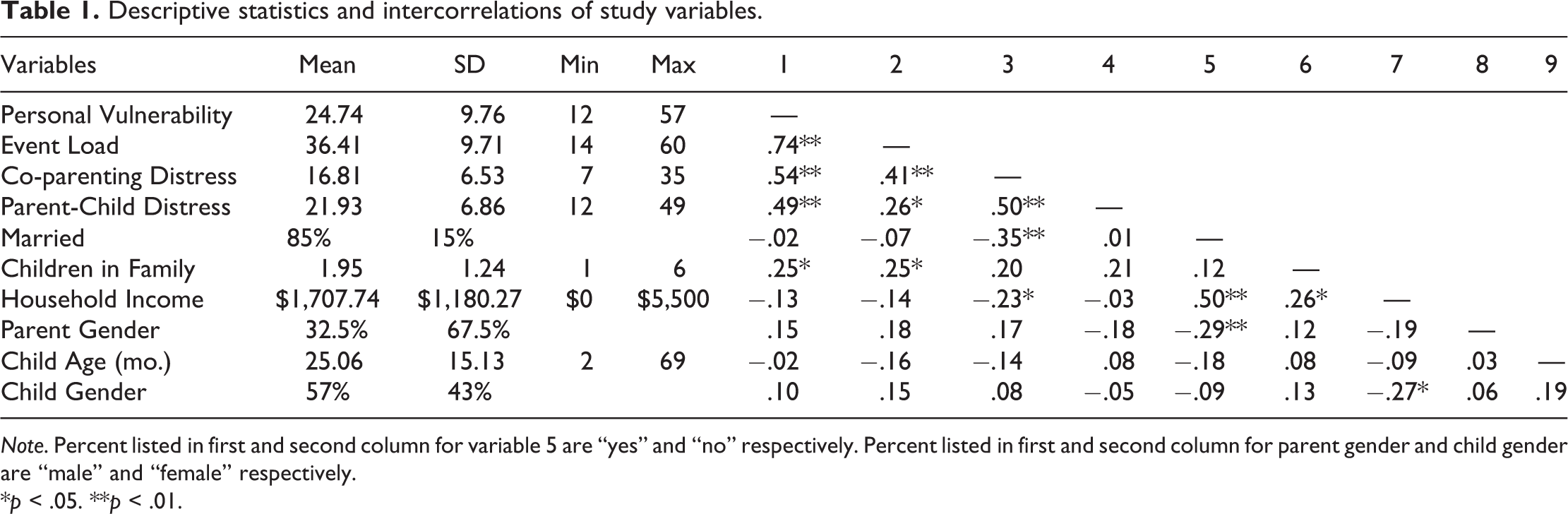
Note. Percent listed in first and second column for variable 5 are “yes” and “no” respectively. Percent listed in first and second column for parent gender and child gender are “male” and “female” respectively.
*p < .05. **p < .01.
Is student parent stress related to distress in parent-child relationships?
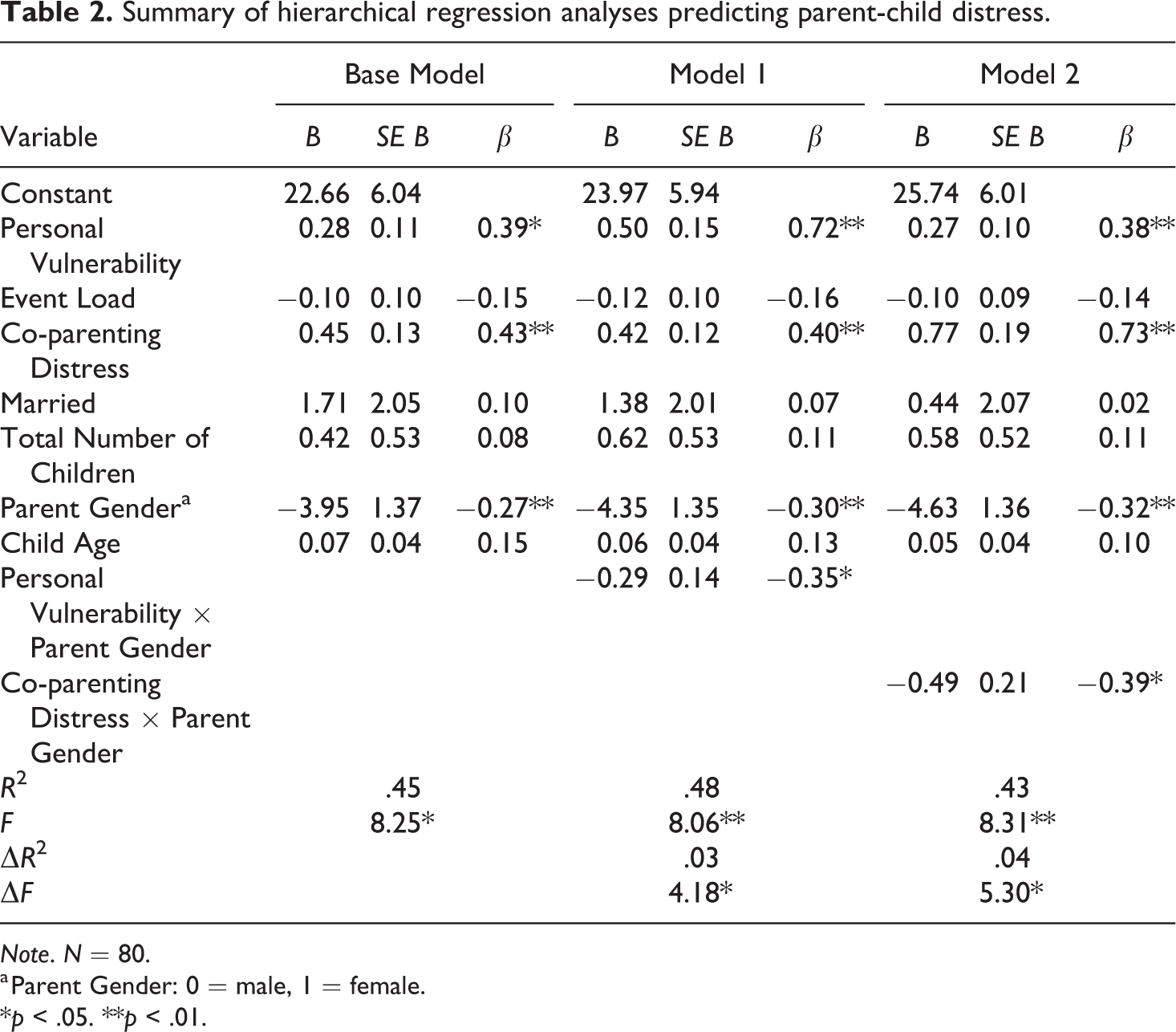
A summary of regression analyses are displayed in Table 2. The first regression tested whether student parents’ stress (personal vulnerability and event load) was associated with distress in the parent-child relationship. Income, parent age, and child gender were tested in initial models, but because they were not statistically significant they were trimmed from the model due to the relatively small sample size. As shown in the base model displayed in Table 2, event load was not a significant predictor of distress in the parent-child relationship. However, parent’s report of personal vulnerability predicted more distress in the parent-child relationship such that for every one-unit increase in personal vulnerability, there was a 0.32 increase in distress in the parent-child relationship (see Table 2). As shown in Table 2, parent gender was a statistically significant predictor of distress in the parent-child relationship, such that mothers, reported less distress in the parent-child relationship compared to fathers.
Summary of hierarchical regression analyses predicting parent-child distress.
Note. N = 80.
a Parent Gender: 0 = male, 1 = female.
*p < .05. **p < .01.
Next, we tested whether parent gender moderated the association between personal vulnerability and parent-child distress (shown in Model 2, Table 2). Results indicate that parent gender moderated the association between personal vulnerability and distress in parent-child relationships. Following the procedures outlined by Aiken and West (1991), simple slopes analysis showed that there was a positive association between personal vulnerability and parent-child distress for both mothers (B = .21, β = .30, t (72) = 2.00, p < .05) and fathers (B = .50, β = .72, t (72) = 3.33, p < .001), however, the association was stronger for fathers (see Figure 1).
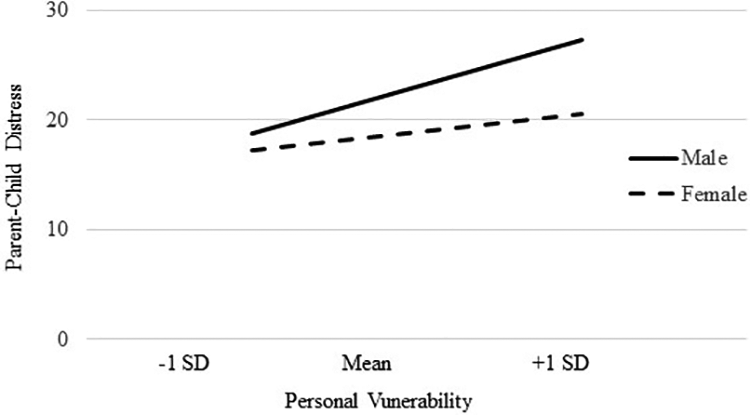
The moderating effect of parent gender on the association between personal vulnerability and parent-child distress.
A third regression model tested whether co-parenting distress predicted distress in parent-child relationships and whether this was moderated by parent gender. After accounting for stress levels via personal vulnerability and event load, the significant main effect for co-parenting distress showed problematic co-parenting was associated with more distress in parent-child relationships. A significant effect for parent gender indicated that fathers reported more distress in their parent-child relationships than mothers, however, these main effects were also qualified by a statistically significant interaction between distress in the co-parenting relationship and parent gender. Following the procedures outlined by Aiken and West (1991), simple slopes analysis showed that there was a positive association between co-parenting distress and distress in parent-child relationships for both mothers (B = .31, β = .29, t (72) = 2.14, p < .05) and fathers (B = .77, β = .73, t (72) = 4.15, p < .001), however, the association was stronger for fathers (see Figure 2).
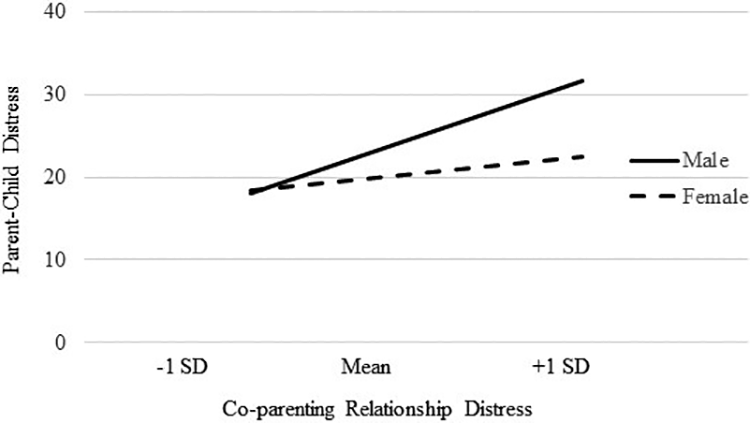
The moderating effect of parent gender on the association between co-parenting distress and parent-child distress.
What stressors do student parents report and how do they balance their family, school and work roles?
To address study goal 2, we conducted semi-structured interviews with college student parents to better understand their unique stressors and supports. Upon initial review, eight themes emerged (Family Goals, Personal Goals, Spousal Differences, External Resources, Scheduling, General Stress, Expectations in Life, and Family vs Student Roles) from open coding procedures by assigning recurring categories to relevant quotes from each interview transcription (Corbin & Strauss, 1990). Themes and sample quotes were then reviewed by the entire research team to check for accuracy of the thematic categories. These themes were then organized into broader categories (Causes of Stress, Coping Strategies, Responses to Being a Student Parent, and Persistence) during the axial coding phase. As a team, the researchers then engaged in a selective coding phase by reviewing the categories and how well each theme fit into its corresponding category. This resulted in the motivation category being dropped and reorganizing themes in this category into the Responses to Being a Student Parent category. The Expectations in Life theme and the Personal Goals theme were combined into the Personal Expectations theme because they both pertained to how parents felt about being a student and a parent. The Spousal Differences theme was dropped because gender differences appeared in every theme and category, indicating it was pervasive but did not yield unique information. For the purpose of clarity and to be consistent with the research questions, the remaining categories were renamed (Stressors, Coping Methods, and Family Relationships) and corresponded to six themes (Time, Vulnerability in Balancing Roles, External Resources, Co-Parenting Relationship, Personal Expectations, and Family Time). These categories and themes along with example quotes from the transcriptions are summarized in Table 3.
Qualitative responses regarding college student parents’ experiences.
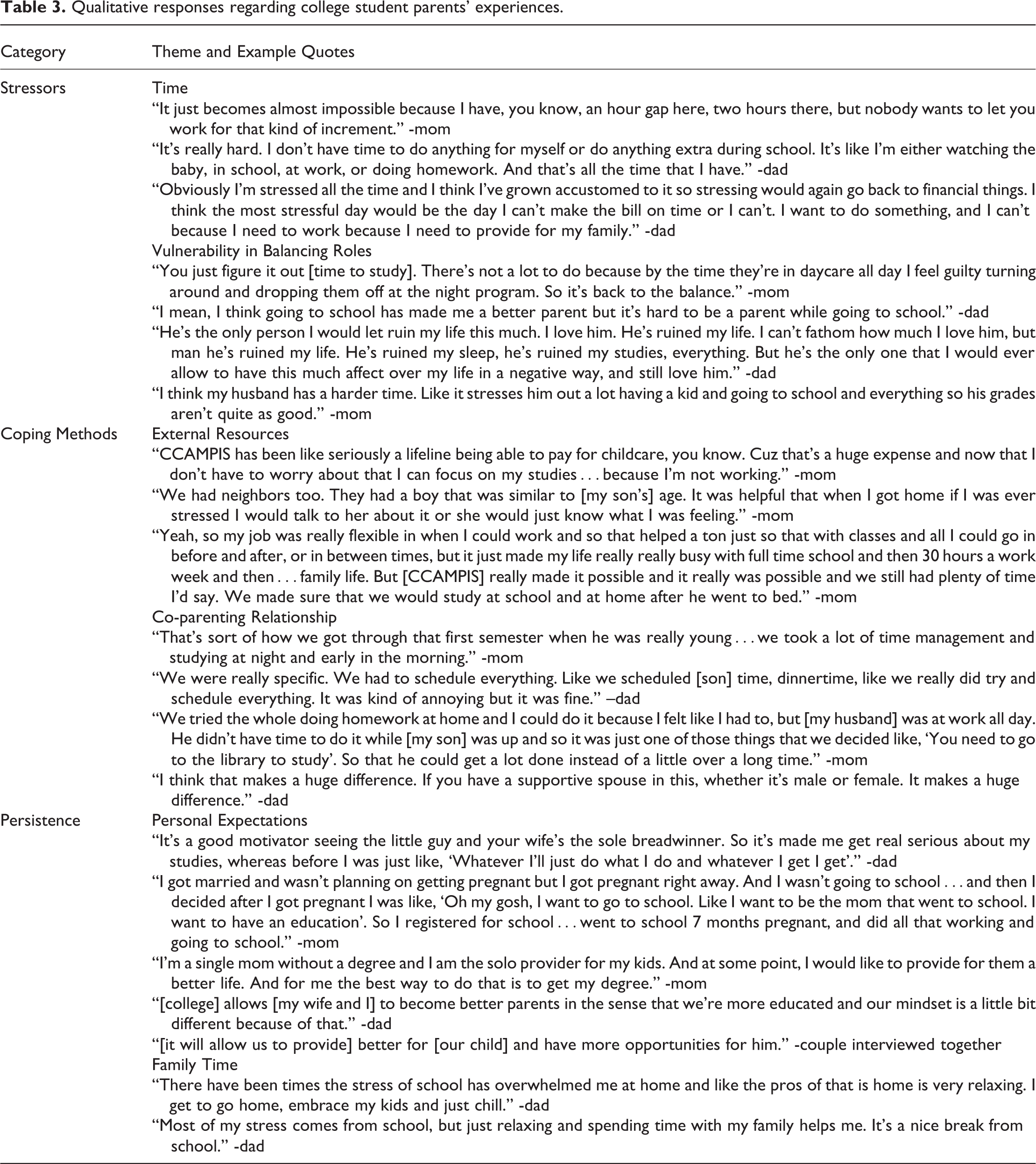
All six themes and how these themes fit into broader categories relating to student parents’ stressors, coping methods and family relationships are summarized in Table 3. These qualitative results provided insight to inform and illustrate the quantitative findings (Greene et al., 1989), especially with regard to gender differences that were observed in the quantitative findings. Additionally, the qualitative results generated new knowledge regarding unique stressors and supports that were not necessarily different for mothers and fathers. Thus, when gender differences were not observed in the qualitative data, specific quotes included in text were chosen based on how well they demonstrated the theme, regardless of parent gender.
The qualitative results showed that two themes emerged as the main sources of parents’ stress including Time and Vulnerability in Balancing Roles. Student parents reported not having enough time to fulfill their roles as student and parent because they had too many responsibilities associated with both. One father illustrated this when he said: But I mean balancing time spent is definitely an issue on where do I spend time. Do I spend it studying [for] my bio quiz or test or do I spend it putting my kids to sleep? And so that is a huge stress, is where do I put my time. It definitely puts a lot of stress and so I feel like sometimes I have to put homework as a priority over doing things with my kids. And at times I feel really bad about it. And I think, particularly this semester it’s been really hard for me to juggle that. Ummm, trying to get the balance right with slightly more difficult classes where I have to put more time into it, but umm, ya I think that’s just the main thing is just stress and time, time management, it’s harder. He’s the only person I would let ruin my life this much. I love him. He’s ruined my life. I can’t fathom how much I love him, but man he’s ruined my life. He’s ruined my sleep, he’s ruined my studies, everything. But he’s the only one that I would ever allow to have this much affect over my life in a negative way, and still love him.
An additional gender difference that emerged in the qualitative interviews was that fathers seemed to report more financial stress and pressure associated with being a provider than did mothers. One father recognized the stress he is constantly under from not having enough time to fulfill both his student role and his parent role. In this case, financial need seemed to be the underlying cause of his stress. He explained, “Obviously I’m stressed all the time and I think I’ve grown accustomed to it so stressing would again go back to financial things.” Not having enough time to spend with his family and get all of his work done led to financial worries, which is when he felt most vulnerable. This vulnerability was illustrated when he said: I think the most stressful day would be the day I can’t make the bill on time or I can’t, I want to do something and I can’t because I need to work because I need to provide for my family.
Interview participants were also asked what resources and strategies they use to help cope with their stress. As shown in Table 3, two themes emerged in response to this interview question: External Resources such as neighbors and institutional programs including CCAMPIS, and the Co-Parenting Relationship, which could act as a coping mechanism or a stressor depending on the partner’s level of supportiveness. The External Resources theme was illustrated by a mother that explained how her neighbor was an emotional support in addition to helping out with childcare: “They had a boy that was similar to [my sons’] age. It was helpful that when I got home if I was ever stressed I would talk to her about it or she would just know what I was feeling.” The Co-Parenting Relationship theme was evident in a quote from a father: “I think that makes a huge difference. If you have a supportive spouse in this, whether it’s male or female. It makes a huge difference.” When asked how he copes when stressed out, this father stated that his wife was the largest supporter and encourager he had. She even took on additional childcare tasks when he was particularly stressed out so that he could maintain a positive relationship with his child and a positive mental health status.
The final category that emerged from the qualitative interviews was Persistence. This category helped explain why participants persist through the stress of going to college while being parents and consisted of two themes: Personal Expectations and Family Time. Parents reported that having personal expectations of becoming a college graduate helped them endure through the stress of being a college student and a parent because they wanted to be able to better provide for their families. One mother described her personal expectations by saying: I am a single mom without a degree and I am the sole provider for my kids. And at some point, I would like to provide for them a better life. And for me the best way to do that is to get my degree.
The second theme in this category, Family Time, represented how beneficial spending time with family can be to student parents’ stress levels. During his interview, one father said, “Most of my stress comes from school, but just relaxing and spending time with my family helps me. It’s a nice break.” For this father, being able to relax and forget about his role as a student helped him de-stress and rejuvenate. Both mothers and fathers reported that even though they had less time overall, the time they did spend with their families was of greater quality because they valued it more. For example, one mother said, “Even though our time was limited with him [our son] we totally valued it way more.”
Discussion
Educational attainment is associated with a plethora of beneficial outcomes such as better physical and mental health, and higher levels of overall life satisfaction (National Center for Education Statistics, 2017). Higher education has long-term benefits for families including better economic and employment opportunities as well as intergenerational benefits such as increased likelihood of college attendance by offspring. Yet, college student parents are in a difficult position of having to manage multiple demands associated with balancing their school and family roles. This puts college student parents at an increased risk for stress and has implications for their family relationships. The present study drew on models of stress (e.g., contagion of stress theory, role overload) and family systems theory to examine the experiences of college student parents using a mixed methods design. Taken together, findings show that college student parents experience a variety of stressors that do pervade their relationships with their children and this association is more detrimental for father-child relationships than mother-child relationships. However, in-depth qualitative interviews not only highlighted and expanded on the various sources of stress (e.g., time demands, multiple roles), but also revealed internal and external resources that college student parents draw on to help cope with the stressors they experience. This is important especially given trends suggesting student parent retention services appear extremely disproportionate to the number of student parents on campuses (Lovell, 2014).
We examined the extent to which parents’ stress was associated with distress in the parent-child relationship. Our measures of stress included personal vulnerability (e.g., “felt like you couldn’t cope) and event load (e.g., “felt swamped by your responsibilities”) and results showed that personal vulnerability but not event load predicted distress in parent-child relationships. We hypothesized that student parents’ multiple roles would generate feelings of being “overextended” or “swamped by responsibilities” and would negatively affect their relationships with their children. However, our findings showed that it was personal vulnerability, feeling like “you couldn’t cope” or “that nothing was going right,” that was associated with greater distress in parent-child relationships. This is an encouraging finding because it suggests that it is not necessarily the multiple roles that college student parents occupy which puts them at-risk for problems in the parent-child relationship. Rather, it is their perceptions about their ability to cope with stressors that seems to be associated with distress in their relationships with their children. This finding may be explained by the voluntary nature of occupying the role of student. For example, it has been posited that multiple roles are more detrimental to health and well-being when they are involuntary rather than voluntary (Mirowsky & Ross, 2003).
Interestingly, these results indicate that the association between personal vulnerability and distress in parent-child relationships was stronger for fathers compared to mothers. This finding is consistent with previous research that documented men and women experience stress differently (Costigan et al., 2003). Some previous research suggests that women are more likely to report family-to-school spillover and work-to family spillover than men (e.g., issues at home interfere with school; Costigan et al., 2003; Pedersen & Jodin, 2016). However, results from the present study indicate that fathers reported more distress in their relationships with their children than mothers when they reported high levels of personal vulnerability. This finding is consistent with previous research that showed fathers experienced greater spillover from home to work than did mothers, even though mothers had a disproportionate share of housework and childcare (Bolger et al., 1989). One potential explanation of this finding is that perhaps because of cultural expectations that continue to view mothers as the primary caregivers of children who are more skilled at managing multiple roles (Offer & Schneider, 2011), mothers may be better able to deal with their stress so that it does not negatively impact their relationship with their children. Whereas fathers may have more of a difficult time managing their stress associated with multiple roles. Although gender roles around parenting have changed significantly and fathers are more involved today than in past decades, mothers continue to take on the majority of childcare (Yavorsky et al., 2015).
The qualitative results also underscored and contextualized gender differences in relation to stress and how stress affected student parents and their families. For example, fathers seemed to report more financial stress and stress associated with being the provider than mothers. It is possible that this constant worry associated with financial stress may be the pathway through which fathers’ stress is linked to distress in their relationships with their children. Parents who are spending their energy being constantly worried about fulfilling their provider, parent, and student roles may not have enough energy left to engage positively with their children. Perhaps, since fathers have historically been expected to be the “breadwinner” of the family and being a college student either diminishes this role altogether or makes it more difficult to fulfill, college student fathers experience more feelings of vulnerability due to their role contagion and spillover into their parent-child relationships compared to college student mothers. This finding is in line with previous literature that found money-related stress spills over into family relationships for fathers more than it does for mothers (McCormick et al., 2017).
Additionally, it may be that mothers have more supports and resources available to them or are more likely to seek out social support and experience a work culture that is supportive of parenting (Hill, 2005). As previously discussed, multiple roles are more detrimental to health and well-being if they are involuntary (Mirowsky & Ross, 2003) which may also explain why the association between personal vulnerability and distress in parent-child relationships was stronger for fathers than mothers in the present study. It may be that a mother’s role as a student is more likely to be viewed as voluntary, whereas a father’s role as a student may be more likely to be viewed as involuntary because of cultural expectations for a father to be the provider for the family. Completion of a college degree could strengthen a father’s role as a provider through more job security or higher pay than before completing a college degree. This finding of gender differences in relation to distress in parent-child relationships, underscores the importance of considering gender differences when planning stress management programs by including both student fathers and mothers.
Our findings also showed that the co-parenting relationship is an important factor to consider among college student parents. A large body of research has documented that the quality of marital and co-parenting relationships has implications for parent-child relationships (Cooper et al., 2009; Margolin et al., 2001). Our results showed that after accounting for other types of stress (i.e., personal vulnerability and event load), lack of support in the co-parenting relationship was associated with greater distress in parent-child relationships. We also found that this association was stronger for fathers compared to mothers. The qualitative data generated from semi-structured interviews also added insight into the coping mechanisms parents use to manage their increased levels of stress during this period of their lives and highlighted the importance of the co-parenting relationship. Maintaining a supportive co-parenting relationship including creating, agreeing on, and following a schedule with their spouse were strategies used by parents to help cope with their personal stress associated with being college student parents.
Overall, interview data provided insight into how participants experienced being a college student parent and this included understanding sources of stress as well as sources of motivation or persistence. Parents overwhelmingly reported several key sources of stress that all dealt with time. These findings are consistent with recent research that showed parents with young children experience more “time poverty” than parents with older children because younger children require more time and attention from parents (Wladis et al., 2018). Our findings also support the literature on stress contagion across multiple roles creating spillover, as results from this study demonstrated parents do not have enough time to fulfill both their roles to their satisfaction. Parents talked of the challenges associated with being a parent and going to school. They explained that they felt the quality of their parenting could be better but was impeded by the time required to study or go to campus. Not surprisingly, they reported feelings of guilt when they prioritized school over parenting activities.
However, the qualitative interviews also revealed positive spillover and showed that low-income student parents were also motivated by their families and personal expectations to pursue their college degrees which likely contributed to their persistence in school. They channeled this motivation to help them endure this stressful but temporary period of life. Two sources of persistence that were evident in the qualitative interviews included personal expectations and family time. Several student parents spoke of their motivation to persist coming from their own desires and self-expectations. Participants commonly referred to the time they spent with their family as being “relaxing” and rejuvenating. Putting aside school and work to spend time with family members helped reduce their stress and strengthened their relationships with their spouses and children. Both fathers and mothers discussed how they believed graduating from college would benefit their family financially and allow them to give their children more opportunities in life. It is likely that these sources of motivation serve as inspiration for student parents to endure through this stressful time in their lives. The qualitative interviews allowed us to identify areas of positive spillover (e.g., being a parent also helped with motivation and discipline in school; being a college student improved parenting) that we would not have discovered if we had focused only on the quantitative results. However, there is little research examining these associations and more research is needed to better understand the role that motivation from family plays in helping mothers and fathers who are college students persist to graduation.
Taken together, the quantitative and qualitative findings from this research have important implications for practice that may reduce stress for college student parents and ultimately facilitate degree completion. Our quantitative results showed that when parents did not feel supported by their co-parent, they reported more distress in their relationships with their children and our qualitative results highlighted how some parents were effective at working together. These results suggest that program efforts to strengthen the co-parenting relationship may help college student parents more effectively manage their stress and engagement in multiple roles thereby increasing retention and graduation rates for student parents. Many universities have centers for nontraditional student success that host career development seminars and academic tutoring. Workshops or presentations that teach relationship-building skills including communication and stress management could be offered to student parents through these centers or similar university offices (e.g., Counseling and Wellness). Given that the connections between parent stress and distress in parent-child relationships were stronger for fathers compared to mothers, efforts to encourage fathers’ participation is especially warranted. Although fathers may be difficult to engage, past research on parenting interventions documents the greatest benefits when co-parenting is the focus and both parents attend (Pruett et al., 2017). Mindfulness-based interventions are also a promising avenue for reducing personal vulnerability and role overload (Economides et al., 2018) and have the benefit of being delivered in a brief intervention via smartphone app.
These results also have policy implications at colleges and universities. For example, one mother’s report of her job flexibility and family-friendly environment emphasized how helpful it was to be able to make her own schedule and work in short increments of time (see Table 3 for direct quote). Workplace and school policies that have flexible schedules/hours could help student parents with their on-campus and off-campus jobs which is important especially given recent evidence that multiple roles do not always have to be in conflict with one another and can be beneficial for female non-traditional students (Andrade et al., 2017). We also learned from the qualitative interviews that many parents heard about the CCAMPIS program through informal channels such as friends rather than from official university sources. This suggests a greater need for university administrators to make student parents more aware of the resources available and possibly increase coordination across university offices. For example, if the admissions office or academic advising is aware of the student’s parent status, that office could connect the student with programs such as CCAMPIS. It is also likely that universities would benefit from expanding student-parent retention services, particularly as the number of college student parents continues to increase and retention services are often low relative to the proportion of student parents on campus (Lovell, 2014).
The findings from this research must be considered in context of study limitations. The data collected were cross-sectional and causal inferences cannot be made. We also recognize that relationship dynamics and stress are reciprocal in nature. Although our models examined whether stress predicted distress in parent-child relationships, it is also possible that distress in parent-child relationships predicts parents’ stress. Further, the stress variables in this study (event load and personal vulnerability) were highly correlated making it difficult to detect unique variance of event load. Given the overlap in these constructs, future research might explore how the combination of event load and personal vulnerability contributes to distress in parent-child relationships. It is also likely that individuals who perceive more stress in general are more likely to perceive greater distress in their relationships with their children. Additional data gathered from direct observations of parent-child interactions is recommended in order to reduce the measurement bias associated with the same person reporting on both the independent and dependent variables. Future research should include longitudinal designs that could investigate reciprocal associations among dimensions of stress and family relationships. The data came from low-income college student parents enrolled in a large, public university in the Mountain West region of the United States and may not be generalizable to student parents in other regions. Unfortunately, we were not able to investigate child outcomes given the scope of the present study and recommend that future research examine child outcomes. Perhaps the greatest evidence of the importance of intergenerational child outcomes came from a single mother of twin 3-year old boys, who remarked in her qualitative interview, “I want them to be able to go to college and I’m not sure I’ll be able to provide that for them unless I finish college…So I mean it’s just this grant [CCAMPIS] will be affecting generations of my family.” Despite these limitations, the present study contributes new knowledge to the literature regarding the experiences of stress faced by low-income college student parents, its impact on their families, and how they cope with this stress. As higher education continues to be necessary for many future employment opportunities, it is critical for researchers, practitioners, and policy makers to investigate how best to support college student parents and their families.
Footnotes
Authors’ note
This research was presented at the annual conference of the National Council on Family Relations, San Diego, CA (2018).
Author contributions
AMD contributed to data analysis, provided interpretation of the data and wrote major portions of the manuscript. ACJ contributed to data analysis and portions of the manuscript, KNM contributed to data analysis and portions of the manuscript, SP assisted with preparation of the manuscript, LKB conceived of the study and its design, provided interpretation of the data, and wrote portions of the manuscript.
Ethical approval
All procedures performed in studies involving human participants were in accordance with the ethical standards of the institutional and/or national research committee and with the 1964 Helsinki declaration and its later amendments or comparable ethical standards.
Funding
The author(s) disclosed receipt of the following financial support for the research, authorship, and/or publication of this article: Funding for this research was provided in part by the U.S. Department of Education [P335A170076] awarded to Lisa K. Boyce.

Informed consent
Informed consent was obtained from all individual participants included in the study.
Open research statement
As part of IARR’s encouragement of open research practices, the authors have provided the following information: This research was not pre-registered. The data used in the research cannot be shared with any person because the data are part of a larger ongoing evaluation study. The materials used in the research cannot be shared with any person because they are copyrighted.