



Abstract
The current study investigates sexual scripts in reality dating shows—in particular, how the gender of the communicator affects the choice of verbal and nonverbal immediacy behaviors aimed at making a first impression. Data were drawn from 331 couples of opposite-sex heterosexual strangers interacting for approximately 30 seconds on two reality dating shows: The Bachelor and The Bachelorette (2012–2019). As a result, a codebook of verbal immediacy cues (N = 1623) and nonverbal immediacy cues (N = 3021) was derived. The findings showed that verbal behavior encompassed 11 categories of verbal immediacy cues, while nonverbal behavior included 32 categories of nonverbal immediacy cues. Results also showed gender-related preferences for verbal immediacy behavior; for instance, men were more likely to outline the probability of relationship development and pay compliments; conversely, women were prone to intriguing men to arouse curiosity and interest. As for nonverbal immediacy behavior, men were predisposed to use clothes straightening, while women tended to communicate immediacy through head tilt, shoulder shrug, gaze down, gaze side(s), eyebrow flashes, hand-in-hand, hug, pat, holding hands in front of their bodies, and hair grooming. Nonetheless, the similarities between men and women were found to be greater than the differences. These findings could have wide-reaching implications for theorizing on social and cultural norms, gender stereotypes, and traditional gender roles in intimate relationships in the form of sexual scripts, along with contributing to the study of reality television.
Keywords
As potential partners decide whether they are interested in initiating romantic relationships, first impressions become a crucial part of face-to-face romantic encounters. They influence initial relationship outcomes and satisfy social needs such as love, acceptance, belonging, affection, intimacy, and relationships (Ambady & Skowronski, 2008; Sprecher, 1989). First impressions are particularly relevant in the context of reality dating shows, such as The Bachelor/The Bachelorette (2002–present). Each season kicks off the series with a “first impression” round, where approximately 30 contestants compete against each other to receive both an invitation to a date and the coveted “first impression rose.” Contestants are seen vying for the attention of the bachelor/bachelorette, and female/male contestants employ various immediacy behaviors to impress the opposite-sex stranger in a highly competitive environment.
Reality dating shows have received attention due to their popularity (Statista Research Department, 2016). The official Facebook pages for ABC’s The Bachelor and The Bachelorette currently have more than 3.6 million followers. Reality dating shows are also significant cultural objects, whose production and consumption shape and reflect ever-changing norms, values, and ideologies of contemporary culture (Montemurro, 2007). Lewis (2016) argued that reality dating shows offer rich insights into the ways in which contemporary media culture negotiates and promotes models of gendered individualism. Specifically, reality dating shows reflect traditional gendered ideas about men and women engaged in romantic relationships (Ferris et al., 2007; Montemurro, 2007). Moreover, research illustrates that reality dating shows can even influence viewers to change their beliefs, perceptions, and behaviors relating to relationships and romance in accordance with the televised storylines they consume. To be specific, viewers slowly absorb the ideas, morals, and views depicted by contestants (Egbert & Belcher, 2012; Zurbriggen & Morgan, 2006), which mostly reflect attitudes and behaviors of gender inequality within relationships that place women in subordinate positions to men (Ferris et al., 2007).
Such mediated depictions (e.g., depictions of gender, immediacy behaviors, and first impressions) in reality dating shows can be understood in the form of sexual scripts. According to sexual scripts theory (Simon & Gagnon, 1986), sexual scripts on television can be utilized as cultural guides that influence individuals’ navigation of their own relationships, dating, and attitudes (Hust & Rodgers, 2018; Seabrook et al., 2016). Sexual scripts in reality dating shows specifically may help inform media consumers’ perceptions of what first impressions for the attention of a romantic interest should be like in real life. As such, the contextual cues depicted in reality dating shows can provide viewers with the procedural elements of first impressions when dating specific to gender—the who, what, when, and where of first impressions for dating in the form of sexual scripts. In the present study, we examine two contextual cues for first impressions that can serve in the form of sexual scripts: gender and immediacy behaviors (both verbal and nonverbal). Hit reality dating shows, then, have immense power to determine what social and cultural norms are acceptable in romantic relationships. Thus, this specific genre of television merits exploration as a source of sexual scripts, which could also contribute to the study of reality television.
Reality dating shows
Reality dating shows are defined as “the edited footage of unscripted interactions, broadcast as a television series about participants’ naturally occurring social life” (Goddard, 2003, p. 73). However, research supports different views regarding realistic displays of the situations and circumstances contestants react to in reality dating shows. Media critics argue that the situations depicted in reality dating shows differ from a typical dating scenario (Cummins & Gordon, 2006; Nabi et al., 2003). For example, “sets are constructed through art and property departments, participants are cast from among thousands of applicants, producers shape and sequence the events, and editors finalize the broadcast segments” (Goddard, 2003, p. 73). On the other hand, scholars claim that contestant behaviors are unscripted and unprompted (Brenton & Cohen, 2003). Similarly, Kavka (2008) highlighted that feelings of intimacy engendered by unscripted drama are both real and socially informative. To build a consensus among media researchers, Dowd (2006) pointed out that whether reality TV is scripted or not, it offers its viewers a real depiction of both individuals and issues. Ultimately, then, it may not be as relevant to consider whether reality dating shows are “real” versus not. Rather, viewers likely consume the shows peripherally for entertainment purposes rather than with a critical eye.
Even though the initial interactions of the contestants are framed by the media dating format, they are still particularly informative and elucidative. Specifically, content analytic work illustrates that reality dating shows depict cultural norms and reinforce gender stereotypes in initial romantic relationships (Ferris et al., 2007). As a result, Zurbriggen and Morgan (2006) suggested that reality dating shows are both informational guides for social behavior and tools to learn about dating and romantic relationships, otherwise known as sexual scripts (Simon & Gagnon, 1986).
Therefore, we argue that reality dating shows are specifically important to study in relationship research within a mediated context for three main reasons. First, with the rise of streaming services, media consumers have easier access than ever before to view reality dating shows; adolescents watch television for approximately 2 hours and 52 minutes per day (Rideout & Robb, 2019) whereas adults consume 4 hours per day (Richter, 2020). Clearly, while the television experience has shifted, the importance and popularity of it has not. Second, compared to other types of television genres, reality dating shows are especially unique because they present relationship formation from start to finish. That is, viewers get a “full story” from the moment where a couple meets and how their relationship develops, which is not a typical experience to which individuals would be able to fully view as an attentive audience. Third, as a result of the easy access and unique appeal from reality dating shows, the romantic narratives from attractive role models (e.g., contestants) that viewers see may act as a set of “instructions” or “guides” in the form of sexual scripts (Simon & Gagnon, 1986; Zurbriggen & Morgan, 2006), to the point where viewers can take the behavioral norms they see in reality dating shows and use them to instruct their own dating behaviors.
Sexual scripts theory
According to the sexual scripts theory (Simon & Gagnon, 1986), heterosexual encounters are learned interactions that follow predictable sequences or “scripts” (Frith & Kitzinger, 2001). Simon and Gagnon (1986) developed the theory to explain how people derive meaning from snippets of information they receive about sex and relationships via different sources. Sexual scripts theory posits that individuals will behave in accordance with sexual scripts under two conditions. First, individuals must believe that the script is socially acceptable. Second, individuals must believe that behaving in accordance with the script will produce a favorable outcome (i.e., a reward). To illustrate, if reality dating show viewers are exposed to a mediated depiction of a first impression among a couple, they will be motivated to mimic similar immediacy behaviors only if the target responds favorably to the first impression and if that behavior yields a reward (e.g., date, first impression rose). Whether a sexual script is socially acceptable depends on three factors: (1) cultural scripts (i.e., social norms), (2) interpersonal scripts (i.e., individual attitudes), and (3) intrapsychic scripts (i.e., personal desires).
First, cultural scripts are guides or “rules” regarding relational norms that are widely accepted (Simon & Gagnon, 1986). An example of a cultural script is the idea that men are sexual initiators and women are sexually submissive or the idea that women seek romantic relationships whereas men seek sexual ones (Aubrey et al., 2020; Kim et al., 2007). Cultural scripts guide interpersonal and intrapsychic scripts. Intrapsychic scripts are one’s personal desires, which are developed by evaluating personal desires (e.g., sexual and relational desires) in conjunction with managing whether acting on that desire will yield a reward. Lastly, interpersonal scripts transform cultural scripts into specific procedures for interactions with others. Interpersonal scripts are developed by combining cultural (i.e., “what is socially appropriate?”) and intrapsychic scripts (i.e., “what are my personal desires?”).
Cultural scripts are the driving force of sexual scripts theory. A main source for cultural scripts is the media (Ward, 2003). Television specifically is a key source for cultural scripts because it is easily accessible with streaming services and provides compelling narratives of romantic relationships. As Wright (2011) argues, people are motivated to seek information from mediated sources, such as television, because individuals yearn to learn more about behaviors that are socially acceptable and rewarding with dating and relationships. In particular, individuals who have little or no first-hand experience with sex or dating will be even more dependent on television to teach them what they should and should not do in their own dating lives (Finnerty-Myers, 2011). Through reality dating shows, then, consumers can acquire sexual scripts (i.e., learn a new script), activate the sexual scripts (i.e., cue retrieval of the script), and apply the sexual scripts (i.e., utilize the script as a guide in their real life; Wright, 2011). Indeed, scholars have illustrated this process with television as a main source of cultural scripts, demonstrating that frequent television consumption predicts strong endorsement of the heterosexual script (i.e., unequal roles for men and women in relationships; Seabrook et al., 2016). As such, we argue that reality dating shows are a source of cultural scripts that have the unique power to determine what rules are socially acceptable among first impressions when dating.
Contextual cues depicted within reality dating shows can teach viewers the very specific ways to navigate first impressions within dating, such as who communicates or behaves in which way with which people in an effort to yield a reward (Simon & Gagnon, 1986). While a growing body of work has found gender normative behaviors in reality dating shows (Ferris et al., 2007), very little is known about the context in which these behaviors occur. Therefore, the present study sought to address this gap with a specific examination of verbal and nonverbal immediacy behaviors for first impressions by gender in reality dating shows.
Verbal and nonverbal immediacy behaviors
Researchers suggest that attraction and interest in first intimate interactions are characterized by immediacy behaviors (Andersen, 2010; Mehrabian & Wiener, 1967); these can also be labeled as “expressive” behaviors (Patterson, 1983). Verbal and nonverbal immediacy behaviors aid in forming impressions, conveying emotions, and signaling attraction. Specifically, they have a positive, warm, approving, or even sensuous effect on a potential date (Prager & Buhrmester, 1998). Mehrabian and Wiener (1967) described verbal immediacy as stylistic differences in expression from which we infer likes or dislikes. Verbal immediacy cues (VICs) are informal forms of address (King & Sereno, 1984), partner nicknames, expressions of affection, sexual invitations (Hopper et al., 1981), self-disclosure (Greene et al., 2006; Guerrero et al., 2011), small talk (McKay-Semmler & Semmler, 2013), humor (Hall, 2017), compliments (Hall & Xing, 2014), and intrigue (Romaniuk, 2020).
When strangers meet for the first time, they communicate their feelings through various nonverbal immediacy cues (NICs; Knapp et al., 2014) that ultimately become the major channel for communication (Grammer, 1990). NICs convey an engaging image that tends to attract a potential partner in the context of flirtation, courtship, and seduction (Givens, 1978). Overall, nonverbal immediacy behavior encompasses touch, smile, high level of mutual gaze, forward lean, head tilts, facial relaxation, general arousal, increase in body movements, open body posture, and proximity (Andersen, 2010; Hall & Xing, 2014; LaFrance & Vial, 2016). During an initial interaction, partners use immediacy behaviors to communicate openness, warmth, interpersonal closeness, willingness to continue the relationship, coyness, submissiveness, attraction, and interest to impress a potential date as well as initiate a romantic relationship.
Similarly, Rose and Frieze (1989) claimed that behavior on a first date or encounter is highly scripted, particularly by gender-related preferences. More recent research suggests that this finding still prevails for adults and college students (Cameron & Curry, 2020). As Cameron and Curry (2020) explain, “first date scripts follow traditional gender stereotypes whereby men are assigned active and dominant behaviors (e.g., asking for the date), and women are prescribed reactive behaviors (e.g., waiting to be asked)” (p. 346). Indeed, men are expected to perform four to five male gender-typed actions (asking for a date, planning date, courtly behavior, payment for the date, and starting sexual interaction), while women perform only one female-typed action (being concerned with appearance; Rose & Frieze, 1993). Following the scripting perspective, the immediacy behaviors employed by female/male contestants to impress a stranger of the opposite sex may serve as predictable dating scenarios for real-life initiation of romantic encounters.
Gender differences in verbal and nonverbal immediacy behaviors
Immediacy behaviors are also highly influenced by stereotypical norms (Sharabi & Dykstra-DeVette, 2019). Traditional gender roles especially are present within three romantic encounter scripts: “dating, hanging out, and hooking up” (Eaton et al., 2015, p. 788). The literature also specifies gender similarities and differences in face-to-face romantic encounters, generally outlining that the similarities between men and women are greater than the differences (Tannen, 1997). For instance, Vergara (2015) pointed out that the reality dating show contestants use uptalk (i.e., a question intonation at the end of a statement) regardless of their gender. However, unlike men, women use uptalk for flirting during romantic interactions. Hsiang (2019) concluded that both men and women construct their images through a positive perspective and express their desirability through metaphors. In addition, Romaniuk (2016) claimed that both men and women have similar choices in their speech; however, men are more likely than women to use adjectives. Similarly, both men and women often initiate relationships using pickup lines; nonetheless, men are more direct than women (Sharabi & Dykstra-DeVette, 2019). Men also prefer to avoid self-disclosure because this might make them appear weak or vulnerable (Wood, 1995). As such, while forms of communication in romantic immediacy behaviors are similar by gender, a few subtle differences exist.
As for nonverbal immediacy behavior, women express their attraction to their male counterparts through smiling and laughing (Hall & Xing, 2014). They also use head tossing, grooming behaviors, and self-touching as ways of communicating to their romantic interest that they want to initiate a conversation (Guéguen, 2008). On the other hand, men are more likely than women to lean toward their conversational partner throughout their interaction with them (Hall & Xing, 2014). Women communicate their romantic interest via bodily signals of self-presentation and submission (e.g., hair flip, avert gaze downward, shoulder movements, head tilt) whereas men do the same through body orientation and signs of dominance (e.g., trunk turned toward the female, hands folded behind the neck, arms either held by the wrist or the palm, legs crossed but open); lack of interest is showcased through closed postures for both men and women (Grammer, 1990). Consequently, men and women have different repertoires of nonverbal behavior to communicate different romantic meanings (LaFrance & Vial, 2016). However, reality dating shows have received relatively little scholarly attention in terms of gender-related preferences for nonverbal immediacy behavior.
Thus, we analyzed how the communicator’s gender affected the choice of verbal and nonverbal immediacy behaviors employed by female/male contestants in reality dating shows. Such behaviors are enacted in an effort to impress a romantic interest that will ultimately yield a compelling reward, such as a date or a first-impression rose. Accordingly, this study could advance our understanding of gender-related differences in immediacy behaviors within the context of sexual scripts, which can explain how reality dating shows account for first impressions in a real-life encounter. Clearly, the range of VICs and NICs is wide and varies greatly by gender, but those enacted by strangers aimed at making a first impression have not been specified. This leads to the following research questions:
Method
Data
Generally, there are 25–30 bachelors/bachelorettes in the first episode of every season of the reality dating show. Consequently, data were collected from 331 couples comprising opposite-sex heterosexual strangers interacting in the first episode of the latest seasons of The Bachelor (Seasons 16–23) and The Bachelorette (Seasons 8–15). We only included episodes that were released from 2012–2019. In order to be selected to be a contestant on the show, contestants must be (1) United States citizens or resident aliens living in the United States, (2) at least 21 years of age, and (3) not currently involved in a committed intimate relationship (see Fleiss & Fuchs, 2012–2019). Men’s ages ranged from 24 to 41 (Mage = 28.9 years, SD = 2.8); women’s ages ranged from 21 to 35 (Mage = 26.4 years, SD = 2.7).
Procedure
The designed format of the dating show implies that in the “first impression” round, every contestant is allocated some time to impress a bachelor or bachelorette. As a result, time spent by men to impress bachelorettes varies from 10 to 86 seconds (Minteraction = 33.6 seconds, SD = 12.9), while time spent by women to impress bachelors ranges from 5 to 58 seconds (Minteraction = 29.5 seconds, SD = 10.3). However, reality dating shows have some limitations. For instance, editing is used to create a story, create impressions, and generate suspense. Other filming decisions, such as specific camera angles and lighting, also vary. Some contestants also prefer to wear costumes, such as Santa Claus, a chicken, a unicorn, or glasses with a mustache (“Groucho glasses”). As a result, contestants’ nonverbal immediacy behavior was impossible to analyze in these circumstances mostly because their faces and bodies were fully or partially covered by the costumes. Thus, in order to maintain the accuracy of the current research, the following criteria for initial interactions were established: (1) contestants should be presented in the whole without editing (verbal immediacy behavior), (2) contestants should not be difficult to assess due to camera placement or other factors like dress (nonverbal immediacy behavior), and (3) contestants should only engage in dyadic encounters (i.e., The Bachelorette Season 11 Episode 1 was left out because male contestants tried to simultaneously impress two bachelorettes). In sum, the number of contestants taken into consideration in our sample was different from the original sample size (cf., Nmales = 190 and Nfemales = 225 vs. Nmales = 142 and Nfemales = 189).
In order to fulfill their goal of impressing a bachelor/ bachelorette, contestants initiated interactions. Conversely, the bachelor/bachelorette’s goal was to choose the contestants that they would like to reward with a “first impression rose” and invite for a date after the “first impression” round. Accordingly, suiters usually had quite short and passive responses, such as “Right,” “Really?,” “Oh, my God,” and “Yeah.” These tactics allowed the contestants to lead the conversation. Therefore, to gain insight into immediacy behaviors employed to impress a potential partner, the VICs and NICs employed by the contestants were the subjects of the subsequent analyses.
To account for the criticism surrounding automated content analyses, particularly with respect to the initial interactions of contestants in a media context, manual coding for the samples was used. Qualitative content analysis began with chunked coding aimed at sorting out every initial dyadic interaction (i.e., data chunk) from the full episode (Berg, 2009). Then, line-by-line coding of every data chunk was performed to define VICs and NICs within every spoken conversational exchange (Charmaz, 2006). Every data chunk was coded twice to ensure thoroughness and accuracy of codes. As a result of a preliminary study of 15 episodes, a pilot codebook of VICs and NICs enacted by male/female contestants on The Bachelor/The Bachelorette was derived. Each NIC was accompanied by a photo or video shot to facilitate efficient coding. Further, two coders separately coded 331 data chunks for the presence or absence of the 12 VICs and 64 NICs that were taken between September and November 2019. The reliability of codes was analyzed after every episode to reconcile disagreements between the coders. If the reliability was inadequate, the two coders were brought together to compare and refine coding categories to ensure consistency and to standardize the codebook interpretation. If the code failed to reach adequate reliability or was infrequent (i.e., not representative), it was excluded from further analyses. Hence, the number of codes was reduced to a more manageable size. One VIC and 32 NICs were eliminated from the study and thus, 11 VICs and 32 NICs were included in the final analyses (see Tables 1 and 2).
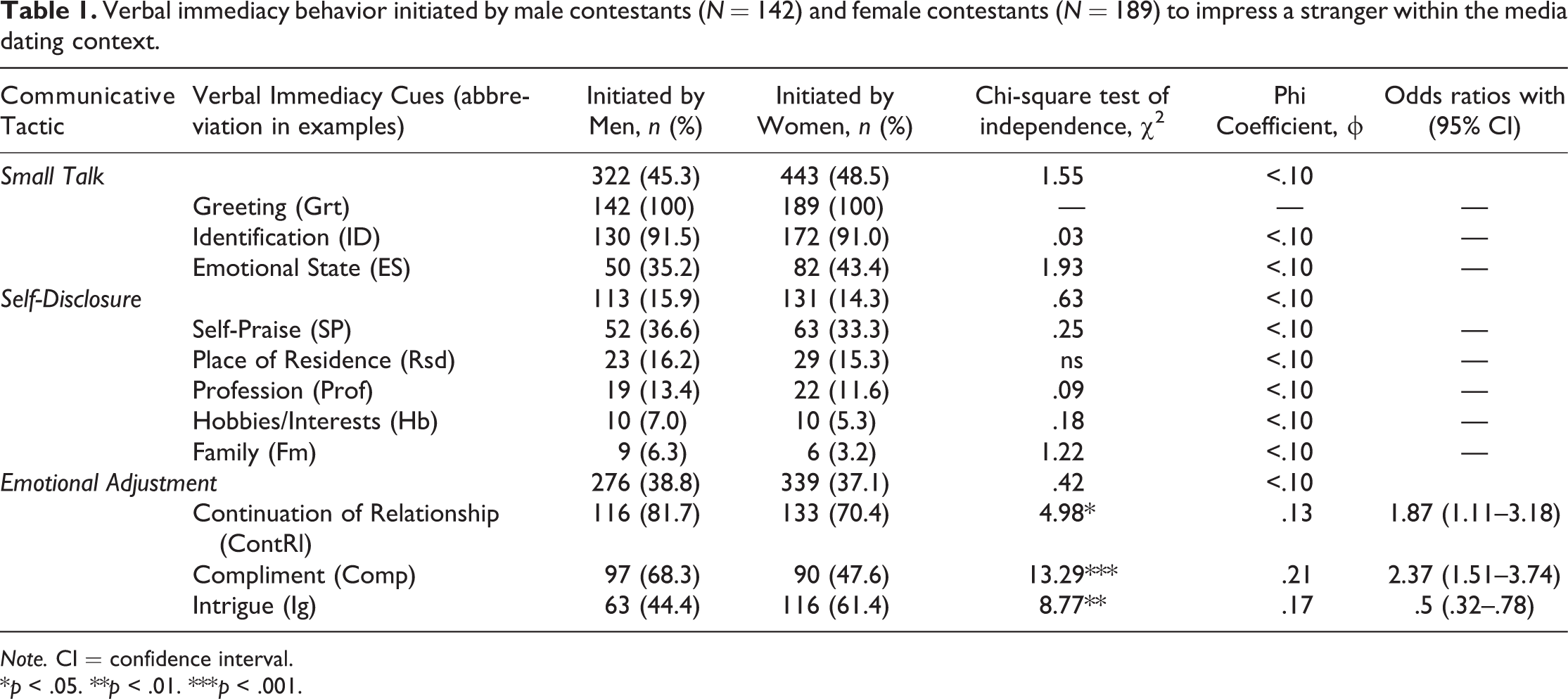
Verbal immediacy behavior initiated by male contestants (N = 142) and female contestants (N = 189) to impress a stranger within the media dating context.
Note. CI = confidence interval.
*p < .05. **p < .01. ***p < .001.
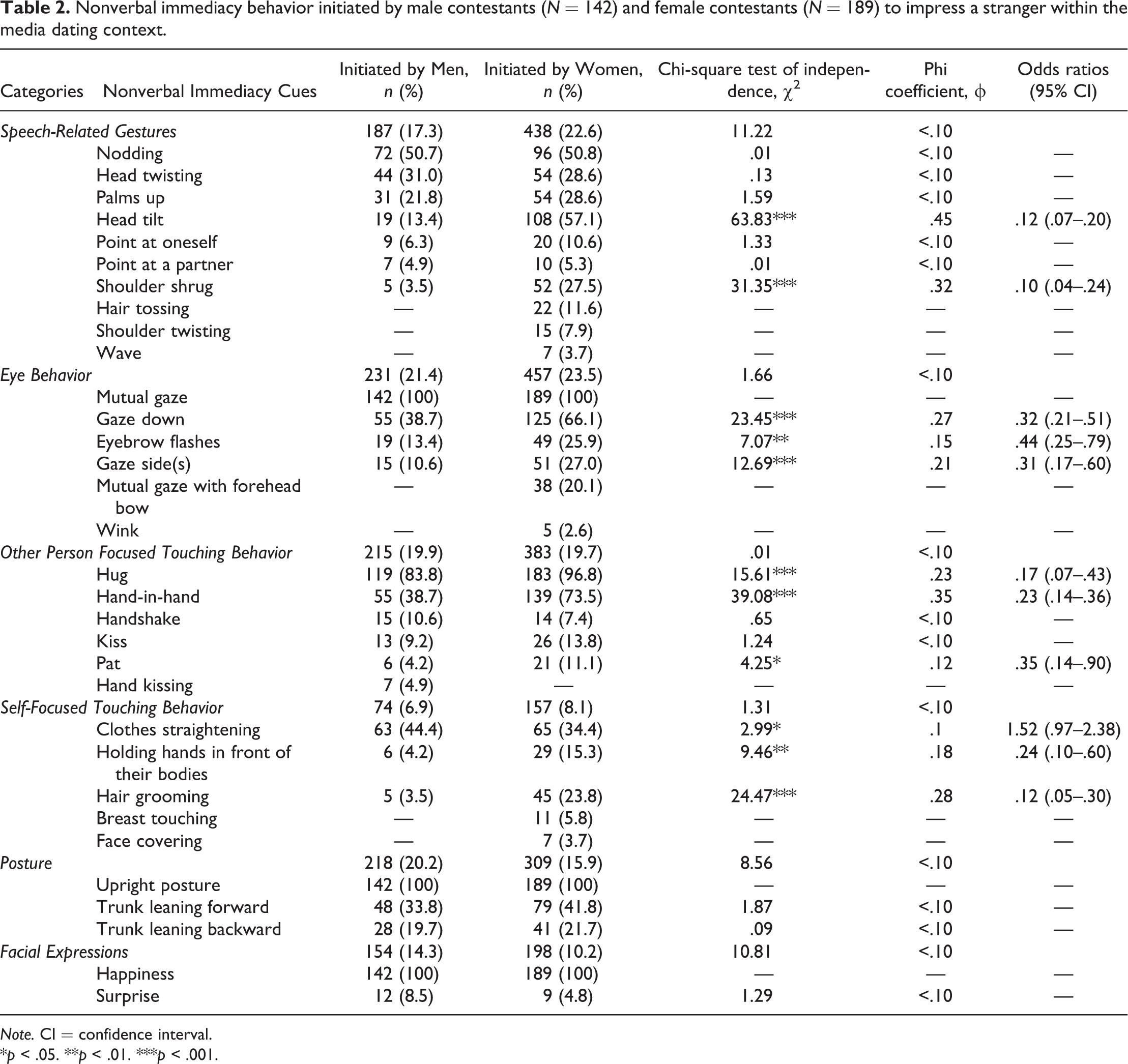
Nonverbal immediacy behavior initiated by male contestants (N = 142) and female contestants (N = 189) to impress a stranger within the media dating context.
Note. CI = confidence interval.
*p < .05. **p < .01. ***p < .001.
After several rounds of discussion of ambiguous cues, adjustment of the codebook, and intercoder reliability checks, alignment between coding from the two coders was attained. Intercoder reliability was adequate (i.e., Cohen’s kappamen = .91 (p < .001), 95% CI [.74, 1.08], and Cohen’s kappawomen = .86 (p < .001), 95% CI [.76, .96]), thus indicating almost perfect agreement between the two coders (Landis & Koch, 1977).
VICs and NICs were analyzed utilizing SPSS Statistics 23. First, to verify whether they affected gender-related preferences, we tested the relationship between variables. The immediacy cues were dichotomous; those that were employed by the contestants received a score of “1” whereas those that were not used received a score of “0.” A chi-square test with Yates’ continuity correction of α = .05 as the criterion of significance was performed to analyze whether gender affected the choice of immediacy cues employed by strangers in initial interactions.
We used the estimation approach to evaluate whether gender-related differences were theoretically and practically meaningful, and also to measure the strength of the association between variables (Cumming, 2013). Thus, effect sizes were reported and interpreted. The phi coefficient (ϕ) was calculated as a measure of effect size. Cohen’s approach (1988) was applied as a means of reporting and interpreting effect sizes. In accordance, we considered a value of ϕ = .10 to be a small effect, ϕ = .30 a medium effect, and ϕ = .50 a large effect. For a 2 × 2 contingency table, the odds ratio (OR) was also calculated to define how the probability of the immediacy cues was affected by the gender of the communicator: OR >1 and <1 indicated that the condition was more likely to occur in male and female immediacy behaviors, respectively.
Results
Verbal immediacy behavior
To make first impressions, contestants used three communicative tactics aimed at achieving different communicative intentions: to get conversations started (small talk); to reveal personal information consciously and intentionally (self-disclosure); and to make potential partners wish to further the relationship by arousing interest and curiosity (emotional adjustment). With each tactic, the conversational initiators enacted VICs to impress a stranger (see Table 1 for full results).
Small talk as a communicative tactic
Potential partners often underestimate the importance of small talk, dismissing it as trifling and superficial (McKay-Semmler & Semmler, 2013). Yet, it allows one to “break the ice.” In reality dating shows, small talk was characterized by three categories of VICs: Greeting, Identification, and Emotional State.
Greeting (Grt)
To get conversations started, contestants mostly followed the traditional speech-etiquette formulas, which included greeting words and etiquette phrases. With respect to a friendly atmosphere, greetings also included an address as a communicative unit. The contestants chose the personal form of an address using: (a) full name form; (b) short name form (e.g., Robert—Rob, Bob; Elizabeth—Beth). Different forms of endearment (e.g., “gorgeous”) are likely used as a playful way to express one’s feelings and establish close emotional connections between partners (King & Sereno, 1984). These affectionate nicknames also included appetizing affiliations such as “cutie-pie,” “sweetie,” and “honey.”
Identification (ID)
The contestants employed two types of identification: (a) conventional, expressed by the standard syntactic constructions, “I’m + name” or “My name’s + name”; (b) alternative, expressed by made-up nicknames related to food, location, or silly names (Hopper et al., 1981). According to Hall (2017), humor is positively associated with relationship satisfaction in young, unmarried couples in the initial stages of engagement. Thus, the usage of humor was perceived as an effective way to initiate the relationship through inside jokes that only the partners involved would understand:
Hi, Ben!
The Baconator?
Yeah, I’m the Baconator
Yeah?!
Come on, do you want a little taste?
Of Bacon, yeah?! Sure?!
So, kiss me! A little, uh?
I’m gonna taste some bacon?
How was it? It makes everything better. Delicious! [The Bachelor, S16E01, 2012]. Note: M = male; F = female
Emotional state (ES)
Verbal immediacy behavior increases the level of closeness in initial interactions by revealing personal feelings and emotions (Romaniuk, 2020). There were three types of emotional states in the present study: (1) excitement, happiness, and satisfaction; (2) indecisiveness, accompanied by concentration of one’s emotional state (e.g., “Oh, my gosh, I had something I was going to say and now I can’t even think, I can’t even talk right now
Self-disclosure as a communicative tactic
Self-disclosure is utilized to reveal personal information, which ultimately affects the feelings of intimacy between partners (Greene et al., 2006; Sprecher et al., 2013). Not being fully aware of its advantages, the initiators prefer to avoid self-disclosure because they believe it makes them vulnerable (Derlega et al., 1993; Romaniuk, 2020). Verbal behavior within self-disclosure leads to immediacy by displaying openness and willingness to share personal information with a stranger (Greene et al., 2006; Guerrero et al., 2011). This category included the following VICs: Place of Residence, Profession, Self-Praise, Hobbies/Interests, and Family.
Place of residence (Rsd)
This was disclosed in two ways: (a) conventional, expressed by standard syntactic constructions, “I am from + city/state” or “I live in + city/state”; (b) alternative, expressed implicitly in combination with intrigue:
Oh, my! Wow! That is the hat.
It’s a clue to where I am from
No idea.
No idea?
Kentucky maybe.
That would be it. Do you know what Kentucky is known for?…Two things
Bourbon?
Oh, no! That’s not the answer. Keep going
Their women?
Their women. Oh, my gosh! Kentucky is known for two things and that is beautiful women and fast horses, my sweetie Aha. Well, all right, now I get it [The Bachelor, S16E01, 2012].
Profession (Prof)
This was utilized in two ways: (a) conventional “I am + profession” (e.g., “I’m an opera singer
Self-praise (SP)
This was characterized by varying degrees of objectivity (e.g., “I’m Miss Pacific Palisades. I don’t actually know how this happened, and I don’t really have the answer to world peace either, but…I’m more than a pageant girl, and I’m sure that you’re more than just a bachelor
Hobbies/Interests (Hb)
These were expressed by personal preferences for activities such as fitness, yoga, horseback riding, traveling, and poetry, used i4n combination with stative verbs (e.g., “I like to write goofy, dorky poems, but you probably won’t like them
Family (Fm)
This information was articulated either in a conventional way, (e.g., “I have + members of the immediate family”), or by revealing inte4resting facts about family relationships.
Emotional adjustment as a communicative tactic
Emotional adjustment was identified by three categories of VICs: Continuation of Relationship, Intrigue, and Compliment.
Continuation of relationship (ContRl)
The contestants used this VIC as a way of outlining the probability of relationship development. Moreover, contestants intensified it with a combination of other VICs. For example, to arouse the sexual interest of potential partners, women used the combination of continuation of relationship and intrigue (e.g., “Make sure you’ll find me later
Intrigue (Ig)
The contestants used intrigue to arouse curiosity. This was implemented with the following formula: communicative hook (coded message/information), along with the addressee’s wish to receive an answer (Romaniuk, 2020). The intensification of the communicative hook occurred by withholding key facts and capturing the partner’s attention from the very beginning of the encounter. Communicative hooks puzzled the addressees, thereby maintaining the effectiveness of intrigue:
I am an accountant
Yeah.
1,190 is the number of miles I traveled to be here tonight
Okay.
Zero is the number of times I’ve been arrested
Okay
54 is the number of dresses I tried on before picking this one
54, very nice.
You like?
Very much so.
One is the number of times I’ve been in love
Okay.
And hopefully after getting to know you a little better
The addressee’s reaction was usually expressed by simple, one-word statements. It demonstrated the communicative tension and intention to force the speaker to make the next move in an effort to clarify key information.
Compliments (Comp)
Partners used compliments to reduce the communicative tension and adjust the initial communication to create a friendly atmosphere (Hall & Xing, 2014). In the present study, compliments in the contemporary media dating context were divided into the following semantic groups: personality traits (e.g., “Seems you’re a sincere, charismatic, and honest guy” [The Bachelor, S18E01, 2014], looks, and appearance: I am…I’m one of the best law students
Guilty? Guilty of what?
Of…. being sexy
RQ1 regarding verbal immediacy behavior enacted by initiators of conversations, indicated 11 VICs. Despite the similarity of these VICs, their frequencies were different. A chi-square test revealed that only the usage of Continuation of Relationships, Compliment, and Intrigue was affected by gender; the effect size is small to medium: Continuation of Relationships χ2 (1, N = 331) = 4.98, p = .02, ϕ = .13, OR 1.87, 95% CI [1.11, 3.18]; Compliment χ2 (1, N = 331) = 13.29, p = .0003, ϕ = .21, OR 2.37, 95% CI [1.51, 3.74]; Intrigue χ2 (1, N = 331) = 8.77, p = .003, ϕ = .17, OR .5, 95% CI [.32, .78] (see Table 1 for details).
Nonverbal immediacy behavior
RQ2 asked what NICs men and women employed in reality dating shows when trying to impress a potential partner. Results indicated that nonverbal immediacy behavior was presented with 32 categories of NICs. The NICs were sorted into six categories: (1) speech-related gestures; (2) eye behavior; (3) other person focused and (4) self-focused touching behavior; (5) posture; (6) facial expressions (see Table 2 for full results).
Speech-related gestures
Nonverbal immediacy behavior was characterized by 10 categories of NICs within speech-related gestures: hair tossing, shoulder twisting, wave, nodding, head twisting, head tilt, palms up, point at oneself/at a partner, and shoulder shrug. Head tilt and shoulder shrug were affected by gender; the effect size is interpreted as medium to large: head tilt χ2 (1, N = 331) = 63.83, p ≤ .0001, ϕ = .45, OR .12, 95% CI [.07, .20]; shoulder shrug χ2 (1, N = 331) = 31.35, p ≤ .0001, ϕ = .32, OR .10, 95% CI [.04, .24]. Three gestures—hair tossing, shoulder twisting, and wave—were observed only among female contestants.
Eye behavior
This was described by six categories of NICs: gazing in different directions (i.e., mutual gaze, gaze down/side(s), mutual gaze with forehead bow), wink, and eyebrow flashes. Choice of gaze down/side(s) and eyebrow flashes were affected by gender; the effect size is small to medium: gaze down χ2 (1, N = 331) = 23.45, p ≤ .0001, ϕ = .27, OR .32, 95% CI [.21, .51]; gaze side(s) χ2 (1, N = 331) = 12.69, p ≤ .0001, ϕ = .21, OR .31, 95% CI [.17, .60]; eyebrow flashes χ2 (1, N = 331) = 7.07, p = .008, ϕ = .15, OR .44., 95% CI [.25, .79].
Other person focused touching behavior
This embodied six categories of NICs: hug, hand-in-hand, handshake, kiss, pat, and hand kissing. The usage of hug, hand-in-hand, and pat was affected by gender; the effect size is (i) medium to large: hand-in-hand χ2 (1, N = 331) = 39.08, p ≤ .0001, ϕ = .35, OR .23, 95% CI [.14, .36]; (ii) small to medium: hug χ2 (1, N = 331) = 15.61, p ≤ .0001, ϕ = .23, OR .17, 95% CI [.07, .43], and pat χ2 (1, N = 331) = 4.25, p = .04, ϕ = .12, OR .35, 95% CI [.14, .90].
Self-focused touching behavior
This encompassed five categories of NICs: clothes straightening, holding hands in front of their bodies, hair grooming, breast touching, and face covering. Clothes straightening, holding hands in front, and hair grooming were affected by gender; the effect size is small to medium: clothes straightening χ2 (1, N = 331) = 2.99, p = .08, ϕ = .1, OR 1.52, 95% CI [.97, 2.38]; holding hands in front of their bodies χ2 (1, N = 331) = 9.46, p = .002, ϕ = .18, OR .24, 95% CI [.10, .60]; hair grooming χ2 (1, N = 331) = 24.47, p ≤ .0001, ϕ = .28, OR .12, 95% CI [.05, .30].
Posture
Initial encounters were also characterized by three categories of NICs within this group: upright posture and trunk leaning forward, aimed at establishing an intimate rapport with a potential date; and trunk leaning backward, usually followed by laughter or surprise. The usage of posture was not affected by gender.
Facial expressions
Finally, the emotional state was displayed by two categories of NICs, including happiness and surprise. However, their usage was not affected by gender.
Discussion
The purpose of this study was to explore how gender-related preferences affected the choice of immediacy behaviors between opposite-sex strangers in a contemporary media dating context. Particularly, we documented the sexual scripts utilized in initial romantic relationships. This study provides two unique contributions. First, we specifically examine the analysis of both verbal and nonverbal immediacy behaviors employed by strangers to impress a potential partner, which could corroborate and extend related studies (e.g., Andersen, 2010; Guerrero et al., 2011; LaFrance & Vial, 2016). Second, we further uncover specific mediated sexual scripts that can ultimately inform viewers about how they are expected to behave in real-life romantic encounters when meeting someone for the first time (Simon & Gagnon, 1986). In other words, our findings could help theorize on the true nature of initial interactions and immediacy behaviors and how they are reinforced through reality dating shows (e.g., Cummins & Gordon, 2006; Kavka, 2008; Zurbriggen & Morgan, 2006). Results of our study are particularly helpful to further understand why individuals—reality dating television viewers specifically—employ specific VICs and NICs when they find themselves in situations where they are meeting a romantic interest. Media viewers acquire (i.e., learn a new behavioral norm) the VICs and NICs in the form of sexual scripts, activate them (i.e., cue the behavioral norm) and apply them (i.e., utilize the behavioral norm in their own dating life; Wright, 2011). Below, we unpack the major findings and discuss the theoretical implications of our results.
By analyzing the screen time of initial interactions between strangers, we found that both men and women were likely to make an immediate impression in 30 seconds, which supports previous research (e.g., Pham & Miyake, 2010; Romaniuk, 2017). The results also showed that both men and women were quite similar in their choice of communicative tactics, such as small talk (45.3% vs. 48.5%), emotional adjustment (38.8% vs. 37.1%), and self-disclosure (15.9% vs. 14.3%); and categories of nonverbal immediacy behavior, i.e. speech-related gestures (17.3% vs. 22.6%), eye behavior (21.4% vs. 23.5%), other person focused touching behavior (19.9% vs. 19.7%), self-focused touching behavior (6.9% vs. 8.1%), posture (20.2% vs. 15.9%), and facial expressions (14.3% vs. 10.2%). As Tannen (1997) argues in terms of communicative tactics, men and women actually share more similarities than differences. In the present study, then, we conclude that this argument still persists in the context of reality dating shows with first impressions and could be reinforcing the same norms in real life.
Moreover, the preference for using small talk and emotional adjustment over self-disclosure ascertained that contestants, as well as real world couples, were partly ready to display openness and willingness to share personal information with a stranger; this finding supports previous research (e.g., Derlega et al., 1993; Romaniuk, 2020). Similarly, Johnson (2009) highlighted that the most comfortable topics of self-disclosure for first encounters are hobbies, occupations, sports, schools, a shared event, and the weather. However, these subjects were changed slightly within reality dating shows to place of residence, profession, self-praise, hobbies/interests, and family. The main topics added within reality dating shows (i.e., place of residence, family, self-praise) likely occurred due to the competitive nature of reality dating shows. Contestants may be more motivated to disclose more substantive sides of themselves given the limited amount of time they are allotted to make a first impression.
Additionally, our results extend previous findings on verbal immediacy behavior by providing 11 categories of VICs enacted by initiators of conversations. Nonverbal immediacy behavior was communicated by 32 categories of NICs, which corroborates and extends previous findings regarding romantic encounters in real life (e.g., Andersen, 2010; Hall & Xing, 2014; LaFrance & Vial, 2016). The findings support previous research illustrating that VICs and NICs are inextricably intertwined. Specifically, NICs convey powerful intimate messages performing four basic functions in initial dyadic encounters: (1) to promote small talk by means of greeting and parting rituals (e.g., handshake, wave, pat); (2) to communicate self-disclosure (e.g., palms up, pointing at oneself); (3) to show excitement, submissiveness, embarrassment, and coyness (e.g., shoulder shrug, gaze down, face covering, holding hands in front of their bodies); (4) to flirt, seduce, express initial romantic or sexual attraction, and arouse interest or curiosity (e.g., hand-in-hand, nodding, hair tossing, kiss) (e.g., Argyle, 1988). Based on these findings, it could be that real life and televised encounters reinforce one another.
Gender similarities and differences
In support of previous research, we found gender similarities and differences in face-to-face romantic encounters for both verbal immediacy behavior (Eaton et al., 2015; Romaniuk, 2016; Sharabi & Dykstra-DeVette, 2019) and nonverbal immediacy behavior (Guéguen, 2008; Hall & Xing, 2014; LaFrance & Vial, 2016). The findings suggest that both men and women employed 11 categories of VICs (i.e., greeting, identification, emotional state, continuation of relationship, intrigue, compliment, place of residence, self-praise, hobbies/interests, profession, and family) and 24 categories of NICs (i.e., nodding, head twisting/tilt, palms up, pointing at oneself/at a partner, and shoulder shrug within speech-related gestures; gaze mutual/down/side(s) and eyebrow flashes within eye behavior; hug, hand-in-hand, handshake, kiss, and pat within other person focused touching behavior; clothes straightening, holding hands in front, and hair grooming within self-focused touching behavior; upright posture and trunk leaning forward/backward within posture; and happiness and surprise within facial expressions.
To be specific, we found differences in eight categories of NICs: hand kissing was initiated only by men whereas hair tossing, shoulder twisting, wave, mutual gaze with forehead bow, wink, breast touching, and face covering were initiated only by women. However, we found no empirical evidence for differences in VICs, which means that both men and women were quite similar in the choice of topics they raised during initial interactions. This supports previous research illustrating that men and women are similar in their verbal forms of verbal communication (Tannen, 1997) yet, vastly different in their nonverbal forms of communicating with romantic interests (Hall et al., 2000).
Further, evidence from the present study also showed gender-related preferences for VICs and NICs. Accordingly, men were more likely to outline the probability of further romantic relationships and pay compliments; conversely, women were prone to intrigue men to arouse curiosity and interest. However, men and women were identical in their preferences for greetings and introductions, sharing their feelings/emotions, revealing personal information on place of residence, hobbies/interests, profession, family, and self-praise. Based on these results, women may feel an obligation to keep their romantic partner interested whereas men may feel obliged to admire women’s physical beauty in the form of compliments.
As for NICs, results of the present study support previous literature on nonverbal behaviors in accordance with gender. Women are more likely to utilize nonverbal communication when interacting with others (Hall et al., 2000), and especially more likely to utilize submissive nonverbal immediacy cues (Burgoon & Dillman, 1995). In support of this, we found that women were more likely than men to communicate immediacy through multiple NICs including: head tilt, shoulder shrug, gaze down/side(s), eyebrow flashes, hand-in-hand, holding hands in front, and hair grooming. As Burgoon and Dillman (1995) explain, such nonverbal tactics (e.g., head tilt, shoulder shrug) are ways of communicating more appeasement or submissive gestures to the opposite sex rather than dominance. Therefore, by employing such NICs in first impressions, women may be following the sexual script that they are expected to be submissive to men (Kim et al., 2007). Contrarily, men were more likely than women to employ one NIC: clothes straightening, likely as a sign of expressing nervousness when first meeting a romantic interest rather than communicating signs of dominance or submissiveness.
Moreover, women were more likely than men to initiate two NICs that communicated affection to the romantic interest: hug and pat. Such NICs can be understood as forms of “nonverbal flirtation,” which plays a “subtle yet major role in the initiation and maintenance of flirtation” (McCormick & Jones, 2015, p. 271). Women, compared to men, are more likely to use such strategies as ways of communicating romantic interest and/or flirting behaviors to the target of the first impression (Clark et al., 2021). In contrast, men are more likely to initiate more intimate touching in private than women. These results, then, suggest that women once again conform to the sexual script that they are more interested in an emotional connection which can be communicated through signs of affection (e.g., hugs, pats), while men may be more interested in sexual or physical connection in private (Kim et al., 2007).
Finally, the choice of nodding, head twisting, palms up, pointing at oneself/at a partner, mutual gaze, handshake, kiss, upright posture, trunk leaning forward/backward, happiness, and surprise was not affected by gender. These NICs, then, may be gender-neutral forms of indicating romantic interest to targets within first impressions.
Theoretical implications
The results of our study offer important theoretical implications in regard to sexual scripts theory (Simon & Gagnon, 1986). Attentive viewers of reality dating shows may yearn to know more about what is expected of them in their dating encounters. As such, we posit that reality dating shows act as guides (i.e., cultural scripts) to instruct viewers how they should behave when they meet a romantic interest. Therefore, viewers may learn about communicative intentions in the forms of VICs and NICs that teach them how they should act. This can go on to influence their interpersonal scripts (i.e., interpersonal conversations with romantic partners) and intrapsychic scripts (i.e., personal desires with romantic partners). Based on our findings, we argue that reality dating shows offer gendered sexual scripts about dating specific to NICs instead of VICs. Reality dating shows encourage female viewers, more than male ones, to utilize a variety of NICs as a way of communicating their romantic interests and intriguing their romantic interest. By viewing female contestants employ strategies such as head tilts and shoulder shrugs, for instance, female viewers may become motivated to behave in the same way when meeting a romantic interest. This is especially likely to occur if the male target reacts favorably to such behaviors (i.e., reward; Wright, 2011). This can be troubling due to the subtle inequality behind the NICs (Burgoon & Dillman, 1995). Specifically, the NICs which women were the most likely to employ in the reality dating shows inadvertently communicate signs of submission to their male romantic interest.
In terms of VICs, male viewers may acquire the sexual script that they should be dominant and communicate a continuation of the relationship and pay compliments to women; these results are also indicative of unequal roles within dating such that women are expected to please their romantic interests by looking physically attractive (and yielding compliments) while men are expecting to take their relationship to the next level (by communicating continuation of the relationships; Kim et al., 2007). Taken together, viewers may be more likely to believe that they should begin romantic relationships from the beginning of an encounter with signs of inequality in their relationships. As Seabrook et al. (2016) found, this effect is indeed more likely to occur among emerging adults who consume heavy amounts of television. As such, media executives and relationship therapists should be conscientious of the subtle messages to which viewers may be exposed to in reality dating shows that can influence harmful behaviors in relationships, specifically in initial encounters.
Limitations and directions for further research
The current study has one major limitation in terms of methodology. Framed by the contemporary media dating context, it is not entirely clear which initial interactions are rehearsed or even repeated several times during filming. As a result, immediacy behaviors and interactions may be affected by the dating show format that, in turn, impedes firm conclusions about the behavior of men and women in real-life dating contexts. Therefore, future studies should focus on the differences and similarities between the media context and real-life context.
There are also several directions for further research in this field. First, the success of The Bachelor franchise resulted in its broadcasting in more than 25 countries. This has led to a rise in interest regarding gender-related preferences in different media dating cultures. Second, ABC’s The Bachelor finally announced their interest in nonbinary gender identity in 2019 (Villarreal, 2019). Third, The Bachelor franchise has recently incorporated more diverse suiters on the show. In 2020 and 2021, both suiters were African Americans (i.e. Tayshia Adams in 2020 and Matt James in 2021). Due to these landmark events in the franchise, future research should analyze how first impressions among romantic dyads differ in terms of sexual orientation, gender identity, culture, and race in reality dating shows. We encourage scholars to approach these questions with a scripting perspective, ultimately arguing that such mediated depictions influence real-life expectations.
Footnotes
Acknowledgments
The authors would like to thank Dr. Melissa Curran for her insightful suggestions and support in the reviewing process of the manuscript. They would also like to thank the three anonymous reviewers for their useful comments on earlier drafts of this paper.
Funding
The author(s) received no financial support for the research, authorship, and/or publication of this article.
Open research statement
As part of IARR’s encouragement of open research practices, the author(s) have provided the following information: This research was pre-registered. The aspects of the research that were pre-registered were research design, hypotheses, analysis plan, and codebook. The registration was submitted to  . The data used in the research are available. The data can be obtained at https://osf.io/emx8f/ or by emailing