



Abstract
Previous studies have revealed that the perceived quality of the parent–child relationship is essential for both physical health and psychological well-being. However, most studies have treated the perceived quality of this relationship as an independent variable. In this study, we considered it a dependent variable and examined the role of parents’ education and parent–child literacy activities on children’s perceived quality of the parent–child relationship. One hundred and eighty-six Chinese primary school students and their parents from low socioeconomic backgrounds participated in this study. Parents’ educational level and the parent–child literacy activity status were assessed based on parents’ reports, whereas parent–child relationships were assessed based on children’s reports. Results showed that parents’ educational level positively correlated with the frequency of parent–child literacy activities and children’s perceptions of the quality of the parent–child relationship. There was also a significant positive correlation between the frequency of parent–child literacy activities and children’s perceptions of the quality of the parent–child relationship. Further analyses showed that the frequency of parent–child literacy activities mediated the connection between parents’ educational level and children’s perceived quality of the parent–child relationship. These results suggest that boosting the frequency of parent–child literacy activities may be a useful strategy for facilitating the parent–child relationship.
Keywords
I Introduction
Family plays a very important role in children’s development. Family relationships provide a relevant context for children’s development of social and emotional skills (Bronfenbrenner, 1979, 1994). Over the past decades, much research has been focused on the link between the parent–child relationship and children’s development (Johnson et al., 2010). A positive parent–child relationship is an important protective factor in determining features of children’s physical, social, emotional, and behavioral development (Branje et al., 2010; Fogelholm et al., 1999). In contrast, a poor parent–child relationship may be a risk factor for a child’s emotional and behavioral problems (Buist et al., 2011). For example, children who report high levels of conflict with and hostility toward their parents show increased levels of aggressive behavior, uncaring interactions, as well as greater levels of symptoms associated with depression and anxiety (Buist et al., 2011, 2017; Scaramella et al., 1999). However, previous studies have treated the parent–child relationship mostly as an independent variable. An analysis of the factors related to parent–child relationships is important for strengthening them, and, in turn, promoting children’s development (Johnson et al., 2010). In the current study, the roles of parents’ educational level and parent–child literacy activities were examined as they related to children’s perceptions of their relationships with their parents.
Socioeconomic status (SES), an indicator of one’s overall prestige and social status in society, is usually measured by education, occupation, and income (Conger and Donnellan, 2007). However, among various measures, education is one of the most widely used indices of SES because it is a primary determinant of both income and occupational status (Krieger et al., 1997). Previous studies have shown that parent–child literacy activities are mostly related to parents’ educational level (Curenton and Justice, 2008; Hoff, 2003). Therefore, in the present study, we used parents’ education as the measure of SES. Over the past decades, numerous studies have shown that SES – particularly parents’ educational level – have profound effects on children’s development (Aizer and Currie, 2014; Bradley and Corwyn, 2002). According to the family investment model, family SES may be a crucial factor in parent–child relationships (Conger and Donnellan, 2007; Conger et al., 2010). The model proposes that parents’ material and interpersonal investments in their children may explain, at least partially, the association between family SES and children’s development (Bradley and Corwyn, 2004; Conger and Donnellan, 2007). Families with greater economic resources have more opportunities to invest in goods, products, and services that facilitate children’s development (Bradley and Corwyn, 2002). Additionally, parents who have obtained higher educational levels tend to be more involved in their children’s daily activities, which in turn affects children’s social, emotional, and cognitive functioning (Crittenden, 2008; Sohr-Preston et al., 2013). For example, Sohr-Preston et al. (2013) showed that parents with more education were more responsive in their communications with their preschool children, which in turn facilitated their children’s language development. Highly educated parents may be more knowledgeable regarding their children’s development, more effective in interacting with them, and more helpful in supporting their adaptation to the environment (Bornstein and Bradley, 2003; Rowe et al., 2016). Therefore, parents’ educational level contributes significantly to the quality of parent–child relationships.
Numerous studies have also demonstrated that family SES, particularly in terms of parents’ educational level, was closely associated with children’s language and reading-related skill development (Hoff, 2013; Romeo et al., 2017; Wang et al., 2017). Compared to children with better educated parents, children with less educated parents performed much worse in both reading and related language skills (Curenton and Justice, 2008; Noble et al., 2007). Parents provide a basic environment that helps children build their language and reading-related skills (Hart and Risley, 1995; Landry et al., 2006). Less educated parents may not only engage less with their children but also provide their children with fewer language and reading inputs compared to more educated parents (e.g. Curenton and Justice, 2008; Evans et al., 2004; Rowe and Goldin-Meadow, 2009). On the one hand, highly educated parents provide more reading materials and opportunities to enable their children’s language and reading development (Mol and Bus, 2011). On the other hand, parents’ educational backgrounds vary considerably, as do their beliefs concerning their role in promoting children’s language and reading skills (DeBaryshe, 1995). Highly educated parents may have a heightened awareness of the value and importance of parent–child literacy activities for facilitating children’s growth (Curenton and Justice, 2008). For example, Curenton and Justice (2008) showed that parental beliefs served as a mediator for the relationship between maternal education and children’s preliteracy skills.
Parent–child literacy activities refer broadly to the process by which adults read, write, and discuss with their children; it also involves interacting with books. Such activities provide a critical context for developing children’s language and reading-related skills (Bus et al., 1995; Sohr-Preston et al., 2013). Numerous studies have demonstrated that when parents engage actively in parent–child literacy activities, preschool-age children benefit from language and reading development (Curenton and Justice, 2008; Sohr-Preston et al., 2013), as do older children in primary school and beyond (Boerma et al., 2018; Klauda, 2009). Some studies have shown that intervention programs focused on parent–child literacy activities are effective in improving children’s language and reading skills (Breit-Smith et la., 2017; Pollard-Durodola et al., 2011). However, the quantity and quality of parent–child literacy activities vary substantially across the SES spectrum (Korat et al., 2007), and have been identified as important mediators of the relationship between parents’ educational level and children’s language and reading development (Sohr-Preston et al., 2013).
Previous studies on parent–child literacy activities have mainly emphasized their role in facilitating cognitive, language, and reading development. However, parent–child literacy activities may also promote children’s socioemotional competencies (Bergin, 2001; Laible, 2004). For example, a recent study showed that shared reading intervention were effective in promoting academic engagement and socioemotional development in a group of Latinas third graders (Cook et al., 2017). Parent–child literacy activities provide more opportunities for parents to be involved in their children’s daily activities and perceive their children’s development, which, in turn, may help parents select more effective strategies for improving their children’s socioemotional competencies and parent–child connections (Conger and Conger, 2002).
To our knowledge, there have been only a few studies that have directly tested the role of parent–child literacy activities in the parent–child relationship. Therefore, the main purpose of the present study was to examine how parents’ educational level and parent–child literacy activities contributed to children’s perceptions of the parent–child relationship. Based on previous studies (Conger et al., 2010; Korat et al., 2007), we hypothesized that both parents’ educational level and the frequency of parent–child literacy activities would correlate significantly with children’s perceptions of the parent–child relationship. Furthermore, parent–child literacy activities may act as a mediator of the relationship between parents’ educational level and the parent–child relationship. Unlike objective observations or assessments of specific supportive behaviors relevant to a particular situation or delimited time period, perceived support or a relationship may reflect generalized impressions of support and affection abstracted from countless such experiences over time and have greater predictive power regarding psychological well-being (Bolger and Amarel, 2007; Hobfoll, 2009). Therefore, we used children’s perceptions of the quality of parent–child interactions as the indicator of parent–child relationships in this study.
II Method
1 Participants
One hundred and eighty-six primary school students (age range = 8.33–14.25 years, Mage = 11.49 years, SD = 1.29; 59% female) and their fathers (n = 55, age range = 30–52 years, Mage = 40.48 years, SD = 4.69) or mothers (n = 131, age range = 28–50 years, Mage = 38.65 years, SD = 4.58) volunteered to participate in the study. The children were recruited from four primary schools in the Dongxiang county of northwest China. In this county, minorities make up the largest demographic group; more than 90% of the residents are from Dongxiang, and the per capita estimated income per adult in this area was approximately $670 in 2016 (Gansu Province Bureau Statistics, 2017). 1 Although previous studies on parent–child literacy activities have focused mainly on children in preschool (Aram and Levin, 2001; Curenton and Justice, 2008), some studies have shown that parent–child literacy activities were also effective in facilitating reading development in the higher elementary grades (Boerma et al., 2018). All children in the present study were from a minority nationality area. They spoke a dialect of Chinese at home and learned Mandarin (Putonghua) in school. According to school records, hardly any children participated in kindergarten education involving literacy instruction that was provided before primary school. Compared to English (i.e. only 26 letters), there are around 620 stroke patterns that make up different Chinese characters. Thus, Chinese is visually more complex than English, and literacy instruction is one of the main tasks throughout elementary school (Ministry of Education, China, 2011). Therefore, we selected elementary school students as the sample for the present study. All participants were recruited through convenience sampling. Informed consent was obtained from all parents and their children, and ethical approval was granted from the local institutional board.
2 Procedure
All data used in the present study were collected via home visits conducted by the first author and four undergraduates majoring in psychology. Furthermore, one parent per child participated. For each family, there were two visitors; one parent answered the survey questions regarding sociodemographic information and parent–child literacy activities in a face-to-face interview with one of the visitors. Children answered survey questions regarding the parent–child relationship with the other visitor. For both parents and children with limited reading skills, the visitor read all items to them and recorded their answers. Although all the children responded regarding parent–child relationships with both father and mother, we analysed data for only one parent–child relationship to correspond with the parent responding to the parental questionnaire. Small gifts were offered to children as tokens of appreciation.
3 Measures
a Parents’ educational level
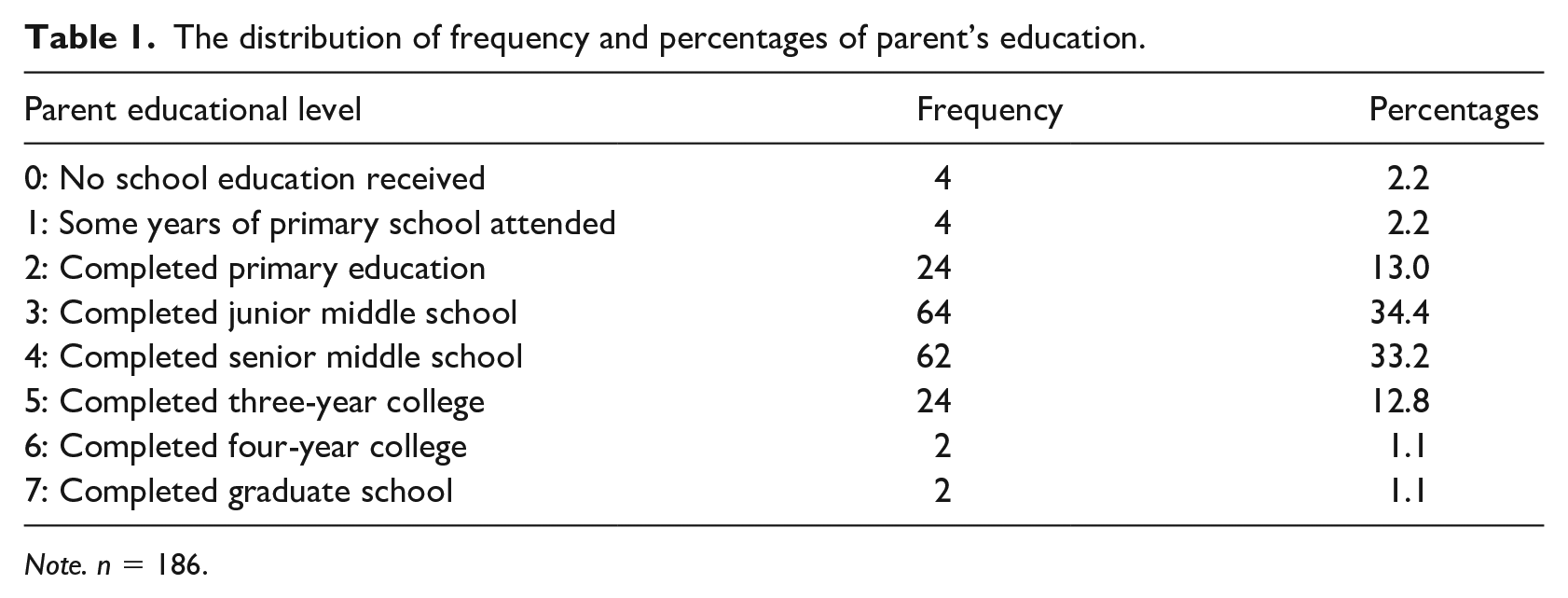
Parents reported on their educational attainment according to an eight-point scale: 0 = No school education received, 1 = some years of primary school attended, 2 = completed primary education, 3 = completed junior high/middle school, 4 = completed senior high/secondary school, 5 = completed three years of college, 6 = completed four years of college, and 7 = completed graduate school. Table 1 shows the frequency distribution and percentages for parents’ educational level.
The distribution of frequency and percentages of parent’s education.
Note. n = 186.
b Parent–child literacy activities
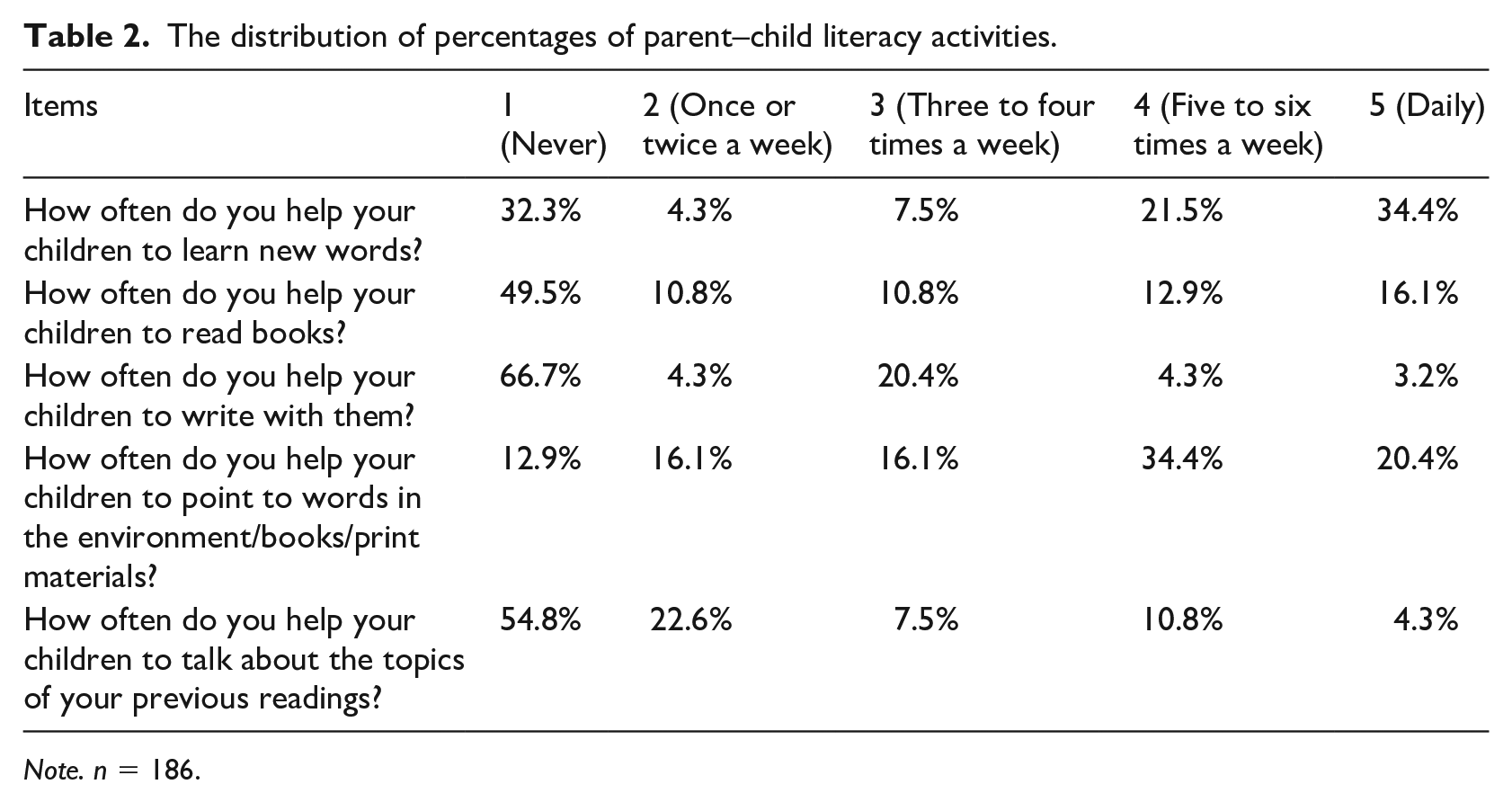
Five questions based on the existing literature that pointed to a variety of parent–child literacy activities were used (e.g. Boerma et al., 2018; Curenton and Justice, 2008; Gest et al., 2004). The questions were as follows: ‘How often do you help your children learn new words, read books to them, write with them, point to words in the environment/books/print materials, and talk about the topics of your previous readings?’ Parents reported regarding the frequency of these activities during the week (including weekends) using a five-point scale (ranging from 1 = Never to 5 = Daily). One hundred and thirty-one mothers and 55 fathers completed the survey questions. For each parent, a mean score was calculated based on these five items; a higher score reflected more frequent parent–child literacy activities. Cronbach’s alpha coefficient was .73 for the survey questionnaire, indicating adequate (above .70) internal consistency reliability (Bland and Altman, 1997; Devellis et al., 1991). Table 2 shows the distribution of percentages of Parent–child literacy activities.
The distribution of percentages of parent–child literacy activities.
Note. n = 186.
c Parent–child relationships
The quality of children’s perceived relationships with their parents was measured with the cohesion subscale of the Family Adaptability and Cohesion Evaluation Scale (FACES) II inventory (Olson et al., 1979), a self-report questionnaire using a five-point Likert-type scale (ranging from 1 = little or none to 5 = the most). Children answered 20 questions about the relationship with their father and mother. The scale consisted of 10 items for each parent (e.g. ‘My mother [father] and I are supportive of each other during difficult times’, and ‘My mother [father] and I feel very close to each other’). A translated version of the scale has been shown to have high validity and reliability for mainland Chinese samples (Fuligni and Zhang, 2004). The internal consistency reliability coefficient (Cronbach’s alpha) was .71 for fathers and .87 for mothers in the present study. The final score was the sum of the 10 items for children’s ratings regarding relationships with their fathers or mothers.
4 Analysis
Descriptive analyses and Pearson’s correlations were performed using SPSS software (IBM SPSS 22.0, Chicago, IL; IBM Corp, 2013). In the descriptive analysis, means and standard deviations were computed for each variable. Pearson’s correlations were calculated to analyse relationships between the variables, and we used the SPSS macro PROCESS program (Hayes, 2013) to examine a mediation model and determine whether the frequency of parent–child literacy activities mediated the relationship between parents’ educational level and the parent–child relationship. We used a bootstrapping method with 5,000 bootstrap resamples to calculate the 95% confidence intervals (CIs) for the indirect effect (Preacher and Hayes, 2008). If the 95% CI did not overlap with zero, the significance of the mediating effects was accepted (Preacher and Hayes, 2008). All statistical tests were evaluated at the p < 0.05 significance level.
III Results
1 Descriptive statistics and correlations
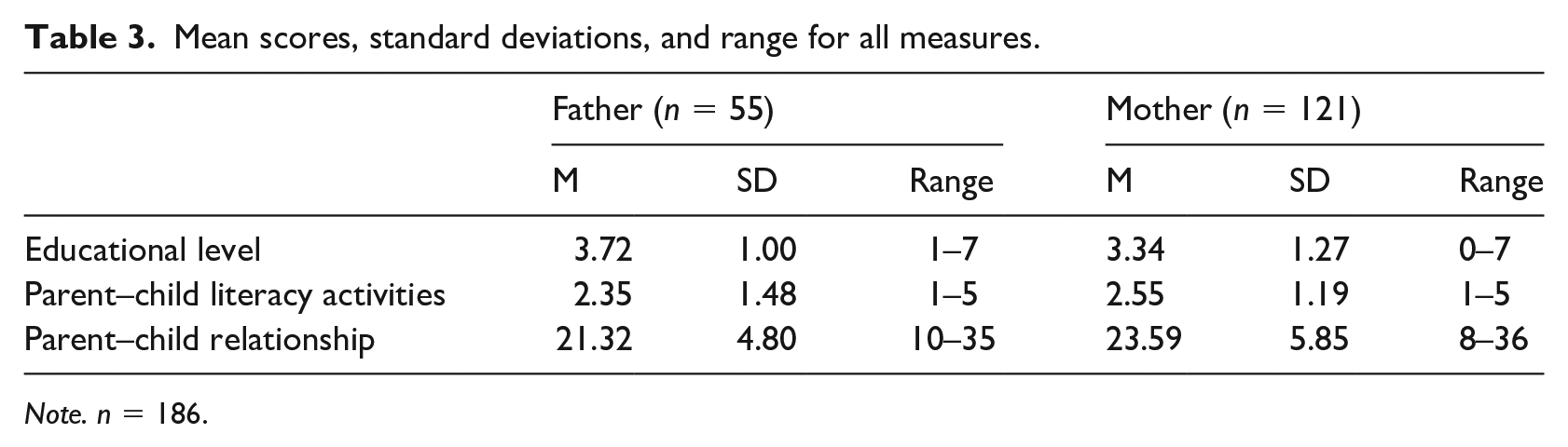
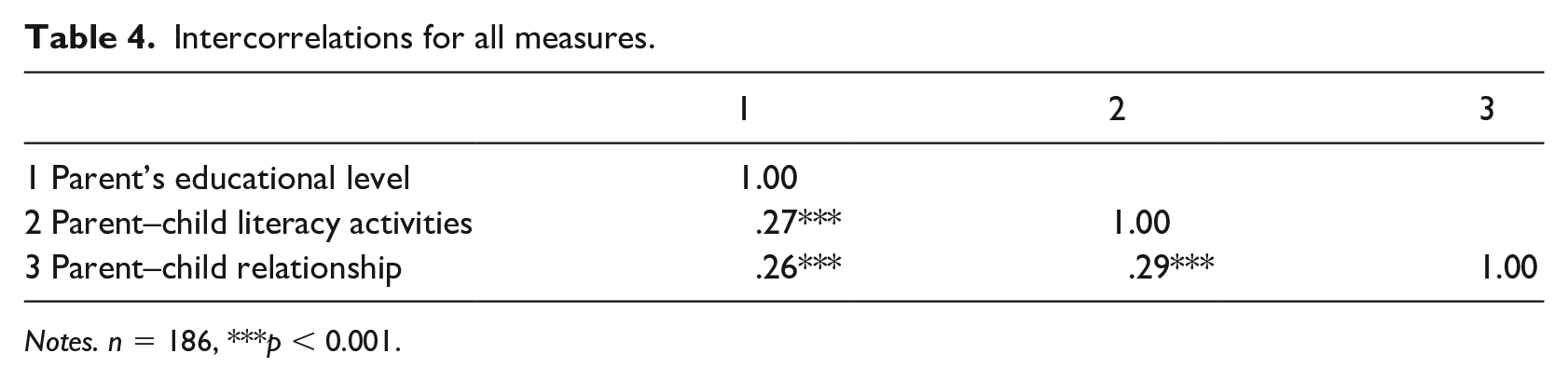
Table 3 shows the mean scores and standard deviations for parent-reported educational levels and the frequency of parent–child literacy activities; children reported regarding the parent–child relationship. Table 4 shows the correlations for all measures in the present study. Several features of the correlations are noteworthy. First, parents’ educational level was significantly correlated with the frequency of parent–child literacy activities and the quality of the parent–child relationship. Second, the frequencies of parent–child literacy activities were significantly correlated with the quality of the parent–child relationship, confirming our hypothesis.
Mean scores, standard deviations, and range for all measures.
Note. n = 186.
Intercorrelations for all measures.
Notes. n = 186, ***p < 0.001.
2 Direct and indirect effects test
We conducted a two step-analysis to understand the complex relationships between parents’ educational levels, parent–child literacy activities, and parent–child relationships. First, we tested a direct model representing the relationships between parents’ educational level and the parent–child relationship. After controlling for the effects of children’s age, gender, and grade, parents’ educational level explained 7% of the variance in parent–child relationships (ΔF(1, 181) = 13.54, p < 0.001). As expected, the direct effect of parents’ educational level on the parent–child relationship was significant (β = .285, t = 3.68, p < 0.001). Then, we tested a mediation model to examine the potential mediating effect of parent–child literacy activities on the association between parents’ educational level and the parent–child relationship. The results showed that the effect of parents’ educational level on the parent–child relationship decreased when parent–child literacy activities entered as a mediator (β = .22, t = 2.82, p < .01). Further, we used the bootstrap estimation procedure (with a specified bootstrap sample of 5,000) to test the significance of the indirect effect of parents’ educational level. The results showed that parents’ educational level exerted a significant indirect effect on the parent–child relationship via parent–child literacy activities (point estimate = 0.06, 95% CI = 0.02 to 0.12).
IV Discussion
The aim of this study was to explore the roles of parents’ educational level and parent–child literacy activities on perceptions of primary school students from mainland China regarding the quality of the parent–child relationship. The results of the present study showed that both parents’ educational level and parent–child literacy activities were significantly associated with children’s perceptions regarding the quality of this relationship. Moreover, our results revealed that parent–child literacy activities played a mediating role between parents’ educational level and children’s perceptions of the quality of the parent–child relationship.
The previous study among Western samples showed that parents’ educational achievements were significantly associated with the parent–child relationship for both preschool children (Thompson and Foster, 2014) and adolescents (Downing-Matibag, 2009). The current study confirmed this result and showed that parents’ educational level was significantly related to the quality of the parent–child relationship among primary school children in a Chinese sample. The findings of the present study partly support the theoretical framework of the family investment model across cultures; thus, human capital measured according to parents’ educational level has an effect on children’s social and emotional development (Conger and Dogan, 2007; Conger and Donnellan, 2007). Highly educated parents may be more involved with their children’s development and enjoy more opportunities to promote their social, emotional, and cognitive functioning (Crittenden, 2008; Sohr-Preston et al., 2013).
Interestingly, findings of the present study provide evidence – for the first time – that widespread activity, such as parent–child literacy activity, mediates the relationship between parents’ educational level and children’s perceptions regarding the quality of the parent–child relationship. Previous studies have focused mostly on the relationship between parent–child literacy activities and young children’s language and reading development (Dexter and Stacks, 2014; Gest et al., 2004). Results of the present study demonstrate that, in addition to their role in language and reading development, parent–child literacy activities were critical in promoting good parent–child relationships for primary school children. While engaging in parent–child literacy activities, parents may not only teach literacy to their children but also appear to perceive and understand their feelings, attitudes, and ideas, thereby establishing a confident parenting style (Ackard et al., 2006; Bergin, 2001). With findings compatible with this assumption, Dexter and Stacks (2014) showed that parents and children shared reading interactions that were positively correlated with parenting quality in a sample of low-income families. However, more research evidence from longitudinal and interventional studies is needed to further verify this assumption. Nevertheless, these findings suggest that highly educated parents engage more frequently in parent–child literacy activities, which in turn may facilitate the formation of a good parent–child connection (Conger and Conger, 2002).
The findings of the present study also have important implications for primary school children by suggesting possible interventions to improve parent–child relationships. Although parents’ educational level is stable and not easily changed based on the mediating role of parent–child literacy activities in linking parents’ educational level with the parent–child relationship, our results suggest that engaging more often in joint literacy activities may be an effective way to develop a more positive parent–child relationship. In addition, although previous studies have revealed that less educated parents may engage less and possess a lack of knowledge regarding their children’s development (e.g. Curenton and Justice, 2008; Evans et al., 2004; Rowe and Goldin-Meadow, 2009), recent studies have shown that enhancing parent–child literacy activities is effective in facilitating children’s language, reading, and socio-cognitive development, regardless of family SES (Aram et al., 2013; Mcgillion et al., 2017). This means that boosting parent–child literacy activities may be a useful strategy for reducing social inequality in children’s language and reading development. However, further studies are needed to examine whether these interventions would be also effective in improving parent–child relationships across different SES backgrounds.
We should acknowledge some possible limitations of the present study. First, participants were recruited with a convenience sampling method instead of random sampling. This approach could hinder the generality of our findings. Second, given the cross-sectional design of the present study, it was not possible to determine the causal relationships between the associated variables. Third, previous studies have shown that both the quantity and quality of parent–child interactions contribute to children’s literacy development. However, in the present study, we only examined the relationship between the frequency of parent–child literacy activities and the quality of parent–child relationships. How the quality of parent–child interactions relates to parent–child relationships should be examined in future studies. Fourth, in the present study, we used only parents’ educational level as an indicator of the SES variable, and we obtained a modest effect between parents’ educational level and the parent–child relationship. Future research should examine how other SES indices, such as parents’ occupation and income, would affect parent–child literacy activities and the parent–child relationship. Despite these limitations, the findings of the present study contribute significantly to the existing literature, showing that parent–child literacy activities play a major role in mediating between parents’ educational level and children’s perceptions of the quality of the parent–child relationship.
Footnotes
Declaration of Conflicting Interests
The author(s) declared no potential conflicts of interest with respect to the research, authorship, and/or publication of this article.
Funding
The author(s) disclosed receipt of the following financial support for the research, authorship, and/or publication of this article: This work was supported by China Postdoctoral Science Foundation (2017M613298XB) and Northwest Normal University Young Teachers’ Scientific Research Ability Promotion Plan (humanities and social sciences) (SKFDY003).
