



Abstract
Introduction
Compression pressure is the key factor determining effectiveness in compression therapy for venous and lymphatic disorders. Despite its clinical importance, few studies report the actual applied pressure, and national standards for compression classes differ. This review aims to identify the optimal compression pressure at different stages of venous disease.
Methods
A literature search was conducted in PubMed, Scopus, and Web of Science (January 1980–October 2025) using MeSH terms related to compression therapy and chronic venous disease, edema, thrombosis, post-thrombotic syndrome, lipedema, and lymphedema. Only English-language studies reporting compression pressure or class were included.
Results
Low pressures (10–21 mmHg) are enough to relieve symptoms in CEAP C0s–C1. For uncomplicated varicose veins (C2), 18–32 mmHg offers optimal symptom control. In venous edema (C3), pressures of 15–21 mmHg help prevent edema, while around 40 mmHg is more effective for treatment. Lipodermatosclerosis (C4) requires about 40 mmHg, and healed ulcers (C5) benefit from pressures greater than 30 mmHg to prevent recurrence, although compliance decreases with higher pressures. Active ulcers (C6) heal fastest under 40–50 mmHg, preferably with short-stretch materials or adjustable wraps. For lymphedema, effective reduction occurs at more than 50 mmHg (up to 120 mmHg briefly), while in the maintenance phase, 23–32 mmHg with flat-knit garments may be enough. Data on thrombosis, post-thrombotic syndrome, and post-procedure compression remain inconsistent.
Conclusions
Optimal compression pressure depends on disease severity. Early CVD stages and lipedema benefit from a compression pressure <30 mmHg, while severe venous or lymphatic disease requires ≥40 mmHg. Standardized reporting and pressure-based recommendations are essential to improve therapeutic consistency and patient outcomes.
Keywords
Introduction
Compression pressure (mmHg) in different standards.
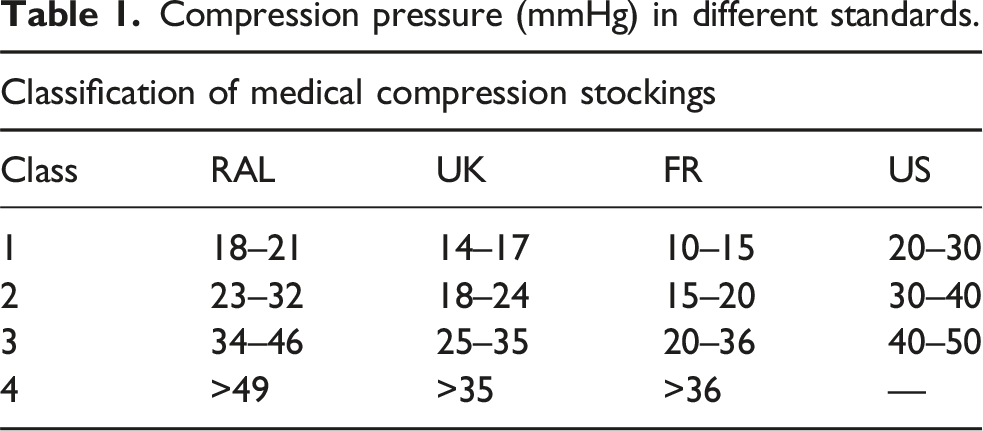
Methods
Our narrative review was conducted on MEDLINE with PubMed, Scopus, Web of Science and Google Scholar. Keywords were selected using PubMed’s medical subject headings (MeSH) and MeSH/EMTREE for Scopus. The keywords ‘chronic venous disease,’ ‘chronic venous insufficiency,’ ‘telangiectasias,’ ‘varicose vein,’ ‘leg edema,’ ‘lipodermatosclerosis,’ ‘healed ulcers,’ ‘venous leg ulcer,’ ‘superficial venous thrombosis,’ ‘deep venous thrombosis’; ‘post thrombotic syndrome,’ ‘compression post venous procedures,’ ‘lymphedema,’ ‘medical compression stockings,’ ‘inelastic bandages,’ ‘short-stretch bandages,’ ‘adjustable compression wraps’ were combined to obtain the pool of articles of interest.
Inclusion criteria
Papers published in peer-reviewed journals between January 1980 and October 2025: only documents in English were included.
Exclusion criteria
PRISMA flow diagram of relevant literature.


Results
Due to the paucity of information on the pressure exerted by different compression systems, we want to highlight that the criterion used to classify the results is the pressure exerted at rest at the ankle level.
In early stages of CVD
defined as CEAP C classes C0s-C1 of the Clinical, Etiological, Anatomical, Pathophysiological (CEAP) classification 1 : It has been reported that MCSs exerting 10–20 mmHg have been shown to control symptoms and signs such as pain, heavy leg sensation, cramps, and ankle swelling in healthy individuals (C0s according to the CEAP classification) who work in standing or sitting positions for a long time.2,3 In patients with telangiectasias and reticular veins (C1 patients) 1 we have two studies reporting effective symptom control of MCS exerting 10–15 mmHg 4 or 20–30 mmHg. 5 A low pressure of 10–15 mmHg was reported as effective in this condition, also by an International Union of Phlebology (UIP) consensus document. 6 In one study, where telangiectasias and reticular veins were associated with saphenous axial reflux, 7 MCSs exerting 20–30 mmHg were reported as effective in symptom control. The conclusion of these few studies indicates that a pressure of 10–20 mmHg is effective in controlling symptoms in stages C0s–C1s without saphenous axial reflux, and that a pressure of 20–30 mmHg is adequate when saphenous axial reflux coexists.
Uncomplicated varicose veins (CEAP C2)
In cases of uncomplicated varicose veins with symptoms such as pain, swelling, heaviness, throbbing, and itching, the role of MCSs remains quite controversial, according to Cochrane researchers. 8 They report that “There is insufficient high-certainty evidence to determine whether or not compression stockings are effective as the sole and initial treatment of varicose veins, or whether any type of stocking is superior to another.” These conclusions reinforce a previous review that expressed similar skepticism about the effectiveness of MCSs in symptomatic varicose veins. 9 However, the negative conclusions of these two systematic reviews are mainly due to heterogeneity and methodological flaws in the published studies, not to a lack of effectiveness. Conversely, MCSs are effective in studies reporting symptoms and signs and are often considered first-line treatment options. 10 However, the ideal compression pressure varies across different studies. In one study, 11 MCSs are reported as beneficial, but the compression pressure is not specified; two studies12,13 report MCSs exerting 23–32 mmHg as effective in patients with varicose veins; one study 14 suggests a higher pressure of 30–40 mmHg, and another found no difference between MCS exerting 18–21 or 23–32 mmHg in this condition. 15 The most recent double-blind controlled trials comparing MCSs exerting 18–21 mmHg with placebo stockings 16 or with no compression 17 report positive effects on symptoms in C2 patients. Another study compared graduated MCSs exerting 30 mmHg at the ankle and 21 mmHg at the calf with progressive stockings exerting 10 mmHg at the ankle and 23 mmHg at the calf. Both types of stockings were effective in controlling symptoms, but the progressive stockings were more effective and easier to put on and remove. 18 These findings have been challenged by another study comparing graduated and progressive stockings, which found the graduated stockings more effective. 19
Special mention is for compression in pregnant women. In this condition, MCSs exerting 20–32 mmHg were effective in controlling symptoms such as heaviness and swelling sensation, dizziness and vomiting, and edema.20–23 The recommendations for MCSs in symptomatic patients not undergoing interventional procedures for varicose veins and in pregnant women are also provided in guidelines and a recent editorial.10,24–26
We could conclude that MCSs are beneficial in symptomatic varicose veins, that compression pressure of 18–32 mmHg seems to be the most helpful, that in patients not tolerating the higher pressure, a pressure of 18–21 mmHg can be enough and, finally, that a pressure of about 20 mmHg ad calf level can be adequate when exerted both by graduated and progressive stockings.
Venous edema (CEAP C3) 1
When treating venous edema, it is necessary to distinguish between prevention and treatment. For edema prevention, studies focus on individuals who sit or stand for extended periods at work (occupational edema) or those who travel on long flights. MCSs exerting 10–20 mmHg are effective in preventing edema in a cohort of hairdressers and in individuals who spend their entire workday sitting or standing. 27 Another study compared MCSs exerting 15–20 or 20–30 mmHg in individuals who sit, stand, or switch between the two positions throughout the day. Both types of stockings were effective, but the strongest MCSs showed significantly better results. 28 However, another study 29 and a meta-analysis including 11 randomized control studies 30 reported no difference between MCSs exerting 10–20 or 20–30 mmHg for preventing occupational edema. Therefore, the authors suggest the lower pressure range as more comfortable. A positive effect of low compression pressure (17–20 mmHg at the calf level) on ankle oedema and reduced symptoms of leg pain, discomfort, and swelling was reported in healthy individuals travelling on long-haul flights. 31 However, in another report on healthy individuals flying for 3 h, a stronger pressure of 23–32 mmHg was effective in edema prevention. 32 Even in this context, MCSs with a progressive pressure profile (an average of 18 mmHg at ankle level, 30 mmHg at calf level) were compared to traditional graduated MCSs (an average of 22 mmHg at ankle level, 18 mmHg at calf level). In a study of 30 healthy individuals (such as nurses and office workers) who were examined before and after their work shifts, those using MCSs with a progressive pressure profile experienced better occupational edema prevention than those using graduated MCSs. 33
Few studies report the compression pressure of compression devices used for edema treatment. An old research comparing different pressure ranges applied by a pneumatic compression device, which delivers both sustained and intermittent compression, found that higher pressure was associated with greater edema reduction. Indeed, sustained non-graduated pressure of 40 mmHg and graduated intermittent pressure of 60 mmHg were more effective than lower pressures in reducing edema; however, they were not always tolerated. Conversely, sustained graduated pressure of 30–40 mmHg and intermittent pressure of 50 mmHg were more effective and better tolerated than lower pressures. 34
However, it has been shown that MCSs exerting 23–32 mmHg can reduce edema; this pressure range is not ideal, as short-stretch bandages applied at 60 mmHg are significantly more effective. Additionally, MCSs must be changed after 2–3 days to adjust to the new leg size, which is not a cost-effective solution. 35 A new non-graduated MCS exerting 23 mmHg at both the ankle and calf was effective in reducing edema, but not as effective as a graduated MCS exerting 40 mmHg at the ankle level, even though the difference is not statistically significant. In this study, a comparison with a stronger short-stretch bandage was not performed. 36 Two superimposed stockings exerting 40 mmHg are just as effective as a short-stretch bandage exerting a very strong pressure of 60 mmHg. 37 Adjustable compression wraps (ACWs) exerting 40 mmHg are more effective than short-stretch bandages exerting 60 mmHg. 38 Both results are easily explained by the pressure maintenance by MCSs and, even more so, by ACWs. In contrast, short-stretch bandages tend to lose pressure quickly over time, even when applied with significantly higher pressure. The same 40 mmHg pressure value reported as effective in edema treatment appears in another study involving ACWs in poorly mobile nursing home patients, 39 as well as in a study comparing short-stretch bandages and ACWs, both of which were applied at approximately 40 mmHg. 40 Even in these studies, ACWs were more effective than short-stretch bandages due to their better pressure maintenance. Conversely, in a small not non-randomized, non-controlled study, a low pressure of 18–21 mmHg was reported to be effective in edema treatment even in pregnant women. 41
There is no data on compression pressures varying with edema severity or pathophysiology.
In conclusion, based on the available data, a compression pressure of 15–21 mmHg is sufficient to prevent occupational edema. This pressure can be exerted by graduated or progressive compression devices. A real advantage of higher pressure has never been proved. For edema treatment, we need higher pressure. Although a pressure of 20–30 mmHg may be sufficient to reduce leg edema, a pressure of about 40 mmHg is significantly more effective for the best outcome. Devices that exert non-graduated or progressive pressure are also effective for edema treatment.
Lipodermatosclerosis (CEAP C4b) 1
In lipodermatosclerosis treatment, there are a few papers reporting compression pressure. In old studies, it has been reported that MCSs exerting 35–45 mmHg are effective in reducing lipodermatosclerotic areas, 42 and that MCSs exerting 30–40 mmHg can remove fluids from the dermal layer in lipodermatosclerotic patients. 43 More recently, bandages were used for lipodermatosclerosis symptoms in a small cohort of patients. 44 Compression pressure is not measured in this study; however, the authors are confident that they can apply 40–45 mmHg with the materials and application method used, as demonstrated in previous publications from their group. Lastly, a recent publication reported a single case of a complex patient who was not tolerating any compression and, ultimately, was successfully treated with an adjustable compression wrap exerting 30–40 mmHg. 45
In conclusion, a compression pressure of approximately 40 mmHg is necessary for patients with lipodermatosclerosis.
Healed ulcer (CEAP C5) 1
For the prevention of ulcer recurrence, the higher the compression pressure, the greater the effectiveness, as demonstrated by two studies comparing class 3 and class 2 MCSs, according to both the European 46 and the British standard. 47 Nevertheless, it was also shown that the higher the compression pressure, the lower the patients’ compliance, which can dilute the superior effectiveness of the higher pressure.46–48 Compliance is a big issue in compression therapy. It must be strictly considered, as it could be even more important than compression pressure, as shown in a paper comparing European class 2 versus class 1 MCSs. 48 This study demonstrated that class 2 MCSs are more effective than class 1, although the difference was not statistically significant. However, the lower recurrence rate was seen in the compliant patients regardless of the compression level. 48
We can conclude that compression pressure above 30 mmHg is most effective in preventing ulcer recurrence; however, lower pressure may be sufficient in non-compliant patients.
Venous ulcers (CEAP C6) 1
Even in this case, a few studies report the compression pressure. Most studies focus on comparisons between different materials, without considering the compression pressure. Consequently, the origin of ≥40 mmHg, which is regarded as the optimal pressure for venous leg ulcer (VLU) treatment,49,50 is unknown. 51 Indeed, looking at the few studies reporting the compression pressure in VLU treatment, it is possible to conclude that the higher the pressure, the higher the healing rate.52–55 In addition, it is necessary to consider not only the resting pressure but also the characteristics of the compression materials. The same resting pressure of 40 mmHg increases by a few mmHg when transitioning to the standing position with elastic materials, but by 20, 30 mmHg or more with short-stretch materials. Only a very strong pressure, >60 mmHg, can occlude the leg veins in the standing position, which is necessary to improve the impaired venous hemodynamics. Consequently, this pressure can be achieved only with short-stretch materials, even when applied at a lower and more comfortable pressure of about 40–50 mmHg.56–60 When applied with this pressure level, the short-stretch material will maintain a very strong standing pressure and its hemodynamic effectiveness, even after a significant pressure loss. 61 With elastic materials, this very strong pressure will never be exerted, and they will be unable to counteract the impaired venous hemodynamics. Summarizing, it should be noted that the resting pressure at the ankle is a rough approximation, because the actual hemodynamic efficacy of compression is more closely related to the working pressure exerted on the calf and the stiffness of the compression systems than to the resting pressure at the ankle.
Moreover, a new concept, the pressure maintenance, must be considered. While pressure drop is well known with short-stretch materials, it does not occur with the adjustable compression wraps, as patients can be educated to readjust the wrap when they feel a loosening sensation, thereby maintaining a strong standing pressure.
In conclusion, a supine pressure of 40–50 mmHg seems to be effective in ulcer treatment when applied with short-stretch materials or adjustable compression wraps. It has also been demonstrated that elastic kits, consisting of two superimposed elastic stockings, are effective in accelerating the healing of small, recent-onset ulcers.62–65 When arterial impairment coexists with venous disease, the compression pressure must be reduced and never exceed 40 mmHg.25,66–70 This pressure level does not impair the arterial inflow and is still effective in improving the impaired venous hemodynamics. 66
Compression after venous procedures
The literature on this topic shows contrasting results. Some studies have found that strong compression is more effective than light compression in reducing side effects, such as pain, hematoma, bleeding, and vein thrombosis.71–75 Some suggest that MCSs compression is more effective than no compression in reducing pain scores.76–78 Others suggest that light compression is just as effective as strong compression, 79 and some find no benefit at all.80–84 Only one paper reports that MCSs exerting 23–32 mmHg are more effective than no compression in treating telangiectasias. 85 Surprisingly, the results vary greatly, even though most studies do not specify the compression pressure used. A recent study reports that after the first 24 h following varicose veins foam sclerotherapy (when a thigh-length elastic bandage was applied to the operated leg), the application of MCSs exerting 18–24 mmHg, worn day and night for 7 days, was effective in reducing post-procedure pain but not effective on clinical severity scores, QoL scores, time to return to normal activities, occlusion rates at 6 months, ecchymosis, and any other complications. 86 In conclusion, it is challenging to determine the optimal compression pressure for this purpose. We can only report that when compression pressure was measured or a clear difference in compression pressure could be assumed based on different compression modalities, a strong pressure of 30–40 mmHg at the thigh level proved more effective than a low compression pressure71–75 This strong pressure range is confirmed in a recent publication. 87 A lower compression seems to be effective in reducing post-sclerotherapy pain. 86
Superficial vein thrombosis (SVT)
It is impossible to determine a specific compression pressure. The significance of compression is currently being questioned. Compression is even overlooked in the latest guidelines 88 and systematic review 89 on venous thrombosis, which primarily focus on rivaroxaban and other direct oral factor Xa or thrombin inhibitors, low-molecular-weight heparin, and nonsteroidal anti-inflammatory drugs. Although compression has been a traditional therapy, it is usually combined with antithrombotic medications, making it difficult to assess its actual effectiveness. Studies have shown that MCSs exerting 23–32 mmHg do not provide significant additional benefit in treating SVT, despite significantly accelerating thrombus regression. 90
Deep vein thrombosis (DVT)
There is a clear indication for early compression in the acute phase of DVT. It must be applied within 24 h of the diagnosis, using both MCSs and multilayer bandaging, to exert a pressure of 30–40 mmHg.88,91–93
Thromboembolism prevention
We do not have data about the necessary pressure to prevent thromboembolism. Compression therapy, applied by MCSs, is even questioned in many papers, as it would not add any benefit to the systemic antithrombotic treatment.
Post-thrombotic syndrome
We have no data on the compression pressure required to relieve symptoms and signs in post-thrombotic syndrome. There are only two small studies that compared MCSs exerting 20–30 mmHg 94 or 30–40 mmHg 95 with no compression, and they were unable to demonstrate any beneficial effect from MCSs wear.
Lymphedema
Compression pressure is rarely reported, even in papers on lymphedema. Compression pressure is different depending on whether the lymphedema is in the arm or the leg. In arm lymphedema, a pressure of 30–40 mmHg has been reported to be as effective as a higher pressure of 41–60 mmHg and more effective than a pressure of 21–30 mmHg. 96 However, in another paper, a low pressure of 20–30 mmHg was reported as effective in reducing arm lymphedema. 97 In addition, this low pressure was reported as more effective than a higher pressure of 44–58 mmHg, 98 raising doubts about the really most effective compression pressure in arm lymphedema treatment. An even lower pressure was reported as effective in the maintenance phase and for recurrence prevention. 99
For leg lymphedema, the higher the pressure, the greater the reduction in edema, 100 especially when lymphatic function is severely compromised or absent and reabsorption must occur through tissue channels. Strong pressure, exceeding 50 mmHg, has been shown to be effective in reducing leg volume in patients with lymphedema. 101 A strong pressure must also be well tolerated. Indeed, it has been demonstrated that a supine pressure of 50–60 mmHg, rising to 80–90 mmHg in the standing position, appears to be both effective and comfortable.102,103 The application of very strong pressure, up to 120 mmHg for a short time, as 30 min, in patients with advanced lymphedema, could speed the edema removal and leg volume reduction. 104 There is no reason to be afraid of occluding the lymphatic capillaries with this strong pressure. It has been demonstrated that only a pressure exceeding 80 mmHg can occlude the lymphatic capillaries. 105 When fluid has been removed and the patient must wear compression to maintain results and prevent recurrences, flat-knit MCSs exerting 23–32 mmHg can be used. 106
Lipedema
Despite several reports on the effectiveness of compression therapy in lipedema patients, no studies have reported compression pressure in lipedema patients. In two studies, second-class flat-knit MCSs are reported to be effective in reducing pain in these patients.107,108 We know that this class corresponds to a compression pressure of 23–32 mmHg. In less advanced stages, the same compression may also be applied by round-knit MCSs. 107 Compression does not affect fat tissue. However, when fluid accumulation is associated with lipedema, compression can reduce limb volume in addition to relieving pain.
Discussion
Our data clearly show that prescribing the precise pressure for any venous disease case is difficult. Very few studies report compression pressure, and this is almost never the case when using MCSs. When applying MCSs, it is necessary to trust the manufacturers who guarantee the range of exerted pressure. Although the pressure declared by the manufacturer does not always correspond to the actual pressure exerted, 109 we can assume that, in large series, the declared compression pressure is likely to match the exact pressure exerted. For these reasons, it is mandatory to specify a pressure range for every clinical situation. This approximation lacks precision, but at least we can recognize that low pressure can be sufficient in the early stages of CVD. At the same time, we need a strong to very strong pressure to treat leg ulcers or lymphedema in the reduction phase. Moreover, suppose these pressure ranges are widely accepted. In that case, we will have a rough indication of which pressure to exert in clinical practice and for future studies, depending on the indication for compression therapy.
Based on the available data, we conclude that mild to moderate compression pressure, 110 consistently lower than 30 mmHg, is sufficient for CVD 1–5, lipedema, and during the lymphedema maintenance phase. Some work is still needed in some instances. In ulcer treatment, the ongoing debate over the best compression method has reached consensus: a compression pressure of at least 40 mmHg yields the greatest increase in healing rates. This is also supported by the observation that higher pressures are associated with greater healing success. These data favor the use of short-stretch materials (bandages or wraps) that can exert strong or very strong pressure from a lower, comfortable level. However, a conclusive study comparing the effectiveness of elastic kits (two superimposed stockings) and short-stretch bandages on the healing rate remains lacking.
Summary of compression pressure for various clinical indications with references and recommended compression materials.
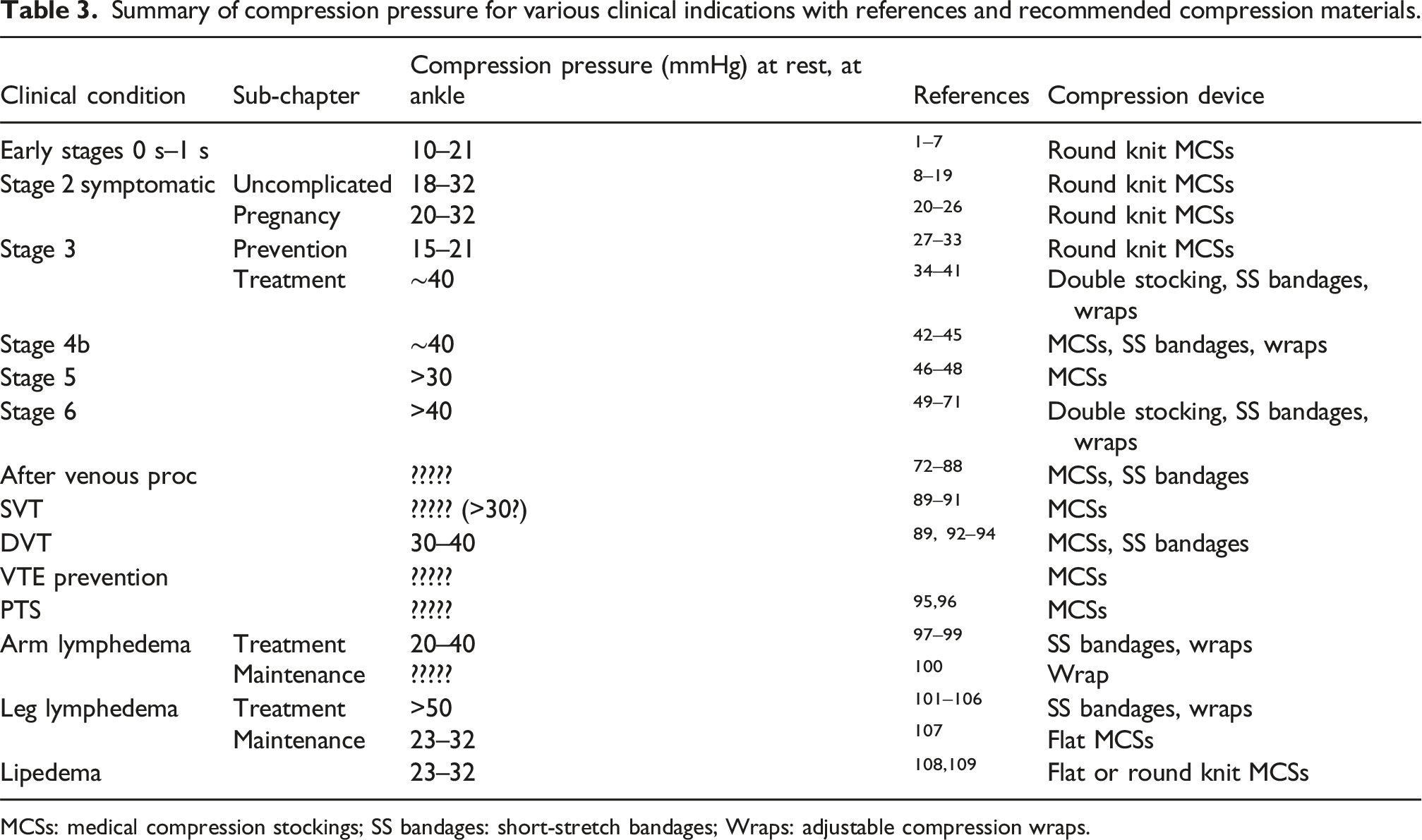
MCSs: medical compression stockings; SS bandages: short-stretch bandages; Wraps: adjustable compression wraps.
Study limitations
As a narrative review, this study is prone to selection bias, despite our efforts to provide a comprehensive overview of all studies reporting compression pressure or compression classes of stockings, which correspond to well-defined pressure ranges. The level of evidence for each publication is not specified, but we are aware that we included some small, sometimes older publications in this review. Many of them report only observational data of poor scientific quality. On the other hand, this is the only data we have. High heterogeneity across included studies (materials, devices, duration, patient populations), limits comparability. In some clinical indications, we do not have data at all or we even have doubts if compression is effective or not. However, despite these limitations, this is the first attempt to identify specific pressure values for each considered indication. This review once again highlights the need for new, high-quality scientific studies to fill the gaps in our understanding of effective compression therapy.
Conclusions
The selection of compression pressure should be guided by disease severity and clinical objectives. The early stages of chronic venous disease benefit from pressures below 30 mmHg, whereas advanced conditions and venous ulcers require pressures of at least 40 mmHg, optimally delivered through short-stretch bandages or adjustable wraps. In lymphedema, a pressure of 50–60 mmHg ensures effective volume reduction, while a pressure of 23–32 mmHg in the maintenance phase yields optimal results. Evidence remains limited for superficial venous thrombosis, post-thrombotic syndrome, and post-procedural compression. For lipedema, we have only empirical indications, not precise ones. Standardized measurement and consistent reporting of applied pressure, along with international harmonization of compression classes, are crucial for improving therapeutic comparability, clinical efficacy, and patient adherence in venous and lymphatic disorders. All these requirements must be satisfied by new high-quality scientific studies.
Footnotes

Ethical considerations
Ethical approval was not sought for this work.
Author contributions
GM, wrote the first draft. JPB and AC contributed suggestions, comments and reference research and review. GM created a final version and sent it to the co-authors, who approved the final version of the manuscript.
Funding
The authors received no financial support for the research, authorship, and/or publication of this article.
Declaration of conflicting interests
The authors declared no potential conflicts of interest with respect to the research, authorship, and/or publication of this article.
Guarantor
GM.