




Abstract
This work presents the results of quantitative research into online child grooming carried out with a sample of 489 secondary school students in Catalonia (Spain). Besides determining the rate of victimisation of children by this behaviour, it establishes the profile of the victims and the offenders. In addition, it analyses the dynamics of these processes, victim–offender interaction, the level of effect that this behaviour has on the victims and the way in which an end was put to the situation. The results obtained in this empirical research do not permit confirmation of the common opinion that the widespread use of information and communication technology has led to an exponential increase in the victimisation of minors through online child grooming behaviour by unknown adults offline, because of which we need to react through the criminalisation of this behaviour.
Introduction
It is a widely-held opinion that the emergence of communication technologies in our everyday lives may constitute a contributing factor to the increase in processes relating to the sexual victimisation of children. International criminal policy undertaken in recent years in the fight against the sexual victimisation of children, following the example of the USA, is based on constructs such as that of the adult sexual predator unknown to the minor who, hidden behind a computer screen, tries to gain sexual access to the child. The stereotype of ‘stranger danger’ is what has been taken as the model to determine the essential sphere of legal–criminal intervention in the USA, but also in European regional instruments, such as the Council of Europe Convention on Protection of Children against Sexual Exploitation and Sexual Abuse (Lanzarote Convention) or Directive 2011/93/UE on combating sexual abuse and sexual exploitation of children and child pornography, which explains the recent criminal reforms that have taken place on this point in various European countries (on this regulatory transfer from the US to Europe, see McAlinden (2012)). Based on legislative interest focused on the sexual victimisation of children through information and communication technology (ICT), the criminalisation of behaviour such as the sexual soliciting of children using ICT – a phenomenon known as online grooming – has been promoted. Such international demands for criminalisation explain the inclusion of the offence of online child grooming in a number of European countries, including England and Wales (2003), Scotland (2005), Ireland, Norway and France (2007), Netherlands and Spain (2010), Austria and Italy (2012).
However, the crusade undertaken in many Western countries against sexual predators is not always based on empirical evidence. The toughening of criminal legislation for such sexual offences against children has been based more on moral panic than on victimisation surveys and other sources of empirical data. Despite this, it is not unusual to find references to the supposed exponential increase in behaviour relating to the online sexual victimisation of children with the arrival of the digital age (Bocij and McFarlane, 2003; Hughes, 2002). Generally, such pronouncements refer to the nature of the internet to favour the widespread occurrence of criminal activities and to the opportunities afforded by the special nature of time and space on the internet to aid their undertaking, based on postulates such as those of the theories of opportunity (Miró, 2011). With regard to potential sexual abusers and paedophiles, they refer to the aid offered to communication between them by social media such as Myspace or Facebook, and the possibility of shielding their true identity behind fake profiles, approaching children as though they were children too (Duncan, 2007–2008; Groppe, 2007–2008; Haubenreich, 2008–2009; Stedman, 2007; Van der Heide, 2008–2009; Whitaker and Bushman, 2009). Along with the advantages offered by the internet, it is said, it contains dangers that give rise to the need for regulation, dangers that are magnified in the case of adolescents, who have greater difficulties than adults in identifying risky behaviour (Duncan, 2007–2008; Lööf, 2012).
The existing empirical evidence on the matter does not appear to bear out the supposed exponential increase in victimisation. The empirical studies conducted by the Crimes Against Children Research Center (University of New Hampshire) have been pioneering in determining the prevalence of child sexual abuse on the internet. There, a team of researchers conducted the first large-scale study of victimisation, with a sample of 1,501 participants – young people between the ages of 10 and 17, with data gathered between 1999 and 2000 (Finkelhor et al., 2000 ), known as the Youth Internet Safety Survey (YISS-1). This study asked about whether the children in the sample were subjected to three different types of activity: sexual solicitation and approaches made by adults (i.e. grooming), unwanted exposure to sexual material and harassment. With regard to grooming, the study concluded that approximately 19% of children using the internet had received an unwanted sexual solicitation in the year prior to the conducting of the survey. The research concluded that the online victimisation of children was higher than was previously thought, and advocated the criminalisation of the behaviour of sexual soliciting over the internet. Subsequent editions of the YISS (YISS-2 and 3) revealed how the sexual soliciting of children had decreased to 13% in 2006 (Wolak et al., 2006) and to 9% in 2010 (Mitchell et al., 2014).
In Europe, the conducting of studies about the prevalence of the sexual victimisation of children on the internet is not as standardised as in the US. Since the late 2000s, comprehensive studies of projects, often funded by the European Union, began to be published. However, they were not studies aimed at determining the prevalence of victimisation by grooming or the characteristics of this phenomenon, but at measuring risky behaviour by children on the internet in general. The final report of the first EU Kids Online project gave a general assessment of various types of risk that may affect children when they are on the internet. According to the ranking of the incidence of risks that it contains, grooming is in fifth place regarding online risks affecting children, below offering private information, viewing pornography or viewing violent or hateful content, or being subjected to harassment (Livingstone and Haddon, 2009). As part of the Safer Internet Plus Programme, the European Online Grooming Project consisted of a qualitative study focused on in-depth interviews with 33 offenders and with various groups of young people, the principal results of which consisted of the creation of both a profile of offenders and of victims of grooming (Webster et al., 2012).
In Spain, besides previous local studies conducted in Madrid and Barcelona (Acción Contra la Pornografía Infantil [ACPI], 2002; Pereda et al., 2013), the most comprehensive study was conducted by a group of researchers from the University of the Basque Country as part of the EU Kids Online project (Garmendia et al., 2011). This was not aimed at determining the prevalence of, or the nature of grooming itself, but at establishing the prevalence of risky behaviour of children on the internet in general. Key results from the Spanish sample were that 11% of the interviewees had seen sexual images on the internet and that 9% of the members of the sample had received or seen sexual messages, with 21% of the children interviewed having had online contact with someone they did not know offline.
The current study has been undertaken in light of the lack of studies aimed at determining the prevalence of victimisation of children by online grooming in Europe in general and in Spain in particular, despite the expansion and greater seriousness of the behaviour related to this phenomenon in the reform of the Spanish Criminal Code in 2015. Besides determining the annual rate of victimisation by grooming by peers or adults among adolescents, it seeks to establish the profile of victims of this type of behaviour as well as to determine predictors of victimisation. In addition, it aims to find out the characteristics of this type of behaviour, the effects it produces on anyone subjected to it and the mechanisms used to bring an end to these situations.
Methodology
The research presented here was carried out with a sample of secondary school students between the ages of 14 and 18, who were studying in a city in the west of Catalonia (Spain). Data were gathered in relation to 489 adolescents studying third and fourth year ESO (compulsory secondary education) and the first and second years of A-Level, or the middle grade of occupational training cycles, in five secondary schools in the city, all of them state-owned and located in different areas of the city, so ensuring the representative nature of the sample.
Despite the sample having been taken in a single city with a study population of some 12,000 individuals, the results can be extrapolated to Catalonia taking into account that, according to the population figures by age in the community in 2015, it may be estimated that the population of between 14 and 18 years of age is 419,761 individuals, 1 in relation to which a sample of 399 individuals would ensure a level of confidence of 95% and that for p = q = 0.50 the margin of error is ±5%. 2 Having selected the schools, to be able to carry out the research we obtained the consent of the management teams of the centres where the research was conducted. Although participants were told that the intervention was voluntary, it was decided not to gather signed information on informed consent to ensure that the questionnaire was anonymous.
The information gathering method consisted of a questionnaire, which was answered anonymously in the five schools between February and March 2015. Drawn up on the basis of the models used by the Crimes Against Children Research Center in the various editions of the YISS, the questionnaire comprised 44 questions.
The survey is divided into two parts. In the first part of the questionnaire (questions 1 to 14) the respondents were asked for general data (age, gender, place of residence), family socio-educational level and information and communication technology usage habits that could be considered significant in explaining victimisation by grooming (Finkelhor et al., 2000; Mitchell et al., 2014; Wolak et al., 2006). The second part of the questionnaire was aimed at determining the prevalence and characteristics of this victimisation. In relation to this second part (questions 15–44), along with the questions directly aimed at determining the prevalence of victimisation by grooming from peers and adults in the previous year to the survey, the respondents were asked about the following aspects: characteristics of the offender, reporting and end of the situation, feelings caused in the victim, dynamics of the grooming, degree of interaction with the offender, and use of deceit, violence or threats. The 20th version of the IBM Statistical Package for the Social Sciences (SPSS) was used for the statistical analysis of the data.
Regarding victimisation, in order to delineate a victim profile, once the list of relevant variables was determined, it was considered necessary to establish the extent of correlation between the variables. Hence, first a binary analysis using the chi-square test was carried out. This was followed by a multivariate analysis of multiple correspondence. Since this statistical technique searches for associations among variables by establishing similar profiles by grouping the significant variables in two dimensions, it was considered appropriate to determine the profile of the online grooming victim. With the purpose of identifying characteristics associated with online grooming victimisation, a positioning map was created with the categories of the variables involved in the model building.
As well as these statistical analyses, with the aim of determining the probability of a child being a victim of grooming, a binary logistic regression was also conducted, following the logit model. This is a methodology that is often used in the social sciences (Carrasco and Hernán, 1993; Hosmer and Lemeshow, 1992; Myers, 1989; Pérez, 2005) that enables prediction (in the case that concerns us according to such variables as gender, age, place where respondents went online or parents’ level of education) of the greatest probability that certain young people will be victims of grooming.
Results
Results relating to the general characteristics of the sample
Before we analyse the results about victimisation through grooming, Table 1 shows the descriptive results from the sample obtained from the treatment of the first questions on the questionnaire.
Characteristics of the young people in the sample (n = 489).
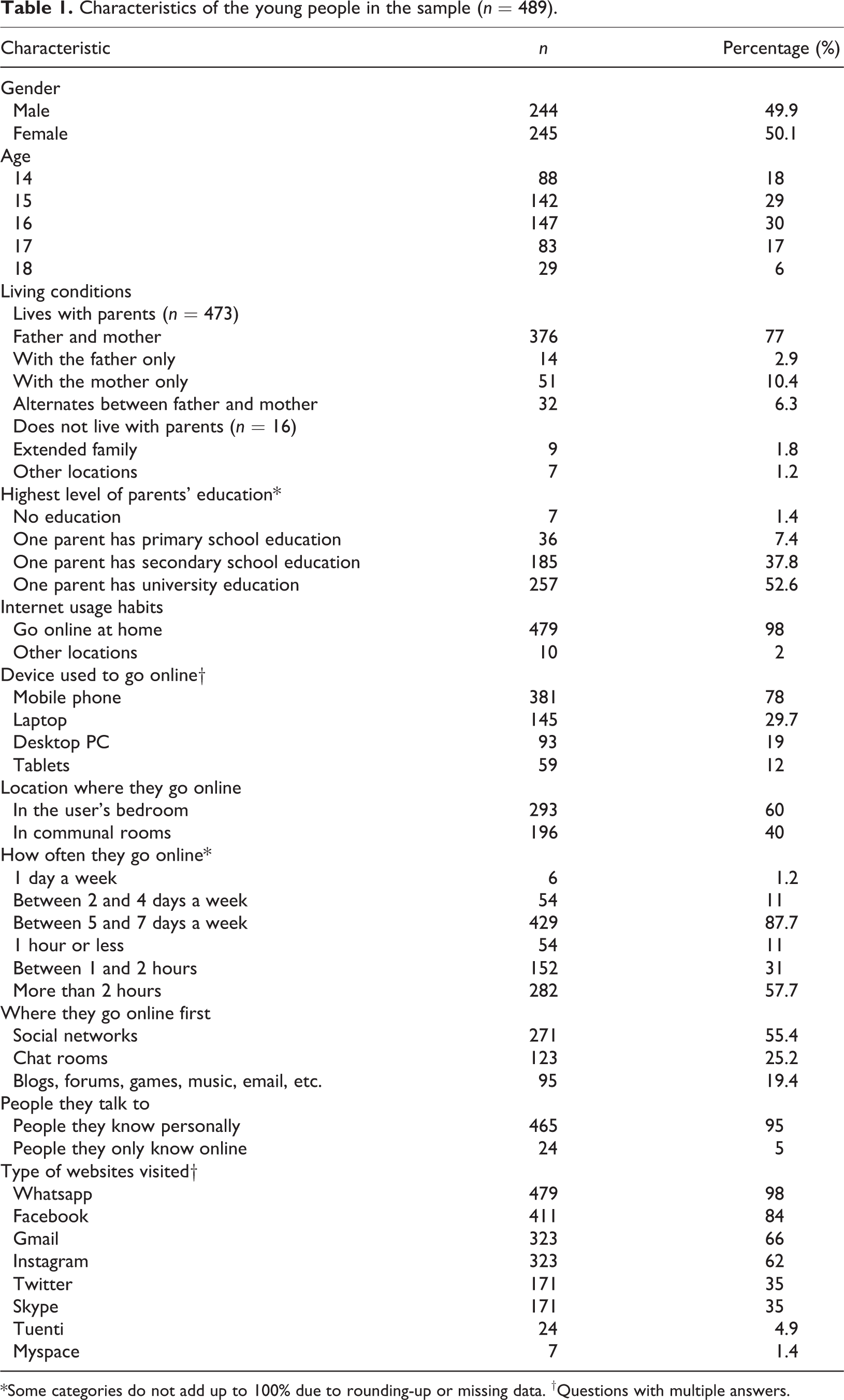
*Some categories do not add up to 100% due to rounding-up or missing data. †Questions with multiple answers.
Victimisation through grooming
Rate of victimisation through grooming
To ascertain the annual rate of victimisation of children through grooming, the children were asked about sexual soliciting behaviour that occurred in the year prior to the questionnaire by people the same age as them and also by adults. The concept of peer grooming was more restricted than the concept of grooming by adults. In the case of adults, it was enough for the perpetrator to try to get the respondents to talk about themselves when they did not want to, also measuring when they asked them to talk about sex, provide sexual information or perform sexual behaviour against their will, whereas in the case of peers, behaviour was counted only when the respondent was asked to talk about sex, leaving aside cases where they were only asked to talk about themselves.
In relation to the annual rate of victimisation caused by persons of their own age, 12.3% (n = 60) of the young people surveyed recognised that in the year prior to the survey they had suffered some type of unwanted sexual contact – relating to someone of their age asking them to talk to them about sex – using some form of ICT. The prevalence related to peer grooming drops to 11% (n = 54) when the respondents were asked if someone had asked them for sexual information about themselves against their will. Finally, in relation to the peer group, the prevalence falls even further when asked if they had been asked to perform some type of sexual behaviour when they did not want to, where the rate of victimisation was 6.7% (n = 33).
With regard to grooming from adults, the rate of victimisation was even lower. The cases where adult groomers tried to get the child to talk to them using any ICT was 10.4% (n = 51), only 5.1% (n = 25) trying to get the respondent to talk to them about sex, with the cases where the adult made demands for sexual information from the respondent when they did not want to reply being 4.3% (n = 21), and finally, only in 2.7% (n = 13) of cases was the respondent asked to perform unwanted sexual behaviour. Using, therefore, a very broad concept of grooming, which identifies it as any attempt to establish contact with a child via ICT without noting the aim of the groomer, the annual rate of victimisation barely exceeded 10% of cases.
The results of this study are not comparable with those of the Crimes Against Children Research Center, due to the use of a different measuring instrument, the different methodology employed to obtain the results and the different configuration of the sample. However, the annual rate of victimisation in the case of grooming by adults approximates the one obtained in YISS-3 for unwanted sexual requests, the lowest of those obtained in the different editions of YISS. We cannot determine a rising or falling pattern over time of this behaviour due to the absence of previous analyses using our instrument, but a rate of victimisation of around 10% – taking into account that it included any attempt by an adult to contact a child online – would contradict statements that sexual requests made to children may be growing exponentially with the use of ICT. To this we should add, above all, that the fact of the rate of victimisation relating to grooming undertaken by adults being lower than that by peers (5.1% compared with 12.3%, respectively, when the respondent is asked to talk about sex) does not fit in with the stereotype of ‘stranger danger’, in the sense that children are more often subjected to requests by unknown adults than by peers.
Profile of the victims
In relation to the socio-demographic characteristics of the victims, both in grooming between peers and by adults, girls invariably appeared as more victimised than boys, with percentages of over 60% in all the questions relating to victimisation by peers or adults, whereas the victimisation of boys did not exceed 40%. The only case where this general pattern changed was in grooming by adults, when the groomer tried to get the victim to talk about sex, in which though the percentage of girl victims remained the majority (52%), that for boys reached 48%. Although gender is a variable to take into account for the purposes of explaining victimisation by grooming, the difference by gender was not always statistically significant. It was in the case of peer grooming when the victim was asked for sexual information (χ2 = 5.256; p = 0.02) or to perform sexual behaviour (χ2 = 3.884; p = 0.04) and in the case of grooming by adults when the groomer limited themselves to trying to get the victim to talk about themselves (χ2 = 4.857; p = 0.028).
Age did not appear to be a determining factor in this type of victimisation, though there was limited variation in age for the members of this sample: between 14 and 18 years of age. Although it is true that the majority group of victims was concentrated amongst 15- and 16-year-olds, in the bivariate analysis it can be seen that, in most of the questions posed, there were no statistically significant differences. The only exception occurred in the case of peer grooming, when the victim was asked for sexual information, in which the under-16s were significantly more victimised (χ2 = 9.762; p = 0.045).
In relation to whether the socio-educational level of the parents had any type of impact on victimisation by grooming, the results from the bivariate study showed differences with statistical significance in relation to the academic level of the parents and the victimisation of their children. Whereas in the case of peer grooming, most of the victims had at least one parent with secondary or university education, which corresponded to the majority profile of the members of the sample, in the case of those victimised by grooming by adults, the victimisation figures relating to children whose parents only had primary education are notable (the responses to questions 15 to 18 on victimisation by grooming from adults produced the following values respectively: χ2 = 18.881, χ2 = 41.717, χ2 = 48.861, χ2 = 44.040, respectively, with p = 0.00 in all of them).
With reference to the ICT usage habits of the victims of grooming by peers and adults, generally the victims went online more at home than at school (the two places where the victims usually were when they received a request), although this pattern corresponds to the general characteristics of the sample. Specifically, 57 of the 137 victims in the case of being asked to talk about sex by peers were using a computer at home and 37 at school, whereas in the case of being asked by adults, 24 of the 58 victims were using it at home and 18 at school. A higher number of children were victimised when they used a mobile phone than when they used another type of device, such as a desktop computer or a laptop, corresponding to the general characteristics of the sample. Generally, the victims of peer grooming used their mobile phone to go online (45 of the 87, including 17 of the 32 in the case of grooming by adults).
The most victimised children were the ones who tended to go online more frequently, as the multivariate analysis confirms. In this, the results follow the general characteristics of the sample, comprised mainly of children who went online every day for more than 2 hours. Victims of peer grooming mainly went online between 5 and 7 days a week (85%), on similar terms as occurred with victims of grooming by adults (84% of the ones who had received requests to talk about sex with the groomer went online between 5 and 7 days a week) and most of them did it for more than 2 hours a day (approximately 70% in the case of peer grooming and 72% in the case of grooming by adults). The victims mainly went on social networks more than using chat rooms in the case of peer grooming (55% compared with 27%), although in the case of grooming by adults, the percentage of victims who stated that they commonly used chat rooms or social networks was the same (44%). This latter may be due to the fact that among internet usage habits, accessing chat rooms may still be more widespread among older groomers than among children. The types of website visited by victims were primarily Whatsapp (12%) and Facebook (11%) in the case of peer grooming. Although these websites were also the ones used most prevalently by victims of grooming by adults (5% and 4.7%, respectively), other websites, such as Gmail (4%) and Instagram (3.3%) also appeared as the ones chosen by victims.
The results of the study do not confirm that the use of computers or going online in communal areas prevents the online sexual victimisation of children. In the case of grooming by other children, 51.7% of the victims habitually went online in communal areas, compared with 48.3% who did so in their bedrooms. However, in the case of grooming by adults, it can be said that in the majority of cases the victims went online in their bedrooms (56%), compared with the 44% who did so in communal rooms (χ2 = 3.74; p = 0.053), which was not the case when the grooming escalated to asking the child to perform some sexual behaviour that they do not want to do, where 69.2% of victims habitually went online in communal areas (χ2 = 4.65; p = 0.031).
The overwhelming majority of victims were adolescents who preferred to talk on the internet with people they knew personally (in over 95% of cases). It was only 10% of victims of grooming by adults, when the groomer tried to get them to talk about themselves, who preferred to talk with strangers on the internet.
The results of the bivariate analysis revealed so far are partially corroborated by the outcomes of the correspondence analysis. Although, according to the bivariate analysis, gender could be considered a salient factor, it is not so relevant when it is correlated with other elements. The multivariate analysis shows how family socio-educational level and victims’ ICT usage habits should be considered the most relevant factors when explaining victimisation by online grooming. With reference to victims of peer grooming, being a victim is principally explained by the variables relating to the level of the parents’ academic education, how often teenagers go online and when they go online first (Cronbach’s alpha 0.797). Victims generally had parents who only have a primary education, are the most often connected (between 5 and 7 days, more than 2 hours per day) and they tended to visit social networks when they went online. Similarly, victimisation through adult grooming is explained by the same salient factors, i.e. parents’ level of academic education and frequency of internet connection (Cronbach’s alpha 0.793). However, in this case victims tended to connect more to chat rooms than to social networks when they went online and they talked with users they had only met online. Age can also be considered a salient factor to be victimised by adults in online grooming, since there is a high correlation among 15-year-old teenagers and this type of victimisation.
With regard to the probability of suffering victimisation by grooming according to certain variables, the logistic regression carried out allows us to state that there is a relationship between the probability of being a victim of grooming and gender, age, level of education of the parents and the place where the child goes online. The probability of suffering this type of behaviour decreases when the victim is a male in relation to when the victim is a female, being reduced to half (OR = 0.528 when the grooming is between peers and OR = 0.436 when it is by adults). In relation to age, under-14s have a greater probability of being a victim of both peer grooming (OR = 0.127) and grooming by adults (OR = 0.086). The place of connection to the internet also has an impact on the probability of being a victim of grooming, as the child who goes online in their bedroom compared to communal rooms has a greater probability of being a victim of grooming by adults (OR = 1.283), unlike peer grooming. Finally, the probability of suffering this type of victimisation increases the lower the level of the parents’ education, given that a child with parents who have not studied have a probability of between 8.6 and 22 times more of being a victim of grooming by peers or by adults, respectively, than a child whose parents have studied in higher education.
Characteristics of the groomer
As regards the characteristics of the person making the request, for grooming in general, those making contact were mainly men (60% men and 30% women, plus 10% of requesters of gender unknown to the victims). In the case of peer grooming, three out of every four offenders were men (χ2 = 6.53; p = 0.038). In the case of grooming by adults, the behaviour was also undertaken primarily by men; in approximately 70% of cases, it was adult men who approached children, compared with 22% women, with the gender of the perpetrator not known in the remaining cases (χ2 = 5.244; p = 0.073). However, when it was a case of trying to get the respondent to talk to the person asking about sex, the percentage of women rises to 39%, compared with 56% men, with the difference not being statistically significant (χ2 = 2.43; p = 0.296).
With regard to the age of the requester, it was observed that most of the groomers were under 18 years of age (48%), followed by adults of between 18 and 25 (40%), with solicitors over the age of 25 at 4.5%. Looking at grooming types by perpetrator, it is logical from the wording of the question that, in the case of peer grooming, most of the offenders were children, around 54%, although it was true that even in these cases, 36% of the offenders were estimated to be between the ages of 18 and 25, so the children surveyed considered young adults to be the same for the purposes of grooming. What was very revealing about the age of the offenders is that, in the case of grooming by adults, the perceived age rarely exceeded 25 years. Together with those far from negligible cases where the victims did not know the age of the offender, victims generally believed that they were between 18 and 25, both in the cases where the child was asked for information about themselves or to talk about sex (around 60%) and when the behaviour escalated, asking for sexual information about the child (66%) or asking them to perform behaviour when the child did not want to (69%). Here, the results of the study again refute the stereotype of ‘stranger danger’, according to which groomers are usually much older than their victims, generally with problems of social communication. In short, it is confirmed that peer grooming is the most prevalent.
The results of the study in relation to the level of victims and offenders knowing each other beforehand, at least in peer grooming, also contradict the stereotype, which holds that victim and offender generally do not know each other offline. Generally speaking, the victim knew the groomer before the request was made (55% of cases); cases where the victim and requester only knew each other on the internet were 29% (in 16% of cases, the victim did not know if they knew the offender). Looking at types of grooming according to the perpetrator, in at least 50% of cases of peer grooming the victim knew the groomer. In the case of adult groomers, however, it cannot be said that most groomers knew the victims beforehand. In this case, when it was a case of asking the victim to talk about sex, in 39% of cases the victim did not know the groomer previously, compared with the 43% who did know them. The results are inverted in more clearly sexual behaviour, when the victim is asked for sexual information about themselves (42% of cases did not know them, compared with 33% who did) and when the victim was asked to perform behaviour of a sexual type (53% of cases did not know them, compared with 23% who did).
With regard to the perceived degree of sincerity of groomers when giving information about themselves in their profiles, this also did not appear to confirm the stereotype of the groomer who lies in their profile. In most of the cases of peer grooming, the victim believed that the information given by the groomer in their profile was true (around 65% of cases compared with 17% who believed it was false). The percentage of cases where the victim believed that the profile information was false increased a little in cases of grooming by adults (between 27% and 33% depending on the question), but cases where the victim believed that the information offered by the groomer in their profile was true continued to be in the majority (between 47% and 53%). In short, generally speaking, victims believed that the information offered by groomers in their respective profiles was true (63%), reaching just 17% of cases where they believed it was false, adding, however, that they said they did not know in 20% of cases.
The dynamics of grooming
In relation to the principal characteristics corresponding to grooming behaviour, the first online contact mainly occurred on social networks (in 54% of cases), both for peer grooming and grooming by adults. The second most chosen place for making contact was chat rooms (23%). Email was in third place (10%).
With regard to the number of those making requests, the proportion of respondents saying there was a single requester was 14%, with the cases where there were several requesters being more numerous: between two and three in 31% of cases and four or more people in 30%. It was more common to have several requesters in grooming by adults than in peer grooming. In the case of multiple peer grooming it was more common for the groomers to be two or three people (between 42% and 48% of cases), but in the case of grooming by adults, it was more common for the requesting behaviour to come from four or more people (around 45%). This circumstance may make sense given that it was precisely in these cases compared to peer grooming that the victim knew the perpetrator via the internet.
In relation to the time the behaviour lasted, in most cases it was primarily definitely under one year. It only reached a year in 23% of cases, being less in the remaining 77%. Persistence in this type of behaviour was not the usual trait. However, it seemed that grooming by adults was rather more persistent, as in this case a year was noted in 34% of cases, depending on the question asked. The duration of the grooming situation was, then, usually measured in shorter units of time than a year. Most of the respondents both in peer grooming and in grooming by adults stated that the situation had lasted several days (33%), followed in percentage terms by the answers that indicated that the duration of the situation had lasted just one day (19%). Such options as the duration being between one to two weeks, two to four weeks or one month or more were selected less often (9.5%, 11% and 13% of cases, respectively).
With regard to frequency, the answers indicated that the general tone in the case of peer grooming was for the request to occur on just one occasion (in approximately 32% of cases). In the case of adults, the most frequent answer was that there was just one repeat (30% of cases), though it was more common for the request to occur on two occasions than for peer grooming (with values that varied between 21% of cases when trying to get the child to talk about sex and 30% when they were asked directly to perform behaviour of a sexual nature).
Despite the differences indicated in frequency, there was no statistically significant difference when cross-referencing the questions related to victimisation by grooming with the duration or frequency of the behaviour. Generally speaking, the referable percentages of all the grooming cases analysed match the following sequence: once (35%), two times (23%), six or more times (13%) and between three and five times (10%), although in 19% of cases the respondent said that they did not know the frequency.
In relation to the place where the victim was when the incident took place, most of the victims were at home (72%), followed a long way below by those at a friend’s house (10%), at school (5%) or in the street (2%). Both in the case of peer grooming and of grooming by adults, the victims were generally at home (74% of cases in the case of grooming by adolescents and between 72% and 90% of cases according to the question in grooming by adults). The differences in the location of the victim depending on who the perpetrators of the grooming were lay in the second of the most commonly chosen locations: whereas in the case of grooming by adolescents, the second place of where victims were was a friend’s house (12%), in the case of grooming by an adult, the school or street option was the second most chosen. This difference may be due to the children interacting more online with peers – eventually groomers – when they were with other peers – such as friends – whereas being in the company of friends was not so decisive for the purposes of explaining their online interaction with adults.
Interaction with the groomer
In relation to this question, grooming has been perceived as the anteroom to a more serious offence of child sexual abuse. In the literature, it has been suggested that the groomer can escalate in their behaviour towards harming the sexual freedom of children (Hamilton, 2011–2012; Taylor, 2011). The escalating behaviour of the groomer can be incentivised by the child when they perform risky behaviour, such as giving their details or image to the groomer.
Beginning with this last question, it was found that most of the victims of grooming in the current study had not undertaken any risky behaviour, in the sense of giving their telephone number to the groomer. In general terms, only 30% gave their telephone number to the groomer. This type of detail was provided to a greater extent when the groomer was a peer (34%) than when they were an adult (26%). Curiously, in both types of grooming, the tendency to offer a telephone number was greater when the victim was asked to perform sexual behaviour (44% in the case of peer grooming and 30% in the case of grooming by adults).
With regard to the exchange of images between requester and respondent, cases where the groomer sent their photo to the respondent were common. In global terms, 58% of groomers did it. In peer grooming, the percentage is around 65% of cases and increased to 82% in cases where the victim was asked to perform some form of unwanted sexual behaviour. The sending of images by the groomer was less common when grooming was by adults, although it did reach 60% at its highest level. When a photo was sent, however, it contained sexual content in half the cases. The cases where the percentages of photos of the requester had sexual content were higher when the latter asked the victim to perform, in turn, some form of behaviour with a sexual content (62% in the case of peer grooming and 71% in the case of grooming by adults). This positive correlation appears to indicate that the requester sending an image with sexual content constituted the anticipated counterpart to the behaviour of sexual content that the child was expected to perform.
Commonly groomers asked the victims to send them their own photo. The groomers asked the victims for photos in 61% of cases, whilst they offered their own in 58% of cases. Also more common was an exchange of photos in peer grooming; in this case, the percentage was 70%, reaching 86% when the victim was asked to perform sexual behaviour. In the case of grooming by adults (a less common occurrence generally), the proportion of respondents saying their groomer had asked them to send a photo varied between 57% (when they only tried to talk about the victim) and 81% (when they asked them for sexual information about themselves). However, in the last case it was less common for the photograph to contain sexual content (in 15 cases, compared with 35 when it did not), with the percentage being greater in the case of peer grooming (it reached 44% when the victim was asked to perform some type of sexual behaviour) than in that of grooming by adults (where it reached 33% in the same case).
The request for offline contact by the groomer with the respondent occurred in only 13% of cases, so it cannot be sustained that most online sexual requests end up escalating into more serious attempts of child sexual abuse. In the cases where these requests did occur, the mechanism generally chosen was to ask for a meeting in person with the victim (56% of cases), more commonly in grooming by adults than between peers (in 60% of cases in peer grooming and between 61% and 72% in grooming by adults), and more clearly prevalent in grooming by adults when the child was asked for sexual information or they were asked to perform sexual behaviour. In second place was a telephone call (16% of cases: 20% in peer grooming and 14% in grooming by adults), while less common was to turn up at the victim’s house or school (in just 5% of cases).
Use of deceit, violence or threats
With regard to the use of deceit, violence or threats, the literature indicates that cases of online grooming should be criminalised because through them it is easier for the requester to deceive the respondent in aspects relating to their age or identity (Martellozzo, 2012; McAlinden, 2012). This stereotype is also not entirely confirmed by the current study. It has already been indicated above, in relation to the characteristics of the requester, that in the case of peer grooming and notably in that of grooming by adults that the victim thought that the information provided by the perpetrators in their profiles was true. This conclusion is reinforced with the answer to the question where victims were asked about any aspects about which they understood that the groomer may have lied during the online contact. Despite this question in the questionnaire not offering the victims the possibility of indicating that they understood that the groomer had not lied, some of the respondents used the ‘other’ response option to state their conviction regarding the absence of deceit (the ‘other’ option was chosen by 53% of the respondents). With regard to those who indicated that some type of deceit had occurred, both in peer grooming and in grooming by adults, the aspect where there were thought to be most lies was identity (26% of cases: 22% in peer grooming and between 30% and 38% in grooming by adults), followed by age (14.5% of cases: 18% in peer grooming and 15% in grooming by adults) and then gender (5.8% of cases: 4% in peer grooming and between 5% and 10% in grooming by adults).
Neither do the results appear to confirm the supposed escalation that is predicated in cases of grooming or the supposed incidence of the use of means such as violence or intimidation. The prevalence of aggressive sexual requests in the US has been found to be no more than 3% at the last estimate (YISS-3). This is similar to that found in the current study, where only 6 of the 489 respondents stated that the groomer had threatened the victim or had become violent with them (1.2%). Beyond this low general rate of victimisation by this type of grooming, even among those who declare themselves victims of grooming the use of violence or intimidation is very scarce (7% of the total cases of grooming). The sexual requests had not been aggressive in 92% of peer grooming cases, and although in the case of grooming by adults a greater percentage of the use of violence or intimidation occurs, it does not exceed 18% of cases.
Feelings experienced by the victim
In terms of the feelings suffered as a result of the grooming process among children considered victims in this study, the respondents were asked whether being subjected to the situation had made them feel upset/offended, anxious, ashamed or other feelings. The feeling most commonly elicited by the grooming situation was feeling offended or upset (34% of cases), more so when the offender was an adult than when the offender was a peer (in 36% cases of peer grooming and between 42% and 52% when it was an adult). Secondly, the most popular unspecific option chosen by respondents was experiencing other types of feelings, which many identified as indifference (37% of cases), primarily in peer grooming, although less so in grooming by adults. Shame, although not a high-profile feeling in most victimisation behaviour – 13% of cases – was the lead emotion when victims were asked to perform sexual behaviour when they did not want to (23% in peer grooming and 15% in grooming by adults). Feeling frightened was also a feeling that was used in relation to grooming by adults (13%), although the percentage drops when talking about grooming in general (8%). Anxiety was the least flagged-up feeling experienced by victims (7%).
We need to remember that the cases that we could identify as grooming that the YISS-1, 2 and 3 designated as distressing, albeit described in this current study in significantly broader terms, had a prevalence of 8.5%. The current study’s more extensive design indicates why the prevalence in our case is also above the level recorded in the different editions of the YISS questionnaire, which were 5% in 2000, 4% in 2005 and 2% in 2010 (Mitchell et al., 2014).
Reporting and ending the situation
Most victims reported the incident or incidents that they had suffered to someone else. The reporting percentage was similar for peer grooming and grooming by adults, with an average of 62%. Where we do observe differences regarding the reporting of one or another type of grooming is when the groomer was an adult and asked the respondent to perform sexual behaviour that they did not want to, where disclosure of the situation rose to 84%.
In terms of the people to whom they reported it, most children chose to tell a friend about the experience (67%), more so when they had experienced peer grooming (from 70% to 77%) than when they had experienced it from someone that they considered an adult (from 59% to 68%). Parents or guardians were the second-most popular choice for reporting (13%), more so in cases where the groomer was an adult rather than a child. Again, in the case of grooming by adults, other members of the family such as siblings became confidants (12% for grooming by adults and only 8% in the case of peer grooming, as a whole in 9% of cases). Other options on the questionnaire in terms of who they told what had happened, such as teachers or authority figures, were hardly ever chosen by the respondents.
The reasons given by those who decided not to report the incident or incidents clearly were mainly to do with the fact that the victim did not take it seriously (44% of cases). Curiously, not taking the perceived incident seriously was even more noticeable in cases of victims of grooming by adults (50%) than in cases of peer grooming (40%). Such a finding contradicts the idea that cases of grooming are effectively cases where the need for punishment in light of the nature of the unfairness of the behaviour should really be stated. Secondly, the option of answering ‘other’ (20%) was mainly used to reference the fact that the victim did not feel the need to explain it – because they were friends, or a joke or they did not even feel uncomfortable. Reasons such as thinking that talking about it would not have any effect (10%) or that they were too frightened or ashamed (7%), as well as feeling guilty (3%), were chosen to a lesser extent.
There were cases where the situation was still unresolved (7%) at the time of the survey. In resolved cases, when the children were asked how they had put an end to the situation, most of them said by blocking the requester (42%), which occurred more in grooming by adults than peer grooming. Secondly, the groomer just stopped (generally in 26% of cases, again more in grooming by adults than peer grooming). Thirdly, asking the requester to stop was the third option chosen (9% of cases). Despite being offered as possible answers, options such as unsubscribing from the corresponding website or changing profile were seldom chosen (2% and 1% of cases, respectively). It appears that the children took this type of request as not being serious, so that that they did not understand that finishing with them required substantial changes to their ‘electronic self’. Finally, reporting also had no effect in resolving the situations, as options such as the situation ending because the person they told what had happened acted or reported it to the police were not chosen.
Conclusions
This study has highlighted how grooming behaviour corresponding to the stereotype of the unknown adult offline who contacts the child online to make sexual solicitations is not the most common. The annual rate of victimisation by grooming was higher for peer grooming (12.3%) than grooming by adults (10%). Children did not tend to contact on the internet people they did not know, whilst the online contacts did not correspond to the ‘stranger danger’ construct and did not tend to include deceit, violence or intimidation. In short, 1 out of every 10 children was contacted by an adult online attempting to get them to talk about themselves and only 1 out of every 20 was contacted by an adult online to talk about sex.
Added to the lower prevalence of this behaviour when undertaken by adults, this does not seem to allow the justification by itself alone of the necessary criminalisation of grooming behaviour because it functions as an anteroom to an eventual more complete attempt against children. Cases that did occur were seen as not very serious, and most did not escalate into offline meetings. The scant seriousness of this behaviour from the point of view of a harmful virtual experience in relation to sexual abuse is confirmed by the weak emotional effect that the respondents state they had suffered when receiving this type of request.
Although we are not in a position to establish the existence of a rising or falling pattern in the prevalence of victimisation by grooming behaviour, as there are no previous quantitative data with which to compare, we are in a position to question the need to criminalise this behaviour as a policy to provide criminal protection against more serious sexual attacks on children, as it has been argued should be done from the prevailing punitive criminal policy on this aspect in the international sphere, based on unproven moral panics. Hence, although it is certain that the European national legislators are obliged to criminalise in some cases online sexual soliciting of children in accordance with Article 23 of the Lanzarote Convention and Article 6 of Directive 2011/93/UE, they should limit themselves strictly to the criminalisation of those behaviours required in these international documents, in light of the reduced seriousness of such phenomena that is shown by this study. Both regulatory instruments always require the intervention of an adult perpetrator who proposes having a physical meeting with a child and performs acts aimed at approaching them with the fundamental aim of sexually abusing the child or, in the case of the Directive, also the online soliciting of the child for pornographic material made by said child. The limitation in the classification to the essential minimum should be the option followed by national legislators that should meet the demands contained in both international instruments while waiting for the empirical research to confirm definitively the appropriateness of a change to this criminal–political orientation.
However, containment has not been the tone followed by the Spanish legislator in the latest reform of the Criminal Code. Article 183ter of the Spanish Criminal Code criminalises behaviour that goes far beyond its international obligations, without limiting the criminal relevance of the behaviour to that undertaken by adults, although there is a personal criminal exclusion clause that permits it not to be applied when the perpetrator and victim are close in age. In accordance with the above Article 183ter Spanish Criminal Code, anyone – including a child – who sexually solicits a child under the age of 16 online would be committing the offence of grooming, the same as anyone tricking a victim into supplying pornographic material or showing them pornographic images in which a child is depicted or appears. In the light of the results of this study, the disproportionate extent of this new type of offence and of others of a similar extent that may be included in other European criminal systems should be reconsidered in the future.
Together with the containment of criminalisation to that required in international regulation, taking into account the high degree of the occurrence of children experiencing this type of behaviour, taking measures to prevent this process of victimisation should be tackled decisively. Also, in matters of prevention, the international documents insist on the establishment of the regulatory standard to be fulfilled in this regard. In this sense, a powerful tool aimed at the prevention of these forms of victimisation, as indicated in the scientific literature (Davidson and Gottschalk, 2011; Davidson and Martellozzo, 2008; McAlinden, 2012; Ost, 2009), comprise educating children, teaching them about how to use new technologies safely and responsibly. In conclusion, more action on prevention and less on criminalisation would be desirable to deal effectively with this field of victimisation at the least cost possible to the children themselves.
Footnotes
Acknowledgements
We would like to publicly thank the management teams at the five secondary schools in the city where this research was carried out for their inestimable contribution. We would like to thank Katherine Flórez, Sandra Pujols and Helena Castells for their help in gathering and analysing the data.
This work was supported by the project DER 2012-38559-C03-03, on the protection of sexual indemnity of minors by the Spanish Ministry of Economy and Competitiveness.