




Abstract
Many new surveys have been developed to assess the prevalence of online sexual abuse. An important type of question asked in many of these surveys is about online sexual solicitation. However, not all sexual solicitations of children necessarily qualify as sexual abuse as it has conventionally been defined. Sexual solicitations from other same age youth may be legal and nonabusive. Solicitations of youth above the age of consent by adults may also be legal. At the same time, many true online sex offenses may not be identified with questions about solicitation wanted or unwanted. This article reviewed 25 online sexual abuse survey reports. It also examined episodes and narratives from the U.S. National Technology Facilitated Abuse (TFA) survey, which asked about online solicitation and other online sexual offenses. Among the surveys reviewed, 9 of 25 elicited and counted online sexual solicitation from adults only, but the rest counted other youth solicitors as well as adults. Eight of 25 asked about only “unwanted” solicitations, but the rest had no such qualification, possibly including solicitations with positive or neutral reactions. Analysis of the TFA survey showed that in over half of solicitation episodes, the recipients did not actually know the age or identity of the solicitor. Very large differences in prevalence rates can occur depending on what types of solicitation are counted and how missing information is classified. Recommendations are made about classifying and reporting on findings about online solicitation.
Introduction
The problem of child sexual abuse (CSA) has invaded the online world just as have so many other interpersonal activities. In its online forms, the problem is often referenced as online child sexual abuse (OCSA) or exploitation and abuse (OCSEA). It has been introduced along with new categories of offenses such as online enticement, online solicitation, online grooming, internet predators, sextortion, nonconsensual sexting, and CSA images (World Health Organization et al., 2022).
Epidemiologists have risen to the challenge of trying to measure the scope of the OCSA problem (ECPAT International & UNICEF Office of Research—Innocenti, 2022; Finkelhor et al., 2022; Madigan et al., 2018) and monitor its trends (Jones et al., 2012; Kreski et al., 2021) given public concern. But this has happened in the absence of a clear consensus about how to define OCSA or how to operationalize its key concepts. The result has been a multiplicity of approaches that do not accord with each other or map neatly on to conventional definitions of CSA.
For example, a key concept in the epidemiology of OCSA has been “online solicitation,” usually defined as a request to a juvenile for sexual information, conversation, or images (Madigan et al., 2018). By contrast, when sexual solicitations occur in face-to-face contexts, if it does not lead to sexual activity, this has not typically been conceptualized or asked about as an important stand-alone element of conventional CSA (Gorey & Leslie, 1997).
As a useful reference point about conceptual diversity, Mathews and Collin-Vezina (2017) have conducted a comprehensive examination of definitions of conventional CSA in epidemiological studies, policy statements, and legal frameworks. Among their most important observations:
There is enormous variability in how the CSA is defined and operationalized.
One major area of disagreement is about whether to include acts committed by other juveniles as opposed to just acts by adults.
Another major area of disagreement is whether to limit acts to those that are unwanted or alternatively to include those that are abusive because of age or power difference, regardless of whether they are perceived as unwanted.
A third major area of disagreement concerns which acts qualify for inclusion, especially which kinds of noncontact acts.
Overall, they recommended including as CSA acts by other juveniles that involve power differential or lack of consent and as well as an age difference. They argued that limiting CSA to unwanted acts was too narrow and that relationships with age and power differentials should also qualify. They also favored the inclusion of acts intended for sexual gratification that had no physical contact.
The Mathews and Collin-Vezina (2017) analysis did not specifically include definitions of OCSA. But not surprisingly the research about OCSA has replicated many of the definitional discrepancies seen in the literature on conventional CSA (Goldman & Padayachi, 2000). Some OCSA studies have focused specifically on adult perpetrators; others have been broader (De Santisteban & Gámez-Guadix, 2018; ECPAT International & UNICEF Office of Research—Innocenti, 2022). Some have focused on unwanted requests for sexual behavior; others have been broader than just unwanted (Chang et al., 2016; Sklenarova et al., 2018). Some researchers have limited acts to persons met online; others have included persons known from any context (Greene-Colozzi et al., 2020; Mitchell et al., 2007).
However, OCSA also has some particular conceptual challenges that are not faced in the CSA context. The identity and age of perpetrators is frequently unknown because they are not necessarily seen (Mitchell et al., 2007). There may be no clear age indicators or signs of power differentials. In addition, spam and bots can disseminate sexual content and inquiries to juveniles in a massive and impersonal way that dilutes the concept of a relationship or sexual gratification.
Moreover, the variety and complexity of online abuse dynamics have not been well delineated to aid in the discussion of where lines should be drawn (Sutton & Finkelhor, 2023). The OCSA problem was introduced to the public through high profile crimes like the online luring, abduction and murder of 13-year-old Connecticut girl, Christina Long (Hancock, 2002), and other offenses dramatized by the reality television series, To Catch a Predator (Hansen, 2007; Marwick, 2008), in which decoys pretending to be teenagers online attracted and filmed adult strangers arrive at homes expecting a sexual encounter. They cemented in the public mind the iconic concept of internet predators and their key attributes—strangers who solicited youth online via chatrooms, online games, or social media (Wolak et al., 2008). These stereotypes have turned out to be misleading even about cases reported to and investigated by police (Sutton & Finkelhor, 2023). Representative samples in police files have shown OCSA crimes to involve great diversity, many nonstranger, offline acquaintance perpetrators, many juvenile offenders, few cases of adults masquerading as youth, and few that entailed violent abduction or physical assault (Wolak & Finkelhor, 2013; Wolak et al., 2008).
In addition, the science about OCSA has now progressed from police record studies (Ibrahim, 2022; Wolak et al., 2012) to victim surveys (Finkelhor et al., 2022) in efforts to better establish population prevalence and to improve child protection by getting perspectives from victims about risk factors and episode dynamics. But the epidemiology has still been strongly influenced by the earlier law enforcement stereotypes. Terms like online solicitation have been typified from police cases that skew the thinking toward the iconic adult and stranger offender stereotypes.
This article takes a critical look at some of the current epidemiology and its use of the concept of online solicitation. It reviews what is revealed about the concept by looking at the survey questions being used and some of the survey responses. It makes some suggestions about how to better frame questions and report findings in ways that reflect the true diversity of online sexual solicitation episodes.
This article addresses the issue in two ways. One involves a review of 25 victim surveys about their conceptualization of OCSA and an analysis of the questions asking about solicitation in those surveys. It will look at common and contrasting definitional elements among the questionnaires. A complementary analysis involves a U.S. nationally representative sample of 2,056 respondents to an online questionnaire on OCSA. Victim narratives and quantitative analyses are presented from the sample to explore the complexity of using solicitation questions to define OCSA.
Review of Epidemiological Studies
We conducted a literature search for studies asking questions about online solicitation in general population surveys about online victimization.
Search was conducted in PsychInfo and Criminal Justice Abstracts, using (teen* OR child OR student* OR underage OR youth* OR minor OR adolescent OR juvenile) AND ((cyber OR online OR technology OR mobile OR internet) AND (solicit* OR groom*)) AND (report OR survey OR meta-analysis). Abstracts were reviewed and excluded if the article did not involve a survey. Full articles were reviewed and excluded for not having questions about sexual solicitation or not publishing their question items. The 37 survey studies were winnowed to 25 (Figure 1), removing duplicative reports and eliminating surveys that did not have questions about solicitation before the age of 18.
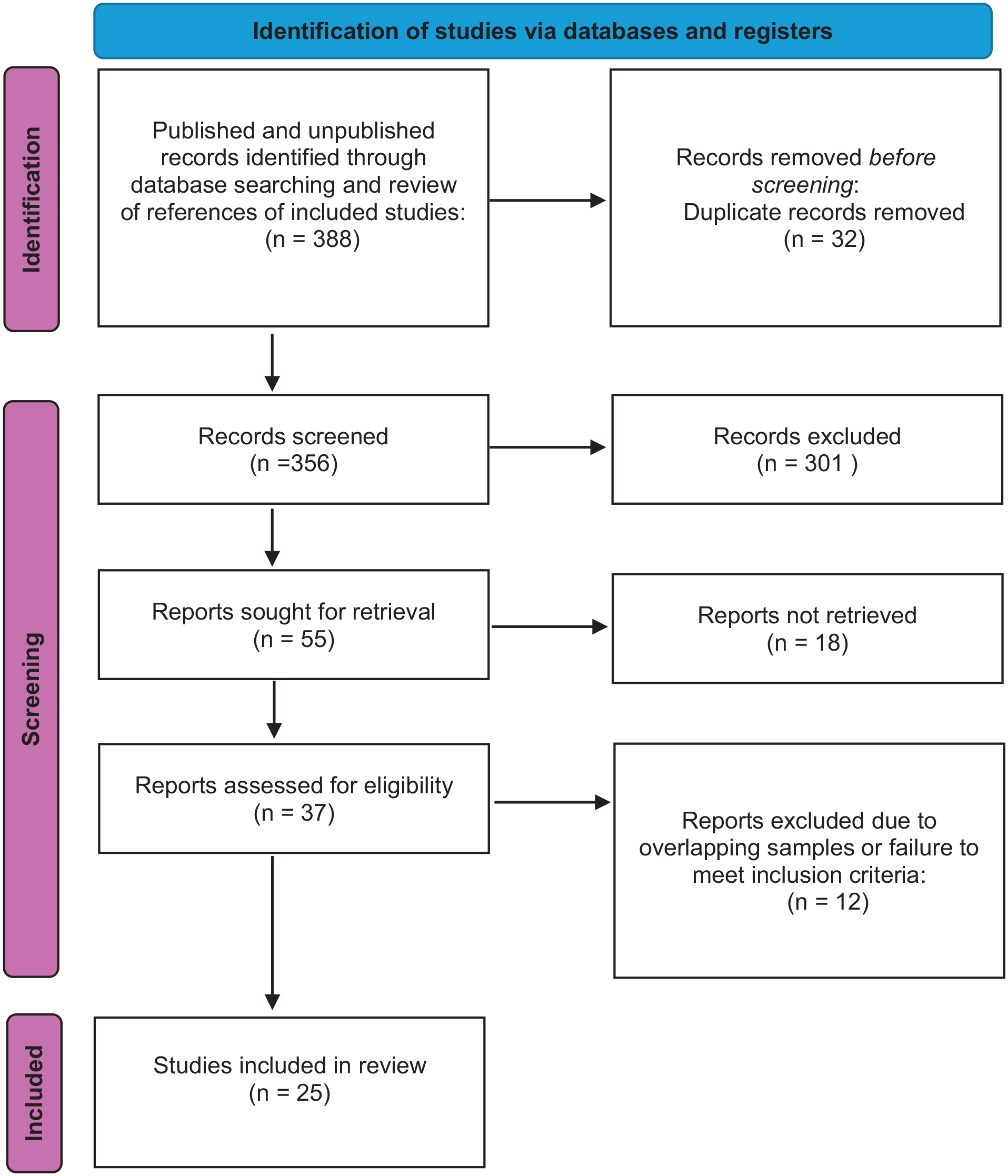
PRISMA flow used to identify studies for detailed analysis of online solicitation.
Typically, online solicitation was defined and operationalized in these studies as requests to talk about sex, engage in sexual acts, or provide sexual images. Online grooming was often differentiated as a more elaborate and longer process, and sometimes operationalized separately (Gámez-Guadix et al., 2021; Greene-Colozzi et al., 2020). But sometimes solicitation was operationalized as the requisite beginning of the grooming process (Resett, 2021). We will focus on differences in the approach to online solicitation exclusively, as there are more studies related to this concept.
Several somewhat different approaches were evident in the studies looking at online solicitation (Table 1). Typically, solicitation questions referred to requests to talk about sex, engage in sexual acts, or provide sexual images. But we identified a variety of qualifiers used in questions that point to disagreements about what should be counted as online solicitations or online sexual abuse.
Online Sexual Solicitation Survey Questions and Their Conceptual Elements.
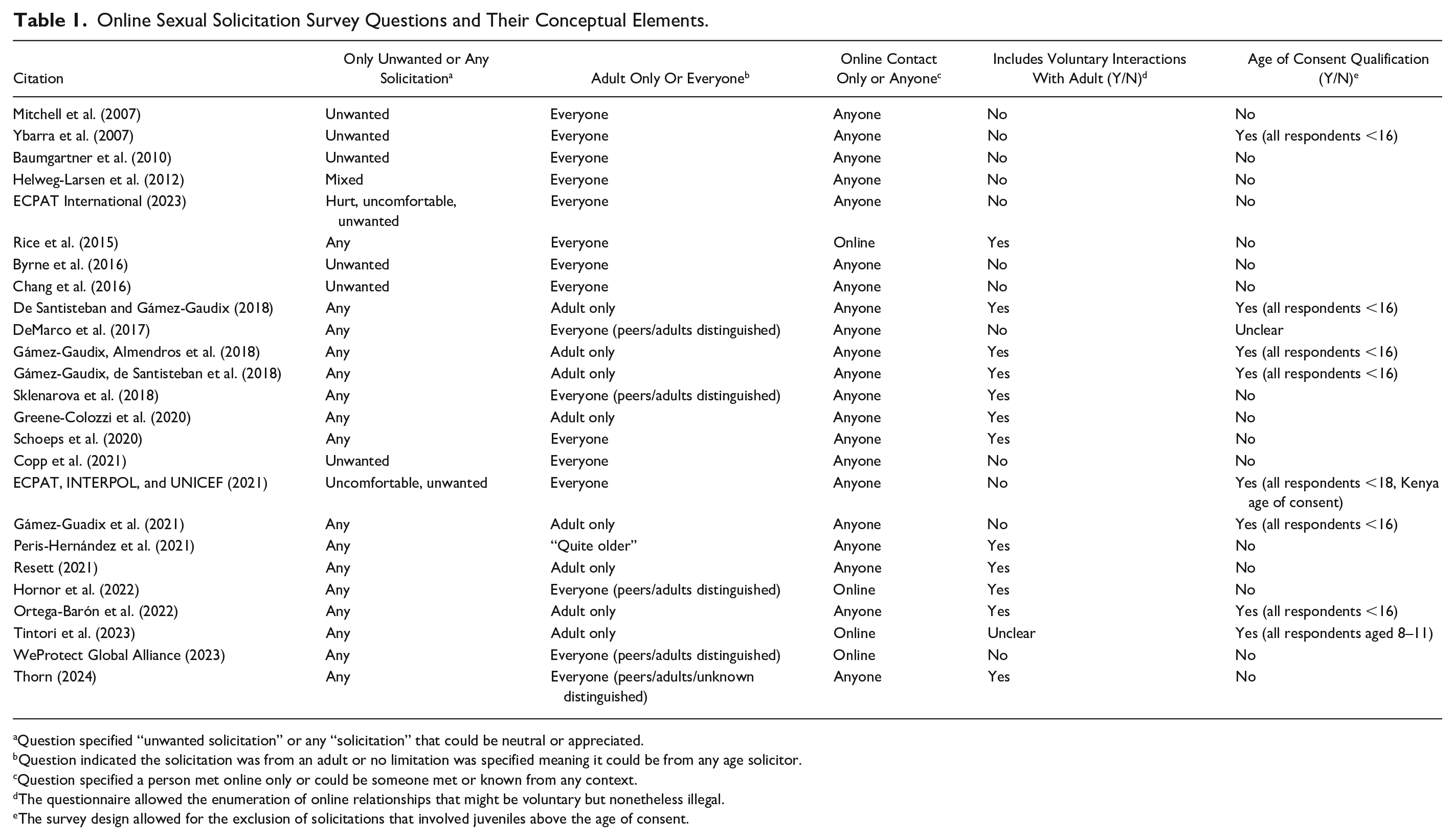
Question specified “unwanted solicitation” or any “solicitation” that could be neutral or appreciated.
Question indicated the solicitation was from an adult or no limitation was specified meaning it could be from any age solicitor.
Question specified a person met online only or could be someone met or known from any context.
The questionnaire allowed the enumeration of online relationships that might be voluntary but nonetheless illegal.
The survey design allowed for the exclusion of solicitations that involved juveniles above the age of consent.
A first and common qualification was limiting the scope to only unwanted solicitations, for example: “someone tried to get you to talk about sex online when you did not want to” (Ybarra et al., 2007). Eight of 25 questionnaires used a qualification about being unwanted or having some other similarly negative element. This conceptualization admits to the reality that young people might get wanted or neutral sexual and romantic requests that researchers would not want to count as abuse.
Another qualification used in some studies limited solicitations exclusively to adults: “an adult asked me questions about explicit sexual content,” specifying adult as “person who is or you suspect to be 18 years old or older” (Gámez-Guadix, de Santisteban et al., 2018). The adult specification was used in 9 out of 25 of the questionnaires. This qualification points to the issue of whether peer solicitations can be abuse. It acknowledges the legal reality that adult-juvenile sexual exchanges in prohibited age categories lack consent intrinsically, but peer exchanges do not unless they are coercive or hurtful. A mixed approach taken by Sklenarova et al. (2018) asked about adult solicitations in one question but also asked a separate question about “subjectively negative sexual interaction with a peer that caused harm.” Five of the questionnaires whose question asked about any age solicitor collected follow-up information to be able to distinguish adults from peers. This meant that altogether 17 of the 25 questionnaires could limit the solicitations to either unwanted or adults only.
Another qualification was whether solicitation applied exclusively to a person who was met online, as did four of the questionnaires. One format asked about any solicitations only from a person met online. “Have you been asked questions or talked about sex via the Internet or mobile device with someone you met online” (Hornor et al., 2022). This comports with the stereotype of the online stranger predator. But it does not account for the possibility that many unwanted and potentially abusive solicitations could come from face-to-face acquaintances who conduct their recruitment and sexual abuse through online communication. Victim surveys and police record studies about online abuse consistently show that acquaintance perpetrators outnumber strangers and people met online (Sutton & Finkelhor, 2023).
There are other possible definitional problems with questions about sexual solicitations, wanted or unwanted, harmful or not, online or offline. It is relatively easy to conjure some unwanted solicitations for sexual talk or sexual behavior that would fail to meet the standard of what is generally considered sexual abuse. For example, a peer with a romantic interest in another youth might say, “I love you. Can we go all the way?” This could easily be unwanted and stressful, but it may be an integral part of teen sexual courtship where a recipient has the opportunity to say no to requests for more sexual intimacy. An adult relative might ask a 15-year-old, “Are you using contraceptives?” This question could be a very unwanted solicitation to talk about sex from an adult but would not be considered sexual abuse. A same-age friend might ask a question, “Did you have sex with my boyfriend?” This could also certainly be a very unwanted and painful solicitation to talk about sex. But it would not be sexual abuse. A stranger might yell at a youth from a passing car, “Show us your dick.” In the passing car situation, this would be considered a form of harassment but would not likely be considered sexual abuse in conventional surveys. Would the same request in a video game chat room be inherently different?
Unfortunately, the field of sexual abuse has inconsistently classified noncontact forms of sexual abuse (Goldman & Padayachi, 2000). The noncontact categories can be challenging to demarcate. When does exposure to another person’s nakedness become exhibitionism? When does an unwanted exposure to sexual images become abuse? When does a solicitation become an episode of sexual abuse?
One way of considering what should be counted as online sexual abuse is to select dynamics that are equivalent to what would be counted as sexual abuse in an offline context. This might exclude unwanted but noncoercive bids for more intimate behavior online from peers or brief episodes of sexual harassment. But a complication is that some laws treat online behavior differently. One group of laws criminalizes the making and sharing of sexual images of minors, even when consensual and similarly aged. As many writers have pointed out (Dodge & Spencer, 2018; Salter et al., 2013), this can mean that criminalizing a youth for sharing or requesting a sexual image while they are engaged in other legal forms of even more serious sexual intimacy with that partner.
Solicitation Dynamics
To examine further some of the complexity of the sexual solicitation questions as a measure of sexual abuse, it is helpful to look at actual victim narrative responses to such questions from a recent victim survey. This allows us to specify the dynamics and features of online episodes that were elicited by questions about solicitation and consider whether they meet the criteria for sexual abuse.
Methods
The Survey of Technology Facilitated Abuse (TFA) was conducted in 2021 by the Crimes against Children Research Center, using the nationally representative Ipsos online KnowledgePanel (KP). The KP panelists were 18 to 28 years old who were recruited for the current survey. In total, 2,639 panel members participated in the survey by the end of data collection, an overall participation rate of 20%. One thousand two hundred fifteen respondents endorsed one or more of the screening questions about possible online victimizations. Data were available on 2,056 incidents of TFA that occurred during childhood (before 18). More detailed information on the methodology is available in a previous publication (Finkelhor et al., 2022).
Four questions in the survey addressed episodes of sexual solicitation: Before the age of 18, did anyone ever use the Internet or a cell phone to try to get you to talk about sex when you did not want to? Before the age of 18, did anyone ever use the Internet or a cell phone to ask you for sexual information about yourself when you did not want to answer those questions? This means very personal questions, like what your body looks like or sexual things you have done? Before the age of 18, did anyone ever use the Internet or a cell phone to ask you to do something sexual that you did not want to do? Before the age of 18, did anyone ever threaten, try to force you, or strongly pressure you to provide sexual pictures or videos online or through a cell phone?
Verbatim accounts of the solicitation episodes from those who endorsed these questions illustrate the breadth of responses. Some accounts about unwanted solicitation were the online equivalent of offline courtship disputes about intimacy.
It was a boy a year older than I was. He wanted to date/hook up. I was not interested. A boyfriend tried to talk about sex over the phone when I was 13. Girl who I was not attracted to trying to get me to talk about sex and I was not into it.
These accounts point to undesired bids for sexual relationships from peers that were rebuffed. It is unlikely that these would be deemed sexual abuse if they occurred in a face-to-face environment.
Other accounts lacked enough information to determine whether the solicitations were coming from peers or adults.
Spam solicitations through email and social media. Random people on the internet. It’s hard to remember what happened exactly. But especially on online video game chat rooms like Roblox.
Some of these solicitation episodes could indeed be the opening bids of adult predators, but it is not certain. They could also be the online equivalent of street sexual harassment, as when a youth gets a sexual comment or solicitation from a passing car or porch. These are sometimes very offensive. In general, however, they have not been counted as sexual abuse in epidemiological surveys about sexual abuse.
The challenge of these ambiguities can be seen when we assessed their effects on prevalence estimates. The total sample prevalence of any unwanted sexual solicitation before age 18 was 22.5% (Table 2, column 1). But the rate of solicitations from a known or suspected adult was only 5.7%, about a quarter of all solicitations (Table 2, column 2). The contrast was large in part because 58.1% of the solicitor identities were unknown to the recipient (Table 2, column 1, row 6). It would make an enormous difference for prevalence whether one counted as sexual abuse all solicitors, or only adult solicitors, or some combination of adult and unknown solicitors.
Prevalence and Features of Unwanted Online Solicitations and Related Offenses.

Episode with an adult perpetrator that were screened into the abuse sample not by the unwanted solicitation question but by questions about commercial sex or about desired sexual interaction with an adult.
Only perpetrators whose identity was fully known by respondent.
Percents add to more than 100 because victims could have more than one episode with a different dynamic.
Some observers of these findings, influenced by the predator stereotype (adult strangers luring children online), might argue that most of the unknown solicitors were actually adults and should be counted as such. But the questionnaire gave respondents a chance to judge the solicitor as even “somewhat likely” to be an adult, and these were all included as adult episodes, even though there is some uncertainty. Moreover, the literature shows clearly that large portions of the juvenile population engage in various kinds of online solicitation, sexual bullying, and nonconsensual sexting, some of it anonymously (Madigan et al., 2018; Molla-Esparza et al., 2020; Mori et al., 2022). Juvenile solicitors have many reasons to also hide their identities when they harass peers. Moreover, among perpetrators with known identities, youth outnumber adults. So, it is not justifiable to apportion all the unknown solicitors to the adult category. At the same time, it could be also problematic to count none of the unknowns as adults.
Another qualifier could strongly influence the rate: whether the online solicitation was from a person whom the youth met online as, for example, is required in the Hornor et al. (2022) questionnaire. The percentage of solicitors identified as exclusively online contacts was only 6.9% (Table 2, column 1, row 9). Unwanted solicitors were identified as offline acquaintances in 91% of episodes (row 8). Once again, however, it made a big difference how the unidentified solicitors (74.1%) were allocated. Many could have been online strangers, but offline friends and acquaintances could also be choosing to mask their identities. The point is clear that prevalence rates for online solicitation offenses can be greatly affected by what portion is being counted.
Beyond Unwanted Solicitation: Statutory Sex Offenses
Still other problems with the solicitation questions are revealed when we consider the variety and complexity of sex crime dynamics that can lurk within the legal definition of sexual abuse online and offline. Juveniles can engage in illegal sexual relationships with adults that are initially voluntary, usually called statutory sex crimes and generally considered sexual abuse. These illegal episodes might not be elicited by a question about unwanted solicitations (Greene-Colozzi et al., 2020) because the overtures were perceived as acceptable. Nine of the 25 questionnaires discussed previously included questions that encompassed such episodes.
The TFA survey asked two questions that would allow the identification of such relationships online.
Did you have intimate sexual conversations or share sexual pictures or videos (online or through a cell phone), even if you wanted to, with a person who was 5 or more years older than you?
“Have you done any of the following things over the Internet or a cell phone (including texting) in exchange for money, drugs, or other valuable items?” (a) Sexual talk, (b) Making, sending, or posting sexual pictures or videos of yourself, (c) Any other sexual activity.
These questions flagged 188 relationships between juveniles under 18 and adults. These episodes more than doubled the episodes that could possibly be considered online adult perpetrator sexual abuse. They have been tabulated in Table 2 column 3 under the category of “adult solicitation plus.”
Here are several narratives from the survey about such voluntary relationships that were not elicited from the unwanted solicitation questions: When I was 15, I was chatting online and met a 20 something man that I sexted and shared nude pictures with for a couple of weeks. It was Omegle and I was exploring my sexuality and sexual desires. I would engage in sexual conduct with men older than me by 5+ years. My best friend’s older brother who was 25 when I was 15 began to message me and flatter me then he began sending me pictures of himself and asked for some in return. The relationship was flattering and sweet at first then it turned into a scary and anxious relationship.
In addition, the following are episodes were elicited by the question about commercial sex, also not likely to be captured by question about unwanted sexual solicitation.
I was 17 and needed money for one of my legitimate prescription medications because my mother had put me out on the street and several adult men online said they would Paypal me money for dirty pics (the third guy wanted videos of me using sex toys on myself while my best friend watched). Had an older “girlfriend” when I was about 15-16 and we used to sext and talk sexual over the phone. She’d usually give me weed and money and other perks (like rides and stuff) for keeping her satisfied.
These are cases of sexual abuse and exploitation entailing impermissible age differences and commercial exploitation of a minor. But they would not likely be elicited from a question about unwanted sexual solicitation. These categories of online sexual abuse had population prevalence rates in the national survey of 3% for voluntary with adults and 2% for commercial online sexual exploitation. This suggests it is possibly important for surveys to ask about commercial and voluntary sexual activities with adults in addition to unwanted activities.
However, the voluntary relationship dynamics add another definitional complexity. The category of a statutory sex crime does not apply to some juveniles depending on age and particular state laws. Statutory sex crime laws in most states and countries permit older juveniles—typically 16- and 17-year-olds—to have consensual sexual relationships with adults or adults of a certain age range (Bierie & Budd, 2018). So, some of these online relationships between older youth and adults might not be sexual abuse in the offline context. That may mean that even an unwanted solicitation from an adult, particularly a young adult, would be more like a peer solicitation between youth, given that these young adults could be older students at the same high school or college.
The TFA survey recorded the ages of youth in cases of unwanted solicitation by identifiable adults (Table 2, column 2, row 12): 39.5% were under age 16, while the remainder, 60.5% of the youth who were solicited by adults, were of age 16 to 17. A portion of these 16- and 17-year-olds (28.9%) were interacting with adults who were 18 to 21, many of whom could be high school or college classmates (Table 2, column 2, row 13).
This information about age pairing of solicitors and recipients suggests a very different dynamic from the predator stereotype. It portrays older teens interacting with persons who may be within the margin of being considered peers, cases addressed by so-called Romeo and Juliet laws (Bierie & Budd, 2018). Removing these cases completely from the adult solicitation reduced the rate from 5.7% to 3.5%. Once again, this adjustment was compromised by the fact that the exact age of nearly three-quarters of solicitors was not known to victims. But it highlights that solicitation questions may be flagging some youth who are statutorily permitted to be courted by older partners. Studies that confine their samples to youth under the age of consent (eight of the studies included above) do not have this problem. But in studies of youth under age 18 in jurisdictions where the age of consent is 16 the measurement of abuse in this population might warrant the usage of different criteria to properly classify episodes as online sexual abuse.
Discussion
This article has highlighted problems with the concept of online solicitation and its operationalization as a form of sexual abuse in victim surveys. It raises the important question of how often the episodes elicited from questions about online solicitations can be confidently qualified as sexual abuse as it has previously been defined.
A review of 25 existing questionnaires asking about online solicitation found large divergence in the conceptualization of solicitation. Some asked about only “unwanted” solicitations, but many had no such qualification, presumably including some solicitations with positive or neutral reactions. Other questionnaires elicited and counted solicitation from adults only, but others from any source, presumably other youth. Some asked about solicitations from a person known only online, but others included online solicitations from anyone, including offline acquaintances. This illustrates a lack of consensus about what kinds of solicitation are problematic and abusive.
Problems With Solicitation Concept
A critical analysis of the concept of solicitation highlighted several problems. Online requests for sexual intimacy can be a normal part of youth courtship when they occur between young people of similar age, for whom, if the request is accepted, a consensual sexual relationship would be legal. Similarly, there are also older youth above the age of consent, typically 16 or 17 in the United States, for whom a sexual relationship with an adult would be legal and therefore so would the solicitations. Solicitations in the context of courtship in these age pairings may not be sexual abuse as long as they are not coercive, and a rejection of the solicitation is respected.
In the TFA study data also analyzed for this article, a majority of the known solicitors identified by the recipients were other juveniles. In addition, a majority of the adult solicitors in the sample were soliciting 16- and 17-year-olds, youth over the age of consent in most jurisdictions in the United States. The inclusion of these episodes in prevalence estimates may overstate the frequency of abuse.
This concern about overestimation extends even to solicitations that are deemed unwanted. Many bids for sexual intimacy are unwanted, even between committed couples, and certainly in ordinary courtship. But these are not necessarily abusive unless their rejection is not respected and they become coercive. Unwanted requests for sexual activity may not necessarily be sufficient to qualify as abuse. This is different from unwanted sexual touching which is abusive.
It is nonetheless true that many online solicitations are undoubtedly crude, obnoxious, inappropriate, and scary. A subset of the solicitations could qualify as abuse based on such features but these elements are usually not measured. For comparison, though, in the offline context, obnoxious and inappropriate solicitations from possibly legal partners are often classified as sexual harassment or bullying rather than sexual abuse. Even when the age difference is criminal, inappropriate solicitations of a verbal nature in the offline context—like lecherous comments or cat calls—are rarely treated as sexual abuse, even though they might be technically prosecutable. Of course, this changes the moment unwanted physical contact occurs. But the sexual solicitation questions that are being asked in surveys may be including dynamics that are not conceptually sexual abuse as we have used this concept in the past.
Unknown Age and Identities
In addition, these complexities collide with another problem in classifying online solicitation episodes illustrated by the survey data: in over half of the solicitations the recipients did not know the identity or age of the solicitor. It is not clear how researchers are dealing with this problem since it is rarely discussed in the epidemiologic reports. One approach could be to ask respondents to make their best guess. But this may just prompt respondents to default to the adult predator stereotype that is in wide circulation, and that may already be influencing the answers even without a best guess prompt. This seems like a biasing solution for an epidemiologic issue of great importance. It should be kept in mind that other youth have many motives for making anonymous sexual solicitations toward peers. One could argue that if a youth thinks the solicitor is an adult then the solicitation has the requisite intimidating character to be treated as such. But this is an assumption not yet supported by research. In an analysis with the TFA data, online offenses from perceived adults were not more impactful or distressing than those from a perceived youth (Finkelhor et al., 2023).
Recommendations
Based on the findings and the discussion, we would make several recommendations for epidemiological questions about online sexual offenses:
Researchers studying online abuse should avoid using the receipt of any unwanted solicitation as a sufficient criterion to count as abuse without additional qualification.
As a stronger standard, unwanted solicitations can be counted as online abuse if they come from an impermissibly older adult. This would exclude unwanted solicitations (without coercion) from similarly aged peers, since these are simply too close to normal courtship dynamics. This should also mean exclusion of solicitations to older youth above the age of consent (again, unless coercion is involved). These exclusions would mean that studies need age information for solicitor and recipient to determine that the solicitor was an adult or substantially older and/or that the youth was under the age of consent.
An additional strengthening of the standard would involve asking about pressured or threatening solicitations to engage in sexual activity, rather than simply unwanted. These could be considered abusive even in situations where the age discrepancy was not illegal.
Special attention needs to be given to solicitations from persons whose age is unknown. The best practice should be to exclude episodes that come from a person whose status as an impermissible adult cannot be judged. Alternatively, the counting of such episodes should be presented as a separate statistic. This would mean disqualifying or underlining episodes where the recipient answers “do not know” or “not sure” to a question about whether the perpetrator was or was strongly suspected to be an adult. Such qualification questions need to be a regular part of questionnaires.
Questions that ask about voluntary but illegal sexual relationships with adults need to be included in addition to questions about unwanted solicitations. These illegal relationships will not necessarily be elicited with questions about solicitations, unwanted or otherwise, because the youth may consider the relationship wanted or even see themselves as the initiator. But these offenses are important and constitute a substantial component of online sexual abuse and exploitation.
Questions need to be included that ask about coercive and nonconsensual online sexual behavior beyond solicitation. These include nonconsensual taking and sharing of images, sextortion, pressured demands for images or sexual favors or commercial exchanges. These would qualify as online sexual abuse even in relationships, like same age peers, where simple solicitation would not.
Online sexual abuse questions should not be confined to perpetrators met online. Acquaintance perpetrators comprise a large portion of the online abuser populations. Findings also show that acquaintance perpetrators are just as impactful as stranger perpetrators (Finkelhor et al., 2023).
Researchers should report findings in ways that would allow inclusion or exclusion of cases that fit various possibly problematic categories. (Also see Tables 3 and 4).
Critical Findings.

Implications of the Review for Practice, Policy, and Research.

Limitations
Some cautions about this report need to be kept in mind. The literature search for surveys about online sexual abuse may not have been exhaustive. Many new surveys are appearing in this quickly developing field. Moreover, conventions about screening questions may be changing as a result of new questionnaires that have been developed in recent years.
The TFA survey portion of this study had the benefit of a large number of screening questions, detailed follow-ups and written episode narratives to flesh out diverse dynamics to online sexual abuse. Even so, it has some limitations that are important to keep in mind. One serious limitation is that respondents were being asked about episodes that occurred in some cases over 15 years earlier, which certainly could exacerbate problems with remembering details of perpetrator age and dynamics of the episode. Relatedly, some of the episodes being documented occurred in a different technological environment which may have had different dynamics than contemporary episodes. For example, at an earlier time less information may have been apparent about solicitors’ identity or age.
Conclusion
Considerable disagreement exists in surveys about online sexual abuse concerning how to operationalize this key construct. Relying on questions about sexual solicitation broadly may under- or overcount the problem. More dialogue is needed among researchers, advocates, and funding groups to arrive at improved measures.
Footnotes
Declaration of Conflicting Interests
The author(s) declared no potential conflicts of interest with respect to the research, authorship, and/or publication of this article.
Funding
The author(s) disclosed receipt of the following financial support for the research, authorship, and/or publication of this article: US National Institute of Justice Grant 2020R2CX0015.
