



Abstract
Research indicates social anxiety is associated with lower friendship quality, but little is known about the underlying mechanisms. This 2-month longitudinal study examined social withdrawal as a mediator of the social anxiety–friendship quality link in a sample of 214 adolescents (Mage = 13.1 years, SD = .73) that included an oversampling of adolescents recently relocated to the community (n = 155). Findings provided preliminary support for the hypothesized models, in which social anxiety is associated with social withdrawal, which in turn is related to lower companionship and intimacy in adolescents’ friendships. Analyses testing whether relocation to a new community intensifies these associations indicated additive, but not multiplicative, effects of social anxiety and relocation on friendship companionship and intimacy. Implications include the importance of increasing socially anxious youths’ social engagement and skills with friends as well as with less familiar peers.
Forming close friendships may be made difficult by feelings of social anxiety, particularly in the transition from childhood into adolescence (Beidel, Turner, Young, & Paulson, 2005; Hartup, 1983; Hymel & Franke, 1985; La Greca & Lopez, 1998). Many developmental functions are served by close friendships during early adolescence, and youth who struggle to establish or maintain friendships are more likely to feel lonely and discontent with their social lives and to have more negative self-perceptions (La Greca & Lopez, 1998). Persistent difficulties in forming close friendships may presage clinically significant problems such as social phobia, depression, or substance use difficulties (Bagwell, Newcomb, & Bukowski 1998; Ferdinand, Stijnen, Verhulst, & Van-Der-Reijden, 1999; Parker & Asher, 1987). Understanding the processes underlying the connection between social anxiety and friendship difficulties is essential for identifying mechanisms amenable to prevention and intervention efforts for socially anxious youth. Some scholars have conceptualized social withdrawal as important in the connection between social anxiety and peer difficulties (Rubin & Burgess, 2001); however, social withdrawal has yet to be studied formally as a mediator between social anxiety and friendship quality. Prior research has focused primarily on the cognitive, emotional, and physiological aspects of social anxiety (Albano, Chorpita, & Barlow, 2003) and adequate understanding of how behaviors such as social withdrawal may predict social outcomes such as friendship quality is lacking. Although social fears and distress in social situations are associated with avoidance of social situations, it is possible for individuals to feel apprehensive about social situations yet still engage in them. Thus, the role of social withdrawal needs to be examined explicitly.
Social Anxiety, Friendship Quality, and Social Withdrawal
A general connection between social anxiety and friendship quality is well established (e.g., Greco & Morris, 2005; La Greca & Harrison, 2005; La Greca & Lopez, 1998; Vernberg, Abwender, Ewell, & Beery, 1992). Social anxiety can affect acceptance into a peer group (Greco & Morris, 2005), the formation of new friendships (Vernberg et al., 1992; Vernberg, Greenhoot, & Biggs, 2006), and the level of support and intimacy in existing friendships (La Greca & Lopez, 1998). Rubin and Burgess (2001) have conceptualized social withdrawal as an important mechanism underlying the connection between social anxiety and friendship quality. They proposed that children and adolescents who are high in social anxiety avoid situations that cause them distress—namely, social situations such as interacting with peers. This avoidance, or social withdrawal, is effective in keeping distress relatively low in the short term, which negatively reinforces withdrawal behavior. Over time, continued withdrawal from social situations limits the opportunities for learning about peer relationships and leads to the inadequate development of social skills and quality friendships. Inadequate social skills and lack of friendships or low-quality friendships then maintain children’s social anxiety, as children become aware that they are lacking in their social relationships and do not know how to change the situation (Rubin & Burgess, 2001).
Lending support to Rubin and Burgess’ model (2001), research has indicated that socially phobic youth use avoidant coping strategies in about a third of distressing events (Beidel, Turner, & Morris, 1999), and youth who are anxious in general tend to be withdrawn and rejected by peers (Bell-Dolan, Foster, & Christopher, 1995). In addition, a large body of research demonstrates a connection between social withdrawal and social difficulties, including peer rejection and poorer friendship quality relative to their peers (Rubin & Asendorpf, 1993; Rubin, Wojslawowicz, Rose-Krasnor, Booth-LaForce, & Burgess, 2006; Gazelle, 2006). Adding to the importance of examining social withdrawal’s role in this relation is evidence that social withdrawal is a stable behavior pattern and most likely will continue to affect a child’s development over time (Moskowitz, Schwartzman, & Ledingham, 1985; Rubin, Burgess, Kennedy, & Stewart, 2003).
Despite the evidence that both social anxiety and social withdrawal are associated with similar social difficulties, only one study has examined the role of social withdrawal in explaining the connection between social anxiety and peer relationships. Erath and colleagues (Erath, Flanagan, & Bierman, 2007) found that social withdrawal mediated the relationship between social anxiety and peer-group acceptance; however, the model proposed by Burgess and Rubin in which social withdrawal mediates the relationship between social anxiety and aspects of friendship quality has yet to be tested formally. Understanding the impact of social anxiety and withdrawal on friendships as well as experiences in the larger peer group is important because both types of peer experiences have developmental significance and are related to adjustment (Parker, Rubin, Erath, Wojslawowicz, & Buskirk, 2006). In particular, social anxiety may make it difficult for an adolescent to initiate conversations and seek out social opportunities with friends because of fears of rejection and embarrassment and general discomfort in social situations. Social anxiety and withdrawal may also make an individual socially invisible and reduce the likelihood of invitations from friends and may make one less likely to accept the invitations one may receive. Having fewer social interactions may decrease opportunities for getting to know friends more intimately. Likewise, social anxiety may manifest itself in the context of friendships as reticence to make the types of disclosures typical of increased intimacy in friendships at this age (e.g., McNelles & Connolly, 1999). Gender is another important consideration in that girls report significantly higher levels of intimacy and self-disclosure in their friendships than boys do (Camarena, Sarigiani, & Petersen, 1990; Sharabany, Gershoni, & Hofman, 1981).
The processes involving social anxiety, withdrawal, and friendship are particularly relevant during adolescence in light of the social and cognitive changes that occur in this developmental period. During adolescence, youth typically place increased importance on time spent with friends and develop greater intimacy in their friendships; the quality of these relationships is believed to be important for the development of self-concept that is also a hallmark of adolescence (Parker et al., 1995). In addition, adolescence brings increased self-awareness (Velting & Albano, 2001), including a sense that one is the focus of attention of an “imaginary audience” (Elkind, 1967). The high importance given to peer relationships combined with the adolescent’s heightened self-awareness increase the likelihood of feelings of social anxiety (Velting & Albano, 2001). Thus, it is not surprising that social phobia typically has its onset during adolescence (American Psychiatric Association, 2000). If feelings of social anxiety lead to social withdrawal and lower friendship quality during adolescence, socially anxious youth may fail to meet important developmental tasks such as expanding their social network beyond the family and learning the skills needed to develop and maintain intimate same-sex friendships, which are believed to form the basis for romantic relationships (Sullivan, 1953).
Social Anxiety and Withdrawal During Social Transitions
It is possible that the hypothesized mechanisms linking social anxiety, withdrawal, and friendships are activated or intensified when socially anxious adolescents are faced with a situation in which they must make new friends. Although all new friendships may take time to grow in companionship and intimacy, adolescents with strong feelings of social anxiety may be particularly reserved in developing new friendships. After living in the same place, even adolescents with high social anxiety may have had sufficient time to ease into friendships with adolescents who facilitate their social engagement and with whom they have grown comfortable enough to talk about personal matters. Without the support of established friendships to make invitations and facilitate social engagement, adolescents with high social anxiety may be more socially withdrawn than usual. In turn, their social withdrawal may have a greater impact on the time spent with friends and the closeness of friendships because unfamiliar peers and new friends may misread their behavior as lack of interest.
Relocation to a new community provides a unique opportunity to examine whether the hypothesized mechanisms are particularly strong for socially anxious adolescents facing the challenge of making new friends. In a longitudinal study of the effects of relocation on friendship quality (Vernberg et al., 2006), most adolescents who relocated to a new community typically experienced a temporary drop in friendship companionship and intimacy compared with residentially stable peers studied during the same school year. Of those who relocated, socially anxious adolescents typically struggled the most and, by the end of the school year, did not spend as much time with friends as did other relocated adolescents. What remains unclear, however, is whether social withdrawal played a role in the association between social anxiety and friendship companionship and intimacy.
The Current Study
We employed a longitudinal design to test whether self-reported feelings of social anxiety at the beginning of the school year would predict parent-reported social withdrawal during the first few months of the school year, which, in turn, was hypothesized to predict friendship quality in November. We hypothesized that social withdrawal would mediate the relationship between social anxiety and friendship quality, specifically time spent with friends (here termed companionship) and intimacy. We also considered gender as both a covariate and moderator of these relationships. Furthermore, we oversampled for adolescents who had recently relocated to the community to test whether the association of social anxiety and friendship quality via withdrawal would be amplified among adolescents forming new friendships in a new community. Figures 1 and 2 depict the mediation and moderated mediation models, respectively. For the current study, it was conceivable that social anxiety at the beginning of the school year may be indirectly related to companionship and intimacy, even if there were not a direct correlation between social anxiety and later friendship companionship and intimacy. That is, social anxiety could increase the likelihood of social withdrawal, which, in turn, could affect these aspects of friendship quality. Therefore, we tested both mediation and indirect effects. Mediation refers to a situation in which an association between two variables is explained by a third, mediator variable; the term indirect effects includes mediation as well as cases in which two variables are not directly related but are related often over time via their relation to a third variable (see Preacher & Hayes, 2004). Moderated, or conditional, indirect effects are those whose strength depends on the presence or strength of a moderator variable.
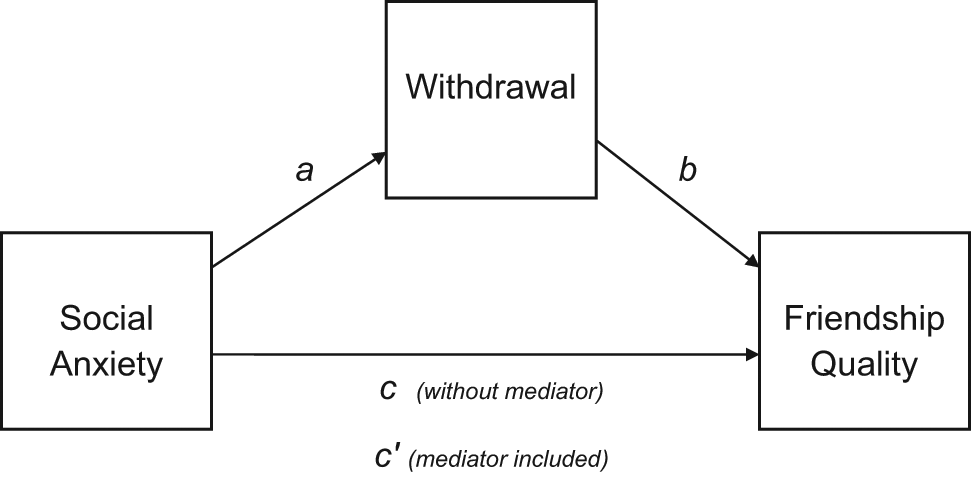
Proposed mediation model

Proposed moderated mediation model
Method
Participants
A total of 214 seventh (n = 111) and eighth graders (n = 103) recruited from eight middle schools in southern Florida participated in the study (106 girls, 108 boys; M age = 13.11 years, SD = .73). Of those, 147 adolescents had relocated to the school district no more than 3 months prior to the start of the school year and 67 were residentially stable; that is, they had lived in and attended school in the district the previous 2 years. As the school district used a middle school format (6th, 7th, and 8th grade in the same building), only the relocated adolescents were experiencing a transition to a new school.
Participants were recruited in cooperation with the school district, which provided rosters for all seventh- and eighth-grade students and indicated which students were new enrollees (Relocated) and which had been in the district for at least 2 years (Stable). Letters describing the project were sent to a subset of families randomly selected from the rosters provided by the school district. Project staff followed up by telephone to determine whether adolescents met the inclusion criteria and to invite their families to participate in the study. Approximately 50% of the adolescents in the Relocated group who were contacted by telephone and met eligibility criteria, and 45% of those who were contacted by telephone and met eligibility criteria for the Stable group agreed to participate and completed the first interview session. Primary reasons for declining to participate included lack of time or an unwillingness to participate by either the adolescent or the parents. Of the 328 who consented and participated in the initial interview, 214 had complete data for the current analyses. T tests and chi-square analyses comparing retained participants with those with incomplete data revealed that retained participants were more likely to be residentially stable, χ2(1, N = 328) = 17.57, p < .01, reported greater companionship (M = 2.98, SD = .76 vs. M = 2.68, SD = .83), t(300) = 3.10, p < .01 and intimacy (M = 3.36, SD = .99 vs. M = 3.04, SD = 1.02), t(300) = 2.51, p < .05, and had more friends named by their parents (M = 3.12, SD = 1.41 vs. M = 2.20, SD = 1.98), t(247) = 3.34, p < .01. No significant differences were found for gender, number of friends reported by adolescents, or parent-reported companionship.
Participating adolescents represented a broad range of socioeconomic backgrounds and came from middle-class families on average, according to Hollinghead’s indices (M = 48.92, SD = 11.11). The sample’s racial and ethnic composition was 56% White, non-Hispanic; 30% Hispanic; 11% African American, and 2% Asian American.
Procedure
Adolescents and their parents participated in structured interviews and completed questionnaires in September and in November. For the current study, we used September reports of social anxiety and November reports of social withdrawal and friendship qualities. Social withdrawal was reported for the previous 6 months and friendship qualities as they were currently, so that the mediator variable was assessed for the time period between the reports of social anxiety and friendship qualities. Interviews and questionnaires were administered in the adolescents’ homes by trained research assistants. Each session lasted approximately 2 hr and included other measures not included in these analyses.
Measures
Social anxiety
Adolescents completed the Social Anxiety Scale for Children–Revised (SASC-R; La Greca, 1993), a self-report measure of anxiety in social situations. The measure includes 18 items assessing fears of negative evaluation and avoidance and distress in novel and familiar social situations, constructs central to the conceptualization of social anxiety. To make a cleaner distinction between the internal (cognitive and emotional) experiences of social anxiety and behaviors of social withdrawal, we excluded two items reflecting socially withdrawn behaviors (“I only talk to kids I know really well” and “I am quiet when I’m with a group of kids”), leaving 16 items assessing emotional and cognitive aspects of social anxiety. The 16 items demonstrated good internal consistency in our sample (Cronbach’s α = .90), and the 16-item total was significantly related to the full 18-item score (r = .88, p < .001). In previous studies, the SASC-R has demonstrated adequate reliability (subscale internal consistencies between .69 and .86) and construct validity (La Greca & Stone, 1993). The full-scale and subscale scores and standard deviations for this sample were comparable with those reported in past research with this measure (La Greca & Stone, 1993).
Friendship companionship and intimacy
We measured adolescents’ friendships with the Friendship Interview (Berndt & Perry, 1986) administered to adolescents and parents. The interview began with a prompt to name the adolescents’ best friends. Adolescent respondents then answered questions pertaining to up to three friendships regarding companionship (six items per friend; e.g., “How often did you go over to each other’s houses?”) and intimacy (four items per friend; e.g., “How often did you tell this friend things about yourself that you wouldn’t tell most kids?”) on a 5-point scale (never, once in a while, sometimes, fairly often, and very often for intimacy items; never, once a month, once a week, a few times a week, and everyday, for companionship items). Parents also named their adolescent’s friends and answered questions pertaining to companionship in the three best friendships. Parents did not report on intimacy because we believed parents may not be privy to the frequency of these behaviors (e.g., how often their adolescent talked with friends about private matters). Because many of the adolescents had recently relocated, they and their parents were asked to identify only friends who lived in their current community. Nearly all adolescents (95%) named at least three friends. Most parents (69%) named at least three friends. Companionship and intimacy scores were based on the average score across the friends who were named (up to three). The interview subscales demonstrated good internal consistency (α = .84 for parent-reported companionship, .88 for adolescent-reported companionship, and .93 for adolescent-reported intimacy). Adolescent–parent agreement on named friends was good. Of adolescents’ three best friends, parents named at least one over 82% of the time, and their ratings of companionship were moderately correlated (r = .53, p < .01).
Social withdrawal
We measured social withdrawal using three items (Items 42, 65, 111) from the Withdrawn Syndrome Scale of the Child Behavior Checklist (CBCL; Achenbach, 1991). Items were selected based on their relevance to the study’s conceptualization of social withdrawal. Specifically, the three items asked about the extent to which youth preferred being alone to being with others and the extent to which youth did not talk or get involved with others. Items were dropped that overlapped with other constructs (e.g., shyness) or psychopathology generally speaking (e.g., low energy, sadness). The selected items demonstrated adequate internal consistency (α = .61), and the three-item total was significantly correlated with scores for the original nine-item scale (r = .91, p < .001).
Results
Preliminary Analyses
Table 1 summarizes the descriptive statistics and Pearson correlations for the key variables in this study. Independent samples t tests indicated significant gender differences in friendship intimacy (Mgirls = 3.76, SD = .92; Mboys = 2.97, SD = .89; t[212] = 6.43, p < .001). Boys and girls were similar across all other study variables. Although relocated and residentially stable adolescents reported similar numbers of friends (Mrelocated = 4.72, SD = 1.96; Mstable = 5.01, SD = 1.66; t[212] = 1.07, ns), relocated adolescents had fewer friends according to parent report (Mrelocated = 2.85, SD = 1.33; Mstable = 3.70, SD = 1.43; t[212] = 4.24, p < .001). Relocated adolescents spent less time with their friends compared with residentially stable adolescents according to both parent report (Mrelocated = 2.71, SD = .76; Mstable = 3.06, SD = .50; t[212] = 3.49, p < .01) and adolescent report (Mrelocated = 2.84, SD = .75; Mstable = 3.30, SD = .69; t[212] = 4.31, p < .001) and had less intimate friendships (Mrelocated = 3.24, SD = 1.00; Mstable = 3.63, SD = .92; t[212] = 2.76, p < .01). Relocated and residentially stable adolescents were similar in levels of social anxiety and social withdrawal.
Means, Standard Deviations, and Bivariate Correlations Among Social Anxiety, Social Withdrawal, and Friendship Quality Variables
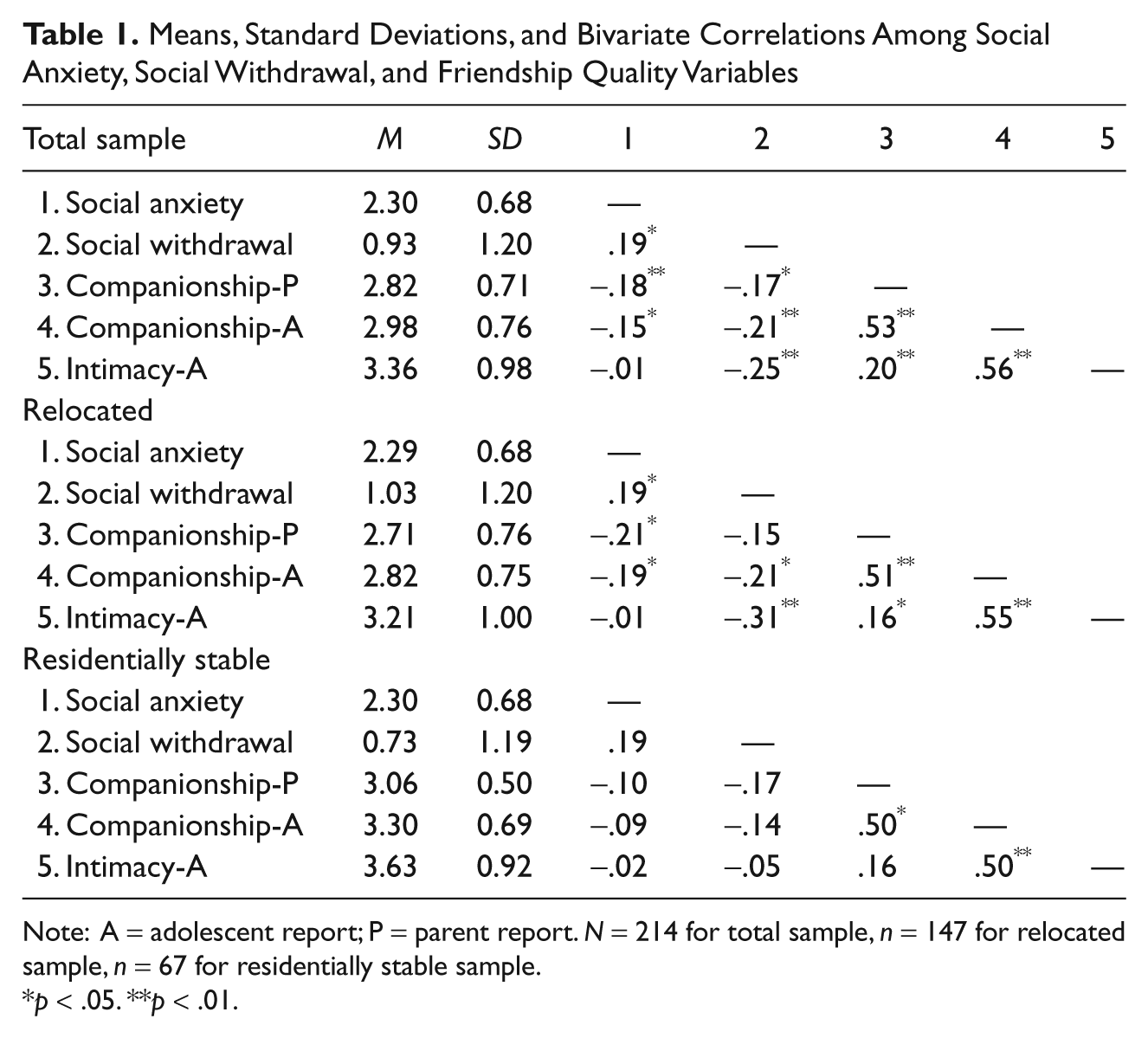
Note: A = adolescent report; P = parent report. N = 214 for total sample, n = 147 for relocated sample, n = 67 for residentially stable sample.
p < .05. **p < .01.
Friendship companionship and intimacy showed significant but modest correlations, suggesting that they tap related but distinct aspects of friendship quality. Social anxiety was correlated with companionship in the expected direction, although it was not significantly related to friendship intimacy. Withdrawal, as expected, was negatively associated with both companionship and intimacy. Although some relationships among social anxiety, withdrawal, and friendship quality reached statistical significance in the relocated sample but not the residentially stable sample, none of the correlations were significantly different across the groups according to comparisons using Fisher z’ transformation (Cohen, Cohen, West, & Aiken, 2003).
Testing Social Withdrawal as Mediator/Indirect Effect
We tested the mediation models following procedures and SPSS macros created by Preacher and Hayes (2004). Largely similar to steps outlined by Baron and Kenny (1986), the Preacher and Hayes method tests the significance of the a, b, c, and c′ paths (see Figure 1) as well the indirect effect of the IV on the DV via the proposed mediator (i.e., the ab path) using a bootstrap method for creating confidence intervals (CIs) of the indirect effect. If the CI does not include zero, the presence of an indirect effect is supported. Preacher and Hayes (2004) advocate this method over the traditionally used Sobel test because the assumption of a normal distribution of ab necessary for an accurate Sobel test may not be supported unless the sample size is large. Due to the differences in companionship and intimacy across the relocated and stable samples, relocation status was included as a covariate in all analyses. Gender was also included as a covariate and as a potential moderator in all of the tested models.
Table 2 summarizes the results of the mediation models predicting friendship quality (i.e., parent-reported companionship, adolescent-reported companionship, adolescent-reported intimacy). Results for parent-reported companionship provided partial support for the model. Although social withdrawal and parent-reported companionship (b path) were no longer significantly related at the multivariate level (as they had been at the bivariate level), the association trended in the expected direction (p = .07), the a and c paths were significant, the indirect effect (ab) was significant, and a reduction in the direct effect indicated partial mediation. Results for adolescent-reported companionship supported the proposed model in that all hypothesized paths and the indirect effect were statistically significant and partial mediation was indicated by a reduction in the direct effect. Although results indicated no direct effect of social anxiety on friendship intimacy, results did support an indirect effect in which social anxiety was related to social withdrawal, which in turn was related to friendship intimacy. A main effect of gender was observed in the friendship intimacy model only. 1
Summary of Mediation Analyses for Social Anxiety (SA, IV), Withdrawal (WD, Mediator), and Friendship Quality (FQ, DV)

Note: CI = confidence intervals. N = 214 for total sample, n = 147 for relocated sample, n = 67 for residentially stable sample. CIs for indirect effects that do not include zero indicate a statistically significant indirect effect at p < .05.
p < .05. **p < .01. ***p < .001.
In addition to the tests of the primary model for the study, we explored gender as a potential moderator using procedures and SPSS syntax for testing conditional indirect effects (also called moderated mediation) from Preacher, Rucker, and Hayes (2007). Specifically, we added to the above model interaction terms to test the moderating effect of sex on the associations between social anxiety and withdrawal and between withdrawal and friendship qualities. If an interaction was significant, we evaluated whether the results indicated conditional indirect effects (i.e., the indirect effect was stronger for either gender). Results indicated the relationship between social anxiety and withdrawal (a path) was moderated by gender in all three models (β = .19, B = .49, SD = .24, p = .044) such that the relationship was significant for girls (p < .001) but not for boys (p = .41). The indirect effect of social anxiety via withdrawal on intimacy was significant for girls (p < .05) but not for boys (p = .64). No conditional indirect effect was found for either parent- or adolescent-reported companionship, and gender did not moderate the relationship of social anxiety with any of the friendship quality indicators.
Testing the Relocation Amplification Hypothesis
We tested whether relocation served as a moderator in the proposed model using procedures for assessing conditional indirect effects (moderated mediation) described above. Specifically, we tested models that expanded on the simple mediation models by including interaction terms to test the moderating effect of relocation status on the associations between social anxiety and withdrawal and between withdrawal and friendship quality (see Figure 2). Results duplicated findings from the mediation analyses in finding main effects for relocation status across all models and gender for the intimacy model but did not identify any significant interaction effects or conditional indirect effects based on relocation status. In other words, relocated adolescents, overall, had lower friendship quality compared with residentially stable peers, but the associations of social anxiety with aspects of friendship quality via social withdrawal were not stronger in the relocated sample compared with the residentially stable group.
Discussion
To our knowledge, the current study provides the first empirical test of the model proposed by Burgess and Rubin (2001) in which social anxiety affects aspects of friendship quality via social withdrawal. Importantly, because we aimed to study friendship formation, we selected a sample in which the majority of friendships were relatively new friendships. Although many of the friendships were new and presumably had not had a lengthy period of time to become particularly close, we still observed individual variability in friendship companionship and intimacy. Consistent with hypotheses, variability in social anxiety was related to adolescent- and parent-reported companionship above and beyond the effect of relocation status on friendship quality. The strongest support for the notion that social withdrawal plays a role in the association between social anxiety and friendship quality came from the model examining adolescent-reported friendship quality. Specifically, we found that, controlling for relocation status and gender, social anxiety was related to social withdrawal, which in turn was related to time spent with friends, with social withdrawal serving as a partial mediator. Results from the parent-reported companionship model were less strong in that social withdrawal was not significantly associated with parents’ reports of adolescents’ time with friends, although the trend (p = .08) was in the expected direction and all other parts of the model were consistent with hypotheses. Overall, findings are consistent with the notion that socially anxious feelings and thoughts are associated with a tendency to withdraw from others and lead to adolescents spending less time with friends. It remains unclear whether adolescents endorsing characteristics of social anxiety are hesitant to spend time with their friends specifically or if their general reticence and discomfort with others restricts the number of contexts in which they enjoy time with friends. Considering that friendships are embedded in a larger social network of cliques and crowds (e.g., Gest, Graham-Bermann, & Hartup, 2001), such scenarios are likely common. Alternatively, youth who fear negative evaluation from peers or who hold other negative social cognitive appraisals may be less likely to invite their friends to do things together for fear of rejection or other negative outcome.
The study also found support for an indirect effect of social anxiety via social withdrawal on the level of intimacy adolescents reported in their friendships. That is, although results suggested that social anxiety is not directly related to friendship intimacy, the findings support the idea that social anxiety leads adolescents to withdraw from social interactions, which, in turn, limits the degree of intimacy in their friendships. It could be that, because adolescents who endorse higher levels of social anxiety spend less time with their friends, they have fewer opportunities for self-disclosure and meaningful discussion of private matters. Another possibility is that social reticence may affect their comfort with the self-disclosure typical in adolescent friendships (McNelles & Connolly, 1999). In sum, the current study provides empirical support to the theoretical model proposed by Rubin and Burgess (2001). That is, social withdrawal appears to be an important mechanism underlying the link between social anxiety and important characteristics of adolescent friendships.
Our exploration of gender as a potential moderator in the proposed model revealed that social anxiety may lead to social withdrawal and reduce the degree of friendship intimacy among girls but not boys. However, our findings suggest that gender affects neither the degree of companionship nor the degree to which social anxiety or withdrawal affect companionship. The role of gender in social anxiety and withdrawal warrants further investigation.
We did not find support for the amplification hypothesis. That is, relocation status did not appear to affect the strength of associations among social anxiety, social withdrawal, and friendships. Thus, it appears that adolescents who endorse relatively high social anxiety have difficulty developing close friendships in both familiar and unfamiliar settings. Not surprisingly, we found that neither did adolescents who had recently entered the community spend as much time with nor were they as close to their friends as those who had been in the community longer and had had longer to develop close friendships. More importantly, we did observe unique and additive associations of relocation and social anxiety with friendship companionship. In other words, although the effects of social anxiety on friendship formation were not any stronger among relocated adolescents, relocated adolescents with relatively high social anxiety likely experienced challenges to friendship formation associated with both social reticence and being in a new community.
Currently, little is known about the long-term implications of friendship formation difficulties. In their study of friendship formation following relocation to a new community, Vernberg and colleagues (2006) found that, generally speaking, the dip in companionship and intimacy in friendships following relocation was relatively short lived. That is, friendship quality of the relocated group was similar to the residentially stable group by the end of the first school year following relocation. Interestingly, a subgroup of these relocated adolescents characterized by high levels of social anxiety continued to report significantly less time spent with their friends throughout the school year compared with their peers. These findings suggest that adolescents with high levels of social anxiety may follow a slower trajectory in establishing new friendships. Taken together with the current findings, low social engagement, generally speaking, appears to explain why socially anxious youth may be slower than their peers to develop friendships in which considerable time is spent together.
Our findings are concerning in light of the developmental changes that occur in early adolescence in the nature and importance of friendships. Sullivan (1953) theorized that the entrance into adolescence brings an increased emphasis on developing intimate friendships. He argued that developing close friendships is important for adolescents’ social and emotional development because adolescents without close friends may miss out on the social validation needed to develop a healthy sense of self and opportunities to develop the skills to interact with others in a competent, age-appropriate manner. Research supports these ideas and has shown that friendship quality is related to global self-worth and social competence, to fewer internalizing problems (Rubin et al., 2004), and to better teacher-rated adjustment (Waldrip, Malcolm, & Jensen-Campbell, 2008). Furthermore, having good-quality friendships may buffer adolescents from the adverse effects of stressors such as conflict between parents (Larsen, Branje, van der Valk, & Meeus, 2007) and peer victimization (Schmidt & Bagwell, 2007).
That we did not find evidence of full mediation for social withdrawal suggests that other mechanisms may be operating in the social lives of socially anxious youth. For example, social anxiety and withdrawal may limit, over time, opportunities to develop adequate social skills in the context of peer interactions, which may negatively affect future peer interactions (Ginsburg & Grover, 2005; Greco & Morris, 2005). In addition, accumulation of negative peer experiences associated with social anxiety may lead to negative self-talk and performance expectations that may become exaggerated over time and result in further impairment in social interactions (Alfano, Beidel, & Turner, 2006), social isolation, and poor social adjustment. Although research on social anxiety and friendships to this point has conceptualized social anxiety as affecting friendship formation and quality, reciprocal effects are possible and deserve attention. Conceivably, a good and trusted friend may help socially anxious youth become more socially engaged and eventually to feel more comfortable in social situations. Future studies could expand on the current study’s model to test an even more complex picture of social anxiety and social adjustment, including reciprocal effects, alternative mechanisms, protective factors, and other friendship qualities (e.g., giving and receiving support). Cultural factors related to the expression of anxiety and interpersonal relationships would also be an interesting future direction.
Caveats
Although our sample size was relatively small, the statistical methods used (i.e., the bootstrap method for testing indirect effects) address this potential limitation and the sample size was large enough to detect small to medium indirect effects with .8 power (see Fritz & MacKinnon, 2007). Power estimates for the moderated mediation model suggest similar power (see Preacher et al., 2007). As such, replication of this study with larger samples could test whether smaller effects are supported. Results should be considered in light of the sample characteristics (e.g., nonclinical sample from a diverse metropolitan area in the Southeast United States, oversampling of adolescents new to the community) and retention patterns (e.g., greater retention of participants who were residentially stable, whose parents named more friends, who reported greater companionship). As the study focused on friendship quality and not quantity, our findings may not represent adolescents whose parents did not name any friends (and, therefore, did not report on friendship quality) or the size of adolescents’ friendship networks.
Considering that social withdrawal was measured at the same time as friendship companionship and intimacy, further study is needed to understand better the direction of effects. Whereas our results support the idea that socially anxious adolescents have lower quality friendships because of social withdrawal, it is also possible that social anxiety could directly lead to spending less time with friends, which in turn could lead parents to see their adolescent as socially withdrawn.
A potential limitation of the current study is our inability to solicit reciprocal friendship nominations. Participants were recruited from a large metropolitan area and data collection conducted outside of the school setting, which greatly restricted the likelihood that mutual friends would participate. Future studies involving adolescents from more proscribed communities may consider obtaining reciprocal friend nominations and ratings of friendship quality in replicating the current study. In addition, future studies may seek additional perspectives on youth social withdrawal (e.g., peer or teacher report). The varying perspectives of different reporters might reveal slight differences in associations; thus, continued inclusion of multiple reporters in future research is important. In the case of the current study, adolescents’ and parents’ agreement about who the adolescents’ friends were and the amount of time spent with them was good but not a perfect match. Thus, the similarity in results across adolescent and parent reports of friendship quality lends further credence to our findings. Finally, considering the large proportion of participants who had recently relocated to the community and that participants were drawn from a community sample, further study is needed to confirm whether similar processes are observed among a more residentially stable sample and among adolescents diagnosed with social phobia.
Practical Implications
The findings highlight the importance of encouraging social engagement among socially anxious youth. Cognitive-behavioral treatments are among the psychosocial treatments with the strongest empirical evidence for addressing social anxiety and typically include planned, graduated exposure to feared social situations in addition to providing psychoeducation, training in coping skills (e.g., relaxation, changing self-talk), and, in some cases, training in social skills (see Ginsburg & Grover, 2005, for a review). The role of withdrawal implicated in this study underscores the importance of exposure, particularly exposure that increases social engagement. For example, Social Effectiveness Therapy for Children (SET-C) includes sessions in which socially phobic youth practice new skills in groups with nonanxious youth (Beidel, Turner, & Morris, 2000). As evaluation of SET-C suggests that learning and practicing social skills with unfamiliar peers has helped reduce symptoms of social anxiety among children and adolescents (Beidel et al., 2000), an exciting question to address in future work is whether social anxiety could be further reduced by expanding such interventions to teach and practice skills needed in new and existing friendships. Work by Buhrmester (1990) has identified several interpersonal competencies that become increasingly important for friendships in early adolescence, including self-disclosure, initiating activities, and providing support. To our knowledge, the employment and effectiveness of these skills have not yet been studied but could be a fruitful line of inquiry.
Footnotes
Declaration of Conflicting Interests
The authors declared no potential conflicts of interest with respect to the research, authorship, and/or publication of this article.
Funding
The authors disclosed receipt of the following financial support for the research, authorship, and/or publication of this article: The study was funded in part by the National Institute of Mental Health Research Grant RO3MH46996 “Impact of relocation on peer relations and adaptation” with Eric Vernberg as principal investigator.