



Abstract
Although autobiographical memory specificity is an important developmental feature fostering adaptation throughout life, little is known about factors related to interindividual differences in autobiographical memory specificity. The current study investigated associations with early adolescents’ communication with mother about their experiences and their trust in her support. For this reason, 80 general population children (ages ranging from 10 to 13) were asked to retrieve specific memories of interactions with mother. Communication and trust in maternal support were measured using questionnaires. Results showed that specificity of autobiographical memories was directly linked with communication, but not with trust in maternal support. Moreover, evidence was found in favor of an indirect effect of trust on autobiographical memory specificity through communication. This study suggests that trust-related mother-child communication is important to understand interindividual differences in autobiographical memory specificity.
Specific autobiographical memories are very concrete recollections of events that occurred at a specific moment in one’s personal past (Williams et al., 2007). Impaired retrieval of specific autobiographical recollections translates into overgeneral memories (e.g., when asked for a memory with regard to the feeling “shame,” an overgeneral answer might be “every time my teacher punished me in front of the classroom”). Overgeneral memories play a crucial role in the development of depression, posttraumatic stress disorder (PTSD), impaired problem solving, and unhealthy repetitive thinking (Williams et al., 2007). To date, little is known about the mechanisms explaining differences in autobiographical memory specificity (Valentino, 2011). Nevertheless, identifying factors related to decreased specificity might be essential to better understand maladaptive development. To increase our understanding of these factors, the current study builds on Kuyken, Howell, and Dalgleish’s (2006) suggestion that adverse mother-child relationships might be essential to understand decreased autobiographical memory specificity.
Mother-child relationships provide a unique context in which children develop autobiographical memories (e.g., Fivush, 2006; Newcombe & Reese, 2004), shaping different autobiographical memory features, such as the level of elaboration, the coherence (e.g., Fivush, 1994; Fivush, Haden, & Reese, 2006), and the emotional content of recollections (Bird & Reese, 2006). Consequently, it is reasonable to assume that overgeneral memories could be the result of maladaptive mother-child relations. Although links between mother-child relations and autobiographical memory specificity have not yet been investigated, three hypotheses have been put forward suggesting such an association (Fivush, 2006; Valentino, 2011): (a) lack of mother-child communication about children’s experiences might decrease children’s ability to recall specific events; (b) insecure attachment-related beliefs might directly decrease autobiographical memory specificity as the result of suppression of specific recollections to avoid emotions experienced during interactions with rejecting mothers (defensive exclusion hypothesis); (c) insecure attachment-related beliefs might decrease mother-child communication about children’s experiences, which in turn might decrease the ability to recall specific events. As already in early adolescence meaningful differences in autobiographical memory specificity were found (Drummond, Dritschel, Astell, O’Carroll, & Dalgleish, 2006; Raes, Verstraeten, Bijttebier, Vasey, & Dalgleish, 2010; Vrielynck, Deplus, & Philippot, 2007), and as previous research found that, in early adolescence, similar cognitive vulnerabilities are developed during interactions with attachment figures (Mezulis, Hyde, & Abramson, 2006), the current study investigated these three hypotheses in that age-group.
Mother-Child Communication and Autobiographical Memory Specificity
A first hypothesis considers communication between children and mothers about children’s experiences as an important determinant of the quality of autobiographical memories, including specificity of recollections. Previous research in early childhood found that quality of mother-child conversation predicts young children’s ability to recall past events. Mothers who discuss past events in an emotionally rich and detailed way have children with more detailed autobiographical memories (e.g., Harley & Reese, 1999; Laible & Song, 2006; Reese & Newcombe, 2007). It has been argued that discussing causes and consequences of emotions is crucial to help young children understand the meaning of experiences before these experiences can be integrated into autobiographical memories (Bird & Reese, 2006). In the same vein, Valentino (2011) argued that mother-child communication might also increase children’s ability to retrieve specific autobiographical memories.
Less research has focused on the association between mother-child communication and the ability to retrieve autobiographical memories beyond early childhood. Nevertheless, even in early adolescence, mother-child communication continues to be important for children’s emotional understanding (Shipman & Zeman, 1999) and as an increasingly important affect-regulating strategy (Mayseless, 2005). These studies suggest that it remains important to investigate outcomes of mother-child communication about children’s experiences in early adolescence. Therefore, the current study’s first aim was to test whether children who communicate less with mother about their experiences have less specific recollections.
Attachment-Related Beliefs and Autobiographical Memory Specificity
A second hypothesis considers lack of autobiographical memory specificity as a cognitive information processing deficit related to insecure attachment expectations (Dykas & Cassidy, 2011; Valentino, 2011). These expectations are determined by children’s experiences with caregivers’ support or lack of support during distress. Bowlby (1980) and Main (1990) hypothesized that individuals develop an unconscious defensive exclusion strategy if they are frequently exposed to the distress related to experiencing rejection and absence of care and support. Consequently, insecurely attached individuals are expected to report less specific autobiographical memories to avoid negative emotions that could be activated by recalling insecure attachment-related information. This defensive exclusion hypothesis is very similar to Williams’s (1996) functional avoidance theory, which suggests that overgeneral recollections protect individuals from reactivating intense painful negative affect related to specific recollections (also see Raes, Hermans, de Decker, Eelen, & Williams, 2003; Raes, Hermans, Williams, & Eelen, 2006; Williams et al., 2007). Ainsworth (e.g., 1973, 1991) argued that secure attachment reflects in its definition children’s certainty or trust in caregivers’ availability, responsiveness, and ability to provide assistance, safety, and comfort, while insecure attachment reflects children’s uncertainty or lack of trust. Therefore, the current study’s second aim was to investigate whether less trust in maternal support is related to overall less specific recollections.
Attachment-Related Beliefs, Communication, and Autobiographical Memory Specificity
A final hypothesis builds on the finding that adequate mother-child communication develops as a function of secure attachment relationships (Newcombe & Reese, 2004). This finding led Fivush (2006) to propose a theoretical model in which securely attached mother-child dyads engage in more elaborated reminiscing, allowing children to develop more coherent explicit representations of attachment-related events. Fivush’s (2006) hypothesis might be relevant to understand interindividual differences in specificity of autobiographical memories as well. This hypothesis differs from the current study’s second hypothesis, where links between insecure attachment and decreased specificity of autobiographical memories are expected to reflect a direct deficit in the cognitive processing of attachment-related information. Instead, the third hypothesis suggests that attachment-related beliefs will determine whether or not children will communicate with mother about their experiences, thus indirectly increasing the ability to retrieve specific autobiographical memories. To test this hypothesis, the current study’s third aim was to test whether children’s trust in maternal support is indirectly related to specificity of autobiographical memories through communication (see Figure 1).
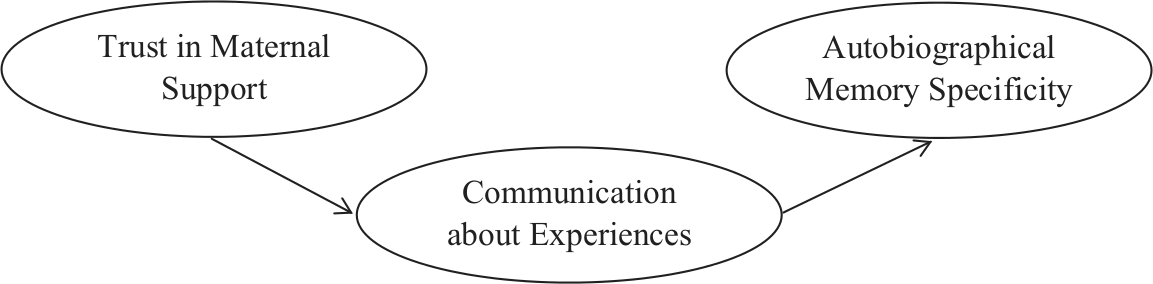
The indirect effect of trust on autobiographical memory specificity through communication.
The Current Study
In order to test the current study’s hypotheses, both trust in maternal support and mother-child communication were measured using self-report instruments. In early adolescence, self-report is currently not only the most widely used approach to measure attachment-related differences but it is also the approach for which most validity support has been found (Kerns, 2008). Moreover, attachment security is a broad and rich construct in which affective, cognitive, and behavioral components have each been considered central. Although theoretically and descriptively important, this richness has made it sometimes difficult to study mechanisms guided by attachment status. Therefore, the present study will focus on children’s explicit expectations regarding mother’s availability and responsiveness. This will allow to investigate mechanisms concerning one specific cognitive component of the broader attachment construct.
While our hypotheses would suggest that associations between memory specificity and communication should be found independently of the content of the recalled events, evidence in favor of defensive exclusion should be most pronounced when children recall events related to mother-child interactions. Therefore, the original Autobiographical Memory Test (AMT; Williams & Broadbent, 1986) was adapted. Children were asked to recall specific events related to positive and negative feelings they experienced when being together with mother. Importantly, Williams et al. (2007) point out that overgeneral memory as an avoidance strategy can only be successful if it is applied not just with respect to negative memories but to memory in general. This was confirmed by a meta-analysis by van Vreeswijk and De Wilde (2004), which showed that reduced specificity occurs independently of the valence of emotions and by Griffith and colleagues (2009) who demonstrated that the AMT measures one general factor and not two independent valence-related factors. Therefore, the current study’s responses to the positive and negative AMT items were summarized in one AMT specificity score.
In summary, the current study aimed to increase our understanding of decreased autobiographical memory specificity in early adolescence. Three hypotheses were tested: (1) whether less self-reported trust in maternal support is related to less specific autobiographical memories regarding interactions with mother; (2) whether children who report to communicate less with mother about their experiences have less specific autobiographical memories; and (3) whether trust is indirectly linked with specificity of autobiographical memories through children’s reported communication with mother. As depression affects memory processes (Timbremont & Braet, 2004) and is related to decreased specificity of autobiographical memories (Williams et al., 2007), the studied associations were controlled for possible effects of children’s depressive symptoms.
Method
Participants
Eighty elementary school children (22 boys, 58 girls) participated to the study with ages ranging from 10 to 13 (
Procedure
Using a letter distributed in the classrooms of the fourth, fifth, and sixth grade of elementary schools, we invited volunteering children and their parents to a study on the relationship between children and their mother. The letter informed the parents about the content of the study and asked their approval to participate. Approximately 40% of the parents who received a letter gave their informed consent. The participating families were visited by a trained bachelor psychology student. All invited children chose to participate after being personally informed about the content and the methodology of the study and about their right to refuse participation.
At the beginning of the experiment every child was individually interviewed about their mother by a trainee in clinical psychology. During the interview, children were asked to describe their relationship with mother, and to recall how they coped with events during which they were distressed, in pain, ill, or overwhelmed by separation or loss of a dear one. Following the theoretical assumptions of attachment interviews, talking with children about their mother should activate the attachment system (e.g., Target, Fonagy, & Shmueli-Goetz, 2003). Comparable strategies have already been used to activate the attachment system in previous attachment research on this age-group (e.g., Bosmans, Braet, Koster, & De Raedt, 2009), and in adult attachment research (e.g., Dewitte, Koster, De Houwer, & Buysse, 2007). Then the Autobiographical Memory Test (AMT) was administered. As this study was part of a larger study, other tasks were administered as well. Afterwards, children filled out the questionnaires. The local ethics committee approved the study design.
Measures
Autobiographical Memory Test (AMT)
To test AM specificity the written version of the AMT was used (see Raes et al., 2010; Williams & Broadbent, 1986). Ten different cue words were presented (5 positive cues like safe or proud and 5 negative cues like afraid and ashamed). For the purpose of this study, the original AMT was adapted. Children were asked to write down for cue words a specific memory about an occasion during which they were together with mother (i.e., a memory referring to one particular occasion or event that happened on a particular day and did not last longer than a day). A written AMT has been used successfully before in this age-group replicating adult research, which suggests that this approach is useful in this age-group (Raes et al., 2010). Before the test, children read together with the experimenter an example cue word (recall a time when you felt “good” while being with your mom) and then different possible responses reflecting different levels of specificity among which a clear illustration of a specific answer.
Each response was coded as either a specific memory (e.g., ashamed: “when the eggs broke in the pocket of my jacket and mom had to wash it”), a general memory (e.g., safe: “when I am with my mom during a thunderstorm”), a no memory (children answering: “I can’t remember”), or a no response (when nothing was written). Interrater agreement was high (κ = .89). Responses to the positive and negative AMT items were summarized in one AMT specificity score.
As the data were collected in two cross-sectional waves for organizational reasons, one cue word was changed in the second wave (pleasant instead of relaxed). However, changing the cue had no effect on the overall AMT-Specificity score, F(1, 78) = .05, ns. Therefore, we combined the two samples in one large sample.
People In My Life Questionnaire
Trust in maternal support and inclination to communicate about negative affect were estimated with the Trust- and Communication-subscales of the People In My Life Questionnaire, which is designed to measure 10- to 12-year-old children’s representations of attachment figures (PIML; Ridenour, Greenberg, & Cook, 2006). This questionnaire is a child-friendly version of the Inventory of Parent and Peer Attachment (Armsden & Greenberg, 1987), which investigates Trust in the attachment figures’ support, Communication about negative affect, and Alienation from the attachment figure (e.g., Allen, Porter, MacFarland, McElhaney, & Marsh, 2007; Belsky, Jaffee, Hsieh, & Silva, 2001). This measure has been widely used and has good psychometrics (Allen, in press). Its validity is suggested for example by links with attachment figure utilization, self-esteem, and parenting quality (e.g., Armsden & Greenberg, 1987; Gullone & Robinson, 2005).
For the current study, only the items of the Trust- and Communication-scales focusing on the relationship with mother were used. Trust is conceptualized as the positive affective/cognitive experiences of trust in the accessibility and responsiveness of attachment figures (10 items, e.g., “I can count on my mother to help me when I have a problem”). The Communication scale consists of 5 items (e.g., “I talk to my parents when I am having a problem.”). Children responded on a 4-point Likert-type scale ranging from 1 (almost never true) to 4 (almost always true). The Trust scale was previously linked with maternal parenting behaviors and the attentional processing of mother (e.g., Bosmans et al., 2009). The Communication-scale moderated the effect of children’s exposure to Hurricane Katrina on the development of anxiety and trauma symptoms (e.g., Costa, Weems, & Pina, 2009). In the current sample we found the Trust scale (α = .65) and the Communication scale (α = .70) to have adequate reliability.
Child Depression Inventory (CDI)
The children and adolescents completed a Dutch version of the CDI to assess current mood (Kovacs, 1992; Timbremont & Braet, 2002). The CDI is used for children and adolescents aged 7 to 17. It includes 27 items measuring cognitive, affective, and behavioral symptoms of depression in children. Each item consists of three statements graded in order of increasing severity from 0 to 2 and children select the item that characterized them best during the past 2 weeks. The item scores are combined into a total Depressive Symptoms score. The original questionnaire has relatively high levels of internal consistency, test-retest reliability and predictive, convergent, and construct validity, especially in nonclinical populations (Craighead, Smucker, Craighead, & Ilardi, 1998). Psychometric results for the Dutch version are promising. The internal consistency of the Dutch CDI is 0.80, the one-month test-retest reliability is 0.81 (Timbremont & Braet, 2002). In the current sample, α = .82.
Results
Preliminary Analyses
No data were missing. Children recalled on average 9.6 events (specific and general memories combined) for 10 cue words. Number of recalled events was not correlated with Trust (r = .04, ns), or with Communication (r = .07, ns), but with Depressive Symptoms (r = −.52, p < .001). In total, 69% of the recalled events were coded as specific memories.
1
On average, children were able to provide six specific memories to the 10 cue words. Although a substantial number of children had divorced parents (25%), and although divorce could have had a negative impact on the frequency of mother-child interactions and number of occasions to recall, having divorced parents was not related to AMT-Specificity, F(1, 78) = .228, ns. ANOVA analyses showed that gender had an effect on level of Trust, F(1, 78) = 8.27, p < .01 (
Correlations Between the Study’s Main Variables.
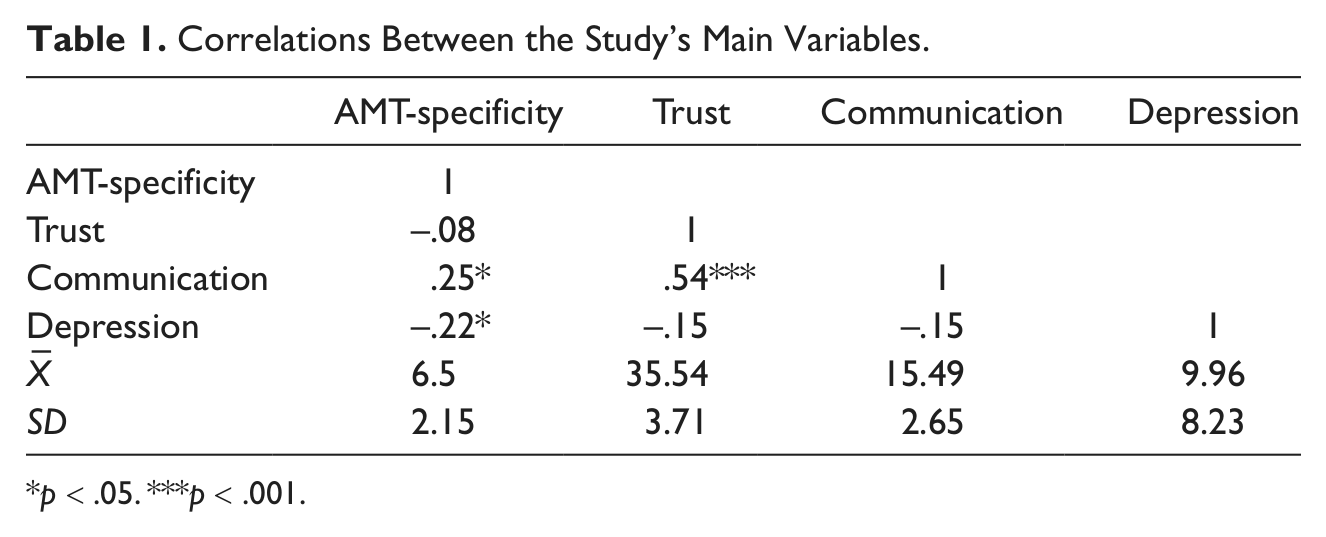
p < .05. ***p < .001.
Communication and Autobiographical Memory Specificity
Table 1 shows the correlations between the main variables of the current study. In line with the current study’s first hypothesis, Communication was significantly correlated with AMT-Specificity. To test whether this effect was specific for Communication and not explained by children’s depressed mood, a Multiple Regression Analysis was conducted with Age, Gender, and Depression as control variables and Communication as predictor of AMT-Specificity. Table 2 shows that the relationship between Communication and AMT-specificity remains significant after controlling for Depression. Moreover, the effect of Depression on AMT-Specificity disappears when Communication is taken into account. This model explains 15% of the variance in AMT-Specificity.
Multiple Regression Analysis With Communication as Predictor of AMT-Specificity and Depression, Age, and Gender as Control Variables.
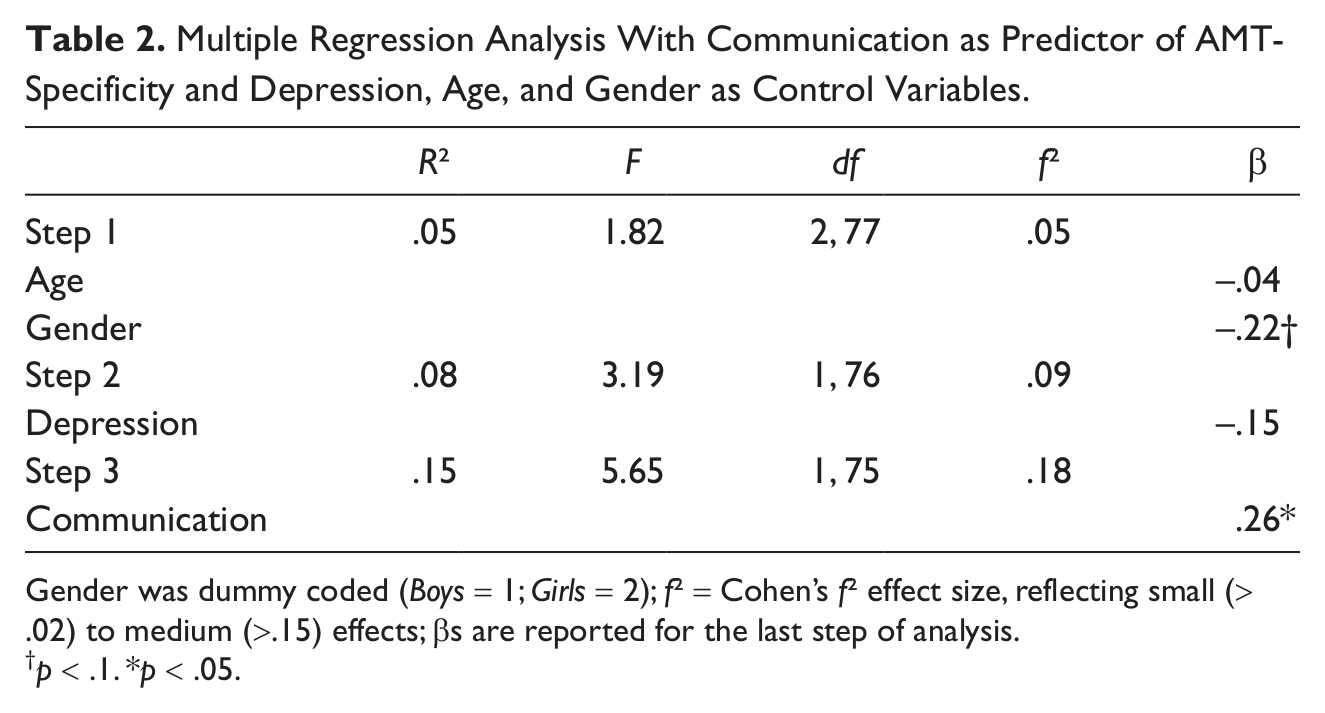
Gender was dummy coded (Boys = 1; Girls = 2); f2 = Cohen’s f2 effect size, reflecting small (> .02) to medium (>.15) effects; βs are reported for the last step of analysis.
p < .1. *p < .05.
Trust and Autobiographical Memory Specificity
Contrary to the current study’s second hypothesis, Trust was not correlated with AMT-Specificity.
Trust linked With Autobiographical Memory Specificity Through Communication
Although not correlated with AMT-Specificity, Trust is correlated with Communication and Communication is correlated with AMT-Specificity (Table 1). Therefore, we tested whether Trust is indirectly linked with AMT-Specificity through Communication. Following the recommendations of McKinnon, Lockwood, and Williams (2004) we used a nonparametric resampling method (bias-corrected bootstrap; Preacher & Hayes, 2008) with 5,000 resamples drawn with replacement from the original sample (n = 80) to derive the trust interval (CI) for the indirect effect. To that end, we used the SPSS Macro provided by Preacher and Hayes (2004). After controlling for the effect of Depression, the true total indirect effect of Trust, expressed in unstandardized regression weights, was estimated to lie between .02 and .28 (SE = .05) with 99% CI. Because zero is not in the 99% CI, we can conclude that the indirect effect of Trust is significantly different from zero at p < .01, two tailed. The entire model explains 17% of the variance in AMT-Specificity. Surprisingly, adding the indirect effect to the model led to a significant direct negative effect of Trust (unstandardized b = −.18, p < .05).
Discussion
The current study investigated links between characteristics of the mother-child relationship and interindividual differences in autobiographical memory specificity. For this purpose, it was tested in early adolescents whether attachment-related autobiographical memory specificity is (a) related to self-reported mother-child communication; (b) directly related to self-reported trust in maternal support; or (c) whether trust in maternal support is indirectly related to specificity through children’s perceived communication with mother about their experiences. Results support the current study’s first hypothesis, showing that more child-reported communication is related to more specific autobiographical memories. Moreover, the data support the current study’s hypothesis that more trust in maternal support is related to more self-reported communication about their experiences with mother and through this indirect link to enhanced retrieval of specific autobiographical memories. The implications of these findings for our understanding of autobiographical memory specificity and for future research will be discussed in the following paragraphs.
Communication and Autobiographical Memory Specificity
The current results suggest that children’s perceived communication with mother is related to autobiographical memory specificity. This supports Valentino’s (2011) hypothesis that the mechanism explaining links between mother-child conversation in early childhood and other features of autobiographical memories might explain autobiographical memory specificity (Valentino, 2011). In early childhood, this mechanism was identified as follows. Through conversation, mothers help their child to reexamine, reinstate, and bring together their memory for personal experiences in everyday conversation about past experiences (e.g., Harley & Reese, 1999; Hudson, 1993; Steele, Steele, Croft, & Fonagy, 1999; Reese & Newcombe, 2007). As a result, young children learn to understand event-related emotions, which fosters autobiographical memory development (Wang, 2008). Further corroborating the importance of early childhood mother-child conversations to understand autobiographical memory development, a direct link was previously found between early childhood mother-child conversations and quality of adolescent autobiographical recollections (Reese, Jack, & White, 2010).
The current study provides two important additions to the existing literature on mother-child reminiscing. First, the current study provides first evidence suggesting that understanding the development of the specificity of autobiographical memories requires focusing on the quality of mother-child communication. Second, the current cross-sectional correlations suggest that mother-child communication might be related to the quality of autobiographical memories beyond early childhood. It remains to be seen whether the current study’s link between communication and early adolescent autobiographical memory specificity results from a continuation of an established early childhood mother-child conversation pattern, reflecting a similar direct effect as found by Reese and colleagues (2010), or whether mother-child communication during later childhood has an independent effect on autobiographical memory development. Future research should now investigate whether the effects replicate when communication is coded from observational data as is most often done in mother-child reminiscing literature.
Trust and Autobiographical Memory Specificity
Specificity of autobiographical memories was not related to self-reported trust in maternal support. This seems to suggest that the role of attachment in explaining reduced memory specificity is not that of a direct, merely cognitive, schema-driven information processing deficit. Although these results inform the defensive exclusion hypothesis, three considerations can be made regarding these results suggesting that the current results cannot be considered a final test of this hypothesis.
First, it could be argued that evidence for the defensive exclusion hypothesis should mainly be found when recalling adverse interactions with mother. According to Bowlby’s (1980) hypothesis, insecurely attached children avoid negative emotions that could be activated by recalling insecure interactions with mother. However, reanalyzing the data for negative recollections alone still did not reveal a significant association between AMT-specificity for negative recollections and Trust (r = −.07, ns).
Second, the current study cannot rule out links with other components of the attachment construct. Self-reports to measure attachment-related beliefs are often criticized for overidentifying security (Ainsworth, 1985). Consequently, the lack of support for the defensive exclusion hypothesis might result from measurement error. Future research might benefit from measuring less explicit and more automatic components of the attachment system. One interesting recently developed assessment tool could be Waters and Waters’ (2006) Secure Base Script test. Although the early adolescent version is still under construction (Waters et al., 2011), this approach could prove crucial to further elaborate our understanding of attachment-related autobiographical memory specificity. Also, Edelstein (2006) demonstrated that avoidant memory impairments are specifically relevant for individuals scoring high on avoidant attachment. Therefore, it could be important to separate out different types of insecure attachment like anxious and avoidant attachment. By the time the current data were collected, no convincing tool was available to measure avoidant attachment (Dwyer, 2005). The questionnaire used by Edelstein (2006) is recently adjusted to early adolescence (Brenning, Soenens, Braet, & Bosmans, 2012) and can be administered in future research.
Finally, given the importance of experienced support in attachment relationships, instructing participants to recall events characterized by (absence of) experienced support could have yielded stronger effects. Yet such an instruction would fundamentally change the AMT, making it difficult to integrate the current results into the existing autobiographical memory specificity literature.
In spite of these limitations, it is important to conclude that the current study provided a first test of the defensive exclusion hypothesis but found no support for this hypothesis. Therefore, the current null finding is important as it puts into question a widely accepted assumption of attachment theory.
Trust Linked With Autobiographical Memory Specificity Through Communication
Finally, although no direct link was found between trust in maternal support and the specificity of autobiographical memories concerning mother, trust was indirectly linked with specificity of these autobiographical memories through perceived communication. Our results suggest that children who trust less in maternal support, report to communicate more with their mother about negative affect, and have, in turn, more specific memories concerning interactions with mother. This finding expands previous research that showed that the quality of the attachment relationship affects the quality of mother-child conversation (Newcombe & Reese, 2004). This supports Fivush’ (2006) hypothesis that the quality of attachment relationships is important for the development of autobiographical memories as conversations that promote autobiographical memory development mainly occur in secure relationships.
Surprisingly, data suggest that taking into account this indirect effect reveals a significant negative association between Trust and AMT-Specificity. Due to the high positive correlation between Trust and Communication, controlling for communication takes out a substantial amount of variance in Trust that is related to positive outcomes. The remaining variance in trust represents a more negative component, which appears to become significantly linked with AMT-Specificity. Although we conjecture that this effect is the result of statistical coincidence, future research is needed to rule out the possibility that, in addition to current theory, children with less trust have very specific recollections of interactions with mother after controlling for the role of quality of Communication.
This study found marginally significant effects of gender on memory specificity and significant effects on trust in maternal support. Similar gender differences in attachment are increasingly found from middle childhood onwards (e.g., Sarracino, Presaghi, Degni, Innamorati, 2011). Similar findings made Del Giudice and Belsky (2010) argue that emerging gender differences in attachment are evolutionary important, reflecting the development of reproduction systems.
Although all variables were measured using the same informant, the use of multiple methods (self-report measures and a performance task) reduces the likelihood that the associations only reflect a reporter bias. Also importantly, these associations could have been the result of children’s underlying negative affective state. Nevertheless, the associations remained significant after controlling for depressive symptoms. Moreover, in these analyses, the initial effect of depression was no longer significant, suggesting that attachment-related autobiographical memory specificity might be uniquely related to communication in this age-group.
Limitations
In the current study, attachment-related autobiographical memory specificity was measured using a written version of the AMT. Future research in children should test whether the present results replicate using an orally administered AMT. For example, children might perform differently/better on the AMT when interviewed, as it could be a more appropriate strategy to prompt specific memories in this age-group. However, the current version did elicit a high number of specific recollections and amount of specific recollections was not related to age or cognitive maturity. Also, the current results replicate earlier work with a written version (Raes et al., 2010) and an oral version of the AMT (Vrielynck et al., 2007). In these previous studies, specificity of autobiographical memories was related to early adolescent depression, independent of the type of the task. This suggests that early adolescent memory specificity can be meaningfully measured with the written version of the AMT.
Also, the test started with an interview to activate the attachment system, a procedure often used in attachment studies (Dewitte et al., 2007). The procedure’s main goal is to make sure that children’s schemas regarding mother are activated at the beginning of the experiment (e.g., Dewitte et al., 2007). Nevertheless, this approach might also have primed children’s memories, inflating the correlations between the current study’s variables. Although the insignificant correlation between trust and AMT-Specificity suggests that the activation procedure might not have compromised the results, it remains important to test in future research whether the activation procedure is necessary to obtain the same results.
Finally, the cross-sectional nature of the current data and the correlational analyses do not allow deducting causal pathways (Kraemer, Stice, Kazdin, Offord, & Kupfer, 2001). Nevertheless, these findings are the first to confirm Valentino’s (2011) hypothesis that studying the mother-child relationship has potentially great value for furthering our understanding of the development of autobiographical memory specificity.
Future Directions
The current study suggests that mother-child communication about children’s experiences is related to autobiographical memory specificity. Results indicate that children who trust more in maternal support, report to communicate more with their mother about their experiences, and have, in turn, more specific memories concerning mother. As reduced specificity of autobiographical memories appears to be a stable construct that endures when depression is in remission (e.g., Mackinger, Pachinger, Leibetseder, & Fartracek, 2000) and predicts the course of depression (e.g., Raes et al., 2006), these findings might inform future developmental psychopathology research. A first next step would be to investigate whether communication plays a role in the development of depression through autobiographical memory specificity or vice versa. Also, a crucial question to investigate is whether quality of the mother-child relationship mediates the often reported association between traumatic experiences (see Williams et al., 2007) and specificity of autobiographical memories.
The current findings might be relevant for clinical practice as well. One successful approach in adults to reduce this cognitive vulnerability is to provide memory specificity training (Raes, Williams, & Hermans, 2009). However, in line with the frequently documented importance of mother-child relationships in (early) adolescent depression (e.g., Bosmans, Braet, Beyers, Van Leeuwen, & Van Vlierberghe, 2011; Brumariu & Kerns, 2010), the current results suggest that improving the quality of mother-child communication might be an adequate intervention strategy in younger age-groups. One promising new approach is Attachment Based Family Therapy for depressed adolescents (ABFT; Diamond, Reiss, Diamond, Siqueland, & Isaacs, 2002). ABFT aims at increasing the quality of parent-adolescent communication about the adolescents’ negative affective experiences and has been empirically evaluated as an effective intervention for adolescent depression (Weisz, McCarthy, & Valeri, 2006). As our study shows that parent-child communication remains important during early adolescence, ABFT might have a positive influence on the specificity of autobiographical memories and might therefore prevent children to relapse.
Footnotes
Declaration of Conflicting Interests
The author(s) declared no potential conflicts of interest with respect to the research, authorship, and/or publication of this article.
Funding
The author(s) disclosed receipt of the following financial support for the research, authorship, and/or publication of this article: This research was supported by Grant G.0934.12 of the Research Foundation Flanders (FWO), and Grants OT/12/043 and CREA/12/004 from the Research Fund KULeuven, Belgium.