



Abstract
The purpose of this multiwave longitudinal study was to examine the structure of self-complexity and its relation to depressive symptoms in 276 adolescents (M = 12.55; SD = 1.04). Self-complexity, depressive symptoms, and negative events were assessed during a laboratory assessment at baseline, and then depressive symptoms and negative events were tracked every 3 months over the next 2 years. Findings from the present research showed that girls had higher levels of Overlap (e.g., the degree to which one sees his or her roles as similar) and NASPECTS (the number of aspects) compared with boys, and that older adolescents had lower levels of Overlap. Furthermore, the present study demonstrated that low levels of positive Overlap (e.g., utilizing the same positive adjectives to describe numerous roles) predicted depressive symptoms, especially in the presence of negative events. Other findings along with developmental and clinical implications for this research are discussed.
Developmental Psychopathology, Depression, Stressors, and Self-Concept
Since the time of William James (1890), psychologists have aimed to understand the relation between self-representations and emotional well-being during adolescence (Harter, 2012). While study on the self-system has witnessed several transformations since this time, one critical shift was moving away from a global perspective concerning the self (e.g., global self-esteem) toward a multidimensional approach. Specifically, researchers have aimed to understand how the self may comprise several different representations and processes that contribute to one’s self-understanding (Harter, 2012). For example, research concerning self-control (Soenens, Vansteenkiste, Luyten, Duriez, & Goossens, 2005), self-efficacy (Bandura, Pastorelli, Barbaranelli, & Caprara, 1999), self-competence (Cole, Peeke, Dolezal, Murray, & Canzoniero, 1999), and contingent self-worth (Burwell & Shirk, 2006), all represent bodies of work that have shown that deficits in specific representations related to the self may relate to emotional distress during adolescence.
In line with a multidimensional approach, current research concerning the self also aims to distinguish between the quality of the self-representation (i.e., the contents of the self-concept) and the organization of self-knowledge (i.e., the self-structure; Altrocchi, 1999; Campbell, Assanand, & Paula, 2003). While a majority of past research concerning the self-system and mental health has focused on the contents of the self-concept (e.g. “Who am I?” “How do I feel about myself?”), researchers have become increasingly interested in how one organizes his or her self-knowledge (e.g., the self-structure). Similar to the literature on the contents of the self-concept, investigators have advocated for a multidimensional approach when assessing the structure of the self-concept. Specifically, pluralism (or differentiation), which is defined as the number of different aspects, and unity (or integration), defined as the similarity between these aspects, are purported to be two key aspects of the self-structure (Campbell et al., 2003). Past research has shown pluralism and unity to be independent constructs (Constantino, Wilson, Horowitz, & Pinel, 2006), which relate to emotional distress (Campbell et al., 2003; McReynolds, Altrocchi, & House, 2000). According to traditional theories concerning the self-structure, a high degree of pluralism (a large number of roles) and a low degree of unity (these roles are dissimilar) are believed to protect against the onset of emotional distress (Linville, 1985, 1987; Stein & Markus, 1994; Zajonc, 1960).
Despite adolescence being a critical period in the formation of one’s self-structure (Damon & Hart, 1991; Harter, 2012; Marsh & Shavelson, 1985), a paucity of research exists on the self-structure during this age. An exception to this trend is Linville’s (1982, 1985, 1987) theory of self-complexity, which has commanded some attention in the developmental literature. According to Linville’s (1985) original theory, self-complexity comprises the quantity of self-aspects (often referred to as NASPECTS; Rafaeli-Mor, Gotlib, & Revelle, 1999) and how much these representations share qualities (often referred to as Overlap; Rafaeli-Mor et al., 1999). For instance, an adolescent may describe himself or herself as a “caring sibling,” “talented basketball player,” and “trusted friend.” In this example, the adolescent has different roles that pertain to NASPECTS (e.g., sibling, basketball player, and friend), and describes these roles in different ways, which contributes to lower Overlap (e.g., caring, talented, and trusted). Past research has conceptualized NASPECTS and Overlap as forms of pluralism and unity respectively (Constantino et al., 2006). According to Linville (1985), a healthy self-complexity consists of high NASPECTS (pluralism) and low Overlap (unity).
A complex self is believed to be advantageous because it “buffers” one against the deleterious effects of a negative event (e.g., “the buffering hypothesis”; Linville, 1987). The “buffering hypothesis” is similar to other cognitive theories of youth depression which state that various cognitive processes may influence the subjective experience of the negative event, and subsequently modulate the event’s depressive impact (see Abela & Hankin, 2008). According to Linville (1987), if a negative event happens to an individual who is low in self-complexity, the bad event is likely to “spillover” to most aspects of his or her life, engendering depressive symptoms. For instance, an adolescent low in self-complexity who only defines himself or herself as a “talented basketball player” may react severely following a bad game because the experience impacted a large percentage of his or her identity. On the other hand, an adolescent high in self-complexity may be less emotionally reactive to the game because he or she has a more flexible view of oneself, and the game only impacted a small portion of the overall identity.
While Linville’s (1985, 1987) theory received strong initial support in adults, investigations have been mixed as to whether high levels of self-complexity are beneficial, deleterious, or unrelated to emotional distress during adolescence (Abela & Veronneau-McArdle, 2002; Evans, 1994). These mixed results concerning self-complexity in adolescence have mirrored a more recent pattern of inconsistent findings discovered in adult samples (Dixon & Baumeister, 1991; Kalthoff & Neimeyer, 1993; McConnell, Strain, Brown, & Rydell, 2009). Research has suggested that these conflicting findings may be due to the traditional approach of combining NASPECTS and Overlap into a single composite score (usually called an H statistic or self-complexity-dimensionality [SC-D]) when examining self-complexity. Researchers have found this composite score to be problematic because it is overly dependent on information concerning NASPECTS (Rafaeli-Mor et al., 1999) and has a curvilinear (Locke, 2003) or even no relationship (Brown & Rafaeli, 2007) with Overlap, as opposed to the negative, linear relationship proposed by Linville (1985, 1987). Thus, this composite score is an inadequate measure of the two theoretical components of self-complexity. In response, researchers have advocated utilizing a multidimensional approach to self-complexity that distinguishes between NASPECTS and Overlap, so that the impact of these two aspects of the self-structure can be properly understood (Rafaeli-Mor et al., 1999).
While cross-sectional research has been helpful in showing the importance of distinguishing between NASPECTS and Overlap (Locke, 2003; Luo, Watkins, & Lam, 2009; Rafaeli-Mor et al., 1999), findings have still been mixed when examining how these aspects of self-complexity relate to prospective emotional distress. For instance, in a 2-week, two-time point design, Constantino and colleagues (2006) found that neither NASPECTS nor Overlap directly predicted depressive symptoms in a sample of young adults. However, they did find marginal support for Linville’s (1987) buffering hypothesis with regard to lower levels of Overlap, but not NASPECTS, interacting with stressors to predict fewer depressive symptoms. However, in similarly designed studies, Brown and Rafaeli (2007) were not able to replicate these findings. Specifically, the authors found support for higher NASPECTS protecting against the depressogenic effects of subjective stress in an initial study, and that lower levels of Overlap protected against severe forms of stressors, but exacerbated the effects of daily hassles.
There may be several explanations for why, even after differentiating between NASPECTS and Overlap, the relation between self-complexity and depression is still unclear. For instance, Koch and Shepperd (2004) noted that an overreliance on cross-sectional and two-time point designed studies within the self-complexity field makes it difficult to determine the impact of the different self-structures on emotional distress. To date, no study has examined self-complexity within a multiwave, longitudinal framework, a recommended approach for understanding the relation between vulnerabilities and psychological distress (Willett, Singer, & Martin, 1998). Another reason may be that past studies on NASPECTS and Overlap have not differentiated between positive and negative information. Because humans are thought to organize positive and negative emotions differently (Morgan & Janoff-Bulman, 1994; Sackheim, 1986), it has been proposed that self-complexity may vary as a function of valence. For instance, an adolescent may describe him or herself as a “smart student,” “friendly counselor,” “happy friend,” and “attractive partner”; however, he or she may also identify as a “bad sibling,” “bad guitar player,” and “bad grandson.” In this case, we may say the adolescent has a low level of Overlap in positive information, but a high level of Overlap in negative information. According to Woolfolk, Novalany, Gara, Allen, and Polino (1995) and others (Abela & Veronneau-McArdle, 2002; Woolfolk et al., 1999), important individual differences exist in people’s capacity to organize positive and negative information concerning the self, and these differences have important implications with regard to the development of depression. However, to date these studies have only differentiated between positive and negative composite scores (e.g., the H statistic) of self-complexity. By applying the same principles to one’s Overlap, a clearer picture may emerge as to whether lower levels of Overlap are indeed adaptive.
Finally, there is also reason to believe that the relation between self-complexity and emotional distress may vary as a function of age and sex. For instance, in a study by McReynolds and colleagues (2000), the authors found that young adults in their 20s saw themselves in far fewer roles than adults in their 50s. To date, a clear picture has yet to emerge as to how NASPECTS and Overlap may function differently with regard to age and sex. Constantino and colleagues (2006) noted that their sample was over 85% female, and stated that future research needed to investigate demographic differences with regard to Overlap and NASPECTS. This issue may be especially important when investigating self-complexity within an adolescent sample. For a variety of cognitive (see Harter, 1990; Keating, 1990) and social (see Harter, Bresnick, Bouchey, & Whitesell, 1997) reasons, girls and boys begin to generate and develop more self-representations during early adolescence (Harter & Monsour, 1992). According to Harter and colleagues (1997), this sets the stage for contradictory or oppositional roles, as for the first time the adolescent struggles to make sense of his or her distinct behaviors and thoughts in different contexts. While these contradictions are not frequently seen in preadolescence, they peek as one becomes a teenager, especially for females (Harter, 2012; Harter & Monsour, 1992). Past research has shown that these conflicting selves may serve as a vulnerability for depression during early to middle adolescence as one does not yet understand how to integrate these different aspects of the self into a coherent whole (Harter et al., 1997). In contextualizing these findings within the self-complexity literature, it may be that a high number of NASPECTS and low level of Overlap are unrelated to emotional distress in preadolescence, but then predict depressive symptoms as one enters adolescence.
The present study aimed to clarify the role of self-complexity during adolescence. To date, only three studies have examined the relation between depressive symptoms and self-complexity in an adolescent sample (Abela & Veronneau-McArdle, 2002; Evans, 1994; Jordan & Cole, 1996). While Evans (1994) found support for Linville’s (1985, 1987) original hypothesis, more recent studies have not. Specifically, Jordan and Cole (1996) found that higher self-complexity predicted elevated depressive symptoms in early adolescence, and did not find support for Linville’s (1987) buffering hypothesis. Similarly, Abela and Veronneau-McArdle (2002) also did not find that total self-complexity protected against the effects of stressors, but did find that high negative self-complexity (i.e., a negative H statistic) exacerbated depressive symptoms during periods of high stress for early adolescents. We propose these conflicting results are due to any combination of the following: (a) using a global (e.g., H statistic) as opposed to multidimensional approach to self-complexity (e.g., assessing NASPECTS and Overlap separately), (b) not consistently accounting for individual differences in the ability to organize positive/negative information, (c) utilizing cross-sectional or two time-point designs, and (d) failing to adequately assess for sex and age differences. The present study sought to remedy these inconsistencies by examining the impact of NASPECTS and Overlap (total, positive, and negative) on depressive symptoms in a nine-wave, 2-year longitudinal study, within a developmental, vulnerability-stress (see Gibb & Coles, 2005 for explanation) framework so that Linville’s (1987) buffering hypothesis could be adequately tested.
The present study had three central research questions: (a) Do NASPECTS and Overlap (total, positive, and negative) vary as a function of age and sex? (b) Do NASPECTS and Overlap (total, positive and negative) relate to prospective symptoms of adolescent depression? (c) Is this relation best understood through the “buffering hypothesis,” with aspects of self-complexity interacting with negative events to predict depressive symptoms? Based on Harter’s (Harter, 2012; Harter et al., 1997) collective research, it was predicted that age and being female would positively correlate with NASPECTS, but negatively correlate with all three forms of Overlap. Furthermore, while research on the relation between NASPECTS and Overlap with adults has been mixed (Brown & Rafaeli, 2007; Constantino et al., 2006), recent studies by Campbell and colleagues (2003) demonstrated that lower unity (related to Overlap; Constantino et al., 2006) corresponded to emotional distress, while pluralism (related to NASPECTS; Constantino et al., 2006) was unrelated to adjustment. Thus, it was hypothesized that lower levels of total, positive, and negative Overlap would predict depressive symptoms, especially in the presence of negative events. Finally, based on research that has shown that negative self-information specifically exacerbates the consequences of stressors (Abela & Veronneau-McArdle, 2002), it was predicted that negative Overlap would interact with stressors to predict the highest levels of depressive symptoms.
Method
Participants
A total of 276 children and adolescents, 159 girls and 117 boys, from Montreal, Quebec, Canada participated in the project. Participants were recruited through ads placed in local newspapers and the greater community seeking participants for a study of adolescent development. Adolescents were given monetary compensation for their participation in the study. The consenting sample at the beginning of the project consisted of 54 eleven-year-olds (32 girls, 22 boys), 77 twelve-year-olds (39 girls, 38 boys), 84 thirteen-year-olds (51 girls, 33 boys), 60 fourteen-year-olds (37 girls, 23 boys), and 1 fifteen-year-old boy. With regard to ethnicity, 76.8% of the children were Caucasian, 14.5% were Asian, 5.8% were African American, 2.2% were Hispanic, and 0.7% self-identified as Native American. All participants were fluent in English (see Abela & Hankin, 2011, for further details concerning the sample).
Procedure
Only adolescents who had signed parental consent and gave verbal assent participated in the study. Phase 1 of the study involved an initial laboratory assessment. A research assistant met with the adolescent and verbally administered the Children’s Depressive Inventory (CDI; Kovacs, 1981) and the Adolescent Life Events Questionnaire (ALEQ; Hankin & Abramson, 2002). In addition, the adolescent completed the Self-Complexity Scale for Children (SCS-C; Abela & Veronneau-McArdle, 2000) during this assessment. Phase 2 of the study involved a series of eight telephone follow-up assessments. Adolescents were instructed to complete these follow-up assessments in private so that he or she felt comfortable disclosing information concerning stressors and emotional well-being. Assessments occurred every 3 months during the 2 years following the initial assessment. At each assessment, a research assistant verbally administered the CDI and the ALEQ to adolescents. At the conclusion of the study, participants were compensated $200 for participating.
Adolescents completed an average of 7.79 (SD = 1.70) assessments. The number of assessments completed by participants was distributed as follows: 42.2% completed all 9 assessments (n = 122), 26.6% missed one follow-up assessment (n = 77), 13.8% missed two follow-ups (n = 40), 4.5% missed three follow-ups (n = 13), 2.4% missed four follow-ups (n = 7), and 5.8% missed five or more follow-ups (n = 17). Importantly, the number of waves completed was not related to any of the self-structures (p > .05) or depressive symptoms (p > .05).
Measures
CDI
The CDI (Kovacs, 1981) is a 27-item self-report questionnaire that measures the cognitive, affective, and behavioral symptoms of depression. Youth were asked whether each item described how they were thinking and feeling in the past week. Items are scored from 0 to 2, with a higher score indicating greater symptom severity. Total CDI scores ranged from 0 to 51. The CDI is the most commonly used and well-studied measure for assessing youth depression (Myers & Winters, 2002). In the present study, the CDI had coefficient alphas range between 0.84 and 0.89 across administrations indicating strong internal consistency.
ALEQ
The ALEQ (Hankin & Abramson, 2002) is designed to assess the occurrence of a broad range of negative events typically reported by adolescents, including school problems (e.g., “You got in trouble with the teacher or principal”), relationship difficulties (e.g., “You found out your boyfriend/girlfriend was cheating on you”), and family problems (e.g., “You had an argument with a close family member [parent, sibling]”). Each of the 57 events is rated for frequency in the past 3 months on a Likert-type scale ranging from A (never) to E (always). Reliability and validity for the ALEQ has been established in past studies (Hankin, 2008; Hankin, Stone, & Wright, 2010).
SCS-C
The SCS-C (Abela & Veronneau-McArdle, 2000) is a two part questionnaire used to assess total, positive, and negative self-complexity in children and adolescents. In the first section of the questionnaire, participants are asked to list the roles or aspects of their lives that they find most important. They are allowed to list up to 10 of these aspects. Friend, brother/sister, son/daughter, (instrument) player, computer player, and student, were all common answers provided by adolescents in response to this prompt. In the second section, children are given a list of 20 adjectives, including 10 positive and 10 negative descriptors, which were taken from third- to ninth-grade reading materials (Carroll, Davies, & Richman, 1971). For each of the items listed in part one of the questionnaire, the participants are asked to choose any of those 20 descriptive words that they associate with each specific role. The participants can choose as many of these descriptors as they see fit for each item. Some examples of these descriptors are cheerful, attractive, ugly, smart, funny, and angry.
Data from this task were used to calculate the two components of self-complexity, NASPECTS (the number of roles) and Overlap (similarity between roles). NASPECTS was simply measured as the number of items listed in the first section of the SCS-C. Overlap was calculated using the equation: OL = Σ i (ΣjCij/Ti) / k × (k – 1), where C is the number of common adjectives in the ith and jth directions, T is the total number of traits in the ith direction, and k is the total number of self-aspect groups (Luo & Watkins, 2008; Rafaeli-Mor et al., 1999). With regard to positive and negative Overlap, the scores were totaled using the same equation above except that only the 10 positive adjectives were used to calculate positive Overlap, and only the 10 negative adjectives were utilized to calculate negative Overlap. Scores for NASPECTS ranged between 1 and 10, and for total, positive, and negative Overlap the scores ranged between 0 and 1, with lower Overlap indicating less similarity between aspects.
Results
Descriptive Statistics and Properties of the Self-Structures
Means and standard deviations for all variables measured at baseline are presented in Table 1. Means for depressive symptoms, negative events, and NASPECTS were similar to past studies. However, the total Overlap statistic is higher than the range previously reported in research with young adults (Constantino et al., 2006). In Table 1, we also present correlations between the indices of self-complexity (NASPECTS and Overlap) and the sex and age of the adolescents. Of note, Overlap (positive and total) and NASPECTS positively correlate. In addition, we found that sex positively correlated with positive/total Overlap and NASPECTS, and that age negatively correlated with total/positive Overlap, suggesting that girls have higher levels of of these self-structures and that total/positive Overlap decreases as a function of age.
Means, Standard Deviations, and Intercorrelations Between Baseline Measures.
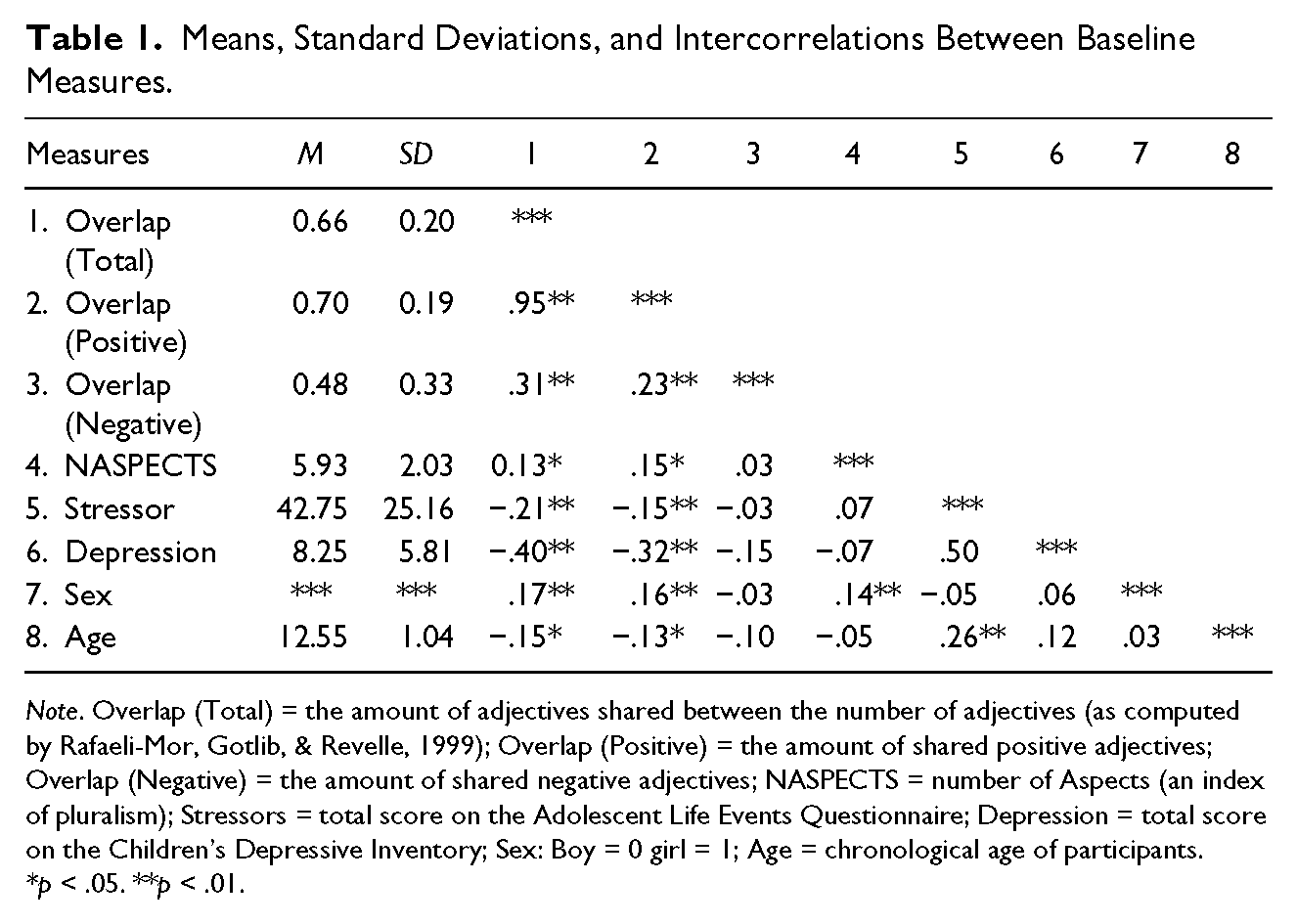
Note. Overlap (Total) = the amount of adjectives shared between the number of adjectives (as computed by Rafaeli-Mor, Gotlib, & Revelle, 1999); Overlap (Positive) = the amount of shared positive adjectives; Overlap (Negative) = the amount of shared negative adjectives; NASPECTS = number of Aspects (an index of pluralism); Stressors = total score on the Adolescent Life Events Questionnaire; Depression = total score on the Children’s Depressive Inventory; Sex: Boy = 0 girl = 1; Age = chronological age of participants.
p < .05. **p < .01.
Overview of Statistical Approach for Multiwave Data
To test the association between the different self-structures and emotional well-being, we built mixed level models (MLM) using the MIXED procedure in SAS version 9.2. MLM is an ideal approach for testing our hypotheses based on longitudinal questions because it is able to represent both change within a person over multiple time points while also ascertaining how individuals may differ from one another over time (Bolger, Davis, & Rafaeli, 2003; Curran & Willoughby, 2003). The two main questions analyzed using this data-analytic approach were (a) Do NASPECTS and Overlap (positive, negative, and total) predict prospective symptoms of depression and (b) Do high scores on these self-complexity indices buffer against or exacerbate prospective symptoms when experiencing a high level of negative events. For both questions, the self-structures were entered as Level 2 variables and depressive symptoms were entered as a Level 1 variables. Age and sex were also entered as fixed effects, and in higher ordered interaction terms to examine whether findings varied as a function of either of these demographic variables. If the higher ordered interaction terms were not significant, they were eliminated from the model and it was tested whether findings held across a more generalized population. In addition, to account for individual differences between participants, a random intercept and random slope were included for depressive symptoms in all models with a Level 1 predictor. For the stress-buffering hypothesis, two additional variables were entered, a negative events (a level 1) variable and a cross-level interaction between negative events and the self-structure. Necessary interaction terms were also created to examine if any of the buffering hypotheses differed across age or sex.
To provide a more rigorous test of our hypothesis, lagged analyses were conducted. Specifically, symptom scores at time T served as the dependent variable, and depressive symptom scores at T − 1 were entered as a time-varying covariate in all analyses. This approach allowed for a stringent, idiographic examination of the relation between the self-structures and symptoms by seeing if the self-structures independently lead to prospective symptoms, and to see whether the self-structures moderated the well-documented relation between negative events and depressive symptoms. To provide greater context concerning the magnitude of our findings, effect sizes using the r statistic (see Rosnow, Rosenthal, & Rubin, 2000, for explanation of statistic; see Rice & Harris, 2005, for comparisons with other effect size statistics) were calculated for all results.
A significant advantage of MLM is that it can accommodate cases with missing data. Random effects models such as the one described above do not require that every participant provide complete, nonmissing data over the 2-year time span. Therefore, participants did not have to be eliminated from the data set for missing follow-up assessments. Furthermore, following steps outlined by Hedeker and Gibbons (1997), we examined if the number of follow-ups completed by participants influenced any of the hypothesized relations in our study. Overall, we did not find any significance for follow-ups interacting with any self-structures to predict depressive symptoms (p > .10). Thus, it was concluded that data were missing at random (MAR).
Do the Self-Structures Predict Prospective Emotional Distress?
With regard to Overlap, contrary to Linville’s (1985) hypothesis, lower levels of positive Overlap, t(262) = −3.71, p < .01; reffect size = .22, and total Overlap, t(262) = −4.65, p < .01; reffect size = .28, predicted prospective depressive symptoms. A complete summary of these findings can be found in Table 2. Meanwhile, NASPECTS, b = 0.00; SE = 0.05; t(264) = 0.00, p > .95, and negative Overlap, b = −0.43; SE = 0.25; t(105) = −1.71, p = .10, were not significant predictors of later depressive symptoms. Overall, none of these findings varied as a function of age and/or sex (p > .05).
Summary of Results for Overlap (Total and Positive) Predicting Depressive Symptoms.

Note. SC = sex; Boy = 0; Girl = 1; Age = chronological age of participants; Depress (n–1) = Children’s Depressive Inventory scores at previous follow-up; Overlap (Total) = the amount of adjectives shared between the number of adjectives (as computed by Rafaeli-Mor, Gotlib, & Revelle, 1999); Overlap (Positive) = the amount of shared positive adjectives.
Small effect size.
Medium effect size.
p < .05. **p < .01. ***p < .001.
Do the Self-Structures Buffer Against Stressors?
It was next tested whether any of the self-complexity structures interacted with stressors to predict depressive symptoms. Across NASPECTS, and all forms of Overlap (positive, negative, and total), no four-way interactions (Self Structure × Stressor × Sex × Age) or three-way interactions (Self Structure × Stressor × Sex; Self Structure × Stressor × Age) were found to be significant suggesting that sex and/or age do not moderate the buffering hypothesis. With regard to the two-way interactions (Self Structure × Stressor), trend-level significance was found for interactions involving total Overlap, b = −0.03; SE = 0.01; t(1409) = −1.72, p = .08; reffect size = .05; positive Overlap, b = −.17; SE = 0.09; t(1409) = −1.79, p = 0.07; reffect size = .05; and NASPECTS, b = −.03; SE = .02; t(1423) = −1.94, p = .05; reffect size = .05. To understand the nature of these interactions, we calculated predicted CDI scores for adolescents possessing either high scores on Overlap and NASPECTS (1.0 SD above the group’s mean) or low scores on the self-structures (1.0 SD below the group’s mean) and who reported either low (1.0 SD below their own mean) or high (1.0 above their own mean) levels of stressors (see Cohen, Young, & Abela, 2011; Holmbeck, 2002, for further explanation of this approach). The results of these calculations are plotted in Figure 1. With regard to positive Overlap and total Overlap, findings indicated that individuals with low Overlap, compared with high Overlap, experienced elevated levels of depressive symptoms in the presence of higher levels of stressors. Meanwhile, individuals with higher NASPECTS experienced slightly lower levels of depressive symptoms in the presence of high stressors compared with those with lower levels of NASPECTS. 1
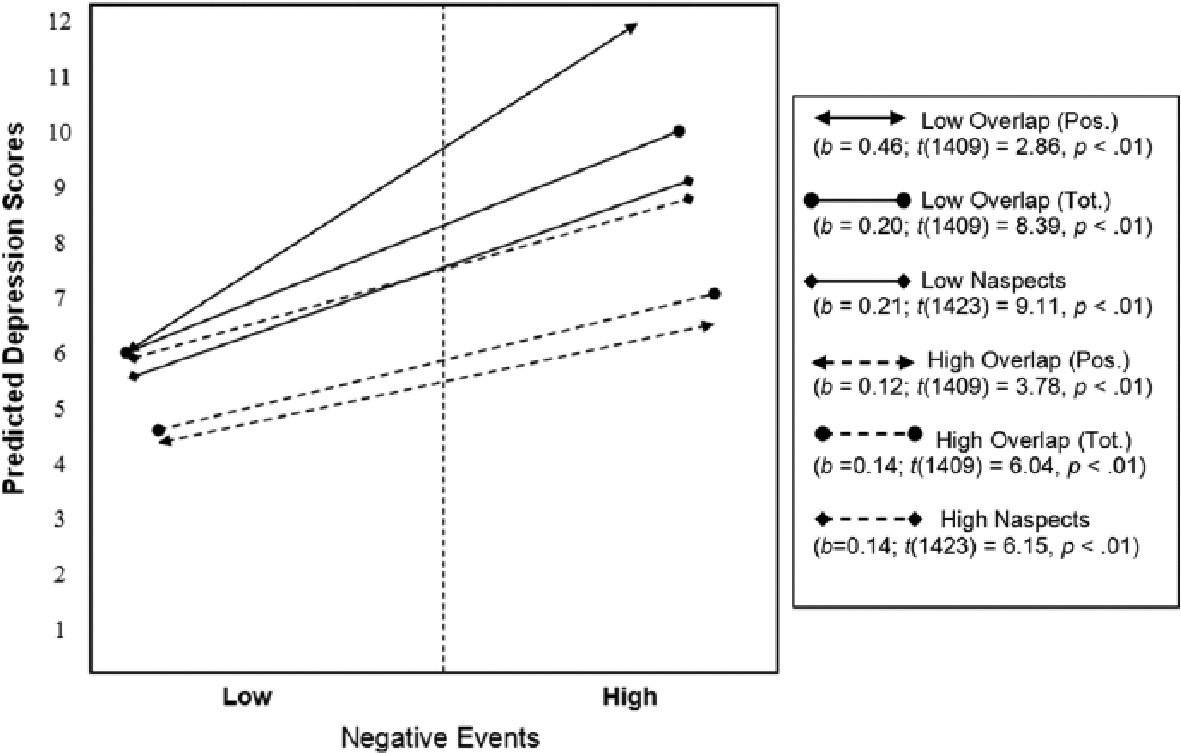
Predicted slope of the relationship between stressors and depressive symptoms as a function of level of self-structures.
Discussion
Findings from the present study partially supported our hypotheses and past research. First, findings that Overlap and NASPECTS have a small, positive correlation is contrary to Linville’s (1985, 1987) original assertion that higher NASPECTS relates to lower Overlap, but is consistent with more recent research that also found contradictory support for a global approach to self-complexity (Brown & Rafaeli, 2007; Constantino et al., 2006; Luo & Watkins, 2008, 2009; Luo et al., 2009; Rafaeli-Mor et al., 1999). Furthermore, differential findings concerning positive and negative Overlap are consistent with past research that advocated examining these dimensions separately (Abela & Veronneau-McArdle, 2002; Woolfolk et al., 1999; Woolfolk et al., 1995). Thus, findings from the present study further emphasize the importance of assessing NASPECTS and Overlap (total, positive, and negative) independently. As our study was the first to examine NASPECTS and Overlap (total, positive, and negative) in adolescents, we believe findings from the present study provides important information concerning the structure of self-complexity during this important developmental period.
The present study further emphasizes the dynamic nature of the self-structure during early to middle adolescence. We found that adolescents closer to middle adolescence tended to have less total and positive Overlap compared with younger adolescents. This is consistent with traditional developmental research which has found that as youth mature they go from having a more unified view of themselves during childhood to an increasingly more differentiated self-structure as one enters and goes through early adolescence (Rafaeli & Hiller, 2010; Werner, 1948, 1957). Interestingly, NASPECTS did not vary as a function of age, suggesting that age-related changes concerning this index of pluralism may happen during a different developmental stage. Given that the mean number of NASPECTS in the present study was similar to past studies conducted with adults (Constantino et al., 2006; Rafaeli-Mor et al., 1999), we believe that age-related changes concerning NASPECTS (and possibly other indices of pluralism) may happen earlier in one’s youth. Future research should investigate if important individual differences exist with regard to NASPECTS during late childhood, as researchers have yet to investigate NASPECTS and Overlap in this age group.
With regard to sex, we found that girls had higher NASPECTS and higher total and positive Overlap. Concerning NASPECTS, these findings are similar to Harter’s (2012) research which showed that girls develop more roles than boys in response to increased social and emotional demands during early to middle adolescence. However, that adolescent girls had a higher degree of total and positive Overlap was surprising, as past research with adolescents (Harter et al., 1997) and adults (Simon, 1995) found that females have more well-distinguished roles compared with men. One possible explanation for this finding comes from identity theorists who have proposed that female identity development is more based on attachment to others, while male identity development is rooted in separation and autonomy (Cramer, 2000; Gilligan, 1982). A collection of studies have shown that starting in early adolescence, adolescent girls have deeper, more interdependent friendships compared with adolescent boys. On the other hand, adolescent boys tend to see friendships more within the context of sports or hobbies in which they have interest (see Galambos, 2004). Therefore, within the context of self-complexity, female roles may be more heavily based on the relationship itself so similar qualities may be used to describe various relationships (e.g., trustworthy, loyal, and loving may be used for daughter, girlfriend, and friend), resulting in greater Overlap. Alternatively, adolescent male self-representations may be more based on various activities, which may trigger a more diverse set of adjectives across different activities (e.g., smart for Chess Club, athletic for soccer, and creative for music). Thus, it may be useful for future research to examine interpersonal self-complexity to clarify the sex differences found in total and positive Overlap during early adolescence found in the present study.
While aspects of self-complexity varied depending on one’s age and sex during early to middle adolescence, the relation between self-complexity and depressive symptoms seemed to be consistent across youth during this period. In other words, we did not find any significant interactions involving age/sex in our analyses suggesting that a consistent pattern between NASPECTS, Overlap, and depressive symptoms may exist across adolescents at this age. In contrast to Linville’s (1985, 1987) theory, we found that lower levels of total and positive Overlap predicted prospective symptoms of depression. These findings are also inconsistent with the theory put forth by Evans (1994) that lower levels of self-complexity (and therefore higher Overlap) represent delays in certain cognitive delays and broad psychological problems. One resolution to these seemingly contradictory results is that levels of Overlap may have unique impacts during different developmental stages. According to Harter and colleagues (1997), up until late adolescence individuals may struggle with differences between different social roles and subsequent self-representations. However, as teenagers mature, they begin to understand that differences between these roles are normative, and that these distinct self-representations are not necessarily contradictory or problematic. Within this paradigm, one may expect low levels of Overlap to predict symptoms of depression in early and middle adolescence, but not later in adolescence and into adulthood. This may be why studies which utilized a multidimensional approach and specifically tested the impact of Overlap did not find a direct relation between the self-structure and prospective depressive symptoms in samples of young adults (Brown & Rafaeli, 2007; Constantino et al., 2006).
While the finding concerning low levels of Overlap was not consistent with past research in self-complexity in adults, it may be more congruent with the self-structure literature at large. While investigating measures of pluralism and unity across several studies, Campbell and colleagues (2003) found that measures of pluralism did not relate to emotional well-being, while indices of unity (a related construct to Overlap; Constantino et al., 2006) positively correlated with several predictors of psychological well-being. These findings reflected past research which supported that aspects of pluralism do not predict emotional health, but that decreased unity may be problematic (Campbell et al., 1996; Donahue, Robins, Roberts, & John, 1993; Gramzow, Sedikides, Panter, & Insko, 2000). Thus, it appears that an early to middle adolescent low in Overlap may suffer from “self-fragmentation” (Campbell et al., 2003) instead of deriving Linville’s (1985, 1987) hypothesized benefits of being “complex.”
The present study also found that the relation between the self-structures and depressive symptoms may be partially explained by a vulnerability-stress (Gibb & Coles, 2005) or “buffering hypothesis” (Linville, 1985, 1987; Rafaeli & Hiller, 2010). Specifically, we found support for low levels of Overlap (positive and total) exacerbating depressive symptoms in the face of negative events. In addition, we also found that higher levels of NASPECTS protected against symptoms during times of high stressors. With regard to NASPECTS, these findings were consistent with Brown and Rafaeli’s (2007), but for Overlap the findings were inconsistent with results reported by Brown and Rafaeli (2007) and Constantino and colleagues (2006). Once again, there are several reasons for these inconsistencies. Brown and Rafaeli (2007) offer that findings concerning Overlap may differ based on the type of stressor being assessed (daily hassles vs. severe stressors). It also may be differences in study design as the present study utilized a multiwave, longitudinal approach and these other studies utilized a two time-point design to test their hypotheses. Furthermore, it may once again be that the relation between NASPECTS, Overlap, and stressors changes with age, with early to middle adolescents feeling especially “fragmented” (Campbell et al., 2003) during times of stress.
However, another possibility is that the “buffering hypothesis” may not be the best explanation of why aspects of self-complexity relate to emotional distress. Collectively, across the present study, Brown and Rafaeli’s (2007), and Constantino and colleagues (2006) findings, significance for the interaction is only marginal, not even achieving a small effect size (defined as greater than r = .10; Rice & Harris, 2005). Therefore, it may be that better explanations exist for why lower levels of Overlap relate to elevated depressive symptoms. For instance, it may be that having lower levels of Overlap leads to greater inconsistencies in one’s behavior during early adolescence and therefore more interpersonal conflict. Within this example, someone low in Overlap may “generate” stressors that lead to increased depressive symptoms (a stress generation model; Gotlib & Hammen, 1992). Future research should test these alternative models concerning self-complexity so that specific mechanisms in the process from vulnerability to symptoms can be properly identified.
Finally, findings from the present study are also consistent with researchers who have recommended accounting for valence when studying the structures of the self (Woolfolk et al., 1999; Woolfolk et al., 1995), by finding that positive Overlap, but not negative Overlap, seems to be highly related to depressive symptomatology. One reason that low Overlap for positive information may be problematic is that having inconsistent positive descriptors for different roles may cause less of a “spillover” in positive affect. In a series of experimental manipulations, McConnell, Rydell, and Brown (2009) showed that in different contexts, specific self-representations may be activated when relevant environmental cues are present. For instance, if an attribute of an adolescent’s “student” role is smart, when an adolescent is home from school and receives a compliment from his or her parent for being smart, the “student” role is activated. However, it would not only be the “student” role which is activated in this context, but any role in which the adolescent associates with the word smart (McConnell, Rydell, et al., 2009). Therefore, someone who is high in positive Overlap (e.g., has many roles associated with the word smart) may have more self-representations activated during these times compared with someone low in positive Overlap. Having these multiple positive self-representations activated more often may have several advantages related to positive mood maintenance. For instance, having a higher percentage of multiple selves activated at once may give one the impression that one’s “true” self is positive, and that one’s self-representations are not conflicted, which is associated with poorer emotional well-being (Harter & Monsour, 1992). In addition, McConnell, Rydell, and colleagues (Study 3; 2009) demonstrated that positive feedback had a greater impact on positive mood when the attribute was associated with more self-representations. As positive mood is associated with more flexible thinking and creative problem solving (Fredrickson, 2001), there is reason to believe that having more self-representations activated may be an important protective factor against prospective depressive symptoms for adolescents. Thus, one implication from the current findings may be to encourage early to middle adolescents to identify attributes that allow them to succeed across domains and then provide them continuous feedback on those specific attributes.
Although the present research extended past research concerning self-complexity, it still has some important limitations. First, self-report measures were utilized to assess depressive symptoms and negative events. While the CDI and ALEQ have both been shown to be reliable and valid self-report measures, interpretations should be tempered until these findings have been replicated with a diagnostic interview (Ingram & Siegle, 2002) and contextual stress interview (Gotlib & Hammen, 1992). Using a multimethod approach to stressors may be especially important within the context of the current study, as it has been suggested that the influence of self-complexity on depression varies as a function of the type of stressor (Brown & Rafaeli, 2007; Rafaeli & Hiller, 2010), and self-report measures may not adequately distinguish between types of negative events (Rudolph et al., 2000). In addition, the present study did not control for any unintentional priming effects (e.g., if entering a university building made adolescents more aware of their “student” role) during the laboratory assessment that may influence self-complexity data (Koch & Shepperd, 2004; McConnell, Rydell, et al., 2009). Finally, several age-related explanations were made in this article; however, the present study did not include any late adolescents or adults. Although similar measures and procedures were utilized in the present study compared with past studies conducted with adults (see Koch & Shepperd, 2004), future research may want to test a sample that includes a wide age range to allow for age-related differences to be tested more directly.
In sum, by incorporating a multiwave longitudinal design, and some of the proposed alternatives to self-complexity, a clearer picture concerning the relation between self-complexity and depressive symptoms emerged. Based on our findings, we propose that Overlap, specifically positive Overlap, may play an important role in the development and/or maintenance of depressive symptoms during adolescence. Future research should continue to examine whether these self-structures interact with other self-content processes to get a more complete understanding of the “self” during adolescence (Campbell et al., 2003) and how the self-structures may influence other forms of psychopathology during adolescence, such as anxiety (McReynolds et al., 2000). In addition, translational research may want to examine what role self-structures may play in depression prevention and treatment efforts. Thus, as basic and applied research on the self-structures continues, a better understanding of the development of adolescent adjustment is possible.
Footnotes
Declaration of Conflicting Interests
The author(s) declared no potential conflicts of interest with respect to the research, authorship, and/or publication of this article.
Funding
The author(s) disclosed receipt of the following financial support for the research, authorship, and/or publication of this article: National Alliance for Research on Schizophrenia and Depression awarded to John R. Z. Abela, National Institute of Mental Health Grant awarded to John R. Z. Abela and Benjamin L. Hankin, and National Institute of Mental Health Grant (1F31MH0964301) awarded to Joseph R. Cohen.