



Abstract
The main aim of this study was to examine one potential mediator of the prospective association between depressive symptoms and peer victimization: sadness rumination. Data were collected from 302 early adolescents (Mage = 10.53, SD =.16; 55.3% girls), at two waves, 1-year spaced, using self-reports. Depressive symptoms preceded increases in peer victimization and sadness rumination. Sadness rumination preceded increases in peer victimization. Sadness rumination mediated the relationship between depressive symptoms and increases in peer victimization. Multi-group analysis indicated that the mediation model tested was significant for boys, but not for girls. Overall, depression-related peer victimization could be minimized with intervention programs targeting early adolescents’ sadness rumination tendencies. Future research should further explain why depressed boys may face greater risk than girls in displaying increases in sadness rumination over time, which in turn, may lead to more frequent experiences of peer victimization.
Keywords
Introduction
Depression represents one of the most common and serious internalizing issues in youth (see Prinzie et al., 2014). It is usually characterized by depressed or irritable mood, anhedonia, self-blame, low self-regard, disturbed sleep or appetite, and poor concentration (Bennett et al., 2005; Leibenluft, 2017). Studies charting the prevalence rates of depressive symptoms document a remarkable increase throughout late childhood and adolescence (see Beirão et al., 2020) as well as a strong female preponderance, similar to adulthood (e.g., Khesht-Masjedi et al., 2017). Multiple concurrent and longitudinal aversive outcomes have been associated with the early-onset of depression including cognitive and social impairments (e.g., Krause et al., 2018; Morabito et al., 2021). Understanding the pathogenic mechanisms related to depression (Essau et al., 2020) is, therefore, critical for timely treatments and interventions (Rudolph & Flynn, 2014).
Interpersonal theories of depression suggest that depressive symptomology should be addressed in the transactions between depressive symptoms and individual’s aversive interpersonal experiences (Coyne, 1976; Rudolph, 2009). However, most studies examine depression as a consequence (e.g., Peets et al., 2021) and not as a predictive marker of interpersonal skill deficits and relationship disruptions (e.g., Kochel et al., 2012). Moreover, underlying mechanisms that might account for the damaging effects of depression on peer relationships are still unclear (see Rudolph, 2017). Yet, better understanding of such mechanisms would be a promising avenue for tailored prevention and treatment so as to alleviate some of the aversive outcomes of depression.
Despite evidence of the positive link between depression and peer victimization experiences (e.g., Morabito et al., 2021), the pathways underlying this longitudinal association remain unexplored. To fill this gap, the present study examines whether a specific cognitive mechanism—rumination (i.e., passive and repetitive thinking about one’s one distress) explains why earlier depression symptoms in early adolescence may lead to increase in peer victimization experiences.
Depression and Victimization
As mentioned earlier, interpersonal theories of depression suggest that depressive symptomology should be addressed in the transactions between depressive symptoms and individual’s aversive interpersonal experiences (Coyne, 1976; Rudolph, 2009) such as peer victimization (Sweeting et al., 2006). Becoming the target of others’ bullying behavior marks a widespread phenomenon (Biswas et al., 2020), usually equally reported by adolescent girls and boys (Haraldstad et al., 2019). Most importantly, the stability that peer victimization experiences seem to display over time (e.g., Cillessen & Lansu, 2015) may lead to concurrent and long-lasting damaging effects on the mental health functioning and psychological well-being of victims (e.g., Stapinski et al., 2015).
Several theoretical models have addressed the longitudinal links between depressive symptomology and disturbances in peer relationships (e.g., Krygsman & Vaillancourt, 2017). Interpersonal scar or symptoms-driven model is rooted in the “scar hypothesis” theory which supports that depression affects in a residual and multifaceted way humans’ personality (Lewinshon et al., 1981). In line with this model, depression-linked characteristics and behaviors seem to elicit or reinforce experiences of peer victimization (Kochel et al., 2017; Krygsman & Vaillancourt, 2017; Saint-Georges & Vaillancourt, 2020) as they dampen individual’s ability to engage functionally in peer relationships. For example, impaired emotion regulation (e.g. sustained negative affect) is a key component of depression that has been associated with social problems and increased risk of experiencing rejection and victimization (Hanish et al., 2004). In contrast, the interpersonal risk model states that negatively toned social interactions, such as prolonged peer victimization, confer risk for depression (e.g., Schwartz et al., 2015) by interfering with individual’s intrinsic need for social connection and/or by generating maladaptive self-cognitions (e.g., perceiving one’s social world as threatening) to the victims (Cole et al., 2016). However, there is also ample evidence to support a transactional model in which depressive symptoms and peer victimization are related reciprocally, creating a stable, escalating and vicious spiral across time (Davis et al., 2019; Sweeting et al., 2006).
Depression and Rumination
Alongside with negative peer experiences, dysregulated cognitive styles have also been advanced in understanding youth depression (e.g., Hong & Cheung, 2014). One such cognitive style is rumination, defined as the individual’s passive tendency to dwell repetitively on the meaning and causes of one’s mood symptoms (Watkins & Nolen-Hoeksema, 2014). Ruminative thinking, usually displayed more frequently by adolescent girls than boys (e.g., Johnson & Whisman, 2013) has been constantly linked to depression (e.g., Zareian et al., 2021).
There are two major competing theoretical models regarding the longitudinal association between depressive symptoms and rumination; the cognitive scar model and the vulnerability model respectively. The cognitive scar model presumes that depressive episodes in early life stages affect in a residual way the cognitive style (e.g., rumination) of young people (e.g., Lewinsohn et al., 1981). For example, evidence suggests that depression may dampen executive functions (i.e., higher-cognitive abilities necessary for goal directed behavior and self-regulation; Diamond, 2013), which in turn may increase individuals’ susceptibility to rumination. In contrast, the vulnerability model derived from the Response Styles Theory (Nolen-Hoeksema, 1991) marks the causal role of the chronic, trait-like ruminative coping in the onset, severity and duration of depressive symptoms (e.g., Broderick & Korteland, 2004; Burwell & Shirk, 2007; Nolen-Hoeksema, 2012). Although most research to date supports the vulnerability model (e.g., Wilkinson et al., 2013), several studies have provided evidence for the cognitive scar (Krause et al., 2018) and the transactional model respectively, with the latest suggesting that depression and rumination are interrelated in a harmful cycle (e.g., Calvete et al., 2015).
Rumination and Peer Victimization
Systematic exposure to peer victimization during the school years and rumination have also been found to be related both concurrently and over time (Dorio et al., 2018; Malamut & Salmivalli, 2021; McLaughlin & Nolen-Hoeksema, 2012; Shapero et al., 2013). For example, McLaughlin and Nolen-Hoeksema (2012) provided initial support to the interpersonal stress model of rumination in which ruminative thinking confers risk for a wide range of peer victimization experiences. Low self-regard (Hagen et al., 2020), social problem-solving deficits (e.g., Watkins & Baracaia, 2002) and excessive reassurance seeking (e.g., Stroud et al., 2018) are some of high ruminators’ characteristics related to increased chances of peer victimization (Crawford & Manassis, 2011; Stroud et al., 2018; Van Geel et al., 2018). Nevertheless, there is also evidence suggesting that peer victimization may act as a vulnerability factor for the development of a ruminative response style (e.g., Malamut & Salmivalli, 2021; Mathieson et al., 2014). According to the elaborated Control Theory (Martin & Tesser, 1989), stressful life events like being rejected by peers (Plexousakis et al., 2019) can create discrepancies between one’s desired and current state, which in turn may generate rumination in an effort of individuals to resolve this discrepancy (Martin & Tesser, 1989).
Towards an Integrated Symptoms-Driven Model of Depression
The scarring effects of depressive symptoms on youths’ peer victimization have been empirically supported, with evidence being, however, scarce (Kochel et al., 2012; Krygsman & Vaillancourt, 2017; Morabito et al., 2021; Saint-Georges & Vaillancourt, 2020; Vaillancourt et al., 2013). Moreover, underlying mechanisms that might explain why earlier depression symptoms may lead to increases in victimization experiences in youth are still unclear (Rudolph, 2017).
Rumination is well established as a pathway underlying the longitudinal damaging effects of victimization on depressive symptoms (Chu et al., 2019; Feinstein et al., 2014; Liu et al., 2020; Mathieson et al., 2014; Monti et al., 2017; Peets et al., 2021). However, there is also evidence suggesting negative cognitive styles as a possible mechanism in the relationship between depressive symptoms and interpersonal life stressors (Keser et al., 2020; Rose et al., 2017). More specifically, rumination thinking has been found to act both as an outcome of depression (e.g., Krause et al., 2018) and as a predictive marker of victimization (e.g., McLaughlin & Nolen-Hoeksema, 2012). Furthermore, among other underlying mechanisms proposed by interpersonal theories to explain the aversive effects of depressive symptoms on relationships, is excessive reassurance seeking (Rudolph, 2017), a behavioral tendency closely related to rumination (Stroud et al., 2018). Surprisingly, to our knowledge, rumination as a potential mediator in the relationship between depressive symptoms and peer victimization has not been examined in any published article yet.
To fill this gap, the present research examines whether sadness rumination explains why earlier depression symptoms may lead to increased chances of being victimized in early adolescence. Identifying potential factors responsible for depressed-prone youths’ interpersonal maladjustment over time is a crucial step in developing interventions that would alleviate some of the aversive outcomes of depressive symptoms.
The Moderating Role of Gender
Previous studies have shown mixed findings with respect to the gender-specific link from depressive symptoms to peer victimization. For example, Lester et al. (2012) found that depression was a precedent for peer victimization only among adolescent boys. Similarly, Tran et al. (2012) supported that depressive symptoms were more predictive of subsequent physical victimization for boys than for girls, whereas Sentse et al. (2017) found no gender moderation effects in the aforementioned relationship. The fact that none of these studies identified processes through which depressive symptoms may generate peer victimization puts some issues into question, as for example, “Why earlier symptoms of depression emerge as a greater risk factor for later peer victimization in boys compared to girls?” or “Are there any underlying mechanisms that might explain equally well the depression-peer victimization link across boys and girls?” Sadness rumination as an outcome of depressive symptoms has been found to be invariant across boys and girls (Calvete et al., 2015; Krause et al., 2018). However, evidence on societal gender norms (see Hellström & Beckman, 2019) and early adolescents’ implicit beliefs regarding gender-appropriate coping styles has shown that ruminative thinking may be a greater risk factor for later peer victimization (Navarro et al., 2011; Wright & Wachs, 2020) in boys compared to girls. That is, because dwelling on distress symptoms is usually perceived by both genders as a feminine coping strategy, that connotes an emotional sensitivity and passivity that violates the norms and ideals of masculinity (e.g., emotional stoicism) (Broderick & Korteland, 2002). However, previous findings have also indicated co-rumination, (i.e., excessively and repeatedly discuss problems within a dyadic relationship) to be a distinct, yet closely related to individual rumination process (Rose, 2002) that exacerbates generation of peer stress only among depressed-prone adolescent girls (Rose et al., 2017).
Why Early Adolescence?
Early adolescence (∼11–14years; Arnett, 2016) is a critical developmental period that marks the emergence of a dramatic increase in depressive symptoms (e.g., Hankin, 2015) as well the gradual establishment and consolidation of rumination tendencies (Hankin, 2008) and peer victimization experiences (Hymel & Swearer, 2015). The psychosocial challenges that individuals may face entering adolescence are usually attributed to changes in physical (e.g. pubertal hormonal shifts, Peper & Dahl, 2013) as well as social domains (e.g., greater exposure to extra-familiar relationships, see Telzer et al., 2015). Moreover, the cognitive development that occurs during early adolescence seems to offer youths both risks and opportunities (Briggs, 2009). Regarding risks, early adolescents’ emerging ability for formal operational thought and semi-abstract thinking may render them vulnerable to self-discrepancies (actual vs. ideal self), which, in turn, may lead both to rumination and depression (Harter, 2006; Gürcan-Yildirim & Gençöz, 2020; Papadakis et al., 2006; Stevens et al., 2013). Furthermore, prefrontal cortex (PFC) a brain area, implicated in executive functioning, is in a flexible and immature state (see Wagner et al., 2015) increasing individuals’ risk for emotional-behavioral problems (e.g., Miconi et al., 2018). Regarding opportunities, youths’ heightened learning ability makes the promotion of positive health attitudes (e.g., mindfulness; Crescentini et al., 2016) especially successful both immediately and over the life span (Blum et al., 2014). Indeed, a wide range of social-emotional interventions have been found to be more effective among children/early adolescents (grades 3 or 4–6) as compared to middle adolescents (grades 7 or 8–11) (see Yeager et al., 2018). This should be considered carefully given the rather malleable nature of depression (Zimmermann et al., 2020), rumination (Bessette et al., 2020) and peer victimization (Troop-Gordon, 2017) early in life. For these reasons, early adolescence represents a developmental period which is worth investing at both prevention and treatment level (Lane et al., 2017).
The Current Study
Depression represents a major mental health issue associated with aversive outcomes both in Greek (e.g., Kleftaras & Alexopoulos, 2015; Papadaki & Giovazolias, 2015) and in international youth samples (e.g., Ghandour et al., 2018; Chu et al., 2019). Building upon the symptoms-driven model of depression, the present study examines sadness rumination as a possible mechanism linking early adolescents’ depressive symptoms and subsequent experiences of peer victimization. Gender moderation effects in the proposed mediation model are also explored. More specifically, the following four main hypotheses are examined: [Hypothesis one] depressive symptoms precede and positively predict peer victimization 1 year later (interpersonal scar or symptoms-driven model of depression); [Hypothesis two] depressive symptoms precede and positively predict sadness rumination 1 year later (cognitive scar model of depression); [Hypothesis three] sadness rumination precedes and positively predicts peer victimization 1 year later (interpersonal stress model), and [Hypothesis four] sadness rumination mediates the effect of depressive symptoms on peer victimization over time (integrated symptoms-driven model of depression). Because of mixed findings regarding gender-based differences in the associations tested herein, no gender moderation hypothesis is put forth.
The study’s contribution to the subject area is as follows: [1] The prospective relationship between depressive symptoms and peer victimization via sadness rumination across early adolescence has not been examined in any published article yet; [2] Taking into account the importance of temporal precedence in mediation analysis (i.e., the cause precedes the effect; Kline, 2015; MacKinnon et al., 2007) as well as prior work showing that the present hypothesized effects could be also found in the opposite direction; peer victimization predicts both depressive symptoms and rumination (e.g., Chu et al., 2019; Peets et al., 2021), directionality of the constructs tested herein was prior assessed; [3] Mediation effects supported by previous studies with two occasions data (e.g., Feinstein et al., 2014) should be considered with caution given the absence of a time interval between the mediator (M—Time 2) and the outcome (X—Time 2) (Selig & Preacher, 2009). Although a full longitudinal mediation requires at least three waves of measurement to assess the temporal sequence of variables (e.g., Selig & Preacher, 2009) the “half-longitudinal mediation” approach (Cole & Maxwell, 2003; Little, 2013) employed here outperforms other modeling alternatives (e.g., Feinstein et al., 2014) in providing preliminary evidence about possible mediation effects with just two occasions (Cole & Maxwell, 2003; Little, 2013). This is because the time-interval between the predictor and the mediator (X and M), as well as the time-interval between the mediator and the outcome (M and Y) are taken into account (Cole & Maxwell, 2003; Little, 2013); [4] moderation effects in the proposed mediation model were tested; [5] all analyses were conducted using latent variable structural equation modeling (SEM) to remove the biasing effect of measurement error in the measured variables (Ledgerwood & Shrout, 2011); [6], psychometric properties of the Greek version of Children’s Response Styles Scale (CRSS; Ziegert & Kistner, 2002) are provided. More specifically, CRSS’s evaluation was conducted prior to the main research, given that there was no psychometrically sound and valid instrument available in Greek language to assess children’s’ tendency towards sadness rumination. Cross-cultural adaption of the research instruments is a process of high importance as it enables comparisons of results across different studies, and ascertains the conceptual accuracy of the construct in measure (see Borsa et al., 2012).
Methods
Overall Study Design and Data Collection
Permission by school principals and teachers were obtained prior to research. Written detailed information about the study, parental consent forms and a short demographic questionnaire (e.g., parental education) were sent via enveloped letters to the parents of students enrolled in Grade 5 in the participating schools. Students with signed parental consent were given a unique personal code and were then gathered in a classroom during a class period (∼45min.) in order to complete a series of paper-and-pencil brief self-report measures. Detailed information regarding the anonymous, confidential, and voluntary nature of their participation were provided. Participants’ verbal agreement was also obtained prior to research. Data were collected in two waves, Time 1 (T1) and Time 2 (T2), respectively, (approximately 2months after the start of the fall semester) spaced 1 year apart. While there is no universal consensus on how long the time-interval between waves should be, in the social sciences inter-wave time lags of 6–24months are considered generally normal (e.g., Walters, 2019). More specifically, the 1-year time lag employed in the present study has been suggested to be long enough to detect substantial cross lagged effects in middle-aged students (Sweeting et al., 2006). It has to be mentioned that no compensate was given to participants. All procedures were approved by the Institute of Educational Policy and the Greek Ministry of Education.
Participants
Participants at T1 consisted of 367 fifth graders (consent rate = 81.6%; Mage=10.53, SD =.18; 54.2% girls). The convenience sample was recruited from 13 primary public schools, located in Heraklion of Crete (Greece). An attrition rate (e.g., school absenteeism due to seasonal influenza; transfer to a new school) of 16.6% (n = 61) at T2 and deleted multivariate outliers (T1/T2, n = 4) reduced the analyzed sample to 302 participants (Mage=10.53, SD =.16; 55.3% girls). X2 tests and univariate general linear models (GLMs) showed significant differences among schools in regard to students’ parental education [mother education, χ2 (36) = 57.80, p < .05; father education, χ2 (36) = 82.67, p < .001] and initial levels of DS [T1, F (12,272) = 2.11, p < .05]. Schools were not found to be differentiated in regard to individuals’ gender distribution [χ2(12) = 16.61, p = .17)], SR [T1, F (12,281) = .66, p = .79] and PV [T1, F (12,288) = .71, p = .75]. Similarly, no significant differences were detected between children who participated in both temporal occasions and those who responded only at first occasion neither for demographic variables [gender, χ2 (1) =.79, p =.37; father education, χ2 (6) = 7.70, p = .26; mother education, χ2 (5) = 6.84, p = .23], nor for study variables [DS, t (346) = 1.45, p = .15; SR, t (356) = 1.11, p = .27; PV, t (362) = 1.68, p= .10]. Consequently, results did not seem to be influenced by any systematic drop out. Based on the guidelines proposed by Kline (2016) our sample (N >200) was considered satisfactory enough for proceeding with SEM analyses.
Instruments
Children’s Response Styles Scale (CRSS; Ziegert & Kistner, 2002). The CRSS is a widely adopted 20-item self-report questionnaire that assesses children’s’ tendency to ruminate or seek distraction in response to sad affect. Participants are asked to rate on an 11-point Likert scale (0 = never to 10 = always) the frequency with which they engage in ruminatory (10 items; e.g., “I replay in my head what happened”) or distracting behaviors (10 items; e.g., I think, “I’m going to go out and have some fun”). The original CRSS was translated—back-translated and then pretested (e.g. items’ understanding) in a sample of 30 fifth graders (see Beaton et al., 2000). Measurement properties of the CRSS’s Greek-version (e.g., factorial validity, measurement invariance across gender) were assessed in a different sample of 503 fifth graders (Mage = 10, SD = 1.41; 53.9% girls) (see Supplemental Material). In contrast with previous findings the CRSS Greek version confirmed its sound and appropriate psychometric properties (Sonkur et al., 2017; Ziegert & Kistner, 2002). For the needs of the present study, only the Rumination subscale was used (T1, ω = .85, SE = .02, [95%CI] = [.82, .87], α = .84; T2, ω = .89, SE =.01, [95%CI] = [.87, .91], α = .89).
Children’s Depression Inventory (CDI; Kovacs, 1992; Giannakopoulos et al., 2009). The CDI is a reliable and valid 27-item self-report questionnaire that targets cognitive, affective and behavioral signs of depression in children and adolescents 7–17years of age (e.g., Masip et al., 2010). Participants are asked to endorse on a 3-point Likert-scale (0 = absence of symptoms to 2 = definite symptoms) the statement that best describes their behavioral or emotional state with regard to a specific symptom of depression (e.g., “I feel like crying every day”). Following the request of the Institute of Educational Policy and the Greek Ministry of Education, the 26th suicidal ideation item (“I want to kill myself”) was omitted. In contrast with previous findings (e.g., Logan et al., 2013) the single-factor structure of the instrument was confirmed, χ2(168) = 410.91, p < .001, CFI = .90, RMSEA [90%CI] = .04 [.03, .04]. Internal consistency of the CDI was (T1, ω = .82, SE = .02, [95%CI] = [.78, .85], α = .84; T2, ω =.76, SE =.03, [95%CI] = [.69, .80], α = .84).
Peer Experiences Questionnaire—Standard Version (PEQ-STDV; Vernberg et al., 1999; Giovazolias et al., 2010). The PEQ-STDV is a reliable and valid 18-item self-report questionnaire that assesses children’s experiences in overt/physical and/or covert/relational bullying perpetration and victimization (e.g. Giovazolias et al., 2017). The PEQ-STDV is comprised of two subscales: The Victimization of Self (VS; nine items) subscale and the Victimization of Others (VO; nine items) subscale. Participants are requested to rate on a 5-point Likert-scale (1 = never–5 = a few times a week) how often in the past 3 months the item content applied to them. For the needs of the present study only the VS subscale was used (e.g., “A student chased me like he wanted to hurt me”). The VS subscale displayed high internal consistency (T1, ω =.84, SE =.94, [95%CI] = [.76, .89], α = .83; T2, ω =.83, SE = .94, [95%CI] = [.78, .88], α = .83).
Analytic Plan
Statistical analyses were conducted using IBM Statistical Package for the Social Science (SPSS) version 25.0 and Mplus version 8.1 (Muthén & Muthén, 2017). Associations between variables were tested by Pearson correlations (r = .10 to .29, small; r = .30 to .50, medium; r > .50, large; Cohen, 1988). Expressed in the Cohen’s d metric, effect sizes of mean differences across gender (d = .20, small; d = .50, medium; d = .80, large; Cohen, 1988) and corresponding 95% confidence intervals (95%CI) were calculated with the free online estimator provided by Lenhard and Lenhard (2016). Univariate outliers (mean +/− SD*3; Tabachnick & Fidell, 2001 as cited in Leys et al., 2019) of all variables across both times of measurement ranged from one to 4 (n = 8). Univariate skewness (−.03–2.08) and kurtosis values (−.60–6.3) were under recommended ranges of 3 and 10, respectively (Kline, 2011). Multivariate outliers evaluated with Mahalanobis distance (p < .001) were deleted before performing SEM as they could easily jeopardize fit indices (Kline, 2015). As mentioned above, latent SEM was employed to remove the biasing effect of measurement error in the measured variables (Ledgerwood & Shrout, 2011). Full information maximum estimation (FIML) and robust maximum estimation (MLR) were used to account for not completely at random missing values (T1 = 10%; T2=11.7%; Little’s MCARχ2(3452) = 3728.62, p < .001) and multivariate non-normality; Mardia’sskewness (χ2 = 115.57, SD = .22, p < .001) and Mardia’skurtosis (χ2 = 220.08, SD = 1,06, p < .001) (Mardia, 1970). Unidimensionality of the study measures in conjunction with the large amount of items per each latent factor indicated the well-established parceling procedure (e.g. Little et al., 2013; Matsunaga, 2008). Hence, the 26 items of the CDI were randomly assigned (Matsunaga, 2008) to five parcels, the 19 items of the CRSS to three parcels and the 9 items of the PEQ-STDV to three parcels, respectively. Next, the following four-step strategy was conducted: First, a three-factor model being represented by our three distinct constructs: depressive symptoms (DS), sadness rumination (SR), and peer victimization (PV) was systematically compared (T1/T2) to a single-factor model (all indicators loaded on a single latent factor) to evaluate if the parcel indicators measured the latent factors as intended; the three latent factors at both time waves were allowed to freely covary. Constructs’ convergent validity was evaluated through the assessment of standardized indicator factor loadings (value ≥.32, Tabachnick & Fidell, 2001) and their statistical significance (p < .05). Constructs’ discriminant validity would be established if factor correlations did not exceed |.80| or |.85| (Brown, 2015). Second, CFA measurement invariance analyses: a) configural (i.e., equivalence of model form); metric (i.e., equivalence of the item loadings on the factors); scalar (i.e., equivalence of item intercepts, for metric invariant items) and strict (i.e., equivalence of item residuals of metric and scalar invariant items) (Putnick & Bornstein, 2016) were employed to test the longitudinal equivalence of the three-factor model’s factorial structure. Marginal violations of equivalence would be considered as tolerable, provided that the invariance of the majority of the indicators had been established (Newsom, 2015). Third, cross-lagged panel models (CLPM) were performed to test Hypotheses 1–3. CLPM examines the amount and strength of the longitudinal effect of one investigated construct on another (cross-lagged effects) by taking into account within time associations (synchronous correlations) as well as across-time stability (autoregressive effects) (Cole & Maxwell, 2003). Instead of using one integrated CLPM (including DS, SR, and PV), three different CLPMs, each having two variables at two times, were conducted to assess the temporal ordering of the study constructs. In the integrated model, the effect of DS on PV could have been explained by SR (the potential mediating variable). Thus, it was necessary to examine the longitudinal relationship between DS and PV first. Fourth, a “half-longitudinal mediation model” (Cole & Maxwell, 2003; Little, 2013) was tested using the maximum likelihood (ML) procedure to examine the hypothesis of longitudinal mediation (Hypothesis 4). As it was mentioned above full longitudinal mediation requires at least three waves of measurement to assess the temporal sequence of variables (e.g., Selig & Preacher, 2009). However, “half-longitudinal mediation” has been proposed to be appropriate for assessing mediation with just two occasions (Cole & Maxwell, 2003; Little, 2013). Instead of merely assessing the influence on the levels of the variables across measurement points, “half-longitudinal mediation” model provides the benefits of controlling for prior levels in the predicted variables (i.e., autoregressive effects) and, thus, testing the significance of the influences on the change variance of the mediator (mediation path α) and the outcome variable (mediation path b) across measurement points (Little, 2013). According to Cole and Maxwell (2003), if paths α and b are both significantly different from zero, then the mediation paths product αb will also be significantly different from zero. However, given that this statement has recently been debated (Little, 2013) bias-corrected bootstrap analysis with 5000 bootstrap sample simulation was also employed, to test the significance of the product αb. An indirect effect is significant if its 95%CI does not include the 0 value (Preacher & Hayes, 2008). One limitation of the “half-longitudinal mediation” model is that the significance of path c (X → Y) cannot be tested to inform whether there is just partial or total mediation (Cole & Maxwell, 2003). Gender as demographic variable was also controlled for across all CLPMs and the initial “half-longitudinal mediation” model, respectively; gender was regressed on all main variables at each time point of measurement. Fifth, multi-group CFA analysis with ML procedure and a bias-corrected bootstrap analysis with 5000 bootstrap sample was conducted to assess mediation effects across both gender. Mean-and variance-adjusted test statistic (MLMV) and the MODELTEST instruction (mediation effects across boys and girls were set equal to zero) was then used to test the null hypothesis that there is no gender moderation in indirect effects.
In general, model fit was assessed based on the standard conventions (comparative fit index, CFI ≥.90; Tucker-Lewis index, TLI ≥.90; root mean square error for approximation, RMSEA ≤.08; Kline, 2016). Model comparison was addressed with the scaled χ2 difference test (Δχ2 > .05 indicates the less parameterized model as more preferable in support of parsimony; Satorra & Bentler, 2001). Constructs’ measurement invariance across time and gender (i.e., constructs have the same meaning across repeated measurements and to both gender and, thus, meaningful inferences can be made; Putnick & Bornstein, 2016) would also be supported with a Δχ2 >.05 (i.e., the model constraints do not worsen the model fit; Satorra & Bentler, 2001) and the criterion of ΔCFI, ΔTLI and ΔRMSEA ≤.01 (Chen, 2007). For multi-group analysis the general rule of thumb of 100 participants in each group (Kline, 2016) was accomplished (boys = 135; girls = 167). A Wald Test of χ2 > .05 with MODEL TEST instruction would indicate a no significant difference in the indirect effect between boys and girls.
Alongside with Cronbach’s alpha (α), measures’ internal consistency was evaluated using omega (ω) coefficient (McDonald, 1999) which seems to outperform α under violations of tau-equivalence (e.g. Dunn et al., 2014).
Results
Descriptive Statistics, Correlations and Mean Differences
Pearson Correlations, Means (M) and Standard Deviations (SD) for the Study Variables.
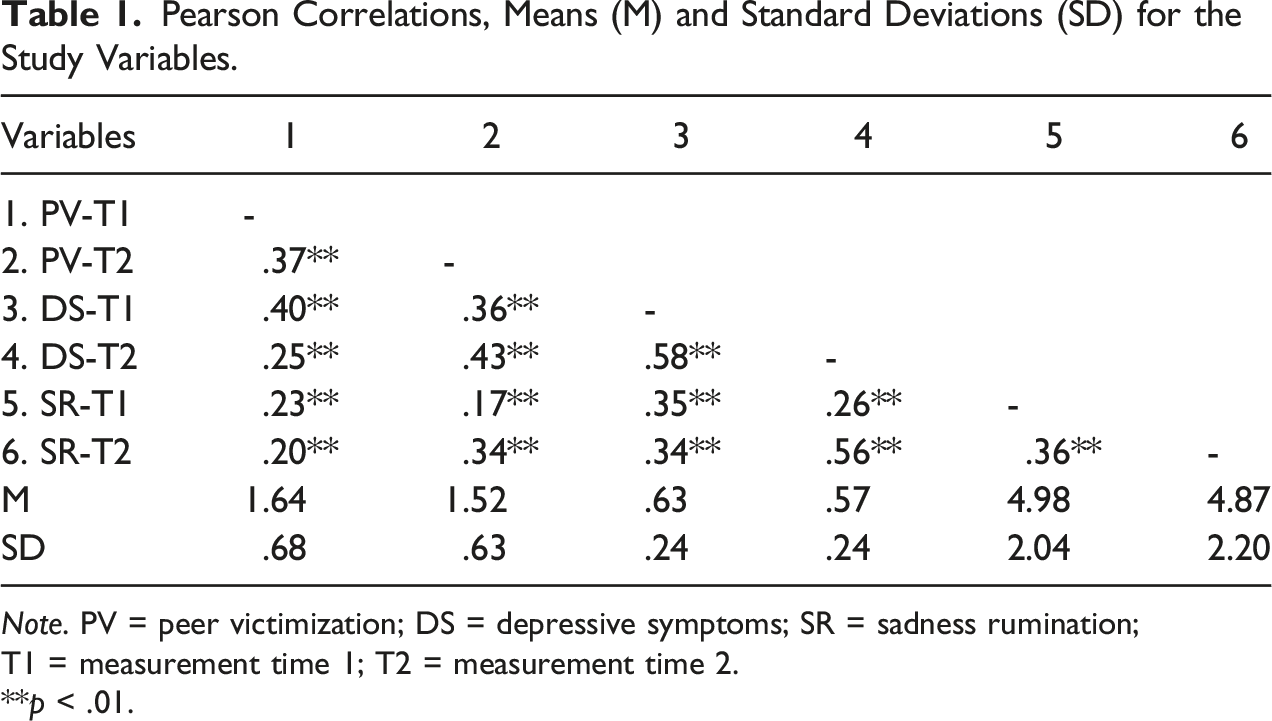
Note. PV = peer victimization; DS = depressive symptoms; SR = sadness rumination; T1 = measurement time 1; T2 = measurement time 2.
**p < .01.
The observed mean levels of DS at T1 and T2 were significantly higher among girls than boys (T1, d = .41, [95% CI = .18, .65]; T2, d = .28, [95% CI = .05, .52]). Significantly higher tendency towards SR was also found among girls but only at T2 (T2, d = .36, [95% CI = .13, .59]; T1, d = .21, [95% CI = −.03, .44]). On the contrary, no significant differences were indicated across gender regarding PV (T1, d =.09, [95% CI = −.14, .32]; T2, d = .02, [95% CI = −.21, .25]).
Constructs’ Measurement Invariance Across Gender
Scalar and partial scalar invariance across gender were accomplished for all constructs at both times of measurement: SR (T1, Δχ2(9)scalar vs metric = 12.72, p = .18; T2, Δχ2(9)scalar vs metric = 11.04, p = .27; ΔCFI, ΔTLI, ΔRMSEA ≤.01); DS (T1, Δχ2(25)scalar vs metric = 37.75, p = .06; T2, Δχ2(25)scalar vs metric = 51.17, p < .01; ΔCFI, ΔTLI, ΔRMSEA ≤.01); PV (T1, Δχ2(4) partial scalar vs metric = 11.87, p <.01; T2, Δχ2(4) partial scalar vs metric = 16.25, p <.01; ΔCFI, ΔTLI, ΔRMSEA ≤.01).
Measurement Model Analysis
Measurement Invariance Statistics.

Note. M1 = configural invariance model; M2 = metric invariance model; M3 = scalar invariance model; M4 = strict invariance model; MLRχ2 = chi-square test of model fit associated with robust maximum likelihood estimator; df = degrees of freedom; scf = MLR scaling factor; CFI = comparative fit index; TLI = Tucker-Lewis index; RMSEA[90%CI] = root mean square error of approximation [90% confidence intervals]; ΔMLRχ2 = chi-square difference test.
***p < .001.
Cross-Lagged Models
Model one
As Figure 1 shows, DS at T1 preceded and positively predicted PV at T2 (b = .22, β = .25, SE = .08, p < .01) even after controlling for (1) autoregressive effects [DS (b = .58, β = .60, SE = .07, p < .001); PV (b = .28, β = .30, SE = .10, p < .01)], (2) within time correlations [DST1 ↔ PVT1 (r = .45, p < .001); DST2 ↔ PVT2 (r = .40, p < .001)], (3) reversed cross-lagged path “interpersonal risk model” [PVT1 → DST2 (b = .02, β = .02, SE = .08, p > .05)], and (4) gender. Model one fitted the data well, χ2(110) = 145.45, p < .05, CFI = .98, TLI = .97, RMSEA [90%CI] = .03 [.02, .05]. Cross-Lagged Panel Analysis Model for Depressive Symptoms and Peer Victimization. Note. Model 1 with standardized path coefficients. Oval boxes indicate latent variables. Factor loadings and extra variable’s (gender) paths are omitted for graphic simplicity.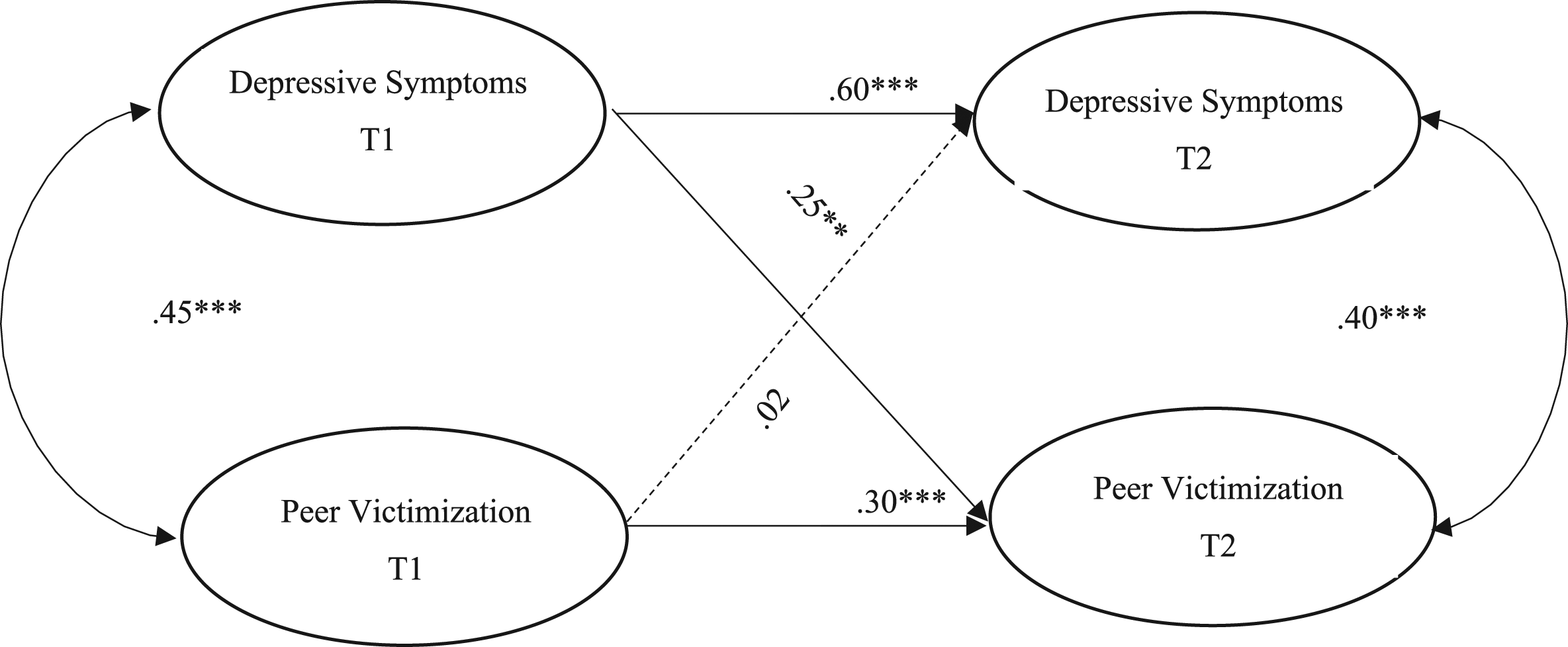
Model two
As Figure 2 shows, DS at T1 preceded and positively predicted SR at T2 (b = .25, β = .23, SE = .07, p < .01) even after controlling for (1) autoregressive effects [DS (b = .57, β = .59, SE = .06, p < .001); SR (b = .32, β = .29, SE = .07, p < .001)], (2) within time correlations [DST1 ↔ SRT1 (r = .40, p < .001); DST2 ↔ SRT2 (r = .60, p < .001], (3) reversed cross-lagged path; vulnerability model [SRT1 → DST2 (b = .06, β = .06, SE = .07, p > .05)], and (4) gender. Model two fitted the data reasonably, χ2(108) = 212.71, p < .001, CFI = .96, TLI = .94, RMSEA [90%CI] = .06 [.04, .07]. Cross-Lagged Panel Analysis Model for Depressive Symptoms and Sadness Rumination. Note. Model 2 with standardized path coefficients. Oval boxes indicate latent variables. Factor loadings and extra variable’s (gender) paths are omitted for graphic simplicity.
Model three
As Figure 3 shows, SR at T1 preceded and positively predicted PV at T2 (b = .11, β = .12, SE = .06, p < .05) even after controlling for: (1) autoregressive effects [SR (b = .39, β = .35, SE = .07, p < .001); PV (b = .36, β = .38, SE = .09, p < .001)], (2) within time correlations [SRT1 ↔ PVT1 (r = .26, p < .01); SRT2 ↔ PVT2 (r = .33, p < .001)], (3) reversed cross-lagged path; control model [PVT1 → SRT2 (b = .12, β = .10, SE = .07, p > .05)], and (4) gender. Model three fitted the data well, χ2(54)= 69.34, p > .05, CFI = .99, TLI = .99, RMSEA [90%CI] = .03 [.00, .05]. Cross-Lagged Panel Analysis Model for Sadness Rumination and Peer Victimization. Note. Model 3 with standardized path coefficients. Oval boxes indicate latent variables. Factor loadings and extra variable’s (gender) paths are omitted for graphic simplicity.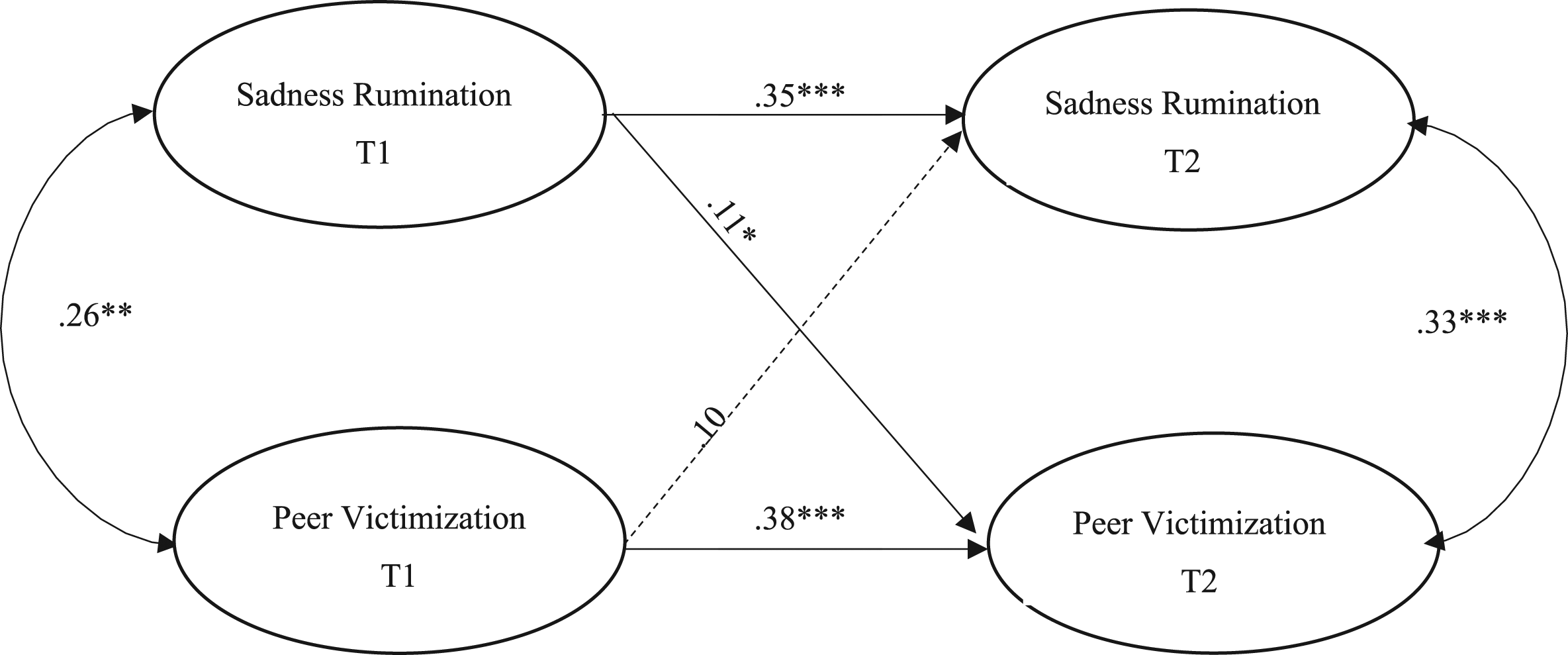
Half-Longitudinal Mediation Model
As Figure 4 shows, the hypothesis that SR mediates the relationship between DS at T1 and PV at T2 was confirmed. There was an indirect effect through SR: DS at T1 positively predicted SR at T2 (α = .17, SE = .08, p < .01) and SR at T1 positively predicted PV at T2 (b = .13, SE = .06, p < .05). The bootstrapping results revealed that the mediator effect of SR gave rise to a small albeit significant indirect relationship between DS at T1 and PV at T2 (αb = .02; 95%CI = .002, .070). Model four fitted the data well, χ2(121) = 178.42, p < .05, CFI = .98, TLI = .97, RMSEA [90%CI] = .03 [.02, .05]. Half-Longitudinal Mediation Model for Testing the Mediation Role of Sadness Rumination between Depressive Symptoms at T1 and Peer Victimization at T2. Note. Model 4 with standardized path coefficients. Oval boxes indicate latent variables. Factor loadings and extra variable’s (gender) paths are omitted for graphic simplicity.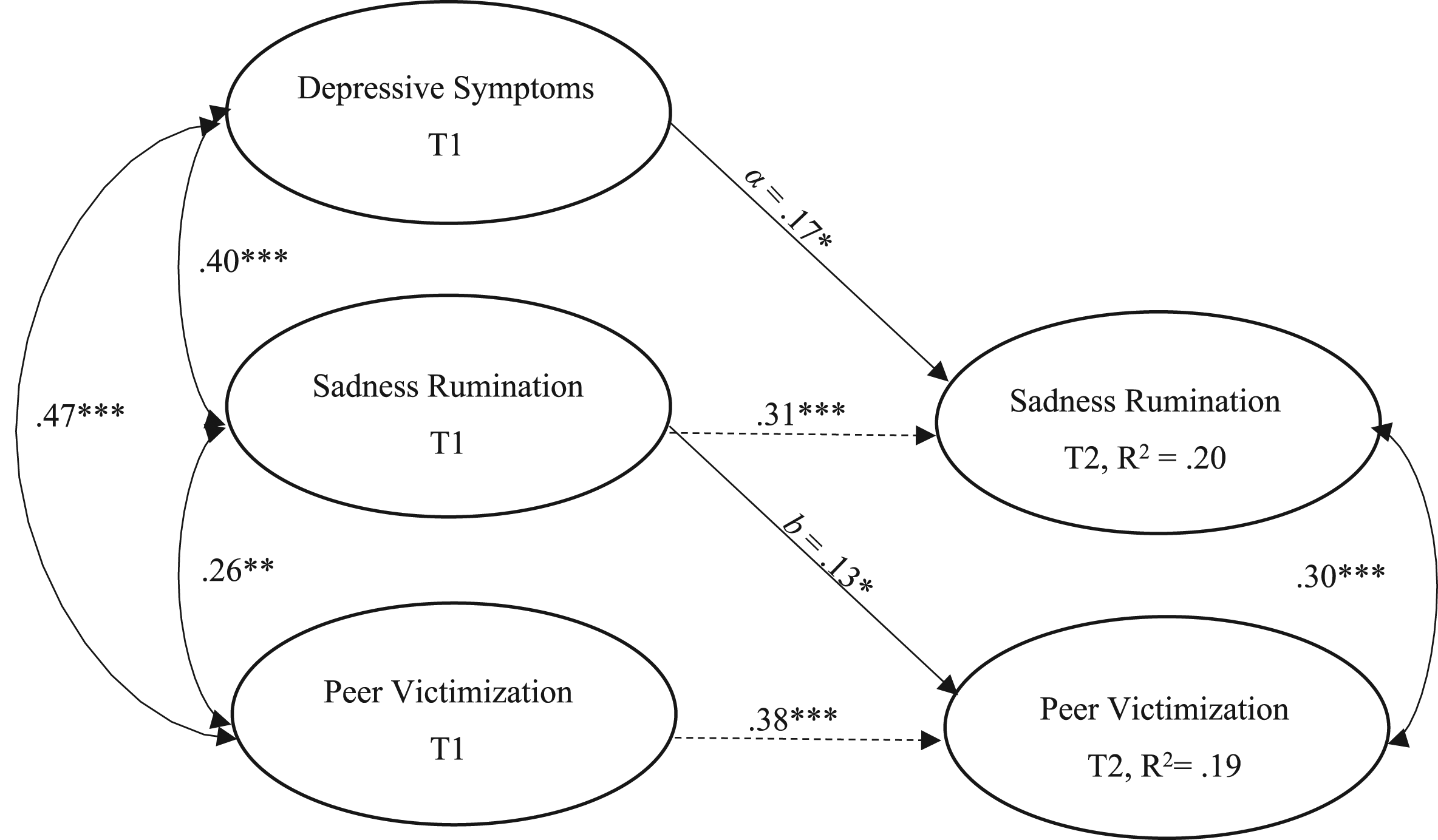
Gender Moderation effects
Baseline model showed good fit to the data, χ2(236) = 336.792, p < .05, CFI = .96, TLI = .95, RMSEA [90%CI] = .05 [.04, .07]. Indirect effect was found significant only for boys (α = .29, p < .05; b = .23, p < .05; αb = .07; 95%CI = .010, .185) and not for girls (α = .07, p > .05; b = .04, p > .05; αb = .00; 95%CI = −.008, .042). Nevertheless, based on the no significant Wald Test, χ2(1) = 2.69, p > .05, the difference in the indirect effects between boys and girls was too small to claim statistical gender moderation.
Discussion
The main aim of the present study was to test sadness rumination as a potential underlying mechanism in the prospective relationship between depressive symptoms and peer victimization. Temporal ordering of the constructs tested herein was examined via three different CLPMs and the theoretical prediction of indirect effects was assessed via a “half-longitudinal mediation” analysis. Gender moderation effects in the proposed mediation model were also explored.
A positive significant path from depressive symptoms to peer victimization was found, establishing the temporal precedence of depressive symptoms over peer victimization. Contrary to the interpersonal risk model in which victimization confers risk for symptoms of depression (e.g., Schwartz et al., 2015), our findings yielded support to the symptoms-driven model of depression, as early adolescents’ self-reported symptoms of depression were found to be a predictive marker and not an outcome of later perceived peer victimization as implicated in previous studies (e.g., Kochel et al., 2017; Saint-George & Vaillancourt, 2020Saint-Georges & Vaillancourt, 2020).
Similarly, a positive significant path from depressive symptoms to sadness rumination was found, establishing the temporal precedence of depressive symptoms over sadness rumination. Contrary to the vulnerability model in which rumination leads to increases in depression (e.g., Abela & Hankin, 2011), our findings provided support to the cognitive scar model of depression (e.g., Krause et al., 2018; McCarty et al., 2007; Van Ettenkoven et al., 2020), as early adolescents’ self-reported depressive symptoms were found to predict subsequent engagement in sadness rumination.
A small positive, albeit significant path from sadness rumination to peer victimization was also found, establishing the temporal precedence of sadness rumination over peer victimization. Contrary to the control model in which victimization paves the pathway to later rumination (e.g., Monti et al., 2017), our findings confirmed the interpersonal stress model of rumination. More specifically, early adolescents’ sadness rumination tendencies emerged as a predictive marker (McLaughlin & Nolen-Hoeksema; 2012; Shapero et al., 2013) and not as an outcome of peer victimization.
As expected, depressive symptoms lead to later increases in sadness rumination and sadness rumination leads to later increases in peer victimization. Consequently, that means that sadness rumination mediates the relationship between depressive symptoms and peer victimization. The longitudinal association between depressive symptoms and peer victimization gives support to an integrated symptoms-driven model of depression in which early adolescents with high levels of depressive symptoms face greater risk of experiencing peer victimization by engaging more in sadness rumination. As mentioned above, the prospective association between depressive symptoms and early adolescents’ sadness rumination tendencies advances the cognitive scar model of depression (e.g., McCarty et al., 2007) and expands prior knowledge regarding the contributing role of depression in individual’s cognitive vulnerabilities, negative attributional styles and dysfunctional cognitive schemas as well (e.g., Calvete et al., 2013; Krause et al., 2018). Most importantly, our findings seem to align with the “Scar Hypothesis” of depression which presumes that depression affects in an enduring and residual way multiple domains of individuals’ personality, including cognitive ones (e.g., Wichers et al., 2010). There is evidence suggesting that emotional well-being may affect the maturation of executive function (EF) during adolescence (Donati et al., 2021). As it was already mentioned, EF represents a set of inter-related but distinct higher-order pre-frontal cognitive control processes (e.g., inhibition control, flexibility of thought; Nyongesa et al., 2019) necessary to purposeful, goal-directed thoughts and behavior (Welsh et al., 1991). Deficits in EF have been related both to depressive symptoms (e.g., Friedman & Robbins, 2021) and rumination tendencies (Dickson et al., 2017). For example, the inhibition control deficits that depression-prone youths usually display (e.g., Ajilchi, and Nejati 2017) have been found to contribute to a sustained focus on negative or distressing material as well as greater use of maladaptive emotion-regulation strategies, including rumination (Dickson et al., 2017). Moreover, depressed individuals usually face difficulties in emotional awareness and recognition (i.e., acknowledging and differentiating between various emotions; Rieffe et al., 2008; Sendzik et al., 2017) that may amplify the risk of using dysfunctional cognitive strategies (e.g., rumination; Eckland & Berenbaum, 2020) instead of healthy ones (e.g., cognitive reappraisal; Volkaert et al., 2020).
The prospective association between sadness rumination and peer victimization advances the stress generation model of rumination (e.g., Shapero et al., 2013) in which youths who ruminate, may experience increases in interpersonal stressors, including peer victimization. More specifically, evidence suggests that individuals with a high propensity towards depressive rumination, usually display excessive reassurance seeking (e.g., Clayton et al., 2021), a behavior that confers risk for interpersonal stressors (e.g., Stroud et al., 2018). It seems that asking repeatedly for reassurance that one is loveable and worthy in order to alleviate feelings of distress (Joiner et al., 1992) makes individuals appear vulnerable and appealing targets of victimization. Moreover, rumination has been related to victims justice sensitivity (Bondü et al., 2017), a personality disposition that may elicit peer victimization (e.g., Bilgin et al., 2021). Evidence suggests that youths who ruminate on thoughts of perceived injustice to their own disadvantage, may react in an aggressive and provoking way (Bondü et al., 2017), which in turn increase the risk of future victimization (Spence et al., 2009). Finally, low self-esteem and poor problem solving represent two rumination-related vulnerability factors that have been linked with peer victimization (Erdur-Baker, 2009).
Gender moderation effects in the mediation model were not statistically confirmed. However, results showed that depressed-prone adolescent boys may face greater risk of becoming targets of peer bullying via sadness rumination compared to girls. Rumination as an outcome of depressive symptoms among boys seems to advance previous studies (e.g., Krause et al., 2018) as well as prior work suggesting that this response style may be perceived as feminine by the peer group (Broderick & Korteland, 2002) and, thus lead to boys’ peer victimization (Wright & Wachs, 2020). On the other hand, rumination did not emerge as an underlying mechanism in the relationship between depression symptoms and peer victimization among girls. A possible explanation could be the greater tendency that depressed adolescent girls usually display compared to boys towards co-rumination (see Rose, 2021). While co-rumination has been generally associated with subsequent interpersonal stressors (Rose et al., 2017) and internalizing problems (e.g., Stone et al., 2011), co-ruminating in the context of rehashing or speculating about problems may reinforce high-quality, close friendships (e.g., Rose et al., 2014), and, thus protect against peer victimization (e.g., Malcolm et al., 2006). However, further research is needed to shed light on these findings.
Contrary to Twenge and Nolen-Hoeksema (2002) meta-analysis in which meaningful gender differences in depressive symptoms seem to emerge after the 13years, girls of the present sample reported modestly higher levels of these symptoms compared to boys at both times of measurement (e.g., Khesht-Masjedi et al., 2017; Salk et al., 2017). Similarly, the modest, albeit, significantly higher levels of sadness rumination reported by girls at T2 (∼11.5years) advance prior evidence suggesting the 12years as the hallmark age for the onset of gender differences in rumination tendencies (Jose & Brown, 2008). Most importantly, the earlier onset of gender differences in depressive symptoms compared to those found in sadness rumination seems to challenge previous notions (Hamilton et al., 2015; Nolen-Hoeksema, 1991) attributing gender depression differences to females’ higher propensity towards rumination. Consistent with Haraldstad et al. (2019) boys and girls reported similar levels of peer victimization.
Partially congruent with previous findings (e.g., Krygsman & Vaillancourt, 2017; Tran et al., 2012), results showed modest to large stability effects for depressive symptoms (Μ β = .60) across the 1-year time interval. Continuity of adolescent depression has been generally attributed to the dynamic interplay of multiple intra-personal and inter-personal factors such as puberty, cognitive change and social stressors (Avenevoli & Laurence, 2001). In contrast with other similar studies (e.g., Cillessen & Lansu, 2015; Pouwels et al., 2016) peer victimization indicated low, albeit significant stability effects (Μβ = .32). The high variability of peer victimization could be explained by social-environmental factors including schools’ positive climate (e.g., Låftman et al., 2017), and/or systematic implementation of anti-bullying programs (see Gaffney et al., 2019 for a review). Finally, the low stability of sadness rumination advances the rather unstable characteristics of cognitive vulnerabilities in early life stages (Hankin, 2008). It seems that early adolescents’ rumination has not become yet a habitual, trait-like cognitive strategy (Nolen-Hoeksema, 1991), but rather displays more transitive state-like features (Martin & Tesser, 1989). That is, youth may engage occasionally in a benign state ruminative thinking in an effort to resolve incidental personal-goal discrepancies (e.g., negative mood caused by low performance in exams).
To summarize, the present research provides initial support to an integrated symptoms-driven model of depression, in which depressive symptoms interfere with healthy peer interactions by reinforcing in early adolescents a sadness rumination response style that increases the chances of experiencing peer victimization. However, sadness rumination seems to explain only among adolescent boys why depressive symptoms may lead to peer victimization over time.
Our findings are especially noteworthy for the following reasons: [1] this is the first study to examine rumination as an underlying mechanism in the longitudinal relationship between depressive symptoms and peer victimization in early adolescence; [2] the indirect effect - product of two individual effects - should be considered important, despite being small in magnitude (Walters, 2019). De Lange et al. (2004, as cited in Wojdylo et al., 2016) suggested that for a similar longitudinal design, it is necessary to consider that cross-lagged effects (such as sadness rumination on peer victimization) refer to predicting changes in a variable from T1 to T2 (after accounting for T1-T2 stability effects of peer victimization). Consequently, “by definition these effects will be small, as many phenomena will be relatively stable across the 1-year time interval employed in this study” (De Lange et al., 2017, p. 162, cited in Wojdylo et al., 2016). Thus, the small effects found in this study are common in longitudinal research; [3] moderated mediation effects were tested, and [4] data collection was conducted using developmentally appropriate and psychometrically sound instruments.
Limitations and Future Directions
There are several limitations in the present study that need to be taken into account. First, we acknowledge that the two waves of data contain in general little information about stability (Fraley & Roberts, 2005) as well as intra-individual (within-person) and inter-individual (between-person) changes in the level of variable over time (Ployhart & MacKenzie, 2015). Moreover, we agree that a full longitudinal mediation requires at least three waves of measurement to assess the temporal sequence of variables (e.g., Selig & Preacher, 2009). However, we proceeded with two-wave data analyses, because as Henk Casto-Schillo, (2016, p. 180) pointed out: “To neglect two-wave data is to ignore the fact that in any longitudinal investigation, there will inevitably be a time when only two waves of data have been collected. At that moment, researchers have a choice: to stall until the remaining data are available, or to begin to identify trends in their data.” Future studies would be strengthened by performing multi-wave longitudinal mediation models that disentangle between-person from within-person effects (e.g., latent difference score models; Selig & Preacher, 2009). It should be noted that one main shortcoming of the “half-longitudinal mediation” design is that there is no way of testing for partial or complete mediation (path c). However, complete mediation is uncommon in psychology research (MacKinnon et al., 2012). In the present design the stationary assumption (i.e., same causal effects do not change in magnitude over time) cannot be tested (Little et al., 2007). However, failing to account for previous levels of the dependent variables is considered more serious than not controlling for violations of stationary (Cole & Maxwell, 2003). Besides from gender, other control variables were not examined so as to control and evaluate alternative theoretical explanations of variable relationships (Walters, 2019). A one such as is inhibitory control (one of the cores of EFs), given its established relationship with all variables tested herein (Edalati et al., 2018; Roberts et al., 2017; Zetsche et al., 2011). In the present study only self-reports were employed. Alongside with social desirability biases issues (Jo et al., 1997), the magnitude of the associations between the study variables may have been artificially inflated due to shared-method variance (Podsakoff et al., 2003). Future studies would be strengthened by employing a multi-methodological perspective, including parent- or interview-based assessments. Examining gender mean differences using independent-t tests does not provide a clear picture of the developmental change trajectories in depressive symptoms, sadness rumination, and peer victimization as well as of the relationship between these changes by gender. Employing multivariate latent growth models across gender would be recommended to test for these differences more accurately (Gomez-Baya et al., 2017). The “Scar Hypothesis” of depression refers mainly to neurobiological changes, with “scars” being a result of prolonged depression episodes (e.g., Ronold et al., 2020). Given that this was a non-clinical study involving a non-clinical and non-stratified sample, interpretations are made with caution and generalizations are difficult to attain. Future research might address the hypotheses tested herein with clinical depressed early adolescents or with those reporting high dimensional scores on the depression measures. Further empirical studies are needed to explore why sadness rumination accounts for the prospective relationship between depressive symptoms and peer victimization only among boys as well as to shed light on potential mechanisms that might explain the well-established depression-peer victimization link in girls (e.g., Sentse et al., 2017). For example, self-reported increases in reassurance seeking behavior among depressed-prone adolescent girls (Prinstein et al., 2005) have been found to confer risk for later interpersonal stressors (Stroud et al., 2018).
Implications and conclusions
The present findings may have meaningful implications for treatment and prevention. As it was already mentioned, depressed youths may increasingly experience victimization by peers as a consequence of their increased tendency to ruminate towards sad mood. Rumination-focused cognitive-behavioral therapy (RFCBT) and social skills training (SST) have been suggested to be especially effective in targeting ruminative thinking and social skills deficits of depressed youth (Krumholz et al., 2014; Watkins, 2015). Professionals in this field place varying emphasis on helping clinically depressed and depressed-prone individuals acquire a more constructive processing style as well as the skills needed for healthy interpersonal relationships. For example, instead of focusing on problem solving, Mindfulness-Based Programs (MBPs) represent another treatment approach that promotes youths’ psychological well-being (i.e., alleviate negative thoughts and feelings) by fostering awareness as well as emotional acceptance of the ongoing experience (e.g., Roux & Philippot, 2020; Watkins, 2015). More specifically, MBPs informed by neurodevelopmental trajectories have been shown to alleviate adolescents’ mental health problems by empowering executive functions necessary to adaptive coping (Sanger & Dorjee, 2015). Alongside with intrapersonal factors, emphasis should also be given to socio-contextual depressogenic factors (e.g., negative parent-child relationship; Zhang et al., 2018) as depression does not occur in isolation from one’s own environment (Lakhan & Ekúndayò, 2013). Finally, there is accumulating evidence suggesting the multifaceted benefits of universal depression-preventing programs implemented to all early adolescents regardless of risk (see Werner-Seidler et al., 2017 for a review).
In sum, the current study provides initial support to an integrated symptoms-driven model of depression, in which depression-prone youth face a greater risk of engaging in rumination, which, in turn may lead to an increased risk of becoming targets of peer bullying. Intervention programs at early adolescence when cognitive styles and behaviors are still amenable to change is of utmost importance to produce better and long-lasting outcomes. However, before developing such interventions, future research should further explain why depressed boys may face greater risk than girls in displaying increases in sadness rumination over time, which in turn, may lead to more frequent experiences of peer victimization.
Supplemental Material
sj-pdf-1-jea-10.1177_02724316221078827 – Supplemental Material for The Scarring Effects of Depression Symptoms on Sadness Rumination and Peer Victimization in Greek Early Adolescents: Evidence for an Integrated Symptoms-Driven Model
Supplemental Material, sj-pdf-1-jea-10.1177_02724316221078827 for The Scarring Effects of Depression Symptoms on Sadness Rumination and Peer Victimization in Greek Early Adolescents: Evidence for an Integrated Symptoms-Driven Model by Elli Spyropoulou and Theodoros Giovazolias in The Journal of Early Adolescence
Footnotes
Declaration of conflicting interests
The author(s) declared no potential conflicts of interest with respect to the research, authorship, and/or publication of this article.
Funding
The author(s) received no financial support for the research, authorship, and/or publication of this article.
Ethical Approval
The present study was approved by the Greek Ministry of Education (No: Φ15/30515/40339/Δ1).
Informed Consent
Informed consent was obtained from all individual participants included in the study.

Supplemental material
Supplemental material for this article is available online.
Author Biographies
References
Supplementary Material
Please find the following supplemental material available below.
For Open Access articles published under a Creative Commons License, all supplemental material carries the same license as the article it is associated with.
For non-Open Access articles published, all supplemental material carries a non-exclusive license, and permission requests for re-use of supplemental material or any part of supplemental material shall be sent directly to the copyright owner as specified in the copyright notice associated with the article.
