



Abstract
Changing curriculum content requirements, based on shifting global perspectives on corporate behavior and capitalism as well as business school accreditation requirements, mean that many marketing instructors have attempted to introduce discussions of organizational ethics, corporate social responsibility, and corporate governance into their classes. How these issues are addressed will, of course, depend on the instructor, the course, the level of the students, and the time available during the course to discuss the issues. Whether ethical issues in marketing are introduced as part of an existing class discussion, as a separate weekly subject topic, or as an entirely dedicated course, we recognize that it can be difficult to get students actively engaged and involved. In this paper, we present an alternative and interactive in-class exercise using group analysis and discussion of imagery and symbolism—understood as a reflection of public sentiment—in political cartoons. We introduce theories of cartoon analysis as social commentary, describe the exercise and methods, and then illustrate an example of the exercise as conducted with our own students. We conclude by noting the method’s limitations and considering alternative pedagogical applications of the analytical framework.
Keywords
In recent years, marketing instructors have been called on to integrate issues related to business ethics and corporate responsibility into their curricula. For instance, Hyman (2004) suggests replacing the 4 Ps of marketing with 5 Ds, one of which (Duty) covers marketing ethics. Similarly, Pomering, Noble, and Johnson (2008) recommend adding People and Planet to the 4 Ps to reflect the changing economic, social, and environmental context within which marketing takes place.
The trend toward integrating marketing with corporate social responsibility (CSR) may be, in part, because the requirements of accreditation bodies necessitate that business ethics features broadly in business school curricula. European Quality Improvement System accreditation standards, for example, list fostering a sense of global responsibility as of the utmost importance (European Quality Improvement System, 2013). More likely, however, marketing instructors include discussion of ethical issues, governance, CSR and sustainability in their classes because they know that these are critical issues that their students will face as marketers in the real world of business.
Whether the tendency to integrate CSR into marketing education is due to accreditation requirements, more general trends toward consideration of CSR in business (schools), or other factors, remains uncertain. However, it is clear that today’s marketing professors attempt to address issues surrounding business ethics, CSR, corporate governance, and sustainability in their marketing classes. Just how these issues are addressed in the marketing classroom will depend on the instructor, the course, the level of the students and the time available during the course to discuss them. However, Bridges and Wilhelm (2008) note that marketing textbooks often contain sections on sustainability and infer that sustainability is becoming an area of pedagogical interest. Bridges and Wilhelm also note that some business schools are dedicating entire courses to the integration of marketing with sustainability.
Using business cases has long been a popular method for teaching business ethics (Gandz & Hayes, 1988). However, one of the problems involved in teaching about ethical, CSR, and governance issues is that it is difficult to get students involved actively beyond merely presenting them with dilemmas and asking them to resolve them. While this may be a valuable practice for getting students to think about ethical issues in marketing specifically, it fails to recreate the business realities of ethical issues and decision making. In this article, we introduce a class exercise that entails “learning by doing” in an engaging way that requires students to think more deeply about the underlying issues surrounding matters of ethics, CSR, and governance.
The article is structured as follows. First, we discuss the rationale for conducting this classroom exercise by reviewing current literature on experiential learning theory and integrating humor into classroom teaching. Referencing theories of caricature, we present graphic (printed) cartoons as a means of bringing humor into the classroom and introduce a framework for analysis of graphic cartoons. Second, we describe an in-class exercise that involves exposing students, in groups, to print cartoons that show, rather than tell explicitly, ethical dilemmas in business and governance. We include discussion of some pedagogical and operational issues to be dealt with in running the exercise. Next, we show some of the results of a recent execution of the exercise in a class and a summary of the students’ discussions and conclusions about ethics and CSR in marketing. Finally, we point out some of the limitations of the exercise as described and identify alternative ways of conducting it under different circumstances.
Experiential Learning
Simply stated, experiential learning is learning by doing (for a review, see Lewis & Williams, 1994). In 1984, Kolb proposed experiential learning theory, in which he argues that learning is the process through which experience is transformed into knowledge. Specifically, Kolb (1984) argued that knowledge is created through experience in a four-part process. First of all, a learner must have a concrete, personal experience. Second, a learner reflects on these experiences. The active involvement in a “here-and-now” experience (Kolb, 1984, p. 21), notably public and shared, give the learner a practical reference point for and immediate means of testing and applying concepts and ideas. Reflective observations then lead to abstract conceptualizations and amalgamations of information, which create generalizations and assist in the formation of theories. Finally, beyond the planned experience, 1 learners engage in active experimentation by using these generalizations and personal theories to guide and be tested by their further actions and experiences.
Learning, change, and growth are seen to be facilitated best by an integrated process that begins with here-and-now experience followed by collection of data and observations about that experience. The data are then analyzed and the conclusions of this analysis are fed back to the actors in the experience for their use in the modification of their behavior and choice of new experiences [ . . . ] Immediate personal experience is the focal point for learning, giving life, texture, and subjective personal meaning to abstract concepts. (Kolb, 1984, p. 21)
In summary, Kolb (1984) suggested that learners acquire information through concrete experiences and abstract conceptualizations and then transform experiences into knowledge through reflective observations and active experimentation. Ultimately, this process comprises and culminates in learning.
Learning by doing has long been a part of postsecondary education. For instance, Lewis and Williams (1994) pointed out that field-based assignments have been a part of higher education since the 1930s and that, today, internships, practical assignments, and cooperative education are standard components of education for careers in medicine, clinical psychology, education, and social work. In business education, experiential learning has been touted as a key component of a quality education (Clark & White 2010). Many highly regarded business schools employ the case study method, a manifestation of experiential learning, as a key component of their pedagogical approach. The Harvard Business School, for example, has relied on the case method for more than a century (Corey, 1998). Indeed, Clark and White (2010) argued that experiential learning is an essential component of a quality business education, as it creates a competitive advantage when students enter the job market. In fact, experiential learning benefits a wide range of business courses, including entrepreneurship (Daly, 2001), accounting (Specht & Sandlin, 1991) and marketing (Gremler, Hoffman, Keaveney, & Wright, 2000). Within marketing, Gremler et al. (2000) suggested that experiential learning is necessary for business students to gain the skills required for effective services marketing.
Humor in the Classroom
Numerous studies provide evidence that humor in classroom settings increases learning (Berk & Nanda, 1998; Gorham & Christophel, 1990; Wanzer & Frymier, 1999). This increase in learning may be due to a variety of physiological and psychological benefits that come from humor. For instance, Glenn (2002) argued that humor can help students engage in the learning process by creating a positive emotional and social environment. In addition, Glenn (2002) suggested that humor can help students and instructors to form common bonds. Berk (1998) notes that humor reduces stress and anxiety, while increasing self-esteem and motivation. In addition to the benefits that humor has for student learning, professors who integrate humor into their teaching received higher ratings from their students (Murray, 1983). Thus, integrating humor into the classroom may be a win-win; student learning may be enhanced, while teacher ratings increase.
Cartoons are a form of humor and have been used as educational tools in some educational settings (Dougherty, 2002; Pease, 1991; Ziv, 1988). Dougherty (2002), for example, advocated using political cartoons as a classroom tool in order to enhance students’ critical thinking skills, generate lively classroom discussions, and get students excited about the subject matter and process of learning.
Graphic Cartoons: Theories and a Framework for Analysis
Developing a “theory of caricature”—an explanation of how cartoons work, how they are created, and of the effects they have—has long been the objective of some social historians. Scholars like Alba (1967), Coupe (1967, 1969), and Streicher (1967) have contended that such a theory would be able to explain not only the caricature or cartoon itself but would also tell us about the cartoonist(s), the environment in which they created, and the audiences for their work. Bal, Pitt, Berthon, and DesAutels (2009) noted that such a theory would reflect the social structure and the point in history within which the cartoon emerged.
Among social historians, and in the social history literature, “strong” and “weak” theories of cartoons have emerged. “Strong” theories of political cartoons argue that cartoons directly stimulate and shape public sentiment (Brinkman 1968; Caswell 2004; Chatterjee 2007). “Weak” theories assume that political cartoons are merely reflectors of public attitudes (Thibodeau 1989; Wheeler & Reed 1975) and, therefore, provide a suitable lens through which to study and understand the general public’s views about the issue at the time of the cartoon’s publication (Edwards 1997; Edwards & Ware 2005).
A number of frameworks have been developed to content analyze the various graphic devices cartoonists use to persuade their audiences (McCloud 1993; Medhurst & DeSousa 1981). Greenberg (2002) asserts that cartoons frame a contemporary political or social issue by defining problems, diagnosing causes, making moral judgments, and suggesting remedies. While broadcast or printed news content is assumed to be objective, political cartoons are able to mix normative prescriptions with factual beliefs, which augment and/or amplify public perceptions of what is in the news. Political cartoons are significant and persuasive according to Greenberg (2002) because they “seize upon and reinforce common sense and thus enable the public to actively classify, organize, and interpret in meaningful ways what they see or experience about the world in a given moment” (p. 181). His framework for coding political cartoons uses four categories:
Narrative: What is the essential story line of the cartoon? A graphic cartoon is seen as a comprehensible story that has subjects and events within an encapsulated frame (in the case of a cartoon) or frames (in the case of a strip).
Domestication: How does the cartoon bring distant events closer to home? Cartoonists typically use familiar locations and symbols to bring distant events closer to our everyday lives. For example, they locate events in homes and workplaces that are familiar to the audience and also use recognizable symbols such as dress, or tools, to symbolize a person’s role or profession.
Binary struggle: Who are the characters that are portrayed in a binary struggle? Cartoons mostly treat issues as a binary (one side is right, the other is wrong) struggle. One of the protagonists is culpable, and the other is depicted as the victim.
Normative transference: Who is portrayed in the cartoon as the “loser?” One of the main functions of a political cartoon is to make a normative judgment by allocating blame and by portraying victims.
Recognizing the influence and power of humor and experiential learning in the business classroom, with particular focus on the potential for cartoons to be a reliable medium of both humor and social informational content, we now proceed to present a classroom exercise for instructing business students on ethics. To our knowledge, no pedagogical approaches to introducing political cartoons into the classroom as a vehicle for experiential learning about ethics and corporate social responsibility, particularly in marketing, have been addressed or introduced to date. Our purpose here is to offer both a contribution to the scholarship literature by addressing the intersection of these relevant theoretical streams, as well as to provide an actionable in-class experiential learning exercise.
Using Cartoons In-Class to Explore Issues Surrounding CSR and Governance
The purpose of the exercise described below is to introduce ideas of and concerns with ethics to a class of students in an engaging, fun, and experiential way. This exercise was conducted as part of a marketing management class on the role of marketing strategy in a public policy and public affairs context. The exercise ran approximately 1 hour 30 minutes, the first half of a 3-hour class. The goal was to begin class by introducing CSR issues in policy marketing in an interesting and thought-provoking way.
Method: Setup
To prepare for the exercise, the teaching team (one instructor and two teaching assistants) compiled a document featuring 50 different political cartoons. All political cartoons were searched and drawn from the database of CartoonStock (http://www.cartoonstock.com), the world’s largest searchable database of cartoons (CartoonStock, n.d.). Teaching assistants spent approximately 4 hours each selecting 25 cartoons, specifically addressing issues of CSR and governance in public policy.
Both teaching assistants used the same predetermined search keywords and phrases to find cartoon examples for the assignment: “corporate governance,” “corporate social responsibility,” “board of directors,” “unethical/ethical behavior,” and “senior managers.” However, one assistant was directed to search only for cartoons published before 2008, and one was directed to search only for cartoons published after 2008. The year 2008 was selected because it represented the beginning of the international economic crisis, and one goal of this exercise was to allow students to see if there was a difference in public sentiment toward CSR issues before and after the economic crisis, and, if so, how this sentiment shifted. An example of a pre-2008 cartoon is illustrated in Figure 1, and an example of a post-2008 cartoon is shown in Figure 2.
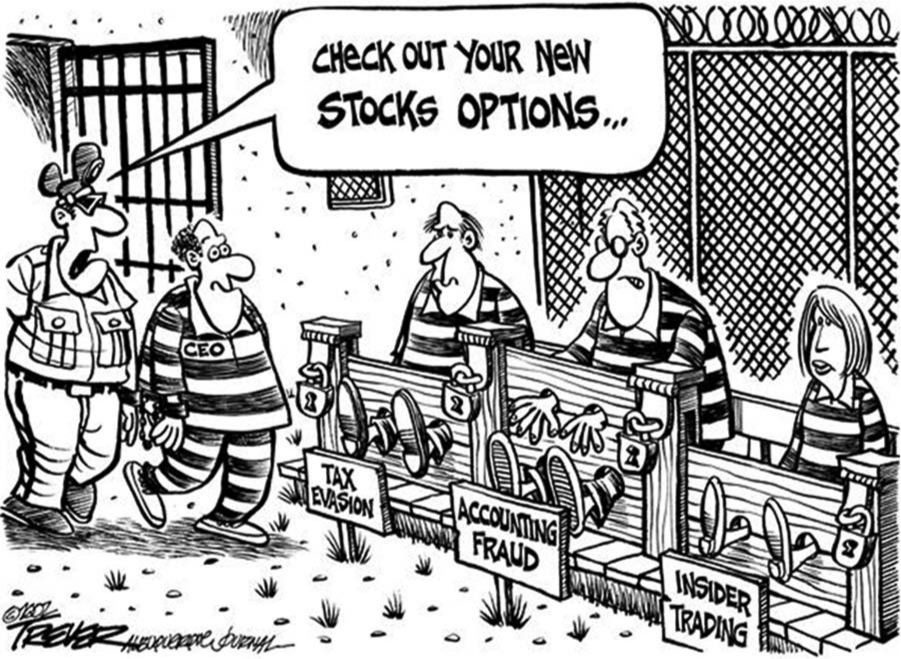
Example of a pre-2008 cartoon.

Example of a post-2008 cartoon.
To attempt to avoid any undue bias or skewing of results, teaching assistants were not informed a priori about the specific nature of the assignment (which might have led, e.g., to an effort to keep relatively equally distributed numbers of certain character depictions or location settings across the samples). When all cartoons had been selected and downloaded, teaching assistants compiled all 50 cartoons into a single unified document for printing. Each cartoon was labeled with a number: #1 through #25 for the pre-2008 cartoons and #26 through #50 for the post-2008 cartoons.
Method: In-Class Execution
To begin the class and exercise, we had students divide themselves into small groups of four or five. Small groups were chosen over the full class as an analytical unit to expedite discussions and decision making on terminology, as well as to avoid groupthink (Janis, 1982) and allow for differences in analytical results between groups. We provided each group with printed copies of the 50 political cartoons, as well as written instructions outlining the students’ requirements. To obtain the results (as described in the following section), we introduced the concept of thematic coding to the class. That is, the task was to view and discuss each cartoon and then record, as concisely as possible, their understanding and impression(s) of the most important and significant themes portrayed in each cartoon.
To guide this analysis and coding exercise, the instruction sheet included a table with blank cells for the students to populate (see Table 1). Rows were numbered #1 through #50, offering space to record data for each of the 50 cartoons. Columns were labeled with the four classifications from Greenberg’s (2002) framework for coding cartoons: Narrative, Domestication, Binary Struggle, and Normative Transfer. Under each column heading, we also included brief descriptions and questions to clarify for students the meaning and intent of these four categories. Students were instructed to use general thematic terms (e.g., “CEO”) rather than cartoon-specific terms (e.g., “Bernard Madoff”) to keep terminology consistent across the examples and to facilitate a cross-sample summary analysis following the coding exercise. When finished coding each cartoon individually, groups were asked to tally the number of like codes in each of the four categories and split between the pre-2008 and post-2008 sample.
In-class instructions.

Rows ran on the back of the page, through #50.
Students were given approximately an hour to perform this analysis in their small groups. Then, each group received 5 minutes to present a summary of their conclusions about the pre- and post-2008 cartoons. As each group presented, the instructor wrote the main themes on the board using a 2 × 4 matrix in which columns were labeled “Pre-2008” and “Post-2008,” and rows were labeled according to Greenberg’s framework (see Table 2). The instructor’s board work served two purposes: (a) helping avoid repetition and expedite the students’ summary presentations and (b) providing a written student-sourced list of discussion points for later reference.
Board plan.
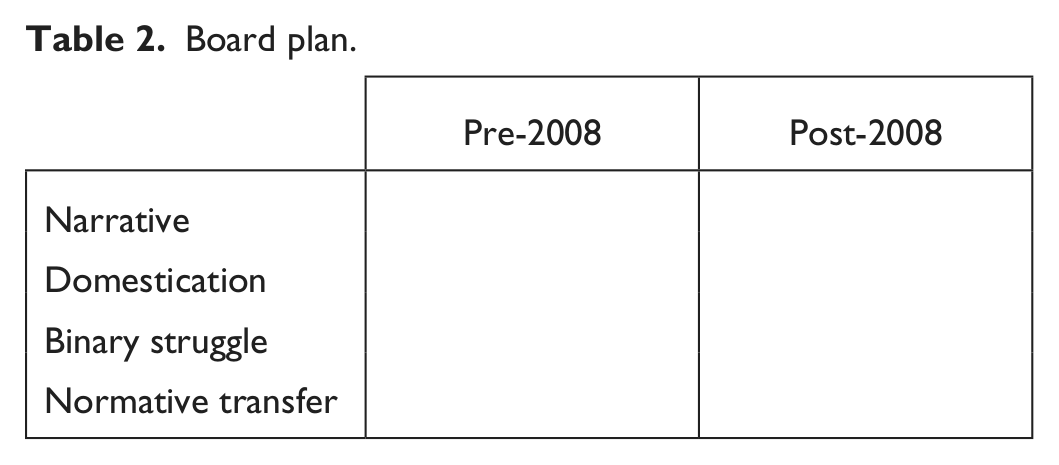
When all groups had presented, the instructor reviewed and summarized the points as recorded. Then, the instructor asked the class as a whole to comment on the general findings of the exercise and also to summarize the main observed differences between the two categories (i.e., pre- and post-2008). Following a brief class discussion of the findings of their analysis, the instructor concluded the exercise by reiterating the main lessons from the exercise with respect to CSR and public policy marketing. That is, assuming the “weak” theory of cartooning, that cartoons reflect what the general public considers to be the most important policy issues at a given time, general sentiment toward these issues, and implications for policy management from a marketing perspective (including in this case, but not limited to ethics, and execution in the marketing mix, segmentation and positioning, integrated marketing communications, and brand management).
Findings and Examples From a Recent Implementation of the Exercise
In this section, we present the results of a recent in-class exercise conducted in the manner described above, for illustrative purposes. In this particular case, the class discussion and summary presentations led to a total of between five and nine codes for each of the four thematic headings under Greenberg’s (2002) framework. 2 The main thematic codes and frequency data for each of the four categories are discussed below.
Results of the In-Class Exercise
Narrative
As presented in Table 3, the Narrative category comprised five thematic codes relating to the corruption of Boards of Directors (“Corrupt Board”), corruption of Chief Executive Officers (“Corrupt CEO”), greed and (over)compensation of Chief Executive Officers (“CEO Greed, Compensation”), the general incompetence of Chief Executive Officers (“CEO Incompetence”), and finally, the general mistreatment, marginalization, and unfair treatment of nonexecutive employees (“Workers get a bad deal”).
Narrative.

The pre- and post-2008 count results for both CEO incompetence and employee marginalization remained constant. However, there were notable changes in the other three categories: Board corruption in the pre-2008 cartoons showed a count of 6/25, whereas this number dropped to only 1/25 in the post-2008 cartoons. Similarly, count reductions were seen in the CEO corruption category, with counts dropping from 13/25 pre-2008 to only 3/25 post-2008. While impressions of corruption decreased significantly between the two groups of cartoons, one category, CEO greed and (over)compensation, increased more than twofold. Pre-2008 counts for CEO Greed represented one third of the sample at 8/25, whereas CEO greed was noted in three quarters of the cartoons from the post-2008 sample.
Domestication
As presented in Table 4, the Domestication category was the largest, comprising nine general codes. Note, however, that these codes fall into two general subcategories of “location” (five codes) and “symbols” (four codes). The five locations in which the cartoons were portrayed were most commonly: at the office or workplace (“Office”), at a media event, public forum or on some sort of stage (“Media/Stage”), in the outdoors away from the office (“Nature/Outdoors”), in prison or detention facility (“Jail”), and finally, in the home of the executive, employee, or public (“Home”).
Domestication.
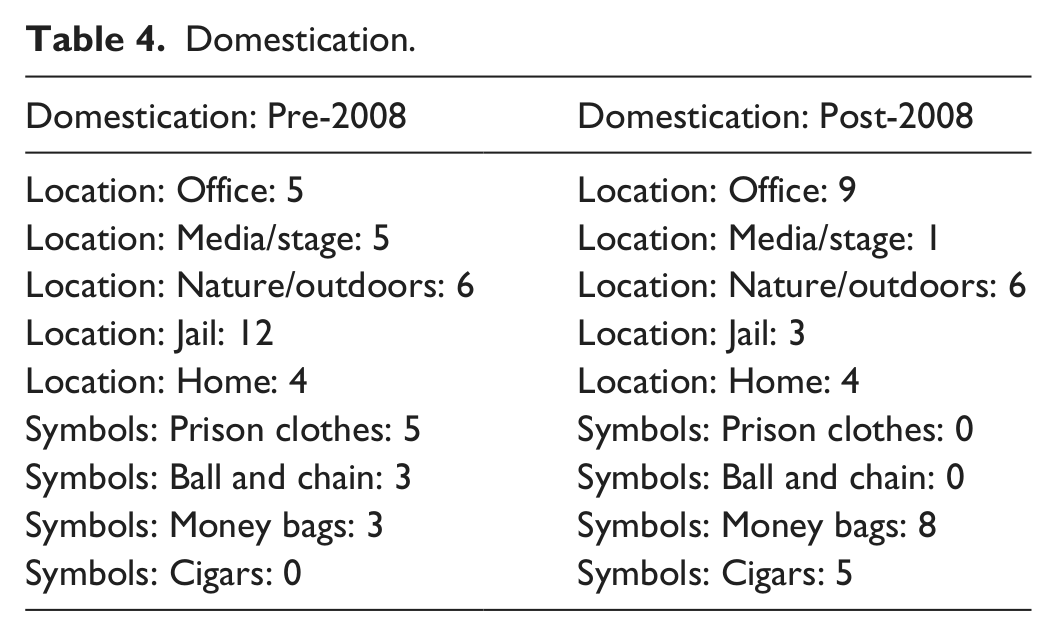
For two location categories, nature and home, there was no change in the number of cartoons counted between the pre- and post-2008 groups. Two locations decreased in total count from the pre-2008 collection to the post-2008 collection. Representations of public media events or staged events decreased from 5/25 in the pre-2008 group to 1/25 in the post-2008 group. More dramatically, representations of jail fell from half of all location depictions in the pre-2008 sample to only 3/25 depictions in the post-2008 sample. The final location of the office or workplace was the only code to see a spike in frequency, from 5/25 in the pre-2008 group to 9/25 in the post-2008 group.
The other subcategory within the Domestication theme related to prevalent symbols presented in the cartoons. Codes here represent prisoners’ clothing (“Prison Clothes”) most often depicted with black and white striped jumpsuits, the protagonists’ bondage to a heavy steel ball weight with a chain (“Ball and Chain”), bags of money, generally styled as burlap-type sacks bound around the top with large “$” dollar signs emblazoned on the front (“Money Bags”), and finally, the protagonists’ smoking of cigars (“Cigars”).
Results of count differences between the pre- and post-2008 cartoon groups are more pronounced in the Symbol subcategory than in the Location subcategory. Two of these codes representing imprisonment or detention—prison clothes and having a ball and chain—dropped from 5/25 and 3/25, respectively, down to 0/25 in the post-2008 sample. Note again that in the Location subcategory, the post-2008 sample still contained 3/25 instances of depictions of imprisonment. In an opposite incarnation, symbols of cigars were not apparent in the pre-2008 sample, but accounted for 20% of the sample in the post-2008 sample. Finally, the symbolism of large bags of money more than doubled between the pre-2008 sample (3/25) and the post-2008 sample (8/25).
Binary Struggle: the “Hero” and “Villain”
The Binary Struggle category, representing the two main agents (or groups) portrayed in the cartoon is shown in Table 5. There were six coded types of struggle presented in the pre- and post-2008 cartoons, all presenting either the CEO or Corporation in the “villain” role, pitted against other groups: the struggle between the public and society at large and CEOs (“Society-CEO”), the struggle between low- or middle-level employees and their employing corporation (“Workers-Corporation”), the struggle between the legal system and corporations (“Law-Corporation”), and the struggle between CEOs and their employees (“Workers-CEO”), the legal system (“Law-CEO”) and stockholders (“Stockholders-CEO”). Note that there was no binary struggle represented in any of the samples between the CEO and the Corporation.
Binary Struggle.
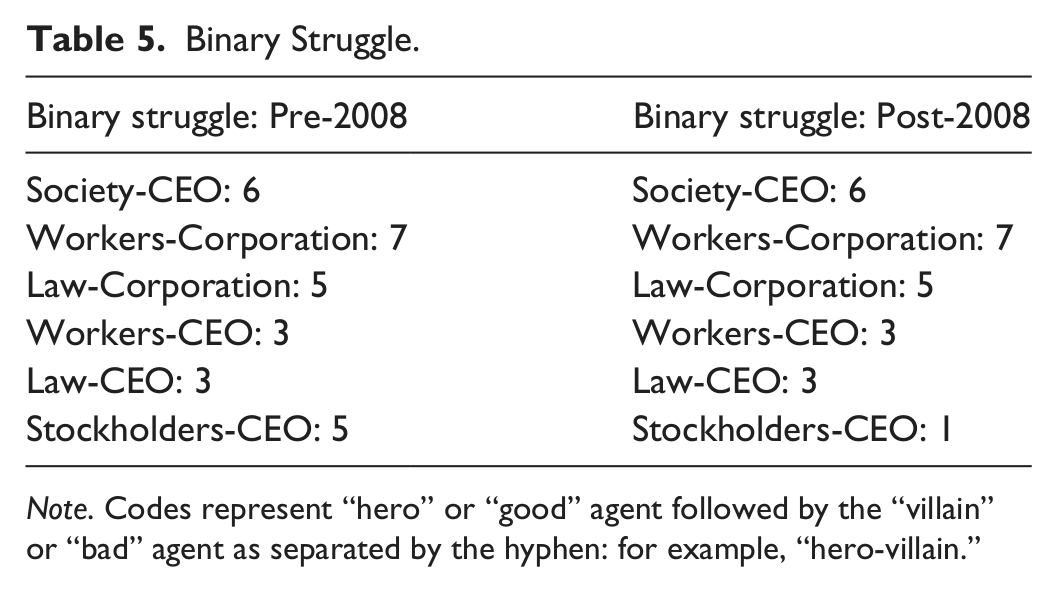
Note. Codes represent “hero” or “good” agent followed by the “villain” or “bad” agent as separated by the hyphen: for example, “hero-villain.”
Of all four thematic categories, Binary Struggle represented the most constant code counts between the pre- and post-2008 cartoon samples. Of the six coded binaries, only the struggle between CEOs and company stockholders shifted in relevance, from 5/25 in the pre-2008 sample to just 1/25 in the post-2008 sample.
Normative Transfer: The “Loser”
As shown in Table 6, the Normative Transfer category comprised five general codes, depicting the “loser” of the binary struggle as the government (“Government”), the corporation (“Corporations”), the lay employees or taxpaying public (“Workers/Taxpayers”), corporate stockholders (“Stockholders”), or those individuals who could be considered “close” to the CEO, whether in personal or professional capacities (“Those Close to CEO”).
Normative Transfer.
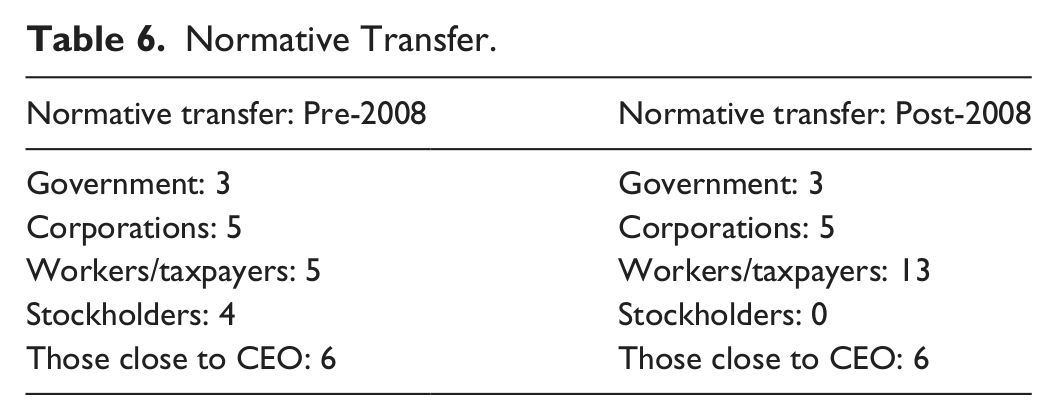
Between the pre- and post-2008 samples of cartoons, only two of the five code depictions of who “lost” the binary struggle shifted from the pre-2008 sample to the post-2008 sample. The depiction of Stockholders as losing the binary struggle appeared in 4/25 in the pre-2008 group, but did not appear at all in the post-2008 group. Conversely, the depiction of lay taxpayers and workers losing the binary struggle increased from only one-fifth of the pre-2008 sample to more than half of the post-2008 sample.
Discussion of Results and Findings of the In-Class Exercise
This section summarizes the student discussion that followed the cartoon analysis and group presentations. We make note of this at this point to highlight that the following findings are those that were generated by the class and should serve as illustrations of possible outcomes, discussion points, and analytical insights in a classroom setting more so than as an exact narrative that one would expect in future classes.
Student discussions and commentaries in class were centered on the illustrations of significant 3 shifts in public opinion—as illustrated by the invocation of the “weak” theory—between the sentiments and symbolism in the pre- and post-2008 cartoon groups. Discussions prompted by analysis of the Narrative category allowed students to observe that public opinion had shifted largely from perceiving corporations and CEOs as corrupt before the 2008 economic crisis to viewing the individual CEOs as greedy, likely because of (as students suggested) excessively high executive compensation in the face of corporate bailouts and rising unemployment. Students noted that this sentiment was echoed in the Normative Transfer theme, where the “losers” in most cartoons were workers and taxpayers in the postcrisis portrayals rather than corporate stockholders or the corporations themselves. This was also observed in the Domestication theme where the symbolism shifted markedly from the criminalization of corporations and CEOs (imprisonment, balls and chains, jail clothes) to representing CEOs as “fat cats” of sorts, smoking cigars surrounded by bags of money.
Recognizing the shift in representations of corporate governance from “criminal” to “greed and overprivilege,” we moved the discussion to the marketing implications of such public opinion in the postcrisis economic world—notably, the business world into which the students would soon be stepping. Student discussions here were insightful, noting policy implications for shifting communications messaging and marketing strategy approaches. A number of points were raised about the benefits of transparency in corporate communications, with specific respect to personalizing and publicizing appearances by top executives and CEOs in media campaigns.
Leading from the discussions of increasing transparency and personalization in communications, a number of students mentioned the advantageous timing of the postrecession marketing arena with respect to the widespread use of social and new media for marketing purposes. Given that social media is well suited for rapid, two-way communication between brands and large amounts of consumers (cf. Mills, 2012), social media platforms could offer a significantly more meaningful approach to transparency and personalization in corporate communications than could more “traditional” political media channels such as print or television, reinforced by the principle that communications between corporation and consumer indeed become two-way transparent conversations rather than simply “push” messages.
Finally, student discussions turned to the interesting—and admittedly, unanticipated—niche of marketing for employment brands specifically. Given the undertones of employee marginalization in the postrecession cartoon sample, students also noted that there could be an opportunity for organizations to differentiate corporate communications and positioning based on things like corporate culture, hiring policies, and other positive or attractive aspects of working for the firm.
The above summarizes the results of an in-class implementation of the cartoon analysis exercise, as well as a summary of the student discussion about ethics, public policy, and marketing that followed. Returning to experiential learning theory as discussed earlier (Kolb, 1984), we see the four stages of experiential learning at play in this exercise. First, students had a concrete experience in the exercise of analyzing and discussing the political cartoons. Importantly, this experience was simultaneously individual (each students’ own personal, subjective experience) and collective (students’ shared group discussions of a specific subject matter, according to a shared agenda for enacting the experience). Second, through the process of group discussion, students reflected on both their own and their peers’ experiences and observations. Third, students were then encouraged, through the process of instructor-led group discussion, to bring their experiences and reflections to a more conceptual and abstract level by discussing overarching themes, trends and implications of their reflections, as well as the rationale and motivations behind them, to formulate ideas and theories about marketing and CSR in business. Finally, students were able to apply and use these ideas and theories to begin formulating further actions, by virtue of planning—at least, beginning to plan—future marketing management strategies and tactics. We see that not only does theoretical learning occur (pedagogically, with respect to marketing ethics principles) but also that students display engagement with and understanding of the subject matter based on their co-created experiences. Furthermore, we see that students were more engaged and seemed to have more fun than in a typical lecture.
Limitations and Alternatives
As with any (new) experiential approach to pedagogy, this exercise using political cartoons is not without limitations. One is the time requirement for the exercise, particularly when working in groups where disagreement and discussion are encouraged. As well, the coding process for the sample of 50 cartoons can be quite time consuming, particularly when the relevance of the exercise may not become clear to the participants until later in the class summary session. The dilemma here is that, as with qualitative case study research, the larger the sample size, the more likely the resultant data will converge on theoretical saturation (Eisenhardt, 1989; Glaser & Strauss, 1967).
In other words, where a smaller number of cartoons will lead to quicker group processes and a shorter overall exercise timeframe, a larger number of cartoons will allow common themes and patterns to emerge across the sample. Also with regard to time investment, the quality of the in-class exercise is inextricably linked to the quality of the cartoons selected by the instructor. Thus, searching for and preselecting a large number of topical illustrations can be fairly time-consuming. For reference, it took two teaching assistants approximately four hours each to select 50 cartoons, then an additional hour to compile the shortlisted cartoons into a unified document for printing. We consider “quality” here to refer to a multidimensional visual representation of the subject matter in question but without a large amount of directly explicative text in the graphic—selecting cartoons for representation, rather than explanation, allows for more thematic richness in the group analysis, discussion, and coding exercise.
A second limitation with this exercise is that, in our experience, it works most effectively when presenting a binary classification so that students may compare and contrast public opinion from one time period to another. In this class example, we used a significant economic event as a cutoff point for the purpose of analyzing public sentiment toward corporations and governance. However, in order to use this exercise to discuss less apparent topics (e.g., how attitudes to advertising, pricing, or personal selling may have shifted over time), a much longer time horizon may be required to properly illustrate and draw out changes in public opinion over time.
Although this exercise is based on the use of cartoons, the group coding practice using Greenberg’s framework could quite easily be applied to spoof videos (e.g., the numerous spoofs following the BP Gulf oil spill and Bernie Madoff’s Ponzi scheme). A massive quantity of footage is available publicly on YouTube and, quite often, long predates the invention of the platform itself as users upload vintage footage. This exercise could also be done as an individual assignment, either in-class or as a take-home project, perhaps leading to a presentation or paper discussing the findings of the analysis and marketing strategy implications of those findings. We do note here, though, that the full class discussion following the presentation of results was extremely fruitful and insightful. We believe the lynchpin of the exercise is to steer students from simply discussing the findings to discussing the implications for and relevance to marketing and corporate social responsibility by providing an encouraging environment for ensuring that the students’ experiential learning process follows through to the final stages of Kolb’s (1984) process model.
Conclusion
There is evidence and support for the use of experiential techniques in marketing pedagogy and similarly for integrating humor into teaching. Making the case for the applicability of cartoon analysis according to Greenberg’s (2002) framework for cartoon analysis, we introduce and illustrate an in-class exercise whereby students learn, in an engaging and experiential way, about ethics and corporate social responsibility. In line with the tenets of experiential learning, our aim in writing this paper and contributing to the pedagogical literature in marketing was twofold. First, we combined pedagogical theories of, and approaches to, experiential learning and cartoon analysis using humor as a theoretical bridge between the two. We have attempted to address the intersection of these relevant theoretical streams and, to the best of our knowledge, present the first application of introducing political cartoons into the classroom as a vehicle for experiential learning about ethics and corporate social responsibility in marketing. Second, we illustrate for the reader a tested in-class exercise, with actionable prescriptive detail for future execution. We believe in conducting an exercise such as this in the marketing classroom, whether to bring to life the subjects of policy marketing and CSR as we have or any other number of possible subject alternatives, the facilitator also experiences the four stages of Kolb’s (1984) experiential learning process. In providing both a new theoretical lens for approaching experiential marketing pedagogy and outlining an actionable in-class exercise, we offer two contributions to educational scholarship.
Footnotes
Declaration of Conflicting Interests
The author(s) declared no potential conflicts of interest with respect to the research, authorship, and/or publication of this article.
Funding
The author(s) received no financial support for the research, authorship, and/or publication of this article.