



Abstract
Peer learning, a pedagogical approach whereby students are partnered together to have one student actively help another student learn predetermined content or skills, has long been utilized as an effective complement to more traditional instructional methods across a wide range of educational disciplines. This approach has been found to reduce the stress of learning, increase student engagement, and yield benefits to both the tutor and the tutee to a roughly equal degree. Yet, pedagogical research to this point has mostly failed to explore the usefulness of this approach to marketing and sales education. In the present research, we examine the effectiveness of peer-learning applications in a sales context and discuss marketing educators' implications. More specifically, we assess college sales students’ perceptions of peer-learning role-play exercise and further examine whether peer-learning exercises can improve students’ abilities. The results indicate that peer-learning exercises are not only enjoyed by students but are capable of producing objective performance improvement for both introductory and advanced students.
Keywords
Make your friends your teachers and mingle the pleasures of conversation with the advantages of instruction.
To better prepare the next wave of marketing and sales professionals, there has been an increase in pedagogical research identifying best practices for educators to lead this charge. In particular, experiential learning, which places an emphasis on interaction above mere instruction, has received considerable attention among marketing academics (Gray et al., 2012). To wit, a quick search for articles published on the topic of experiential learning in marketing in the past 20 years yields research and guidance for almost every topical area within marketing, including services (Gremler et al., 2000), branding (Bennett et al., 2019), retailing (Franco Valdez & Valdez Cervantes, 2018), customer experience management (Klink et al., 2020), digital marketing (Kemp et al., 2019), marketing channels (Young et al., 2019), sales (Chapman et al., 2016), and the list goes on. However, while this marks significant and important progress in the pedagogical approach to marketing courses in higher education, research examining how experiential learning can be refined and improved remains important.
One promising extension of experiential learning is the peer-learning approach. Peer learning can be utilized within an experiential learning framework through the pairing of advanced students and novice students to work together on a given task. The expectation is that the novice student will benefit from the advanced student’s instruction, demonstrating increased learning and retention, and that the advanced student’s understanding and command of the subject matter will similarly improve through the act of teaching the novice student (Topping, 2000). Here, it is important to distinguish between more general collaborative learning approaches where students work together on a task, such as on a group project or a think–pair–share activity, and strategically implemented peer learning as we have described it above. The key distinction between the two lies in the formally defined roles within peer learning in which one student with a mastery of a subject is designated to mentor another student who has not yet achieved mastery. While generic collaborative learning exercises are common in college classrooms, strategically designed peer-learning exercises are not. Moreover, scholarly research exploring the efficacy of the peer-learning approach is scarce, particularly within the field of marketing.
The purpose of the present research is to examine the viability of peer learning within marketing education and its ability to enhance student skills. Specifically, we aim to address continued calls in the marketing discipline for research pertaining to experiential learning in the classroom (Gray et al., 2012), and more specifically for examinations of peer-to-peer learning applications (Dahl et al., 2018; Lange et al., 2018). Moreover, the present research adheres to the persistent recommendations of marketing scholars for the use of direct measurement in its assessment approach (Bacon, 2016; Dahl et al., 2018; Gray et al., 2012). To this end, we introduce, and empirically evaluate, a role-playing activity featuring a peer-learning approach whereby advanced sales students and introductory sales students work together in a mentor–mentee fashion. We implement a mixed-methods research design by first conducting a qualitative study to gain a deeper understanding of students’ perceptions of the peer-learning activity, followed by a quasi-experimental study that empirically assesses the effect of the peer-learning activity on subsequent student performance. While a smattering of previous research has investigated the application of peer learning to marketing education, assessments of peer learning’s impact on objective performance outcomes have been rare. This research makes a significant contribution to the marketing pedagogical literature by establishing the effectiveness and practicality of a long-established, but underutilized, teaching approach that is both easy to implement and demonstrated to markedly improve student performance.
In this article, we first provide background on experiential learning and how peer learning is best implemented within this pedagogical framework. Next, the qualitative study (Study 1) and the empirical evaluation of the peer-learning activity (Study 2) are presented. We then introduce a discussion in which we review the implications for marketing educators and employers, acknowledge the limitations of our research, and suggest potential future research directions. Finally, we offer strategies for implementing a peer-learning role-play exercise for marketing and sales educators.
Background
Experiential Learning and Marketing Education
Experiential learning theory posits that experience plays a central role in the learning process and is a critical component to knowledge development, alongside cognition and behavior (Kolb, 1984). Kolb (1984) defines learning in experiential learning theory as the “process whereby knowledge is created through the transformation of experience” (p. 38). Experiential learning has been shown to lead to numerous favorable learning outcomes for students, including increased enthusiasm for the subject (Dabbour, 1997), an improvement on graded assignments (Perry et al., 1996), and enhancement of learning (Lawson, 1995). Traditional education has not been replaced by experiential approaches; it has been complemented.
Proponents of experiential learning further tout its applicability to a wide range of domains and levels of learning, ranging, for example, from elementary to college, and science to business, education. Experiential learning has been a focal point for pedagogical research in the field of marketing for decades (Gray et al., 2012) and primarily centers around two broad approaches. The first, semistructured classroom activities (see Kemp et al., 2019 and Gremler et al., 2000 for examples), are relatively short, moderately complex activities typically requiring students to work in small groups to complete a task (Hamer, 2000). The second, loosely structured experiential activities, are generally more complex, completed over a longer time frame, and involve greater ambiguity for students to navigate (Hamer, 2000). These activities require students to engage in deeper-level processing (Hamer, 2000), directly answering calls in marketing for classroom approaches, which engender higher amounts of critical thinking among students (Dahl et al., 2018). These activities include simulations, group projects, and role-plays.
While both experiential approaches are worth utilizing, the more demanding loosely structured activities offer the greatest value to students. Despite the increased challenge to develop and implement these activities, marketing educators have found a variety of ways to integrate them into their courses. More traditional approaches have included creative updates to conventional pedagogical practices, such as group projects (see Bennett et al., 2019; Young et al., 2019), simulations (see Bolton et al., 2019; Cadotte, 2016) and role-plays (see Delpechitre & Baker, 2017; Spiller et al., 2020). Others have developed altogether new and novel activities. Petkus (2000) provides guidance on how experiential learning can be blended with service-learning projects across a number of common marketing courses to provide students both hands-on experience with the subject matter, while at the same time benefiting the local community through volunteerism; Franco Valdez and Valdez Cervantes (2018) describe the benefits of direct student engagement in a retailing laboratory, noting the enhanced levels of critical thinking and strategic decision making observed when students are immersed in a retail setting firsthand as opposed to discussing similar decisions from a theoretical standpoint; and Klink et al. (2020) introduce guidelines for developing a customer experience management course, which includes a week-long field immersion to gain direct insights into best customer experience practices.
One underutilized approach that can be incorporated to promote even greater success across a spectrum of experiential activities is peer learning. While the loosely structured activities described above all have merit as they were originally conceived, many of them could be modified to produce even greater benefits, for both students and educators, if they involved a peer-learning component. In the following sections, we review the concept of peer learning, explain the multiple beneficiaries of this approach, and examine how this approach has been previously utilized in the field of marketing. Following that, we introduce a peer-learning exercise, and then examine the efficacy of this pedagogical approach.
Peer Learning
One way to further enhance the effectiveness of experiential learning activities is the incorporation of peer learning. Peer learning is a prominent topic in education pedagogy, but one that has yet to be explored with the same fervor in marketing pedagogical research. Peer (assisted) learning is the “acquisition of knowledge and skill through active helping and supporting among status equals or matched companions” (Topping, 2000, p. 2). In peer learning, participants from similar social groups help each other learn and, in turn, thereby learn themselves. Peer learning includes peer tutoring, modeling, monitoring, and assessment (Topping, 2000). These types of peer interaction provide learners an opportunity to learn by practice in a nonthreatening environment. Since peers are closer in age and experience, anxiety is often reduced and participants are more receptive to feedback (Adams & Oliver, 2019). Thus, compared with traditional instruction, peer learning often results in a more relaxed and open learning environment, that is characterized by accessibility, knowledge transfer, and more activity and interactivity. This is likely because fear of judgment is reduced, the vocabulary used is less complex and more similar to their own, and examples are more concrete and local (Topping, 2000).
Many educators and researchers have touted the effectiveness of this approach. P. A. Cohen et al. (1982) noted that peer-learning activities help develop learners’ communication skills, including listening and speaking. Such skills are not just enhanced in terms of listening to understand, but in terms of knowing how to respond, which translates into more effective communication beyond the classroom (e.g., as a salesperson or marketing consultant; Adams & Oliver, 2019). Moreover, their results indicated that both the “tutor” and the “tutee” demonstrate improvement after engaging in peer-learning activities. That is, not only did tutored students outperform control students in attainment, but those acting as tutors did as well. Interestingly, some researchers have indicated that it may even be more beneficial to be on the giving end of peer learning, as a tutor, rather than on the receiving end (Adams & Oliver, 2019).
While the focus of our research centers on how peer learning can affect student outcomes in an educational setting, it is worth noting that similar effects have been observed between peers in professional settings, further confirming the power of peer influence. A stream of research spanning disciplines has determined that employees’ attitudes, behaviors, and performance are significantly influenced by the attitudes, behaviors, and performance of their colleagues, a phenomenon referred to as “peer effects” (Atefi & Pourmasoudi, 2019). For example, the competitive nature of sales employees has been found to be correlated with perceptions of how competitive their peers are (Brown et al., 1998; Schrock et al., 2016). Similar peer influences have been found for a range of workplace outcomes and attitudes, including employee’s turnover intentions (Sunder et al., 2017), commitment to new strategies (Hayati et al., 2018), organizational identification (Kraus et al., 2012), and technology adoption (Weinstein & Mullins, 2012), among others. Though peer effects yield similar results to peer-learning approaches, they differ significantly in terms of how these effects are achieved. Specifically, peer effects are unintentional. They occur naturally over time as peers interact with and observe one another (Atefi & Pourmasoudi, 2019). The peer-learning approach, by contrast, is an intentional effort to design a program of learning where a mentor and mentee realize mutually beneficial outcomes from formal and guided tutelage.
Though peer-learning research has been scant among marketing academics, there are several notable examples. Much of the research involving peer learning in the marketing domain has been theoretical in nature and has featured subjective evaluation techniques to support its use. For example, Burnett and Pettijohn (1999) advocate for the implementation of student mentoring in the marketing classroom, touting the benefits to student mentees (increased comfort level, knowledge gains), student mentors (discovery of knowledge gaps, increased self-confidence), and teachers (time savings, validated concepts), and providing a step-by-step guide to developing a peer-learning activity. Exploratory research by Gunn et al. (2017), examining the challenges and benefits of a year-long peer mentoring program, found that mentees identify the acquisition of academic knowledge as challenging yet important, while mentors noted role modeling as the greatest benefit as it aided in the development of leadership skills. Schwepker and Hirlinger (2018) conducted a student-to-student sales coaching exercise that featured sales management students practicing coaching techniques with students from a professional selling course. The study found that sales management students enhanced their interpersonal skills, while professional sales students improved their confidence and overall sales-call delivery. Finally, Peltier et al. (2007) examined contributing factors to the perceived quality of online learning experiences and determined that peer-to-peer interactions positively influenced perceptions of course content.
Investigations of peer learning in the field of marketing involving objectively assessed performance outcomes are rare. In one example, Rocco and Whalen (2016) examined the difference in performance on a real-world sales activity between two sections of an introductory sales course, one coached by a student sales manager and the other taught only by the instructor. At the conclusion of the activity, the group coached by the student sales manager s had generated a higher average sales revenue, while also expressing a higher level of course satisfaction. In a larger study, Metcalf et al. (2016) studied the effectiveness of implementing a prolonged peer mentoring program in a Principles of Marketing course, featuring weekly classroom engagements between mentees and a small group of mentors to reinforce and expand learning. Their findings determined that students receiving peer mentoring over a 10-week quarter outperformed those in a control condition on multiple-choice content exams in a pre- versus posttest design. They also concluded that the leadership improvements demonstrated by the mentor students between successive quarters helped contribute to the mentee student’s improvement on the content exam. Our research builds on these findings in a different context by first replicating the objective performance improvement observed within a mentee group, and then extending to determine that mentors also demonstrate objective performance improvement as a result of participating in peer-learning activities. Furthermore, we utilize a mixed-methods approach to gain additional insights into the value of peer learning, including a content analysis of open response feedback gathered from participating students.
Examining a Peer-Learning Role-Play Exercise
Building on previous pedagogical research examining the benefits of experiential learning and peer learning, we endeavored to test the merits of a combination of these approaches. To this end, we carefully developed and implemented a peer-learning role-play exercise in sales courses at two universities, each with a longstanding tradition in sales education, to serve as the basis and context for our study in the present research.
While sales educators frequently use a variety of experiential approaches, role-play activities have become a staple (Mani et al., 2016). Role-plays present a “realistic job preview” allowing students to practice and refine the selling skills they learn in the classroom (Mani et al., 2016). Furthermore, role-playing uniquely supports students’ intellectual development as well as their “capacity to deal with several alternatives simultaneously, to tend to several sequences in the same period, and to allocate time and attention in a manner appropriate to these multiple demands,” (Bruner, 1966, p. 6). Thus, role-playing affords sales and marketing students the opportunity to simulate the types of encounters they are likely to be confronted with early in their careers.
Sales role-play exercises commonly feature pairings between a student and instructor, a student and a sales professional, or two students from the same course. Less common is the pairing of an advanced student with an introductory student, such as in a peer mentoring approach. While we have already recounted the many proposed benefits of a peer-learning approach, it is essential to note that the success of peer learning also resides in its systematic application. Often, peer learning is introduced in an “ad hoc” manner. Failing to provide adequate structure and instruction when implementing a peer-learning exercise can lead to negative effects such as student confusion, missed opportunities for learning, and diminished skill development (R. Cohen et al., 2001). As such, appropriate care was taken in the development and implementation of the focal exercise, as described below.
The peer-learning exercise was tested at two Midwestern universities over a 2-year period. One university (University “A”) implemented the exercise over three consecutive semesters (spring 2018 through spring 2019) while the other (University “B”) only implemented the exercise in the spring semester each year. University “A” offers an undergraduate sales certificate program, and “B” has a sales sequence (major). Students in both programs are required to take 15 hours of sales-related coursework to satisfy program requirements. The exercise paired students enrolled in an introductory sales course (mentees) with students who had already completed the introductory course with a “C” grade or higher, and were enrolled in an advanced sales course at the time of the study (mentors). Pairs participated in a practice role-play and feedback session where the introductory students acted as “sellers” and advanced students played the role of the “buyer.” The exercise lasted 30 to 45 minutes in total. Furthermore, it was introduced roughly three quarters into the semester, allowing for introductory students to gain a solid foundation prior to engaging with the advanced students. In accordance with extant peer-learning research, the general expectation was that both student groups would benefit from the engagement, allowing each to perform better in subsequent selling activities in their respective courses.
Qualitative Study
A qualitative research inquiry was conducted to understand the benefits and effectiveness of the peer-learning exercise. In the present research, the qualitative research design was exploratory in nature and aimed at gaining a deeper understanding of peer learning, given that previous research on the topic is limited (Gegez, 2005). The goal of the qualitative inquiry was to gain firsthand insights from participants involved in the exercise regarding their impressions of the appropriateness and helpfulness of peer learning to their overall learning objectives in their respective sales courses.
Methodology
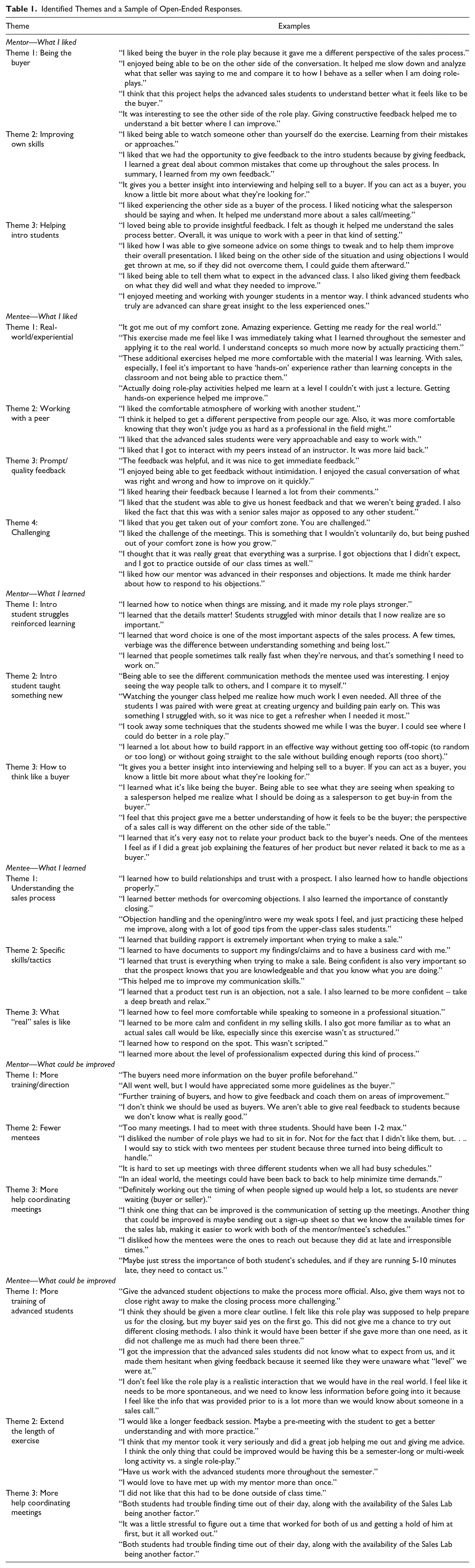
In total between the two universities, 415 students participated in the qualitative study. A total of 117 of the participants were mentors, 79 of whom were from University “A” (14 from spring 2018, 14 from fall 2018, and 51 from spring 2019) and 38 of whom were from University “B” (21 from spring 2018 and 17 from spring 2019). The remaining 298 participants were mentees, 209 were from University “A” (45 from spring 2018, 54 from fall 2018, and 199 from spring 2019) and 89 from University “B” (43 from spring 2018 and 46 from spring 2019). In some instances, an advanced student was assigned to two or more introductory students so that all introductory students were matched to an advanced student mentor to complete the exercise. After the exercise, all participants were asked to provide typed responses to three open-ended questions assessing what they liked about the exercise, what they learned, and what suggestions they had for improving the exercise. A content analysis was conducted to determine the common perceptions that emerged in the response data for each of these questions. A four-step process was followed to perform the content analysis. First, the textual data were reviewed by members of the research team, and an initial set of common themes were identified. Second, the initial set of themes were then included in a coding spreadsheet for evaluation by a separate set of independent coders. Subsequently, two graduate assistants were trained on how to conduct content analyses with the response data. Third, the coders scored each response relative to how well the response “fit” within the set of preidentified themes. Coders were instructed to enter a “0” if the response did not align with the theme at all, a “1” if the response aligned with the theme to a small degree, a “2” if the response aligned with the theme to a moderate degree, and a “3” if the response aligned with the theme to a high degree. Finally, after the coders had scored all responses, the research team analyzed the results of the content analysis to determine which of the initial set of themes were rated the highest and therefore were the most representative of how the students felt about the peer-learning exercise. Coders could also indicate a new theme if they believed that the response belonged in a separate category from those initially determined by the research team. The following is a review of the key findings (a summary of identified themes and sample responses can be found in Table 1).
Identified Themes and a Sample of Open-Ended Responses.
Open-Response Results
1-A: What I Liked—Advanced Students
The content analysis revealed the emergence of three primary themes related to what the advanced students liked about the peer-learning exercise. The first theme identified was that students enjoyed the opportunity to be on the other side of the table in this exercise and liked the opportunity to gain the buyer’s perspective. Many students indicated that playing the role of the buyer, many for the first time, allowed them to think more about how a salesperson should approach and sell to the buyer. The second theme identified was that advanced students liked that this exercise helped them improve their skills and/or that it reinforced what they were learning in their advanced courses. Peer-learning theory suggests that the “teacher” learns considerably from the opportunity to educate the student. We saw evidence of this in many advanced student responses. The last theme related to enjoying the opportunity to help their peers and serve as a coach. The responses indicated that students really embraced the idea of helping others, with many noting that they could empathize with the introductory students because they had struggled with similar issues when learning the sales process.
1-B: What I Liked—Introductory Students
The analysis of the introductory student response data revealed four predominant themes to summarize what students liked about the peer-learning exercise. Overwhelmingly, the most common response from students related to liking the peer-learning exercise because it was more experiential, and thus more realistic, than other exercises that the students had been working on in class. Our coders identified responses along these lines at a rate nearly three times higher than any of the other themes. The second theme indicated that students liked working with a peer, with many further explaining that they felt more comfortable or relaxed in that situation. This finding reinforces one of the proposed advantages of peer learning that students can learn concepts in different ways in part because they relate to their peers in a way that they cannot relate to an instructor. The third theme related to both the promptness and quality of the feedback that the peer-learning exercise provided to the introductory students. Compared with the traditional role-plays that need to be performed, recorded, and graded by a professor before feedback can be provided, the peer-learning role-play allowed students to get instantaneous feedback from the mentor. Finally, the last theme identified that students liked participating in what they perceived as a more challenging exercise than they had worked on up until that point. Most introductory students in our sample had previously completed role-plays with other introductory students in their classes. The feedback suggested that perhaps those previous role-plays were sometimes a bit too scripted or just too easy to provide a realistic and challenging sales encounter. Thus, students seemed to appreciate the challenge presented by working with an advanced student.
2-A: What I Learned—Advanced Students
The content analysis revealed that there were three primary themes among the responses from the advanced students identifying what they learned from the peer-learning exercise. Moreover, we found that the primary areas of learning students identified closely mirrored those areas students had also identified as what they liked about the exercise. The most frequently noted feedback indicated that watching the introductory students struggle with elements of their sales presentation helped reinforce the importance of those elements to having a successful sales engagement. Somewhat surprisingly, advanced student responses also indicated many instances where the pupil had become the teacher. Playing the role of the buyer appeared to allow the mentor students to pick up on some specific things that the introductory students were doing well that could be integrated into their own sales pitches. The third theme related to how the exercise helped train the advanced student to think like a buyer. Similar to how the advanced students indicated that they “liked” the opportunity to sit on the other side of the table during the peer-learning exercise, they also frequently responded that doing so helped engage in perspective-taking and see things from the buyer’s point of view.
2-B: What I Learned—Introductory Students
Three key themes emerged among the introductory student feedback. The most common theme to emerge related to an increased understanding of either the entire sales process or specific steps in the selling process (i.e., needs discovery or objection handling). For the second theme, nearly an equal number of students mentioned learning a specific selling skill or ability. Whereas the learning that comprised the first theme was more procedural in nature, the learning described in the second theme spoke more directly to skills and abilities that are useful throughout the selling process. The last theme indicated that students felt as if the peer-learning exercise taught them how to sell in a more “realistic” setting compared with other class activities.
3-A: What Could be Improved—Advanced Students
Among the most helpful feedback received from the students was their thoughts on how the peer-learning exercise could be improved. While most students indicated that they liked the exercise in its current form, many students offered helpful suggestions for improvement. Three predominant themes emerged among the advanced student responses. The most common theme indicated that the advanced students felt that more training or direction was needed on how to play the role of the buyer as, for many of the students, this was the first time they had played the role of the buyer in a role-play. A second theme revealed that advanced students preferred fewer mentees to work with. The final theme indicated that more help was needed in coordinating the meeting between the introductory and advanced students. At one of the universities, the onus was placed on the introductory student to reach out to the advanced student to set up a time to complete the exercise. As we learned, not all of the introductory students completed this first step in a prompt manner.
3-B: What Could be Improved—Introductory Students
The introductory students also provided a lot of valuable feedback regarding how they felt the peer-learning exercise could be improved. The content analysis once again revealed three predominant themes. The theme comprising the most frequently mentioned response among the introductory students mirrored the predominant theme from the advanced student results suggesting that the advanced students needed more training. However, the perspective of the introductory students shed a bit more light on how the advanced student needs to be trained. According to the response data, the introductory students felt that the advanced students needed to be trained to make the role-play more difficult and/or realistic. This feedback was unexpected, as many students had previously highlighted that the realism and challenge of the peer-learning exercise was something that they liked. This suggests that some “quality control” issues may have led to different students having very different experiences in terms of the degree of challenge presented by the buyer. The second introductory student theme to emerge indicated that the mentees felt that either a longer interaction with the mentor or more than a single interaction would provide more feedback and overall value. Interestingly, several advanced students also indicated that they felt more than a single interaction would be beneficial, though this sentiment did not arise frequently enough to constitute a theme. The final theme replicated another, which had emerged in the advanced student feedback: more help was needed in coordinating the meetings.
Summary of Qualitative Analysis
Based on the qualitative study findings, it was evident that the peer-learning activity benefited both mentors and mentees. Importantly, the response data also indicated several areas where the peer-learning exercise was able to uniquely benefit students relative to other pedagogical approaches (i.e. working with professional buyers or completing simulations). Specifically, the advanced student mentors expressed that playing the role of the buyer allowed them to gain deeper insights into a buyer’s mentality, thus allowing them to reflect on that vantage point when they were back in the role of the seller to have more effective sales engagements. Mentors also emphasized that the opportunity to coach introductory students helped reinforce and cement their own learning and understanding of important sales concepts. For the introductory student mentees, the most commonly reported advantage they saw in the peer-learning exercise was the comfortability and relatability in working with a peer. Though many sales exercises smartly attempt to replicate the stress of a typical “real-world” sales meeting with an unfamiliar buyer, often played by a working sales professional, the feedback from the students suggests that a peer-learning exercise may serve as a nice complement to those more strenuous exercises. Research on the impact of stress on learning and retention has indicated that, while in some instances high stress levels can produce positive outcomes, it has also been found to inhibit memory retrieval and, more concerningly, prevent the updating of memories as new information is introduced (Vogel & Schwabe, 2016). Thus, taken with the results of the qualitative study, sales educators may have a greater influence on overall student learning by introducing both higher and lower stress activities, such as the peer-learning exercise, to account for the varying ways in which stress influences student learning.
At the conclusion of the peer-learning exercise, both mentors and mentees completed an online survey. This data was then used to empirically test hypotheses related to the peer-learning activity. In the next section, we develop hypotheses, outline the methodology, and discuss the results of the empirical analysis.
Quantitative Study
Peer-Learning Activity and Improving Selling Skills
Mentorship is an exchange of knowledge and experiences between a mentor and mentee where thoughts, reflections, and knowledge are deepened (Lindgren & Morberg, 2012). Peer learning can also be viewed as a mentorship activity, where learning takes place in the social interaction between a mentor and mentee. During this interaction, both individuals are continuously learning something from one another (Lave & Wenger, 1991). Considering the peer-learning role-play exercise, mentors who act as mock-buyers for mentees are tasked with viewing the sales situation from a customer perspective (a different perspective than the salesperson perspective they are most accustomed to). During and after the role-play, mentors utilize their advanced knowledge, experience, and the novel perspective of being a customer to provide valuable insights to the mentee. In the process of doing so, mentors reflect on their existing knowledge, apply that knowledge to the present exercise, and then translate that knowledge in a meaningful way to help educate the mentee. In turn, this process helps the mentors broaden their own knowledge and further develop their ability to sell.
For the mentees, the goal is to seek knowledge and enhance ability. Mentees learn how to effectively assess the situation, prepare for the encounter, and effectively engage the prospect in the steps of the sales process. The learning process in the mentorship activity is surrounded by a structure to simulate an actual sales situation but in conditions that offer the familiarity and comfort of interacting with a peer to foster learning and knowledge development (Cahill et al., 2010). Therefore, we propose the following:
Peer Learning Exercise and Conduciveness to Sales Education
Researchers have found that students are motivated to excel in educational activities that are relevant to the course material and to their career objectives. A goal of the present research was to determine how “conducive” the peer-learning role-play was to helping students learn how to sell. This study defines the conduciveness of an activity as the student’s perception of whether the peer-learning role-play activity helps prepare students achieve their career aspirations and personal goals (Keller, 1983). Other factors affecting conduciveness include the content presentation and the previous knowledge and experiences of students. Specifically, effective learning takes place when the activity that is assigned facilitates learning and is relevant to student goals. As a result, students who are engaged in the activity are increasingly more likely to become enthusiastic, interested, and involved in learning. Each of the advanced students who participated in the peer-learning activity was enrolled in a sales program and was interested in pursuing a career in professional sales; this was also the case for the majority of the introductory students. The peer-learning activity was designed to provide both mentors and mentees the opportunity to enhance their selling skills and aptitude (Peter & Olson, 1999). Therefore, we propose the following:
Peer Learning Activity and Improved Role-Play Performance
Mentoring and peer learning are often found in the sales industry between a senior, experienced salesperson or manager (mentor), and a less experienced, junior salesperson (protégé) in which the mentor provides support, direction, and feedback regarding career and personal development (Haggard et al., 2011). Successful mentorship and peer activities help both mentors and mentees become more aware of their strengths and weaknesses, increase awareness of identity and values, and develop needs, reactions, and behavior patterns that result in positive change, ultimately leading to improved performance (Higgins & Kram, 2001). The design of the peer-learning role-play allows mentees to receive direct feedback from mentors related to strengths and weaknesses. This information can then be used to adjust and improve in subsequent sales encounters. Similarly, mentors can gain beneficial insights from observing the mentee and then coaching them for improvement. The act of a mentor recalling their own sales training and then translating and demonstrating those lessons to the mentee will help strengthen the mentor’s own skillset. Accordingly, we expect that beyond simply improving theoretical knowledge of how to sell, participants in the peer-learning exercise will improve their observable sales performance:
Methodology
At the conclusion of the peer-learning exercise, a total of 415 students (298 introductory and 117 advanced) completed an online survey, which consisted of items that measured how the activity improved mentor/mentee ability to sell and the conduciveness of the activity for sales education.
The Survey and Measures
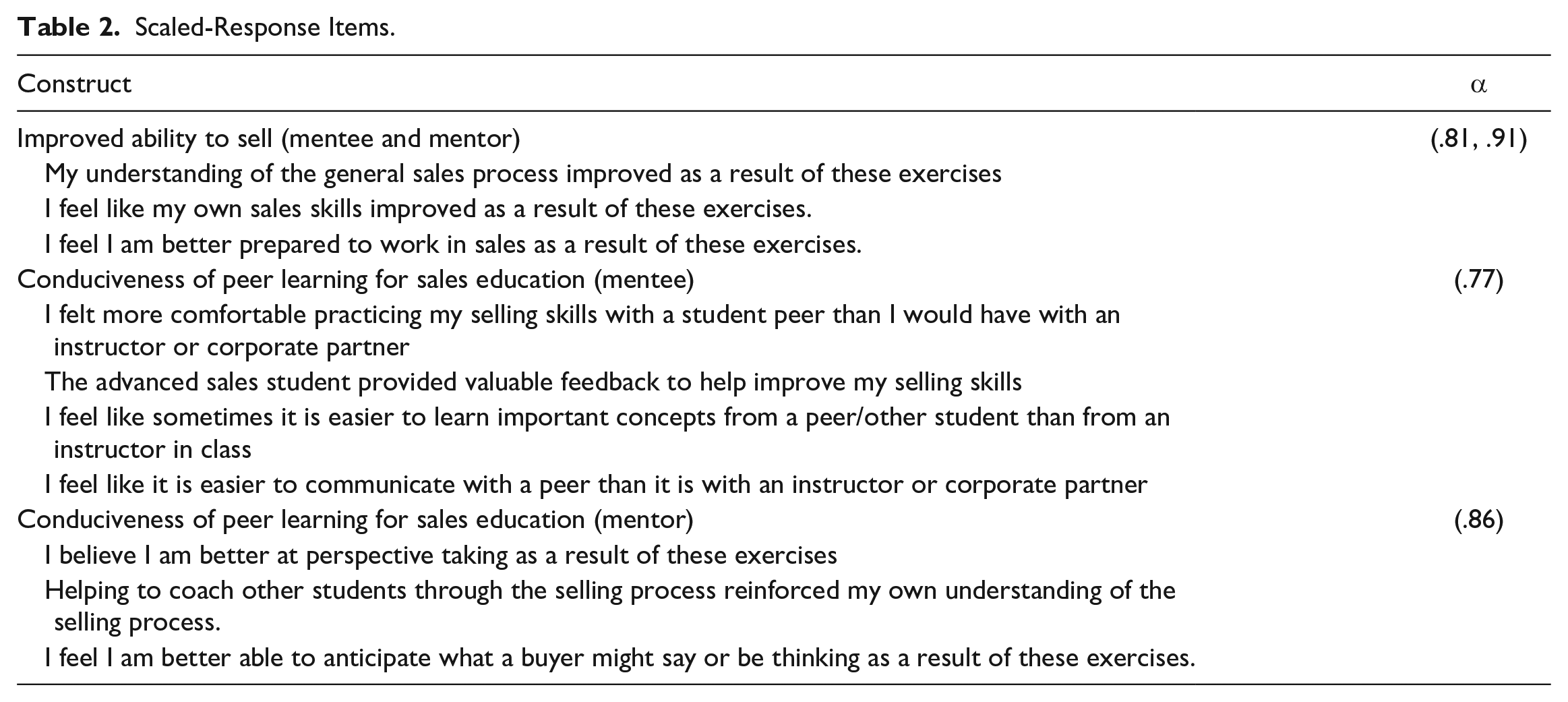
The measure developed to capture how the peer-learning exercise improved the student’s ability to sell included three items (e.g., “I feel like my sales skills improved as a result of this exercise”) and was identical for both the introductory students (α = .81) and advanced students (α = .91). The measures developed to capture student’s assessments of the peer-learning approach as conducive for sales education varied depending on the role of the student in the exercise. For instance, the introductory students responded to items such as “The advanced sales student provided me with valuable feedback to improve my selling skills” and “I feel like sometimes it is easier to communicate with a peer than it is with an instructor” (four items, α = .77). Advanced students, on the other hand, responded to items such as “I believe I am better at perspective-taking as a result of this exercise” and “Helping to coach other students through the selling process reinforced my own understanding of the sales process” (three items, α = .86). Two additional items were included in the survey to assess who the student felt benefited more from the exercise (introductory vs. advanced), as well as if the student would recommend the exercise for future use. All scaled items were assessed on a 5-point scale. A listing of all items is provided in Table 2.
Scaled-Response Items.
Survey Results
The results of the survey data indicate that students generally believe that they benefited from participating in the peer-learning exercise. We first tested if the mean values recorded for each measure were significantly higher than the scale mid-point (in this case, a “3” on a 5-point scale representing “neither agree nor disagree”), indicating student indifference to the impact of the peer-learning exercise. Values significantly above the scale mid-point can be interpreted as agreement that the exercise had a positive impact. Overall, the results of the analysis indicated that both the mentees, M = 4.32; one-sample t(297) = 31.69, p < .001, and the mentors, M = 4.27; one-sample t(116) = 15.22, p < .001, believed that the exercise improved their ability to sell. As a result, Hypothesis 1 was supported.
Additionally, both introductory students, M = 4.07; one-sample t(297) = 23.58, p < .001, and advanced students, M = 4.38; one-sample t(116) = 18.68, p < .001, indicated that they found the peer-learning approach to be highly conducive to learning how to sell. Therefore, Hypothesis 2 was also supported.
Furthermore t-test analyses indicated that both sets of students would recommend keeping the exercise as a part of the course in the future. Both sets of students also agreed that the introductory students benefited more from the exercise, though only slightly. See Table 3 for a complete summary of the survey results.
Scaled-Response Results.
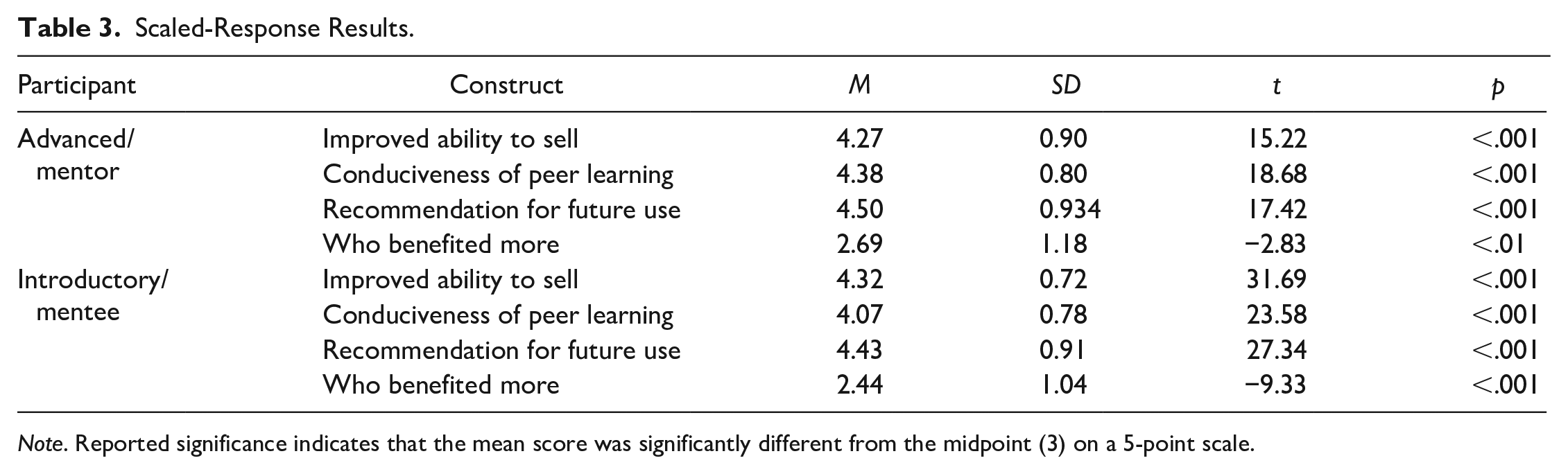
Note. Reported significance indicates that the mean score was significantly different from the midpoint (3) on a 5-point scale.
Two-Group Comparison
To evaluate if the peer-learning activity improved student’s role-play performance (Hpothesis 3), a treatment group and a control group were created using only participants from University “B.” At University “B,” the introductory and advanced sales courses were designed and taught in the exact same manner, by the same instructor, for two consecutive years (four consecutive semesters), with the only difference being that the peer-learning exercise was implemented in the two spring semesters but not in the two fall semesters. This rotation created a quasi-experimental design where theoretically the only difference experienced by subjects was that those in the spring courses completed the peer-learning exercise and those in the fall courses did not. The treatment group (those who participated in the peer-learning activity) consisted of 47 mentors (advanced students; 72.3% male) and 89 mentees (introductory students; 64% male). In the treatment group, 10.6% of the mentors had a single mentee, 38.3% had two mentees, and 51.1% had three mentees. The control group consisted of students who did not participate in the activity, which included 41 mentors (82.9% male) and 91 mentees (67% male). Importantly, all participants completed the same number of role-play exercises throughout the spring and fall semesters for their respective classes, including a “final” role-play at the conclusion of the courses, which was identical, respectively, across the four semesters comprising the sample. However, because the peer-learning exercise was only conducted during the spring semester each year, roughly half of the students in the sample completed the peer-learning exercise before the “final” role-play (i.e., the treatment group from the spring semesters), while the remaining students did not complete the peer-learning exercise (i.e., the control group from the fall semesters). We then examined all student grades, for both the control and treatment conditions, to determine the extent to which their final role-play grade improved relative to their previous role-play score on a similar exercise. After calculating the change-scores for all students, we then tested Hypothesis 3 by comparing the change scores between the conditions to see if students completing the peer-learning exercise showed greater improvement relative to the students who did not complete the exercise.
Role-Play Performance Results
All role-play presentations were graded by the instructor using the role-play grading evaluation that is utilized to evaluate sales students’ performance at the annual National Collegiate Sales Competition. To enhance the reliability of the grading conducted by the instructor, and to account for potential bias, 18 randomly selected role-play recordings were sent to six industry sales experts to evaluate using the same grading rubric as was used for the exercise. Each industry expert received three role-play videos, and then the instructor’s role-play grades were compared against those of the industry experts. The results show that there was not a significant difference between the instructor’s evaluations of the role-plays and industry experts’ evaluations (t = 1.76, p = .10).
An independent-sample t test was performed for both student groups to determine if students who participated in the peer-learning exercise improved their final role-play grades relative to students who did not. The findings support that the peer-learning exercise improved students’ role-play performance. For the mentee students, the results showed that a significant difference existed between the next-to-last and final role-play grades for the students who participated in the peer-learning exercise (i.e., the treatment group) compared with students in the control group who did not complete a peer-learning session, t(178) = 5.30, p < .001, Mcontrol = 1.7% improvement versus Mtreatment = 7.6% improvement. Interestingly, the mentor students who completed the peer-learning exercise also demonstrated significant gains relative to the control group, t(86) = 2.82, p < .01, Mcontrol = 2.6% improvement versus Mtreatment = 5.9% improvement.
The comparison group results provide strong, objective evidence that the peer-learning role-play exercise can improve students’ selling ability. Therefore, Hypothesis 3 was supported. Furthermore, it is important to stress that these results demonstrate that the peer-learning exercise significantly benefits both types of students. The introductory student and advanced student treatment groups each demonstrated significant gains after completing the peer-learning exercise relative to controls.
Though we did not explicitly compare peer learning with other pedagogical approaches to teaching sales, the results suggest that peer learning certainly warrants consideration for widespread adoption in sales curricula. Frankly, we expect that the student gains observed from peer learning would be roughly the same as those found using more traditional exercises, such as having students train with a sales professional. While some students might see greater improvement from training with peers, others may still find the greatest benefit from working with a professional. It is worth considering, however, the unique opportunity that the peer-learning exercise grants advanced students to coach introductory students. Our findings support the peer-learning literature indicating that teaching a skill or concept to another really helps cement that skill or concept for the person doing the teaching. Other commonly used exercises do not afford advanced students this opportunity. Our conclusion is that sales educators should incorporate peer-learning exercises into their courses alongside other approaches to account for the different ways in which students learn. We explore this idea more fully in the discussion below.
General Discussion
In recent years, there have been important and varied pedagogical innovations in sales education (Loe & Inks, 2014). We believe that the peer-learning role-play exercise described herein is an excellent complement to other marketing teaching innovations which break our discipline from the stranglehold of the traditional lecture–exam–repeat model that characterized collegiate education for most of the 20th century.
While variations of the mentor–mentee peer activity have been used sporadically in other educational disciplines such as nursing (Robinson & Niemer, 2010), occupational therapy (Milner & Bossers, 2004), disability studies (Roberts & Birmingham, 2017), teacher education (Leshem, 2012), and pharmacy practice (Rodis et al., 2014), peer mentoring has undergone very little empirical scrutiny in marketing or sales education pedagogy research. Therefore, this research not only provides valuable insights into peer learning in the marketing domain but also demonstrates that marketing education can be similarly innovative with great potential success. Moreover, we assert that this specific exercise offers the greatest “value” to educators and students alike because it uniquely creates teaching efficiencies for educators while also enhancing the skills of two student groups: beginning and advanced sales students. Below, we further examine and contextualize the important implications of this peer-learning exercise for each of these key stakeholders, as well as the employers who will one day rely on them to drive success.
Our analysis of student response data suggests that both the mentee and the mentor improve performance after participating in peer mentoring. However, we do find evidence that the mentees benefit the most. In fact, both the beginning and advanced students indicated that they felt the mentees benefited more than the mentors, confirming not just the success of the peer-learning experience but the impetus behind its creation. Interestingly, these results both validate the claim that mentors benefit from peer learning, while simultaneously challenging the assertion of some scholars that they benefit more than the mentees (see Adams & Oliver, 2019). Admittedly, it is likely a matter of context that dictates the greatest beneficiary of each peer-learning scenario.
In the context of our investigation, introductory students likely benefited the most because they have the most to learn and are generally not yet proficient in any one area of the sales process, effectively allowing for greater learning to occur across the board. In addition to the sales knowledge gained from this exercise, the introductory students expressed that they also benefited in some unexpected ways. For instance, many students expressed liking the ability to network with other students, particularly with those who may be able to serve as mentors beyond the framework of this exercise.
Though introductory students benefitted most from this peer-learning exercise, our analysis also supported that the advanced students saw objective performance improvement. As peer-learning theory suggests, the advanced students’ improved performance can likely be attributed to the learning reinforcement that occurs when teaching a topic to others. The act of teaching itself helps cement the knowledge being taught, thus benefiting the mentor, in addition to the mentee (Topping, 2000). An interesting discovery in the advanced student feedback was that, in some cases, advanced students learned from things that the introductory students did well (or better) in the role-play. A final important outcome for the advanced students was that most of the students seemed to thoroughly enjoy the opportunity to serve as a mentor. Specifically, they stressed that they could empathize with the introductory students, having been in their situation just recently and embraced the opportunity to help shorten the learning curve for their mentee students in such situations.
Classroom Strategies and Peer-Learning Implications
As a result of this role-play exercise, including student feedback and faculty experience with implementation, several strategies for enhancing the efficacy of this peer-learning exercise have been developed. Some of these strategies will directly relate to this role-play, while others can be extrapolated to enhance experiential learning exercises generally. They are shared below.
First, as with any classroom innovation, there will always be challenges that are easily remedied with the benefit of hindsight. Many students indicated frustration with the logistics of scheduling meetings between advanced and introductory students. While not detailed within this article, University “A” employed SignUpGenius.com to facilitate anonymous pairings based on mentor/mentee availability. No names were revealed and meetings were scheduled randomly across a series of rooms concurrently to ensure student pairings were fair and impartial. Depending on the number of students involved in the peer-learning exercises each semester, faculty may also consider booking days and rooms well in advance to ensure availability or utilizing Microsoft Teams or Zoom for virtual meeting alternatives.
Second, both mentor and mentee students indicated that advanced students would benefit from additional training. Such improvements might include dedicating advanced class meetings to practice mock mentor/mentee meetings, providing best practices in coaching, inviting corporate partners to speak about effective mentoring, or simply completing LinkedIn learning courses related to the marketing or sales course project topic at hand. Each approach will serve to better prepare the advanced student for the interaction.
Third, just as advanced students may benefit from mock exercises and exposure to an executive or practitioner perspective, introductory students would likely benefit from exposure to alternative perspectives beyond those offered by the text or instructor. Inviting former students who have already completed the project, or even the instructor of the advanced course, to speak to the class on project preparation strategies might help students better envision the experience as a two-way interaction. Another possibility to improve performance for both parties would be to offer an “interclass” meeting in the weeks preceding the project, held outside class, which encourages advanced and introductory students to network and prepare each other for the exercise in a nonthreatening environment.
Next, classroom strategies beyond those related to this specific peer-learning experience were also identified as a result of this research. Student feedback was a key element of the learning uncovered in this study. That, in itself, is a key finding of the research which applies to all experiential learning innovations. While faculty may develop a vision for an assignment or project with a specific learning objective in mind, it is important to remember that we are only one part of the learning process, and we very likely learned in ways that are different from those of contemporary students. Accordingly, faculty are strongly encouraged to always include a feedback loop in any classroom innovation. Importantly, questions should not just focus on whether students liked the experience but, rather, how it might be improved. Sharing innovations with fellow faculty and collaborating on peer-learning innovations will also enhance their efficacy. Marketing faculty brainstorming sessions could unlock new perspectives and approaches to project facilitation and mentor/mentee engagement.
Finally, another (almost) forgotten beneficiary of this assignment are the instructors of both the introductory and advanced courses. While the data collection for this research focused on the positive outcomes enjoyed by the students, it is important to note that the instructors also derive some key benefits from this exercise. Most obviously, this exercise affords the instructor a means of getting each introductory student some level of individualized attention and coaching without requiring a single instructor to attend each meeting. This creates great teaching efficiencies whereby introductory students are improving without creating untenable time demands on the instructor. This exercise also benefits instructors by helping introduce a fresh and new experiential learning activity to the curriculum. Introductory student feedback expressed excitement to be engaging in experiential learning activities because they represent a new way of learning material. By comparison, advanced students also appreciated this activity, not just because it is experiential in nature, but because it is a different challenge for them to play the role of a mentor and coach for introductory students. In either case, students’ positive reviews bode well for the instructors of these courses. In fact, students in both the introductory and advanced course commented that the peer-learning exercise was the most enjoyable activity of the entire semester!
Limitations and Future Research
There are several limitations related to this research, which should be noted. First, the peer-learning experience described herein relies on self-regulated performance. We cannot assume all students dedicated complete commitment to the peer-learning approach or its benefits. However, on average, we believe that this peer-learning exercise offers a refreshing new approach in which the pluses outweigh the minuses. Future researchers might consider a scaled-down version of this approach, which instead asks trained faculty or corporate partners to watch the activity to evaluate student performance, as well as the feedback sessions to identify whether, and to what extent, each student is likely benefitting from the experience.
Second, because this peer-learning activity is offered late in the semester and consists of just one interaction between the mentor and mentee, truly quantifiable measures of improvement are still based on somewhat subjective elements. Future educators and researchers might look to move the activity to earlier in the semester, pairing mentors and mentees with multiple partners, tracking self-reported progress and partner-scored evaluations of performance each step along the way. Another option may be to have students evaluated by a corporate partner at the beginning of the semester, then once again at the end of the semester after all such mentor–mentee training has taken place.
Relatedly, a notable limitation is that the peer-learning activity was not compared with other learning activities such as using executives to examine the effectiveness of the activity. A fair question one might ask regarding our results is, “Interesting, but does peer learning work better than other pedagogical approaches?” Conducting a comparative study would provide significant insights into the effectiveness of the exercise and increase its contributions. Future research should focus on comparing the effectiveness of the peer mentoring learning activity against other traditional experiential activities. For example, with planning and coordination, one might envision a university sales program with multiple professional sales sections each employing a different approach to a role-play assigned at the midpoint of the semester. Then, at the conclusion of the semester, all students could be tasked with completing a final role-play assignment with a limited team of trained buyers, while concurrently a group of trained evaluators scored the role-plays (or recorded videos) from another room and averaged scores. With this approach, differential performance improvement for each student could be noted, along with any significant differences between each method. This approach could also be used across universities if a standardized team of faculty and corporate buyers were willing to offer their services to the project. Similar approaches to more traditional marketing project assignments might also be envisioned wherein the peer-learning approach could be quantifiably compared against other traditional or innovative project pedagogy/facilitation.
Another interesting question to explore would be to identify and understand how gender might influence performance within the peer mentoring exercise. That is, future research could explore whether there are more positive results when the mentor is of the same gender as the mentee, or whether greater performance improvements are seen when the genders are mixed. Similarly, subsequent research could also explore whether performance differences exist on the basis of the number of mentees assigned to each mentor. Does the mentor show greater improvement if they coach multiple mentees? In contrast, do mentees whose mentor only works with one, rather than with multiple students, see greater attention and therefore perform better as a result? These would be interesting research questions to explore. We call upon all marketing and sales faculty and researchers to consider gender, ethnic, international and other culturally diverse (or otherwise) pairings and assignments in future peer-learning focused research in response to the changing 21st-century business landscape. While others have considered the impact of culturally diverse relationships from a traditional academic standpoint (Bush et al., 2001), its importance in contemporary practice is only growing (Vitasek, 2018) and pedagogical marketing education research in this area has great potential for meaningful impact.
Due to the logistical and practical constraints of this peer-learning exercise, which paired students from introductory and advanced courses taught by different instructors, the effectiveness of the experience might not replicate to the same degree in every collegiate context. One potential improvement that might alleviate some of these concerns would be to offer a single marketing project class or practicum available to students at different levels of their education, from beginning to advanced, wherein a single instructor could control the environment, assignment, and learning before, during and after the mentor/mentee meetings. In such a course, pairings could still be made between the beginning and advanced students, or between those with more and less internship experience or comfort with specific material, and then mentoring/feedback sessions would remove a lot of the random nature of the role-play pairing in this work.
Finally, a unique contribution of the study, while not intended, is how the study contributes to the educational setting during the current and post-COVID-19 pandemic era. With educational institutions limiting in-person, face-to-face classes due to the COVID-19 pandemic, students are experiencing the negative consequences of remote learning. Even in the postpandemic world, it is anticipated that institutions will have an increased number of courses that are offered virtually due to resource limitations and preferences by students and educators. Therefore, academics should develop classroom innovations that are focused toward virtual learning environments (Cummins et al., 2020).
Although virtual education has its advantages, it is important to recognize the negative psychological consequences students experience, especially for students who find the campus environment welcoming and homelike. Due to being away from school and peers, students often experience loneliness and social isolation. It has been found that it has a direct impact on students’ mental health and well-being. Therefore, during and post-COVID-19, educators should adapt teaching innovations to create virtual community focused learning experiences where students are connected with each other. The activity that is proposed in the study, can be adapted and modified to suit just about any marketing course. Connecting advanced students with students who are currently enrolled in introductory-level courses can create a more holistic and dynamic virtual learning experience. As a result, students will feel more connected and less lonely. More research is needed on this area to explore how educators can use peers in a virtual learning environment to create a more communal and holistic learning experience for students.
In summary, the experiential peer-learning exercise proposed and explored in this research offers a step forward in the preparation of marketing and sales graduates. While any approach or pedagogy can always be improved, this experience can be replicated in any university that offers two courses taught by instructors looking to collaborate on new approaches to deliver the most value to their curriculum and students. It is our hope that future educators and researchers will adopt and improve this model so that we can collectively improve our effectiveness. Our call for continued innovation in peer mentoring approaches to education is not limited to sales or marketing, and we look forward to the ideas and advances peer mentoring might bring to other disciplines. The potential is unlimited!
Footnotes
Declaration of Conflicting Interests
The author(s) declared no potential conflicts of interest with respect to the research, authorship, and/or publication of this article.
Funding
The author(s) received no financial support for the research, authorship, and/or publication of this article.
