




Abstract
Sales education programs are undergoing rapid growth and dynamic change as more business and other undergraduate students pursue sales jobs as desirable career entry points. The number of collegiate sales programs has grown dramatically over the past decade, and sales educators today are increasingly focused on teaching experientially. That is, they seek to link theory to industry practice to prepare students more effectively for in-demand sales careers. Sales knowledge and sales-related self-efficacy have been established clearly to be determinants of future sales performance in industry. This article is a first step in examining the role self-efficacy plays within the context of sales education. More than 500 students, who have completed or are currently enrolled in at least one sales course at one of approximately 20 colleges, completed an 85-item survey for this study. The responses were analyzed using structural equation modeling techniques. The authors recommend specific methods for sales educators to more effectively develop sales knowledge and sales-based self-efficacy so that students are well-prepared to “hit the ground running” in the early stages of their sales careers.
Keywords
Introduction
Sales is among the top three career entry points for graduates in various business disciplines, including economics, finance, general business, human resources, management information systems, management, marketing, and operations management (Cummins, Peltier, Erffmeyer, & Whalen, 2013). Perhaps more unexpectedly, Georgetown University in a 2010 study finds that sales occupations are among the top five post-graduate job categories (on a percentage basis) for all 15 college major groupings, including agriculture and natural resources (15%), arts (12%), biology and life sciences (11%), business (18%), communications and journalism (17%), computers and mathematics (16%), education (6%), engineering (7%), health (3%), humanities and liberal arts (14%), industrial arts (12%), law and public policy (8%), life and physical sciences (11%), psychology and social work (11%), and social sciences (16%; Carnevale, Strohl, & Melton, 2011). As the recent recession approaches its end, demand is increasing for sales-ready graduates (Dixon & Peltier, 2013). As students seek new educational opportunities to learn the skills necessary for sales careers, colleges and universities seek to develop more robust sales education programs. Dixon and Peltier (2013) call for the urgent advancement of sales education research to guide the rapid development of sales education programs. Gray, Peltier, and Schibrowski (2012) note with concern that only 27 articles specific to sales education appear among the over 800 articles published in the Journal of Marketing Education since its inception.
Experiential learning and career development are two of the most commonly discussed topics found in a critical review of 107 articles published in the top four journals that cover sales education (i.e., Journal of Marketing Education, Marketing Education Review, Journal of Education in Business, and the Journal of Personal Selling & Sales Management), according to Cummins et al. (2013). Innovative pedagogical tools, which incorporate working world sales experiences into the classroom, are increasingly the focus of sales education researchers. Experiential teaching is often identified as necessary to help students (a) link theory to practice and (b) build the necessary skills to excel in this emerging profession (Anderson et al., 2005; Carroll, 2006; Hawes & Foley, 2006; Hawes, Rich, & Widmier, 2004). Skills developed through experiential learning techniques include developing professional relationships, learning effective communication, gathering and integrating information for a sales call, problem solving for clients, ethical decision making, and dealing with unanticipated or complex sales situations (Michaels & Marshall, 2002). Sales educators expose students to working world conditions in order to achieve two goals: building sales knowledge and skills and elevating sales-based self-efficacy.
Self-efficacy is defined as a person’s judgments or expectations about his/her own capabilities to perform a given task, is routinely found to impact sales performance positively (Bandura, 1977; Barling & Beattie, 1983; Fu, Richards, Hughes, & Jones, 2010), and is found to be impacted by learning effort (Wang & Netemeyer, 2002). The significance of self-efficacy in practice raises two questions for sales education researchers. First, how do enactive learning (i.e., direct experiences) and vicarious learning (i.e., modeling, observation, and comparison) enhance one’s expectations about his/her abilities to accomplish a particular task, which in turn impact his/her performance in that task? Second, specific to sales education, what role does experiential learning play in building a student’s self-efficacy so that he/she excels in sales?
The intent of this article is to respond to the recent, urgent call for sales education research by exploring the significance of developing self-efficacy in our sales programs. While previous research considers the role of experiential learning in the important task of preparing students for real-life careers, this article incorporates the construct of self-efficacy into the experiential learning model. This study is a first step in exploring the role self-efficacy plays within sales education and explores the role of self-efficacy along three dimensions: (a) the antecedents to self-efficacy that lie outside of sales education, (b) the direct and indirect impact of sales education on self-efficacy, and (c) the impact of self-efficacy on student outcomes, such as student attitude toward and intention to pursue a career in sales.
Hypotheses
Sales Education and Self-Efficacy
In the 1990s, sales practitioners commented on the lack of sales skills with which students left academia (Johnson, 1990). Students were deemed unprepared to enter sales roles, in which 80% of undergraduate marketing majors and 50% of undergraduate finance majors find themselves at some point during their careers (Bobot, 2010). In fact, more graduates of 4-year college programs of all disciplines find their first career positions in sales-related roles than in any other types of positions combined (Hayes, 2008). In response, a relatively small but rapidly growing number of U.S. colleges offer sales programs to fill this need. The 2007 biannual DePaul University survey of the Universities and Colleges Sales Education Landscape identified only 13 universities with “developing, mature, or robust” sales programs and 31 universities with “emerging or embryonic” programs (DePaul University, 2007-2008). The 2011 survey identified 47 schools with “developing, mature, or robust” sales programs and 54 “emerging or embryonic” programs (DePaul University, 2011-2012). The number of sales education programs increased by more than 30% per year to over 100 business schools, of which 88 are also accredited by AACSB-International.
The advancement of sales curricula continues as educators use sales courses to aid in the development of essential skills (e.g., communication, analysis, and interpersonal relations) desirable for all marketing graduates (West, 2006). Students also benefit from reflective learning techniques (Peltier, Hay, & Drago, 2005, 2006) that allow a hindsight perspective on experiences; in essence, a personal “debriefing” on what was learned. With an increased emphasis on sales education, students are found to improve their listening and communication skills and are better prepared for effective prospecting and conducting sales calls (Bristow, Gulati, & Amyx, 2006; Cost, Bishop, & Anderson, 1992). The increase in the number of sales courses taken, resulting from the described advances in sales education, is proposed to impact students’ knowledge of sales, as has been established in previous studies.
Specifically, the experiential, hands-on approach allows sales educators to better prepare students for the unfulfilled demands placed on sales professionals in the field. Several major trends indicate the necessity that new sales hires receive effective preparation (Anderson, 1996): customer expectations have risen, customers may avoid negotiations with salespeople, large retailers require more service tasks (e.g., inventory management and promotion assistance), local salespeople compete on a global scale, new technologies necessitate learning new skill sets and displace some salespeople, and the demand for profitability leads to the use of more efficient sales techniques (e.g., direct marketing, sales outsourcing, and streamlined sales channels).
Sales skills are regarded as complex and multifaceted, making them difficult to teach through lectures and readings alone (Mallin, Jones, & Cordell, 2010; Michaels & Marshall, 2002). Sales researchers espouse experiential methods that prepare students for an increasingly competitive, complex, and changing environment (Mantel, Pullins, Reid, & Buehrer, 2002). In response, sales educators have shifted “from a teaching-oriented perspective to a learning-oriented perspective” (Anderson et al., 2005, p. 2), from passive to active learning, and from lectures to experiential learning (Bobbitt, Inks, Kemp, & Mayo, 2000).
By definition, experiential learning involves students’ experiences as a core component of the learning process, necessitating both interaction with the environment and the creation of concepts through assimilation of experiences (Dewey, 1938; Lewin, 1948). Experiential learning is best achieved when (a) students participate and have control of the learning process; (b) students are confronted with practical, social, personal, or research problems; and (c) assessment of progress and success is done through self-evaluation (Rogers & Freiberg, 1994). It is established and thus expected that experiential learning, as part of sales education, will have a positive impact on students’ sales knowledge.
Experiential learning techniques and sales-focused courses use “learning, experience, and feedback” to alter students’ beliefs that they can successfully work to reach sales performance goals (Gist & Mitchell, 1992, p. 186). Self-efficacy becomes a core motivation that determines not only if one gets involved in challenging situations but also how long and how hard one persists regardless of the obstacles. A goal of efficacy-based training is to increase the range of students’ experiences and promote personal and contextual learning (Bandura, 1997). Weinbaum and Rogers (1995, p. 17) describe contextual learning as a process by which “knowledge is socially shared, thinking is shaped by engagement with tools, learning is engaged with objects and events, and learning is situation specific.” Therefore, experiential learning is an important form of contextual learning, which connects the understanding of theoretical concepts with developing professional perspectives by involving students in solving working world problems. Allowing students to learn through experience allows them to link theory to practice and build confidence in their ability to succeed in sales.
The uniquely practical nature of sales encourages educators to integrate hands-on, experiential learning with efficacy-based training. Students involved inside and outside the classroom build skills and competencies rather than just knowledge. In one form of experiential learning, the use of role-plays, case analyses, simulations, sales presentations, and other activities allows educators to bring the practical nature of sales into the classroom, adding realism to theory (Bobot, 2010). Role-plays are reportedly a traditional mainstay of experiential sales training (Inks & Avila, 2008; Moncrief, 1991; Moncrief & Shipp, 1994; Sojka & Fish, 2008; Taute, Heiser, & McArthur, 2011; Widmier, Loe, & Selden, 2007), becoming particularly effective when students receive constructive feedback and reflect on their performance (Carroll, 2006; Peltier et al., 2005, 2006).
In other forms of experiential learning, educators connect students with outside sales professionals by engaging them in such activities as shadowing, interviewing, and attending sales meetings (Hawes & Foley, 2006). An emphasis on experiential learning enables both enactive (i.e., direct experiences) and vicarious (i.e., modeling, observation, and comparison) learning that influence the impact of sales education on self-efficacy (cf. Ryerson, 2008; Wang & Netemeyer, 2002). It is expected that experiential learning impacts not only sales knowledge but also self-efficacy.
Sales courses better prepare students for roles in sales, increasing their confidence in their ability to apply sales skills. Self-efficacy expectations, in the context of business training, refer to individual perceptions regarding “career-related behaviors, educational and occupational choice, and performance and persistence in the implementation of those choices” (Betz & Hackett, 1997, p. 383). As previously mentioned, self-efficacy involves individual perceptions about personal abilities to perform a given task or behavior (i.e., efficacy expectations) and personal beliefs about the consequences of behavior (i.e., performance expectations; Hackett & Betz, 1981). Newly hired salespeople with sales course experience are found to be more optimistic and more confident in their ability to perform successfully in their sales roles than new salespeople without sales course experience (Bristow et al., 2006). Based on previously established links, it is expected that as sales knowledge increases, self-efficacy will also increase.
Antecedents to Self-Efficacy
As a core motivation in one’s perceived ability to succeed in a career, self-efficacy both impacts performance and intention and is itself impacted by individual traits and experiences (Bandura, 1977; Barling & Beattie, 1983; Day & Allen, 2004; Fu et al., 2010). Role models are found to be influential in both increasing self-confidence and informing career preferences (Day & Allen, 2004; Scherer, Adams, Carley, & Wiebe, 1989). Parents are perhaps the primary influencers in an individual’s life, modeling much of what is learned about work ethic, aspirations, and self-confidence. Individuals who are mentored either through formal training or through informal role models show greater self-esteem and confidence as a result of the role-modeling and verbal persuasion of the mentor(s) (Day and Allen, 2004). Individuals who are mentored may be expected to have greater self-efficacy and career commitment. In addition to the impact of formal sales education, informal mentoring from family members or important influencers will impact self-efficacy and sales career intention (i.e., commitment).
In addition to role models that impacts self-efficacy and career intention, personal experience plays a role in knowledge, self-efficacy, and the intent to pursue a particular career. Performance accomplishments are influential because they are based on mastery of an area (Bandura, 1977). The early life successes and failures of adolescents are found to impact self-efficacy and career aspirations (Cunnien, Martin Rogers, & Mortimer, 2009). The quality of work experience (learning opportunities, management support, and stress levels) and the duration of career commitment may impact life expectations. Managerial support was found to impact adolescent self-efficacy in a work environment. Thus, it is expected that work experience will influence knowledge, self-efficacy, and even career intention within a particular domain.
Outcomes of Self-Efficacy
Social cognitive career theory considers the way in which (a) career interests are developed through self-efficacy, (b) career choices are made, and (c) performance outcomes are actualized (Bonitz, Larson, & Armstrong, 2010). The theory supposes both that changes in self-efficacy directly lead to changes in interest and that interest indirectly impacts self-efficacy. In this bidirectional relationship, not only does self-efficacy affect interests but interest in an activity leads to engagement in that activity and development of mastery, which in turn increases self-efficacy. Defined as a pattern of “likes, dislikes, and indifferences” with relation to career activities (Lent, Hackett, & Brown, 1996), interests can be measured in terms of both attitude and intentions toward a sales career. Intention has been shown to be a predictor of outcomes, including new product launch success (Fu et al., 2010). A salesperson’s intention to sell a new product has a profound impact on how that product will do in the marketplace, and self-efficacy and attitude greatly impact those intentions. Thus, it is expected that (a) self-efficacy will impact intention toward a sales career, (b) attitude will impact both career intention and self-efficacy, and (c) career intention will impact self-efficacy (see Figure 1).
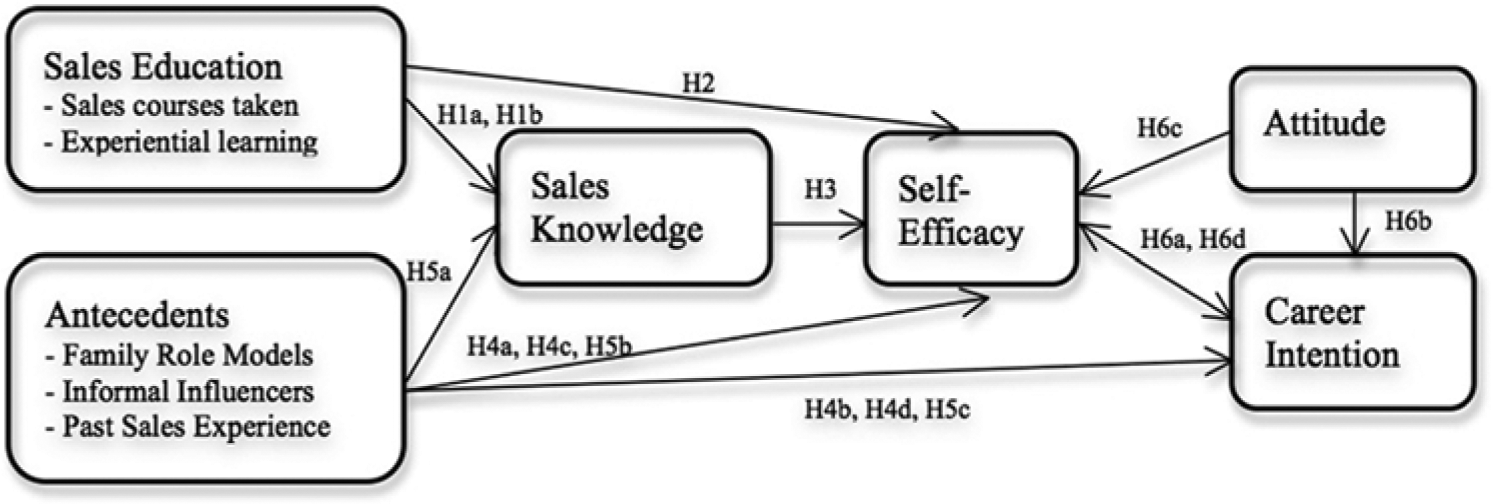
Proposed model and hypotheses.
Method
A study was conducted among 531 students attending U.S. universities and colleges. A pretest of a draft questionnaire was conducted among 51 senior sales and marketing students at a Midwestern public university. The reliability and validity of individual questions were evaluated through Cronbach’s alpha statistics of scales. In all cases, Cronbach’s alpha values were greater than 0.73, and respondents demonstrated no difficulties in answering questions.
Data were collected by means of an electronic survey emailed to 78 faculty members identified as teaching sales courses. Faculty members forwarded the survey link to their students and directed the 591 student responses to the authors. The extant literature suggests that 20 responses per nonrecursive path (Tanaka, 1987) are adequate for purposes of structural equation modeling. Since a maximum of 16 paths were to be tested, outliers were eliminated based on Malahanobis distances (Kline, 2005), and missing values were eliminated on a casewise basis (Garson, 2006; Kline, 2005), resulting in a sufficient sample of 531 fully completed responses. IP addresses seemed to indicate that the 531 responses originated from 19 different schools; however, respondents were not asked to identify their institution in order to ensure anonymity (per institutional review board requirement). Respondents ranged in age from 20 to 35 years and 55% of respondents were male. Only 14% of respondents identified sales as their primary major, 52% identified marketing, and 34% identified other majors. As indicated in the DePaul survey, a relatively small number of universities currently offer more robust programs, such as a Sales major, whereas many offer less robust curricula, such as minor, concentration, or certificate programs (DePaul University, 2011-2012).
Measures
Where available, existing measures were used and adapted to a sales context, as these have been established as reliable. In some cases, specific measures were created either because existing measures were not identified or in order to better capture the construct within the sales context. For both existing and created measures, the authors consulted with four experienced sales education researchers and pretested measures with 51 upper-level sales students. See Table 1 for a list of the items used.
Scales and Item Measures.
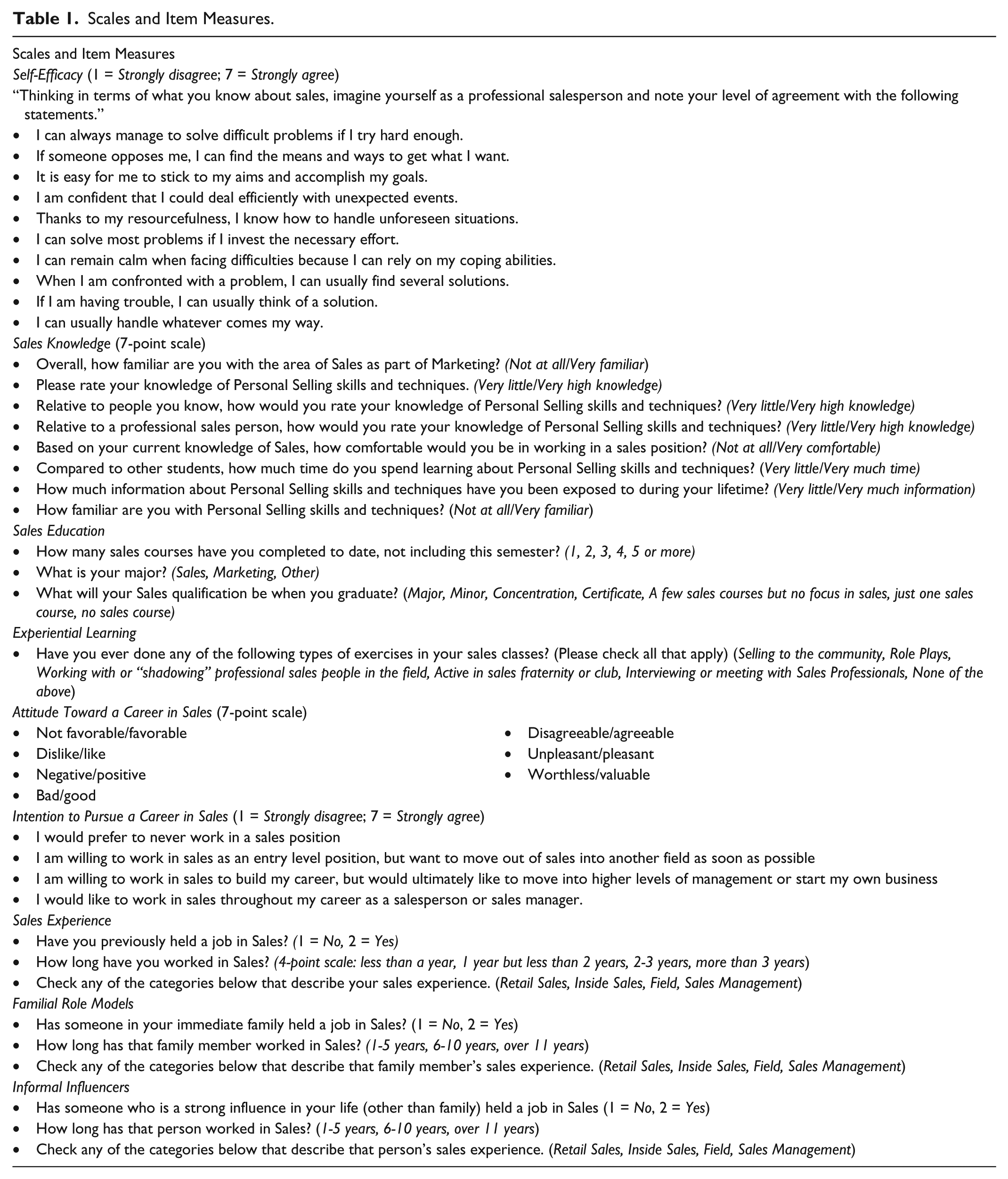
The survey instrument was developed to include 3 to 14 measures for each construct to achieve good estimation. Respondents were asked about their sales education background, knowledge of sales techniques, participation in experiential learning through experiential exercises, past sales experience, perceived sales performance, potential influencers (family members and others) in sales, self-efficacy, attitudes toward a career in sales, and intention to pursue a sales career, in addition to demographic information.
Existing scales were adapted to a sales context from established measures found in the Marketing Scales Handbook, Volume IV (Bruner, Hensel, & James, 2005). Self-efficacy was measured through the previously tested 10-item scale drawn from Schwarzer and Jerusalem (1995). This scale was adapted to sales, as self-efficacy is always a task-specific (sales) judgment about capability rather than a self-specific affective evaluation (Gist & Mitchell, 1992). The 7-item scale for attitude toward a career in sales combined items from two attitude scales (Huff & Alden, 1998; Schmitt, Pan, & Tavassoli, 1994) and adapted them to a sales context. Knowledge about sales was measured using a 7-item scale adapted from two knowledge scales (Bottomley, Doyle, & Green, 2000; Mason, Jensen, Burton, & Roach, 2001). Finally, new measures were created to capture the likelihood of one pursuing a career in sales, students’ past experience in sales, incidence of family and other key influencers working in sales careers, and level and type of experiential engagement in the classroom. Two measures, which were designed to capture perceptions of individual’s sales performance to date and the incidence of sales internships, were eliminated because they were relevant only to a small proportion of the survey sample, as became apparent after data collection.
Data Preparation and Analysis
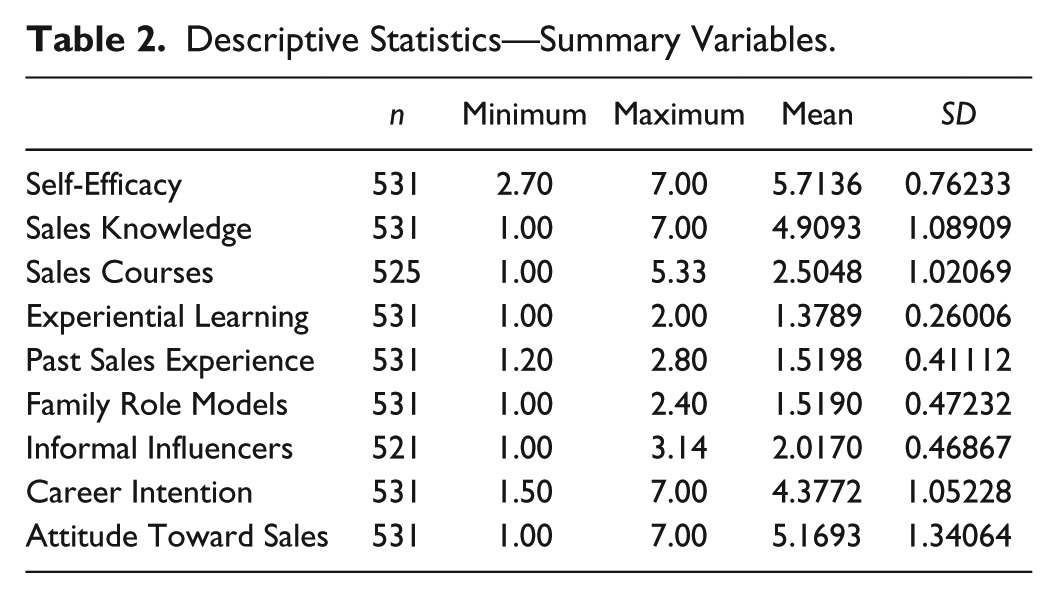
The data set was analyzed through multivariate analysis using PASW version 18 and structural equation modeling (LISREL 8.8). Prior to analysis, tests were done for multivariate normality of the indicators and for possible biases derived from the responses of early versus late respondents (Garson, 2006; Kline, 2005; O’Rourke, 2003). The summary of descriptive statistics is found in Table 2.
Descriptive Statistics—Summary Variables.
In general, the samples were drawn from three measurable and sizeable groups (University A had 192 respondents, University B had 140 respondents, and the remaining 199 respondents were students from 17 other universities). For use of the scales outlined in Table 1, there is a critical assumption that the scale is measuring the same trait in all three of the groups. If that assumption holds, then comparisons and analyses of those scales are acceptable and yield meaningful interpretations (see Table 3). This is the concept of measurement invariance (MI; Vandenberg & Lance, 2000).
Invariant Population Covariance Matrices.
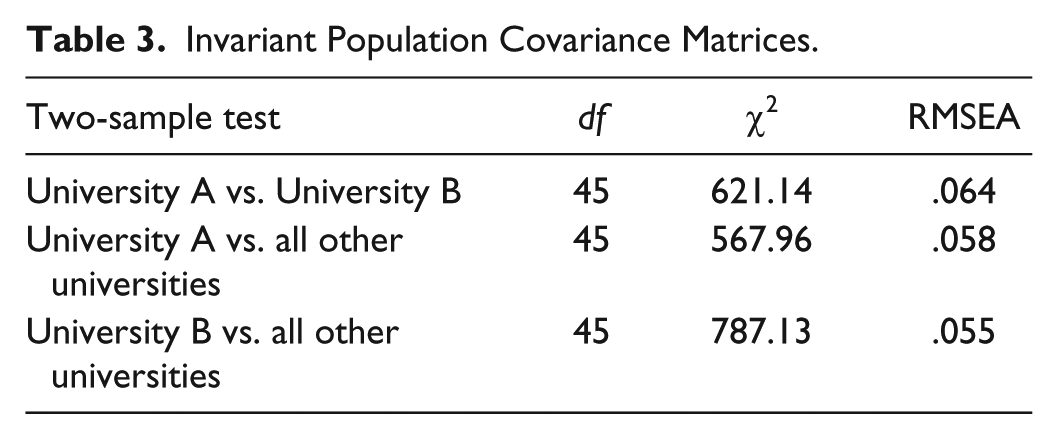
The first step in testing MI is the test of hypotheses that the population covariance matrices are equal. Failure to reject this model implies that equality of population covariance matrices is plausible, which in turn implies that equality of parameters of the covariance structure model (factor loadings, unique variances, and factor variances and covariances) is plausible. In this case, there is no need to carry out further tests of invariance of these parameters (Vandenberg & Lance, 2000). RMSEA measures shown in Table 3 indicate a moderate to good fit (Garson, 2006), indicating that the equality of population covariance matrices is quite plausible.
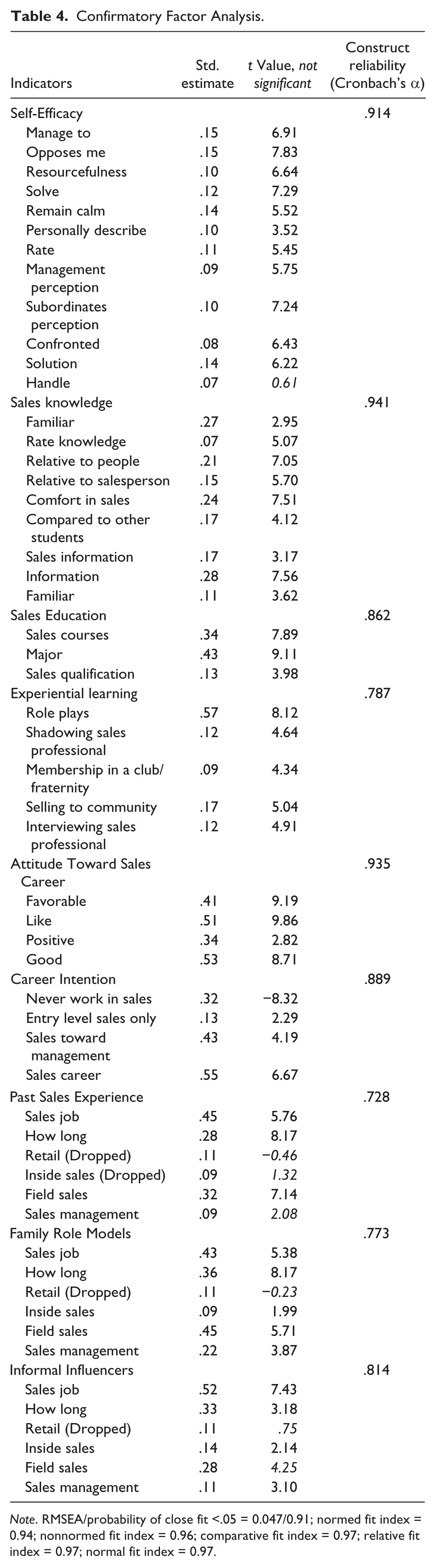
Following data cleaning, the research model was tested. Content or nomological validity was established through the pretesting of the questionnaire, soliciting expert opinion on the survey items, and reviewing the precedents in the literature. Following the recommendation of Churchill (1979), convergent and discriminant validities were also tested for the latent constructs. Convergent validity was assessed by examining the Cronbach alphas of the latent measures, which ranged from 0.728 to 0.941 in comparison to Hair, Black, Babin, Anderson, and Tatham’s (2005) recommended minimum values of 0.70 (see Table 4). Items assessing sales experience that captured retail or “inside” sales experience were dropped in some cases to improve alpha scores of the related latent variables.
Confirmatory Factor Analysis.
Note. RMSEA/probability of close fit <.05 = 0.047/0.91; normed fit index = 0.94; nonnormed fit index = 0.96; comparative fit index = 0.97; relative fit index = 0.97; normal fit index = 0.97.
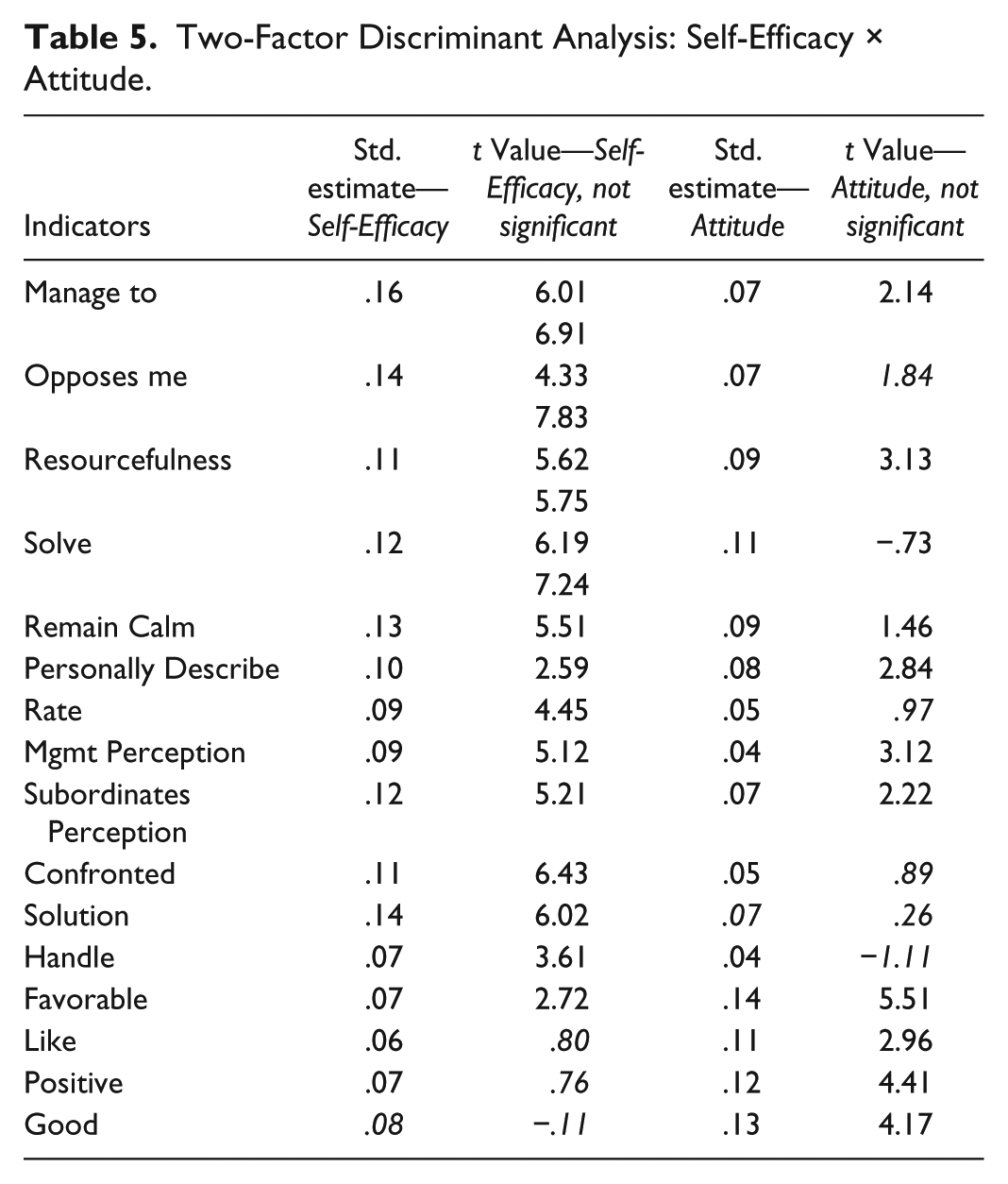
Discriminant validity was assessed by measuring the average variance extracted statistic (Fornell & Larcker, 1981), which varied between 0.53 and 0.83, higher in every case than the largest squared pairwise correlation of 0.38 between each construct (Espinoza, 1999). More specifically, one expert reviewer of the model suggested that the indicators for the attitude and self-efficacy constructs be cross-loaded to ensure that the two constructs were not measuring similar phenomena. In all cases, the indicators loaded better onto the constructs intended (see Tables 4 and 5). In conclusion, the items and scales exhibited acceptable levels of reliability and validity.
Two-Factor Discriminant Analysis: Self-Efficacy × Attitude.
Confirmatory factor analysis (CFA; Anderson & Gerbing, 1988) was used to test the fit and construct validity of the proposed measurement model (see Table 4). Items that did not load well onto a proposed construct were reexamined as indicators for alternate constructs where this appeared to be reasonable. Garson (2006) suggests that RMSEA indicators for CFA should be less than 0.10 to be considered a close fit and below 0.05 to be considered a very close fit. The RMSEA was found to be 0.047. Other indicators of goodness of fit included the normed fit index (0.94), the nonnormed fit index (0.96), the comparative fit index (0.97), the relative fit index (0.97), and the normal fit index (0.97). All four indices were adjusted to be independent of sample size, normal distribution, and complexity, and were found to be above 0.9, indicating a close model fit.
Common method variance, which is bias attributable to the measurement process and/or source rather than to the constructs that the measures represent, is a potential problem in behavioral research when independent and dependent variables are gathered from the same source (Podsakoff, MacKenzie, Lee, & Podsakoff, 2003). Measurement error threatens the validity of the conclusions about the relationships between measures and is widely recognized to have both a random component and a systematic component (Bagozzi & Yi, 1991). Although both types of measurement error are problematic, systematic measurement error is a particularly serious problem because it provides an alternative explanation for the observed relationships between measures of different constructs that is independent of the one hypothesized. Podsakoff et al. (2003) identify two categories of remedies for common method variance: procedural and statistical.
In terms of procedural remedies, efforts were made to reduce potential biases that can occur due to factors such as item ambiguity, social desirability of item questions, using similar scales for predictor and criterion variables, and a lack of assurance of anonymity. Pretests and expert external review of the questionnaire, comprehensive informed consent statements, and a general awareness of the procedural sources of common method variance aided in significantly reducing potential sources of common method variance.
In terms of statistical remedies, to determine the degree to which common method bias may be present in this research, a common latent factor test was employed using LISREL 8.8 (Williams, Hartman, & Cavazotte, 2010). A common latent variable was formed and was regressed against all indicators in the final model. All the regression weights of the paths were constrained to be equal, and the variance of the common latent variable was constrained to 1. Each regression path was found to have a coefficient of −.16, indicating a common variance of roughly 2.56% (the coefficient is squared in this method to determine the percentage of common method variance). This indicates a relatively low percentage of variance attributable to common method. However, a further test was conducted to determine the incidence of common method bias via addition of a marker variable. A performance variable for which data were collected, but not included in the model as the literature review did not ultimately support inclusion, was added to the common latent factor test model. The coefficients of all paths were reduced marginally from −.16 to −.15, reducing the percentage of common method variance from 2.56% to 2.25%, again indicating that the impact of common method bias is minimal on the findings.
Findings
The hypothesized structural model was tested to compare fit with that of different possible structural models (Garson, 2006). The structural model, as suggested by the hypotheses, is summarized in Table 6 and illustrated in Figure 1. Hypotheses H1a, H1b, H3, H4c, H4d, H5a, H5b, H5c, H6a, and H6d were supported, whereas Hypotheses H2, H4a, H4b, H6b, and H6c were not. The hypothesized model was not found to be a close fit, so alternative models were considered using a model building and trimming approach (Garson, 2006).
Summary of the Proposed Model and Hypotheses.

Note. RMSEA/probability of close fit >.05 = 0.058/0.00; normed fit index = 0.89; nonnormed fit index = 0.88; comparative fit index = 0.88; relative fit index = 0.87; normal fit index = 0.87.
Nonsignificant paths were examined and removed and fit was reassessed. The model was also retested using modification indices suggested by LISREL 8.8. The best fitting model was indicated by modification indices and appeared nomologically correct; the primary addition being that experiential learning was suggested by LISREL 8.8 analysis to significantly influence sales knowledge rather than self-efficacy. Follow-up tests indicated that the role-play and sales club/fraternity indicators relating to experiential learning were not individually correlated with self-efficacy. Thus, those indicators were dropped and the model re-analyzed with experiential learning as a three-factor construct; the path was then significant. The model fit was also improved substantially by the complete removal of the attitude toward a career in sales construct and the removal of the family role models to self-efficacy path. This process resulted in the best fitting model (see Table 7 and Figure 2) with an RMSEA less than 0.05 and other fit indices greater than 0.9, which indicate a close fit.
Summary of the Final Model and Hypotheses.

Note. RMSEA/probability of close fit <.05 = 0.047/0.92; normed fit index = 0.95; nonnormed fit index = 0.96; comparative fit index = 0.97; relative fit index = 0.98; normal fit index = 0.97.
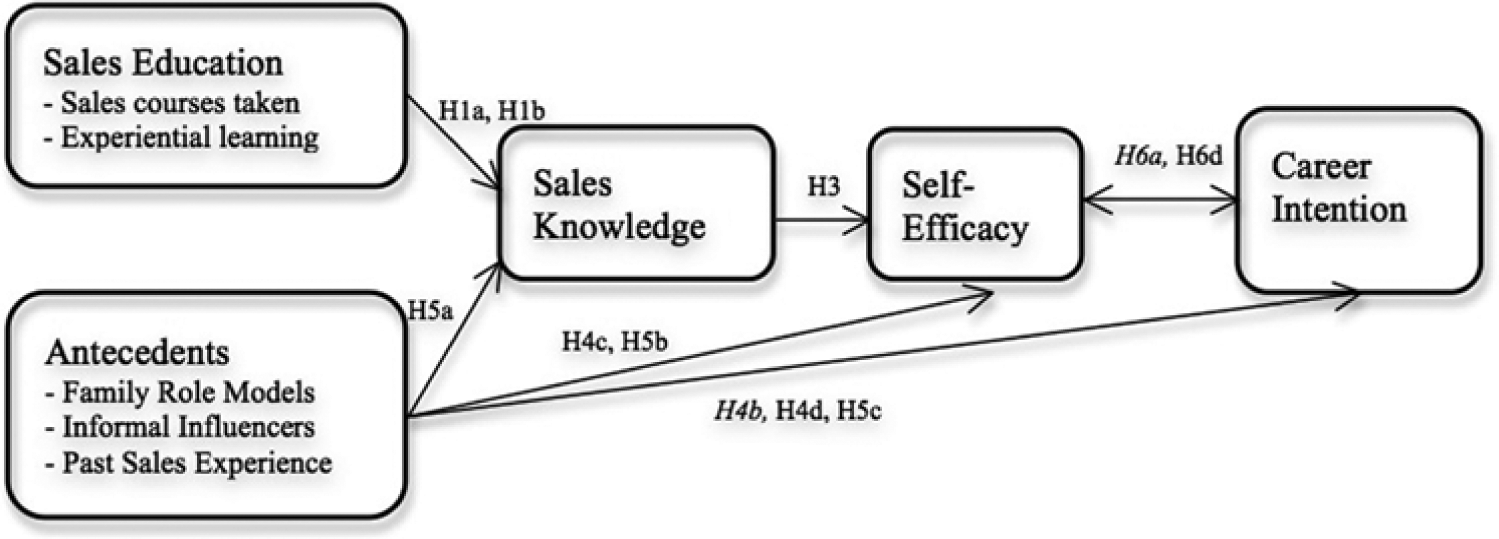
Final model and hypotheses.
Discussion
As expected, sales knowledge is impacted by the number of courses a student takes, his/her past experience in a sales-related position, and his/her participation in experiential learning activities. Additionally, the level of sales knowledge gained from a variety of sources both inside and outside the classroom determines the level of sales self-efficacy, demonstrating the value of sales experience and sales education in preparing students for successful sales careers. Leasher and Moberg (2008) found that sales knowledge gained through sales education and sales internships leads to higher levels of overall job performance and quicker ramp-up time early in sales careers. Clearly, collegiate sales programs play an important role in this preparation and should be expanded. Future research could also explore results among business versus nonbusiness majors and students enrolled in sales courses versus those who are not.
Of particular interest was experiential learning, which was significant in impacting self-efficacy only when role-plays and participation in sales fraternities were excluded. Role-plays are a staple of most sales programs (Inks & Avila, 2008; Moncrief, 1991; Moncrief & Shipp, 1994; Sojka & Fish, 2008; Taute et al., 2011; Widmier et al., 2007), and, as expected, were reported as being used in almost all (92%) of respondents’ sales classes at one time or another. However, it appears that role-plays must be supplemented with “working life” experiential exercises to be most effective. Role-plays do not build self-efficacy on their own. Less frequently used experiential learning exercises such as selling in the community (27%), working with or “shadowing” professional sales people in the field (22%), and interviewing or meeting with sales professionals (55%) appear to develop self-efficacy, although all types of experiential exercises, including belonging to a sales club or fraternity (14%), serve to create sales knowledge.
National collegiate sales competitions offer many opportunities to interview or meet sales professionals and also to participate in role-plays with these sales professionals, so they represent a “perfect storm,” it would seem, to develop self-efficacy. These opportunities are often limited to a relatively small number of students, particularly in larger sales programs. However, it appears that sales instructors should liberally use “real-life” sales resources such as selling to the community, working with or “shadowing” professional sales people in the field, competing in “real to the world” sales competitions, and interviewing or meeting with sales professionals in the classroom if the intent is to build self-efficacy.
Although role-plays are clearly effective in developing sales knowledge, sales educators, it appears, should follow the lead of employers of early stage sales trainees and intersperse field activities in sales curricula wherever possible for all sales students. Some schools, such as DePaul University, have developed student call centers as part of their sales centers, contracting with local clients and giving students opportunities to engage in real-life selling situations while receiving extensive feedback and coaching. This recommendation reinforces the literature suggesting that self-efficacy impacts sales performance for all salespersons, including those in the early stages of their careers (Barling & Beattie, 1983; Fu et al., 2010).
Nonetheless, this finding is a rather provocative one and it is highly recommended that future research is conducted to assess the impact of the specific characteristics of role-plays, including design, format, technologies used, and feedback provided on development of sales-related self-efficacy. It is suggested that perhaps role-plays that exhibit certain features may, in fact, be effective in developing sales-related self-efficacy. For example, one Midwest school uses industry professionals for the capstone project in its Selling Principles course. Student teams of two are tasked with researching a real life Request for Quotation (RFQ) issued by a corporate buyer and following the sales cycle from start to finish in order to compete with other teams to secure the sale. One of the authors has noted that students find that this process brings to life many of the concepts explored in preparatory lectures and role-plays with the instructor.
In addition to sales education, certain antecedents impact both self-efficacy and career intention. Past experience in sales has an impact on self-efficacy and career intention. This is intuitive, as working in sales would increase one’s perceptions of one’s ability to effectively pursue a career in sales. Additionally, informal influencers, perhaps most often good friends or mentors who currently have or have had a career in sales, appear to have a much stronger impact on individual intent to pursue a sales career than family members with a career in sales. In fact, the influence of family members with sales experience on sales career intention appears to be negative and significant. Friends and other role models, rather than immediate family, may be more influential in the lives of college students, particularly once students spend time away from family and begin to explore and develop individual career paths. Students appear to be motivated and inspired by those role models to whom they can relate, particularly recent graduates in the field. Sales educators should consider involving recent graduates and sales professionals as class speakers or program mentors to increase student self-efficacy and career intention. However, this observation deserves further examination.
A surprising “negative” finding in this study was the exclusion of attitude toward a career in sales as a factor. Attitude impacted neither student self-efficacy nor career intention. This suggests that students have a realistic perspective of sales careers, as attitude was only moderately positive, being neither high nor low. Educators do not necessarily need to paint an idealistic or rosy picture of sales so that students pursue it as a career. Students may prefer the “real” picture of sales careers to idealized versions, and may even be more likely to pursue sales if there is a clear understanding of the pros and cons.
It appears that when all factors are tied together (knowledge, experience, and influencers), students get a realistic picture of what to expect in a sales career and are more likely to pursue a sales career. Sales educators are encouraged to incorporate the powerful impact of outside influencers alongside the practical applications of experiential learning. As mentioned above, some programs have done this by requiring sales students to interview, shadow, or sell to sales professionals.
Finally, the career intention–self-efficacy bidirectional relationship showed some interesting results. On the one hand, career intention impacted self-efficacy, but self-efficacy did not impact career intention. Although unexpected, these findings are intuitive. If one intends to pursue a career in sales, the tools that enhance self-efficacy are meaningful in increasing his/her perceived abilities to succeed in a sales career. However, even if one can “do the job” of sales, it does not mean that he/she will desire to. Thus, to increase student career intention, sales educators should focus on the previous factors discussed (knowledge, experiential learning, and influencers), as self-efficacy will not necessarily increase intention alone. On the other hand, knowing students’ intentions initially can aid sales instructors in building self-efficacy to better prepare students desirous of a sales career.
Conclusion
Collegiate sales programs play an important role in preparing graduates for this perennially in-demand career and should continue to expand their offerings. Sales instructors should include a high proportion of interaction with sales professionals and real-life interaction with the community to develop sales-related self-efficacy, which has been strongly related to sales performance in previous studies. Sales experience gained through sales employment and internships, where possible, during sales programs will serve to develop the sales knowledge and sales-related self-efficacy needed to maximize the likelihood of success in a sales career.
Footnotes
Declaration of Conflicting Interests
The author(s) declared no potential conflicts of interest with respect to the research, authorship, and/or publication of this article.
Funding
The author(s) received no financial support for the research, authorship, and/or publication of this article.