




Abstract
A new interactive computer simulation designed to teach sales ethics is described. Simulation learner objectives include gaining a better understanding of legal issues in selling; realizing that ethical dilemmas do arise in selling; realizing the need to be honest when selling; seeing that there are conflicting demands from a salesperson’s company, customers, and colleagues; and experiencing some of the challenges of selling. Assessment results suggest each objective was met, for both males and females. A description of how this and other simulations can be effectively used in sales courses is provided.
Keywords
One need merely glance at a daily or weekly business news summary to realize that ethical issues in marketing and business are common (e.g., Business News Summary, 2013; Foley, 2013). It is not surprising that the Association to Advance Collegiate Schools of Business (AACSB) has called for enhanced ethics training for business students (AACSB Ethics/Sustainability Resource Center, 2013; Nill & Schibrowsky, 2005). Research has shown that teaching ethics in business schools is effective in helping develop a student’s moral sensitivity and reasoning, as well as ethical behaviors (see Sims 2002).
Personal selling is also commonly faced with ethical issues (Agnihotri, Rapp, Kothandaraman, & Singh, 2012; DeConinck, 2011). Studies show that salespeople need ethical training, especially those in commission sales roles, which have less control and few norms (Hsu, Fang, & Lee, 2009, Ingram, LaForge, & Schwepker, 2007). Encouragingly, ethical behavior of salespeople is influenced by ethics training (Schwepker & Good, 2007). As Table 1 indicates, an effective method of ethics training is the use of simulations. Simulations are powerful learning tools, as evidenced by the sheer number available for marketing courses. Although there are many highly regarded online simulations, none has as its focus professional selling or selling ethics.
Pedagogical Benefits of Simulations in Sales Courses.

A Sales Ethics Interactive Simulation
An interactive and experiential web-based simulation has been specifically designed to educate and train selling students with regard to sales ethics issues. A number of learning goals were developed for the simulation, well-grounded in the sales literature, as well as the two predominate marketing ethical decision-making theories (Ferrell & Gresham, 1985; Hunt & Vitell, 2006). The simulation and objectives were also developed with an intent to encompass a wide variety of learning taxonomy dimensions (Anderson et al., 2001), so that the student would be challenged at many levels. Table 2 provides the learning dimensions as well as the simulation learner objectives.
Simulation Learner Objectives: Relationship With Learner Taxonomy and Assessment of Results.
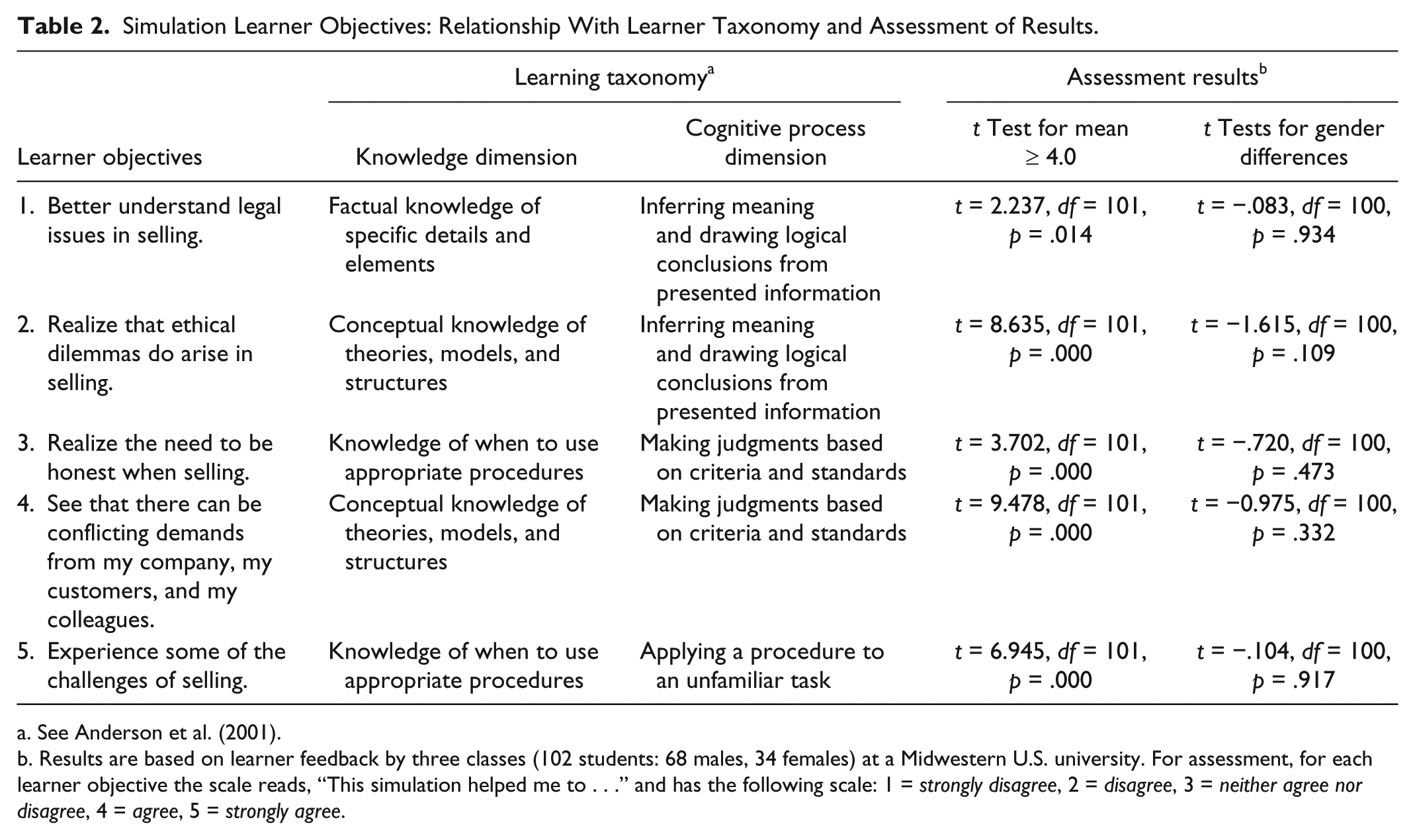
Results are based on learner feedback by three classes (102 students: 68 males, 34 females) at a Midwestern U.S. university. For assessment, for each learner objective the scale reads, “This simulation helped me to . . .” and has the following scale: 1 = strongly disagree, 2 = disagree, 3 = neither agree nor disagree, 4 = agree, 5 = strongly agree.
Several additional factors suggest the learning objectives are appropriate. Legal issues play a critical role in relation to sales ethics (Castleberry, 2007), resulting in inclusion of Learning Objective 1 (see Table 2). With regard to Learning Objective 2, it is important that learners are able to recognize that almost every business decision also has one or more moral dimensions to it (French & Granrose, 1994; Sims, 2002). The simulation will allow learners to realize that ethical issues are common for salespeople in daily life. Learning Objective 3 is included because it takes considerable time to build solid trust, but that trust can be eroded or lost completely when a salesperson makes unethical decisions (Friedman, 2013; Vaughan-Smith, 2013). Due to the interactive nature of the simulation, it is intended that learners gain a better understanding of the consequences of dishonesty and acquire the moral courage to be honest (Sims, 2002). Learning Objective 4 is included, because while role conflict has often been discussed in sales literature (e.g., Miao & Evans, 2013), moral conflict is also pervasive in sales positions (Castleberry & Tanner, 2011). For example, what may seem perfectly moral from a company’s perspective can be considered immoral from a customer’s viewpoint. Likewise, a salesperson’s peer salespeople may appreciate an action taken by the salesperson that benefits them in some way, whereas the salesperson’s company may view the same action as an unethical breach of loyalty to the company. Thus, salespeople can expect to experience conflicting moral demands (Hollet-Haudebert, Mulki, & Fournier, 2011; Sims, 2002). Finally, with regard to Learning Objective 5, although the simulation is primarily a tool for sales ethics, it is better if other non–ethics sales decisions must also be made by the learner (Chiesl, 1994). If the sales ethics issues are entwined with other decisions that a seller would make on a daily basis, then the learner has the advantage of realizing that ethics are truly interweaved with daily sales life (Sims, 2002).
In the simulation, students are provided the necessary background information needed to make informed decisions as well as to establish the culture of the organization. The fictitious firm they will work for in the simulation manufactures and markets office equipment, such as copiers, scanners, multifunction machines, high-volume production printers/copiers, and document imaging systems. The learner starts the simulation as an entry-level salesperson at the company and is told she/he is a recent college graduate. Early in the simulation, web links are provided to nine real companies’ web pages that would be competitors (e.g., Canon, Xerox, Lexmark), so learners can discover more about the industry and the types of products that would be offered by the company. However, it should be noted that the simulation is written with the assumption that the learner does not have any extensive product knowledge, with the exception of common consumer knowledge (knowing what a copier is, for example).
Learners are provided their job description, an organizational chart, the firm’s code of ethics, and a list of potential illegal actions of salespeople. These are introduced at the beginning of the simulation, and a link is provided in the header of each page thereafter, so the learner can be reminded of these facts, as needed. The learner is also asked to respond to the question, “What are your personal goals for your job when you graduate?” This information is retained and provided to the learner at the conclusion of the simulation as part of the debriefing portion. It is intended that the learner will engage in serious self-reflection at the end of the simulation about his/her goals and realize the importance of incorporating ethical and legal considerations when setting goals.
The simulation initially provides the learner with a base salary plus commission and an assigned annual sales revenue quota. As the simulation progresses, the compensation method changes (the commission is replaced with a bonus) and the salary level is adjusted to reflect changes in job title and responsibilities.
Learners are presented with 48 scenarios that deal with ethical, legal, and selling challenges; and the learners must decide their course of action from among various alternatives. Scenarios were developed based on popular sales textbooks (Anderson, Dubinsky, & Mehta, 2007; Castleberry & Tanner, 2011; Futrell, 2008; Ingram, LaForge, Avila, Schwepker, & Williams, 2011; Johnston & Marshall, 2008; Manning & Reece, 2007), marketing ethics textbooks (Chonko, 1995; Davidson, 2002; Schlegelmilch, 2001; Smith & Quelch, 1993), ethics statements of firms, journal articles (e.g., Amyx, Bhuian, Sharma, & Loveland, 2008; Bellizzi & Bristol, 2005; Caywood & Laczniak, 1986; Chonko, Wotruba, & Loe, 2002; DeConinck, 2011; Donoho & Heinze, 2011; Donoho, Herche, & Swenson, 2003; Dubinsky, Jolson, Michaels, Kotabe, & Un Lim, 1992; Dubinsky, Nataraajan, & Huang, 2004; Li & Murphy, 2012; McClaren, 2000; Radin & Predmore, 2002; Sayre, Joyce, & Lambert, 1991; Stevenson & Bodkin, 1998), as well as suggestions from business law professors, salespeople, sales managers, and sales executives. A sample scenario is shown in Table 3.
Sample Scenario From Salesperson Ethics Simulation (Scenario 6).
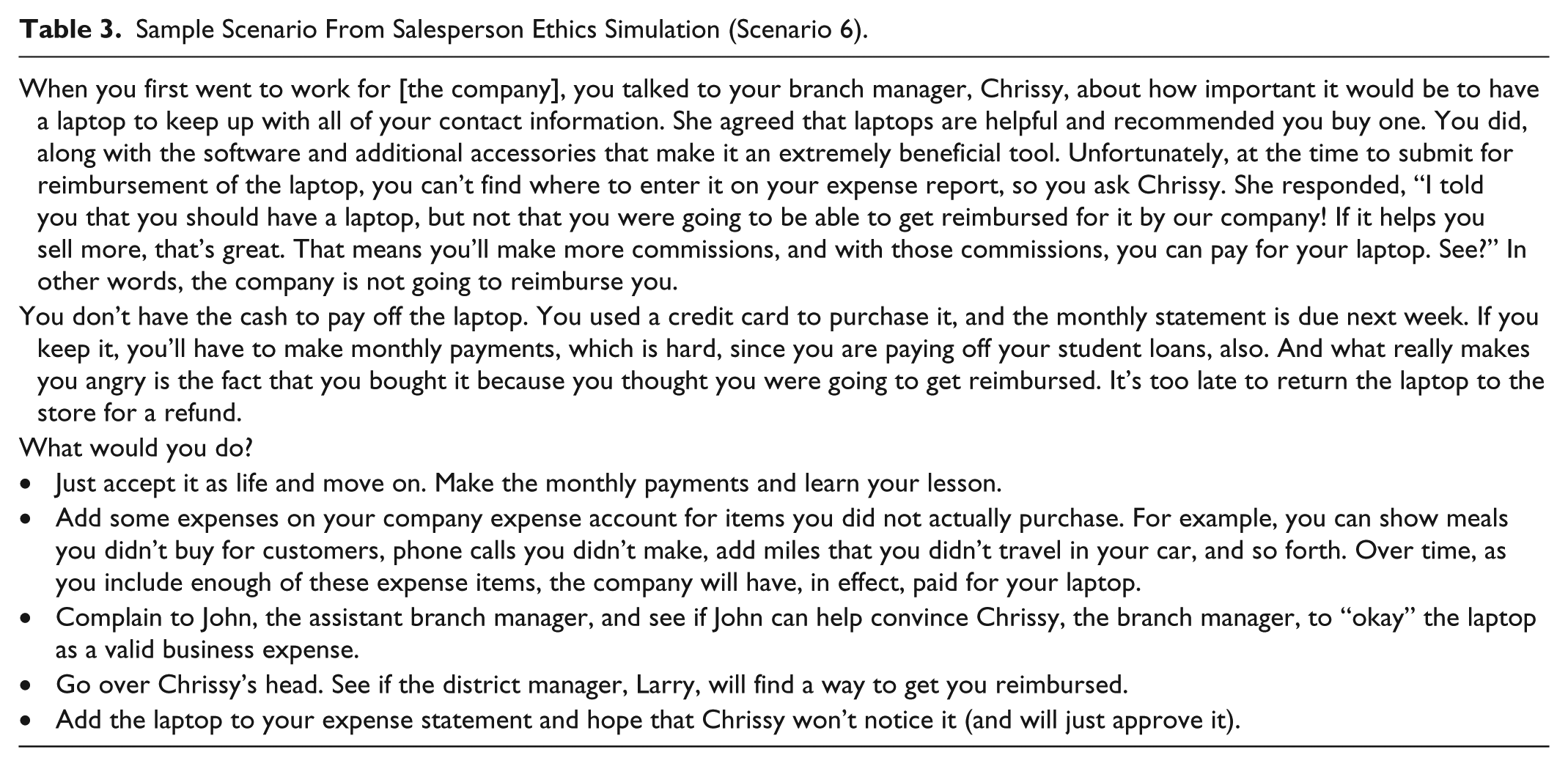
Each scenario provides a multitude of possible responses from which a learner must choose. A number of scores were created for each possible response for each scenario in terms of the impact of the decision on the following: (a) the seller’s relationship with the company, (b) the seller’s relationship with the customer, (c) the seller’s relationship with coworkers, (d) the reputation of honesty that the seller accrues, (e) the number of illegal actions the learner has committed, and (f) seller income.
Assigning scores to each response is clearly a subjective element. In an effort to reduce bias, three respected university faculty who have taught selling for multiple years were sent the simulation scenarios, possible responses for each scenario, and the proposed scores for each decision on each dimension. Minor changes to a few scenario responses were suggested, and these were incorporated into the simulation.
The simulation tracks learner’s responses and makes adjustments to the simulation for that learner based on those responses. Given the interactive nature of the simulation, many responses will take the learner to a new screen to provide more information about the situation, tell the seller that they just broke the law, or give the learner the buyer’s reaction to the learner’s response. For example, if the learner for Scenario 6 chose to bypass Chrissy, the learner’s boss, the simulation provides this information: “Chrissy found out what you did and chewed you out for going over her head. She said if you ever did that again, she’d find a good reason to fire you.” For the scenarios dealing with legal issues, the learner gets an immediate notification that a law has been broken, including details about the law itself and penalties for breaking it.
As the learner proceeds through the simulation, she/he has several different jobs. Starting as an entry-level salesperson at a branch office, the learner is later promoted to a staff position in the district office, as assistant to the district manager. Toward the end of the simulation, the learner returns to the original branch office as a key accounts salesperson. This job variety was designed to reflect real-world sales advancements, as well as to afford the chance to experience ethical situations from a variety of roles that salespeople may encounter in their first few years out of college. The higher that a sales position is, the more potentially devastating the effects on the firm will be from making poor ethical and illegal decisions. Also, ethics issues do tend to change as a salesperson gets promoted. In the simulation, as an entry-level salesperson, issues like the following arise: dishonesty when the seller does not know the answer to the customer’s question, a customer making a pass at the seller, going against company policy, misrepresenting expenses for reimbursement, misrepresenting experience, lying about activity, inappropriate actions that affect a peer’s sales contest rankings, sharing confidential information with a buyer. As a salesperson is promoted to assistant to the district manager, new ethics issues like the following arise: inaccurately adjusting the sales numbers for a report to make the manager look better, providing confidential district sales information to outsiders against company policy in exchange for a fee, working at conventions as part of the district staff and dealing with resulting ethical issues (e.g., sabotage of competitors). Being promoted to a key account salesperson position can present a different set of ethical issues, especially due to the relatively larger size of the customer and the importance of the business to the firm, for example, ethical issues dealing with formal negotiating, the use of tying agreements with large potential customers, the use of entertaining to secure significant business, dealing with bids and information control on large contracts, dealing with an offer to change companies and bring your large clients with you, and so forth. This simulation explores all of these situations and more.
The “Results” portion of the simulation, which occurs after the learner makes the last decision, provides his/her score on the six dimensions (honesty, the three relationship scores related to the company/customers/coworkers, income earned, and illegal behavior), as well as a review of illegal actions taken by the learner (including a brief discussion of the law that was broken). Students are also provided information about the range of outcomes for these scores from prior students who completed the simulation, allowing them to compare their results with others.
Student learning in the simulation is strengthened by effective administration by the instructor. Table 4 provides suggested tactics for the use and evaluation of this and other simulations in sales courses.
Tactics for Using Simulations in Sales Courses.

Example is based on implementation of sales ethics simulation at a Midwestern U.S. university. Learner feedback data are based on most recent three introductory sales classes taught.
Implications and Future Research
The simulation has been used over a period of 3 years with students at three universities. Informal feedback from instructors indicated no problems with the simulation. Learner feedback by 102 students (68 males, 34 females) at a Midwestern U.S. university from surveys embedded in the simulation from the three most recent classes is shown in Table 2. Results indicate that the simulation successfully achieved all five core objectives, with no significant difference between male and female learners, confirming previous findings about gender (e.g., Castleberry, 2007; Nill & Schibrowsky, 2005).
The simulation was created primarily for undergraduate students in a personal selling or advanced selling course. However, the simulation could also be used for MBA students who are taking a sales course or for practitioner purposes (e.g., sales executive education, sales training). The simulation is not designed to replace other forms of discussion and learning of ethical and legal issues; rather, the simulation is intended to put students in simulated environments to wrestle with making ethical decisions in contexts of uncertainty, as well as for students to see that there are real consequences of ethical decision making.
The results reported here were not compared with a control group of students. It could be that students who did not engage in the simulation would also have a good understanding of legal issues in selling, realize that ethical dilemmas do arise in selling, realize the need to be honest when selling, and see that there can be conflicting demands from company/customers/colleagues. Future studies should assess results against a control group.
Results reported are for the most recent three sections of an introductory selling course. It is not known what the results would be for an advanced selling course, an MBA course, or for any executive or practitioner education.
We did not measure learning styles of participants. There has been some research to suggest that students with various learning styles prefer various types of instruction. For example, O’Leary and Stewart (2013) found that experiential (active) learners rated the usefulness of experiential techniques higher than nonexperiential (passive) learners did. If a large proportion of students in a selling class are passive learners, it could be argued that the simulation might not be the most appropriate tool. It should be noted that in terms of learning styles, the simulation is not designed to especially appeal to, nor provide lack of appeal to, any style in particular. Certainly, for those with solitary learning styles (Yaremich, 2011), who prefer to work alone and use self-study tools, the simulation allows for this, since the learner can take his/her time, study the links provided, and make carefully measured decisions without time or social pressures. Some students did provide open-ended comments that reflect their appreciation of the opportunity to give serious reflection before making ethical decisions, and the ability to deal with selling ethics situations without doing so in a classroom setting. For those with a social learning style (Yaremich, 2011), the classroom debriefing allows an opportunity to learn from and interact with the experiences of other students. Future research should assess learning styles, in their various configurations, in relation to the effectiveness of this and other selling simulations.
Asking learners to respond to fictitious scenarios might result in different answers than if the learners were in a real-life situation and faced with making a decision that could affect their actual income and relationships. In the simulation, learners might not answer truthfully, because they are more concerned with providing socially acceptable answers and are perhaps trying to “win” in the ethics simulation from an ethics standpoint. Also, salespeople in the real world certainly experience more stress when faced with ethical scenarios than would learners in a simulation. Research should attempt to assess the truthfulness of learners when they use ethics simulations.
Learners in this simulation had a limited number of options to choose from for each scenario. This restriction, while due to practical limitations, is somewhat unrealistic. Actual salespeople are more likely to have more options and can even combine various alternatives to arrive at their solution to an ethical dilemma. Future research should be designed to see what effect offering more potential responses, or even allowing learners to provide their own, unique responses, would have on learners’ ethical deliberation and decision making.
The simulation did provide some company norms with regard to ethical stances (by providing the firm’s Code of Ethics and Business Conduct). It is possible that in this simulation, students read the background information about the firm’s ethical stance at first and never really considered those issues again, even though the link is provided at the top of every webpage of the simulation. Furthermore, in a real sales job, these norms might be more explicitly communicated, and the salesperson might be made more aware of them. There is also the possibility that a corporation’s culture might be counter to their stated ethical principles (e.g., “From Enron’s Code of Ethics,” 2013), something that would be more evident in the real world than could be experienced in a simulation. More research should be done to assess these possibilities and their ramifications.
In conclusion, the simulation was found to meet the objectives for ethics instruction of salespeople. Learners self-reported that they gained a better understanding of legal issues in selling; realized that ethical dilemmas do arise in selling; realized the need to be honest when selling; more clearly saw that there are conflicting demands from a salesperson’s company, customers, and colleagues; and experienced some of the challenges of selling.
Using an active and engaging format, the use of simulations in sales classes can create a nonthreatening, confidential environment for learners to wrestle with difficult or sensitive issues. Simulations can allow the learner to deal with emotions and uncertainty, often associated with sales scenarios, before dealing with them in front of a classroom of peers and an instructor. Furthermore, sales simulations allow learners to progress at their own pace, and each receive the same information in the same way. For these and other benefits summarized in Table 1, it is hoped that this article will encourage faculty to use more simulations in their sales classes and even develop additional simulations to help students work through issues before entering the sales profession.
Footnotes
Acknowledgements
Special thanks to Henrique Brandao, Utkarsh Khamesra, and Gina Grensing from UMD, to anonymous reviewers, and Journal of Marketing Education special editors Andrea Dixon and Jimmy Peltier who offered valuable suggestions for this article.
Declaration of Conflicting Interests
The author(s) declared no potential conflicts of interest with respect to the research, authorship, and/or publication of this article.
Funding
The author(s) disclosed receipt of the following financial support for the research, authorship, and/or publication of this article: Thanks to the University of Minnesota Duluth for funding the time and cost associated with producing this sales simulation.