



Abstract
This article discusses the implementation and diffusion of mandatory and voluntary food safety regulations from a marketing systems perspective, and specifically applies this framework to an analysis of the antecedents and implications of the Danish 2003 ban on trans-fatty acids (TFAs). The analysis is based on reviews of published material and on interviews with food marketers, nutrition experts, and policy makers. It is established that the ban was implemented due to scientific proof of health risks associated with the intake of TFAs but also as a result of aligned interests and efforts of the major stakeholders in the Danish food marketing system. Adding to the literature on diffusion of regulatory initiatives, the analysis shows that the Danish ban on trans-fats had—and still has—an important impact on trans-fat regulation in other European and overseas countries. In the final section, insights from the analysis are used as a starting point for a discussion of how public authorities, food marketers, and macromarketing researchers can apply the marketing systems perspective when designing, managing, and studying future cases of food safety regulation.
Introduction
The regulation of food safety in Europe and the United States has undergone substantial changes in recent years. For example, fragmented national regulations in Europe have been transformed into a harmonized system that features new institutional and legal frameworks as well as new roles for public and private stakeholders (EU Commission 2000). The US Food Safety Modernization Act (FSMA), approved in January 2011, similarly shifted the focus of federal regulation from responding to food safety problems to preventing them. With the aim of preventing foodborne illnesses and other health risks, these new regulatory frameworks substantially alter the food safety requirements placed on food production and distribution companies. Furthermore, the authority of public entities to enforce both existing laws and new regulatory initiatives has increased (Promar 2010), even though many regulatory initiatives build on the principle of consumer competence and free choice (Holm and Halkier 2009). These structures assume that consumers, if given the right information, can protect themselves from risks related to food consumption meaning that legislation should not set up moral barriers against private choice. Sulkunen (2009) suggests the appropriateness of this approach by arguing that modern consumers’ identity concerns tend to make it politically impossible to ban products (e.g., food) that are strongly linked to individual lifestyles. But Sulkunen also sounds a note of caution that such structures may “stress agency to a point, where autonomy is not only granted to but demanded even of those who have little or no capacity for it” (p. 181).
Although both European and US administrations generally prefer voluntary agreements over compulsory regulation (Hobbs 2010), outbreaks of foodborne illnesses, steep increases in health-related expenditure, cumulative evidence of the influence of food consumption on health, and a greater focus on evidence-based health policy have led to compulsory food safety regulations (Dobrow, Goel, and Upshur 2004). Therefore, both policy makers and food marketers need to understand the potential impact of various regulatory designs. The macromarketing perspective (Hunt 1981) offers an expedient framework for conducting such an analysis, as this study of Danish regulations of trans-fatty acids (TFAs) reveals. TFAs, which occur naturally in fats from ruminant animals, appear in hydrogenated cooking oils and many processed foods. However, substantial evidence links TFAs produced by means of hydrogenation to cardiovascular diseases, diabetes, and other degenerative diseases (Remig et al. 2010; WHO 2008). Rather than using economic incentives or informative strategies, it was decided in 2003 that Denmark should implement a maximum limit of 2 g of industrially processed TFAs per 100 g of oils and fats intended for consumers or as ingredients in processed foods (Lovtidende 1993).
According to Capacci et al. (2012), before 2010, the Danish TFA ban was the only example of a mandatory food composition standard implemented in the European Union (EU). Whereas legislative procedures preceding food safety regulations normally take many years (Holm and Halkier 2009), the Danish TFA ban was passed within a few months, thus strengthening the notion that the ban represents a unique piece of food safety regulation. Beyond its speedy approval, the Danish TFA regulation is interesting because it originated as a voluntary agreement among Danish margarine producers. With these characteristics, the Danish TFA regulation is a promising context for exploring the workings and macromarketing implications of different types of voluntary and mandatory food safety regulation instruments.
This article explores the drivers and dynamics of the Danish TFA regulation and provides insight into how public authorities and food marketers may apply the macromarketing perspective to future food safety regulation scenarios. In particular, the objectives of the study are to investigate (1) how the Danish TFA ban came into being in an environment supposedly opposed to compulsory regulation, (2) the extent to which and how food reformulation and marketing have been affected by the TFA regulation, and (3) whether and how the Danish ban has influenced TFA regulation in other European and overseas countries. In identifying these effects and outcomes, this investigation suggests how food marketers might use a macromarketing perspective to influence future food regulations, as well as how policy makers may apply it when selecting alternative regulations (e.g., mandatory vs. voluntary). To facilitate this discussion and position this study in the macromarketing literature, the next section offers a brief review of macromarketing research into food marketing systems and regulations.
Food Marketing Systems and Public Regulation
A marketing system operates through exchanges of ownership, risk, information, finance, and possession (Fisk 1967). Using the term “flows” instead of “exchanges,” Hunt (1981) describes macromarketing as a study of the flows and stakeholders in a marketing system, the impact and consequences of those marketing systems on society, and the impact and consequences of society on marketing systems. These bidirectional impacts occur through continued, reciprocal sequences of marketing and regulatory initiatives, which transform both the exchanges and the output (e.g., assortment) that characterize the marketing system (Carman and Harris 1986; Harris and Carman 1983; Harris and Carman 1984). In virtually any society, food distribution is a primary marketing system. Furthermore, food marketing systems are becoming increasingly complex, so relevant flows and stakeholders appear in many influential accounts of macromarketing (e.g., Arndt 1981; Fisk 1967; Hunt, Ray, and Wood 1985).
For example, Baker, Gentry, and Rittenburg (2005) describe the consequences of food marketing practices on vulnerable consumer segments, and Nason (1989) notes the risk of food ingredients which might create unforeseen or even unforeseeable health risks for food consumers. When risks are unforeseen or unforeseeable, they tend to stem from an aggregation of small effects that arise through daily food consumption. Although different stakeholders often disagree about scientific research results, Nason (1989) clarifies the need to make the unknown known and impose regulations that can remedy and prevent such market failures.
Regarding the impact of society on food marketing systems, Charlebois and Labrecque (2009) also study the consequences of bovine spongiform encephalitis (BSE) regulations on Canadian beef producers; the imposed measures, though they helped promote societal stability and social welfare, created uncertainty for members of the beef marketing system. Grewal and Dharwadkar (2002) assert that food safety initiatives are complicated by their aim to secure safety but simultaneously maintain supply and competition. Although this duality of purpose describes the regulation of most types of markets, the significance of a stable, safe food supply, and the vast economic importance of the food industrial complex mean that the conflict becomes especially prominent in food-oriented regulations.
Although national and supranational authorities frequently conduct supply oriented studies of agricultural marketing systems, applications of a macromarketing perspective to analyze food safety regulation is a relatively new notion for public policy makers (Layton 2007). Yet, a macromarketing perspective (Hunt 1981) can enable a closer consideration of the relations and interactions among food marketers, nutritional experts, and regulators by identifying and assessing relations and stakeholders—topics that rarely have been included in supply oriented studies of marketing systems.
Designing Food Safety Regulation
From a macromarketing perspective, designing any particular piece of safety regulation first requires mapping the stakeholders and exchanges that characterize the relevant marketing and regulatory systems (Hunt 1981). With this map, policy makers address three interdependent decisions: (1) which type of exchange/exhanges to regulate, (2) at which level/levels in which supply chain/chains to regulate them, and (3) which regulatory instrument/instruments to use. The interdependency of these three decisions arises because the exchanges that constitute a particular marketing system are complementary as well (Gadde and Mattsson 1987). Financial measures or the regulation of information exchanges at one level thus could provide an alternative to ownership regulations, limitations on the possession (or use) of certain products, or ingredient requirements at other levels (Traill and Koenig 2010). Although regulation through some types of exchanges (e.g., financial, possession) must be regulated by mandatory measures, the regulation of information or the use of products might succeed better if it entails stakeholder involvement and voluntary agreements (Segerson and Miceli 1998).
To design food safety standards, direct stakeholder involvement and voluntary agreements is a common approach, especially in countries such as the United Kingdom and Denmark, with their concentrated food industries and distribution channels (Capacci et al. 2012) and their long traditions of participatory democracy (Timotijevic et al. 2010). But in recent years, various countries also have started using direct stakeholder involvement and voluntary agreements as alternatives to or antecedents of mandatory legislation.
Unlike the binding measures, voluntary agreements seemingly provide firms with greater flexibility, exploit company expertise, reduce overall costs, stimulate innovation, and further understanding and trust among stakeholders (Segerson and Miceli 1998). Voluntary agreements also can offer participating companies greater possibilities for branding and market positioning, such as in export markets.
However, the need to choose between products marketed by companies that participate and those that do not participate in a declared voluntary agreement may take a heavy toll on consumers’ information processing capabilities (Mayer 2008), particularly for frequently bought and heterogeneous products, such as food. Despite the many advantages of voluntary agreements, mandatory regulation of food safety can be preferable from a consumer perspective, especially when evidence of food-inflicted health risks is substantial (Hoek and Jones 2011).
As regards the decision of which level/levels and which supply chain/chains to regulate, it should be noted that food marketing commonly is characterized by the coexistence of parallel but structurally different supply channels (Layton 2007). Hence, efficient food safety regulation may demand different instruments and the regulation of different types of exchanges in various supply chains. When a parallel channel exists that attempts to evade public inspection (e.g., customs, tax), it clearly adds to the complexity of designing efficient regulations.
Another complication for the design task, in particular as regards the choice between voluntary or compulsory standards, entails the influence of a wide range of geo- and sociopolitical relationships and a large and heterogeneous set of stakeholders (Charlebois and Labrecque 2009). For example, the interaction of national systems of food safety governance with similar systems in other countries, as well as with initiatives by supranational institutions, must be taken into account when determining regulations to implement at a national level.
In international competition, national regulations typically imply higher costs and competitive disadvantages for domestic firms, but if compliance is easier for domestic firms than for their foreign competitors, a national regulation may give the former an upper hand in their home markets (Vogel 1997). Depending on the ease of compliance and the relative importance of home markets compared with export markets, domestic companies may be willing to support stricter or even mandatory, national regulations, and their suppliers could support those demands (Vogel 1997), such as when stricter regulations of food formulations facilitate sales and exports of new food processing technologies. Some food safety regulations thus have been criticized as protectionist (Bernauer and Caduff 2006), though regulators generally aim for competitive neutrality (Vogel 1997). Because food safety regulations and their compliance costs typically differentiate the advantages that firms enjoy (Grewal and Dharwadkar 2002), such neutrality seldom exists in reality. Large firms with lower average fixed costs per unit of output and those that market substitute (unregulated) products could gain from food safety regulation, at the expense of their competitors.
Finally, different stakeholders often prefer regulations of different types of exchanges (ownership, risk, information, finance, and possession) and different regulatory instruments (voluntary or mandatory). Therefore, the final design of regulations associated with a particular food safety issue in a specific country (and then the international diffusion of this design) depends on the relative (economic and political) power of the involved national and international stakeholders (Charlebois and Labrecque 2009).
International Diffusion of Food Safety Regulations
A new regulation in one country often induces regulation of the same issue in other countries. Before the 1990s, European food safety policy was fragmented and mainly reflected individual countries’ attempts to protect their domestic markets (Bernauer and Caduff 2006). However, the food safety White Paper of the EU Commission (2000) advanced harmonization of European food safety regulations (see Holm and Halkier 2009). Similarly, the US FSMA appears likely to prompt regulatory changes in other countries, considering the vast volume of the US food market and the influence of agreements such as North American Free Trade Agreement (NAFTA). Thus, Charlebois and Labrecque (2009) observe that the focus on food safety by inter- and supranational trade institutions has shifted the usual patterns of power in global food marketing systems. Whereas historically, changes in the supply of basic food products (e.g., grain embargoes) were instigated by national and supranational organizations, the expansion of food safety standards and general increases in the food supply in most parts of the world have transformed the role of food in international power structures, from mostly supply to predominantly demand driven. Accordingly, the likelihood and speed of international diffusion of regulations depends not only on the seriousness and acuteness of potential health risks but also on the position of the country or countries that first instigated or adopted the regulation, such as whether they are important players in the international marketing system or members of supranational trade organizations (Holm and Halkier 2009).
Another critical factor is whether the regulation implemented is voluntary or compulsory (Holm and Halkier 2009). A voluntary agreement to improve food safety is easier to apply in various contexts, so it should facilitate the international diffusion of food safety standards. This ease, together with the importance of the principle of free choice (Sulkunen 2009), explain why supranational institutions such as the EU generally prefer voluntary to mandatory types of regulations (Holm and Halkier 2009). In some cases though, a mandatory initiative is more likely to stimulate the diffusion of safety standards, such as when the country that first imposes the compulsory regulation is a major importer of food products (Charlebois and Labrecque 2009; Vogel 1997). Consider some examples.
Because of the importance of demand for foreign cars in California, the state’s emission standards for car engines (enacted in 1966) diffused quickly, in a phenomenon described as the “California effect” (Vogel 1997). In food marketing, the California effect arose when Dutch and Danish food producers, which consider Germany their most important export market, changed their general packaging policies to meet Germany’s laws about reusing packaging material (Vogel and Kagan 2004). Similarly, Japan’s effort to reduce BSE-inflicted health risks, led to changes in the regulations applied to Canadian beef production (Charlebois and Labrecque 2009).
In other conditions, the imposition of a compulsory regulation spreads even if the first adopter is relatively insignificant in terms of international demand for food products, because it paves the way for improved safety standards. For example, the corporate world generally prefers voluntary agreements to binding legislation (Segerson and Miceli 1998). However, if one country establishes compulsory safety regulations, internationally oriented corporations perceive a greater probability that other countries might follow suit (Charlebois and Labrecque 2009). To avoid compulsory standards (Segerson and Miceli 1998), such corporations might voluntarily adopt the latest standards and thus increase the international diffusion of the initial regulation. Without such voluntary actions, assuming the evidence of the health risks in question is sufficient, other countries ultimately are likely to apply compulsory regulatory standards. This is particularly likely for countries belonging to an international trade agreement/union, which is also signed by the country first adopting the regulation.
At the international level, Danish food demand plays a very limited role, which makes it less likely that Danish regulatory standards would be diffused internationally through a market pull, or California, effect. However, Denmark also is a member of the EU and hosts many producers and marketers of foods, ingredients, and food processing technologies that themselves are strongly integrated on the supply side of the international food marketing system. In this context, the international diffusion of food safety standards conceivably could originate in a small country such as Denmark.
Epistemology and Method
Because food safety regulation involves the dynamic interaction of commercial and regulatory stakeholders with different types of goals and governance structures, an institutional paradigm building on the political economy framework such as proposed by Arndt (1981) seemingly offers an appropriate approach to study the drivers and dynamics of one particular example, namely, Danish TFA regulation. Beyond the application of an evolutionary and inductive perspective, this approach involves an acknowledgment of the control systems, power plays, negotiations, and goal satisfaction that exist for three types of institutional coordination mechanisms: markets, politics (democracy), and hierarchies (public and private bureaucracies). According to Arndt (1981), these three mechanisms together form the conditions, for example, voluntary or mandatory regulations for transactions and other interactions in focal marketing systems. Also, whereas studies of the international diffusions of technological innovations is mainly based on economic analysis, the inclusion of the institutional coordination mechanisms of hierarchies and politics is indispensable to a study of the international diffusion of regulatory initiatives (cf. Arndt 1981).The conceptual framework (see Figure 1 ) of the study of the Danish TFA ban is hence based on the institutional paradigm.

Institutional influences on food safety regulation.
As acknowledged by Arndt (1981), a clear-cut distinction between the three institutional mechanisms is seldom seen; and in countries such as Denmark, where stakeholder involvement and consensus-based legislation is common (Sverdrup 2004), it is often impossible to disentangle the workings and relative influence of the institutions of markets, bureaucracies and politics. Thus, although voluntary agreements and the involvement of interest groups and marketers in new regulatory initiatives further implementation and compliance (Sverdrup 2004), they also tend to make the formative process and power play behind the regulation less transparent. Strengthening this point, Sulkunen (2009) observes that social order in contemporary societies increasingly rely on contractualism and agency, yet, “the contract is an illusion, but an illusion that has real effects. It disguises relations of domination as voluntary partnership” (p. 181).
Considering the rising importance of evidence-based food safety policies, the choice to make coordination mechanisms and power plays central to the analysis implies an acknowledgment of the complementary, coproductive relations of power and knowledge (Flyvbjerg 2001). This study therefore makes an a priori assumption that knowledge (e.g., about food safety deficiencies and possible solutions) creates power and vice versa. It also predicts that power—even in democratic countries and settings—can be used to suppress knowledge, especially if it has not been sufficiently substantiated.
In an effort to study the impacts of BSE-related safety regulations on Canadian cattle producers, Charlebois and Labrecque (2009) adopt a political economy framework (Stern and Reve 1980), in which context they focus on what Arndt (1981) calls the super organizations of channels of distribution. Charlebois and Labrecque define Canadian cattle producers as their focal interest; suppliers and direct customers of these cattle producers represent the primary task environment. Competitors, second-order suppliers, and indirect customers then make up the secondary task environment, and the forces of public regulation, together with other political and economic influences, belong to the macro-task environment. Focal channel members have minimal influence on this latter environment.
This study is inspired by Charlebois and Labrecque’s (2009) conceptualization but differs from it in important ways. In particular, this study adopts a tri-focal, macro-level perspective to focus on the actions and interactions of institutions represented by nutritional experts, food marketers, and politicians (Arndt 1981). Thus, the research emphasis goes beyond the influence of food safety regulations on distribution channels. Rather, this work investigates how the three sets of focal stakeholders, which constitute one another’s task environments, as well as the important elements across the three institutional coordination mechanisms (Arndt 1981), influence the national implementation and then international diffusion of TFA regulations.
Notwithstanding this approach, any analysis of a marketing system realistically must consider a particular subset of stakeholders and flows (Layton 2007).The choice of particular stakeholders and marketing flows to investigate starts with the present research objectives (see above). The exploratory nature of these objectives means that the task of identifying appropriate elements is far from trivial. For example, initial proof of the harmful effects of TFAs appeared in the United States (Willett et al. 1993), but the first regulation and reformulation of foods containing TFAs originated in Denmark. Therefore, the empirical analyses center primarily on the activities and perspectives of Danish stakeholders. The first step was to establish an a priori list of important Danish stakeholders and interests, representing the three institution types that define market systems: markets, politics, and hierarchies (Arndt 1981).This identification relied on a review of literature on the implementation and diffusion of food regulation, together with access to various secondary sources (e.g., news media, nutritional science publications, consumer organizations, and public authorities). In addition to delineating the study parameters, these search results provided input for designing and interpreting the stakeholder interviews.
The interviews reflected the exploratory case study methodology (e.g., Yin 2003) adopted for this research, such that the list of interviewees and interview topics evolved as the interviews progressed. In keeping with Hunt’s (1981) definition of macromarketing, the interview probes focused on the essential initiatives, linkages, flows, and outcomes related to the Danish TFA ban, especially flows related to information and (consumer) risks and outputs associated with product reformulation. The operationalization of these elements (i.e., framing of the probes) in the interviews reflected the information search from the first step. The names and descriptions of the final set of interviewees appear in Appendix A, including the affiliations that reflect their representation of markets, politics, or hierarchies (Arndt 1981).
Each interview lasted between one and two hours and was taped and transcribed. Through careful review, the transcribed interviews revealed several emerging themes and categorizations (Miles and Huberman 1994); these themes, combined with the secondary sources, produced the most important observations and conclusions, which were summarized and presented to the interviewees to obtain their feedback. Thus, the study conclusions were substantiated and elaborated again (Flyvbjerg 2001; Yin 2003). Although the accounts of the interviewed experts and stakeholders related to information derived from other sources, all sources of information are potentially biased in terms of personal or organizational interests, so this study reports both divergent and consensual perspectives.
Perspectives on the Danish Trans-Fat Regulation
The Danish trans-fat regulation was driven by a multitude of actions and interactions between nutritional bodies, food marketers, politicians, and other stakeholders. Figure 2 shows a timeline depicting the major milestones and activities (related to the mechanisms of hierarchies, politics, and markets), which have defined the implementation and diffusion of the Danish TFA regulation. Each of these activities and milestones will be discussed in turn.
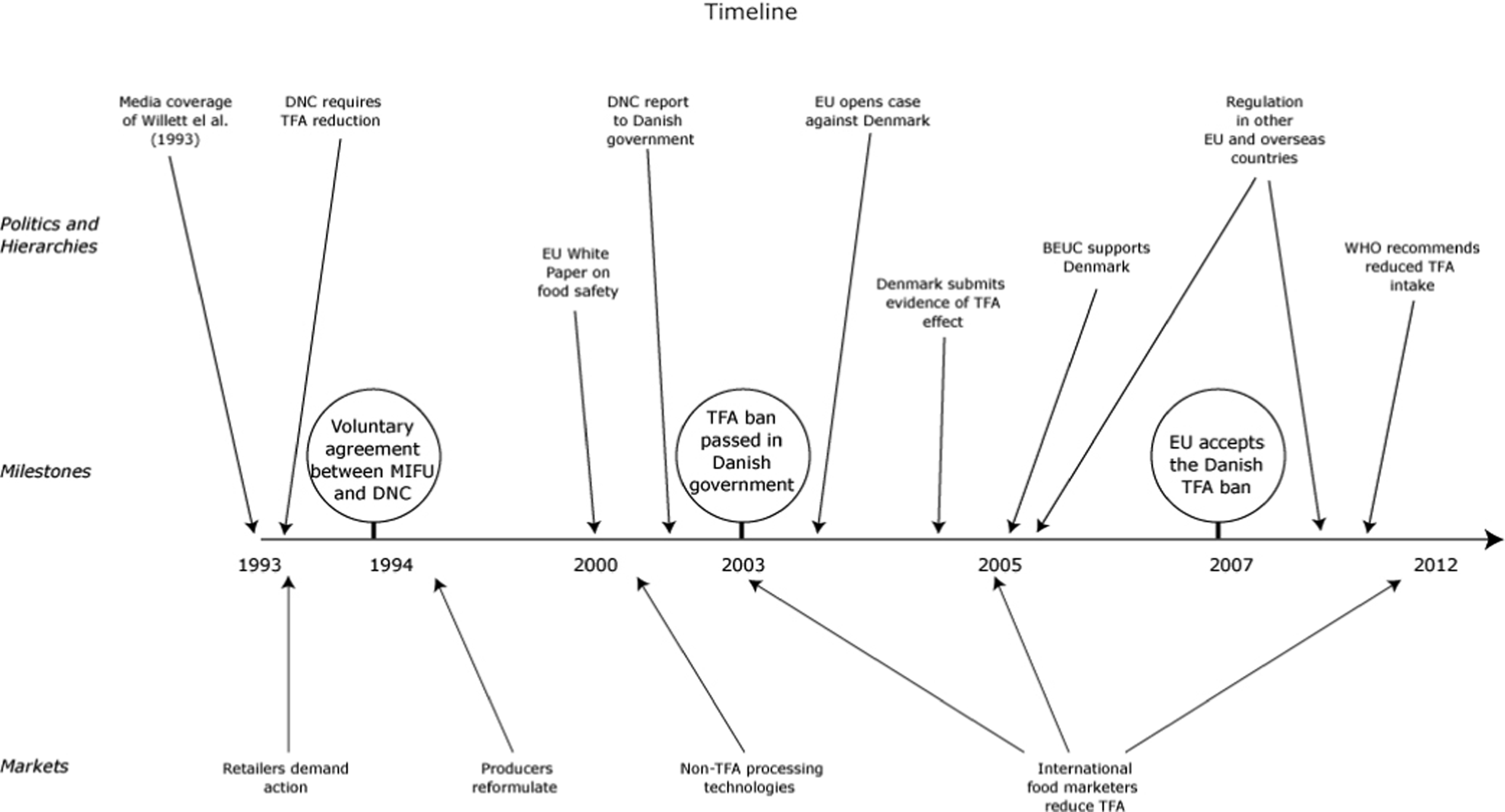
Timeline of Danish trans-fat regulation.
The Danish interviewees consistently emphasized the intense Danish media coverage in the wake of a Lancet article on trans-fat consumption and coronary disease (Willett et al. 1993) as the driver of the process that ultimately led to a voluntary TFA reduction and then the trans-fat ban ten years later. What stimulated the attention of the Danish media to the Lancet article is not clear but presumably a nutritionist or another expert with good media relations could have sparked such interest. The Lancet article likely aroused similar concerns in other countries, but the actions subsequent to the media coverage were particular to Denmark.
The issue of trans-fat-related health risks had appeared on the agendas of both nutritionists and margarine producers prior to 1993, but such activities gained pace after the new documentation was disseminated to the general public. In an ensuing major event, the Danish Nutritional Council (DNC)—a non governmental organization composed of Danish nutritionists and cooperatively financed by the Danish Government and industrial actors—issued an emergency call for a meeting to discuss how to react to the new evidence. The decision reached at the meeting was to require the six members of the Margarine Producers Association (MIFU) to voluntarily decrease TFA contents in their products. Larger Danish food retailers followed suit, and MIFU promptly conceded. Yet, the Danish Dairy Board, 1 an important sponsor of the Nutritional Council, competed directly with MIFU. Although acknowledging the interests of the Danish Dairy Board, the management of the Nutritional Council maintained that the initiative for the emergency call had originated with it, not the dairy producers.
Regardless of who called the meeting, media coverage of the Lancet article meant that 1993 sales of margarine, which had already experienced a recent downward trend, dropped further. Danish margarine producers moved to invest in technologies that could eliminate or significantly reduce TFAs in their products; the available trans-fat-reducing technology had existed for several years but was very expensive, and removing TFAs created quality (mouth feel and melting point) problems for some industrial customers (e.g., bakeries). Within a few years, by expending substantial development costs, margarine producers solved these problems. Thus, by 2003, when the Danish Parliament passed the maximum TFA limit at 2 percent, Danish margarine producers already complied with these standards and were willing to support the regulations. Danish suppliers of the margarine processing technology also had been involved in the development of the TFA-reducing technology, and they perceived export potential if the ban diffused internationally. Enzyme-assisted interesterification (known as LipolaseTM produced by the Danish company Novozymes A/S) offered a new alternative to traditional, TFA-producing hydrogenation technologies. In its 2001 annual report, Novozymes quoted a research director who expressed the belief that enzymes would overcome traditional hydrogenation in the manufacture of margarine, because health authorities and consumers worldwide increasingly would become aware of the health risks associated with TFAs, and because enzymes were competitive in price.
From Voluntary to Mandatory Regulation
As Segerson and Miceli (1998) suggest, voluntary agreements can be an alternative to or a first step toward public regulation. Prior to 2001, the Danish Government had taken no direct action about TFAs, and then in 2001, the Minister for Food Ritt Bjerregaard (perhaps after reading the EU food safety White Paper of 2000, though the source is not clear) requested a new review of trans-fat-associated health risks from the Danish Nutrition Council (Ernæringsrådet 2001), which concluded that since 1993, when the voluntary agreement with MIFU was adopted, evidence of the influence of TFA on cardiovascular diseases had been further substantiated. Even though TFAs in most margarines produced in Denmark had been reduced to below 1 percent, trans-fat remained substantial in various processed foods, such as cakes, biscuits, crisps, and fast food. Most of these foods were imported (including through parallel marketing systems, such as kiosks), which reflected the complexity of regulating food safety through voluntary agreements alone. The Nutrition Council thus voiced concerns about the health risks for overweight consumers of these products and recommended the adoption of mandatory standards (Ernæringsrådet 2001).
After a change in government administration in 2002, Mariann Fischer Boel became Danish Minister for Food (later, EU Food Commissioner) and took over the promotion of trans-fat regulation in both Danish and European contexts. As one of the interviewees for this study, Fischer Boel noted the strong evidence of TFA-associated health risks, as reported by the Nutrition Council, as the main reason for the Danish Parliament’s unanimous and speedy regulation, which was based on the general Danish food legislation (Act no. 471, July 1, 1998) and came into force as of January 1, 2004.The Danish trans-fat ban meant that the regulation of TFAs extended from voluntary agreements that only included oils and fats produced by national companies to all foods produced and marketed in Denmark.
In addition to evidence of TFA-associated health risks, the interview analysis revealed that passage of the Danish TFA legislation in just a few months had been facilitated by the consensus about the central topics among the most powerful stakeholders in the Danish food marketing system. This consensus related not only to the alignment of commercial interests and food safety aims but also to the general political sentiments of the Danish constituency. Therefore, the resolution of the regulators and the speedy legislative process appeared strongly influenced by negative EU sentiments—particularly skepticism toward European food safety legislation—among significant segments of the Danish populace. For example, 2003 EU legislation earned the derisive nickname “the food make-up directive” in the Danish media, because it allowed twice the concentration of nitrites, nitrates, and sulphites in meat compared with existing rules in Denmark. With the argument that despite their promise for prolonging the shelf life of foods, these substances appeared potentially carcinogenic, the Danish Government appealed the directive to the European Court. In March 2003, the Court ruled partly against the Danish appeal (accepting lower Danish maximum standards for nitrate and nitrite but not for sulphite), causing another great stir in the Danish media.
International Diffusion of the Trans-Fat Regulation
In 2004, the EU Commission claimed that as a result of the trans-fat ban, Denmark had failed to fulfill its obligations under the terms of the EC Treaty Articles 28 and 30 (free movement of goods), so the EU took initial steps toward prosecution in the European Court of Justice. Referring to evidence about the harmful effects of TFAs, the Danish Government refused to change its national legislation. Then in April 2006, the EU suggested a TFA limit of 10 percent. But in June, a European consumer organization offered support for Denmark’s position when it urged the Commission not to interfere with the Danish regulations but instead to implement similar regulations across the EU. The Commission accepted the Danish arguments by March 2007 and dropped the case, though it took no steps to create EU-wide adoption of the Danish regulation. Some individual European countries, including Switzerland and Austria (BMG 2009), have adopted legislation similar to the Danish law, and still other EU member countries are considering whether to follow suit. Yet, most European countries, including the United Kingdom and Germany, continue to rely on voluntary agreements to reduce TFAs.
The United States has no federal maximum limit for TFAs (Remig et al. 2010), though the US Food Drug Administration requires that “Nutrition Facts” panels on all food packaging include information about the amount of trans-fat per serving. Products containing less than .5 g per serving may claim that they contain no trans-fat. Several states and cities, including California (in 2008) and New York City (in 2005), have declared partial bans. Media coverage of the debate leading up to and following the implementation of these regulations frequently cited the Danish legislation and the ease of its implementation in prominent pro-ban arguments (see Adams 2010). For example, The New York Times published an article that featured multiple interviews with and comments from the Director of MIFU (Frederik Madsen) and the President of the Danish Nutritional Board (Steen Stender).Other non-European countries, such as Australia and Canada, have fully or partly banned the use of TFA in food, though industrialized countries continue to rely on voluntary regulation. The government of Singapore even published a list of reasons not to regulate or inform consumers about the contents of TFAs in processed foods. Again, these TFA debates tend to feature news media that refer to the Danish ban.
Although producers of cooking oils and processed foods in Europe that accept voluntary TFA limitations use the same technologies as their Danish counterparts, no legislation prohibits them from accepting large quantities of TFAs in imported foods. The UK Food Standards Agency (2007, p. 1) has asserted instead that compulsory reformulation to reduce trans-fats could increase saturated fat levels in food and that “Unlike Denmark which identified in 2000/2001 very high levels of trans fats in popular foods on the Danish market, voluntary industry action has reduced artificial trans-fat levels in food and UK average dietary intakes dramatically.” Similar questions have been raised by some nutritionists who wonder if replacements for TFAs are really better for consumers’ health (e.g., if saturated fats replace trans-fats; EU Commission 2010; Ratnayake, L’Abbe, and Mozaffarian 2008).Thus, despite the example set by the Danish ban, the steps taken in other countries appear mainly to represent responses to increasing proof of the detrimental effects of TFAs. A WHO/FAO report (2008) now recommends that trans-fat intake should not exceed 1 percent of total calorie intake. In another report, WHO (2010) recommends that foods containing TFAs should not be marketed to children.
Effects on Food Reformulation and Health
According to Leth et al. (2006), TFA content in margarines and shortenings has steadily declined from about 10 percent in the 1970s to practically none in margarines by 1999. After the Danish regulation took effect in 2004, TFA contents in processed foods that originally had very high TFA contents, such as French fries and microwave popcorn, had been reduced to such a low level that consumption of TFA from processed foods was no longer significant in Denmark. As an illustration, Stender, Astrup, and Dyerberg 2008) showed that a serving of McDonald’s French fries and chicken nuggets in New York City contained 10.2 g of TFAs, while the same meal in Denmark contained just .33 g of trans-fat. In an unpublished study, these authors also find that current trans-fat contents in margarines in most Western countries is less than 5 percent, but in Denmark, the content is less than 1 percent (Stender, Dyerberg, and Astrup 2010; also see Kuhnt et al. 2011). In some less-developed countries, the content is closer to 35 percent.
However, even with increasing evidence that excessive TFA intake is a significant risk factor in terms of cardiovascular diseases and sudden cardiac death (WHO 2008) and decreasing levels of TFAs in processed foods, resulting from either voluntary or mandatory regulation efforts, it remains difficult to provide that the changes have had any notable effect on the health of the general population. The Danish Ministry of Interior and Health reports that cardiovascular diseases and cardiac deaths have dropped significantly since the TFA reduction process was initiated in 1993 (Stender, Dyerberg, and Astrup 2010), but these improvements may relate to multiple factors. As many countries achieve similar results and offer varying explanations for this development (including greater intake of cholesterol-reducing medicine), no evidence confirms that the health improvements are a consequence of reformulations resulting from voluntary and mandatory TFA regulations.
Effects on Competitive Dynamics
In the early twentieth century, Denmark contained more than 100 small margarine producers (Cohn and Skade 1933), but the 1970s saw a major consolidation of the industry. In 1993, when the MIFU members voluntarily agreed to decrease the trans-fat content in their products, only six were left. As of 2011, these six margarine producers remain in Denmark, so it appears unlikely that the costs incurred by the regulation significantly intensified concentration in the industry.
From this historical perspective, it becomes interesting to acknowledge that TFAs result from the hydrogenation of vegetable oils, a process that was invented to compensate for shortages and price increases of butter due to rising demand during the Industrial Revolution, world wars, and postwar periods. In much of the world, especially newly industrialized countries, the presence of TFAs in margarine and other processed foods today both involves issues of health-related food safety but also helps secure a safe supply in the broader sense of the term (Charlebois and Labrecque 2009).
In the United States, most food manufacturers have responded to the federal labeling rules by reducing the trans-fat content in their products to .5 g or less (Remig et al. 2010) or recommending small servings (Adams 2010), which enables them to make a “0 g trans-fats” claim. For some of them, reducing TFA contents demanded significant investments and cost increases though (Unnevehr and Jagmanaite 2008). When Kraft Foods faced a lawsuit, it quickly invested 30,000 person hours in 125 plant trials to reformulate its signature Oreo cookies without trans-fats (Unnevehr and Jagmanaite 2008).When Walmart (2011) announced that it will stop selling all industrially produced TFAs by 2015, this further heightened the development toward reducing TFA contents in foods marketed in the United States
The interviews and secondary data collected for this study similarly reveal that Western European and US producers of oils, fats, and processed food shave reformulated their products to meet retailers’ demands and countries’ individual standards. In the latter case, many of these standards have been influenced by the original Danish rules. Ownership of some Danish margarine factories by multinational food companies, such as Unilever, also likely has stimulated the international diffusion of reformulated foods. For example, though it owns no Danish margarine factories, Nestlé has indicated it was influenced by the Danish TFA regulations, and its TFA policy came out in 2003, the same year as the Danish ban. Although initially, the limits set by the Danish ban were stricter than Nestlé’s policy, the company later changed its policy to match the Danish limits. Similar to the interviewees who represented Danish margarine producers, the Nestlé representative reported notable investments and development costs to reduce the TFA content of its products. Nestlé also has worked intensively with suppliers, without jeopardizing the organoleptic qualities of its end products. Unlike most other European food producers, Nestlé has not chosen a defensive promotion strategy in relation to TFA reductions but instead has positioned itself as a leader in the elimination of TFAs, though Nestlé also is in the business of using animal oils and fats. In those that originate from ruminant animals, TFAs cannot be extracted easily. Therefore, companies in this sector also are working to communicate the idea that TFAs in products from ruminant animals are less unhealthy than those produced through hydrogenation of vegetable oils.
Discussion
The objectives of the study reported above were to investigate (1) how the Danish TFA ban came into being in an environment supposedly opposed to compulsory regulation, (2) to which extent and how food reformulation and marketing have been affected by the TFA regulation, and (3) whether and how the Danish ban has influenced TFA regulation in other European and overseas countries. Below the findings are summarized and a number of implications for food marketers, public regulators, and macromarketing researchers are discussed.
The preceding analyses have revealed that the proactive resolution of the DNC and the Danish Association of Margarine Producers (MIFU), together with demand from Danish retail chains, paved the way for voluntary agreements about trans-fat reductions and then the implementation of the 2003 ban of TFA—the first compulsory nutritional standards imposed in Europe (joined later by bans in Austria, Switzerland, and Iceland).The main reason for the implementation of the ban was substantial proof of TFA-associated health risks. In this sense, the Danish TFA regulation offers an example of the risk-based safety policies now being promoted in both Europe (Holm and Halkier 2009) and the United States (Promar 2010). But the analysis also reveals that the speedy approval and implementation of the Danish TFA legislation came about because of the consensus on central issues and aligned interests among the most powerful stakeholders. In other words, although the corporate world is generally opposed to compulsive regulations, the TFA ban represented a case where such a regulation was also acceptable or even beneficial to many of the important commercial players in the Danish food marketing system.
As regards the question on to which extent and how food reformulation and marketing have been affected by TFA regulation, the study have identified various sources documenting a reduction of TFA content in food distributed on the Danish as well as on other markets. The interviews also observed, and confirmed, however, that most food processors, who have reduced the TFA contents in their products, have followed a defensive promotion strategy in relation to the TFA reductions—this even when these have demanded significant investments and cost increases.
The pitfalls of regulatory initiatives are innumerable, and failures of compulsory regulations are more difficult to remedy than failures resulting from voluntary measures (Carman and Harris 1986). Therefore, there is ample motivation to apply a macromarketing perspective to analyses of the potential impacts of alternative regulatory instruments that might help prevent a particular food safety risk.
For food marketers, the main challenge is to identify proactively, and then reduce, consumer risks. Using a macromarketing perspective to analyze and influence national and supranational food safety regulations is one way to do so. For example, from a macromarketing perspective, food researchers and regulatory authorities might cooperate with national and international competitors and partners to implement voluntary standards. The specification of such standards could influence or even define national and international standards for later mandatory regulations. Thus short-term cost increases may lead to long-term advantages in both national and international food markets.
For national and supranational authorities, despite their experience conducting supply oriented studies of agricultural marketing systems (see Layton 2007), the application of a macromarketing perspective to design and implement different types of food safety regulation is a new concept. To facilitate their analysis and increase the speed of acceptance of regulatory standards, policy makers should analyze how alternative regulations affect both current and potential stakeholders in the marketing system (Gadde and Mattsson 1987).In addition to the “usual suspects,” such as organizations and food producers directly affected by the regulatory initiatives, policy makers would need to round up other stakeholders, such as suppliers of the processing technology, producers of food substitutes, nongovernmental officers and nutritional researchers, even if they are not as directly affected. Such an extended view of the marketing system and its institutions, involving a consideration of the workings of the three types of coordination mechanisms of: markets, politics, and hierarchies (Arndt 1981) also might offer new perspectives on the most efficient regulatory designs and allow for better predictions of the long-term influences of different regulatory alternatives on the food marketing system (Gadde and Mattsson 1987). In principle, food marketers could follow a similar approach. However, although the “marketing mindset” inherent to commercial stakeholders may make such an approach more appealing to commercial than it is to regulatory stakeholders, only larger food marketers and perhaps trade and lobby associations are likely to have the resources to undertake this effort.
For public and private stakeholders, the application of a macromarketing perspective involves both short- and long-term assessments of the impacts on society and the marketing system. For some issues, voluntary agreements are sufficient to limit consumer risk but also account for the interests of marketers. In other cases, mandatory regulation may be warranted. As illustrated by the Danish trans-fat regulation, voluntary agreements, by granting commercial stakeholders more time to cope with challenges associated with technological and competitive changes can pave the way for wider acceptance and implementation of mandatory regulations. When considering choices between different types of regulation, public regulators should assess the interests of the different stakeholders, as well as complementarities across different marketing system flows, such as ownership, possession, finance, risk, and information (Hunt 1981). In some marketing systems, the complementarities between the flow simply a sufficient reduction of consumer risk through the use of financial or informational measures. Other marketing systems, with lower levels of complementarities, may demand regulations or bans on the possession of a certain product or ingredient.
According to the study reported in this article, the Danish TFA legislation clearly has influenced regulatory initiatives in other European and overseas countries. Furthermore, whereas once countries’ varying beliefs about public health principles and risk created substantial national differences in food safety standards (Charlebois and Labrecque 2009), the internationalization of food marketing systems has minimized such differences. In Europe, the requirement for greater harmonization of nutrient and food safety standards remains at odds with the involvement of national stakeholders and sensitivity to local and national specificities (Stirling 2008). Some observers even argue that food safety is at greater risk because of the globalization of food marketing systems (Carruth 2006). However, the globalization of food safety standards also can have positive effects. The very influence of the Danish TFA regulation on the implementation of safety standards and labeling schemes in other countries means that globalization does not always lead to the lowest common denominator in safety standards. New food safety policies in Europe and the United States suggest that the globalization of marketing systems could lead to higher international standards of food safety (Charlebois and Labrecque 2009).
Whether resulting in higher standards or not, what is certain is that the new policies and the international diffusion of food safety regulation as well as other regulatory initiatives pose a new set of challenges for marketers, politicians, and bureaucrats—and hence also for researchers in macromarketing. The analytical framework presented and applied in this paper contributes to the field of macromarketing by documenting an example of risk-driven food safety regulation, originating in Denmark, that has affected regulatory initiatives, safety standards and food reformulation worldwide. Denmark is a small country with an insignificant food market, but its high level of political and economic integration into the structures governing international food marketing systems led its TFA ban to exert significant effects. These findings supplement research on market-driven diffusions of regulatory standards (i.e., the California effect in Vogel 1997). Adopting similar terminology and referring to the different influences of the three types of coordination mechanisms of: markets, politics, and hierarchies (Arndt 1981), this study suggests that further research into the international diffusion of regulatory standards should investigate the potential of “the Denmark effect,” by exploring other examples of regulatory diffusions which are driven more by politics and hierarchies rather than by markets.
By doing this, and by applying and improving the analytical framework presented in this article, researchers in macromarketing may further the understanding of the implementation, implications, and international diffusion of regulatory initiatives, whether related to food safety or to other marketing systems and/or issues (e.g., environmental sustainability). A possible way forward is to integrate the analyses of the institutional mechanisms of hierarchies and politics with market-based models of the international diffusion of innovations (cf. Arndt 1981) and/or with models of stability and change in network relationships (Gadde and Mattsson 1987).
Footnotes
Appendix A
Acknowledgment
Terrence Witkowski, the editor of this journal, guided the authors well on improving the manuscript.
The author(s) declared no potential conflicts of interest with respect to the research, authorship, and/or publication of this article.
The author(s) disclosed receipt of the following financial support for the research, authorship, and/or publication of this article: Research was supported by a grant from the European Commision (grant no. 226713).