



Abstract
Brands are ubiquitous and adorn contemporary marketing systems. Modern branding practices spawn contradictory social mechanisms, value co-creation and value co-destruction. This paper considers the societal implications, including personal, psychological, social, ecological, and economic consequences of branding. It posits brand externalities as meaning-led discrepancies and symbolic spill-overs igniting mechanisms detrimental to the integrity of the social system. Brand externalities accompany the assortment of brands in contemporary marketing systems. We propose a taxonomy of brand externalities and elucidate societal consequences of branding upon brand exchange actors themselves, their immediate others, future others and general others. This stakeholder orientation sets a future research agenda and calls for redefining branding from the system’s perspective.
Keywords
Introduction
Macromarketing is the study of exchange systems (Meade and Nason 1991). Market failure occurs, to some extent, in every market exchange (Harris and Carman 1983). Though market failure occurs for many reasons, its ubiquity indicates inefficiency and imbalance in the goal achievement of exchange actors leading to, often unforeseen and undesirable, consequences. The social consequences of marketing (Nason 1989) and externalities (Mundt 1993) are not new to macromarketing, but brands have received little attention, despite branding ubiquity being recognized (Keller and Lehmann 2006; Levy and Luedicke 2013; O’Reilly 2006).
Conejo and Wooliscroft (2015a, p. 287) defined brands as “semiotic marketing systems that generate value for direct and indirect participants, society, and the broader environment, through the exchange of co-created meaning.” Brands are socio-cultural phenomena (Heller and Kelly 2015) and symbolic structures of the marketing system (Kadirov and Varey 2011). Layton (2015, p. 306) recommended that macromarketers recognize “the significance of meaning and symbol generation in the study of marketing system formation, growth, and adaptation.” Brands are commodified meanings (Hatch and Rubin 2006; O’Reilly 2006), and dissemination of meaningful information is associated with both positive and negative externalities (Bomsel 2013).
Brands are known to provide opportunities for sellers and buyers and contribute to the quality of life (Chevalier and Mazzalovo 2003). The critical paradigm of branding research, on the contrary, extensively criticizes contemporary branding practices; it articulates that brands pose social consequences characterized by, often adverse, market trade-offs (Schroeder 2017). Brands may be at the center of concerns like the hidden costs of human choices (Laczniak 2017; Nason 1989), miscalculations in exchange equations (Mundt 1993), market imbalances due to changing assortment diversity (Layton and Duan 2015), social mechanisms generated by field participants (Layton 2015), macromarketing ethics and distributive justice (Ferrell and Ferrell 2008), and lack of sustainability in marketing systems (Peterson 2012). These concerns necessitate a study of the social impacts of branding from the system’s perspective. While this paper analyses literature from economics, marketing, and branding, it extends the extant conceptualizations of brands and externalities to evaluate the societal consequences emerging from branding practices. The objectives are to: propose a taxonomy of brand externalities, establish contemporary branding as a macro-system’s phenomenon, and develop an agenda for future research.
The “social externalities” that impact people are an essential macromarketing concern (Fisk 1981, p. 5). The taxonomy of brand externalities draws a symbolic path dependence among stakeholders over time and space in a brand system. It demarcates the ethical choices from the systemic anomalies emerging from branding. This paper views the brand-society relationship in a new light and builds a foundation to redefine the managerial practice of branding from the system’s approach. In doing so, this paper contributes new perspectives for better governance in contemporary brand systems, addressing moral and ethical dilemmas, concerns of distributive justice and sustainability, and complex choices encountered by public policy makers.
Dynamics of Contemporary Branding
To exhibit the societal consequences from contemporary branding, brands are positioned into three dominant perspectives: as marketing systems, as an agency for value co-creation, and an agency for value co-destruction.
Layton (2015) described that system stakeholders bring certain social mechanisms into action when individual micro-marketing systems form. These social mechanisms, may be positive or negative, often fail in optimizing value for the macro-system. Brands can be viewed as micro-systems, in the complex network of meso- and macro-marketing systems. They have the potential to trigger social mechanisms like value co-creation and concurrently, value co-destruction (Bertilsson and Rennstam 2018). A brand system, like Layton’s (2007) marketing systems, can be defined as a micro-system of semiotic assortments encompassing social mechanisms like value co-creation and/or co-destruction. These social mechanisms are generated by system stakeholders (brand exchange actors and non-participating stakeholders) within branding-action fields.
Dominant Conceptualizations of Brands.

Brands are social and perceptual processes (Berthon and Pitt 2018). Contemporary branding literature regards a brand as a platform for mediation of marketplace interactions (Askegaard 2006; Bertilsson and Rennstam 2018) and a dynamic socio-cultural phenomenon that attunes multiple stakeholders co-creating brand value (Brodie, Benson-Rea, and Medlin 2017; Merz, He, and Vargo 2009). This is in line with the stakeholder-unifying, value co-creation philosophy (Lusch and Webster 2011; Vargo and Lusch 2004) and the organic view of the brand (Iglesias, Ind, and Alfaro 2013).
Brand value, co-created within the micro-domain of consumers and firms, aggregates at the macro-level and articulates social benefits. Hilton (2003) argued that while branding empowers the non-profit sector to advance social value, it produces social surplus even through the commercial sector. Branding establishes public and non-profit organisations as social arbiters, strengthens stakeholder relationships, expedites access to charity and donations, enables provision of social services and serves a reliable and credible platform, with no commercial gains, for positive social change (Leijerholt, Biedenbach, and Hultén 2019; Stride and Lee 2007).
Commercially, brands garner income and growth certainty for firms, foster sustainable levels of employment and wealth creation, and contribute to the economic growth (Corrado and Hao 2014). Brands stimulate socially beneficial innovation and improve individual and community life (Brexendorf, Bayus, and Keller 2015). Higher brand value puts greater pressure for corporate social leadership and responsibility, harnessing positive social change. Brands are “a great ally of social progress” and promote social cohesion nationally and globally, “by enabling shared participation in aspirational and democratic narratives” (Hilton 2003, p. 48).
Criticism on Branding Practices.
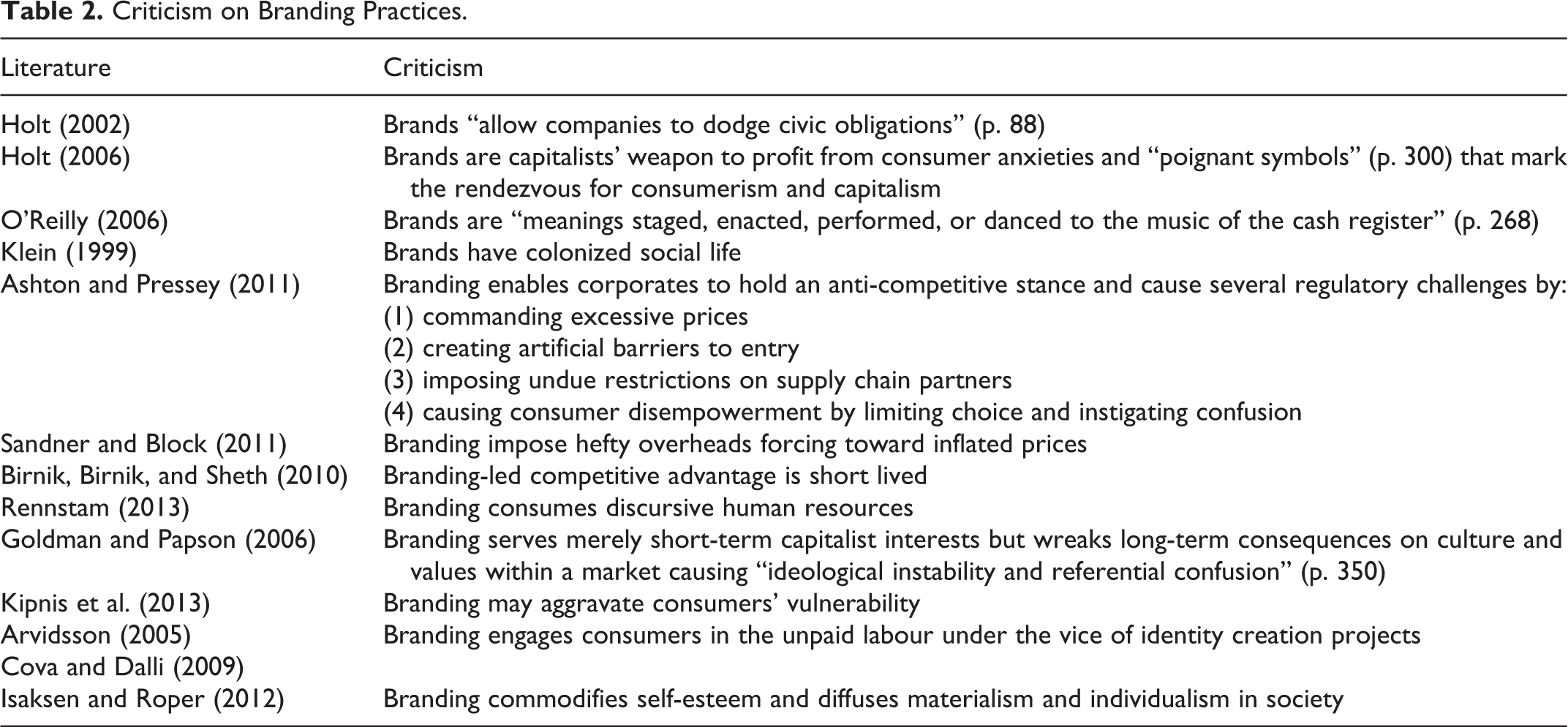
Branding may destroy civic and social values through discursive closure and organized hypocrisy (Bertilsson and Rennstam 2018). Dove’s campaign for real beauty was denounced for discursive closure as it supposedly attempted to conceal corporate aims by associating social problems with the corporate image (Bissell and Rask 2010; Murray 2013). McDonald’s was accused of hypocrisy when it expanded into hospitals promoting a high in fat, sugar, and salt diet within sick children’s spaces (Botterill and Kline 2007). Similarly, HSBC investing in an organization accused of causing deforestation while claiming to be concerned about the planet was hypocritical (Woolley 2010). These examples reflect value-destruction for society and spark anti-brand activism.
Anti-brand sentiments and consumer resistance spur an ideological tension in the consumption system (Kozinets and Handelman 2004), contributing to value-destruction. Such value co-destruction demands new conceptualizations of brand authenticity (e.g., Kadirov, Varey, and Wooliscroft 2014) and poses a challenge for firms and society.
The parallel brand conceptualizations put branding at the heart of the problem. Authorities find it difficult to objectify branding and regulate brand misconduct (Ashton and Pressey 2011). Value co-destruction predominantly highlights a gap in marketing theory and branding practice. Concerns like corporate social responsibility (Torelli, Monga, and Kaikati 2012), branding and sustainability (Dauvergne and Lister 2012), conscientious corporate brands (Rindell et al. 2011) and social and consumer well-being (Kipnis et al. 2013) repeatedly appear without conceptualizing brand externalities. This gap offers an opportunity to explore the externalities branding inflict upon society, addressing the phenomenon from a system-wide stakeholder perspective, at the micro- and macro-level.
Externalities
Externalities are addressed in several ways in macromarketing literature (see Table 3).
‘Externalities’ Concepts in Macromarketing.

Economists restrict the concept of externalities to the effects of exchange on parties external to the price mechanism (Baumol and Oates 1988; Hartwick and Olewiler 1986). In macromarketing, Nason (1989) and Mundt (1993) argued that externalities could accrue to the exchange actors too. Exchange and externalities are fundamentally tied, and this paper builds on the inclusive idea of externalities to understand the hidden costs of human decisions in the contemporary brand system. Externalities, occurring in production and consumption situations (Hartwick and Olewiler 1986), are the uncalculated costs and benefits of exchange, accruing to the transacting parties themselves and/or parties external to the transaction (Mundt 1993; Nason 1989).
In economics, externalities are shown to emerge from poorly defined property rights (Baumol and Oates 1988; Demsetz 1964). Dahlman (1979) states that transaction costs, encompassing imperfect information, are the exclusive source of externalities, and all potential exchange interactions involve some transaction costs (Buchanan 1973). A principle social cause of externality is the dominant market mentality (Swaney 1981), where the individuals’ responsibility to themselves supersede their responsibility to society (Wheaton 1972). Marketing theory agrees with the social and individual goal conflict as consumer behavior is primarily “guided by the principle of self-interest” (Nason 1989, p. 244).
Bator (1958) identified that many externalities are like public goods. They possess a common property characteristic and joint consumption interaction (Buchanan 1973). This led to categorizing externalities as public and private based on their undepletable and depletable nature, respectively (Baumol and Oates 1988; Hartwick and Olewiler 1986). Private externalities are typically found in the dyadic micro-exchange. They do not spill over to a large scale and barely constitute policy implications. Public externalities, causing public bad, are macromarketing issues and major policy concerns.
Traditionally, economists classify externalities as technological (non-pecuniary) and pecuniary (Baumol and Oates 1988; Scitovsky 1971). Technological externalities are the direct effects of the actions of economic agents on the utility of other economic agents, whereas pecuniary externalities occur through the price mechanism or transactional links. Scitovsky (1971) offers a comprehensive typology of technological externalities useful in understanding their differential nature and analyzing their micro- and macro-implications. Several commonalities can be deduced from the economic and marketing conceptualizations of externalities (see Table 4).
Economic and Marketing Conceptualizations of Externalities.

Capacity externality results from the limited capacity of resources in the short term, e.g. an overcrowded theatre due to the fixed seating capacity (Scitovsky 1971) or the road congestion due to the limited capacity of a highway (Verhoef 2002). This externality personifies the externality producer simultaneously as the externality consumer. Nason’s (1989) foreseeable and unforeseeable first-party effects somewhat overlap capacity externalities where imperfections in market structure, information, and analysis cause transacting parties to suffer.
Nuisance externality is the neighborhood effect where the externality is inflicted upon third parties and citizens around the transaction. Mundt (1993) identified neighborhood citizens as second parties and identifiable third parties, for example, externality from smoking affecting non-smokers. This externality relates to Nason’s (1989) foreseeable third-party effects and occurs from the lack of goodwill and welfare concern for immediate others. Since these externalities are usually foreseeable, they receive the most attention when disregarded by transacting parties.
Supply externality is the long run counterpart of capacity externality. It results from using non-renewable resources, the fixed capacity of which in the long run, would inflict undesirable consequences on future others. The existing generation obtains benefits from the non-renewable resources at the cost of the welfare of all future generations.
Environmental externality combines capacity and supply externalities and refers to the infliction of present and future generations as the aggregated society in the short and long run, e.g., air and water pollution, climate change, ill-effects of technology explosion, etc. It results from the lack of concern for general others and constitutes the harsh reality of modern-day excessive consumption culture (Wooliscroft and Ganglmair-Wooliscroft 2018). These effects are the aggregation phenomenon. They emerge from the physical and/or social interdependence of economic agents generating new complexities which are inconceivable from the micro-analytic theory (Krupp 1963). Nason (1989) addressed supply and environmental externalities as the indirect effects to all others, including foreseeable and unforeseeable effects. Their root causes include aggregation of micro-transactions, a shift in the social values and morals, and changes in the economic and technological environments (Mundt 1993; Nason 1989).
Micro-Macro Relationship of Brands and Society
Macromarketing literature identifies that dyadic, micro-level interactions, activities, and decisions of stakeholders aggregate into complexities at the macro-level (Bone and Corey 1992; Redmond 2018; Rittenburg and Parthasarathy 1997). Branding is one such activity produced and consumed supposedly within the firm and consumer dyad without any regard to its (dys)functional consequences on society.
Brand externalities reflect a symbolic path dependence among stakeholders beyond the brand exchange dyad. The symbolic path dependence in brand exchange proliferates minor influences into macro-social mechanisms over time and space. These social mechanisms establish brand externalities as a system’s phenomenon due to the interdependence of social actors and the aggregation of the individual attitudes, beliefs, and behaviors.
Externalities are frequently described as a system’s problem (Laczniak 2017; Meade and Nason 1991). Krupp (1963) argued that externalities are a function of aggregates emerging beyond a boundary. Callon (1998) takes a similar stance and explains externalities, as overflows, from a sociological perspective. The overflows emerge as a failure in the framing process where either it is impossible to frame the behavior (virtual impossibility of assigning property rights), or the frame is purposefully transgressed by agents involved (disregarding the welfare of others).
Bertilsson and Rennstam (2018) produced an inter- and intra-world critique on branding. Brands create value in the market world, but the spill-over sabotages value in the same (regarded here as brand congestion) or other worlds of fame, industrial, civic, domestic, inspired, and green worlds (as other brand externalities). Mittelstaedt, Kilbourne, and Mittelstaedt (2006, p. 131) stated, “The actions of market participants have consequences far beyond the boundaries of firms.” Brand externalities link contemporary marketing systems (market world) with stakeholders beyond the system (in other worlds) and acknowledge the symbolic path dependence in brand exchange.
Fournier (1998, p. 366) argues that brands holistically articulate their relationship with consumers both at the micro- and macro-level and stresses the “consideration of the larger whole in which that [consumer-brand] relationship is embedded.” Brands are cultural resources (Holt 2002), a culture cynosure (Diamond et al. 2009) that leave impressions beyond the scope of the marketing system into the wider context of the economy, society, culture, and even the global ideoscape (Askegaard 2006).
In line with Kadirov and Varey (2011) and Conejo and Wooliscroft (2015a), it is asserted that brands are semiotic marketing systems or symbolic characters of marketing system assortments, and brand externalities are the symbolic spill-overs accompanying brands within marketing systems.
Contrasting Product and Brand Externalities
The idea that brands go beyond the product is well established (Brodie, Benson-Rea, and Medlin 2017; Iglesias, Ind, and Alfaro 2013; Kornum et al. 2017; Merz, He, and Vargo 2009). A brand is “a mental representation” (Stern 2006, p. 219), residing in consumers’ brand schema (Berthon and Pitt 2018), emotionally and cognitively coded in memory (Gordon 2002), as an associative neural network, an engram (Batey 2016). These conceptualizations dematerialize the brand from its material assortment, contingencies, and hybrids (Manning 2010). “Brands have transcended products” (Conejo and Wooliscroft 2015b, p. 393), and so do the externalities originating from them.
A distinct contrast between product and brand externalities may not always be possible, but there are two attributes that differentiate between them. The first relates to brand semiotics and symbolism, and the second is the interaction effect that encompasses the extent of product externalities in the context of branding.
Research has largely ignored the externalities emerging from the relational, cultural and social processes that cultivate subjective brand meanings. While brands are consumption objects, like commodities, they are suffused with social and cultural expression (Heller and Kelly 2015; O’Reilly 2005). “The social and expressive value of these marks [brands] can create externalities that overstep the marketplace of goods, and instead spill over into the marketplace of ideas” (Katyal 2010, p. 1621).
Brand externalities are symbolic and expressive influences distinctly evident in pharmaceutical brands. Pharmaceutical brands provide greater learning opportunities and objectivity to evaluate products in terms of efficacy, side effects, contraindications etc. Within a therapeutic class, consumers’ (physicians’ and/or patients’) preference for Zantac (as opposed to Tagamet, Axid, or Pepcid), despite similar therapeutic (functional) effects, is attributed to brand-specific consumption externality (Berndt, Pindyck, and Azoulay 2003). The behavioural response from the brand stimuli, beyond product objectivity, is a brand externality.
A negative externality, from brand symbolism, may take the form of “emotional harm, reputational damage, or misinformation about a certain group or person” (Katyal 2010, p. 1632). In Australia and France, for example, Starbucks was perceived as a bully of local café culture. The brand violated cultural heritage, communal solidarity, aesthetic and social authenticity, and patronage of local diversity (Bryson and Atwal 2018; CNBC 2018; Patterson, Scott, and Uncles 2010). It ignited communal aversion, even in US, due to the externalities embedded in “the feelings of cynicism, alienation, disenchantment, and disempowerment that could result from the increasingly ubiquitous presence” of the global giant (Thompson and Arsel 2004, p. 639).
The interaction of branding and product externalities, as an aggregation phenomenon, provides another configuration for brand externalities. Brand externality is the experience effect established from brand recognition (Ohe, Shinichi and Kurihara 2013). This experience effect would be lower with a lower brand recognition. Hilton (2003, p. 49) argued that “without brands, producers of consumer goods would have been limited to selling their products to a small pool of local customers.” Branding provides a cultural logic to commodities, often antithetical to the ideals of the commodity itself (Wilk 2006). This cultural logic fosters modern capitalism, an era of excess consumption, that intensifies associated positive and negative externalities (Wooliscroft and Ganglmair-Wooliscroft 2018).
A Taxonomy of Brand Externalities
Brands provide consumption with meaning but perpetrate ramifications on targeted segments, as well as consumers external to the intended domain (Fan 2005). Drawing from the discussion on branding dynamics and externalities, we define brand externalities, under the system’s perspective, as: the discounted system component (brand variable) with no explicit utility value, in an exchange actor’s (consumer or firm)’s brand consumption or production function, over which the actor has no control and the magnitude of which is determined by some other actor or component in the brand system.
Taxonomy of Brand Externalities.

Brand Congestion Externalities
Brand congestion involves first-party effects – the phenomenon concerning self-infliction – where stakeholders, within the brand exchange dyad, influence the brand value for themselves and/or their counterparts intentionally or unintentionally.
Brand congestion stems from network externalities 1 . It shows that brands, like network markets, are limited in their capacity to provide value and meaning to respective stakeholders. It is sub-categorized based on the affected and affecting stakeholders (see Figure 1).

Brand congestion externalities.
Consumer-to-consumer interactions create positive brand externalities when the brand, as an intangible network, has higher brand equity. This phenomenon is manifested when consumers of a brand transpose into a “structured set of relationships” called brand community (Muniz and O’Guinn 2001, p. 412). Consumers seek emotional and psychological fulfillment through peer approval, affective association, and belongingness; and utilitarian fulfillment through sharing information, assistance, and participative rewards. Brand community members share values and ethical surplus, the value “produced by ethics, or by the ability to install affectively significant relations” (Arvidsson 2011, p. 273).
Brand community membership may simultaneously exert negative externalities as consumer-to-consumer brand congestion. Algesheimer, Dholakia, and Herrmann (2005) determined that active brand community engagement breeds normative community pressure. Consumers experience an obligatory burden to publicly comply with the community’s norms, especially if public display of brand acceptance differs from private enthusiasm for the brand. It may cause cognitive dissonance, a mental stress, characterised with reactance and negative behavioural intentions toward membership continuance, participation, recommendation and loyalty. For this reason, subgroups – founders, insiders, regulars and newcomers – identified in NBRO (Nike related community in Copenhagen, Denmark) display different degrees of social ties and conformity to the brand community norms and rituals (Kornum et al. 2017). Active engagement in one brand community intensifies a negative predisposition toward rivals within the community and members of rival brand communities. Consumers may indulge in ridicule, negative stereotyping, derogatory remarks, and trash-talking (Ewing, Wagstaff, and Powell 2013). These behaviors create a negative externality on the social standing of brand consumers themselves, as others may feel repugnant and avoid association with them.
Consumer-to-consumer brand congestion is also manifested as a crowding effect causing dilution of value perceived in brands. Typically, an extensive market presence and higher market share are linked with positive market outcomes (Arthur 1996; Caminal and Vives 1996). Several brands accentuate their leadership position for this reason, e.g., Head & Shoulders claims to be World’s No. 1 Antidandruff Shampoo, and Gillette promotes as The Best a Man Can Get. Contrarily, Hellofs and Jacobson (1999) and Rego, Morgan, and Fornell (2013) reported a negative relationship between market share and consumers’ quality perception and satisfaction, indicating a diminished perceived value. Brand value is often linked with exclusivity. When a brand becomes cliched in the market, the consumer desire for uniqueness and prestige gets violated, and brand utility starts dwindling. Every additional consumer adopting the brand compresses brand value unknowingly for self and other brand consumers (Ewing, Jevons, and Khalil 2009). The market price seemingly fails to reflect a consumer’s marginal brand utility for oneself and other consumers, causing the disadvantage in brand buying and use.
Firm-to-firm brand congestion may also result from consumer interactions. Consumer interactions are not always brand specific and may not result in positive network externalities for innovator brands. Brand-based consumer interactions favor innovators by reinforcing their competitive advantage. The higher expectation of larger network size, due to rising market competition, increases all consumers’ willingness-to-pay. The former monopolist benefits from the stronger effect of consumer willingness-to-pay over the effect of competition entering the market (Economides 1996). This positive externality fosters the competitive position of innovators over followers. Conversely, cross-brand communication among consumers of the product category becomes a positive externality for followers. It reduces their take-off time (Libai, Muller, and Peres 2009), creating a negative externality, a source of congestion, for innovator brands. This mechanism is evident in the success of smartphones by Samsung and other brands following the launch of the iPhone. Similarly, Google achieving brand leadership, despite Yahoo and MSN launched over two years earlier, may also be somewhat attributed to it.
Market fragmentation is another source of brand congestion for firms. Every new brand differentially splits the market, diminishing the perceived difference between brands. It reduces brand value and returns on branding. It also has a chilling effect on the net present value of a new brand. This is due to the influence of the initial wait-and-see scenario of consumers, breeding a slow diffusion of the new brand during the introduction phase, followed by fast growth in later stages (Goldenberg, Libai, and Muller 2010). Congestion from poor financial implications and slow adoption of the innovator brand may threaten their survival duration. It facilitates followers contributing to the higher rate of the innovator failures (Srinivasan, Lilien, and Rangaswamy 2004).
Consumer-to-firm and firm-to-consumer brand congestion broadly encompass effects imposed by brand exchange partners – firms and consumers – on each other. Consumer-to-firm brand congestion occurs when consumers engage in complaining, ridicule, negative word-of-mouth, and other anti-brand actions. It leads to the firm losing more than a group of dissatisfied customers. Similarly, firm-to-consumer brand congestion occurs when corporate actions, undermining ethical concerns, perpetrate externalities on consumers. Corporate actions, like targeting vulnerable consumers, attractive packaging of hazardous products, and decorative packaging for children (Bone and Corey 1992; Rittenburg and Parthasarathy 1997), may result in wider social consequences. Brands, like Benetton and The Body Shop, are blamed for emotionally exploiting vulnerable consumers by utilizing social (external) atrocities in their corporate-image work (Muhr and Rehn 2014).
When corporate interests supersede social citizenship in brand exchange, brand congestion is entrenched. Activities, like disguising brand-sponsored messages as anonymous word-of-mouth in web-based blogs, paid celebrity endorsements as spontaneous word-of-mouth, and using brand pushers to deliver commercial messages as customer-oriented experiences (Magnini 2011), comprise firms intentionally exerting externalities. Wal-Mart (Gogoi 2006), McDonald’s (Siebert 2006), and Dr. Pepper (Kaikati and Kaikati 2004) allegedly disguised brand-sponsored messages in web-based blogs. Sony Ericsson (Martin and Smith 2008) and Blackberry (Osterhout 2010) used brand pushers to get unsuspecting consumers to try the product. Amgen Inc. and Wyeth paid the actress Kathleen Turner to promote a website marketing drug-brand Enbrel (Kaikati and Kaikati 2004). Similarly, using corporate social responsibility as a disguise to conceal questionable corporate activities, like Enron before its demise (Fan 2005), and using emotional appeal as a surrogate for concrete product information (Caccamo 2009), also represent brand congestion. Automobile brands, MG Rover in the UK, Mitsubishi Diamante, and Ford XR8 in New Zealand, increased the likelihood of accidents by inciting young drivers with the adrenaline rush in their brand communications (Jones 2007).
Brand congestion from deceptive branding reduces customers’ individual and social welfare. It propagates negative consequences like dwindling confidence, erosion of trust, denigrated self-esteem, and heightened suspicion in commercial relationships and potential personal interactions (Martin and Smith 2008). The most vocal and enthusiastic brand advocates become the worst misanthropists of the brand (Thomson, Whelan, and Johnson 2012), especially if the brand is highly self-relevant (Johnson, Matear, and Thomson 2011).
Brand Friction Externalities
Brand friction constitutes second-party effects – the social consequences of branding on immediate others – where branding influences subjects, not within the brand exchange dyad, but neighboring it.
The immediate others to brand consumers may include their friends and family, neighbors, colleagues, and others, who are not directly involved in the brand exchange. Brand friction is prominent during interactions between people from different social strata because friendships are often based on belongings causing social discrimination and exclusion. Roper and Shah (2007) reported bullying, teasing, and stereotyping based on brand consumption among children in Kenyan and British schools. Children not possessing the right brands found it difficult to fit in. They were frequently labeled as “poor quality people” (p. 719), “un-cool” (p. 720), and “out-groups” (p. 721). This interpersonal pressure causes inferiority complex and deprives children of the value of community and belonging. It prompts the feeling of resentment in them toward their parents. Parents, in turn, suffer from guilt owing to the victimization of their children. Ritzer (2004) discussed that brands undermine relationships within families and other social relationships. Highly branded work environments, especially service encounters, restrict customer-worker and worker-worker interactions creating externalities of poor personal and professional relationships.
Immediate others to firms include stakeholders like employees, suppliers, distributors, and retailers of brands, who may not be the potential brand buyers, but get exposed to the power of brands. The critical analysis of McDonald’s brand journey describes the havoc brands can wreak over their immediate stakeholders (Botterill and Kline 2007). McDonald’s is accused of exploiting young and immigrant workers by keeping wages low and demanding non-unionization, stringent productivity, and flexibility in labor hours supplied. Ritzer (2004) criticized fast-food brands like McDonald’s and Burger King for establishing robot-like work settings, utilizing a minimal set of skills, neglecting skill development, and discouraging creative thinking. This contributes to job dissatisfaction, high employee turnover, and poor well-being.
Vertical restraints in the brand supply chain form another aspect of brand friction. It includes restrictive distribution agreements for prime shelf space, full-line forcing, sole distribution, and change in the retail atmosphere to reflect the brand image. Buying agreements with component manufacturers enforcing usage of their brand name in component manufacturing and consequent eclipsing of the corporate reputation of suppliers is a testimony of brands executing their power over supply-chain partners (Ashton and Pressey 2011). Starbucks’ efforts to suppress Ethiopian coffee producers’ trademark applications through industry lobbyists, depriving them of the value they are generating, is not just a matter of exploiting supply partners; it questions the ethical and moral credibility of the corporate (Faris 2007).
Brand Junction Externalities
Brand junction addresses third-party effects – the social consequences of branding on future others – where the present brand-fostered consumer culture influences the welfare of children limiting the progression of future generations.
Brand junction follows the contention that “today’s consumption causes tomorrow’s externality” (Meade and Nason 1991, p. 81). Branding typically resonates with children. It has a tremendous impact on their psychological development and socialization. Formulation of child-brand relationships commences at an early age (Ji 2002). Young children view brands perceptually, whereas more conceptual interpretations occur while growing up (Achenreiner and John 2003).
Brands are more than a source of fun and entertainment for children. They are used as a passport to the membership of aspirational groups, to seek value for money, quality in consumption, and reinforce gender/class/ethnic/etc., identity. Children re-enact brand narratives in their social environments (Nairn, Griffin, and Wicks 2008). The American Girl epitomizes ordinary dolls with historical and personal stories. It illustrates social values reinforced by the intergenerational engagement of grandmothers, mothers, and daughters at the American Girl Place and personal spaces where “these personal narratives are then redacted, recirculated, and replayed” (Diamond et al. 2009, p. 131).
Brands can instill negativity and suspicion and invoke extreme hatred, violence, vandalism, and theft (Nairn, Griffin, and Wicks 2008; Roper and Shah 2007). In the “Sneaker Culture” (Weinswig 2016), brands are accused of instigating sneaker crimes when a pair of Nike’s Air Jordon came to the center stage for being the motive behind first-degree murder of a 15-year-old boy on May 2, 1989 (Telander 1990). A similar incident was reported on December 18, 2017 (Alexander 2018). A father was stabbed while protecting his 8-year-old son from a teenager trying to steal the son’s pair of sneakers (Hitt 2017). Several newspapers, including reports of such offenses, demonstrate how susceptible young consumers can be and how significantly branding needs to incorporate the multidimensional construct of consumer vulnerability (e.g., Baker, Gentry, and Rittenburg 2005).
Brands have commodified self-esteem because failure to fit-in and possess the right brands cause negative peer evaluation, social exclusion, and damaged self-worth (Isaksen and Roper 2012). They have transformed the younger generation into the insecure materialistic dependents of consumerism for identity and social reference (Achenreiner and John 2003). Brands are used to disguise poverty, and brand names are more desirable to children from lower socio-economic tiers (Roper and Shah 2007). These children seek self-identity reinforcement in brands. Their self-concepts destabilize when they are unable to keep up with the modern consumption trends. It becomes “a vicious cycle” where weaker self-concept further enhances their susceptibility to peer pressure and financial aspirations to reach the status quo (Isaksen and Roper 2008, p. 1063). Brands plague children with social comparisons interfering with their intra-psychic development and social well-being.
Children’s physical well-being is directly threatened by food branding and brand placements in popular media. Brand characters, like Chester the Cheetah (Cheetos), Tony the Tiger (Kellogs Frosties), Ronald McDonald (McDonald’s), M&M’s Spokescandies, etc. instill early brand recognition in children affecting their food preferences and eating habits (Boyland and Halford 2013). Brand tie-ins with popular media characters and spaces, like Coca Cola placed in American Idol and Burger King enticing children with SpongeBob toys during the movie’s release, exemplify how future generations are affected by the clutter. Brand awareness mediates the relationship between weight status and food intake. The obese children are more responsive to food branding, taking in statistically larger food portions in branded meals (Forman et al. 2009). Branding affects children’s taste perceptions to the extent that they were found to accept milk and carrots coming out of McDonald’s packaging (Robinson et al. 2007).
Promotional regulations on tobacco marketing have seen corporates focus on branding. Branding (brand familiarity and brand image) affects adolescents’ attitudes and intentions to smoke more strongly than peer influence (Grant et al. 2008). Tobacco brands communicate, primarily, through the point of purchase promotions. Marlboro, Pall Mall, Kent, Dunhill, and Lucky Strike were being promoted within 300 meters of schools in several countries (Boseley et al. 2018). Sponsorships of global events have taken the impact of tobacco branding beyond the borders, increasing adolescents’ propensity to relate and indulge in physical afflictions through smoking. Young children easily relate to alcohol branding too (Harris et al. 2015). The beer brand Victoria Bitter reportedly got a brand exposure of 1.6–3.8 times per minute on-screen during the 2015 Cricket World Cup final between Australia and New Zealand (Johnston 2017). The vivid imagery and symbolic structures of style, class, and maturity in alcohol brands resonate with children providing a gateway into adulthood.
Brand junction externalities exhibit the imprints of branding practices on the pillars of our future society. Psychologically vulnerable children with limited physical capabilities, due to obesity and other ailments, require interventions to sustain the epidemic of the consumer culture.
Chronic Brand Externalities
Chronic externalities include third-party effects – the social consequences of branding on general others – where branding influences wider society in the short and long run.
Chronic externalities amount to the collective adversity of branding practice and fall in the dominion of conservation versus commercialization discourse. Branding has accelerated the rate of resource exhaustion. Branded water exemplifies the commodification of a free public good causing deleterious effects on the natural habitat and environment in the process (Wilk 2006). A lot of money is spent on a commodity otherwise free, only to bring a marginal difference in the lives of those who are adequately blessed. Expending resources this way is counter to the sustainability claims of brands. Nestle Pure Life, despite its Water and Environmental Sustainability Policy, is criticized for extracting groundwater in Pakistan and developing a bottled water culture, which serves the minor elite with a status symbol. It is drying out existing water systems and violating human rights to health by making clean drinking water inaccessible for the majority poor (Rosemann 2005).
Chronic brand externalities include psychosomatic nuisance on humans. Brand priming significantly disrupts human behavior. Mere exposure to the status-oriented brands can trigger a desire for prestige driving consumer choice towards premium-priced products (Chartrand et al. 2008). Brasel and Gips (2011) reported a dual effect of brand exposure on the behavior in a non-consumptive environment. This dual effect encompasses the simultaneous positive and negative outcomes on consumer performance metrics. Red Bull brand exposure, in line with the perceived brand identity, induced an aggressive racing strategy in a virtual car race, and resulted in either the fastest or reckless, crash-riddled slowest race times. Similarly, brand priming with Gatorade resulted in better physical endurance (Friedman and Elliot 2008); that with Apple led to more creative behavior than IBM and Disney priming ensued more honesty than E! (Fitzsimons, Chartrand, and Fitzsimons 2008).
Brands give corporates the power to benefit from the desires of low-end consumers to emulate high-end consumer choices (Amaldoss and Jain 2015). Compulsive buyers are more vulnerable and prestige sensitive. They seek relief in well-reputed premium-priced brands (Kukar-Kinney, Ridgway, and Monroe 2012). Brands become a surrogate for such consumers met with unfulfilled social and interpersonal needs (Thomson, Whelan, and Johnson 2012). Materialism arises as a coping mechanism in the face of self-doubt and perceived societal normlessness (Chang and Arkin 2002). This unhealthy coping mechanism usually results in lower self-esteem, poor functionality, diminished life satisfaction, and heightened social discomfort.
Corporations authenticate the illusion of life satisfaction and happiness built on brands. When Disneyland claims to be The Happiest Place on Earth and BMW positions itself as Joy is BMW, Coca Cola promoting itself through Open Happiness and Hershey’s Chocolate as Pure Hershey’s. Pure Happiness, they imply that gratification is hinged upon indulgence. These brand promises – seemingly harmless claims – are largely paradoxical because consumerism undermines happiness, subjective well-being, and fulfillment of psychological needs (Wang et al. 2017). At best, they drive consumer emotions into the delusion of fleeting contentment to supplement “the extraction of surplus value” and “buffer it’s [firm’s] voracious appetite” for capital accumulation (Goldman and Papson 2006, p. 340).
Material well-being and subjective well-being (SWB) may not necessarily resonate with each other, although several researches report otherwise. Ganglmair-Wooliscroft and Lawson (2011) found that resource availability influences overall SWB. In addition, a positive relationship has been reported between income, material resources, financial satisfaction, and SWB, recommending pursuit of both material and psychological aspects (Ahuvia and Friedman 1998; Ng and Diener 2014). The opposing school of thought claims that income and material possessions increase life satisfaction and happiness only in the short run and at subsistence-level poverty, with the marginal benefit of rising income waning after a certain threshold (Chancellor and Lyubomirsky 2014; Howell and Howell 2008).
Research has demonstrated a negative correlation between materialism and SWB (Christopher, Saliba, and Deadmarsh 2009; Dittmar et al. 2014). This phenomenon can be elucidated from a socio-cultural and psychological perspective. When more psychic energy is exhausted in pursuing happiness from extrinsic means, less remains for its pursuit intrinsically (Wang et al. 2017). Material acquisitions, brands in this case, become quickly habituated through hedonic adaptation. They escalate self-expectations providing merely momentary happiness (Chancellor and Lyubomirsky 2014). The socio-cultural cause of the discrepancy between materialism and social welfare lies in relative deprivation; comparing material possessions with others causes eventual exasperation (Crosby 1976). The disintegration of community sense and the emergence of quantifiable lifestyles have ingrained the hoax of material acquisitions into the equation of happiness and SWB (Dittmar et al. 2014; Wang et al. 2017).
Social issues related to deception and emotional manipulation that undermines trust are linked with branding. Brands engender psychological attachment to consumption. They undermine deeper social needs of love and gratification, endanger “integral human development and undermine common good” (Caccamo 2009, p. 309). The consumer preoccupation with material acquisition and brand-orientation hinders the attainment of sustainability in production and consumption (Scott, Martin, and Schouten 2014).
Discussion
Brands are ubiquitous (Keller and Lehmann 2006; Levy and Luedicke 2013), and branding is powerful yet fragile enough to instigate societal implications as brand externalities. Brand externalities indicate a systemic anomaly in contemporary marketing systems. Just as Nason’s (1989) typology of the social consequences of marketing features the foreseen and unforeseen effects, the taxonomy of brand externalities offers insight into ramifications wrought knowingly and/or unknowingly. Unintentional effects of branding may be supplemented as the systemic anomaly yet to be analyzed through a system’s vision (see Layton 2007; Nason 2006). The impact, well perceived and disregarded, formulates the major proportion of the plight and showcases an ethical paradigm.
This paper establishes branding as a macro system’s phenomenon and conceptualizes a taxonomy of brand externalities. In doing so, it: identifies the nodes from which the systemic anomalies originate in a marketing system, delineates ethical and moral concerns embedded in branding practices, draws the symbolic path dependence among system stakeholders, and provides a framework to segregate the anomalous behavior and ethical choices encountered by different stakeholders.
According to Ferrell and Ferrell (2008, p. 31), “Macromarketing ethics is concerned with economic and social impact in the distribution of products and other resources through the marketing system, including the consequences to all stakeholders.” Brand externalities expand the domain of macromarketing ethics, including the distribution of, not just products and resources, but meanings and interpretations and their consequences to all stakeholders. Managerial activities negotiating value and meanings within society should pass through the framework for marketing ethics (see Laczniak 1983). Ethical branding is a practice of paramount importance (Fan 2005) that ties brands back to the authenticity and grants a new dimension for branding practices.
The taxonomy of brand externalities demonstrates that some branding practices undermine dimensions of distributive justice (Ferrell and Ferrell 2008). Brand friction, when brands accentuate social inequality, shows a violation of the principle of strict egalitarianism and the difference principle. Brand friction, from the anti-competitive acts, curtailed individual liberty and freedom of choice, also demonstrate contravention of the libertarian principle. Chronic externalities, when brands breed compulsive behavior and lead to unequal economic outcomes, display defiance of the resource-based principle. Similarly, brand congestion, by setting unjust and baseless standards of beauty and self-improvement for women, infringes the feminist principle. Such value-laden branding raises ethical concerns and jeopardizes egalitarian values of corporate integrity, transparency, and social accountability.
Layton (2011, p. 272) stated that “assortments generated by marketing systems are highly visible indicators of the nature of a society, its values and its commitments.” The taxonomy of brand externalities contends that current branding practices producing untenable brand assortments do not reflect social sustainability. The present paper not just identifies brand externalities but establishes the possibilities to re-evaluate the brand-society relationship with a more nuanced, judicious, and expedient use of the branding practice.
Future Research Agenda
The conceptualization of brand externalities provides significant research avenues whereby a method for analyzing the systemic architecture of brand externalities holds promise. The notion of a system’s model of branding is not new (e.g., Keller and Lehmann 2006), but the idea is not adequately developed. The systems-based model of branding would determine the specifications of a brand system and expedite the macromarketing vision of sustainability (Nason 2006).
The methods for measurement and management of brand externalities would be the next logical step. Future research should explore social intervention methods and public policy instruments through qualitative and quantitative investigations, precisely when symbolic spill-overs embody a higher order of pervasiveness and raise concerns of sustainability and well-being of future generations. Stakeholders within a brand system may (or may not) observe and analyze brand externalities from individualistic perspectives. Research is needed to determine and differentiate between methods and strategies for the management of externalities by exchange actors (first parties), their immediate others (second parties), future others, and general others (third parties).
Extending the framework of marketing ethics (Laczniak 1983), a framework for branding ethics provides another direction for future research. The guidelines for how ethical branding can be embedded in corporate marketing strategies become imperative in the wake of brand externalities. Future research should outline the managerial and organizational responsibilities in view of brand externalities originating from their decision-making processes.
The brand externalities at the micro-level (brand congestion) lead to cognitive dissonance and consumer dissatisfaction. When aggregated, these externalities may translate into social mechanisms like anti-branding movements. Further investigation is needed to determine conditions for externality endurance and remediation, the thresholds of individual and social tolerances, subsequent behaviors, and consequences of behavioral outcomes. Additionally, how brand externalities aggregate from individual stakeholders (brand congestion) to society in the short and long term (chronic externalities)? How could the aggregation of micro-brand externalities into aggregate macro-phenomenon be circumvented?
Brand externalities contribute to imperfections in the contemporary brand system. They link branding practices with the wider array of stakeholders and enable to understand the latent social mechanisms and action fields where the trouble may be deeply rooted.
Conclusion
Brand externalities illustrate a symbolic path dependence among actors in a marketing system. They link brand consumers, their immediate others, future others, and general others as potential stakeholders not traditionally conceived to be connected in contemporary branding literature. The taxonomy of brand externalities establishes the micro-managerial practice of branding as a macro-system’s phenomenon, causing complex systemic outcomes at the aggregated macro-level over time and space. In doing so, this paper brings branding further under the macromarketing umbrella and contributes to the stream of research that emphasizes the unintended consequences of branding (Bertilsson and Rennstam 2018).
A conscientious and ethically sound branding practice is holistic, environmentally oriented, and aesthetically appealing. It incorporates effects of the past heritage, not just a cosmetic veil, but formulate an authentic trajectory that links system-wide stakeholders to the happy ideals of future welfare and sustainability. Identifying brand externalities creates an opportunity to revitalize branding for a sustainable branding era. For any marketing system to thrive and contribute to the developments in a social system, considering brand externalities as an output of a contemporary marketing system and its proactive management is essential.
Footnotes
Declaration of Conflicting Interests
The author(s) declared no potential conflicts of interest with respect to the research, authorship, and/or publication of this article.
Funding
The author(s) received no financial support for the research, authorship, and/or publication of this article.
