



Abstract
Sustainability has emerged as a critical macromarketing perspective over the last five decades. Starting with the early concerns in the 1960s about the world’s finite resources that would limit economic growth, sustainability thinking has expanded to encompass societal issues and ecological and environmental considerations in economic and governance activities. Governments and businesses need to act in tandem to address myriad world problems associated with climate change, pollution, environmental degradation, depleting resources, and the socio-economic disparities that characterize persistent world hunger and poverty. A vital aspect of this challenge is to stop or reverse unsustainable production and consumption that have hitherto been pursued as part of market-driven business activity. Marketing, through its market-driven consumption-oriented practices, may have knowingly or unknowingly promoted these unsustainable production-consumption practices. Therefore, it needs to change its orientation from merely being responsive to consumer and market needs into a more responsible approach that drives markets for sustainable products and services and builds sustainable societies. In this paper, we review how sustainable marketing considerations have grown but not to the extent of becoming the driver of markets and business practices that meet sustainability goals. To this end, we present a framework for driving sustainable consumption through corporate marketing strategy and relevant government interventions. We highlight four strategies of corporate marketing and four types of government intervention for sustainable marketing.
Keywords
Introduction
Sustainable marketing, as corporate practice and a domain of academic inquiry, has begun to take center stage (Hult et al. 2018; Hunt 2011; Kramer 2020; Varey 2010; Winston 2019). Several factors have contributed to the rise of this trend. First, the growth of scientific evidence coupled with people’s experiential observations that climate change, environmental degradation, and effects of substantive economic inequalities around the world are not anymore a distant future. It is happening now and needs to be addressed urgently; otherwise, it would lead to further public aggravation, causing protest, anger, conflict, disharmony, economic disruptions, and even a collapse of the socio-political-economic system built by humankind over the past few centuries (Independent Group of Scientists appointed by the Secretary General 2019; Yunus 2017).
Secondly, governments in many parts of the world, at local, sub-national, and national levels, have made sustainability commitments by setting goals, policies, laws, and regulations to effect behavioral changes and economic activities that impact the environment and society (Dernbach and Mintz 2011; EPA 2020; Saravanan et al. 2018; U.S. Sustainability Alliance 2020; Wijen et al. 2012). Even at the supranational levels, such as the European Union and the United Nations, member nations are pursuing an agenda on sustainable development for the next three decades (BIO Intelligence Service 2012; United Nations 2012 and 2018).
Thirdly, as public concern over environmental deterioration and social issues rise, corporate marketers are also taking action. Several companies from across industry sectors, including 3M, Dow Chemicals, Kimberly-Clark, Microsoft, Novelis, Procter & Gamble, Unilever, and Walmart have initiated programs, engaging with their key stakeholders in the value chain, including suppliers and customers, to adhere to social and environmental standards (Apte and Sheth 2016; Bhattacharya and Polman 2017; Ottman 2009; Stevens 2019; Villena and Gioia 2020; Winston 2012 & 2019).
Although there are some concerns about “greenwashing,” “blue washing,” and “sustainable development goals washing” – a concern that businesses use these signposts for marketing their positive contribution to some of these goals while ignoring or not fully reporting their negative impact on others (Gabriel 2019; Nieuwenkamp 2017; Parguel, Benoît-Moreau, and Larceneux 2011), – it still signals the recognition of the need to address our environmental and social challenges. Over 200+ leading global companies, representing a combined revenue of around $9 trillion and 20 million employees, that were once considered amongst the most polluting companies, are currently working with the US Business Council for Sustainable Development (US BCSD) and the World Business Council for Sustainability Development (WBCSD) to accelerate the transition to a sustainable world. Their focus has gone beyond eco-efficiency, into promoting circular economy (zero waste goals); sustainable societies (control emissions and facilitate mobility); climate and energy (reduce carbon footprint and use alternative energy); food and nature (water, food, and land use management); redefining value (disclosures on performance, risk management, and governance); and people issues (social impact and sustainable lifestyles) (wbcsd 2020).
Recently, sustainability was brought at the center of investment approach by the global investment management company, BlackRock, in their annual letter to the CEOs of companies within their investment portfolio (Kramer 2020). These trends suggest that more stakeholder actions towards corporate compliance of sustainability goals and consequently, due diligence and responsible business conduct are likely to grow.
On the academic front, marketing scholars have become more interested in the macro aspects of sustainability as evidenced by several publications in mainstream marketing journals and books (Belz and Peattie 2012; Chabowski, Mena, and Gonzalez-Padron 2011; Fuller 1999; Kotler 2011; Minton et al. 2012; Peterson 2013; Sheth, Sethia, and Srinivas 2011; Vardarajan 2017). The Journal of Macromarketing has been a pioneer in recognizing sustainability as a “megatrend” in marketing (Fisk 1981; 2006), and published three special issues on it within this decade (June 2010; Sep 2014; and Mar 2015), in addition to several other articles published on macromarketing aspects of sustainability and consumption. These have certainly advanced our knowledge and understanding of the value of integrating environmental/social issues and opportunities in commercial marketing thinking. Several academic articles and books have expounded on sustainable marketing to explain how marketing can play a significant role in fostering sustainable societies and business practices (Holliday, Schmidheiny, and Watts 2002; Hunt 2011; 2012; Mittelstaedt et al. 2014; Polonsky and Rosenberger 2001; Prothero and McDonagh 2015; Sheth and Parvatiyar 1995; Varey 2010; van Dam and Apeldoorn 1996).
Kotler, Roberto, and Leisner (2006) have suggested that sometimes to tackle macromarketing challenges, a combination of micro-marketing techniques and macromarketing policy interventions must be skillfully applied. Along the same lines, in this paper, we postulate that sustainable development can be achieved by proactive corporate marketing and active government intervention. Our postulation conforms to the aggregate marketing system (AGMS) concept proposed by Wilkie and Moore (1999) in which marketers, consumers, and governments are primary actors to facilitate the societal tasks of marketing. As depicted in Figure 1, we suggest that marketing needs a two-dimensional shift in focus from consumption to sustainability, and from a free-market approach to a guided market approach of active policy intervention. While governments actively engage in translating policy commitments and sustainability priorities, including legally binding conventions, corporate marketers have to embrace transformative strategies to change business practices, particularly those linked to the unsustainable production, distribution, and consumption systems. It cannot remain merely market-driven and reactive to changes in market forces. It needs to actively change markets towards more sustainable behavior, making sustainability goals integral to business goals. Without these two concurrent interventions at the enterprise and government levels, sustainable development goals will be hard to achieve. Although consumers are becoming more conscious about the impact of their consumption activity on ecological systems and human life, we submit it is still not sufficiently large enough to create by itself a market force to ensure sustainability. Hence, more conscious and conscientious institutional interventions are needed.
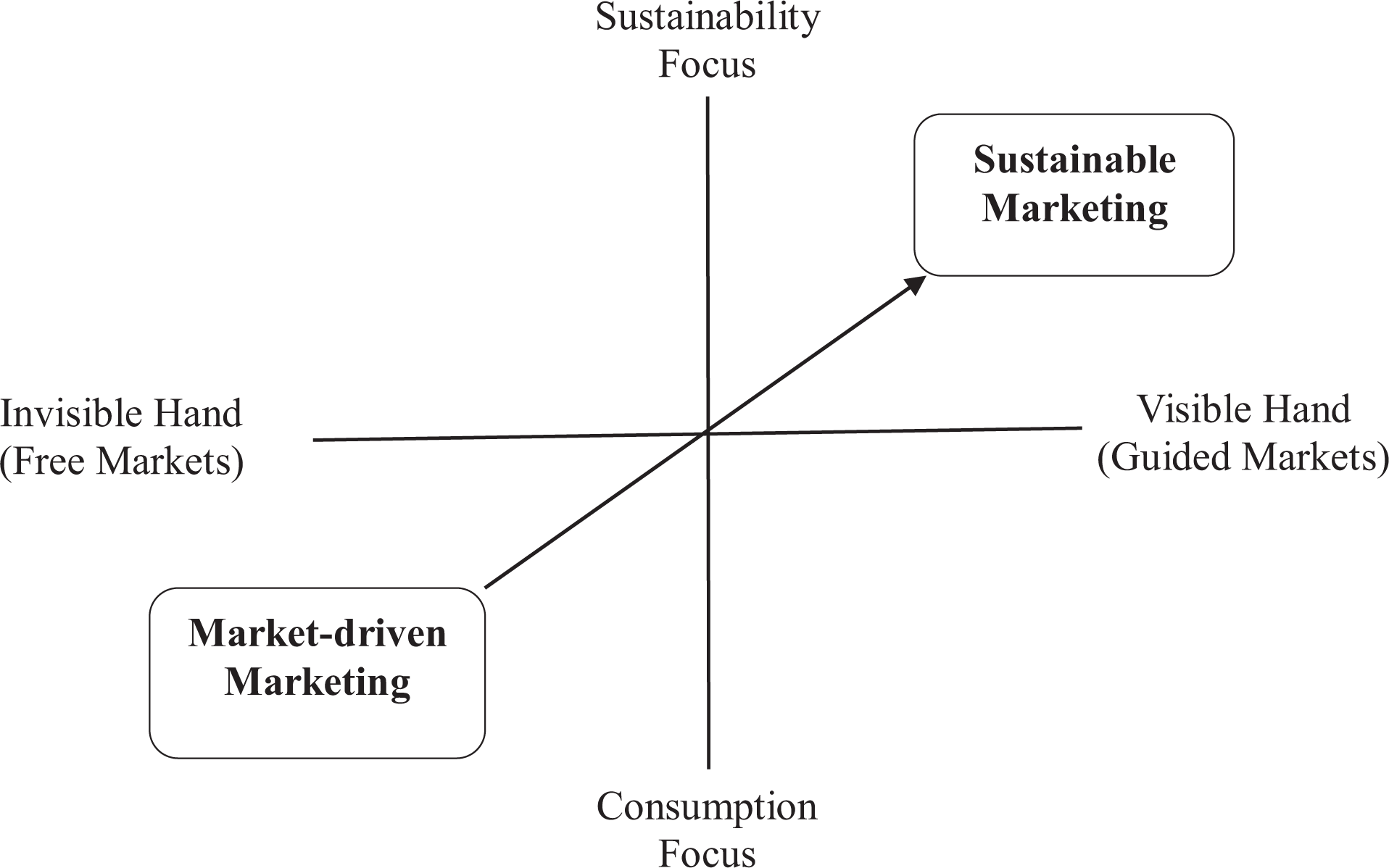
From market-driven to sustainable marketing - two-dimensional shift.
In the sections that follow in this paper for the special Ruby Anniversary issue of the Journal of Macromarketing, we first recount the evolved discourse on sustainable development governance and its stated goals and priorities. We then explain how and why these goals and priorities are of material consideration to businesses and corporations. Thereafter, we examine the marketing strategy implications and potential proactive response for sustainable marketing. Finally, we provide a framework of institutional intervention for sustainable marketing.
Evolving Discourse on Sustainable Development
For a large part, the discussion on sustainable development was triggered by the report for the “Club of Rome’s Project on the Predicament of Mankind,” The Limits to Growth, (Meadows et al. 1972), that applied the industrial dynamics model of Jay Forrester (1971) in a computer simulation of exponential economic and population growth with a finite supply of resources. The report had concluded that unless more resources grew exponentially, the rate of economic activity would overshoot and collapse the global system by mid-to-latter part of the 21st century. Following this report, in the mid-1970s, many scholars began to make essential contributions to socio-ecological perspectives of marketing (Cravens 1974; Fisk 1973, 1974; Henion 1976; Perry 1976; Shapiro 1978; Sheth and Wright 1974). Despite these early efforts, few marketing scholars channeled their intellectual pursuits in this direction for almost two decades, until the mid-1990s. Perhaps the fundamental belief prevailed that the market process is sufficient to correct any environmental imbalances. Also, scientific uncertainty and the hesitant commitment of business leaders to this issue made it difficult for marketing scholars to engage themselves in research in this area wholeheartedly. Whatever the reasons for marketing managers and academicians to fend the issue, it was no longer possible to ignore it in the current millennium. Environmental concerns have grown, and so has the general awareness about it. While during the mid-1970s, it remained mostly an issue of conservation of resources and local area pollution, in the current era, both ecological and socio-economic concerns have become global and more compelling (Vardarajan 2017; Vila and Bharadwaj 2019).
Public Policy Initiatives
The reach of sustainable development thinking has expanded considerably at local, national, regional, and international levels since the 1972 UN Conference on the Human Environment in Stockholm. Initially, the concerns were to save the planet, primarily focused on the environment and ecological considerations, including depletion of natural resources, waste and environmental pollution, and energy costs. The subsequent call for the integration of economic development, natural resource management, and social inclusion and equity was introduced by the Brundtland Report of the World Commission on Environment and Development (WCED). The Commission defined sustainable development as development “to ensure that it meets the needs of the present without compromising the ability of the future generations to meet their own needs” (WCED 1987, p. 8). This report’s findings became central to framing the discussions at the 1992 United Nations Conference on Environment and Development (UNCED), also known as the Earth Summit at Rio de Janeiro.
Since then, three pillars of sustainable development – economic, social, and environmental – were advanced through various World Summits organized by the United Nations. As Purvis, Mao, and Robinson (2019) note, there is no single point of origin of this three-pillar conception, but instead was a gradual emergence due to academic critique of the economic status quo that ignored the social and ecological problems of economic growth. It recognized that poverty eradication, changing unsustainable patterns of consumption and production, and protecting and managing the natural resource base of economic and social development was essential for sustainable development. Inclusive and equitable economic growth with more significant opportunities for all, fostering equitable social development, gender equality, women’s empowerment, human rights, democracy, freedom, right to a standard of living, and sustained management of natural resources and ecosystems that support sustainable development – all became part of sustainability goals. Sustainable development has a much-enlarged connotation than what was conceptualized in the early to mid-1990s.
The United Nations General Assembly formally adopted the universal, integrated and transformative 2030 Agenda for Sustainable Development, along with a set of 17 Sustainable Development Goals (SDGs) and 169 associated targets. The 17 SDGs and their operational directives and rationale are summarized in Table 1. From a macromarketing perspective, amongst the 17 SDGs, three are most relevant – “responsible consumption and production,” “climate action,” and “partnerships” (Goals 12, 13, and 17).
Key Sustainability Development Goals*.
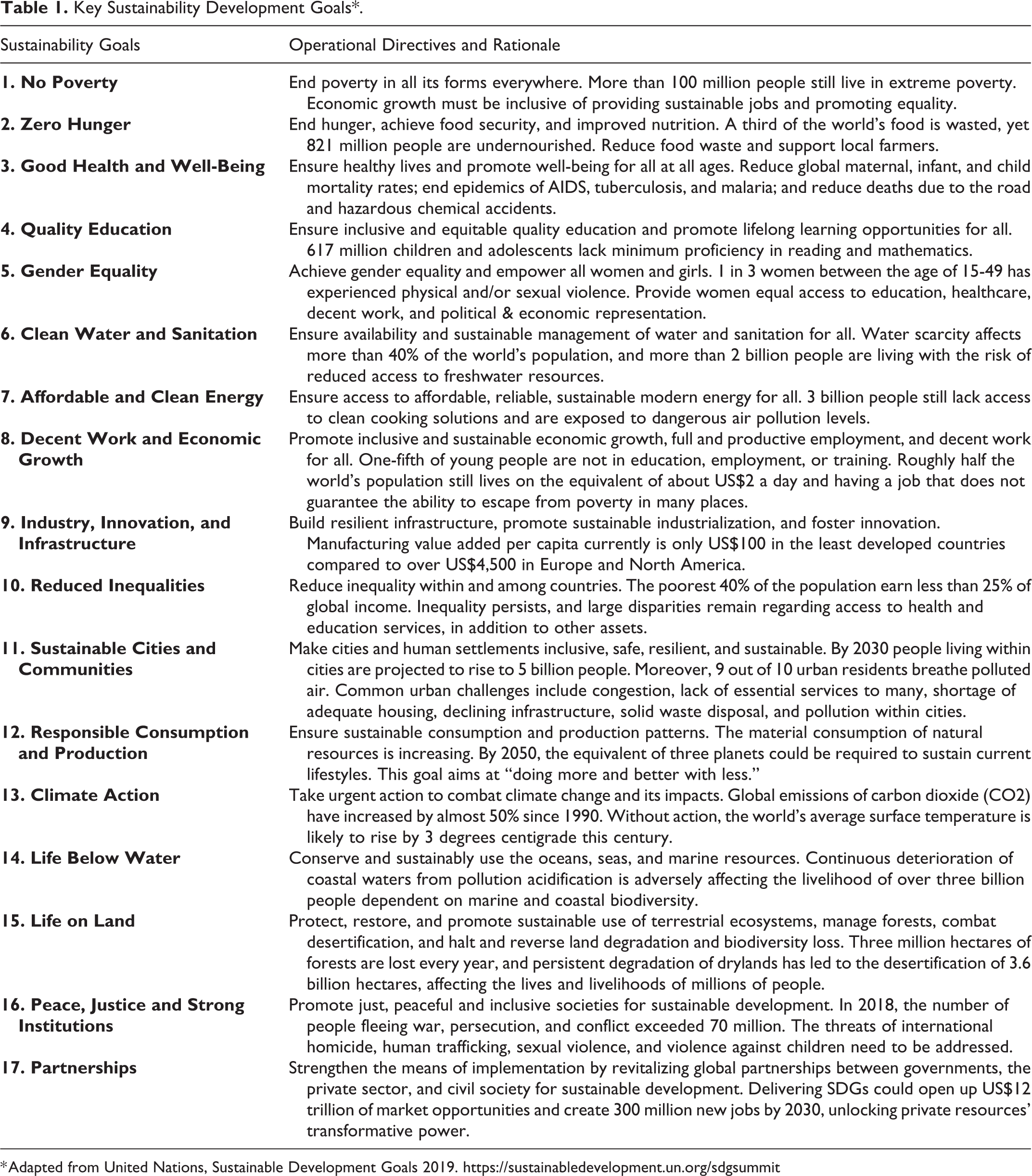
* Adapted from United Nations, Sustainable Development Goals 2019. https://sustainabledevelopment.un.org/sdgsummit
Thus, it is apparent that the sustainable development agenda has widened considerably from the earlier emphasis mostly on ecological factors and bio-physical damage, despite and because of economic growth. It has expanded to include the societal concerns of the disappointing record of post-WWII ‘development’ efforts, particularly the persistence (and in some places worsening) of poverty and desperation in a period of substantial global increases in material wealth (Kemp, Parto, and Gibson 2005). Businesses in general, and marketers in particular, cannot anymore limit themselves to a reactive approach of conforming to laws and regulations about material use and disposal (environmental laws) but have to actively incorporate the larger sustainability goals into their overall strategic response (Chattopadhyay 2019).
Enterprise Role in Sustainable Development – Why It Matters
Although sustainable development goals (SDGs) are common global priorities and aspirations of governments and civil society, they also explicitly call all businesses to apply their creativity and innovation to solving sustainable development challenges. As such, they present an opportunity for business-led solutions and the development and implementation of technologies that help meet these goals and targets for the development of societies. The future markets for sustainability sector products and services could be $12 trillion a year by 2030 (Elkington 2018). On the one hand, marketers can salivate on encashing the potential opportunity, but this would need innovation and demonstration of efforts that minimize negative impacts and, on the other, maximize positive impacts on people and the planet.
While we are forced to be concerned with the impacts of environmental stress – climate change and degradation of soils, water regimes, atmosphere, and forests – upon our economic prospects, we also need to be concerned about the status of human life and the social impact of both lop-sided economic growth and environmental pressures on people. Economy, society, and ecology are interwoven locally, nationally, and globally. Enterprises cannot insulate themselves from these sustainable development problems. It needs to be concerned about the resources it uses to satisfy consumer needs and wants and be concerned about its effects on human life and its biosphere. Sustainable development requires “enterprise sustainability” - not only financially and competitively sustainable, but also societally and ecologically sustainable (Peterson 2013; Villa and Bharadwaj 2019).
Enterprise sustainability, built on the three pillars of environment, social, and governance (ESG) thinking, needs to demonstrate how it plans to commit and deliver goods and services in a sustainable manner. At the minimum, it should ensure that enterprise practices do not harm people or the planet, and at best, they create value for stakeholders. Improving ESG performance in the areas in which the enterprise and or its brand have a material environmental or societal impact, such as in their operations, value chains, or customers, is increasingly becoming the goal. No more do traditional corporate social responsibility (CSR) programs that support employee volunteering in the community qualify as corporate sustainability efforts (Whelan and Fink 2016).
Thus, the triple bottom line (TBL) thinking of people, planet, and profits have been advocated and followed by several companies in their accounting and reporting of business results (Apte and Sheth 2016; Elkington 1999; Peterson 2013; Vardarajan 2019). However, as noted by Elkington, the TBL has been captured by accountants and reporting consultants, but it has failed to bury the single-bottom line paradigm. From the outset, TBL’s stated goal was system change toward the transformation of capitalism, and not just an accounting system. It aimed to bring breakthrough change, disruption, and asymmetric growth (with unsustainable sectors actively sidelined), and the scaling of next-generation market solutions (Elkington 2018). Thus, to achieve the radical intent, the pace and scale of sustainability marketing practices have to increase substantially.
The Business of Sustainability Creates Value
A proactive approach to institutional and multi-stakeholder engagement can drive competitive advantage. According to a McKinsey report by Bonini and Görner (2011), the business of sustainability has the potential to capture value through core business activities that support growth (the composition of business portfolios, innovation, and reaching new customers and markets); advance returns on capital (from green sales and marketing, sustainable value chains, and sustainable operations); and effective risk management (regulatory management, reputation management, and operational risk management).
Corporations have been slow to transition from traditional business models and concerns centered around shareholders into broader concerns for all stakeholders and becoming sustainable corporations. Part of the reason is the erroneous perception that one can have profits or sustainability, but not both. Perhaps there is a hangover of the 1970s and 1980s when businesses with low quality, high priced environmental products failed in the market, and early socially responsible investing delivered low returns. However, there is enough evidence that financial benefits can accrue – including significant cost reductions from improved environmental sustainability-related operational efficiencies and higher sales growth, return on assets, profit before taxation, and improved cash flows (Whelan and Fink 2016). Also, the ESG focused funds have performed much better than the S&P index last year (Coffey 2019).
Thus, sustainability is material to enterprises. It not only matters from a financial standpoint and business opportunity possibilities but also matters because stakeholders are demanding so. The sustainability discourse has fundamentally shaped the expectations and demands of internal and external stakeholders, be they investors, customers, employees, business partners, governments, or the public. They are all increasingly wanting the business and non-business enterprises with whom they engage or interact to proactively address sustainability challenges. Understanding the enterprise’s role in creating a more socially and environmentally conscious business ecosystem has never been more profound than today. Bansal and Roth (2000) reported that three motivations drive corporate ecological responsiveness: competitiveness, legitimation, and ecological responsibility. However, three contextual conditions influence these motivations: field cohesion, issue salience, and individual concern – that vary considerably across organizations and individuals. Thus, we see some, but not widespread, initiatives by corporations to constructively engage with stakeholders and utilize institutional entrepreneurship in developing sustainability solutions (Gollnhofer and Schouten 2017; Menon and Menon 1997; Nair and Ndubisi 2011; Polonsky 1995; Shultz 2017).
Perhaps the most effective enterprise interventions have been made by corporations who have declared sustainability goals on all three pillars of environmental, social, and governance and established science-based targets (SBTs) for system-wide application engaging all stakeholders, including customers, suppliers, associates, shareholders, and community. For example, as a solution to climate change, Walmart’s ‘Project Gigaton’ initiative of a system-wide global commitment to avoid One Gigaton of greenhouse gases by 2030, has already yielded impressive results not only of reducing its carbon footprint and greenhouse gas emissions but also on a variety of social and ethical parameters (Stevens 2019; Walmart ESG Report 2019). Their initiative has also catapulted their suppliers to commit to sustainability goals and initiatives as Walmart has made these as conditional to doing business with them. Similar results have been noticed at Unilever and other organizations, leveraging their buying power as a customer to get supply chain members to conform to sustainability goals and targets (Bhattacharya and Polman 2017; Villena and Gioia 2020; Whelan and Fink 2016). The essential aspect of enterprise intervention has been to consider the entire value chain through which sustainability goals can be impacted, from sourcing to delivering final consumer value and market operations that the enterprise is engaged in.
Sustainable Marketing for Sustainable Development
Marketing’s role in the development process has been well recognized (Kinsey 1982; Shultz and Pecotich 1997; Sirgy et al. 2012). Much of the production-consumption activity is triggered by the marketing process that offers and stimulates consumption opportunities to satisfy human needs and wants (Wilkie and Moore 1999). However, it has been pointed out that marketing’s critical role in development will be appreciated only when, through planned sustainable marketing, it meets the needs of the present without compromising future generations’ ability to meet their own needs. Considering the superordinate goal of human survival and better quality of life for all, Fisk (2006) envisioned that the macromarketing focus for sustainable consumption, away from the maximization of entrepreneurial profit or individual want satisfaction, is the result to be sought. Over the years, several scholars have called for marketing to assume a more responsible role for sustainable development (Mitchell, Wooliscroft, and Higham 2010; Shultz and Holbrook 1999; van Dam and Apeldoorn 1996; Varey 2012).
Responsibility varies from responsive. Marketing hitherto has been more focused on responsive approaches towards serving consumer and corporate needs. It has followed consumer trends, identified consumer needs, and responded to consumers wants to achieve the corporate profit goals (Kotler 2011). Due to this principal drive towards effecting consumption, often overlooking the “commons problems” associated with the socio-environmental impact on societal resources, marketing has been accused of being myopic and somewhat antithesis to sustainability (Belz and Peattie 2012; Hillier et al. 2008; Shultz 2015; Smith, Drumwright, and Gentile 2010). Responding to market trends by provisioning goods and services fulfilling the people’s immediate needs is much easier than taking responsibility for shaping customer needs and expectations, and then providing them with appropriate sustainable choices. The concept of “socio-ecological product” emphasizes the environmental consequences (the product’s aggregate impact on everyone affected by its use) and the societal impact of marketing activities. It requires breaking free from the anthropocentric epistemology and its associated social traps that reward corporations for immediate commercial gains in user acceptance or short-term profits (Martin et al. 2019; Shultz and Holbrook 1999; Shultz 2015). Adopting the ecocentric epistemology or the new environmental paradigm (NEP) would enable the development of alternative and transformational marketing approaches that place equal importance to nature, planet, and ecological sustainability as sources of well-being for humans and other species (Borland and Lindgreen 2013; Iyer 1999).
Sustainable Marketing for Sustainable Consumption
Marketing’s societal role of informing customers of the availability of goods and services to improve their quality of life can be tenable only if its communication approach and techniques help inform, educate, and channel the needs of its current and potential customers towards sustainable products, services, or activities. Implicit in this is the assumption that such marketing efforts are also directed to reforming inefficient and societally damaging consumption habits, including a product’s post-consumption disposal and or recycling. Changing, and sometimes even reducing, consumption patterns call for positive incentives, new product and process developments, price or non-price deterrents against certain customer practices, as well as macromarketing initiatives to constructively engage with multiple stakeholders (Little, Lee, and Nair 2019; Peattie and Peattie 2009; Scott, Martin, and Schouten 2014; Sheth, Sethia, and Srinivas 2011; Shultz and Holbrook 1999; Vardarajan 2017).
It requires a new mindset, new tools, and adjustments throughout the organization. Sustainable marketing needs responsible and proactive corporate strategies that drive the market toward sustainable products and services. Although it is an immense challenge for companies to advance economically sustainable activities while being environmentally and socially responsible, it is still attainable. Many companies have repeatedly demonstrated their abilities to manage oxymorons, such as with total quality management (TQM), where competing objectives of increasing quality while lowering costs was achieved (Curkovic et al. 2000; Schmidheiny and Business Council for Sustainable Development 1992). The path towards sustainable development may appear to be arduous and lengthy, but we believe corporations can effectively build a strategy for sustainable marketing through four distinct efforts: redesigning products and services, promoting responsible consumption, repurposing the marketing mix; and reorganizing the marketing function.
Redesigning Products and Services
Innovation is key to marketing, and innovation for sustainable development has the potential for the highest payoffs for any organization. Many enterprises are thriving today because they adopted new innovative technologies or rethought the formulation of products and services they sold. Good examples are electric vehicles, LED lights, eco-friendly housing material, and a host of new products introduced in the market that have replaced traditional market leaders, such as Tesla, in the automotive sector. Companies such as 3M, which have made growth, sustainability, and innovation a trifecta, have succeeded in bringing several path-breaking sustainable products into the market, consistently positioning them as sustainability leaders (Winston 2012).
In addition to innovations in products and services, companies have to think beyond the impact of their product in the hands of the consumer and the process by which the product is made and sold. They need to be concerned about every product’s “eco-balance,” the minimization of risks and impacts throughout its life cycle, and the resources required to make and dispose of it, as well as about extending strategies of “eco-efficiency” and “eco-sufficiency” to consumers (Heikkurinen, Young, and Morgan 2019). Promoting “reconsumption” – the ability to use and reuse goods in whole or in part, over several use-cycles or generations – can become the industrial ideal of a sustainable economic system. Developing products that can be reconsumed over several generations and accordingly educating consumers becomes the marketers’ task. There is already evidence that products made of high-density plastics, ceramics, and rare metals have a lesser impact on our fast-depleting natural resources than steel, aluminum, or other metals because they possess higher strength appropriate for facilitating reconsumption (Andrady 2015; McLellan et al. 2016; Vatan and Yilmaz 2020). We contend that companies that succeed in developing such products and convincing consumers regarding their benefits will have a competitive advantage over others, as consumers become sustainability conscious. Thus, embedding the thinking about product life-cycle usage and management in the circular economy has to be consciously undertaken (Andersen 2007: Lacy and Rutqvist 2015; Remmen 2007).
Life-cycle usage implies life-cycle responsibility. Marketing managers geared towards thinking that their role and responsibilities end with the transaction exchange are less likely to cope with this new situation. Conceptual and operational plans are needed to manage such responsibility, as governments around the world are beginning to take regulatory action on package and product disposal at the end of the consumption cycle. Conscious strategies that promote reconsumption could provide a competitive advantage to many products. We have seen that some environmentally sound products have commanded almost a 25% premium. For instance, people typically pay more for organically grown food and innovatively designed experiences in tourism destinations that are less polluting and more sustainably packaged (Pulido-Fernández and López-Sánchez 2016; van Doorn and Verhoef 2011).
Sustainable marketing means more than pollution reduction and life-cycle responsibility. Businesses have to move toward “zero pollution,” “zero waste,” and redirect product development efforts to meet sustainability needs. The goal will be to make the production, use, and disposal of products more compatible with sustainable development. These include efforts that help us produce more with less or shift entire industries away from high carbon footprint into more sustainable industries, as in the case of livestock-based food products shifting towards plant-based substitutes (Beverland 2014).
Responsible Consumption
For the most ardent environmentalists, customers are the ultimate paradox. Their consumption uses up the earth’s capacity to produce materials and absorb waste. Undoubtedly, we agree that they should consume less, not differently. Nevertheless, until such human disposition comes about, they must consume more environmentally friendly products. Marketing’s task is to redirect their needs and wants towards consumption that is socially and ecologically least harmful. Marketing’s current tools can be geared towards such redirection. The framework and paradigm provided by Sheth and Mittal (1996) on managing customer expectations could guide sustainable consumption. Also, the role of advertising and promotion cannot be understated in this regard. However, market research and in-depth customer analysis will provide the most sustainable results in this context. First, market researchers and consumer analysts need to identify the current consumption options, customer choice criteria, the relative importance placed on these criteria, and the sources of information shaping these criteria (Kotler 2011). It is only then that marketers can intervene to appropriately change consumer decision-making criteria in favor of sustainable consumption (Geiger, Fischer, and Schrader 2018; Phipps et al. 2013; Prothero et al. 2011). Consumer attitude studies will help design proper communication messages for sustainable marketing (Kilbourne, McDonagh, and Prothero 1997; McDonagh 1998).
Consumer sensitivity to sustainability issues does not always translate into purchase behavior. The green consumer is often elusive; they want sustainable products, but they tend not to buy them (White, Hardisty, and Habib 2019). It becomes the responsibility of marketers to use their communication and promotional tools to convert this latent desire for quality of life into actions and activities that promote such environmental quality of life. If marketing during the past several decades has been so successful in increasing societal consumption and meeting human needs, we believe that it will also be successful in redirecting consumption behavior towards environmentally sustainable consumption. Large scale research on consumption behavior and the net effect of interventions towards changing such consumption criteria could be effectively utilized by corporate marketers to redirect customer needs and wants and prevailing unsustainable consumption cultures (Dolan 2002; Schaefer and Crane 2005).
Repurposing Marketing Mix
Sustainable marketing requires the repurposing and reorientating of the entire marketing mix, everything from product and packaging through positioning and promotion. Every marketer will have to assess the sustainability impact of the manufacturing, content, package, label, advertising, distribution, use, and disposal of its products. Beyond assessment, strategic opportunities can be identified for a positive response that will earn the favor and support of sustainability-conscious consumers, advocacy groups, media, and retailers. There may be strategic possibilities for new product development and acquisition opportunities. Retailers, such as H&M, Ikea, Nordstrom, Sephora, Target, and Walmart, and brands such as Levi’s, Patagonia, and Reformation have already adopted aggressive sustainability promotional plans (Rosmarin 2020; Widlitz 2020).
Repurposing the marketing mix means that marketers should consider repackaging, relabeling, reformulating, and repositioning. We are already familiar with growing concerns regarding ecologically harmful product packaging and over-packaging. Several marketers have either started using biodegradable packages or are using recycled packaging. Product relabeling that includes more sustainability-related information has begun to appear on retailer shelves. Many companies have initiated efforts to reformulate products to either remove the harmful ingredients, like phosphates in detergents or make them more energy efficient. Repositioning products as environmentally friendly offers an opportunity to gain market recognition and support of conscious consumers, and it also provides higher visibility in the already cluttered advertising media.
Selling approaches and sales incentive programs also require repurposing. Credible sustainability themes based on appropriate customer education can make a difference. Especially in business-to-business settings, firms and salespeople providing vital sustainability information to their clients on the use of supplies are of significant advantage. As more businesses make responsible sourcing a vital sustainability goal and make sustainability-related demands on their suppliers, pressure on companies selling to them will further accentuate. Retailers are already favoring those suppliers that carry products that help uplift their image as sustainability promoting organizations. The opportunities associated with proactive leadership and responsible selling far outweigh the risks. Retailers, such as Walmart, demand all their category captains provide a plan on the initiatives they would undertake to help Walmart fulfill its 2030 Project Gigaton commitments.
Reorganizing Marketing Function
Commitment to a vision of sustainable marketing has to translate into strategies and action plans. It may often involve reorganization, restructure, and redesign of many processes and systems within a corporation that enhances the dynamic capabilities of the organization for sustainability practices (Teece 2007; Wu et al. 2012). For example, some of these changes could include: Companies in the “sunset” industries develop sustainable substitutes. Alter the traditional roles of boards of directors and top management towards integrating external and internal dimensions of a business to provide new vehicles for stakeholder engagement. Appoint a sustainability leader to steward the company’s sustainability program and design and communicate sustainable production and consumption values to all stakeholders (Stoughton and Ludema 2012). Develop a learning organization that involves middle management continually rethink and relearn the fundamentals of every aspect of business (Hurley and Hult 1998). Much like Kaizen, create small action teams that lead to significant differences leveraging corporate sustainability to drive business and societal value (Bhattacharya 2020).
Proper incentive schemes within the organizational system that encourage employees to adopt sustainable development philosophy should complement the reorganization. Providing meaning for employees beyond salaries is critical. Employee motivation can be further enhanced by providing technical and management training for sustainably sound operations. An organization that does not improve its environment cannot market environmentally sound products or services (Iyer 1999). Focused education sets the orientations and attitudes of professionals and managers. Perhaps even a partnership with the government to provide education and training will help develop this capacity.
Sustainable marketing efforts often require cross-functional teams. Marketing people by themselves will not be able to develop a sustainability marketing orientation for the firm. Cross-functional teams and partnerships help build the firm’s dynamic capabilities to undertake sustainability centric initiatives (Borland et al. 2016). Like total quality management, sustainable marketing requires employees from all functional areas, including marketing, production, procurement, accounting, and information systems, to manage trade-offs and interdependencies (Miller 2003; Szalavetz 2018).
The Visible Hand of Government in Sustainable Marketing
We submit that a sustainability policy is inevitably interventionist. Without intervention by the government, our planet and societies cannot be adequately protected (Cairncross 1992). The government is a critical stakeholder in solving the prosocial commons problem (Shultz and Holbrook 1999), and just leaving the challenge of sustainability only to market forces and corporations would not yield the results. It needs government intervention and market-driving initiatives by corporations and macromarketing tools to encourage multi-stakeholder engagement. Many enlightened economists have argued that unbridled self-interest and unregulated freedom are failures of governance systems resulting in economic degradation, climate change, poverty, and inequality of outcomes. They want business managers to recognize their “agency” responsibilities to the legislative and regulatory rule-making that supports the “system” in which their firms are embedded (Simons 2015).
Although the forces of unfettered competition can destroy the environment or cause societal challenges, this does not mean that we replace markets with the government. Such systems of absolute control by the government have not worked. That became apparent by the scope of environmental catastrophe in the state-run countries of Eastern Europe. Bad governmental policies can further ruin the environment or social fabric of nations, even more so than unfettered competition, as has been recently witnessed in Brazil concerning the Amazon forest fires. It is, therefore, essential to identify mechanisms that the government can use to induce change. In this section, we identify those mechanisms of governmental intervention that may be useful for sustainable development. When the free market process does not sufficiently promote sustainable development, the government mandate is one way to achieve it. However, a governmental intervention that too suddenly disrupts our industry and business practices could be catastrophic.
Indeed, the government can use public policy tools to either correct market failures by enforcing regulations, taxes, and subsidies; or correct system failures by mandating labels, communications, education, and public procurement measures (Stevens 2010). Nobody is likely to argue that governmental measures must not be strong enough to encourage everyone to follow sustainable development and discourage those practices that cause environmental and societal degradation. However, these measures should be based on prudence (without delaying implementation) to nudge businesses to internalize environmental and social costs or limit the damage to them. The government also has to play the role of a champion in leading the world towards sustainable development. Its role has to extend beyond that of a watchdog and regulator to one of a promoter of better human life for current and future generations. Therefore, we suggest four intervention roles for the government: regulatory policies, reform measures, promotional programs, and participative partnerships.
Regulatory Policies
Through the process of regulations and policies relating to production and consumption systems, including resource use and product and technology performance standards, governments can command and control the industry to prevent it from damaging our environment beyond sustainable limits. Also, policies and laws relating to worker compensation, work-life balance, health and social services, and community facilities, governments can play a very prominent role in fostering sustainable societies. For such command and control to be successful, it needs to be based on efficiency standards; flexible and transparent compliance of regulatory policies and policy stability equally applies to all other parties; and policy effectiveness in achieving sustainability goals (Meng 2015). We suggest that the government make long term explicit policies in this regard and consonance with the binding agreements they undertake through supranational organizations, such as the United Nations. Supranational coordination makes integrated effort to solve sustainability problems possible, given global interdependence and the need for multi-sectoral and multi-nation expertise. Sustainability challenges transcend national boundaries (Shultz 2015).
Reform Measures
For sustainable development, major restructuring and reform of cultural, social, and political mores are needed. The systemic nature of these issues means that we recognize the linkages between production and consumption practices in most nations. Consumption reforms, as well as production reforms, need to co-occur. The commitment of the government towards such reforms is critical. A clear path in this direction would be raising the level of knowledge about sustainable consumption and production processes (Stevens 2010). Governments may have to invest in educational programs that educate consumers on how to effectively reduce their use of energy and other resources, reconsume products, and reduce wastage (McGregor 2005).
There is also a need to reform institutional practices that are widely accepted but dysfunctional for sustainability purposes. For example, most pricing and accounting practices do not place the cost of using irreplaceable natural resources or emission of wastes and pollutants into their books of account. The firm’s inability to internalize all costs in decision-making yields a distorted view of costs and is institutional failure. Reforming production processes, marketing practices, and rewards for employee performance may all require government mandates, at least in the short run, to shed our dysfunctional practices and adopt the path of sustainable development.
Reform of political institutions and orientations may also be necessary for a reordered world. The international security system, which features more concern for social, economic, and environmental questions and relatively less for military concerns, will soon have to be adopted. It may require reorganization or expansion of some of the formal institutions of government or international bodies that are vested with responsibilities relating to security, social equity, environment, or economy. It includes redefining the roles and authority of these formal institutions to function effectively for the new task at hand.
Promotional Programs
These market interventions include pollution taxes and charges, tractable pollution permits, deposit-refund systems, performance bonds, resource-saving credits, differential prices, special depreciation provisions, and the removal of distorting subsidies or barriers to market entry. Governments can potentially encourage the industry to change to cleaner technologies. To the extent that they may encourage industry to develop new technologies to overcome these costs, such economic measures are useful. However, if these economic costs get recovered through high market prices, then we are neither improving our environment nor the system leading to improved efficiency. Therefore, governments also have to undertake positive measures that lead to the continuous and speedy development of alternative technology for sustainable development. The government’s promotional role should, therefore, extend beyond the use of these economic instruments.
The right promotional role of the government comes with support facilities and institutions that it helps establish. As in the case of export promotion, whereby governmental organizations help business firms with information, training, and other support services, they need to develop similar services and programs to help business firms transition towards sustainable business practices. Several suggestions can be made in this regard: sharing information through a more useful database on environmental products, consumers, and support service availability; providing training; raising additional funds for environmental work (including low-cost loans); providing assistance in assessing the impact of current practices on the environment and suggesting alternative processes; facilitating technology transfer; and identifying market opportunities for alternative products or technologies. The most effective and economical solutions will be those who work creatively with powerful market forces rather than substitute them. Therefore, cooperation between industry and government is essential (Stevens 2010).
Participative Partnerships
Building partnerships between government, industry, and civil society is essential to achieving sustainability goals. Partnerships and interdependence are the building blocks to sustainable development, and multi-stakeholder partnership networks have the potential to bridge transnational norms and local action by drawing upon a diverse number of actors from civil society, government, and business (Bäckstrand 2006; Presas 2001). Through participative partnerships, governments can help the industry and the public move towards sustainable development. The participative role of the government spans over at least three areas: procurement, research and scientific development, and international agreements. In most countries of the world, the government is the largest single customer. Through its purchase and procurement policies favorable to sustainable products and services, governments can substantially impact what goods are produced and by what production processes (Bocken and Allwood 2012). The resolve not to buy unsustainable products or from companies that have environmentally defaulted would be appropriate
Through cooperative measures such as participating in multilateral trade negotiations, promoting technology cooperation across companies and industry, and providing financial assistance for cooperative research, governments can foster sustainable development. Multilateral trade agreements are crucial for developing countries to afford investments in environmental and social improvement. As the United Nations General Assembly has repeatedly observed, global ecology and economy are so interrelated that if we do not meet the needs of developing countries, we will be endangering our ecology (UN General Assembly 2012; 2018). Similarly, technology cooperation is vital for enhancing our ability to solve environmental problems. Very few industries are capable of developing the necessary technology on their own. Sharing their resources across industry and with research institutions helps share investment risks. Included in technology partnerships is the issue of technology transfer, especially to developing countries. The government’s role is vital in facilitating such technology transfer reducing poverty and global hunger.
Governments’ participative partnerships in the past have brought impressive results through space programs. It is perhaps time that governments individually or collaboratively set up NASA-like institutions for research on sustainable development. Funds allocated for such purposes will have a snowballing effect on the quantity and quality of research at academic institutions in this area. It will signal the commitment of governments towards achieving sustainable development and sustainable marketing.
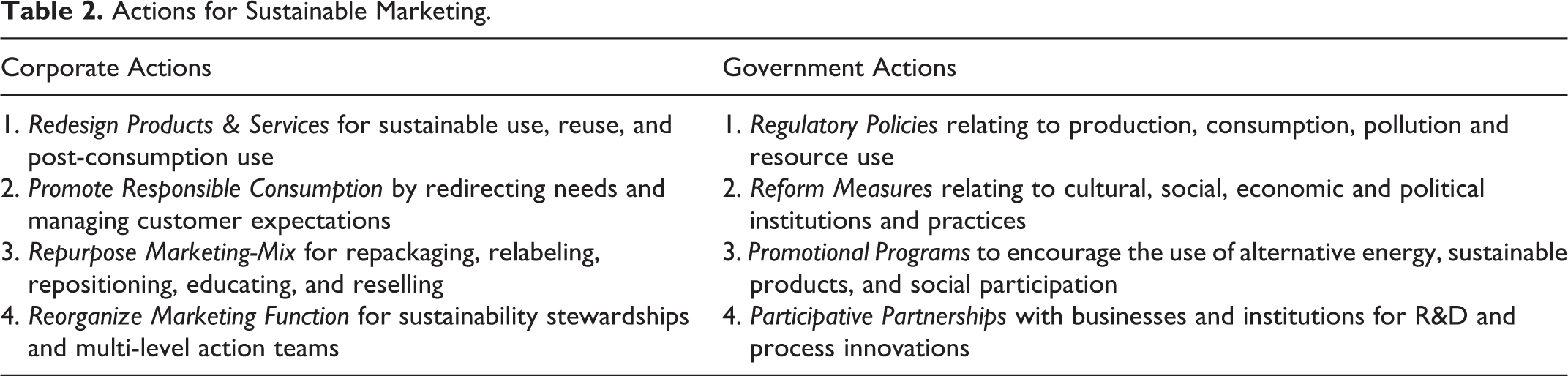
Table 2 below summarises the recommended market driving actions by both corporations and governments for sustainable marketing.
Actions for Sustainable Marketing.
Discussion and Future Directions
Since its emergence over the past century, marketing discipline has made tremendous progress in advancing our knowledge of micro-marketing techniques that can best meet consumer needs and wants and macromarketing efforts that address broader system-wide issues, including societal and development matters involving public policy and multi-stakeholder engagements. However, much of this marketing knowledge and practice propagated a responsive approach driven by market forces, which were primarily assumed to be uncontrollable and not within the marketer’s control toolbox. Thus, emergent marketing strategies, programs, systems, and policies were mostly based on studying and responding to market forces, trends, behaviors, and outcomes. Hence, empirical positivism of what is, prevailed over normative thinking of what ought to be, despite the many social and environmental concerns expressed by macromarketing scholars over the past five decades. The prevalent consumption focused marketing concept (understanding customer needs and fulfilling them) on the one hand, and the philanthropic approach of corporate social responsibility activities and non-profit sector initiatives based on enlightened self-interest concept (Tocqueville 2000) on the other, have remained insufficient in driving sustainable economic and societal development. The global sustainability issues are increasing alarmingly and mostly caused by our current unsustainable production and consumption patterns. Even though marketing is recognized for being closely related to social welfare, it’s consumption focus, and sometimes irresponsible practices have raised questions regarding the vulnerability consumers face from exploitative marketing practices (Shultz and Holbrook 2009). It, therefore, calls for responsible marketing that is more of a market-driver than market-driven.
Future studies by macromarketing scholars should examine what strategies and processes lead markets towards specific desirable directions, particularly for creating significant scale demand for the socio-ecological products and services. Studies have to go beyond testing the willingness to buy or pay for socio-ecological products and services into examining how aggregate market demand can be rapidly built for desirable products and services, and how harmful products and services can be effectively de-marketed. Marketing’s most significant challenge lies in changing consumption cultures that have evolved over decades or even centuries and requires redirection towards reduced or mindful consumption. More studies on creating mindful consumption cultures as well as techniques of altering post-consumption behavior in terms of disposal and reuse at both individual and community levels are needed. Studies that examine the elasticity of each of the programs we have recommended in this paper would be very valuable as we would assume that not each of the corporate initiatives or government interventions would have the same elasticity of sustainability effect.
Strategies and processes of educating consumers and other marketing actors towards higher consciousness and understanding the socio-ecological implications of their consumption behavior have received limited attention in our marketing literature. Much of this activity has been left purely for educational institutions to cover in formal education programs or to individual companies adopting micro strategies for their audience. It is crucial to direct our scholarly interests in examining and proposing macro-level strategies for consumers, producers, and other value chain partners. Studying the effectiveness of sustainability education programs and processes of private-public partnerships in creating consumer values and market demand directions is a rich area of learning.
Some of our research efforts need to be directed towards studying the market driving capabilities of organizations. Not all would have the same capability to drive markets for sustainable production and consumption. However, a network effect can be orchestrated by leveraging the unique capabilities of various marketing actors. As argued in the service-dominant (S-D) logic, value can be created by multiple actors integrating operant resources by themselves and through institutional arrangements, particularly in the context of sustainability (Vargo and Lusch 2004; 2008; 2016). As such, our knowledge about cooperation and collaboration among multi-level stakeholders needs to be expanded to examine how organizations with differing and often competing viewpoints and capabilities can work together for a common cause to achieve market transformation.
We contend that proactive corporate marketing strategies and active government interventions are needed to achieve sustainable development goals. Thus, it implies that academic research that examines individual and joint effects of corporate and government actions for sustainability would be precious. Both marketers and governments (as well as civil society) have vested interests in redirecting customer needs toward sustainable products, responsible consumption, eco-efficiency, eco-balance, and eco-sufficiency. They may be initiating actions in this regard, but what is unknown is the relative effect of individualized actions versus joint or coordinated actions that produce the best results. It is even unknown whether industry or inter-industry initiatives are superior to individual pursuits in this sphere. As in the case of international business and trade studies, researchers have plenty of opportunities to examine and suggest how these macromarketing programs could be made more effective.
An examination of government policies and programs are in order. Governments, at national, subnational, local, and even supranational levels, are expected to balance economic, environmental, and social goals through regulatory policies, socio-economic reforms, responsible procurement, public-private partnerships, and reform activities for social equity and justice for all. They have the visible hand to guide and drive markets toward sustainable production and consumption practices. Governments expend a large part of the tax dollars for these purposes. So, their role cannot be minimized. Thus, it is imperative that as macromarketing scholars, we study the effectiveness of government programs and policies meant to enable marketing innovations that achieve sustainability goals.
In the end, we reiterate our opinion that the world will never reach sustainable development goals without active intervention by both governments and businesses. While businesses make positive contributions – such as finding innovative sustainability solutions, creating jobs, contributing to human capital development, redirecting consumption, and communicating societal value – they potentially also make negative impacts such as damaging the environment, exploiting labor in supply chains, engaging in corrupt practices, not paying fair wages, or even over exploiting consumers and our planetary resources. Not only should businesses and marketers become more responsible for their activities, but they also need to be guided and directed through government policies and programs.
This suggests that macromarketing issues are more compelling today than they were ever in the history of the evolution of the marketing discipline. For so long, micro-marketing has held the center stage with its concerns of individual firms and their marketplace successes. Much of marketing theory has developed around individual firm’s distinctive market positioning, core capabilities and functions, competitive stance, customer and channel partner relationships, and the marketing mix strategies relative to products, pricing, and promotion to influence consumer behavior. As Wilkie and Moore (2007) pointed out the sole firm focus for the field of marketing has many risks and failings, particularly as many societal issues remain unaddressed or on the sidelines for interested macromarketing scholars to examine. However, the forces have now changed. Increasingly, marketing is being called upon to demonstrate its more substantial value in solving complex societal problems. No wonder, thus, other leading marketing journals, such as Journal of Marketing and the Journal of the Academy of Marketing Science, have announced special issues on marketing for a better world. Problems relating to the environment, poverty, public health, socio-economic imbalances, and living standards of people around the world have generally been the concerns of macromarketing scholars, are now sought to be addressed in the mainstream marketing literature. We believe that this is good news that sustainable marketing is now getting the center stage and therefore, will potentially become one of the most critical areas of study in the marketing discipline.
Footnotes
Declaration of Conflicting Interests
The author(s) declared no potential conflicts of interest with respect to the research, authorship, and/or publication of this article.
Funding
The author(s) received no financial support for the research, authorship, and/or publication of this article.
