




Abstract
Before governments formulate sustainable consumption policies, people's environmental attitudes must be ascertained. This study explores Costa Ricans’ interest in green products, those with a reduced ecological impact. A large sample is used, N = 1,036, representative of the country's adult population. Analyses indicate that consumers that are female, Generation Z, university-educated, and mid-high socio-economically have significantly higher Green Product Involvement/GPI levels. Surprisingly, Millennial and high-class GPI levels were but average. Overall GPI was also low, just 44%. Despite Costa Rica's stellar sustainability reputation, green products are hardly relevant to its people. This hinders the country from being truly sustainable. Counter to some views, bi/multivariate results indicate that demographic variables still play a key role in establishing (un)sustainable consumer profiles. Demographic indicators are simple, convenient, and effective segmentation criteria. They should not be discounted, especially by resource-strapped developing countries. Some preliminary suggestions indicate how Costa Rican consumption might be made more sustainable.
“Great countries are those that produce great men” (people).
Benjamin Disraeli, in Wood (1893, p. 133)
Introduction
Over the past decades, sustainability has become one of Macromarketing's thematic foci (Prothero and McDonagh 2021), even dubbed a mega-trend (Mittelstaedt et al. 2014). A sustainability area reaping growing interest refers to personal consumption (Reisch and Thøgersen 2015). This attention derives from consumption's centrality within marketing systems: Consumers impact what occurs both up and downstream from them: From product design and sourcing, through production and distribution, to usage and disposal, consumer preferences drive market activity. Interest also stems from consumption's environmental impact: From resource depletion, through pollution, to climate change, many of today's environmental problems derive from everyday consumer choices (Dahlstrom and Crosno 2022). If a more sustainable future is to be attained, fundamental changes to how the world consumes are imperative (UN 2021).
Sustainable product adoption has indeed grown. However, left to their own devices, mainstream consumers will not embrace sustainable products fast enough, if at all. This undermines the urgent need to protect the environment as it rapidly approaches various tipping points (McKie 2022, UN 2022). Active government intervention is thus essential to steer consumption toward more sustainable patterns (Sheth and Parvatiyar 2021). Yet before formulating such policies, citizens’ penchant for sustainable products must be ascertained. Consumer predispositions not only influence the direction and degree that policies might follow. They also indicate how consumers might respond to policies, impacting the latter's success or failure (Antil 1984b, Katona 1982). Public sentiment is especially important to understand while developing more radical and extensive policies, like those needed to attain sustainable consumption at a societal level.
This study aims to explore Costa Ricans’ green product involvement. That is, the personal interest that the country's consumers have for products with a lesser environmental impact (Conejo et al. 2021). Higher green involvement improves sustainable product perceptions and adoption (Atkinson and Rosenthal 2014, Mataraci and Kurtulus 2020). It should therefore enhance the reception of sustainable consumption policies.
Involvement is first analyzed in aggregate to see if policies stimulating green product adoption are generally viable within the country. This is useful to know. Mainstream consumption is where some of the worst environmental impacts occur; but also, where some of the best opportunities for improvement lie (Dahlstrom and Crosno 2022). Analyses are then done via demographic subsamples based on age, gender, education level, and social class. Identifying which consumer segments are more/less interested in green products is also useful. It reveals among whom it might be easier/harder to implement policies, allowing to target and develop them better.
In doing the above, the present study contributes to Macromarketing's understanding of consumption, sustainability, and public policy. It also contributes to the field's interest in what occurs at the intersection of markets and society. The study thus helps fill conceptual, contextual, and practical gaps within Macromarketing's sustainable consumption literature.
Conceptually, this study adds to how sustainable consumer behavior is understood. Addressing the psychology behind consumer decision-making is essential to spur behavioral change, and hopefully, achieve a more sustainable future (Trudel 2019). Various studies address the impact of mental constructs like environmental awareness, knowledge, or concern upon green consumption, e.g., Zameer and Yasmeen (2022). However, constructs like the above are quite specific, bearing rather focused insights. Said constructs are also prone to social desirability biases, and thus, to the attitude-behavior gap rampant within sustainable consumption research: Even though most consumers claim grave concern over environmental problems, few follow through via concrete actions to ameliorate them (Carrington, Neville, and Whitwell 2010).
The present study addresses these gaps by applying the more-encompassing involvement construct. It thereby attains a broader sense of consumer inclinations towards green products. The measure used for this purpose is also behavioral. It thus lessens the pitfalls of the aforementioned attitude-behavior gap, revealing a more accurate picture of consumer predispositions.
Prior research already addresses involvement in the context of green consumption. Examples include Atkinson and Rosenthal (2014), Rahman (2018), or Kamboj et al. (2022), to name a few. However, these and other studies focus on consumers’ involvement toward specific sustainable products like milk, cars, or hotels, and not the green category as a whole. The result of this micro-level focus is that the proclivity towards general sustainable consumption becomes distorted. The present study ameliorates this other gap. By addressing green products in general, without focusing on any one in particular, the country's overall interest in sustainable products may be better estimated. This more macro-level focus also allows to gauge the viability of broad-scope sustainable consumption policies.
Contextually, and in line with this special issue's Non-WEIRD theme, the present study investigates GPI in a rare developing-country setting. Sesini, Castiglioni, and Lozza (2020) review the sustainable consumption literature. They find studies to be geographically concentrated: While 86% of them refer to Europe, North America, and Asia, only 5% address Latin America. Not only is research on this region's sustainable consumption sparse (Feil et al. 2020). But from broader marketing (Fastoso and Whitelock 2011) and business research perspectives (Aguinis et al. 2020), Latin America is rarely studied. The present study also addresses these gaps.
As to why Latin America, relative to ‘first world’ nations it has for decades grown faster in terms of population, income, and purchasing power. With consumer spending now driving growth, it becomes important to understand the region's consumers (Knight 2014). This includes how they might respond to environmental policies. As to why Costa Rica, the country has been long recognized as a sustainability paragon given its macro-level institutions and policies (Florek and Conejo 2007). This not only makes it topically relevant. But as an extreme case, it transcends common contexts, potentially making constructs, relationships, and processes more salient (Arnould, Price, and Moisio 2006). As an extraordinary context, Costa Rica also has the potential to uncover boundary conditions and test taken-for-granted assumptions (Mook 1983).
Yet countries may also serve as cultural proxies, e.g., Kim, Park, and Suzuki (1990). Costa Rica seems like a Latin-American outlier (no army, high development, etc.). However, it is not unlike other countries in the region (Palmer and Molina 2004). Latin America is after all quite homogenous given its shared history and culture (Aguinis et al. 2020). Present findings are thus deemed to reasonably reflect regional sustainability attitudes. This is pertinent, as ethical/sustainable development models are being increasingly called for in Latin America, e.g., Salazar-Xirinachs (2022).
Studies have found cross-national sustainable consumption similarities, e.g., Thøgersen et al. (2015). It might thus be argued that country/region-specific studies like the present are unnecessary. However, marketing systems are path-dependent. They are product of unique socio-structural conditions (Layton and Duffy 2018). Sustainable consumption, in particular, acquires unique forms in different countries precisely because of this path dependency (Ganglmair-Wooliscroft and Wooliscroft 2022). Hence the need for localized studies like the present one, especially as it relates to local public policy design.
Practically, this article adds to the sustainable consumption literature by linking green product involvement to demographic variables and reminding researchers of the latter's relevance. Early sustainability studies focused on consumers’ personal characteristics. While useful, results were at times inconclusive, even contradictory. Research thus shifted in the 2000s toward the psychological factors driving sustainable decision-making (Trudel 2019). But in response to this growing conceptual and methodological sophistication, studies began suggesting that demographic variables were inadequate to profile consumers and thus passé within sustainability research, e.g., Diamantopoulos et al. (2003) or Wijekoon and Sabri (2021).
However, via a large consumer sample (N = 1,036), representative of Costa Rica's adult population, this study shows how demographic variables may still effectively segment consumers. Unlike psychographic indicators, demographic ones are among the simplest and most readily available (McKercher et al. 2022). This is particularly important for developing countries. Policy-makers and NGOs are oft challenged by the data needed to support their efforts. They usually lack the resources to gather said data, and then analyze, interpret, and implement it effectively. Especially at more local levels, where resource limitations are exacerbated.
Present results indicate that demographic variables remain relevant. They still play a significant role within sustainable consumption, still effectively segment consumers, and should therefore not be discounted. Even if other variables are studies’ foci, demographic indicators still help contextualize, interpret, and compare findings. Demographic variables are thus not only valuable in their own right. They constitute an important foundation for both researchers and policymakers to build on, and should by no means be dispensed with.
The authors hope that the conceptual, contextual, and practical insights here offered help researchers better understand sustainable consumption in Costa Rica, Latin America, and perhaps other locales. Insights should not only aid further studies on this increasingly important, albeit severely under-researched region. Insights should also help governments, NGOs, and businesses in their efforts to shift people towards more sustainable consumption patterns.
Construct Background
Involvement broadly refers to the personal interest that consumers have in certain products or categories. These may be important to consumers’ lives, even essential to their identities. This prominence derives from factors that are personal, such as interests or values; or situational, like usage occasions or needs. The prominence also stems from reference/membership groups, peer pressure, or marketing communications. High-involvement products thus tend to be those that allow consumers to express their selves, or that are prone to social evaluation (Solomon 2020).
However, products are not involving per se. Their importance instead derives from the personal or social meanings ascribed to them (Antil 1984a). This semiotic attribution is consistent with more current consumption paradigms: Products are not only sought for what they intrinsically are or do, but increasingly, for what they mean (Conejo and Wooliscroft 2015).
Involvement is also not dichotomous. It instead spans an intensity continuum. At one end of the spectrum, individuals show little interest in the product/category. Their behavior is at best habitual and lacking effort. At the spectrum's other end, consumers are passionate. Intense motivation drives complex consumption behaviors. It increases the time and effort people spend seeking, processing, and acting upon information. It also boosts intended, actual, and recurring purchases (Solomon 2020). Yet most consumers fall somewhere in between the two poles. As an individual difference, involvement thus becomes a useful segmentation variable (Michaelidou and Dibb 2008). Hence the value of measuring it in the context of green product consumption.
Hypotheses
Costa Rica has long been at the forefront of sustainability. Half its territory comprises forests, a quarter of its area is protected, and its electricity comes mostly from renewable sources. The country recently launched an ambitious plan to decarbonize its economy. Via electrified transport, improved waste management, and sustainable agriculture, among others, its goal is a developmental paradigm in which production and consumption actually generate environmental surpluses (Sengupta and Villegas 2019). In recognition of its ongoing sustainability efforts, Costa Rica received the 2019 United Nations Champions of the Earth award. Ex-president Alvarado indicates that “sustainable development is very much in the DNA of Costa Ricans” (UN 2019). Ex-minister Segura adds that sustainability is “embedded in the culture and traditions of Costa Rica… From an early age, children are taught to protect the country's forests and wildlife” (Gallagher 2021). We thus propose that: H1: Overall, Costa Rican consumers have relatively high green product involvement levels.
Much research addresses the demographics tied to sustainable consumption. Yet results remain inconclusive. Discrepancies occur, among others, due to studies using different outcome variables (attitudes, knowledge, behaviors), different instruments to measure the former, different thematic foci (organic food, electric vehicles, etc.), different samples (students, general population, green consumers), and different local/national contexts. These methodological inconsistencies hinder generalization. However, literature reviews on sustainable consumption like those of Diamantopoulos et al. (2003), Gifford and Nilsson (2014), or Quoquab and Mohammad (2020) provide useful foundations.
The literature finds gender to consistently predict sustainable consumption. Females generally have more pro-environmental attitudes than males. Females’ heightened concern leads to more frequent and varied sustainable behaviors. These are then reflected in their consumption choices (Luchs and Mooradian 2012). This gender difference stems from socialization processes. Mainly from how the labor division evolved over millennia. Male roles traditionally emphasize assertiveness, competition, and dominance. In contrast, female roles are more collaborative and egalitarian. This results in more altruistic values, reflected in stronger pro-environmental attitudes and behaviors (Eagly 2009). We therefore posit that: H2: Compared to Costa Rican consumers generally, female ones have significantly higher green product involvement levels.
The literature is somewhat inconclusive as to the link between age and sustainable consumption. Results differ as to pro-environmental behavior. Studies generally find negative relationships between age and intended behavior. Younger individuals are keenly bent on behaving more sustainably in the future. However, positive relationships emerge between age and actual behavior. Compared to younger consumers, older ones show weaker pro-environmental intentions. But older ones are more inclined to follow through, and actually behave in more eco-friendly ways. Strong negative relationships thus generally emerge between age and pro-environmental attitudes. Younger individuals clearly show a stronger affinity. Addressing environmental issues involves challenging traditional values, behaviors, and institutions. And younger consumers are more inclined toward said reform than their elders. We thus propose that: H3: Compared to Costa Rican consumers generally, younger ones have significantly higher green product involvement levels.
The literature finds education level to rather consistently predict sustainable consumption. Ecological issues involve complex relations between organisms, their environment, and other actors/forces. The average person has difficulty understanding these interactions and their consequences. Given their exposure to more and better information, higher-educated consumers tend to understand environmental issues more fully. This knowledge, combined with superior information in other areas, leads to stronger pro-environmental attitudes. These attitudes result in more responsible behaviors, including those consumption-related. We therefore posit that: H4: Compared to Costa Rican consumers generally, more educated ones have significantly higher green product involvement levels.
The literature finds social class to somewhat consistently predict sustainable consumption. Consumers in higher strata tend to have more environmental knowledge given their superior education. They thus have stronger pro-environmental attitudes, which result in more responsible behaviors. These positive attitudes and behaviors also derive from their outdoor leisure pursuits. Higher social classes are more likely to personally experience nature, and therefore, be more concerned by environmental degradation. Moreover, higher income and wealth tend to generate post-materialistic values. When individuals devote a lesser portion of their resources to basic needs, materialistic values shift towards ones more closely related to well-being, which includes concern for the environment (Inglehart 1997). Importantly, consumers from higher strata have the means to afford the premiums that this more sustainable lifestyle demands. This is especially the case in developing countries, where green products are deemed more premium than in advanced economies (Wijekoon and Sabri 2021). We thus propose that: H5: Compared to Costa Rican consumers generally, higher socio-economic class ones have significantly higher green product involvement levels.
Methodology
Instrument
To test the hypotheses, Conejo et al.'s (2021) Sustainable Product Involvement Scale was applied. The latter addresses sustainable products in general. It thereby avoids the impact that specific sub-categories might have. It instead captures consumers’ overall interest in sustainable products, and by extension, how they might react toward sustainable consumption policies. Said instrument was developed for practitioners; especially from the public and non-profit sectors. Its purpose is to help segment consumers. By revealing different involvement levels, policies may be tailored to specific targets, enhancing outcomes. The scale is thus short and easy to apply. It nevertheless covers key involvement aspects, from thinking, through talking, to buying sustainable products. Notably, the measure is behavioral. It thereby ameliorates the pitfalls of the attitude-behavior gap so frequently seen in sustainable consumption research.
The scale's five items were mixed with Sandy et al.'s (2017) 20 personal value items. Doing so masked the study's intent and lessened demand effects (De Jong, Steenkamp, and Veldkamp 2009). Involvement and value items followed the same format. Both had respondents indicate how similar they were to a series of hypothetical people presented. (E.g.,
Modified Likert response options were offered: 0-nothing, 2-a little, 4-somewhat, 6-quite, 8-very, and 10-totally similar to me. This 0-10 range is intuitive as people have grown accustomed to evaluating objects in deciles (Rossiter 2002). Numerical-verbal category labels made response options yet clearer (Windschitl and Wells 1996). The six answer options provided detail but kept cognitive requirements low. Broad inter-option spacing distinguished options better. An even number of response options forced committed answers. The lack of a neutral option produced less ambiguous responses and reduced error (Suchman 1950). The above measures enhanced the data obtained.
A third of the items were reversed. This reduced acquiescence and helped detect anomalous responses. Items were also order-inverted, with two questionnaire versions deployed. Doing so further reduced response biases. Surveys were anonymous. Though four demographic items served sampling and analyses purposes: Gender (conceived in a traditional binary way), Age (brackets mirrored commonly used generational cohorts: Z, Y, etc.), highest Education Level Attained (primary, secondary/technical, tertiary), and Social Class (low, low-mid, mid-high, high). Instructions indicated that there were no right or wrong answers. They also encouraged respondents to be honest. The above measures reduced method biases, further enhancing the data (Podsakoff et al. 2003).
Collection
To give this study more credence, the researchers sought a large sample demographically resembling Costa Rica's adult population. This allowed to analyze GPI across a range of consumers, and thereby, to estimate their receptivity towards sustainable consumption policies. Of concern with such a diverse sample were online access limitations. Especially among respondents from lower socioeconomic levels. This precluded digital survey applications, paper questionnaires instead used. A pretest with 20 consumers ensured that the survey was easily answered. The main data collection followed.
Per Cleveland, Laroche, and Papadopoulos (2009), quota/snowball sampling was used: As part of a class project, students from four marketing courses at a private Costa Rican university surveyed adults of preset genders, ages, education levels, and social classes. To further diversify the sample, no responses were allowed from students’ immediate families, and only a quarter from students’ immediate neighborhoods. Upon finishing surveys, respondents referred students to potential participants, later contacted. This was done until students met their assigned quotas. Students followed an administration protocol explained and practiced in class. Researcher data, similarly obtained, complemented student data.
The collection bore 1,169 responses. Incomplete or patterned ones, e.g., all answers marked 4-Somewhat Similar, were omitted to improve the data (Tabachnick and Fidell 2013). This left 1,036 responses. Table 1 describes the sample. It approaches Costa Rica's population in age, gender, education level, and social class, per the country's census institute, INEC 2018, 2020a, 2020b. Given Costa Rica's population of five million, the sample has a 99% confidence level, with a 4% error margin (Qualtrics 2020).
Sample Characteristics.

Age range 18-82, mean 43.59, median 42.00, s.d. 18.15. Generational cohorts are not necessarily real (Pinsker 2021), especially in non-US settings. Though common generational cohorts, see e.g., Pew Research (2019), were still used for comparative purposes. *Slightly over-represented.
Preliminary Analyses
Before testing the hypotheses, Conejo et al.'s (2021) scale was psychometrically assessed. Cronbach's Alpha tested reliability. Its value was .895, supporting internal consistency (Nunnally and Bernstein 1994). Maximum likelihood confirmatory factor analyses tested dimensionality. The optimal solution was one factor. Item loads ranged from .704 to .860, averaged .793, and were supported by robust fit indices (GFI = .945, AGFI = .834, Chi-square = 160.222, DF = 5, and p = .000), see Hair et al. (2009). Validity was tested by relating GPI to Universalism. This personal value seeks collective well-being, achieved, among others, by preserving nature (Schwartz et al. 2001), which green products strive to accomplish. Many studies have found significant relations between Universalism and sustainable consumption (Ganglmair-Wooliscroft and Wooliscroft 2019). Total GPI and Universalism scores were calculated by adding their item scores. A moderate, albeit significant relation emerged (r = .481, p < .01), externally validating the scale. Results supported the scale's viability to profile consumer involvement. The main analyses were thus proceeded with.
Main Analyses
Aggregate Sample
The total sample's GPI was first evaluated. This addressed H1 and benchmarked ensuing analyses. Table 2 shows how aggregate GPI scores ranged from 0 to 50 points possible, averaging 22 (44%). As to quintile distribution, 29% of the sample showed moderate GPI levels (21–30). However, 48% of the sample showed low to very low GPIs (0–20). This is over twice as much as those showing high to very high levels (23%, 31–50). The relatively low GPI average, coupled with the prevalence of lower GPI levels, disconfirm H1: Overall, and despite the country's stellar reputation as a sustainability paragon, Costa Ricans are hardly interested in green products.
Green Product Involvement – Total Sample.

Gender
Z-tests compared the total sample's GPI mean to that of each gender to see if significant differences emerged. The total sample's large size and quota structure adequately reflected the country's adult population. Gender subsamples were left within the total sample to generate stricter hypothesis testing values. Table 3's middle shows the gender statistics. Those of the total sample are to the left for comparison. Mean GPI for the total sample was 22.33. That for males was 18.96 and for females 25.40. Z values (table's bottom) indicate that both genders are significantly different from the total sample. Males have significantly lower GPIs while females significantly higher ones.
Green Product Involvement - Gender and Age Subsamples.

*Bolded values indicate significant differences at the p < .05 level.
T-tests comparing male and female means validated and refined results. Their difference was −6.443. T(1,034) = −8.781, p < .001 indicated that this difference was significant. H2 is supported: Compared to Costa Rican consumers generally, female ones have significantly higher GPI levels. The difference is especially significant with respect to males.
Age
Z-tests compared the total sample's GPI mean to that of each age cohort to see if significant differences emerged. Table 3's right shows the age statistics. Mean GPI for the total sample was 22.33. That of Gen Z consumers (18–24 years old) was 27.01, Gen Y (25–39) 23.00, Gen X (40–54) 21.67, Gen B (55–74) 19.98, and Gen S (75+) 17.75. Z values indicate that Gen Z has significantly higher, while Gens B and S significantly lower GPIs than the total sample. No significant differences between Gens X/Y and the total sample emerged, both fairly average.
One-way ANOVAs comparing generational means validated and refined results. F(4,1031) = 11.796, p < .001 indicated significant differences. A Games-Howell post-hoc, chosen given unequal group sizes and variances (Field 2013), indicated that Gen Z's GPI was significantly higher than that of all other cohorts, all ps < .00l. Gen Y's GPI was also significantly higher than Gen B's (p = .044) and Gen S's (p = .014), but not Gen X's. H3 is supported: Compared to Costa Rican consumers generally, younger ones have significantly higher GPI levels. The difference is especially marked with respect to older age groups.
Education Level
Z-tests compared the total sample GPI mean to that of each education level to see if significant differences emerged. Table 4's middle shows the education level statistics. Mean GPI for the total sample was 22.33. That of primary-educated consumers was 14.82, secondary/technical 23.42, and university 26.93. Z values indicate that primary-educated consumers have significantly lower GPIs than the total sample, while university-educated consumers significantly higher ones. No significant difference with secondary/technical-educated consumers emerged, these fairly average.
Green Product Involvement - Education and Social Class Subsamples.

*Bolded values indicate significant differences at the p < .05 level.
One-way ANOVAs comparing educational level means validated and refined results. F(2,1033) = 87.376, p < .001 indicated significant differences. The Games-Howell post-hoc indicated that primary-educated consumers have significantly lower GPIs than all other educational levels, all ps < .00l. Secondary/technically-educated consumers also had significantly lower GPS than university-educated consumers, p < .00l. H4 is supported: Compared to Costa Rican consumers generally, more educated ones have significantly-higher GPI levels. The difference is especially marked with respect to primary-educated consumers.
Socio-Economic Class
Z-tests compared the total sample GPI mean to that of each social class to see if significant differences emerged. Table 4's right shows the social class statistics. Mean GPI for the total sample was 22.33. That of low-class consumers was 12.23, low-mid 23.18, mid-high 28.31, and high 23.40. Z values indicate that low-class consumers have significantly lower GPIs, while mid-high-class consumers significantly higher ones than the total sample. No significant differences between low-mid/high-class consumers and the total sample emerged, both fairly average.
One-way ANOVAs comparing social class means validated and refined results. F(3,1032) = 102.294, p < .001 indicated significant differences. The Games-Howell post-hoc indicated that low-class consumers had significantly lower GPIs than all other social classes, all ps < .00l. Low-mid-class consumers had a significantly lower GPI than mid-high-class ones, p < .00l, and, unexpectedly, mid-high-class consumers had a significantly higher GPI than high-class ones, p < .00l. H5 is mostly supported: Compared to Costa Rican consumers generally, higher socio-economic class ones tend to have significantly higher GPI levels.
Multivariate Analysis
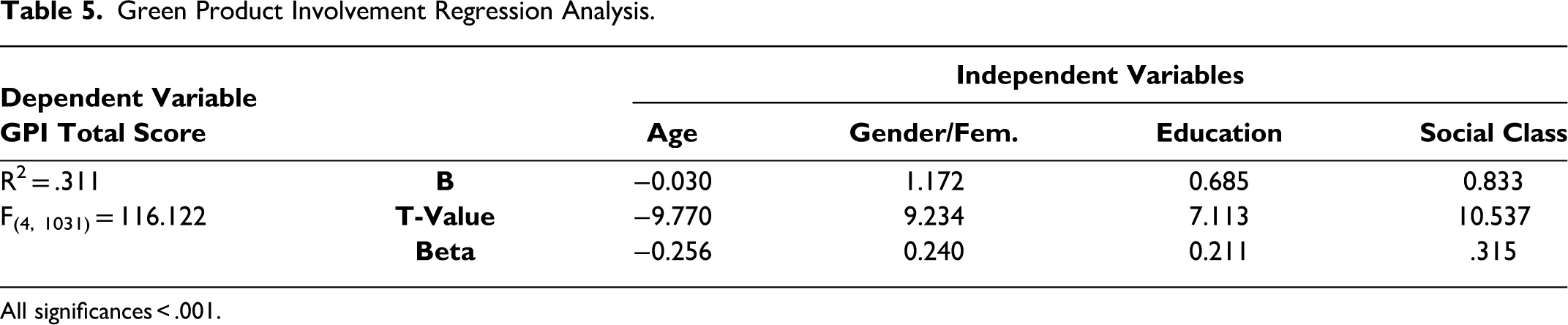
Prior tests addressed demographic variables in isolation. This showed their operation with fewer confounding effects. Though in reality said variables operate in unison. A multivariate regression model thus explored their joint operation. In it, GPI served as the dependent variable while the demographic characteristics as the independent/predictor ones. Regression analyses require at least interval variables (Lewis-Beck and Lewis-Beck 2016). Age's continuous nature was not a problem. Neither were the progressive nature of education level and social class, both assumed to be interval variables (1/primary, 2/secondary-technical, 3/tertiary education; and 1/low, 2/low-mid, 3/mid-high, 4/high-class). However, gender did need conversion into dummy variables (0/male, 1/female). Table 5 shows the results.
Green Product Involvement Regression Analysis.
All significances < .001.
All parameters are significant and operate in their expected direction. Regression results thus confirm bivariate findings: GPI indeed relates to consumers’ demographic characteristics.
However, results do not consider the relation between GPI items and total score, nor the demographic variables’ multicollinearity. A structural equation model addressed these issues. The four demographic variables served as independent exogenous variables and the five scale items as indicators of the latent endogenous GPI variable. Figure 1 shows the results. The straight arrows from the left demographic variables to the figure's central latent GPI construct are the standardized Beta coefficients. The curved arrows between demographic variables show their correlations. The straight arrows from the central latent GPI construct to its scale items on the right are the standardized Lambda coefficients/factor loadings. The squared multiple correlation (R2) for GPI is .338, supported by robust fit statistics (Chi-Square = 746.744, df = 21, p = .000, NFI = .829, CFI = .832, RMSE = .182).
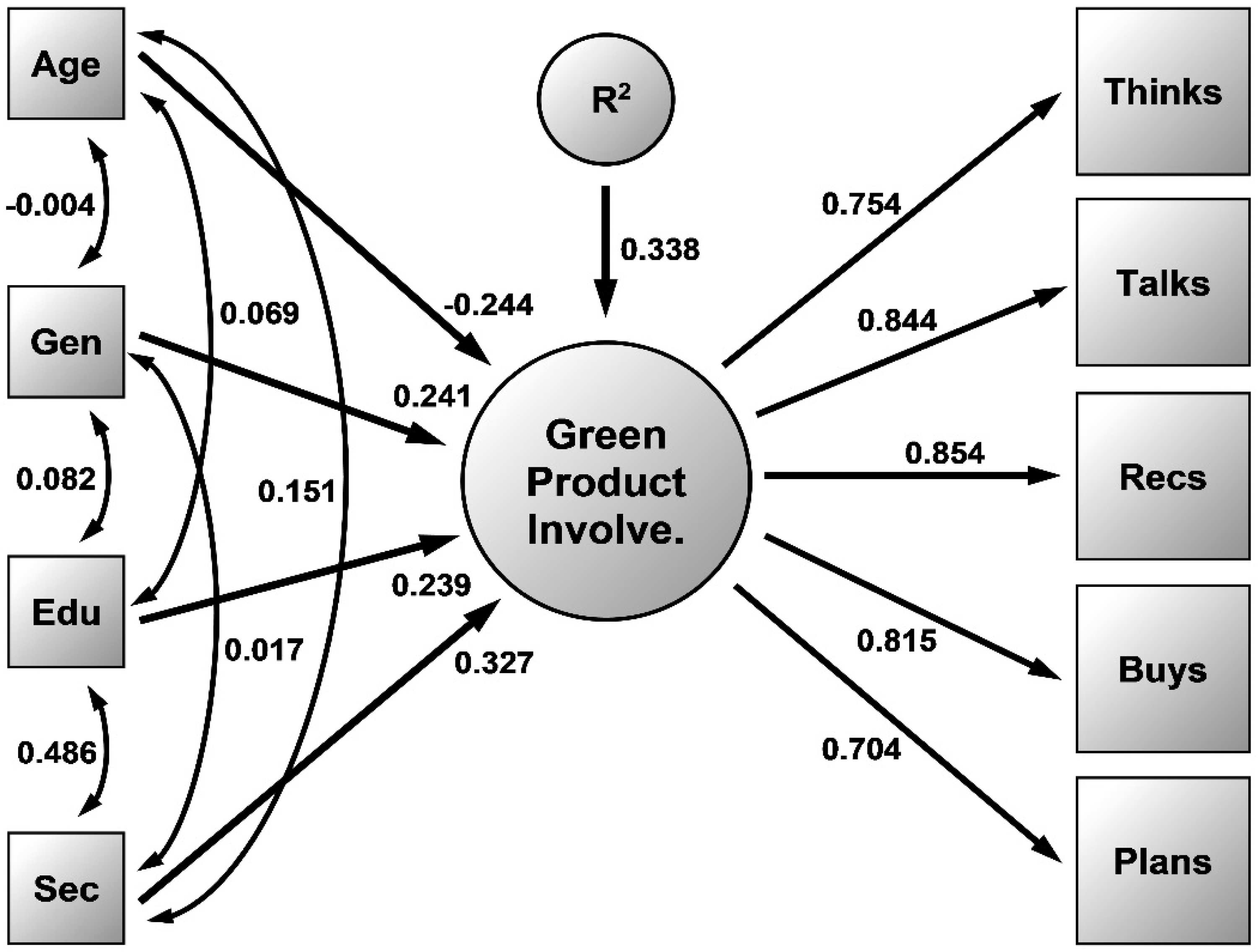
Demographic structural equation model.
GPI is clearly a function of age, gender, education level, and social class. Predictive parameters are all significant and in their hypothesized direction. That said, education level and social class show strong multicollinearity. A streamlined model might drop one or the other with similar overall results. If social class is eliminated, the R2 decreases from .338 to .236. If education level is omitted, the R2 drops to .277. If one had to be omitted, education would be preferred given its lesser impact on the model. However, neither option is recommended as eliminating a variable decreases the model's overall explanatory power.
It might seem that jointly the four demographic variables “only” explain .338 of GPI variance. However, this regression/SEM value is not that low. Perusal of the marketing literature reveals that when studies attempt to explain human behavior, R2 values of under .500 are not uncommon; especially with complex/abstract constructs like attitudes. Moreover, the model parameters obtained were significant and operated as expected. This, combined with prior bivariate results, indicate that GPI indeed relates to consumer demographics.
That demographics are inadequate to profile green consumers, and thus passé, has been long suggested in the literature (Diamantopoulos et al. 2003). However, Dolnicar, Grün, and Leisch (2018) indicate that just because psychographic variables are sexier (i.e., more sophisticated), they do not necessarily segment better than demographics. McKercher et al. (2022) compare different segmentation criteria. They find simple ones, like demographics, to be most efficient. This derives from psychographic variables being more abstract and thus harder to operationalize. They also require more complex data collection and analysis techniques. Importantly, psychographic variables do not necessarily result more effective as to predictive power. The authors therefore recommend using the most parsimonious segmentation criteria given the context and research objectives.
Policymakers and NGOs in developing countries are oft challenged by the data needed to support their efforts. Especially at local levels, where resource limitations are exacerbated. While appealing in academic contexts, esoteric psychographic variables and sophisticated statistical techniques become a hindrance in the real world. Demographic data remain relatively easy to acquire, and then analyze, interpret, and implement effectively. Present results indicate that demographic variables remain relevant. They still play a significant role within sustainable consumption research, are still able to effectively profile consumers, and should thus not be discounted.
Discussion
Gauging consumers’ green product involvement/GPI is useful. It indicates how sustainable a country's consumption might be. And as an underlying attitude, it also signals how open citizens might be toward policies fostering more sustainable consumption.
Costa Rica has long enjoyed a stellar international reputation as to sustainability (Sengupta and Villegas 2019). The country's political and business narratives regularly highlight this, e.g., UN (2019) or Gallagher (2021). Yet Costa Ricans’ GPI was surprisingly low. Its consumers are hardly interested in green products, and by extension, in sustainable consumption. There might also be a generalized reluctance toward sustainable consumption policies. While disappointing, results are consistent with studies in other countries. These also indicate that consumers are for the most part unengaged as to sustainability (Ganglmair-Wooliscroft and Wooliscroft 2022). However, other countries rarely portray themselves as sustainability paragons, which aggravates present findings.
It thus seems that even in seemingly extreme cases like Costa Rica, sustainability's attitude-behavior gap holds. This unexpected result led to a review of local sources to attain preliminary explanations. Sources confirmed Costa Ricans’ unsustainable consumption. Illustrative thereof are the amounts of plastic that people consume and litter. The country generates about 550 tons of plastic trash every day. Only 9% is recycled and 11% sent to landfills. The remaining 80%, 440 tons, is randomly tossed on streets, lots, creeks, etc., much making its way into the oceans (Grajales 2018). Clean and green Costa Rica can actually boast about having one of Central America's most polluted river basins, the Tárcoles, Figure 2. In addition to plastics, the basin evacuates assorted waste from the Greater Metropolitan Area, where about half the country's population and major industries reside (ElPais 2015). From water bottles to tires, and gas cylinders to refrigerators, the river handily carries everything out of sight.
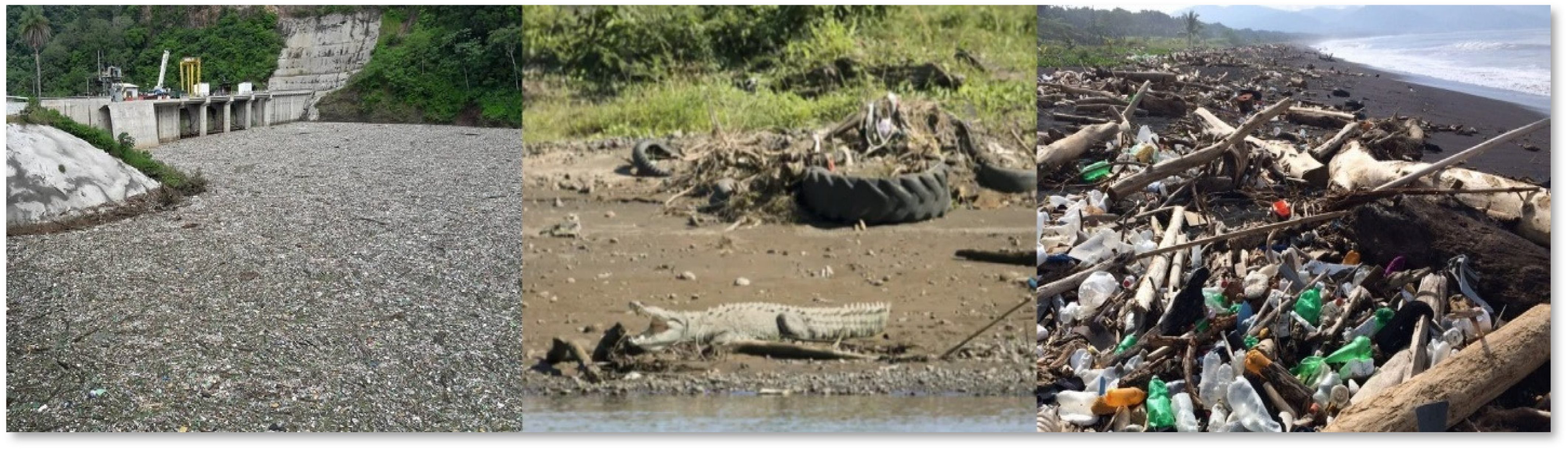
Trash linked to the Tárcoles River Basin. Left: Trash floating at the Chucas hydroelectric plant, above the Tárcoles River. Middle: Trash likely along the lower Tárcoles. Right: Trash washed up on Guacalillo beach, near the Tárcoles river mouth. Sources: Left/Right Grajales (2018). Middle: Núñez (2020).
The Tárcoles’ pollution not only impacts local ecosystems. It also has global effects. The tons of plastic spewed daily into the oceans likely add to the colossal Pacific and Atlantic plastic patches which are devastating marine life (NationalGeographic 2022). Tossed plastics moreover contribute to micro/nano plastics now being found everywhere on Earth. These are increasingly present in people's food, water, air, and bodies (Rozsa 2022, Schank 2022).
The rate and way in which Costa Ricans consume have become the country's most serious environmental threats (Núñez 2020, O'Neal 2019). (See Conejo, Gamboa, and Young (2022) on how Costa Rica's consumption culture emerged.) Costa Rica's consumption footprint reflects this unsustainability, growingly deficient since 1973. As of 2018, the country required 1.55 Earths to support its lifestyle. While better than the US’ staggering 5.13 Earths, Costa Rica's ecological deficit is not unlike that of Central America (1.45 Earths), Latin America/the Caribbean (1.56 Earths), and the World (1.75 Earths) (GFN 2022). For a country that fancies itself a sustainability paragon, its ecological footprint is quite unremarkable. Also troubling is that its eco deficit has steadily worsened for half a century with little having been done about it.
Costa Rica is oft lauded for its sustainability efforts. And credit is due for its achievements. Especially considering that it is a small developing nation with extremely limited resources. However, nature reserves/national parks alone do not make a country sustainable. It is a nation's people, through their everyday attitudes and actions, that really make a country sustainable. Alas, Costa Ricans’ disinterest in sustainable consumption not only stands to undermine the country's ecological achievements. From a broader nation branding perspective, the stark incongruence between consumers’ unsustainable behavior and the country's idealized image stands to erode Costa Rica's international credibility and appeal (Florek and Conejo 2007). This is concerning as tourism, one of the country's main industries, relies heavily on this pristine image, see ICT (2022).
Sullivan-Barger (2021) notes that in economically unequal settings like developing countries, people stand to lose/gain more via their actions. To guard their individual well-being, people in these zero-sum settings become highly competitive. They focus more on their selves and care less about others (and by extension, the environment). This might explain the country's low GPI. Alternatively, decades of nationalist rhetoric on Costa Rican exceptionalism might have given the country's consumers a false sense of security/superiority. It may have even driven them to be unsustainable via some sort of entitlement effect. These and other potential explanations are beyond this study's scope. However, the reasons behind Costa Ricans’ unsustainable consumption must be addressed if the country is to become truly green.
Costa Ricans’ GPI was also examined in terms of gender, age, education level, and social class. Each comprised different segments. Figure 3 shows GPI averages for each, out of 50 points possible. The total sample's average is to the left as a benchmark. Shading separates broad demographic categories. Significant differences with respect to the total average are in bold. Findings indicate towards which segments sustainable consumption policies might be directed. Also, how policies might be best formulated for superior effect.
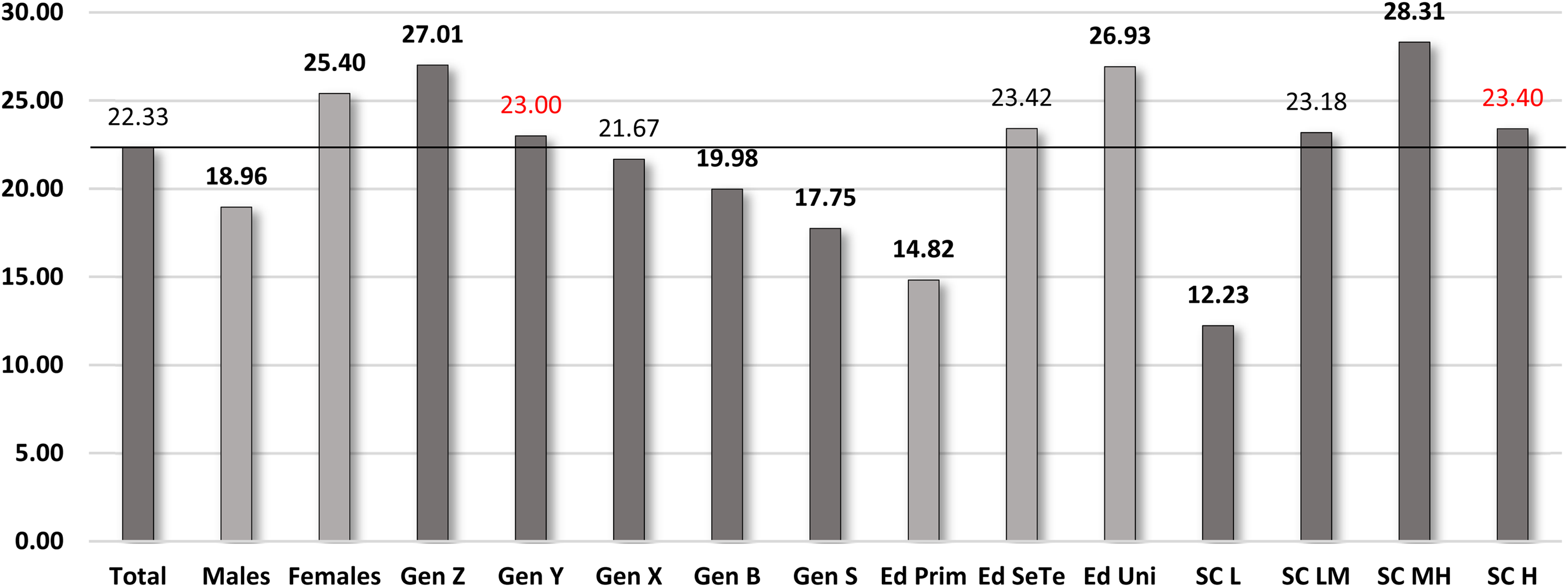
Average GPI score by demographic subsample.
As shown above, Costa Rican consumers that are male, older (Gen B/S), less educated (Primary), and from a low social class have the weakest GPIs. These segments show the greatest improvement potential. Though their lack of interest and/or resources would likely lead these segments to ignore, perhaps even oppose, sustainable consumption policies. Targeting them would therefore result ineffective.
Conversely, consumers that are female, younger (Gen Z), highly-educated (University), and from a mid-high social class have the strongest GPIs. These segments would likely accept, perhaps even embrace, sustainability policies. However, they probably already engage in sustainable consumption practices. Targeting them would be akin to ‘preaching to the choir’. And likely still studying, living with parents, and without their own families, their consumption footprint is probably already low. The benefits of targeting them would also be marginal.
Sustainable consumption policies should therefore focus on consumers with average GPIs: those of both genders, middle-aged (Gen Y/X), moderately-educated (Secondary/Technical), and from a mid-low class, essentially Costa Rica's population's core. While not highly interested in green products, they at least do not seem averse to them. Their moderate involvement thus constitutes an opportunity to make the nation's consumption more sustainable. Targeting this population core may also have a dual spillover effect. Upwards, policies would reach segments with higher GPIs. This should reinforce or increase their sustainable consumption. Downwards, policies would reach segments with lower GPIs. While perhaps ineffective in the short term, initiatives might at least prime these segments for future efforts.
Two results stand out. Figure 3 highlights these in red. First, is Gen Y's (25–39) surprisingly low GPI. Its significant drop with respect to Gen Z (18–24), and consistency with the total average, might be a sampling effect: Gen Y comprises nearly a third of all respondents. However, the GPI drop is more likely the result of life cycle processes: Once young consumers become independent in their mid-20s to focus on work and family, they are likely hit by life's realities. Pragmatism overrides their youthful ideals, the environment less relevant as they age.
This finding presents a major obstacle for Costa Rica to become truly sustainable. Gen Z is oft heralded as the planet's salvation given its sustainability penchant. Yet if everyday life socializes it into conventional ways of thinking/acting, as seems to have occurred with Gen Y, the perpetuation of non-sustainable consumption seems inevitable. Counting on Gen Z and those thereafter to save the planet is thus a risky bet. Hence the need for public policies that foster sustainable consumption. Though essential is that these policies do not conflict with other life areas/goals. Policies need to be compatible, and ideally enhance, young adults’ success within the familial and professional spheres so that their enthusiasm for sustainability not be overridden by the realities of life. Moreover, the importance of sustainable consumption needs to be strongly imbued within low-involvement shopping contexts so that it permeates everyday life.
The second unexpected finding is the high-class’ relatively low GPI. These consumers have the best information and education access. They should thus appreciate the gravity of the environmental problems afflicting Costa Rica and the planet. High class consumers also have, by far, the means to live more sustainably and help mitigate these problems. Yet their GPI is but average, similar to the total sample's. This suggests an astounding lack of environmental concern.
This would be consistent with Lee and Winterich (2022). The authors find that when upper-class consumers buy expensive products, which they often do, a sense of entitled self-importance arises, which overrides environmental concerns. Findings would also be consistent with Piff et al. (2010), who find upper-class consumers to be less pro-social, and with Piff et al. (2012), who find them to be less ethical.
Another explanation for Costa Rican elites' low environmental concern might be their sheltered lives; residing, working, and enjoying themselves in the finest locales. The latter shield them from the realities most Costa Ricans face, making them oblivious to environmental issues. Moreover, elites have the resources to outright dodge environmental problems, say escaping abroad if things become really bad. This would be consistent with elites elsewhere: E.g., billionaires have for years been preparing for a global socio-environmental collapse by purchasing vast land tracts in New Zealand (O’Connell 2018). And the US’ growing socio-political dysfunction has triggered a surge in Golden Visa applications. Buying a home in say Portugal leads to eventual citizenship. Once confined to the elites, these programs are being increasingly sought by upper-middle classes also seeking escape options(Berger 2022).
Regardless of the reason, the high class' low GPI thwarts Costa Rican sustainability in two main ways: Not only does the upper class consume much more per capita, disproportionately affecting the environment. But in doing so, it also signals to the classes below them that high consumption levels are acceptable, even desirable. This derives from lower classes long emulating higher ones due to the aspirational nature of upper-class products, behaviors, and attitudes, e.g., Veblen (1899/1912). That the upper class does not lead by example, but instead reinforces unsustainable attitudes and behaviors, is most concerning.
Consumption behaviors not only derive from demographic and other personal features. Equally important is the context in which consumption takes place. Markets are path-dependent. Unique structural circumstances determine their infrastructure, participants, and dynamics. These then hinder or enable sustainable behaviors (Ganglmair-Wooliscroft and Wooliscroft 2022). Without having studied Costa Rica structurally, also beyond this paper's scope, it would be premature to suggest how policies might make consumption more sustainable. Some preliminary suggestions are nevertheless offered.
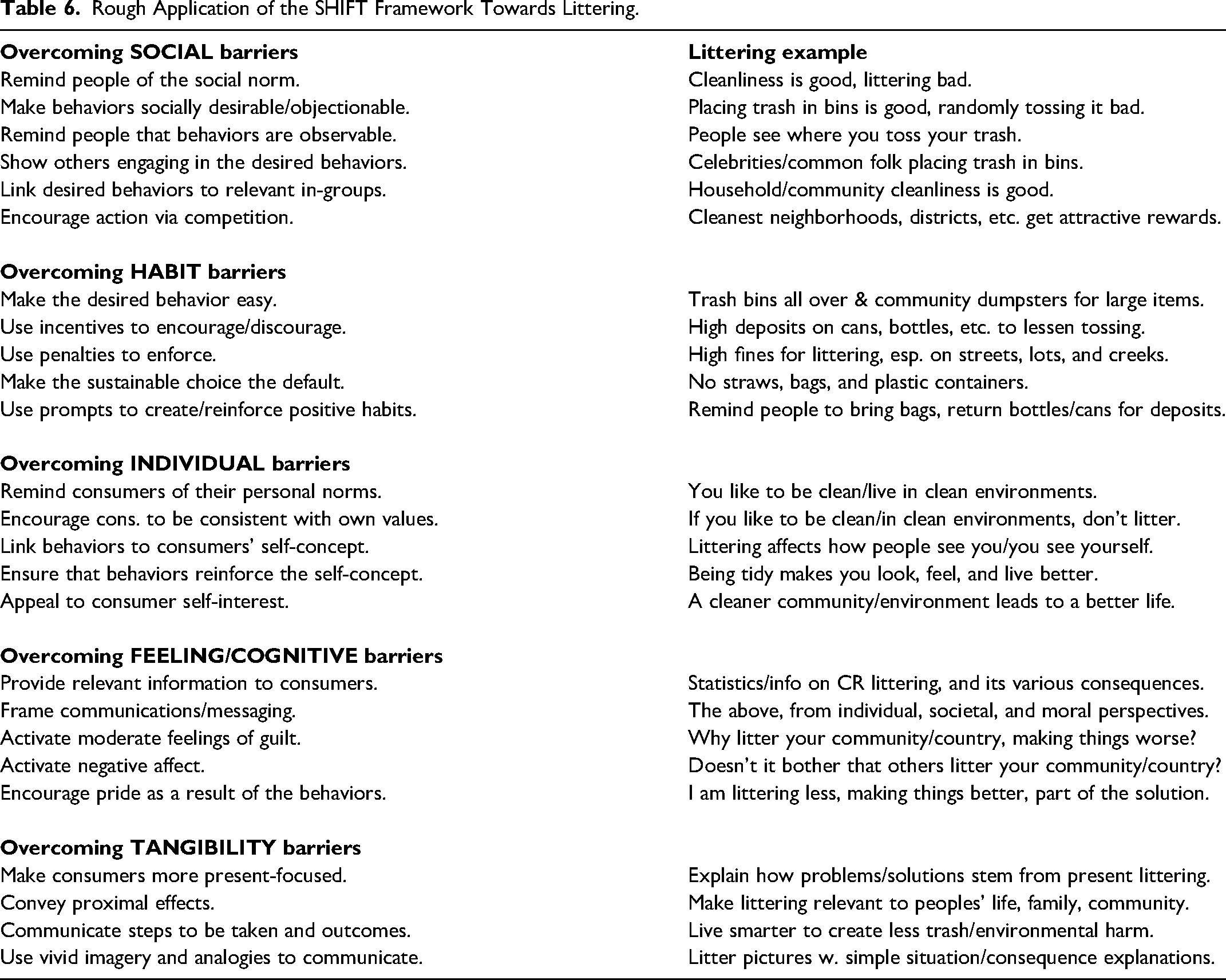
At the micro level, White, Habib, and Hardisty's (2021) comprehensive SHIFT framework might be applied to improve everyday consumption behaviors. The framework identifies several sustainability barriers (Social, Habit, Individual, Feelings/Cognition, and Tangibility) and offers avenues to overcome them. Table 6 illustrates how some of these avenues might be deployed to resolve the country's aforementioned littering problem. While broad and by no means exhaustive, examples do show how micro-level consumption might be made more sustainable, leading to macro-level improvements.
Rough Application of the SHIFT Framework Towards Littering.
Vital is that sustainability efforts like those mentioned above be tailored to the demographics they target. E.g., high-class consumers have more resources and thus control over their lives. Depending less on other people makes them more self-centered and transactional. Conversely, low-class consumers have fewer personal resources. This makes them more reliant on others. Their attitude thereby becomes more empathetic and communal (Piff et al. 2010). Efforts targeting upper classes should thus emphasize what they stand to gain individually via more sustainable consumption, say an improved personal image, see Naderi and Strutton (2015). Efforts targeting lower classes should instead emphasize what they stand to gain collectively, e.g., a healthier, nicer community or country.
At a more macro level, also important is that sustainability policies match social norms so that they be more likely accepted (Kopnina 2017). Possessions are essential to consumers’ identity-building projects, helping them express their personal and social selves (Belk 1988). If trying to shift consumption away from conventional products, attractive sustainable alternatives must be a-priori available. These must equally aid consumers’ identity-building projects. They must offer the same socio-personal signaling value as the products they seek to replace. If substitutes lack this resonance, sustainability policies will unlikely catch on (Dolan 2002).
In line with the above, Prothero and Fitchett (2000) suggest that sustainable consumption be stimulated by working within the dominant social paradigm. Specifically, by leveraging consumer culture; commoditizing sustainability via eco-friendly goods, services, and notions; and marketing these via mainstream institutions and practices. We generally agree with this approach, especially given the promising results it may yield, e.g., Prothero, McDonagh, and Dobscha (2010).
However, the commodities approach focuses excessively on products. This is concerning as it is not up to date with more current consumption paradigms. Despite recognizing product's semiotic nature, the commodities approach does not contemplate how brands are often more important than their underlying products. Given the broader, richer meanings that brands offer, it is brands that now drive how consumers think, feel, and behave, not products (Conejo and Wooliscroft 2015). Moreover, and despite having already been amply marketed via mainstream institutions and practices, green products are still hardly relevant to Costa Ricans. The commodities approach has thus been ineffective in this setting, unlikely to yield significant gains.
In line with Spry et al.'s (2021) transformative branding notion, see also Golob et al. (2022), we suggest taking the commodities approach a step further, and extending it to brands. The goal would be to not only support sustainable consumption via a commodities discourse. Also, by an overarching brand discourse spanning product categories. The suggested branding approach might seem micro/managerial, neglecting key macro aspects. However, brands are not confined to the consumer-firm dyad. They are broad signification systems that incorporate various flows and participants. This feature, and the impact that brands have at the greater socio-environmental level, like stimulating overconsumption, clearly places brands within macromarketing's purview (Conejo and Wooliscroft 2015).
The proposed branding discourse should in the first instance be anthropocentric. This might seem counterintuitive, even anathema. After all, subordinating nature to human interests is often the root of today's environmental problems (Kopnina et al. 2018). However, individuals and social groups tend to be self-centered. This especially applies to global mainstream consumption, designed to indulge the self (Solomon 2020). Brand communications calling to consume more sustainably should thus invoke core human interests like safety, pleasure, and status to make the environment more personally/socially relevant. Over time, and once consumers are more environmentally committed, the brand discourse can be extended to more self-transcendent eco/biocentric notions. But initially, an ethical anthropocentric approach is necessary. One which drives people to protect the environment via self-interest.
Also important is that this branding discourse leverage the power of human emotion. Consumers are oft irrational, sometimes markedly so (Solomon 2020). This feature has prevented the plethora of environmental facts available from making mainstream consumption more sustainable. In some instances facts have made consumption less sustainable by disengaging people from key issues, triggering skepticism and denial (Stoknes 2015). Brand communications must thus go beyond the cognitive. They should also capitalize on the pervasive impact that emotions have upon decision-making and behavior. Doing so will connect consumers more deeply with the environment, making them more likely to adopt sustainable behaviors (Brosch and Steg 2021). Though this must occur at the societal level, where entire populations become emotionally committed to the sustainability imperative.
The above notwithstanding, sustainability cannot be achieved by focusing only on consumers. Consumption is but part of the macro socio-cultural processes germane to particular locations. Excessive consumer focus decontextualizes consumption from the latter, making sustainability harder to achieve (Dolan 2002). The sustainability branding discourse would thus need to be all-encompassing and permeate the various aspects of everyday life. The goal would be for environmentalism to become institutionalized at different levels, drive mainstream narratives, and not just be a trendy token, as is frequent today. In line with Prothero and McDonagh (2021), sustainability needs to be an all-encompassing political project, a true cultural force. It must encompass all major societal actors (government, business, media, citizens, etc.), as well as special interest groups, to make national values and behaviors truly sustainable.
The above is admittedly ambitious, even naïve. But without a united front encompassing all social sectors, Costa Rica has a slim chance of becoming truly sustainable. The environmental issues facing the country (and the planet) are wicked: extraordinarily large, complex, and nefarious, see Wooliscroft (2020). They cannot be properly addressed, much less resolved, if undermined by special interests and a lack of political will. A comprehensive systems approach toward sustainability is thus required. One in which consumers and other societal stakeholders are all actively engaged in the eco imperative.
Limitations and Future Research
Like any study, this one presents limitations. Yet these also provide interesting research opportunities.
A first limitation refers to the object. This study addressed green products in general. It thereby mitigated the impact that any one class of them might have upon results. However, green products are diverse. They range from organic food, through biodegradable detergents, to electric vehicles, among many others. Research must be increasingly specific for fields to develop (Most, Conejo, and Cunningham 2018). Future research should thus investigate Costa Ricans’ involvement with respect to specific eco-friendly categories. Studies might alternatively address involvement toward socially-sustainable products, like those that are fair-trade or local; non-traditional sustainable products, like volunteering and donating, which nevertheless involve exchange; and the adoption of sustainable everyday behaviors like avoiding plastic bags and recycling. These and other studies should refine how sustainable involvement is understood, and improve how policies might be deployed.
A second limitation pertains to subjects. This study's large quota sample yielded representative results. However, data originated mostly from Costa Rica's Greater Metropolitan Area. Despite spanning different cities and provinces, the data's largely urban/sub-urban nature does not necessarily reflect the GPI of consumers in rural or tourist areas. Especially remote ones, where education, income, and lifestyles greatly differ. Moreover, and while Costa Rica is similar to other Latin American countries (Palmer and Molina 2004), national consumption patterns remain path-dependent. Country-specific factors like resource availability, legislation, and others, result in cross-national differences. Future research should thus address GPI in other Costa Rican regions, as well as in other Latin American countries. Together, such studies should yield more precise insights into consumers’ penchant for sustainability.
A third limitation concerns the segmentation variables used. This study applied common demographic indicators to ascertain GPI. While these yielded actionable insights, the variables used are by no means comprehensive. Future research should thus add others like marital status, number of children, or occupation to gain a more complete demographic picture of Costa Ricans’ green inclinations. Consumer location should also be included to help target policies better. However, demographic variables are admittedly atheoretical and only indirectly relate to people's sustainability penchant. Importantly, they reveal little about people's underlying motivations (McKercher et al. 2022) Future research should thus add behavioral, lifestyle, and psychographic variables to further understand GPI.
A fourth limitation refers to the research approach. This study used surveys to quantify GPI. However, surveys are admittedly reductionistic. They yield an incomplete picture of constructs’ nature and operation. Especially in foreign contexts, where items abstract away key cultural nuances (Holt 1997). Moreover, and even though the precautions taken reduced response biases, some may have persisted. To address both of the above, future research might use more objective GPI indicators. Per e.g., Carrero, Redondo, and Fabra (2016), an option might be sales data. This would lessen survey biases. It would also allow to compare green vs. conventional product sales while accounting for location/timing effects.
Identifying consumers that are more/less sustainable is valuable. But consumption is a cultural process. The motivations behind people's actions must also be understood (Dolan 2002). Consumers seek different benefits from their green product purchases. Benefits range from personal health or environmental preservation to social desirability or personal image building. These underlying motives must be uncovered, beyond what quantitative data might reveal. Given their importance for effective policy formulation, future research might thus apply qualitative approaches to understand consumer motivations. Of particular interest is why Costa Ricans are generally so disinterested in green products, whilst coming from such a (supposedly) sustainable country. Also of interest is why Gen Y and Upper-Class consumers show merely average GPI levels.
A fifth limitation pertains to the broader consumption context. This study addressed consumers’ green product involvement. However, involvement does not only depend on personal characteristics. It also derives from the broader consumption context, the latter embedded within macro-structural factors (Thøgersen 2010). Local path dependencies enable or hinder sustainable consumption. Feedback loops then reinforce certain patterns (Layton and Duffy 2018). As done by e.g., Ganglmair-Wooliscroft and Wooliscroft (2022), future research must address the structural conditions that in Costa Rica stimulate or inhibit green product uptake. Though studies must consider the geographic, social, political, and economic aspects in unison. By adopting a systems approach to these structural conditions, a better understanding of the country's sustainable consumption may be attained. Understanding structural elements will also lead to more effective policy interventions.
A sixth limitation concerns the results’ temporality. This study assessed involvement cross-sectionally. However, and like other attitudinal constructs, GPI is unlikely static. Its level and nature vary according to socioeconomic conditions. Following Steenkamp and Maydeu-Olivares (2015), who study consumer trait evolution, future research should address GPI longitudinally. Virtually nothing is known about this construct's temporal dynamics. Monitoring it across time, especially after key events, should yield valuable insights for policy formation. Moreover, people are not born with sustainable predispositions. These develop over time, contingent on what individuals are exposed to via education and life experiences. How sub-samples are socialized into being more/less interested in green products should also be studied. Results would then allow for more effective government interventions. Regardless, the findings here presented should serve as a foundation for these and other studies.
Closing Thoughts
Countries usually strive to improve their standard of living by increasing their GDP. The core assumption is that economic growth trickles down throughout society, benefitting everyone (Stiglitz 2016). Costa Rica eagerly embraced this paradigm. Upon liberalization in the mid-1980s, it focused on economic expansion. The country eventually attained one of Latin America's highest development levels (UNDP 2020) and was recently admitted into the OECD (OECD 2021).
However, this GDP approach involves stimulating personal consumption, which comes at high socio-environmental costs (Coscieme et al. 2020). In Costa Rica's case, it eroded traditional values. People have become consumption-oriented, even materialistic, which has severely degraded the social fabric (Allen 2019). This ‘progress’ also came at an environmental cost. The rate and way in which Costa Ricans consume are now the country's most serious ecological threats (Núñez 2020, O'Neal 2019). Material gains have moreover lowered the country's quality of life (dissatisfaction, stress, etc.) (Sengupta and Villegas 2019), ironically, what heightened consumption supposedly improves.
Costa Rica is but another example of the dominant social paradigm's effects. Characterized by hyper-consumption, among others, it detaches individuals from nature. This leads consumers to ignore or even negate the environment, resulting in its rapid degradation (Kilbourne, McDonagh, and Prothero 1997). We thus concur with Conejo and Wooliscroft (2020) in that traditional neoliberal developmental models are not all that they purport to be. They come with heavy socio-environmental consequences which require consideration. More sustainable development models, that decouple economic growth from wanton consumption and socio-environmental degradation, must be devised. Though how this might be achieved remains most challenging. Especially for small developing countries, given their more limited resources and high vulnerability to foreign/corporate interests. Intersecting marketing, society, and the environment, the Journal of Macromarketing is an ideal platform to address these and other challenging issues.
Footnotes
Associate Editor
Ben Wooliscroft
Declaration of Conflicting Interests
The author(s) declared no potential conflicts of interest with respect to the research, authorship, and/or publication of this article.
Funding
The author(s) received no financial support for the research, authorship, and/or publication of this article.
