



Abstract
This paper proposed that marketing capability is a critical component of market orientation. As such, knowledge of intelligence and competitive strategy, aspects of market capability obtained through training is essential for market orientation. Cross-sectional survey was used. Data were collected with a structured questionnaire and analysed using the structural equation model (SEM). The structural model and path estimates indicate that all the constructs intervene in food security, implying that a systemic approach rather than individual strength can help achieve food security. The study's findings support the perspective that marketing capabilities have spill-over effects that improve market orientation and food security performance. Therefore, BoP producers through training can generate significant marketing capabilities that can improve the food market. It highlights the importance of producers adopting a market-oriented approach. The study recommended a multi-stakeholder engagement model toward integrating biofortification into public and private policies and programmes. This would encourage investment and continuous training of producers on how to improve communication and customer relationship management to stimulate consumption and supply.
Keywords
Introduction
With the rise in malnutrition and hunger as shown by the food security indicators (FAO et al. 2020; Osabohien et al. 2023), Africa is far from achieving the global target stipulated in the Sustainable Development Goals (SDGs) on hunger and nutrition. As a result, biofortification has gained more support as a local food alternative for addressing nutritional issues (Saltzman et al. 2017) accelerating the transition to more sustainable and healthier food outcomes.
The bioavailability of vitamin A in biofortified foods, along with additional benefits for public health, has demonstrated that biofortified foods can address deficiencies in micronutrients. (Talsma et al. 2016). This suggests that biofortified foods have high market potential and could revolutionise the local food industry, leading to improved food security. Unfortunately, data reveals that the market systems for biofortified foods are unstable in supply due to the relatively scant availability of biofortified foods and seeds in most local markets across Africa. This makes the delivery process quite challenging. For instance, although biofortified crops were distributed to more than 68% of Nigeria's farming households since 2015 (Saltzman et al. 2017); about 75% of the products were consumed by farming households, while only 10% of the total estimated production of 7000 tons of Vitamin A-rich cassava roots were sold in local markets (Oteh et al. 2020). This vicious circle intensified during the farmer-herders conflict and the Covid-19 pandemic (Arndt et al. 2020), thereby exacerbating food insecurity, child malnutrition, hunger, poverty, and other health-related crises.
Furthermore, existing literature indicates that most BoP producers lack an understanding of the market dynamics and market orientation, this, restricting their competitiveness in the food market system (Oteh and Nwachukwu 2014). Market orientation enhances the capacity of a small resource farmer to create value and capitalize on market opportunities (Yaseen et al. 2018), because it drives commercialization and innovation. Successful firms leverage these resources to provide options that enhance customer performance (Kotler et al. 2021). This study, therefore, addresses the marketing capabilities of BoP producers of biofortified products. This is because a firm's marketing capability is both an intelligence and competitive strategy that drives the integration of market orientation systems with demand and supply to enhance the performance of food security. Interestingly, micromarketing phenomena include: marketing capability and market orientation.
The study broadens the discourse on the crucial role of BoP producers as value creators in the local food industries primarily located in informal markets with low demand engagement (Adéchian et al. 2022). BoP producers are strategic drivers of local food consumption in the industrial processing sector. Essentially, they are central to the progress of reaching more than 1 billion people with biofortified crops and meeting food security objectives (FAO et al. 2020). Despite their contributions, little effort has been made to understand the activities that can stimulate their market orientation (Yaseen et al. 2018), leaving them vulnerable to exploitation by middlemen.
Overview of Biofortified Cassava Food Production and Marketing in Nigeria
Cassava is a strategic staple crop, with diverse social and economic potentials for developing countries (Oteh and Nwachukwu 2014). In Nigeria, agricultural policies have identified cassava as one of the strategic alternatives to address food security (FAO et al. 2020). As a result, government initiatives like the Presidential Initiative on Cassava in 2003 and the Strategic Action Plan for the Development of the Nigeria Cassava Industry in 2006 were created because it encourages economic agents to participate in the cassava market. This has re-engineered the support of Nigeria universities and agricultural research institutions to develop improved cassava seeds that increase yield performance.
The impact is on: the increase in farmer's productivity (Ikuemonisam et al. 2020), the use of biotechnology to treat viral diseases and the reduction of low multiplication rates. Nigeria is the world's top producer of cassava, but owing to a confluence of variables, problems with land use and management, and its pitifully low yield per hectare, there are gaps between supply and demand. Another contributor to the gap is the management of cassava cultivation by BoP producers, who control roughly 80% of farmed holdings (Oteh and Nwachukwu 2014).
In Nigeria, cassava is in high demand because it is a preferred meal. Recent advancements in consumer diet and food preferences are centred on quality factors such as food safety, nutrition, organic farming, fair trade, free-range, and locally grown foods (Caswell and Joseph 2007). Moreover, the global micronutrient market is driven by the growing concern for malnutrition which is reflected in the rise in obesity and stunted growth. Due to this, emphasis is being placed on the consumption of functional foods or “superfoods”. Unfortunately, the conventional white-fleshed cassava is not rich in pro-vitamin A which is one of the target nutrients for addressing the double burden of malnutrition (Afolami et al. 2021). Therefore, cassava has been biofortified through conventional cross-breeding. Currently, it is one of the key target crops of biofortification that is marketed as a cost-effective intervention (Onyeneke et al. 2019).
There is an expansion of the size of the global food market and this expansion is expected to be at the Compound Annual Growth Rate (CAGR) of 5% from 2020–2027. Though, it is difficult to estimate the market size of global functional foods and superfoods, the global demand is estimated at 8% annually (Arndt et al. 2020). Evidence from Mordor Intelligence shows that in Africa, South Africa and Nigeria are top in the demand for functional foods given an estimated growth of 6.5% from 2020–2025. This shows that superfoods like biofortified foods have high market potential in African economy (Oteh et al. 2020). Although evidence shows that older people are more likely to demand for these categories of foods, however, innovation in functional foods are making it attractive for young people due to increase competition (Bistrom and Nordstrom 2002).
Base of Pyramid Market Orientation and Marketing Capabilities
BoP manufacturers represent a significant proportion of private suppliers in the conventional food business, which explains the increased interest in them. Regrettably, many small and medium-sized enterprises (SMEs) lack market systems and appropriate understanding of market orientation (Aravind and Ashil 2019). The competition from large enterprises puts a strain on their capacity to respond to and adapt to market changes. Therefore, these small businesses require knowledge of marketing resources to understand market-related needs, and leverage such knowledge to meet customers’ expectations, and competitive supply (Kotler et al. 2021).
The nature of the relationship between the small and large enterprises (direct or indirect) is dependent on the mediating role of the components of the marketing capabilities (Alnawas and Allam Abu 2020). This leads to better food outcomes in the context of customer performance and market performance (Acikdilli et al. 2022). In a way, marketing capability enhances a firm's ability to recognise, respond to, and manage customer and market expectations with positive outcomes. Therefore, the perspective of the study is that biofortified foods is an essential marketing intervention, given the increasing levels of food and nutrition insecurity in developing economies.
The developing economies require an understanding of access and use of agricultural market informational capabilities to improve market recognition and competition. This understanding is critical because transformation of local economies for better food outcome requires market intelligence and an appreciation of customer values. By integrating different processes that galvanize collective knowledge, skills, and resources of the firm to support superior value delivery, a superior market and consumer performance will be built. In addition, sensing and learning capabilities and market performance moderated by market orientation will be improved.
Based on various measuring criteria, marketing capabilities have been applied in various economic activities and sectors with differing degrees of success. Extant literature shows its application in family farm business and diversification, agri-food SME (Cannas, 2021), SME performance (Davcik et al., 2021), manufacturing and service enterprises, agricultural science and technology enterprises, and small food businesses. Despite these various contributions by researchers and positive implications on performance, opinions differ with respect to the elements and measurement of marketing capabilities.
The view of functional marketing capabilities has been highlighted by several studies, which include: firms’ functional capabilities in terms of marketing and operational capabilities, product development capabilities, pricing, informational and economic resources, marketing, and research and development (Ren et al. 2015); innovation and learning capabilities, entrepreneurial and market orientation (Susanto et al. 2021), channel management, product management, pricing, delivery management, post-sale services, marketing communication and selling marketing sensing, and brand and customer relationship management and channel management, new product development, brand management, pricing and information management, marketing communication, selling, marketing planning and implementation (Alnawas and Allam Abu 2020).
The functional level and adopted dimensions were selected for this study because they are internal, within the control of the business, and are based on marketing concepts and applications. In addition, these dimensions are at the nexus of consumer food performance in terms of meeting food availability, access, and utilisation. The increasing demand and pressure for sustainable and nutritious food opened economic opportunities for competitions and investments in biofortified food production and marketing. This requires integrative efforts in resources and skill. Moreover, observable evidence reveals that no empirical studies were conducted on marketing capabilities and food security. In this regard, the absence of a policy instrument is a serious concern, particularly for Nigeria's food systems.
Marketing systems have an enormous responsibility in facilitating and engaging consumers to improve demand and supply, and to meet the food security agenda for Nigeria and the world at large (Beierlein, Schneeberger, and Osburn 2014). The study aims to make important contributions: first, the gap in the availability of empirical literature on biofortification makes this study unique. In essence, it serves as a pioneer study given that the results from the paths will further deepen the literature with empirical support. Second, the implication of the empirical findings will help bridge the gap on policy recommendations which has been absolutely non-existent in Nigeria. Third, the use of SEM provides a robust analysis on issues surrounding marketing capabilities and food security performance in African economies other than the use of simple descriptive statistics.
Food Security: Triangular Interaction of Food Demand, Supply and Dimensions of Marketing Capabilities
Food security is a complex and an evolving concept with multifaceted dimensions. Generally, it revolves around three to four major dimensions – access, availability, consumption and stability (FAO et al. 2020). These dimensions are distinct, but they interact to deliver better food performance. They are influenced by the convergence of economic, social, and environmental factors at both micro and macro levels (FAO et al. 2020). This leads to gaps in food demand and supply (Oteh and Nwachukwu 2014) at individual and household levels. Extant literature indicates that, to improve food security, it is necessary to improve market access, resources and social network (Ahmed et al. 2017).
At the extreme of food security is food insecurity. Food insecurity is driven by poverty, food marketing issues (Babatunde and Oyatoye 2015) and food price increase. We take cognizance that the rising food prices resulting from poor market infrastructures and information management affects the poor since they spend more on food. A small shift in price could affect affordability and trigger consumption of unhealthy diets since they cannot afford more diverse food.
As a result, majority of poor households continue to remain food insecure due to: economic circumstances (Webb et al. 2018), supply issues such as lack of seed or new varieties (Pircher et al. 2022) and the land system (Caiafa and Wrabel 2019) that hinders production and distribution. These in turn, affect food accessibility and availability and negatively impacts on food consumption and choice (Capone et al. 2014). Although having adequate food does not guarantee greater access, it is essential for proper nutrition. Availability of food is mostly mentioned in the context of food environment. This is because it supports the prevention of malnutrition (FAO et al. 2020) and calls for efficiencies in the food supply chain to mitigate hoarding behaviour that results in food scarcity.
As food insecurity is caused by gaps in demand and supply, marketing system plays a critical role as a mechanism for exchange connecting producers to market to bridge the gaps (Beierlein, Schneeberger, and Osburn 2014). Extant literature depicts a nexus between food production, food security and food marketing (Babatunde and Oyatoye 2015) mediated by availability and accessibility to food. Integrated marketing communication is strategic in market information management as it serves as a gateway that guides producers’ and consumers’ decision making. It also provides insights to customer profiling and trends.
Since malnutrition is fuelled by poverty, and poverty increases food insecurity and hidden hunger (Pereira and Oliveira 2020), many nations make efforts to improve the food systems through biofortification (Oteh et al. 2020). This is an alternative cost-effective nutritious solution with comparative advantage over conventional variants (Talsma et al. 2016). However, there is limited presence of biofortified crops in many markets, due to convergence of supply-related challenges such as seed delivery. Consequently, accessibility, availability and consumption are affected. Marketing serves as a bridge, making profitable connections between demand and supply by stimulating commercialization (Babatunde and Oyatoye 2015). This is because it is modelled with layers of value-driven activities and networks which are strategic to a firm's performance (Lagat and Frankwich 2017).
Studies have established the positive trade-offs between marketing capabilities and business performance (Acikdilli et al. 2022). A firm's performance is a complex multi-dimensional attribute that involves financial and non-financial indicators. This study focuses on non-financial performance which involves market-based performance, new products, market orientation, customer satisfaction and brand devotion. Customer satisfaction is a measurement for customer performance and may involve more accessibility and availability of food at the right place, time, and with the right resources. In this study, performance is viewed as primarily customer performance, specifically food security performance which depends on complementary capabilities mediated by market forces – food demand and producers supply. Therefore, the current study also considers how producers can leverage marketing capabilities to meet food security - availability, accessibility, and utilisation.
Development of Hypothesis
Food Availability and Market Forces of Demand and Supply
Food availability deals with food sufficiency in the right quality which is made available through importation or local production (Mockshell and Villarino 2018). It is defined as the condition where food exists for the local community to consume and access without difficulties. As one of the key dimensions of food security that significantly impacts the supply aspect of food security (FAO et al. 2020), it facilitates sustainability in food security. Naturally and healthily cultivated lands, (Caiafa and Wrabel 2019) and ‘the level of food production, stock levels and net trade’ influence it.
The importance of food availability is seen in its modulation of the rate at which individuals acquire caloric resources. Due to the present global food availability, it is theoretically feasible to consume enough calories, but it might be difficult for people to follow a nutritious diet. Extant studies show that food availability and security can be significantly improved with biofortification, fortification or reformulation. However, to guarantee food availability, the role of marketing has to take the central stage. Marketing is a key determinant in consumer demand for food choice and consumption.
The market forces of demand and supply play a significant role in the availability of goods and market economies. They explain the utility function, monetary variable, willingness of consumers to pay value for a product and the suppliers’ willingness to supply at the value. The knowledge of demand is important for scheduling production. In biofortified foods such knowledge comes from the food industry and government programmes. However, studies show existence of demand-supply imbalances in African food market and its associated food allocation. Thus, food demand that does not meet food supply creates food crisis (Ojo and Adebayo, 2012). As a result, we propose the following hypotheses:
H1. Food availability is significantly related to demand H2. Food availability is significantly related to supply H3. Food availability is significantly related to marketing capabilities
Food Access and Market Forces of Demand and Supply
Another important component of food security is food accessibility. It addresses all forms of food acquisition, whether they are practical or financial. (Capone et al. 2014). Food accessibility is defined as ‘the ability to obtain food, free from the barriers of travel time, physical features of the area and the store, neighbourhood safety and transportation costs’ (Carson and Boege 2020). Studies show that affordability, allocation and preference are key variables that are often used in literature to describe food accessibility. (Capone et al. 2014) Affordability has been the most significant factor given its specific association with availability of food and ability of people to get the food (Carson and Boege 2020).
In essence, food accessibility indicates that adequate food supply is good but not satisfactory (Capone et al. 2014; FAO et al. 2020) because it does not guarantee liberation from hunger (Capone et al. 2014). Some studies measured food accessibility with indicators like prevalence of food inadequacy and undernourishment, while others considered it as an intersection of availability and affordability (Carson and Boege 2020). However, with deficiencies in economic access to food, every country faces the enormous challenge of poverty. This is because food access is traceable to determinants such as social variables (Capone et al. 2014; FAO et al. 2020), demographic factors such as income and household support (Capone et al. 2014) and a society's method of food allocation.
In other studies, the ‘access dimension uses indicators that measure logistics infrastructures, economic development and anthropometric indicators such as prevalence of undernourishment’ (Abbade 2017). In essence, food access is influenced by not only societal demand, but also by food supply despite its classification of being an insufficient indicator for determining food access. The role of price, income and other economic indices related to marketing capabilities are also influential Therefore, in line with the development, the following hypotheses are proposed:
H4. Food access is significantly related to demand H5. Food access is significantly related to supply H6. Food access is significantly related to marketing capabilities
Food Utilization and Market Forces of Demand and Supply
Food utilization is perceived as the way various food nutrients are used in the human body (FAO et al. 2020). It is one of the dimensions widely used to assess food security (Abbade 2017). It emphasizes the importance of nutrition security in food security. It is defined as ‘the utilization of food through adequate diet, clean water, sanitation and health care to reach a state of nutritional well-being where all physiological needs are met’ (FAO et al. 2020). Extant studies show that it helps in evaluating a person's access to resources for appropriate food. (Mockshell and Villarino 2018). In literature it is often measured with the percentage of stunting in children below 5 years and the prevalence of anemia in pregnant women. It is also useful for identifying the peoples’ nutritional status. Therefore, the following hypotheses were proposed:
H7. Food utilization is significantly related to demand H8. Food utilization significantly influences supply H9. Food utilization is not significantly related to marketing capabilities H10. There is no trade-off between food demand and food supply H11. There is no trade-off between food demand and marketing capability H12. There is no trade-off between food supply and marketing capability Figure 1.
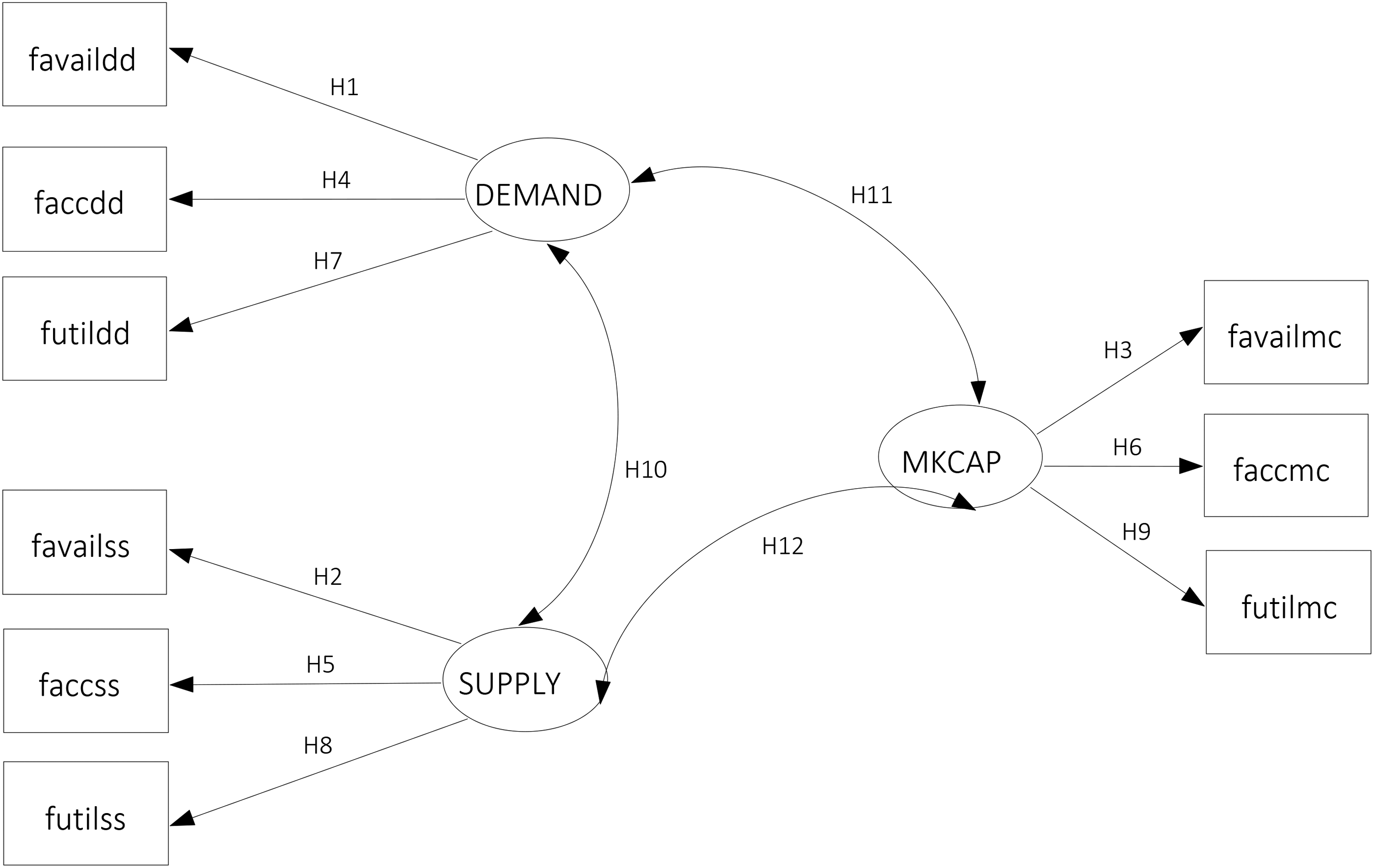
Proposed Structural Model. Proposed Framework of the Hypothesized Research Model Showing the Path Relationships Between Food Demand, Food Supply and Marketing Capabilities. Note: favaildd = food availability for demand; faccdd = food access for demand; futildd = food utilization for demand; favailss = food availability for supply; faccss = food access for supply; futilss = food utilization for supply; favailmc = food availability for marketing capability; faccmc = food access for marketing capability; futilmc = food utilization for marketing capability.
Methodology
Study Context
This study targeted biofortified cassava producers and consumers in Abia state, South-East Nigeria. The region was selected based on the prevalence of cassava cultivation and marketing, as well as the presence of the National Root Crops Research Institute (NRCRI) located in one of its towns, Umudike. The NRCRI was one of the Nigerian agricultural institutes that were responsible for the field trials of pro-vitamin A and biofortified iron crops (Sayre 2011). Moreover, the region of Umudike in Abia state was one of the first six locations in Nigeria where pro-vitamin A cassava varieties were approved by the Nigerian National Variety Release Committee in 2011. The relevance of this study's location is further illustrated by the importance of cassava products in micronutrient deficiencies.
Survey Design and Administration
The data collection consists of structured questionnaires designed in English and interpreted by enumerators in respondents’ local language. It consists of questions on respondent's socio-demographic profiles, and dimensions of marketing capabilities which entail: channel management, marketing communication, customer insight, selling, pricing, and information management. The researchers scored all essential items of the structured questionnaire on a five-point Likert type scale ranging from “strongly agree” to “strongly disagree.”
Sample and Procedures
The researchers developed a cross-sectional research design for target BoP producers in synergy with the Research and Extension Department of the Agricultural Development Program (ADP). Multistage cluster sampling procedure was used for recruiting the stakeholders. The first stage involved a purposive selection of 3 local Government Areas (LGAs) from each State's agricultural zone. These LGAs included the Aba zone (Ugwunagbo, Obingwa, and Isiala-Ngwa North), Ohafia zone (Arochukwu, Isuikwuato, and Bende) and Umuahia agricultural zone (Umuahia south, Isialangwa south and Ikwuano). These zones are major cassava farming communities in the State. One autonomous community from each selected LGA was chosen randomly during the second stage. The third stage was a purposive selection of ten biofortified cassava farmers, with 30 respondents for each zone to ensure suitable mean and deviation estimates.
The study adopted the descriptive analysis and the Structural Equation Model (SEM). The SEM was employed because it is considered a more robust tool when dealing with theoretical models comprising many dependent constructs. Also, the tool has the advantage of incorporating both factor analysis and regression or path analysis. iIt has a distinctive attribute of including the latent construct as dependent and explanatory variables in the regression equation. Compared to other models, the SEM allows for more accurate and precise estimation of regression analysis.
Herman's one-factor test was used to check for common method bias (CMB). The items were adjusted to a single factor. It produced 48.79%. This is within the threshold of 50%, thus indicating no existence of CMB (Kalinic et al. 2019). Cronbach's alpha and composite reliability were used to check the reliability of the techniques while convergent validity was used to check their validity. A set of goodness of fit indices were used to assess the fit of the model. The structural equation model (SEM) was used to test hypotheses.
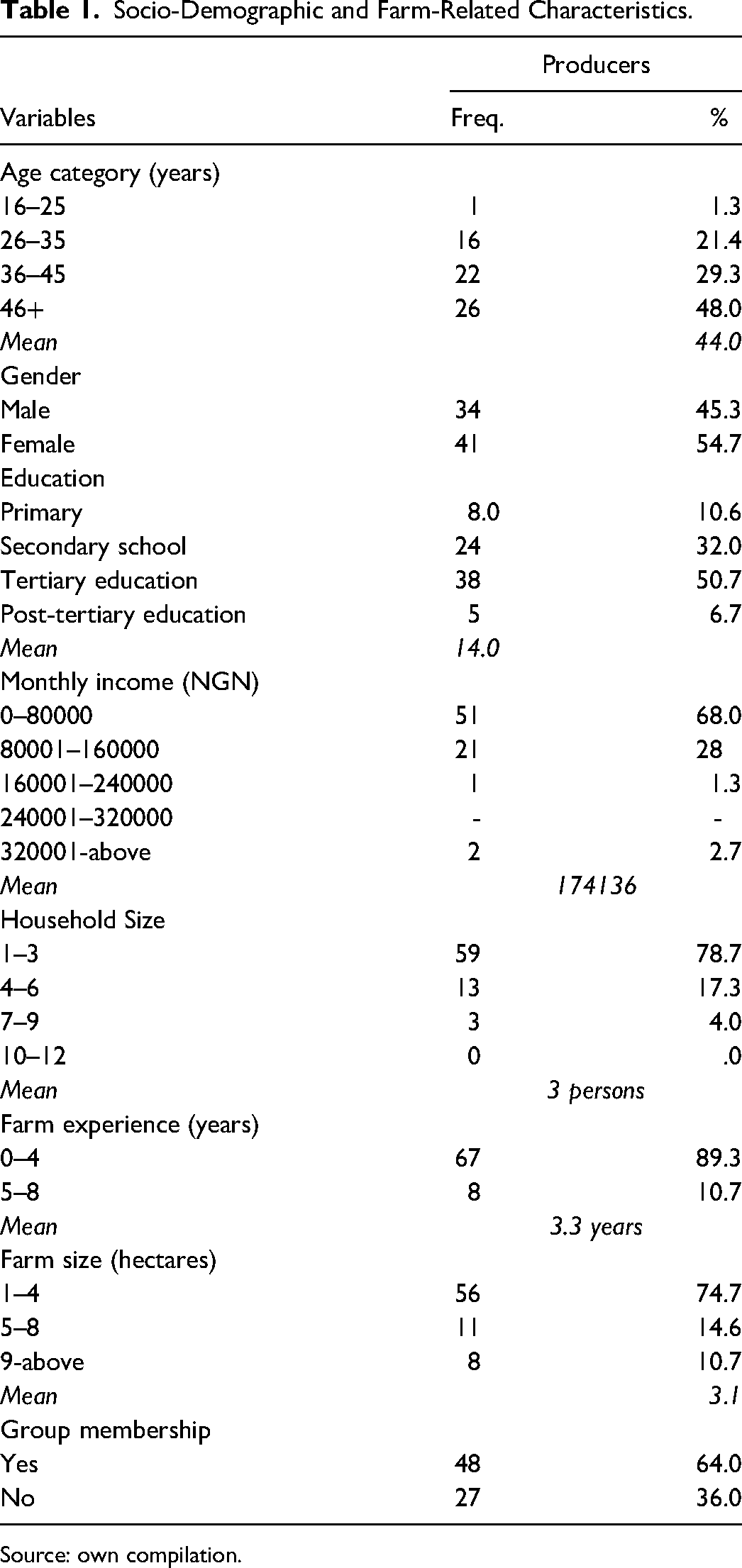
The socio-demography and farm-related characteristics is presented on Table 1. Majority of the respondents (40.4%) fall within the age group of 26–46 years, with a mean age of 44 years. The sample also has more female producers (54.7%) than their male counterparts (45.3%). This is not surprising given the enormous contribution of women to agricultural production, particularly in the cassava value chain (Agwu, Oteh, and Amama 2017). Furthermore, most producers are literate, as shown by the average years spent in school, i.e., 14 years. Education generates knowledge, which drives brand preference and product evaluation (Bornkessel et al. 2014). The household size typically ranges between 1–3 persons (71.1%), with 2 as an average per household.
Socio-Demographic and Farm-Related Characteristics.
Source: own compilation.
The producers’ mean income level was NGN 174136, pointing to a relatively reasonable monthly income to cater for basic household needs. The producers differ in their experience with producing cassava and biofortified cassava. About 89% have less than 5 years of experience with biofortified cassava. The average farm size amounts to 3 hectares, which is relatively large but still not large enough to drive commercial production to a level that allows substantial scaling up of the supply of cassava products. Interestingly, most of these producers belong to an agricultural group or cooperative, in which they share experiences.
Assessment of the Measurement Model
Following Anderson and Gerbing's two-step approach, the study tested the level of reliability and validity of the SE model. The Kaiser-Meyer-Oklin coefficient was .670 which indicates sampling adequacy while Bartlett's test of significance is .000 which implies that the correlation matrix is significantly different from the identity matrix in the data. Thus, the data is suitable for applying this technique for our study. The overall Cronbach Alpha is .8440. This implies that the indicators have very good internal consistency.
The composite reliability was assessed and the values fall between .57 to .87 These values were higher than the threshold except for one item - customer insight (.57). However, the value indicated adequate internal consistency of multiple indicators for each construct in the model because composite reliabilities exceeded .50. From Table 2, AVE ranged between .27–.52. Besides the customer insight construct, all the other constructs were close to the threshold of .5. Based on the view of Fornell and Larcker (1981), the convergent validity of the construct is still satisfactory and adequate if AVE is less than .50, but composite reliability is greater than .60. Unfortunately, this was not the case for customer insight. This raises a concern. One plausible explanation for the low alpha value for customer insight could be the level of understanding of producers in the application of customer management trends and market behaviour, as well as the nature of the study questionnaire and a new field of research for the participants.
Standardized Factor Loading, Cronbach's α and CR of CFA.

Analysis of Table 2 shows that surprisingly, all the observed constructs loaded very well except for customer insight 1 (ability to create manage customer trends and behaviour), evidenced with a lower value (.3450). The result gives an insight into biofortified cassava producers’ customer management capabilities. It implies that the producers are not very conscious of managing customer trends/database and information. The plausible suggestion is the lack of marketing orientation or technically marketing myopic tendency (Kotler et al. 2021). The result is not surprising given that most small-scale businesses are more sales orientated and lack good knowledge of managing data, which could improve a firms’ analytic ability.
To further confirm the validity of the study, the discriminant validity was tested by comparing the AVE of each construct with the squared variance which it shares with other constructs. All AVE exceeded the squared correlation coefficient following Fornell and Larcker (1981). The overall fitness indices suggest a good fit for the model (X2 (351) = 769.10, df = 27, p < .01), which indicates that the measurement model fits the data well.
Structural Model Relationship among the Latent Constructs
The convergent validity of the measurement scales to determine the model fit indicates a good model fit with an X2 = 772. 098, df = 200, p < .000, which was highly significant. Since a good fit to a model is measured when the ratio of Chi-squared to the degree of freedom is less than 3, then the SEM indicates a good fit measurement, becausethe likelihood ratio analysis is less than 3. Other indices also confirmed this (SRMR = .024, CD = .914) except for CFI with a value of .492. The indices suggest a good fit for the SEM with a root mean square error of approximation (RMSEA) of .039. A good fit is obtained when RMSEA is less than .06. This is further buttressed with the 91.4% explanation of the variability in the dependent variables by the predictors in the model.
Testing of Hypotheses and Discussions
We tested several possibilities trying to identify or measure the relationships between marketing capabilities, food demand, and supply and food security. The path estimates indicated a strong relationship between the variables. To remove bias and find out the standard error, which helps to obtain an appropriate t-value, bootstrapping becomes necessary. Therefore, Figure 2 and Table 3 show the results of the structural model. From the results, all the standardized path coefficients and variables were significant, positive and therefore, were supported. Furthermore, standard estimation of the full model of the three paths indicates a significance for DEMAND, SUPPLY, and MKCAP, respectively. Thus, all the proposed hypotheses in the study were proven based on the significance of the p-values except H10.
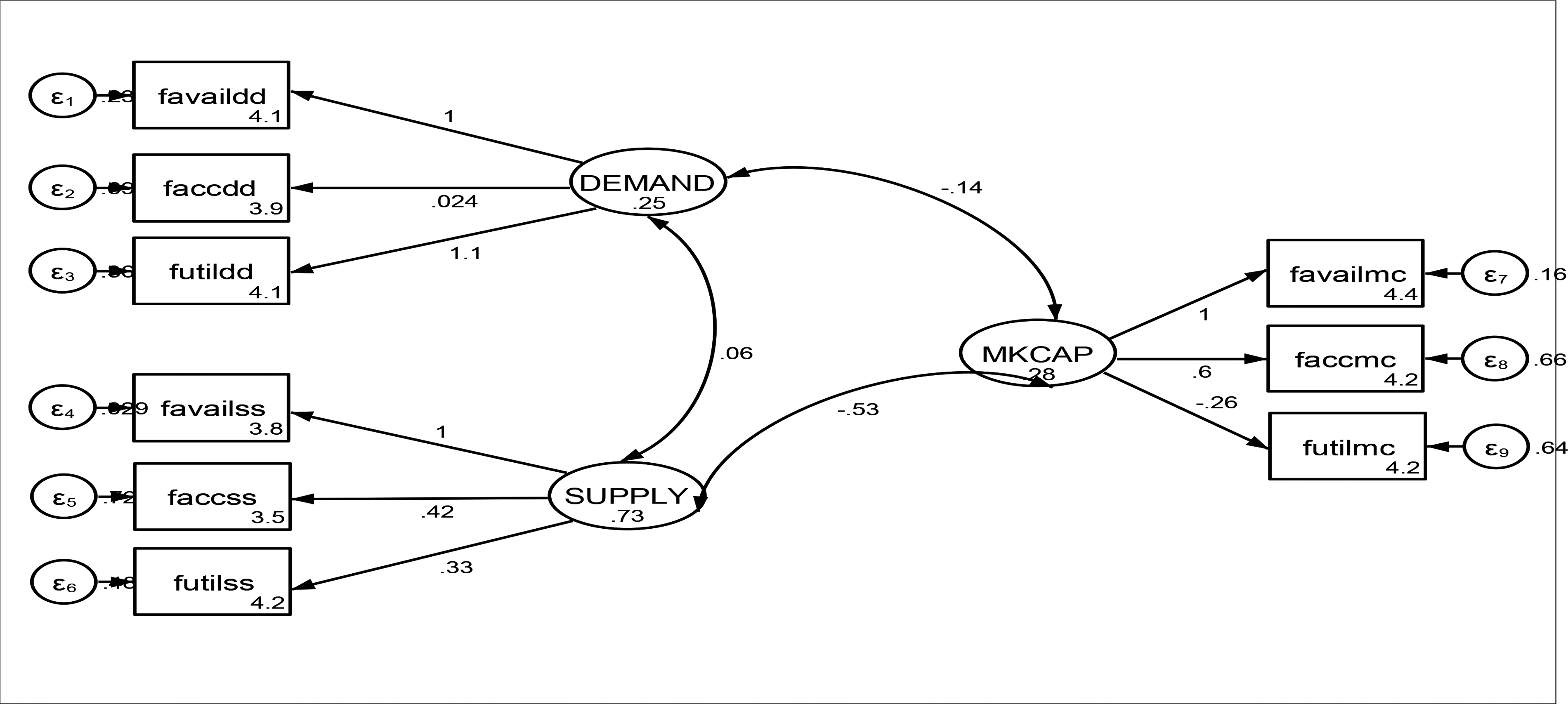
Path Diagram and SEM Estimates. Source: Field Survey Computation.
Regression Results of the Interrelationship Among Demand, Supply, and Marketing Cap.

Note: * indicate that the parameter is significant at 1%, respectively; Marketing cap. = Marketing capability.
Source: Authors’ Computation.
Discussions, Conclusions and Implications
The analysis of marketing capabilities provides understanding of functional tools that are critical and can be leveraged to meet market and customer expectations. If small-scale farmers are to benefit from projections of demand and growth and meet the predicted global food demand for 2050, a marketing system is essential (Beierlein, Schneeberger, and Osburn 2014). This involves understanding of dimensions of marketing capabilities that interact with demand and supply and the direction of the interactions that would enhance food security performance. The outcome of this study highlights the usefulness of marketing capabilities in managing the inherent gaps in demand and supply, particularly as it relates to knowledge gaps, consumer trends, market access and channel management.
This study reveals interesting outcomes about the interrelationship between the paths of demand and supply from the perspective of economics, demand drives supply. However, from this result, the Cov. (FOOD DEMAND and SUPPLY), which highlighted the relationship between the paths of DEMAND and SUPPLY, was not significant. It indicates an inconsistency in the path movement between FOOD DEMAND and SUPPLY. Extant literature shows that connecting demand and supply will enhance growth and welfare. The plausible explanation for our result could be the nature of the product which is a food security crop with high market demand (Oteh et al. 2020). It could also be because of other factors driving demand such as per capita food demand due to rising income. For the Cov (FOOD DEMAND, MKCAP)
The negative sign indicates that a unit increase in one factor may not lead to a corresponding increase in another factor. The plausible explanation for this could be that, the interaction of food demand and dimensions of the marketing capabilities have positive and negative effect, mediating the factors of food availability, access and utilization. This explains the result of the effect of customer insights. Majority of producers in the agricultural market space lack market orientation, as such long-term orientation in relation to market capabilities becomes a key challenge. Finally, Cov (FOOD SUPPLY, MKCAP) statistical findings also revealed that the path relationship between FOOD SUPPLY and Marketing capabilities has a significant (i.e., at 1% level; p = .000) but negative influence on each other. This suggests the existence of no conflict between SUPPLY and MKCAP paths. However, a unit increase in SUPPLY may not have a corresponding influence on MKCAP. This result conforms the a priori expectation.
The aim of marketing capabilities is to cultivate the market capabilities of producers to understand market dynamics and increase their operational capacity to meet market and consumers’ expectations. According to the results of the path movement, there is a significant and causal relationship between the variables that explain the directions and effects of the variables in the category—demand, supply, and marketing capabilities—and the sub-construct of food security. This is demonstrated by their individual estimates and the disturbances in the equation. We are therefore more inclined to say that the impact will be stronger if the entire constructs are approached from a system perspective.
This is not surprising given that in many local markets, the primary aim of many BoP producers is centred on the need to convert their output into cash, using most times aggressive selling techniques. The level of their interaction with customers is limited to immediate financial gains without recourse to building a profitable relationship with customers based on marketing perspectives. The unstable marketplaces in many local communities may be a viable explanation for this outcome. This limits producers’ ability to forge lasting relationships that may assist these marketers in developing profitable partnerships. Due to a lack of understanding of the market's dynamics among many rural producers, better communication technology, like mobile phones and other digital technologies, which are available in rural markets and can improve engagement opportunities, is underutilised.
There are key practical implications from this result. The result aligns with the findings of Banterle et al. (2008) that the size of a firm which in this case is the producer, is not an important variable to conclude a good performance in marketing, as small and medium enterprises achieve significant marketing management capabilities. This highlights the importance of producers adopting market-oriented approach. Hence, producers must integrate three essential marketing concepts in their strategies which include - customer focus, coordinated marketing and profitability (Kotler et al. 2021). These will help them to understand the dynamics of the market and identify plausible economic opportunities and linkages. There is therefore, an unwritten understanding that even small businesses can compete effectively with the right marketing capabilities.
This result lends credence to the fact that marketing capability is a key block in improving the performance of firms in meeting market dynamics. This is because it enables a firm to apply market intelligence and be customer oriented. In addition, the implications of the result calls for a critical consideration of the macroeconomic variables – demand and supply – and their implications on marketing system linkages that improve better food outcome. Specifically, the significance of the result for the demand factor confirms its positive association with availability, accessibility and utilization of biofortified foods.
Positive correlations indicate how the critical factors promote the demand for biofortified foods in such a way that the factors are positively linked to that demand. However, the higher estimate of the association between demand and utilization of biofortified food calls for greater emphasis on the utilization of biofortified foods. The implication is that more varied uses of biofortified cassava foods have the potential to positively increase demand. This provides an understanding on attaining nutritional well-being and improving the knowledge of access and adequacy of biofortified foods. In other words, the positive relationship of the knowledge of demand to food utilization helps deepen the knowledge of the nutritional status of people and food security assessment (Abbade 2017; Osabohien et al. 2022)
The relationship between supply and food availability, accessibility and utilization are positive and significant. The significant correlation buttresses how the critical factors positively influence the supply of biofortified food. As availability, accessibility and utilization increase, the supply of biofortified food is projected to increase. However, the association between food utilization and supply has higher implication given its higher estimate. This supports the theory of supply where the increase in food utilization (in other words increased demand) positively affects increase in the supply of biofortified foods. It emphasizes the importance of food adequacy and acquisition that is devoid of economic or physical barriers. This is significant because food adequacy does not effectively translate to liberation from hunger (Capone et al. 2014). Nevertheless, the result buttresses the consideration of factors that affect supply. It is in this guise that critical components such as the price of biofortified foods, government policies on biofortified foods, transportation and other facilitative conditions and technology need to be considered as they relate to food utilization and supply. This is because these factors have the tendency to influence the affordability and availability of biofortified foods which Carson and Boege (2020) consider to be critical indicators in food accessibility.
The study does not support the covariate of demand and supply. Yet, there is sufficient evidence to suggest that demand and supply are associated with marketing capabilities of biofortified foods. Though the evidence is more of a negative association, with very low estimates, it supports the evidence of limited demand for biofortified crops and supply-related challenges. The demand for biofortified foods is negatively associated with marketing capability. Essentially marketing capability is vital for the success of biofortified producers. This is because of the importance of gaining an understanding and fulfilment of customer needs. The inverse association between the variables suggests that the correlation between demand and marketing capability poses a great gap in the appropriate awareness creation and the in-depth knowledge of the benefits of biofortified foods. This is fundamental because consumer acceptance of biofortified foods is influenced by sensory evaluations and economic indicators.
In addition, marketing capability is a multidimensional construct that includes distribution, pricing, promotion, marketing management, marketing research, and new product development capabilities (Lagat and Frankwich 2017). The implication is that a great deal of investment in knowledge transfer is required while in-depth enlightenment on the benefits is necessary to improve demand. In addition, food-based policies are needed to affect consumption patterns of consumers. This is not dissimilar to the supply of biofortified foods as the result indicates an inverse association between supply and marketing capability. The marketing capabilities which were used in the work include channel management, marketing communication, selling, customer insight, and pricing and information management.
Though the result indicates a better estimate, the negative association provides an insight on important areas of concern. The understanding is that there is need to mitigate supply-side constraints to scale-up production and delivery; training and knowledge transmission to biofortified producers. This supports extant evidence on the need for more extensive research on food utilization, cost-effective strategies, development processes and processing. It also calls for a focus on improving the little gains realized in biofortification. This could be achieved through government policy intervention and investments, increased commitment of the political class to food systems, and synergic approach by all sectors to mainstream biofortification.
This study strengthens the argument for resource-based theory, particularly when considering a firm's market-based resources. Customer insight is an important market-based knowledge resource. In building a profitable connection, relationships, knowledge about customers and trends are important. This is because a firm's success in terms of market value depends on its intangible resources, which are indirectly mediated by dynamic capabilities. These resources include customer knowledge and customer equity that are sustained through understanding of customer trends. The nexus between customer insight and performance is positive (Said et al. 2015) especially when it is complemented by other resources such as the producers’ strength and valuable, rare and imperfectly imitable tangible offerings. This suggests exploiting outside-in-capabilities to match and achieve inside-out-capabilities. In this study, we consider marketing capabilities as a mediatory factor between demand and supply that creates an opportunity to address food insecurity.
This study makes significant contributions to literature in the field of marketing and food systems as prior studies have not considered how BoP producers’ marketing capabilities can help improve food security performance. Therefore, the study advances an argument for resource-based theory, particularly from the perspective of the market-based resources of the firm. Customer insights are an essential market-based knowledge resource. Hence, our study advances conversations around market-based learning theories and customer insights (Said et al. 2015).
Notably, our study reveals that no single factor can generate the right outcome. From the path estimates, all the constructs intervene on food security, implying that the constructs’ individual strengths alone cannot achieve food security. Hence, the need to utilise a systemic approach rather than treating them in isolation. This is very important because achieving food security requires inclusive stakeholder engagements. Anything outside this invalidates efforts at this commitment. Therefore, we recommend a multi-stakeholder arrangement that encourages investments and integrates biofortification into public and private policies and programmes. This involves working on BoP producers to adopt training in key marketing dimensions to improve communication and customer relationship management, and stimulate consumers to adopt and consume biofortified cassava products.
Despite the varied findings from the study, there are limitations. One of the factors to be taken into consideration, prior to wider integration, is the respondents’ short tenure which is mostly not more than 4 years. In this regard, a longer tenure and a more diverse sample is recommended as this could provide deeper insight and offer better understanding to the issues of marketing capability and food security. Following the findings of this study, the authors propose additional research that considers the role that training plays in transferring knowledge to the producers. Certainly, additional research that examines the ways that producers already build their knowledge base may offer deeper understanding of marketing prowess, market orientation, and food security in developing countries. In order to properly reveal the innate characteristics that congregate and hinder producers’ success, subsequent research should include a qualitative description of producers’ behaviour.
Footnotes
Associate Editor
Sussie Morrish
Declaration of Conflicting Interests
The author(s) declared no potential conflicts of interest with respect to the research, authorship, and/or publication of this article.
Funding
The author(s) received no financial support for the research, authorship, and/or publication of this article.

Author Biographies
Dr Osabohien has co-edited two books, notably; i) COIVD-19 in the African Continent: Sustainable Development and Socioeconomic Shocks (2022, Emerald Publishing [ISBN: 978-1801176873); and ii) Socioeconomic Shocks and Africa's Development Agenda: Lessons and Policy Directions in a Post-COVID-19 Era (2023, Routledge/Taylor and Francis Group). He is an author, a reviewer and editorial board member for rated journals such as Elsevier (Heliyon) - Business and Economics. He is well published with about 100 journal articles published in high impact journals