



Abstract
This study examines the mediating role of identification in the relationship between gameplay point-of-view, gender-swapping, and enjoyment of the gaming experience, taking a multidimensional perspective of identification. In a 2 × 2 factorial experiment, we manipulated avatar point-of-view and gamer-avatar gender match and measured the influence on physical similarity, homophily, customization, perspective-taking, wishful identification, and liking. In addition, we tested both how the independent variables influence enjoyment and how each identification dimension may predict enjoyment. Results provided initial support for a multidimensional view of gaming identification. In addition, some of the identification dimensions were found to mediate the relationship between game point-of-view and enjoyment, but the nature of these relationships depended on gender match. Implications for conceptualizations of identification and video game experiences, as well as the theoretical implications for understanding awareness, are discussed.
Since the first mass market game was created, industries have had vested interest in understanding the elements that lead to successful, immersive, and enjoyable video games. As the popularity of gaming has grown over the decades, so too has communications’ scholars interests in these effects, and with good reason. The value of the global video game market was estimated at $73.5 billion in 2015 and is estimated to increase to $89 billion by 2018 (PwC, n.d.). In 2012, the majority of active gamers worldwide lived in the United States, Brazil, Germany, and the United Kingdom (Newzoo, n.d.). In the last decade, female gamers have become a significantly larger share of the market. For example, in France, female gamers grew from being roughly 10% of the market in 1999 to being 49% of the market in 2013 (Statista, 2015). Given the widespread appeal and increasing competition for market share, developers continue to look for new ways to enhance narratives and gamers’ experiences. While transportation into the environment remains an important element, so too are the mechanisms through which players experience these worlds—the avatars.
Cohen (2001) defined identification as the way people experience external events as though they are happening to them. This occurs in a multitude of settings, from children identifying with the hero of a story (Bettleheim, 1976) to teenagers identifying with star athletes. Identification allows people to live vicariously through others (Cohen, 2001).This process of “taking the role of the other” aids individuals in understanding society and their place within it (McDonald & Kim, 2001).
Not only can individuals live vicariously through people they can meet but also those they cannot meet—fictional characters. Viewers see characters on screen, and as they are focused on the characters and story, temporarily lose part of their own self-awareness. This void is then filled by connections made with the character. This is a process that is designed to happen; media creators build characters specifically so that viewers will relate to them (Cohen, 2001). Through identification, narratives can enhance a person’s sense of self by broadening one’s perspective and ability to understand others’ feelings and experiences (Slater & Cohen, 2017). However, in this process, there is still perceived distance between viewer and character; the viewer knows he or she is not the character on screen, even though they may identify with that character. This conceptualization of identification falls under the dyadic view in that there is a clear distinction between the media user and media persona (Klimmt, Hefner, & Vorderer, 2009). The viewer recognizes that there is distance between him or herself and the media persona, and that they are distinct from one another (Downs, 2010).
Video games can create opportunities for similar involvement with avatars varying in psychological intensity, but video game identification is arguably different. Players perceive themselves as nondistinct from the avatars they control (Downs, 2010; Klimmt et al., 2009), so identification in this environment is monadic. Klimmt et al. (2009) argued that this definition arises from the inherent interactivity of gaming. Video game identification is somewhat more automatic than other types; in-game tasks are strongly tied to the main character, making it more difficult to separate the character from the player completing the tasks (Klimmt, Hefner, Vorderer, Roth, & Blake, 2010). Given the monadic nature of video game identification, some researchers argue that video game identification may actually be divided into several dimensions including physical similarity, homophily, wishful identification, customization, and perspective-taking (Downs, 2010). In many ways, identification with avatars could be considered an extension of the self, providing insights into how the selection and creation of avatars and actions performed during game play are expressions of one’s sense of self.
The current study has two primary goals: (a) empirically examine identification as a multidimensional construct and (b) examine the influence playing point-of-view (POV) and playing as opposite-gender avatars (gender-swapping) may have on the dimensions of identification and ultimately the gaming experience.
Literature Review
The Importance of Avatars to the Gaming Environment
In today’s gaming environment, avatars constitute one of the most important elements of gaming design and experiences as they provide the opportunity for one to represent her or himself within the game environment (Lim & Reeves, 2009). Such representation has been argued to improve game immersion (Biocca, 1997; Taylor, 2002) and involvement in the game experience making them more compelling (Lim & Reeves, 2009), while also increasing a player’s self-relevance during play (Lim & Reeves, 2009) and the likelihood that the game interface is more perceived as social (Nass, Steuer, Tauber, & Reeder, 1993). Avatar creation, thus, becomes a psychological investment (Lim & Reeves, 2009) as Poncin and Garnier (2012) argue that one of the main aims in constructing an avatar is to create strong levels of identification so that the player imagines the avatar as a substitute for him or herself.
The avatar, while serving as a surrogate for a player, is also the mechanism through which players can experiment with multiple identities, choosing to represent themselves authentically through physical and personality characteristics, or in an idealized or nonnormative way (Bessière, Seay, & Kiesler, 2007; Dunn & Guadagno, 2010; Jin, 2010; Taylor, 2002). Typically, researchers have focused on physical and personality similarities in their examination of identification with avatars, but one must consider wishful identification, projecting one’s own or wished for values and emotions into the character, and other elements in avatar construction (Poncin & Garnier, 2012; Suh, Kim, & Suh, 2011). In addition, Dunn and Guadagno (2010) argue that gamers may create what they call alter-self avatars—avatars with accentuated attributes (e.g., intelligence) advantageous for game play even if they do not feel they necessarily possess such attributes. Such selections, however, do not diminish the degree of similarity players feel with their avatars. Researchers have found that female players tend to create avatars similar to who they really or are representations of their ideal selves, while male players are more likely to create either improved or fantastical representations (Poncin & Garnier, 2012).
In fact, gender of both player and avatar have been found to be strong influencing factors in the gaming experience, including being key to moderating the relationship between avatar identification and environment immersion (Poncin & Garnier, 2012), influencing perceptions of both the avatar’s user (Lee, 2004), and helping behavior of other players (Lehdonvirta, Nagashima, Lehdonvirta, & Baba, 2012; Waddell & Ivory, 2015). While players are more likely to select same-gender avatars (Nowak & Rauh, 2005), it is becoming increasingly common that players choose avatars of the opposite gender (Hussain & Griffiths, 2008), making the gender of the avatar less salient than it once was in the past. “Gender swapping” is a common practice in multiuser dungeons (Turkle, 1995), massively multiplayer online role-playing games, and other virtual worlds (Griffiths, Davies, & Chappell, 2004). Players may play as opposite-gender avatars for fun, to obtain items or characteristics that are specific to a particular gender in the game, or to experiment with social interactions (Hussain & Griffiths, 2008; Poncin & Garnier, 2012). However, a gender mismatch between player and avatar has been found to affect other players’ interactions and responses. Female users playing as male avatars receive less assistance when requested compared to when they play as female avatars, while male users receive the same amount of assistance regardless of their avatars’ gender (Waddell & Ivory, 2015). Importantly, the impact of gender of the avatar often depends on visual cues of that avatar’s gender, and in some games, these visual cues may or may not be present.
Perspective-Taking and Game POV
Related to avatar selection or creation is the player POV, or vantage point from which the player experiences the game (Lim & Reeves, 2009). The game POV serves as a visual determinant of how players are presented in the environment as well as how the environment is presented to the player, affecting the player’s ability to take on the character’s personality. POV takes the form of either first-person or third-person POV. In the first-person POV, the player does not see a full view of the avatar as she or he navigates the environment. For example, a player might only see the avatar’s hands, legs, or the environment’s response to his or her actions from their vantage point. The action taking place in the game, is therefore centered on the avatar’s body, creating what Vogeley and Fink (2003) refer to as an egocentric frame (p. 38). While an avatar is present in that there is a representation of the player—even if that representation may not be visible—there is no visible character as a separate entity, giving players a greater sense of perceived self-control. In many ways, the player becomes the avatar, highlighting the monadic nature of the player–avatar relationship.
On the other hand, in third-person POV, players can see their entire avatar as she or he is presented on-screen, and the avatar is corporally separate from the player, allowing players to see what is behind and around them. In this POV, the player is more detached from the avatar making it possible to ascribe behaviors and mental states to someone else (Aguirre & D’Esposito, 1999; Klatzky, 1998), and possibly limiting monadic identification, as POV may represent the difference between controlling the avatar and becoming the avatar.
The use of camera POV is a primary storytelling technique that has been used by film and television cinematographers for many years. Different POVs can manipulate and frame the way an audience processes the storyline and empathizes with characters in a dyadic relationship (Zettl, 1990). Because visual POV can visually represent how separate a player is from his or her avatar, it can influence the psychological connections, such as identification, players have with the avatar.
Previous research is inconclusive on the possible effects of POV. POV has been found to moderate the impact of avatar selection on arousal, with selection having a significant impact on gamers’ heart rates when playing from the third-person POV as compared with the first-person POV. Conversely, when not given the opportunity to select an avatar, players experience higher levels of presence in the first-person POV compared with the third-person POV (Lim & Reeves, 2009). Tamborini, Eastin, Skalski, and Lachlan (2004) found that players identify more strongly with aggressive characters when playing with a first-person POV, while Dahlquist, Herbert, Weiss, and Jimeno (2010) found that players exposed to a first-person POV reported higher levels of presence. However, other researchers found that a third-person POV was indicative of higher levels of involvement and identification (Farrar, Krcmar, & Nowak, 2006; Krcmar & Farrar, 2009). Of course, POV may highlight the salience of identification. This is because POV—and video game identification—are related to distance. POV directly influences perceptions of physical distance between player and avatar. A change in POV does not simply change vantage point of the story’s events but also vantage point of the character; this change can minimize the distinction between the individual and the character, just as a monadic conceptualization of identification would suggest. Thus, we propose: Hypothesis 1: Identification levels will vary as a function of the perspective from which the game is played (first-person POV vs. third-person POV).
Identification and the Gaming Experience
As mentioned earlier, the monadic nature of video game identification has led some researchers to argue that video game identification may in fact be divided into several dimensions, namely perspective-taking, physical similarity, homophily, wishful identification, customization, and liking (Downs, 2010). Perspective-taking occurs when an audience member “internalizes what happens to a mediated character and process it as if they were the character” (Downs, 2010, p. 17; Zillmann, 1995). In this situation, a player understands the character’s motivations and actions and feels as though they are inside the character’s head. Donohue (1977) found that this rang true for children, who, when faced with an ethical dilemma, said they would behave similarly to their favorite characters. This indicates that they understood the actions and motivations of the character to the point that they would emulate. Selnow’s (1987) findings seem to lend support to the idea of the importance of perspective-taking in video gameplay, since the interactivity of video games allows players to feel as though they are in the game rather than simply observing. Identification can expand the range of experiences from different points of view, increasing empathy and self-efficacy in dealing with a range of situations, and simultaneously providing insights into the self and emotions (Slater & Cohen, 2017).
Physical similarity between gamer and avatar is another dimension of identification. Audience members tend to identify more closely with media personae when those characters match the viewer in terms of physical appearance (Fox & Bailenson, 2009; Trepte, Reinecke, & Behr, 2010). This suggests that allowing game players to create their own characters would promote identification with those characters (Downs, 2010). Along a similar vein, identification through customization suggests that game players would theoretically identify more closely with customized characters than with premade ones (Downs, 2010). This effect is likely compounded when the character is customized to look very similar to the player, or possess wished for or needed qualities.
Of course, not all similarities are physical. Homophily refers to similarities based on attitudes or backgrounds (Eyal & Rubin, 2003). This form of identification may be particularly at play in gaming situations that involve gender-swapping. A person’s background is vital to the attitudes they possess and therefore to the choices they make (Zhu & Chen, 2012), and if an avatar is homophilous to the player, it may become easier for the player to slip into that character. Considering the monadic nature of video game identification, this form of identification may be especially profound for video gameplay; players may be more likely to identify with characters homophilous to them if they are also controlling that character. The concept of gender-swapping could be especially relevant to this aspect of identification. When gender is matched, it is reasonable to expect that physical similarity would be more salient, as the avatar would look more similar to the player. However, when gender is not consistent with the player’s own, they should rely more strongly on homophily, as similarities that the player may find are more likely to be nonphysical.
Wishful identification, or a viewer’s desire to be like the media persona, is an exceptionally powerful form of identification, as it can influence behaviors even after the media exposure is over (Boon & Lomore, 2001; Murray, 1999). This can take the form of dressing like a character (Murray, 1999) or emulating a celebrity’s lifestyle (Boon & Lomore, 2001). Generally, this form of identification expands the scope of the imagined and possible selves (Slater & Cohen, 2017). Wishful identification can be closely linked with other identification dimensions, such as physical similarity. For example, Lonial and Auken (1986) found that elementary school children tended to wishfully identify more closely with media characters of their own genders. In the context of gameplay, it occurs when a player desires to be like the characters they either control or interact with (Downs, 2010). As mentioned earlier, players often engage with alter selves, selecting or creating avatars that possess characteristics for a persona representing an idealized notion of the self. As players engage themselves with the game, they begin to perceive themselves as possessing attributes they want to have, the attributes that the character already possesses (Klimmt et. al, 2010).
The dimension of liking is distinct from enjoyment. According to Raney (2004), media consumers empathize more strongly with characters they like than characters they dislike. Different people like different characters for different reasons, so two people with similar backgrounds may like very different characters (Raney, 2004), but if the player likes the avatar they control, they are more likely to identify with it. In fact, liking is a necessary component of identification—according to Downs (2010), one cannot identify with a character that they do not like to some degree, and liking can be linked to other subsets of identification, such as perspective-taking. Hence: Hypothesis 2: Identification levels will vary as a function of both the perspective from which the game is played and the presence of gender-swapping. Hypothesis 3: The dimensions of identification will positively predict enjoyment.
Proposed Model
Previous research has found that game mechanics (e.g., avatars, game POV, interactivity, etc.), specifically those that encourage gamers to feel as though they are part of the environment, can have an impact on video game enjoyment (Limperos, Schmierbach, Kegerise, & Dardis, 2011; Skalski & Whitbred, 2010). In the same vein, the monadic relationship between player and avatar, strengthened by a first-person POV, may also influence the gaming experience. One, however, cannot disregard the role of the avatar itself in creating enjoyment. Selection and creation of an avatar, in addition to which perspective a player is immersed within the environment, can also affect the gaming experience. Avatar similarity in terms of gender and POV can interact to create varying identification levels, which in turn may influence enjoyment. However, the research findings are mixed in regard to the effect gender-swapping may have on these relationships. Hence: Research Question 1 (RQ1): What is the relationship among game POV, gender match, the dimensions of identification and enjoyment of the gaming experience? Research Question 2 (RQ2): What are the direct and indirect relationships among game POV, identification and enjoyment, as moderated by gender match between the player and the avatar? Proposed model.
Methods
Participants
A total of 83 participants were recruited from undergraduate courses at a large southern university in the United States. 1 Participants received extra course credit in exchange for participation. To control for prior experience with the stimulus, all participants who reported having played the game before were excluded, resulting in N = 78 (26.9% male, 69.2% female, 3.8% did not disclose). Participant age ranged from 18 to 42 years (M = 20.14, SD = 2.78).
Experimental Design and Materials
The experiment followed a 2 (POV) × 2 (gender match) factorial design. POV was operationalized as whether the player saw through the avatar’s eyes while playing (first person) or over the avatar’s shoulder (third person). Gender match was operationalized as whether the player’s gender matched that of the avatar. Fall Out: New Vegas (NV), an action role-playing game set in a wide-open, postapocalyptic environment, was chosen as the stimulus. NV was chosen due to its unique ability to allow both a switch in perspective and customization of main character, as well as its relatively realistic graphics. Participants played NV on PCs.
The Courier, the avatar and main character which the participants controlled, begins the game on a quest for answers after being shot and left for dead. The game allows for a high degree of customization of the Courier, which allowed for manipulation of the gender-match variable.
Each participant started a new game. For gender match conditions, participants were instructed to customize their avatars to look as much like themselves as possible. For nongender match conditions, participants were told to create avatars similar in appearance to themselves, but of the opposite gender. For first-person conditions, players were allowed to play in the game’s default POV, and participants were instructed to switch POV in third-person conditions. If participants mistakenly switched POV during game play, one of the researchers corrected them.
Measures
Six identification subscales (physical similarity, homophily, wishful identification, identification through customization, perspective-taking, and liking) were adapted from Downs (2010). Physical similarity consisted of three items (e.g., “The Courier is a mirror image of me,” α = .86). Homophily also consisted of three items (e.g., “The Courier has the same attitude toward good and evil as I do,” α = .79). Identification through customization initially contained five items (e.g., “I spent a lot of time creating the Courier”). However, two items were dropped due to low reliability, resulting in a 4-item scale (α = .71). Perspective-taking was composed of four items, (e.g., “While playing the game, I could feel the emotions the Courier portrayed,” α = .83). Wishful identification consisted of two items (e.g., “I’d like to do the kinds of things the Courier does in real life.”). However, these items were not found to be strongly correlated with each other (r = .35, p < .01). Thus, wishful identification was not included in further analyses. Identification through liking consisted of five items (e.g., “I liked the way the Courier responded to other characters,” α = .75).
An enjoyment scale was adapted from Sanders (2004) and Downs (2010), consisting of 12 items (e.g., “I did not want to stop playing at the end of each session,” α = .62). Each scale was measured on a 7-point Likert-type scale, and participants were asked to rate their level of agreement with each item, from “Very much disagree” to “Very much agree.” The questionnaire also asked for demographic information and media usage (e.g., “Thinking about an average week, how many times do you play video games on a personal computer?”).
Procedure
The experiment was divided into three 1-hr sessions that took place approximately one week apart. This allowed participants enough playing time to overcome the potential learning curve connected to playing a new game, while allowing them breaks to prevent fatigue. Upon arrival to the first session, participants were given an implied consent form. They were seated at personal computers and told the backstory of their avatar. Each participant watched a 5-min introductory scene, which explained the background of NV. They were then instructed to customize the Courier’s physical appearance according to their assigned condition and to adjust perspective accordingly. At this point, participants were guided through an in-game tutorial session that instructed them on the basic controls for the game. If players got off-course during this training mission, they were redirected to ensure they finished it. Upon completion of the tutorial, they were then instructed to play freely for the remainder of the session. After they completed the tutorial, the researcher did not offer the participants any assistance unless the players accidentally changed POV or the game glitched in some way; this was done in order to ensure a level gameplay experience across participants and to avoid potential confounds caused by the researcher.
For the second session, participants were instructed to resume their previously saved game. They played freely for the entire 1-hr session. For the third session, participants resumed their games but were given a task list. They were allowed 30 min to complete as much of the list as possible. When time expired, participants completed a paper-pencil questionnaire. After completing the questionnaire, participants were thanked and awarded extra credit points.
Results
Predictors of Game Enjoyment
Interaction Effects Between Gender Match and POV on Identification Dimensions.

Note. For each identification dimension, within rows means without lowercase subscripts in common differ at p < .05. Within columns, means without uppercase subscripts in common differ at p < .05.
p < .06. *p < .05. **p < .01.
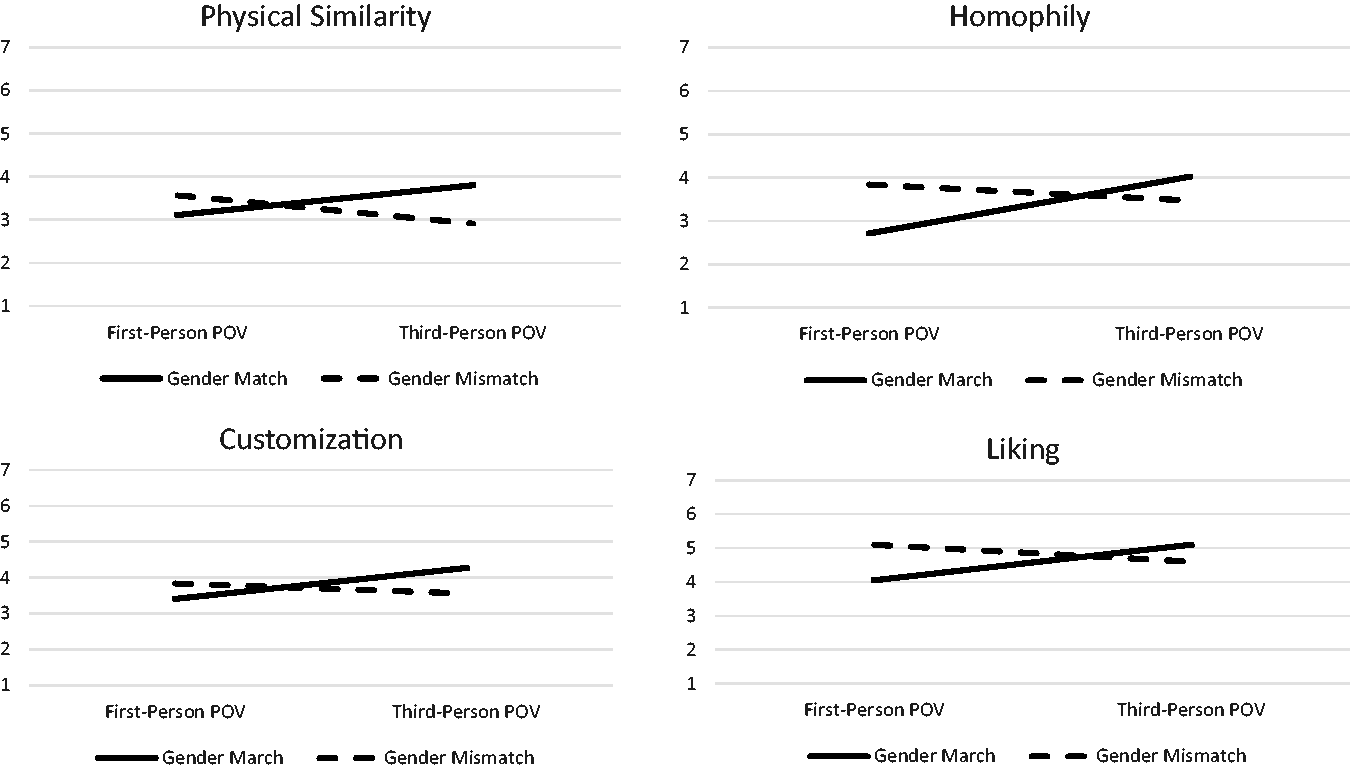
Univariate interaction effects on identification dimensions.
In the first-person POV, there was little difference in perceived physical similarity between those who played as same-gender and opposite-gender avatars. However, the difference in match between player and avatar gender yielded significantly higher perceptions of physical similarity for those who played as a same-gender avatar from the third-person perspective (M = 3.80, SE = .30) compared with those who played as opposite gender (M = 2.91, SE = .28), F(1, 80) = 5.30, p < .05, pη2 = .06.
Concerning homophily, the influence of avatar was moderated by POV, such that in the first-person POV, playing as a different gender resulted in higher feelings of homophily (M = 3.84, SE = .33) than playing as a same-gender avatar (M = 2.71, SE = .33), F(1, 80) = 6.51, p < .05, pη2 = .08. However, perceived homophily was similar in the third-person POV regardless of the avatar’s gender. In addition, those playing as a same-gender avatar had significantly higher levels of homophily when playing from the third-person POV (M = 4.02, SE = .34) compared with playing the game in the first-person mode.
There was also an interaction effect on the customization dimension of identification, driven primarily by POV when the player and avatar gender were consistent, F(1, 80) = 3.81, p = .06, pη2 = .05. When playing as a gender-match avatar, experiencing the game from the third-person perspective yielded higher feelings of customization (M = 4.27, SE = .20) than did experiencing the game from the first-person perspective (M = 3.41, SE = .29).
Finally, gender match moderated the effect game perspective had on liking of the avatar, F(1, 80) = 9.73, p < .01, pη2 = .11. In the first-person POV, a gender mismatch yielded significantly more liking (M = 5.10, SE = .25) than did a gender match (M = .4.05, SE = .25). In addition, for those who played as a same-gender avatar, participants playing in the third-person POV liked the avatar significantly more (M = 5.10, SE = .25) than those playing from the first-person perspective.
Summary of Regression Analysis for Variables Predicting Enjoyment.
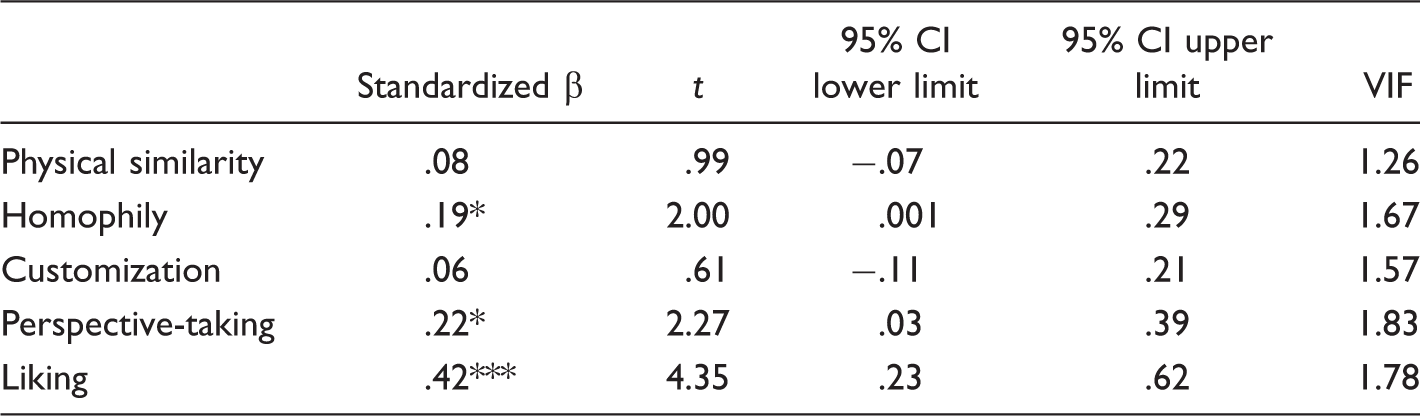
Note. F(5, 78) = 22.64, Adjusted R2 = .57, p < .001.
p < .10. *p < .05. ***p < .001.
VIF= Variance Inflation Factor.
Proposed Model
To examine RQ1, a parallel mediation analysis was conducted using Model 4 of the PROCESS macro (Hayes, 2013). This analysis technique was chosen so as to examine multiple, simultaneously occurring mediators. Customization, physical similarity, homophily, perspective-taking, and liking were modeled as parallel mediators of the relationship between gaming POV and enjoyment.
Game POV was not directly associated with similarity (β = : .00, p > .05, 95% CI: [−.59, .59]), homophily (β = − .45, p > .05, 95% CI: [−1.13, .22]), perspective-taking (β = − .28, p > .05, 95% CI: [−.84, .28]), liking (point estimate: −.24, p > .05, 95% CI: [−.74, .27]), customization (β = − .00, p > .05, 95% CI: [−.44, .44]), or enjoyment (β = .06, p > .05, 95% CI: [−.34, .38]). However, some dimensions of identification were significantly associated with enjoyment. More specifically, homophily (β = .17, p < .05, 95% CI: [.02, .32]), perspective-taking (β = .25, p < .01, 95% CI: [.07, .43]), and liking (β = .40, p < .001, 95% CI: [.21, .60]) were found to influence enjoyment levels, reiterating results of the regression analysis. The analysis did not yield support for a mediation effect, where the dimensions of identification would mediate the relationship between game POV and enjoyment levels. However, given that the overall proposed model treats gender-swapping as a first-stage moderator, it is quite possible that depending on the gender match between player and avatar, game POV’s influence on enjoyment levels could still be mediated by identification, as posed by RQ2. To examine this possibility, a moderated mediation model was analyzed.
Moderated Mediation Model
To assess the moderated mediation model (RQ 2), data were analyzed using Model 8 of the PROCESS macro (Hayes, 2013). In essence, it allowed us to examine whether the previously explored parallel mediation model differed as a result of the interaction between gaming POV and gender match. Again, customization, physical similarity, homophily, perspective-taking, and liking were modeled as parallel mediators of the relationship between gaming POV and enjoyment. Gender match between the player and avatar was entered as a first-stage moderator. Indirect effects were tested with 5,000 bootstrap samples.
2
The results, presented in Figure 3 and Table 3, show that the effect of game POV on enjoyment is mediated by the dimensions homophily, liking, and marginally by perspective-taking for those participants who played the game as an avatar of the same gender. The indirect effect of game POV through homophily was negative for those who played as a same-gender avatar (β = − .22, 95% CI: [−.61, −.03]). The effect was also negative through perspective-taking (β=: −.20, 95% CI: [−.60, −.01]) and liking (β = − .45, 95% CI: [−.86, −.16]). Specifically, playing from the third person POV seems to have increased enjoyment levels indirectly through homophily, perspective-taking, and liking for those who played the game as a same-gender avatar. These same effects were not found when gender did not match. When gender was mismatched, no significant indirect paths were found. Game POV did not have a direct effect on enjoyment, regardless of whether the avatar’s gender matched the player’s gender.
Respecified moderating mediation model. Moderated Mediation Models for Enjoyment and Identification as Functions of Game POV and Avatar Gender Match. Note. POV = point-of-view. Significant effects are in bold. Indirect effects tested with 5,000 bootstrap samples. Unstandardized coefficients, +p < .10. *p < .05. **p < .01. ***p < .001.

Discussion
The present study had multiple purposes to explore the multidimensional nature of identification, to examine the role of POV and gender-match on these subdimensions, and to explore the mediating role of these subdimensions on enjoyment.
Previous research has been split on the effects of perspective on video game identification (Dahlquist et al., 2010; Farrar et al., 2006; Krcmar & Farrar, 2009; Tamborini et al., 2004). The findings of the present study suggest that this may be due to gender match acting as a moderator. POV did indeed have an effect, but that effect depended on whether gender-swapping occurred. The results of the multivariate analysis of variance indicate that there was a significant Perspective × Gender Match interaction, specifically concerning similarity, homophily, and liking, with effects approaching significance for both perspective-taking and customization. Essentially, identification through physical similarity, homophily, liking, perspective-taking, and customization were higher for third-person perspectives only when gender matched. Generally, the opposite pattern was found when gender did not match.
These findings were further supported by the moderated mediation model. When gender was matched, significant indirect paths emerged between POV and enjoyment, specifically through homophily, perspective-taking, and liking. These paths were negative, indicating that homophily, perspective-taking, and liking were all higher when the player was playing in third-person, that is, when they could see their characters. This could indicate the importance of visual cues. Those who were able to see the character they had previously created were constantly reminded of that avatar’s features, which may have reinforced feelings of nonphysical similarities such as the character’s background or motivations, allowing them to more easily see the avatar’s side of events, and overall just like the character more.
Importantly, these paths were only significant when gender matched. Gender-swapping and being overtly aware of physical dissimilarities may have hindered the ability to more fully take on the persona. This could indicate the importance of being able to play as an avatar similar to the player in gender, an issue prevalent in the video game industry today. Selection of avatar gender may cue more attention to other forms of similarity and seemed to warrant various forms of identification, when playing from the third-person perspective, but the effect may not be additive to other physical similarities that make up identification. Each of these subdimensions (i.e., homophily, physical similarity, and liking) contributed to enjoyment, while physical similarity and customization did not.
Theoretical Implications
While in many cases, gender-swapping may not impact the gaming experience, it does play a role, particularly when examining the impact POV may have on enjoyment levels, through various forms of identification. This is evidenced in the differences we found between the parallel mediation model compared with the moderated mediation model.
Importantly, this study has implications for understanding video game identification, enjoyment, and POV. Identification as conceptualized by Downs (2010) was shown here; different dimensions of identification were affected separately, and some to a greater degree than others. This indicates that each dimension of identification may contribute differently to an overall sense of identification between player and character. Enjoyment, while conceptually related to identification, may not be dependent on all dimensions of identification. Finally, POV was found to affect both identification and enjoyment but only when moderated by gender match. As popular as gender-swapping is becoming, its influence on the overall experience works in connection with other game selections like POV. This indicates that game features such as avatar POV and customization of avatar work in tandem to influence identification and enjoyment. Future research is necessary to determine what other, if any, game features may moderate perspective.
In particular, the results of the present study have implications for the study of identification as an imaginative practice. As shown in the moderated mediation analysis, it was those players who incorporated the features of the avatars into their existing personas that most enjoyed the gaming experience. Interestingly, players who felt a sense of homophily with their avatars enjoyed the game to a greater degree. However, players were not given background information about their characters to indicate any nonphysical similarities, indicating that these players must have the sense of homophily from their own thoughts and feelings. Further work could shed additional light on this homophily-building process.
Wishful identification wound up falling away in the final analysis. While this is partially due to measurement artifacts, it may also be the case that wishful identification exists separately from the other subsets of identification. This supports previous theorizing by Klimmt et al. (2009), who suggest that wishful identification is perhaps the truest form of identification. While this study did not find wishful identification to be more evident for gameplay, it does suggest that wishful identification may be held separately.
These findings suggest that these technological features while influencing self-presence, the state in which individuals experience the virtual self as the actual self (Jin, 2011), may not necessarily be associated with the overall assessment of one’s gaming experience. The results concerning overall understanding of connections with avatars as extension of the self imply while similarity and customization are impacted by both POV and gender similarity, this connection did not necessarily extend into enjoyment of the overall gaming experience. It did extend, however, for homophily and liking, particularly for individuals who played as a same-gender avatar from the third-person perspective. Of additional interest, is the idea that gender-swapping can lead to more open, vicarious experiences when there is no visible distance between player and avatar, such as in the first-person POV, but this appreciation and connection does not seem to connect with appreciation of the overall gaming experience. Taken together, the findings suggest that one’s sense of self and consciousness when made more distinct from the avatar in some respects but more similar in others may serve to heighten the subjective experience in mediated environments.
Limitations and Future Directions
When interpreting the results of the present studies, there are limitations to consider. First, the sample size was relatively low, with high participant mortality, due mainly to the time commitment required of participants. As a result, the confirmatory factory analysis (CFA) may have been slightly unstable. However, given previous research using small sample sizes (Mundfrom, Shaw, & Ke, 2005) and the fact that the model supported existing theory, the model was retained. Future research would do well to attempt a larger sample size to verify the results with more stable analysis.
The stimulus selected for this study, Fall Out: New Vegas, was selected primarily for its ability to allow manipulation of both perspective and gender match. In effort to allow enough time for participants to learn how to play, each participant played for 3-, 1-hr sessions. However, given the complex nature of the game, it is possible that participants were not able to fully acclimate to the gameplay system in the given time. This may have masked some of the identification effects, as participants may have been too focused on learning how to play the game to connect to the character. To truly learn to play and become immersed in the story, a great deal of time and effort is likely required. While participants did play for more than 2 hr, it is entirely possible that the game was still too difficult for some. Gaming complexity and difficulty in controlling the avatar’s actions could indeed mitigate a player’s identification with an avatar. The results in the present study suggest that the possible effects of perceived difficulty may be minimal given that across conditions, players did identify with their avatars in a variety of ways. It is possible, however, that difficulty may limit specific forms of identification. Unfortunately, the data collected here did not include a measure of perceived complexity or difficulty; future study utilizing complicated games like NV should incorporate such variables as covariates or moderators to ensure that potential effects are not obscured by the difficulty of the game.
This study found that homophily, perspective-taking, and liking all increased when individuals played with third-person avatars when gender matched their own, highlighting the importance of visual cues to these subdimensions of identification. Given the nature of the stimulus selected, a game in which the avatar exists solely as the player in another guise, it is difficult to say how these results may differ if the first-person avatar had a preexisting, well-defined background, which is the case in many first-person games. Future research should attempt to further explore this potential area. Finally, while customization of avatars was allowed, the degree of customization was limited by the study’s design so it may have hampered examination of customization as a distinct identification mediator.
As gaming environments become more diverse and narratives and technology become more complex, so too must the ways in which scholars conceptualize and understand key concepts related to the gaming experience. It is quite possible that, as more features become customizable, a monadic understanding of identification and its effects may become more applicable in certain gaming environments while dyadic identification may continue to apply in others. Continued exploration into this area may help us to understand transportation into gaming environments and the popularity that this media form has attained.
Footnotes
Declaration of Conflicting Interests
The authors declared no potential conflicts of interest with respect to the research, authorship, and/or publication of this article.
Funding
The authors received no financial support for the research, authorship, and/or publication of this article.