



Abstract
Music that ‘fits’ with the attributes of commercial products should raise the salience of those products over others, and therefore prime their selection. Participants were presented with two advertisements for two competing petrol brands, which featured music that did (not) fit with those brands. Brand preferences were not affected by the advertisements among participants who were regular users of one of the brands. However, participants who were not regular users of either brand demonstrated a preference for the brand advertised with music that ‘fitted’ the brand attributes. This demonstrates that musical ‘fit’ can influence product choice when consumers do not have a clear existing preference for one product over another, but is otherwise of limited commercial value.
Keywords
Most studies of music and consumer behaviour have been geared towards Western culture. Academics in the West have studied many aspects of music, such as tempo and modality effects, as well as variations in tempo, rhythm, harmony, and dynamics. For example, North and Hargreaves’ (2008) review highlighted the many different effects of music in advertising, retail, and leisure settings, and the varied theoretical mechanisms that have been proposed to underlie these effects. Similarly, Garlin and Owen’s (2006, p. 755) meta-analysis showed ‘small-to-moderate, yet quite robust effects’ of background music on dependent variables such as value returns, duration of behaviour, and affective response. There is, unfortunately, hardly any research on how music affects consumers living in Asian cultures, and probably no psychological literature at all on Asians being affected by music from their own culture. The present research explores the use of musical fit in Malaysia.
‘Musical fit’ refers to the tendency for customers to select one product over another on the basis of background music activating superordinate knowledge structures. In essence, music with characteristics that correspond with the central brand messages of a particular product should prime relevant beliefs about the product while consumers are actively considering it. For example, North, Hargreaves, and McKendrick (1999) found that playing stereotypically French (e.g., accordion music) or German (e.g., Bierkeller songs) music by a supermarket display of French and German wines led to greater selection of wines, at a ratio of three bottles to one, from whichever country was represented by the music playing at that time. This was explained as resulting from the national connotations of the music priming selection of wine based on country of origin. Similarly, Areni and Kim (1993) found that customers in a wine cellar spent more when classical music rather than top-40 music was played, arguing that this was because the affluent, wealthy stereotype of classical music primed customers to act consistently and spend money.
Music is a cultural phenomenon, and it would be reasonable to investigate whether any effect of music on behaviour that has been identified in one culture can also be identified in another. Moreover, much of the existing research on musical fit effects is based on participants sharing an understanding that a particular piece of music has certain extra-musical connotations. It is perfectly possible, for instance, that (n)either of the these processes occurs outside the Western samples that have been employed. Among a handful of studies conducted in an Asian setting investigating the effects of musical fit are Yeoh and North (2009) and Yeoh and North (2010a). In the former, the authors investigated the impact of musical fit amongst Malaysian consumers of different ethnic backgrounds on product choice. They found that when ethnically Chinese Malaysian participants were presented with six pairs of products, each containing a Malay or an Indian version of the product in question, with corresponding Malay or Indian music playing simultaneously in the background, product choices corresponded with the ethnicity of the background music played. In a similar vein Yeoh and North (2010a), investigated the impact of musical fit amongst Malaysian consumers of different ethnic backgrounds on food choices. It was found that food choices corresponded with the ethnicity of the background music played, but only when consumers did not have a clear pre-existing preference for one product over another (see also, e.g., Yeoh, 2010; Yeoh & North, 2010b). The present research aims to extend these Malaysian findings by investigating whether using lyrics as the basis of musical fit could affect consumers’ product choices and whether this effect could be extended to utilitarian products, such as petrol.
As hinted at already, research on musical fit that has employed Western samples has yielded encouraging results to date. In essence, almost all the research to date has argued that music should prime related schemas, which, therefore, influence opinions of the product under consideration and its likelihood of selection. For instance, Baker, Grewal, and Parasuraman (1994) and Grewal, Baker, Levy, and Voss (2003) both report that the ‘upmarket’ stereotype of classical music led to it causing perceptions of high-quality service and merchandise. Several studies argue that spending and product selection specifically can result from background music activating related schemas concerning ‘wealth’ and ‘sophistication’. North and Hargreaves (1998) played classical music, pop, easy listening, or no music in a student café. Questionnaire responses indicated that classical music created an upmarket atmosphere, and when customers were asked to state the amount they were prepared to spend on each of 14 items on sale therein, the mean total amounts were UK£17.23, UK£16.61, UK£14.51, and UK£14.30 respectively. North, Shilcock, and Hargreaves (2003; see similar results in Wilson, 2003) similarly found that classical music in a restaurant was associated with higher spending per head (UK£32.52) than either pop music (UK£29.46) or no music (UK£29.73). Kellaris, Cox, and Cox (1993) found that music that ‘fits’ the commercial message in an advertisement can help reinforce commercial messages that are congruent with (as opposed to incongruent) the music. It is interesting though that a similar argument can also be found commonly in the literature on the effects of rap and rock music on young people.
Schwarz’s (2004) review of cues and heuristics in consumer research notes that, ‘Variables that increase processing fluency should increase the perceived truth … of the processed information’ (p. 339). This means that processing of any object is easier if it is consistent with or primes the context in which it is presented, and that ‘A growing body of research demonstrates that any variable that facilitates fluent processing is likely to increase liking’ for the target object (p. 340). This is clearly analogous to musical fit, and implies that it may be possible to conceptualize the latter in terms of research on heuristics and other biases in information processing, leading to several hypotheses concerning those products and circumstances where musical fit effects should manifest to varying degrees. Similarly, several researchers in this field have drawn explicitly on cognitive priming theory (e.g., Berkowitz & Rogers, 1986) in arguing that exposing people to violent or sexist music videos should prime cognitions concerning related violent or sexist acts, such that these acts are subsequently regarded as more acceptable and are more likely to be displayed (e.g., Anderson, Carnagey, & Eubanks, 2003; Hansen, 1989; Hansen & Hansen, 1988, 1990, 1991; Hansen & Krygowski, 1994; Johnson, Jackson, & Gatto, 1995; Ward, Hansbrough, & Walker, 2005). Although carried out independently, the aforementioned research itself mirrors studies within experimental aesthetics carried out during the same period, indicating that a liking for a given piece of music is influenced by the extent to which the music activates related knowledge structures; and several studies have supported various manifestations of this approach, such as Martindale’s preference for the prototypes model (see, e.g., Hekkert & van Wieringen, 1990; Martindale & Moore, 1988; Martindale, Moore, & Borkum, 1990). In short, studies within consumer psychology, media psychology, and experimental aesthetics suggest that music that fits a particular product or commercial behaviour is effectively a type of cognitive prime that activates certain knowledge and therefore raises the salience of selected aspects of consumers’ knowledge of the world. In the same manner, implicit memory, which is a type of memory by which previous experiences aid in the performance of a task without conscious awareness, might lead to similar predictions.
Although representing an apparently consistent set of findings, the existing consumer research on musical fit overlooks one obvious potential caveat. The majority of research on the phenomenon has investigated Western participants in a Western culture. This raises several interesting questions. First, can the findings of North, Hargreaves, and McKendrick (1999), concerning the effects of music on preferences for otherwise similar types of wine, be replicated outside Western culture? Second and more interestingly, would such an effect apply for all consumer decision processes? It seems very likely that it would not. It is noteworthy that North, Hargreaves, and McKendrick (1999) explained at length how they attempted to ensure that one type of wine enjoyed no other advantage over the other that might influence preference for it. For example, the French and German wines considered by the research were similarly priced, of a similar degree of dryness/sweetness, and were even alternated between the left- and right-hand sides of the supermarket display to control for customers being predominantly right-handed. The present research investigates whether a ‘fit’ between advertisements for different brands of petrol and the music that these advertisements contain can influence Malaysians’ petrol preferences, particularly when one of the competing products was preferred by participants prior to the research commencing. As such, the present research represents a much stricter test of the musical fit hypothesis than has hitherto been attempted. Since Garlin and Owen’s (2006) meta-analysis reported that the effects of music in commercial contexts were only small to moderate, we might expect that the impact of musical fit is insufficient to override any effect on customer preferences attributable to one product having a natural advantage over another. Furthermore, with one or two exceptions, previous studies have tended to use musical features (e.g., genre, instrumentation) rather than lyrics per se as a means of influencing product choices. The current study instead investigates whether musical fit via lyrics can produce similar effects: in addition to broadening knowledge of the range of variables from which musical fit effects can emanate, such a finding would be advantageous from a commercial standpoint, since the use of language allows much more detailed messages to be provided to a wider range of consumers. After all, establishing musical fit via music alone means that the only people it can affect are those who share a similar cultural understanding of it (e.g., the notion that accordion music in some way represents France). Using lyrics instead to establish musical fit would allow a much more specific and less ambiguous message to be sent to consumers.
The present study employed advertisements for two petrol brands, namely Caltex and Esso. Two contemporary songs were employed which either did or did not fit the brand in question. Half of the participants were asked to watch two advertisements, one for Caltex with music that fitted the Caltex brand followed by the advertisement for Esso with the same music that fitted the Caltex brand (which means that the music did not fit the Esso brand). The remaining participants were required to watch an advertisement for Caltex with music that fitted the Esso brand followed by an advertisement for Esso with the same music that fitted the Esso brand. Participants were then required to state which of the two petrols they preferred. It was predicted that regular users of Caltex petrol would still choose Caltex petrol whether or not the music used fitted the advertisement; and similarly that regular users of Esso would choose Esso irrespective of the degree of musical fit in the advertisements with which they were presented. It was also predicted, however, that participants who were not regular users of Caltex and Esso petrols would be influenced to choose the brand that was advertised with music that fitted it.
Method
Participants
Ninety people took part in the study. They were divided into three groups of 30, with each group comprising equal numbers of males and females. The first group of participants were recruited via signs requesting ‘regular users of Caltex petrol’, the second group of participants were ‘regular users of Esso petrol’, and the third group of participants were ‘not regular users of either Caltex or Esso petrol’. Participants’ mean age was 24.89 years (SD = 9.54). The participants consisted of students recruited at the University Putra Malaysia library. Testing was conducted individually in a quiet room on campus. The participants were all fluent English speakers.
Materials and design
The first group of 30 participants, who were regular users of Caltex, were then subdivided into two groups of 15, Group1A and Group1B, with the suffix indicating the set of stimuli that participants were presented with. Similarly, the second group, of regular Esso petrol users, and the third group, of neither Caltex nor Esso petrol users, were also subdivided in the same manner, giving rise to Group 2A and 2B and Group 3A and 3B respectively. The research employed a between-subjects design in which participants were shown either Set A (music that fitted the Caltex advertisement and which did not fit the Esso advertisement) or Set B (music that fitted the Esso advertisement and which did not fit the Caltex advertisement). Seven or eight of the participants within each subgroup watched the Caltex advertisement followed by the Esso advertisement, and the other seven or eight of them watched the Esso advertisement followed by the Caltex advertisement. The music was played through a pair of headphones attached to the laptop that also presented the advertisements.
The two advertisements were presented via Microsoft PowerPoint and featured a series of 10 still images, each visible for one second, with accompanying music. The pictures were of at least 100 KB and were downloaded from the Internet. The music used to fit Caltex was ‘Twinkle, Twinkle Little Star’ by Noelle and John and which was a free download from the Web at KidsMusicWeb.com. The music used to fit Esso was taken from the album Eye of the Tiger by Survivor and the track used here was ‘Eye of the Tiger’. The song ‘Twinkle, Twinkle Little Star’ was considered a fit for the Caltex advertisement because the company’s logo, featured prominently in its marketing and the advertisement employed here, is a star symbol. The song ‘Eye of the Tiger’ was chosen to fit the Esso advertisement, since the company’s logo, featured prominently in marketing and the advertisement employed here, is a tiger.
Procedure
Participants were asked to watch the advertisements and then given a five-item questionnaire. Question 1 required them to choose which of the two brands they liked most. Question 2 asked participants whether they drove a vehicle. Question 3 asked those participants who drove a vehicle to rate between 0 and 10 how often they did so, with 0 representing (very rarely) and 10 representing (several times a day). Question 4 asked participants to state whether or not the music playing in the background to the advertisements influenced their choice of petrol brands. Question 5 asked participants to rate between 0 and 10 the extent to which the music playing in the background influenced their choice of petrol, with 0 representing (no influence at all) and 10 representing (very strong influence).
Results and discussion
Three chi-square tests were carried out to determine whether the type of petrol chosen was associated with the type of music played among regular users of Caltex, Esso, and neither respectively. The results were non-significant for participants who were regular users of both Caltex and Esso respectively. Participants who were not regular users of either Caltex or Esso petrol did give rise to significant results (χ²(2, N = 30) = 16.13, p < .001), and Table 1 presents the associated frequencies. Participants in this group had a clear preference for the brand of petrol advertised with music that fitted it.
Music × petrol choice in Groups 3A and 3B

The frequencies and means (including SD values) for questions 2 to 5 for all three groups are shown in Table 2. Perhaps the most noteworthy aspect of these is that participants did not rate music as being a strong influence on them when deciding which petrol to choose. This is understandable of course on the part of participants who already had a clear preference between the two brands at the start of the research (i.e., Groups 1 and 2): the music did not have an influence on them. However, the data in Table 1 indicate that participants without a clear pre-existing preference between the two brands at the start of the experiment (Group 3) clearly were influenced by the music, and their reluctance to note any effect of the music via the data reported in Table 2 was surprising: perhaps they were simply not prepared to admit the impact of advertising upon them. It is perhaps also worth mentioning here that participants in Group 3 rated lowest in terms of how often they drive, when compared to Groups 1 and 2, and this might explain why they were not regular users of either Esso or Caltex petrol.
Mean ratings and SD in responses to the questionnaire for all groups
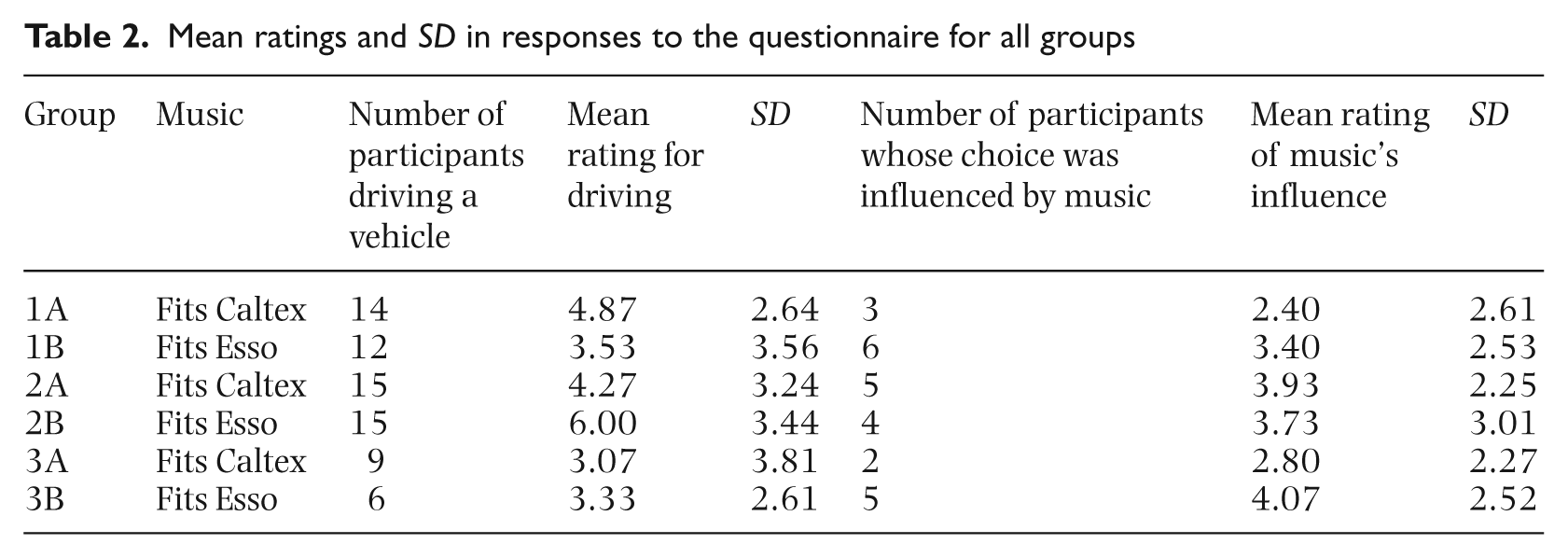
The results of this experiment provide a clear indication that musical fit can influence product choice, and do so outside the West. This experiment showed also, however, that the effect of musical fit is significantly limited when participants are already regular users of one of the competing alternatives. Rather, the effect is apparently limited to those cases where participants have no criteria to select otherwise between the products in question. Regular users of Esso petrol chose Esso petrol regardless of whether the music fitted the advertisement or not, and similarly too with regular users of Caltex petrol. However, non-regular users of both petrols were influenced by music that fitted the advertisement to choose the respective petrols. This is consistent with the recognition heuristic (see Goldstein & Gigerenzer, 2002), which states that a known alternative will be selected over an unknown one. Likewise the results also support a second aspect of the heuristic, namely that when both alternatives are unknown, participants should search for a cue to aid them in decision making: under these circumstances, in the present research, participants chose the brand associated with the music playing in the background.
Participants, on the whole, did not cite the music as a reason for their choices. This might be because they were unaware of the effects of the music or simply unwilling to concede them. This is interesting, since North, Hargreaves, and McKendrick (1999) reported that their supermarket sample seemed similarly either unaware of, or unwilling to concede to, the effects of musical fit on their product choices. We should also note here two other interesting aspects of the results that would have benefited from more data. First, because only nominal data was collected, it is unfortunately difficult to factor driving frequency into any of the statistical analyses. Second, we should also note that there was an uneven number of people in the subgroups tested (i.e., seven or eight respectively), and it would have been better if the numbers in each subgroup had been identical.
The research here is subject to limitations that highlight several potential issues in using musical fit. First, the music used was easily accessible and understood by the participants. As such, the research reported here indicates effects of musical fit only when consumers are familiar with the type of music employed. Further research is needed to determine whether unfamiliar music (or music featuring lyrics in a second, foreign language) is able to prime consumers’ responses to products. Similarly, it remains to be determined whether too great a degree of musical fit could instead lead to consumers’ not choosing the product in question as a consequence of the technique appearing crass.
Second, although music clearly did affect participants’ behaviour in the research reported here, when given the opportunity to do so, most of the participants refused to state, or perhaps even failed to recognize, that music had influenced them. It also remains to be determined whether participants were really unaware of the effects of music on their decision-making. One possibility is that participants did realize that the music influenced their decision, but did not like to admit to this, as it might not have seemed to them a rational explanation for their behaviour. More quantitative work is needed to specify the nature and effect of these factors, and to map out the underlying psychological processes. Questions could be geared, for example, to asking participants whether the music conveyed certain notions, or instead to asking participants simply to describe the general characteristics of the music, as both approaches would indicate the type of thought processes being activated by the music. Note also that different music may bring about different thoughts or recollections, and more research could be conducted concerning the specific associations primed among certain groups of people by certain types of music.
Third, these studies were conducted under strict laboratory conditions and on an individual basis. The results of these studies might not be similar if they were to be repeated under different, more naturalistic conditions. For instance, could the findings be replicated among a group of participants in their own homes watching an advertisement break on TV? Similarly, would any effects obtained be strong enough to last until those people were actually in a commercial setting that required them to select between two competing products? Furthermore, in ‘real’ commercial settings, consumers often have to choose between three or more competing products, rather than the two products with which they were presented in the research here. Would musical ‘fit’ effects be diluted when participants are given more than two options to choose from? Also, would participants’ choices be different if they were told that they would be given the product at the end of the experiment?
Future research might also investigate whether it is possible to adapt arguments made by Hansen and Hansen (1991) concerning cognitive priming by rock and rap music lyrics. These arguments lend themselves to hypotheses that can be made for subsequent research on musical fit effects on consumer behaviour. For instance, greater familiarity with the products in question reduces the processing load associated with weighing up their relative advantages. This in turn would reduce the likelihood of consumers being influenced by cognitive priming in general and musical fit specifically. In short, musical fit effects should be less likely to occur when consumers have previous experience of selecting between the products in question.
In theoretical terms, the research here suggests that heuristics and stereotypes are relevant to a consideration of the impact of music on consumer decision-making. Real-life commercial judgements and decisions made in the presence of background music are guided by simple rules that pick out the simplest strategy applicable when presented with a problem or choice. Of particular relevance to the present research is the so-called recognition heuristic. This states, for example, that when one or more products are similar, then a single discriminating feature will be used to make a decision between them. Use of the ‘right’ music could be such a feature, although others may well play a role also. However, if such an assertion is correct, then future research might investigate whether the factors that experimental work has shown to increase the likelihood of heuristic processing being employed also increase the influence of music fit. For example, if heuristic processing is more likely to be employed under conditions of high arousal or cognitive load, does this mean that there is more opportunity for musical fit effects to occur when a store is crowded or hot, or when people are listening to radio advertisements in the car rather than in their living room?
Since ambiguous information tends to be interpreted as consistent with primed schema, this suggests that perceptions of ambiguous products may be influenced by music that primes certain specific perceptions (see, e.g., North & Hargreaves, 1998). Future research may follow up the findings in this study on why participants did not appear to be aware of the impact of musical fit on their petrol choices. A further possibility is that musical fit operates as, in effect, a form of demand characteristic, under which participants feel compelled to respond in a particular way. Given the previous research, described earlier, indicating that musical fit effects exist in real commercial settings, this is perhaps less troubling than it might seem at first. Indeed, it is far from clear what practical distinction there is between point-of-purchase advertising effects and demand characteristics.
The current study also addresses the numerous ways in which musical fit can be defined. In North, Hargreaves, and McKendrick (1999), people were shown to buy more French wine when stereotypically French music was played in the background illustrating that music was used to prime national stereotypes which then biased buyers’ choices. In the wine cellar example (Areni & Kim, 1993), music primed not a national but a social status stereotype, inferred from the amount of money spent. In this study, the music that had lyrics containing the word tiger/star functioned as a metaphor in assigning a particular meaning to the product. There is a possibility that since the musical excerpts differed in terms of genre, tempo, and emotionality this might have a confounding influence. Perhaps future research could look at the lyrics in more detail by using the same music in both conditions, although such an approach would have implications for external validity.
More generally, semioticians argue that there are three components to the marketing messages contained in packaging or advertising. The object is the focus of the message, such as a particular product or service. The sign is an image or sound used in advertising or packaging that functions as a metaphor in assigning a particular meaning to the product or service. Finally, the interpretant is the meaning that the consumer actually ascribes to the product or service as a consequence of associating it with the sign. For example, a box of chocolates (the object) might be wrapped using a red velvet ribbon (the sign), which leads to perception of the chocolates as being luxurious and upmarket (the interpretant). For example, Caltex petrol(the object) is matched with music containing the word ‘star’ (the sign). As a consequence, participants ascribed the music to the symbol found in Caltex advertisements (the interpretant). What ties together all the differing concepts of musical fit is that the music is a ‘sign’ that leads to an interpretant, which in turn makes the object more attractive. Such an approach would undoubtedlycontribute to a more detailed definition of musical fit that could be tested directly.
In the meantime, there are nonetheless other clear gaps in the literature on musical fit, and these should be investigated by future research. First, there is no direct evidence substantiating the claim that music primes product-related schemas, often demonstrated via enhanced recall and recognition. Second, if schemas and cognitive shortcuts underlie musical fit, the effect should vary depending on the nature of the products in question; interest in and familiarity with them; and concurrent cognitive load. It is possible to explain almost any finding in terms of the highly complex theories that have been produced concerning elaboration likelihood, involvement, and fit. For example, resource-matching explanations suggest that the presence of music in an advertisement may reduce recall because it detracts from the cognitive resources available for advertisement processing, whereas research on musical fit suggests that the presence of music may enhance recall, provided it is congruous with expectations. Furthermore, Heckler and Childers (1992; see also Houston, Childers, & Heckler, 1987) argue that incongruity between different elements of an advertisement may improve recall by encouraging deeper processing, such that incongruous music may be optimal in facilitating recall of advertising. As such, any finding can be presented as ‘consistent with previous research’. This is so problematic here because there are indeed numerous instances of studies yielding data inconsistent with the predictions of the approaches outlined above. For example, Morris and Boone (1998) found few differences in brand attitudes and purchase intent when participants were shown advertisements with either no music or music that fitted the product playing in the background; and Brooker and Wheatley (1994) found that differing musical tempi (with the different processing resources they require) had no effect on unaided recall of radio advertisements. Such inconsistencies in research findings are no doubt due to the very complex stimuli and cognitive processes involved in advertising research. Future studies should investigate non-linear relationships between variables, and over the short term at least, adopt very reductionist experimental methods that sacrifice ecological validity for the sake of greater insight into the conditions under which certain theories do and do not operate. In conclusion, musical fit has the potential to influence consumer decision-making, although the present research highlights one possible limitation on the generality of this, and further research is undoubtedly necessary before practitioners can reliably employ the effect in real commercial settings.
Footnotes
Author biographies
Joanne P. S. Yeoh is Lecturer in Music at Universiti Putra Malaysia. She recently obtained her Doctorate in psychology from Heriot Watt University in Edinburgh. Her research concerns the impact of music in commercial contexts, and she is also a keen musician.
Address: Universiti Putra Malaysia, Music Department, 43400 UPM, Selangor 47500, Malaysia. [email:
Adrian C. North is Professor and Director of Psychology at Heriot Watt University. His research concerns the social and applied psychology of music. His 2008 The Social and Applied Psychology of Music (with David Hargreaves) is published by Oxford University Press.
Address: Heriot Watt University, Edinburgh EH14 4AS, United Kingdom. [email: